CAN 2025 de football : quand l’image du sport influence le business et l’économie

Source: The Conversation – in French – By Fabrice Lollia, Docteur en sciences de l’information et de la communication, chercheur associé laboratoire DICEN Ile de France, Université Gustave Eiffel

À l’occasion de la Coupe d’Afrique des Nations (CAN) 2025, l’attention se concentre naturellement sur les équipes et les performances sportives. Pourtant, au-delà du football, cet évènement continental joue un rôle tout aussi influent : il contribue à la construction de l’image économique des pays africains en projetant des signaux de confiance, de capacité organisationnelle et de crédibilité institutionnelle. Or cette dimension est rarement analysée pour elle-même.

Le sport est souvent pensé comme levier d’émotion ou de cohésion sociale, plus rarement comme un producteur d’images économiques susceptible d’influencer les perceptions des investisseurs, des partenaires internationaux et des acteurs business. La CAN offre ainsi un terrain privilégié pour interroger ce lien.

Je travaille sur la manière dont les images, la confiance sociale et les dispositifs symboliques influencent les dynamiques économiques, politiques et organisationnelles. J’analyse comment cette grande compétition sportive africaine participe au façonnage de représentations économiques qui dépasse largement le cadre du sport.

Un dispositif de visibilité pour tous

Les grandes compétitions sportives concentrent plusieurs dynamiques puissantes : une visibilité médiatique mondiale, une forte intensité émotionnelle et des récits de réussite ou de fragilité à forte portée symbolique. Ces « méga événements » sont analysés en sciences de l’information et de la communication comme des dispositifs de visibilité capables de structurer durablement des représentations collectives.


Read more:
Le Maroc à la Coupe du monde: les 6 raisons d’une victoire historique


Dans ce cadre, le sport agit comme une fabrique d’images. Il donne à voir, sur un temps court, des éléments rarement observables ailleurs comme la capacité d’un pays à organiser, sécuriser, coordonner et accueillir un évènement d’ampleur mondiale. Ces images ne relèvent pas du simple spectacle. Elles nourrissent une véritable économie de la confiance au sens où elles participent à forger des croyances partagées de fiabilité, de stabilité et de compétence des institutions – des croyances centrales pour l’attractivité économique et politique d’un pays.

Organiser une CAN mobilise des infrastructures lourdes, des chaînes logistiques complexes, des dispositifs de sécurité et une gouvernance multi-acteurs. Lorsqu’un tel événement se déroule sans incident majeur, il projette un message implicite, notamment celui d’un État capable de gérer des projets complexes dans des délais contraints. Ces signaux jouent un rôle dans l’évaluation informelle du risque par les acteurs économiques.

Au-delà de l’organisation, l’impact le plus difficile à mesurer est psychologique. Les grandes compétitions renforcent temporairement la fierté nationale, atténuent certaines fragmentations sociales et nourrissent le sentiment que des projets ambitieux sont possibles. Or la confiance collective influence des comportements économiques concrets tels que l’initiative entrepreneuriale, la propension à investir, la consommation ou perceptions du risque.

Une CAN réussie ne transforme pas une économie, mais elle modifie le climat cognitif et émotionnel dans lequel elle évolue. À l’inverse, des dysfonctionnements visibles — retards, problèmes de sécurité, désorganisation — peuvent fragiliser l’image projetée et alimenter des perceptions d’instabilité. Il ne s’agit pas d’un lien automatique entre sport et investissement, mais d’un effet de résonance. Le sport amplifie des signaux préexistants et les rend visibles à grande échelle.


Read more:
CAN de football : comment l’économie du pays organisateur peut en profiter


Le rôle amplificateur du numérique et des réseaux sociaux

L’impact de la CAN sur l’image économique des pays africains ne se construit plus uniquement dans les stades ni à travers les médias traditionnels. Il se joue désormais largement sur les plateformes numériques et les réseaux sociaux, où images, récits et émotions circulent en continu, surpassant les audiences TV chez les jeunes générations. Les analyses de la Coupe du monde 2022 et des JO 2024 confirment que les réseaux sociaux surpassent les audiences TV traditionnelles, avec 70 % des 18-34 ans consommant le sport principalement via plateformes numériques.

Les algorithmes des réseaux sociaux privilégient les contenus les plus visibles et émotionnels. Les hashtags événementiels (#CAN2025) génèrent des milliards d’interactions qui façonnent l’image du pays en temps réel auprès des diasporas et investisseurs.

Ils amplifient aussi bien les signaux positifs — ferveur populaire, organisation maîtrisée, infrastructures modernes — que les signaux négatifs — incidents, retards, controverses.

Lors de la Coupe du monde 2022, le Maroc a bénéficié de cette dynamique numérique. Sa visibilité dans les médias influents a augmenté de 277 % pendant la Coupe du monde et de 23 % après la Coupe du monde, renforçant une image internationale de pays structuré et crédible, bien au-delà du seul terrain sportif.

De la même manière, la victoire du Sénégal à la CAN 2021 a été amplifiée sur les réseaux sociaux, consolidant une perception de cohésion nationale et de stabilité, largement reprise par les médias internationaux.

La CAN fonctionne ainsi comme un événement à forte intensité réputationnelle. L’image des pays hôtes se construit en temps réel à partir des contenus produits par les institutions, les médias, les supporters et les marques. Ces perceptions numériques influencent des décisions économiques concrètes : stratégies de sponsoring, choix de partenariats, attractivité touristique, implantation de marques ou évaluation informelle du risque pays. La réputation devient un actif immatériel central.

Le numérique agit donc comme un accélérateur. Il renforce rapidement la confiance lorsque l’organisation est perçue comme maîtrisée, mais peut tout aussi vite amplifier la défiance en cas de problème. L’image sportive devient plus réactive mais aussi… plus fragile. Lors de la CAN 2023, la diffusion massive d’une organisation globalement maîtrisée a contribué à renforcer la confiance autour du pays hôte. À l’inverse, la circulation virale, sur les réseaux sociaux, de rumeurs ou d’incidents ciblés a montré comment le numérique peut, en quelques heures, fragiliser ce récit.

Au-delà de la possibilité d’attirer directement des investisseurs, les
travaux montrent que ces signaux contribuent à projeter une capacité organisationnelle et un climat de sérieux, particulièrement importants pour des pays en voie de développement, où la confiance et la crédibilité perçues constituent des leviers essentiels de l’attractivité économique.

Diplomatie sportive et influence économique

Le sport joue également un rôle croissant dans la diplomatie économique. Une CAN réussie renforce la visibilité internationale d’un pays et contribue à repositionner son image dans l’imaginaire global. En communication stratégique, ce phénomène relève du soft power : une forme d’influence indirecte fondée sur l’attractivité, la crédibilité et la capacité à susciter l’adhésion, plutôt que sur la contrainte.


Read more:
Mondial de football 2022: quelles retombées diplomatiques pour le Maroc?


Cette diplomatie par le sport ne remplace pas les instruments classiques de la politique économique, mais elle peut en renforcer l’efficacité. En améliorant l’image d’un pays, elle crée un climat plus favorable aux échanges, aux partenariats et aux investissements, en réduisant les perceptions de risque et en renforçant la confiance.

Il convient toutefois de rester prudent. L’image sportive ne saurait se substituer aux fondamentaux économiques : gouvernance, réformes structurelles, stabilité institutionnelle et investissement productif. Sans stratégie de transformation, une réussite sportive reste un moment émotionnel sans effet durable.

Les recherches récentes montrent que même si les grands événements sportifs stimulent souvent l’activité économique immédiatement autour de l’événement, ces effets tendent à s’estomper en l’absence de stratégies spécifiques pour prolonger leur impact.

La CAN 2025 illustre le rôle souvent invisible du sport dans les dynamiques économiques africaines. À l’image du sportif de haut niveau, l’événement sportif est encore trop souvent perçu à travers le prisme de l’instantanéité, réduit à une émotion collective éphémère. Pourtant, en produisant des images, des récits et des signaux de confiance, la CAN participe à la construction d’une crédibilité qui influence, de manière directe et indirecte, le monde du business.

Le sport apparaît ainsi comme un acteur symbolique de l’économie. Son impact ne tient pas tant à l’événement lui-même qu’à la capacité des États à penser cette ressource immatérielle, à l’intégrer dans une stratégie cohérente et à la prolonger par des politiques publiques capables de transformer l’émotion en confiance durable et en opportunités économiques structurées.

The Conversation

Fabrice Lollia does not work for, consult, own shares in or receive funding from any company or organisation that would benefit from this article, and has disclosed no relevant affiliations beyond their academic appointment.

ref. CAN 2025 de football : quand l’image du sport influence le business et l’économie – https://theconversation.com/can-2025-de-football-quand-limage-du-sport-influence-le-business-et-leconomie-273279


Evidence for link between digital technology use and teenage mental health problems is weak, our large study suggests

Source: The Conversation – UK – By Qiqi Cheng, Quantitative Research Associate, School of Environment, Education and Development, University of Manchester

PeopleImages/Shutterstock

For years, the narrative surrounding teenagers’ use of digital technology has been one of alarm.

Time spent scrolling through TikTok or playing video games is widely seen to be driving the current crisis in youth mental health, fuelling rising rates of anxiety and depression.

But our recent study suggests that this simple story of cause and effect is not supported by the evidence.

After following more than 25,000 young people in Greater Manchester over three school years, we found little evidence that self-reported time spent on social media or frequent gaming causes mental health problems in early-to-mid adolescence. Instead, the relationship between digital technology use and teenagers’ wellbeing is far more nuanced than simple cause and effect.

While many previous studies have looked at a single snapshot in time, we used a longitudinal approach: observing the same young people over an extended period of time. We did this through the #BeeWell programme, which surveys young people annually. We tracked the same pupils across three annual waves, from year eight (when they were aged 12-13) to year nine (aged 13-14) to year ten (aged 14-15).

Another crucial point is that our analysis separated “between-person” effects from “within-person” effects. In other words, rather than just comparing the mental health of heavy users of social media or gaming to that of light users, we looked at whether a specific teenager’s mental health worsened after they started spending more time on social media (or gaming) than they usually did.

Child alone on swing with phone
It’s easy to assume that social media causes low mood.
caseyjadew/Shutterstock

When we applied this rigorous method, the supposed link between digital technology use and later “internalising symptoms” – worry, low mood – largely vanished. For both boys and girls, an increase in time on social media or gaming frequency did not predict a later rise in symptoms.

How teens use social media

A common theory is that how we use social media matters more than how long we spend on it. Some argue that “active” use, like posting photos and chatting, is better than “passive” use, such as endless scrolling.

However, our sensitivity analyses found that even when we distinguished between these two types of online behaviour, the results remained the same. Neither active nor passive social media use was a significant driver of later mental health problems in our sample.

While we found no evidence of digital technology use causing later mental health issues, we did find some interesting differences in how boys and girls navigate their digital lives over time.

Girls who spent more time gaming in one year tended to spend less time on social media the following year. This suggests that for girls, gaming and social media may compete for the same limited free time.

Boys who reported higher levels of internalising symptoms (like low mood) in one year went on to reduce their gaming frequency the next. This suggests boys may lose interest in hobbies they previously enjoyed when their mental health declines. This is known as “anhedonia”.

The gap between headlines and research

If the evidence is so weak, why is the concern so strong? Part of the issue is a reliance on simple correlations. If you find that anxious or depressed teens use more social media, it is easy to assume the social media caused their difficulties.

But it is just as likely that the mental health problems came first, or that a third factor, such as school stress or family difficulties, is driving both. By using a large, diverse sample and controlling for factors like socio-economic background and special educational needs, our study provides a clearer view of the real-world impact (or lack thereof) of teenagers’ digital technology use.

Our findings do not mean that the digital world is without risks. Our study looked at year-on year trends, so it does not rule out the possibility of negative effects of social media or gaming in the shorter-term – such as immediately after use. Furthermore, issues like cyberbullying, sleep disruption or exposure to harmful content remain serious concerns.

However, our findings suggest that limiting the hours spent on consoles and apps or measures such as banning social media for under 16s is unlikely to have an effect on teenagers’ mental health in the long term. Policymakers should take note. Worse, such blanket bans may obscure the real risk factors by offering a simple solution to a complex problem.

Instead, it’s important to look at the broader context of a young person’s life, including the factors that may lead to both increased digital technology use and internalising symptoms. If a teenager is struggling, technology use is rarely the sole culprit. By moving away from the predominant “digital harm” narrative, we can focus on the real, complex factors that drive adolescent wellbeing.

The Conversation

Neil Humphrey receives funding from various bodies including The National Lottery Community Fund to conduct research on young people’s wellbeing

Qiqi Cheng does not work for, consult, own shares in or receive funding from any company or organisation that would benefit from this article, and has disclosed no relevant affiliations beyond their academic appointment.

ref. Evidence for link between digital technology use and teenage mental health problems is weak, our large study suggests – https://theconversation.com/evidence-for-link-between-digital-technology-use-and-teenage-mental-health-problems-is-weak-our-large-study-suggests-273386

Why the world’s central bankers had to speak up against Trump’s attacks on the Fed

Source: The Conversation – Global Perspectives – By John Hawkins, Head, Canberra School of Government, University of Canberra

Central bankers from around the world have issued a joint statement of support for US Federal Reserve Chair Jerome Powell, as he faces a criminal probe on top of mounting pressure from US President Donald Trump to resign early.

It is very unusual for the world’s central bank governors to issue such a statement. But these are very unusual times.

The reason so many senior central bankers – from Australia, Brazil, Canada, Europe, New Zealand, South Africa, South Korea, the United Kingdom and other countries, as well as the central banks’ club the Bank for International Settlements – have spoken up is simple. US interest rate decisions have an impact around the world. They don’t want a dangerous precedent set.

Over the course of my career as an economist, much of it at the Reserve Bank of Australia and the Bank for International Settlements, I have seen independent central banks become the global norm in recent decades.

Allowing central banks to set interest rates to achieve inflation targets has avoided a repeat of the sustained high inflation which broke out in the 1970s.

Returning the setting of monetary policy to a politician, especially one as unpredictable as Trump, is an unwelcome prospect.

What’s happened

Trump has repeatedly attacked the US Federal Reserve (known as the Fed) over many years. He has expressed his desire to remove Powell before his term as chair runs out in May. But legislation says the president can only fire the Fed chair “for cause”, not on a whim. This is generally taken to mean some illegal act.

The Supreme Court is currently hearing a case about whether the president has the power to remove another Fed board member, Lisa Cook.

And this week, Powell revealed he had been served with a subpoena by the US Department of Justice, threatening a criminal indictment relating to his testimony to the Senate banking committee about the US$2.5 billion renovations to the Fed’s historic office buildings.

Trump has denied any involvement in the investigation.

But Powell released a strong statement in defence of himself. He said the reference to the building works was a “pretext” and that the real issue was:

whether the Fed will be able to continue to set interest rates based on evidence and economic conditions – or whether monetary policy will be directed by political pressure or intimidation.

US Federal Reserve Chair Jerome Powell’s statement addressing the investigation.

On Tuesday, more than a dozen of the world’s leading central bankers put out a statement of support:

We stand in full solidarity with the Federal Reserve System and its Chair Jerome H Powell. The independence of central banks is a cornerstone of price, financial and economic stability in the interest of the citizens that we serve. It is therefore critical to preserve that independence, with full respect for the rule of law and democratic accountability.

Another statement of support came from leading US economists – including all the living past chairs of the Fed. This included the legendary central bank “maestro” Alan Greenspan, appointed by Ronald Reagan and reappointed by George HW Bush, Bill Clinton and George W Bush.

This statement warned undermining the independence of the Fed could have “highly negative consequences” for inflation and the functioning of the economy.

Why it matters for global inflation

Trump has said he wants the Fed to lower interest rates dramatically, from the current target range of 3.5–3.75% down to 1%. Most economists think this would lead to a large increase in inflation.

At 2.8% in the US, inflation is already above the Fed’s 2% target. The Fed’s interest rate would normally only drop to 1% during a serious recession.

A clear example of the dangers of politicised central banks was when the Fed lowered interest rates before the 1972 presidential election. Many commentators attribute this to pressure from then president Richard Nixon to improve his chances of re-election. This easing of monetary policy contributed to the high inflation of the mid-1970s.

A more recent example comes from Turkey. In the early 2020s, President Recep Tayyip Erdoğan leaned on the country’s central bank to cut interest rates. The result was very high inflation, eventually followed by very high interest rates to try to get inflation back under control.

Trump should be careful what he wishes for

What will happen if Trump is able to appoint a compliant Fed chair, and other board members, and if they actually lower the short-term interest rates they control to 1%? Expected inflation and then actual inflation would rise.

This would lead to higher long-term interest rates.

If Trump gets his way, US voters may face a greater affordability problem in the run-up to the mid-term elections in November. This could then be followed by a recession, as interest rates need to rise markedly to get inflation back down.

And as over a dozen global central bank leaders have just warned us, what happens in the US matters worldwide.

The Conversation

John Hawkins was formerly a senior economist at the Reserve Bank of Australia and the Bank for International Settlements.

ref. Why the world’s central bankers had to speak up against Trump’s attacks on the Fed – https://theconversation.com/why-the-worlds-central-bankers-had-to-speak-up-against-trumps-attacks-on-the-fed-273450

Why Iran can’t afford to shut down the internet forever – even if the world doesn’t act

Source: The Conversation – Global Perspectives – By Dara Conduit, ARC DECRA Fellow, The University of Melbourne

As citizens around the world prepared to welcome the new year, Iranians began taking to the streets to protest their country’s deepening economic crisis. Spurred by the continued devaluation of the Iranian currency against the US dollar, as well as crippling inflation, the unrest is the latest in years of economic pain and protest.

The Iranian regime initially acknowledged the legitimacy of the protesters’ concerns, distributing hopelessly inadequate cash vouchers worth only US$7 to help with the cost of living.

But it’s since taken a much heavier hand. According to the regime’s own figures, as of today, at least 2,000 people have been killed. Protesters bravely continue to take to the streets.

Like clockwork last Thursday, the regime rolled out one of its most potent tools of population control: internet shutdowns. In the six days since, Iranians have been almost entirely cut off from the internet, with alternative means of access, such as smuggled Starlink terminals, proving unreliable because of satellite jamming.

As the world waits to see if US President Donald Trump follows through on his threats of “very strong action” if Iran hangs protesters, the truth is that even without international action, the regime can’t afford to keep Iran’s internet offline indefinitely.


Read more:
The use of military force in Iran could backfire for Washington


Why the regime blocks the internet

The Iranian regime has used internet shutdowns since the Green Movement protests following the disputed 2009 presidential election. They’re a powerful tool that stops citizens from communicating with the outside world and each another.

This limits opposition organising, because people can’t join protests if they don’t know where they are. It also isolates individuals, preventing them from seeing violent crackdowns outside their neighbourhood. Internet shutdowns also obscure the international gaze, allowing the regime to crack down on protesters in the dark.

Shutdowns have become so synonymous with political unrest that the non-government digital rights organisation Article 19 declared in 2020 “protests beget Internet shutdowns in Iran”.

Internet shutdowns are costly

But it would be a mistake to think the Iranian regime has an endless capacity to shut down the internet. Each shutdown comes at a high economic and political cost.

As well as blocking instant messengers and social media sites, internet shutdowns in Iran have often blocked work applications such as Slack, Skype, Google Meet and Jira. These are central to ordinary businesses’ operations.

Similarly, the regime’s efforts to block virtual private networks (VPNs) and secure HTTPS connections can wreak havoc on corporate payment systems, multi-factor authentication and even corporate email.

Global internet monitor Netblocks estimates internet shutdowns cost the Iranian economy more than US$37 million a day. That’s more than US$224 million in the past six days alone.

As I wrote in a recent journal article, we’ve already seen how bad the economic impacts of internet shutdowns can be in Iran.

During the 2022-23 protests following the death-in-custody of the Kurdish-Iranian woman Mahsa “Jina” Amini, internet shutdowns had far-reaching implications.

One source claimed the volume of online payments inside Iran halved in the first two weeks of the protests alone.

Iran has a vibrant e-commerce sector. An estimated 83% of its online businesses use social media platforms such as Instagram, WhatsApp and Telegram to generate sales. All three were blocked during the 2022-23 unrest. A report later found Instagram blocking and periodic internet disruptions in the 17 months after the protests cost the Iranian economy US$1.6 billion.

The regime has been working hard for decades to build a domestic internet that could alleviate some of this damage, but so far it has failed.

The regime’s enormous technology needs – for surveillance, but also to power a modern economy for around 92 million people – has led to the emergence of a large semi-private information and communications (ICT) sector in Iran. This includes internet service providers, cell network operators and a large IT sector.

Just six weeks into the 2022 protests, the cellphone operator RighTel’s chief executive penned an open letter to the ICT minister, Issa Zarepour, complaining the digital crackdown was crippling his business. He noted RighTel had upheld the regime’s “security priorities and requirements” during the shutdowns, and demanded compensation or RighTel may be forced to withdraw from the market.

These demands were echoed in letters privately written (but later leaked) by other communications providers.

These were not natural regime critics. Indeed, internet shutdowns were creating a dangerous dynamic in which even those close to the regime were being alienated, generating a new class of potential protesters who could one day join those marching in the streets.

Why the current shutdown can’t last forever

This is why the current internet shutdown is a risky strategy. While the regime is succeeding in concealing the worst of its bloody crackdown, it risks further provoking the country’s already struggling economic class.

In 2022-23, the shutdowns were implemented in a targeted manner, taking place for the most part in certain cities, or at specific times of day when protests were expected. In contrast, the current shutdown is countrywide.

Only 1% of internet connections in Iran are online today (which is how the supreme leader is still able to freely use X to spout propaganda). This means the economic and political impacts of this current shutdown, if it continues, could easily dwarf those of 2022-23.

Given Iran’s economic woes are the driving force of the current unrest, a sustained internet blackout could motivate more people to take to the streets. The regime is only too aware of this risk.

The Conversation

Dara Conduit receives funding from the Australian Research Council.

ref. Why Iran can’t afford to shut down the internet forever – even if the world doesn’t act – https://theconversation.com/why-iran-cant-afford-to-shut-down-the-internet-forever-even-if-the-world-doesnt-act-273454

El laberinto de la soledad: anatomía de una crisis de salud pública

Source: The Conversation – (in Spanish) – By Jose Juan Rivero Pérez, Profesor universitario: Intervención psicología de la salud, habilidades del terapeuta en psicología de la salud, experto en psicología positiva, Universidad Europea

David Michael Bellis/Shutterstock

La soledad no deseada es una de las crisis existenciales y de salud pública más relevantes. Y lo es en una época definida por la hiperconectividad digital y el individualismo. Esta paradoja, propia de la sociedad moderna, trasciende toda frontera y barrera generacional. Sus ramificaciones impactan en el bienestar y la salud mental de la población. ¿Cuál es la naturaleza psicológica de este fenómeno multifactorial? ¿Qué papel juegan las redes sociales? ¿Qué consecuencias supone la desconexión sobre nuestra vida?

En primer lugar es fundamental distinguir entre dos conceptos: el aislamiento social y la soledad no deseada. Ambos a menudo se confunden, pero no son lo mismo.

El aislamiento social implica la ausencia de contacto social y es una condición objetiva que podemos cuantificar. Por ejemplo: falta de amigos, vivir solo, tener pocas interacciones fuera del entorno virtual.

Por contraste, la soledad no deseada es una experiencia intrínseca, subjetiva y de carácter emocional. Se trata de una carga negativa que genera malestar y sufrimiento. Surge cuando las relaciones sociales que poseemos son diferentes, en calidad y cantidad, de las que anhelamos. En España, el 20 % de las personas se encuentra en esta situación, aunque casi la mitad dice haberla vivido alguna vez en la vida.

La soledad es una sensación visceral de desconexión emocional o ausencia de apoyos significativos. Puede experimentarse incluso estando rodeado de personas, porque el problema no está solo en la cantidad, sino en la calidad del vínculo. Comprender esta diferencia es crucial.

Los lazos se debilitan y aumenta el individualismo

La soledad crónica en adultos se alimenta de rupturas en tres pilares relacionales: pareja, familia y amistad. Antes estos lazos ofrecían seguridad, pero hoy su fragilidad se debe a una profunda reconfiguración de los valores sociales y económicos.

Una serie de enemigos silenciosos están debilitando nuestros lazos afectivos:

  • Masificación y movilidad urbana. Las grandes ciudades facilitan el anonimato y diluyen la responsabilidad comunitaria. La constante movilidad dificulta la formación de lazos vecinales profundos y estables.

  • Precarización laboral y falta de tiempo. La presión por la productividad y las largas jornadas reducen el tiempo necesario para cultivar relaciones significativas. El tiempo libre se consume en la recuperación o el consumo, no en la construcción de relaciones sanas.

  • Debilitamiento del lazo familiar extenso. Las estructuras familiares cambiantes y la falta de contacto entre generaciones reducen la red de apoyo inmediato.

Sin embargo, el factor que más deteriora los vínculos es la filosofía de la autosuficiencia radical. Hoy, la autonomía, la independencia absoluta y la soledad disfrazada de tiempo para uno mismo parecen la máxima realización personal.

Esta doctrina del “yo primero” tiene consecuencias devastadoras. Fomenta las relaciones frágiles, al permitir desvincularse ante el primer conflicto. Se demoniza la interdependencia, se genera terror a la vulnerabilidad y se bloquea la intimidad real.

Al priorizar el crecimiento individual, se impone una cultura del descarte. Los conflictos se resuelven con la eliminación del vínculo en lugar de su reparación. La soledad se convierte en el coste inevitable de esta búsqueda.

Las redes sociales: el instrumento de la soledad

Las redes sociales no son la causa, pero sí el instrumento que amplifica esta filosofía. Ofrecen una ilusión de conexión mientras profundizan el aislamiento emocional. El ecosistema digital está diseñado para la idealización y la comparación social negativa.

  • Identidad e idealización. Los usuarios presentan una versión editada y exitosa de su vida. Esto genera una presión que hace que las interacciones reales parezcan fallidas.

  • Magnificación de la carencia. La exposición constante a narrativas de éxitos activa el miedo a perderse experiencias. Esto magnifica la percepción de las propias carencias y alimenta la envidia.

  • Validación superficial. La obsesiva búsqueda de likes genera una dependencia excesiva de la validación social externa. De lo contrario, la persona se siente vulnerable, sola e insuficiente, y pierde su sentido de identidad.

La calidad de la interacción digital es clave, pero rara vez es nutritiva:

El factor de la edad

La soledad se manifiesta con matices distintivos en cada edad.

En personas mayores se relaciona con pérdidas vitales inevitables (fallecimiento de seres queridos, deterioro de la salud). La brecha digital también aumenta el aislamiento. Los factores protectores son la calidad de las relaciones sociales previas y el involucramiento comunitario.

En jóvenes, la soledad está impulsada por la presión social, la búsqueda de identidad y la dependencia excesiva de la validación de redes sociales. Aunque sean frecuentes, las interacciones online resultan superficiales y no suplen el apoyo emocional profundo. Dejan una sensación constante de vacío y dificultad para desarrollar habilidades de conexión genuina.

Problemas de salud mental asociados a la soledad crónica

La soledad no deseada es un factor de riesgo psicológico y médico de primer orden. Cuando se cronifica, sus efectos son graves:

  1. Trastornos del estado de ánimo y ansiedad. La soledad no deseada es un potente predictor de la depresión. La sensación prolongada de desconexión lleva a un estado de indefensión. Aumenta la ansiedad social y es un factor de riesgo significativo para la ideación suicida.

  2. Impacto cognitivo y autoestima. La falta de estimulación social y el estrés crónico se han vinculado a un mayor riesgo de deterioro cognitivo y demencia con un deterioro más rápido de la función cognitiva. La soledad prolongada se asume como un fallo personal, que deteriora la autoestima y la visión negativa de uno mismo.

  3. Trastornos de la conducta. La falta de apoyo dificulta la regulación emocional. Las personas solitarias pueden recurrir al consumo de sustancias o a la sobrealimentación para compensar el vacío. También puede generar hipervigilancia social, que perpetúa la desconfianza.

La soledad no deseada es el coste psicológico y social de una individualización impuesta. Desmontarla requiere reconocer que la interdependencia no es una debilidad, sino la clave de la resiliencia humana. El esfuerzo debe redirigirse hacia construir vínculos significativos y proteger relaciones de calidad.

The Conversation

Jose Juan Rivero Pérez no recibe salario, ni ejerce labores de consultoría, ni posee acciones, ni recibe financiación de ninguna compañía u organización que pueda obtener beneficio de este artículo, y ha declarado carecer de vínculos relevantes más allá del cargo académico citado.

ref. El laberinto de la soledad: anatomía de una crisis de salud pública – https://theconversation.com/el-laberinto-de-la-soledad-anatomia-de-una-crisis-de-salud-publica-271696

The World Trade Organization is on life support. Will Trump’s new rules finish it off?

Source: The Conversation – Global Perspectives – By Jane Kelsey, Emeritus Professor of Law, University of Auckland, Waipapa Taumata Rau

Chip Somodevilla/Getty Images

The United States has now withdrawn from 66 international organisations, conventions and treaties, illegally invaded Venezuela, and promoted an “America First” agenda in its new National Security Strategy.

This all signals the collapse of a global system that has operated for the past 60 years. The old world order – driven by hyper-globalisation and US hegemonic power – is in its death throes, but a new era is yet to be born.

We now face a deepening ideological, strategic and military conflict over what shape it will take. The global “free trade” regime, overseen by the World Trade Organization (WTO), is one such battleground.

Largely designed to serve its strategic and corporate interests, the US now sees the WTO as a liability because of the economic ascendancy of China and a domestic populist backlash against globalisation and free trade.

But US antipathy to the current multilateral trade regime is not exclusive to the Trump administration. America has long resisted binding itself to the trade rules it demands other countries obey.

Congress reserved the power to review US membership when it authorised joining the WTO in 1994. Since then, both Republican and Democrat administrations have undermined its operation by:

  • calling for an end to the Doha Round of negotiations launched in 2001

  • breaking the WTO dispute mechanism by defying rulings that go against it, and refusing to appoint judges to the WTO Appellate Body so it is now moribund (effectively allowing rules to be breached)

  • and starving the WTO’s budget during the latest US review of international organisation memberships.

To date, Trump has not withdrawn the US from the WTO. But his administration seeks instead to reinvent it in a form it believes will restore US geostrategic and economic ascendancy.

Rewriting the rulebook

In December 2025, the newly-arrived US Ambassador to the WTO warned its General Council:

If the WTO does not reform by making tangible improvements in those areas that are central to its mission, it will continue its path toward irrelevancy.

“Reform” in this context means abandoning the cornerstone most-favoured-nation rule that requires all WTO members to be treated equally well, which is the bedrock of multilateralism.

The US wants to reinterpret the WTO’s “security exceptions” (which apply to arms trade, war and United Nations obligations to maintain peace and security) to allow countries absolute sovereignty to decide when the exception applies – effectively neutralising the rules at will.

The WTO would also cease to address issues of “oversupply” and “overcapacity”, “economic security” and “supply chain resilience”, which the US believes have enabled China’s growing economic dominance, leaving the way open for unilateral action outside the WTO.

In the stripped-down WTO, decision-making by consensus would be abandoned and multilateral negotiations replaced by deals that are driven by more powerful players on cherry-picked topics.

Unilateral action is not an idle threat. Trump has imposed arbitrary and erratic tariffs on more than 90 countries for a variety of “national and economic security” reasons, demanding concessions for reducing (not removing) them.

Those demands extend way beyond matters of trade, and impinge deeply on those countries’ own sovereignty. There is nothing the WTO can do.

Weaponising tariffs is also not a new strategy. President Joe Biden maintained the tariffs imposed on China during the first Trump presidency, triggering WTO disputes which remain unresolved.

But Trump’s embrace of raw coercive power strips away any chimera of commitment to multilateralism and the model that has prevailed since the 1980s, or to the development of Third World countries that have been rule-takers in that regime.

Where now for the WTO?

Some more powerful countries have bargained with Trump to reduce the new tariffs. China’s retaliation generated an uneasy one-year truce. Brazil held firm against Trump’s politically-motivated tariffs at considerable economic cost. Australia made a side-deal on critical minerals.

The European Union remains in a standoff over pharmaceutical patents and regulating big tech. India has diversified to survive relatively unscathed, ironically forging closer ties with China.

Less powerful countries are much more vulnerable. Among other obligations, the full texts of “reciprocal trade agreements” with Malaysia and Cambodia, signed in October, require them to:

  • replicate US foreign policy and sanctions on other countries

  • consult the US before negotiating a new free trade agreement with a country that “jeopardises US essential security interests”

  • promise to make potentially crippling investments in and purchases from the US

  • involve the US in regulating inward investment and development of Malaysia’s rare earth elements and critical minerals (Malaysia has large unmined repositories, an alternative to China)

  • and not tax US tech giants, regulate their monopolies or restrict data flows.

If implemented, these agreements risk creating economic, fiscal, social and political chaos in targeted countries, disrupting their deeply integrated supply chains, and requiring they make impossible choices between the US and China.

In return, the 2025 tariffs will be reduced, not reversed, and the US can terminate the deals pretty much at will.

This poses an existential question for WTO members, including New Zealand and Australia, at the 14th ministerial conference in Cameroon in late March: will members submit to US demands in an attempt to keep the WTO on life support?

Or can they use this interregnum to explore alternatives to the hyper-globalisation model whose era has passed?

The Conversation

Jane Kelsey is affiliated with a number of international NGOs that monitor and advise on developments in international trade law and the WTO.

ref. The World Trade Organization is on life support. Will Trump’s new rules finish it off? – https://theconversation.com/the-world-trade-organization-is-on-life-support-will-trumps-new-rules-finish-it-off-273216

Iran’s protests have spread across provinces, despite skepticism and concern among ethnic groups

Source: The Conversation – Global Perspectives – By Shukriya Bradost, Ph.D. Researcher, International Security and Foreign Policy, Virginia Tech

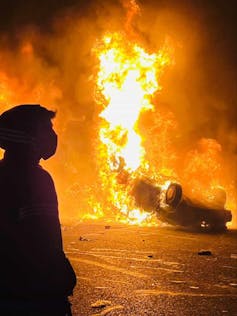
Protester in Punak, Tehran on Jan. 10, 2026. Author-obtained image., CC BY

When Iran’s ongoing protests began in Tehran’s Grand Bazaar on Dec. 28 2025, the government initially treated them as manageable and temporary.

Bazaar merchants have historically been among the most conservative social groups in Iran, deeply embedded in the state’s economic structure and closely connected to political authority. Within the Iranian government itself, there was apparent confidence that their protests were not revolutionary in nature but transactional – a short-lived pressure campaign aimed at stabilizing the collapsing currency and curbing inflation that directly threatened merchants’ livelihoods.

This perception led to an unprecedented development. In his first public response, Iran’s supreme leader Ali Khamenei openly acknowledged the merchants’ protests – the first time he had ever accepted the legitimacy of any demonstration.

He characterized them as part of the traditional alliance between the state and the bazaar, indicating that the government still viewed the unrest as controllable.

But authorities did not anticipate what happened next: The protests spread to over 25 provinces and developed into a nationwide challenge to the government’s survival, met by a violent crackdown in which more than 6,000 protesters have reportedly been killed.

As an expert on Iran’s ethnic groups, I have watched as the unrest has expanded to include minority groups – despite skepticism among these communities over the possible outcome of the unrest and concerns over the plans of some central opposition figures.

As reports emerge of government forces killing thousands, the central question has now shifted from whether the state can suppress the protests to how different regions of Iran interpreted the concept of change – whether it is something achievable within the government or necessitates regime change itself.

Ethnic minorities join the protest

Iran is a country of about 93 million people whose modern state was built around a centralized national identity rather than ethnic pluralism.

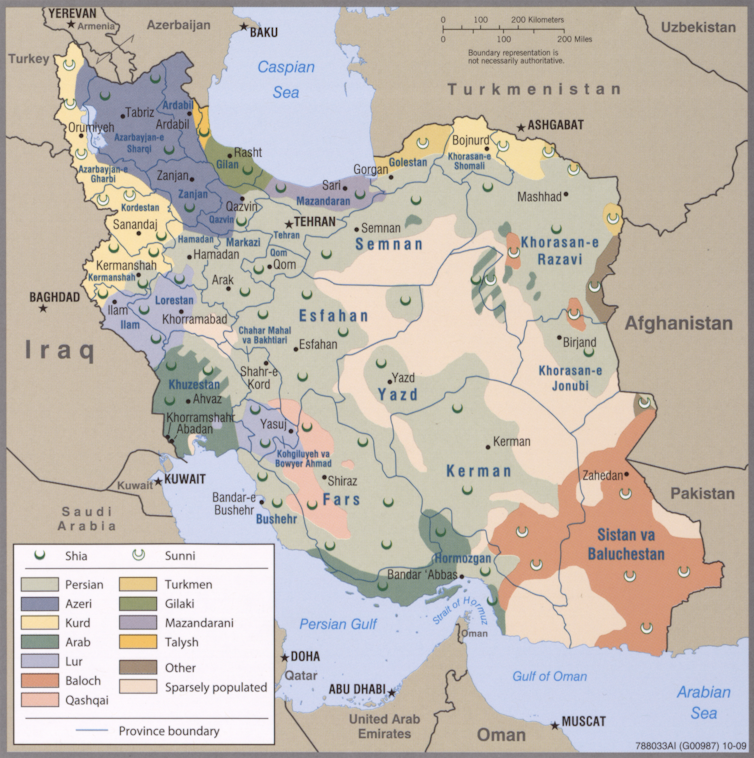
But that masks a large and politically significant ethnic minority population. While 51% form the Persian majority, 24% of the country identify as Azeri. Kurds number some 7 million to 15 million, composing roughly 8% to 17% of the total population. And Arabs and Baluch minorities represent 3% and 2% of the population, respectively.

A map highlights different regions
A map of the distribution of Iran’s ethnic groups.
Wikimedia Commons

Since the Pahlavi monarchy’s nation-building project began in 1925, successive governments, both monarchical and then the Islamic Republic, have treated ethnic diversity as a security challenge and repeatedly suppressed demands for political inclusion, language rights and local governance.

The role of Iran’s ethnic minority groups in the current protests has evolved. Initially, minority regions were less prominent than in the last serious wave of protests: the 2022–23 “Women, Life, Freedom” uprising sparked by the death of a Kurdish-Iranian woman named Jina Mahsa Amini.

The Kurdish involvement in the current protests began in the small city of Malekshahi in Ilam province on Jan. 3. A subsequent violent raid by security forces on wounded protesters inside Ilam hospital provoked outrage beyond the local community and attracted international attention.

Protests continued in Ilam, while in nearby Kermanshah province, particularly the impoverished area of Daradrezh, they erupted over economic deprivation and political discrimination.

A strategic approach to protest

Shiite Kurdish communities in Ilam and Kermanshah continue to experience exclusion rooted in their Kurdish identity. That’s despite sharing a Shiite identity with Iran’s ruling establishment in Tehran – a factor that has historically afforded greater access to government than for the Sunni Kurdish population.

Following the killing of protesters in Ilam and Kermanshah, Kurdish political parties issued a joint statement calling for a region-wide strike.

Notably, Kurdish leaders did not call for protests but for strikes alone. During the “Women, Life, Freedom” uprising, the government treated Kurdish cities as security zones – framing the protests as a threat to Iran’s territorial integrity and using that justification to carry out mass killings and executions.

By opting for strikes this time, Kurdish leaders sought to demonstrate solidarity while reducing the risk of large-scale violence and another massacre.

A protester in Tehran on Jan. 10, 2026.
Author-obtained image., CC BY

The result was decisive: Nearly all Kurdish cities shut down.

Baluchestan, in Iran’s southeast, followed Kurdistan a day after. Beginning with Friday prayers on Jan. 9, protests erupted, also driven by long-standing ethnic and religious marginalization there.

Iranian Azerbaijan, an area in the country’s northwest, joined later and more cautiously. This delayed, small protest reflects Azerbaijanis’ current favorable position within Iran’s political, military and economic institutions.

Historically, from the 16th century to 1925, Shiite Azari-Turks dominated the Iranian state, with Azerbaijani functioning as a court language.

The Pahlavi monarchy marked a rupture, banning the Azerbaijani language and curtailing local autonomy. But since 1979, the Islamic Republic has partially restored Azerbaijani influence, allowing clerics to address constituents in their native language and reintegrating Azerbaijan into central government in Tehran. The current supreme leader, Ali Khamenei, is of Azerbaijani descent.

A history of repression

Ethnically based political movements emerged across Iran immediately after the 1979 revolution, which many minority groups had supported in hopes of greater inclusion and rights.

But these movements were quickly suppressed as the Islamic Republic crushed uprisings across Iranian Azerbaijan, Baluchestan, Khuzestan and other peripheral regions.

Kurdistan was the exception, where resistance, military confrontation and state violence, including massacres, continued for several years.

This repression and the impact of the Iran–Iraq War, during which wartime mobilization overshadowed internal grievances, muted ethnic minority demands throughout the 1980s.

But these demands resurfaced in the 1990s, especially sparked by a sense of cultural revival and cross-border identity formation after the Soviet Union’s collapse. In Iranian Kurdistan, a large part of the armed struggle was transformed into a civil struggle, while Peshmerga forces maintained arms and military training across the border in the Kurdistan region of Iraq.

The Iranian government has increasingly viewed this awakening as a strategic threat and has responded by decentralizing security and military authority to enable rapid crackdowns on protests without awaiting approval from Tehran.

Diverging protest demands

This history of repression explains why the protests in Iran now were at least initially more centralized than previous uprisings. Ethnic minority regions are not indifferent to change; they are skeptical of its outcome.

Many Persian-majority urban protesters seek social freedoms, economic recovery and normalization with the West, particularly the United States. But ethnic communities carry additional demands: decentralization of power, recognition of linguistic and cultural rights, and genuine power-sharing within the state.

For over four decades, ethnic minority demands have been labeled as separatist or “terrorist” and met with arrests and executions by the Islamic Republic.

This rhetoric has also influenced major Persian-dominated opposition groups – spanning the ideological spectrum from left to right and operating largely in exile – that perceive ethnic minority demands as a threat to Iran’s territorial integrity.

Fears of the shah’s return

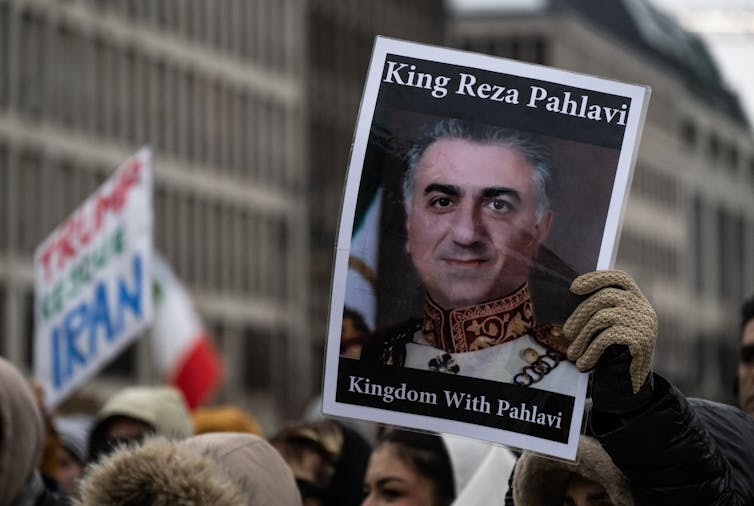
Reza Pahlavi, the exiled son of the last shah of Iran, is positioning himself as the leader of the opposition and a transitional figure. But ethnic communities have reason for concern.

Pahlavi’s office has published a road map for a transitional government that sharply contrasts with his public claims of not seeking to monopolize power. The document envisions Pahlavi as a leader with extraordinary authority. In practice, the concentration of power he proposes under his leadership closely resembles the authority currently exercised by Iran’s supreme leader.

A protester holds aloft a photo of a man with 'King Reza Pahlavi' written above.
Reza Pahlavi, the son of Iran’s late ruler Mohammad Reza Pahlavi, has seen his support surge among protesters, such as those seen here in Germany on Jan. 12, 2026.
John MAcDougall/AFP via Getty Images

For ethnic communities, these implications are particularly troubling. The road map characterizes ethnic-based demands and parties as threats to national security, reinforcing long-standing state narratives rather than departing from them. This explicit stance has deepened skepticism in peripheral regions.

In contrast to Ayatollah Khomeini in 1979, whose revolutionary vision was deliberately vague regarding the future status of ethnic groups, the current opposition leadership project articulates a centralized political order that excludes ethnic inclusion and power-sharing.

For communities whose languages were banned and whose regions were systematically underdeveloped during the Pahlavi monarchy, the resurgence of monarchist slogans in central cities only reinforces fears that any transition driven by centralized narratives will again marginalize Iran’s peripheral regions.

The risk of ignoring provinces

Iran’s protests, therefore, reveal more than resistance to authoritarian rule. They expose a fundamental divide over what political change means – and for whom.

In a country as ethnically diverse as Iran, where millions belong to non-Persian ethnic communities, a durable political order cannot, I believe, be built on centralized power dominated by a single ethnic identity.

Any future transition, whether through reform within the current system or through regime change, will have a better chance of success if it incorporates a political framework that acknowledges and incorporates the demands of all regions and communities. Without such inclusion, trust in the process of change will remain elusive – and hopes for a better future dimmed.

The Conversation

Shukriya Bradost is affiliated with the Middle East Institute.

ref. Iran’s protests have spread across provinces, despite skepticism and concern among ethnic groups – https://theconversation.com/irans-protests-have-spread-across-provinces-despite-skepticism-and-concern-among-ethnic-groups-273276

Why unlocking Venezuelan oil won’t mean much for US energy prices

Source: The Conversation – USA (2) – By Amy Myers Jaffe, Director, Energy, Climate Justice, and Sustainability Lab, and Research Professor, New York University; Tufts University

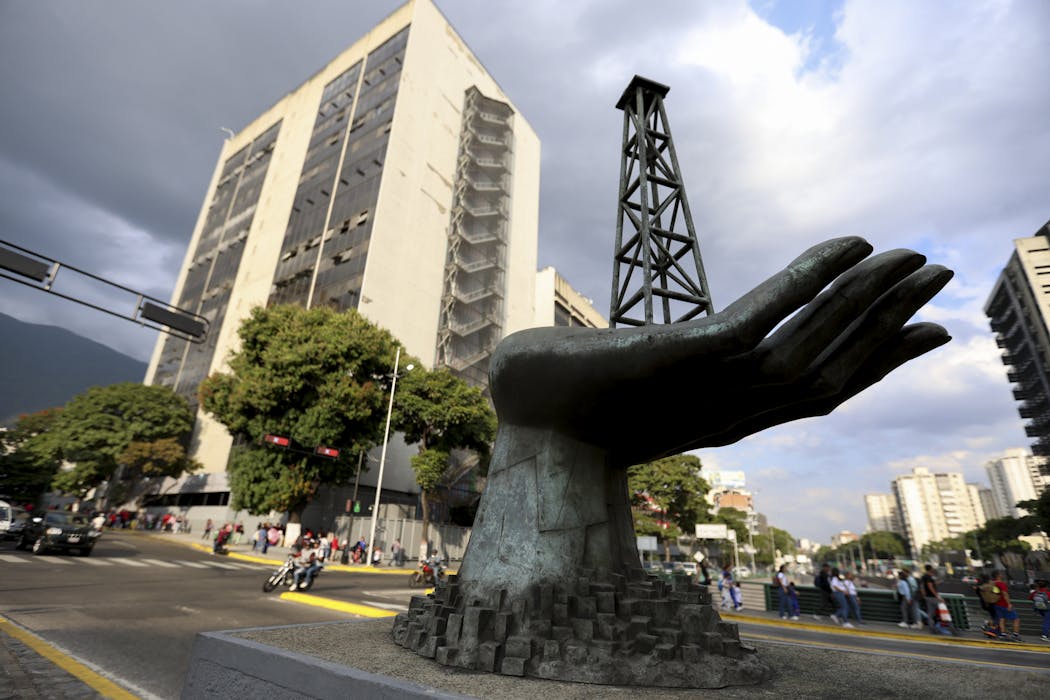
A sculpture of a hand holding an oil rig stands outside the headquarters of Venezuela’s national oil company. Pedro Mattey/AFP via Getty Images

In the wake of U.S. forces’ arrest of Venezuelan President Nicolás Maduro, U.S. President Donald Trump has said the U.S. is taking over Venezuelan oil production.

In addition, the U.S. has blockaded Venezuelan oil exports for a few weeks and seized tankers that reportedly escaped from the blockade.

To understand what’s happening and what it means for U.S. consumers and the American energy industry, The Conversation U.S. checked in with Amy Myers Jaffe, a research professor at New York University and senior fellow at Tufts University who studies global energy markets and the geopolitics of oil.

What is the state of Venezuela’s oil industry and how did it get to this point?

Venezuela’s oil industry has experienced profound turmoil over its history, including a steady downward spiral beginning in 1998. That’s when a worldwide economic downturn took global oil prices below $10 per barrel at the same time as the Venezuelan public’s growing interest in reasserting local control of the country’s oil industry ushered in populist President Hugo Chávez.

In April 2002, Venezuelans took to the streets to protest the appointment of Chávez loyalists to replace the top brass of the national oil company, Petróleos de Venezuela. The chaos culminated in an attempted coup against Chavez, who managed to retake power in a matter of days. Petróleos de Venezuela’s workers then went out on strike, prompting Chávez to purge close to 20,000 top management and oil workers. That began a brain drain that would last for years.

In 2007, Chávez, standing in front of a banner that read “Full Oil Sovereignty, The Road to Socialism,” took over ExxonMobil’s and ConocoPhillips’ oil-producing assets in Venezuela. The companies had declined to accept new oil contracts at radically less profitable terms than they had in previous years.

After Chávez’s death in 2013, national economic chaos accelerated. By 2018, reports began to surface that roving gangs, as well as some oil workers struggling to survive, were stripping the industry of its valuable materials – computers, copper wiring, and metals and machinery – to sell on the black market.

U.S. sanctions added to the mix over the years, culminating in a drop in Venezuelan oil production to 840,000 barrels a day in 2025, down from the 3.5 million barrels a day it was able to produce in 1997.

A handful of international oil companies remained in the country throughout the turmoil, including U.S.-based Chevron, French-Indonesian firm Maurel and Prom, Spanish firm Repsol, and Italian firm ENI. But the political chaos, sanctions and technical mismanagement of the oil industry have taken a heavy toll.

Some estimates say that the country wouldn’t need a lot of investment to increase production to about 1 million barrels a day by 2027. But other analysts say that immediate investment of as much as $20 billion could only raise Venezuela’s production to 1.5 million barrels a day.

Most of the oil in Venezuela is very heavy oil and requires expensive processing to be able to be refined into usable products. The country’s leaders have claimed to have 300 billion-plus barrels of reserves.

A wide view shows a group of large industrial buildings with a road and other buildings nearby.
The El Palito refinery in Puerto Cabello, Venezuela, is owned by the country’s national oil company.
Jesus Vargas/picture alliance via Getty Images

What effect does Venezuela’s production have on prices that U.S. consumers pay for gasoline, natural gas, gas-fired electricity and other petroleum products?

In general terms, U.S. gasoline prices are influenced by global crude oil market levels. Sudden changes in export rates from major oil-producing countries can alter the trajectory for oil prices.

However, Venezuela’s recent export levels have been relatively small. So the immediate effect of changes in Venezuelan oil export levels is likely to be limited. Overall, the global oil market is oversupplied at the moment, keeping prices relatively low and in danger of falling further, even though China is stockpiling large oil reserves.

Venezuela did not export any natural gas. In the long run, a fuller restoration of Venezuela’s oil and gas industry could mean oil prices will have difficulty rising as high as past peaks in times of volatility and could potentially fall if oil demand begins to peak. And Royal Dutch Shell and Trinidad and Tobago National Gas Company have plans to develop Venezuela’s offshore Dragon natural gas field, adding to an expected glut of liquefied natural gas, often called LNG, in global markets in the coming years.

How much oil is coming to the U.S. now, and how would more imports of Venezuelan oil affect U.S. refiners?

The U.S. Gulf Coast refining center is known for its capability to process heavy, low-quality oil like Venezuela’s into valuable products such as gasoline and diesel. Already, refineries owned by Chevron, Valero and Phillips 66 are bringing in Venezuelan oil.

Before the U.S. seized Maduro, most of Venezuela’s exports were going to China, though about 200,000 barrels a day were coming to the United States under Chevron’s special license.

Two figures watch a large ship move across the water.
An oil tanker approaches a dock in Maracaibo, Venezuela, on Jan. 10, 2026.
Margioni Bermúdez/AFP via Getty Images

Trump has said the U.S. will get between 30 million and 50 million barrels of oil from Venezuela, to be used “to benefit the people” of both countries. That’s about two or three days’ worth of U.S. oil production, and between one and two months’ worth of Venezuelan production. What effects could that have for the U.S. or Venezuela?

Some 20 million to 50 million barrels of Venezuelan crude oil is currently piled up in Venezuela’s storage tanks and ships in the aftermath of the U.S. blockade. Exports needed to resume quickly before storage ran out to prevent oil production facilities from needing to shut down, which could then require lengthy and expensive restart procedures.

The United States has been a major exporter of petroleum products in recent years, reaching 7.7 million barrels a day at the end of 2025.

Processing more Venezuelan oil might help make U.S. Gulf Coast refineries a bit more profitable by making more money on their refined products exports. But since there was no shortage of products in the U.S. market, I don’t expect consumers to see much savings.

But U.S. refineries only have so much capacity to refine heavy oil like Venezuela’s. And they have long-term contracts for oil from other suppliers. So they won’t be able to handle all of those 30 million to 50 million barrels. Some of it will either have to be sold abroad or put in the U.S. strategic petroleum reserve.

How does a potential increase in Venezuelan oil production affect U.S. domestic oil producers?

Over time, the impact of the restoration of Venezuelan oil production on oil prices is hard to predict. That’s because it will likely take a decade or more before Venezuela’s oil production levels could be fully restored. Long-term oil prices are notoriously tricky to forecast.

Generally speaking, U.S. shale production rates and profitability benefit when oil prices are above $50 a barrel, as they have been since 2021. U.S. oil production rose to 13.8 million barrels per day for the week ending Dec. 26, 2025, up slightly from the end of 2024. Forecasts suggest a slight increase in 2026 as well, if oil prices stay relatively flat.

Longer term, all bets are off, since the Organization of the Petroleum Exporting Countries, or OPEC – a group of countries that coordinate global petroleum production and sales – has a history of telling members not to increase production when they add new oil fields, which sometimes leads to so much disagreement that a price war erupts.

The last time Venezuela moved to increase its production significantly, in the 1990s, oil prices sank below $10 a barrel. Major OPEC members like the United Arab Emirates have been expanding capacity in recent years, and others with large reserves like Libya and Iraq aspire to do the same in the coming decade as well. The UAE has been asking the group for permission to increase its production, causing difficulties in the group’s efforts to agree on what their total production and target oil price should be. That could be good news for consumers, if OPEC disunity leads to higher supplies and falling prices.

Some commentators have suggested China could be the biggest loser if shipments of Venezuelan oil shift West and away from discounted sales to China. How does the current situation affect China’s energy security and geostrategic considerations?

China’s oil imports have been averaging about 11 million barrels per day, with about 500,000 to 600,000 of that coming from Venezuela. Iran and Russia are among China’s largest oil suppliers, and both countries’ industries face tightening U.S. sanctions. There is enough oil available on the global market to provide China with what it wants, even if it doesn’t come from Venezuela.

The real question is about China’s overall response to the U.S. intervention in Venezuela. Beijing’s initial reaction to Maduro’s removal was fairly muted. In a Dec. 31, 2025, speech, however, China’s President Xi Jinping said China’s defense capabilities and national strength had “reached new heights” and called for the “reunification of our motherland.” In light of the U.S. intervention in the Americas, China may see a justification to move more aggressively toward Taiwan.

The Conversation

Amy Myers Jaffe does not work for, consult, own shares in or receive funding from any company or organization that would benefit from this article, and has disclosed no relevant affiliations beyond their academic appointment.

ref. Why unlocking Venezuelan oil won’t mean much for US energy prices – https://theconversation.com/why-unlocking-venezuelan-oil-wont-mean-much-for-us-energy-prices-273194

La ciencia pierde fuerza en la toma de decisiones climáticas internacionales

Source: The Conversation – (in Spanish) – By Gian Carlo Delgado Ramos, Tenured professor and researcher, Universidad Nacional Autónoma de México (UNAM)

PeopleImages/Shutterstock

La humanidad, la biodiversidad y el planeta Tierra enfrentan múltiples crisis de manera simultánea. La matriz energética mundial sigue siendo mayormente fósil –en más de 80 %– y el consumo creciente y desigual de energía y materiales constituye la causa principal de la responsabilidad climática diferenciada entre países.

Producto de la distribución desigual de la riqueza, se estima que el 10 % de la población más acomodada es responsable del 77 % de las emisiones globales asociadas a la propiedad privada de capital. El 40,7 % de la población más pobre, que accede a sólo 0,6 % de la riqueza global, figura en cambio entre la más vulnerable, y no sólo a los impactos del cambio climático.

Más allá del binomio energía-clima, la persistencia de formas de producción poco sostenibles y la extracción y consumo creciente de recursos están degradando la base material de la reproducción de la vida debido a la pérdida de la biodiversidad, la degradación y desertificación, así como la contaminación de aire, suelos, agua dulce, océanos y costas.

La transgresión de las fronteras planetarias es tal que ha puesto en riesgo la viabilidad de la vida, al menos tal y como la conocemos. No solo la biodiversidad y los ecosistemas están en crisis, la salud del planeta (y evidentemente la nuestra) también se encuentra bajo amenaza debido a la generación y exposición a una gran diversidad de contaminantes persistentes y tóxicos, incluyendo los plásticos que prácticamente ya se encuentran en todas las cadenas alimenticias.

Decisiones contra el negacionismo climático

En este contexto de agudización del cambio climático e impactos cada vez más severos y potencialmente irreversibles, la ciencia para la toma de decisiones en materia ambiental y climática está perdiendo fuerza y relevancia, sobre todo en lo que respecta a la cooperación internacional.

En sentido opuesto a lo que recomienda la ciencia, algunos gobiernos relajan sus compromisos y medidas o bien han hecho valer políticamente el negacionismo climático (caso, por ejemplo, de Argentina y Estados Unidos.

Otros han ampliado los marcos temporales de sus metas. Es el caso de la prohibición de la venta de vehículos de gasolina y diésel en Europa para 2035, un objetivo que ahora se propone sea solo del 90 % para ese año.

Más grave aún, algunos gobiernos están repetidamente negociando los hallazgos de la ciencia. Esto genera condiciones adecuadas para afianzar el status quo, priorizar el corto plazo, apalancar los privilegios de algunos e hipotecar el futuro de la vida humana y de otras formas de existencia.

Se implementaron medidas para evitar cualquier consenso tanto en las negociaciones para un acuerdo internacional sobre la contaminación plástica en agosto de 2025 como en la eventual aprobación del resumen para tomadores de decisiones de la séptima edición del informe Perspectiva del Medio Ambiente Mundial (GEO-7), el pasado noviembre.

En ambos casos se cuestionaron los mecanismos procedimentales, se criticaron los argumentos científicos, muchas veces sin contar con evidencias, y se buscó la imposición de narrativas como condicionante para otorgar el refrendo de dichos documentos. Estas prácticas, que pareciera se están convirtiendo en la norma, han permitido a países como Estados Unidos, Arabia Saudita, Irán y Rusia agotar los tiempos de negociación, crear puntos muertos y bloquear tanto la movilización de evidencias y de información como la construcción de consensos.

El caso del GEO-7 establece un precedente indeseable al no haber logrado un consenso en torno al resumen para tomadores de decisiones. Desgraciadamente, existe el riesgo de que se repitan situaciones similares en informes como los del Panel Internacional de Cambio Climático (IPCC) o la Plataforma Intergubernamental sobre Biodiversidad y Servicios de los Ecosistemas (IPBES).


Leer más:
La realidad cada vez se lo pone más difícil, pero el negacionismo climático sigue ignorando las evidencias


Financiación climática

A la situación por la que cruza la ciencia para la toma de decisiones, se suma la notable erosión del financiamiento, resultado de las actuales condiciones económicas en muchos países y de las tensiones geopolíticas en curso que gradualmente se traducen en el redireccionamiento de la inversión pública hacia el gasto en seguridad y defensa.

El propio sistema de Naciones Unidas, que depende de las donaciones de los países miembro, recortó un 17 % su presupuesto y un 18 % su personal en 2025, con riesgo de terminar el año con déficit. Para 2026, los recortes ascenderán al 20 %, 3.700 millones de dólares.

La asistencia y cooperación internacional está asimismo disminuyendo y, con ello, los recursos para, por ejemplo, atender cuestiones humanitarias, de cambio climático y el medio ambiente.

En el caso de los dos principales donadores, Estados Unidos y Alemania, se constatan ajustes importantes. A principios de 2025, el Gobierno federal del primer país rescindió 4.000 millones de financiamiento al fondo verde climático (GCF), a la vez que la Agencia de los Estados Unidos para el Desarrollo Internacional (USAID) terminó con el 98,3 % del financiamiento a la acción climática. Alemania redujo un 8 % el presupuesto de 2025 del Ministerio para la Cooperación Económica y el Desarrollo de Alemania (BMZ), mientras que aumentó el gasto en defensa en 20 %.

La tendencia para 2026 no parece que vaya a cambiar pues, además del retiro de todo financiamiento al GCF por parte de EUA), la lista de otros casos similares continua, incluyendo Argentina en América Latina, que ya recortó el 80 % del presupuesto climático-ambiental. Otros países como Canadá, Francia y Reino Unido han planteado contracciones al presupuesto de ayuda internacional, aunque todavía mantienen su apoyo a la agenda climática.

China es, hasta ahora la excepción, lo cual sugiere que estamos ante una situación de reajustes geoeconómicos y geopolíticos. Al contrario que Occidente, en 2025 el país asiático mantuvo sin cambios su gasto en defensa, pero aumentó 8,4 % el financiamiento a la ayuda internacional, por ejemplo, al impulsar proyectos que propicien el desarrollo sostenible.


Leer más:
Un gran poder conlleva una gran responsabilidad: el papel de las multinacionales en la mitigación del cambio climático


Geopolítica y ciencia

Debido al ascenso de China en diversos ámbitos, incluyendo el primer lugar en publicación de artículos científicos en las más prestigiosas revistas del mundo, las tensiones que protagoniza con Estados Unidos no deben sorprender, así como tampoco el refrendo de la doctrina Monroe, calificada en la actualidad como “corolario de Trump”.

En su más reciente Estrategia de Seguridad Nacional, Estados Unidos reafirma que América es para los estadounidenses y llama a Europa a sumarse a defender la identidad de Occidente. También se detiene a expresar su rechazo a “…las ideologías desastrosas de cambio climático y del cero neto que tanto han dañado a Europa, amenazado a Estados Unidos y subsidiado a nuestros adversarios (sic)”.

La situación en la que nos encontramos, tanto en términos políticos, económicos y sociales, pero también culturales y discursivos, desgraciadamente plantea condiciones adecuadas para dirigirnos aceleradamente hacia un escenario de transgresión de las fronteras planetarias. Contexto en el que la politización de la ciencia ha llegado al extremo de la falacia ad hominem, es decir, un error lógico derivado de atacar y desacreditar a un actor en lugar de refutar su argumento.

El “error lógico”, dígase de la Casa Blanca, es sin embargo funcional para alejarse de los acuerdos internacionales, desestimando a la ciencia y calificándola de ideología. Hace sólo unos días, Donald Trump decidió retirar a Estados Unidos de la Convención Marco de las Naciones Unidas sobre el Cambio Climático y de otros 65 grupos multilaterales de la ONU, principalmente vinculados al medio ambiente, las energías renovables, el desarrollo, la educación y la promoción de la democracia y los derechos humanos.


Leer más:
Las medidas de adaptación al cambio climático mal diseñadas exacerban las desigualdades


¿Por qué es importante la ciencia para la política?

De cara al avance de múltiples crisis, el papel de la ciencia para la política debería ser fortalecido entendido no sólo como aquella que busca informar el proceso de toma de decisiones de los gobiernos, sino como la que además se dirige a informar, empoderar y movilizar a todos los actores sociales con la finalidad de generar soluciones basadas en alianzas, colaboraciones y diálogo.

La ciencia para la política significa poco si no apuesta por la vida, la justicia y la construcción sistémica de soluciones plurales, sensibles a los contextos locales y con visión a largo plazo.

La transformación a fondo de los factores o causas de las múltiples crisis en curso es obligada y el tiempo para hacerlo, y hacerlo de manera justa e incluyente, se reduce.

En un escenario de desequilibrios hacia el que nos dirigimos, los límites de la adaptación harán en algún momento obsoleto el mecanismo de “pérdidas y daños” propuesto en el marco de las negociaciones climáticas con el fin de compensar a países vulnerables por impactos climáticos inevitables. Lo cual implica que los mayores afectados seguirán siendo los más pobres.

Para el Sur Global esto reafirma que la acción climática es en gran medida una cuestión de política de desarrollo y justicia social donde no sólo la velocidad y el alcance de los cambios es importante, sino también qué es lo que se está transformando, cómo y en beneficio de quién.

Esta cuestión abre sin duda la interrogante de qué tipo de gobernanza multilateral, nacional y subnacional puede realmente responder a la urgencia y complejidad que plantea el avance de múltiples crisis y cuáles son los actores que a esas distintas escalas podrían impulsarla de manera exitosa y coordinada a pesar de las adversidades imperantes.

The Conversation

Gian Carlo Delgado Ramos ha participado en diversos informes y redes internacionales de investigación en cambio climático y sostenibilidad. Fue rapporteur del Multidisciplinay Expert Scientific Advisory Group del GEO-7, ente encargado de validar la integridad científica del informe. Participó en el 5to y 6to informe de evaluación del IPCC y actualmente es CLA en el informe especial de Cambio Climático y Ciudades. Es director del hub de CDMX de la UCCRN, integrante del Comité Ejecutivo de la REDCiC–Red Mexicana de Científicos/as por el Clima, así como del Comité Asesor de Innovate4Cities 2026

ref. La ciencia pierde fuerza en la toma de decisiones climáticas internacionales – https://theconversation.com/la-ciencia-pierde-fuerza-en-la-toma-de-decisiones-climaticas-internacionales-272589

¿Cómo decide un dentista si recetar un antibiótico? Solo algunos países tienen guías clínicas de referencia para guiarles

Source: The Conversation – (in Spanish) – By Maruxa Zapata Cachafeiro, Profesora de Salud Pública, Universidade de Santiago de Compostela

Ungvar/Shutterstock

A todos nos suena eso de que hay que usar bien los antibióticos. Probablemente haya visto un anuncio o un cartel en su centro de salud alertando sobre su pérdida de efectividad. Actualmente, la resistencia de las bacterias a estos medicamentos son una de las principales amenazas para la salud mundial.

Todos hemos contribuido, en mayor o menor medida, a llegar a este punto. Como pacientes, muchos nos hemos saltado alguna dosis de antibiótico, no hemos completado el tratamiento o directamente nos hemos tomado las pastillas que nos habían sobrado de un tratamiento anterior. Otra parte importante de responsabilidad la tiene el sector sanitario, ya que muchas veces se prescriben de forma innecesaria o inadecuada.

La forma de atajarlo parece clara. Si los profesionales prescriben estos fármacos solo cuando son necesarios y los pacientes les hacemos caso, tendríamos esta parte del problema resuelto. Pero no es tan fácil. Por lo menos para los dentistas.

¿Qué pensaría si su dentista le hace una receta de antibiótico y el principio activo que indica es “depende”? Pues eso es lo que deberían prescribir en algunos casos si emplearan como fuente de información solamente las guías de práctica clínica a las que tienen acceso.

No todos los países tienen una guía de referencia

Estas guías son conjuntos de recomendaciones elaboradas por expertos y organismos como ministerios de salud, asociaciones profesionales de dentistas o la Organización Mundial de la Salud, para ayudar en la toma de decisión y que están basadas en una revisión sistemática de la evidencia científica disponible.

Sin embargo, según hemos descubierto en nuestro reciente estudio, en el que hemos analizado las guías de prescripción de antibióticos existentes a nivel internacional, no todas tienen la misma calidad ni son igual de fiables. Ni siquiera todos los países tienen una.

En primer lugar, hallamos que no todos los dentistas van a tener un documento de referencia: tan solo nueve países disponen de guías sobre prescripción de antibióticos para patologías orales. Además, únicamente 10 de las 17 analizadas pueden ser clasificadas como “recomendadas” si nos basamos en su calidad. Incluso dos guías se clasifican como “no recomendadas”.

Los dentistas de Bélgica, España, Escocia y Reino Unido son los más afortunados, ya que son los que tienen acceso a las guías de mayor calidad.

Por ejemplo, en España, el documento que cumplía los requisitos para ser considerado como guía de práctica clínica es la Guía Terapéutica Antimicrobiana del Área Aljarafe, creada desde la Consejería de Salud de Andalucía y actualizada desde el Plan Nacional de Resistencia a los antibióticos del Ministerio de Salud.

Otros organismos que tienen guías recomendadas son el Ministerio de Salud de Chile, el Real Colegio de Cirujanos de Inglaterra, la Organización Mundial para la Salud, el KCE Belgian Health Care Knowledge Centre, la Asociación Dental Americana y el Programa Escocés de Efectividad Clínica Dental.

¿Qué antibióticos recetan los dentistas?

No todos los aspectos son negativos: en general, en la mayoría de los casos las guías disponibles están de acuerdo en que el dentista debe prescribir como primera opción la amoxicilina (un derivado de la famosa penicilina de Fleming). Según los estudios, este es uno de los principios activos que más prescriben los dentistas, así que lo están haciendo bien.

Entre las guías también hay bastante concordancia en la duración de este tratamiento, aunque en algunas directamente no se hacía referencia al tiempo.

Sin embargo, la concordancia disminuye cuando analizamos los principios activos que se recomiendan para tratar enfermedades concretas. Y el problema es mucho mayor cuando el paciente es alérgico a la amoxicilina (algo relativamente frecuente, ya que hasta un 25 % de la población podría serlo). En ese caso, las recomendaciones se vuelven muy dispares. El 29 % de las guías recomendaba metronidazol, el 24 % azitromicina, el 24 % clindamicina, el 18 % cefalosporinas y 6 % doxiciclina. Y esas diferencias no están justificadas.

Cómo mejorar las guías

Estos documentos tienen además mucho margen de mejora en algunos aspectos concretos: el rigor de la evidencia, la forma de presentar la información y la aplicabilidad de las recomendaciones de prescripción de antibióticos.

Mejorar todos estos aspectos podría facilitar el uso de estas guías y ayudar a los dentistas a tomar las mejores decisiones. Además, será menos probable que se informen a través de otras fuentes que a priori podrían estar más sesgadas como, por ejemplo, la industria farmacéutica, ya que siempre tendrá detrás intereses comerciales.

El objetivo final está claro: necesitamos reducir el consumo de antibióticos innecesarios. No podemos quedarnos parados. El problema de las resistencias a los antibióticos ya no es una amenaza, es una realidad. En Europa mueren alrededor de un centenar de personas al día por resistencias a los antimicrobianos. Es urgente actuar de forma conjunta, y necesitamos que los profesionales sanitarios dispongan de fuentes fiables y prácticas que les permitan tener la seguridad de que están tomando la mejor decisión para sus pacientes.

The Conversation

Las personas firmantes no son asalariadas, ni consultoras, ni poseen acciones, ni reciben financiación de ninguna compañía u organización que pueda obtener beneficio de este artículo, y han declarado carecer de vínculos relevantes más allá del cargo académico citado anteriormente.

ref. ¿Cómo decide un dentista si recetar un antibiótico? Solo algunos países tienen guías clínicas de referencia para guiarles – https://theconversation.com/como-decide-un-dentista-si-recetar-un-antibiotico-solo-algunos-paises-tienen-guias-clinicas-de-referencia-para-guiarles-266119