La campagne de financement participatif des travaux du château de Chambord est un vrai succès. Que dit cette réussite de l’intérêt des Français pour le patrimoine ? Les résultats obtenus sont-ils transposables à d’autres monuments ? Ou faut-il craindre que ces campagnes pour des édifices d’intérêt national ne détournent le public d’opérations moins ambitieuses mais indispensables ?
Le domaine national de Chambord (Loir-et-Cher), deuxième château le plus visité de France après celui de Versailles (Yvelines), a fermé l’accès à l’aile François Ier. Fragilisée par le temps et le climat, cette partie du monument nécessite des travaux de restauration estimés à 37 millions d’euros.
Bien que disposant d’un modèle économique solide, le domaine ne peut absorber seul un tel coût. Aux côtés du mécénat, Chambord a choisi de mobiliser aussi le grand public en lançant, le 19 septembre 2025, une campagne de financement participatif à l’occasion des Journées européennes du patrimoine. Intitulée « Sauvez l’aile François Ier, devenez l’ange gardien de Chambord », elle visait à collecter 100 000 euros.
Deux mois plus tard, la collecte a déjà dépassé l’objectif initial, atteignant 218 139 euros grâce aux 2 191 dons, déclenchant un nouveau palier à 300 000 euros. Ce succès interroge : pourquoi des citoyens choisissent-ils de contribuer à la restauration d’un monument déjà emblématique soutenu par l’État et par des mécènes privés ?
Le cas de Chambord n’est pas isolé. Le financement participatif consacré au patrimoine est devenu une pratique courante en France, malgré de fortes fluctuations. Selon le baromètre du financement participatif en France, 1,4 million d’euros ont été collectés en 2022, 5,7 millions en 2023, puis seulement 0,8 million en 2024. Les raisons de ces écarts restent à documenter, mais ces chiffres révèlent un mode de financement ponctuel, voire incertain.
Ce mode de financement repose sur les dons principalement en ligne des citoyens. Il ne remplace ni l’argent public ni le mécénat d’entreprise, mais les complète, parfois même symboliquement. Dans certains cas, il joue un rôle de déclencheur. En effet, en apportant la preuve d’une mobilisation locale, la participation citoyenne peut débloquer des subventions publiques conditionnées à cet engagement. En partenariat avec certaines régions, la Fondation du patrimoine peut ainsi apporter une bonification à la souscription, comme ce fut le cas pour la restauration de l’église de Sury-en-Vaux (Cher) dans le Sancerrois.
Les projets financés sont divers : restauration d’églises rurales, sauvegarde de moulins, mise en valeur de jardins historiques, consolidation de lavoirs… Cette diversité reflète la richesse du patrimoine français, mais aussi sa fragilité et le besoin constant de mobilisation pour sa préservation.
Une question de proximité
Des recherches menées en région Centre-Val de Loire montrent que la décision de contribuer repose sur divers éléments, notamment sur le lien, appelé proximité, entre le contributeur et le bien patrimonial. Les donateurs entretiennent souvent un lien particulier avec le monument qu’ils soutiennent. Ce lien est d’abord géographique. Il peut être lié au lieu de résidence, mais aussi à des séjours passés, des vacances ou encore des visites. Il n’implique donc pas toujours d’habiter à proximité.
Il est aussi affectif. Certains contributeurs expriment un attachement direct au bien patrimonial, car ce monument peut évoquer des origines familiales, des souvenirs personnels ou susciter une émotion particulière. D’autres s’y intéressent de manière plus indirecte, parce qu’il incarne, au même titre que d’autres biens, une identité territoriale ou encore une passion pour le patrimoine en général.
Chambord cumule les atouts
La campagne de Chambord se distingue des projets plus modestes. Contrairement à une petite église de village ou à un lavoir communal, ce château touristique active simultanément plusieurs types de liens, ce qui explique en partie son potentiel de mobilisation exceptionnelle. Les premiers témoignages de participants à la campagne de Chambord illustrent ces logiques de proximité.
Chambord est un marqueur d’identité territoriale fort, dont le lien géographique et affectif fonctionne à plusieurs échelles. Chambord est avant tout un symbole du patrimoine culturel français. Pour de nombreux contributeurs, soutenir cette restauration vise à préserver un emblème de la France et de son rayonnement culturel.
« Tout comme Notre-Dame de Paris, c’est un symbole de notre patrimoine que nous devons préserver », souligne Julie.
« Ce patrimoine exceptionnel contribue au rayonnement de la France à travers le monde », précise Benjamin.
Ce sentiment d’appartenance ne s’arrête pas au niveau national. Chambord est aussi un marqueur d’identité territoriale locale. Pour les habitants du Loir-et-Cher et de la région Centre-Val de Loire, Chambord est « leur » château, le fleuron de leur territoire, comme le confie un autre donateur anonyme.
« J’habite à proximité du château de Chambord et le domaine est mon jardin ! »
Cette capacité à créer un sentiment élargi d’appartenance géographique multiplie considérablement le potentiel de contributeurs.
Passion pour l’histoire
Ce lien affectif indirect s’exprime également lorsqu’il est nourri par une passion pour l’histoire ou pour le patrimoine en général. Ces passionnés ne soutiennent pas Chambord parce qu’ils y ont des souvenirs personnels, mais parce qu’il incarne, à leurs yeux, l’excellence de l’architecture française, le génie de la Renaissance ou l’héritage culturel commun. Leur engagement s’inscrit dans une forme d’adhésion à l’idée même de sauvegarder le patrimoine.
C’est le cas de Carole,
« passionnée d’histoire, je souhaite participer à la conservation d’un patrimoine qui doit continuer à traverser les siècles pour que toutes les générations futures puissent en profiter et continuer cette préservation unique ».
Au-delà de l’identité territoriale nationale ou locale ou encore de la passion patrimoniale, les commentaires des contributeurs expriment un lien affectif direct avec le monument. L’état alarmant de Chambord réveille des émotions patrimoniales profondes, liées aux valeurs que le monument incarne, comme la beauté et la grandeur.
« Personne ne peut rester insensible à la beauté de ce château », estime Dorothée.
France 3 Centre Val-de-Loire, 2025.
Urgence et souvenirs
L’urgence de la restauration suscite également une forme de tristesse et d’inquiétude,
« C’est très triste de voir un tel chef-d’œuvre en péril », pour Mickaël.
Ce lien affectif direct s’exprime également à travers l’évocation de souvenirs personnels, témoignant d’une identité singulière attachée au lieu, comme la sortie scolaire inoubliable, la visite en famille ou entre amis, les vacances familiales ou encore la découverte émerveillée de l’escalier à double révolution.
Cette accumulation de liens entre le bien patrimonial et les contributeurs explique en partie pourquoi Chambord peut viser un objectif au-delà des 100 000 euros, là où la plupart des projets patrimoniaux se contentent de quelques dizaines de milliers d’euros. Tous les monuments ne disposent pas des mêmes atouts.
L’exemple de Chambord montre la force de l’attachement des Français au patrimoine. Il illustre aussi à quel point la réussite d’un financement participatif patrimonial repose en partie sur une bonne compréhension des liens géographiques et affectifs qui unissent les citoyens à un monument.
Ce succès interroge. Le recours au don pour les « monuments stars » comme Chambord ne risque-t-il pas de détourner l’attention des patrimoines plus fragiles et moins visibles, ou au contraire de renforcer la sensibilisation des Français à leur sauvegarde ? Dans ce contexte, le ministère de la culture, sous l’impulsion de Rachida Dati, explore l’idée d’un National Trust à la française, inspiré du modèle britannique, pour soutenir l’ensemble du patrimoine.
Aurore Boiron ne travaille pas, ne conseille pas, ne possède pas de parts, ne reçoit pas de fonds d’une organisation qui pourrait tirer profit de cet article, et n’a déclaré aucune autre affiliation que son organisme de recherche.
Au Getty Museum, à Los Angeles, l’exposition « PST ART: Art & Science Collide » met en avant la coopération entre scientifiques et artistes. Youtube/capture d’écran.
Les collaborations entre scientifiques et artistes font régulièrement parler d’elles à travers des expositions intrigantes ou des performances artistiques au sein de laboratoires scientifiques. Mais qu’est-ce qui motive vraiment les chercheuses et les chercheurs à s’associer à des artistes ?
Considérons ainsi les principaux instituts états-uniens de sciences marines : tous sont dotés d’ambitieux programmes de collaboration art/science, mis en place à partir du tournant des années 2000. Le prestigieux Scripps Institution of Oceanography a, par exemple, développé une collection d’art privée, ouverte au public, pour « refléter des connaissances scientifiques objectives dans des œuvres d’art à la fois réalistes et abstraites ». À l’Université de Washington, des résidences d’artiste sont organisées, au cours desquelles des peintres passent entre un et trois mois au milieu des scientifiques des Friday Harbor Laboratories (une station de recherche en biologie marine), sur l’île reculée de San Juan.
Ces démarches semblent indiquer que les institutions scientifiques sont déjà convaincues du potentiel de la collaboration entre art et science. L’initiative ne vient pas toujours des laboratoires : nombre d’artistes ou de collectifs sollicitent eux-mêmes les chercheurs, que ce soit pour accéder à des instruments, à des données ou à des terrains scientifiques. En France comme ailleurs, plusieurs résidences – au CNRS, à Paris-Saclay ou dans des centres d’art – sont ainsi nées d’une démarche portée d’abord par les artistes.
Mais qu’en est-il des chercheurs eux-mêmes ? ceux-là même qui conçoivent, développent et réalisent les projets de recherche et qui a priori ont une sensibilité artistique qui n’est ni inférieure ni supérieure à la moyenne de la population. Quels sont ceux qui choisissent d’intégrer l’art dans leurs projets scientifiques ? Et pour quoi faire ? Les études disponibles ne sont pas très éclairantes sur le sujet, car elles se sont focalisées sur des scientifiques atypiques, passionnés par l’art et artistes eux-mêmes. Peu de travaux avaient jusqu’ici procédé à un recensement « tout azimuts » des pratiques.
Dans une étude récente, nous avons recensé les pratiques, des plus originales aux plus banales, en analysant plus de 30 000 projets de recherche financés par la National Science Foundation (NSF) aux États-Unis entre 2003 et 2023, dans les domaines des géosciences et de la biologie.
Une analyse textuelle du descriptif des projets permet de sortir de l’anecdotique pour révéler des tendances structurelles inédites. Cette source comporte toutefois des biais possibles : les résumés de projets sont aussi des textes de communication, susceptibles d’amplifier ou d’édulcorer les collaborations art/science. Pour limiter ces écarts entre discours et réalité, nous combinons analyse contextuelle des termes artistiques, comparaison temporelle et vérification qualitative des projets. Ce croisement permet de distinguer les effets d’affichage des pratiques réellement intégrées.
En France aussi, les initiatives art/science existent mais restent dispersées, portées par quelques laboratoires, universités ou centres d’art, sans base de données centralisée permettant une analyse systématique. Nous avons donc choisi les États-Unis, car la NSF fournit depuis vingt ans un corpus homogène, public et massif de résumés de projets, rendant possible un recensement large et robuste des collaborations art/science.
Trois façons d’associer les artistes
Pour commencer, les collaborations entre art et science sont très rares : moins de 1 % des projets ! Ce chiffre reste toutefois une estimation basse, car il ne capture que les collaborations déclarées par les chercheurs dans des projets financés : nombre d’initiatives impulsées par des artistes ou des collectifs échappent à ces bases de données. En revanche, leur fréquence a augmenté sans discontinuer sur les vingt années d’observation.
En analysant plus finement les projets, on peut identifier que l’artiste peut y jouer trois grands rôles. D’abord, il peut être un disséminateur, c’est-à-dire qu’il aide à diffuser les résultats auprès du grand public. Il ne contribue pas vraiment à la recherche mais joue le rôle d’un traducteur sans qui l’impact des résultats du projet serait moindre. C’est, par exemple, la mise sur pied d’expositions ambulantes mettant en scène les résultats du projet.
Ensuite, l’artiste peut intervenir comme éducateur. Il intervient alors en marge du projet, pour faire connaître un domaine scientifique auprès des enfants, des étudiants, ou de communautés marginalisées. L’objectif est de profiter d’un projet de recherche pour faire connaître un domaine scientifique de manière plus générale et susciter des vocations. Par exemple, l’un des projets prévoyait la collaboration avec un dessinateur de bande dessinée pour mieux faire connaître aux enfants les sciences polaires.
Enfin, dans des cas beaucoup plus rares, les artistes jouent un rôle de cochercheurs. Le recours au travail artistique participe alors à la construction même des savoirs et/ou des méthodes. Par exemple, un des projets réunissait des artistes et des chercheurs en neurosciences pour concevoir de nouvelles façons de visualiser les circuits nerveux du cerveau, et in fine créer de nouvelles formes de données scientifiques.
Ces différentes formes reflètent une tension encore vive dans le monde académique : l’art est majoritairement mobilisé pour « faire passer » la science, plutôt que pour nourrir la recherche elle-même. Pourtant, les projets les plus ambitieux laissent entrevoir un potentiel plus grand : celui d’une science transformée par le dialogue avec d’autres formes de connaissance.
Cette réflexion fait également écho à des considérations plus générales sur la complémentarité entre l’art et la science, non pas comme des disciplines opposées, mais comme deux approches différentes pour questionner le monde. Comme le formulait joliment un article publié dans The Conversation, il s’agit moins d’opposer l’art à la science que de leur permettre de « faire l’amour, pas la guerre », c’est-à-dire de collaborer pour produire de nouvelles formes de compréhension et d’engagement citoyen.
Au-delà de ces différentes façons d’associer les artistes à un projet, notre étude montre également que ces collaborations ne sont pas réparties au hasard. Certains scientifiques les pratiquent bien plus que d’autres, en fonction de leurs caractéristiques personnelles, leur contexte institutionnel et enfin les objectifs scientifiques de leur projet.
Une science plus ouverte… mais pas partout
Première surprise : ce ne sont pas les universités les plus prestigieuses qui s’ouvrent le plus à l’art. Au contraire, ce sont les institutions les moins centrées sur la recherche dite « pure » qui s’y engagent plus largement. Ces établissements s’appuient probablement sur l’art pour conduire des projets plutôt éducatifs, visant essentiellement à faire connaître la science au plus grand nombre.
Deuxième enseignement : les femmes scientifiques sont bien plus nombreuses que leurs homologues masculins à s’engager dans ces démarches. Cette surreprésentation est à rapprocher d’autres résultats montrant que les femmes scientifiques sont en moyenne plus engagées dans les activités de vulgarisation que les hommes – qui, eux, ont tendance à investir plus exclusivement les domaines supposés plus prestigieux, notamment ceux liés à la publication purement académique.
Ce biais de genre, loin d’être anecdotique, soulève des questions sur la manière dont la reconnaissance académique valorise (ou ignore) certains types d’engagement. Incidemment, ce résultat suggère aussi que promouvoir et financer des collaborations entre art et science serait un moyen a priori efficace de rééquilibrer les différences régulièrement constatées entre hommes et femmes.
L’art, catalyseur d’impact sociétal, mais pas sur tous les sujets
Alors que l’on demande de plus en plus aux scientifiques de démontrer l’impact de leurs travaux sur la société, beaucoup se trouvent mal préparés à cette tâche. Peintres, sculpteurs, écrivains, photographes, etc., ont l’habitude de s’adresser à un public large, de captiver l’attention et déclencher les émotions qui garantissent une impression. Leur interprétation du travail et des résultats scientifiques peut ainsi accroître la visibilité des recherches et susciter le changement. On pourrait donc s’attendre à ce que les projets les plus orientés vers des objectifs sociétaux ambitieux aient plus souvent recours aux artistes.
C’est globalement le cas, mais avec toutefois de grosses différences selon les défis sociétaux concernés, que nous avons classés suivants les grands objectifs de développement durable (ODD) édictés par l’ONU. Notamment, la collaboration art/science est bien plus fréquente dans les projets portant sur la biodiversité marine (ODD 14 « Vie aquatique ») que dans ceux axés sur l’action climatique (ODD 13).
Cette différence s’explique probablement en partie par la grande difficulté à rendre visibles ou compréhensibles certains phénomènes plutôt lointains de la vie quotidienne du grand public : l’acidification des océans, la dégradation des écosystèmes marins, etc. Le travail artistique permet de mobiliser les sens, créer des émotions, des narrations, des imaginaires, qui vont faciliter les prises de conscience et mobiliser les citoyens ou les pouvoirs publics. Bref, il va augmenter l’impact sociétal de la recherche sur ces sujets.
Lever les freins : une affaire de politiques scientifiques
Comment expliquer que ces collaborations restent somme toute très marginales dans le monde de la recherche ? Des défis persistent, tels que le manque de financements qui y sont consacrés ou le cloisonnement disciplinaire des recherches. En outre, l’incitation à explorer ces frontières reste très faible pour les chercheurs, dans un monde académique où la production de publications dans des revues spécialisées reste le critère de performance essentiel.
Intégrer l’art à un projet scientifique nécessite du temps, de la confiance et un changement de posture, souvent perçu comme risqué dans un milieu académique très normé. Mais des solutions existent sans doute : il s’agirait de former mieux les scientifiques à la collaboration, de financer des projets transdisciplinaires et de changer les critères d’évaluation de la recherche, pour valoriser les prises de risque.
À l’heure où la science est appelée à jouer un rôle majeur dans la transition écologique et sociale, l’art ne doit plus être considéré comme un simple emballage esthétique : il pourrait devenir un allié stratégique ! Il ne s’agit pas uniquement de « vulgariser » la science, mais bien de la faire résonner autrement dans les imaginaires, les émotions et les débats publics.
En écoutant celles et ceux qui osent franchir les murs du laboratoire, nous comprendrons peut-être mieux comment faire de la science de manière plus sensible, plus accessible et surtout plus transformatrice.
Les auteurs ne travaillent pas, ne conseillent pas, ne possèdent pas de parts, ne reçoivent pas de fonds d’une organisation qui pourrait tirer profit de cet article, et n’ont déclaré aucune autre affiliation que leur organisme de recherche.
Musk présente son projet Grokipedia comme une réponse aux « biais politiques et idéologiques » de Wikipédia.Miss Cabul/Shutterstock
Grokipedia, le nouveau projet d’Elon Musk, mis en ligne le 27 octobre 2025, promet plus de neutralité que Wikipédia. Pourtant, les modèles d’IA sur lesquels il repose restent marqués par les biais de leurs données.
La société d’intelligence artificielle d’Elon Musk, xAI, a lancé, le 27 octobre 2025, la version bêta d’un nouveau projet destiné à concurrencer Wikipédia, Grokipedia. Musk présente ce dernier comme une alternative à ce qu’il considère être « le biais politique et idéologique » de Wikipédia. L’entrepreneur promet que sa plateforme fournira des informations plus précises et mieux contextualisées grâce à Grok, le chatbot de xAI, qui générera et vérifiera le contenu.
A-t-il raison ? La problématique du biais de Wikipédia fait débat depuis sa création en 2001. Les contenus de Wikipédia sont rédigés et mis à jour par des bénévoles qui ne peuvent citer que des sources déjà publiées, puisque la plateforme interdit toute recherche originale. Cette règle, censée garantir la vérifiabilité des faits, implique que la couverture de Wikipédia reflète inévitablement les biais des médias, du monde académique et des autres institutions dont elle dépend.
Ces biais ne sont pas uniquement politiques. Ainsi, de nombreuses recherches ont montré un fort déséquilibre entre les genres parmi les contributeurs, dont environ 80 % à 90 % s’identifient comme des hommes dans la version anglophone. Comme la plupart des sources secondaires sont elles aussi majoritairement produites par des hommes, Wikipédia tend à refléter une vision plus étroite du monde : un dépôt du savoir masculin plutôt qu’un véritable panorama équilibré des connaissances humaines.
Le problème du bénévolat
Sur les plateformes collaboratives, les biais tiennent souvent moins aux règles qu’à la composition de la communauté. La participation volontaire introduit ce que les sciences sociales appellent un « biais d’autosélection » : les personnes qui choisissent de contribuer partagent souvent des motivations, des valeurs et parfois des orientations politiques similaires.
De la même manière que Wikipédia dépend de cette participation volontaire, c’est aussi le cas de Community Notes, l’outil de vérification des faits de Musk sur X (anciennement Twitter). Une analyse que j’ai menée avec des collègues montre que sa source externe la plus citée, après X lui-même, est en réalité Wikipédia.
Les autres sources les plus utilisées se concentrent elles aussi du côté des médias centristes ou orientés à gauche. Elles reprennent la même liste de sources « approuvées » que Wikipédia ; c’est-à-dire précisément le cœur des critiques de Musk adressées à l’encyclopédie ouverte en ligne. Pourtant, personne ne reproche ce biais à Musk.
Wikipédia reste au moins l’une des rares grandes plateformes à reconnaître ouvertement ses limites et à les documenter. La recherche de la neutralité y est inscrite comme l’un de ses cinq principes fondateurs. Des biais existent, certes, mais l’infrastructure est conçue pour les rendre visibles et corrigibles.
Les articles contiennent souvent plusieurs points de vue, traitent des controverses et même consacrent des sections entières aux théories complotistes, comme celles entourant les attentats du 11-Septembre. Les désaccords apparaissent dans l’historique des modifications et sur les pages de discussion, et les affirmations contestées sont signalées. La plateforme est imparfaite mais autorégulée, fondée sur le pluralisme et le débat ouvert.
L’IA est-elle impartiale ?
Si Wikipédia reflète les biais de ses contributeurs humains et des sources qu’ils mobilisent, l’IA souffre du même problème avec ses données d’entraînement. Grokipedia : Elon Musk a raison de dire que Wikipédia est biaisée, mais son alternative fondée sur l’IA ne fera pas mieux
Musk affirme que Grok a été conçu pour contrer de telles distorsions, mais Grok lui-même a été accusé de partialité. Un test, dans laquelle quatre grands modèles de langage ont été soumis à 2 500 questions politiques, semble montrer que Grok est plus neutre politiquement que ses rivaux, mais présente malgré tout un biais légèrement orienté à gauche (les autres étant davantage marqués à gauche).
Si le modèle qui soustend Grokipedia repose sur les mêmes données et algorithmes, il est difficile d’imaginer comment une encyclopédie pilotée par l’IA pourrait éviter de reproduire les biais que Musk reproche à Wikipédia. Plus grave encore, les LLM pourraient accentuer le problème. Ceux-ci fonctionnent de manière probabiliste, en prédisant le mot ou l’expression la plus probable à venir sur la base de régularités statistiques, et non par une délibération entre humains. Le résultat est ce que les chercheurs appellent une « illusion de consensus » : une réponse qui sonne de manière autoritaire, mais qui masque l’incertitude ou la diversité des opinions.
De ce fait, les LLM tendent à homogénéiser la diversité politique et à privilégier les points de vue majoritaires au détriment des minoritaires. Ces systèmes risquent ainsi de transformer le savoir collectif en un récit lisse mais superficiel. Quand le biais se cache sous une prose fluide, les lecteurs peuvent même ne plus percevoir que d’autres perspectives existent.
Ne pas jeter le bébé avec l’eau du bain
Cela dit, l’IA peut aussi renforcer un projet comme Wikipédia. Des outils d’IA contribuent déjà à détecter le vandalisme, à suggérer des sources ou à identifier des incohérences dans les articles. Des recherches récentes montrent que l’automatisation peut améliorer la précision si elle est utilisée de manière transparente et sous supervision humaine.
L’IA pourrait aussi faciliter le transfert de connaissances entre différentes éditions linguistiques et rapprocher la communauté des contributeurs. Bien mise en œuvre, elle pourrait rendre Wikipédia plus inclusif, efficace et réactif sans renier son éthique centrée sur l’humain.
De la même manière que Wikipédia peut s’inspirer de l’IA, la plate-forme X pourrait tirer des enseignements du modèle de construction de consensus de Wikipédia. Community Notes permet aux utilisateurs de proposer et d’évaluer des annotations sur des publications, mais sa conception limite les discussions directes entre contributeurs.
Un autre projet de recherche auquel j’ai participé a montré que les systèmes fondés sur la délibération, inspirés des pages de discussion de Wikipédia, améliorent la précision et la confiance entre participants, y compris lorsque cette délibération implique à la fois des humains et une IA. Favoriser le dialogue plutôt que le simple vote pour ou contre rendrait Community Notes plus transparent, pluraliste et résistant à la polarisation politique.
Profit et motivation
Une différence plus profonde entre Wikipédia et Grokipedia tient à leur finalité et, sans doute, à leur modèle économique. Wikipédia est géré par la fondation à but non lucratif Wikimedia Foundation, et la majorité de ses bénévoles sont motivés avant tout par l’intérêt général. À l’inverse, xAI, X et Grokipedia sont des entreprises commerciales.
Même si la recherche du profit n’est pas en soi immorale, elle peut fausser les incitations. Lorsque X a commencé à vendre sa vérification par coche bleue, la crédibilité est devenue une marchandise plutôt qu’un gage de confiance. Si le savoir est monétisé de manière similaire, le biais pourrait s’accentuer, façonné par ce qui génère le plus d’engagements et de revenus.
Le véritable progrès ne réside pas dans l’abandon de la collaboration humaine mais dans son amélioration. Ceux qui perçoivent des biais dans Wikipédia, y compris Musk lui-même, pourraient contribuer davantage en encourageant la participation d’éditeurs issus d’horizons politiques, culturels et démographiques variés – ou en rejoignant eux-mêmes l’effort collectif pour améliorer les articles existants. À une époque de plus en plus marquée par la désinformation, la transparence, la diversité et le débat ouvert restent nos meilleurs outils pour nous approcher de la vérité.
Taha Yasseri a reçu des financements de Research Ireland et de Workday.
*Pour la première fois, une femme se trouve à la tête du gouvernement au Japon. Un apparent progrès sociétal qui, pour autant, n’est pas synonyme de progressisme, au vu de ses opinions ultraconservatrices. Le gouvernement de Sanae Takaichi va avant tout devoir relever le défi de l’inflation qui frappe les foyers japonais… et, pour cela, peut-être assouplir certaines de ses positions. *
Ce n’est certes pas la première fois qu’une femme se retrouve à la tête d’un parti politique au Japon. En 1986, Takako Doi devenait en effet la secrétaire générale du Parti socialiste (jusqu’en 1991 puis de 1996 à 2003) ; elle est aussi la première et seule femme à avoir été présidente de la Chambre basse (1993-1996). Néanmoins, Mme Takaichi est bien la première à devenir cheffe de gouvernement.
Un parcours classique de femme politique dans un monde d’hommes
Afin d’expliquer cette nomination, on peut commencer par lui reconnaître une habileté certaine en politique et une bonne maîtrise des stratégies communicationnelles.
À l’instar de l’actuelle gouverneure de Tokyo, Yuriko Koike, et de plusieurs autres femmes politiques japonaises, elle a été un temps présentatrice télé avant sa première élection à la Diète (Parlement japonais) en 1993.
Elle a ensuite navigué entre plusieurs partis politiques avant de s’arrimer au PLD et de se rapprocher de son aile droite, en particulier de l’ancien premier ministre Shinzō Abe (2012-2020, assassiné en 2022).
À plus d’un titre, Sanae Takaichi, 64 ans aujourd’hui, a en réalité mené une carrière typique… d’homme politique. Elle a progressivement gravi les échelons au sein d’un parti qui, malgré quelques évolutions, privilégie encore largement l’ancienneté (son principal adversaire, Shinjirō Koizumi, âgé de 44 ans, en a sûrement fait les frais). Elle n’a, par ailleurs, jamais eu à concilier maternité et vie professionnelle, contrairement à bien des Japonaises (les enfants de son mari, ancien parlementaire du PLD, étaient déjà âgés quand ils se sont mariés en 2004).
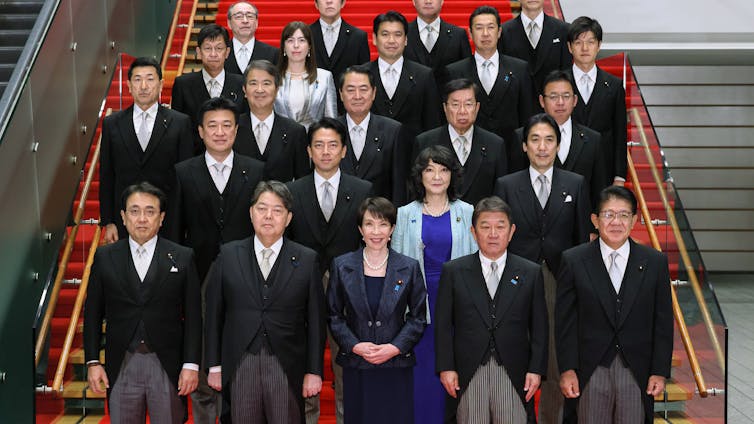
Sanae Takaichi (au centre, au premier rang), pose lors d’une séance photo avec les membres de son gouvernement à Tokyo, le 21 octobre 2025. Cabinet Public Affairs Office, CC BY-NC-SA
Le pari du PLD pour redynamiser son image
Mais l’arrivée de Mme Takaichi à la tête du PLD résulte avant tout d’un pari réalisé par une frange du parti (notamment par certains de ses caciques autrefois proches de Shinzō Abe, comme Tarō Asō) pour remédier aux récentes défaites électorales subies d’abord à la Chambre basse en 2024, puis à la Chambre haute en 2025.
En faisant d’elle le nouveau visage du parti, les objectifs étaient multiples. Il s’agissait tout d’abord de redonner une image dynamique à un PLD frappé par plusieurs scandales (liens avec la secte Moon, financements de campagne illégaux, etc.), ce que les trois précédents premiers ministres (2020-2025), aux styles parfois très austères, avaient peiné à réaliser.
Cette personnalisation de la politique n’est pas nouvelle au Japon, mais il est clair, depuis les années 2000, que la figure et le style du premier ministre ont désormais un impact déterminant sur les résultats électoraux du parti. Les cadres du PLD, conscients que leur destin est étroitement lié à la perception que l’opinion publique a de leur chef, n’hésitent pas à mettre entre parenthèses leurs éventuels désaccords et leurs luttes intrapartisanes.
Bien entendu, le parti n’avait aucun doute quant au fait que la candidate avait la ferme intention de ne surtout rien changer en substance concernant la gouvernance du PLD ou les règles de financement de campagne – en dépit du slogan et mot-dièse #KawareJimintō (#ChangePLD !) utilisé dans les réseaux sociaux officiels du parti lors de cette élection à la présidence.
Ainsi, Sanae Takaichi sait également qu’elle doit cette élection à la tête du parti au soutien de personnages essentiels qui n’hésiteront pas à la pousser vers la sortie s’ils estiment qu’elle les dessert plus qu’elle ne les sert. Elle qui a plusieurs fois évoqué son admiration pour Margaret Thatcher doit sûrement se rappeler de la violence et de la rapidité avec laquelle le Parti conservateur britannique avait évincé la Dame de fer. Elle a conscience que seules de multiples victoires électorales pourraient lui permettre de consolider sa place à la tête du parti. C’est ce qui avait permis à son autre modèle, Shinzō Abe, de battre le record de longévité au poste de premier ministre (sept ans et huit mois).
C’est justement sur ce point que Mme Takaichi a su convaincre son parti. L’un de ses atouts évidents réside dans le fait qu’elle semblait être la seule à pouvoir potentiellement capter la fraction de l’électorat qui s’était tournée vers le parti d’extrême droite Sanseitō aux dernières élections à la Chambre haute (il y avait obtenu 14 sièges).
En ce sens, contrairement aux élections à la présidence du PLD de 2021 et 2024 où elle avait terminé respectivement troisième puis seconde, sa candidature arrivait cette fois-ci à point nommé puisque, sur bien des sujets, ses positions très conservatrices sont alignées sur celles du Sanseitō (par exemple sur les questions migratoires).
Une redéfinition des alliances : le « virage à droite »
Par ailleurs, ce « virage à droite » peut aussi être vu comme une manifestation du mouvement de balancier (furiko no genri) observé depuis longtemps au sein du PLD, qui consiste en une alternance à sa tête entre des figures tantôt plus libérales, tantôt plus conservatrices.
Ce phénomène, qualifié d’« alternance factice » (giji seiken kōtai) par les spécialistes, est souvent invoqué comme explication de l’extraordinaire longévité de la domination du PLD (soixante-cinq années au pouvoir entre 1955 et 2025) ; il donnerait en effet à l’électeur la vague impression d’un changement sans pour autant qu’une autre force politique s’empare du pouvoir.
Cela étant dit, certaines choses ont d’ores et déjà changé. À la suite de la nomination de Mme Takaichi à la présidence du PLD, le Kōmeitō, parti bouddhiste qui formait avec lui une coalition depuis vingt-six ans (1999), a décidé d’en sortir. Officiellement, le Kōmeitō a expliqué son geste par le refus de la première ministre de réguler davantage les dons réalisés par les entreprises aux partis politiques (le PLD perçoit la quasi-totalité des dons faits par des entreprises au Japon).
Cependant, on peine à voir pourquoi cette réforme deviendrait aussi soudainement une condition sine qua non de sa participation au gouvernement alors que le Kōmeitō a, au cours de cette dernière décennie, fait des concessions que son électorat – par ailleurs très féminin et essentiellement composé des membres de la secte Sōka gakkai – a eu bien du mal à digérer, notamment la réforme de 2015 qui a élargi les cas dans lesquels les Forces d’autodéfense japonaises peuvent intervenir à l’étranger. C’est en réalité plutôt là que se trouve la raison pour laquelle ce parti, pacifiste et présentant une fibre plus « sociale », a décidé de quitter cette alliance qui ajoutait désormais à l’inconvénient d’être une coalition minoritaire avec un PLD affaibli, celui d’opérer un virage à droite qui n’allait pas manquer de crisper ses soutiens.
Mais, alors que la situation du PLD semblait encore plus critique – au point que l’élection de sa présidente comme première ministre devenait très incertaine –, Nippon Ishin no kai, le parti de la restauration du Japon, est venu à sa rescousse.
Ce parti, dont l’assise électorale se concentre dans la région d’Ōsaka, était demeuré dans l’opposition depuis sa création en 2015. Pour autant, en dehors de son ancrage local, il ne se distinguait pas vraiment du PLD sur le plan idéologique et votait de fait en faveur de la plupart de ses projets de loi. Son président, l’actuel gouverneur d’Ōsaka Hirofumi Yoshimura, suit, tout comme son fondateur Tōru Hashimoto, avocat devenu célèbre sur les plateaux de télévision, une ligne néolibérale et sécuritaire, saupoudrée de déclarations populistes anti-establishment, nationalistes et parfois clairement révisionnistes.
La compatibilité avec le PLD, désormais menée par Sanae Takaichi, n’a probablement jamais été aussi grande. Le parti a néanmoins pris la précaution de ne pas intégrer le gouvernement, et il sait qu’en dépit du fait qu’il ne possède qu’une trentaine de sièges à la Chambre basse (environ 7 %), il est celui qui peut à tout moment le faire tomber (le PLD occupe à l’heure actuelle 196 sièges, sur les 465 de la Chambre basse).
De la Dame de fer à la Dame d’étain ?
Pour autant, doit-on s’attendre à ce que ces nouvelles alliances accouchent d’importantes évolutions au niveau des politiques publiques ? C’est plus qu’improbable.
Même sur la question migratoire, Mme Takaichi ne pourra pas revenir sur la politique volontariste engagée en 2019 par Shinzō Abe lui-même, lequel avait bien été obligé d’accéder aux doléances du monde économique (soutien indispensable du PLD) confronté à une pénurie de main-d’œuvre dans plusieurs secteurs (construction, hôtellerie, etc.). Le pays comptait en 2024 environ 3,6 millions d’étrangers sur son sol (3 % de la population totale), dont environ 56 % ont entre 20 ans et 39 ans. Plus de 23 % sont Chinois, 17 % Vietnamiens et 11 % Sud-Coréens. Bien que ces chiffres soient relativement modestes, il convient de rappeler que la population immigrée au Japon a augmenté de 69 % au cours de ces dix dernières années.
Bien sûr, tout comme Shinzō Abe, la première ministre ne manquera pas d’afficher sa fermeté et fera peut-être adopter quelques mesures symboliques qui n’auront qu’un impact numérique marginal.
Elle pourrait certes avoir les coudées plus franches si elle décidait de dissoudre la Chambre basse et remportait ensuite une large victoire électorale qui redonnerait à son parti une confortable majorité. Son taux de soutien actuel dans l’opinion publique (autour de 70 %), et les prévisions favorables au PLD concernant le report des votes des électeurs du Sanseitō, du parti conservateur et du parti de la restauration du Japon (environ 25 % de report vers le PLD), pourraient bien l’inciter à adopter cette stratégie.
Cependant, ce soutien dans l’opinion (notamment chez les jeunes où le taux atteint les 80 %) n’est guère le produit de ses positions conservatrices, mais plus le résultat d’une communication – aussi redoutable que superficielle – qui fait espérer un renouveau. C’est bien plus sur l’amélioration de la situation économique d’un Japon durement frappé par l’inflation (notamment liée à des importations rendues coûteuses par un yen faible) que la cheffe du gouvernement est attendue.
Ses premières déclarations en tant que première ministre montrent que Mme Takaichi en est bien consciente et qu’elle va par ailleurs devoir assouplir ses positions sur plusieurs thèmes. En somme, la Dame de fer va devoir opter pour un alliage plus malléable.
Arnaud Grivaud ne travaille pas, ne conseille pas, ne possède pas de parts, ne reçoit pas de fonds d’une organisation qui pourrait tirer profit de cet article, et n’a déclaré aucune autre affiliation que son organisme de recherche.
Source: The Conversation – France in French (3) – By Ayouba Sow, Doctorant en Science de l’information et de la communication à l’Université Côte D’Azur, laboratoire SIC.Lab Méditerranée., Université Côte d’Azur
De nombreux articles ont déjà été publiés sur la pénurie de carburant provoquée au Mali par le blocus que les djihadistes imposent à la quasi-totalité du pays. La présente analyse propose une approche communicationnelle de cette crise sans précédent.
Dans une guerre, qu’elle soit conventionnelle ou asymétrique, comme c’est le cas au Mali et plus largement au Sahel, il est déconseillé de porter un coup avant d’en mesurer les conséquences. La pénurie de carburant actuelle résulte de l’amateurisme des autorités maliennes, qui ont été les premières à interdire la vente de carburant aux citoyens venant s’approvisionner avec des bidons. Cette décision s’inscrit dans leur stratégie visant à couper la chaîne d’approvisionnement des djihadistes afin de réduire la mobilité de ceux-ci. Dans la région de Nioro, les autorités militaires ont interdit, le 30 juillet 2025, « la vente de carburant dans des bidons ou des sachets plastiques ». Rappelons que les djihadistes ne sont pas les seuls à utiliser les bidons : les populations rurales s’en servent aussi, pour de multiples usages, notamment pour le fonctionnement des équipements agricoles.
À la suite de la décision du 30 juillet, le Groupe de soutien à l’islam et aux musulmans (Jama’at Nusrat ul-Islam wa al-Muslimin, JNIM) a étendu l’interdiction à l’ensemble de la population. Ainsi, dans une vidéo publiée le 3 septembre, l’organisation terroriste a adressé un message aux commerçants et aux chauffeurs de camions-citernes qui importent des hydrocarbures depuis les pays côtiers voisins du Mali, à savoir la Côte d’Ivoire, la Guinée, le Sénégal et la Mauritanie. Elle a annoncé des représailles à l’encontre de quiconque violerait cette décision.
Assis en tenue militaire, Nabi Diarra, également appelé Bina Diarra, porte-parole du JNIM, explique en bambara les raisons de ce blocus. Son porte-parolat met à mal l’argument selon lequel les djihadistes seraient exclusivement des Peuls, car Nabi Diarra est bambara. D’après lui :
« Depuis leur arrivée, les bandits qui sont au pouvoir les [militaires, ndlr] fatiguent les villageois en fermant leurs stations-service. Pour cette raison, nous avons également décidé d’interdire toutes vos importations d’essence et de gasoil, jusqu’à nouvel ordre. […] Ces bandits ont voulu priver les villageois d’essence et de gasoil, pensant que cela arrêterait notre activité de djihad. Est-ce qu’un seul de nos véhicules ou de nos motos s’est arrêté depuis le début de cette opération ? Aucun ! Nous continuons notre travail. Les conséquences ne touchent que les plus vulnérables. »
Après cette annonce, une centaine de camions-citernes ont été incendiés par les djihadistes sur différents axes. Des vidéos ont été publiées sur les réseaux sociaux par les auteurs afin de démontrer leurs capacités de nuisance. Dans une vidéo que nous avons pu consulter, un homme à moto montre près d’une quarantaine de camions-citernes incendiés sur la route nationale 7, entre Sikasso et la frontière ivoirienne.
Dans sa vidéo annonçant le blocus, le JNIM a également interdit la circulation de tous les autobus et camions de la compagnie Diarra Transport, qu’il accuse de collaborer avec l’État malien. Depuis, la compagnie a cessé ses activités. Après un mois d’inactivité, le 6 octobre, sa directrice générale Nèh Diarra a publié une vidéo sur les réseaux sociaux pour justifier les actions de son entreprise et, indirectement, présenter ses excuses aux djihadistes dans l’espoir que ces derniers autorisent ses véhicules à reprendre la route.
Nèh Diarra, directrice générale de Diarra Transport, présente ses excuses. Capture d’écran, Fourni par l’auteur
Le 17 octobre, dans une autre vidéo, arme de guerre et talkie-walkie en main, le porte-parole du JNIM a autorisé la reprise des activités de la compagnie de transport, dans un discours au ton particulièrement clément :
« Nous sommes des musulmans, nous sommes en guerre pour l’islam. En islam, si vous vous repentez après une faute, Allah accepte votre repentir. Donc, les gens de Diarra Transport ont annoncé leur repentir, nous allons l’accepter avec quelques conditions. La première est de ne plus vous impliquer dans la guerre qui nous oppose aux autorités. Transportez les passagers sans vérification d’identité. La deuxième condition va au-delà de Diarra Transport : tous les transporteurs, véhicules personnels, même les mototaxis, doivent exiger des femmes qu’elles portent le hijab afin de les transporter. »
Pour finir, il exige de tous les conducteurs qu’ils s’arrêtent après un accident afin de remettre les victimes dans leurs droits. Une manière de montrer que les membres du JNIM sont des justiciers, alors qu’ils tuent fréquemment des civils innocents sur les axes routiers. Le cas le plus récent et le plus médiatisé remontait à deux semaines plus tôt : le 2 octobre, le JNIM avait mitraillé le véhicule de l’ancien député élu à Ségou et guide religieux Abdoul Jalil Mansour Haïdara, sur l’axe Ségou-Bamako, le tuant sur place. Il était le promoteur du média Ségou TV.
Dans les gares routières de Diarra Transport, des scènes de liesse ont suivi l’annonce de la reprise. La compagnie a même partagé la vidéo du JNIM sur son compte Facebook, avant de la supprimer plus tard. Le lendemain, elle a annoncé la reprise de ses activités, avant que le gouvernement malien ne les suspende à son tour.
Revenons au blocus sur le carburant. Il ne concerne pas uniquement Bamako, comme on peut le lire dans de nombreux articles de presse. Il couvre l’ensemble du territoire national.
Cependant, les médias concentrent leur couverture sur la situation dans la capitale, principal symbole politique de la souveraineté des autorités en place. Les analyses, notamment celles des médias étrangers, gravitent autour d’une question centrale : Bamako va-t-elle tomber ? Nous répondons : le Mali ne se limite pas à Bamako. Toutes les localités du pays sont affectées par ce blocus. Les habitants des autres localités méritent autant d’attention que les Bamakois.
Pays enclavé, au commerce extérieur structurellement déficitaire, le Mali dépend totalement des importations. Les régions de Kayes, plus proche du Sénégal, et de Sikasso, plus proche de la Côte d’Ivoire, sont toutefois moins impactées par ce blocus, qui est particulièrement concentré autour de Bamako. Les attaques sont principalement menées sur les voies menant à la capitale. Des actions sporadiques ont également été signalées sur l’axe Bamako-Ségou, afin de priver les régions du centre, comme Ségou et Mopti, d’hydrocarbures. Dans la ville de Mopti, les habitants manquent de carburant depuis deux mois. Depuis un mois, ils n’ont pas eu une seule minute d’alimentation électrique. Ils ne réclament d’ailleurs plus l’électricité, devenue un luxe : ils recherchent plutôt du carburant pour pouvoir vaquer à leurs occupations.
La violence des mots pour camoufler l’insuffisance des actes
Confrontées à la crise, les autorités, tant régionales que nationales, ont préféré masquer l’impuissance par la désinformation, l’appel mécanique à la résilience et la censure des voix critiques.
Le 23 septembre, le gouverneur de la région de Mopti a présidé une réunion de crise consacrée à la pénurie de carburant. Au lieu de s’attaquer aux racines du mal, le directeur régional de la police, Ibrahima Diakité, s’en est pris aux web-activistes de la région, couramment appelés « videomen (ils prononcent videoman) » au Mali, qui, selon lui, se font particulièrement remarquer par leur « incivisme ». Les créateurs de contenus sont blâmés et menacés par la police pour avoir diffusé des faits et alerté sur les souffrances qu’ils vivent, à l’image de l’ensemble de la population. Au lieu de s’en prendre aux djihadistes, M. Diakité dénigre les citoyens qui publient sur les réseaux sociaux des images de longues files de conducteurs attendant désespérément d’être servis dans les stations-service :
« Si nous entendons n’importe quel “videoman” parler de la région de Mopti, il ira en prison. Il ira en prison ! Celui qui parle au nom de la région ira en prison, parce que c’est inadmissible ! […] Ils mettent Mopti en sellette, oubliant que les réseaux [sociaux, ndlr] ne se limitent pas au Mali. »
Il exige donc de censurer tout propos mettant en évidence l’incompétence des autorités à pallier un problème qui compromet leur mission régalienne. Au lieu de rassurer la population en annonçant des politiques qui atténueront sa souffrance, il opte pour la censure et la menace d’emprisonnement. Dans sa vocifération autoritaire, il mobilise un récit classique en appelant à préserver l’image du pays et en présentant les web-activistes comme des ennemis de celui-ci, des ignorants qui ne comprennent rien aux événements en cours :
« On est dans une situation où les gens ne comprennent rien de ce qui se passe dans leur pays et ils se permettent de publier ce genre de vidéo. Mais c’est le Mali tout entier qui est vilipendé à travers ce qu’ils disent, parce que le monde le voit. […] Ils sont en train d’aider l’ennemi contre le pays. Monsieur le gouverneur, il faut saisir le moment pour remettre ces gens à leur place, pour les amener à comprendre que, dans un État, tant que tu es Malien et que tu restes au Mali, tu respectes la loi ; sinon, tu quittes notre pays si tu ne veux pas te soumettre aux lois de la République. »
Le policier s’est substitué au législateur en appelant le gouverneur à adopter une loi autorisant la censure médiatique locale de cette crise.
Dans les heures qui ont suivi, de nombreux journalistes et web-activistes l’ont interpellé sur les réseaux sociaux pour obtenir des explications concernant l’existence d’une loi malienne prohibant la diffusion d’informations factuelles. Les contenus des web-activistes n’ont pas pour objectif de ternir l’image du pays. Contrairement à ce que laisse entendre le directeur régional de la police, il n’est pas plus malien qu’eux. Il ne lui revient pas non plus de décider qui doit quitter le pays.
Nous observons un clivage général au sein de la population malienne. Les dirigeants et leurs soutiens estiment que tous les citoyens doivent obligatoirement soutenir la transition. Ceux qui la critiquent sont qualifiés de mauvais citoyens, voire d’apatrides. Cette pression a étouffé le pluralisme et la contradiction dans l’espace médiatique.
« Ils ont su créer la pénurie de carburant dans la tête des Maliens »
Pendant que les citoyens passent la nuit dans les files d’attente pour s’approvisionner en carburant, l’un des désinformateurs du régime, adepte des théories du complot, Aboubacar Sidiki Fomba, membre du Conseil national de transition, a livré, dans un entretien avec un videoman, des explications qui défient tout entendement. Dans cette vidéo publiée le 7 octobre, il établit un lien entre la stratégie du JNIM et la volonté de l’Alliance des États du Sahel (AES, qui regroupe le Mali, le Burkina Faso et le Niger) de créer sa propre monnaie. D’après lui, l’objectif de ce blocus, qu’il présente comme la dernière stratégie des terroristes, est de porter atteinte au pouvoir d’Assimi Goïta et à l’AES :
« Ils attaquent les citernes, puis font croire aux populations qu’il y a une pénurie de carburant, alors qu’il n’y en a pas. Mais ils convainquent tout le monde qu’il y a une pénurie. Ils créent la psychose. Sous l’effet de la panique, les citoyens provoquent eux-mêmes une pénurie qui, à l’origine, n’existait pas. »
Dans la même vidéo, il dissocie les coupures d’électricité de la pénurie de carburant, expliquant les premières par des problèmes de remplacement de câbles électriques défaillants. Pourtant, c’est bien le manque de carburant qui est à l’origine des coupures d’électricité observées ces dernières années. Le blocus n’a été qu’un accélérateur d’une crise énergétique déjà déclenchée. Il a considérablement réduit les capacités de production énergétique. Selon une étude conduite par le PNUD, en 2020, « la production électrique était de 2 577,44 GWh (69 % thermique, 26,8 % hydraulique et 4,2 % solaire photovoltaïque) ».
Le pays doit accélérer sa transition énergétique afin de réduire sa dépendance aux importations d’hydrocarbures et de limiter ses émissions de gaz à effet de serre. En plus de la crise énergétique, ce blocus a également entraîné une pénurie d’eau potable dans la région de Mopti, le gasoil étant utilisé pour la production et la distribution d’eau.
Le même parlementaire s’est ensuite attaqué aux conducteurs de camions-citernes, les accusant de « complicité avec les terroristes ». Selon lui, les conducteurs simuleraient des pannes pour quitter les convois escortés par l’armée et revendre leur cargaison d’hydrocarbures aux groupes djihadistes. À la suite de cette déclaration, le Syndicat national des chauffeurs et conducteurs routiers du Mali (Synacor) a lancé un mot d’ordre de grève et déposé une plainte contre Fomba pour diffamation. Au lieu d’apporter la preuve de ses accusations, ce dernier a finalement présenté ses excuses aux conducteurs de camions-citernes. Il avait auparavant annoncé la mort de Nabi Diarra et qualifié de deepfake les vidéos du porte-parole du JNIM – une énième fausse information. Par la suite, le porte-parole a diffusé des vidéos dans lesquelles il précise la date d’enregistrement et se prononce sur des faits d’actualité.
Le pouvoir dénonce la piste ukrainienne
Au sommet de l’État, lors d’un déplacement dans la région de Bougouni le 3 novembre, le président de la transition a appelé les Maliens à faire preuve de résilience et à limiter les sorties inutiles. Assimi Goïta a tenté de rassurer la population et de dissuader ceux qui apportent leur aide aux djihadistes : « Si nous refusons de mener cette guerre, nous subirons l’esclavage qui en sera la conséquence », a-t-il déclaré face aux notables de la région. Il a salué le courage des chauffeurs et des opérateurs économiques pour leurs actes de bravoure. En effet, depuis l’instauration du blocus, les premiers risquent leur vie, et les seconds voient leur investissement menacé.
Assimi Goïta a laissé entendre que des puissances étrangères soutiennent les actions des djihadistes. Il convient de rappeler que l’Ukraine a apporté son aide aux rebelles séparatistes du Cadre stratégique permanent (CSP), lesquels coopèrent parfois avec le JNIM dans le nord du pays. Alors que les djihadistes revendiquent l’application de la charia, les rebelles exigent la partition du territoire. Les deux mouvements se sont, à plusieurs reprises, alliés pour combattre l’armée malienne. Le 29 juillet 2024, Andriy Yusov, porte-parole du renseignement militaire ukrainien (GUR), a sous-entendu, lors d’une émission de télévision locale, que son service était en relation avec les rebelles indépendantistes du nord du Mali. Après la dissolution du CSP fin 2024, l’Ukraine a poursuivi son aide au groupe rebelle qui a pris le relais au nord du Mali, le Front de Libération de l’Azawad (FLA). Parmi les actions, nous pouvons noter « la visite de conseillers militaires ukrainiens dans un camp du FLA l’an dernier. Dans la foulée, plusieurs combattants du FLA sont envoyés en Ukraine. De retour dans le désert, ils adoptent les mêmes tactiques que celles de l’armée ukrainienne contre les positions russes ».
Cette aide fournie par l’Ukraine s’inscrit dans le prolongement du conflit qui l’oppose à la Russie, devenue le principal partenaire du Mali dans la lutte contre le terrorisme depuis la fin de la coopération militaire avec la France en 2022. Grâce à ce nouveau partenariat, la ville de Kidal contrôlée par les rebelles depuis 2012 a pu être reprise en novembre 2023. Toutefois, la situation sécuritaire s’est détériorée dans le reste du pays, les djihadistes ayant renforcé leur influence et étendu leur présence à l’ensemble des régions.
Les autorités maliennes estiment que cette assistance ukrainienne est soutenue par la France, qui souhaiterait l’échec de la transition. Dans leurs éléments de langage, les responsables de la transition expliquent tous leurs problèmes par des complots contre leur régime et contre le Mali. Toutes les difficultés et incompétences sont justifiées par « l’acharnement de la France » contre la transition. L’ancienne puissance coloniale a pour sa part ouvertement montré son opposition à cette transition qu’Emmanuel Macron qualifie de « l’enfant de deux coups d’État ».
La guerre de communication est au cœur de la crise malienne et ne semble pas devoir s’arrêter si tôt. Pendant que les médias occidentaux commentent l’éventualité d’une prise de Bamako par le JNIM, le gouvernement malien a inauguré le 11 novembre le Salon international de la défense et de la sécurité intitulé Bamex 25. Cette exposition turque est, pour la transition malienne, un autre moyen de communiquer au monde que la situation sécuritaire est sous contrôle.
Ayouba Sow ne travaille pas, ne conseille pas, ne possède pas de parts, ne reçoit pas de fonds d’une organisation qui pourrait tirer profit de cet article, et n’a déclaré aucune autre affiliation que son organisme de recherche.
Source: The Conversation – Canada – By Kerry McCuaig, Fellow in Early Childhood Policy, Atkinson Centre, Ontario Institute for Studies in Education, University of Toronto
Both the auditor general of Canada and the auditor general of Ontario have warned that the Canada-Wide Early Learning and Child Care (CWELCC) program, while successful in lowering fees, is failing to meet its other commitments — inclusion, quality and equitable access.
The $10-a-day plan was meant to be a nation-building project — one that gives every child, regardless of background, an equal start in life.
But affordability without equity is a hollow victory. If governments fail to correct course, inequities will harden into the system’s design, and the intergenerational cycle of poverty will deepen.
Subsidies down
Low-income families have traditionally been eligible for government subsidies to help pay for care. For the poorest families, the subsidy can cover the entire cost.
Competition intensifies — and more affluent families, who have greater networks and resources, move to the front of the line.
This is a well-documented social pattern known as the Matthew effect: advantage begets more advantage.
The problem is compounded by the fact that CWELCC-funded programs are not required to enrol families receiving subsidies.
By mid-2025, according to reports published on the City of Toronto open data portal, roughly 30 per cent of Toronto’s CWELCC programs — representing over one-third of all infant-to-preschool spaces — had no contract with the city to serve subsidized children.
Funding structures further entrench inequity. Fee subsidies are paid from provincial budgets, while CWELCC affordability funding comes from the federal government.
When families stop using subsidies — because spaces are unavailable or eligibility rules too restrictive — provinces and territories save money, while still benefiting politically from federal investments that make care appear more affordable.
On Nov. 10, Ontario announced a one-year extension of its federal child-care deal, maintaining current funding terms while a longer agreement is negotiated. The extension preserves the current fee — roughly $22 a day — but does nothing to address the inequities embedded in the system.
Even if new funding materialized, money alone wouldn’t fix the problem. Federal and provincial governments control the purse strings, but in Ontario, regional policymakers already have the tools — and the responsibility — to act.
They allocate subsidies, set local priorities and conduct annual program reviews. With stronger direction, they could require all CWELCC-funded programs — both for-profit and non-profit — to:
Accept subsidized children as a condition of continued funding;
Set targets for equitable access based on local demographics.
In areas identified as child-care deserts, where demand far outstrips supply, service managers could also give priority to neighbourhood families until new facilities are built.
Danger of unchecked for-profit expansion
Equity cannot be achieved by giving for-profit operators a free hand — yet that’s exactly what’s happening across several provinces.
For-profit growth has exceeded the limits set in child-care agreements. These operators naturally expand where profits are fastest — in higher-income communities. The result: rapid growth in affluent areas and stagnation in places where families most need affordable, high-quality care.
Ontario’s auditor general flagged this trend, finding that nearly half of all new licensed spaces were in for-profit centres — despite federal and provincial commitments to prioritize non-profit and public expansion.
Unfettered commercial growth not only weakens public accountability but also deepens the inequities the federal child-care program was meant to eliminate.
A system designed to build a public good cannot rely on private profit as its engine.
Redirect the savings
The one-year CWELCC extension gives Ontario breathing room to get this right. By our calculations, holding the line at a $22 daily fee — rather than dropping to the promised $12 — would free up roughly $100 million in Toronto alone.
Those funds could expand care in low-income neighbourhoods, strengthen program quality, stabilize the educator workforce and rein in for-profit expansion.
Contrary to political fears, this would not cause undue hardship for middle-income families. After applying existing federal and provincial tax benefits, the median Ontario family with two children in care pays approximately $15 per child per day, which is close to the $12 goal.
The greater hardship lies with families who still can’t find a space at all.
Expanding subsidies won’t fix structural inequality. Under current rules, parents must prove they are employed, in school or meeting specific “activity” requirements to qualify.
These conditions exclude children whose parents are outside the labour market — precisely those who could benefit most from early education.
These rules should be scrapped. Every child deserves access to quality care, regardless of their parents’ work status.
A choice about values
Over time, Canada should move toward a universal, income-based model — similar to the Canada Child Benefit — where all children qualify for early learning and fees are scaled to family income. Fees based on the family’s ability to pay are well-established in Nordic countries.
This would replace the costly and complex patchwork of subsidies and flat fees with a simpler and fairer system.
The next phase of Canada’s early learning and child-care plan must put equity at its centre — not as an afterthought, but as the measure of success.
Canada has already proven it can make child care affordable. Now it must make it fair.
Kerry McCuaig receives funding from the Margaret and Wallace McCain Family Foundation, The Lawson Foundation, Atkinson Foundation and the Waltons Trust.
Michal Perlman receives funding from the Social Sciences and Humanities Research Council, the Canadian Institutes of Health Research, the Data Science Institute at the University of Toronto, the Margaret and Wallace McCain Family Foundation and the Lawson Foundation.
Nina Howe has received funding from the Social Sciences and Humanities Research Council of Canada and the Economic and Research Council of the UK..
Petr Varmuza is affiliated with B2C2 – (Building Blocks for Child Care) as an advisory board member
Source: The Conversation – USA (2) – By Jay Gulledge, Visiting Professor of Practice in Global Affairs, University of Notre Dame; University of Tennessee
You might not know it from the headlines, but there is some good news about the global fight against climate change.
A decade ago, the cheapest way to meet growing demand for electricity was to build more coal or natural gas power plants. Not anymore. Solar and wind power aren’t just better for the climate; they’re also less expensive today than fossil fuels at utility scale, and they’re less harmful to people’s health.
Yet renewable energy projects face headwinds, including in the world’s fast-growing developing countries. I study energy and climate solutions and their impact on society, and I see ways to overcome those challenges and expand renewable energy – but it will require international cooperation.
Falling clean energy prices
As their technologies have matured, solar power and wind power have become cheaper than coal and natural gas for utility-scale electricity generation in most areas, in large part because the fuel is free. The total global power generation from renewable sources saved US$467 billion in avoided fuel costs in 2024 alone.
As a result of falling prices, over 90% of all electricity-generating capacity added worldwide in 2024 came from clean energy sources, according to data from the International Renewable Energy Agency.
Burning coal, oil and natural gas releases tiny particles into the air along with toxic gases; these pollutants can make people sick. A recent study found air pollution from fossil fuels causes an estimated 5 million deaths worldwide a year, based on 2019 data.
Fossil fuels are also the leading sources of climate-warming greenhouse gases. When they’re burned to generate electricity or run factories, vehicles and appliances, they release carbon dioxide and other gases that accumulate in the atmosphere and trap heat near the Earth’s surface. That accumulation has been raising global temperatures and causing more heat stress, respiratory illnesses and the spread of disease.
Electrifying buildings, cars and appliances, and powering them with renewable energy, reduces these air pollutants while slowing climate change.
So what’s the problem?
In spite of the demonstrated economic and health benefits of transitioning to renewable energy, regulatory inertia, political gridlock and a lack of investment are holding back renewable energy deployment in much of the world.
The 2024 Energy Permitting Reform Act introduced by Sens. Joe Manchin, a Democrat from West Virginia, and John Barrasso, a Republican from Wyoming, to speed approvals failed to pass. Manchin called it “just another example of politics getting in the way of doing what’s best for the country.”
These countries need to meet soaring energy demand. The International Energy Agency expects emerging economies to account for 85% of added electricity demand from 2025 through 2027. Yet renewable energy development lags in most of them. The main reason is the high price of financing renewable energy construction.
Most of the cost of a renewable energy project is incurred up front in construction. Savings occur over its lifetime because it has no fuel costs. As a result, the levelized cost of energy (LCOE) for those projects varies depending on the cost of financing to build them. The chart shows what happens when borrowing costs are higher in developed countries. It illustrates the share of financing in each project’s levelized cost of energy in 2024 versus the weighted average cost of capital (WACC). The yellow dots are solar projects; black and gray are offshore and onshore wind. Adapted from IRENA, 2025, CC BY
In many developing countries, wind and solar projects cost more to finance than coal or gas. Fossil projects have a longer history, and financial and policy mechanisms have been developed over decades to lower lender risk for those projects. These include government payment guarantees, stable fuel contracts and long-term revenue deals that help guarantee the lender will be repaid.
Both lenders and governments have less experience with renewable energy projects. As a result, these projects often come with weaker government guarantees. This raises the risk to lenders, so they charge higher interest rates, making renewable projects more expensive upfront, even if the projects have lower lifetime costs.
To lower borrowing costs, governments and international development banks can take steps to make renewable projects a safer bet for investors. For example, they can keep energy policies stable and use public funds or insurance to cover part of the lenders’ investment risk.
China produces the vast majority of solar cells sold worldwide. The Chinese government has also built renewable energy projects in many Latin America countries and other developing regions. AFP via Getty Images
Without international cooperation to lower finance costs, developing economies could miss out on the renewable-energy revolution and lock in decades of growing greenhouse gas emissions from fossil fuels, making climate change worse.
Achieving this goal won’t be easy, but it is significantly less difficult now that renewable energy is more affordable over the long run than fossil fuels.
Switching the world’s power supply to renewable energy and electrifying buildings and local transportation would cut about half of today’s greenhouse-gas emissions. The other half comes from sectors where it is harder to cut emissions — steel, cement and chemical production, aviation and shipping, and agriculture and land use. Solutions are being developed but need time to mature. Good governance, political support and accessible finance will be critical for these sectors as well.
The transition to renewable energy offers big economic and health benefits alongside lower climate risks — if countries can overcome political obstacles at home and cooperate to expand financing for developing economies.
Jay Gulledge is affiliated with PSE Healthy Energy
Not long ago, the idea of getting paid to share your morning routine online would have sounded absurd. Yet today, influencers are big business: The global market is expected to surpass US$32 billion by the end of 2025.
Rooted in celebrity culture but driven by digital platforms, the influencer economy represents a powerful force in both commerce and culture. I’m an expert on digital consumer research, and I see the rise of influencers as an important evolution in the relationship between companies, consumers and creators.
Historically, brands leaned on traditional celebrities like musicians, athletes and actors to endorse their products. However, by the late 2000s, social media platforms opened the door for everyday people to build audiences. Initially, influencers were viewed as a low-cost marketing tactic. Soon, however, they became a central part of marketing strategies.
In the 2010s, influencer marketing matured into a global industry. Agencies and digital marketplaces emerged to professionalize influencer-brand matchmaking, and regulators like the Federal Trade Commission started paying more attention to sponsored content.
The rise of video and short-form content like TikTok and Reels in the mid-2010s and 2020s added authenticity and emotional immediacy. These dynamics deepened influencer-follower relations in ways that brands couldn’t easily replicate. Influencers are now recognized as not only content creators, but also as entrepreneurs and cultural producers.
Why people trust influencers
Social media influencers often foster what researchers call “parasocial relationships” – one-sided bonds where followers feel as if they personally know the influencer. While the concept has roots in traditional celebrity culture, influencers amplify it through consistent, seemingly authentic content.
This perceived intimacy helps explain why consumers often trust influencers more than brands. Though the parasocial relationship isn’t mutual, it feels real. That emotional closeness cultivates trust, a scarce but powerful currency in today’s economy.
The goal for many influencers may be financial independence, but the path begins with social and cultural capital, acquired through community connection, relatability and niche expertise. As an influencer’s following grows, so does their perceived legitimacy. Brands, in turn, recognize and tap into that legitimacy.
Although risks exist, like algorithmic incentives and commercial partnerships that undercut authenticity, many influencers successfully navigate this tension to preserve their community’s trust.
The many ways creators add value
Like any economy, the influencer economy revolves around value exchange. Followers spend their valuable resources – time and attention – in return for something meaningful. Researchers have identified several forms of value that influencers’ content can take:
Connection, or what researchers call “social value”: Influencers often build tight-knit communities around shared interests. Through live chats, comments and relatable storytelling, they offer a sense of belonging.
Fun, or “hedonic value”: Many influencers provide enjoyment using entertainment, humor and a touch of allure in their content. Think cat videos, TikTok dances and random acts of kindness that deliver joy and distraction from the day-to-day.
Knowledge, or “epistemic value”: Creators offer informational or educational content to feed consumer curiosity. This can be through tutorials, product reviews or deep dives into niche topics.
Usefulness, or “utilitarian value”: From life hacks to product roundups, like “Amazon must-haves,” influencers provide utilitarian or practical value to help simplify consumer decisions and solve everyday problems.
Money, or “financial value”: People love finding a bargain. Discounts, affiliate links and deal alerts offer direct economic benefit to followers. Some influencers even launch their own products or digital courses, delivering long-term value through entrepreneurial spinoffs.
These forms of value often overlap, reinforcing trust, and can pay off financially for influencers. In fact, consumers are significantly more likely to trust user-generated content like influencer posts over brand-generated advertising.
Lessons for brands
First, there’s evidence that smaller is often stronger. Marketing researchers categorize influencers based on how many followers they have, and nano- and microinfluencers – defined as those with fewer than 10,000 and 100,000 followers, respectively – often generate stronger engagement than mega-influencers with more than 1 million. Influencers with smaller followings can interact with their communities more closely, making their endorsements feel more credible.
This has driven brands to focus on mid-tier and microinfluencers, where return on investment is often stronger. As a result, influencer agencies, brokers, platforms and trade associations have sprung up to facilitate these partnerships.
Second, brands should remember that influencers’ role in the market comes with new challenges. As the field continues to become more professionalized, it’s also become more complex. Like other entrepreneurs, influencers must keep up with shifting regulations – namely, FTC sponsorship guidelines – which can lead to hefty fines if violated. Many struggle to identify how to best file their taxes when they receive freebies they are expected to build content around. It can also be a challenge for influencers to keep up with continued algorithm tweaks from the multiple social media platforms where they publish.
Influencers manage more than content creation. Their role includes quickly responding to followers’ comments and managing communities, as well as handling trolls, all of which is stressful. Personal brand management adds another layer of pressure. As influencers gain more brand partnerships, they run the risk of being seen as “selling out.” Because parasocial trust depends on being viewed as authentic, aligning with the wrong brand or being too promotional can damage the very connection that built an influencer’s following. A single misstep can trigger public backlash.
While growing a following can bring brand recognition and financial independence, some influencers even fear that they will lose their own identity. Influencers can struggle with work-life balance, as this is not a nine-to-five job. It requires being “always on” and the constant blurred lines. Their lives become their livelihoods, with little separation between personal and professional identity.
In short, when engaging with influencers, strategic brands will recognize that they operate within an intense, high-pressure environment. Organizations such as the American Influencer Council offer support and advocacy, but industry-wide protections are lacking.
Influencers have earned a central place in consumer culture not just by selling products, but by offering emotional proximity, cultural relevance and value. They’re not just marketers – they’re creators, community leaders and entrepreneurs.
As the creator economy continues to grow, trust will remain its cornerstone. However, the next chapter will require thoughtful navigation of issues like regulation, platform ethics and creator well-being. Understanding influencers means recognizing both their creative work and the evolving market that now depends on them.
Kelley Cours Anderson does not work for, consult, own shares in or receive funding from any company or organization that would benefit from this article, and has disclosed no relevant affiliations beyond their academic appointment.
We seem to have an endless appetite for Tudor history. Films, TV shows, documentaries, books and exhibitions about this famous dynasty are produced every year. And more recently, the touring production Six has offered a compelling reimagining of Henry VIII’s wives as a work of musical theatre.
As a historian of the Tudor age, I am perhaps even more interested in these offerings than most. Here are five of my favourite TV shows about the Tudor dynasty.
1. The Six Wives of Henry VIII (1970)
Each episode of this six-part BBC series was written by a different dramatist and focused on a different wife of Henry VIII, who was played by Keith Michell.
Modern viewers will immediately notice the stripped-back nature of the production compared with contemporary shows. There are, for example, hardly any outdoors scenes. But what makes this series compelling are the outstanding performances.
Katherine Howard on screen.
Michell bears an almost unnerving resemblance to the Tudor king. And his queens are distinguished by a commitment to historical accuracy, rather than being sexualised. The character of Katherine Howard (Angela Pleasence), for example, was undoubtedly influenced by the latest academic research at the time of production.
2. Elizabeth R (1971)
This six-episode BBC drama starred Glenda Jackson as the “virgin queen” Elizabeth I. It begins in 1549, during the reign of her brother Edward VI, and ends with her death in 1603.
Jackson’s portrayal of the queen is one of the most convincing. This is in no small part due to the highly effective use of costume and makeup. In the course of playing Elizabeth from young princess to elderly monarch, Jackson had her head partially shaved in order to acquire a high hairline.
And the costumes, which recreated Elizabeth’s gowns from her portraits, were regarded as so authentic that author Robert Seatter dubbed the BBC “the pre-eminent maker of costume drama”.
Glenda Jackson in Elizabeth R.
The series explores a period of over 50 years from Elizabeth’s life, from her trials and tribulations as princess during the reigns of Edward VI and Mary I to her death as an aged queen. It also compellingly depicts Elizabeth’s highly charged relationships and dramatises key episodes from her reign, including her defeat of the Spanish Armada.
3. The Shadow of the Tower (1972)
Television shows about the first Tudor king, Henry VII, are few and far between. The Shadow of the Tower is little known today, but it offers perhaps the best portrayal of Henry on screen. This 13-episode BBC series served as a prequel to the earlier dramas The Six Wives of Henry VIII and Elizabeth R.
James Maxwell stars as a shrewd, intelligent and capable king, with Norma West as his consort Elizabeth of York and Marigold Sharman as his mother, Lady Margaret Beaufort. The series depicts momentous events from Henry’s reign, including his triumph at Bosworth and his struggles with the pretenders Lambert Simnel and Perkin Warbeck. The latter have subsequently been dramatised in later productions (The White Queen, 2013, and The White Princess, 2017) and have been the subject of recent research.
The Shadow of the Tower.
However, the undoubted strength of The Shadow of the Tower is its depiction of lesser-known events from Henry’s reign, including the 1497 Cornish Rebellion and the exploits of the navigator and explorer John Cabot.
Compared with modernised and sensationalised dramatisations of the 21st century, The Shadow of the Tower presents a believable Henry VII and his court that is grounded in historical accuracy.
4. Wolf Hall (2015, 2024)
Released in two instalments almost ten years apart, this series dramatised three of Hilary Mantel’s novels: Wolf Hall, Bring Up the Bodies and The Mirror & the Light. It explores the rise to power of Thomas Cromwell, Henry VIII’s chief minister, and his downfall and execution.
Like the other shows discussed in this article, Wolf Hall is compelling viewing because of its overall commitment to historical accuracy and the stellar performances of its cast, namely Mark Rylance as Cromwell, Damian Lewis as Henry and Claire Foy as Anne Boleyn. As in the novel, the favourable portrayal of Cromwell in the TV series presented a revisionist take that caused controversy among some historians.
The trailer for Wolf Hall.
The second season also proved controversial on account of its decision to incorporate colour-blind casting – an issue that has also emerged with regards to other contemporary TV shows including Anne Boleyn (2021).
The strength of Wolf Hall lies in offering a more nuanced portrayal of a minister traditionally regarded as a ruthless thug and bully, which has subsequently inspired further research into his life and career.
5. Becoming Elizabeth (2022)
Becoming Elizabeth is set entirely during the reign of Edward VI (1547-1553) and focuses on Elizabeth’s younger years. German actress Alicia von Rittberg stars in the titular role, with her siblings Edward and Mary played by Oliver Zetterström and Romola Garai.
The series begins after Henry VIII’s death and concludes with the illness of Edward VI. The opening episodes focus on Elizabeth’s residency in the household of her stepmother Katherine Parr and the predatory attentions of Katherine’s new husband Thomas Seymour. This attention engulfed both Seymour and Elizabeth in scandal and has been recognised by historians as a formative episode in the young royal’s life.
The trailer for Becoming Elizabeth.
This scandal is interspersed with scenes of religious and political intrigues at Edward’s court, including the machinations of the Lord Protector Edward Seymour, duke of Somerset and John Dudley, earl of Warwick. The series also dramatises lesser-known episodes from Edward’s largely neglected reign, including the outbreak of Kett’s Rebellion.
Becoming Elizabeth is a fascinating series in view of its focus on a period of Elizabeth’s life that is traditionally somewhat neglected, despite some attention from historians such as David Starkey and Nicola Tallis.
It also deserves to be regarded as one of the best TV shows about the Tudors because of the much greater attention given to Edward and Mary who, like Henry VII, have traditionally been marginalised in television.
Do you have a favourite television show about the Tudors that didn’t make our list? Let us know in the comments below.
Looking for something good? Cut through the noise with a carefully curated selection of the latest releases, live events and exhibitions, straight to your inbox every fortnight, on Fridays. Sign up here.
This article features references to books that have been included for editorial reasons, and may contain links to bookshop.org. If you click on one of the links and go on to buy something from bookshop.org The Conversation UK may earn a commission.
Conor Byrne does not work for, consult, own shares in or receive funding from any company or organisation that would benefit from this article, and has disclosed no relevant affiliations beyond their academic appointment.
The resignation of the BBC’s director general and CEO of news is only the latest symptom of a deeper malaise in the media , a crisis of trust that runs through broadcasters and newspapers alike.
The leaked BBC file, splashed across the newspapers, may make for eye-catching headlines, but it hardly tells the whole story. To ignore the press’s own credibility problem is, at best, selective outrage.
The truth is that the erosion of trust is not confined to the public broadcaster. It’s a reckoning the entire media industry must face.
New YouGov polling shows that public confidence in the press is low, and concern about accountability is widespread.
The survey was commissioned by the Press Recognition Panel (PRP). The PRP (of which I am a board member) is an independent body set up in the wake of the Leveson Inquiry. Its role is “to ensure that regulators of the UK Press are independent, properly funded and able to protect the public”.
The public perceives serious ongoing problems in press practices. Most (at least six in ten) believe the press blur news and opinion, publishing false or misleading stories, exaggerating just to get attention and failing to represent people or groups fairly. Many feel that despite reforms after the phone hacking scandal and subsequent Leveson Inquiry, misinformation and unfair reporting are becoming more common.
There is also a strong sense that power and privilege shape press behaviour. Four in five think politicians and wealthy individuals exert significant influence, that informal deals for favourable coverage are commonplace. Six in ten believe that politicians often avoid challenging the press to stay on good terms.
People see a clear imbalance in whose voices are heard. Four in five respondents believe complaints from the rich are taken seriously, while few think the same is true for ordinary members of the public.
Only about one in five would even know how to complain about unfair or inaccurate reporting. Just as few believe an ordinary person could expect a correction to be made, in stark contrast to the likelihood of action for a politician or celebrity.
Given these concerns, it’s no surprise that the polling found strong public backing for genuinely independent press regulation. Around four in five people think major news outlets, including newspapers, magazines and online publishers, should be regulated.
Most favour an independent system free from both government and industry control. Support for an industry-run model of press self regulation – currently used by most national newspapers – is just 3%.
Who regulates the press?
While BBC broadcasting and other broadcasters are regulated by Ofcom, newspapers and their websites are largely exempted from this kind of regulatory oversight. The regulatory landscape responsible for overseeing news publishers is fractured, and can’t hold the whole industry to account.
The story of press regulation in the UK today begins with the News International group phone hacking scandal in 2011. The revelation that the phone of murdered schoolgirl Milly Dowler had been hacked by journalists from the News of the World newspaper had a knock-on effect on the police investigation. Editors and journalists were prosecuted, and the scandal resulted in the paper’s closure.
But revelations of further phone hacking of dozens of celebrities, politicians and royals also came under public scrutiny. There are still ongoing court cases related to phone hacking against the Associated Newspapers Limited, the publisher of the Daily Mail and The Mail on Sunday.
The 2012 Leveson Inquiry was established to investigate the culture and practices of the press following the scandal.
Taking account of concerns about press freedom and independence from government, Lord Justice Leveson recommended a framework for an independent, self-regulatory body for the press.
This framework was put into a royal charter, which created the Press Recognition Panel to oversee the industry’s self-regulation. The alternative would have been a statutory regulator similar to Ofcom.
To date, Impress (the Independent Monitor for the Press) is the only independent self-regulator approved under this system. It oversees 231 publications, including The Conversation UK.
In 2014, most national newspapers together established a trade complaint body: the Independent Press Standards Organisation (Ipso). Ipso showed no interest in applying for recognition from PRP as an approved independent regulator. Some broadsheets, including the Guardian and Financial Times, declined to participate, referring to Ipso as a “flawed regulator”. Instead, they set up their own independent complaints systems.
Ipso was intended to replace the Press Complaints Commission (PCC), which was discredited for its close connection with publishers. Ipso was supposed to avoid its predecessor’s shortcomings.
But it ended up mirroring the PCC structure, in that it is controlled by the very newspapers and publishers it regulates. As such, it was dismissed by the National Union of Journalists in the UK as a “pointless so-called regulator”, who instead endorsed Impress.
By contrast, Impress has been so far compliant with the Leveson recommendations and the criteria set in the Royal Charter for an independent press regulator.
The public’s frustration reflected in the YouGov polling, over the lack of accountability and the perception of the press’s tendency to publish false or misleading stories, exaggerate just to get attention and not represent people or groups fairly, should not be downplayed. Arguably, the lack of a clear regulatory structure has contributed to the decline in trust in the press.
Independent regulation of the press under the PRP-recognised system offers the public real protection from press harm. A truly independent regulatory body, free from both government and industry influence, protects free speech and doesn’t threaten it.
Zahera Harb is board member of the Press Recognition Panel (PRP)