Faut-il arrêter de croire en la culture pour la sauver ?

Source: The Conversation – France (in French) – By Fabrice Raffin, Maître de Conférence à l’Université de Picardie Jules Verne et chercheur au laboratoire Habiter le Monde, Université de Picardie Jules Verne (UPJV)

La Comédie-Française, à Paris (I<sup>er</sup>arrondissement). Wikipédia, CC BY

Le secteur culturel se trouve aujourd’hui pris en étau. D’un côté, les attaques se multiplient : restrictions budgétaires, controverses autour d’un élitisme supposé, accusations de déconnexion ou de coût excessif. De l’autre, les acteurs du secteur, malgré leur engagement, peinent à regarder leur situation avec lucidité : une grande partie de la population demeure à distance de l’offre culturelle, tandis que beaucoup d’institutions continuent d’agir comme si leurs propositions s’adressaient « à tout le monde ».


Les difficultés que rencontre le milieu culturel sont parfois évoquées par les acteurs du secteur culturel, mais aussitôt amorties par des formules qui neutralisent leur portée. L’argument du manque de moyens est souvent présenté comme une explication suffisante, comme si l’énoncer résolvait le problème. L’échec de la démocratisation culturelle est constaté, mais compensé par des « j’ai envie d’y croire » ou « j’ai le droit d’être idéaliste ». Autant de manières de maintenir un récit devenu fragile. Dans ces moments, la croyance tient lieu d’analyse et empêche d’examiner les causes structurelles des tensions actuelles.

Or ces causes ne tiennent pas uniquement au contexte budgétaire ou politique. Elles sont aussi liées à la persistance de trois idées fausses qui continuent de structurer le secteur et d’orienter la manière dont la culture se raconte à elle-même, selon une croyance magico-lyrique, disait Jean Caune.

Une partie de la population n’aurait pas accès à la culture

Cette affirmation repose sur une définition restrictive, qui identifie la culture aux œuvres reconnues par l’histoire de l’art et par les institutions. Vu sous cet angle, une partie du public apparaît effectivement éloignée. Mais si l’on envisage la culture à partir des expériences esthétiques vécues que chacun d’entre nous peut vivre (même hors institution), le constat change. L’expérience du beau, de l’émotion existe partout, dans tous les milieux sociaux, mais elle s’appuie sur des pratiques et des sociabilités différentes. Les formes institutionnelles ne sont qu’une partie de ce paysage. Les pratiques culturelles de nombreux Français relèvent de moments festifs, de loisirs expressifs, de pratiques variées où l’artistique se mêle au plaisir et à la relation aux autres. On parle bien de culture néanmoins, parce que ces moments sont tous structurés autour d’une expérience esthétique qui mobilise des formes artistiques, même si elles ne correspondent pas aux canons de l’histoire de l’art. Dire que certains « n’ont pas accès » revient à confondre absence de fréquentation des institutions et absence de pratiques culturelles et à invisibiliser des pratiques bien réelles, mais non reconnues comme telles.

Il existe des œuvres universelles

Ce deuxième postulat, encore solidement ancré, suppose que certaines formes artistiques possèdent une valeur évidente pour tous. Il continue de guider de nombreuses programmations et une part majeure du financement public. Pourtant, dans la réalité, ces œuvres suscitent souvent indifférence, évitement, voire répulsion chez une large partie de la population. Non (seulement) parce que les publics seraient insuffisamment éduqués, mais parce que ces œuvres appartiennent à un univers symbolique particulier, façonné par des groupes sociaux précis – en premier lieu les professionnels de la culture identifiés aux classes supérieures.

Leur présentation comme « universelles » sert alors de justification à une hiérarchie esthétique qui ne dit pas son nom. Malgré des évolutions avec les droits culturels, elle permet de financer majoritairement des formes consacrées tout en reléguant au second plan les pratiques festives, vernaculaires, relationnelles ou populaires, pourtant largement partagées. L’erreur consiste à prendre un goût particulier – celui des élites culturelles – pour une norme collective, et à imposer cette norme au nom de l’intérêt général. Cette confusion empêche de reconnaître qu’il existe, dans la société, plusieurs régimes légitimes de culture. Certains, ceux des professionnels, reposent sur la contemplation artistique, d’autres sur l’hédonisme et le plaisir, d’autres encore sur l’intérêt relationnel et la dimension sociale de la pratique. Les traiter comme secondaires ou « non culturels » revient à nier la diversité des expériences esthétiques qui structurent aujourd’hui les usages culturels réels.


À lire aussi :
Dionysos vs Apollon : expériences esthétiques et milieux sociaux


La culture crée du lien social

Cette croyance est devenue un réflexe défensif : si la culture produit du lien, elle serait légitime par principe. Pourtant, la culture engage des identités, des manières de se situer, des frontières symboliques. Dire ce que l’on pratique ou ce que l’on apprécie revient à exprimer une appartenance, parfois une prise de distance. Une même pratique peut rapprocher certains individus et groupes sociaux et tenir d’autres à l’écart. Le lien qui en découle est donc variable, parfois fragile, parfois conflictuel, loin de l’image d’un ciment social universel. Ainsi, les formes culturelles qui véhiculent des messages politiques, comme certains textes de rap, ne créent par l’adhésion des personnes qui font l’objet de leurs critiques, voire de leurs invectives, par exemple envers les policiers. Le lien qui s’établit entre ces derniers et de jeunes chanteurs, certes social, est surtout conflictuel.

Cette croyance a un autre effet, plus discret : elle évite d’examiner ce que financent réellement les politiques publiques. L’argent public ne soutient pas toutes les pratiques culturelles, mais un ensemble restreint de formes considérées comme légitimes. Les pratiques festives, quotidiennes ou relationnelles, pourtant largement partagées, demeurent marginales dans les arbitrages. De même, sont exclues des financements des formes artistiques qui seraient trop politisées ou revendicatives. En découle également un formatage de l’offre artistique institutionnelle : en recherchant un lien consensuel, les productions deviennent policées, ni trop expérimentales, ni trop politiques, sans exubérance surtout. En invoquant un lien social supposé, on contourne la question essentielle : quelles cultures sont effectivement soutenues, avec quelles attentes ? Lesquelles restent en marge, et pour quels publics ?

L’ensemble de ces croyances rassurantes a longtemps protégé la politique culturelle de ses angles morts. Elles ne suffisent plus. La situation actuelle exige d’autres repères : reconnaître la diversité des pratiques, comme le font déjà certaines collectivités territoriales ; admettre les hiérarchies existantes ; assumer les choix que produit l’argent public. La culture n’a pas besoin de récits unifiants, mais d’un diagnostic lucide. C’est seulement en clarifiant ce qui est soutenu, pour quels motifs et au bénéfice de qui, que la politique culturelle pourra se réinventer et répondre aux attentes d’une société plus diverse qu’elle ne l’a jamais été.

The Conversation

Fabrice Raffin ne travaille pas, ne conseille pas, ne possède pas de parts, ne reçoit pas de fonds d’une organisation qui pourrait tirer profit de cet article, et n’a déclaré aucune autre affiliation que son organisme de recherche.

ref. Faut-il arrêter de croire en la culture pour la sauver ? – https://theconversation.com/faut-il-arreter-de-croire-en-la-culture-pour-la-sauver-271793

Climate engineering would alter the oceans, reshaping marine life – our new study examines each method’s risks

Source: The Conversation – USA (2) – By Kelsey Roberts, Post-Doctoral Scholar in Marine Ecology, Cornell University; UMass Dartmouth

Phytoplankton blooms, seen by satellite in the Baltic Sea, pull carbon dioxide out of the atmosphere. European Space Agency via Flickr, CC BY-SA

Climate change is already fueling dangerous heat waves, raising sea levels and transforming the oceans. Even if countries meet their pledges to reduce the greenhouse gas emissions that are driving climate change, global warming will exceed what many ecosystems can safely handle.

That reality has motivated scientists, governments and a growing number of startups to explore ways to remove carbon dioxide from the atmosphere or at least temporarily counter its effects.

But these climate interventions come with risks – especially for the ocean, the world’s largest carbon sink, where carbon is absorbed and stored, and the foundation of global food security.

Our team of researchers has spent decades studying the oceans and climate. In a new study, we analyzed how different types of climate interventions could affect marine ecosystems, for good or bad, and where more research is needed to understand the risks before anyone tries them on a large scale. We found that some strategies carry fewer risks than others, though none is free of consequences.

What climate interventions look like

Climate interventions fall into two broad categories that work very differently.

One is carbon dioxide removal, or CDR. It tackles the root cause of climate change by taking carbon dioxide out of the atmosphere.

The ocean already absorbs nearly one-third of human-caused carbon emissions annually and has an enormous capacity to hold more carbon. Marine carbon dioxide removal techniques aim to increase that natural uptake by altering the ocean’s biology or chemistry.

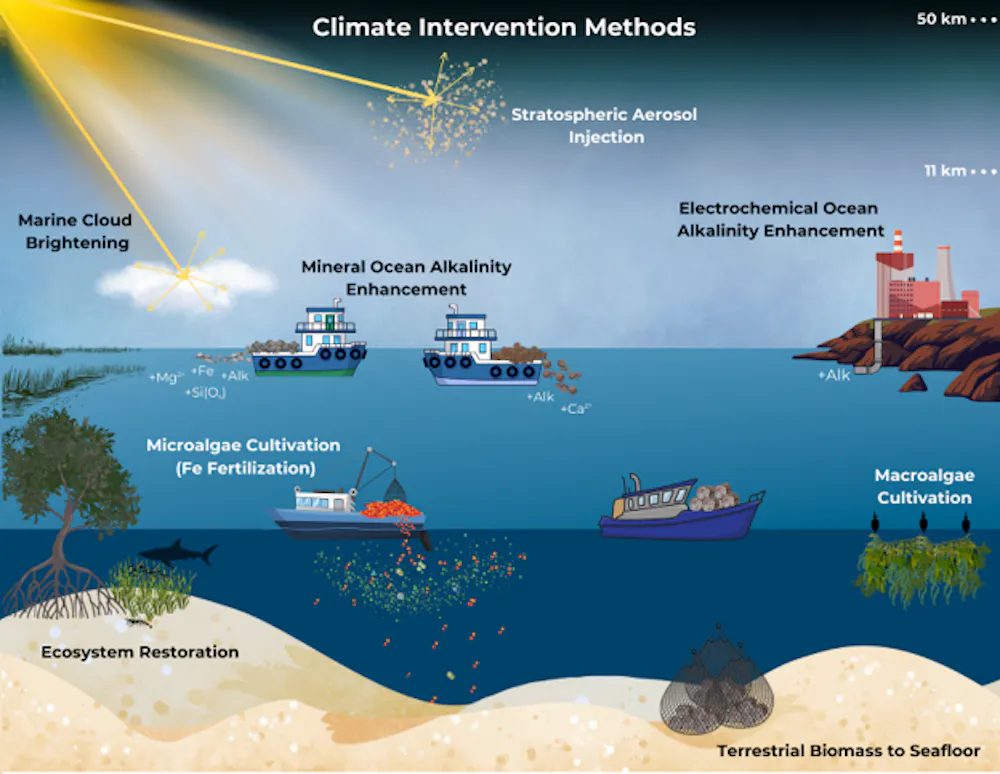
An illustration shows solar modification, ocean fertilization and other methods.
Some of the methods of climate interventions that affect the ocean, such as iron (Fe) fertilization.
Vanessa van Heerden/Louisiana Sea Grant

Biological carbon removal methods capture carbon through photosynthesis in plants or algae. Some methods, such as iron fertilization and seaweed cultivation, boost the growth of marine algae by giving them more nutrients. A fraction of the carbon they capture during growth can be stored in the ocean for hundreds of years, but much of it leaks back to the atmosphere once biomass decomposes.

Other methods involve growing plants on land and sinking them in deep, low-oxygen waters where decomposition is slower, delaying the release of the carbon they contain. This is known as anoxic storage of terrestrial biomass.

Another type of carbon dioxide removal doesn’t need biology to capture carbon. Ocean alkalinity enhancement chemically converts carbon dioxide in seawater into other forms of carbon, allowing the ocean to absorb more from the atmosphere. This works by adding large amounts of alkaline material, such as pulverized carbonate or silicate rocks like limestone or basalt, or electrochemically manufactured compounds like sodium hydroxide.

How ocean alkalinity enhancement methods works. CSIRO.

Solar radiation modification is another category entirely. It works like a sunshade – it doesn’t remove carbon dioxide, but it can reduce dangerous effects such as heat waves and coral bleaching by injecting tiny particles into the atmosphere that brighten clouds or directly reflect sunlight back to space, replicating the cooling seen after major volcanic eruptions. The appeal of solar radiation modification is speed: It could cool the planet within years, but it would only temporarily mask the effects of still-rising carbon dioxide concentrations.

These methods can also affect ocean life

We reviewed eight intervention types and assessed how each could affect marine ecosystems. We found that all of them had distinct potential benefits and risks.

One risk of pulling more carbon dioxide into the ocean is ocean acidification. When carbon dioxide dissolves in seawater, it forms acid. This process is already weakening the shells of oysters and harming corals and plankton that are crucial to the ocean food chain.

For images show a shell slowly dissolving over time.
How a shell placed in seawater with increased acidity slowly dissolves over 45 days.
National Oceanic and Atmospheric Administration, Pacific Marine Environmental Laboratory

Adding alkaline materials, such as pulverized carbonate or silicate rocks, could counteract the acidity of the additional carbon dioxide by converting it into less harmful forms of carbon.

Biological methods, by contrast, capture carbon in living biomass, such as plants and algae, but release it again as carbon dioxide when the biomass breaks down – meaning their effect on acidification depends on where the biomass grows and where it later decomposes.

Another concern with biological methods involves nutrients. All plants and algae need nutrients to grow, but the ocean is highly interconnected. Fertilizing the surface in one area may boost plant and algae productivity, but at the same time suffocate the waters beneath it or disrupt fisheries thousands of miles away by depleting nutrients that ocean currents would otherwise transport to productive fishing areas.

A glass beaker with cyanobacteria growing inside.
Cyanobacteria, or blue-green algae, can multiply rapidly when exposed to nutrient-rich water.
joydeep/Wikimedia Commons, CC BY-SA

Ocean alkalinity enhancement doesn’t require adding nutrients, but some mineral forms of alkalinity, like basalts, introduce nutrients such as iron and silicate that can impact growth.

Solar radiation modification adds no nutrients but could shift circulation patterns that move nutrients around.

Shifts in acidification and nutrients will benefit some phytoplankton and disadvantage others. The resulting changes in the mix of phytoplankton matter: If different predators prefer different phytoplankton, the follow-on effects could travel all the way up the food chain, eventually impacting the fisheries millions of people rely on.

The least risky options for the ocean

Of all the methods we reviewed, we found that electrochemical ocean alkalinity enhancement had the lowest direct risk to the ocean, but it isn’t risk-free. Electrochemical methods use an electric current to separate salt water into an alkaline stream and an acidic stream. This generates a chemically simple form of alkalinity with limited effects on biology, but it also requires neutralizing or disposing of the acid safely.

Other relatively low-risk options include adding carbonate minerals to seawater, which would increase alkalinity with relatively few contaminants, and sinking land plants in deep, low-oxygen environments for long-term carbon storage.

Still, these approaches carry uncertainties and need further study.

Scientists typically use computer models to explore methods like these before testing them on a wide scale in the ocean, but the models are only as reliable as the data that grounds them. And many biological processes are still not well enough understood to be included in models.

For example, models don’t capture the effects of some trace metal contaminants in certain alkaline materials or how ecosystems may reorganize around new seaweed farm habitats. To accurately include effects like these in models, scientists first must study them in laboratories and sometimes small-scale field experiments.

Scientists examine how phytoplankton take up iron as they grow off Heard Island in the Southern Ocean. It’s normally a low-iron area, but volcanic eruptions may be providing an iron source. CSIRO.

A cautious, evidence-based path forward

Some scientists have argued that the risks of climate intervention are too great to even consider and all related research should stop because it is a dangerous distraction from the need to reduce greenhouse gas emissions.

We disagree.

Commercialization is already underway. Marine carbon dioxide removal startups backed by investors are already selling carbon credits to companies such as Stripe and British Airways. Meanwhile, global emissions continue to rise, and many countries, including the U.S., are backing away from their emissions reduction pledges.

As the harms caused by climate change worsen, pressure may build for governments to deploy climate interventions quickly and without a clear understanding of risks. Scientists have an opportunity to study these ideas carefully now, before the planet reaches climate instabilities that could push society to embrace untested interventions. That window won’t stay open forever.

Given the stakes, we believe the world needs transparent research that can rule out harmful options, verify promising ones and stop if the impacts prove unacceptable. It is possible that no climate intervention will ever be safe enough to implement on a large scale. But we believe that decision should be guided by evidence – not market pressure, fear or ideology.

The Conversation

Through his role at Cornell University, Daniele Visioni receives funding from the Quadrature Climate Foundation and the Advanced Research + Invention Agency UK. Daniele Visioni is Head of Data for Reflective, a philanthropically-funded initiative focused on responsibly accelerating sunlight reflection research.

In addition to her primary role as UCSB faculty, Morgan Raven serves as the Chief Science Officer for, and holds minor equity in, a seed-funded startup company exploring applications of biomass-related CDR (Carboniferous). This work was supported by a grant from the Grantham Foundation for the Protection of the Environment to UCSB.

Through his role at the Univeristy of Tasmania, Tyler Rohr receives funding from the Australian government and Co-Labs ICONIQ Impact Co-Labs to research impacts and efficeincy of marine carbon dioxide removal.

Kelsey Roberts does not work for, consult, own shares in or receive funding from any company or organization that would benefit from this article, and has disclosed no relevant affiliations beyond their academic appointment.

ref. Climate engineering would alter the oceans, reshaping marine life – our new study examines each method’s risks – https://theconversation.com/climate-engineering-would-alter-the-oceans-reshaping-marine-life-our-new-study-examines-each-methods-risks-270659

For some Jewish women, ‘passing’ as Christian during the Holocaust could mean survival – but left scars all the same

Source: The Conversation – USA (3) – By Hana Green, Postdoctoral Fellow in Holocaust Studies, Zucker/Goldberg Center for Holocaust Studies, College of Charleston

A 1943 post office identification card for Annelies Herz, a German Jewish woman who managed to survive by posing as a Christian woman with the last name ‘Stein.’ From the Collection of the Museum of Jewish Heritage – A Living Memorial to the Holocaust. Gift of Annelies and Helmut Herz, 393.89.

Travel case in hand, dressed in fashionable clothing and wearing a practiced, coquettish smile, Hela Schüpper Rufeisen sat aboard the train to Warsaw, Poland. No one on board would have suspected that beneath the coat of the young woman were strapped assorted handguns and several cartridge clips.

Schüpper Rufeisen, who was Jewish, relied on this dissonance between appearance and reality to ferry items into, out of and between the Warsaw and Krakow ghettos. Her carefully cultivated “Aryan” image and false papers listing her as Catholic made it possible to cross borders and survive encounters that would otherwise have ended in death.

A black-and-white, close-up portrait of a girl with dark hair and a serious expression.
Hela Schüpper Rufeisen before the war.
Eli Dotan/Wikimedia Commons, CC BY-SA

During the Holocaust, trying to “pass” as non-Jewish was often more feasible for women than men. Some Jewish women, like Schüpper Rufeisen, took the risk in order to join resistance efforts against the Nazis and their collaborators. Most Jews who tried to pass, however, did so simply to remain alive in a system designed to murder them.

Passing took many forms. It enabled some women to transport weapons, papers or messages, while allowing others to work as domestic servants, move between cities, secure food or sleep safely for another night. What united these experiences was the pressure of living under constant threat. Blanca Rosenberg escaped the Kolomyja ghetto – then Polish, now part of Ukraine – in 1942. As she recalled afterward, “I tried to force myself into the mind of the woman I was to impersonate … I was now an Aryan, with a right to life, and no longer a Jewess, hunted like prey.”

Over years of research on Jews who evaded capture during the Holocaust, what struck me most was not the daring of these acts, but how often survivors described them as something done to get through the day alive. A central aim of my work has been to move beyond celebrated figures such as couriers and resistance agents – not to diminish their bravery, but to show how passing functioned as a strategy of survival within a system committed to Jewish annihilation.

Women’s roles

Under Nazism, “passing” meant assuming a non-Jewish identity and performing it convincingly in hostile public places, whereas going into hiding meant concealing one’s physical existence. This required constructing an entirely new self: adopting new names and speech patterns, demonstrating fluency in Christian rituals, and sustaining backstories capable of withstanding scrutiny.

Passing relied on constantly negotiating visibility and concealment, safety and exposure. The stakes were immense. Exposure often meant immediate death, and those who helped risked execution themselves.

Jewish men and women who passed navigated unique dangers. Yet women, often perceived as less of a threat, also had distinct possibilities.

A yellowed page of an official form written in German.
Duplicate copy of Christine Denner’s birth records issued in July 1942 and given to her Jewish friend Edith Hahn as false identification.
United States Holocaust Memorial Museum Collections Photo Archive #23179. Courtesy of Edith Hahn. Copyright of United States Holocaust Memorial Museum.

Their mobility was less strictly policed than men’s, and they could assume roles such as domestic workers or caretakers, providing credible explanations for their presence in public spaces. Women could adapt hairstyles, clothing and mannerisms to try to blend in. Men’s circumcisions, on the other hand, might expose them as Jewish, and in some circumstances, being a military-aged man out of uniform could arouse suspicion.

Testimonies from survivors show how many women relied on intuition and social awareness to navigate danger, crafting performances that balanced vulnerability and confidence. These were not advantages born of privilege, but survival strategies shaped by patriarchal and Nazi stereotypes, in which women’s perceived docility became a precarious form of cover.

The experience of Adina Blady-Szwajger reflects this precarious calculus. Traveling under a false Polish passport, the young physician moved between the Warsaw Ghetto and the so-called “Aryan side,” concealing ammunition beneath ordinary goods. When stopped by a gendarme on Żelazna Street, she opened her bag, revealing a heap of potatoes masking ammunition, smiled broadly, and waited. The patrolman glanced inside and ordered only “Los” – “Go.”

At the same time, Jewish women were doubly vulnerable. Living without legal protection, they faced heightened risks of sexual violence and coercion, as well as the potentially fatal consequences of pregnancy. Gender shaped not only how women passed, but the dangers they faced while doing so.

Emotional weight

Passing exacted a heavy psychological toll. Women lived with the constant fear that a single mistake could reveal their true identity. Rosenberg’s account of suppressing her sense of self after escaping the Kolomyja ghetto illustrates how passing fractured identity, producing a self that was at once protective and deeply alien.

Isolation compounded this strain. Cut off from family, unsure whom to trust, and burdened by guilt, many women endured emotional isolation that lingered long after liberation.

Ruth Ackerman, who survived the war by working for a German family under a false name, recalled scanning newly arrived American troops for a single “Jewish face.” The only member of her family to survive, Ackerman searched for other Jews, yearning for connection after years of concealment.

Edith Hahn-Beer, who lived in a displaced persons camp after the war, recalled feeling rejected by survivors who resented that she had emerged “intact,” without the physical suffering, imprisonment and degradation they themselves had endured. Using the false papers of a friend from Vienna, Hahn-Beer survived the war by living as an “Aryan” in Germany, marrying a Nazi officer – choices that complicated how other survivors saw her survival.

A black-and-white photo of a young woman in a coat and dark hat standing before a ramp leading up a building with a bell tower.
Leah Hammerstein Silverstein, born Lodzia Hamersztajn, poses in front of the Jasna Gora monastery in Czestochowa, Poland.
United States Holocaust Memorial Museum Photo Archives #17907. Courtesy of Leah Hammerstein Silverstein. Copyright of United States Holocaust Memorial Museum.

Lodzia Silverstein, a courier in Poland, described the postwar shift as “crawling out from the Polish skin and back into my Jewish skin.” This arduous psychological process was complicated by continued antisemitic violence, including the 1946 Kielce pogrom, a blood libel massacre that killed 42 Jews and wounded at least 50 others in the southeastern Polish town.

In some cases, Jews who passed for Christian retained their wartime identities for years, or even for the remainder of their lives, out of fear of continued persecution or a desire to move on.

Lasting lessons

As these women’s struggles show, passing was an ongoing negotiation of selfhood under extreme, and often violent, duress. For Jews who managed to pass, their deception was both a shield and a burden. Every gesture, word and detail of appearance carried the risk of exposure.

Their stories continue to resonate. People displaced by war, persecution or discrimination often alter aspects of their identities to remain safe. Belonging is rigorously policed – from immigration enforcement, racial discrimination and attacks on gender identity in the United States to ethnic violence across the globe. Whether through documents and checkpoints, or everyday scrutiny of language, dress, religion and appearance, people scrutinize each other, drawing lines around who belongs.

During the Holocaust, concealment was a condition of survival under persecution. Survivors’ testimony illuminates both the ingenuity required to endure such pressure and the emotional costs of erasing parts of oneself. In a moment of rising nationalism, antisemitism and mass displacement, their stories carry renewed urgency.

The Conversation

Hana Green has received research funding from the Central European History Society, the Leo Baeck Institute, the German Academic Exchange Service (DAAD), the German Historical Institute, the United States Holocaust Memorial Museum’s Mandel Center for Advanced Holocaust Studies, and the Conference on Jewish Material Claims Against Germany (Claims Conference).

ref. For some Jewish women, ‘passing’ as Christian during the Holocaust could mean survival – but left scars all the same – https://theconversation.com/for-some-jewish-women-passing-as-christian-during-the-holocaust-could-mean-survival-but-left-scars-all-the-same-268745

Building ‘beloved community’: Remembering the friendship between Martin Luther King Jr. and Buddhist monk Thich Nhat Hanh

Source: The Conversation – USA (3) – By Jeremy David Engels, Liberal Arts Endowed Professor of Communication, Penn State

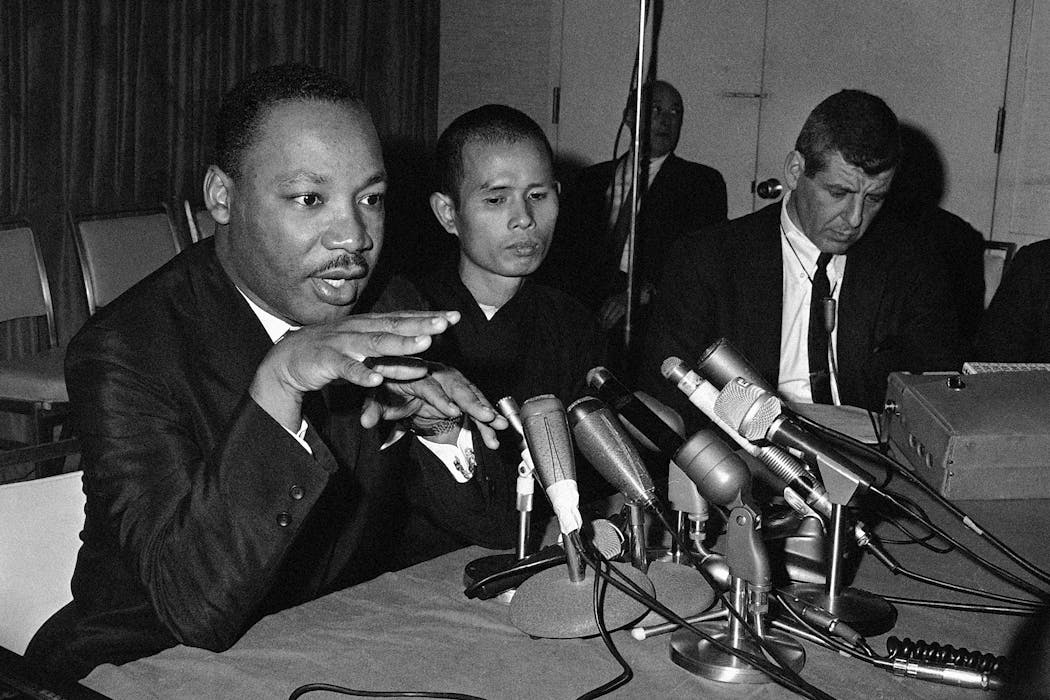
The Rev. Martin Luther King Jr., left, appears at a Chicago news conference with Buddhist monk Thich Nhat Hanh on May 31, 1966. AP Photo/Edward Kitch, File

Before Martin Luther King Jr. was killed, he asked several of his friends to continue his life’s work building what he called “beloved community.” One of the people he invited was the Vietnamese Zen Buddhist monk, poet and mindfulness teacher Thich Nhat Hanh.

My new book, “On Mindful Democracy: A Declaration of Interdependence to Mend a Fractured World,” is inspired by King and Hanh’s friendship. These two men bonded over the shared insight that how we show up for each other matters, as does how we advocate for social change. In his sermon “Loving Your Enemies” King announced, “Hate cannot drive out hate, only love can do that.” Hanh taught: There is no way to peace, peace is the way.“

At the heart of beloved community is true democracy. To be agents of change who do not add to the suffering of the world, people must learn to become more loving and peaceful people.

‘The real enemies of man’

Hanh was born in 1926 in central Vietnam. As a young Buddhist monk living in a nation confronted by colonialism, conflict and war, he developed the doctrine of ”engaged Buddhism,“ premised on the belief that working to relieve suffering in the world is enlightenment.

During the mid-1960s, amid the Vietnam War – Vietnamese call it the “American War” – Hanh founded the School of Youth for Social Services to practice engaged Buddhism and help those affected by the bombs raining down on their homes.

On June 1, 1965, Hanh wrote a letter to King to raise awareness of the suffering of the Vietnamese people. He also hoped to correct some common misconceptions about Buddhism.

His overarching point was that Buddhists in Vietnam did not hate Americans. In fact, they did not hate anyone. Their goal was simply to bring an end to war – and an end to the delusions that led to war. “Their enemies are not man. They are intolerance, fanaticism, dictatorship, cupidity, hatred and discrimination which lie within the heart of man,” he wrote. “These are the real enemies of man – not man himself.”

Hanh refused to take a side during the war. He stood for peace. His peace activism earned him a 39-year banishment from his homeland.

Continuing King’s dream

Marc Andrus, author of the 2021 book “Brothers in the Beloved Community,” notes that King and Hanh met in person twice: once in Chicago, on May 31, 1966, and a second time in May 1967, at the World Council of Churches Peace on Earth Conference in Geneva, Switzerland. In Geneva, King shared his understanding of the beloved community with Hanh, inviting him to participate in its construction.

In between these two meetings, King nominated Hanh for the 1967 Nobel Peace Prize, writing in his nomination letter, “I know Thich Nhat Hanh, and am privileged to call him my friend.” No award was given that year, however, perhaps to protest King’s choice to make his nomination letter public. Nominations were typically private, but King used his to call out the injustice of the Vietnam War.

Hanh was crushed when he learned of King’s death in 1968. “I was in New York when I heard the news of his assassination; I was devastated. I could not eat; I could not sleep,” he later recalled. “I made a deep vow to continue building what he called ‘the beloved community’ not only for myself but for him also. I have done what I promised Martin Luther King Jr. And I think that I have always felt his support.”

Building ‘beloved community’

In the years after King’s murder, part of Hanh’s life work was devoted to fulfilling King’s dream and building the “beloved community.”

Beloved community is not an abstraction. It is a loose-knit global community composed of a multitude of smaller, local communities committed to practicing peace, nonviolence, freedom, love and justice. Emerging from King’s activism and Hanh’s engaged Buddhism, these communities are also committed to social change.

In 1982, Hanh and his student Sister Chan Khong established the Plum Village monastery in southern France. In the years since, the Plum Village community has founded dozens of monasteries around the world, including three in the United States: Blue Cliff in upstate New York, Deer Park outside San Diego, and Magnolia Grove in Mississippi.

Hanh’s lay students have established thousands of smaller Plum Village sanghas – communities – in North America and Europe. These monasteries and sanghas serve as practice centers where people learn to embody the ideals of beloved community in their mindfulness practice and daily lives.

A monk’s gravestone rests in the foreground, with a towering statue of the Buddha behind it.
Thich Nhat Hanh’s gravesite outside Hue, Vietnam.
Jeremy Engels, CC BY

Since the time of the Buddha, people committed to the path of mindfulness have agreed to live by a number of “precepts.” These precepts, typically numbering five, provide a moral foundation for action. Hundreds of thousands of people attending Plum Village retreats have agreed to live by the updated, secular version of the precepts that Hanh and his community wrote called the Five Mindfulness Trainings. These include: reverence for life, true happiness, true love, loving speech and deep listening, and nourishment and healing.

The Five Mindfulness Trainings are written to provide people with a practical path to building a shared life based in love, compassion, joy and peace: the type of life that both King and Hanh envisioned for all.

As Hanh told the global Plum Village community in a 2020 letter titled Climbing Together the Hill of the Century: “We have continued that aspiration of Dr. Martin Luther King Jr., and every day, our practice is to generate brotherhood and sisterhood, to cultivate joy and the capacity to help people. This is a concrete way to realize and continue that dream.”

On MLK Day, their friendship and writings are a reminder that democracy rests on the ability of citizens to be present for each other, to recognize their interconnectedness, to embody loving kindness and to disagree without resorting to violence.

The Conversation

Jeremy David Engels does not work for, consult, own shares in or receive funding from any company or organization that would benefit from this article, and has disclosed no relevant affiliations beyond their academic appointment.

ref. Building ‘beloved community’: Remembering the friendship between Martin Luther King Jr. and Buddhist monk Thich Nhat Hanh – https://theconversation.com/building-beloved-community-remembering-the-friendship-between-martin-luther-king-jr-and-buddhist-monk-thich-nhat-hanh-272062

En Inde, les chiens des rues fouillent de moins en moins les poubelles, et c’est dangereux pour les citadins

Source: The Conversation – in French – By Nishant Kumar, India Alliance Fellow, National Centre for Biological Science, Bangalore & Department of Biology, University of Oxford

Des chiffres vieux de dix ans évoquent une population de 60 millions de chiens des rues en Inde, bien trop pour les rassembler dans des foyers. Dasarath Deka/Shutterstock

On compte plus de 60 millions de chiens errants en Inde. Depuis le déclin des vautours à la fin des années 1990, l’apparition de nouvelles sources de nourriture issues des déchets leur permet d’accéder aux déjections des abattoirs, au nourrissage spontané et aux carcasses abandonnées (la disparition des vautours a entraîné l’absence de régulation des populations de charognards, comme les chiens et les rats). Le comportement de ces animaux opportunistes a évolué, révélant l’interdépendance complexe entre chaîne alimentaire, pratiques humaines et santé publique.


Quand j’étais enfant, dans l’Inde rurale, ma grand-mère donnait chaque après-midi au chien du village un demi-chapati et un bol de lait, manifestement insuffisants pour couvrir ses besoins. Le chien survivait en fouillant les environs et en récupérant de la nourriture auprès des maisons voisines. Des années plus tard, à Delhi, j’ai croisé des chiens errants refusant des biscuits tant ils recevaient de nourriture de la part des habitants du quartier, qui tous rivalisaient d’attention à leur égard.

En Inde, l’entrelacement de valeurs religieuses et culturelles a instauré une forte tolérance à l’égard des non-humains et de la faune sauvage, toutes classes sociales confondues. Une attitude ancrée dans des millénaires de coexistence. Les populations acceptent délibérément de s’exposer à des risques importants pour vivre avec les animaux. Mais cet équilibre se fragilise à mesure que les villes s’étendent et que les chiens deviennent plus territoriaux dans des espaces partagés toujours plus encombrés et jonchés de déchets.

L’Inde compte au moins 60 millions de chiens en liberté, selon un décompte vieux de plus de dix ans. Des enquêtes plus récentes en recensent environ 1 million rien qu’à Delhi. Dans le même temps, le pays concentre plus d’un tiers des décès dus à la rage dans le monde.

À la différence de la plupart des pays occidentaux, la culture et le droit indiens proscrivent l’abattage. Les chiens doivent être capturés, stérilisés, vaccinés puis – impérativement – réinstallés sur leur territoire initial. En pratique, ces règles sont fréquemment bafouées.

Tout change en août 2025. Après plusieurs attaques de chiens errants contre des enfants, la Cour suprême indienne ordonne brièvement la capture de tous les chiens des rues de Delhi et de sa région, avec leur placement en refuges ou en fourrières, promettant pour la première fois depuis des décennies des rues sans chiens.

La décision est inapplicable – il n’existe tout simplement pas de structures pour accueillir des millions d’animaux – et déclenche une vive réaction des associations de protection animale. Deux jours plus tard, la Cour fait machine arrière et rétablit la politique de stérilisation en vigueur.

Les décisions ultérieures ont resserré le périmètre d’application. En novembre 2025, la Cour a ordonné le retrait des chiens des écoles, des hôpitaux et des zones de transport public dans tout le pays, tout en imposant des restrictions à l’alimentation des chiens dans l’espace public et en encourageant la mise en place de clôtures pour les tenir à distance.

Plus récemment encore, le 7 janvier 2026, elle a demandé aux autorités de clôturer et de sécuriser l’ensemble des 1,5 million d’écoles et d’établissements d’enseignement supérieur de l’Inde contre les chiens, et ce, en seulement huit semaines. Mais, comme les précédentes injonctions, ce calendrier ambitieux fait abstraction des contraintes d’infrastructure et a peu de chances de réduire significativement la fréquence des morsures et des infections qui en découlent. La Cour entend actuellement les parties prenantes, cherchant une voie médiane entre le retrait à grande échelle des chiens et le respect du bien-être animal.

La nation est divisée. L’État semble incapable de tuer ces chiens, de les héberger dans des foyers ou de les contrôler. La question de leur devenir relève à la fois de la sécurité publique et de la protection animale, mais touche aussi à quelque chose de plus profond : le dernier chapitre de l’un des partenariats les plus remarquables de l’évolution.


À lire aussi :
« Permis de tuer » ou sécurité publique ? En Turquie, une loi controversée sur les chiens errants


Une expérience de coexistence

Les chiens sont la seule espèce de vertébrés à avoir suivi les migrations humaines hors d’Afrique, à travers tous les climats et tous les types de peuplement. Si le moment exact de leur domestication reste incertain, on sait que les chiens ont évolué pour vivre aux côtés des humains. Mais ce lien entre espèces se heurte aujourd’hui à un défi inédit : celui de l’urbanisation tropicale.

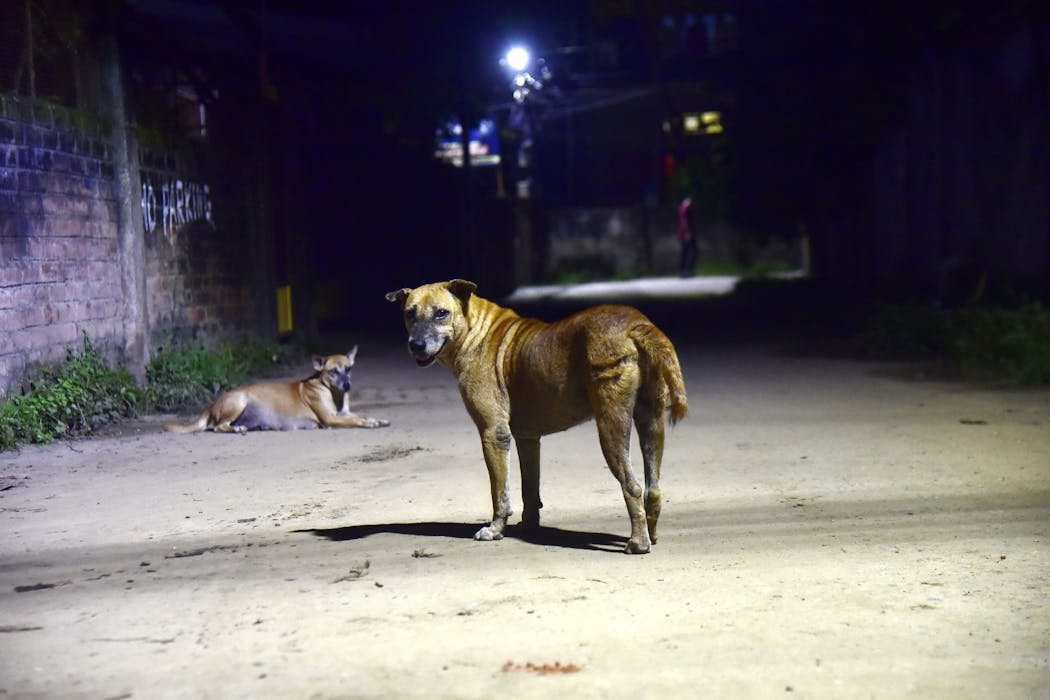
Trois chiens en Inde
Les chiens des rues en milieu urbain peuvent se montrer très territoriaux.
thinkpaws.org

Au cours des derniers siècles, alors que les chiens gagnaient leur place dans nos foyers, les humains ont créé plus de 400 races, belles, laborieuses ou affectueuses. Cette coévolution est importante : elle a rendu les chiens sensibles aux signaux humains et capables de développer de forts liens avec des personnes ou des lieux précis. Dans l’Inde urbaine, où les chiens n’appartiennent à personne mais ne sont pas vraiment sauvages, ces liens se traduisent par un comportement territorial autour d’un foyer ou d’une personne qui les nourrit.

Le laboratoire socio-écologique unique de l’Inde

L’Inde offre une perspective inégalée sur cette relation. Historiquement, les chiens des rues jouaient le rôle d’éboueurs. Dans les quartiers plus modestes, ils le font encore. Mais dans les zones plus aisées, ils sont désormais nourris délibérément.

Scène de rue en Inde
Chiens, cochons, vaches et humains coexistant.
thinkpaws.org

Des recherches préliminaires à Delhi menées avec ma collègue Bharti Sharma montrent que les chiens s’organisent en meutes autour de foyers précis, où quelques personnes qui les nourrissent régulièrement peuvent couvrir presque 100 % de leurs besoins alimentaires. Cela permet des densités de chiens bien plus élevées que ce que le rôle d’éboueur pourrait supporter.

La collision urbaine

C’est ici que la coexistence ancienne se heurte à l’urbanisme moderne. Les rues indiennes sont des espaces multifonctions. Dans les climats tropicaux, les récupérateurs de déchets et les travailleurs manuels opèrent souvent la nuit
– exactement aux heures où les chiens se montrent les plus territoriaux et où les habitants plus aisés qui les nourrissent dorment.

Dans les climats tropicaux, les chiffonniers et les ouvriers travaillent souvent la nuit – précisément aux heures où les chiens se montrent les plus territoriaux et où les habitants plus aisés qui les nourrissent dorment.

Les chiens ont adapté leur comportement – aboiements, poursuites, morsures occasionnelles – de manière à être involontairement récompensés par ceux qui les nourrissent, tout en créant des dangers pour les autres. Les chiffres sont inquiétants : des millions de morsures et des milliers de décès dus à la rage chaque année.

Pour autant, une réaction contre les décisions de la Cour suprême était inévitable. Avec la gentrification, qui redéfinit qui peut décider de l’organisation de la vie urbaine, un conflit de valeurs est apparu : certains défendent la présence partagée des animaux, d’autres privilégient l’élimination des risques.

La voie à suivre

Les villes indiennes ont peut-être atteint leur « apogée de coexistence ». Malgré les nuisances quotidiennes – aboiements, poursuites – des millions de personnes continuent de nourrir ces chiens. Pourtant, le même chien qui remue la queue devant ses nourrisseurs familiers peut mordre un inconnu. Il ne s’agit pas d’agression irrationnelle, mais d’une protection territoriale née d’un lien profond avec une communauté humaine spécifique.

Les villes occidentales ont abattu leurs chiens errants il y a longtemps, car les priorités sociales y étaient plus homogènes. La diversité de l’Inde empêche un tel consensus. Il faudra sans doute encore de vingt à trente ans avant que l’ensemble de sa population urbaine considère la présence de chiens territoriaux comme intolérable.

À mesure que l’Inde s’urbanise, elle doit choisir entre préserver des espaces pour des relations anciennes, antérieures aux villes elles-mêmes ou suivre la voie occidentale d’un contrôle total. Le rituel de ma grand-mère, donnant son demi-chapati, incarnait un ancien accord : un investissement minimal, une coexistence pacifique et un bénéfice mutuel. Les chiens de Delhi, suralimentés et défendant leur territoire, incarnent aujourd’hui une nouvelle intimité plus intense – et il n’est pas certain que cette situation soit bénéfique pour les deux espèces.

The Conversation

Nishant Kumar bénéficie d’un financement de la DBT/Wellcome Trust India Alliance Fellowship. Il est chercheur associé à cette bourse au National Centre for Biological Science, TIFR, à Bangalore, en Inde, son accueil à l’étranger étant assuré par le Département de biologie de l’Université d’Oxford. Il est également cofondateur et scientifique en chef d’un think-tank de recherche basé à Delhi, Thinkpaws : www.Thinkpaws.org.

ref. En Inde, les chiens des rues fouillent de moins en moins les poubelles, et c’est dangereux pour les citadins – https://theconversation.com/en-inde-les-chiens-des-rues-fouillent-de-moins-en-moins-les-poubelles-et-cest-dangereux-pour-les-citadins-273379

Broncos say their new stadium will be ‘privately financed,’ but ‘private’ often still means hundreds of millions in public resources

Source: The Conversation – USA (2) – By Geoffrey Propheter, Associate Professor, School of Public Affairs, University of Colorado Denver

In September 2025, the Denver Broncos announced their plan to build a new, privately financed stadium. Icon Sportswire/Getty Images

The Denver Broncos announced in early September 2025 their plan to build a privately financed football stadium. The proposal received a lot of attention and praise.

Across the five major sports leagues in the U.S. – the NBA, NHL, NFL, MLB and MLS – only 20% of facilities are privately owned.

I’ve studied the intersection of state and local public finance and pro sports for two decades. This experience has led me to approach claims of private financing with suspicion.

Private dollars are often masked as public dollars in these arrangements.

A Fox31 Denver news report aired in November 2025 about the Broncos’ plans for a new stadium.

Private vs public dollars

In theory, what counts as private or public dollars is uncontroversial. Dollars are public when government has a legal claim over them – otherwise, they are private.

The public versus private dollar distinction matters when accounting for who is contributing how much to a sports facility. When public dollars are allowed to count as private dollars, a project proposal looks more enticing than it is, in fact.

For instance, lawmakers regularly allow team owners to count public dollars as private dollars. The Sacramento City Council agreed to let the NBA’s Sacramento Kings count their property tax payments for the city-owned arena as private contributions to the overall cost of financing the arena. But property taxes are public dollars that in other instances go toward public services like schools and road repairs.

A building at night is lit up with purple lights that read
The Sacramento Kings stadium, the Golden 1 Center, counts property tax payments as a private contribution, even though property taxes are public dollars.
Thearon W. Henderson/Getty Images

Team owners building private facilities also typically receive public dollars through tax breaks, which is government spending in disguise. Property tax exemptions, sales and use tax exemptions on materials and machinery, and income tax credits are common forms of government givebacks to sports team owners.

I’ve estimated that property tax exemptions alone, among facilities in the five major leagues, have cost state and local governments US$20 billion cumulatively over the life of teams’ leases, 42% of which would have gone to K-12 education.

Rental payments spent on facilities are not private dollars

Many facilities and their infrastructure are funded through public debt secured in part by team rental payments. Lawmakers, media and consultants often view projects secured by rents as privately financed, in part or whole.

However, rental income in exchange for use or operation of public property should not be counted as private dollars.

Here’s a thought experiment. Suppose state lawmakers allocated the rent paid for use of campground sites in a state park to pay for new campground bathrooms. Are the bathrooms privately funded?

The flaw in concluding “yes” arises from a failure to appreciate that lawmakers, through policy, create legal claims over certain dollars. All dollars start as private dollars, but through the tax system, lawmakers transfer ownership of some dollars to the public.

It is the government landlord’s choice, a policy decision, to spend the rental income on the rented property, a choice available to them only if they own the rental income in the first place.

Yet lawmakers regularly allow teams, both professional and minor league, to count rental payments as private contributions. This accounting makes sports subsidies look less generous than they actually are.

Looking beyond construction

Facilities not only need to be constructed but also operated, maintained and eventually upgraded. Roads, sewer lines, overpasses, game-day security and emergency response and public policies to mitigate gentrification caused by a facility are all common taxpayer-funded touchpoints. In addition, facilities have preconstruction costs such as land acquisition, soil remediation and site preparation, as well as later costs such as demolition and remediation for the land’s next use.

Focusing on privately financed construction and ignoring all other aspects of a project’s development and operation is misleading, potentially contributing to lawmakers making inefficient and expensive policy decisions.

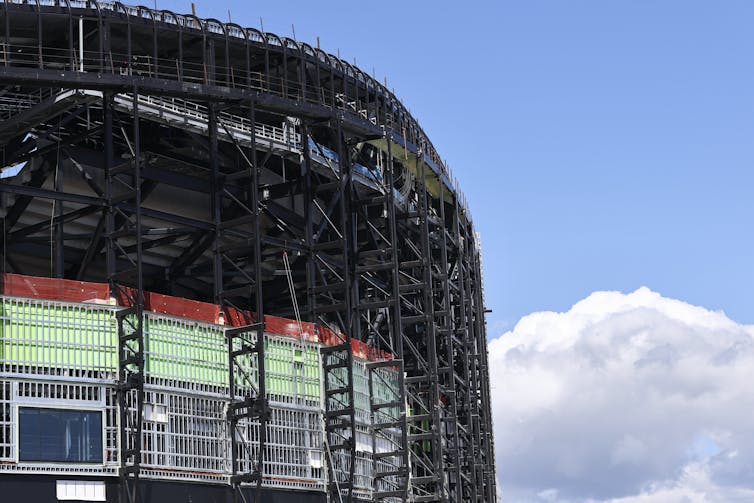
Outer wall of a stadium under construction.
The Buffalo Bills’ stadium.
Aaron M. Sprecher/Getty Images

By way of example, the Council of the District of Columbia approved a subsidy agreement last year with the NFL’s Commanders. The stadium would be financed, constructed and operated by the team owner, who would pay $1 in rent per year and remit no property taxes. In exchange for financing the stadium privately, the owner receives exclusive development rights to 20 acres of land adjacent to the stadium for the next 90 years.

The stadium is expected to cost the owner $2.5 billion, with the city contributing $1.3 billion for infrastructure.

But the city also gives up market rental income between $6 billion and $25 billion,depending on future land appreciation rates, that it could make on the 20 acres.

In other words, the rent discount alone means the city gives up revenue equal to multiple stadiums in exchange for the Commanders providing one. It is as if the council has a Lamborghini, traded it straight up for a Honda Civic, and then praised themselves for their negotiation acumen that resulted in a “free” Civic.

The Broncos’ proposed stadium

As of January 2026, Denver taxpayers know only that the Broncos stadium construction will be privately financed and that public dollars will be spent on some infrastructure.

Being enamored with such a proposal is similar to being offered a $1 billion yacht at a 75% discount. In my experience, there are two types of public officials: one will want to spend $250 million to save $750 million, while the other will ask whether $250 million for a yacht is an appropriate use of taxpayer resources given existing needs elsewhere.

My hope is that lawmakers better appreciate the many ways government participation in sports facility development, including privately financed ones, imposes serious risks and costs for current and future taxpayers. What is the expected total cost of the stadium project over its life? How much of the life cost would public resources cover? Could public resources generate greater benefits in an alternative use? How much will it cost to mitigate or compensate those affected by a project’s expected negative side effects, such as gentrification, congestion, pollution and crime?

Read more of our stories about Colorado.

The Conversation

Geoffrey Propheter does not work for, consult, own shares in or receive funding from any company or organization that would benefit from this article, and has disclosed no relevant affiliations beyond their academic appointment.

ref. Broncos say their new stadium will be ‘privately financed,’ but ‘private’ often still means hundreds of millions in public resources – https://theconversation.com/broncos-say-their-new-stadium-will-be-privately-financed-but-private-often-still-means-hundreds-of-millions-in-public-resources-270053

Le grand bond en arrière de Donald Trump sur la Fed, la Réserve fédérale des États-Unis

Source: The Conversation – in French – By Alain Naef, Assistant Professor, Economics, ESSEC

Donald Trump est en guerre affichée contre Jerome Powell, le président de la Réserve fédérale (Fed), la banque centrale des États-Unis. Misscabul/Shutterstock

Une enquête pénale vise Jerome Powell, l’actuel gouverneur de la puissante Réserve fédérale des États-Unis (Fed), dont le mandat arrive à terme en mai 2026. Donald Trump, dont la prérogative est de lui nommer un successeur, souhaite mettre à la tête de la Fed un de ses supporters, Kevin Hassett. Mais alors qui pour être le contre-pouvoir ? Contre-intuitivement, ce pourrait bel et bien être les marchés financiers.


Mervyn King, gouverneur de la Banque d’Angleterre de 2003 à 2013, aimait dire que « l’ambition de la Banque d’Angleterre est d’être ennuyeuse ». Le président de la Banque nationale suisse Thomas Jordan rappelait encore récemment que « la clé du succès est peut-être d’être ennuyeux ». Leur message est clair : la stabilité monétaire repose sur la prévisibilité, pas sur le spectacle.

Avec Donald Trump, cette règle pourrait changer. Le président des États-Unis, lui, n’aime pas être ennuyeux. S’il n’est pas clair que cela lui réussisse en politique intérieure ou extérieure, pour ce qui est de l’économie, c’est différent. La prévisibilité est un moteur de la stabilité des marchés et de la croissance des investissements. Dans ce contexte, les marchés pourraient être l’institution qui lui tient tête.

C’est ce rôle de contre-pouvoir que j’analyse dans cet article. Le conflit à venir se porte sur la nomination du successeur du président de la Réserve fédérale des États-Unis (Fed), la banque centrale des États-Unis, Jerome Powell dont le mandat expire en mai 2026. Dans la loi, le président de la première puissance mondiale a la prérogative de nommer un successeur.

Jerome Powell est actuellement visé par une enquête pénale du département de la justice américain, liée officiellement à la rénovation du siège de la Fed. Le président de la FED, lui, y voit une tentative de pression sur son indépendance, après son refus de baisser les taux d’intérêt. Donald Trump nie toute implication, même s’il dit de Powell qu’il « n’est pas très doué pour construire des bâtiments ». Pour de nombreux observateurs, le timing de l’attaque plaide pour une attaque politique. Les marchés ont réagi avec une montée du prix de l’or.

Car les présidents des banques centrales sont des personnages clés. Avec de simples mots, ils peuvent participer à créer des crises financières. Le président de la Bundesbank eut un rôle dans la crise du système monétaire européen de 1992. Si ce dernier s’était abstenu de faire un commentaire sur l’instabilité de la livre sterling, le Royaume-Uni aurait peut-être rejoint l’euro.

Gouverneurs technocrates

Traditionnellement, le choix du successeur n’est pas uniquement politique. Il se porte sur une figure reconnue, souvent issue du Conseil des gouverneurs. Les sept membres du Conseil des gouverneurs du système de la Réserve fédérale sont nommés par le président et confirmés par le Sénat. Il s’agit ordinairement de technocrates.

Les chercheurs Michael Bordo et Klodiana Istrefi montrent que la banque centrale recrute prioritairement des économistes formés dans le monde académique, soulignant la sélection d’experts de la conduite de la politique monétaire. Ils montrent que les clivages entre écoles « saltwater » (Harvard et Berkeley) et « freshwater » (Chicago, Minnesota). Les économistes freshwater étant plus restrictifs (ou hawkish) en termes de baisse de taux, alors que les « saltwater » préfèrent soutenir la croissance.

Ben Bernanke incarne cette tendance. Du 1er février 2006 au 3 février 2014, il est gouverneur de la FED. Après un premier mandat sous la présidente de George W. Bush, Barack Obama le nomme pour un second mandat. Ce professeur d’économie, défenseur de la nouvelle économie keynésienne, gagne le prix Nobel en 2022 pour ses travaux sur les banques et les crises financières. La gouverneure de 2014 à 2018, Janet Yellen, est auparavant professeure d’économie à Berkeley, à Harvard et à la London School of Economics.

Ce processus relativement apolitique est essentiellement technocratique. Ces conventions seront potentiellement bousculées pour la nomination du prochain gouverneur de la banque centrale des États-Unis. Évidemment, certains gouverneurs avaient des préférences politiques ou des liens avec le président.

Kevin Hassett, économiste controversé

Le candidat de Donald Trump pressenti par les médias est Kevin Hassett. Ce dernier s’inscrit dans le sillage de la vision du nouveau président des États-Unis en appelant à des baisses de taux brutales. Il a qualifié Jerome Powell de « mule têtue », ce qui alimente les craintes d’une Fed docile envers la Maison Blanche.

« Kevin Hassett a largement les capacités pour diriger la Fed, la seule question est de savoir lequel se présentera » entre « Kevin Hassett, acteur engagé de l’administration Trump, ou Kevin Hassett, économiste indépendant », explique Claudia Sahm, ancienne économiste de la Fed dans le Financial Times. C’est cette question qui inquiète les marchés. Cela même si l’économiste a presque 10 000 citations pour ses articles scientifiques et a soutenu sa thèse avec Alan Auerbach, un économiste reconnu qui travaille sur les effets des taxes sur l’investissement des entreprises. De façade, Hassett a tout d’un économiste sérieux. Uniquement de façade ?

Les investisseurs s’inquiètent de la politisation de la Fed. Depuis la nomination de Stephen Miran en septembre 2025 au Conseil des gouverneurs, les choses se sont pimentées. Le président du comité des conseillers économiques des États-Unis est un des piliers de la doctrine économique Trump. Il a longtemps travaillé dans le secteur privé, notamment au fonds d’investissement Hudson Bay Capital Management.

Si les votes de la Fed sont anonymes, le Federal Open Market Committee, chargé du contrôle de toutes les opérations d’open market aux États-Unis, publie un graphique soulignant les anticipations de taux d’intérêt des membres. Depuis l’élection de Stephen Miran, un membre vote en permanence pour des baisses drastiques des taux d’intérêt, pour soutenir Donald Trump. Sûrement Miran ?

Si le nouveau président de la Fed faisait la même chose, on pourrait assister à une panique à bord… qui pourrait éroder la confiance dans le dollar. Les investisseurs internationaux ne veulent pas d’une monnaie qui gagne ou perde de la valeur en fonction du cycle électoral américain. Pour que les investisseurs aient confiance dans le dollar, il faut qu’il soit inflexible à la politique.

Les marchés financiers en garde-fou

Le marché, à l’inverse de la Cour suprême des États-Unis ou du Sénat, n’a pas d’incarnation institutionnelle, mais il a tout de même une voix. Il réagit par les prix, mais pas seulement. Si on ne l’écoute pas, le marché pourrait-il hausser le ton, en changeant les prix et les taux d’intérêt ?

Quelles seraient les conséquences de la nomination d’un président de la Fed pro-Trump et favorable à des coupes de taux pour soutenir le mandat de Trump ? Il se peut que les investisseurs institutionnels puissent fuir la dette américaine, du moins à court terme. Cette réaction augmenterait potentiellement les taux d’emprunt du gouvernement, notamment à long terme.

« Personne ne veut revivre un épisode à la Truss », a résumé un investisseur cité par le Financial Times, à la suite de la consultation du Trésor auprès des grands investisseurs. Liz Truss, la première ministre du Royaume-Uni, avait démissionné sous la pression des marchés en septembre 2022. Elle avait essayé dans un « mini-budget » à la fois d’augmenter les dépenses et de réduire les impôts. Quarante-quatre jours plus tard, elle avait dû démissionner à cause de la fuite des investisseurs qui ne voulaient plus de dette anglaise, jugée insoutenable.

Donald Trump ne démissionnera probablement pas quarante-quatre jours après la nomination de Kevin Hassett. Mais, en cas de panique des marchés, Kevin Hassett lui-même pourrait sauter. Et le dollar perdre encore un peu plus de sa splendide.

The Conversation

Alain Naef a reçu des financements de l’Agence Nationale de la Recherche (ANR).

ref. Le grand bond en arrière de Donald Trump sur la Fed, la Réserve fédérale des États-Unis – https://theconversation.com/le-grand-bond-en-arriere-de-donald-trump-sur-la-fed-la-reserve-federale-des-etats-unis-272522

South Florida’s Brightline has highlighted an old problem – every year for the past decade, 900 pedestrians were killed by trains

Source: The Conversation – USA – By Ian Savage, Professor of Economics, Northwestern University

High-speed passenger trains like Florida’s Brightline travel through dense neighborhoods, increasing the likelihood of accidents involving pedestrians. Brynn Anderson/Associated Press

In 2018, high-speed passenger trains branded as Brightline started running along the formerly freight-only Florida East Coast Railway. Initial service from Miami to West Palm Beach was extended to Orlando in 2023. Unfortunately, the southern end of the line is in the spotlight because of collisions with pedestrians and motor vehicles.

The safety concerns have received extensive coverage in the Miami Herald, Orlando Sentinel, The Atlantic and on local television and radio stations.

To South Floridians, the furor may be novel. But nationally the debate over how to prevent these incidents has been going on for decades.

Most of the risks of railroading fall on pedestrians and motorists. Over the past decade, an average of 900 pedestrians lost their lives each year in the U.S., and another 150 motor vehicle occupants died in collisions at highway-rail grade crossings.

I’m an economist who has studied transportation safety for 40 years. My research has analyzed why motor vehicle risks have fallen substantially, while there has been hardly any progress for pedestrians.

Reducing motor vehicle crashes

In 1966, 1,700 motor vehicle occupants died at railroad crossings. Nowadays, that number is typically less than 150. Over the same period, the number of vehicles on the road has tripled. By these measures, the risk has fallen by an amazing 97%.

What happened?

In part, the risk fell due to better vehicle technology and reduced drunken driving, which have improved overall highway safety.

The rest was due to actions taken starting in the early 1970s in reaction to the high number of deaths. Notably, the responsibility for deciding on safety features at crossings was taken away from the railroads and given to state and local highway authorities.

A design standards handbook and risk analysis tools were developed by the U.S. Department of Transportation. The analysis tools produce a priority listing of the riskiest crossings. The handbook describes the options that engineers can use to reduce risks, such as installing flashing warning lights and barriers across the road. It also suggests when to consider closing or consolidating dangerous crossings. Federal money supplemented spending by railroads and state and local governments to pay for these improvements.

A public information campaign educating drivers about the risks at crossings was established in Idaho in 1972 under the name Operation Lifesaver. By 1986, the program had spread to every state.

Railways closed many unprofitable lines after they were allowed to do so by the Staggers Rail Act of 1980. The reduced number of railroad miles and crossings also dropped the associated risk.

Stagnant risks to pedestrians

A similar analysis of pedestrian deaths is complicated. Pedestrian deaths occur all along the railroad and not just at crossings. Sadly, some deaths are intentional. Federal railroad officials had stopped requiring that suicides be reported in the mid-1950s and resumed doing so only in 2011.

In 1966, there were 730 nonintentional pedestrian deaths. Today, that number is roughly the same. It’s worth noting, however, that the U.S. population is 70% higher than it was in the 1960s, so the risk per person is lower.

Federal data from the past decade shows that about a quarter of the 900 annual pedestrian deaths were ruled by a coroner or medical examiner to be intentional. Coroners often lack sufficient evidence to definitively rule a suicide, so the actual proportion of pedestrians with suicidal intent is likely much higher. My own research in the Chicago area found that about half were confirmed or likely suicides.

Getting to the root cause

While the risk is down, the reduction is nowhere near as large as that of motor vehicles at crossings.

In the past decade the U.S. Department of Transportation has funded development of handbooks on the design of pedestrian crossings and interventions to mitigate risks at places away from crossings.

The latter handbook emphasizes that successful countermeasures need to be tailored to the reasons people are on the tracks in the first place. And, of course, there are many reasons.

Fencing may seem like an obvious countermeasure, but a fence does not prevent access at crossings and stations. Moreover, fences also tend to be destroyed where it is onerous to detour to a formal crossing rather than take a shortcut.

In fact, fencing can be counterproductive if it screens the railroad from public view and encourages nefarious activities, including theft, drug dealing and loitering.

Tackling intentional deaths has been challenging. Countermeasures have focused on signage providing information on mental health services and training rail workers to recognize people displaying symptoms of distress and then intervening or calling for help.

At times, tackling the root of the problem may involve land use and zoning at a local level. For example, a city might decide not to allow a convenience store to be located on the opposite side of the tracks from the population it serves. Or a city or school district might relocate transit or school bus stops to avoid the temptation to take a shortcut.

train tracks running through an intersection with multiple stoplights
This intersection with red traffic lights and railway crossings in Miami requires the traffic lights to coordinate with railway crossing gates.
LB Studios/Connect Images via Getty Images

Florida railroads

South Florida faces several challenges. The primary challenge is its flat land. No hills means there is no natural grade separation between the railroad and intersecting roads and footpaths.

Elevating the railroad would be expensive and would cut communities in two. The effects of such severance should not be underestimated. In fact, the trend in recent times has been to rejoin urban neighborhoods that were bisected by interstate highway construction in the 1960s.

Another challenge comes, ironically, from the original vision behind rail travel in Florida. Standard Oil magnate Henry Flagler developed and built the Florida East Coast Railway in hopes of spurring coastal development. These days, dense communities surround the line, with housing, schools, stores and restaurants scattered on both sides of the tracks.

Development also made it less safe for motor vehicles. Main roads, such as U.S. Route 1 and Dixie Highway, were built parallel to the tracks. Over time, as these roads have become wider and busier, the cross streets have a smaller distance between the railroad and the main road. The space for vehicles waiting to turn onto the main road is limited, and the lights and gates at the railroad crossing must be coordinated with the traffic signals on the main road. This is a major challenge to the state, county and municipal traffic engineers who have inherited these complicated intersections.

It is tempting to suggest that many of these crossings should be consolidated into fewer, well-designed crossings. But this could result in unintended consequences for pedestrians. When too few crossings are available, pedestrians are more likely to take unauthorized shortcuts. Any consolidation of road crossings must be accompanied by alternative ways for pedestrians to cross the tracks safely.

It is important to keep looking for solutions to pedestrian and vehicle safety issues so that South Florida communities can be safer while enjoying the benefits that rail offers, such as reducing the number of trucks on the roads and offering an alternative to passengers who wish to avoid flying or driving on congested Interstate 95.

If you are experiencing suicidal thoughts, you can contact the National Suicide Prevention Lifeline (988) or Crisis Text Line (text “HELLO” to 741741) for immediate support.

The Conversation

I was a volunteer member of the National Academies of Sciences, Engineering, and Medicine oversight committee as the 2022 “Strategies for Deterring Trespassing on Rail Transit and Commuter Rail Rights-of-Way” handbook was developed. As such we could comment on drafts but were not the authors of the report.

ref. South Florida’s Brightline has highlighted an old problem – every year for the past decade, 900 pedestrians were killed by trains – https://theconversation.com/south-floridas-brightline-has-highlighted-an-old-problem-every-year-for-the-past-decade-900-pedestrians-were-killed-by-trains-272229

The ‘drug threat’ that justified the US ouster of Maduro won’t be fixed by his arrest

Source: The Conversation – USA – By Eduardo Gamarra, Professor of Politics and International Relations, Florida International University

This isn’t going to stop in the U.S. just because Venezuelan President Nicolás Maduro was arrested. Floris Leeuwenberg, Corbis Documentary/Getty Images

Donald Trump has flagged Venezuelan drug trafficking as a key reason for the U.S. military operation on Jan. 3, 2026, that captured President Nicolás Maduro and whisked him to New York to face federal drug charges.

Trump has described Maduro as “the kingpin of a vast criminal network responsible for trafficking colossal amounts of deadly and illicit drugs into the United States.”

In 2025, the administration presented the U.S. military buildup in the Caribbean and repeated strikes on alleged drug trafficking vessels off Venezuela’s coast as necessary to counter the flow of cocaine into the United States.

But as an international relations scholar focused on Latin America, I know that when assessed against hard data on cocaine production and transit, the U.S. pretense for military action against Venezuela falters.

Venezuela has never been a major cocaine producer. That distinction belongs overwhelmingly to Colombia, which accounts for the vast majority of coca cultivation and cocaine processing in the Western Hemisphere.

That means the arrest of Maduro and subsequent U.S. attempts to control Venezuela’s government are unlikely to stem the influx of cocaine into the U.S.

Justifying intervention

While Venezuela’s geography and governance gaps make it a transit country for Colombian products, most U.S. cocaine originates and flows through corridors north and west of Venezuela. This contradicts the claim that Caracas was the central hub of cocaine trafficking into the United States.

Moreover, the opioid overdose crisis in the U.S. today is overwhelmingly driven by synthetic drugs such as fentanyl, which have supply chains rooted in Mexico and Asia, not Venezuela.

So why did Washington elevate Venezuela’s role in narcotics?

A man in handcuffs being moved along by uniformed law enforcement agents.
Nicolás Maduro, in handcuffs, is escorted by federal agents en route to a federal courthouse in New York on Jan. 5, 2026.
XNY/Star Max/GC Images

The answer, I believe, lies less in illicit markets than in power. By conflating criminal networks with government authority, an act amplified through legal designations and indictments, the Trump administration could justify military intervention without explicit congressional authorization.

Once Maduro was removed, the substance beneath the rhetoric became clearer. The U.S. has not turned power over to an opposition democratic coalition. Instead, it facilitated the swearing-in of Vice President Delcy Rodríguez as interim president, a figure deeply tied to the existing regime and whose network includes people long accused by U.S. authorities of illegal activities.

The release of political prisoners by the interim government and U.S. moves to reopen Venezuela’s oil sector to American interests underscore that what unfolded was not purely a counternarcotics mission but a reconfiguration of governance in Caracas.

Pretext for military action

The role of the Cartel de los Soles – or Cartel of the Suns – in this narrative deserves particular scrutiny. Originally a label for alleged trafficking networks within Venezuela’s security forces, U.S. legal indictments and terrorist designations expanded that concept. That amplified the narrative that Maduro was at the head of a transnational criminal enterprise.

In fact, the Cartel de los Soles is not a structured cartel at all. Yet the narrative of Maduro as head of a narco-terrorist empire was politically and legally potent. It provided a pretext for military action, creating a justification that could be sold domestically and internationally as an effort to defend U.S. citizens from an external criminal threat.

But the U.S. attack in Venezuela was not, in substance, a counternarcotics mission. It was a strategic economic and geopolitical operation framed in the language of law enforcement.

Two days after the Venezuela attack, the Justice Department retreated from its November 2025 claim that Maduro was the head of Cartel de los Soles, underscoring that the link between drug enforcement and regime removal was more instrumental than evidentiary.

Rodríguez said just days after the U.S. attack, “Drug trafficking and human rights were the excuse; the real motive was oil.”

A man in a blue suit walking into a group of other men in suits in a high-ceilinged room.
President Donald Trump arrives at a White House meeting with oil and gas executives on Jan. 9, 2026, to discuss plans for investment in Venezuela after ousting its leader, Nicolás Maduro.
Alex Wong/Getty Images

No meaningful reduction

While the U.S. operation in Venezuela undoubtedly disrupted the trafficking networks that operated under Maduro’s umbrella, at least temporarily, the action cannot be convincingly framed as a drug supply intervention.

The reality of drug trafficking itself underscores this point.

Cocaine production and distribution networks are dynamic. When one route is disrupted, traffickers invariably find alternative pathways.

Routes that once used Venezuelan territory have likely rerouted rather than collapsed. This has historically characterized drug flow in Latin America in response to pressure from law enforcement.

Even if Venezuelan transit networks are briefly destabilized, there is no evidence that U.S. intervention will lead to a meaningful reduction in the volume of illegal drugs flowing into the United States. The most significant drivers of U.S. drug problems, including Mexico-based distribution systems and the surge of synthetic opioids, operate largely outside Venezuela.

The U.S. operation may benefit Venezuela politically by toppling a long-standing authoritarian figure. That opens the possibility of political change.

But if the lens through which policymakers view these events is drug policy, they are misreading both the evidence and the incentives. The action was centered on energy and strategic realignment, with counternarcotics rhetoric serving as a justification rather than a driver of the U.S. attack.

And while trafficking networks adapt and survive, these shifts will not reduce the flow of drugs into the United States, which has long been shaped by factors far beyond Venezuela’s borders.

The Conversation

Eduardo Gamarra does not work for, consult, own shares in or receive funding from any company or organization that would benefit from this article, and has disclosed no relevant affiliations beyond their academic appointment.

ref. The ‘drug threat’ that justified the US ouster of Maduro won’t be fixed by his arrest – https://theconversation.com/the-drug-threat-that-justified-the-us-ouster-of-maduro-wont-be-fixed-by-his-arrest-273139

US military has a long history in Greenland, from mining during WWII to a nuclear-powered Army base built into the ice

Source: The Conversation – USA (2) – By Paul Bierman, Professor of Natural Resources and Environmental Science, University of Vermont

Rusting fuel drums and vehicles remain at an abandoned U.S. World War II base in Greenland. Posnov/Moment via Getty Images

President Donald Trump’s insistence that the U.S. will acquire Greenland “whether they like it or not” is just the latest chapter in a co-dependent and often complicated relationship between America and the Arctic’s largest island – one that stretches back more than a century.

Americans have long pursued policies in Greenland that U.S. leaders considered strategic and economic imperatives. As I recounted in my 2024 book, “When the Ice is Gone,” about Greenland’s environmental, military and scientific history, some of these ideas were little more than engineering fantasies, while others reflected unfettered military bravado.

A person stands next to a sled and dog team looking at a large radar installation.
Inuit and their dog team stand in front of a U.S. military radar installation at Thule, Greenland, that scanned the skies for Soviet bombers and missiles during the Cold War. More than 100 native Inuit were removed from their land during base construction.
NF/SCANPIX/AFP via Getty Images

But today’s world isn’t the same as when the United States last had a significant presence in Greenland, decades ago during the Cold War.

Before charging headlong into this icy island again, the U.S. would be remiss not to learn from past failures and consider how Earth’s rapidly changing climate is fundamentally altering the region.

Early US plundering of Greenland’s metals

In 1909, Robert Peary, a U.S. Navy officer, announced that he had won the race to the North Pole – a spectacular claim debated fiercely at the time. Before that, Peary had spent years exploring Greenland by dogsled, often taking what he found.

In 1894, he convinced six Greenlanders to come with him to New York, reportedly promising them tools and weapons in return. Within a few months, all but two of the Inuit had died from diseases.

A man stands beside a very large rock almost as tall as he is
People moved the 34-ton Cape York meteorite fragment named Ahnighito from the Greenland coast to Robert Peary’s ship, which took it to New York in 1897.
Account Of The Discovery And Bringing Home Of The ‘Saviksue’ or Great Cape York Meteorites. New York 1898/Wikimedia Commons

Peary also took three huge fragments of the Cape York iron meteorite, known to Greenlanders as Saviksoah. It was a unique source of metal that Greenlandic Inuit had used for centuries to make tools. The largest piece of the meteorite, Ahnighito, weighed 34 tons. Today, it sits in the American Museum of Natural History, which reportedly paid Peary US$40,000 for the space rocks.

World War II: Strategic location and minerals

World War II put Greenland on the map strategically for the U.S. military. In spring 1941, Denmark’s ambassador signed a treaty giving the U.S. military access to Greenland to help protect the island from Nazi Germany and contribute to the war effort in Europe. That treaty remains in effect today.

New American bases in western and southern Greenland became crucial refueling stops for planes flying from America to Europe.

Hundreds of American soldiers were garrisoned at Ivittuut, a remote town on the southern Greenland coast where they protected the world’s largest cryolite mine. The rare mineral was used for smelting aluminum, critical for building airplanes during the war.

A view across the water to a small mining outpost.
The Ivittuut cryolite mine in southwestern Greenland, shown in 1940. U.S. troops guarded the mine, essential for aluminum production, during World War II.
U.S. Coast Guard via Wikimedia Commons

And because Greenland is upwind from Europe, weather data collected on the island proved essential for battlefield forecasts as officers planned their moves during World War II.

Both the Americans and Germans built weather stations on Greenland, starting what historians refer to as the weather war. There was little combat, though allied patrols routinely scoured the east coast of the island for Nazi encampments. The weather war ended in 1944 when the U.S. Coast Guard, and its East Greenland dogsled patrol, found the last of four German weather stations and captured their meteorologists.

Men holds their hands in the air in surrender while soldiers point guns at them.
American soldiers capture members of Germany’s Edelweiss II weather station in northeastern Greenland in 1944.
U.S. Coast Guard via Wikimedia Commons

Cold War: Fanciful engineering ideas vs the ice

The heyday of U.S. military engineering dreams in Greenland arrived during the Cold War in the 1950s.

To counter the risk of Soviet missiles and bombers coming over the Arctic, the U.S. military transported about 5,000 men, 280,000 tons of supplies, 500 trucks and 129 bulldozers, according to The New York Times, to a barren, northwest Greenland beach – 930 miles (1,500 kilometers) from the North Pole and 2,752 miles (4,430 kilometers) from Moscow.

There, in one top-secret summer, they built the sprawling American air base at Thule. It housed bombers, fighters, nuclear missiles and more than 10,000 soldiers. The whole operation was revealed to the world the following year, on a September 1952 cover of LIFE magazine and by the U.S. Army in its weekly television show, “The Big Picture.”

Trucks packed into a ship arrive with the ocean in the background.
A wave of U.S. military engineers lands on the shores of northwestern Greenland to build Thule Airbase in summer 1951.
Keystone-France/Gamma-Keystone via Getty Images

But in the realm of ideas born out of paranoia, Camp Century and Project Iceworm were the pinnacle.

The U.S. Army built Camp Century, a nuclear-powered base, inside the ice sheet by digging deep trenches and then covering them with snow. The base held 200 men in bunkrooms heated to 72 degrees Fahrenheit (22 Celsius). It was the center of U.S. Army research on snow and ice and became a reminder to the USSR that the American military could operate at will in the Arctic.

Military engineers building Camp Century wear parkas and stand in a tunnel wide enough to drive a truck through.
Metal arches placed over trenches cut into the snow-formed roofs at Camp Century. The arches were covered with snow and ice, removed, and reused. A similar idea had been planned for rail lines through the ice.
U.S. Army Corps of Engineers, 1960

The Army also imagined hundreds of miles of rail lines buried inside Greenland’s ice sheet. On Project Iceworm’s tracks, atomic-powered trains would move nuclear-tipped missiles in snow tunnels between hidden launch stations – a shell game covering an area about the size of Alabama.

In the end, Project Iceworm never got beyond a 1,300-foot (400-meter) tunnel the Army excavated at Camp Century. The soft snow and ice, constantly moving, buckled that track as the tunnel walls closed in. In the early 1960s, first the White House, and then NATO, rejected Project Iceworm.

Trucks are parked outside the partially buried Camp Century.
An aerial view shows Camp Century, which was powered by a small-scale portable nuclear reactor.
US Army

In 1966, the Army abandoned Camp Century, leaving hundreds of tons of waste inside the ice sheet. Today, the crushed and abandoned camp lies more than 100 feet (30 meters) below the ice sheet surface. But as the climate warms and the ice melts, that waste will resurface: millions of gallons of frozen sewage, asbestos-wrapped pipes, toxic lead paint and carcinogenic PCBs.

Who will clean up the mess and at what cost is an open question.

Greenland remains a tough place to turn a profit

In the past, the American focus in Greenland was on short-term gains with little regard for the future. Abandoned bases, scattered around the island today and in need of cleanup, are one example. Peary’s disregard of the lives of local Greenlanders is another.

History shows that many of the fanciful ideas for Greenland failed because they showed little consideration of the island’s isolation, harsh climate and dynamic ice sheet.

Large rusted construction trucks and some fuel drums.
World War II-vintage trucks abandoned at a U.S. airfield in east Greenland were still there decades later.
Posnov/Moment via Getty Images

Trump’s demands for American control of the island as a source of wealth and U.S. security are similarly shortsighted. In today’s rapidly warming climate, disregarding the dramatic effects of climate change in Greenland can doom projects to failure as Arctic temperatures climb.

Recent floods, fed by Greenland’s melting ice sheet, have swept away bridges that had stood for half a century. The permafrost that underlies the island is rapidly thawing and destabilizing infrastructure, including the critical radar installation and runway at Thule, renamed Pituffik Space Base in 2022. The island’s mountain sides are crashing into the sea as the ice holding them together melts.

The U.S. and Denmark have conducted geological surveys in Greenland and pinpointed deposits of critical minerals along the rocky, exposed coasts. However, most of the mining so far has been limited to cryolite and some small-scale extraction of lead, iron, copper and zinc. Today, only one small mine extracting the mineral anorthosite, which is useful for its aluminum and silica, is running.

It’s the ice that matters

The greatest value of Greenland for humanity is not its strategic location or potential mineral resources, but its ice.

A NASA animation of satellite data shows Greenland’s ice sheet mass losses between 2002 and 2023, measured in meters of water equivalent in the ice.

If human activities continue to heat the planet, melting Greenland’s ice sheet, sea level will rise until the ice is gone. Losing even part of the ice sheet, which holds enough water to raise global sea level 24 feet in all, would have disastrous effects for coastal cities and island nations around the world.

That’s big-time global insecurity. The most forward-looking strategy is to protect Greenland’s ice sheet rather than plundering a remote Arctic island while ramping up fossil fuel production and accelerating climate change around the world.

The Conversation

Paul Bierman receives funding from the US National Science Foundation.

ref. US military has a long history in Greenland, from mining during WWII to a nuclear-powered Army base built into the ice – https://theconversation.com/us-military-has-a-long-history-in-greenland-from-mining-during-wwii-to-a-nuclear-powered-army-base-built-into-the-ice-273355