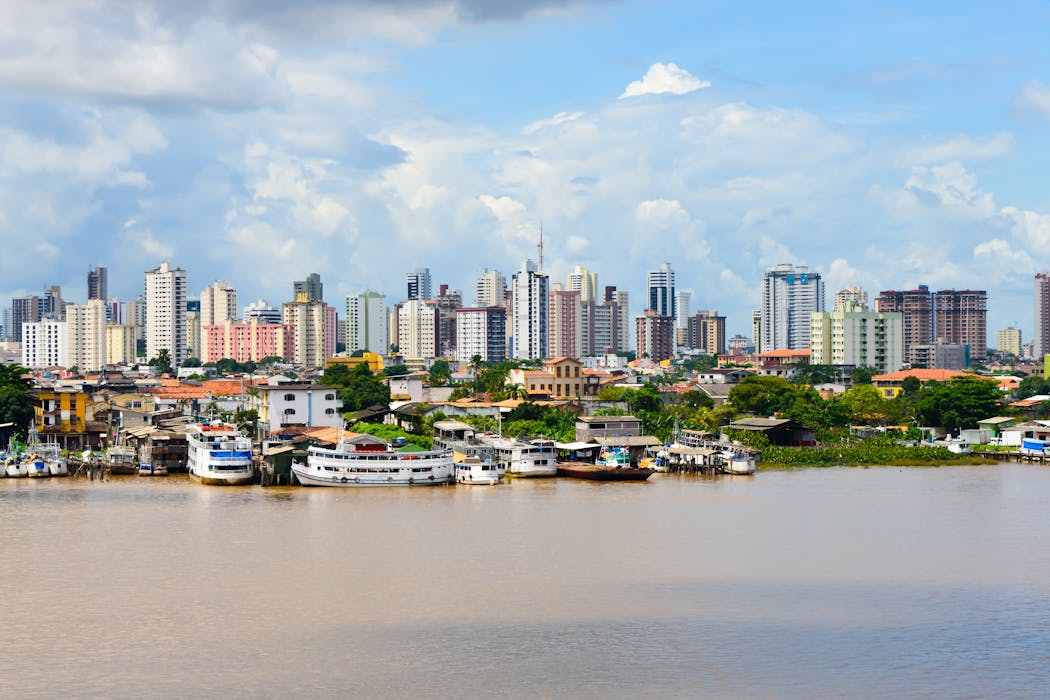
Belém has more than 1 million people yet is too small for a modern ‘Cop’. Maritime Art Blog / shutterstock
If you’re still heading to this year’s UN climate conference in Belém, Brazil, I hope you booked early. Hotels long sold out, and latecomers face extortionate rates – or the prospect of a dubious “love hotel”.
The incredible cost and variable quality of accommodation have sparked outrage. It’s been the subject of high-level meetings and dialogues. But it’s also a symptom of a wider problem: these climate summits have grown so large they’re no longer fit for purpose.
I have been to 11 of these summits over the years, and follow them closely for my academic work, and with the Earth Negotiations Bulletin – a free, curated summary of global environmental negotiations. Cop30, which started on November 10 in Belém, is the first I have missed since Cop18 in Doha in 2012.
I have seen first hand how these annual negotiations and accompanying summit and events (together, broadly called Cops) have grown. They are now MegaCops – enormous conglomerations of events, parallel workshops, receptions, exhibitions and photo ops that attract over 50,000 people. They are the largest events on the UN calendar.
Even with a population of 1 million, Belém is too small. Most cities are. Only a handful of wealthy countries can hope to host them. Many negotiators from poorer countries, along with Indigenous and civil society groups, simply can’t afford to attend this summit.
All this means power is subtly shifting further towards those with the money to participate and host. This bodes poorly for global climate governance.
Prestige and power, for those who can pay
Cities and countries big enough to host a Cop gain some soft power in exchange for the large bill they foot. For instance Paris hosted 25,000 people for the summit in 2015, which cost around €187 million (£164m). In return, the city got its name on a climate treaty we’ll be talking about for decades.
Other MegaCop hosts have also pushed to have an outcome with their name, like the UAE Consensus or Glasgow Climate Pact. It’s hard to imagine a Majuro Pact simply because the Marshall Islands capital won’t be hosting 50,000 diplomats anytime soon, despite the island nation’s climate leadership.
The host countries also set the themes for high-level events and gain support for political declarations of their choosing. The UAE-hosted Cop in 2023 featured declarations on health, renewable energy, peace and gender (among others). None mentioned phasing out fossil fuels. This was no accident – the UAE was reluctant to push its fellow oil-producing states towards such language in the negotiations.
Recent Cop hosts have been oil-producing and exporting states such as the UAE, UK, and Azerbaijan. It’s perhaps little wonder that they spearhead declarations outside the negotiation space on peace or forests, and not fossil fuels.
Too big for small countries
Far fewer declarations have focused on loss and damage (UN jargon for the permanent consequences of climate change), at a time when lives and livelihoods are at risk. Small island states – some of the most climate-vulnerable nations in the world – could get this message across, but these efforts require diplomatic capacity.
Successful Cop hosts have networks of ambassadors or professional diplomats to sound out ideas from negotiators. They can rally consensus in negotiations and support for the president’s various legacy initiatives and declarations. Small countries often lack this capacity. Last year, 39 small island states together sent 261 negotiators to the summit (an average of six or seven people each, compared to the UK’s 37 diplomats).
Cop hosts sometimes find donor money to hire consultants to manage public relations and provide legal and technical advice. Many of these consultants are from developed countries, which has led to questions about their influence.
Inequality in the pavilion
It’s a pervasive myth that a bigger Cop is a more inclusive Cop. It just means more people. At Cop27, there were twice as many fossil fuel lobbyists as Indigenous peoples’ representatives, for instance.
Richer Cop participants can also pay to get their messages across. In Brazil, space in the pavilion – the exhibition zone that runs alongside the main negotiations – starts at US$1,250 (£856) per square meter, excluding additional costs for audio and visual equipment, coffee machines, and decor. These pavilions are offered on a commercial basis by the host countries to help recoup costs.
Governments, corporations and NGOs with deep pockets buy space to host events, distribute their reports, and push their preferred solutions. From the WWF’s Panda Hub to the Gulf Cooperation Council’s space, the pavilion usually focuses on the issues of richer countries and organisations.
In smaller spaces, youth and Indigenous peoples are afforded their own pavilions, paid for by donors or donated by the Cop presidencies. These groups are disproportionately affected by climate change. Yet they struggle to be heard above the din.
If the global climate process could shed its obsession with ever-larger Cops, it would be to its benefit. Smaller countries could help set the agenda, and climate-vulnerable voices might not be outnumbered or outspent.
One practical solution would be to split up the three different events: the main negotiations, the summit for political leaders, and the exhibition zone. Negotiations could take place somewhere smaller and less glamorous, perhaps the UN campus in Bonn, Germany. Political summits and climate action showcases could rotate or sometimes be held online.
We could also limit delegation sizes and centre the talks on implementing the rules we already have rather than new rule-making. These changes would reduce costs and make it easier for smaller and poorer countries to have their say. True climate equity demands a rethink of the very process meant to deliver it.
Don’t have time to read about climate change as much as you’d like?
In October 2025, members of the European Parliament voted in favour of a bill to reserve terms such as “burger” and “sausage” for meat products. If this bill is approved by most EU member states, products made from meat alternatives or vegetables will no longer be allowed to have “burger” on their packaging.
This bill would change the words on the packaging, but it is not enough to change the words that people use in their everyday lives. A push to change the meaning of a word from a government body is unlikely to be successful, linguistically speaking, because of how the human brain processes and stores the meaning of words.
People often think that the meaning of a given word is a single, unchanging definition, much like you would expect to find in a dictionary. However, the linguistic part of the brain that stores words and their meanings is actually a lot more dynamic – and a lot more vague – than that.
Our understanding of meaning is a lot more “I’ll know it when I see it”. Consider the word “milk”. Attached to that word are a number of qualities that you, personally, find relevant to its meaning. These qualities might include its source (from a cow, a pint carton from the supermarket), its appearance (white, liquid) and its function (a drink, a component in coffee or tea, poured over cereal, as an ingredient in baking, or processed into cheese/yoghurt/cream).
It is these qualities that are stored in the brain under the category “milk”. These qualities, or meanings, are continuously edited, upgraded and discarded over time as we gain new information. By this process, the brain learns how to categorise new experiences or unusual examples, such as chocolate-flavoured milk.
Plant-based alternatives have many of the same qualities as their dairy equivalent. Garna Zarina/Shutterstock
Now consider a dairy alternative, such as one made from oat or soya. This plant-based product has many of the same qualities as its dairy equivalent. The milk alternatives fit the appearance and function of milk, and so they are stored under the category “milk” in the brain.
If oat milk is something you drink regularly, then your meanings will update to reflect this: oat milk will become the prototypical “milk” in your brain. Even if oat milk is not a common occurrence in your everyday life, your brain will likely store it under the linguistic category of “milk”, albeit as a fringe example of milk.
When is a burger not a burger?
Now let us consider the meanings associated with a word like “burger”. Its source (beef, turkey, chicken, pork, bean, falafel, meat alternatives), its appearance (a processed disc patty, presented in a bun) and its function (a patty placed in a bun, usually with some accompanying salad or sauces).
There aren’t any non-burger products that have been processed into the prototypical burger-shaped disc. Tatjana Baibakova/Shutterstock
The first thing you might notice is how many options there are for the source of the burger. Most of these sources are quite common and well-known. Even if you yourself have a strong preference for beef burgers, you probably wouldn’t consider a chicken burger an unusual example of a burger.
In other words, our linguistic category of “burger” allows a lot more flexibility and a wider range of sources than “milk”. On the other hand, the shape of the burger (a processed disc patty) and its function (between two buns) are both very important and more restrictive qualities of a burger.
This is in part because there aren’t any non-burger products that have been processed into the prototypical burger-shaped disc. Similarly, there aren’t any sausage-shaped products that aren’t sausages. The shape of the burger is reinforced in our mental linguistic definitions every time we see a burger, and is never undermined by seeing a non-burger patty. This is why we feel very strongly that the very essence of a burger is tied to its function and its shape.
The meaning of the word “burger” doesn’t come from the dictionary definition, or from being told what a burger is by a government. In fact, there isn’t one single meaning for “burger”.
Instead, in the linguistic database in our brain, we have a collection of meanings that we associate with burgers. This linguistic ability allows us to confidently categorise burgers from non-burgers, even if it is, ironically, hard for us to put into words. What is a burger? I’ll know it when I see it.
Don’t have time to read about climate change as much as you’d like?
Victoria-Elliot Bush does not work for, consult, own shares in or receive funding from any company or organisation that would benefit from this article, and has disclosed no relevant affiliations beyond their academic appointment.
Source: The Conversation – UK – By Stewart Lansley, Visiting Fellow, School of Policy Studies, University of Bristol
In the run-up to the 2024 election, future prime minister Keir Starmer labelled wealth creation Labour’s number one mission. “It’s the only way our country can go forward,” he declared. “We should nourish and encourage that – not just individuals but businesses.”
Starmer was right, in theory. But wealth creation is a slippery concept. Essential for economic and social progress, it can also work against both. It’s therefore vital to distinguish between “good” and “bad” wealth.
According to one definition, increases in “good” wealth come from innovation, investment and more productive business methods. Such activity boosts economic resilience, social strength and the size of the economic cake.
Examples include investment in medical and scientific technology – but also, crucially, in the activities that provide vital everyday services and goods to sustain our daily lives. Improvements in the quality of local shops, transport, services for children, adult care and decent hospitality all expand a country’s resources in ways that see the gains shared widely across society.
However, over the past half-century, a rising share of economic activity in the UK and other rich countries has been connected with “bad” wealth accumulation, which actively hampers and harms a country’s prospects.
The Conversation and LSE’s International Inequalities Institute have teamed up for a special online event on Tuesday, November 18 from 5pm-6.30pm. Join experts from the worlds of business, taxation and government policy as they discuss the difficult choices facing Chancellor Rachel Reeves in her budget. Sign up for free here
Bad wealth is especially associated with non-productive or low social-value activities geared to personal enrichment. In Britain and elsewhere, decades of privatisation and wider tax, benefit and monetary economic policies have
fuelled rising inequality while handing much of the command over resources to corporate boardrooms, top bankers and the very rich – with damaging effects for societies and economies alike.
A central source of bad wealth has been a rise in the level of economic “extraction” or “appropriation”. This occurs when capital owners use their power to capture excessive shares of economic gains through activity which weakens economic strength and social resilience. Examples include the rigging of financial markets and manipulation of corporate balance sheets, a range of anti-competitive devices such as the rise in aggressive acquisitions and mergers, and the skimming of returns from financial transactions – a process City of London traders like to call “the croupier’s take”.
Bad wealth is also the product of passive activity unrelated to merit, skill or prescient risk-taking. Over half of the increase in household wealth in the UK since 2010 has come from rising asset prices – in particular relating to property – rather than from more productive activity. This means a huge amount of that wealth is trapped in property and other assets which are not available for reinvestment in the economy.
Britain’s economic record since the 2008 financial crisis has been dismal, with a collapse in the rate of economic growth amid much hand-wringing about its “productivity puzzle”. Yet over the same period, private wealth holdings have surged. In total, UK wealth – comprising property, physical and financial assets – is now more than six times the size of the country’s economy, up from three times in the 1970s. Other rich countries have seen similar trends.
This surge in levels of personal wealth is not the product of more dynamic and innovative economies and record rates of investment. As an editorial in UK financial investment magazine MoneyWeek argued in 2019, too much personal wealth is the result of “mismanaged monetary policy, politically unacceptable rent-seeking, corruption, asset bubbles, a failure of anti-trust laws, or some miserable mixture of the lot”.
It is these activities which account for the burgeoning bank accounts of the already super-rich. Around the world, from the mid-1990s to 2021, the top 1% of wealth holders captured 38% of the growth in personal wealth, while the bottom 50% received just 2%. In the UK, the average wealth of the richest 200 people grew from 6,000 times the average person in 1989 to 18,000 times in 2023.
One of the most important outcomes of the rise of bad accumulation, and the associated surge in the concentration of personal wealth, has been the way opulence and plenty sit beside social scarcity and growing impoverishment. It has brought a significant shift in how national resources are used – away from meeting basic needs to serving the demands of corporate elites, a growing billionaire class, and private markets.
“The test of our progress is not whether we add more to the abundance of those who have much,” declared US president Franklin D. Roosevelt during his second inaugural address in January 1937. “It is whether we provide enough for those who have too little.”
By most metrics, Britain and many other wealthy countries are failing that test.
A key explanation for Britain’s low private investment, low productivity and slow growing economy is the disproportionate share of the rising profit levels of Britain’s biggest companies that has gone in payments to shareholders and executives in recent times. Dividend payments in the UK and globally have greatly outstripped wage rises over the last 40 years. In 2020, aggregate dividend payouts by the FTSE 350 companies made up some 90% of pre-tax profits.
Often, these heightened dividend payments have been financed through borrowing, thus undermining corporate strength. In the case of Thames Water – stripped of much of its value by an aggressive profit strategy by its overseas owners – this has brought near-bankruptcy.
Meanwhile, far from the promise of a property-owning society, large sections of the UK population have – outside of pension provision – no, or only a minimal, stake in the way the economy works. Those with few assets lose out from rising property prices and higher interest rates on savings.
How a nation’s productive resources – land, labour and raw materials plus physical, social and intellectual infrastructure – are owned and used is key to its productive power, social stability, and distribution of life chances. “Money is like muck – not good except it be spread,” wrote the English philosopher and statesman Francis Bacon in 1625.
In the UK, the more egalitarian politics after the second world war led to a more equal sharing of private wealth, and a much higher level of public ownership of key utilities and land. Then in 1979, newly elected prime minister Margaret Thatcher launched her drive for a “property owning democracy”. The windfall gains from council house sales and the selling of cut-price shares in her great privatisation bonanza initially benefited many ordinary people.
But today, the balance sheet looks markedly different. While the sale of council houses initially boosted levels of home ownership in the UK, the number of first-time home buyers is now less than half its mid-1990s rate. As a result, the rate of home ownership has shrunk from a peak of 71% in 2000 to 65% in 2024, with the most marked decline among those aged 25-34.
Getting on the housing ladder is now heavily dependent on having rich parents. The proportion of young people aged 18-34 living with their parents reached 28% in 2024 – a significant rise since the millennium.
At the same time, today’s much more heavily privatised economy has eroded Britain’s holdings of common wealth. Publicly owned assets as a share of GDP have fallen from around 30% in the 1970s to about a tenth. This is one of the principal causes of the deterioration in the UK’s public finances, while handing more control over the economy to private company owners.
The French economist Thomas Piketty has argued that today’s model of corporate capitalism has a natural, inbuilt tendency to generate ever-growing levels of inequality – “a fundamental force for divergence”, as he termed it.
When the return on capital from dividends, interest, rents and capital gains exceeds the overall growth rate, asset holders accumulate wealth at a faster rate than that at which the economy expands, thereby securing an ever-greater slice of the pie – and leaving less and less for everyone else.
In his 2014 book, Capital in the Twenty-First Century, Piketty offered an essentially pessimistic conclusion that breaking this inequality cycle has only happened across history through war or serious social conflict. In response to critics, he modified this position and now seems to accept that there are democratic mechanisms for delivering more equal societies – whatever the undoubted hurdles of implementation.
Suppressing the profiteering and excessive returns that have driven higher levels of inequality is one of the biggest challenges of our time. But such an alignment of growth and rates of return on capital was broadly achieved in the post-war era, and there are several routes for achieving such convergence again – even in today’s very different conditions.
1. Shift the tax focus from income to wealth
Despite the scale of today’s wealth boom, Britain’s tax system is still heavily biased to earnings. Income from work is taxed at an average of around 33% and wealth at less than 4%. Through political inertia, the UK tax system has failed to catch up with the growing importance of wealth over income in the way the economy operates, and does little to dent the growing concentration of wealth holdings at the top.
In her first budget in October 2024, the chancellor, Rachel Reeves, took steps to raise revenue through changes to inheritance and capital gains tax (the profits made on selling shares or property other than your home). But these were too modest to alter the imbalance in the taxation of wealth and earnings.
A more fundamental shift would be to reform the existing system of council tax with a larger number of tax bands at the top. Still based on 1991 property values, this is perhaps the least defensible tax in Britain. Households in poorer areas pay more than better off households in the richest.
In Burnley, the typical household pays some 1.1% of the value of their home in council tax every year. In a typical property in Kensington and Chelsea, it is 0.1%. The most effective alternative would be to replace council tax and stamp duty – the tax on the purchase of homes – with a single progressive or proportionate “property tax”. Any serious reform requires a long overdue property revaluation and an extension in the number of tax bands.
A modest and phased rise in capital taxation would also help to break up today’s wealth concentrations and reduce the passive – and often malign – role played by wealth holdings. Even small changes would release funds which could be used to improve social infrastructure from schools to hospitals.
One such change, as recommended by the Office for Tax Simplification, should be to raise the rates on capital gains tax so that they are equal to income tax rates. In 2024, 378,000 people paid UK capital gains tax worth a total of £12.1 billion – a decrease of 19% on the previous year.
Measures to limit asset inflation could include extending the Bank of England’s remit on inflation to limit rises in property prices, which have led to historically high rents and priced a rising proportion of young people out of home ownership.
2. Reduce how much wealth gets passed on
“A power to dispose of estates forever is manifestly absurd,” the Scottish economist Adam Smith declared 250 years ago. “The Earth and the fulness of it belongs to every generation, and the preceding one can have no right to bind it up from posterity. Such extension of property is quite unnatural.”
Despite Smith’s exhortations, birth and inheritance remain the most powerful indicators across most countries of where you end up in the wealth stakes and the pattern of life chances.
Importantly, inheritance does little to boost productive activity. Higher ratios of inheritance in wealth holdings – and recent decades have seen an upward shift – tend to be associated with reduced economic dynamism. Assets tied up in large wealth pools are often little more than “dead money”: idle resources that could be put to use funding public services or productive investment.
Yet, helped by light taxation, social privileges continue to be handed on in perpetuity. Only 4.6% of deaths in the UK resulted in an inheritance tax charge in the 2023 financial year, contributing a tiny 0.7% of all tax receipts.
Around 36% of all wealth is stored in property, and there is a strong public attachment to people retaining their inherited housing wealth – even among those who are not beneficiaries. In part, inheritance tax is widely perceived as unfair because of the way the richest are able to avoid it.
Of people born in the UK in the 1980s, those in the poorest fifth by wealth will enjoy an average 5% boost to their lifetime income through inheritance, compared with 29% for the top fifth. Clearly, those on the wrong side of this gap will be left even further behind by the end of their lives.
And the divide is widening sharply. The scale of intergenerational wealth transfer is on a steeply upward trend, with projected levels of inheritance set to dwarf all previous wealth transfers in the coming decade. Little of this process contributes to more productive activity, with one of its primary and malign effects being to fuel higher house prices.
3. Introduce a ‘whole wealth’ tax
Another much-debated option would be to levy a new tax on whole wealth holdings, rather than just the revenue these assets generate. An annual 1% tax on wealth over £2 million – affecting some 600,000 people in the UK – could raise around £16 billion a year, according to the 2020 Wealth Tax Commission report.
Such taxes would be easier to levy on immobile assets like buildings and land taxes than on liquid assets, such as financial holdings. But this complexity is not insurmountable – and nor is public opinion. Such a measure could be sold politically as a “solidarity tax” to help pay for key under-resourced but high social-value services – such as a proper social care system and improved services for children.
While many governments have been wary of the political reaction to higher taxes on wealth, YouGov’s most recent survey suggests around three-quarters of the public now support such a tax, with more than half strongly supporting it.
The Inequality Crisis – a talk by the article’s author, Stewart Lansley, in March 2013. Video: RSA.
4. Increase public ownership of utilities and services
Tackling inequality and profiteering also require a greater level of common and social ownership. Britain is a heavily privatised and marketised economy. Few other developed countries have handed over such control of key utilities to private firms.
Privatised in 1989, Britain’s water industry has been turned into a potent example of profiteering. Under private ownership, it has delivered leaky and unrepaired pipes, the illegal dumping of sewage spills into rivers and beaches, and two decades of under-investment in large part because of the disproportionate share of profits going in dividend payments to mostly overseas owners.
Another significant trend has been the private takeover of a range of public services – from social care to children’s services. According to the Competition and Markets Authority (CMA), the UK has “sleepwalked” into a dysfunctional system with widespread profiteering in privately run children’s homes. It found operating profit margins averaging 22.6% from 2016-20, driven by escalating charges and cost-cutting.
These examples of bad accumulation have hollowed out some of the UK’s most vital industries. A mix of public and social ownership and much more effective regulation are necessary to turn these industries into effective service providers rather than cash machines for investors.
Regulatory reforms are also needed to moderate the way some markets work. The CMA suggests that anti-competitive behaviour and “oligopolistic structures” are hallmarks of a rising volume of business activity. For example, it has accused the UK’s seven largest housebuilders of collusion on issues from pricing to marketing.
Price gouging – when firms exploit emergencies such as the COVID pandemic and Russia’s invasion of Ukraine to charge excessively high prices for essential goods – is another area ripe for tougher intervention.
5. Establish citizens’ wealth funds
Alongside greater social ownership, all citizens need to be given a more direct stake in the gains from economic activity. As one heckler put it during the Brexit referendum: “That’s your bloody GDP, not ours.”
One route would be to build models of “people’s capital” through a new strategy of asset redistribution to individuals. This would extend the principle of income redistribution that has been one of the main, if now much weakened, pro-equality instruments of the post-war era. A medium to long-term plan would be to create one or more national and local “citizens’ wealth funds”, owned collectively by all on an equal basis.
Originally advanced by the British economist and Nobel laureate James Meade, such funds would be created by the state but owned by society, with returns distributed either as universal dividends or as investment in public services. Such a fund could be financed from a mix of sources including long-term government bonds; the transfer of several highly commercial state-owned enterprises, such as the Land Registry, Ordnance Survey or Crown Estate; part of the proceeds from higher wealth taxes; and new equity stakes in large corporations.
Anchorage, capital of the US state of Alaska, which operates a permanent fund for its citizens. TripWalkers/Shutterstock
Perhaps the most notable example of citizen-owned capital is the Alaska Permanent Fund. This was created in 1976 from oil revenues and effectively owned by all of the US state’s citizens. It has since paid out a highly popular annual dividend which averages about US$1,150 (£875) a year.
The UK has its own example: also in 1976, the Shetland Islands Council established a charitable trust from “disturbance payments” paid by oil companies in return for operational access to the seas around the islands. The returns from this trust have been used to fund social projects, from leisure centres to support for the elderly.
Another possibility is to establish a national pension fund that would eventually pay for the cost of state pensions. Australia’s Future Fund, for example, is an independently managed sovereign wealth fund to meet future civil service pension obligations. Established in 2006 by receipts of AUS$50 billion (£20 billion) from the sale of Telstra, the national telecoms company, it has since been supplemented by direct government grants and is projected to reach a value of AUS$380 billion by 2033.
The UK government has launched the Community Wealth Fund, a £175 million initiative aiming to “transform neighbourhoods with long-term financing”. Working with local communities the initiative will fund projects in local communities across England. Despite its modest finances, this establishes the principle of collectively owned social funds. This is funded through the government’s Dormant Assets Scheme, which unlocks old bank accounts and other financial products that have been left untouched.
6. Spread access to the nation’s assets across society
Any meaningful redistribution of wealth across society requires a suite of deep structural reforms from improving access to affordable housing to reducing levels of corporate extraction.
One of the most important issues is finding ways of extending access to assets to all citizens as a condition of democratic opportunity. The Child Trust Fund, introduced by New Labour in 2005, was an ambitious attempt to address wealth inequality by giving every child a modest financial stake – a kind of citizen’s inheritance. Yet the scheme was abolished in 2010 by the incoming coalition government.
In the event, it only achieved a modest impact. Average payouts when children reached 18 were around £2,000, with a quarter of all accounts being forgotten or lost. The desired shift in household saving habits tended to be limited to more affluent parents paying extra into the trust funds, meaning the policy reinforced some of the inequalities it had aimed to challenge.
Bold decisions required
While recent years have seen a growing debate about the impact of ever higher concentrations of wealth in the UK, few proposals for real change – beyond a mere tampering at the edges of inheritance and capital gains tax – are yet on the political agenda. Some of these measures would take longer to achieve, and some, such as citizens’ wealth funds, are more ambitious and potentially transformative than others. All would require bold decisions by government.
In the run-up to her much-anticipated November 26 budget, the chancellor has hinted that higher taxes on the wealthy will be “part of the story” – although a manifesto-busting rise in the base rate of income tax is also on the cards.
Against this, Reeves has ruled out a standalone wealth tax, and there appear to be no plans for more radical measures to rein in excessive profiteering. This means that the wealth gap is probably set to widen.
Yet history suggests the idea of limiting high concentrations of wealth is far from utopian. Limits operated relatively effectively among nations including the UK and US in the post-war decades, through a combination of regulation, highly progressive taxation and changes in cultural norms.
The highest personal fortunes were more modest in part because of the destructive effect of war on the size of asset holdings. There was also a new social and cultural climate that would not have tolerated today’s towering fortunes, and which allowed the post-war progressive tax systems to be maintained for decades.
Restructuring the process of wealth accumulation is never going to be straightforward politically. The protests over the adjustment to inheritance tax in 2024, in particular its impact on farmers, demonstrates how sensitive these issues are – particularly when stoked by those seeking to make political capital out of pro-equality reforms.
But Britain stands at a historic moment. Failure to tackle mounting wealth-driven inequality will have harmful consequences for the social and economic stability of generations to come. Amid rising public anxiety about the future and a widespread sense that the economy is “rigged” against ordinary people, a more ambitious political agenda that addresses inequality and economic stagnation could win public backing, if any government is brave enough to try.
The Conversation and LSE’s International Inequalities Institute have teamed up for a special online event on Tuesday, November 18 from 5pm-6.30pm. Join experts from the worlds of business, taxation and government policy as they discuss the difficult choices facing Chancellor Rachel Reeves in her budget. Sign up for free here
To hear about new Insights articles, join the hundreds of thousands of people who value The Conversation’s evidence-based news. Subscribe to our newsletter.
Stewart Lansley is a fellow of the Academy of Social Sciences. His latest book, The Richer, The Poorer: How Britain Enriched the Few and Failed the Poor, is published by Bristol University Press.
Source: The Conversation – UK – By Sophie E Harrison, Lecturer in Sport and Exercise Science, Bangor University, Bangor University
Being anxious, stressed or in a bad mood before a marathon may make you more vulnerable to illness.Asier Romero/ Shutterstock
Marathons have quickly become a popular pursuit. Hundreds of thousands of people submit ballots each year to run in some of the most prestigious races. In 2024, a record number of people crossed the finish line at some of the world’s biggest marathons. If you haven’t run a marathon yourself, chances are you know someone who has.
While we know that running has a range of health benefits, including reducing your risk of illness, research also shows that runners are more likely to catch a cold after completing a marathon.
Scientists used to think this was caused by reduced immune function following prolonged exercise, alongside increased exposure to infection due to the large crowds that marathons attract. But our latest research shows that a person’s anxiety, stress and mood may also play a role in whether they’re more vulnerable to getting ill or not after a long run or marathon.
In our first study, we asked 406 runners to complete questionnaires about their anxiety and mood in the month and days before running a marathon. We also asked them to provide saliva samples before and after the race.
The mouth is one of the main routes of access for the majority of viruses and bacteria that cause respiratory infections. The saliva samples allowed us to detect whether there were signs that the defence systems that normally stop these pathogens from entering the body (known as mucosal immunity) were suppressed.
We then tracked their common cold symptoms during the two weeks after their marathon.
Runners who were more anxious generally and those who experienced greater mood disturbance before the race (such as anger, frustration or tension) were more likely to experience a respiratory infection during the two weeks after the marathon. They also had a greater reduction in mucosal immunity.
In the second study, we asked 45 adults to run on a treadmill for an hour inside our laboratory. We asked them to complete questionnaires about their anxiety, stress and mood before they completed the run. We also measured their mucosal immunity in saliva before and after the run.
Men with higher anxiety levels, stress levels and greater mood disturbance were more likely to have a reduction in mucosal immunity after the run compared to men who had lower anxiety and stress levels before the run.
When examining the influence of stress, anxiety and mood on the immune response to one hour of running in women, findings were not as clear cut. There are many potential reasons for this – with factors such as hormone fluctuations, contraceptive use and differences in immune response depending on menstrual cycle phase all potentially having an influence. It will be important for future studies to examine this.
Together, the findings from our studies indicate that people who are more stressed or anxious before a run might be at greater risk of getting sick or catching a cold. This effect seems to apply not only to marathon-length runs, but to moderate-length runs of around an hour, too.
Immune function
One possible reason for this link between stress and immunity is due to the way stress changes how the immune system functions.
Both psychological and physical stressors affect the body through similar mechanisms – specifically through the hypothalamic-pituitary axis and sympathetic-medullary axis. These pathways link the nervous system to the brain and play a role in the stress response. High psychological stress or prolonged exercise can suppress these axes and reduce immune function.
So when runners experience both psychological and physical stress, the impacts on the immune system might be more significant than if they were just experiencing psychological or physical stress alone.
Stress can make our bodies us less able to fight infections. Dirima/ Shutterstock
For example, both mucosal immunity and the immune system’s ability to respond to new foreign pathogens are reduced following prolonged running in people with higher anxiety and stress levels. This shows just how significant the effects of both psychological stress and physical stress are when it comes to immune function.
But before you cancel that 10k or withdraw your marathon ballot, it’s important to remember that being physically active still reduces your risk of a respiratory infection compared to not exercising at all.
Instead, it’s important to prepare yourself well before your run by dealing with your stress and anxiety beforehand. Finding ways to reduce stress before a run should be treated the same way as you would ensure that you’re hydrated and fuelled well.
It can also help to monitor stress, anxiety and mood so that you can identify when your stress or anxiety starts to increase – or when your mood begins to worsen. This will help you identify triggers and take proactive steps to reduce the impacts before things progress and become worse.
If you’re taking part in a race or marathon, some easy ways to reduce stress include:
Planning your travel route in advance and allowing extra time to avoid rushing and stress
If you can, try to arrive the night before the race to scope out your route
Plan some “what if” or “if/then” strategies to be prepared to deal with anything unexpected on race day.
Of course, some of the best ways to avoid getting sick involve sticking to the tried and tested techniques – such as washing your hands properly (and avoid touching your eyes, nose and mouth), aim to get at least seven hours of sleep each night, eat a well-balanced diet, plan a recovery week into your training every second or third week and never train if you have an injury.
The authors do not work for, consult, own shares in or receive funding from any company or organisation that would benefit from this article, and have disclosed no relevant affiliations beyond their academic appointment.
More than 50 years after the last time humans walked on the Moon, China is working steadily towards landing its astronauts on the lunar surface.
On October 30, 2025, a spokesman for China’s crewed space programme said the country was “on track” to launch its lunar mission by 2030. So how does China plan to send astronauts to the Moon?
Among legislators and senior figures in the US space sector, China’s progress towards a crewed lunar mission has generated concern. Some fear damage to America’s status as a spacefaring nation if China lands before Nasa’s effort to return astronauts to the Moon.
The US space agency’s Artemis III mission should send the first American astronauts to the lunar surface since Apollo 17 in 1972. It is scheduled to launch in 2027, but delays could bring it much closer to Beijing’s planned lunar flight.
The approaching date for China’s crewed Moon mission represents a remarkable trajectory for the country. Beijing launched its first astronaut, Yang Liwei, to space in 2003, aboard the Shenzhou 5 mission. China’s decades-long preparation for a lunar landing mirrors the milestones or “firsts” that characterised the space race between the US and Soviet Union in the 1960s and 70s.
China has moved from its first astronaut mission to launching a pair of astronauts, followed by a three person mission, which featured the first spacewalk for a Chinese astronaut. The country has since built a space station, Tiangong, in low Earth orbit. When the International Space Station is retired in 2030, it will leave China as the only country with a permanent outpost in Earth orbit.
On October 31, the Shenzhou 21 flight launched three crew members to the Tiangong orbital outpost. They took over operations from three other Chinese astronauts who have been on the space station since April 2025. Such crew rotations are now the norm for China and further demonstrate the country’s impressive capabilities as it prepares for the lunar mission.
However, the three departing astronauts’ return to Earth has been delayed after their capsule was hit by space debris. It’s a reminder that space is a hostile environment, however routine missions might appear to be.
The way that China has steadily built its presence in space highlights its technological prowess. Since the 1970s, China has developed more than 20 types of its Long March family of rockets – with 16 active today.
According to the state-run China Daily, Long March rockets have a 97% success rate. That falls just slightly under the SpaceX Falcon 9 rocket’s 99.46% success rate.
With its reliable launchers, China has been able to accurately plan and build realistic timelines for its space milestones. In August this year, China conducted a ground test of their newest Long March 10 model.
This model is meant to launch astronauts to the Moon aboard the next-generation Mengzhou crew capsule in 2030. This will replace the Shenzhou spacecraft which has been the workhorse for crewed missions up until now.
The spacecraft consists of two different sections, or modules: a crew module and a service module. The crew module carries the astronauts. The service module provides power, propulsion and life support for the crew module. The modular design allows it to be tailored to meet the requirements of different missions.
Officials envisage two versions initially: one for use in Earth orbit to ferry astronauts to and from the Tiangong space station and a deep space version designed for lunar missions.
The crew module will be able to carry up to six astronauts compared to Shenzhou’s three. The first flight for the Mengzhou spacecraft, without crew, is scheduled for next year.
Mengzhou will also carry a lunar lander, called Lanyue. This name originates from a poem written by the late Chinese head of state Mao Zedong and translates as “embracing the Moon”. Lanyue consists of two segments, a landing stage and a propulsion stage.
The landing stage carries the crew. The propulsion stage carries fuel for the landing and separates during the final stages of touching down on the Moon. Lanyue will weigh nearly 26 tonnes and will accommodate two astronauts for the trip to the lunar surface.
Testing of the lunar lander has been underway since 2024. A robotic prototype
is scheduled for trials in 2027 and 2028 and an uncrewed Mengzhou-Lanyue mission is planned for 2028 or 2029, ahead of the full crewed mission to the lunar surface in 2030.
In 2024, the China Manned Space Agency (CMSA) also unveiled the spacesuits designed to be used by astronauts on the Moon. At the unveiling event in Chonqing, a technician wearing the suit demonstrated its range of motion by crouching, bending over and climbing steps.
China unveils spacesuits for walking on the Moon.
China will build on its successful robotic lunar exploration programme, which has already delivered several major milestones. These include the Chang’e-6 mission’s delivery of the world’s first samples from the far side of the Moon in June 2024, via a robotic probe. This headline-grabbing breakthrough underscored China’s growing technological reach in space.
China’s path to the Moon is realistic, feasible, and most importantly on track. Their multi-decade history in space means that it not only has the necessary know-how, but it also has what many other nations do not: a clear vision and deep pockets.
China was the second highest spender on government space programmes in 2024, though its US$19 billion spend was a remarkable US$60 billion less than that spent by the US. Its missions, at least on the face of it, are also subject to far less disruption through changing political winds.
A crewed Chinese lunar landing will carry profound symbolism, especially if the country gets there before Nasa’s planned return mission. But such a feat would go beyond simple prestige: “The countries that get there first will write the rules of the road for what we can do on the Moon,” former Nasa Associate Administrator Mike Gold told a recent US Senate hearing.
A Chinese Moon landing would enable the country to start shaping the rules, the research agendas and the geopolitical landscape of this new era in space.
Marissa Martin does not work for, consult, own shares in or receive funding from any company or organisation that would benefit from this article, and has disclosed no relevant affiliations beyond their academic appointment.
Source: The Conversation – UK – By Helen Pleasance, Senior Lecturer in Creative Writing and English Literature, York St John University
The John Lewis Christmas advert has become as much a part of the festive season as tinsel and crackers. These adverts function as short films that don’t just sell products, they sell feelings. They work not through product placement but through sentiment, nostalgia and connection.
This year’s advert, which centres on a teenage boy buying his father a vinyl record, strikes a particularly resonant chord. The story invites us to think not only about family and festivity, but about how music and the technologies that carry it, allow us to travel in time and revisit the past, and to understand who we are.
Through these projects, we discovered that when people tell stories about music, they are also telling stories about themselves: where they were and who they were and what this means for their older selves. These stories reveal how deeply music is woven into our sense of self and place. Music becomes, in effect, an emotional map of a person’s life.
Our current project, the forthcoming Turntable Stories, extends this exploration by focusing on the specific technologies of record players and vinyl. For those who grew up in the 1970s, 1980s and 1990s, the turntable was more than a playback device.
The act of placing the needle on the record, of flipping the disc and studying the sleeve notes, shaped how we experienced music as both sound and an object. In collecting these stories, one of the most poignant themes to emerge has been intergenerational connection. Vinyl records link parents and children, not only through shared listening but through the stories and memories embedded in the grooves.
Back in time
This theme sits at the very heart of this year’s John Lewis advert. The boy’s decision to buy his father a vinyl record is about more than a gift – it’s about recognition. The moment the record begins to play, his father is transported back to his younger self, moving to the rhythm of a 1990s dance banger.
The music collapses time. The father’s younger self flickers momentarily in the present, and in that moment the son glimpses his parent anew: as a person with a past, the music a soundtrack of his father’s youth. The advert gives us, in miniature, a father-and-son biography told through music, fusing memory, identity and affection.
Our research helps to explain why such a story resonates so powerfully. Music psychologists and cultural theorists alike have suggested that songs act as “time machines” of emotion. They allow us to revisit versions of ourselves long after the circumstances of those memories have faded.
In the process, listening becomes a form of autobiography. As our Turntable Stories contributors tell us, the act of hearing an old record often feels like a dialogue across time. In one chapter, author Amy McCarthy beautifully reverses the dynamic of the John Lewis advert. Rather than a son giving to a father, Amy’s father gives her a box of his old vinyl records from the 1980s, including the Smiths.
Thinking about how my dad experienced listening to The Queen is Dead at 24, I realise I know very little about my parents’ lives before they had children. I wonder what my dad thought the first time he brought this record home.
During the pandemic, she listens to these records as a 24-year-old, the imaginative act of listening across time becoming a way of understanding him and herself. The records offer a shared space of reflection where two 24-year-olds, separated by nearly four decades, coexist for the duration of a song.
Other contributors in Turntable Stories describe similar experiences of time folding, where the sound of an old record creates a bridge between past and present. To play a record is to perform memory. It reactivates not only what was heard but where, when, and with whom it was first experienced.
Author Prasad Bidaye’s chapter expands this discussion, exploring how records circulate within diasporic communities. As part of a second-generation Indian family in Canada, Bidaye describes how vinyl became a means of continuity, carrying fragments of cultural identity from one continent to another, discovering “the ways music creates community, especially for families like mine who never fully fitted into the North American mainstream, nor the one of our ever-growing Desi diaspora”.
The power of vinyl
These accounts remind us that vinyl is more than nostalgia. Its material qualities shape how memory works; it is the weight of the record, the sleeve art, the beer stain on the inner sleeve, the crackles and jumps in familiar places.
Unlike digital formats, which render music as infinitely reproducible and placeless, vinyl situates music in time and space. It invites a slower, more embodied engagement. To hold a record is to hold a fragment of the past, a tangible link to a moment that can be reactivated through listening.
So when the John Lewis dad drops the needle on that record, the emotional force of the scene is not accidental. It draws upon a shared cultural understanding of how music, memory and materiality connect.
What we witness is clever marketing, but it is also a meditation on how music allows us to reconnect. In the end, the John Lewis Christmas advert succeeds because it mirrors a truth at the core of our research: that music is one of the most powerful narrative technologies we possess.
The grooves of a record don’t just hold sound waves, they carry emotional inscriptions. Each play is a small act of storytelling, one that spins us backwards and forwards through time.
Looking for something good? Cut through the noise with a carefully curated selection of the latest releases, live events and exhibitions, straight to your inbox every fortnight, on Fridays. Sign up here.
The authors do not work for, consult, own shares in or receive funding from any company or organisation that would benefit from this article, and have disclosed no relevant affiliations beyond their academic appointment.
The leaked memo raising concerns about BBC impartiality was an early Christmas present for those who believe the UK’s biggest public service broadcaster is biased and needs to be reformed and cut down to size.
For some, the crisis the memo has sparked – which has led to the resignation of the BBC’s director general and its head of news and a threat from US president Donald Trump of a US$1 billion lawsuit – reflects a terrible failure of internal governance. For others, it represents a “coup” at Broadcasting House, launched by a faction within the BBC’s senior echelons seeking to push the tone of the broadcaster’s news coverage to the right.
But whatever the case may be, this crisis comes at a pivotal moment in the broadcaster’s history, as it approaches the once-a-decade renewal of its royal charter.
This arcane-sounding instrument is the BBC’s foundational document. It gives the corporation independence from politicians and civil servants on a day-to-day basis, while also ensuring a measure of accountability to the public which owns and funds it.
Crucially, the charter does not run in perpetuity. Typically, it needs to be renewed every ten years. This gives parliament an opportunity to hold the BBC to account for its performance over the previous decade, and to decide whether fundamental reform is needed. Conceivably, parliament could decide that no new charter should be granted, effectively ending the BBC’s existence as a public corporation.
Negotiating with the government over charter renewal is, unsurprisingly, a major preoccupation for BBC leaders in the years before each charter expires. The current charter ends on December 31 2027. As a result of Tim Davie’s resignation, the BBC now lacks an experienced director general at a crucial time. Some believe that this crisis therefore represents an existential threat to the BBC.
Historical precedent
Allegations of political bias – generally that the BBC leans to the left – have existed for almost as long as the corporation has. Back in the 1920s, the government’s response was to impose restrictions on the type, amount and timing of news and current affairs coverage the BBC could broadcast.
The BBC had a monopoly on broadcasting at the time, and lawmakers worried what it would mean for UK politics if the BBC started to editorialise in support of one or other of the main political parties. As one early regulator put it: “Once you let broadcasting into politics, you will never be able to keep politics out of broadcasting.”
Yet others recognised that radio, and later television, were key means to disseminate news. The ban on “controversial” broadcasting could not last. The BBC itself pressed for the legal restrictions to be relaxed, and governments gradually gave way. By the outbreak of the second world war the BBC had become a significant, and increasingly trusted, source of news for audiences across the UK and around the world. After the war, it massively expanded its journalistic capacity and became the major news operation that it is today.
Yet allegations that the BBC was politically biased never disappeared. They reached a peak when Margaret Thatcher was prime minister. Thatcher believed that the BBC was unsympathetic to her political programme and to the Conservative party more generally. She particularly resented the corporation’s news coverage of the Falklands War, the Miners’ Strike, and the Troubles in Northern Ireland.
Thatcher used two strategies to bring the BBC into line. First, she sought to install a more sympathetic senior leadership team at the BBC. Two prominent Conservative supporters were put on the BBC board, with Stuart Ward as chair (replaced after his untimely death by another Thatcher loyalist, Marmaduke Hussey) and William Rees-Mogg as vice chair.
One senior BBC executive thought that Rees-Mogg acted less like a vice-chair, and “more like the leader of the opposition”. A long-running dispute over a BBC Panorama documentary broadcast in 1984 on far-right tendencies within the Conservative party allowed senior board members to oust director general Alasdair Milne.
The new regime at the BBC also drove through reforms designed fundamentally to change the way that the BBC worked. The corporation moved away from its old public sector ways of operating, towards commercialisation and outsourcing, in a bid to reduce costs and increase revenues. These reforms were championed by a new director general recruited from the private sector, John Birt. The wider aim was to reduce the monopolistic power of the BBC and allow more powerful commercial competitors to emerge. Birt also imposed a much tighter set of editorial guidelines on BBC journalists.
Thatcher even raised the prospect of abolishing the licence fee which funded the BBC. However, Professor Alan Peacock, the economist commissioned by the government to report on how to fund the corporation, shied away from recommending this drastic step.
What’s next for the BBC?
The BBC ultimately survived the existential threats of the 1980s. The price was radical transformation, as the BBC became leaner and increasingly driven by the need to generate commercial revenues to support its public service activities.
Some think that the current controversy reflects the attempts of previous governments to stack the BBC board with supporters, as Thatcher once did. The political loyalties of the next director general, and of any new appointees to the board, will as a result be intensely scrutinised.
Will charter review also involve fundamental reform of the way the BBC is governed and funded? The licence fee has become a lightning rod for hostility to the corporation and the future of this financing system is certainly in doubt.
In the coming battle over charter renewal, the outcome of debates about how the BBC is governed, and how it is funded, will determine what sort of BBC can survive past 2027. The next director general will need to restore public trust in BBC news, satisfy politicians that rigorous impartiality can and will be guaranteed, and navigate the financial challenges that may arise from potential legal settlements or the end of the licence fee system.
That is, of course, assuming that the BBC is able to learn the lessons of its own history, and adapt to survive its latest existential crisis.
Simon Potter received funding from the Leverhulme Trust, 2016-2019, for a research project on the history of international broadcasting.
A variety of websites now have processes designed to verify the ages of their users. These checks are carried out in several ways. For instance, AI can be used to analyse whether a photo of the person looks old enough for the age threshold on a website.
Asking for photo ID, such as a scan of a person’s driving licence or passport, is another method, along with asking for a verified credit card.
However, the amount of personal data involved in completing age verification comprises a veritable treasure trove for hackers.
Recent incidents have further highlighted the privacy and security concerns around age verification. In October 2025, Discord, a social media and chat platform popular among gamers was hacked, with an unspecified amount of data extracted.
However, the company said it had identified 70,000 users globally who potentially had their photo IDs exposed to the hackers. Discord said the data was accessed through a third-party service provider, although it remains unclear exactly how the breach occurred.
Age verification checks for the UK were brought in by Discord in order to comply with the Online Safety Act. The act required that websites allowing pornography and harmful content introduce age checks by July 25 2025.
In July 2025, the Tea app, which allows women to anonymously share information about the men they date for safety purposes, was also hacked. The app requires a photo selfie and photo ID in order to register. The breach reportedly revealed these photos along with content and messages.
Grave consequences
These breaches highlight issues of compliance with website privacy policies, security practices and general data protection regulations (GDPR) legislation.
When Discord brought in age verification, its support website said it did “not permanently store personal identity documents or your video selfies”. It added: “Images of your identity documents and ID match selfies are deleted directly after your age group is confirmed, and the video selfie used for facial age estimation never leaves your device.”
The consequences of such breaches can be grave. Leaked images of selfies and photo IDs can lead to users facing a range of harms, such as identity theft and fraud. The kind of data that’s hacked also lends itself to particularly sophisticated forms of these crimes, particularly when you consider the availability of deepfake technology and generative AI tools.
In fact, third-party providers have represented a consistent vulnerability to be relentlessly exploited by cybercriminals, as seen in recent breaches of the UK Ministry of Defence, the Co-op supermarket and M&S to name but a few.
The proliferation of age verification checks in recent years is partly a response to new legislation, such as France’s Security and Regulation of the Digital Space law, the European Commission’s Digital Services Act and the Online Safety Acts in the UK and Australia. These all deem checks where users self-declare their age as unfit for purpose. Instead, they require websites to use more effective methods, such as photo ID matching, or credit card checks.
In a recent press release, the UK’s Department of Science, Innovation and Technology attempted to address the cybersecurity and privacy concerns arising from such checks. The department’s guidance says that any measures implemented by platforms to confirm a user’s age must be done “without collecting or storing personal data, unless absolutely necessary”.
This reiterates rules from the EU’s GDPR legislation. Further guidance is offered by the UK Information Commissioner’s Office and the regulator, Ofcom.
However, the Tea and Discord breaches highlight regulators’ inability to prevent data retention or enforce data deletion in practice. This is particularly relevant when the third parties are located outside of the UK.
The incidents show that the implementation and use of age verification requires genuine review; further regulation of data handling with enforcement powers – beyond mere guidance. This is a necessity to safeguard privacy, especially when third-party companies are involved.
Mark Tsagas does not work for, consult, own shares in or receive funding from any company or organisation that would benefit from this article, and has disclosed no relevant affiliations beyond their academic appointment.
En 2025, des mobilisations portées par la jeunesse ont éclaté du Maroc au Népal, en passant par Madagascar et l’Europe. Partout, une génération refuse le silence face à la précarité, la corruption et le manque de démocratie.
Nées dans des contextes très différents, ces colères rencontrent pourtant les mêmes réponses : répression, mépris, et suspicion envers une jeunesse jugée irresponsable.
Mobilisation sur plusieurs continents
Au Maroc, le mouvement #Gen212, né sur les réseaux sociaux, dénonce la vie chère, les violences policières, le musellement de la société civile et l’absence de perspectives. Cette mobilisation, d’abord numérique sur des plates-formes telles que Discord, a rapidement débordé les écrans pour s’incarner dans des actions concrètes dans plusieurs villes du pays.
À Madagascar, c’est dans un climat de fortes tensions préélectorales que la jeunesse est descendue dans la rue pour réclamer un véritable changement dès la fin du mois de septembre, avant d’être violemment réprimée. Au Népal, des milliers de jeunes occupent l’espace public, exigeant une démocratie authentique et la fin de la corruption qui mine le pays.
En Europe aussi, la jeunesse se mobilise face aux dérives autoritaires et aux inégalités persistantes. En Italie, en France ou en Espagne, les jeunes descendent dans la rue contre les violences sexistes, les réformes impopulaires, les répressions policières ou encore pour la reconnaissance des droits politiques.
Malgré la diversité des contextes, ces mobilisations traduisent une même volonté : refuser l’injustice et faire entendre des voix trop souvent marginalisées.
Pourtant, la réponse des États semble suivre un autre chemin : celui du durcissement. Les jeunes manifestants et manifestantes sont surveillés, arrêtés, stigmatisés, parfois accusés de trahison ou d’être manipulé par des puissances étrangères.
Au Maroc, par exemple, depuis septembre 2025, près de 2500 jeunes ont été poursuivis, dont plus de 400 condamnés — parmi eux 76 mineurs. Les chefs d’accusation incluent la « rébellion en groupe », l’« incitation à commettre des crimes » ou encore la participation à des rassemblements armés. Plus de 60 peines de prison ferme ont été prononcées, certaines allant jusqu’à 15 ans.
Cette judiciarisation massive d’un mouvement pacifique a été dénoncée par Amnesty International, qui pointe un usage excessif de la force et une criminalisation croissante de la protestation.
À Madagascar, la réponse a été tout aussi brutale : au moins 22 morts, plus de 100 blessés et des centaines d’arrestations arbitraires recensées lors des mobilisations de la jeunesse contre la corruption et les irrégularités électorales. Selon les Nations unies, les forces de l’ordre ont eu recours à des balles en caoutchouc et à des gaz lacrymogènes pour disperser les foules. La crise a culminé avec la fuite du président Andry Rajoelina, confirmant que cette répression n’a pas désamorcé le conflit, mais révélé la fragilité des institutions face à une jeunesse politisée.
Un discours qui renvoie à la responsabilité des parents
Les jeunes interpellés lors des récentes mobilisations ont souvent été renvoyés à la responsabilité parentale dans un discours profondément moralisateur. Au Maroc, par exemple, le ministère de l’Intérieur a appelé les parents à surveiller et encadrer leurs enfants. Que ce soit en Indonésie, aux Philippines, au Pérou, ou au Népal, les autorités ont régulièrement appelé les parents à surveiller, encadrer ou retenir leurs enfants, déplaçant ainsi le conflit politique vers la sphère familiale.
Ce mouvement illustre ce que la chercheuse Fatima Ahdash nomme la « familialisation » du politique : au lieu de traiter les causes sociales, économiques et idéologiques des mobilisations, les gouvernements dépolitisent, individualisent et privatisent les contestations en en faisant un problème d’éducation domestique. Les familles deviennent alors le prisme par lequel les conduites politiques des jeunes sont interprétées, évaluées, et parfois sanctionnées.
Ce réflexe répressif n’est pas nouveau, mais il prend aujourd’hui une ampleur inédite dans un contexte global de fragilisation démocratique et de recentrage autoritaire du pouvoir, marqué par la restriction des libertés, le contrôle de la contestation et la criminalisation des mouvements sociaux. Les États adoptent une posture défensive, percevant l’engagement de la jeunesse non comme une ressource civique, mais comme une menace à neutraliser. Ce durcissement révèle un malaise plus profond : une génération qui refuse de se satisfaire de promesses creuses et de compromis imposés, face à des pouvoirs qui peinent à reconnaître la légitimité de sa colère et de ses aspirations.
Des réflexes répressifs pour faire taire la critique
La répression, en réponse à la critique, devient alors une manière d’éviter la remise en question. Mais cette stratégie est de plus en plus fragile. D’abord parce qu’elle nie la légitimité des colères exprimées. Ensuite, parce qu’elle ignore une réalité de fond : ces colères sont ancrées dans des expériences collectives de déclassement, de discrimination, d’impuissance politique. Ce ne sont pas des colères vides. Elles expriment une demande de transformation — sociale, politique, environnementale — que les institutions peinent à saisir.
Contrairement aux mobilisations comme les « printemps arabes » de 2011, les mobilisations actuelles portées par la génération Z sont horizontales, sans leaders identifiables, décentralisées et ancrées dans l’urgence du présent. Elles naissent sur les réseaux, s’organisent en micro-cellules autonomes, rejettent les récits idéologiques structurants, et privilégient une politique du quotidien : refus de la précarité, dignité immédiate, justice concrète. Leur esthétique est fluide, empruntant aux codes numériques — memes, mangas, remix visuels — et leurs formes circulent par affinités d’émotions plus que par imitation. Ce qui les rend insaisissables pour les pouvoirs, mais puissamment virales.
Déjà des milliers d’abonnés à l’infolettre de La Conversation. Et vous ? Abonnez-vous aujourd’hui à notre infolettre pour mieux comprendre les grands enjeux contemporains.
Ces mobilisations activent des émotions politiques (la colère, mais aussi l’espoir), des langages nouveaux, des pratiques numériques, et des formes d’engagement souvent en dehors des partis traditionnels. Un élément visuel fédérateur revient sans cesse : le drapeau noir à tête de mort coiffée d’un chapeau de paille, symbole tiré du manga One Piece. Plus qu’un clin d’œil à la pop culture, ce Jolly Roger incarne une soif de justice, de liberté et de révolte partagée par une jeunesse globalisée, de Katmandou à Rome.
En Serbie, par exemple, début 2025, un soulèvement étudiant sans leader visible a rassemblé des milliers de personnes autour d’un mot d’ordre simple : plus de démocratie. Le mouvement s’est étendu à d’autres générations, sans parti ni hiérarchie, défiant un gouvernement qui a tenté d’étouffer la contestation par la force et la stigmatisation. De leur côté, les jeunes de Cuba Decide mobilisent sur les plates-formes numériques pour exiger un référendum démocratique, malgré une surveillance constante. Grâce à des outils chiffrés et des alliances à l’étranger, ils déjouent la censure et amplifient leurs voix au-delà des frontières.
La criminalisation de la jeunesse et des mobilisations peut certes ralentir les élans, mais elle ne résout rien. Elle dégrade le contrat social, alimente le désenchantement politique, et renforce la polarisation. Plus encore, elle risque de transformer des revendications réformistes en posture de rupture.
Les mobilisations récentes nous rappellent une évidence : les jeunes ne sont pas « l’avenir », mais des acteurs politiques du présent. Et ce que les gouvernements devraient entendre, ce n’est pas seulement le bruit de la contestation, mais la clarté des demandes : justice, dignité, représentativité, avenir.
Amani Braa a reçu des financements des Fonds de Recherche du Québec – Sociétés et Culture (FRQ-SC).
On connaît bien le rôle de l’oxygène (O2) pour la vie sur Terre, mais il est tout aussi essentiel à celle des océans. Dans les eaux profondes du Saint-Laurent, sa raréfaction déclenche une série de réactions, invisibles à l’œil nu, qui modifient la circulation des nutriments, avec des effets potentiels sur la vie marine et sur le climat lui-même.
Dans l’océan, l’azote « fixé », c’est-à-dire sous une forme que les organismes peuvent utiliser, est essentiel à la croissance du phytoplancton, ces organismes marins semblables à des plantes microscopiques. Ces derniers jouent un rôle clé dans la « pompe biologique à CO2 », un processus naturel qui capture du carbone dans l’air et le transporte vers les profondeurs marines.
Schéma simplifié représentant le lien entre le cycle de l’azote et du carbone et la probable présence de processus de perte d’azote dans la colonne d’eau. L. Pascal, CC BY-NC
Mais ce stock d’azote « fixé » peut être réduit lorsque certains microbes le convertissent en diazote (N2), un gaz que la plupart des organismes ne peuvent pas assimiler. On pensait jusqu’à présent que ces réactions de « perte d’azote » ne se déclenchaient que dans des conditions presque totalement dépourvues d’oxygène (moins de 5 micromoles par litre).
L’étude que nous avons récemment menée remet en question cette idée bien ancrée. Ce phénomène s’inscrit dans un contexte plus large : partout dans le monde, les océans s’appauvrissent en oxygène. Depuis plus d’un demi-siècle, les zones marines pauvres en oxygène s’étendent et leur niveau de désoxygénation s’intensifie. Ces changements résultent en grande partie du réchauffement climatique et des apports excessifs de nutriments, comme l’azote, liés aux activités humaines.
Cette tendance inquiète les scientifiques. Elle menace non seulement la biodiversité marine, mais elle perturbe aussi les grands cycles naturels, comme ceux de l’azote et du carbone, qui régulent le climat de la planète.
Nous avons étudié les eaux profondes de l’estuaire et du golfe du Saint-Laurent, où l’eau est sous-oxygénée, mais non dépourvue d’oxygène. Ces conditions influencent directement la façon dont l’azote est transformé ou perdu dans l’eau. Pour mieux comprendre ces dynamiques, nous avons utilisé des traceurs chimiques, un peu comme des balises invisibles permettant de suivre ces réactions, depuis les zones bien oxygénées du golfe jusqu’à celles où l’oxygène devient plus rare dans l’estuaire.
Nous avons constaté que le stock d’azote utilisable (« fixé », surtout sous forme de nitrates, NO3⁻) diminue et que du N2 est produit dès que l’oxygène descend sous un seuil critique d’environ 58 micromoles par litre. Or, ce seuil est beaucoup plus élevé que ce que l’on pensait nécessaire pour activer les réactions de « perte d’azote ».
Ne manquez pas les nouveaux articles sur ce fleuve mythique, d’une remarquable beauté. Nos experts se penchent sur sa faune, sa flore, son histoire et les enjeux auxquels il fait face. Cette série vous est proposée par La Conversation.
Mais ce n’est pas tout : sous ce même seuil, nous avons également observé une production de protoxyde d’azote (N2O), un gaz à effet de serre (GES) 300 fois plus puissant que le CO2 en termes de réchauffement global. Or, dans le Saint-Laurent, les eaux profondes remontent naturellement vers la surface près de Tadoussac, poussées par la circulation des masses d’eau de l’estuaire et les marées. Cette remontée d’eaux riche en N2O transforme l’estuaire en une zone potentielle d’émission de GES vers l’atmosphère, montrant clairement le lien entre la désoxygénation des eaux profondes, le cycle de l’azote et le climat.
Où cette production se produit-elle ?
Pour comprendre l’origine de cette production, notre équipe a d’abord examiné les sédiments du fond marin, la zone benthique, un environnement riche en matière organique et quasiment dépourvu en oxygène, où d’importants changements avaient déjà été observés.
Les résultats ont révélé que les sédiments ne racontent pas toute l’histoire : bien que l’azote « fixé » y soit effectivement consommé, cette consommation ne suffit pas à elle seule à expliquer les fortes baisses de concentration d’azote « fixé » observées dans les eaux profondes, ni la production importante de N2 et N2O qui y survient. Il semble donc que ces phénomènes résultent d’une combinaison de processus se déroulant dans la masse d’eau profonde et dans les sédiments.
Carte des sites étudiés dans l’estuaire et le golfe du Saint-Laurent, montrant les concentrations d’oxygène (O₂), de diazote (N₂) et de protoxyde d’azote (N₂O) dans les eaux profondes, du détroit de Cabot (à l’est) jusqu’à Tadoussac (à l’ouest). La ligne rouge marque le seuil d’hypoxie (faible teneur en oxygène). Le N* indique si une masse d’eau contient plus ou moins d’azote que prévu (ligne jaune). La ligne noire montre la zone où commencent les productions de N₂ et de N₂O. (Fond de carte par Stamen design), CC BY-NC
Un déséquilibre qui se propage le long de la chaîne alimentaire ?
Et si le déséquilibre du cycle de l’azote affectait la chaîne alimentaire ? Dans cette même étude, nous avons constaté que la réduction du stock d’azote « fixé » entraînait un déficit de celui-ci par rapport au phosphore disponible (mesuré par l’indice N*).
Même si cela reste à confirmer, ce déséquilibre, combiné à la remontée d’eaux profondes pauvres en azote, mais riches en phosphore vers Tadoussac, pourrait modifier le régime alimentaire du phytoplancton dans les eaux de surface. Or, le phytoplancton est à la base de toute la chaîne alimentaire marine. Un changement dans sa composition pourrait en altérer la qualité nutritive pour le zooplancton, ces minuscules organismes, eux-mêmes mangés par les poissons, maillons essentiels de la chaîne alimentaire.
Selon cette hypothèse, cela pourrait affecter la productivité des pêcheries commerciales et dégrader davantage l’habitat des mammifères marins, comme les baleines et bélugas, déjà vulnérables. Pour les communautés côtières qui dépendent de ses ressources, les conséquences de ces changements écologiques dépasseraient les pertes économiques : elles toucheraient aussi au patrimoine naturel et culturel régional.
Le Saint-Laurent à bout de souffle : des recherches aux solutions
Les eaux profondes du Saint-Laurent sont littéralement « à bout de souffle ». En perdant de l’oxygène, elles déclenchent des réactions biochimiques qui menacent la productivité marine et génèrent des gaz à effet de serre puissants. Face à cette situation, il n’est pas question de tirer des conclusions hâtives. Il devient plutôt nécessaire de renforcer le suivi des conditions chimiques et écologiques dans l’estuaire et le golfe du Saint-Laurent.
Des recherches interdisciplinaires sont indispensables pour mieux comprendre les interactions entre la désoxygénation de l’estuaire et du golfe du Saint-Laurent, les cycles biogéochimiques et les écosystèmes. Par exemple, il demeure primordial de déterminer si le déficit en azote « fixé » influence les communautés de phytoplancton et leur qualité nutritive. Comprendre et suivre ces changements est essentiel, car ils nous rappellent que la santé de nos écosystèmes marins est intimement liée au climat de la planète.
Pour être pleinement comprises, ces interventions doivent faire l’objet de recherches interdisciplinaires. Il s’agit non seulement d’évaluer leur faisabilité et leurs impacts écologiques, mais aussi de réfléchir aux enjeux éthiques et sociaux qu’elles soulèvent.
Ludovic Pascal est membre du regroupement inter-institutionnel Québec-Océan et de l’association scientifique Nereis Park. Il a reçu des financements du FRQNT, du réseau de centres d’excellence MEOPAR, du Gouvernement du Québec (Réseau Québec Maritime, MEIE, MELCCFP, MTMD) et du Gouvernement du Canada (CFREF)
Gwénaëlle Chaillou a reçu des financements du Conseil de recherches en sciences naturelles et en génie du Canada (CRSNG), des Fonds de Recherche du Québec, des Chaires de Recherche du Canada et du Gouvernement du Québec (Réseau Québec Maritime, MELCCFP, MTMD, MEIE). Elle est la directrice générale du Réseau Québec maritime depuis 2023. Elle est membre de l’ACFAS, de la Geochemical Society et de International Association of Hydrogeologists – Canadian National Committee (IAH-CNC).