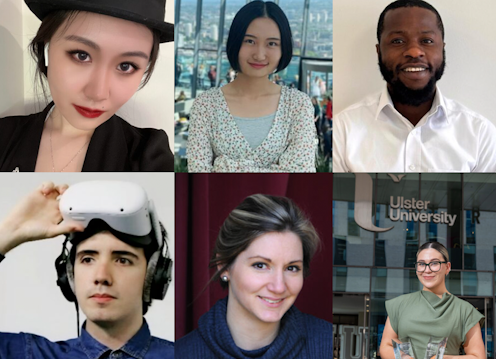
The 2025 Vitae 3MT finalists, clockwise L-R: Miranda Qianyu Wang, Yuxuan Wu, Abubakar Yunusa, Caitlin Campbell, Vic Pickup, Cesar Portillo.CC BY
You have three minutes to present your big research idea which will be viewed by thousands of people. Go! That is the challenge put to doctoral researchers in the 2025 Vitae Three Minute Thesis competition, sponsored by The Conversation. The candidates must present a compelling spoken presentation on their research topic to non-experts in those three minutes. The competition is fierce, and this year is no exception.
Research doesn’t exist in a vacuum, and we all benefit from more open knowledge and understanding. The Conversation and the Vitae Three Minute Thesis (3MT®) competition aim to provide engaging, exciting and accessible insights into academic research, and to inspire new thinking.
There are three prizes up for grabs: the Judges Choice, selected by a panel of judges; the Editor’s Choice, selected by The Conversation; and the People’s Choice – chosen by you.
Six finalists will by vying for your vote and the online final will be broadcast on Wednesday 1 October at 12 noon
(GMT+1). Register to watch and vote for your favourite. All winners will be be announced on Friday October 3.
The six finalists are:
Miranda Qianyu Wang, Durham University. Miranda’s research examines the legal and ethical implications of neuroscientific evidence within the criminal justice system. By exploring the intersection of law, neuroscience, and criminal behaviour, she provides insightful comparative analyses on how justice systems might better integrate neuroscientific findings.
Abubakar Yunusa, Robert Gordon University. Abubakar specialises in hydrogen injection and mixing optimisation in natural gas pipelines. His research supports safer and more efficient transitions to low-carbon energy systems. Abubakar bridges technical expertise with real-world challenges in the energy transition.
Caitlin Campbell, Ulster University. Caitlin is an optometrist and PhD researcher who is passionate about preventing avoidable vision loss and supporting those with visual impairment. Through the development of a new vision test, her work aims to enable earlier detection of glaucoma-related vision loss, the leading cause of permanent blindness worldwide, and to accelerate access to treatment.
Yuxuan Wu, University of Birmingham. Yuxuan has a general interest in the intersection of new technologies and work and employment. Her research focuses on artificial intelligence (AI) and the future of work.
Vic Pickup, University of Reading. Vic is the author of three poetry books and a long-time lover of romance novels. She is currently working in the Mills & Boon archives held in the university’s special collections.
Cesar Portillo, University of West London. Cesar is a sound engineer and PhD candidate specialising in immersive audio and accessibility for visually impaired audiences. His research investigates how spatial sound and haptic feedback can transform virtual environments into inclusive narrative spaces.
The six above have already battled it out to win the 3MT® competition within their own institution, and have progressed through the national semi-finals. Who will get your vote?
Rachel Eastwood Cox, director of business operations at CRAC/Vitae, said: “The Three Minute Thesis (3MT®), launched in 2008 by the University of Queensland, Australia, dares doctoral candidates to do the impossible: explain years of complex research in a clear, captivating, and concise three-minute spoken presentation.
“Since 2014, Vitae has proudly hosted the UK’s national 3MT® competition, supporting Vitae member institutions in fostering a culture of effective research communication and public engagement.
“3MT® presentations have reached tens of thousands of viewers on YouTube, making cutting-edge research accessible and engaging to the wider public. It’s become a powerful way to spark curiosity and inspire the next generation of researchers.
To find out more about the finalists, the semi-finalists and the competition click here.
Vitae and its membership programme are managed by the Careers Research and Advisory Centre (CRAC) Limited, an independent registered charity.
From a distance, Biosphere 2 emerges from the cacti and creosote of the Sonoran desert like a gleaming oasis, a colony of glass and bright white structures. Despite being just outside Tucson, Arizona, it looks almost like a colony on another planet.
When one of the facility’s 100,000 annual visitors steps inside, they see a whole world – from a tropical rainforest, glistening in 50 shades of green and teeming with life, to a miniature, experimental ocean. Toward the end of the tour, the visitor comes to a comparatively barren-looking experiment called the Landscape Evolution Observatory, where life is struggling to establish itself on crushed volcanic rock originally spewed from an ancient Arizonan volcano.
It is these rock slopes, where life is colonizing and transforming a tough landscape, that our team thinks are the key to humanity’s future – both on Earth and, eventually, on other worlds.
Biosphere 2 first became famous as the human experiment of the 1990s that sealed a group of eight researchers inside its 3 acres of diverse ecosystems for two long years. The goal was to experiment with the viability of a closed ecological system to maintain human life in outer space. Today, we – a global change ecologist, an astronomer and a doctoral student specializing in microbial biogeochemistry, along with our team of colleagues – have made Biosphere 2 into a test bed for understanding how life transforms landscapes, from local areas to whole planets.
We hope to use what we learn to help preserve biodiversity, access to fresh water and food security. To address these issues, we must understand how soil, rocks, water and microbes together drive the transformation of landscapes, from local to planetary scales.
Beyond Earth, these same principles apply to the challenge of terraformation: the science of rendering other worlds habitable.
How life on Earth affects the Earth
Life doesn’t just sit on the Earth’s surface. Organisms profoundly affect the planet’s geology, as well as the atmosphere’s composition. Biology can transform barren environments into habitable ecosystems.
Atmospheric oxygen, in turn, enabled a new supercharged metabolism of life called aerobic, or oxygen-using, respiration. Aerobic respiration produced so much energy that it became the dominant way for organisms to make the energy needed for life, eventually making multicellular life possible.
Cyanobacteria allowed organisms to take in oxygen and produce energy, which made more complex life possible.
In addition, the oxygen produced by photosynthesizing cyanobacteria also made its way to the upper atmosphere, forming another kind of oxygen known as ozone, which, by shielding the Earth’s surface from sterilizing ultraviolet radiation, allowed life to expand onto land.
Biology again transformed the planet when the life that expanded onto land 400 million years ago gave a biological boost to the chemical and geological process known as weathering. Weathering occurs when carbon dioxide in the atmosphere chemically reacts with material on Earth’s surface – such as rocks, minerals and water – to create soils imbued with nutrients that can support plants and other living organisms.
On Earth, weathering was first driven by purely physical and chemical processes. Once plants expanded from the oceans onto land, however, their roots injected carbon dioxide directly into the soil where weathering reactions were strongest. This process sucked carbon dioxide out of the atmosphere. Lower carbon dioxide levels in the atmosphere then cooled the Earth, turning a hothouse planet into one with a more temperate climate, like the one enjoyed by life today.
How organisms colonize new landscapes
When life colonizes a new, previously barren landscape, it starts up the process of primary succession. In this process, the first biological organisms – simple microbes – expand into interacting communities made of different kinds of organisms, which increase in complexity and biodiversity as they change and adapt to fit their new environment.
These microbes react with the air and rock through photosynthesis and respiration to produce organic molecules called metabolites. The metabolites can alter the soil, allowing it to support larger plants. The larger plants that then emerge have complex structures such as roots and leaves that regulate the flow of water – and contribute to weathering. Eventually, humans can domesticate some of these plants for food crops.
Biosphere 2’s Landscape Evolution Observatory is ideal for the careful study of how weathering and primary succession work together. Those processes both happen at the small, molecular scale but emerge as important only over large areas.
The Landscape Evolution Observatory has both hillslopes larger than any experiment in the world and crushed rock soils that are more simple and uniform than almost any natural setting. These characteristics mean the molecular measurements are consistent and understandable, even in different places across the larger hillslope.
The observatory is made up of three hillslopes covering 300 square yards that look like three giant tray-shaped, inclined planters made of steel, filled with crushed rock instead of fertile soil. The rain that falls on them soaks into the surface and flows down the incline to dribble out along the lower edge, where it is captured and carefully measured for its chemical and biological content.
We are using biological tools to understand how microbes and simple plants end up spreading across the larger, originally bare, crushed-rock hillslopes. These techniques include metagenomics, which can identify all the microbial life forms in a hillslope, and metabolomics, which can look at the organic molecules that microbes and plants produce and use in their interactions with each other and their surroundings.
Putting this all together, we see that colonies of photosynthesizing bacteria initiate succession on the Landscape Evolution Observatory. Critically, these cyanobacteria – descendants of those same organisms that gave Earth oxygen – capture the essential nutrient, nitrogen, from the air. Nitrogen buildup paves the way for mosses – simple plants without roots – to join them.
These bacteria-moss communities are now gradually spreading across the observatory’s hillslopes, preparing the way for the next phase: colonization by larger plants with roots.
By learning how life establishes itself and then thrives on lifeless landscapes, we will gain insights for addressing key problems scientists face today. For example, when life-forms in a new landscape successfully spread and diversify, they tell us how biodiversity is preserved.
When those spreading organisms transform the way a landscape uses water, they give us lessons on how we should use water. And when plants find a way to be productive under stressful conditions, they give us examples for increasing our own plant-dependent food security.
Implications for Mars
Earth isn’t the only planet where we can apply our findings. Today, Mars, unlike Earth, is a barren, lifeless desert. But it was once warmer, wetter and, like the early Earth, it may have hosted primitive living organisms several billion years ago.
While the rock in the Landscape Evolution Observatory comes from an Arizona volcano, basalt is the same kind of rock found on the surface of the Moon and Mars.
Countries such as the United States and China plan to land humans on Mars, and the company SpaceX has grandiose plans to send a million colonists there. If humans ever hope to grow plants on the red planet’s surface, learning how to create early succession there will prove crucial.
Before Mars colonization can happen at a large, sustainable scale, the first step is to grow plants and create food for human life. That is, we must solve what might be called the “Matt Damon problem,” after the actor in the movie “The Martian.” In order to survive, his character had to quickly learn to grow food crops – potatoes – on Mars.
In ‘The Martian,’ Matt Damon’s character Mark Watney had to figure out how to grow food and survive the red planet’s barren, inhospitable environment. 20th Century Fox
Matt Damon’s character would probably not have survived on the real Mars of today, because its rocklike surface, called regolith, is too full of salts and toxic chemicals such as perchlorate for potatoes, or most Earth-like plants, to grow.
At the Landscape Evolution Observatory, we are focusing on experiments in chambers that simulate Martian environments to ask what it will take to detoxify Mars-like soils so that microbes and plants can live there.
One initial approach is to use perchlorate-reducing bacteria, recruited from extreme environments on Earth, to convert the perchlorate into harmless chloride.
In this way, experiments at Biosphere 2 are informing the science of terraforming Mars. Together with progress made in other areas, such as finding ways of making Mars warm enough to sustain liquid water, restoring barren environments on Earth could be a key to one day living on Mars.
Scott Saleska receives funding from National Science Foundation, NASA, and U.S. Department of Energy.
Ghiwa Makke receives funding from National Science Foundation and U.S. Department of Energy.
Chris Impey does not work for, consult, own shares in or receive funding from any company or organization that would benefit from this article, and has disclosed no relevant affiliations beyond their academic appointment.
Source: The Conversation – USA – By Debra Lam, Founding Director of the Partnership for Inclusive Innovation, Enterprise Innovation Institute, Georgia Institute of Technology
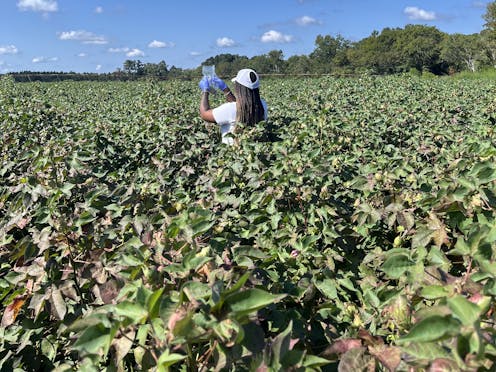
A researcher works in a cotton field in Jenkins County, Georgia, as part of a project on AI and pesticide use.Dorothy Seybold
Precision agriculture uses tools and technologies such as GPS and sensors to monitor, measure and respond to changes within a farm field in real time. This includes using artificial intelligence technologies for tasks such as helping farmers apply pesticides only where and when they are needed.
Our team, led by Georgia Southern University and the City of Millen, with support from University of Georgia Cooperative Extension, local high schools and agriculture technology company FarmSense, is piloting AI-powered sensors to help cotton farmers optimize pesticide use. Georgia is one of the top cotton-producing states in the U.S., with cotton contributing nearly US$1 billion to the state’s economy in 2024. But only 13% of Georgia farmers use precision agriculture practices.
Public-private-academic partnership
Innovation drives economic growth, but access to it often stops at major city limits. Smaller and rural communities are frequently left out, lacking the funding, partnerships and technical resources that fuel progress elsewhere.
At the same time, 75% of generative AI’s projected economic impact is concentrated in customer operations, marketing, software engineering and research and development, according to a 2023 McKinsey report. In contrast, applications of AI that improve infrastructure, food systems, safety and health remain underexplored.
Yet smaller and rural communities are rich in potential — home to anchor institutions like small businesses, civic groups and schools that are deeply invested in their communities. And that potential could be tapped to develop AI applications that fall outside of traditional corporate domains.
The Partnership for Innovation, a coalition of people and organizations from academia, government and industry, helps bridge that gap. Since its launch almost five years ago, the Partnership for Innovation has supported 220 projects across Georgia, South Carolina, Kentucky, Tennessee, Virginia, Texas and Alabama, partnering with more than 300 communities on challenges from energy poverty to river safety.
One Partnership for Innovation program provides seed funding and technical support for community research teams. This support enables local problem-solving that strengthens both research scholarship and community outcomes. The program has recently focused on the role of civic artificial intelligence – AI that supports communities and local governments. Our project on cotton field pesticide use is part of this program.
Cotton pests and pesticides
Our project in Jenkins County, Georgia, is testing that potential. Jenkins County, with a population of around 8,700, is among the top 25 cotton-growing counties in the state. In 2024, approximately 1.1 million acres of land in Georgia were planted with cotton, and based on the 2022 agricultural county profiles census, Jenkins County ranked 173rd out of the 765 counties producing cotton in the United States.
Cotton is a major part of Georgia’s agriculture industry. Daeshjea Mcgee
The state benefits from fertile soils, a subtropical-to-temperate climate, and abundant natural resources, all of which support a thriving agricultural industry. But these same conditions also foster pests and diseases.
Farmers in Jenkins County, like many farmers, face numerous insect infestations, including stink bugs, cotton bollworms, corn earworms, tarnished plant bugs and aphids. Farmers make heavy use of pesticides. Without precise data on the bugs, farmers end up using more pesticides than they likely need, risking residents’ health and adding costs.
While there are some existing tools for integrated pest management, such as the Georgia Cotton Insect Advisor app, they are not widely adopted and are limited to certain bugs. Other methods, such as traditional manual scouting and using sticky traps, are labor-intensive and time-consuming, particularly in the hot summer climate.
Our research team set out to combine AI-based early pest detection methods with existing integrated pest management practices and the insect advisor app. The goal was to significantly improve pest detection, decrease pesticide exposure levels and reduce insecticide use on cotton farms in Jenkins County. The work compares different insect monitoring methods and assesses pesticide levels in both the fields and nearby semi-urban areas.
We selected eight large cotton fields operated by local farmers in Millen, four active and four control sites, to collect environmental samples before farmers began planting cotton and applying pesticides.
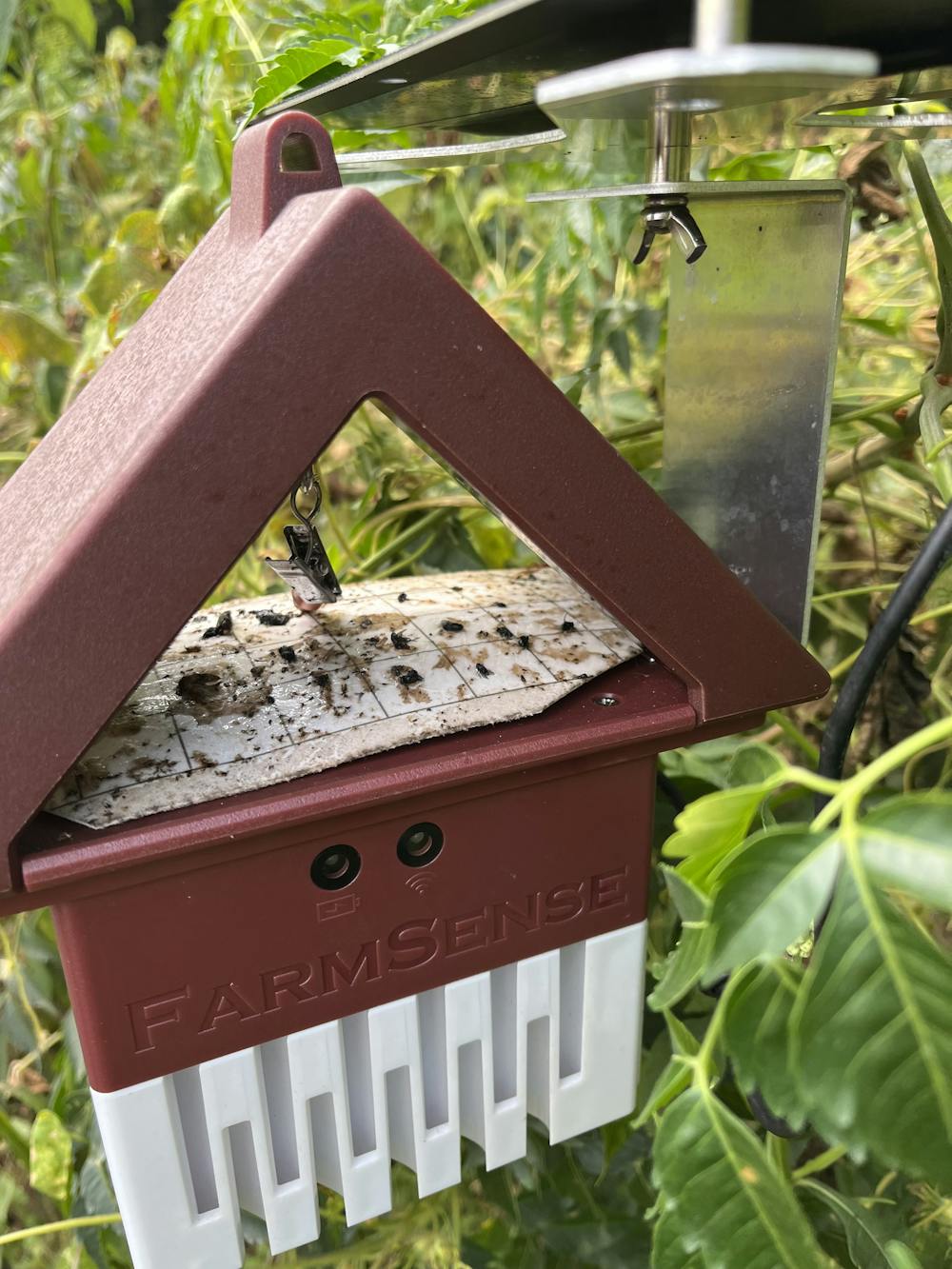
Pest insects are identified by AI as they fly through a light sensor inside this trap. Daeshjea Mcgee
The team was aided by a new AI-based insect monitoring system called the FlightSensor by FarmSense. The system uses a machine learning algorithm that was trained to recognize the unique wingbeats of each pest insect species. The specialized trap is equipped with infrared optical sensors that project an invisible infrared light beam – called a light curtain – across the entrance of a triangular tunnel. A sensor monitors the light curtain and uses the machine learning algorithm to identify each pest species as insects fly into the trap.
FlightSensor provides information on the prevalence of targeted insects, giving farmers an alternative to traditional manual insect scouting. The information enables the farmers to adjust their pesticide-spraying frequency to match the need.
What we’ve learned
Here are three things we have learned so far:
1. Predictive pest control potential – AI tools can help farmers pinpoint exactly where pest outbreaks are likely – before they happen. That means they can treat only the areas that need it, saving time, labor and pesticide costs. It’s a shift from blanket spraying to precision farming – and it’s a skill farmers can use season after season.
2. Stronger decision-making for farmers – The preliminary results indicate that the proposed sensors can effectively monitor insect populations specific to cotton farms. Even after the sensors are gone, farmers who used them get better at spotting pests. That’s because the AI dashboards and mobile apps help them see how pest populations grow over time and respond to different field conditions. Researchers also have the ability to access this data remotely through satellite-based monitoring platforms on their computers, further enhancing the collaboration and learning.
3. Building local agtech talent – Training students and farmers on AI pest detection is doing more than protecting cotton crops. It’s building digital literacy, opening doors to agtech careers and preparing communities for future innovation. The same tools could help local governments manage mosquitoes and ticks and open up more agtech innovations.
Blueprint for rural innovation
By using AI to detect pests early and reduce pesticide use, the project aims to lower harmful residues in local soil and air while supporting more sustainable farming. This pilot project could be a blueprint for how rural communities use AI generally to boost agriculture, reduce public health risks and build local expertise.
Just as important, this work encourages more civic AI applications – grounded in real community needs – that others can adopt and adapt elsewhere. AI and innovation do not need to be urban or corporate to have a significant effect, nor do you need advanced technology degrees to be innovative. With the right partnerships, small towns, too, can harness innovations for economic and community growth.
The authors do not work for, consult, own shares in or receive funding from any company or organization that would benefit from this article, and have disclosed no relevant affiliations beyond their academic appointment.
A new European health survey shows that Candidozyma auris – a dangerous drug-resistant fungus – is spreading rapidly in hospitals across the continent. Cases and outbreaks are increasing, with some countries now seeing ongoing local transmission.
Here’s what you need to know about this deadly fungus.
What is C auris?
Scientists first isolated C auris from the ear of a Japanese patient in 2009. It has since spread to hospitals in over 40 countries.
C auris is a yeast species – single-celled microorganisms from the fungi kingdom. While yeasts contribute to a healthy microbiome and many people experience only mild yeast infections when microbial balance becomes disrupted, C auris is far more dangerous. The fungus usually causes only mild infections in healthy people, but in patients with weakened immune systems, it can prove deadly, particularly when it enters the bloodstream and vital organs.
The fungus primarily affects severely ill patients, spreading from the skin into the bloodstream and organs.
Why is it dangerous?
C auris causes severe organ infections when it breaches the body’s natural defences. Between 30% and 60% of patients with invasive C auris infections die. And patients who carry the fungus risk developing infections themselves and spreading it to others.
The fungus can be very difficult to treat because some strains are resistant to nearly all available drugs. C auris appears to evolve rapidly, with new drug-resistant strains emerging regularly.
C auris spreads mainly in hospitals through direct contact with infected people or contaminated surfaces. The fungus produces proteins called adhesins that help it stick to surfaces, making it very hard to remove.
Why is it spreading so quickly?
C auris spreads quickly because hospitals struggle to detect and eliminate the fungus. People can carry it on their skin without symptoms, unknowingly bringing it into hospitals. And diagnosis is difficult. Standard laboratory tests misidentify C auris as more common yeasts. Hospitals need specialised methods to correctly identify it, so early cases go unidentified without access to these tools.
The fungus grows well at higher temperatures (optimally at 37-40°C), thriving on warm bodies. It also withstands routine disinfection. C auris forms biofilms – layers of microbial growth that prove extremely difficult to eliminate.
How common is it in Europe?
C auris has spread fast across Europe. Once limited to isolated cases, it now causes sustained hospital outbreaks. Between 2013 and 2023, there were over 4,000 cases, including 1,300 in 2023 alone.
The UK recorded 134 cases between November 2024 and April 2025 – a 23% increase compared with the previous six months.
In some European countries, the fungus has become endemic in hospitals, and true numbers may be higher because of limited testing.
Scientists have identified distinct genetic groups that dominate in different regions, each varying in how easily they spread and how resistant they are to treatment, making control more difficult.
What are health authorities doing about it?
Health authorities recognise that they need to contain C auris and are taking action. The European Centre for Disease Prevention and Control has called for stronger surveillance, and the World Health Organization has placed C auris on its list of priority fungal pathogens.
In the UK, new guidance sets out practical steps for hospitals, highlighting the careful and responsible use of antifungal drugs as crucial for controlling the disease.
Can it be stopped?
Hospitals can stop or at least control C auris. Those acting quickly have successfully contained outbreaks. Experts stress that a critical window exists when rigorous measures can stamp out a single case or small outbreak. However, once C auris spreads widely in a hospital or region, it becomes extremely difficult to stop.
What’s being done about it?
Hospitals and governments need to act swiftly. Hospitals must strengthen their infection-control practices, while governments should mandate that every case of C auris is reported to health agencies so its spread can be tracked. Public health authorities can help by issuing clear guidance and expanding access to reliable tests, and specialised response teams should be ready to support hospitals during outbreaks.
What happens if it’s not contained?
If authorities allow C auris to spread unchecked, it could become a permanent healthcare menace, causing frequent outbreaks that mean higher costs, strained hospital capacity, and more illness and deaths.
We might also see C auris evolve even greater drug resistance through continued circulation. Scientists have already found some strains that resist all major antifungal drugs. This is why health authorities stress the need for immediate action while containing and limiting C auris remains possible. Without urgent action, this fungus could become a permanent fixture in hospitals, driving up infections,costs and deaths.
The authors do not work for, consult, own shares in or receive funding from any company or organisation that would benefit from this article, and have disclosed no relevant affiliations beyond their academic appointment.
While the air and ground war in Ukraine grinds on, Moscow is increasing pressure on Kyiv’s western allies. Russian drone incursions into Poland in the early hours of September 10, and Romania a few days later, were followed by three Russian fighter jets breaching Estonian airspace on September 19.
And there has been speculation that drones which forced the temporary closure of Copenhagen and Oslo airports overnight are connected to the Kremlin as well.
While this might suggest a deliberate strategy of escalation on the part of the Russian president, Vladimir Putin, it is more likely an attempt to disguise the fact that the Kremlin’s narrative of inevitable victory is beginning to look shakier than ever.
A failed summer offensive that has been extremely costly in human lives is hardly something to cheer about. Estimates of Russian combat deaths now stand at just under 220,000. What’s more, this loss of life has produced little in territorial advances.
Since the start of the full-scale invasion in February 2022, Russia has gained some 70,000 sq km. This means that Moscow has nearly tripled the amount of territory it illegally occupies. But during its most recent summer offensive, it gained fewer than 2,000 sq km. On September 1, 2022, Russia controlled just over 20% of Ukrainian territory, three years later it was 19% (up from 18.5% at the beginning of 2025).
Perhaps most telling that the Russian narrative of inevitable victory is hollow is the fact that Russian forces were unable to convert a supposed breakthrough around Pokrovsk in the Donbas area of Ukraine in August into any solid gains after a successful Ukrainian counterattack.
That Russia is not winning, however, is hardly of comfort to Ukraine. Moscow still has the ability to attack night after night, exposing weaknesses in Ukraine’s air defence system and targeting critical infrastructure.
The western response, too, has been slow so far and has yet to send a clear signal to the Kremlin what Nato’s and the EU’s red lines are. While Nato swiftly launched Eastern Sentry in response to the Russian drone incursion into Poland, the operation’s deterrent effect appears rather limited given subsequent Russian incursions into Estonia and undeclared flights in neutral airspace near Poland and Germany.
The status of the war in Ukraine, September 22, 2025. ISW
Subsequent comments by Donald Tusk, the Polish prime minister, threatened to “shoot down flying objects when they violate our territory and fly over Poland”. He also cautioned that it was important “to think twice before deciding on actions that could trigger a very acute phase of conflict.”
On the other side of the Atlantic, Donald Trump, the US president, has said little about Russia ratcheting up pressure on Nato’s eastern flank. Regarding the Russian drone incursion into Poland, he mused that it could have been a mistake, before pledging to defend Nato allies in the event of a Russian attack.
This is certainly an improvement on his earlier threats to Nato solidarity, but it is at best a backstop against a full-blown Russian escalation. What it is not is a decisive step to ending the war against Ukraine. In fact, any such US steps seem ever farther off the agenda. The deadline that Trump gave Putin after their Alaska summit to start direct peace talks with Ukraine came and went without anything happening.
Europe scrambles to replace US guarantees
As for Trump’s phase-two sanctions on Russia and its enablers, these have now been made conditional by Trump on all Nato and G7 countries, imposing such sanctions first.
Meanwhile, US arms sales to Europe, meant to be channelled to strengthen Ukraine’s defences, have been scaled down by the Pentagon to replenish its own arsenals.
At the same time, a longstanding US support programme for the Baltic states – the Baltic security initiative – is under threat from cuts. There are justified worries that it could be discontinued as of next year.
As has been clear for some time, support for Ukraine – and ultimately the defence of Europe – is no longer a primary concern for the US under Trump. Yet European efforts to step into the gaping hole in the continent’s security left by US retrenchment are painfully slow. The defence budgets of the EU’s five biggest military spenders – France, Germany, Poland, Italy and the Netherlands – combined are less than one-quarter of what the US spends annually.
Even if money were not the issue, Europe has serious problems with its defence-industrial base. The EU’s flagship Security Action for Europe programme has faced months of delays over the participation of non-EU members – including the UK and Canada, two countries which have significant defence-industrial capacity.
European defence cooperation, including the flagship Future Combat Air System, is threatened by national quarrels, including between the EU’s two largest defence players, France and Germany.
Thus far, muddling through has worked for Ukraine’s western allies. This is mostly because Kyiv has held the line against the Russian onslaught. It has done so by making do with whatever the west provided while rapidly innovating its own defence sector.
It has also worked because Trump has not (yet) completely abandoned his European allies. There is enough life – or perhaps just enough ambiguity – left in the idea of Nato as a collective defence alliance to give Putin pause for thought. For now, he is merely testing boundaries. But if unchallenged, he might keep pushing further into uncharted territory – with unpredictable consequences.
Western stop-gap measures may be fine for now. But the west’s responses to Putin’s challenges – which are likely to become more frequent and more severe in the future – will require the European coalition of the willing to focus on the here and now and raise its level of preparedness.
Stefan Wolff is a past recipient of grant funding from the Natural Environment Research Council of the UK, the United States Institute of Peace, the Economic and Social Research Council of the UK, the British Academy, the NATO Science for Peace Programme, the EU Framework Programmes 6 and 7 and Horizon 2020, as well as the EU’s Jean Monnet Programme. He is a Trustee and Honorary Treasurer of the Political Studies Association of the UK and a Senior Research Fellow at the Foreign Policy Centre in London.
Source: The Conversation – UK – By Karen Roehr-Brackin, Reader, Department of Language and Linguistics, University of Essex
If you’ve always wanted to learn a new language, don’t let age put you off. People aged over 60 can be independent and flexible in how they learn a language – and successful, too.
There is ample evidence from decades of research that, as we age, some of our perceptual and cognitive abilities gradually decline. Our hearing and vision are not as sharp as they used to be, we process information less speedily, and our memory may not be as good as it was when we were younger. These are all known corollaries of healthy ageing which do not normally have a major adverse impact on daily life.
What is noted less frequently is the possibility that these effects need not be deficits in themselves, but may arise from a lifetime of accumulated knowledge and experience. The older we get, the more information we have to sort through, and this may slow us down. In this context, it is also important to highlight the fact that general and especially verbal knowledge can actually grow with increasing age.
In line with this, researchers have investigated language learning in late adulthood and shown that there is no age limit to our ability to learn a new language – we can do it at any point in our lives. However, it is less clear which approach to language learning and teaching works best later in life.
Research with younger adults indicates that an explicit approach which includes explanations of the target language and spells out grammar rules, for instance, is most effective.
At first glance, we may assume that this should apply to older adults too, or indeed that it should be even more true for them, given that it reflects a traditional approach to language instruction. Older adults may well have experienced exactly such an approach during their schooling and may therefore favour it.
To date, there is surprisingly little research that has put this assumption to the test. A recent study in the Netherlands found no evidence that late-life language learners would do better with an explicit approach.
Indeed, it did not matter whether instruction was explicit or implicit, that is, with or without any grammatical explanations. The senior volunteers did equally well, regardless of how they were taught.
Comparing approaches
In my new study with colleague Renato Pavlekovic, we compared an explicit with an incidental approach to language learning. In a small set of online lessons, 80 English-speaking volunteers aged between 60 and 83 learned the beginnings of Croatian – a language they were completely unfamiliar with.
In the explicit approach, a full explanation of the grammatical structure we targeted was given. In the incidental approach, there was no explanation, but additional practice exercises were available instead.
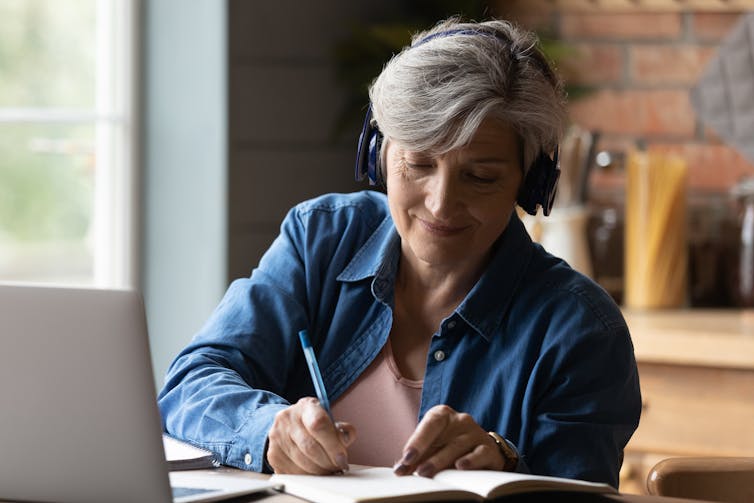
Older learners were successful with different learning methods. fizkes/Shutterstock
We found that learners did equally well regardless of the instructional approach they experienced. They first learned a set of vocabulary items and subsequently the targeted grammatical structure to a high level of success, achieving average scores of around 80% accuracy. This suggests that the teaching approach did not matter to these late-life learners – they could find their own way independently of how the learning materials were presented.
In this new study, we also explored the role of cognitive and perceptual factors as well as our volunteers’ self-concepts: that is, how they felt about their own health, happiness and abilities. In addition, we asked questions about their (former) occupations and prior language learning experience. Interestingly, we found a connection between the ability to learn implicitly (that is, picking things up from context without being aware of it), occupational status (whether someone was retired or still working) and self-concepts.
Specifically, people who reported a more positive self-concept showed better implicit learning abilities. Moreover, people who were still working at the time of the study showed better implicit learning abilities than individuals who were retired – something we had observed in a previous study too. Importantly, this effect was independent of age.
Superficially, a link between employment status, implicit learning ability and self-concept may not make much sense. There is arguably a common denominator, though: confidence could be at the centre of a self-reinforcing cycle. A person with strong implicit learning ability remains in the workforce for longer. This boosts their self-concept, which in turn makes them continue with their occupation for longer.
While in work, they need to take the rough with the smooth; they cannot only engage in activities they enjoy. This means that they continue drawing on their implicit learning ability, and so forth.
Taken together, the results of our study show that late-life language learners can be very successful. They seem to be sufficiently independent to choose the path that works best for them, so it does not matter so much which teaching approach is used. In addition, confidence is important; it appears to arise from a combination of ability and social status.
Karen Roehr-Brackin received funding from the British Academy/Leverhulme Trust (grant reference SRG23230787) which supported the research project reported here.
Anne de France et sa fille Suzanne, sur le panneau de droite du _Triptyque de Moulins_, peint par le maître flamand Jean Hey à la fin du XV<sup>e</sup> siècle et restauré par les équipes des musées de France de 2022 à 2025. Le chef-d’œuvre sera exposé au Louvre, à Paris, fin 2025 avant de retrouver sa place dans la cathédrale de Moulins (Allier).Wikimédia Commons
À partir du Moyen Âge, l’éducation des filles fait l’objet d’une grande attention dans la noblesse et, dans une moindre mesure, les milieux bourgeois.
Le manuscrit original des Enseignements, rédigés au XVe siècle par la fille aînée du roi Louis XI, Anne de France, duchesse du Bourbonnais et d’Auvergne, destinés à sa fille de 12 ans, Suzanne de Bourbon, récemment réapparu sur le marché de l’art, nous éclaire sur les valeurs essentielles transmises aux princesses de la Renaissance.
Historiens et historiens de l’art le pensaient égaré dans les fonds de la bibliothèque de Saint-Pétersbourg (Russie) qui était en sa possession depuis la fin du XVIIIe siècle environ. Il se trouvait en fait dans la collection particulière de Léon Parcé (1894-1979), érudit et passionné de Blaise Pascal (1623-1662), qui l’avait acquis des autorités soviétiques dans les années 1930.
La nouvelle de la réapparition de ce manuscrit réjouit historiens, historiens de l’art et de la littérature, qui ne le connaissaient que par une copie du XIXᵉ siècle et qui espèrent pouvoir l’étudier dans les prochaines années. Mais quelle est au juste la spécificité de ces Enseignements ?
L’éducation des filles constitue depuis le Moyen Âge un enjeu fondamental dans les milieux nobiliaires et, dans une moindre mesure, bourgeois. Comme les garçons, elles sont les destinataires de manuels de savoir-vivre appelés « miroirs » qui contiennent une multitude de préceptes moraux et de conseils pour la vie quotidienne.
Le Livre pour l’enseignement de ses filles, du chevalier de La Tour Landry, ou encore les enseignements de saint Louis à sa fille Isabelle de Navarre figurent au rang des plus connus.
Au XVe siècle, la femme de lettres Christine de Pizan rédige des miroirs à l’intention des princes, des princesses et, plus largement, des femmes de toutes conditions. Son Livre des trois vertus constitue un modèle dans lequel puiser.
Cependant, les Enseignements, d’Anne de France, qui se placent dans cette filiation littéraire, ont ceci de particulier qu’ils sont l’œuvre d’une mère pour sa fille, ce qui est assez unique. Surtout, Anne de France n’est pas une femme parmi d’autres : fille du roi Louis XI (1461-1483), c’est aussi la sœur de Charles VIII (1483-1498). Cette « fille de France » est l’une des femmes de pouvoir les plus puissantes du royaume, entre la fin du Moyen Âge et du début de la Renaissance.
Anne de France s’est imposée sur la scène politique dès les années 1480, en assurant une sorte de régence pour son frère Charles, aux côtés de son époux Pierre de Beaujeu. Dotée d’une grande expérience de la politique, de la cour et d’une grande culture, dont témoignent ses nombreuses références à Aristote et à saint Augustin, elle rédige les Enseignements à [s]a fille vers 1503-1505.
Il s’agit d’un moment charnière dans sa vie familiale. Tout juste veuve, celle qui n’est autre que duchesse de Bourbonnais et d’Auvergne, s’apprête à marier sa fille à Charles de Bourbon-Montpensier, connu plus tard sous le nom de connétable de Bourbon. Sans doute Anne s’est-elle inspirée des miroirs cités précédemment, conservés dans la bibliothèque des ducs de Bourbon, à Moulins.
La rédaction de ce miroir fait passer la princesse de la pratique à la théorie. En effet, en raison de son statut de fille de roi, Anne s’est illustrée depuis les années 1480 comme éducatrice de très nombreux princes et princesses envoyées par leurs familles à la cour de France pour recevoir un enseignement de premier plan. Outre son propre frère Charles qu’elle forme à son futur métier de roi, elle se voit confier Marguerite d’Autriche (tante de Charles Quint et régente des Pays-Bas), Louise de Savoie (mère de François Ier et première régente officielle du royaume de France), Philippe de Gueldre, duchesse de Lorraine, ou encore Diane de Poitiers toutes promises à un brillant avenir politique.
L’idéal de la princesse, parangon de vertu et de bonne éducation
C’est donc une femme d’expérience qui prend la plume pour s’adresser à Suzanne de Bourbon au tout début du XVIe siècle. Pour justifier son entreprise, elle évoque « la parfaite amour naturelle » qu’elle éprouve à l’égard de sa fille, alors âgée d’une douzaine d’années. Le manuscrit d’une centaine de feuillets dont elle fait don à Suzanne est enluminé et composé des Enseignements, suivis de l’Histoire du siège de Brest, bref opuscule dont Anne est également l’auteur.
Anne de France rappelle en premier lieu à sa fille son état de créature faible, marquée par le péché originel (comme toute créature humaine, homme ou femme) et la nécessité de dompter et de dépasser ses faiblesses naturelles afin de faire son salut sur terre.
C’est le principal objet de toute existence chrétienne. Pour cela, Suzanne devra s’efforcer d’acquérir la vertu qui se décline en de nombreuses qualités : prudence, piété, bonne renommée, courtoisie, humilité, maîtrise de soi, etc.
« Il n’est rien plus délectable à voir en femme noble que vertueux savoir »,
poursuit Anne. La vie doit ainsi s’ancrer dans la connaissance et la vérité, qui rapprochent de la sagesse, tout éloignant de la « folie » tant redoutée.
Destinée à être une femme de haut rang et à évoluer dans les milieux de cour, Suzanne devra savoir s’y comporter sans faire défaut à ses origines. Plus encore, il lui faudra se méfier de la fausseté ambiante de la cour, lieu du mensonge, du faux-semblant et de la trahison, qui représentent autant de pièges quotidiens à éviter.
Comme épouse, la princesse devra demeurer fidèle à sa propre lignée, « à son sang », tout en s’attachant fidèlement à son époux, se montrant notamment capable de le seconder en cas d’absence de ce dernier.
Les Enseignements expriment l’idéal de la princesse, parangon de vertu et de bonne éducation, selon Anne de France. Fruit d’années d’expérience du pouvoir et de la cour, ce miroir se présente comme un modèle de piété, de morale et de vertu destiné, certes, à sa fille mais, plus largement, à toutes les dames et demoiselles évoluant dans la sphère aulique.
C’est ce qui explique sa diffusion rapide dans le royaume de France, dès le premier quart du XVIe siècle, au sein des plus hautes franges de la société. Sous une forme imprimée, les Enseignements rejoignent par exemple les bibliothèques de Marguerite de Navarre, sœur du roi François Ier (1515-)1547), de Diane de Poitiers (1500-1566) puis de la puissante souveraine Catherine de Médicis (reine de France de 1547 à 1559, ndlr). C’est dire l’importance accordée par ses comparses aux conseils de celle qui fut l’une des plus puissantes femmes de la première Renaissance.
Aubrée David-Chapy ne travaille pas, ne conseille pas, ne possède pas de parts, ne reçoit pas de fonds d’une organisation qui pourrait tirer profit de cet article, et n’a déclaré aucune autre affiliation que son organisme de recherche.
Pour la première fois dans l’histoire, une intelligence artificielle a fait en Albanie son entrée au sein d’un gouvernement. Au-delà des questionnements sur la place des IA dans la décision publique, la nomination de Diella comme ministre chargée des marchés publics suscite des interrogations sur la féminisation quasi systématique des avatars IA. Cette pratique trompeuse qui entretient les stéréotypes de genre perpétue l’objectification des femmes et facilite la manipulation.
Le gouvernement albanais vient de créer la surprise en nommant Diella, une intelligence artificielle (IA), au poste de ministre des marchés publics. Présentée comme un atout dans la lutte contre la corruption, Diella serait chargée d’analyser les appels d’offres, repérer les conflits d’intérêts et garantir l’impartialité des décisions publiques.
Cette initiative inédite marque une étape historique. Pour la première fois, une IA entre officiellement dans un gouvernement, ici, sous les traits d’un avatar numérique féminin. Mais au-delà du coup médiatique, et des questionnements éthiques que peut soulever cette nomination – peut-on vraiment gouverner avec une IA ?, elle suscite des interrogations fondamentales sur la féminisation quasi systématique des agents IA.
Pourquoi Diella est-elle une femme artificielle ? Et quelles sont les implications de cette féminisation de l’IA ?
Diella : un cas d’école problématique
L’IA a déjà été utilisée comme outil de gouvernance. Certaines villes se servent, par exemple, des algorithmes pour optimiser les transports ou pour détecter la fraude. Mais en nommant une IA au rang de ministre, l’Albanie franchit une étape symbolique majeure : plus qu’un outil, elle devient une figure féminine publique, censée incarner des valeurs de transparence et de justice.
La promesse est séduisante : même si une IA peut reproduire ou amplifier les biais de ceux qui l’ont programmée, une machine ne peut, en théorie, ni accepter de pots-de-vin ni favoriser des proches. Elle paraît offrir une garantie d’impartialité dans un pays où les scandales de corruption entachent la vie politique. L’Albanie est, en effet, classée 80e sur 180 pays dans l’indice de perception de la corruption, selon Transparency International.
Mais cette vision occulte un problème central : les conséquences éthiques de la féminisation de l’IA sont loin d’être anodines.
Pourquoi les IA sont-elles presque toujours féminines ?
Depuis Siri (Apple), Alexa (Amazon) Cortana (Microsoft) ou encore Sophia, le premier robot ayant obtenu la nationalité saoudienne en 2017, la plupart des assistants virtuels et robots intelligents ont été dotés d’une voix, d’un visage, d’un corps ou d’un prénom féminins. Ce n’est pas un hasard.
Sophia, interviewée dans le Tonight Show, de Jimmy Fallon en avril 2017.
Dans une première recherche sur la question, nous avons montré que nous percevons les bots féminins comme plus chaleureux, plus dignes de confiance, voire même plus humains que leurs équivalents masculins.
Pourquoi ? Parce que les femmes sont, en moyenne, perçues comme plus chaleureuses et plus susceptibles d’éprouver des émotions que les hommes… et ces qualités font défaut aux machines. La féminisation des objets en IA contribue donc à humaniser ces objets.
Cette féminisation s’appuie sur des stéréotypes bien ancrés : la femme serait « naturellement » plus douce, attentive et empathique. En dotant leurs machines de ces attributs, les concepteurs compensent la froideur et l’artificialité des algorithmes et facilitent leur acceptation et leur adoption.
Quand la féminisation devient manipulation
Mais cette pratique soulève des problèmes éthiques majeurs, que j’ai développés dans un article récent publié dans les pages du Journal of Business Ethics.
Cet article compare les implications éthiques de l’usage d’attributs genrés et sexués féminins dans deux contextes. D’un côté, la publicité, où l’on recourt depuis longtemps à des représentations féminines idéalisées pour séduire les consommateurs. De l’autre, les agents IA, qui reprennent aujourd’hui ces mêmes codes. Cette mise en parallèle permet de montrer que, dans les deux cas, la féminisation engendre trois dangers majeurs : tromperie, objectification, et discrimination.
La tromperie et la manipulation
Attribuer artificiellement des caractéristiques humaines et féminines à des machines exploite nos réactions inconscientes et automatiques aux traits néoténiques (caractéristiques juvéniles associées aux traits féminins comme les yeux ronds, des traits arrondis) qui évoquent inconsciemment l’innocence et, donc, l’honnêteté et la sincérité.
Cette manipulation subtile pourrait faciliter l’acceptation de décisions algorithmiques potentiellement problématiques. Une IA féminisée fait croire qu’elle est plus humaine, plus empathique, plus « digne de confiance ». Or, il ne faut pas oublier qu’il s’agit d’un programme informatique, sans émotions ni conscience – question qui commence à être discutée –, dont les décisions peuvent être biaisées voire instrumentalisées.
Contrairement à la publicité qui compare métaphoriquement les femmes à des objets, l’intelligence artificielle va plus loin : elle transforme littéralement la femme en objet programmable (une machine, un algorithme). Les IA féminines réduisent les attributs féminins à de simples outils de service : des machines obéissantes, disponibles en permanence. Cette mécanisation de la féminité reproduit et amplifie les logiques publicitaires d’objectification, mais avec une dimension inédite : l’interactivité.
Résultat, des chercheurs relèvent la persistance de propos agressifs et à caractère sexuel dans les interactions avec ces assistantes, normalisant ainsi des comportements abusifs envers les « femmes-machines » qui risquent de se reporter sur les vraies femmes… In fine, l’humanisation et la féminisation de l’IA peut paradoxalement conduire à une déshumanisation accrue des femmes.
La perpétuation de stéréotypes
À première vue, Diella pourrait apparaître comme une victoire symbolique : une femme – même virtuelle – accède à un poste de ministre. Dans un pays où la politique reste dominée par les hommes, et alors que la plupart des IA féminines sont des assistantes, certains y verront un signe d’égalité.
Mais cette lecture naïve et optimiste occulte un paradoxe. Alors que les femmes réelles peinent à accéder aux plus hautes fonctions dans de nombreux gouvernements, c’est une femme artificielle qui incarne l’intégrité au pouvoir. Surnommée « la servante des marchés publics », c’est en réalité une femme sans pouvoir d’agir. On retrouve ici un vieux schéma : « l’Ève artificielle », façonnée pour correspondre à un idéal de docilité et de pureté. Une ministre parfaite, car obéissante et inaltérable… et qui ne remettra jamais en cause le système qui l’a créée.
L’IA au féminin, sainte dévouée ou Ève manipulatrice
La féminisation des IA repose en réalité sur deux tropes profondément enracinés dans notre imaginaire, qui réduisent l’identité féminine à l’archétype de la sainte dévouée ou de l’Ève manipulatrice.
La sainte dévouée, c’est l’image de la femme pure, obéissante, entièrement tournée vers les autres. Dans le cas de Diella, elle se manifeste par une promesse de transparence et de loyauté absolue, une figure de vertu incorruptible au service de l’État et de son peuple.
La représentation visuelle de Diella rappelle d’ailleurs fortement l’iconographie de la Vierge Marie : visage doux, regard baissé, attitude humble, et voile blanc. Ces codes esthétiques religieux associent cette IA à une figure de pureté et de dévouement absolu. Mais en faisant de l’IA une figure féminine idéalisée et docile, on alimente un sexisme bienveillant qui enferme les femmes réelles dans ces mêmes stéréotypes.
L’Ève manipulatrice : dans la culture populaire, la confiance accordée à une IA féminisée se transforme en soupçon de tromperie ou de danger. Exemple emblématique : le film de science-fiction Ex Machina, dans lequel le héros est dupé par une IA dont il tombe amoureux.
Si Diella venait à servir d’instrument politique pour justifier certaines décisions opaques, elle pourrait elle aussi être perçue sous ce prisme : non plus comme une garante de transparence, mais comme une figure de dissimulation.
Ces deux représentations contradictoires – la vierge sacrificielle et la séductrice perfide – continuent de structurer nos perceptions des femmes et se projettent désormais sur des artefacts technologiques, alimentant une boucle qui influence à son tour la manière dont les femmes réelles sont perçues.
Pour une IA non humanisée et non genrée
Plutôt que d’humaniser et de genrer l’IA, assumons-la comme une nouvelle espèce technologique : ni homme ni femme, ni humaine ni divine, mais un outil distinct, pensé pour compléter nos capacités et non pour les imiter. Cela suppose de lui donner une apparence et une voix non humaines, afin d’éviter toute confusion, toute tromperie et toute manipulation.
Le développement des IA devrait s’appuyer sur une transparence totale, en représentant l’IA pour ce qu’elle est vraiment, à savoir un algorithme.
Enfin, les concepteurs devraient rendre publics la composition de leurs équipes, les publics visés, les choix de conception. Car, derrière l’apparente neutralité des algorithmes et de leur interface, il y a toujours des décisions humaines, culturelles et politiques.
L’arrivée de Diella au gouvernement albanais doit ouvrir un débat de fond : comment voulons-nous représenter l’IA ? Alors que ces technologies occupent une place croissante dans nos vies, il est urgent de réfléchir à la façon dont leur représentation façonne nos démocraties et nos relations humaines.
Sylvie Borau ne travaille pas, ne conseille pas, ne possède pas de parts, ne reçoit pas de fonds d’une organisation qui pourrait tirer profit de cet article, et n’a déclaré aucune autre affiliation que son organisme de recherche.
Source: The Conversation – in French – By Cédrick Bonnet, Chargé de recherche CNRS, spécialiste dans l’influence des positions du corps sur Comportement, Cognition et Cerveau, Université de Lille
Des travaux de recherche révèlent que la position debout améliore l’attention visuelle. Ce constat plaide en faveur de l’alternance des stations assise et debout au cours de la journée de travail. Prendre cette habitude permettrait aussi de lutter contre les effets délétères pour la santé résultant du maintien sur une trop longue période de l’une ou l’autre des deux positions.
Depuis la fin de la Deuxième Guerre mondiale, la mécanisation, le confort accru, l’ordinateur, Internet et le télétravail entre autres ont considérablement augmenté le temps que nous passons assis.
On sait que ces changements ne sont pas sans conséquence pour notre santé. Il a notamment été démontré que l’augmentation de la sédentarité est associée à un risque accru de maladie cardiovasculaire, de diabète de type 2, de cancer, d’obésité, d’anxiété ou de dépression. Mais ce n’est pas tout, il semblerait que notre position ait également un impact sur notre productivité.
Dans notre équipe de recherche, au SCALab, nous avons émis l’hypothèse qu’une personne en bonne santé (autrement dit, dans ce contexte, ne rencontrant pas de problème pour se tenir debout) devrait réaliser de meilleures performances debout qu’assise, ceci tant que la fatigue en position debout n’est pas excessive. Les résultats que nous avons obtenus jusqu’ici le confirment. Explications.
Notre posture influe-t-elle sur notre efficacité ?
Au cours d’une journée, les individus adoptent trois types de position du corps : allongée pour dormir, debout pour bouger et plus ou moins pliée, pour s’asseoir notamment.
Ces dernières années, notre équipe de recherche a conduit plusieurs projets de recherche pour valider notre hypothèse. Dans un article récemment accepté pour publication, nous avons demandé à 24 jeunes adultes de réaliser six fois une tâche d’attention (« Attention Network Test ») en alternant les positions du corps (assis, debout), et six fois cette même tâche seulement en position assise.
Les résultats obtenus montrent que l’attention visuelle des participants est meilleure en alternant les positions du corps qu’en restant tout le temps assis. En outre, les participants réalisaient la tâche plus rapidement (avec des temps de réaction plus courts) quand ils étaient debout dans la condition d’alternance.
Dans un second article récent, nous avons demandé à 17 jeunes adultes sains de réaliser la même tâche d’attention (« Attention Network Task ») soit assis, soit debout. Nous avons testé si c’était le fait de devoir contrôler et ajuster l’équilibre debout, et pas uniquement le fait d’être debout, qui peut expliquer de meilleures performances debout qu’assis.
Les analyses ont effectivement montré que plus les oscillations des participants étaient complexes, plus leur temps de réaction était raccourci (corrélation de Pearson négative significative) et plus leur score d’alerte (tiré de la tâche d’attention) était élevé. Par définition, le score d’alerte reflète la capacité d’un individu à préparer et à maintenir un état d’alerte afin de répondre rapidement à un stimulus attendu.
Ces résultats indiquent que les individus complexifient leurs oscillations posturales debout de façon à améliorer leur performance à la tâche d’attention. On peut supposer qu’en position assise, tout individu serait moins (voire, ne serait pas) capable de complexifier ses oscillations justement parce qu’il n’a pas à contrôler son équilibre.
En 2024, nous avons demandé à 24 jeunes adultes sains de réaliser une tâche de Stroop modifiée dans quatre positions du corps différentes : debout contre un mur ; debout naturellement avec les pieds serrés ; avec les pieds normalement écartés ; avec les pieds légèrement plus écartés que d’habitude.
Les résultats obtenus révèlent l’existence d’une corrélation significative entre le nombre de cibles bien trouvées dans cette tâche de Stroop et des variables d’oscillations de la tête et du centre de pression (le point d’application de la résultante des forces de réaction au sol exercées par les pieds sur le sol). Autrement dit, plus les participants oscillaient (en rapidité et en amplitude) et meilleure était leur performance à bien trouver les cibles dans cette tâche de Stroop modifiée.
En résumé, ces trois études menées en laboratoire sont en accord avec notre hypothèse initiale. La position debout optimise la performance à des tâches d’attention visuelle de courtes durées.
Il faut souligner que la dynamique posturale a non seulement des conséquences sur la performance et la productivité, mais aussi sur la santé. On savait déjà que rester debout excessivement longtemps est très problématique pour la santé. Depuis une vingtaine d’années plus particulièrement, les travaux de recherche ont aussi révélé que la station assise excessive est également très problématique pour la santé.
Alterner au fil de la journée les postures assises et debout toutes les 15 à 45 minutes permettrait non seulement d’améliorer la productivité, mais aussi de réduire les conséquences pour la santé. Cela permet en effet d’augmenter le temps passé debout tout au long de la journée en évitant au mieux la fatigue.
Pour y parvenir, il faudrait équiper les travailleurs de bureaux assis/debout. Ceux-ci sont déjà adoptés dans de nombreux pays dans le monde, notamment aux États-Unis, au Canada, en Australie, en Chine ou en Europe du Nord. Pour aider les utilisateurs à adopter une dynamique posturale bénéfique ou optimale, l’emploi de tels bureaux devrait être couplé à une application « assis-debout » destinée à guider les utilisateurs. Malheureusement, l’offre en matière d’applications – y compris celle proposée par des objets connectés tels que montres, smartphones ou bureaux connectés – est encore imparfaite à l’heure actuelle. Afin d’y remédier, notre équipe est en train de développer une telle application.
Cédrick Bonnet ne travaille pas, ne conseille pas, ne possède pas de parts, ne reçoit pas de fonds d’une organisation qui pourrait tirer profit de cet article, et n’a déclaré aucune autre affiliation que son organisme de recherche.
Aux États-Unis, baisse du taux de natalité et réduction de l’écart salarial entre hommes et femmes ne sont pas simplement concomitantes. Elles sont liées. Pour obtenir l’égalité salariale, il faudra agir sur les effets de la parentalité en matière de rémunération.
Aux États-Unis, les femmes ne gagnaient en moyenne que 85 % de ce que les hommes gagnaient pour chaque heure travaillée en 2024. Cependant, elles s’en sortent beaucoup mieux que leurs mères et grands-mères il y a quarante ans. Au milieu des années 1980, les femmes ne touchaient que 65 % du salaire des hommes pour chaque heure de travail rémunéré.
Les salaires des femmes se sont améliorés par rapport à ceux des hommes en partie grâce aux progrès réalisés dans leur niveau d’éducation et leur expérience professionnelle, et parce que les femmes se sont orientées vers des professions mieux rémunérées. Mais les avancées vers l’égalité salariale sont actuellement au point mort.
En tant que sociologues et démographes, nous voulions savoir si les changements au sein des familles américaines avaient également contribué à rapprocher les femmes de l’égalité salariale avec les hommes. Dans un article publié en juin 2025 dans la revue académique Social Forces, nous avons montré que cet écart salarial se réduit en partie parce que les femmes ont moins d’enfants.
Les mères gagnent moins, mais les pères gagnent davantage
Aux États-Unis et ailleurs, de nombreuses preuves montrent que la parentalité affecte différemment les salaires des hommes et des femmes. Comparativement aux femmes sans enfant, la maternité entraîne des pertes de salaire pour les femmes. Et ces pertes sont plus importantes lorsque les femmes ont plusieurs enfants.
Les Américaines ont en général moins d’enfants. Les femmes, y compris celles qui ne travaillent pas à l’extérieur du foyer, avaient en moyenne environ trois enfants avant l’âge de 40 ans en 1980. En 2000, cette moyenne était tombée à 1,9 enfant, et elle est restée relativement stable depuis.
Pour déterminer si les changements dans le nombre d’enfants des mères américaines actives influencent leurs revenus par rapport à ceux des hommes, nous avons analysé des données recueillies auprès d’un échantillon représentatif à l’échelle nationale des familles américaines. Nous avons suivi l’évolution au fil du temps du nombre d’enfants des Américains actifs âgés de 30 à 55 ans.
Nous avons constaté que le nombre moyen d’enfants par employé a chuté de manière significative entre 1980 et 2000, passant d’environ 2,4 à environ 1,8. Cette moyenne s’est stabilisée après 2000 ; en 2018, dernière année de notre analyse, les employés avaient en moyenne environ 1,8 enfant.
Dans le même temps, le salaire horaire des femmes de cette tranche d’âge par rapport à celui des hommes a fortement augmenté. Il est passé de 58 % en 1980 à 69 % en 1990, puis a progressé plus lentement pour atteindre 76 % en 2018. Autrement dit, à mesure que le nombre d’enfants diminuait, l’écart salarial entre les sexes se réduisait. Pour les deux tendances, les changements ont été rapides dans les années 1980, puis plus lents après 1990.
Nous avons ensuite estimé dans quelle mesure la diminution du nombre d’enfants chez les hommes et les femmes pouvait expliquer la réduction de l’écart salarial entre les sexes entre 1980 et 2018. Nous avons constaté que, même après avoir tenu compte d’autres facteurs tels que le nombre d’années d’études, l’expérience professionnelle antérieure et la profession exercée, environ 8 % de la réduction de l’écart salarial entre les sexes peut s’expliquer par le fait que les hommes et les femmes actifs ont moins d’enfants.
Ensuite, nous avons montré que le nombre d’enfants des employés américains avait diminué plus rapidement dans les années 1980 que par la suite. Ce ralentissement a coïncidé avec une décélération des gains salariaux des femmes par rapport aux hommes. Une fois que le nombre moyen d’enfants des employés américains s’est stabilisé vers 2000, les progrès des femmes vers l’égalité salariale avec les hommes se sont également stabilisés.
Des questions sur l’avenir de la fécondité aux États-Unis
Nous convenons que ce sont des questions importantes.
Nos recherches montrent que tout changement futur dans le nombre d’enfants des Américains est très susceptible d’influencer la rapidité avec laquelle les femmes et les hommes atteignent l’égalité salariale. Mais ce n’est pas une fatalité. Le nombre d’enfants que les Américains ont affecte l’écart salarial entre les sexes uniquement parce que la parentalité réduit les salaires des femmes tout en augmentant ceux des hommes. Tant que ces effets inégaux de la parentalité sur les revenus des hommes et des femmes persistent, ils continueront à freiner les progrès des femmes vers l’égalité salariale.
Les auteurs ne travaillent pas, ne conseillent pas, ne possèdent pas de parts, ne reçoivent pas de fonds d’une organisation qui pourrait tirer profit de cet article, et n’ont déclaré aucune autre affiliation que leur organisme de recherche.




















_at_Biosphere_2.jpg)