Supreme Court to decide if Colorado’s law banning conversion therapy violates free speech

Source: The Conversation – USA (3) – By Timothy R. Holbrook, Professor of Law, University of Denver

The US Supreme Court will hear oral arguments for yet another case involving the LGBTQ+ community. Saul Loeb/AFP via Getty Images

The constitutionality of a Colorado law that bans so-called “conversion therapy” is scheduled to go before the Supreme Court on Oct. 7, 2025. The question at the center of the case, Chiles v. Salazar, is whether a therapist who uses talk therapy to try to convince minors to change their sexual orientation or gender identity is protected by a First Amendment right to free speech.

Twenty-three other states and the District of Columbia also ban conversion therapy.

People stand behind a table cheering as a white man in a blue suit jacket signs bills into law.
Colorado Gov. Jared Polis is applauded as he signs a law banning the use of conversion therapy on minors.
Aaron Ontiveroz/The Denver Post via Getty Images

I am a legal scholar who has explored aspects of the rights of the LGBTQ+ community, and this case is an important test of the status of the community’s rights and protections at the Supreme Court.

Why it matters

The case has similarities to the court’s 2025 decision in United States v. Skrmetti that upheld state laws banning gender-affirming care for transgender minors, such as the use of puberty-blocking hormones. LGBTQ+ persons viewed those bans as hurting the community, whereas bans like Colorado’s on conversion therapy are viewed as protecting the community.

Technically, the legal issue in Skrmetti was different: The court addressed whether the ban violated the equal protection clause of the 14th Amendment, which prohibits states from discriminating against particular protected classes, such as race or gender, absent a particularly strong state interest. In the Skrmetti decision, the court held there was no discrimination on the basis of sex, which meant the law received no heightened scrutiny.

Instead, the court assessed whether there was a “rational basis” for the law and held that Tennessee had “plausible reasons” for the ban: protecting minors from harms such as sterility and treatments whose long-term effects are unclear. The court upheld the law banning gender-affirming care even though major U.S. medical professional associations oppose such bans and support such care.

The facts of Chiles

In Chiles, the issue is freedom of speech, not equal protection. But this time the Colordo ban on conversion therapy aligns with leading medical associations.

Kaley Chiles is a licensed professional counselor who uses talk therapy in her counseling practice. Chiles identifies as Christian and often works with Christian clients. Chiles “does not try to help minors change their attractions, behavior, or identity, when her minor clients tell her they are not seeking such change.” She would like to use talk therapy with clients “who have same-sex attractions or gender identity confusion and who also prioritize their faith above their feelings” and who “are seeking to live a life consistent with their faith,” according to court filings.

Chiles sued Colorado to invalidate the statute as unconstitutional for violating her freedom of speech and religion under the First Amendment of the U.S. Constitution. Both the federal district court in Colorado and the U.S. Court of Appeals for the 10th Circuit denied her request for a preliminary injunction, rejecting both arguments.

The Supreme Court agreed only to hear her free speech claim, leaving the 10th Circuit’s rejection of her religious liberty claim in place.

Is ‘talk therapy’ speech or conduct?

The Supreme Court first will need to address whether talk therapy is protected speech under the First Amendment. This decision likely will determine the case’s outcome.

Chiles contends that talk therapy is protected speech and that Colorado is impermissibly regulating the content of her potential speech. The law permits her to help minor clients embrace their sexual orientation or gender identity through talk therapy but not to change it. If this therapy is speech, it would be regulating the content of her speech because the law determines what can and cannot be said. Affirming talk therapy is allowed, but conversion therapy is prohibited.

Colorado, however, insists that the statute regulates medical conduct, which is not protected by the First Amendment, even if there is an incidental burden on speech.

A state undisputably can regulate medical activity, such as the prescription of a medicine. If the therapy involved the use of medicines, there would be no dispute because no speech would be involved. The Colorado conversion therapy ban is part of a broader statute, the Mental Health Practice Act, which prohibits acts that could harm patients. Thus, talk therapy, according to Colorado, is treatment – like providing medicine – that the state is free to regulate.

Conversion therapy is also deemed ineffective and harmful to children by leading medical associations, such as the American Psychiatric Association and the American Medical Association. The 10th Circuit noted that the Colorado ban regulates treatment, not expression, because Chiles is free to share her views on conversion therapy, even with minors. She simply cannot engage in actual therapy under the law.

People with protest and support signs stand outside of the U.S. Supreme Court building.
Members of both sides of the debate stand in front of the U.S. Supreme Court on Dec. 5, 2022. The high court heard oral arguments in a case involving the owner of a website design company in Colorado who refused to create websites for same-sex weddings despite a state antidiscrimination law.
Kent Nishimura/Getty Images

The Supreme Court will need to decide whether talk therapy is speech or conduct. The court often takes a broad view of what constitutes speech, particularly in the area of LGBTQ+ rights. In 303 Creative LLC v. Elenis, another case out of Colorado, the court held that creating a wedding webpage was deemed protected speech. This 2023 decision permitted the webpage designer to deny services to same-sex couples requesting webpages for their weddings, in violation of Colorado’s law prohibiting sexual orientation discrimination.

If the court concludes that conversion therapy is conduct, then the Colorado law is subject to the same standard used in Skrmetti – rational basis – and likely will survive. In light of 303 Creative, however, the court may deem it speech.

If talk therapy is speech, can Colorado ban it?

Simply because an act constitutes speech protected by the First Amendment does not mean the state cannot regulate it. For example, the state can rightly regulate defamatory statements or obscene material.

Courts, however, apply an exacting standard of review, known as strict scrutiny, and rarely does a law survive such analysis. Colorado must show that its ban on conversion therapy is narrowly tailored to achieve a compelling state interest. Colorado contends that ensuring minors receive safe and effective mental health care is a compelling interest, and the law is narrowly tailored because “(i)t prohibits only specific harmful treatment while leaving therapists free to engage in any other appropriate therapy.”

Chiles’ strongest argument is that the law is not narrowly tailored for a number of reasons. Chiles contends the law is too broad because it bans more speech than necessary to protect against any harms to LGBTQ+ minors, including any therapy to change behavior, expression, identity or feeling.

For example, she argues she could not counsel a gay client toward celibacy. It is also not properly tailored, Chiles argues, because it exposes minors to the harms of conversion therapy by its omissions: It applies only to licensed mental health professionals and not others, such as life coaches, and it applies only to minors. If conversion therapy is as harmful as Colorado alleges, these gaps show the lack of proper tailoring, says Chiles.

The court has frequently struck down laws that regulate the content of speech. If the court concludes that talk therapy is protected speech, it is likely the court will find the Colorado ban on conversion therapy unconstitutional.

Such a decision would contrast sharply with Skrmetti. If the court strikes down the Colorado law, then a law meant to protect LGBTQ+ minors will be invalidated while one deemed harmful to trans minors will stand.

The court again will have gone against the predominant view of medical experts in a way detrimental to the LGBTQ+ community, potentially adding to criticism of the Supreme Court as being too political.

Read more of our stories about Colorado.

The Conversation

Timothy R. Holbrook does not work for, consult, own shares in or receive funding from any company or organization that would benefit from this article, and has disclosed no relevant affiliations beyond their academic appointment.

ref. Supreme Court to decide if Colorado’s law banning conversion therapy violates free speech – https://theconversation.com/supreme-court-to-decide-if-colorados-law-banning-conversion-therapy-violates-free-speech-265529

Windhoek’s Old Location was a place of pain, but also joy – new book

Source: The Conversation – Africa – By Henning Melber, Extraordinary Professor, Department of Political Sciences, University of Pretoria

All that’s left of a famous settlement called the Old Location in Windhoek, Namibia, is a graveyard and a monument to remember the residents who were killed while protesting their forced removal in 1959.

But a new open source book documents how the spirit and culture that drove resistance are kept alive by those who lived there.

After the Old Location massacre the national liberation movement Swapo would be founded to fight for independence.

The Windhoek Old Location tells the residents’ stories with historical images by Dieter Hinrichs and words by Henning Melber. We asked Melber more about the site.


What is a township and can you give us a brief history of this one?

Townships were established in southern African settler colonial societies by white minority regimes. They created reserves for ethnic groups classified as “tribes” to separate whites from other local communities in cities and towns.

In Namibia, the Old Location was the main residential area for Africans in the capital, Windhoek. The settlement was established from 1903 during German colonial rule. After the first world war German colonies were handed over to allied powers and South Africa was entrusted with the administration of its neighbour, turning it into a province-like entity.

Following South Africa’s apartheid doctrine, Black Namibians were physically separated by ethnic classification. The Old Location was then just called a Location. Residents were from various local ethnic communities, living together peacefully and sharing a common identity in daily life.

But since the late 1950s the residents were relocated to a new, ethnically subdivided township that had been demarcated further from the capital’s “white” city centre where many worked as underpaid labourers. The so-called Coloureds and Rehoboth Basters would then be separated and moved to a new suburb, Khomasdal.

When the Location’s “Native Advisory Board” was asked for a name for the new destination, it suggested Katutura. Through ignorance of the meaning of this Otjiherero word (“A place where we do not stay”), the proposal was adopted.

Towards the end of 1959, boycotts and demonstrations in protest of the forced removal were organised, mostly by women. On 10 December some 13 people were killed and many more injured in a clash with the police. The day is remembered as Human Rights Day/Namibian Women’s Day.

Residents who refused to move were deported to reserves. All homes were demolished. This destruction followed South Africa’s policy to raze established communities to establish white suburbs. The Location was closed in August 1968.

A year earlier, in August 1967, the first clash between South African soldiers and armed fighters of the liberation movement Swapo took place in the north of the country. The trauma of the forced removals from the Old Location was a turning point for a liberation struggle that would last until independence in 1990.

What role does memory play in telling this story?

The Old Location’s history has so far been preserved mainly in archives and people’s memories. We wanted it to be available in the public sphere. The book documents resilience and the determination to resist apartheid. It also highlights the unique social interaction in the Old Location.

It includes many personal memories. Bience Gawanas, chancellor of the University of Warwick, was born in the Old Location in 1956. Her father was a motor mechanic who owned a shop and filling station. He opposed the forced removal. In her preface she stresses the need

to tell our stories to bring back the values of humanity and community in our lives…

Uazuvara Katjivena, who published his grandmother’s story of the German genocide in Namibia, emphasises in his postscript:

Documenting aspects of what happened then and the lives we had under apartheid … are an important reminder that we did not surrender.

The voices of former residents recall a community nurtured by a spirit of extended family and solidarity. Zedekia Ngavirue, the Location’s first social worker, was involved in the resistance. Years later he said:

It was, indeed, when we owned little that we were prepared to make the greatest sacrifices.

For many, the Old Location was a place of security and harmony. Daniel Humavindu remembers:

The Old Location created a great family in which residents looked out for each other.

According to former resident Petrina Rina Tira Biwa:

The segregation we experienced when we moved to Katutura was not there.

“On Saturdays,” stressed educator and activist Ottilie Abrahams, “you are at the football field. Everybody used to go there, like a religion.”

And former resident Anna Campbell remembers two of the Location’s most famous bands, Johannes Mareko’s and Laydon’s:

It was safe to attend the dances. We also had films.

Why are the photos so important?

The book’s photos offer an authentic face and they capture the atmosphere of the time. They were taken mainly in 1959 and 1960 by young German photographer Dieter Hinrichs. After training in Germany he took a temporary job in a Windhoek photo studio. In his spare time he took the photos that today offer a rare glimpse into Black social realities of the time.

They show ordinary daily life and cultural activities. Dancing competitions were a weekend entertainment. Church events created togetherness. Every year the Location’s Coon Carnival would invade the Windhoek inner city.

Alongside these photos are others of the loss and pain that characterised the move to Katutura. In contrast, family portraits staged in the atelier of the local photo shop reclaim individual pride and dignity.

Aerial views contrast the motley Old Location with the soulless drawing board design of Katutura. The photo gallery in the book reveals humanity, an essential antidote to the dehumanisation of apartheid.

What happened after the bulldozers?

Katutura became a kind of open-air prison, where access was controlled and people were under constant observation. But they did not capitulate. Their struggle took new forms.

Katutura became the operational base for organised underground activities of the resistance. The Swapo Youth League was constituted there.


Read more:
Namibia celebrates independence heroes, but glosses over a painful history


Those forced to live at “a place where we do not stay” entered new forms of social interaction. A thriving music scene blending local township tunes with pop culture kept alive the spirit of the Old Location. But much of its genuine social fabric faded.

What do you hope readers will take away?

That history matters. That the heroic narrative of a patriotic national historiography under a former liberation movement as government is not the whole story.

The often-nameless heroines and heroes deserve recognition. History hasn’t got just one truth to offer. Memories are mixed and even contested. Accounts of ordinary living conditions must be part of history.

So, the book attempts to restore a significant element of the struggle for liberation in formation. But also remembers the many forms of oppression under apartheid. It’s important to us that the book is in the public domain.

I hope the book can motivate a younger generation of Namibian scholars and activists to explore the country’s culture of resistance. Those still alive to remember get fewer.

The Conversation

Henning Melber does not work for, consult, own shares in or receive funding from any company or organisation that would benefit from this article, and has disclosed no relevant affiliations beyond their academic appointment.

ref. Windhoek’s Old Location was a place of pain, but also joy – new book – https://theconversation.com/windhoeks-old-location-was-a-place-of-pain-but-also-joy-new-book-266151

Edson Sithole: new book uncovers the work of a thinker, lawyer and Zimbabwean freedom fighter who ‘disappeared’

Source: The Conversation – Africa (2) – By Brooks Marmon, Post-doctoral Scholar, Mershon Center for International Security Studies, The Ohio State University

Edson Sithole was born in what was then Southern Rhodesia in 1935. He was the first black person in southern Africa to obtain a Doctor of Laws degree. He was the second black person in the country (which became Zimbabwe in 1980) to qualify as a lawyer, and co-founded Rhodesia’s African Bar Association in 1973.

Sithole was an anti-colonial nationalist. He was “disappeared” alongside his secretary, Miriam Mhlanga, in downtown Salisbury (present-day Harare) 50 years ago. Brooks Marmon, a historian of Zimbabwe’s liberation struggle, has compiled and edited a forthcoming collection of Sithole’s writings, speeches and interviews.

Who was Edson Sithole? Why does he matter in Zimbabwe’s history?

He was one of the most prominent pan-African nationalists who had not gone into exile, a major legal and intellectual force behind multiple Zimbabwean liberation movements.

Despite his important intellectual and organisational contributions to Zimbabwe’s independence struggle, he is best remembered today for the sensational nature of his elimination from the political scene. He left the Rhodesian press club at a downtown hotel in Salisbury on 15 October 1975, and was never seen again.

The 50th anniversary of Sithole’s elimination is an apt time to recover his political voice. Sithole was a prolific writer but much of his work appeared in periodicals that were banned and silenced by settler authorities.

What’s new in this collection?

The contributions in the book highlight four themes: Sithole’s views on pan-Africanism; his experience as a political prisoner; his views on intra-nationalist factionalism; and his search for a settlement with white Rhodesians.

Sithole’s voice is supplemented by my own biographical account of his political life.

Given Zimbabwe’s struggles with political pluralism, the section on factionalism is especially illuminating. A recurring theme is Sithole’s rivalry with one of the leading protagonists of Zimbabwe’s liberation struggle, Joshua Nkomo. Coupled with Sithole’s overlooked membership in several breakaway liberation movements, a holistic view of his independent character emerges.

This was particularly notable in an era in which an absolute commitment to unity was a key facet of the defining ideology of the struggle, pan-Africanism.

What role did he play in the liberation struggle?

Sithole was an executive member of four Zimbabwean liberation movements. In 1964 he became the publicity secretary of Zanu-PF, Zimbabwe’s current ruling party, then known as the Zimbabwe African National Union. He was that party’s chief spokesperson 60 years ago this November when the colony’s small white minority unilaterally declared its independence from Britain.

The last decade of Sithole’s life was spent trying to end this rebellion and usher in genuine independence under majority rule.

When the Conservative British government appeared poised to reach a settlement favourable to continued white domination, Sithole co-founded the African National Council (ANC) in December 1971. Its opposition to the tentative accord forced the British government to abandon that effort to reconcile with their settler “kith and kin” in Rhodesia.

White minority rule dragged on for eight more years and thousands lost their lives in the struggle to affect a change, including Sithole.

Sithole’s intellectual profile was particularly impressive as he spent more than half of his adult life as a political prisoner. He was first detained in 1959 at the age of 23. He completed a master’s degree in law from the University of London via correspondence during that first stint of restriction. During a second period of imprisonment, he completed most of his work toward a Doctor of Laws from the University of South Africa.

Why was 1974 such a pivotal year?

In April 1974, the hardline Estado Novo regime in Portugal was overthrown in a military coup. It soon became clear that Portugal would dismantle its colonial empire, including Mozambique and Angola.

This development transformed the political scene in southern Africa. White Rhodesia was deprived of a major European ally and a secure border on its eastern flank. At the end of that year, all four of Zimbabwe’s major liberation movements united under the banner of the African National Council in Zambia.

For some of the most prominent Zimbabwean nationalists, such as Nkomo and Robert Mugabe, the Portuguese revolution resulted in their release from prison, culminating in their ascent to political power in independent Zimbabwe in early 1980.

Sithole, however, experienced no fruits of détente. Instead he became enmeshed in a political struggle with both the settler state and his erstwhile nationalist colleagues.

In early June 1975, intra African National Council violence erupted between factions loyal to its head, Abel Muzorewa, whom Sithole backed, and Nkomo, a long-time foe of Sithole, who had headed the Zimbabwe African People’s Union.

Nearly a dozen people were killed and Sithole was manhandled by Nkomo loyalists.

Near the end of the month, Sithole released a document which claimed that Nkomo and prime minister Ian Smith had reached a secret deal to elevate Nkomo to the head of the African National Council. Days later, Sithole developed severe stomach cramps. He declared that the settler state had poisoned him, an allegation backed by a Zambian doctor who treated him.

Tensions increased. The last month of Sithole’s life was consumed by attempts to derail any possible attempt by Nkomo and the Zapu element in the African National Council to reach an accord with the Rhodesian state.

What’s known about his abduction?

On Sithole’s last day as an independent man – 15 October 1975 – he held a press conference which accused the settler state of favouring Nkomo, whose faction had recently been allowed to hold a massive open-air meeting.

Two detectives visited Sithole at his office that afternoon and took a statement.

That evening, he made the short drive to the Ambassador Hotel in his blue BMW for drinks at the Quill Club.

Sithole left the hotel around 7pm, where a witness outside saw him met by two white and two black men who identified themselves as belonging to Rhodesia’s Special Branch. They escorted Sithole and his secretary into a grey Mazda van, a make typically associated with the renegade state’s security apparatus.

International media accounts identified Detective Inspector Winston Hart and Detective Section Officer George Mitchell as the two white men. As recently as April 2023, an interview with Hart about his service in Rhodesia popped up on YouTube.

Sithole was never seen again, although persistent rumours claimed that he had been seen in various government detention centres.

Sithole was just one of tens of thousands of individuals who died during Zimbabwe’s independence struggle.

Unlike South Africa, Zimbabwe did not embrace any formal transitional justice mechanism following independence. After Mugabe was voted into power, he announced:

We will be interested to get some evidence as to what happened to Dr. Sithole. (16 March 1980 issue of the Zimbabwean Sunday Mail)

Nothing substantial ever came out of the inquiry.

The Conversation

Brooks Marmon does not work for, consult, own shares in or receive funding from any company or organisation that would benefit from this article, and has disclosed no relevant affiliations beyond their academic appointment.

ref. Edson Sithole: new book uncovers the work of a thinker, lawyer and Zimbabwean freedom fighter who ‘disappeared’ – https://theconversation.com/edson-sithole-new-book-uncovers-the-work-of-a-thinker-lawyer-and-zimbabwean-freedom-fighter-who-disappeared-265765

How the arts strengthen newcomer settlement in Canada

Source: The Conversation – Canada – By Jeremie Molho, Senior Research Associate, Canada Excellence Chair in Migration and Integration Program, Toronto Metropolitan University

Settling in a new country is often imagined as a sequential process, built on a supposed hierarchy of needs. You accomplish one priority, then another, and another and then you’re integrated into the country and economy.

Material and essential matters — housing, employment, language classes — come first. Cultural or spiritual matters — a sense of belonging, community connections, civic participation — come second.

The recently released research I conducted with Toronto Arts Council (TAC) on its Program for Newcomers and Refugees (PNR), however, suggests this logic needs to be challenged.

What does art have to do with settlement?

Founded in 1974, TAC is an independent funding organization that operates at arm’s length from the City of Toronto. Its mission is to enrich the quality of life in the city by supporting the arts. The decision to create a program specifically for newcomers was driven by research highlighting the barriers newcomer artists faced in finding work and navigating the Canadian arts landscape.

The PNR launched in 2017 and has allocated about $2.92 million between its inception and 2023. Forty organizations received support through the Newcomer and Refugee Arts Engagement stream, while 176 individual artists received Newcomer and Refugee Artist Mentorship grants.

Two years ago, along with TAC, I began researching to learn about who benefited from this support and how. We held focus groups with newcomer artists, arts managers and settlement organizations, analyzed program data and produced film portraits of two artists.

Our goal was to understand what the arts contribute to integration and what challenges newcomer artists face. Our findings show that the divide between settlement and the arts should be reconsidered.

Instead of being treated as separate domains, they can complement each other in ways that strengthen integration.

The arts as holistic settlement support

The Newcomer and Refugee Arts Engagement stream provides grants to organizations — including settlement agencies, community arts organizations and artistic institutions — with experience serving newcomers through artistic activities. Beneficiaries of the engagement stream showed that arts projects are not cosmetic add-ons.

Community arts professionals work hand in hand with settlement workers to address practical barriers from the outset.

Child care is arranged so mothers can attend. Interpreters support multilingual workshops. Programs offer snacks and Toronto Transit Commission fare. Schedules are adapted to hospitality and shift-work hours. These small design choices make participation possible.

The outcomes are multidimensional. Arts programs support language learning in low-pressure, confidence-building settings. They open pathways to employment through the acquisition of digital skills, production experience and access to professional networks. They reduce isolation and support mental health by creating safe, culturally sensitive spaces.

Newcomers Dance Too!, a free dance class for refugee-background women and girls in Flemington Park run by dancers from Fusion Cardio Toronto — which was promoted in Arabic, Urdu, Punjabi and other languages — is one example.

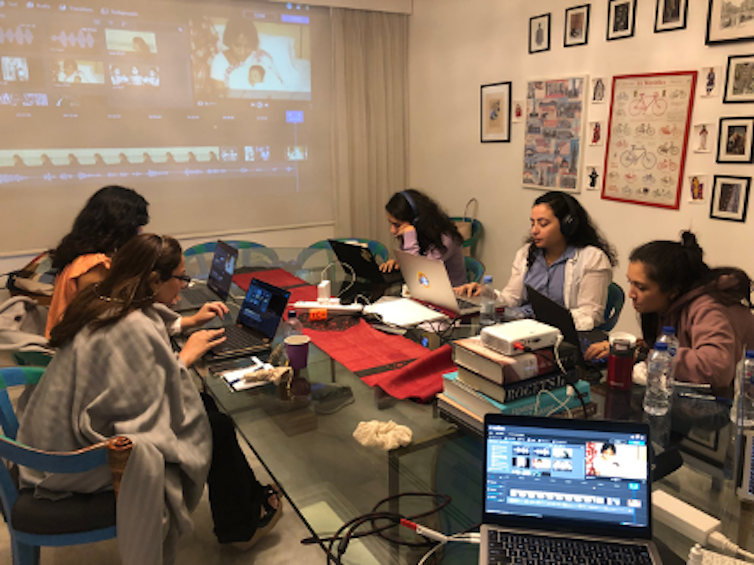
StoryCentre Canada, a non-profit that empowers short multimedia first-person narratives, set up digital storytelling workshops that taught photography and video editing while letting participants share their stories in the language of their choice, building both technical and communication skills. Hinprov, a collective of South Asian improvisers, created spaces where expression was possible even for those still learning English.

Six women surround a table where they work on multimedia projects.
Participants working on their projects for the digital storytelling workshop at StoryCentre Canada.
StoryCentre Canada, CC BY

Arts projects also spark civic conversations. At Matthew House, which offers transitional housing settlement assistance, a mural led by a refugee artist-in-residence prompted neighbours to ask questions about refugees, opening dialogue that challenged stereotypes. Another PNR project collaborated with LGBTQ+ newcomers, using photography and film to counter stigma and create networks of care.

These initiatives show how the arts allow creative newcomers to assert their voices and identities on their own terms, positioning them not simply as guests but as active shapers of the cultural fabric of their new country.

Newcomer artists face systemic barriers

Newcomer artists design and deliver effective arts-based projects. Their ability to contribute, however, is limited by systemic obstacles.

General settlement services rarely provide tailored guidance for creative careers. Newcomer artists are directed toward generic job markets or told to pursue “Canadian credentials,” with little information about arts funding, networks or sector norms.

Discrimination compounds these hurdles: accents and linguistic differences become barriers to casting and collaboration; racial bias and expectations about “ethnic” content narrow opportunities; western-centrism and unfamiliarity with certain artistic traditions from outside the West devalue skills gained abroad. For instance, an Indian musician criticized the tendency to classify Indian classical music as “world music” rather than recognizing it as a classical form, limiting its appropriate recognition and funding.

Administrative rules add further exclusions. Temporary residents may be ineligible for public arts funding. Artists living in the Toronto area but outside the city proper can be excluded by residency requirements, even when they exhibit and perform in Toronto. These policies limit access to precisely the resources that help artists integrate into local scenes.

As part of our project, we worked with filmmaker Ogo Eze to produce two short portraits of newcomer artists: Iranian artist Aitak Sorahitalab and Palestinian-Syrian musician Tarek Ghriri.

Both stories illustrate how, despite formidable challenges, newcomers can become community leaders, using their art to support other newcomers while enriching Toronto’s cultural scene. Their stories show resilience but also underline how much potential is lost when systemic barriers remain in place.

“Strings of Resilience” portrays Syrian musician Tarek Ghriri’s journey of resettlement in Canada. Through music, he navigates displacement, fosters community connections and challenges stereotypes about refugees.
“Clay of Freedom” follows Iranian artist Aitak Sorahitalab as she rebuilds her artistic career in Toronto. The film highlights both the challenges faced by newcomer artists and the creative ways they support their communities through art.

Mending the arts and settlement divide

We have too often treated settlement and the arts as separate and incompatible worlds. Bridging them requires a shift on both sides.

On the settlement side, we must move away from sequential-needs thinking that relegates the arts to the bottom of the priority list or treats cultural activities as communications window dressing. This underestimates the concrete, multifaceted support community arts professionals can provide and sidelines newcomer artists.

On the arts side, TAC’s program is a promising template. By offering targeted support to newcomers, the PNR acknowledges the particular challenges they face when starting out, while avoiding the trap of permanently labelling them as “migrant artists.”

Given that only two per cent of Canadian arts funders offer targeted support for newcomers, lessons from this program can guide similar initiatives across Canada and beyond.

The Conversation

Jeremie Molho received funding from the Social Sciences and Humanities Research Council Partnership Engage Grant for the project Fostering Integration through the Arts: Learning from Toronto Arts Council’s Program for Newcomers and Refugees’, conducted in partnership with Toronto Arts Council

ref. How the arts strengthen newcomer settlement in Canada – https://theconversation.com/how-the-arts-strengthen-newcomer-settlement-in-canada-265462

Sex-motivated violence should be treated as a hate crime

Source: The Conversation – Canada – By Debra M Haak, Assistant Professor, Faculty of Law, Queen’s University, Ontario

Canada recently introduced the Combatting Hate Act, legislation that will create three new criminal offences intended to strengthen protections against hate.

The first new offence targets hate crimes directly for the first time in Canada. The second targets intimidation and obstruction. The third expands an existing criminal law targeting wilful promotion of hatred.

Canada’s hate crime laws apply to acts of hatred towards identifiable groups, those distinguished by colour, race, religion, national or ethnic origin, age, sex, sexual orientation, gender identity or expression, or mental or physical disability.

Hate crimes are under-reported, under-recorded and under-prosecuted in most jurisdictions where legislation exists.

Data from Statistics Canada shows that in 2019, nearly 250,000 people reported they were victims of hate-motivated incidents, but fewer than one per cent were investigated as hate crimes.

Sex-motivated violence is common

Acts of hatred towards women and girls regularly occur in Canada. Some involve violence. Femicide is defined as the killing of women and girls because of their sex or gender. However, sex-motivated violence is rarely treated as hate crime.

The Montréal Massacre is the best known example of sex-motivated killing in Canada. On Dec. 6, 1989, a lone white male, armed with a gun, entered École Polytechnique at the Université of Montréal and killed 14 women. He killed them because they were women and, in his view, feminists, towards whom he expressed hatred.


Read more:
Montréal Massacre anniversary: The media must play a key role in fighting femicide


This mass femicide has never been officially recognized as a hate-motivated crime in Canada.

Other mass killings of women also reveal sex-motivated hatred. The Toronto van attack in 2018 was perpetrated by a male who admitted he drew inspiration from the so-called incel online subculture of men united by sexual frustration and a hatred of women.

The fact that the attack was motivated by hatred towards women does not appear to have been considered at sentencing.


Read more:
Toronto van attack: Guilty verdict, but Canada still needs to tackle ideological violence


Hatred based on sex

In June 2022, the Office of the Chief Coroner of Ontario held an inquest into one of the worst instances of intimate partner femicide in Canadian history. It involved the killings of three women by one man in eastern Ontario in 2015.

In that case, the sentencing judge said the perpetrator was “a violent, vindictive, calculating abuser of women” who “took his hatred to its ultimate climax and committed triple murders.”

Sex-motivated violence is not limited to mass killings. A woman or girl is killed every other day in Canada. A significant number of these deaths are also motivated by hatred based on sex.

In many cases, violence against women and girls is not only sex-motivated. It is well-documented that many of the disappearances and deaths of Indigenous women and girls also involve racially motivated hatred as well as systemic misogyny and racism, particularly by police.

Sex-motivated violence not treated as hate

Yet our research has revealed that violence motivated by hatred of women and girls is relatively invisible in crime reporting data, sentencing and public discourse.

Sex-motivated violence against women and girls is seldom recorded as hate crime. Sex has never comprised more than three per cent of police-reported hate crime in Canada, despite self-reported data showing at least 22 per cent of Canadians — mostly women — have experienced hate.

Sex-motivated hate, in fact, was the most under-reported category of hate crime when comparing self-reported data to police data.

Neither is sex-motivated violence sentenced as a hate crime, despite the fact that the Criminal Code already provides for increased sentences when there is evidence an offence was motivated by hate.

Canada’s Department of Justice has found that sex-motivated hatred was one of the least commonly addressed grounds when applying hate as an aggravating factor at sentencing. Based on a review of more than 40 years of case law up to 2020, only seven cases were found to focus on sex. Two of these cases were unsuccessful.

Male violence against women, girls is hate

Hate-motivated crime is significant in Canada. In 2020, the first year of the COVID-19 pandemic, overall hate crimes reported to police increased by 37 per cent compared to 2019.

The first pillar of Canada’s Action Plan on Combatting Hate is empowering communities to identify hate. That currently does not happen in cases of male violence against women, even though sex is an identified group in Canadian criminal laws targeting hate.

Here are three ways it could happen:

  • Canada should enhance monitoring of hate-motivated gender-based violence.
  • To increase responsiveness to sex-motivated violence, existing and proposed laws targeting sex-motivated hate must be implemented and enforced.
  • Canada should promote an understanding of male violence against women and girls as a form of hate. The new laws and the focus they bring to this issue could help.

For hate crime legislation to be more than symbolic, crimes motivated by hatred must be reported, recorded, prosecuted and sentenced as hate crimes for all identifiable groups — not just some of them.

The Conversation

Debra M Haak receives funding from the Social Sciences and Humanities Research Council and the Canadian Bar Association Law for the Future Fund.

Myrna Dawson received funding from the Social Sciences and Humanities Research Council and British Columbia’s Office of the Human Rights Commissioner.

ref. Sex-motivated violence should be treated as a hate crime – https://theconversation.com/sex-motivated-violence-should-be-treated-as-a-hate-crime-265927

Comment un médicament valant un milliard de dollars a été découvert dans le sol de l’Île de Pâques (et pourquoi scientifiques et industrie pharmaceutique ont une dette envers les peuples autochtones)

Source: The Conversation – in French – By Ted Powers, Professor of Molecular and Cellular Biology, University of California, Davis

Le peuple Rapa Nui est pratiquement absent de l’histoire de la découverte de la rapamycine telle qu’elle est généralement racontée. Posnov/Moment/Getty

La découverte en 1964, sur l’île de Pâques, de la rapamycine, un nouvel antibiotique, a marqué le début d’une success story pharmaceutique à plusieurs milliards de dollars. Pourtant, l’histoire a complètement occulté les individus et les dynamiques politiques qui ont rendu possible l’identification de ce « médicament miracle ».


Baptisé du nom autochtone de l’île, Rapa Nui, la rapamycine a initialement été employée comme immunosuppresseur, afin de prévenir le rejet des greffes d’organes et d’améliorer le taux de succès de l’implantation de stents, de petits treillis métalliques destinés à étayer les artères dans le cadre de la lutte contre la maladie coronarienne (laquelle se traduit par rétrécissement progressif des artères qui nourrissent le cœur, ndlr).

Son usage s’est depuis étendu au traitement de divers types de cancers, et les chercheurs explorent aujourd’hui son potentiel dans le contexte de la prise en charge du diabète,

des maladies neurodégénératives, voire de la lutte contre les méfaits du vieillissement. Ainsi, des études mettant en évidence la capacité de la rapamycine à prolonger la durée de vie ou à combattre les maladies liées à l’âge semblent paraître presque quotidiennement depuis quelque temps… Une requête sur PubMed, le moteur de recherche recense plus de 59 000 articles mentionnant la rapamycine. Il s’agit de l’un des médicaments qui fait le plus parler de lui dans le domaine médical.

Cependant, bien que la rapamycine soit omniprésente en science et en médecine, la façon dont elle a été découverte demeure largement méconnue du public. En tant que scientifique ayant consacré sa carrière à l’étude de ses effets sur les cellules, j’ai ressenti le besoin de mieux comprendre son histoire.

À ce titre, les travaux de l’historienne Jacalyn Duffin portant sur la Medical Expedition to Easter Island (METEI), une expédition scientifique mise sur pied dans les années 1960, ont complètement changé la manière dont nombre de mes collègues et moi-même envisageons désormais notre domaine de recherche.

La découverte du complexe héritage de la rapamycine soulève en effet d’importantes questions sur les biais systémiques qui existent dans le secteur de la recherche biomédicale, ainsi que sur la dette des entreprises pharmaceutiques envers les territoires autochtones d’où elles extraient leurs molécules phares.

Pourquoi un tel intérêt pour la rapamycine ?

L’action de la rapamycine s’explique par sa capacité à inhiber une protéine appelée target of rapamycin kinase, ou TOR. Cette dernière est l’un des principaux régulateurs de la croissance et du métabolisme cellulaires. De concert avec d’autres protéines partenaires, TOR contrôle la manière dont les cellules répondent aux nutriments, au stress et aux signaux environnementaux, influençant ainsi des processus majeurs tels que la synthèse protéique et la fonction immunitaire.

Compte tenu de son rôle central dans ces activités cellulaires fondamentales, il n’est guère surprenant qu’un dysfonctionnement de TOR puisse se traduire par la survenue de cancers, de troubles métaboliques ou de maladies liées à l’âge.

Structure chimique de la rapamycine
Structure chimique de la rapamycine.
Fvasconcellos/Wikimedia

Un grand nombre des spécialistes du domaine savent que cette molécule a été isolée au milieu des années 1970 par des scientifiques travaillant au sein du laboratoire pharmaceutique Ayerst Research Laboratories, à partir d’un échantillon de sol contenant la bactérie Streptomyces hydroscopicus. Ce que l’on sait moins, c’est que cet échantillon a été prélevé dans le cadre d’une mission canadienne appelée Medical Expedition to Easter Island, ou METEI, menée à Rapa Nui – l’Île de Pâques – en 1964.

Histoire de la METEI

L’idée de la Medical Expedition to Easter Island (METEI) a germé au sein d’une équipe de scientifiques canadiens composée du chirurgien Stanley Skoryna et du bactériologiste Georges Nogrady. Leur objectif était de comprendre comment une population isolée s’adaptait au stress environnemental. Ils estimaient que la prévision de la construction d’un aéroport international sur l’île de Pâques offrait une occasion unique d’éclairer cette question. Selon eux, en accroissant les contacts de la population de l’île avec l’extérieur, l’aéroport risquait d’entraîner des changements dans sa santé et son bien-être.

Financée par l’Organisation mondiale de la santé, et soutenue logistiquement par la Marine royale canadienne, la METEI arriva à Rapa Nui en décembre 1964. Durant trois mois, l’équipe fit passer à la quasi-totalité des 1 000 habitants de l’île toute une batterie d’examens médicaux, collectant des échantillons biologiques et procédant à un inventaire systématique de la flore et de la faune insulaires.

Dans le cadre de ces travaux, Georges Nogrady recueillit plus de 200 échantillons de sol, dont l’un s’est avéré contenir la souche de bactéries Streptomyces productrice de rapamycine.

Affiche du mot METEI écrit verticalement entre l’arrière de deux têtes de moaï, avec l’inscription « 1964-1965 RAPA NUI INA KA HOA (N’abandonnez pas le navire) »
Logo du METEI.
Georges Nogrady, CC BY-NC-ND

Il est important de comprendre que l’objectif premier de l’expédition était d’étudier le peuple de Rapa Nui, dans un contexte qui était vu comme celui d’un laboratoire à ciel ouvert. Pour encourager les habitants à participer, les chercheurs n’ont pas hésité à recourir à la corruption, leur offrant des cadeaux, de la nourriture et diverses fournitures. Ils ont également eu recours à la coercition : à cet effet, ils se sont assuré les services d’un prêtre franciscain en poste de longue date sur l’île pour les aider au recrutement. Si leurs intentions étaient peut-être honorables, il s’agit néanmoins là d’un exemple de colonialisme scientifique dans lequel une équipe d’enquêteurs blancs choisit d’étudier un groupe majoritairement non blanc sans son concours, ce qui crée un déséquilibre de pouvoir. Un biais inhérent à l’expédition existait donc dès la conception de la METEI.

Par ailleurs, plusieurs des hypothèses de départ avaient été formulées sur des bases erronées. D’une part, les chercheurs supposaient que les habitants de Rapa Nui avaient été relativement isolés du reste du monde, alors qu’il existait en réalité une longue histoire d’interactions avec des pays extérieurs, comme en témoignaient divers récits dont les plus anciens remontaient au début du XVIIIe siècle, et dont les publications s’étalaient jusqu’à la fin du XIXe siècle.

D’autre part, les organisateurs de la METEI partaient du postulat que le bagage génétique de la population de Rapa Nui était homogène, sans tenir compte de la complexe histoire de l’île en matière de migrations, d’esclavage et de maladies (certains habitants étaient en effet les descendants de survivants de la traite des esclaves africains qui furent renvoyés sur l’île et y apportèrent certaines maladies, dont la variole). La population moderne de Rapa Nui est en réalité métissée, issue à la fois d’ancêtres polynésiens, sud-américains, voire africains.

Cette erreur d’appréciation a sapé l’un des objectifs clés du METEI : évaluer l’influence de la génétique sur le risque de maladie. Si l’équipe a publié un certain nombre d’études décrivant la faune associée à Rapa Nui, son incapacité à établir une base de référence est probablement l’une des raisons pour lesquelles aucune étude de suivi n’a été menée après l’achèvement de l’aéroport de l’île de Pâques en 1967.

Rendre crédit à qui de droit

Les omissions qui existent dans les récits sur les origines de la rapamycine sont le reflet d’angles morts éthiques fréquemment présents dans la manière dont on se souvient des découvertes scientifiques.

Georges Nogrady rapporta de Rapa Nui des échantillons de sol, dont l’un parvint à Ayerst Research Laboratories. Là, Surendra Sehgal et son équipe isolèrent ce qui fut nommé rapamycine, qu’ils finirent par commercialiser à la fin des années 1990 en tant qu’immunosuppresseur, sous le nom Rapamune. Si l’on connaît bien l’obstination de Sehgal, qui fut déterminante pour mener à bien le projet en dépit des bouleversements qui agitaient à cette époque la société pharmaceutique pour laquelle il travaillait – il alla même jusqu’à dissimuler une culture de bactéries chez lui – ni Nogrady ni la METEI ne furent jamais crédités dans les principaux articles scientifiques qu’il publia.

Bien que la rapamycine ait généré des milliards de dollars de revenus, le peuple de Rapa Nui n’en a tiré aucun bénéfice financier à ce jour. Cela soulève des questions sur les droits des peuples autochtones ainsi que sur la biopiraterie (qui peut être définie comme « l’appropriation illégitime par un sujet, notamment par voie de propriété intellectuelle, parfois de façon illicite, de ressources naturelles, et/ou éventuellement de ressources culturelles en lien avec elles, au détriment d’un autre sujet », ndlr), autrement dit dans ce contexte la commercialisation de connaissances autochtones sans contrepartie.

Des accords tels que la Convention des Nations unies de 1992 sur la diversité biologique et la Déclaration de 2007 sur les droits des peuples autochtones visent à protéger les revendications autochtones sur les ressources biologiques, en incitant tous les pays à obtenir le consentement et la participation des populations concernées, et à prévoir des réparations pour les préjudices potentiels avant d’entreprendre des projets.

Ces principes n’étaient cependant pas en vigueur à l’époque du METEI.

Gros plans de visages alignés portant des couronnes de fleurs dans une pièce sombre
Les habitants de Rapa Nui n’ont reçu que peu ou pas de reconnaissance pour leur rôle dans la découverte de la rapamycine.
Esteban Felix/AP Photo

Certaines personnes soutiennent que, puisque la bactérie productrice de rapamycine a été trouvée ailleurs que dans le sol de l’île de Pâques, ce dernier n’était ni unique ni essentiel à la découverte du médicament. D’autres avancent aussi qu’étant donné que les insulaires n’utilisaient pas la rapamycine et n’en connaissaient pas l’existence sur leur île, cette molécule ne constituait pas une ressource susceptible d’être « volée ».

Cependant, la découverte de la rapamycine à Rapa Nui a jeté les bases de l’ensemble des recherches et de la commercialisation ultérieures autour de cette molécule. Cela n’a été possible que parce que la population a été l’objet de l’étude montée par l’équipe canadienne. La reconnaissance formelle du rôle essentiel joué par les habitants de Rapa Nui dans la découverte de la rapamycine, ainsi que la sensibilisation du public à ce sujet, sont essentielles pour les indemniser à hauteur de leur contribution.

Ces dernières années, l’industrie pharmaceutique a commencé à reconnaître l’importance d’indemniser équitablement les contributions autochtones. Certaines sociétés se sont engagées à réinvestir dans les communautés d’où proviennent les précieux produits naturels qu’elles exploitent.

Toutefois, s’agissant des Rapa Nui, les entreprises qui ont directement tiré profit de la rapamycine n’ont pas encore fait un tel geste.

Si la découverte de la rapamycine a sans conteste transformé la médecine, il est plus complexe d’évaluer les conséquences pour le peuple de Rapa Nui de l’expédition METEI. En définitive, son histoire est à la fois celle d’un triomphe scientifique et d’ambiguïtés sociales.

Je suis convaincu que les questions qu’elle soulève (consentement biomédical, colonialisme scientifique et occultation de certaines contributions) doivent nous faire prendre conscience qu’il est nécessaire d’examiner de façon plus critique qu’ils ne l’ont été jusqu’à présent les héritages des découvertes scientifiques majeures.

The Conversation

Ted Powers ne travaille pas, ne conseille pas, ne possède pas de parts, ne reçoit pas de fonds d’une organisation qui pourrait tirer profit de cet article, et n’a déclaré aucune autre affiliation que son organisme de recherche.

ref. Comment un médicament valant un milliard de dollars a été découvert dans le sol de l’Île de Pâques (et pourquoi scientifiques et industrie pharmaceutique ont une dette envers les peuples autochtones) – https://theconversation.com/comment-un-medicament-valant-un-milliard-de-dollars-a-ete-decouvert-dans-le-sol-de-lile-de-paques-et-pourquoi-scientifiques-et-industrie-pharmaceutique-ont-une-dette-envers-les-peuples-autochtones-266381

En 2030, la NASA dira adieu à la station spatiale internationale et entrera dans l’ère des stations commerciales

Source: The Conversation – in French – By John M. Horack, Professor of Mechanical and Aerospace Engineering, The Ohio State University

La Station spatiale internationale sera désorbitée en 2030. NASA via AP

La Station spatiale internationale vit ses dernières années : en 2030, elle sera désorbitée. Vingt-cinq ans d’occupation continue laisseront alors place à une nouvelle ère, celle des stations spatiales commerciales.


Depuis novembre 2000, la NASA et ses partenaires internationaux assurent sans interruption une présence humaine en orbite basse, avec toujours au moins un Américain à bord. Une continuité qui fêtera bientôt ses 25 ans.

Dans l’histoire de l’exploration spatiale, la Station spatiale internationale apparaît sans doute comme l’une des plus grandes réalisations de l’humanité, un exemple éclatant de coopération dans l’espace entre les États-Unis, l’Europe, le Canada, le Japon et la Russie. Mais même les plus belles aventures ont une fin.

Un emblème représentant une photo de la Station spatiale internationale, entourée d’un anneau où figurent les drapeaux des pays partenaires
L’emblème de la Station spatiale internationale arbore les drapeaux des États signataires d’origine.
CSA/ESA/JAXA/NASA/ROSCOSMOS

En 2030, la Station spatiale internationale sera désorbitée : elle sera dirigée vers une zone isolée du Pacifique.

Je suis ingénieur en aérospatiale et j’ai contribué à la conception de nombreux équipements et expériences pour l’ISS. Membre de la communauté spatiale depuis plus de trente ans, dont dix-sept au sein de la NASA, il me sera difficile d’assister à la fin de cette aventure.

Depuis le lancement des premiers modules en 1998, la Station spatiale internationale a été le théâtre d’avancées scientifiques majeures dans des domaines tels que la science des matériaux, la biotechnologie, l’astronomie et l’astrophysique, les sciences de la Terre, la combustion et bien d’autres encore.

Les recherches menées par les astronautes à bord de la station et les expériences scientifiques installées sur sa structure extérieure ont donné lieu à de nombreuses publications dans des revues à comité de lecture. Certaines ont permis de mieux comprendre les orages, d’améliorer les procédés de cristallisation de médicaments essentiels contre le cancer, de préciser comment développer des rétines artificielles en apesanteur, d’explorer la production de fibres optiques ultrapures et d’expliquer comment séquencer l’ADN en orbite.

Vue de dessus d’un scientifique en blouse de laboratoire et portant des gants, manipulant une pipette sur un plan de travail à bord de l’ISS
L’environnement en microgravité de l’ISS en fait un cadre idéal pour une grande variété de projets de recherche scientifique.
NASA, CC BY

Au total, plus de 4 000 expériences ont été menées à bord de l’ISS, donnant lieu à plus de 4 400 publications scientifiques destinées à améliorer la vie sur Terre et à tracer la voie de futures activités d’exploration spatiale.

La station a démontré toute la valeur de la recherche conduite dans l’environnement unique des vols spatiaux – marqué par une très faible gravité, le vide, des cycles extrêmes de température et des radiations – pour faire progresser la compréhension d’une large gamme de processus physiques, chimiques et biologiques.

Maintenir une présence en orbite

Avec le retrait annoncé de la station, la NASA et ses partenaires internationaux n’abandonnent pas pour autant leur avant-poste en orbite terrestre basse. Ils cherchent au contraire des alternatives pour continuer à exploiter le potentiel de ce laboratoire de recherche unique et prolonger la présence humaine ininterrompue maintenue depuis 25 ans à quelque 402 kilomètres au-dessus de la Terre.

En décembre 2021, la NASA a annoncé trois contrats visant à soutenir le développement de stations spatiales privées et commerciales en orbite basse. Depuis plusieurs années, l’agence confie déjà le ravitaillement de l’ISS à des partenaires privés. Plus récemment, elle a adopté un dispositif similaire avec SpaceX et Boeing pour le transport d’astronautes à bord respectivement de la capsule Dragon et du vaisseau Starliner.

Un vaisseau spatial blanc de forme conique avec deux panneaux solaires rectangulaires en orbite, la Terre en arrière-plan
La capsule Dragon de SpaceX s’amarre à l’ISS.
NASA TV via AP

Fort de ces succès, la NASA a investi plus de 400 millions de dollars pour stimuler le développement de stations spatiales commerciales, avec l’espoir de les voir opérationnelles avant la mise hors service de l’ISS.

L’aube des stations spatiales commerciales

En septembre 2025, la NASA a publié un projet d’appel à propositions pour la phase 2 des partenariats concernant les stations spatiales commerciales. Les entreprises retenues recevront des financements pour réaliser les revues critiques de conception et démontrer le bon fonctionnement de stations capables d’accueillir quatre personnes en orbite pendant au moins 30 jours.

La NASA procédera ensuite à une validation et une certification formelles afin de garantir que ces stations répondent à ses normes de sécurité les plus strictes. Cela permettra ensuite à l’agence d’acheter des missions et des services à bord de ces stations sur une base commerciale – de la même manière qu’elle le fait déjà pour le transport de fret et d’équipages vers l’ISS. Reste à savoir quelles entreprises réussiront ce pari, et selon quel calendrier.

Pendant que ces stations verront le jour, les astronautes chinois continueront à vivre et à travailler à bord de leur station Tiangong, un complexe orbital habité en permanence par trois personnes, évoluant à environ 400 kilomètres au-dessus de la Terre. Si la continuité habitée de l’ISS venait à s’interrompre, la Chine et Tiangong prendraient ainsi le relais comme station spatiale habitée sans discontinuité la plus ancienne en activité. Tiangong est occupée depuis environ quatre ans.

Photos et vidéos de l’ISS permettant d’observer la Terre depuis l’orbite.

En attendant, levons les yeux

Il faudra encore plusieurs années avant que les nouvelles stations spatiales commerciales n’encerclent la Terre à environ 28 000 kilomètres par heure et avant que l’ISS ne soit désorbitée en 2030.

D’ici là, il suffit de lever les yeux pour profiter du spectacle. Lors de ses passages, l’ISS apparaît la plupart des nuits comme un point bleu-blanc éclatant, souvent l’objet le plus brillant du ciel, traçant silencieusement une courbe gracieuse à travers la voûte étoilée. Nos ancêtres n’auraient sans doute jamais imaginé qu’un jour, l’un des objets les plus lumineux du ciel nocturne serait conçu par l’esprit humain et assemblé par la main de l’homme.

The Conversation

John M. Horack a reçu des financements de recherche externes de la NASA, de Voyager Technologies et d’autres organismes liés au domaine spatial, dans le cadre de son travail de professeur à l’Université d’État de l’Ohio.

ref. En 2030, la NASA dira adieu à la station spatiale internationale et entrera dans l’ère des stations commerciales – https://theconversation.com/en-2030-la-nasa-dira-adieu-a-la-station-spatiale-internationale-et-entrera-dans-lere-des-stations-commerciales-266506

Palm trees in Africa are in decline: these botanists made a plan to do something about it

Source: The Conversation – Global Perspectives – By Fred Stauffer, Curator, Conservatoire et Jardin botaniques de Genève (CJBG)

Palm trees grace the landscape across Africa, thriving in environments as diverse as deserts and rainforests. Central Africa holds the richest variety, home to 52 species, while west Africa has 38 and east Africa 18. They form part of a global family of 2,600 palm species.

Africa is home to relatively few palm species when compared with other tropical regions of the world. However, palms play a central role in the social and economic life of the continent’s people. They’re consumed as food and beverages for people and animals, used in healthcare and medicine and fashioned into construction material. They have spiritual and cultural importance too.


Read more:
The loss of Madagascar’s unique palm trees will devastate ecosystems


Several botanical studies have placed the palm family, along with the grass and legume families, among the most economically and culturally important plant groups in many rural parts of the continent.

We are a group of botanists from Benin, Côte d’Ivoire and Switzerland who collectively have decades of knowledge about Africa’s native palm diversity. Our research aims to come up with suitable strategies for conserving the palms, and ways for communities to use them sustainably.

At a recent African flora conference in Ghana, we launched a new pan-African network for palm specialists from the continent to study and protect palms. Researchers from Guinea, Sierra Leone, Nigeria, Gabon, Congo, Ethiopia and Tanzania signed up for projects related to palm biology, uses and conservation.

We officially called this new network the African Network of Palm Scientists.


Read more:
Red gold: the rise and fall of West Africa’s palm oil empire


The network places palms at the centre of conservation projects. This is important because African palms are disappearing due to deforestation, overexplotation, and human-induced habitat loss. Some, such as Hyphaene guineensis or Sclerosperma profizianum, are rare. Their extinction would harm not only ecosystems but also the people who rely on them.

The African Network of Palm Scientists therefore also aims to pool expertise, document traditional knowledge about palms, and train the next generation of palm experts.

The slow life cycle of a threatened tree

Although only a few palm species in Africa currently face extinction, most palm species across the continent are now in decline. Ghana hosts the Sclerosperma profizianum, and Sierra Leone and Liberia host several species of Eremospatha that are among the most threatened.

The oil palm (Elaeis guineensis), date palm (Phoenix dactylifera) and coconut (Cocos nucifera) are farmed, but other species that are harvested are mostly wild.


Read more:
Africa’s tropical forests could be next in line as global food demand grows


Even under undisturbed conditions, the natural regeneration of palms is slow. Seeds can take months or even years to germinate, and the young plants also grow very slowly. They need very specific conditions to grow, such as high temperature and elevated humidity. Some – rattan palms, for example – need decades before they reach the necessary size to be harvested.

This is one of the main goals of our research: to find out exactly how much time it takes for palms to germinate and be ready for sustainable harvesting.

Missing pieces in the palms’ puzzle

Elaeis guineensis (African oil palm), Cocos nucifera (coconut palm) and Phoenix dactylifera (date palm) have been widely studied because they are used a lot in food and cosmetics.

However, other African palm species such as Borassus aethiopum (African fan palm), Raphia hookeri (raffia palm), Hyphaene compressa (doum palm), or the group of rattan palms (Laccosperma, Eremospatha, Calamus), remain poorly documented. This is despite their uses for starch, fibre, wine extraction and building materials, and in local cultures. The fruits of Borassus aethiopum, for example, are edible and this palm is tapped for wine, but unsustainable tapping techniques could endanger it.


Read more:
Africa’s plants: a database project has recorded 65,000 species – and is still growing


Overall, scientists still do not fully understand how diverse African palms are, how they are spread across different landscapes, or how well they can cope with environmental changes. This means we have not yet been able to figure out how best to manage them in a sustainable way.

As climate change progresses, it is likely that some palms won’t be able to adapt. Extremely high temperatures will reduce water availability and increase the levels of salt content in the soil beyond what the palms can tolerate.

What needs to happen next

First, the African Network of Palm Scientists will evaluate the threats that some palms face. We’ll then propose measures adapted to local realities to promote palm conservation.

Second, classifying all African palm species and listing where they are found is crucial. We estimate that at least 15% of native African palms are incompletely documented (no flowers or fruits that are potentially useful for humans or animals have ever been seen and collected from those palms).

Botanists in Africa also need to conduct more research into how African palms reproduce, what’s needed for their seeds to germinate, and their genetic diversity, so that they know the best ways to conserve the trees.


Read more:
Burkina Faso and Mali’s fabulous flora: new plant life record released


Third, more research is needed to see how the palms could contribute to food security, climate adaptation and biodiversity conservation. Palms are not only important for humans, but also for many herbivores (mammals, birds) that strongly rely on palm leaves and fruits for their daily feeding.

Fourth, a domestication plan is needed. Domestication means planting and promoting the growth of palms in a controlled way that provides economic benefits. This can be done in farm plots. However, we also propose it should happen in semi-controlled conditions in the forest. This could reduce the harvesting pressure on wild palms, boost the livelihoods of rural people and bring palms into agroforestry (growing trees with crops).


Read more:
Mistletoes, locust bean trees and birds work together in Nigeria’s forest ecology


Although the new African Network of Palm Scientists only concentrates on African palm diversity, the conservation strategies we develop will be useful for conserving other plants. Biodiversity loss disrupts the delicate balance of ecosystems worldwide. Protecting Africa’s palms could be vital for the survival of both people and wildlife.

The Conversation

Fred Stauffer receives funding from the Conservatory and Botanic Garden of Geneva for his research activities and field missions. He is affiliated to this institution, as well as the University of Geneva, where he is lecturer in botany

Doudjo Noufou Ouattara receives funding from Fondation Audemars Piguet pour les arbres. He is affiliated with Université Nangui ABROGOUA and Centre Suisse de Recherches Scientifiques en Côted’Ivoire.

Kifouli Adéoti receives funding from Fondation Audemars Piguet pour les arbres. He is affiliated with Université d’Abomey-Calavi in Benin’ Republic.

ref. Palm trees in Africa are in decline: these botanists made a plan to do something about it – https://theconversation.com/palm-trees-in-africa-are-in-decline-these-botanists-made-a-plan-to-do-something-about-it-264705

Israel’s interception of the Gaza aid flotilla is a clear violation of international law

Source: The Conversation – Global Perspectives – By Donald Rothwell, Professor of International Law, Australian National University

The Israel Defence Force has intercepted a flotilla of humanitarian vessels seeking to deliver aid to Gaza, taking control of multiple vessels and arresting activists, including Greta Thunberg.

The interceptions took place in the Mediterranean Sea between 70-80 nautical miles off the Gazan coast. These are international waters where international law recognises high seas freedom of navigation for all vessels.

Israel has countered by arguing it has a maritime blockade which prohibits entry to Gaza by foreign vessels. Israel has also suggested the flotilla was supported by Hamas – an assertion the flotilla organisers have rejected.

Gaza humanitarian aid flotillas

The Global Sumud Flotilla was comprised of more than 40 boats carrying humanitarian aid (food, medical supplies and other essential items), along with several hundred parliamentarians, lawyers and activists from dozens of countries.

The flotilla departed Spain in late August and has been making its way eastwards across the sea, with stops in Tunisia, Italy and Greece. Along the way, the Italian and Greek governments deployed naval escorts to ensure their safe passage.

Passengers on the boats alleged they had been harassed by drones at mulitple points in the voyage.

This flotilla campaign is the latest iteration of a movement that has existed for over 15 years to challenge Israel’s long-running blockade of the Gaza Strip.

Earlier this year, a ship called the Conscience carrying activists and aid bound for Gaza was hit by explosions off the coast of Malta.

Israel then intercepted the Madleen, with Thunberg and other activists on board, in June, and the Handala in July.

And in 2010, a flotilla tried to reach Gaza carrying humanitarian relief and hundreds of activists. Israeli commandos boarded the Turkish-flagged Mavi Marmara, leading to a violent confrontation that resulted in the deaths of ten activists. The deaths drew widespread condemnation and strained Israeli-Turkish ties for years.


Read more:
There are clear laws on enforcing blockades – Israel’s interception of the Madleen raises serious questions


The legality of Gaza’s naval blockade

The international law related to the actions of the flotilla vessels and Israel’s capacity to intervene is complex.

Israel has imposed blockades of Gaza in various forms for nearly 20 years.

The legal basis for the blockades and their consistency with international law, particularly the law of the sea, has been contentious, which was highlighted during a UN inquiry that followed the Mavi Marmara incident.

While Israel’s legal relationship with Gaza has varied during this time, Israel is now considered an occupying power in Gaza under international law.

The roles of occupying powers were codified in the Fourth Geneva Convention in 1949 and built upon the legal obligations that Allied powers assumed in Germany and Japan at the end of the second world war. The Geneva Convention outlines the clear legal framework for occupying powers.

In recent decades, Israel has been both a de jure (recognised under the law) and de facto occupying power in Palestine.

In 2024, the International Court of Justice ruled Israel’s occupation of the Palestinian territories was illegal under international law.

As an occupying power, Israel controls all access to Gaza whether by land, air or sea. Aid trucks are only permitted to enter Gaza under strict controls. Foreign air force aid drops that have occurred in recent months have only been permitted under strict Israeli control, as well.

Very little aid has arrived by sea since the war began because Israel has severely restricted maritime access to Gaza. The United States built a floating pier off the coast to deliver aid in 2024, but this was soon abandoned because of weather, security and technical issues.

This clearly indicated, however, that Israel was prepared to permit the flow of maritime aid from its closest ally, the US. This exception to the blockade was not applied to other humanitarian actors.

Intercepting ships in international waters

While delivery of aid by sea is legally problematic at the moment, there are limits to Israel’s ability to disrupt flotillas. The freedom of navigation is central to the law of the sea. As such, the flotilla is entitled to sail unimpeded in the Mediterranean Sea.

Any harassment or stopping of the flotilla within the Mediterranean’s international waters is therefore a clear violation of international law.

Crucial to this is the actual location where Israeli forces intercept and board flotilla vessels.

Israel can certainly exercise control over the 12 nautical mile territorial sea off Gaza’s shores. Its closure of the territorial sea to foreign vessels would be justified under international law as a security measure, as well as to ensure the safety of neutral vessels due to the ongoing war.

Flotilla organisers said their ships were intercepted between 70 to 80 nautical miles from shore, well beyond Gaza’s territorial sea.

No doubt this was done for operational reasons. The closer the flotilla came to the Gazan coast, the more difficult it would be for the Israel Defence Force to successfully intercept each ship, raising the possibility that at least one vessel may make landfall.

Scores of activists onboard the ships have reportedly been detained and will be taken into custody in the Israeli port of Ashdod. They will then likely be quickly deported.

The activists have protections under international human rights law, as well, including access to foreign diplomats exercising consular protection for their citizens.

The Conversation

Donald Rothwell receives funding from Australian Research Council.

ref. Israel’s interception of the Gaza aid flotilla is a clear violation of international law – https://theconversation.com/israels-interception-of-the-gaza-aid-flotilla-is-a-clear-violation-of-international-law-266254

Venezuela and US edge toward war footing − but domestic concerns, international risks may hold Washington back

Source: The Conversation – Global Perspectives – By Robert Muggah, Richard von Weizsäcker Fellow na Bosch Academy e Co-fundador, Instituto Igarapé

U.S. Marines park a Lockheed Martin F-35B fighter aircraft at Naval Station Roosevelt Roads in Puerto Rico on Sept 13, 2025. Kendall Torres Cortés/picture alliance via Getty Images

For many in Venezuela, the question is no longer whether tensions with Washington will reach a boiling point – they already have. Rather, the big unknown now is whether the U.S. will follow up on threats and the sinking of drug boats with something more drastic: direct military engagement or even regime change.

Certainly, Venezuelan President Nicolás Maduro is preparing for all eventualities. On Sept. 29, 2025, the leftist leader signed a decree granting him additional powers. The following day, Maduro threatened a “state of emergency.” Already, Caracas has carried out military drills amid talk of being a “republic in arms.”

It follows a month in which Washington has positioned warships, an attack submarine and aircraft in the Caribbean and destroyed at least four suspected “go-fast” drug boats. At the United Nations General Assembly on Sept. 23, U.S. President Donald Trump warned of more to come, vowing to blow drug traffickers “out of existence” while repeating his assertion that Maduro was behind the trafficking networks.

Maduro and his generals deny that charge. Nonetheless, Washington has set a US$50 million dollar bounty on Maduro’s arrest and has rejected Venezuela’s appeals for talks.

As an expert on international security and U.S.-Latin American relations, I believe the U.S. position appears to be inching toward regime change from a prior position of ambiguity that has fallen short of an outright pledge to remove Maduro.

But Washington will be aware that any direct military engagement in Venezuela will be a messy affair. Despite increasing international isolation, Maduro still has friends in Moscow and Beijing, as well as closer to home in Havana. And such factors may force the Trump administration to continue to walk a fine line between maximum pressure on the Maduro government without full commitment to armed conflict.

US ramps up pressure

Recent deployments by the U.S. Southern Command demonstrate a shift in posture by the U.S. administration.

The USS Stockdale became the ninth U.S. Navy vessel and third destroyer – alongside USS Gravely and USS Jason Dunham – to join the USS Iwo Jima Amphibious Ready Group maneuvering between Puerto Rico and the Lesser and Leeward Antilles, and the waters north of Venezuela. In all, at least 4,500 Marines and sailors are positioned in the area.

Meanwhile, at least 10 F-35 fighters and multiple MQ-9 drones are reportedly operating from Aguadilla and Ceiba airports in Puerto Rico, offering the capacity for persistent surveillance and strike options.

These forces are more powerful than the entire Venezuelan navy but reportedly fall short of the forces needed for a full-scale invasion.

For the moment, SouthCom is framing the campaign as enhanced counternarcotics operations, rather than a prelude to a blockade or invasion. Statements have highlighted joint patrols and interdiction efforts with the Royal Netherlands Navy, Canada, the Dominican Republic and the United Kingdom, and the humanitarian or information-sharing nature of missions.

SouthCom has described its position as one of readiness, not war. But this could change, especially with the much-anticipated 2025 national defense review expected to prioritize countering the perceived threat of Chinese interference in the Western Hemisphere.

And it is worth recalling that the U.S. has long maintained a light but steady military footprint in the region.

Caracas pushes back

Caracas has staged military displays of its own.

Defense Minister Vladimir Padrino López announced on Sept. 15 three days of drills involving naval units, aircraft air-defense assets and militia participation. Maduro has declared “maximum preparedness” and threatened to mobilize a “republic in arms” if attacked.

If enacted, the state of emergency would be effective for 90 days and centralize military control in the office of the president. The aim is clear: to project resolve and raise the cost for Washington of any further escalation.

Venezuela’s military is not negligible, but readiness has been eroded by decades of economic crisis, sanctions and maintenance shortfalls. It is no match for U.S. military dominance at sea or in the air, although it could inflict damage through asymmetric tactics and militia mobilization.

On the U.S. side, the means for coercion through targeted strikes, interdictions, cyberattacks and sanctions are already at hand. Further escalation may, however, hinge on a catalyzing event, such as an attack resulting in the killing of Venezuelan or U.S. military personnel.

Adversaries and allies

Regionally, most governments have avoided taking sides. One exception is Colombian President Gustavo Petro, who at the United Nations General Assembly called for “criminal proceedings” over the recent U.S. strikes.

In the Caribbean, there is little appetite for hosting a U.S. invasion force. The president of Dominica noted in her speech at the General Assembly that “there is no place in the Caribbean for war.” One exception is Guyana, which is locked in a territorial dispute with Venezuala over the oil-rich Essequibo region and has welcomed U.S. security cooperation.

Yet, an attack on Venezuela or an attempt at regime change risks rallying the country’s allies.

First among them in the region is Cuba. Cuban intelligence and security advisers have long been embedded across Venezuela’s military and security services. This gives Maduro some resilience against internal coups and complicates U.S. efforts to precipitate elite defections from Maduro’s inner circle.

While expressing political support for Maduro, it is highly unlikely that Cuba would ever be in a position to supplement any Venezuelan combat forces given Havana’s own weak position, struggling economy and relatively modest military capabilities.

And despite fresh affirmations of solidarity and the continued presence of Russian “military experts,” Moscow also lacks the political military bandwidth for large, new deployments. Still, long-standing military and technical ties such as training, maintenance, weapons sales and selective systems support offer Maduro a modest but valuable hedge against external pressure.

Even a token port call or bomber overflight could add political friction – and pause for thought in Washington. Russia has sent nuclear-capable bombers to Venezuela in the past, and its navy made a publicized visit to La Guaira in July 2024.

A man in army fatigues speaks and gestures in front of a large photo of another man.
Venezuela’s Defense Minister Vladimir Padrino Lopez speaks in Caracas on Sept. 23, 2025.
Federico Parra/AFP via Getty Images

Oil in the balance

One much more consequential factor could be the position of China.

Beijing plays a consequential role as a buyer of Venezuelan oil. As Western sanctions have set in, a growing share of Venezuelan hydrocarbon exports is now funneled through “shadow fleet” tankers and complex rerouting schemes, allowing crude to reach Chinese refineries despite sanctions and export restrictions.

Any U.S. campaign that disrupts these flows would hit Chinese refiners first. This would likely prompt Beijing to push back diplomatically and commercially.

In late September, China stressed that it “opposes the use of force” and decried external interference in Venezuela’s internal affairs – a clear rebuke of the U.S. military buildup.

The Chinese ambassador in Caracas has also conveyed solidarity to his host, emphasizing that Beijing will “firmly support Venezuela in safeguarding sovereignty, national dignity and social stability.”

China is offering diplomatic support but has stopped short of any pledge of force.

For now, America’s most likely path is, I believe, coastal policing and military pressure. At sea, this means the U.S. continuing to lead counternarcotics operations, but with Navy cover close at hand. The U.S. buildup could well boost underground opposition networks in Venezuela, increasing pressure on the Maduro regime from within.

This will be paired with increased financial pressure in the form of sanctions aimed at further squeezing Venezuela’s state oil industry, but calibrated to avoid a global energy shock. Measures also include restricting dollar-clearing and maritime insurance, blacklisting intermediaries and dark fleet tankers, and targeting front companies.

Pressure short of war

Nonetheless, expectations of a military clash are edging upward. Several forecasters now put the odds of some form of U.S. strike against Venezuela before year’s end at roughly 1 in 3, with the chances rising further into 2026.

Yet the prospect of an outright invasion remains, I believe, remote. U.S. domestic politics may act as a brake: Opinion polls show most Americans oppose military action to topple Maduro, and an even larger majority reject the idea of a full-scale invasion.

Even so, three factors could shape if and when Washington steps up its action: a deadly incident at sea involving civilians or U.S. personnel; hard evidence that Venezuelan officials are directly tied to large-scale trafficking to the U.S.; and regional governments lining up behind stronger action.

While the odds of a strike and even regime change are rising, Washington’s strategy in the very near term appears to remain one of pressure without full commitment, using shows of force, sanctions and selective strikes to weaken Caracas while avoiding being dragged into a messy war or sparking an oil shock.

The Conversation

Dr. Robert Muggah is affiliated with the Igarapé Institute and SecDev.

ref. Venezuela and US edge toward war footing − but domestic concerns, international risks may hold Washington back – https://theconversation.com/venezuela-and-us-edge-toward-war-footing-but-domestic-concerns-international-risks-may-hold-washington-back-266509