Qui fait la culture ? Le modèle français à l’épreuve des tensions budgétaires

Source: The Conversation – France (in French) – By Fabrice Raffin, Maître de Conférence à l’Université de Picardie Jules Verne et chercheur au laboratoire Habiter le Monde, Université de Picardie Jules Verne (UPJV)

La programmation du festival des arts de rue de Ramonville, organisé par l’association Arto, près de Toulouse, a dû être réduite d’un tiers en 2025 du fait des coupes budgétaires. Mathieu Lacout, CC BY-ND

Réductions budgétaires et logiques de concurrence mettent sous tension les différents acteurs de la culture publique. Une recomposition silencieuse du modèle français serait-elle en cours ?


Depuis un an, les coupes budgétaires annoncées par l’État et les collectivités territoriales bouleversent l’écosystème culturel français. Ces réductions sont plus complexes à appréhender qu’elles n’en ont l’air. Il demeure qu’elles ont un effet structurel majeur : elles mettent en tension les différents acteurs du secteur culturel public, dont l’équilibre reposait sur des soutiens croisés (État, régions, départements, villes). De plus, elles ravivent d’anciennes lignes de fracture entre ces acteurs de la culture inégalement dotés, renvoient à des conceptions différentes de la culture, et interrogent plus largement la pertinence du modèle français d’action culturelle fondé sur l’intervention publique.

Quatre grandes familles de professionnels face à la crise

La crise actuelle révèle avec acuité la coexistence, au sein du monde de la culture subventionnée, de quatre grandes familles d’acteurs aux logiques différentes – et parfois concurrentielles.

Un premier type d’acteur est constitué des structures les plus historiquement installées : théâtres nationaux, centres dramatiques, scènes nationales, opéras, musées nationaux, conservatoires. Elles concentrent environ 75 % des crédits d’intervention du ministère de la Culture affectés au spectacle vivant et bénéficient d’une multisubvention stable et pluriannuelle. Ce sont aussi elles qui disposent d’un personnel permanent (direction, technique, administration), et qui structurent l’agenda culturel national. Mais leur centralité symbolique et économique est aujourd’hui questionnée : ces structures restent souvent centrées sur une offre culturelle relevant des Beaux-Arts, de la création contemporaine, du patrimoine artistique. Actrices de la culture légitime, inscrites dans une logique de démocratisation culturelle et centrées sur des questions artistiques, elles apparaissent parfois éloignées des pratiques et des attentes de la population. De plus, leur gouvernance verticale fait parfois obstacle à l’expérimentation ou à l’inclusion.


Du lundi au vendredi + le dimanche, recevez gratuitement les analyses et décryptages de nos experts pour un autre regard sur l’actualité. Abonnez-vous dès aujourd’hui !


Compagnies indépendantes et collectifs artistiques

Les compagnies indépendantes et collectifs artistiques constituent un deuxième groupe d’acteurs qui apparaît de plus en plus dépendant du premier. Ils sont essentiellement financés sur projets, via appels à candidatures, aides à la création ou conventionnements limités dans le temps. Ces équipes sont au cœur de la création contemporaine, mais subissent de plein fouet les logiques de sous-traitance qui les assignent à un rôle d’exécutants, contraints de s’adapter aux conditions imposées par les institutions détentrices des lieux, des moyens et de la visibilité. Près de 80 % des compagnies n’ont aucun lieu de diffusion en propre, ce qui les oblige à négocier en permanence avec les institutions pour diffuser leur travail. Le Syndicat des Cirques et Compagnies de Création (SCC) a d’ailleurs rejeté, en février 2025, la « Charte des relations entre équipes artistiques et lieux » proposée par le Syndeac, l’une des principales organisations professionnelles du secteur culturel public, estimant que le texte renforçait cette logique de sous-traitance.

Secteur associatif et citoyen

Le tiers secteur culturel (associatif et citoyen) regroupe lui les initiatives culturelles locales citoyennes, souvent portées par des associations, des tiers-lieux, des collectifs d’habitants ou des structures hybrides. Ces acteurs incarnent une vision décentrée de la culture, centrée sur l’animation des territoires, les droits culturels, et la co-construction de l’offre avec les habitants. Loin des canons de la culture classique des grandes institutions, elles apparaissent plus en phase avec les pratiques culturelles réelles des Français et les dynamiques locales : pratiques amatrices, participation, ancrage dans les réseaux locaux. Si la logique artistique et la création peuvent irriguer ces initiatives, elles sont avant tout orientée vers l’animation, l’événementiel, l’expression et la créativité des habitants. Les coupes budgétaires fragilisent en priorité ces structures, car elles dépendent le plus des financements croisés et ne disposent ni de réserves ni de financements d’État direct. En mai 2025, le collectif MCAC (Mobilisation et Coopération Arts et Culture) mettait ainsi en avant dans une lettre ouverte à la ministre de la Culture que près d’une structure sur deux a subi des coupes de la part d’au moins deux niveaux de collectivités, menaçant la pérennité d’écosystèmes locaux entiers.

Le clown Typhus Bronx devant une foule au festival de Ramonville en septembre 2024
Le clown Typhus Bronx au festival des arts de rue de Ramonville en 2024. Organisé par une association, le festival a vu sa programmation diminuer d’un tiers en 2025 en raison des coupes budgétaires.
Mathieu Lacout, CC BY-ND

Les agents territoriaux

Enfin, un quatrième groupe d’acteurs, moins visibles, regroupe les agents territoriaux chargés de la mise en œuvre concrète des politiques culturelles au sein des collectivités locales : chargés de mission, médiateurs culturels, responsables des affaires culturelles dans les mairies, départements ou régions. Au fil des lois de décentralisation, les collectivités territoriales ont acquis un rôle majeur dans la gestion et le développement culturel. Elles ont ainsi pris en charge des compétences clés comme le soutien à la création artistique, la diffusion, l’éducation artistique et culturelle, la médiation culturelle, ou encore animent des projets d’inclusion sociale. Leur action repose souvent sur des partenariats avec des structures associatives, des établissements scolaires ou des institutions artistiques. Lorsque les budgets culturels sont revus à la baisse – ou coupés comme dans la Région Pays de la Loire – les conséquences sont immédiates : suppression de projets éducatifs, gel des subventions aux associations partenaires, fermeture temporaire ou définitive d’équipements culturels, etc. Ne sachant plus comment maintenir leur action sans moyens, ces agents expriment depuis quelques mois un profond sentiment de découragement, voire de désespoir.

Concurrentes plutôt qu’irréconciliables ?

Il serait excessif de dire que ces familles d’acteurs sont « irréconciliables » : des coopérations existent, des passerelles aussi. Mais la réduction de moyens observable depuis septembre 2025 les met en compétition directe pour l’accès aux subventions, aux lieux, à la reconnaissance institutionnelle. Cette mise en concurrence accentue les asymétries, renforce le pouvoir des structures les mieux dotées, et tend à marginaliser les formes plus fragiles et expérimentales.

Dans ce contexte, les débats sur la gouvernance, sur les droits culturels ou sur la légitimité des modèles économiques prennent une tournure conflictuelle. Le rejet de la Charte du Syndeac par le SCC, mentionné plus haut, en est un symptôme : derrière un désaccord sur les conditions de travail, se cache une fracture sur la définition même du pacte culturel républicain. Le SCC revendique ici une parole singulière, celle de « ceux qui font », en opposition à « ceux qui ont ». Plus qu’un désaccord financier ou professionnel, c’est un désaccord sur les fondements mêmes du pacte culturel. Qui décide ? Qui produit le sens ? Qui est légitime pour parler au nom de « la culture » ?

La poursuite du désengagement budgétaire, même marginal, risque ainsi de déséquilibrer durablement le modèle français de soutien à la culture. Elle renforce les logiques de sélection, de concentration des moyens, et affaiblit les formes culturelles les plus proches des publics éloignés de l’offre institutionnelle.

The Conversation

Fabrice Raffin ne travaille pas, ne conseille pas, ne possède pas de parts, ne reçoit pas de fonds d’une organisation qui pourrait tirer profit de cet article, et n’a déclaré aucune autre affiliation que son organisme de recherche.

ref. Qui fait la culture ? Le modèle français à l’épreuve des tensions budgétaires – https://theconversation.com/qui-fait-la-culture-le-modele-francais-a-lepreuve-des-tensions-budgetaires-260359

Lemurs can help save Madagascan forests, but first we need to protect them

Source: The Conversation – Canada – By Colombe Nirina Sehenomalala, PhD candidate, Anthropology, Université de Montréal

Most people’s encounters with lemurs have occurred through their representations in popular children’s media, like Zoboomafoo or Madagascar. However, most people don’t know that lemurs play an important role in forest renewal and that they’re currently in grave danger from climate change.

In my home country of Madagascar, there is an amazing array of creatures that are not found anywhere else in the world. Madagascar is a biodiversity hotspot, and approximately 90 per cent of plant and animal species on this island are endemic.

Among them are lemurs, a group of primates that are not only the flagship symbols of the island’s fauna, but also one of the key players in the health and stability of Madagascar’s ecosystems because they do the very important work of dispersing seeds.

I am a primatologist who researches the interactions between infant-and-mother lemur dyads in wild. Their bond is a reminder of what we stand to lose, as it shows care, learning and viability. When forests disappear, so does this fragile bond, and a whole way of life we can never replace.

Lemurs’ habitats and survival are increasingly being threatened by human activities such as deforestation, forest resource exploitation and hunting. There is an urgent need for conservation projects that involve local communities in preserving Madagascar’s unique biodiversity.

a bent over branch in a rainforest
A lemur trap encountered in the field during our research.
(C.N. Sehenomalala), CC BY

Charismatic animals

Due to their charisma, media attention and their biological significance, lemurs attract tourists and researchers to Madagascar. The viability of lemurs is essential to the island’s future, both economically but especially in terms of protecting biodiversity. As they eat fruits from trees like ebony, mammea and wild coffee and then scatter seeds through their droppings, they help new plants grow.

Among the 105 lemur species of Madagascar, Propithecus candidus, commonly known as the silky sifaka, is one of the most endangered species. Only around 250 of them are currently living in the wild.

As their name implies, silky sifakas have visually striking long white hair, and they can only be found in the misty, mountainous rainforests of northeastern Madagascar.

Silky sifakas are primarily active during the daytime, and can travel very quickly through the trees by vertically clinging to them and leaping from tree to tree using their powerful legs. They have highly specialized diets consisting of leaves, flowers and fruits like Diospyros pervilleana, a native ebony species from Madagascar.

A BBC Nature documentary clip on silky sifakas.

Observing mothers and infants

I have spent 10 years studying and following lemurs daily. During my fieldwork in northeastern Madagascar, I closely observed how deforestation and habitat fragmentation affect silky sifaka females and their young.

I studied these females during their lactation season in three different forest contexts: Marojejy National Park (a mostly untouched primary rainforest), Makira Natural Park (a mix of old-growth and re-generating forest) and Anjanaharibe-Sud Special Reserve (known as COMATSA-Sud, a primary forest with heavily degraded areas).

At each forest, the forest canopy, which provides both shelter and food for the lemurs, measured above 10 metres at all sites, but was semi-open, which is a sign of habitat degradation. A semi-open canopy allows more light to permeate the forest canopy, but it also exposes animals to predators and decreases the quantity of high-quality food.

Mothers’ movements and behaviours

One clear difference between the three sites is how mother–infant pairs move and use space. In Marojejy, where the forest is more continuous even if the canopy is partly open, mothers and babies stay within fairly fixed areas, following the same paths and resting spots.

But in places like Makira and COMATSA-Sud, where the forest is broken up into separate patches, mothers have to travel farther and more unpredictably, moving between these isolated patches. This extra travelling causes them to burn more energy and face higher risks from predators and hunters.

These differences show that fragmentation doesn’t just affect food availability, but also changes how these lemurs move and survive.

Forest fragmentation affects lemurs’ social behaviour and grouping patterns to deal with low food availability. It also impacts their health and development; a poor diet causes malnourishment in the lemurs.

a white lemur feeds another one
Lemurs are social animals, but scarce resources can cause competitive behaviours to emerge.
(Simponafotsy/Wikimedia Commons), CC BY

Poor nutritional quality

While the food availability for silky sifakas in northeastern Madagascar during the lactation season is relatively abundant, it is of low nutritional quality.

This leads to increased stress and competition as dominant lactating females, desperate to feed their infants, attack subordinates to accumulate more nutrients to produce higher quality milk.

As offspring start to feed on non-milk foods, the poor nutritional quality of available plants after weaning can lead to poor health and stunted growth.

Engaging the community

The decline of lemur populations, particularly silky sifakas, shows the need for urgent conservation action. Continued monitoring — as well as sustained support and funding for Malagasy scientists — is crucial for long-term lemur and biodiversity conservation.

When it comes to the effects of human activity, this decline — habitat fragmentation, global climate change and deforestation — is the result of large-scale activites such as extraction, tourism and state infrastructural development.

Education and awareness campaigns are crucial, both in Madagascar and internationally, to inform people about lemurs’ habitat needs and what can be done to prevent their extinction.

Conservation will never be successful without building an appreciation of the environmental, cultural and economic value of lemurs and the forests they inhabit.

The Conversation

The authors do not work for, consult, own shares in or receive funding from any company or organisation that would benefit from this article, and have disclosed no relevant affiliations beyond their academic appointment.

ref. Lemurs can help save Madagascan forests, but first we need to protect them – https://theconversation.com/lemurs-can-help-save-madagascan-forests-but-first-we-need-to-protect-them-256300

Canada’s proposed east-west energy corridors should prioritize clean energy

Source: The Conversation – Canada – By Andy Hira, Professor of Political Science, Simon Fraser University

Canadian Prime Minister Mark Carney has made establishing east-west energy corridors a priority for Canada. He suggested that such corridors would include new oil and natural gas pipelines, designed to reduce dependence on the United States.

Energy and Natural Resources Minister Tim Hodgson has gone even further in pushing for subsidization of carbon capture and storage projects that would effectively underwrite the long-term continuation of the fossil fuel industry at taxpayer expense.

While there might be short-term political reasons for backing fossil fuels, such an approach goes against Canada’s long-term interests. Prioritizing fossil fuels undermines the country’s commitments to reduce emissions and takes away the investment needed for it to realize its potential to become a green energy superpower.

Creating energy corridors is in the national interest, and would allow Canada to take full advantage of its abundant and diverse energy and mineral resources. The government also needs to be involved, as the corridors are interprovincial and will require substantial investment. However, the government has limited resources and so Canada must think strategically about its priorities for such corridors.

Canadian taxpayers should not be subsidizing an already lucrative oil and gas industry. Instead, the federal government should prioritize funding clean energy supply solutions.

Oil and gas subsidies

Canadian governments have long faced opposition to building new pipelines. The provinces of Québec and British Columbia and many First Nations have strongly opposed new pipeline proposals. More recently, there is some signs of softening under the duress of U.S. tariffs.

Even if such shifts are lasting, it’s for the private sector to step up and invest into these projects. Previous federal investments, such as the Trans Mountain pipeline (TMX), were reflections of the private market’s unwillingness to invest in pipelines because they are bad investments. The 2024 Parliamentary Budget Office report estimated that selling the TMX would result in a loss.

There are reasons to question the soundness of fossil fuels on a purely financial basis. A 2022 Parliamentary budget office report found that climate change reduced GDP by 0.8 per cent in 2021, or around $20 billion. This number is expected to rise to 5.8 per cent per year by 2100 (or $145 billion in 2021 dollars).

By contrast, from 2017 to 2021, federal, provincial and territorial governments received an average of $12 billion annually in revenues from the the oil and gas industry.

The gap between the costs and benefits is only going to increase over time. The costs cut across all aspects of life, including food security, health care, global instability and threats to coastal cities due to sea level rise.

On the other hand, every dollar invested in adaptation today has an estimated return of $13-$15.

Furthermore, a recent study indicates a likely glut in global natural gas markets, and the future prospects for oil are equally questionable. For example, one of Canada’s target markets, Japan, has been reselling its liquefied natural gas imports to other countries, suggesting the glut of oil and gas is likely to continue as cheaper producers, including those in the Middle East and Southeast Asia, who are cheaper and closer to consumers, flood the market.

Cheaper and closer oil producers are also flooding markets in anticipation of declining prices.

There are important opportunity costs of investing money in fossil fuels that could otherwise be invested in the clean energy economy. When new technologies arise, there is a limited window of opportunity for global competitors to enter into an emerging industry.

In light of the shift to electric vehicles, heat pumps and artificial intelligence, it’s clear that energy demand is bound to increase significantly in Canada in the coming years. Canada can become a global competitor, but only if it enters the race now, while the window is open.

An East-West clean energy system

Solar and wind prices have declined by 83 per cent and 65 per cent respectively since 2009. However, they suffer from the fundamental issue of intermittency; the sun is not always shining and the wind isn’t always blowing.

While battery prices are declining, they remain an expensive solution. An easier solution is at hand: Canada’s hydroelectric resources. Québec, B.C. and Manitoba have abundant hydro resources that can reduce energy costs throughout the rest of the country.

Alberta and Saskatchewan have potential for significant geothermal power generation. Ontario and the Atlantic provinces could contribute wind and solar. Trading electricity through an integrated national grid increases the investment capital and reduces the need for batteries while diversifying the energy mix.

But we need an east-west electricity market to make this happen.

An east-west grid would reduce the need for every province to run its own power generation system. Creating a pooled market would allow provinces to trade electricity, giving consumers more choice and investors a larger market and potential return on their investment.

More valuable still is the fact that electricity capacity has to be built for the few peak hours and seasons. But most of the time demand is well below full capacity, such as the middle of the night or early summer, when neither heat nor air conditioning is needed in many areas. As peak times and seasons vary across the country, Canada can reduce overall costs by trading the electricity in the lowest cost producing province at a given time to where it’s needed in the other.

By locating some of the new clean energy in First Nations, Canada can also move reconciliation forward. There is potential for a win-win situation whereby Canada increases renewable energy generation while creating new jobs and income for First Nations wherever feasible.

The first step is for regulatory reform across the provinces to support a Canada-wide electricity market, and to provide the funding for the massive infrastructure investment required to connect provincial grids. This would be a federal investment with incredible long-term payoffs for employment, taxpayers and future generations.

Following this plan could truly make Canada an energy superpower on the right side of the energy transition, create thousands of jobs and give the country a global competitive edge — all while helping to save the planet in the process.

This article was co-authored by energy consultant Sheldon Fernandes.

The Conversation

The authors do not work for, consult, own shares in or receive funding from any company or organisation that would benefit from this article, and have disclosed no relevant affiliations beyond their academic appointment.

ref. Canada’s proposed east-west energy corridors should prioritize clean energy – https://theconversation.com/canadas-proposed-east-west-energy-corridors-should-prioritize-clean-energy-259530

Want more orgasms? Choose a woman partner

Source: The Conversation – Canada – By Caroline Pukall, Professor, Department of Psychology, Queen’s University, Ontario

Being partnered with a woman is associated with an orgasm advantage. (Pexels/Cottonbro)

The orgasm gap — the consistent finding that men who have sex with women have more frequent orgasms than women who have sex with men — has been shown in study after study of cisgender, heterosexual participants.

The gap is a big one: Based on a recent Canadian study, approximately 60 per cent of women and 90 per cent of men reported reaching orgasm in their most recent sexual encounter.

In sexually diverse samples (samples that also include women who have sex with women and men who have sex with men), the pattern becomes more nuanced but still supports a gendered orgasm gap.

Two women, one with her arms around the other and kissing her forehead
Research has shown that women who have sex with women have a more equal frequency of orgasms within their partnership.
(Pexels/Ketut Subiyanto)

Research has shown that the gap in orgasm frequency is reduced (in other words, there is more equal orgasm frequency) in women who have sex with women (about 75 per cent), and this rate is significantly higher than in women who have sex with men (about 62 per cent). However, men as a group — regardless of who they were having sex with — still had significantly higher orgasm frequency (85 per cent) than women overall (63 per cent). Women are orgasm-disadvantaged overall and especially when they have sex with men.

Mind the gap

How far-reaching is the orgasm gap and what factors might be standing in the way of orgasms for all? We — a team of researchers and science journalists from the podcast Science Vsexamined orgasm frequency in a large diverse sample that included sexual (such as lesbian) and gender (such as trans) minorities and majorities, as well as racialized participants (there were no significant results with analyses focused on sexual orientation or race).

The good news? We found that many people overall were having lots of orgasms — about two-thirds reported having orgasms almost or every time they engaged sexually.

The not-so-great news? The orgasm gap persisted: cis men overall reported the highest orgasm frequency compared to women and gender minorities (who did not differ significantly from each other). In addition, we found that participants of all genders who engaged sexually with women reported significantly more frequent orgasms than those who engaged sexually with men. So being partnered with a woman is associated with an orgasm advantage.

More not-so-great news was that about 17 per cent of participants reported almost never or never having orgasms during sex and that there were many factors preventing orgasms in participants. For cis women, psychological barriers — such as insecurities, mental health struggles and distractions — were prominent, as were sexual obstacles (like not receiving adequate stimulation), difficulties inherent in having orgasms (for example, they take too long and require too much effort) and not knowing why orgasms are difficult for them to have.

Closing the gap

So why does the orgasm gap exist and persist? One main reason is that broad sociocultural norms prioritize men’s sexual pleasure over women’s. Indeed, these norms develop from the traditional (heterosexual, western) sexual script that defines the end of sexual activity as male orgasm; importantly, women’s adherence to this script has been associated with lower sexual satisfaction.

A woman in a yellow dress and a man in a dark shirt and khaki shorts sitting on a bed
Women’s own degree of familiarity with their partner has also been shown to be critical in narrowing the gap.
(Unsplash/Jonathan Borba)

Another is that mainstream media feeds into narratives of sexual expectations based on gender, such that portrayals of women who do not have orgasms are much more — even readily — acceptable than portrayals of orgasmless men. This inequality is played out in sexual encounters, perpetuating the gap and contributing to complacency in addressing it.

But there is hope: Heterosexual men’s motivation to bring their partner to orgasm and their intentional incorporation of sexual activities that increase the chance of orgasm for their partner — such as clitoral stimulation and oral sex — can help narrow (and even eradicate!) the gap. Women’s own degree of familiarity with their partner has also been shown to be help narrow the gap. Higher familiarity (think of a long-term situationship as opposed to a casual hookup) was associated with higher orgasm frequency.

The simple act of prioritizing women’s orgasm — captured with an easy-to-remember phrase of “she comes first” — may be all that is needed to substantially narrow the orgasm gap.

The Conversation

Caroline Pukall receives funding from the Canadian Institutes of Health Research, the International Society for the Study of Women’s Sexual Health, and Queen’s University.

ref. Want more orgasms? Choose a woman partner – https://theconversation.com/want-more-orgasms-choose-a-woman-partner-259655

Not just a few bad apples: The Canadian Armed Forces has a nagging far-right problem

Source: The Conversation – Canada – By Stéphane Leman-Langlois, Professor, School of Social Work and Criminology, Université Laval

The Canadian Armed Forces (CAF) is making headlines. But not, as they probably hoped, for the renewed recruiting efforts they’re about to launch. Instead, they are once again confounded by a far-right scandal.

The latest episode is the arrest of four CAF members and ex-members. Three of them have been charged with taking concrete steps to facilitate terrorist activity and possessing prohibited firearms. A fourth man was charged with possession and storage of prohibited firearms and devices.

The crew had allegedly been under surveillance by the federal government’s Integrated National Security Enforcement Team since 2021, most likely when equipment, weapons and ammunition began to go missing from military installations. The weapons were finally seized in January 2024, some in the personal vehicle of one of the suspects, but the group remained free for another 18 months.


Read more:
Charges against Canadian Army members in anti-government terror plot raise alarms about right-wing extremism


As is usual with these types of efforts, a certain degree of amateurism was present at multiple stages of the alleged scheme, which may have developed on the fly. The idea that a micro-militia might successfully seize and hold territory in Canada is far-fetched at best.

Recruitment efforts for the suspected mission, complete with propaganda and self-aggrandizing pictures of military training, took place on, you guessed it: Instagram. (We won’t publish the name of the account.)

It might be pointed out that any large organization like the CAF inevitably represents a microcosm of society, meaning that it can’t be expected to be free of various forms of undesirable behaviour, including political extremism. But this “rotten apple” theory of far-right extremism in the CAF falls somewhat short of explaining the situation.

Not just a ‘few rotten apples’

First, the rotten apples seem too numerous. Just days before the recent arrests, the CAF announced on July 3 it was investigating the participation of other soldiers in a private Facebook page named the “Blue Hackle Mafia.” The page disseminated openly racist, homophobic, misogynist and antisemitic content.

These events point to a phenomenon difficult to measure within western countries, even though it’s very real. The penetration of ideas associated with the far right within the military and law enforcement agencies is currently happening. Whether more or less structured, the emergence of underground small groups are more or less ready to “take action.”

Second, previous reports have identified a general laissez-faire approach within the CAF regarding far-right activities. In a 2022 independent report commissioned by the CAF, the presence of white supremacist and other far-right ideologies was identified not only as a growing problem for the Army, but also one that was not being addressed.

Similar conclusions were reached in the 1997 report on the behaviour of Canadian soldiers in Somalia, which had explicitly recommended that “the Canadian Forces establish regular liaison with anti-racist groups to obtain assistance in the conduct of appropriate cultural sensitivity training and to assist supervisors and commanders in identifying signs of racism and involvement with hate groups.” In other words, neither the concern nor the awareness is news.

Affinity between far right and military

At the root of the problem is a peculiar affinity between most forms of far-right ideologies and military or paramilitary/policing organizations.

It’s absurd to simply paint such organizations as inherently far right in their nature, of course. But strict authority structures and notions of defence, fellowship, honour — as well as the projection of power through physical strength and training and the accompanying symbolism of weapons, fatigues, uniforms and campaign-like deployments — are all very appealing to far-right extremists.

This nexus has been amply documented and leads to multiple practical implications: extremist groups trying to recruit active or retired soldiers; soldiers joining existing groups or setting up their own; veterans joining existing groups or creating their own, like the founders of Québec’s La Meute; professionally trained lone wolves, like Correy Hurren, who attempted to “arrest” Prime minister Justin Trudeau at Rideau Hall in 2020)

Members of extremist groups also routinely try to join the military to benefit from training, which elevates their standing within the group.

Military, former and active, and law enforcement members are to be found in multiple “militia” groups like the Three Percenters, the Proud Boys, the Oath Keepers, Diagolon and the Boogaloo movement, for instance. Some are overtly anti-government and/or anti-system, like the Veterans 4 Freedom or The Base.

Far-right demons

It may sound strange to think of military personnel or veterans getting involved or creating an anti-government movement when they’ve served under the flag sometimes for decades. The apparent paradox quickly disappears once we understand the manifold individual motivations that underpin their actions.

They range from the feeling of having served a timourous government that failed to make proper use of the Armed Forces at its disposal. The absence of deployments to theatres of conflict also generates frustration among some in search of military adventure.

A lot of young men are quickly bored with exercises that never satisfy their expeditionary spirit. The role of camaraderie, of group dynamics based on mutual aid, honour and the presence of danger, as well as mental health issues, must not be overlooked. Not to mention the idea, strong in some units, of defending a singular idea of a “fatherland” endangered by government contempt and inaction.

What is striking in the light of the recent charges in Québec is not so much the racist and anti-semitic ideological ideas allegedly held by the accused group members. It’s the primacy given to a patriarchal ideology that explicitly targets women and gender. Fascination with Russia and the war in Ukraine waged by Vladimir Putin is also palpable.

In short, the CAF is still wrestling with far-right demons, though in a new context of social media acceleration and global loss of confidence in democratic institutions. The situation has a high potential to undermine confidence in Canada’s Armed Forces at a time when geopolitical tensions are calling for a strengthening of its military arsenal, and first and foremost, our military human capital.

The Conversation

Stéphane Leman-Langlois receives funding from the Social Sciences and Humanities Research Council of Canada.

Samuel Tanner receives funding from Social Sciences and Humanities Research Council of Canada.

Aurélie Campana does not work for, consult, own shares in or receive funding from any company or organisation that would benefit from this article, and has disclosed no relevant affiliations beyond their academic appointment.

ref. Not just a few bad apples: The Canadian Armed Forces has a nagging far-right problem – https://theconversation.com/not-just-a-few-bad-apples-the-canadian-armed-forces-has-a-nagging-far-right-problem-260896

Guineafowl can outsmart extreme temperatures: we spent a year finding out how

Source: The Conversation – Africa (2) – By Johann van Niekerk, Doctor, Department of Environmental Sciences, University of South Africa

Have you ever wondered how wild birds cope with baking hot afternoons and freezing cold mornings? Our new study has taken a close look at one of Africa’s most familiar birds – the helmeted guineafowl – and uncovered surprising answers about how they deal with extreme temperatures.

The helmeted guineafowl (Numida meleagris) is a common sight across sub-Saharan Africa’s savannas and semi-arid regions. They are instantly recognisable with their spotted plumage, bony helmet, bare blue head, and loud cackling calls. These birds are famously social, often seen roaming in noisy flocks.

Helmeted guineafowl can endure air temperatures from -4°C up to 40°C in South Africa.

The idea that animals huddle to stay warm – known as social thermoregulation – is well documented in mammals and birds like penguins. This theory proposes that animals huddle together to conserve heat in cold conditions, but is this what guineafowl are doing?

Together with colleagues in Spain, we set out to find the answer because understanding whether birds group to keep warm or for other reasons helps ecologists uncover the true drivers of social behaviour. This can also inform how species will respond to changing climates and help guide conservation strategies.

We studied a wild population of guineafowl in South Africa’s Madikwe Game Reserve, a protected area near the Botswana border. It’s known for its sharp daily temperature fluctuations during winter, with cold, frosty mornings dropping to 0°C and sweltering afternoons reaching up to 40°C.

To spy on the birds without disturbing them, we set up a live-streaming webcam at a busy waterhole, recording their behaviour over an entire year. We watched how group size, body posture and daily routines shifted with the seasons and weather.

What we found was striking.

Our study challenges some common assumptions about how animals survive in extreme climates. Guineafowl don’t rely on cuddling for warmth like some penguins and some species of monkeys. Rather, they use behaviour – adjusting posture, timing their activity and changing group sizes according to food and safety needs – to navigate life’s temperature extremes.

This strategy may help them cope with the growing unpredictability of climate.

When they get together, it’s to exploit a food patch and nurture their offspring within close-knit social groups while foraging, or to fend off predators during coordinated mobbing behaviour.

What we found

The evidence we gathered shows that the guineafowl did not form bigger groups when temperatures dropped. There was no evidence they huddled together to stay warm. Even at night, when they roosted in trees, they perched in small family units – just two or three birds per branch.

Our findings suggest that the reason guineafowl form groups has more to do with food and safety.

During the dry winter months, when seeds and vegetation are scarce, the birds form large foraging flocks to help find food and stay safe from predators. More eyes mean better chances of spotting danger. This supports the widely recognised “many eyes” hypothesis, which shows that individuals in larger groups benefit from improved predator detection. But once the rains return and food becomes more plentiful and spread out, the guineafowl split into pairs or small groups to focus on breeding.

While group size wasn’t tied to temperature, the birds used clever body postures to handle both heat and cold. On chilly mornings below 17°C, they puffed out their collar feathers and tucked their bare necks deep into their bodies, creating a rounded, fluffy ball that trapped heat.

On warmer days, they stood tall with their necks fully extended, legs exposed, and feathers sleek to release excess heat. When temperatures soared above 30°C, they opened their beaks to pant, spread their wings slightly away from their bodies, and exposed bare skin to cool off, much as a dog pants on a hot day.

One of the most delightful behaviours observed was “sunning”. On frosty winter mornings, guineafowl would fly down from their roosts and stand facing the rising sun, fluffing their feathers and soaking up warmth before starting their day. It’s a simple, effective way to heat up after a cold night.

Another surprise was how rarely the birds drank water. Despite living in a dry environment, only about 2% of observed guineafowl visits were to the waterhole. In wet seasons, they likely get most of their moisture from eating green plants and insects. In the cold, dry season, when food is drier, drinking increased slightly, but still far less than expected.

They drank even less when it was both hot and windy, possibly because the noise of the wind makes it harder to detect predators when standing out in the open. Avoiding water during hot periods is usual among helmeted guineafowl, which typically avoid exposing themselves during peak heat due to increased predation risk and the physiological stress of extreme temperatures. Most galliforms (gamebirds) and terrestrial species favour early morning or late afternoon activity patterns, limiting mid-day exposure.

Every evening, the flock gathered at the same familiar “launching pad” near the waterhole and flew into nearby trees to roost. But once again, warmth wasn’t the reason for this behaviour. They roosted to avoid ground predators, not to share body heat. I have seen them for many years going into trees when predators or dogs chase them, unlike spurfowl and francolin just flying further on.

Why insights are useful

This research carries important lessons for understanding animal adaptation. Rather than relying on group warmth, guineafowl show how behavioural flexibility, adjusting posture, timing and habitat use, can buffer them against harsh conditions. It highlights how survival depends not just on temperature or water availability, but on having access to diverse habitat types: open grasslands for foraging and trees or dense bush for roosting and safety.

As climates shift and ecosystems change, understanding how animals like guineafowl cope with extremes will be crucial for conservation planning.

The Conversation

Johann van Niekerk does not work for, consult, own shares in or receive funding from any company or organisation that would benefit from this article, and has disclosed no relevant affiliations beyond their academic appointment.

ref. Guineafowl can outsmart extreme temperatures: we spent a year finding out how – https://theconversation.com/guineafowl-can-outsmart-extreme-temperatures-we-spent-a-year-finding-out-how-260439

Indonesia plans to rewrite its national history: A return to an incomplete narrative?

Source: The Conversation – Indonesia – By Adrian Perkasa, Peneliti Pascadoktoral, Royal Netherlands Institute of Southeast Asian and Caribbean Studies

Indonesia’s plan to rewrite its official national history was initially met with positive responses, particularly for its goal of better serving the younger generation. But the project to reshape the country’s mainstream historical narrative soon ignited widespread controversy for overlooking underrepresented groups and reinforcing authoritarian tendencies.

By incorporating the latest data and expanding the coverage of historical events and figures, the initiative — launched by the Indonesian Historian Association (MSI) and backed by the Culture Ministry on May 2025 — raised hopes for a more inclusive, accurate, and relevant national history.

However, backlash soon followed, with criticism intensifying after Culture Minister Fadli Zon’s controversial statement) dismissing the 1998 mass rapes as mere rumours.

Various groups argue that the rewriting of national history is a calculated move to bolster an increasingly authoritarian government, as it relies solely on scholars and historians with ties to those in power.

Many groups remain underrepresented

A nation’s relationship with its history is deeply tied to how contemporary narratives are constructed or shaped. For national historiography to carry legitimacy, it must meaningfully include the voices of diverse groups, classes, communities, and entities.

However, the project’s terms of reference fail to give due attention to space for women’s roles in the Indonesian independence movement].

Its treatment of historical narratives from regions beyond Java also remains insufficient — let alone its neglect of non-political and non-economic themes, such as the arts or sports.

Silent affirmation?

In response to the controversy, few formal statements have been made from either MSI or the historians involved in the project, apart from the minister and the project’s principal editor.

One notable exception came from a historian via his social media page, where he reflected on the dilemma of being both an intellectual and a public servant involved in the project.

He argued that speaking from within, rather than criticising from the outside, demands greater courage and careful calculation – a stance he fears is likely to be overlooked.

As a history-and-culture researcher, his remarks reinforce the perception that many of the historians involved in the revision project are civil servants at state universities or individuals closely aligned with those in power.

Lessons from the past

History itself tells us that the writing of national history is deeply intertwined with the interests of ruling authorities and their affiliated groups.

From its inception, the genre of national history that emerged in 19th-century Europe and the United States was closely tied to efforts to legitimise territorial expansion and colonial rule.

In the context of Indonesia’s current national history revision project, it is worth revisiting comparisons between how national histories were written under Ferdinand Marcos in the Philippines and Suharto in Indonesia.

Historians in both countries should be recognised as active agents with their own interests and authority — not as passive participants or easily influenced figures.

During Suharto’s regime, one historian even withdrew from the state-led national history writing project due to disagreements, particularly over methodological approaches.

The project’s director marginalised historian Sartono Kartodirdjo — who championed a multidimensional approach — in favour of a more linear, state-centric narrative. Sartono’s more holistic perspective made space for a broader range of historical actors, including farmers and other often-overlooked communities.

A similar precedent can be traced back to the early years of Indonesian independence, when the government initiated efforts to document the country’s national history in the 1950s. At the time, the National History Writing Committee — comprising prominent scholars — organised Indonesia’s first National History Seminar.

Yet the initiative failed to produce an official national history, partly due to the same kind of unresolved methodological debates that resurfaced during Suharto’s rule.

A project for whom?

Marcus Tullius Cicero, the Roman philosopher-turned-statesman, once said, historia magistra vitae est – history is the teacher of life.

Given the failures and controversies surrounding Indonesia’s earlier attempt to produce an official national history, the current revision project demands critical re-evaluation — and, if necessary, a complete halt.

Merely involving more historians to boost representation is not an adequate solution either.

The core issue lies not in revising history, but in advancing Indonesian historiography. Rather than pushing ahead with an extensive national history rewrite, the government should prioritise fostering diverse local history initiatives — through programmes such as the Cultural Endowment Fund or the Indonesiana Fund.

This approach would enable a more comprehensive and representative account of Indonesian history — one that integrates local perspectives while remaining connected to national and global narratives.

The Conversation

Saya pernah dan masih berkolaborasi untuk riset dengan beberapa lembaga di lingkungan Kementerian Kebudayaan seperti Museum dan Cagar Budaya Nasional, Balai Pelestarian Kebudayaan, dan lainnya.

ref. Indonesia plans to rewrite its national history: A return to an incomplete narrative? – https://theconversation.com/indonesia-plans-to-rewrite-its-national-history-a-return-to-an-incomplete-narrative-260298

Shopping en ligne : comment Shein, Temu et les autres utilisent l’IA pour vous rendre accro

Source: The Conversation – in French – By Ghassan Paul Yacoub, Associate Professor of Innovation and Strategy, EDHEC Business School

Le succès rencontré par des applis comme Temu ou Shein (et d’autres) s’appuie sur des outils marketing très efficaces. L’intelligence artificielle est devenue un levier majeur pour fidéliser les clients… Au-delà du raisonnable ?


Ces dernières années, plusieurs sites Internet à positionnement ultra low cost ont fait leur apparition sur le marché français. Shein, Temu ou encore Aliexpress, pour ne citer qu’eux, rebattent les cartes du commerce en ligne. D’après une étude menée par BPCD Digital & Payments en 2023, le nombre de cartes de paiements enregistrant au moins une transaction mensuelle sur un site discount a ainsi augmenté de 20 % entre le premier trimestre de 2022 et le premier trimestre de 2023.

Rien d’étonnant si le site Temu compte 18,4 millions d’internautes français chaque mois, selon les données de la fédération du e-commerce et vente à distance (Fevad)). Et, désormais, les plates-formes low cost représentent 22 % des colis pris en charge par la Poste, contre 5 % il y a 5 ans. Cette hausse devrait se prolonger, puisque l’on anticipe une croissance du secteur à 6,5 % en 2025.

Bien entendu, l’inflation galopante en France ces dernières années explique pour partie cet engouement. Mais celle-ci n’est pas la seule explication de ces évolutions. L’usage de l’intelligence artificielle (IA), au cœur du business model de ces plates-formes low cost, permet de fidéliser les consommateurs.


À lire aussi :
Comment fait Temu pour proposer des prix aussi bas ?


Profilage comportemental

Ainsi, dans nos derniers articles sur Shein et Temu, nous avons analysé, notamment, la façon dont ces plates-formes œuvrent en coulisses. En analysant les données comportementales des utilisateurs, les outils d’IA utilisés par les plates-formes peuvent identifier les clients les plus susceptibles de réaliser un achat et ajuster les messages publicitaires que ceux-ci reçoivent.

Des algorithmes prédictifs analysent également le comportement des utilisateurs pour leur proposer des recommandations personnalisées. Cette approche vise à créer un besoin avant même qu’il n’apparaisse, en jouant sur le sentiment de rareté et d’urgence. C’est le fameux FOMO, l’acronyme de fear of missing out, défini comme la crainte de rater une occasion importante.

Ces algorithmes prédictifs existent depuis de nombreuses années, mais leurs nouvelles capacités « augmentées » par les outils IA ouvrent une nouvelle ère, s’adaptant encore plus finement et rapidement à chaque internaute. En bas de chaque page, figure ainsi une liste d’« articles également consultés » par les autres utilisateurs, qui ressemblent au produit recherché. Cette technique marketing classique est poussée plus loin : les algorithmes soumettent en permanence de nouveaux contenus au client pour étudier sa réaction. La moindre réaction (clic, ajout d’un article dans le panier…) est analysée en direct. L’algorithme, appuyé par l’IA, utilise ensuite ces données pour inciter l’utilisateur à acheter d’autres produits, qu’il n’était pas venu chercher en premier lieu.


Abonnez-vous dès aujourd’hui !

Chaque lundi, recevez gratuitement des informations utiles pour votre carrière et tout ce qui concerne la vie de l’entreprise (stratégie, RH marketing, finance…).


Jouer pour mieux vendre

La gamification, aussi appelée ludification en français, désigne l’utilisation des mécanismes du jeu à des fins de marketing pour capter l’attention des clients.

Sur l’application Temu, les interfaces s’inspirent des jeux d’argent, connus pour être particulièrement addictifs : roue de la fortune, comptes à rebours mettant en avant des offres limitées dans le temps, cadeaux et codes promotionnels à débloquer… Ces stimulations constantes génèrent chez l’utilisateur un sentiment d’urgence, tout en perturbant le mécanisme biochimique du circuit de la récompense.

Les leviers psychologiques exploités par les plates-formes low cost sont redoutables. Elles agissent sur :

  • le besoin : grâce à des prix très bas qui incitent à acheter toujours plus de produits ;

  • le sentiment d’urgence, avec des comptes à rebours qui laissent croire que l’article ne sera bientôt plus disponible ;

  • la transformation de l’expérience shopping en un jeu.

Tarification dynamique

Toujours sur Temu, des mini-jeux intégrés à l’application mobile (Farmland, Fishland) promettent de gagner des objets gratuits et des coupons de réduction. Par ailleurs, des systèmes de points et de bons d’achat sont utilisés pour pousser les utilisateurs à retourner sur le site le plus souvent possible. Des notifications personnalisées sont également envoyées selon le moment propice, en fonction des données recueillies sur l’utilisateur (jour, heure, humeur supposée).

Par ailleurs, des algorithmes de tarification dynamique (qui ajustent les prix en fonction des variations de la demande) affichent des réductions dont la réalité est parfois loin d’être patente. Elles n’en sont pas moins psychologiquement puissantes sur les consommateurs.

Une hyperpersonnalisation en temps réel

Autre levier utilisé : l’hyperpersonnalisation de la plate-forme. Grâce à l’intelligence artificielle, qui collecte d’abondantes données relatives aux profils des utilisateurs, chaque client dispose d’une boutique en ligne différente, personnalisée selon son historique, ses goûts, ses préférences et ses aversions. De quoi augmenter la probabilité d’un ou de plusieurs achats impulsifs.

Mais la contribution la plus importante de l’IA au succès de Shein va bien plus loin, et précède l’arrivée des clients sur la plate-forme. En effet, Shein a développé ses propres outils d’IA et ses propres algorithmes pour collecter et analyser des données. Les utilisant pour suivre le comportement de ses clients sur Internet (sur et au-delà de son site), Shein s’appuie aussi sur ces outils pour analyser les résultats des recherches faites en ligne, les posts des réseaux sociaux, les sites de ses concurrents, etc.

Ces outils sont donc au cœur du succès de Shein, qui peut identifier les tendances (couleurs, prix, designs, etc.) en temps réel ou presque, et ajuster très rapidement la conception et la production de ses produits car l’ensemble de ces données est partagé avec ses fournisseurs, qui produisent l’intégralité des pièces vendues sur son site. Ceci est facilité par une stratégie privilégiant une production de petits volumes (100 pièces ou moins) pour tout nouveau produit.

France 24 2025.

D’importants enjeux éthiques

L’ensemble de ces éléments soulève évidemment des problèmes éthiques, eu égard à l’opacité des algorithmes utilisés et du manque de transparence quant à l’utilisation qui est faite des données recueillies.

Shein a d’ailleurs été condamnée en 2022 par la justice new-yorkaise pour ne pas avoir informé près de 40 millions d’utilisateurs d’un vol de données sur les utilisateurs intervenu en 2018. Comme nous l’avons évoqué plus haut, l’entreprise est aussi dans le viseur de la Commission européenne, qui lui reproche au moins six pratiques trompeuses ou abusives envers les consommateurs (faux rabais, informations mensongères, pression à l’achat, opacité de certaines informations, etc.).

Alors, jusqu’à quel point faut-il réguler l’intelligence artificielle dans la vente et le marketing en ligne ? Quelles limites doit-on poser ? Jusqu’où, enfin, doit aller la protection du consommateur ? Selon un rapport Statista de 2024, les systèmes de recommandation basés sur l’intelligence artificielle influencent près de 35 % des achats en ligne, ce qui démontre leur impact considérable. Ceci interroge sur la portée effective du Digital Services Act et de l’EU AI Act, pourtant supposés œuvrer pour une meilleure protection des consommateurs.

The Conversation

Les auteurs ne travaillent pas, ne conseillent pas, ne possèdent pas de parts, ne reçoivent pas de fonds d’une organisation qui pourrait tirer profit de cet article, et n’ont déclaré aucune autre affiliation que leur organisme de recherche.

ref. Shopping en ligne : comment Shein, Temu et les autres utilisent l’IA pour vous rendre accro – https://theconversation.com/shopping-en-ligne-comment-shein-temu-et-les-autres-utilisent-lia-pour-vous-rendre-accro-257029

Tour de France 2025 : quand des réserves naturelles émergent sur des sites pollués

Source: The Conversation – France (in French) – By Patrick de Wever, Professeur, géologie, micropaléontologie, Muséum national d’histoire naturelle (MNHN)

La mare à Goriaux, née d’un affaissement minier. Wikimedia commons, CC BY-NC-SA

Au-delà du sport, le Tour de France donne aussi l’occasion de (re)découvrir nos paysages et parfois leurs bizarreries géologiques. Le XXIe siècle est marqué par un regain de sensibilité à la nature, qui a poussé à la protection de certains sites, sélectionnés parmi de nombreuses possibilités. Mais paradoxalement, certaines aires sont protégées alors qu’elles semblent polluées… par un phénomène naturel ?


Le naturaliste respecte tout ce qui vient de la nature. De cette dernière il exclut généralement l’humain et ses œuvres, tant elles portent atteinte à un équilibre sain. En témoignent les nombreuses traces laissées par le passé industriel de notre pays : certaines sont visibles (bâtiments en ruines…), quand d’autres, plus insidieuses, sont chimiques (sols pollués).

Et pourtant, en France, certaines pollutions et désordres industriels sont aujourd’hui classés… comme des réserves naturelles.

La troisième étape du Tour de France 2025, le 7 juillet dernier, a permis de l’illustrer avec deux exemples : les pelouses métallicoles de Mortagne-du-Nord et la « Mare à Goriaux », deux réserves biologiques du Parc Naturel régional Scarpe-Escaut traversées par la route dans la forêt de Saint-Amand, à une dizaine de kilomètres de son départ. Nous évoquerons aussi un troisième cas dans le Massif central, que les cyclistes parcourront lors de la 10e étape, le lundi 14 juillet 2025.

Pelouses métallicoles et plantes hyperaccumulatrices

Éliminer les cicatrices que l’humain a laissées en maltraitant la Terre n’est pas chose aisée et les approches sont aussi variées que les causes sont différentes. Les blessures visuelles se résorbent quand les moyens financiers sont mobilisés. La pollution chimique en revanche requiert, outre des subsides, un bien non achetable : du temps.

Magie de la nature, certaines plantes dites hyperaccumulatrices ont la propriété de prospérer sur des sols qui empoisonneraient la plupart des autres. Elles ne sont pas rares : on en connaît près de 400 espèces. La plupart bioaccumulent un ou deux métaux, mais certaines prélèvent un plus large éventail, en pourcentage variable selon le polluant.


Du lundi au vendredi + le dimanche, recevez gratuitement les analyses et décryptages de nos experts pour un autre regard sur l’actualité. Abonnez-vous dès aujourd’hui !


Ces capacités d’extraction par des plantes qui absorbent et concentrent dans leurs parties récoltables (feuilles, tiges) les polluants contenus dans le sol sont utilisées pour la dépollution : on parle de phytoremédiation. Le plus souvent, les végétaux sont récoltés et incinérés : les cendres sont stockées ou valorisées pour récupérer les métaux accumulés.

Mortagne du Nord, commune qui appartient au Parc naturel régional Scarpe-Escaut, en offre un exemple édifiant. Une usine y traitait du zinc, du cadmium, du plomb et quelques terres rares.

Mortagne-du-Nord, une pelouse métallicole décontaminante environne le collège, 2005.
Patrick De Wever, Fourni par l’auteur

Désormais, en lieu et place de l’amoncellement de déchets qui y étaient entreposés, prospèrent de jolis prés. Des pelouses dites « métalicolles » ou « calaminaires » qui entourent un collège en pleine nature.

Une réserve biologique fruit d’un effondrement minier

Le nord de la France est connu pour son absence de relief, comme la plaine de Flandre, vers Dunkerque, ou la région marécageuse de Saint-Amand-les-Eaux. Cette horizontalité est démentie par une dépression, notamment visible sur certaines routes.

Ainsi, à proximité de la terrible « trouée de Wallers-Arenberg », passage célèbre du Paris-Roubaix, une route montre une dépression très nette qui semble évoquer le passage d’une rivière. Or il n’y a pas de rivière. Quelle peut en être l’explication ?

La dépression de la route D313 ne correspond pas à un vallon naturel mais à un effondrement minier du Boulevard des mineurs d’Aremberg.
Patrick de Wever, Fourni par l’auteur

La dépression de la route ci-dessus permet de quantifier l’effondrement topographique. On notera, sur la partie droite de la photo, que la ligne de chemin de fer est restée horizontale car un remblai régulier était effectué. C’est d’ailleurs ce remblai, pris annuellement en charge par les houillères, qui a permis de les rendre responsables de cet effondrement. La gauche de la route, derrière les arbres, est bordée par le terril qui délimite la Mare à Goriaux (gorets en picard), une zone naturelle protégée installée sur un terril plat.

Les bois de la gauche de la route sont ceux de la « Mare à Goriaux », une réserve naturelle créée suite à un affaissement minier en 1916. En effet, il existait là un ancien terril horizontal – avant de prendre leur forme conique avec la mécanisation des apports, les terrils étaient horizontaux car alimentés par des wagonnets poussés par des hommes ou tirés par des chevaux. L’affaissement a formé trois mares, qui ont fini par se réunir en 1930 en un seul plan d’eau, la Mare à Goriaux.

La colonisation des lieux par la flore et la faune, riche et diversifiée, a conduit à décréter ce lieu réserve biologique domaniale de Raismes-St Amand-Wallers en 1982.

Une source de pétrole au cœur de l’Auvergne

La nature rejette du pétrole depuis toujours : on en connaît dans les Caraïbes tant au fond de la mer, où il suinte et est constamment digéré par des bactéries spécialisées, qu’à terre. Il était déjà utilisé par les Amérindiens Olmèques 12 siècles avant notre ère, afin d’imperméabiliser les toitures, étanchéifier les navires, les canalisations, les récipients ou décorer des masques. Dans l’Antiquité Classique, il a servi à étanchéifier les jardins suspendus de Babylone, à enduire l’arche de Noé ou à conserver les momies.

Si le bitume affleurait en surface dans toutes les régions aujourd’hui connues comme étant pétrolifères, de l’Arabie saoudite à l’Iran (alors la Perse) en passant par l’Irak (alors la Mésopotamie), en France, le pétrole est plus rare. Il existe néanmoins un endroit où il coule en surface.

Près de Clermont-Ferrand, à proximité de l’aéroport de Clermont-Aulnat se trouve une rivière de pétrole. L’eau, très riche en organismes (bactéries, algues…), présente une couleur d’un vert très particulier.
Patrick de Wever, Fourni par l’auteur

À l’est de Clermont-Ferrand, que traversera le peloton lors de la 10e étape, est visible entre l’autoroute et l’aéroport la « Source de la Poix », un lieu géré par le Conservatoire des espaces naturels. Le bitume qui s’y écoule librement est associé à de l’eau salée, du méthane et des traces d’hydrogène sulfuré, dont l’odeur parfois forte peut évoquer celle d’œufs pourris. Le mélange, qui circule sur une quinzaine de mètres avec un débit extrêmement faible (de l’ordre d’un hectolitre/an), surgit par des fractures dans la roche volcanique, ce qui explique qu’il n’est plus exploité. Dans le passé, il fut utilisé pour calfater (c’est-à-dire, étanchéifier) les embarcations de l’Allier.

Panneau de la source de la poix. Ce site, unique en France, n’est cependant pas protégé aux yeux de la loi. Il est demandé de le « préserver ensemble » (haut du panneau), mais (est-ce parce qu’il s’agit de pétrole ?), en bas… on pense à le partager !
Patrick de Wever, Fourni par l’auteur

Cet hydrocarbure vient des sédiments de Limagne qui se sont déposés dans un grand lac peu profond qui permettait une vie abondante, il y a une trentaine de millions d’années (Oligocène). Celle-ci a évolué avec le temps pour devenir le bitume que l’on trouve aujourd’hui – il ne s’agit pas vraiment de pétrole car il a subi une légère oxydation. N’ayant pas été piégé par une couche ou une structure imperméable, le liquide remonte lentement en surface.

Les suintements de bitumes sont nombreux en Limagne : outre au Puy de la Poix, on en connaît au Puy de Crouël, à la carrière de Gandaillat et à Dallet, à quelques kilomètres, où une mine a été exploitée jusqu’en 1984.

Cette source de bitume a été plus ou moins aménagée au cours des siècles, mais depuis, le site est presque tombé dans l’oubli. Il présente pourtant un joli potentiel pédagogique, d’un point de vue géologique, biologique, environnemental et sociétal.


À lire aussi :
La filière pétrolière française que tout le monde avait oubliée


The Conversation

Patrick de Wever ne travaille pas, ne conseille pas, ne possède pas de parts, ne reçoit pas de fonds d’une organisation qui pourrait tirer profit de cet article, et n’a déclaré aucune autre affiliation que son organisme de recherche.

ref. Tour de France 2025 : quand des réserves naturelles émergent sur des sites pollués – https://theconversation.com/tour-de-france-2025-quand-des-reserves-naturelles-emergent-sur-des-sites-pollues-258130

A wildfire’s legacy can haunt rivers for years, putting drinking water at risk

Source: The Conversation – USA (2) – By Ben Livneh, Associate Professor of Hydrology, University of Colorado Boulder

Burned ground can become hydrophobic and almost waxlike, allowing rainfall to quickly wash contaminants downslope. Carli Brucker

A wildfire rages across a forested mountainside. The smoke billows and the flames rise. An aircraft drops vibrant red flame retardant. It’s a dramatic, often dangerous scene. But the threat is only just beginning for downstream communtiies and the water they rely on.

After the smoke clears, the soil, which was once nestled beneath a canopy of trees and a spongy layer of leaves, is now exposed. Often, that soil is charred and sterile, with the heat making the ground almost water-repellent, like a freshly waxed car.

When the first rain arrives, the water rushes downhill. It carries with it a slurry of ash, soil and contaminants from the burned landscape. This torrent flows directly into streams and then rivers that provide drinking water for communities downstream.

As a new research paper my colleagues and I just published shows, this isn’t a short-term problem. The ghost of the fire can haunt these waterways for years.

Scientists explain how wildfires can contaminate water supplies and the ways they measure the effects, summarized in their 2024 publication. University of Colorado-Boulder.

This matters because forested watersheds are the primary water source for nearly two-thirds of municipalities in the United States. As wildfires in the western U.S. become larger and more frequent, the long-term security and safety of water supplies for downstream communities is increasingly at risk.

Charting the long tail of wildfire pollution

Scientists have long known that wildfires can affect water quality, but two key questions remained: Exactly how bad is the impact? And how long does it last?

To find out, my colleagues and I led a study, coordinated by engineer Carli Brucker. We undertook one of the most extensive analyses of post-wildfire water quality to date. The results were published June 23, 2025, in the journal Nature Communications Earth & Environment.

We gathered decades of water quality data from 245 burned watersheds across the western U.S. and compared them to nearly 300 similar, unburned watersheds.

A map of watersheds in the western U.S.
A map of the basins studied shows the outlines of fires in red and burned basins in black. The blue basins did not burn and were used for comparisons.
Carli Brucker, et al., 2025, Nature Communications Earth & Environment

By creating a computer model for each basin that accounted for its normal water quality variability, based on factors such as rainfall and temperature, we were able to isolate the impact of the wildfire. This allowed us to see how much the water quality deviated after the fire, year after year.

The results were stark. In the first year after a fire, the concentrations of some contaminants skyrocketed. We found that levels of sediment and turbidity – the cloudiness of the water – were 19 to 286 times higher than prefire levels. That much sediment can clog filters at water treatment plants and require expensive treatment and maintenance. Think of trying to use a coffee filter with muddy water – the water just won’t flow through.

Concentrations of organic carbon, nitrogen and phosphorus were three to 103 times greater in the burned basins. These dissolved remnants of burned plants and soil are particularly problematic. When they mix with the chlorine used to disinfect drinking water, they can form harmful chemicals called disinfection byproducts, some of which are linked to cancer.

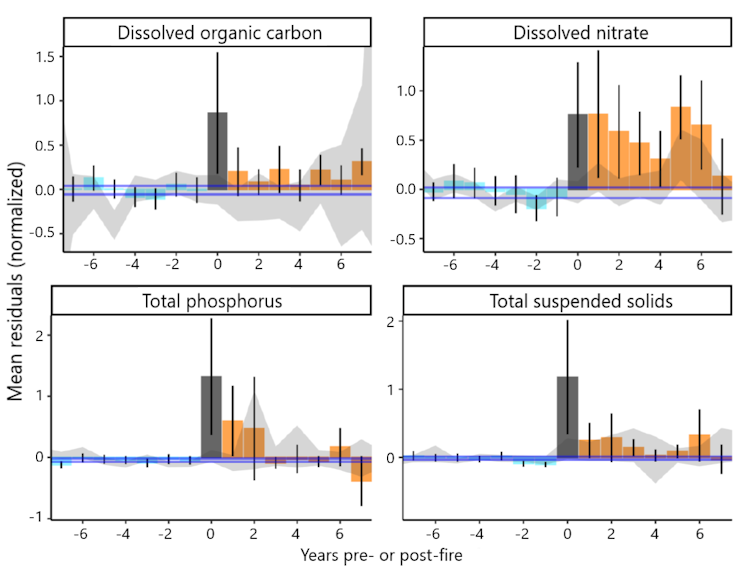
More surprisingly, we found the impacts to be really persistent. While the most dramatic spikes in phosphorous, nitrate, organic carbon and sediment generally occurred in the first one to three years, some contaminants lingered for much longer.

Charts show how contaminants lingered in water supplies for years after wildfires.
Contaminants including phosphorus, organic carbon and nitrates lingered in water supplies for years after wildfires. The charts show the average among all burned basins eight years before fires (light blue) and all burned basins after fires (orange). The gray bars show levels in the year immediately after the fire. The horizontal purple line shows levels that would be expected without a fire, based on the prefire years.
Carli Brucker, et al., 2025, Nature Communications Earth & Environment

We saw significantly elevated levels of nitrogen and sediment for up to eight years following a fire. Nitrogen and phosphorus act like fertilizer for algae. A surge of these nutrients can trigger algal blooms in reservoirs, which can produce toxins and create foul odors.

This extended timeline suggests that wildfires are fundamentally altering the landscape in ways that take a long time to heal. In our previous laboratory-based research, including a 2024 study, we simulated this process by burning soil and vegetation and then running water over them.

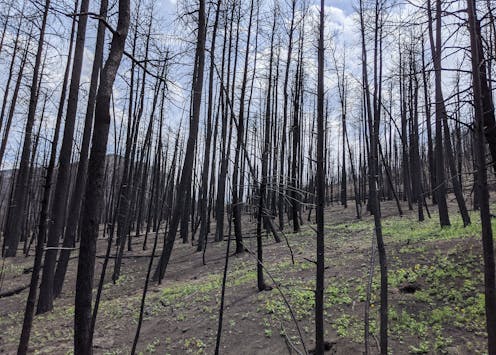
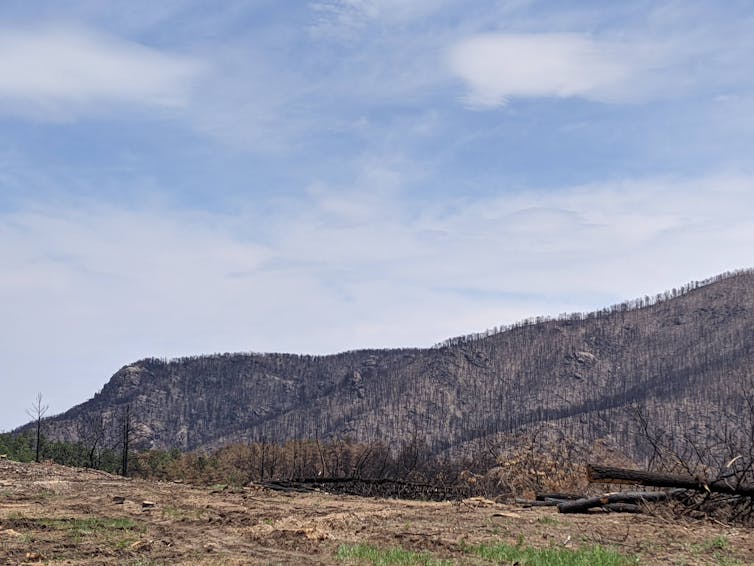
A blackened mountain slope where all of the trees have burned.
After mountain slopes burn, the rain that falls on them washes ash, charred soil and debris downstream.
Carli Brucker

The stuff that leaches out is a cocktail of carbon, nutrients and other compounds that can exacerbate flood risks and degrade water quality in ways that require more expensive treatment at water treatment facilities. In extreme cases, the water quality may be so poor that communities can’t withdraw river water at all, and that can create water shortages.

After the Buffalo Creek Fire in 1996 and then the Hayman Fire in 2002, Denver’s water utility spent more than US$27 million over several years to treat the water, remove more than 1 million cubic yards of sediment and debris from a reservoir, and fix infrastructure. State Forest Service crews planted thousands of trees to help restore the surrounding forest’s water filtering capabilities.

A growing challenge for water treatment

This long-lasting impact poses a major challenge for water treatment plants that make river water safe to drink. Our study highlights that utilities can’t just plan for a few bad months after a fire. They need to be prepared for potentially eight or more years of degraded water quality.

We also found that where a fire burns matters. Watersheds with thicker forests or more urban areas that burned tended to have even worse water quality after a fire.

Since many municipalities draw water from more than one source, understanding which watersheds are likely to have the largest water quality problems after fires can help communities locate the most vulnerable parts of their water supply systems.

As temperatures rise and more people move into wildland areas in the American West, the risk of wildfires increases, and it is becoming clear that preparing for longer-term consequences is crucial. The health of forests and our communities’ drinking water are inseparably linked, with wildfires casting a shadow that lasts long after the smoke clears.

The Conversation

Ben Livneh receives funding from the Western Water Assessment NOAA grant #NA21OAR4310309, ‘Western Water Assessment: Building Resilience to Compound Hazards in the Inter-Mountain West’.

ref. A wildfire’s legacy can haunt rivers for years, putting drinking water at risk – https://theconversation.com/a-wildfires-legacy-can-haunt-rivers-for-years-putting-drinking-water-at-risk-259118