At dawn on October 28, residents of Rio de Janeiro woke to the sound of gunfire. Battles continued throughout the day in the favelas of Alemão and Penha, as police mounted a huge operation targeting the Commando Vermelho, or the Red Command, one of Brazil’s largest organised criminal gangs.
In the days that followed, as graphic images showed lines of bodies on the streets, it emerged that at least 115 civilians and four police officers had been killed, making it the most violent police operation in Brazilian history.
A poll carried out two days after the raid indicated that 62% of Rio residents supported the raid – rising to 88% in the favelas. But there were also protests against alleged extrajudicial killings and condemnation by the UN and other human rights organisations.
The violent operation overshadowed the start of the Cop30 climate summit in Belem on the edge of the Amazon. At a press conference upon his arrival in Belem, Brazil’s President Luiz Inácio Lula da Silva, who was not aware of the operation beforehand, condemned the raid as “diastrous” and a “mass killing”.
In this episode of The Conversation Weekly podcast, we speak to Robert Muggah, founder of the Institute Igarapé and a research collaborator at the Brazil LAB at Princeton University, about how organised crime become so deeply embedded in Brazil – and if there’s a better way to confront it.
The origins of the Red Command lie in Brazilian prisons during the years of Brazil’s military dictatorship in the 1970s. “ The authorities at the time often would crowd common criminals together with left-wing political prisoners in the same jails,” explains Muggah. “ You had this almost metastasis happening between these different inmates and … an alliance emerged from these two groups called the falange vermelha, which means the red phalanx.”
Incubated in the prison system, the gang moved out in the street, shedding its left-wing ties as the dictatorship ended. “By the 1980s, you have a fairly well-organised group which is diversifying its income streams from what was typically bank robberies or targeted raids, to the cocaine economy,” Muggah says.
Today, the Red Command has expanded out of Rio and is present across Brazil and in neighbouring countries. “What you’ve seen over the past decade in particular is the penetration of organized crime, not into just new geographic areas, but entirely new sectors of the economy,” says Muggah.
Listen to the interview with Robert Muggah on The Conversation Weekly podcast, and read an article he wrote in Portuguese on the October 28 operation against the Red Command.
This episode of The Conversation Weekly was written and produced by Katie Flood, Mend Mariwany and Gemma Ware. Mixing by Eleanor Brezzi and theme music by Neeta Sarl.
Listen to The Conversation Weekly via any of the apps listed above, download it directly via our RSS feed or find out how else to listen here. A transcript of this episode is available on Apple Podcasts or Spotify.
Robert Muggah is the co-founder of the Igarape Institute, a think and do tank in Brazil and a principal and co-founder of SecDev, a geopolitical and digital advisory group.
Source: The Conversation – Africa – By Nnamdi O. Madichie, Professor of Marketing & Entrepreneurship, Unizik Business School, Nnamdi Azikiwe University
Short comedy videos circulating on social media have created a booming industry in Nigeria in the past few years. The country’s comedy creators put their skits out on platforms like YouTube, TikTok and Instagram to reach a massive audience.
As these online comedians gain followers they make their money from advertising, by endorsing brands as influencers, and through collaborations. In Nigeria the industry is popularly called the skit economy.
This phenomenon represents more than a major new entertainment trend. It highlights the ingenuity of young Nigerians in using technology to create livelihoods and influence culture. In the process, they contribute to national economic growth.
The skit industry has joined the likes of Nollywood film, Afrobeats music and local fashion to put the country on the entertainment map globally.
The rise of the industry is chronicled in the 2024 book Skit Economy: How Nigeria’s Comedy Skit-Makers Are Redefining Africa’s Digital Content Landscape, by entrepreneurship scholar and polling guru Bell Ihua. His work is supported by findings from the Africa Polling Institute.
As he explains:
The Nigerian entertainment industry is undoubtedly creating job opportunities and contributing to the country’s diversification from oil … The industry is rated as the second most significant employer of youths in Nigeria after agriculture, employing over one million people.
According to his book, skit-making is estimated to be Nigeria’s third largest entertainment industry sector, with a net worth of over US$31 million.
What becomes clear as you read it is that social media platforms have not only amplified the reach and impact of skits. Online platforms have allowed creators to reach global audiences while preserving the culture, language and stories unique to their communities. Skit creators prove the potential of comedy as a medium for both entertainment and cultural diplomacy.
However, as the industry grows, argues Ihua, the skit economy must navigate new challenges related to representation and ethics.
What’s in the book
The book’s eight chapters cover Africa’s digital content landscape, taking into account the continent’s youth bulge and the evolution of social media and content creation.
Ihua then explores Nigeria’s booming cultural and creative industries before homing in on comedy skit-making in chapter 4. It attempts to classify various types of digital content creation in Nigeria and outline the trends in online videos before embarking on an in-depth national study on comedy skit-making in chapter 7. He then considers implications for public policy and future research in the field.
What makes the book so compelling is that it recognises skit-making as an ecosystem on its own terms. It then defines what that ecosystem looks like in Nigeria. In the process Ihua makes it clear why books like this matter.
They are a call for taking entertainment seriously and investing future research in it. Social media and digital technology have reconfigured an unsung economic sector that’s capable of including the bulging youth population in the national conversation. This is despite limited institutional support.
What’s driving the boom
Ihua traces its boom to COVID-19 lockdowns that began in Nigeria in 2020:
They provided a source of laughter and relief to many Nigerians, as most people found it safer to stay at home and get entertained with skits.
Today, writes Ihua, two-thirds of Nigerians watch comedy skits frequently. According to his study they serve as stress relief and social commentary.
With 63% of Nigerians under 25 and high social media uptake, skit-making taps into abundant creative energy and mobile-first audiences.
Value
The Skit-Economy highlights how skit comedians create direct and indirect jobs (editors, social media managers, brand consultants). They generate income through endorsements, platform monetisation (the revenue they get from advertising on a space like YouTube), and various partnerships and collaborations.
Their cultural value is not just measured in their global influence. Skits reflect everyday Nigerian realities with humour and satire, influencing local public opinion and reinforcing national identity.
As prominent Nigerian entrepreneur and cultural worker Obi Asika notes in the book’s foreword:
Their success … stems from a combination of talent, creativity, innovation, an entrepreneurial spirit, and a deep understanding of their audience’s preferences and cultural nuances.
Challenges
However, Ihua identifies a number of challenges facing the industry.
Financial rewards are unequal. Only top creators earn sustainably. For many skit-makers revenue is unstable.
Working from Nigeria means dealing with infrastructure deficits. Electricity supply is unreliable, the internet is expensive and there is limited access to digital production tools.
Nigerian skit-makers also operate in a climate where there are weak intellectual property protections. Piracy and unauthorised reuse undermine earnings.
The job can be an ethical minefield. Pranks can be harmful. They can perpetuate stereotypes and be insensitive to minorities.
These challenges are enhanced by a policy vacuum. There is little government recognition or support for digital creatives in Nigeria.
An African future?
For Ihua, skit-making is a good example of how new digital industries can aid in absorbing Africa’s growing youth workforce. With adequate support, skit-making can help provide dignified livelihoods.
So, for Ihua these creators are not merely entertainers. They’re also job creators, cultural ambassadors, and catalysts of digital transformation.
For Africa broadly, the rise of skit-making underscores the continent’s potential to innovate in ways that are uniquely aligned with its youthful demographics and digital future.
Nigeria’s skit economy offers a blueprint for the continent. Already, skit-making is spreading to other countries, like Ghana, Kenya and South Africa. The lines are blurring between stand-up or TV comedians and skit makers.
If nurtured with the right infrastructure, policy, and industry support, the skit economy could evolve from an informal hustle into a structured pillar of Africa’s creative economy. This could further solidify the continent’s role in the global cultural imagination.
Nnamdi O. Madichie does not work for, consult, own shares in or receive funding from any company or organisation that would benefit from this article, and has disclosed no relevant affiliations beyond their academic appointment.
A chapbook – a small publication usually under 40 pages – is an accessible and honoured format for poets to publish focused selections of their work. In this series, each chapbook features an emerging African poet, and is presented as part of a beautifully designed box set of 10 or more chapbooks. Besides the poetry itself, each box set also showcases the work of a commissioned African visual artist. The artists include Sokari Douglas Camp, Victor Ehikhamenor, Ficre Ghebreyesus and Aida Muluneh, among others.
This ever-growing archive has now published over 100 poets, and offers a window into the diversity of African poetic expression today.
Marking the project’s 10th anniversary is a new anthology called Toward a Living Archive of African Poetry, edited by Jordanian writer Siwar Masannat. It collects Dawes and Abani’s rich introductions to each box set and has a foreword by Masannat. In it, readers learn about the impact of the series, offering a layered and necessary account of how these chapbooks have transformed the visibility of African poets over the past decade.
My work as a scholar of African literature focuses on recovering overlooked histories and interrogating the spaces in which literature is made and circulated.
This new anthology matters because it documents not just poems, but a cultural movement that redefines what an African literary archive can be, and why poetry remains central to that conversation.
Decidedly diasporic
While the series places Africa at the centre of its imagination, its focus is largely diasporic, shaped by Africans living outside the continent. The majority of the poets live in the US or the UK. Poets based on the continent form a minority and are scattered geographically.
The editors acknowledge this imbalance, attributing it to “better access to workshops and craft education” available to diaspora poets. The result is an archive arguably shaped less by the immediacies of the continent and more by the diaspora’s sensibilities and infrastructures.
Nigeria, more than any of the 25-odd countries included in the chapbooks, shapes the aesthetics of the series. This reflects both the density of the country’s literary networks and the curatorial choices of the editors. They rely heavily on personal connections and prize pools to spot new and emerging talents.
A recurring feature of the poets in the series is the “hyphenated African”: Somali-American, Ghanaian-British, Ethiopian-German, Sierra Leonean-American. Some were born in countries outside Africa or migrated as toddlers. Their Africanness is claimed through memory, nostalgia, heritage, or family history, rather than geography.
The editors assert that all the poets “self-identify as Africans in the full and complicated way that Africanness is best defined”. This also underscores how the project expands the category of African poetry.
In fact, the transcontinental profile of these writers shows how African poetry today cannot be read solely through a nationalist lens. The hybridity of identity and place becomes central. Many poets occupy in-between spaces – culturally, geographically, linguistically and emotionally.
Still, the series impresses on many other levels. Particularly in its commitment to highlighting the continent’s plural and localised poetics, and in its rare, long-term investment in the future of African poetry.
This signals an important feminist turn in African poetics. The chapbook form becomes a space where African women’s voices are nurtured and given international circulation, countering historical silences. The poets here highlight a generational continuity of feminist expression.
Intergenerational
The birth years of poets in the series range from 1963 to 2007, showcasing a vibrant intergenerational dialogue. The older poets often engage in socio-political critique informed by post-independence transitions. Millennial and Gen Z poets frequently explore themes of identity, queerness, internet culture, displacement and decoloniality with linguistic experimentation and digital fluency.
Ghanaian poet Tryphena Yeboah, in her chapbook, A Mouthful of Home, exemplifies this:
I TELL MY MOTHER I WANT A BODY THAT
EXPANDS
Into a map. She wants to know where I’ll travel to. I say
“myself”.
The act of travel becomes a metaphor for self-mapping that captures how younger African poets reimagine movement, belonging and home as internal, affective geographies.
In contrast, South African poet Ashley Makue, in her chapbook, i know how to fix myself, offers a more visceral expression of embodied trauma and inherited violence:
my mother is a war zone
they don’t tell her that
these men that pee in her
and leave with gunpowder in their chests
Living archive
The New Generation African Poets Chapbook Series has been an extraordinary intervention in the history of African poetry. It has foregrounded a generation, opened an aesthetic safe space, and created a beautiful, living archive.
Dawes and Abani introduce each of the box sets with two introductions – what they call “simultaneous conversations” – and they often debate identity, the style of the poetry, circulation, and other issues.
This is more than an impressive catalogue; it is a breathing archive of African poetic consciousness, one that resists static definitions. It captures the fluidity of identity, the urgency of voice, and the diverse shaping of African poetry today.
What it tells us: that African poetry is thriving, diverse and globally mobile. What it does not tell us: how poets working entirely from the continent might imagine and enact African poetics differently.
But by foregrounding new and emerging voices, the Africa Poetry Book Fund affirms that poets remain vital chroniclers of the African experience, articulating emotion, history and imagination in ways that other forms of writing often cannot.
Tinashe Mushakavanhu does not work for, consult, own shares in or receive funding from any company or organisation that would benefit from this article, and has disclosed no relevant affiliations beyond their academic appointment.
The water infrastructure politics of eThekwini, the municipality that includes the city of Durban, have been splashed across the digital pages of South Africa’s news outlets in recent years.
The city’s water politics has a long history. Some of the infrastructure issues can be traced back to the mid-1800s, when it was a British imperial port.
I’m a historian with an interest in coastal communities and urban life. As part of my work on water as a public health concern in colonial cities, I spent months in the Durban Archives Repository, going through correspondence, reports, business contracts, newspaper clippings and town council minutes.
The records revealed how the system of colonial-era water infrastructure worked – and for whom.
The first water technologies in Durban were British-styled wells. Anyone could use them, for free. They brought people of different origins and class together for practical purposes but also created anxiety about social difference. For colonial officials, the public had to follow British standards or lose access to the infrastructure altogether. They created Durban’s first water-policing system, purportedly for better public health and conservation. While wealthier and white people eventually came to rely on piped water, poorer and black (Zulu and Indian) people were excluded.
This system formed the basis for the uneven access to water that today’s residents experience. People still depend on private water infrastructure as the municipal system struggles.
Nineteenth-century infrastructure
Founded by British traders as Port Natal in 1824, the colonial borough of Durban depended on stand-alone water infrastructures from the beginning. Brick and cement wells were the first technologies from which residents drew water, since they were easy to build and maintain. Most wells had either a bucket or a pump attached to them. Pumps attached to wells became common after the borough made most wells publicly available in the mid-1850s.
Water tanks, on the other hand, were private technologies which mainly lay underground. Only wealthier households and businesses could afford to build them. They became prominent in the 1870s.
It’s hard to know exactly how many of these infrastructures existed in total. By the 1870s, though, official reports indicate that about 18 public wells and pumps across the town served the bulk of the town’s approximately 20,000 inhabitants.
Piped water came to Durban in the 1880s, supplied initially by the spring at Curries Fountain. In 1889, the city’s laws were extended to cover private tanks that were filled from the municipal pipes. Even so, much of the population still relied on standalone infrastructures for water supplies.
As time went by, conflicts began to brew. The rising population placed a strain on these stand-alone infrastructures, which offered varying amounts of water depending on rainfall patterns. Arguments sparked when a community drew too much water or polluted a well, creating a local water scarcity.
Clashes and restrictions
White colonists blamed much of the water scarcity and contamination on African labourers who worked as household or business servants, sanitary workers and launderers. These positions demanded a close relationship with fresh water collection and use, which meant African labourers became the main users of wells, pumps and tanks.
Labourers did not always use water technologies according to colonial expectations, however. Local people were accustomed to using open water sources like rivers and streams, not restrictive iron and brick infrastructures. So, they modified their traditional work at open sources, like washing objects and produce, to the new technologies they had to use.
That sometimes created problems, according to the archive records. They accidentally broke handles and chains when pumping too quickly. They drew water from tanks without using a filter, which was officially perceived as a disease risk. They publicly washed clothing, bodies and food at wells, where the dirty wash water flowed back into the enclosed water supply.
Colonists exploited this situation to place restrictions on how labourers could use stand-alone water infrastructures. Borough officials crafted new laws that forced colonised residents to conform with British standards. They punished those who did not comply with fines, verbal lashings and even jail time.
Durban was part of a colonial system predicated on white supremacy. The government sought to maintain segregation between white colonists and African and South Asian residents. So, it imbued its water technology regulations with the notion that some water management actions – British – were “healthier” than others, namely African and South Asian. If someone used a technology contrary to British standards, then they faced restricted access to public technologies and the water they provided.
Water system legacy
Stand-alone water infrastructures still exist across eThekwini. Many residents of informal settlements and formerly racially segregated areas remain officially unconnected with municipal pipes. They instead depend on local wells, pumps and illegal individualised connections. An increasing number of households are investing in water tanks as the municipal water system becomes more unreliable.
Things have, of course, changed since the 19th century. However, the municipality continues to require residents to use these technologies within regulatory boundaries if residents want to maintain access to them. Cutting off municipal water supply to private storage tanks is an example.
Infrastructural stopgaps further expose a water system that was never meant to supply every resident equitably and without restriction. These actions tell us that today’s officials have inherited and inadvertently continue a water system that was meant to exclude more than include, to punish more than teach, to restrict more than provide.
Kristin Brig receives funding from the US Fulbright Program, the US National Science Foundation (NSF), and Johns Hopkins University.
Souvent associée aux jeux vidéo, la réalité virtuelle (RV) s’impose désormais comme un outil de soutien aux proches aidants, en leur offrant des formations immersives adaptées.
Imaginez : votre père atteint d’Alzheimer vous pose sans cesse la même question. L’impatience monte, la culpabilité aussi. Comment garder votre calme ? La réalité virtuelle offre une solution : en enfilant un casque, on s’entraîne dans une simulation immersive à répondre avec bienveillance, à trouver les mots justes et à gérer son stress, sans risque pour son proche.
On associe souvent la réalité virtuelle aux jeux vidéo ou aux simulateurs de vol. Pourtant, son histoire remonte bien avant l’ère numérique avec l’invention du stéréoscope par le physicien Charles Wheatstone en 1838. Des romans de science-fiction aux expériences cinématographiques comme le Sensorama du cinéaste Morton Heilig en 1957, en passant par le premier casque conçu en 1968, la RV s’est d’abord nourrie du monde artistique et littéraire avant de trouver sa place dans les laboratoires de recherche et les salles de formation.
Aujourd’hui, cette technologie immersive s’invite dans un domaine où on ne l’attendait pas forcément : la proche aidance.
Concevoir une formation immersive en RV, ce n’est pas transposer un cours classique dans un monde en 3D. C’est un travail exigeant, qui demande de penser chaque détail : le scénario, les interactions, le rythme, la charge cognitive. La conception pédagogique est aujourd’hui un pilier incontournable pour rendre une simulation crédible et utile.
Imaginez qu’on vous donne les clés d’un avion : vous ne voulez pas seulement qu’il ait fière allure, mais qu’il soit sécuritaire, ergonomique et capable de vous amener à destination.
De la même façon, une formation en RV doit être bâtie comme un simulateur d’expériences, où l’aidant apprend en faisant, en se trompant sans conséquence et en s’ajustant. C’est ce qu’on appelle apprendre « par essais et erreurs », mais dans un cadre où l’erreur ne coûte rien… sauf un peu de sueurs froides virtuelles.
Co-concevoir avec les aidants : un travail d’équipe
La conception pédagogique en RV ne peut pas reposer sur une seule expertise. Elle exige un travail de co-conception où chaque acteur joue un rôle : les pédagogues structurent l’expérience, les experts de santé valident les contenus cliniques, les techniciens développent les environnements 3D.
Mais il ne faut pas oublier les proches aidants eux-mêmes. Plus que de simples apprenants, ce sont des partenaires de soins dont l’expérience quotidienne permet de cibler les situations les plus pertinentes à simuler. En les impliquant, on s’assure que la RV réponde à leurs besoins réels et reflète leurs émotions. Comme on dit ici, « rien sur nous sans nous ».
Les modèles de conception pédagogique : encore en rodage
La recherche scientifique propose peu à peu des façons d’encadrer l’utilisation de la réalité virtuelle en formation. Par exemple, certains modèles suggèrent de découper les tâches en petites étapes et d’accompagner l’utilisateur pour éviter la surcharge d’informations.
L’idée est simple : trop de détails d’un coup, et on perd l’essentiel.
Ces repères rappellent surtout une chose importante pour les proches aidants : l’immersion doit rester au service de l’apprentissage. Autrement dit, la technologie ne doit pas éblouir au point de faire oublier l’objectif principal : mieux préparer les aidants à leurs défis quotidiens.
Des compétences à cultiver pour concevoir en RV
Concevoir une formation en RV, c’est :
Raconter une histoire (engageante qui capte l’attention et donne sens à l’expérience ;
Imaginer des interactions réalistes, mais sans surcharger l’aidant ;
Assurer l’inclusion et l’accessibilité, pour que chacun puisse participer, peu importe ses limites ;
Travailler en équipe, car ces projets réunissent souvent des experts de domaines variés (santé, éducation, technologie).
Et surtout, avoir des compétences humaines, car on ne forme pas des professionnels en blouse blanche, mais des personnes souvent épuisées, qui ont besoin de répit, d’écoute et de soutien.
À cela s’ajoutent deux défis d’actualité : le premier, protéger les données sensibles, car la RV peut capter des mouvements, des voix ou même des émotions. Le second : composer avec l’essor de l’IA générative qui peut aider à créer des scénarios ou des visuels, mais dont le rôle doit rester de soutenir le travail humain. Le concepteur garde un rôle essentiel : s’assurer que l’expérience reste adaptée aux besoins réels des proches aidants.
Une formation immersive réussie repose sur un mariage délicat entre trois ingrédients : des environnements 3D crédibles, des animations pertinentes et des interactions adaptées. Trop de stimuli peuvent créer une surcharge cognitive, rendant l’expérience inefficace, voire stressante. Ici encore, le rôle du concepteur pédagogique est d’orchestrer ces éléments de sorte qu’aucun instrument ne couvre les autres.
Ce que dit la recherche : des effets prometteurs
De nombreuses études montrent que la RV aide les aidants à mieux comprendre la maladie d’Alzheimer, à améliorer leur communication, et à se sentir plus confiants dans leur rôle.
Déjà des milliers d’abonnés à l’infolettre de La Conversation. Et vous ? Abonnez-vous aujourd’hui à notre infolettre pour mieux comprendre les grands enjeux contemporains.
Former sans professionnaliser
Il est important de le rappeler : l’objectif n’est pas de transformer les proches aidants en « mini-infirmières » ou en spécialistes de gériatrie. La RV doit rester un outil de soutien, pas une école de médecine déguisée. On veut leur donner des clés simples, concrètes, qui allègent leur quotidien et renforcent leur confiance.
Au-delà de la technologie, l’ambition est humaine. Créer des formations immersives, c’est imaginer des expériences qui parlent aux aidants, qui les soutiennent dans leurs moments de doute et qui améliorent leur bien-être. C’est aussi valoriser leur rôle central dans la société, en leur donnant accès à des outils innovants et de qualité.
La réalité virtuelle n’est pas une mode passagère : c’est une boîte à outils pédagogique qui, bien utilisée, peut transformer la formation en santé. Mais son efficacité repose sur un maillon trop souvent négligé : la conception pédagogique.
Je suis étudiante au doctorat en technologie éducative et je m’intéresse a la conception pédagogique, au potentiel de la réalité virtuelle et à la proche aidance.
Je fais du bénévole a la société Alzheimer du Québec, juste pour apporter du soutien aux proches aidants qui vivent une situation pareille a la mienne.
Donc, ce que je cite dans l’article s’appuie sur la recherche que je mène uniquement, sur la recension des écrits scientifiques et sur la littérature grise.
With more than 85 million people naming it their top choice, Canada has become one of the most desired migration destinations in the world over the past decade.
Yet even in 2024, its highest year on record, Canada only admitted about 480,000 new permanent residents, a small fraction of global demand.
The challenge, however, is not how few people get in; it is how unpredictable the system has become.
Admissions of permanent residents by year (1980-2027) (Immigration, Refugees and Citizenship Canada)
A shifting framework
In June 2022, the federal government amended the Immigration and Refugee Protection Act to give itself more flexibility.
It rolled out a new immigration stream to prioritize in-demand occupations in health care, engineering and agriculture, as well as French-speaking applicants.
In the earlier system, fixed points for education and high-skilled work experience provided applicants with a clear way to assess their eligibility. In contrast, the new category-based approach relies on occupational needs that shift rapidly.
The goal was to respond quickly to labour shortages and economic goals by consulting with provinces, industries, labour groups and the public. However, this category-based selection has been rolled out with little consistency or transparency. Announcements come with no clear timelines, fixed numbers or indication of when a stream might close.
In this new framework, broad categories such as health care or STEM (science, technology, engineering and mathematics) encompass hundreds of distinct occupations. Yet the government may single out only a handful of these occupations for invitations while excluding the rest, which makes outcomes unpredictable even within the announced priority categories.
Migration is a long-term project
What this changing immigration policy fails to consider is that immigration is not an instant decision, but a long-term project.
My research shows that people may spend more than a decade preparing for migration by carefully choosing a field of study, seeking related work experience, saving aggressively and even reshaping their personal lives. Some even avoid intimate relationships or postpone having children in hopes of migrating. However, those plans fall apart when the qualifying requirements change quickly.
The uncertainty created by shifting immigration policies is not felt only abroad. Within Canada, roughly three million people are on temporary permits, and many of them are hoping for a chance at permanent residency. They spend years establishing roots in their communities, with the belief that it will ultimately lead to a more secure future. But when policy priorities change unexpectedly, their lives are thrown into limbo.
Yet, as the rules change, they may find themselves with no option to stay in Canada once their studies end. Similarly, temporary foreign workers may fill urgent labour shortages, only to see pathways to permanence narrow or close before they can apply.
A problem for everyone
Quick and unpredictable changes in rules make immigration seem like a lottery rather than a structured system. Success now often depends not on careful planning or merit, but on being in the right place at the right time.
The lottery effect erodes confidence in Canada’s immigration policy. It conveys the idea that long-term planning and investment might not be essential and that today’s standards might change tomorrow.
Uncertainty also fuels a darker consequence: fraud.
Consequently, the political climate has shifted toward risk-averse immigration policies that focus on immediate results instead of developing sustainable approaches.
A more sustainable system
Immigration is essential to Canada’s future because it sustains the workforce as the population ages, with nearly all of Canada’s labour force growth now coming from newcomers.
Meanwhile, many temporary residents who have studied, worked in highly skilled jobs and paid taxes for years are ineligible to apply for permanent status because their occupations are not on the list. They end up leaving despite their contributions.
The immigration system should include defined criteria, realistic deadlines and transparent information that lets people inside and outside Canada plan with confidence. Consistency is crucial.
A more sustainable approach would connect permanent residency more closely to proven success in the Canadian labour market. At the end of the day, immigration should be based on preparation, abilities and dedication — certainly not on luck.
Omid Asayesh does not work for, consult, own shares in or receive funding from any company or organisation that would benefit from this article, and has disclosed no relevant affiliations beyond their academic appointment.
Dix ans après les attaques du 13-Novembre, Paris s’apprête à inaugurer un jardin en hommage aux victimes, place Saint-Gervais, derrière l’Hôtel de Ville (Paris Centre). Longtemps absente des politiques municipales, la commémoration du terrorisme s’est construite pas à pas, au fil des décennies, sous l’impulsion d’associations et, plus récemment, de la Ville elle-même. De la rue Copernic (1980) au Bataclan (2015), l’histoire de ces plaques et monuments raconte aussi celle d’une lente reconnaissance publique des victimes et du rôle de la capitale dans la mémoire nationale.
Le 13 novembre prochain aura lieu l’inauguration officielle du jardin en hommage aux victimes des attentats du 13 novembre 2015, place Saint-Gervais derrière l’Hôtel de Ville de Paris (Paris Centre). Celui-ci a vocation à être un « lieu de recueillement à la mémoire des victimes » et un « oasis de calme et d’apaisement en hommage à la vie et à la résilience ». Il marque l’aboutissement d’une politique publique de mémoire municipale investie dans la commémoration du 13-Novembre dans l’espace public. Dès le premier anniversaire des attaques, des plaques avaient en effet été apposées sur chacun des lieux touchés.
Cet investissement municipal dans la commémoration du terrorisme est pourtant récent. Il est possible d’en retracer l’évolution. En effet, jusqu’en 2015, aucune des plaques commémoratives rappelant des attentats survenus dans l’espace parisien n’avait été posée à l’initiative de la Ville.
Les premières plaques commémoratives et l’action des associations
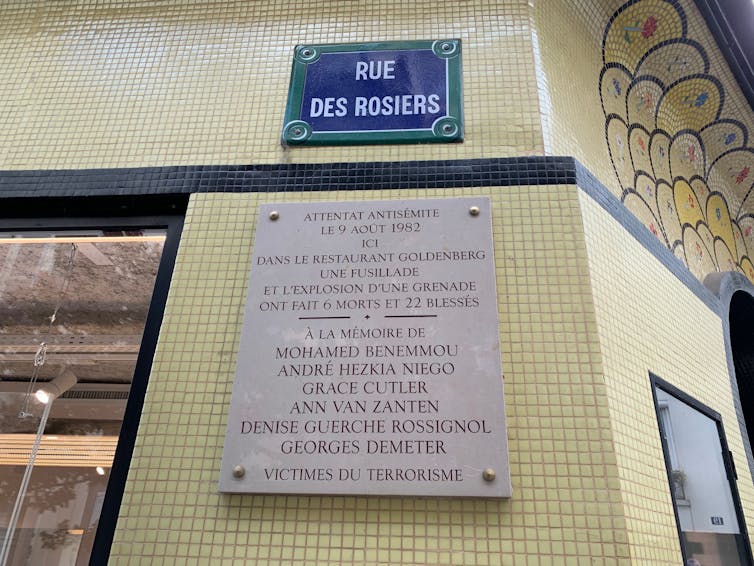
Les deux premières plaques relatives à des actes de terrorisme contemporain à avoir été apposées à Paris sont dues à la mobilisation d’organisations de la communauté juive en référence aux deux attentats antisémites survenus le 3 octobre 1980 contre la synagogue de la rue Copernic (dans le XVIᵉ arrondissement) et le 9 août 1982 contre le restaurant casher Jo Goldenberg, rue des Rosiers (IVe). Rue Copernic comme rue des Rosiers, les textes reprennent à l’époque la forme mémorielle traditionnelle de la lecture des noms. Elle commence par l’expression canonique : « À la mémoire de… »
La Ville de Paris n’est pas davantage à la manœuvre pour la pose de la plaque sur la façade du magasin Tati, rue de Rennes, frappé en 1986. Posée en 1989, celle-ci est due à l’initiative de la principale association de victimes du terrorisme existant à l’époque, SOS Attentats. La pose de la plaque s’inscrit ainsi dans la stratégie de mobilisation de l’association pour l’obtention de droits pour les victimes du terrorisme par les pouvoirs publics. Seul le nom du président François Mitterrand y est ainsi mentionné, comme un symbole de l’investissement attendu de l’État dans la prise en charge des victimes. Les sept personnes décédées dans l’attaque restent, elles, anonymes pour les passants. Du point de vue de SOS Attentats, c’est la cause des victimes qu’il s’agit de promouvoir et non le destin, tragique, de telle ou tel.
Les attentats commis dans le RER B en juillet 1995 et en décembre 1996 occupent à cet égard une position intermédiaire. Là non plus, la Ville de Paris n’est pas à la manœuvre. Les quais et couloirs du métro sont en effet de la responsabilité de la RATP. D’ailleurs, au cours des longs débats consacrés à ces deux attentats et à ses conséquences pour la ville qui ont lieu lors du Conseil municipal qui se tient en septembre 1995, aucun orateur, quel que soit son bord politique, n’évoque une éventuelle commémoration de ces événements, sous une forme ou une autre.
Vingt ans après, pourtant, immédiatement après l’attaque contre le journal satirique Charlie Hebdo, le Conseil municipal s’accorde d’emblée sur le principe de sa commémoration. En janvier 2016, pour le premier anniversaire des attentats de janvier, des plaques commémoratives sont apposées sur la façade de l’immeuble de la rue Nicolas-Appert (XIᵉ) et sur celle de l’Hyper Casher porte de Vincennes (XXᵉ). Ce jour-là, au coin de la place de la République, dans sa partie nord-ouest, côté Xe arrondissement, un « chêne du souvenir » est également inauguré accompagné d’une plaque qui rend hommage aux victimes de janvier et à celle de novembre. En novembre 2016 enfin, chacun des lieux touchés par les attentats du 13 novembre 2015 se voit doté d’une plaque commémorative qui porte le nom de victimes décédées.
Plaque commémorative inaugurée au pied du chêne du souvenir, place de la République (Paris), janvier 2016. S. Gensburger, Fourni par l’auteur
Le restaurant Goldenberg : vers une prise en charge municipale de la mémoire
Comment expliquer ce changement dans la politique municipale en matière de mémoire du terrorisme ? Le premier changement opère en réalité avant la séquence de 2015.
Depuis le début des années 1990, la Ville de Paris développe un programme de préservation du souvenir des noms des victimes juives de la Shoah, notamment des enfants, dans l’espace public. Cette politique publique va inspirer l’investissement municipal dans la commémoration des attentats. Parce qu’elle commémore un attentat antisémite dans un quartier, celui du Marais, emblématique de la persécution des Juifs sous l’Occupation, la plaque en hommage aux victimes de l’attentat du restaurant Goldenberg, rue des Rosiers en constitue le premier terrain d’action.
En effet, cette plaque, à l’origine donc associative, disparaît en 2007. Comme, trois plus tard, l’expliquera Christophe Girard, élu parisien et alors adjoint à la culture, lors d’un débat sur la question au sein du Conseil de Paris :
« La plaque était une plaque privée. Ce n’était pas une plaque apposée par la Ville. Elle a été enlevée à la suite de travaux du restaurant, qui n’existe plus, comme vous le savez, et qui a été remplacé par une boutique de vêtements. En 2008, le maire de Paris (Bertrand Delanoë, ndlr) a exprimé son souhait qu’une plaque rappelant cette tragédie soit apposée sur la façade de l’immeuble. Depuis, les contacts entre la direction des affaires culturelles et le syndic de l’immeuble ont été multiples, mais avec, je dois le dire, des réticences du côté de l’immeuble et des propriétaires privés. Nous sommes en attente de l’accord écrit du propriétaire du nouveau magasin, qui ne devrait plus tarder, pour que nous puissions délibérer et apposer enfin cette plaque que la Ville de Paris prendra en charge, bien entendu. »
En 2011, une nouvelle discussion a lieu pour voter la délibération proposée. Le propriétaire des lieux ayant accepté entre temps le principe de la pose d’une nouvelle plaque. Karen Taïeb, adjointe à l’histoire de Paris, prend alors la parole :
« “Ne pas oublier, c’est aussi rester vigilant”, avait déclaré le président François Mitterrand venu en personne témoigner “de sa solidarité et de sa fidélité au souvenir”, lors du premier anniversaire de cette triste commémoration. Aussi, pour être fidèle au souvenir, la mention “Attentat antisémite au restaurant Goldenberg” va figurer en titre sur cette plaque commémorative, c’est ainsi qu’il est inscrit dans la mémoire collective et je me félicite donc de voir cette délibération ainsi amendée avec cette précision historique. »
Catherine Vieu-Charier, adjointe elle à la mémoire qui a joué un rôle important dans la mise en œuvre des plaques en souvenir des enfants juifs déportés dans les écoles parisiennes depuis le milieu des années 1990, prend à son tour la parole. Elle fait alors le lien direct entre les deux formes de commémoration :
« Je voudrais rappeler aussi que cette rue des Rosiers a été particulièrement frappée le 16 juillet 1942 et que des enfants qui ont échappé à la dramatique rafle nous ont raconté combien il était poignant de voir jeter par terre toutes les photos et tous les documents qui jonchaient le sol. On est donc bien dans un lieu où l’âme juive dont a parlé Karen était très forte, et qui disparaît effectivement. Il nous semblait important de recontextualiser et de rappeler que c’était bien au restaurant Goldenberg, et non pas sur une boutique qui s’appelle “Le Temps des cerises” et qui n’a pas grand-chose à voir avec le Pletzl et toute sa culture. »
La nouvelle plaque est inaugurée le 29 juin 2011.
Une accélération de la mémorialisation des attentats
Lorsque surviennent les attentats de janvier et de novembre 2015, cette nouvelle plaque de la rue des Rosiers est encore la seule à avoir été posée par la Ville. Son format fournit alors un cadre à la manière desquelles les plaques liées aux attaques de 2015 vont être rédigées. Le développement du principe de l’inclusion des listes de noms de victimes de la Shoah au cours des années 1990-2000 d’une part, l’ampleur inédite des attentats de 2015 de l’autre, entraînent en effet la mise en place d’une nouvelle politique publique municipale qui se caractérise par l’accélération de la mise en mémoire dans l’espace public.
Les attentats du 13 novembre 2015 marquent ainsi un net raccourcissement du délai moyen entre la survenue de l’attentat et son rappel dans l’espace public. La plaque qui rappelle l’attentat de 1986 de la rue de Rennes comme celle qui rend hommage aux victimes de l’attentat de 1982 de la rue des Rosiers avaient, toutes deux, été apposées à l’occasion du troisième anniversaire des attaques. Le délai est désormais d’une année seulement.
Cette accélération, depuis 2015, de la mémorialisation des attentats dans l’espace public parisien va de pair avec une plus grande solennité. Depuis leur installation en 2016, les plaques commémoratives du 13-Novembre ont ainsi connu des aménagements successifs pour les rendre davantage solennelles, à la hauteur du drame dont elles doivent rappeler le souvenir.
Ce nouveau registre d’action publique n’est toutefois pas rétroactif. Il participe de la construction tant d’une mémoire publique que d’un trou de mémoire pour ce qui concerne les attentats antérieurs à 2015 et qui sont très nombreux. En 2017, le capitaine de police Xavier Jugelé est poignardé sur les Champs-Élysées lors d’une attaque terroriste. Un an plus tard, la Ville de Paris y inaugure une plaque à sa mémoire. Les débats au Conseil municipal insistent alors sur l’importance du lieu :
« Français et étrangers, touristes et Parisiens, petits et grands passeront devant cette plaque commémorative. Elle rappellera pour ne jamais oublier qu’en ces lieux un odieux attentat terroriste est survenu. »
Il n’est pourtant pas rappelé, ni dans les débats ni dans l’espace public, qu’un attentat est survenu à la Galerie Point Show sur la même avenue, le 20 mars 1980, faisant deux morts et vingt-neuf blessés.
Des lieux de mémoire à distance : entre recueillement et vie quotidienne
Pourtant, la Ville de Paris a exprimé à plusieurs reprises son intention de rendre visible des attaques antérieures à 2015 qui sont aujourd’hui invisibles. Elle s’est alors heurtée à la réticence des propriétaires ou exploitants, comme évoquée par Christophe Girard dès 2008. Dans le cas des attaques terroristes, l’apposition de plaques commémoratives a en effet ceci de particulier qu’elle est toujours le produit d’une tension entre l’importance de se souvenir du drame et des victimes et la nécessité de continuer à vivre et de reprendre une activité sociale normale, notamment économique, dans les lieux touchés, et ce alors que précisément la menace du terrorisme n’est jamais totalement révolue.
Cette tension n’échappe pas à l’apposition de plaques concernant les attentats du 13 novembre 2015, et c’est d’ailleurs une différence majeure avec celles qui rappellent les attaques de janvier 2015. L’attentat antisémite du 9 janvier 2015 contre l’Hyper Casher est rappelé par une plaque sur la façade même du bâtiment qui a certes également une vocation économique. Mais sa nature le fait s’inscrire dans une histoire propre, qui est celle de la mémoire de l’antisémitisme, et justifie que la plaque s’y trouve. De même, c’est bien sur les murs de l’immeuble de la rue Nicolas-Appert qui abritait les bureaux du journal Charlie Hebdo que figure la plaque commémorative de l’attaque contre la rédaction du journal. C’est, en effet, non une entreprise privée ou un particulier mais la Régie immobilière de la Ville de Paris (RIVP), bailleur social en lien avec la municipalité, qui en est propriétaire.
Il en va différemment des plaques commémoratives consacrées au 13-Novembre. Chaque lieu touché compte sa propre plaque avec les noms des victimes mortes en ce lieu. Toutefois, et contrairement cette fois-ci à la pratique habituelle en matière de plaque commémorative dont les textes débutent d’ordinaire par « Ici… », « En ce lieu… », « Dans [ou devant] cet immeuble… », aucune de ces plaques inaugurées à Paris, en novembre 2016, à l’occasion du premier anniversaire des attentats n’a été accrochée sur les murs des lieux mêmes où les tueries se sont déroulées. Elles sont toutes installées à distance.
Les cafés La Bonne Bière et Casa Nostra comme la salle de concert du Bataclan ne disposent pas, face à eux, d’un bâtiment public sur lequel poser une plaque. Des parcs ont donc été choisis. Dans le premier cas, la grille extérieure du square a servi de support. Dans l’autre, l’intérieur du square sert d’écrin à la stèle commémorative. Pour les autres lieux, le mur de l’hôpital Saint-Louis, celui du Palais de la femme ou encore un poteau de lampadaire accueillent la plaque. Volontariste, la politique publique municipale systématisée depuis le 13 novembre 2015 doit ainsi composer avec deux logiques différentes, celle du deuil et celle du retour à la normale.
À cet égard, la forme de jardin mémoriel qui a été choisie pour servir de monument du 13-Novembre articule de belle manière ces deux pratiques sociales d’hommage aux victimes, d’une part, et d’usage ordinaire de l’espace public, de l’autre. Elle marque l’aboutissement d’une politique publique certes récente mais volontariste.
Sarah Gensburger ne travaille pas, ne conseille pas, ne possède pas de parts, ne reçoit pas de fonds d’une organisation qui pourrait tirer profit de cet article, et n’a déclaré aucune autre affiliation que son organisme de recherche.
Attaques contre la synagogue de la rue Copernic (1980), contre le restaurant Jo Goldenberg de la rue des Rosiers (1982), le magasin Tati rue de Rennes (1986), le RER B aux stations Saint-Michel (1995) et Port-Royal (1996)… sur près de 150 attentats survenus depuis 1974 à Paris ou au départ de la capitale, seuls quelques-uns ont trouvé place dans la mémoire urbaine. Comment expliquer que tant d’attaques passées restent invisibles ?
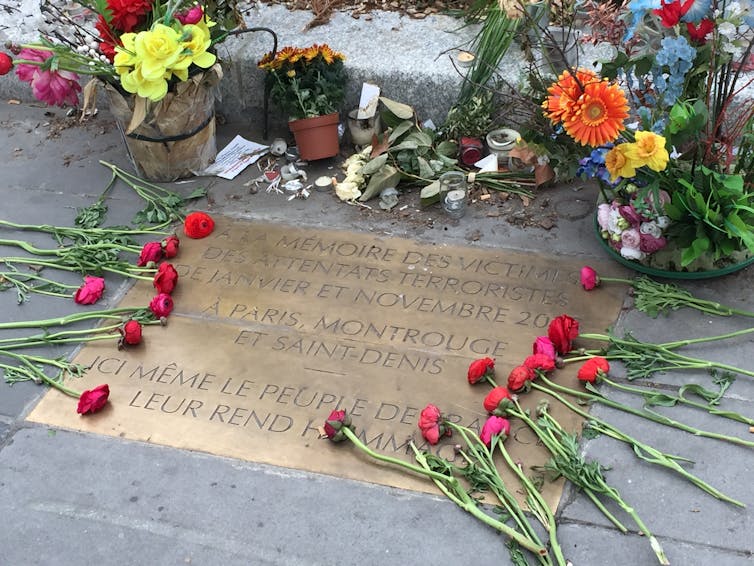
Le 13 novembre prochain, dix ans jour pour jour après les attaques de Paris et de Saint-Denis (Seine-Saint-Denis), aura lieu l’inauguration officielle du jardin en hommage aux victimes des attentats du 13 novembre 2015, place Saint-Gervais derrière l’Hôtel de Ville de Paris (Paris Centre). Ce nouveau site de mémoire, particulièrement soigné et original, s’ajoute aux plaques commémoratives qui, dès novembre 2016, ont été inaugurées devant les lieux visés. Certaines victimes voient aussi, depuis plusieurs années déjà, leur nom honoré dans d’autres espaces. Il en est, par exemple, ainsi de Lola Salines et Ariane Theiller, qui travaillaient dans le milieu de l’édition et dont une plaque disposée dans le hall intérieur du Centre national du livre, dans le VIIe arrondissement de Paris, porte le nom.
L’espace public parisien a été profondément transformé par les attaques du 13-Novembre. Si les plaques commémoratives d’attentat y sont désormais plus nombreuses et quasi systématiques, elles mettent simultanément en lumière le trou de mémoire qui entoure la majeure partie des attaques terroristes qui ont frappé la ville depuis 1974.
Mémoire collective et trou de mémoire
À Paris, près de 20 plaques qui rappellent le souvenir d’attentats survenus dans la ville, et rendent hommage à celles et ceux qui en furent victimes, sont aujourd’hui visibles dans l’espace public. Elles se répartissent dans sept arrondissements différents. Elles concernent les attaques du 3 octobre 1980 contre la synagogue de la rue Copernic (XVIe arrondissement) ; du 9 août 1982 contre le restaurant casher Jo Goldenberg, rue des Rosiers (IVe) ; du 17 septembre 1986, contre le magasin Tati, rue de Rennes (VIe) et les deux explosions qui ont visé le RER B, le 25 juillet 1995 à la station Saint-Michel (Ve) et le 3 décembre 1996 à Port-Royal (Ve).
Le reste de ces plaques renvoient aux attentats de janvier (XIe et XIIe arrondissements) et surtout du 13 novembre 2015 (Xe et XIe arrondissements) à l’exception de celles commémorant les attaques, postérieures, contre Xavier Jugelé, survenues le 20 avril 2017 sur l’avenue des Champs-Élysées (VIIIe), et contre Romain Gosnet, le 12 mai 2018 rue Marsollier (IIe).
Plaques commémoratives des attentats du 13-Novembre. Fourni par l’auteur
Si elle donne à voir une volonté de commémoration, cette mémoire urbaine met aussi en lumière le véritable trou de mémoire qui entoure la majeure partie des attaques terroristes à être survenues à Paris dans la période contemporaine.
1974 : l’attaque du Drugstore Publicis, point de départ du terrorisme contemporain
En France, l’État a institué l’année 1974 comme le point de départ du terrorisme contemporain. C’est, en effet, cette date qui marque le début de la période que l’exposition permanente du futur Musée mémorial du terrorisme a pour vocation de couvrir. Et les « victimes du terrorisme », qui sont notamment définies par leur droit à l’attribution d’une médaille particulière, sont celles touchées par des attentats survenus depuis cette même année 1974. Celle-ci renvoie à l’attaque contre le Drugstore Publicis Saint-Germain-des-Prés qui a eu lieu à Paris (149, boulevard Saint-Germain, VIᵉ arrondissement), le 15 septembre de cette année-là. Cette borne chronologique peut bien sûr être discutée, comme tout découpage temporel. Elle est toutefois prise ici comme une donnée.
Depuis 1974 donc, dans le cadre du travail de préfiguration du Musée mémorial du terrorisme, l’historienne Jenny Raflik-Grenouilleau a recensé près de 150 attentats à Paris ou au départ de Paris. Sur ce total, 130 attaques ont fait au moins un ou une blessée et un peu plus de 80 ont entraîné le décès d’au moins une victime. Selon le lieu où chacun souhaite placer le curseur de ce qui est digne d’être commémoré – des morts jusqu’aux seules atteintes aux biens, c’est plus de 80 attentats et jusqu’à près de 150 qui, à Paris, pourraient potentiellement avoir donné lieu à un rappel permanent dans l’espace public.
Les 17 plaques existantes ne concernent donc qu’une toute petite minorité des actes terroristes qui ont eu lieu dans la ville. À cet égard, à Paris, le constat rejoint celui dressé par Kenneth Foote dans son étude pionnière : elles sont à la fois sources de mémoire et productrices d’oubli. Ainsi, l’attentat qui a frappé le Drugstore Publicis Saint-Germain en 1974 a fait deux morts et trente-quatre blessés. Alors qu’il fait donc figure de point de départ de la séquence contemporaine du terrorisme, aucune plaque ne mentionne l’événement aux passants, Parisiens comme touristes, nombreux à emprunter chaque jour ce carrefour très fréquenté de Saint-Germain-des-Prés.
Récits sélectifs et invisibilisation des responsables
Qu’ont donc en commun les quelques plaques commémoratives parisiennes qui rappellent, rarement donc, des attentats survenus dans la capitale ?
Il apparaît tout d’abord que ce sont les attentats les plus meurtriers qui sont rappelés au souvenir et au premier rang desquels, évidemment, ceux du 13 novembre 2015. Tous les attentats qui ont fait au moins quatre victimes décédées sont signalés dans l’espace public. Ce fait ne compte qu’une exception. En juin 1976, une explosion fait quatre morts boulevard Sébastopol (IIIe). L’attentat à la bombe est le fait d’une « brigade révolutionnaire » qui a visé une agence d’intérim pour dénoncer la précarisation de l’emploi. La concierge de l’immeuble et sa fille ainsi que deux habitants trouvent la mort.
Par contre, seuls deux attentats qui ont fait un mort unique sont commémorés : il s’agit des plus récents, survenus en 2017 et en 2018, dont les victimes ont été nommées plus haut. Les attaques qui ont conduit à moins de quatre décès sont invisibles.
Ensuite, les plaques existantes ne font référence qu’à des attentats qui sont le fait d’organisations islamistes (Groupe islamique armé, Al-Qaida, Daesh…), d’une part, ou qui ont été revendiqués au nom de la défense de la cause palestinienne, de l’autre. À cet égard, les plaques existantes sont d’abord le reflet de la nature infiniment plus criminelle des attaques portées par ces groupes comme de leur présence majoritaire. Il n’en reste pas moins qu’elles ne portent, en conséquence, que deux visages du terrorisme.
Des terrorismes divers mais une mémoire partielle
Ceux-ci ont pourtant été divers depuis 1974. Sont par exemple absentes de l’espace public la mémoire des terrorismes d’extrême gauche et, dans une moindre mesure, celle d’extrême droite, qui ont pourtant été des faits importants des années 1970 et 1980 à Paris et qui ont fait plusieurs morts et de nombreux blessés.
C’est ainsi que, dans un attentat fomenté par Action directe, en 1983, Françoise Rudetzki, créatrice de l’association SOS Attentats qui a permis de faire advenir la prise en charge des victimes du terrorisme par les pouvoirs publics telle qu’on la connaît aujourd’hui, est grièvement blessée alors qu’elle dîne au restaurant Le Grand Véfour. Encore aujourd’hui, aucune mention de cet attentat n’existe pourtant sur les murs de l’immeuble en question du Ier arrondissement.
Ce trou de mémoire interroge d’autant plus que les justifications mises en avant par ces attentats invisibles n’ont pas disparu. Entre les 5 et 21 juillet 1986, le groupe Action directe, toujours, réalise successivement trois attentats à la bombe. L’attaque du 9 juillet vise la brigade de répression du banditisme, tue un policier et fait 22 blessés. La revendication fait mention de Loïc Lefèvre, jeune tué par un membre des forces de l’ordre à Paris quatre jours auparavant, qu’il s’agissait de « venger ». En octobre 1988, ce sont cette fois-ci des intégristes catholiques qui attaquent le cinéma Saint-Michel, qui projette le film qu’ils jugent blasphématoire la Dernière Tentation du Christ, de Martin Scorsese, et font 14 blessés. Ces deux exemples montrent à quel point certaines des attaques demeurées invisibles dans l’espace public n’en résonnent pas moins avec des thèmes encore très présents dans le débat public contemporain : des « violences policières » à la « liberté d’expression ».
Enfin, cette différenciation quant à l’identité de leurs responsables entre les attentats mentionnés dans la ville et ceux qui ne le sont pas se dissout dans le fait qu’aucune plaque ne mentionne les motivations des auteurs de l’attentat.
Qu’elles aient été posées en 1989 ou en 2018, ces plaques rendent hommage « aux victimes du terrorisme » ou rappellent un « acte de terrorisme », sans précision. Là aussi, une exception à cette règle existe et, à son tour, permet de réfléchir en creux à travers un cas limite. Les plaques commémorant l’attentat de 1982 contre le restaurant casher Jo Goldenberg, rue des Rosiers, ou celui de 2015 contre l’Hyper Casher, avenue de la porte de Vincennes, sont les seules à ajouter un adjectif épithète, en l’espèce « antisémite », à la mention de l’attentat tandis que la plaque apposée rue Copernic, visée par une bombe en 1980, renvoie à « l’odieux attentat perpétré contre cette synagogue », précisant ainsi la raison de l’attaque. À ce jour, seuls les attentats antisémites sont nommés comme tels.
Plaque commémorative de l’attentat contre le restaurant Jo Goldenberg, rue des Rosiers. Fourni par l’auteur
Les pratiques mémorielles dans l’espace public parisien
Produisant à la fois mémoire et oubli, ce sont donc une infime partie des actes terroristes commis à Paris depuis 1974 qui sont aujourd’hui signalés au passant. La question de savoir quels usages sont faits de ces rappels du passé dans l’espace public parisien reste ouverte.
Si la question n’est pas propre à la commémoration des attentats, elle se pose avec une acuité particulière pour les plaques qui y font référence, puisque celles-ci renvoient à un événement – « le terrorisme » – qui, contrairement à une guerre – qui a un début et un fin –, est un processus continu dont il est délicat de considérer qu’il est terminé. En 1996, lorsque la RATP avait été sollicitée par les familles de victimes de l’attentat du RER B pour faire figurer leurs noms sur une plaque, celle-ci avait dans un premier temps fait part de ses hésitations. Elle disait redouter des attroupements, dangereux, sur un quai de métro trop étroit. Ces craintes se sont révélées sans fondement. Très peu de voyageurs lèvent effectivement les yeux pour regarder la plaque.
À cet égard, le nouveau jardin mémoriel du 13-Novembre crée une forme inédite de commémoration qui laisse ouverte la possibilité de nouvelles pratiques mémorielles, au croisement des usages d’un parc urbain et de la participation à l’entretien du souvenir.
Sarah Gensburger ne travaille pas, ne conseille pas, ne possède pas de parts, ne reçoit pas de fonds d’une organisation qui pourrait tirer profit de cet article, et n’a déclaré aucune autre affiliation que son organisme de recherche.
Solid components such as used grains and yeast from this waste end up in landfills, where harmful compounds can leach into the soil. Brewing wastewater that makes it into aquatic ecosystems can contaminate streams and lakes, decrease oxygen levels in those environments and threaten organisms.
To keep this waste from going into the environment, scientists like me are exploring how to manufacture beer brewing waste into useful products. I’m a chemist, and my research team and I are interested in figuring out how to recycle and repurpose brewery waste into tiny particles that can be used to make new types of prescription drugs.
The brewing process
The brewing process takes raw cereal grain – usually from barley – and converts its starch and proteins into simpler chemicals by malting. Brewers initiate this process by adding water, which wakes the seed from dormancy, and then keeping the seeds at a controlled temperature to sprout the grain.
During this time, important enzymes are released that can convert the starch and proteins in the grains to fermentable sugars and amino acids. They then heat up the resulting product, called the malt, to dry it out and stop further sprouting. After this malting process, they add hot water and mash the malt to release the compounds that give the beer its iconic flavor.
The brewing process produces waste at four main stages. Alcina Johnson Sudagar, CC BY-SA
The brewers then separate the sweet malt extract, called wort, and the leftover solid is removed as waste, called brewer’s spent grains. About 30% of the weight of the raw grain ends up as spent grain waste. This waste is either used as animal feed or discarded. About 30 million tons of spent grain is generated annually.
Brewers add a cone-shaped flower of the Humulus lupulus plant, called hops, to the wort, then boil and clarify it. The hops flower is the key ingredient that gives beer its bitterness and aroma. The undissolved hops and proteins get collected during clarification to form hot trub, the second major waste from breweries. Roughly 85% of the hops are removed as waste material.
The clear wort is then cooled and fermented by adding yeast. The yeast filtered out after fermentation, called brewer’s spent yeast, forms the third type of waste that breweries generate. The spent yeast is one of the major byproducts of the brewing industry. This waste has a large quantity of water and solid material: 100 liters of beer generate 2 to 4 kilograms (4.4 to 8.8 lbs.) of spent yeast.
Finally, the fermented beer is filtered before entering the production line, where the beer is bottled for consumption. The wastewater generated at this last stage forms the filtration waste. A medium-size brewery generates about 8 tons of dense sludge and five to seven times – or 40 to 56 tons – of wastewater as filtration waste monthly. Several tons of waste from breweries remain largely underused due to their low economic value.
The brewery waste problem
These wastes have several compounds, such as carbohydrates, proteins, amino acids, minerals and vitamins that can potentially be repurposed. Scientists have tried to reuse the wastes in creative ways by creating biofuels and vegan leather using either some compounds extracted from the waste or the entire waste.
Breweries can send their solid wastes to farms that repurpose it as soil fertilizer, compost or animal feed, but a major fraction of it industrywide is discarded as landfill. The wastewater is discharged into the sewage lines, which can challenge sewage treatment systems, as they contain more than 30 times higher pollutants than the typical residential sewage.
Although breweries are becoming more aware of their waste and moving toward sustainable approaches, demand for beer has continued to rise, and a large amount of waste remains to be dealt with.
Repurposing waste in nanoparticles
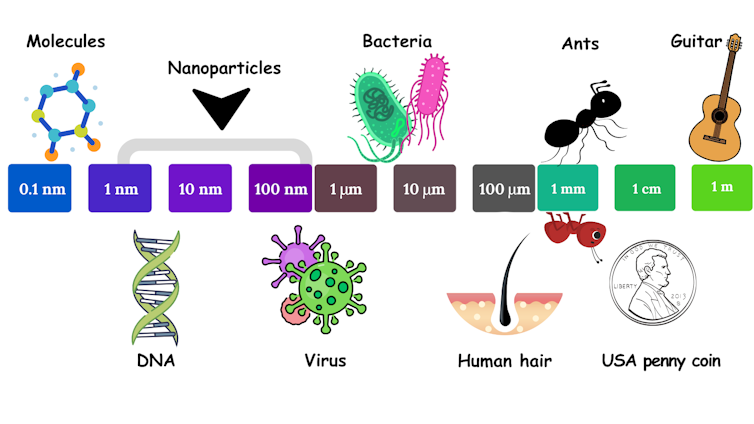
In my research, I’m interested in determining whether compounds from brewery waste can help create nanoparticles that are compatible with human cells but fight against bacteria. Nanoparticles are extremely tiny particles that have sizes in the range of one-billionth of a meter.
Nanoparticles are smaller than bacteria – they can be the size of viruses or even human DNA. Alcina Johnson Sudagar, CC BY-SA
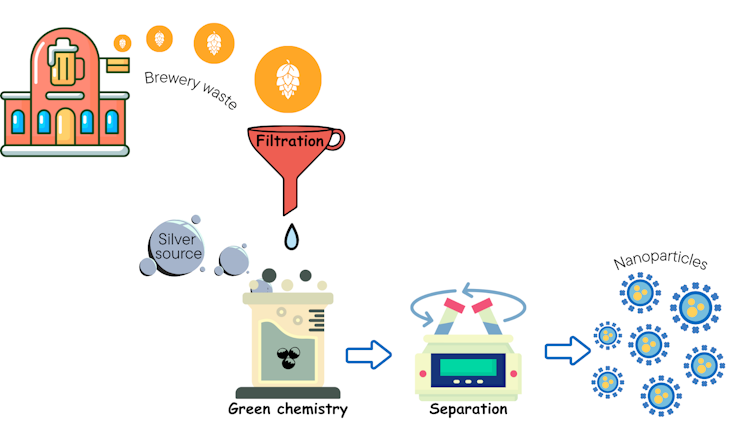
My team and I developed nanoparticles coated with some of the compounds found in brewery waste – an invention which we have since patented but are not actively commercializing. We created the particles by adding waste from any stage of brewing to a metal source.
When we added a chemical containing silver – for example, silver nitrate – to the waste, a combination of processes converted silver compound into nanoparticles. One process is called reduction: Here, compounds found in the brewery waste undergo a chemical reaction that converts the silver ions from the silver nitrate to a metallic nanoparticle.
The other process, called precipitation, is similar to how chalky soap scum forms in your sink when soap reacts with minerals such as calcium in hard water. Oxide and phosphate from the brewery waste combine with a silver ion from the silver nitrate, causing the silver to form a solid compound that makes up the nanoparticle’s core.
The organic compounds from the brewing waste such as proteins, carbohydrates, polyphenols and sugars form a coating on the nanoparticles. This coating prevents any other reaction from happening on the surface of these particles, which is very important for making the nanoparticles stable for their applications. These nanoparticles prepared from brewery waste were made of three components: silver metal, silver oxide and silver phosphate.
Nanoparticles preparation using one-pot method. Alcina Johnson Sudagar, CC BY-SA
Environmentally friendly processes that reduce the use of hazardous chemicals and minimize harmful side products are known as green chemistry. Because our procedure was so simple and did not use any other chemicals, it falls into this green chemistry category.
Nanoparticle safety
My colleague Neha Rangam found that the coating formed by the brewery waste compounds makes these nanoparticles nontoxic to human cells in the lab. However, the silver from these nanoparticles killed Escherichia coli, a common bacterium responsible for intestinal illness around the world.
We found that a special type of nanoparticle containing high amounts of silver phosphate worked against E. coli. It appeared that this silver phosphate nanoparticle had a thinner coating of the organic compounds from the brewery waste than silver metal and oxides, which led to better contact with the bacteria. That meant enough silver could reach the bacteria to disrupt its cellular structure. Silver has long been known to have an antimicrobial effect. By creating nanoparticles from silver, we get lots of surface area available for eliminating bacteria.
Several nanoparticles have been in clinical trials and some have been FDA approved for use in drugs for pain management, dental treatment and diseases such as cancer and COVID-19. Most research into nanoparticles in biotechnology has dealt with carbon-based nanoparticles. Scientists still need to see how these metal nanoparticles would interact with the human body and whether they could potentially cause other health problems.
Because they’re so tiny, these particles are difficult to remove from the body unless they are attached to drug carriers designed to transport the nanoparticles safely. Before doctors can use these nanoparticles as antibacterial drugs, scientists will need to study the fate of these materials once they enter the body.
Some engineered nanoparticles can be toxic to living organisms, so research will need to address whether these brewery waste-derived nanoparticles are safe for the human body before they’re used as a new antibacterial drug component.
Alcina Johnson Sudagar received funding from the European Union’s Marie Curie Horizon 2020 program for this work. Part of the work has been patented, Polish patent valid since August 2020 (Patent no: P.435084)
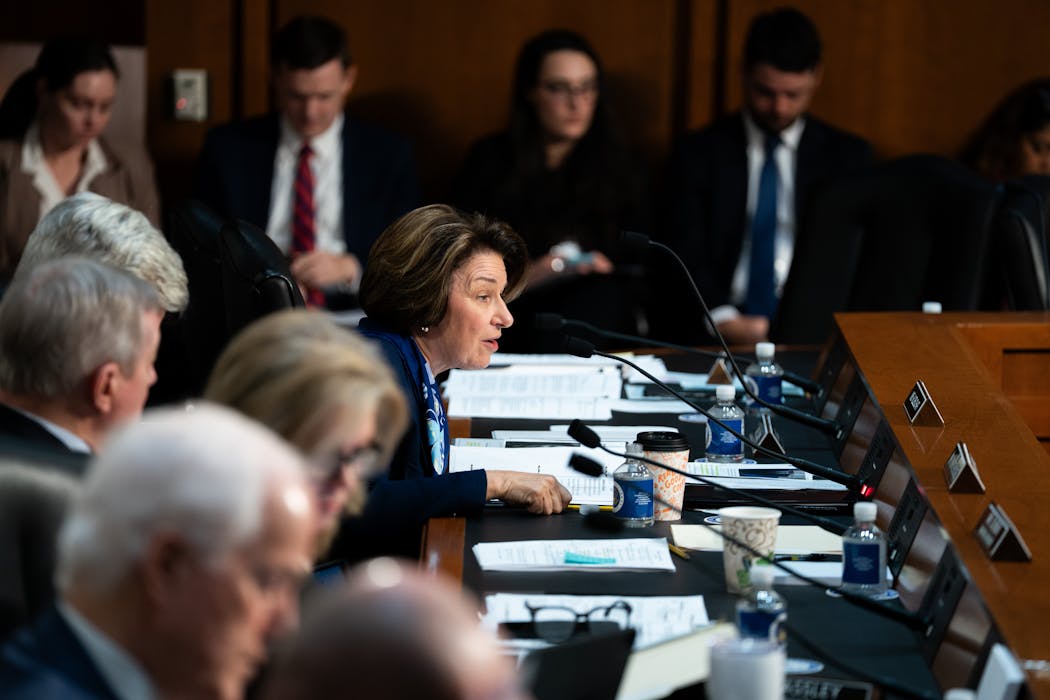
U.S. Sen. Amy Klobuchar of Minnesota speaks at an oversight hearing before the Senate Judiciary Committee on Oct. 7, 2025. AP Photo/Allison Robbert
Routine congressional oversight hearings usually don’t make headlines. Historically, these often low-key events have been the sorts of things you catch only on C-SPAN – procedural, polite and largely ignored outside the Beltway.
But their tone has shifted dramatically during the second Trump administration.
When Attorney General Pam Bondi appeared before the Senate Judiciary Committee on Oct. 7, 2025, what took place was a contentious, highly partisan, made-for-TV-and-social-media confrontation.
The hearing occurred on the heels of the indictment of former FBI Director James Comey, which many legal experts view as an example of a president targeting his political enemies. Bondi came ready to fight. She refused to answer many questions from Democrats, instead launching personal attacks against these members of the U.S. Senate.
From our perspective as political scientists who study the U.S. Congress, congressional oversight has played an important role in American democracy. Here’s a brief history.
Congressional oversight hearings help keep executive branch agencies accountable to the public.
Inquisitory powers
In simple terms, oversight is the ability of Congress to ensure that the laws it passes are faithfully executed. This generally means asking questions, demanding information, convening hearings and holding the executive branch accountable for its actions.
Oversight isn’t specifically mentioned in the Constitution. Article 1, Section 8, which lists the powers of Congress, includes the power “to make all laws which shall be necessary and proper,” without identifying an oversight role. Once laws are enacted, Article 2, Section 3, states that the president “shall take Care that the Laws be faithfully executed.”
However, the framers viewed congressional oversight as a key component of legislative authority. They wanted presidents to take Congress seriously and structured the Constitution to ensure that the executive would be accountable to the legislature. As James Madison urged in Federalist 51, the separate branches of government should have the power to keep each other from becoming too powerful. “Ambition must be made to counteract ambition,” Madison wrote.
At the Federal Convention in 1787 that produced the Constitution, Delegate George Mason noted that members of Congress possessed “inquisitory powers” and “must meet frequently to inspect the Conduct of public officials.” Even though this idea was never written down, it was a habit of self-government that early Congresses put into practice.
Sen. Sam Ervin, chair of the Senate Watergate Committee, announces on July 23,1973, that the committee has decided to subpoena White House tapes and documents related to the Watergate burglary and cover-up. AP Photo
Early oversight hearings
Congressional oversight began almost as soon as the first Congress met. In 1790, Robert Morris, the superintendent of finances during the Continental Congress and a financier of the American Revolution, asked Congress to investigate his handling of the country’s finances and was exonerated of any wrongdoing.
During this period, congressional investigations were often referred to select committees – bodies created to perform special functions. These panels had the power to issue subpoenas and hold individuals in contempt. Since there was no official record of debates and proceedings, the public relied on newspaper accounts to learn about what had happened.
In March 1792, congressional oversight exposed businessman William Duer, who signed contracts with the War Department but failed to furnish the needed military supplies. This shortfall contributed to a stunning U.S. military defeat against a confederation of Native American tribes in the Northwest Territory.
Congress eventually removed the quartermaster general from his role for mismanaging the contracts. Duer was simultaneously involved in perhaps the first American economic bubble, which burst at the same time as Congress’ hearings. He ended up in a debtor’s prison, where he died in 1799.
Throughout the 19th century, Congress continued to quietly exercise this power. The work was often invisible to the public, but the issues were important. Hearings from December 1861 to May 1865 on the conduct of the U.S. Civil War produced a detailed record of the war, exposed military wrongdoing and condemned slavery. In 1871, the Senate created a select committee to investigate Ku Klux Klan violence during Reconstruction.
Investigating corruption and criminal acts
Congress started to use its oversight power more aggressively in the 1920s with the Senate Committee on Public Land and Surveys’ high-profile investigations into the Teapot Dome scandal.
Hearings revealed that Interior Secretary Albert Bacon Fall had secretly leased federal oil reserves in Wyoming to two private corporations and had received personal loans and gifts from the companies in return.
The investigation found clear evidence of corruption. Fall was indicted and became the first U.S. Cabinet member to be convicted of a felony.
The U.S. Supreme Court helped to shape the legal foundation of congressional oversight. In McGrain v. Daugherty, decided in 1927, the court held that congressional committees could issue subpoenas, force witnesses to testify and hold them in contempt if they fail to appear. Two years later, in Sinclair v. United States, the court ruled that witnesses who lied to Congress could be charged with perjury.
These cases granted the judicial branch’s sanction to what had long been an implied legislative power, cementing the constitutionality of congressional oversight.
Oversight highs and lows
The modern era of congressional oversight has produced some very important reforms – and some truly regrettable spectacles.
The most important example of bipartisan congressional oversight came in response to reporting by The Washington Post’s Carl Bernstein and Bob Woodward. The two journalists wrote about the 1972 burgling of Democratic National Committee offices in Washington, D.C.’s Watergate Hotel and subsequent cover-up efforts by the Nixon administration.
On Feb. 7, 1973, the U.S. Senate voted 77-0 to establish a Select Committee on Presidential Campaign Activities, which brought together Democrats and Republicans to investigate what came to be known as the “Watergate scandal.” The committee’s work spurred action in Congress to impeach President Richard Nixon, leading to Nixon’s resignation in 1974 and to the enactment of legal reforms to provide an institutional check on presidential power.
Another high point for congressional oversight came after the 9/11 terrorist attacks in 2001. Seeking to learn how the deadliest terrorist strike on American soil had occurred, Democratic Sen. Bob Graham and Republican Rep. Porter Goss, who chaired the Senate and House Intelligence committees, formed a joint committee to investigate intelligence failures before and after the attacks.
This inquiry produced several important recommendations that were ultimately adopted, including the creation of a director of national intelligence and a Department of Homeland Security, as well as better information sharing among law enforcement agencies.
After the Sept. 11, 2001, attacks on the World Trade Center in New York City, shown here, and targets in Washington, D.C., a congressional committee investigated intelligence failures that had impeded detection of the terrorist plot. Universal History Archive/UIG via Getty Images
Congress’ oversight can extend beyond the executive branch when the actions of private actors raise questions about existing laws or spur the need for new ones. As examples, investigations into medical device safety and Enron’s 2001 collapse examined malfeasance in the private sphere that existing regulations failed to prevent.
However, the power to expose corruption can also be used as a tool to score partisan points and generate outrage, rather than holding the executive branch accountable for actual malfeasance. Notably, in the 1950s, Wisconsin Sen. Joseph McCarthy turned oversight into inquisition and used the power of media to amplify his accusations of communist influence within the federal government.
Democracy needs oversight
Congressional oversight has strengthened the democratic system at many points. But hearings like Bondi’s recent session before the Senate Judiciary Committee aren’t the first, and likely won’t be the last, to substitute sound bites for substance.
As we see it, the problem with allowing oversight to become political theater is that it distracts Congress from quieter and more meaningful oversight work. Slow, procedural work isn’t likely to go viral, but it helps keep government accountable. The task of a deliberate legislative body is to reconcile those very different impulses.
The authors do not work for, consult, own shares in or receive funding from any company or organization that would benefit from this article, and have disclosed no relevant affiliations beyond their academic appointment.