When you look at the promotional materials advertising luxury high-rise developments in London, it is obvious that the fantasy of living in the sky is fused by a desire for sunlight and “unobstructed” views of the city. Phrases such as “the brightest addition to London’s skyline” or apartments being “flooded with natural light” and offering “expansive sky views” are common.
It is a dream with a dark side, however, which plays out below in the shadows of London’s mushrooming cityscape. In a recent paper, I show how daylight and shadow are unevenly distributed across the urban population. Vulnerable and marginalised residents are disproportionately affected by overshadowing, a lack of privacy and the overbearing nature of new high-rise developments.
Dubbing such socially skewed access to daylight “light violence”, as I do, may sound dramatic. But it captures something insidious.
When you build tall buildings, it is no surprise that they cast shadows in the surrounding environment. In northern climates, where sunlight is scarce, especially during long, overcast winter days, the compounding effect of living in shadows can be potentially harmful. Scientific studies show that depriving people of daylight can lead to increased stress, sleep disruption and early onset of myopia or short-sightedness. Sudden changes in daylight are also linked to an increased risk of cardiovascular diseases.
To protect the health and wellbeing of residents, the UK’s Building Research Establishment (BRE) issue national planning guidance that sets out minimum daylight levels. Yet, in practice, the guidance is advisory. And in cases where a proposed development breaches the BRE guidelines, they are easily dismissed and breaches often deemed legally acceptable.
Take the example of Buckle Street Studio, a 13-storey apartment hotel that caused daylight to drop to levels in breach of BRE guidance for 201 windows across 166 rooms in 58 individual flats in neighbouring buildings. As I show in my paper, for each of these 58 homes, the drop in daylight levels amount to material harm. It is a deterioration of the living environment that will compromise the health and wellbeing of its residents.
Standing a mere nine meters from the newly built tower, Goldpence Apartments, a seven-storey housing block comprised of social and affordable homes, was the worst affected block. Of the 58 households in Goldpence apartments, 35 would be directly affected by the development. In fact, 33 residents submitted written objections that expressed both a concern for their individual homes and the lack of light for communal spaces in the neighbourhood.
The proposal was called in for a public inquiry, with a planning inspector assessing the reasons for the council’s refusal. In the final report, he sided with the developer and said that the existing levels of amenity and low levels of daylight in neighbouring buildings constituted a local norm, which the residents in Goldpence Apartments should expect
The research draws attention to the legal process through which the harm resulting from a drop in daylight is both neutralised in the planning inquiry and normalised through the planning process. Levels breaching the BRE regulations would be expected, because neighbouring flats already had poor living conditions.
I argue that this kind of race to the bottom amounts to a form of soft or light violence. It is a legally accepted and politically encouraged erosion of living conditions that disproportionately affects vulnerable and marginalised residents.
A dark future?
When Buckle Street Studios completed, the residents in Goldpence Apartments were not only exhausted from the lengthy planning process but had lost faith in the planning system’s ability to protect them. As I show in a related paper,
they had to come to terms with no longer being able to see the sky from inside their homes.
Many left their curtains drawn all day or rearranged furniture in their children’s bedrooms to prevent neighbours overlooking them. Instead of letting their defeat define them, the residents developed coping strategies that have allowed them to process and deal with the imposing presence of Buckle Street Studios.
This demonstrates how people deal with light violence in everyday life by developing innovative solutions to the challenges they face. And, if they can, so too can city builders.
The architects who design the towers of tomorrow should be able to uphold standards and produce healthy living environments rather than detract from them. More sensitive daylight design would include considering the orientation of buildings, the size and placement of windows and in some cases using reflective materials or diffusers.
Yet, to ensure healthy living environments for all the residents in the city – both those living on upper floors flooded in natural light, and those living below – city-builders must acknowledge the deeper challenge of addressing the socioeconomic divisions that are created as part of new developments. And, they should take the role of design more seriously in challenging residential segregation rather than smoothing over it.
Casper Laing Ebbensgaard does not work for, consult, own shares in or receive funding from any company or organisation that would benefit from this article, and has disclosed no relevant affiliations beyond their academic appointment.
When Claudia Sheinbaum — Mexico’s first woman president — was publicly groped during a walkabout recently, her response was striking in its restraint: “If this happens to the president, where does that leave all the young women in our country?”
The phrase ricocheted across Mexico and beyond. It captured both the routine nature of gendered harassment and the profound political implications of a society in which even the country’s most powerful woman can be violated in full public view.
The incident was trivialised by some as a momentary lapse of security. But it was emblematic of the deeper structures of machismo and misogyny that continue to shape political life across Latin America.
Viewed through a narrow lens, Latin America appears increasingly progressive on gender equality. Over the past two decades, the region has implemented some of the world’s most ambitious gender-parity laws. Countries including Mexico, Costa Rica, and Argentina have introduced sweeping legislative reforms requiring equal representation in party lists and public office.
As a result, Latin America consistently ranks among the regions with the highest proportions of women in national legislatures. The region has also produced several high-profile female heads of state.
In addition to Sheinbaum, there’s been Michelle Bachelet in Chile, Cristina Fernández de Kirchner in Argentina and Dilma Rousseff in Brazil. And were it not for some distinctly questionable electoral practices, we might be talking about this year’s Nobel peace laureate, Maria Corina Machado, as president of Venezuela.
Yet these advances in representation coexist with and often provoke virulent misogynistic backlash. The presence of women in power has not dismantled the patriarchal norms underpinning political life. Instead it has exposed how resilient they are.
Feminist scholars describe this phenomenon as “gendered political violence”. It’s a spectrum of practices aimed at punishing women who assume roles historically reserved for men.
Such violence is not confined to physical assault. It also manifests in smear campaigns, sexualised caricature, digital harassment and threats targeting both female politicians and their families. Misogyny here operates not simply as a cultural residue but as a political technology. It’s a way of disciplining women who disrupt established hierarchies.
Sheinbaum’s encounter illustrates this dynamic with unusual clarity. The groping was not merely an act of individual misconduct but a symbolic assertion of power over a woman whose very position challenges longstanding gendered expectations.
But when the president herself is subjected to unwanted touching, the incident becomes more than a breach of protocol. It becomes a fleeting but potent reminder of the gendered vulnerability deeply embedded in public life.
Sheinbaum’s remark distils a troubling truth: if the nation’s most protected woman can be violated in plain sight, what protections exist for those without status, visibility, or security personnel? In Mexico, this question is particularly acute. The country continues to record some of the world’s highest rates of femicide (the killing of women or girls because of their gender), and gender-based violence is frequently met with institutional inertia.
Against this backdrop, the symbolic violation of a female president cannot be dismissed as trivial. It speaks to a continuum of violence in which women’s bodies remain contested terrain, regardless of their political authority.
Systemic machismo
Machismo, far from being a casual label for male bravado, is a wider ideological system that normalises male dominance in public and private life. It seeks to shape who is seen as credible, rational and fit to lead. It sets expectations that political authority should look and sound masculine.
This means that traits praised in men – decisiveness, assertiveness, toughness – are often judged as inappropriate in women. Within this logic, women entering politics do not simply take up official positions, but rather challenge a symbolic order built on the assumption that power belongs to men.
This helps explain why female leaders attract forms of scrutiny fundamentally different in tone and tenor from those directed at their male counterparts. This includes the policing of their appearance, voice, emotional expression and personal morality, reinforcing the ideological boundaries that machismo seeks to maintain.
Dilma Rousseff, for instance, experienced sustained misogynistic vitriol during and after her presidency. She had to put up with sexualised imagery, accusations of emotional instability and incessant commentary on her appearance — all documented by journalists and human rights organisations.
In Bolivia, women politicians have faced psychological, economic and symbolic aggressions, culminating in extreme cases such as the unsolved 2012 murder of councillor Juana Quispe .
The list is long and unedifying. And it reveals the limitations of formal gender parity. Legal frameworks have succeeded in bringing more women into public institutions, but they have not transformed the cultural logic that determines whose authority is respected and whose is contested.
In many cases, increased representation has heightened hostility, as women’s visibility exposes the fragility of entrenched patriarchal structures. Misogyny, in this sense, becomes a reaction to perceived disruption. It acts as a reassertion of dominance where male authority no longer appears guaranteed.
Ultimately, the episode underscores the gap between representation and transformation. Latin America has made significant strides in bringing women into positions of formal power, but the cultural and political structures that underpin misogyny remain deeply entrenched.
The groping of a sitting president encapsulates this contradiction. A woman can symbolise national authority and still be reduced, in an instant, to an object of public violation.
The future of gender equality in the region will depend not merely on increasing the number of women in political office but on confronting the cultural and political systems that enable misogyny to flourish.
Until machismo is challenged in legislation, public discourse, political culture and everyday life, women in power will continue to face the paradox embodied in Sheinbaum’s remark. Even at the highest level, authority does not guarantee respect, and visibility does not guarantee safety.
Adriana Marin does not work for, consult, own shares in or receive funding from any company or organisation that would benefit from this article, and has disclosed no relevant affiliations beyond their academic appointment.
Source: The Conversation – UK – By Jeremy Howick, Professor and Director of the Stoneygate Centre for Excellence in Empathic Healthcare, University of Leicester
Artificial intelligence has mastered chess, art and medical diagnosis. Now it’s apparently beating doctors at something we thought was uniquely human: empathy.
A recent review published in the British Medical Bulletin analysed 15 studies comparing AI-written responses with those from human healthcare professionals. Blinded researchers then rated these responses for empathy using validated assessment tools. The results were startling: AI responses were rated as more empathic in 13 out of 15 studies – 87% of the time.
Before we surrender healthcare’s human touch to our new robot overlords, we need to examine what’s really happening here.
The studies compared written responses rather than face-to-face interactions, giving AI a structural advantage: no vocal tone to misread, no body language to interpret, and unlimited time to craft perfect responses.
Critically, none of these studies measured harms. They assessed whether AI responses sounded empathic, not whether they led to better outcomes or caused damage through misunderstood context, missed warning signs, or inappropriate advice.
Yet even accounting for these limitations, the signal was strong. And the technology is improving daily – “carebots” are becoming increasingly lifelike and sophisticated.
Beyond methodological concerns, there’s a simpler explanation: many doctors admit that their empathy declines over time, and patient ratings of healthcare professionals’ empathy vary greatly.
Inquiries into fatal healthcare tragedies – from Mid Staffordshire NHS Foundation Trust to various patient safety reviews – have explicitly named lack of empathy from healthcare professionals as contributing to avoidable harm. But here’s the real issue: we’ve created a system that makes empathy nearly impossible.
No carebot, however sophisticated, can truly replicate certain dimensions of human care.
A bot cannot hold a frightened child’s hand during a painful procedure and make them feel safe through physical presence. It cannot read unspoken distress in a teenager’s body language when they’re too embarrassed to voice their real concern. It cannot draw on cultural experience to understand why a patient might be reluctant to accept certain treatment.
AI cannot sit in silence with a dying patient when words fail. It cannot share a moment of dark humour that breaks the tension. It cannot exercise the moral judgment required when clinical guidelines conflict with a patient’s values.
These aren’t minor additions to healthcare; they’re often what make care effective, healing possible and medicine humane.
Here’s the tragic irony: AI threatens to take over precisely those aspects of care that humans do better, while humans remain trapped doing tasks computers should handle.
We’re heading toward a world where AI provides the “empathy” while exhausted humans manage technical work – exactly backward. This requires three fundamental changes.
First, we must train doctors to be consistently excellent at empathic communication. This cannot be a brief module in medical school. It needs to be central to healthcare education. Since AI already matches humans in many technical skills, this should free doctors to focus on genuine human connection.
Second, redesign healthcare systems to protect the conditions necessary for empathy. Dramatically reduce administrative burden through better technology (ironically, AI could help here), ensure adequate consultation time, and address burnout through systemic change rather than resilience training.
Third, rigorously measure both benefits and harms of AI in healthcare interactions. We need research on actual patient outcomes, missed diagnoses, inappropriate advice, and long-term effects on the therapeutic relationship – not just whether responses sound empathic to raters.
The empathy crisis in healthcare isn’t caused by insufficient technology. It’s caused by systems that prevent humans from being human. AI appearing more empathic than doctors is a symptom, not the disease.
We can use AI to handle administrative tasks and free doctors’ time and mental space, and even provide tips to help healthcare professionals boost their empathy. Or we can use it to replace the human connection that remains healthcare’s greatest strength.
The technology will continue advancing, regardless. The question is whether we’ll use it to support human empathy or substitute for it – whether we’ll fix the system that broke our healthcare workers or simply replace them with machines that were never broken to begin with.
The choice is ours, but the window is closing fast.
Jeremy Howick receives funding from the Stoneygate Trust.
Source: The Conversation – UK – By Aiden Hoyle, Assistant Professor in Intelligence and Security, Institute for Security and Global Affairs, Leiden University
When we talk about disinformation – the intentional spreading of misleading information – we usually picture blatant lies and “fake news” pushed by foreign governments. Sometimes the intention is to sway voters in elections, and sometimes it’s to sow confusion in a crisis.
But this is a somewhat simplified version of events. In fact, authoritarian countries, such as Russia and, increasingly, China, are engaged in continuous and more expansive projects aimed at creating a tilted political reality. They seek to subtly undermine the image of western democracies, presenting themselves, and their growing bloc of authoritarian partners, as the future.
Crafting this political reality includes the use of blatant falsities, but the narrative is typically grounded in a much more insidious manipulation of information. Positive facts are highlighted to a disproportionate degree, while inconvenient ones are ignored or taken out of context, so that they appear more in line with the narrator’s goals.
The Kremlin has, for a long time, used state-sponsored media outlets, proxy media outlets or bots to disperse a consistent stream of stories – news articles, tweets, videos or social media posts – designed to subtly steer and antagonise political discussions in democratic societies. Reports show that these stories can reach audiences far beyond their original Russian outlets. They are unknowingly (or sometimes, knowingly) repeated by local or national media, commentators or online users.
A common trope is the idea that democratic societies are chaotic and failing. Coverage might exaggerate crime, corruption, and social disorder, or highlight public protests, economic stagnation, or governmental instability as evidence that democracies are not working. The underlying message is that democracy leads to chaos.
Some stories focus on making progressive values in western societies seem weird. They ridicule progressive social change regarding, for example, LGBTQ+ rights or multiculturalism, making them seem illogical or silly.
Others use real grievances but frame them to amplify feelings of discrimination and victimhood. In the Baltic states, for example, Russian media frequently highlights the alleged persecution of Russian speakers, suggesting they are being treated as second-class citizens and giving far less space to other perspectives.
If we look at the growing online “manosphere”, this mechanism is also in evidence – messaging that reinforces a collective sense of victimhood that fuels division and distrust.
An authoritarian alternative
These types of stories, portraying western societies as dysfunctional and strange, have long been used by the Kremlin to damage the image of democracy. Increasingly, however, we are also seeing Russia and China collaborating in the global online media space to jointly present the authoritarian world as stable and principled alternative powers.
Both Russia and China are critical of the “international rules-based order”, a framework of liberal rules and political norms that emerged after the second world war. They see this order as western-centric and want to reshape the global order in their interest.
Military and economic collaboration form part of their efforts to challenge this order, but global media and online spaces are important too. Both states, for example, frequently disseminate stories that portray western countries as neo-colonial powers.
Another theme is that democracies are hypocritical actors who preach equality and fairness but do not practice it. Stories of a lack of unity in western alliances like Nato or the EU are also consistent in Russian and Chinese narration. Conversely, Russia and China are presented as logical and sane countries, seeking to protect other, more vulnerable nations from western exploitation.
Why are these stories effective?
These stories seem to resonate, especially with audiences in developing countries. That’s often because they have a kernel of truth. Storytellers might focus on real issues, like inequality, foreign policy missteps or double standards and, of course, it’s true that many western countries are indeed dealing with cost of living crises and that foreign policy is not always consistent. Memories of colonial rule make accusations of current exploitation all the more believable.
It’s often the way a story is told that misleads. Details are withheld or taken out of context. Speculative information is presented as fact. This creates a distorted version of the truth.
The stories are often told in emotive terms in a bid to trigger our anger, shock, fear or resentment. For example, in the context of the war in Ukraine, disinformation might suggest that our governments are betraying us by getting involved in foreign wars, or that ordinary citizens are the ones paying the price for the ambitions of a corrupt elite.
They are laden with scandal and sensationalism, skipping nuance in favour of emotional resonance. This ensures the stories are shared and promoted across social media.
The truth can be complex and, at times, boring. Yet by capitalising on our tendency to gravitate towards the sensational, Russia and China can drip-feed a specific worldview into our own – where democracy is ineffective and chaotic and where they offer a fairer, functional future.
In this way, disinformation today is less about outright falsehoods and more about the subtle sculpting how we see the world. Over time, this quiet reshaping can reach far beyond what a false headline might do, and make us doubt the very value of democracy itself.
Aiden Hoyle does not work for, consult, own shares in or receive funding from any company or organisation that would benefit from this article, and has disclosed no relevant affiliations beyond their academic appointment.
Source: The Conversation – UK – By Abisola Olawale, PhD candidate, Centre for Migration, Diaspora, Citizenship and Identity, University of the West of Scotland
Moving and living abroad is one of the most exhilarating experiences you can have as a young adult. For the tens of thousands of people on youth mobility schemes or simply working abroad, it is a leap that can bring new adventures, career opportunities and friendships.
But underneath the excitement lies something much more complex: the challenge of figuring out your identity when your “home self” and your “new self” begin to evolve side by side.
I experienced this “dual identity” myself when I moved from Nigeria to Scotland at age 33. It’s what pushed me to my current academic path, researching Nigerian migration to Scotland. My ongoing work analyses how adults and young adults navigate cultures, form identities and settle into a new society, and how changing policies affect their experience of integration.
Cultural identity formation starts at a young age and continues throughout your development. For those who move abroad or are children of immigrants, this process is more complex, involving a negotiation between personal goals, cultural heritage and the social environment of the host country.
Your twenties and thirties are a time for self-discovery, marked by building a career, forming new friendships and romantic relationships, and shaping the adult you want to become. All of this while integrating into a new society adds an extra layer of complexity.
Navigating two identities
In the very first stage of migration, you may be excited by the new foods, people and ways of life you are exposed to. But as time goes by, the difficulty of adapting may become clearer. You may experience challenges like discrimination, an unwelcome political climate, visa restrictions, professional barriers, or simply feel homesick for the people and things back home.
No one’s twenties and thirties look the same. You might be saving for a mortgage or just struggling to pay rent. You could be swiping dating apps, or trying to understand childcare. No matter your current challenges, our Quarter Life series has articles to share in the group chat, or just to remind you that you’re not alone.
This is when the intrapersonal battle of cultural adaptation typically starts. You realise that migration is not merely about moving, but about living two lives. Half of you stays behind where you originally came from, and half of you moves to the host country. This duality is what many migrants experience as they struggle to belong to two worlds. Research shows that people or groups adopt the cultural norms of the host culture over, or at the expense of, their home country culture.
This negotiation of your dual migrant identity emerges in seemingly insignificant moments. At work, you might worry about what your colleagues think of the food you’ve brought from home. You may struggle to understand your colleagues and their patterns of speaking.
When you meet new people, you may pause or think in your head before introducing yourself. Do you say your name the authentic and cultural way, or say it the easier way so it is not mispronounced or laughed at? You laugh at jokes, but feel gutted when no one understands the humour you grew up with.
Some people accept their dual identity and integrate smoothly. Dual identity can give you flexibility and resilience as you learn and shift between languages, accents and cultural cues. This allows you to express a fuller version of yourself rather than hiding some part of your identity.
For others, the process is more difficult and prolonged, shaped by factors such as discrimination, isolation or limited social support. Some days, you may feel like you don’t fully belong in your new country of residence. To locals, you might seem “too foreign” and to people back home, you might appear “too changed”.
While there is no perfect guide to integrating, transitioning and navigating your identity after you move, there are ways to make it less overwhelming and more empowering.
First, allow yourself to grow without guilt. This new phase doesn’t erase your other self, it enriches it.
Second, keep the traditions that matter most to you. Consider joining support groups to connect with people who understand both sides of your experience. This could be fellow migrants or locals who are genuinely accepting and curious.
Third, say yes to experiences that push you. This will help you improve and build your resilience. Belonging is not about fitting into one box, it’s about finding your identity and thriving in a way that spans oceans, cultures and time zones.
Abisola Olawale does not work for, consult, own shares in or receive funding from any company or organisation that would benefit from this article, and has disclosed no relevant affiliations beyond their academic appointment.
Entre promesses ajournées et coalitions aux intérêts divergents, les COP se suivent et démultiplient les arènes de négociation sans nécessairement réussir à accélérer l’action climatique. À l’aube de la COP30, organisée au Brésil, l’enjeu est de taille : sortir de la procrastination climatique. Les organisations de la société civile jouent un rôle crucial et bousculent de plus en plus les arènes onusiennes.
La trentième conférence des parties sur le climat (COP 30), présidée par le Brésil, a lieu à Belém, en Amazonie, en novembre 2025. Depuis 1995, ce rendez-vous annuel des États qui ont ratifié la Convention-Cadre des Nations unies sur les changements climatiques (CCNUCC) a produit seulement deux traités majeurs : le protocole de Kyoto et l’accord de Paris. Leur mise en œuvre, dont les effets positifs en termes de réduction des émissions de gaz à effet de serre tardent encore à pleinement se concrétiser, est révélatrice de la « procrastination » qui caractérise la gouvernance internationale de la lutte contre les changements climatiques.
Les engagements pris sont souvent recyclés d’une COP à l’autre et leur mise en œuvre est trop souvent repoussée aux calendes grecques. C’est par exemple le cas de l’engagement des pays développés, de financer à hauteur de 100 milliards de dollars par an, les pays en développement, dans le cadre du fonds vert pour le climat, créé lors de la COP 15 à Copenhague en 2009. Il a été recyclé lors des COP suivantes, sans pour autant être tenu. L’inertie s’explique par les intérêts divergents des États, regroupés au sein de coalitions hétérogènes.
Le monopole des États est toutefois bousculé par les organisations de la société civile (OSC). Que peuvent-elles pour l’action climatique ? Comment cette tension s’inscrit-elle dans le cadre de la COP30 à venir au Brésil ?
Une démultiplication des arènes officielles depuis 30 ans
Depuis la première COP en 1995, le paysage des négociations climatiques s’est complexifié : au format initial s’est ajoutée une deuxième arène avec l’entrée en vigueur du protocole de Kyoto (CMP) en 1997, puis une troisième avec l’accord de Paris (CMA) en 2015, chacune réunissant les États ayant ratifié ces accords.
En 2009, lors de la COP15, des négociations sont engagées pour un accord multilatéral de plus grande envergure pour l’après Kyoto. Celles-ci échouent du fait des tensions et des rivalités entre les États (confrontation entre l’Union européenne, les États-Unis et la Chine, marginalisation des pays en développement…).
L’accord de Paris, deuxième résultat majeur des COP, ouvre en 2015 une nouvelle approche. Les États, qu’ils soient développés ou en développement, doivent élaborer puis soumettre leurs Contributions nationales déterminées (CND). Autrement dit, des engagements et une feuille de route des actions qu’ils prévoient de mettre en œuvre pour lutter contre les changements climatiques à l’horizon 2030.
Chaque année depuis 2016, les COP, les CMP et les CMA ont lieu conjointement. Les CND ont fait l’objet d’un premier bilan en 2023. Il est prévu qu’elles soient examinées et rehaussées tous les 5 ans. Certains États en sont à la troisième version, pour des engagements à mettre en œuvre d’ici 2035.
Au fil du temps, le nombre d’arènes onusiennes relatives à la lutte contre le changement climatique s’est démultiplié, pour un succès tout relatif… Conception : Moïse Tsayem Demaze, réalisation : Sébastien Angonnet, laboratoire ESO Le Mans, 2025, Fourni par l’auteur
Bien qu’ayant été ratifié par davantage d’États que le protocole de Kyoto, l’accord de Paris souffre du même écueil : il est non contraignant. Quant aux engagements pris par les États dans le cadre des CND, ils aboutiraient, en l’état, à une hausse de la température moyenne de l’ordre de 3,5 °C à l’horizon 2100, largement au-dessus de l’objectif de 1,5 °C.
Comme le protocole de Kyoto avant lui, l’accord n’a pas pris en compte la complexité de la gouvernance du monde, avec l’influence économique grandissante exercée notamment par les multinationales et par les pays émergents (donc la Chine et l’Inde), qui refaçonnent les relations commerciales internationales. La question environnementale a été progressivement reléguée à l’arrière-plan : l’imaginaire d’un grand régulateur central apte à définir et à distribuer des droits d’émissions semble de moins en moins en prise avec la réalité. Tout cela s’inscrit en réalité dans la reconfiguration des rapports géopolitiques internationaux, avec la montée en puissance du Sud global, et la crise latente du multilatéralisme.
Dans le même temps, l’accord de Paris, tout comme le processus d’élaboration du texte des COP, tend à mettre les désaccords sous le tapis, puisque les décisions sont prises au consensus. Il en résulte des difficultés bien concrètes, notamment pour sortir des énergies fossiles.
Des coalitions d’États qui orientent les négociations
Au fil des ans, la COP s’est alourdie avec une multitude de coalitions d’États défendant des intérêts variés. Un clivage classique oppose généralement les pays développés aux pays en développement. Lors des dernières COP, l’ONU a recensé 14 coalitions d’États qui ont pris part aux négociations.
L’arène des COP : une hétérogénéité de groupes d’acteurs étatiques aux intérêts divergents. Fourni par l’auteur
Beaucoup de ces coalitions sont constituées d’États du Sud (Afrique, Amérique du Sud, Asie) : groupe africain, Alliance bolivarienne des Amériques, Groupe des pays en développement partageant les mêmes idées, etc.). Pour faire entendre leurs positionnements ou leurs spécificités, et porter leur voix au sein des COP, les pays en développement ont multiplié les coalitions, parfois hétérogènes.
Plusieurs États sont ainsi membres de plusieurs coalitions à la fois, suivant leurs enjeux et intérêts par rapport aux changements climatiques et à leurs niveaux de développement économique et social. Par exemple, la Chine, l’Inde et le Brésil sont membres de quatre coalitions, les Comores sont membres de six coalitions, et le Soudan est membre de six coalitions.
Il existe ainsi plusieurs groupes attentifs à la question des financements climatiques en lien avec des sujets bien précis. Par exemple, les Petits États insulaires en développement, très attentifs à la problématique de la hausse du niveau de la mer, ou encore les pays de forêt tropicale humide, très attentifs à la lutte contre la déforestation.
On retrouve aussi des regroupements plus traditionnels, comme celui des pays les moins avancés
ou le G77+Chine. Le groupe parapluie (États-Unis, Australie, Canada, Nouvelle Zélande…) rassemble de son côté plusieurs États peu prompts à l’ambition climatique. Quelques États qui ont voulu se démarquer et garder une position neutre sont membres du groupe pour l’intégrité environnementale (Suisse, Corée du Sud, Mexique, etc.). L’Union européenne participe aux négociations en tant que groupe à part entière, même si chaque État membre participe parallèlement aux négociations en tant que Partie à la CNUCC.
Ces coalitions peuvent refléter les intérêts économiques des États vis-à-vis des énergies fossiles : le Groupe des États arabes, par exemple, réunit plusieurs membres de l’OPEP, qui ont davantage intérêt à maintenir le statu quo sur les énergies fossiles.
Les COP mises au défi par la société civile
Si les États sont au cœur des COP, ils ne sont pas pour autant les seuls acteurs. Les organisations de la société civile (OSC) ont pris une place considérable dans les négociations, soit aux côtés des États, soit en constituant leurs propres arènes, subsidiaires aux négociations officielles.
Ces OSC, très hétérogènes, sont organisées en groupes et réseaux d’une grande diversité. Des ONG peuvent ainsi être associées à des fondations humanitaires, à des think tanks, à des syndicats, à des églises, à des chercheurs, etc. C’est par exemple le cas de l’ONG 350.org, ou encore de l’ONG Climate Action Network.
Les OSC s’expriment non seulement à titre individuel, mais aussi à travers les réseaux qui les représentent ou les fédèrent, par exemple le Climate Action Network, ou le réseau Climate Justice Now. Certaines OSC et leurs réseaux organisent des off ou des side-events plus ou moins informels pour médiatiser et rendre visibles des sujets bien spécifiques ou des angles morts des négociations (la question des océans, celle des peuples autochtones, la compensation carbone, les énergies fossiles, etc.). Par exemple, l’ONG Climate Justice Alliance médiatise le renoncement aux énergies fossiles articulé, avec une transition énergétique juste portée par les communautés et les collectifs de citoyens, tandis que l’ONG Ocean Conservancy se positionne sur la question des océans. Quant à la Organización de los Pueblos Indígenas de la Amazonía, elle œuvre pour une meilleure prise en compte des peuples indigènes.
Hétérogénéité des organisations de la société civile constituant des arènes subsidiaires aux COP. Fourni par l’auteur
Depuis 2015, on assiste à une évolution majeure, caractérisée par une multiplication des fronts de mobilisation, avec un foisonnement des actions par le bas, sur le terrain, ce qui décentre le regard par rapport à l’arène onusienne. Pour ces OSC, celle-ci n’est plus le point névralgique de la lutte contre les changements climatiques.
Une nouvelle vague d’OSC (Just Stop Oil, Friday for future, Extinction Rebellion…) entend mettre la pression sur des décideurs, sur des entreprises, généralement des acteurs « clés », en politisant et en radicalisant le débat, parfois sur la base des rapports du GIEC, soulignant ainsi l’importance de la prise en compte des travaux scientifiques.
Grace aux OSC, la justice climatique est devenue un sujet majeur qui reconfigure la lutte contre les changements climatiques. Parallèlement à ces actions (grèves pour le climat, blocages et sit in, etc.), d’autres OSC, plus anciennes et/ou plus structurées, judiciarisent la lutte contre les changements climatiques en portant plainte contre des États. C’est ce qui s’est passé par exemple en France, avec l’Affaire du Siècle, procédure judiciaire inédite engagée en 2018 contre l’État français, accusé d’inaction climatique, par quatre ONG (Notre Affaire à Tous, la Fondation pour la Nature et l’Homme, Greenpeace France et Oxfam France).
Cette reconfiguration devrait une fois de plus être à l’œuvre durant la COP30, d’autant plus que celle-ci revêt plusieurs symboles : ce sera la première COP en Amazonie, le 20e anniversaire de l’entrée en vigueur du protocole de Kyoto et le 10e anniversaire de l’accord de Paris. Elle a lieu dans le pays hôte de l’adoption de la CCNUCC, un des traités fondateurs du développement durable, institué en 1992 lors du sommet de Rio de Janeiro sur l’environnement et le développement.
Les lettres de cadrage diffusées par le président de cette COP, nommé par le président du Brésil, donnent le ton. Comme pour les précédentes COP, le financement de l’action climatique des États en développement sera un enjeu majeur. Ces États, dans la dynamique géopolitique du Sud global, avec les pays émergents en tête desquels le Brésil, souligneront la nécessité d’alimenter et d’augmenter les fonds dédiés à leur participation à la lutte contre les changements climatiques, dans le respect des principes de la justice climatique.
Souhaitant que cette COP 30 soit la « COP amazonienne », le Brésil envisage que l’importance accordée aux forêts tropicales soit renforcée, avec une augmentation des financements et des investissements pour réduire la déforestation et la dégradation des forêts.
Déforestation par transformation de la forêt tropicale en espace agraire en Amazonie brésilienne (Benfica, Para). M. Tsayem, 2003, Fourni par l’auteur
Le Brésil espère que cette COP soit celle du déclic – ou du tournant – pour la mise en œuvre des actions ambitieuses, innovantes et incluses. Le mutirão, c’est-à-dire l’effort collectif, dans un esprit de coopération associant toutes les parties prenantes (États, organisations internationales, collectivités locales, OSC, peuples indigènes, entreprises, citoyens, etc.), est prôné pour rehausser et réactiver l’action climatique dans une perspective globale.
Moïse Tsayem ne travaille pas, ne conseille pas, ne possède pas de parts, ne reçoit pas de fonds d’une organisation qui pourrait tirer profit de cet article, et n’a déclaré aucune autre affiliation que son organisme de recherche.
La tique est un acarien parasite bien connu pour se nourrir de sang (on dit qu’elle est hématophage) et pour transmettre des maladies, telles que la maladie de Lyme. Contrairement à une idée reçue, les tiques ne dépendent pas de l’être humain : elles piquent principalement des animaux sauvages et domestiques. La question devient alors : combien de temps peuvent-elles survivre sans se nourrir ?
Les scientifiques ont identifié environ 900 espèces de tiques, dont une quarantaine est présente en France. La durée d’existence d’une tique et les particularités de son cycle de vie varient beaucoup d’une espèce à l’autre.
La piqûre de la tique
Contrairement aux moustiques ou aux punaises qui mènent une vie libre et ne cherchent un hôte que lorsqu’ils ont besoin de sang, les tiques s’accrochent fermement à leur hôte pendant de longues périodes, parfois de plusieurs mois, durant lesquelles elles se nourrissent lentement et de façon continue.
L’attachement d’une tique à la peau d’un animal ou d’un humain est très ferme grâce à ses pièces buccales munies de crochets et à la sécrétion d’une substance qui la colle à la peau. De cette façon, la bouche de la tique reste en contact permanent avec une petite accumulation interne de sang produit par l’action de sa salive qui détruit des tissus et des vaisseaux capillaires de l’intérieur de la peau, ce qui lui assure un apport de nourriture permanent.
Un besoin de sang à chaque étape de sa vie
Une tique passe par quatre stades de développement :
œuf,
larve (6 pattes),
nymphe (8 pattes),
adulte.
Chaque étape, de la larve à l’adulte, nécessite du sang pour se développer et pour passer au stade suivant de même que pour survivre et se reproduire. Il s’agit d’organismes dits « hématophages obligés », car le sang des animaux constitue leur unique source de nutriments tout au long de leur vie.
Une fois qu’elle est prête à passer au stade suivant, ou lorsque la femelle a accumulé suffisamment d’œufs, la tique se détache pour muer ou pondre dans le sol. Ce cycle peut nécessiter, selon les espèces, un, deux ou trois hôtes différents que la tique parasitera au cours de sa vie.
La quantité d’œufs qu’une tique femelle peut produire avant de se détacher de l’hôte est énorme, grâce à son corps souple qui augmente de taille à mesure que les œufs s’accumulent par milliers à l’intérieur. Une petite tique à peine repérable devient ainsi une boule d’œufs et de sang de plus d’un ou deux centimètres lorsqu’elle est prête à pondre.
Certaines espèces montent à l’état de larve sur un hôte et ne le quittent qu’une fois adultes, au bout de quelques mois, au moment de la ponte des œufs et le cycle se répète de manière continue.
D’autres espèces passent leur première année de vie en tant que larve sur un rongeur, leur seconde année en tant que nymphe sur un herbivore de taille moyenne, comme un lapin, puis leur troisième année en tant qu’adulte sur une vache, pendant laquelle la femelle produit une quantité colossale d’œufs qu’elle laisse par terre avant de mourir.
Une question de santé humaine et animale
En France, la maladie de Lyme est principalement transmise par la tique dure Ixodes ricinus, qui est largement répandue sur le territoire hexagonal, à l’exception du pourtour méditerranéen et des régions en altitude. La même espèce peut transmettre d’autres maladies, comme l’encéphalite à tiques.
D’autres espèces de tiques aussi présentes en France transmettent également des maladies qui affectent l’homme, comme la fièvre boutonneuse méditerranéenne et le Tibola, qui sont causées par des bactéries du genre Rickettsia et transmises par des tiques comme Rhipicephalus sanguineus ou Dermacentor.
Les tiques impactent également la santé animale, car elles transmettent des micro-organismes pathogènes au bétail, comme les responsables de la piroplasmose et de l’anaplasmose bovine, provoquant des pertes économiques importantes dans les élevages et dans la production laitière.
La survie sans piquer
Les tiques ont la capacité remarquable de survivre longtemps sans se nourrir. Pour supporter le manque de nourriture, elles mettent en place diverses stratégies, comme ralentir leur métabolisme et ainsi leurs dépenses énergétiques, ou consommer leurs propres tissus, un processus appelé « autophagie ».
Selon plusieursétudesscientifiques, à l’état de nymphe ou d’adulte, les tiques peuvent survivre plus d’un an sans se nourrir dans la litière (l’ensemble de feuilles mortes et débris végétaux en décomposition qui recouvrent le sol), si les conditions environnementales sont favorables, notamment une température basse et une humidité élevée. Comme tout organisme de taille relativement petite, les tiques sont particulièrement exposées à la perte d’eau corporelle par dessiccation. Elles possèdent néanmoins des mécanismes pour absorber de l’eau de l’air si l’humidité relative de l’environnement le permet, comme au moment de la rosée.
Le jeûne hors hôte se caractérise par un métabolisme lent avec de longs intervalles d’inactivité, ponctués par des déplacements courts afin d’augmenter l’absorption d’eau ou de rechercher une position permettant de détecter un hôte. Si la température et l’humidité relative restent adéquates, la survie dépend alors du maintien d’un équilibre délicat entre une utilisation judicieuse de l’énergie et le maintien de la teneur en eau du corps, car l’équilibre hydrique est probablement le facteur le plus critique.
Pour maximiser les possibilités de trouver un hôte, les tiques ont un comportement assez particulier, consistant à grimper sur une brindille à côté des corridors de passage d’animaux et restent longtemps accrochées avec les pattes étendues. Ce comportement, appelé « de quête », leur permet de détecter le passage d’un hôte et de monter sur lui.
Il est important de rappeler que les tiques ne préfèrent pas les humains comme hôtes. Elles s’attaquent naturellement aux mammifères sauvages (cerfs, rongeurs), aux oiseaux et aux animaux domestiques. Elles ne dépendent donc pas de l’homme pour survivre ou évoluer. Une tique peut très bien vivre toute sa vie sans jamais piquer un être humain, pourvu qu’elle trouve un autre hôte.
Claudio Lazzari ne travaille pas, ne conseille pas, ne possède pas de parts, ne reçoit pas de fonds d’une organisation qui pourrait tirer profit de cet article, et n’a déclaré aucune autre affiliation que son organisme de recherche.
Serotonin is often described as the happiness chemical because of its well-known role in regulating mood. However, recent research suggests this familiar molecule may play an unexpected role in cancer development. Not through its effects on the brain, but through a completely different mechanism in other parts of the body.
Despite serotonin being commonly associated with the brain, almost 95% of the body’s serotonin is produced in the gut. From there, it enters the bloodstream and travels to various organs and tissues, including the liver, pancreas, muscles, bones, fat tissue and immune cells.
Gut serotonin helps regulate blood sugar levels through its actions on the liver and pancreas, and regulate body temperature by acting on fat tissue. It also contributes to maintaining healthy bones, stimulating appetite and gut motility, stimulating sexual health, promoting wound healing, and supporting immunity against harmful microbes. It essentially drives the functions of many cells throughout the body, and its effects extend far beyond mood regulation.
In 2019, scientists at the Icahn School of Medicine at Mount Sinai in New York discovered that serotonin can enter cells and interact directly with DNA. They found that it binds to molecular “switches” that control whether genes are active or inactive – and this binding can turn specific genes on.
Studies since then have shown that serotonin can switch on genes involved in cancer growth. This mechanism has been seen in brain, liver and pancreatic cancers – and it may play a role in many other types of cancer.
My colleagues and I at the University of Limerick in Ireland are currently investigating the interaction between serotonin and DNA to better understand how it influences cancer. Identifying the specific sites where serotonin binds to cancer-related genes could support the development of targeted “epigenetic” therapies – treatments that control which genes are switched on or off.
Epigenetic therapies aim to reprogramme cancer cells by adjusting their gene activity directly. They can specifically turn off the harmful genes and turn on the beneficial ones in cancer cells without altering the DNA sequence itself. Such therapies may one day attack cancer cells with greater precision than current methods: surgery, chemotherapy and radiotherapy. (While these approaches can be life-saving, they are often aggressive, carry significant side-effects and do not always prevent recurrence.)
Scientists are also exploring how serotonin produced in the gut reaches cancer cells. Understanding this pathway could allow doctors to manage serotonin levels in patients. Approaches might include dietary changes, maintaining a healthy gut microbiome, or using antidepressant drugs called “selective serotonin reuptake inhibitors” (SSRIs).
Cells take up serotonin through tiny “transport channels” and the SSRIs block these channels, limiting serotonin’s entry into cancer cells. These drugs increase serotonin levels in the body but prevent it from reaching the DNA to cause their cancer-promoting effects. This strategy could complement existing therapies and possibly improve their effectiveness.
Brain and gut serotonin operate largely independently. The serotonin that influences mood does not appear to drive cancer growth. For instance, people with depression may have lower serotonin activity in the brain, but the serotonin produced in the gut doesn’t seem to have a clear effect on brain serotonin. SSRI antidepressants, such as Prozac, Celexa and Zoloft, act by increasing serotonin levels in the brain and, therefore, people taking these pills need not worry that their pills may be driving cancer.
On the contrary, as mentioned above, early studies suggest that SSRIs could have beneficial effects against certain cancers – although larger clinical trials are needed to confirm this.
Our research aims to build a detailed understanding of serotonin’s role across different tissues and cellular pathways, potentially opening new avenues for treatment. However, significant challenges remain.
A clearer understanding of how serotonin interacts with cancer-related genes is needed to determine which targets are most effective. Accurate delivery systems must also be developed to ensure epigenetic drugs reach their intended sites of action. Most importantly, encouraging results from cell-based experiments must be validated in ethically designed animal studies and human clinical trials before meaningful progress can be claimed.
If therapies can be developed to target serotonin’s activity specifically in cancer cells, tumours could become less aggressive and easier to remove surgically, with a lower risk of recurrence.
A more complete understanding of serotonin’s functions in the body – across mood, metabolism and cancer – may guide the development of more precise and effective therapies in the future.
Jeremiah Stanley receives funding from the Horizon Europe research and innovation programme of the European Commission.
Source: The Conversation – UK – By Pragya Agarwal, Visiting Professor of Social Inequities and Injustice, Loughborough University
The Land Sings Back, a new exhibition at the Drawing Room gallery in London, is a gorgeous evocation of our rights to our lands and our symbiotic relationship with nature.
Thirteen artists with ancestral lands in south Asia, Africa and the Caribbean are subverting the role that sketching and drawing have played in conquest and colonialism. Instead, they have reimagined it as a way to reclaim indigenous knowledge for environmental justice. Drawing on archival research, soundscapes, zines, ceramics, found objects and ephemera, the work on show dissolves the boundaries and lines between various media, questioning the institutionalisation of knowledge.
The exhibition draws on the concept of ecofeminism, first coined by French writer Françoise d’Eaubonne in her 1974 book Feminism or Death. Ecofeminism maintains that patriarchy and colonialism are inherently interlinked. The subjugation of women and marginalised people, which has severed their connection to the lands and the oppression of their myths and stories, has created an imbalance between nature and humans.
The exhibition opens with the work of Lado Bai, a Bhil artist from Madhya Pradesh in India. Bai combines traditional motifs with contemporary symbolism to show a deep connection to the natural world. The Bhil religion is deeply rooted in animism. Animism is the belief that everything from trees and rivers to rocks and animals possesses a spiritual essence and that these entities must be respected through rituals and offerings.
In the 1901 census, 97% of Bhils identified as animists, and they retain this connection through stories and folklore. This forms the basis of Bai’s work. Like so much of indigenous art from India, there is a deceptive simplicity to her work, but within the dots and lines, there is a deeper story of ancient knowledge. Every painting presents an episode in the larger story of Bhil ritual and tradition.
Another Indian artist on display is Manjot Kaur. Kaur reimagines the historical miniature paintings from Mughal art and Rajasthani tradition and uses anthropomorphism to challenge black-and-white thinking. It’s a hopeful response to the climate crisis and extinction. Not merely content with representing the traditional stories and rituals, Kaur is reimagining the mythologies for a post-queer world – a world where people no longer feel the need to define themselves through queer labels – or even a post-human one.
This series is titled Chthonic Beings. The title comes from the Greek mythological creatures of the underworld. These monstrous looking beings are gods of fertility – but also of death. Both coexist, fluidly merging into one another. And so, here too, Kaur decentres the human, instead imagining many of the local Indian species such as blackbuck and great Indian bustard playing the roles of protectors and care givers.
Whose truth and whose land?
Every artist in this exhibition is unique in their approach and response, but drawing is the thread that weaves their stories together. There are broad questions at play: what does a line on the paper mean? Whose labour is hidden? Who has the power to imbue meaning in these lines?
Historically, lines have been drawn to divide people, marginalise them and push them away from the mainstream of society where power lies. Here, the lines are doing the opposite. They are discordant, but only to challenge the disharmony and oppression of the past and the present.
The lines are uncomfortable at times, as in Anupam Roy’s work, which uses satirical imagery and protest posters to draw attention to the land rights movement against the many mining projects in rural Bengal. In February 2025, local activists from west Bengal’s Birbhum district demanded the mining work in the Deocha-Pachami-Dewanganj-Harisingha coal block be cancelled.
It led to the displacement of thousands of indigenous people from their lands. Roy’s drawings demand urgent action for the subaltern subjects (those people who have been historically marginalised and excluded from the dominant power structures) and their precarious condition in the contemporary capitalist system.
But the larger question in Roy’s work is the matter of truth, and whose truth we see represented in images around us. Truth and propaganda are very much on the same axis, as we are seeing today in our current political climate.
The Land Sings Back is beautifully curated by Natasha Ginwala, artistic director of Colomboscope. And it is an emotional experience too, which left me with more questions than answers. But then, that is what good art always does.
Looking for something good? Cut through the noise with a carefully curated selection of the latest releases, live events and exhibitions, straight to your inbox every fortnight, on Fridays. Sign up here.
This article features references to books that have been included for editorial reasons, and may contain links to bookshop.org. If you click on one of the links and go on to buy something from bookshop.org The Conversation UK may earn a commission.
Pragya Agarwal does not work for, consult, own shares in or receive funding from any company or organisation that would benefit from this article, and has disclosed no relevant affiliations beyond their academic appointment.
Source: The Conversation – UK – By Theo Stanley, Postdoctoral Research Fellow in Environmental Geography, University of Southampton
Until the end of October, China had refused to purchase a single soya bean from the US’s 2025 harvest. It usually spends tens of billions of dollars on the crop, which is a key ingredient in animal feed, so the boycott hit US farmers hard – and affected food systems far beyond US and Chinese borders.
Since then, a meeting between the countries’ two presidents has meant that the soya bean trade is back on for the time being. But the stand-off is yet another reminder of the vulnerability of global trade to geopolitical crises.
Shocks in supply chains often lead to rising prices, and expensive soya beans can quickly push up the cost of meat elsewhere. This happened after the price of wheat, another animal feed ingredient, spiked in 2022 following Russia’s full scale invasion of Ukraine.
Many countries are completely reliant on imported soya. In the UK, around 70% of the cost of producing a chicken is what farmers feed them, and soya is a vital ingredient.
Last year the UK imported 2.4 million tonnes of soya beans and “meal” (made from grounding and heating the beans after their oil has been extracted), mostly from Argentina and Brazil, two of the world’s largest exporters. China imported 105 million tonnes, including 27 million tonnes from the US.
If China switched to buying more, or even all, of its soya from South America, prices could increase for UK companies whose import infrastructure is locked in to the South American supply chain. To keep chicken prices low, some supermarkets and wholesalers may start selling fresh chicken produced overseas, which can be reared to much lower welfare and environmental standards than in the UK.
One of the reasons for the high demand in the UK for soya beans is that the meal used to feed chickens has an extremely high concentration of protein, at around 48%. Similar produce made from sunflower seeds or fava beans is about 30%.
It is this high protein content which allows modern meat (“broiler”) chickens to grow quickly and efficiently.
In the 1950s, chickens required around 4.4kg of feed per 1kg of meat produced. Improvements in the sciences of genetics and nutrition mean that today that ratio can be as low as 1.3kg of feed for the same amount of meat. The most common chicken strain, known as the Ross 308, can grow to 2.5kg in just six weeks.
For many in the industry, these developments are a triumph of science and biotechnology. Less feed means lower costs and a smaller environmental footprint. But animal welfare experts have highlighted that these efficiency gains can come at the expense of welfare and lead to increased mortality rates.
And there are also fears about a national protein shortage if the soya supply were to be compromised. This might be the result of drought in soya-growing regions, geopolitical tensions, trade blockades or war. As part of ongoing government-funded research into the resilience of the UK food system, I have been interviewing animal feed experts, and many expressed concern that the UK does not have a domestic protein source in sufficient quantities.
Protein fix
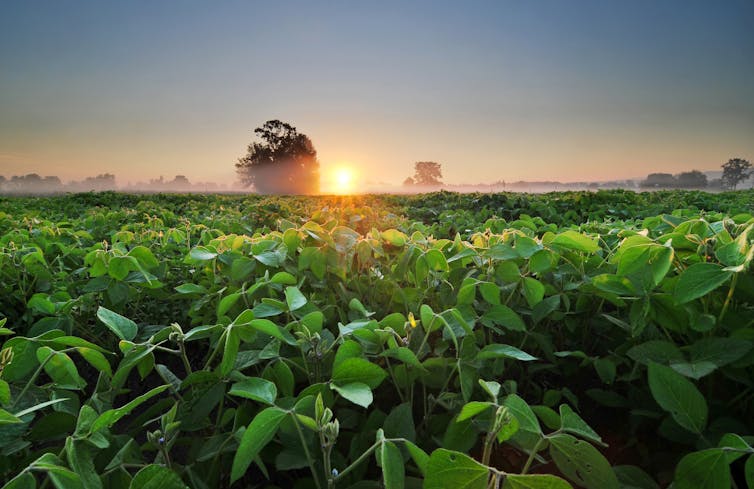
Currently the UK chicken industry – and all the roast dinners, nuggets, curries and sandwiches it provides – relies on soya beans. But because they struggle to grow in the UK’s cool and wet climate, they have to be imported.
Attempts to grow a domestic alternative protein for chicken feed have struggled. Peas, beans, sunflower and rapeseed, all of which grow in the British climate, have a much lower protein content than soya beans, are harder to grow predictably, and are difficult to digest.
Distillers’ grain, the byproduct leftover from bioethanol production, could be a promising high-protein alternative. But the largest bioethanol plant in the UK shut down in August 2025 because of changing US-UK tariff agreements, and cheap imports have now made domestic production economically non-viable.
Soya needs sun.
Insect meal is promising in theory but cannot be scaled to anywhere near the same quantities as soya, which arrives in Liverpool from South America every week in huge amounts.
Modern supply chains have been built on systems of logistics which are incredibly efficient when things go right, but are not necessarily resilient to things going wrong. And while the “soya bean war” might not end up drastically disrupting the UK food system, it does highlight the precarious framework of international trade.
MI5 has a saying that the UK is “four meals away from anarchy”, suggesting any serious interruption to the country’s food supply chain would lead to mass disorder. Chicken, the county’s most popular meat, is completely dependent on overseas imports. And although global commodity supply chains have stayed generally stable throughout the 21st century, that stability can never be taken for granted.
Theo Stanley receives funding from the UK Government (Biotechnology and Biological Sciences Research Council, part of UK Research and Innovation; and the Department for Environment, Food and Rural Affairs).