Polls say Starmer and Reeves are the most unpopular PM and chancellor ever – what’s a fair way to judge them?

Source: The Conversation – UK – By Christopher Byrne, Assistant Professor in British Politics, University of Nottingham

After last year’s tax-raising budget, UK chancellor Rachel Reeves assured the public that Labour had “wiped the slate clean” and would not be coming back for more. And yet this year, the chancellor froze tax thresholds and introduced several other tax-raising measures in a budget that was called “brutal” even before it was delivered.

This reversal helps to explain why Reeves is, according to one poll, the UK’s most unpopular chancellor on record. And she’s not alone. Depending on which polling you think is most credible, Keir Starmer comes out as either the most unpopular prime minister since records began in 1977, or merely on a par with Boris Johnson, just prior to his scandal-plagued resignation in 2023.

Clearly, the Labour government has got off to a bad start. But might the bad vibes be fleeting? Is there a way to fairly and objectively assess the performance of governments that cuts through the noise?

It’s difficult to identify objective criteria for judging a government. I have already alluded to one possible measure, in the form of public opinion polls. But many would argue that the best measure of a government is whether or not it does what’s “good”.

In this regard, the government’s defenders might point to decisions such as scrapping the two-child benefit cap at this budget or raising minimum wage. The problem with this approach is that it’s deeply subjective and depends on moral and ethical judgements which are impossible to prove.

A third approach, and one the electorate uses frequently, is economic stewardship: what is the government’s record on the economy and has it been able to generate general prosperity? A fourth is whether the incumbent party keeps its manifesto promises.

Given the UK’s dismal economic growth and this budget’s stealth income tax increase in the form of the threshold freeze, the Labour government arguably doesn’t do well on either of these criteria.


Read more:
What will the budget mean for economic growth? Experts give their view


How to measure government success

Academic literature provides us with a range of potentially more objective and systematic measures. Within this, I argue the best all-round set of criteria comes via political scientist Jim Bulpitt’s highly-cited “statecraft” model. This approach has been used for decades to evaluate political leaders.

It emphasises that governments need three main things in order to succeed: first, a winning electoral strategy, founded on a policy package that unites the party and is appealing to at least a plurality of the electorate. Second is “political argument hegemony”. This means getting your story about what is wrong with the country, and how to fix it, accepted as the common sense of politics. And third, of paramount importance, is to be perceived as competent.

So how does the current government stack up?

Not being Liz Truss was an excellent election strategy in a country traumatised by spiralling mortgage and energy costs. But a viable strategy for governing it is not.

A common criticism of Starmer is that he lacks what we might call a “political vision” for the country – a conception of what the good society looks like and how to get there. When polled recently, just 24% of the public said that they “understand his vision for Britain”. What is Starmer’s big idea, comparable to Thatcher’s supply side revolution, Blair’s modernisation drive, or even Cameron’s “big society” agenda?

In lieu of such a big idea, he prefers to play up his managerial and technocratic credentials. This has led to criticism that he “governs by focus group”. This budget, with all the briefing and leaks that preceded it, actually resembled an extended national focus group designed to see which tax rises the country would wear.

Competence is key

It is on competence – according to Bulpitt, a matter of selecting the right policies and implementing them well – that the current government’s record really falls apart.

Time and again, Starmer has been stymied by his own MPs on key issues like welfare reform, and forced into a humiliating climbdown over cutting winter fuel payments.
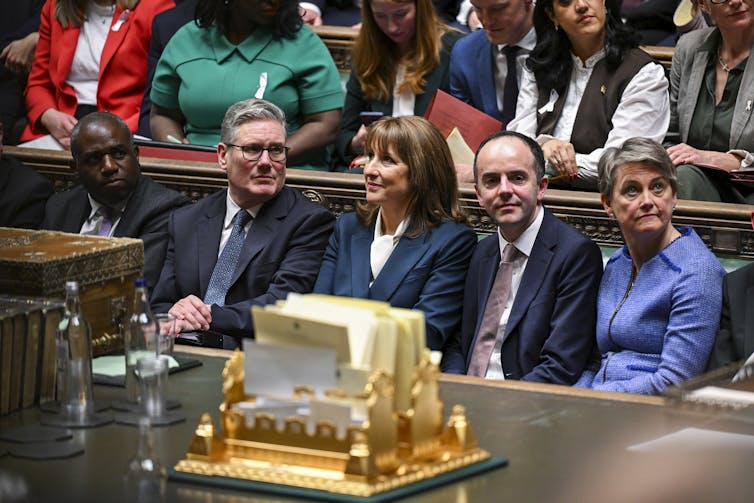
The Labour frontbench on budget day
Could this budget turn things around for Starmer and Reeves?
House of Commons/Flickr, CC BY-NC-ND

The appearance of competence has not been helped by the mistaken release of migrant sex offender Hadush Kebatu from HMP Chelmsford, simultaneously making a mockery of the government’s plan to “smash the gangs” and sort out prisons.

Nor by any of the scandals that have damaged the government since it was revealed that Starmer and Reeves had accepted tens of thousands of pounds’ worth of clothes and hospitality from Labour donor Lord Alli. This, plus deputy PM Angela Rayner’s resignation after having underpaid stamp duty on her second home, were particularly damaging for a leader who consciously cultivated an image as “Mr. Rules”.

Worse still, Starmer and Reeves seem to have stumbled into a debt doom loop on the economy: public spending increases lead to a shrinking of the government’s fiscal headroom, which leads to an increase in the cost of borrowing (gilt yields have already exceeded the heights reached as a result of Truss’s mini-budget) and speculation about future tax rises.

This in turn inadvertently dampens consumer and business confidence and depresses economic growth, leading inexorably to a tax-raising budget like this one that the government hoped it would never have to do again.


Read more:
Will the budget save Rachel Reeves and Keir Starmer? Experts give their views


One final insight the academic literature gifts us is that context is everything. While Starmer and Reeves have arguably performed poorly against the criteria above, perhaps their biggest mistake is to have fundamentally misread the nature of the political moment they are in.

They are governing as if it were still 1997, doubling down on a Blairite style of politics that passed its sell by date around 2008. The current situation now is much closer to 1945 or 1979 – moments when an exhausted political settlement had plainly stopped working and there was an urgent need for a new politics. The tragedy of this government is that, barely a year in, they are already in survival mode.

The Conversation

Christopher Byrne does not work for, consult, own shares in or receive funding from any company or organisation that would benefit from this article, and has disclosed no relevant affiliations beyond their academic appointment.

ref. Polls say Starmer and Reeves are the most unpopular PM and chancellor ever – what’s a fair way to judge them? – https://theconversation.com/polls-say-starmer-and-reeves-are-the-most-unpopular-pm-and-chancellor-ever-whats-a-fair-way-to-judge-them-270588

Ukraine’s peace talks reveal the risks of replacing diplomats with dealmakers

Source: The Conversation – UK – By Alexandros Koutsoukis, Lecturer in International Relations, University of Lancashire

Recent reports about the role of Donald Trump’s special envoy, American businessman Steve Witkoff, in the Ukraine peace negotiations have raised wider questions about why political leaders turn to business figures in high-stakes diplomacy – and whether this can ever work.

A leaked recording of Witkoff advising Russian officials on how to present their proposals to Washington has intensified concern about the direction of the process. Some see it as a symptom of the US president’s personalised foreign policy, while others view the process as a sign of a broader shift away from professional diplomacy altogether.

Diplomacy is often portrayed as the preserve of seasoned professionals, and for good reason. Skilled negotiators such as the UK’s Jonathan Powell – who played a key role in the Northern Ireland peace process – understand how to manage escalation, read political constraints and build agreements that can survive leadership changes.

Yet political outsiders sometimes play constructive roles. Businesspeople can think creatively, take risks that cautious officials avoid and open up transactional trade-offs that traditional diplomats might have dismissed as impossible.

When diplomatic processes are stuck and international pressures are high, a different perspective can widen the space for compromise and create opportunities for what earlier leaders could not achieve: a working deal.

One of history’s most striking examples of a businessman-turned-diplomat is Jean Monnet. After starting his career in his family’s cognac business, Monnet was appointed by the French government in 1939 to coordinate Franco-British war supplies.

He was one of the key figures to propose and advocate the idea that became the Lend-Lease Act of 1941 to the then-US president, Franklin D. Roosevelt. This agreement saw the US provide military and other supplies to its European allies without the need for immediate payment.

Jean Monnet (right) at the signing of the lend-lease agreement in 1941.
Jean Monnet (right) at the signing of the Lend-Lease Act in 1941.
United States Library of Congress / Wikimedia Commons

Monnet later conceived the plan that led to the 1950 Schuman Declaration. This produced the European Coal and Steel Community and laid the foundations for the European Economic Community, which eventually evolved into the EU.

What made Monnet successful was not only his creativity, positive political vision and ability to work behind the scenes. He was helped by a political context in which the US and Europe shared a desire to find a way to unite. This contributed to effective, cooperative and stable outcomes.

Strengths like those displayed by Monnet only matter when business envoys operate within political contexts and organisational structures that keep their transactional instincts in check. Unlike Monnet, Witkoff is operating within a context that amplifies – rather than restrains – these tendencies.

Dangerous tendencies

Witkoff’s first tendency is to lean towards a “victor’s peace”. His advising of Russian officials on how to persuade Trump of their peace plan reflects a transactional mindset that prioritises what is politically easy for the presumed victor, rather than what is just or stable.

But if negotiations begin from the assumption that Russia will ultimately win the war, and therefore Ukraine must accept the terms of its anticipated defeat sooner rather than later, the result may look less like a lasting peace and more like a humiliating capitulation.

This fear has already been voiced by European leaders. The French president, Emmanuel Macron, warned on November 25 that Europe cannot support “a peace that is in essence a capitulation” as this would leave Ukraine weakened and Russia emboldened.

Witkoff’s second tendency is to focus on the outcome of the negotiations rather than the process, neglecting to realise that peace agreements endure only when they are recognised as legitimate by those who must live with them.

The carefully calibrated balance of coercion and consent is the real art of diplomacy, and requires appreciating how the defeated can learn to live with defeat and not see it as humiliation. This occurred in Japan after the second world war, where defeat was gradually transformed into pride in a new liberal pacifist culture.

Witkoff’s third tendency is that he, like many businesspeople, appears to view negotiations as direct dealings between the most powerful players. This is what I have referred to in my research as the “great power bias”.

Approaching negotiations in this way can reinforce the idea that the US and Russia are the “real” players in the peace negotiations, while Ukraine and its European allies become peripheral. This could result in a deal based on the idea that the strongest party does what it wants and the weakest suffers what it must.

These three tendencies are manageable on their own. But the danger arises when they all move in the same direction and experience very little pushback. In an era of rising populism and a political environment dominated by Trump’s personalised style, there is little room for such counterweights. Witkoff’s influence is based on proximity to the president, not on a mandate shaped by allies, diplomats or Congress.

Ordinarily, allies would act as a counterweight to such tendencies. Yet Europe’s ability to shape the negotiations is limited by its own dependency. Without greater capacity to support Ukraine militarily or to provide the satellite intelligence on which Kyiv relies to continue fighting the war, European governments are forced to depend on the US even as they question its approach. This leaves them able to offer guidance but with diminished influence on the terms of the negotiation.

Peace in Ukraine will ultimately require a combination of creativity and restraint: an openness to new ideas but within a framework that ensures a degree of fairness, legitimacy and security. Businesspeople can contribute to such a process, but not when their tendencies are unchecked. The balance that makes outsider involvement constructive is precisely what is missing in the case of Ukraine.

The Conversation

Alexandros Koutsoukis does not work for, consult, own shares in or receive funding from any company or organisation that would benefit from this article, and has disclosed no relevant affiliations beyond their academic appointment.

ref. Ukraine’s peace talks reveal the risks of replacing diplomats with dealmakers – https://theconversation.com/ukraines-peace-talks-reveal-the-risks-of-replacing-diplomats-with-dealmakers-270827

Rhino: documentary unravels the challenges rangers face, but that’s not the whole story

Source: The Conversation – UK – By Susanne Shultz, University Research Fellow, University of Manchester

On the western flanks of Mount Kenya lies the Laikipia plateau, an achingly beautiful landscape that is both a refuge for wildlife and a home to traditional Masai communities. Black rhinos, which were once nearly extinct, are now thriving on some of these conservation properties, thanks to the intense efforts to keep them safe.

The new documentary Rhino tells the story of the people and the challenges faced to protect wildlife in this volatile landscape. The cinematography and score beautifully captures the landscape, people, animals and pace of life, which is at times languorous and at times frantic.

The story unfolds from the perspective of two rangers. Ramson Kiluko is an experienced ranger who works with his team to watch, protect and understand the rhinos. The film gives us a glimpse into his family life, the camaraderie of the ranger team and the rich knowledge he has about the lives of individual rhinos and their landscape. Rita Kulamu is a young ranger learning about rhinos as her property prepares to welcome them. Their work takes place against a background of danger, posed by both people and animals.

Rhino focuses on the critical role rangers play in the conservation story of black rhinos, which is an inspiring change from the traditional wildlife documentary that suggests a wildness that exists without the need for human intervention or involvement. Once on the brink of extinction, it is precisely the intensive efforts made to protect rhinos by people like Kiluko and Kulamu that has seen numbers slowly rebound.

A vehicle in the foreground, and further away a rhino.
The film focuses on the role of rangers in conserving rhinos.
Tom Martienssen/Dustoff Films

The film loosely follows a narrative around the planned move of 21 rhinos from the Lewa and Borana reserves in central Kenya, where they are too numerous, to Loisaba – a 58,000 acre wildlife conservation area which has long been without rhinos.

On Lewa and Borana, the rhinos fight for space and territory, on Loisaba they have the opportunity to create a new breeding population. Moving rhinos between reserves is a core part of their conservation. Poaching pressures require rhinos to be fiercely guarded. In Kenya, where my team has carried out research to understand the factors that lead to successfully breeding rhino populations, rangers are tasked with finding each rhino every day. Fences that keep rhinos in and people out mean that rhinos cannot move to avoid threats, avoid inbreeding, or to reestablish populations where they no longer are found.

Moving rhinos is far from easy. They can be aggressive and need to be handled with care. Rhinos are also not very resilient to being moved between properties. These moves often lead to rhinos dying from fighting, stress and disease.

The film shows how extreme drought led to a delay of several years to try to maximise the success of the move . This widespread and prolonged drought caused intense suffering of humans, livestock and wildlife. Conflicts over animals and land boiled over, leading to violence between communities but also towards rangers. These day-to-day challenges faced by conservationists are rarely touched on. Hopefully this film will help audiences understand that there are legions of passionate conservation professionals behind every success story.

The new documentary covers how the black rhino were facing extinction.

However, there is much that the story doesn’t tell. My experience researching wildlife health and disease in this landscape has highlighted how critical it is to create solutions that benefit both nature and people. Laikipia is a complicated landscape, where land rights, land ownership and power inequalities create tensions, and even violence, between communities.

This is a landscape where settlers, European farmers that immigrated, appropriated the best, most productive beautiful lands from traditional communities. High-end conservation reserves manage landscapes that teem with wildlife but are often off limits to the people that once moved widely with their animals. Our conversations with local people suggest that they view rhino conservation as a Trojan horse, moved around to justify high fences, armed security and to restrict people’s movement.

Rhino portrays the situation in somewhat simplistic terms: the good rangers and the bad “bandits”. In reality, conservation sits at a much less clear cut interface between the haves and the have nots, between those with international and national support for protecting animals, and pastoralists, a traditional way of life where people move with their herds of animals across the land, who feel their rights and traditional lands have been taken from them and that the wild animals have more rights that they do.

Violence comes not just from evil, avaricious thieves, but sometimes from frustrated, desperate people who have to deal with too many animals on too little land. Rhino tells an interesting and valuable story, but true conservation success must also address inequality, disenfranchisement and the tensions that “parachute” and colonial conservation can create in local communities.


Don’t have time to read about climate change as much as you’d like?

Get a weekly roundup in your inbox instead. Every Wednesday, The Conversation’s environment editor writes Imagine, a short email that goes a little deeper into just one climate issue. Join the 47,000+ readers who’ve subscribed so far.


The Conversation

Susanne Shultz and her group have received funding for their work in Laikipia from the Darwin Initiative, the International Science Partnership Fund, the University of Manchester, the Biotechnology and Biosciences Research Council, and the Natural Environment Research Council.

ref. Rhino: documentary unravels the challenges rangers face, but that’s not the whole story – https://theconversation.com/rhino-documentary-unravels-the-challenges-rangers-face-but-thats-not-the-whole-story-270828

Élection présidentielle en Centrafrique : un scrutin à haut risque

Source: The Conversation – in French – By Alexandra Lamarche, PhD Candidate | Doctorante, Université de Montréal

Les Centrafricains éliront leur président, le 28 décembre 2025, dans un contexte toujours fragile, où l’insécurité persiste et où le spectre des groupes armés continue de peser lourdement sur le processus électoral. L’élection présidentielle s’annonce sous haute tension, avec la candidature du président sortant Faustin-Archange Touadéra, mais aussi de figures comme Anicet-Georges Dologuélé ou l’ancien Premier ministre Henri-Marie Dondra. La chercheuse Alexandra Lamarche jette un éclairage sur les principaux risques entourant le processus électoral en Centrafrique, et évoque les actions prioritaires et nécessaires pour prévenir des violences post-électorales.


Quels sont, selon vous, les principaux risques entourant l’élection du 28 décembre ?

L’élection présidentielle du 28 décembre en République centrafricaine (RCA) se déroule dans un climat d’insécurité marqué par la présence persistante de groupes armés et les tensions avec les Forces armées centrafricaines (FACA). Cette situation fait planer un risque réel de violences et d’affrontements. Dans de nombreuses régions, les électeurs pourraient être confrontés à des intimidations venant tant des forces nationales que des groupes armés. Certains combattants issus d’anciennes coalitions dissoutes ont rejoint de nouvelles factions.

Bien que les membres de certaines milices aient été intégrés aux forces nationales, cette intégration présente des lacunes et bon nombre d’anciens combattants pourraient ne pas se montrer loyaux envers l’État en cas de conflit. Cela accroîtrait encore les risques liés au scrutin. Cette insécurité, combinée à une profonde frustration politique et à un désengagement, suggère que le taux de participation sera faible.

Le référendum du 30 juillet 2023 — boycotté par l’opposition et largement perçu comme un « coup d’État constitutionnel » – a supprimé la limitation du nombre de mandats présidentiels. Il permet à l’actuel chef de l’Etat, Faustin-Archange Touadéra, de demeurer au pouvoir indéfiniment. Cette situation renforce l’impression que les règles du jeu démocratique sont biaisées.

Enfin, les difficultés persistantes pour de nombreux citoyens musulmans à obtenir une carte d’identité nationale risquent de les exclure du scrutin. Elles exacerbent les frustrations communautaires et sapent davantage la crédibilité du processus électoral.

Quel rôle jouent les groupes armés et les acteurs étrangers dans ce scrutin ?

Les groupes armés demeurent des acteurs centraux, surtout dans les zones où ils peuvent perturber les opérations électorales, restreindre l’accès des électeurs ou interrompre le vote afin de préserver leur influence locale ou de se positionner pour d’éventuelles négociations post-électorales.

À leurs côtés, les acteurs étrangers jouent un rôle tout aussi déterminant. La Russie, via ses instructeurs et sociétés militaires alliées, sécurise certaines zones tout en renforçant l’avantage du pouvoir en place. Le Royaume-Uni accuse même Moscou d’envisager de réprimer des voix politiques et de mener des campagnes de désinformation pour influencer le débat électoral.

Le Rwanda, pour sa part, soutient activement le président Touadéra afin de consolider sa présence militaire et protéger un réseau croissant d’investissements dans les secteurs minier, commercial et de la construction, tout en étendant son influence régionale. Cette dynamique s’ajoute à l’appui que la Russie, notamment via Wagner, accorde à Touadéra pour sécuriser leurs propres intérêts miniers et maintenir un régime favorable à son implantation stratégique en Afrique centrale.

Si la force de maintien de la paix onusienne, la Minusca, tente de promouvoir un processus plus crédible, sa marge de manœuvre reste limitée par la fragmentation territoriale et les alliances politiques du régime. Parallèlement, le gouvernement de Touadéra apparaît de plus en plus dépendant de ses partenaires étrangers, au détriment de la souveraineté de la RCA.

Comment la situation des déplacés affecte-t-elle la crédibilité du vote ?

La situation des déplacés internes et des réfugiés centrafricains compromet sérieusement la représentativité du scrutin. Alors que les réfugiés — majoritairement musulmans — avaient pu voter en 2015-2016, ils en sont désormais exclus par le gouvernement, malgré les appels des Nations Unies en faveur de leur inclusion et les offres de soutien pour faciliter ce processus. Cette exclusion prive l’élection de milliers de voix. À l’intérieur du pays, de nombreuses personnes déplacées, de toutes confessions et d’origines ethniques, vivent dans des zones isolées ou se cachent pour échapper aux violences et peuvent hésiter à se rendre aux bureaux de vote par peur d’être ciblées.

Cette combinaison d’exclusion administrative et de contraintes sécuritaires crée un processus électoral qui laisse de côté certaines des populations les plus affectées par le conflit, remettant en doute l’inclusivité et, par conséquent, la légitimité globale du scrutin.

Quelles actions prioritaires sont nécessaires pour prévenir des violences post-électorales ?

Prévenir les violences post-électorales nécessiterait une action anticipée et coordonnée, mais j’ai peu d’espoir que ce soit possible. Même si les bulletins de vote sont déposés, si une partie importante de la population se sent exclue ou contrainte, le résultat pourrait déclencher un retour à la violence.

Bien que le mandat de la Minusca ait été renouvelé année après année, celle-ci ne dispose pas des fonds ni des effectifs nécessaires pour mener à bien sa mission ambitieuse. L’une des principales priorités est de travailler en étroite collaboration avec l’Autorité nationale des élections (ANE). Bien que celle-ci fasse de nombreux efforts positifs, notamment sur les plans technique et logistique, elle n’est probablement pas encore en mesure de garantir que tous les risques majeurs (sécurité, portée, légitimité) soient atténués.

Les élections ne sont qu’une étape. Le véritable test consistera à déterminer si l’État sera capable d’exercer son autorité après les élections de manière à renforcer la paix plutôt qu’à accentuer la polarisation.

La protection des civils doit être assurée de manière impartiale, notamment par un déploiement ciblé de la MINUSCA dans les zones sensibles afin d’éviter l’usage excessif de la force par les FACA ou leurs alliés étrangers.

Il est également crucial de décourager tout discours identitaire inflammatoire et de garantir un accès rapide à la justice pour enquêter sur les violences, protéger les témoins et poursuivre les auteurs, quel que soit leur camp. Cette combinaison de prévention, de transparence et de responsabilité est indispensable pour réduire les risques de violences après le scrutin.

The Conversation

Alexandra Lamarche receives funding from the Social Sciences and Humanities Research Council (SSHRC) of Canada.

ref. Élection présidentielle en Centrafrique : un scrutin à haut risque – https://theconversation.com/election-presidentielle-en-centrafrique-un-scrutin-a-haut-risque-270575

Voici pourquoi les pays africains ne profitent pas de leur richesse en minerais

Source: The Conversation – in French – By Bonnie Campbell, Professeure émérite en économie politique. Département de science politique de l’Université du Québec à Montréal., Université du Québec à Montréal (UQAM)

Les activités d’extraction d’or ont récemment repris dans le complexe de Loulo-Gounkoto, dans l’ouest du Mali, après plusieurs mois d’interruption. En janvier, le gouvernement malien a commencé à bloquer les exportations de la mine appartenant à la société canadienne Barrick Mining (anciennement Barrick Gold).

Le gouvernement a bloqué les exportations et saisi trois tonnes de lingots d’or à la suite d’un différend avec Barrick Mining concernant des impôts prétendument impayés.

Ce cas particulier est trop complexe pour être abordé ici. Cependant, les conflits concernant la distribution des revenus soulèvent des interrogations majeures quant à la façon dont les nations dotées de ressources naturelles tirent profit de leurs richesses.

Selon le Fonds monétaire international, l’évasion fiscale pratiquée par les multinationales minières priverait les pays africains de 470 à 730 millions de dollars américains de recettes fiscales par an.

Pour améliorer leurs infrastructures et leurs services de santé, ainsi que pour atteindre leurs objectifs de développement social, l’apport des recettes publiques générées grâce à la taxation de leurs ressources naturelles est d’une importance critique pour les pays d’Afrique subsaharienne.

Plusieurs raisons expliquent pourquoi les pays d’Afrique riches en ressources minérales ne tirent pas suffisamment profit de leurs ressources.


À lire aussi :
Les minières face à la violence au Burkina Faso


Déséquilibres de pouvoir, revenus insuffisants

Le Forum intergouvernemental sur l’exploitation minière et l’Organisation de coopération et de développement économiques ont recensé différents obstacles à la perception de recettes minières, notamment une législation défaillante, des prix de transfert abusifs et d’autres mécanismes de transferts de bénéfices artificiels.

De plus, les incitations fiscales régulièrement accordées pour attirer des investissements miniers, telle qu’une réduction significative des taux d’imposition et de redevances, sont rarement justifiées au regard de la perte de recettes publiques qu’elles entraînent.

Malgré ses importantes ressources minérales, le continent est en proie à un mécontentement généralisé, à la pauvreté et au sous-développement en raison des concessions excessives obtenues par les sociétés minières étrangères. Cette situation a été condamnée par les dirigeants de tout le continent.

En réponse, la Vision minière pour l’Afrique de l’Union africaine et les politiques qu’elle a inspirées, notamment la réforme des codes miniers, visent à garantir une contribution plus durable des ressources minérales du continent.

Or, les déséquilibres de pouvoir entre les entreprises étrangères et les gouvernements africains persistent et orientent les négociations relatives aux codes miniers, aux contrats et aux pratiques.

Bien que la situation varie d’un pays, d’un secteur et d’un site à l’autre, des recherches ont été menées pour déterminer les principaux obstacles à l’augmentation des recettes minières des États.

L’inégalité d’influence dans le cadre des négociations, qui favorise les sociétés minières, entraîne de nombreuses irrégularités. On peut citer, par exemple, la prolongation des clauses de stabilité malgré les réformes réglementaires, ou encore la priorité accordée aux contrats miniers par rapport aux cadres réglementaires nationaux plus larges.

Les pratiques du régime commercial international, les privilèges tarifaires à l’importation et les conventions bilatérales constituent de puissants facteurs dissuasifs à l’échelle internationale qui empêchent les États africains de mettre en œuvre des politiques profitables aux collectivités.

Code minier du Mali

Le secteur minier est un pilier de l’économie malienne. En 2022, il représentait 9,2 % du produit intérieur brut (PIB), 76,5 % des recettes d’exportation et 34,8 % des recettes publiques.

Comme dans d’autres pays du continent, la nouvelle législation minière vise à remédier aux dommages environnementaux et aux recettes minières décevantes qui sont l’héritage du passé. Le code minier de 2023 propose des réformes qui ont pour but d’améliorer les retombées nationales du secteur, à l’instar des mesures prises en Tanzanie, en Zambie et en République démocratique du Congo.

Ces réformes comprennent des exigences plus importantes en matière de participation de l’État (généralement de 10 à 30 %), des redevances et des taux d’imposition plus élevés, des exigences concernant le contenu et les emplois locaux, des dispositions plus strictes relatives à la responsabilité environnementale et sociale, ainsi que des obligations accrues en matière de développement communautaire.

Le code de 2023 vise à renforcer la souveraineté du Mali sur ses ressources et à garantir une répartition plus équitable des bénéfices.

Le régime fiscal a notamment été réformé pour supprimer certaines exonérations dont bénéficiaient les sociétés minières. Le nouveau code met aussi fin à l’allégement fiscal de 25 % accordé par les codes précédents pour une durée de 15 ans. Il introduit également une redevance de 10 % sur la production excédant les prévisions.

Par ailleurs, le Mali a créé plusieurs fonds pour répondre aux besoins du secteur et favoriser l’inclusion sociale.

Une autre innovation importante est la Loi relative au contenu local dans le secteur minier. Elle vise à encourager la participation d’entreprises et de travailleurs nationaux à ce secteur.

Comme d’autres pays riches en minerais, le Mali a dû faire face à une forte résistance, notamment de la part des entreprises les plus importantes et les plus influentes. Cela a conduit à une escalade de conflits plutôt qu’à des solutions négociées.

Il convient de noter que plusieurs sociétés, comme Robex Resources, ont conclu des accords avec le gouvernement malien. L’entreprise britannique Endeavour Mining a négocié avec le gouvernement des conditions d’exploitation dans le cadre du nouveau code minier.


Déjà des milliers d’abonnés à l’infolettre de La Conversation. Et vous ? Abonnez-vous gratuitement à notre infolettre pour mieux comprendre les grands enjeux contemporains.


Deux autres producteurs d’or ont également signé des accords pour exercer leurs activités en vertu du nouveau code minier : Faboula Gold et Bagama Mining.

Bien que moins importants en termes d’investissement, ces projets illustrent la possibilité de mener à bien des initiatives conformément au nouveau code. Ils offrent aussi de nombreuses possibilités d’emploi dans les zones rurales.

Une souveraineté accrue

Certains analystes du secteur ont critiqué les pays riches en minerais pour avoir adopté une approche de « nationalisme des ressources ». Des études montrent toutefois que des revenus miniers bien gérés, transparents et stables pourraient contribuer à améliorer l’accès aux soins de santé et aux services sociaux au Mali et au Sénégal.

Le fait d’exercer une plus grande souveraineté sur les ressources naturelles afin d’assurer le bien-être de la population d’un pays pourrait en fait être salué comme un nationalisme responsable.

Le Mali et ses voisins sont confrontés à d’importantes menaces militaires et sécuritaires. L’industrie minière peut jouer un rôle clé dans la lutte contre ces problèmes en générant des revenus et des emplois.

Pour ce faire, elle devra respecter les réglementations nationales et contribuer de manière équitable aux recettes fiscales. En fin de compte, la rentabilité et la responsabilité sociale de l’industrie sont étroitement liées à la stabilité sociale du pays ainsi qu’au bien-être sanitaire, social et économique de sa population.

La Conversation Canada

Bonnie Campbell a reçu des financements du Conseil de recherches en sciences humaines du Canada (CRSH) et du Centre de recherches pour le développement international (CRDI) du Canada.

Moussa Doumbo ne travaille pas, ne conseille pas, ne possède pas de parts, ne reçoit pas de fonds d’une organisation qui pourrait tirer profit de cet article, et n’a déclaré aucune autre affiliation que son organisme de recherche.

ref. Voici pourquoi les pays africains ne profitent pas de leur richesse en minerais – https://theconversation.com/voici-pourquoi-les-pays-africains-ne-profitent-pas-de-leur-richesse-en-minerais-269766

Frida Kahlo’s record-breaking painting El Sueño positions death as a roommate

Source: The Conversation – UK – By Benedict Carpenter van Barthold, Lecturer, School of Art & Design, Nottingham Trent University

Frida Kahlo’s 1940 self-portrait, El Sueño (La Cama), or The Dream (The Bed), has sold for US$54.7 million (£41.4m) at Sotheby’s New York. It is now the most expensive Latin American artwork in history, and has set the auction record for a female artist.

Kahlo’s canvas was the standout lot in a collection titled Surrealist Treasures. The painting appears to be a quintessential surrealist nightmare: a skeleton stalking a sleeping woman. But there is more to Kahlo’s work than the surrealist label might imply.

The painting (which is 74×98 cm) shows a four-poster bed floating in a cloudy sky. The perspective is disquieting. The bed tilts away from the viewer, as though seen from below. The upper part of the painting, where the skeleton lies, is light and airy. Its elbow almost touches the upper edge of the canvas, suggesting the structure is floating upward. The bottom tier, occupied by Kahlo, appears heavier. The cloudy backdrop is more threatening and the palette is earthier.

a young Frida Kahlo with hair smoothed back in a centre parting
Frida Kahlo as photographed by her father in 1926.
Wiki Commons

Kahlo sleeps under a blanket covered with a plant motif, something like a thorned and blossomless rose. The vines escape the confines of the blanket to surround her head. Curling roots can be seen at her feet. Implicitly, her body is anchored, like the plant, in cycles of growth and decay, a theme familiar from other paintings.

The two figures, death and life, mirror each other. Their heads face the same way, with two pillows under each. The skeleton is covered with wired explosives, mimicking the twining stems and roots. He holds a bouquet of flowers in his left hand, like a suitor.

The skeleton is not a surreal invention. It is a Judas figure, a painted papier-mâché “guy”, a real object from Kahlo’s collection.

In Mexico, these figures are personifications of evil that are burned or exploded on Holy Saturday, the day before Easter Sunday, in a symbolic triumph over evil. Their destruction, a brief spin of sparks, ends in an almighty bang. This Judas figure also resembles a calaca, a skeleton from the Mexican Day of the Dead. Its apparently bizarre placement on the canopy of Kahlo’s colonial-era four-poster bed is how it was displayed in her home. This is death as a roommate.

The composition reminds me of a “double-decker” late medieval cadaver tomb. These European tombs show the deceased, recumbent on the top layer as in life, and below, their skeleton or rotting corpse. Here, in an inversion of that layering, death appears to be an escape: from earth, to foliage, to flower, to sky. Furthermore, the way the bed imposes a grid on the painting is structurally similar to a Mexican retablo or “miracle painting”.

These typically depict a moment of miraculous recovery, or rescue from danger, accompanied by a dedication to an intervening saint. Kahlo adapts this format by substituting the saint with the Judas figure, moving from the reality of her body to a world of tradition, signs, symbols.

Art and death

Art and the body are often linked in Kahlo’s life, which was short and traumatic (she died in 1954 aged 47).

She contracted polio aged six, which left her with a stunted leg. At 18, she was terribly injured when the bus she was riding collided with a tram. An iron bar pierced her lower back and exited through her abdomen, damaging her spine and several organs. She required more than 30 operations throughout her life. Yet this incident was also her birth as an artist. Confined to bed for months, her body in a plaster corset, as stiff and white as the skeleton in this painting, she began to paint.

A young girl with a large bow in her hair
Frida Kahlo aged 11, five years after contracting polio.
Museo Frida Kahlo

In addition to physical anguish, her marriage to the celebrated muralist Diego Rivera was fraught. She suffered multiple failed pregnancies. The pair separated for a year when she discovered his infidelity with her younger sister, Cristina.

The bed, a site of convalescence and recovery, is a frequent motif in Kahlo’s work. Her constant physical and psychological pain is a central subject in her art. But this doesn’t come from dreams, conjured from automatic drawing, or psychological play as it was for many of the surrealists. Her art reflects a life defined by events that exceed the human norm of what is tolerable. In El Sueño, the Judas figure is a symbol of incipient pain – a double, a lover and a complex form of promised escape. She is asleep, but he’s awake.

This context firmly distances her work from the European surrealists. Kahlo herself had a difficult relationship with the movement. André Breton, the “pope of surrealism”, lauded her, saying that “the art of Frida Kahlo is a ribbon around a bomb”. But Kahlo found the surrealists fake, complacent and badly organised. In a ferocious 1939 letter to the photographer Nickolas Muray, she stated:

I would rather sit on the floor in the market of Toluca and sell tortillas, than have anything to do with those ‘artistic’ bitches of Paris … they live as parasites of the bunch of rich bitches who admire their ‘genius’ of ‘Artists’. Shit and only shit is what they are.

Years later, she was more measured: “They thought I was a surrealist, but I wasn’t. I never painted dreams. I painted my own reality”. Kahlo’s work, combining realism with myth and cultural specificity, is better described as the marvellous real: experience grounded in her own culture of Mexico – and experience of pain.


Looking for something good? Cut through the noise with a carefully curated selection of the latest releases, live events and exhibitions, straight to your inbox every fortnight, on Fridays. Sign up here.


The Conversation

Benedict Carpenter van Barthold does not work for, consult, own shares in or receive funding from any company or organisation that would benefit from this article, and has disclosed no relevant affiliations beyond their academic appointment.

ref. Frida Kahlo’s record-breaking painting El Sueño positions death as a roommate – https://theconversation.com/frida-kahlos-record-breaking-painting-el-sueno-positions-death-as-a-roommate-270728

A suburban sexual awakening – what to watch and see this week

Source: The Conversation – UK – By Naomi Joseph, Arts + Culture Editor, The Conversation

Bromley has never struck me as an exciting place – perhaps because I spent part of my teenage years loitering in its aggressively grey 1980s shopping centre, The Glades. I always found it bizarre that it was technically London; it felt too stiflingly suburban to belong to any city. So it’s not a setting I ever expected for a queer BDSM (bondage and discipline, dominance and submission, and sadism and masochism) story. And yet, it turns out to be the perfect backdrop for Pillion’s main character.

Colin (Harry Melling) is a timid gay man living with his parents and working a dead-end job as a traffic warden. His drab world is changed when he meets Ray (Alexander Skarsgård), a magnetic, leather-clad member of a local biker gang. It’s a seemingly implausible pairing. But Ray clearly sees something in mild-mannered Colin.

They agree to meet outside Bromley Primark on Christmas Day. What begins as a rough, transactional alleyway hook-up escalates quickly into a strict BDSM relationship. A willing “slave”, Colin finds himself living in Ray’s house and carrying out to his every command – whether sexual or domestic.

As our reviewer, Chantal Gautier – an expert in sex therapy – observes, the film explores power, eroticism, masculinity and identity:

“For Colin, the dominant-submissive slave journey becomes a path of self-discovery, allowing him to recognise what he wants, what he excels at – his ‘aptitude for devotion’ – and ultimately who he is.”

The result is a surprisingly funny, tender film about a man who finds his way out of drudgery and towards self-actualisation. It just happens he does so through BDSM.

Pillion is in cinemas now


Read more:
Pillion: what a sex therapy expert thinks of this domination-themed queer rom-com


Pillion holds plenty of surprises – including an unexpectedly Christmassy vibe. It’s not a straight Christmas movie (pun intended), but it’s Christmassy in the way Bridget Jones is. As the holiday season approaches, we’d love to know which “accidentally Christmassy” film you think makes the best festive viewing. Cast your vote in our poll, and feel free to reply to this email with any favourites we’ve missed.

Ongoing good yarns

For a more family-friendly option, Zootropolis 2 arrives in cinemas today – and our reviewer, Laura O’Flanagan, found it a delight. Sequels to beloved films often stumble, as we explored in last week’s email about Wicked: For Good. Only a few match the magic of the original, and an even smaller handful surpass it. Judging by your poll responses, Paddington 2 still reigns as readers’ favourite second outing.

Zootropolis 2 doesn’t stumble, according to O’Flanagan, joyously returing with the laugh-out-loud animal charm that made the first film such a hit. Bunny detective Judy Hopps is back, now partnered with reformed fox-turned-cop Nick Wilde. Their latest case involves a slippery reptile suspect, a stolen journal and a mystery that leads them straight into the heart of Zootropolis.

Zootropolis 2 is in cinemas now


Read more:
Zootropolis 2: this funny, heartfelt crowd-pleaser is a worthy sequel with something to say


If you want to stay at home this weekend, then you can hunker down with volume one of the final season of Stranger Things. The rag-tag team of gangly teens are set for a showdown where only one reality can survive: the real world of Hawkins or the monstrous mirror world of the villain Vecna, known as the Upside Down.

The story of Stranger Things has spun out in bursts over nine years, and fans had to wait three and a half for this final instalment. In this piece, psychologist Edward White explains the grip this ode to 80s nostalgia and sci-fi storytelling has had on people – the answer is hauntology, which is the use of elements from the past.

Stranger Things season five, volume one is available to stream on Netflix now


Read more:
Stranger Things has kept our attention through clever use of ‘hauntology’ – a psychologist explains


New takes on heritage art

BBC Civilisations has long been a landmark BBC series. First commissioned in 1969 by Sir David Attenborough to showcase the new medium of colour television, its original run followed art historian Kenneth Clarke as he traced western culture from the fall of Rome to the Romantics. It then got a second outing in 2018, fronted by historians Mary Beard, David Olusoga and Simon Schama.

Now the series returns with four expansive episodes on the collapse of major civilisations: the Roman Empire, the Ptolemaic dynasty, the Aztecs and Edo Samurai of Japan. The BBC again experiments with format, blending high-tech docudrama, expert commentary and artefacts from the British Museum. We asked four specialists – one for each civilisation – to assess the episodes and suggest further reading. Their verdicts were mixed, but the series offers plenty to think about.

Civilisations Rise and Fall is airing on BBC One every Monday


Read more:
Does BBC Civilisations get its four stories of collapse correct? Experts weigh in


If you’re in Paris this winter, don’t miss the exquisite exhibition now on at the Petit Palais. Paname brings together Bilal Hamdad’s serene, contemporary visions of Paris, displayed alongside the museum’s grand masters – a pairing that captivated our reviewer Anna-Louise Milne. In this dialogue between old and new, the past feels refreshed and the present gains unexpected gravitas.

The show features three new commissions created with the permanent collection in mind. Across Hamdad’s large-scale canvases, you can see how deeply he has absorbed the city’s artistic heritage. His works are at once human, modern, and timelessly Parisian. Milne was especially struck by one painting that subtly echoes Édouard Manet’s Un bar aux Folies Bergère.

Bilal Hamdad’s Paname is on at the Petit Palais in Paris from October 17 2025 to February 8 2026


Read more:
Bilal Hamdad’s paintings of Paris life show the thrill of new art when embedded within the grandeur of the old


Looking for something good? Cut through the noise with a carefully curated selection of the latest releases, live events and exhibitions, straight to your inbox every fortnight, on Fridays. Sign up here.


The Conversation

ref. A suburban sexual awakening – what to watch and see this week – https://theconversation.com/a-suburban-sexual-awakening-what-to-watch-and-see-this-week-270844

What five years of evidence on hybrid working tells us about the future of employment

Source: The Conversation – UK – By Jane Parry, Associate Professor of Work and Employment, University of Southampton

insta_photos/Shutterstock

The COVID pandemic accelerated remote and hybrid working practices across the world. It also provided evidence that these approaches could work for a wide variety of jobs.

The UK has been at the forefront of the shift to hybrid working and its sustainability as a work practice in future. This year, the Global Survey of Working Arrangements calculated that the typical UK worker averaged 1.8 days of remote working per week, only just behind the more rural Canada (1.9 days).

Along with colleagues, I observed this adaptation in a research project called Work after Lockdown, which followed organisations through lockdowns and examined what they learned around hybrid working. And our subsequent research for the conciliation service Acas looked at post-pandemic working across various industries in the UK.

The employment rights bill, with its proposals to simplify decision-making around flexible working, may also prompt workers to formalise their hybrid working patterns.

At a time when working practices have been transformed for millions of employees, there is real value in drawing together what has been learned over the past five years. This should enable organisations to thrive as hybrid employers.

The House of Lords has now done this – pulling this information together in its special inquiry on homeworking in the UK. The inquiry has recently reported on its ten-month investigation Is Working from Home Working?.

Since September 2024, I have been seconded to parliament to work for three days a week as thematic research lead for business, economics and trade. This is part of an Economic and Social Research Council project to enhance the use of academic evidence in parliament.

During this time, I have supported the home-based working inquiry and observed how a range of select committees and special inquiries work. The committee on home-based working was one of four special inquiries that the Lords stage each year.

A huge volume of academic evidence was submitted, with the report providing a synthesis of the emerging evidence base. Now the inquiry’s findings can help employers make informed decisions about their own hybrid management.

What the inquiry found

First, hybrid working’s impact on productivity appears to be limited. The inquiry concluded that it’s best to assess hybrid work on a case-by-case basis, looking at what is suitable in particular industries, jobs and personal circumstances.

On the other hand, remote and hybrid working shows real benefits in terms of raising employment rates, particularly for those who find it difficult to commit to full-time site-based working. This could include disabled people and parents of young children, for example.

Giving evidence to the inquiry, one employment expert estimated that hybrid working offered a potential labour supply gain of 1-2%, with real potential to enhance UK productivity. This is relevant to the government’s commitment to address economic inactivity, set out in its Get Britain Working white paper.

Another area where hybrid working could benefit employers is in terms of retention and recruitment. In the report, it was estimated that this could save employers between £7 billion and £10 billion every year. But there was an important exception to this. New starters can benefit from more in-person time at their workplace during inductions.

The inquiry also observed that employers’ main concern was losing opportunities for staff collaboration. But this misses an important point. Well-managed hybrid work – which coordinates so-called “anchor days” when teams get together in person – offers exactly these opportunities for workplace relationships to thrive.

And perhaps it can even do so better than full-time office work, when these interactions could be ad hoc and irregular. The inquiry pointed to the “best of both worlds” offer that hybrid working made to organisations. It noted that the potential for technology to support collaboration is under-used. As digital platforms continue to evolve, it seems likely that hybrid working can become increasingly effective.

But given that organisations appear to be concerned about collaboration, they could use this to acknowledge and incentivise employees. For example, appraisals could recognise the collaborative work (such as mentoring) that often goes unnoticed within organisations.

The inquiry also took an interest in headline-grabbing return-to-office mandates. It found that the codification of office days in mandates (along the lines of “staff must be in the office four days a week”) represented a trade-off by employers between collaborative benefits and staff satisfaction. Blanket mandates fail to address the gap between employees’ and employers’ office preferences – and the reasons underpinning these. Unaddressed, this could cause employment relations problems.

modern office space with breakout room with sofas
Smart office design can still allow for collaboration space in smaller workplaces.
shulers/Shutterstock

On a practical note, after the COVID disruption some organisations have rethought their workplace needs, with the result that they now have insufficient space for genuine collaboration. Colleagues and I are finding in our ongoing research that seat-booking systems can leave workers unable to sit with their teams when they attend the office. This clearly negates the benefits of in-person days.

A more forward-looking approach is to redesign offices in a way that better reflects the needs of collaborative work. This could include creating bespoke meeting places, more differentiated individual working spaces, and the development of hybrid policy alongside inclusive office design.

The inquiry has taken into account the views of a wide range of people, providing an important and accessible review of the evidence at a key time when many organisations are reviewing their hybrid work policy. It offers a wealth of insight as to how employers can adapt and refine their hybrid working practice to achieve both productivity and happy workers.

The Conversation

Jane Parry receives funding from the ESRC.

ref. What five years of evidence on hybrid working tells us about the future of employment – https://theconversation.com/what-five-years-of-evidence-on-hybrid-working-tells-us-about-the-future-of-employment-270319

Weight-loss drug doesn’t reduce risk of Alzheimer’s – new studies

Source: The Conversation – UK – By Rahul Sidhu, PhD Candidate, Neuroscience, University of Sheffield

Vitalii Vodolazskyi/Shutterstock.com

Semaglutide, the drug behind the blockbuster weight-loss jabs Ozempic and Wegovy, does not slow cognitive decline in people with early-stage Alzheimer’s, according to two large new studies. The results close the door, for now, on hopes that a treatment for diabetes and obesity might also help protect the brain.

The evoke and evoke+ trials tracked nearly 3,800 people aged 55 to 85 with mild cognitive impairment or early Alzheimer’s for two years. Those taking daily semaglutide did no better on tests of memory, thinking skills or day-to-day functioning than those given a placebo.

The drug used was Rybelsus, an oral version of semaglutide normally prescribed for type 2 diabetes. Like Ozempic and Wegovy, it contains the same active ingredient.

Scientists had reason to be hopeful: earlier lab work and studies in people with diabetes suggested semaglutide might offer multiple routes to protecting the brain, from calming inflammation to helping neurons function more efficiently.

Those early hints didn’t hold up in patients. Despite encouraging shifts in some biological markers of the disease, the drug failed to slow overall cognitive decline.

The trials were global, randomised and placebo-controlled – the gold standard for testing drugs in people. The main test they used was the Clinical Dementia Rating Sum of Boxes, a score that reflects both thinking ability and how well someone manages everyday tasks.

Researchers also checked memory, behaviour and levels of Alzheimer’s-related proteins in cerebrospinal fluid. Although some biological markers improved slightly in people taking the drug, their overall decline was no different from that of those on the placebo.

A bottle containing Rybelsus pills, with an Ozempic injector pen on the side.
Rybelsus contains the same active ingredient as Ozempic and Wegovy.
KK Stock/Shutterstock.com

Scientists have been excited about GLP-1 drugs like semaglutide because they appeared to tackle several processes involved in Alzheimer’s.

Animal studies showed they might reduce inflammation, improve how the brain responds to insulin, support the cell’s “power stations” (mitochondria) and limit the build-up of amyloid plaques and tau tangles. Observational studies in people with diabetes even hinted that those on GLP-1 drugs declined more slowly.

GLP-1 is a hormone released after eating that helps regulate blood sugar. Semaglutide mimics it, triggering insulin release, calming hunger signals and slowing digestion. In the brain, semaglutide activates GLP-1 receptors on neurons and support cells, dampening inflammation, protecting cells from damage and helping them manage energy and metabolism.

Lab experiments have also shown it can reduce the build-up of amyloid and tau. These overlapping effects made semaglutide look like a strong candidate for Alzheimer’s – but brain biology often behaves very differently in real patients than in a petri dish or in mice.

Why it might have failed

The negative results may have several explanations. Treatment could have come too late, as drugs that protect brain cells may work best before symptoms appear.

Alzheimer’s is a complicated disease, and targeting inflammation or metabolism on their own may not be enough once amyloid and tau have already built up. Also, shifts in blood markers of disease don’t always lead to real-world improvements that patients or families can notice, especially over only two years.

The drug’s safety looked similar to what’s already been seen when it’s used for diabetes or weight loss. But with no sign of benefit, Novo Nordisk is dropping plans to extend the study for another year. The full results will be shared at Alzheimer’s conferences in 2026, giving researchers a chance to dig into subgroups and additional findings that haven’t been released yet.

The headline results give the main answer but leave a lot of details unclear. Researchers will want to see whether any smaller groups of patients reacted differently, how steady the biological changes were, and whether any of the additional cognitive tests showed small effects.

For now, the message is clear: promising biology does not guarantee a working treatment. Semaglutide does influence processes linked to Alzheimer’s, but these trials suggest it does not slow symptoms once they begin. For families hoping for progress, it’s another reminder of how hard it is to turn experimental promise into real-world gains.

The news had immediate financial fallout. Novo Nordisk’s share price dropped sharply, reflecting just how much expectation had built around a potential breakthrough. The results may also shape how pharmaceutical companies approach future trials of weight-loss and diabetes drugs for brain diseases.

For now, though, semaglutide looks unlikely to become an Alzheimer’s treatment. Researchers will need to explore other strategies to see if the mechanisms observed in cells and mice can ever translate into meaningful cognitive benefits.

The Conversation

Rahul Sidhu does not work for, consult, own shares in or receive funding from any company or organisation that would benefit from this article, and has disclosed no relevant affiliations beyond their academic appointment.

ref. Weight-loss drug doesn’t reduce risk of Alzheimer’s – new studies – https://theconversation.com/weight-loss-drug-doesnt-reduce-risk-of-alzheimers-new-studies-270578

How visible displays of wealth make people support higher taxes – new study

Source: The Conversation – UK – By Milena Tsvetkova, Associate Professor of Computational Social Science, London School of Economics and Political Science

Song_about_summer/Shutterstock

In the middle of the ongoing cost of living crisis, exorbitant displays of wealth are back. Since the beginning of his term in January, US president Donald Trump has been literally bringing the gilded age back to the White House.

In April, Katy Perry spent 11 minutes in space for an undisclosed price, reportedly as much as US$28 million (£21.4 million). In June, billionaire Jeff Bezos closed part of Venice, Italy, for his lavish private wedding party.

In news, entertainment media and fashion, luxury is becoming louder. But what are the consequences? Could daily reminders of inequality lead to collective action and social change? A new study my colleagues and I conducted provides a clue.

Social scientists like to measure inequality with the Gini coefficient – a metric that describes how wealth is distributed among a group of individuals (a high coefficient means large inequality). It is well known that people have a poor understanding of the actual distribution of wealth in the society they live in, as well as their own position in that distribution.

The reason is that people tend to associate with others who are in a similar financial position. And that can make the Gini coefficient seem lower – giving the impression of more equally distributed wealth than is actually the case. In particular, the rich are more likely to underestimate inequality than others.

It’s understandable that people don’t think in Gini coefficients. In daily life, we perceive and act on inequality through social comparison.

When we decide how much to invest in sending our children to university, what to buy, where to go on holiday, or whether to ask for that pay raise, we typically compare ourselves to those we know well. And that may include neighbours, colleagues and cousins as well as influencers or celebrities.

Social comparison, more than any national statistics, helps us understand our place in society and moulds our life ambitions, ideological preferences and even political decisions.

Attitudes to wealth distribution

In our new study, we tested whether the composition of our social comparison group dictates our preferences for wealth redistribution.

We used online game experiments to simulate mini-societies where 1,440 people were randomly chosen to be born rich or poor. They each observed the wealth of a small social circle, and voted for a tax rate in a referendum, where the median vote won and the respective tax was collected and redistributed equally among all.

These were idealised, direct democracies with unrealistic 100% tax compliance and government efficiency. Still, they allowed us to create a multiverse of different worlds where voters’ social circles differed by wealth.

In some worlds, the poor were completely segregated from the rich. In other worlds, the poor were more visible to all – think, for instance, of rough sleepers or persistent news reports about families in need. In yet other worlds, the rich were more visible, for instance via celebrity gossip about the lifestyle of the wealthy, glitzy party and ballroom gala revellers spilling out on the streets.

What we found was that wealth segregation is inequality’s best friend. It keeps the status quo by keeping the poor apathetic. In contrast, observing the rich increases support for redistribution and reduces inequality.

View from inside of a homeless tent. Man in dark dirty cloths sitting by the entrance looking at rich high value district houses.
Inequality benefits from segregation.
mark gusev/Shutterstock

It should be mentioned that the rich in our experiment were not at all susceptible to social information; they always wanted the same low tax rate. It was the poor who voted for higher redistribution when they saw more rich people around them. Nearly 20% of them voted for 100% taxation. This means that redistribution preferences start to polarise in the society with stark disagreements between the rich and poor.

More disturbingly, in universes with a higher selected tax rate, the poor were better off by comparison but the least happy: they reported that they were not satisfied with their own final score and that the scores were not fairly distributed overall. In other words, observing the rich may increase support for redistribution and reduce inequality, but it also increases polarisation and discontent, presenting an inherent trade-off.

Recently, there has been a surge in popular films and TV shows portraying the life and tribulations of the ultra-rich: from celebrations (Crazy Rich Asians) to dark satires (Parasite, Triangle of Sadness, Succession, The White Lotus) and even slasher horrors.

We can speculate that this is indicative of a brewing discontent with inequality, an imminent breaking point for a maturing generation that has been burdened with educational debt, robbed of home ownership and deprived of parenthood. Dissatisfaction and polarisation might be necessary for social change in a highly unequal society.

The Conversation

Milena Tsvetkova receives funding from the European Research Council.

ref. How visible displays of wealth make people support higher taxes – new study – https://theconversation.com/how-visible-displays-of-wealth-make-people-support-higher-taxes-new-study-270629