Myanmar’s military will no doubt win this month’s sham elections. But could a shake-up follow?

Source: The Conversation – Global Perspectives – By Nicholas Coppel, Honorary Fellow, The University of Melbourne

Myanmar’s military regime has announced elections will be held in three phases, starting on December 28 and concluding in January.

Two outcomes are certain: first, the military-aligned party will be recorded as winning and, second, the government in exile – the National Unity Government – will fade even further into the background.

In the close to five years since the military seized power in February 2021, the country has been engulfed in a civil war, with the military pitted against People’s Defence Forces and numerous ethnic armed organisations. Thousands of resistance protestors, fighters and politicians, including President Win Myint and the ever-popular leader Aung San Suu Kyi, remain imprisoned.

The military controls the levers of government and holds all the major population centres. But its brutal air, artillery and drone attacks have failed to crush the resistance. The resistance has captured large swathes of territory, restricting the upcoming elections to only 274 of the nation’s 330 townships (constituencies).

Inside and outside the country, the elections are seen as a sham. The military-stacked Union Election Commission has deregistered political parties for failing to meet criteria it has set, such as having a certain number of party members or offices. It has also dissolved Aung San Suu Kyi’s National League for Democracy party.

The elections will be held in the context of a state-controlled media landscape in which criticism of them is prohibited under the newly-minted Law on the Prevention of Disruption and Sabotage of Multi-Party Democratic General Elections.

Citizens criticising the election on social media have been sentenced for up to seven years in prison with hard labour. For some offences, the death penalty applies.

The elections are an attempt to gain the legitimacy, at home and abroad, that currently eludes the military regime. They are designed to demonstrate authority and give an impression of effective control. By simulating compliance with international democratic norms, the regime hopes to promote a sense of normalcy, consolidate power and open the door to greater international engagement, all the while preserving the status quo.

The National Unity Government living in exile and a myriad of its international supporters are calling on the international community to not send election observers. Instead, they want the world to denounce the sham election.

ASEAN leaders are insisting that a cessation of violence and inclusive political dialogue precede elections. They have rebuffed an invitation to send observers.

The best the regime could hope for is that some individual ASEAN member states join Russia and Belarus in sending observers. However Thailand, the most ambivalent ASEAN member, which has argued the election should serve as a foundation for a sustainable peace process, is now saying it will be difficult for ASEAN re-engage with Myanmar. China is believed to be supportive of elections, but has not committed publicly to sending observers.

Continued Western ostracism won’t matter to the junta, for whom regional legitimacy is more important than either domestic or Western legitimacy.

Neighbouring countries are concerned about peace and stability on their borders, high levels of irregular migration, the impact of unregulated mining that pollutes rivers flowing through their countries, the flourishing production and trade in heroin and methamphetamine, and the proliferation of cyber scam centres enslaving and defrauding their citizens.

Citizens of these countries demand their governments address these issues, and the elections will make contact with the regime more defensible. It won’t be a case, as it was before, of competing views on whether engagement or isolation is the better way to bring about reform in Myanmar.

This time, there will be no delusions about reform. Rather, neighbours will be concerned with their national interest agenda, and will ride out any accusations of appeasement and complicity in atrocity crimes. After all, authoritarian elections and dealing with authoritarian regimes is not unusual in Southeast Asia.

It would be a mistake to see the elections in 2025–26 as a re-run of the 2010 elections. Those elections were held under the 2008 constitution, which ushered in a reformist government led by a former general.

The elections will not be a transition to civilian or parliamentary rule. Nor will they be an exit ramp for coup leader Commander-in-Chief Min Aung Hlaing. To ensure his own safety, he will want to remain in a role where the apparatus of the state will protect, not prosecute, him.

The elections will be a sham, but they will usher in changes to the military line-up. The current commander will no doubt become president and choose a compliant military officer as his replacement as commander-in-chief. The parliament will be dominated by the military and military-aligned parties.

In the immediate aftermath of the election, it will be hard to see any change in the fear and violence that are the tools of choice for regime survival.

However, under Myanmar’s tattered constitution, the military commander is not answerable to any civilian authority, even the president. Min Aung Hlaing’s replacement might at some point become his own man and favour a negotiated end to the conflict.

That is, the elections open the possibility of some diffusion of power. Although this seems unlikely now, it may be better to have this (albeit remote) possibility rather than no election and a continuation of the status quo – a brutal military dictatorship and relentless war of attrition.

The National Unity Government in exile needs to engage with the reality that elections will be held, bringing the junta greater regional engagement, rather than wishing for some imagined day of meaningful international support. Otherwise, it could fade even further into the background.

The Conversation

Nicholas Coppel is affiliated with the Australia Myanmar Institute, a not-for-profit group, and is a former Australian ambassador to Myanmar.

ref. Myanmar’s military will no doubt win this month’s sham elections. But could a shake-up follow? – https://theconversation.com/myanmars-military-will-no-doubt-win-this-months-sham-elections-but-could-a-shake-up-follow-269793
Governments need to prepare for more frequent large floods

Source: The Conversation – Canada – By Samadhee Kaluarachchi, PhD Student in Forest Hydrology, University of British Columbia

Flood management is a priority for many governments around the world. Recent floods have led to hundreds of deaths and caused significant damage in Indonesia, Sri Lanka, Thailand, Vietnam, Albania, Kenya and elsewhere.

Canada too is no stranger to floods. Notably, in 2021, flooding in British Columbia cut off access to Metro Vancouver from the rest of the country and caused up to $14 billion in damages.

While many scientific and technical reports show that floods are becoming larger and more common, these reports may be underestimating how their frequency is changing. Flood sizes get the spotlight, however governments and experts need to also consider their frequency to address implications overlooked by traditional management methods.

Frequency and size together must tell the story, because even modest increases in size can lead to surprisingly big jumps in frequency. For example, timber harvesting in the B.C. Interior has led to a 19 to 26 per cent increase in flood size, and turned the former 100-year flood into a once-a-decade flood. Despite floods becoming more frequent, today’s practices still dominantly focus on flood size.

The consequences are severe. We can build infrastructure like dikes and dams bigger so they withstand larger once-in-a-century floods. But if we don’t capture how floods of all sizes (including the 100- and 200-year events) are becoming way more common, infrastructure can weaken and fail faster than we expect.

In our recently published study, we examined a range of scientific, technical and governmental documents to assess whether practices today help us reliably predict flood risks. We found that many of the factors contributing to the severity of a flood could respond much more strongly to climate and landscape changes than traditional methods imply, calling for change in our flood prediction practices.

We’re underestimating flood risk

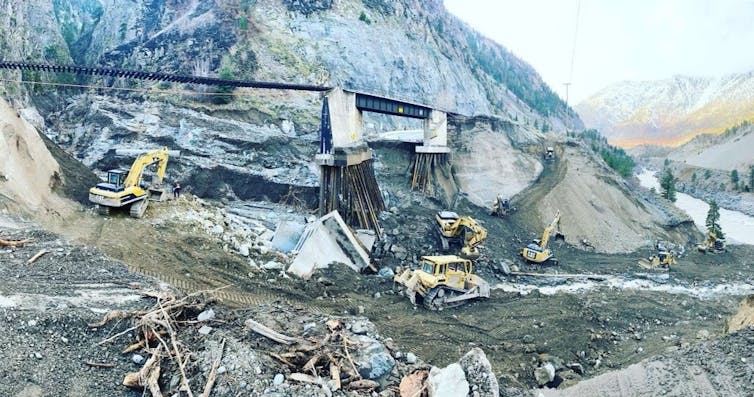
tractors and diggers clear debris following a flood
Restoration work underway following November 2021 flooding damage at Tank Hill on Highway 1 in B.C.
(B.C. Ministry of Transportation and Transit/flickr), CC BY-NC-ND

Nature’s flood “ingredients” include rainfall, snow, soil wetness and energy for snowmelt, which combine in many “recipes” to trigger floods. Human influences like climate change, land use and land cover changes can alter these recipes, making floods bigger and more common. Understanding how human activity causes these effects on floods means predicting flood frequency and size together.

However, short flood records make it difficult to estimate the frequency and size of large floods. Without overcoming this challenge, assessments can produce unreliable results.

Additionally, many studies lump distant flood records with more recent records, suggesting that floods today have similar odds as those decades ago. Yet, experts agree that changes in the climate and landscape alter floods more strongly today.

These practices together produced a widespread perception in risk assessments where flood sizes rise rapidly, or steeply, per change in frequency (called a “heavier tail”).

Our recently published study challenges that perception, which implies that human influence shouldn’t greatly alter floods. In many places, human activities are making large floods more common. By giving little attention to how our activities affect flood frequencies, our practices don’t seem to capture just how sensitive floods are and how much they’re changing.

Without adapting our practices, we risk the loss of lives and livelihoods, misallocating funds, economic losses and lawsuits against governments, municipalities and professionals. Reliable flood projection and management is vital.

Considering flood frequency

To make reliable flood projections, we first need to identify a region’s natural flood frequencies and sizes, and which climate and landscape features drive them. With this solid baseline, we can determine how human activities shift flood frequencies and sizes, if floods are sensitive to human influence and what this means for society.

We can do this by predicting how different human activities affect floods through modelling or landscape experiments. We can work with flood records, using methods that recognize how current and future floods are far more affected by human activities than past floods.

We can use existing techniques to overcome challenges with short records and ensure that our estimates reflect a strong understanding of the natural and human drivers of flood frequencies and sizes.

By adopting stronger practices, our study predicts that many regions could see very different frequency-size relations: flood sizes could increase more slowly per change in frequency.

It signals a more “fragile,” or super sensitive, flood regime than what current methods imply. When we disturb the climate or landscape, large floods can react strongly; they become much more common, reflecting what we see in many places today.

This knowledge can help governments effectively manage the land while mitigating major jumps in flood frequency.

The way forward

Muddy floodwaters submerge a highway
Floodwaters wash away part of Highway 8 in B.C. in November 2021.
(B.C. Ministry of Transportation and Transit/flickr), CC BY-NC-ND

Effective flood management must include strong policies, nature-based solutions, and infrastructure designed for size and strength to withstand both larger and more frequent floods.

Nature-based solutions such as green areas, permeable surfaces and water-retaining features are being adopted by governments worldwide. Studies suggest that measures like increased forest cover have little impact on large floods; however, this may reflect the focus on flood size. Natural landscapes like forests can greatly reduce flood frequencies, even for very large floods.

In B.C., landscape features like mountains, forests, lakes, wetlands and floodplains spread out floods, lowering their peaks and making large events rarer. However, these same features make floods react strongly to changes in the climate and landscape.

Flood risk management must work with nature, maintaining or increasing the landscapes’ ability to store floodwaters. Our policies must address flood risk at the source through effective land management, recognizing that key causes of urban floods could lie thousands of kilometres away in the distant uplands. With strong policies and interventions both upstream and downstream, we can proactively manage floods.

The Conversation

Samadhee Kaluarachchi receives funding from the Natural Sciences and Engineering Research Council of Canada, the Faculty of Forestry at the University of British Columbia, the Gordon and Nora Bailey Fellowship in Sustainable Forestry, and the Mary and David Macaree Fellowship.

Younes Alila receives funding from Mitacs Canada and the Natural Sciences and Engineering Research Council of Canada.

ref. Governments need to prepare for more frequent large floods – https://theconversation.com/governments-need-to-prepare-for-more-frequent-large-floods-269251

Wicked: For Good – what lies beneath correcting the way people speak?

Source: The Conversation – UK – By Emma Humphries, Research Fellow, School of Arts, English and Languages, Queen’s University Belfast

“Pink goes good with green.” This is a lesson we learned from Glinda (Ariana Grande) in Wicked part one. But do you remember the line that comes after that?
“Goes well with green.”

A small, easily missed comment from the green-skinned outsider Elphaba (Cynthia Erivo), but one that reveals something important about language and common usage. Hierarchies of “correct” and “incorrect” language are not just found in grammar books and classrooms, but in popular culture too.

From “holding space” to “sex cardigans”, Wicked continues to dominate popular culture, but one thing that has been overlooked is Elphaba’s insistence on correct language.

In the first film, we see Elphaba ostracised and eventually positioned as public enemy number one by the Oz propaganda machine. From the film’s very opening, a flashforward to citizens celebrating Elphaba’s death, her unpopularity is made clear in the song No One Mourns The Wicked.

One way in which the filmmakers signal Elphaba’s unlikeability is through her often awkward, borderline rude social encounters, including when she first meets her frenemy, Glinda. It’s safe to say that the two characters don’t hit it off and Elphaba’s correction seems to upset Glinda.

Glinda: I could care less what others think.

Elphaba: Couldn’t.

Glinda: What?

Elphaba: You couldn’t care less what other people think. Though, I … I doubt that.

In the land of Oz, where people “pronuncify” and “rejocify”, are “disgusticified” and “moodified”, Elphaba’s comments demonstrate the idea that there is only one correct way to use language and that incorrect language should be corrected.

From stage to cinema

Elphaba’s corrections are not in the original stage musical. They were added to the film. The adaptation of a stage show for film offers an opportunity to modernise and change parts of the story that have been controversial or become outdated.

One excellent example of this in Wicked is its improvement of the stage show’s depiction of disability. The addition of language policing, however, is more disappointing. Because when we correct someone’s language, it’s about much more than the words themselves.

Correcting language is not neutral. When we place value on using language correctly, those who fall short often find themselves judged and discriminated against.

The policing of correct language can be seen as a gatekeeping tool, deciding who belongs and who is excluded. This has inevitable consequences for diversity. The way we speak, write and sign can reflect many aspects of our identities: where and how we grew up, our gender, age and race.

Rules and rebellion

With the run time of the films almost doubling that of the stage show, there is much more time devoted to character development in the films. Elphaba’s language pedantry has been added to demonstrate how she can rub people up the wrong way. However, it also suggests an adherence to authority and to socially constructed rules that stands in contrast to her character more broadly.

Elphaba is an outsider who starts the film wanting to be “degreenified”, but by the end of Wicked part one and as a main storyline in Wicked: For Good, she is willing to sacrifice her safety and reputation to do what is morally right, rather than what is socially acceptable.

Adherence to the strict rules of correct language suggests the opposite: a tendency to want to be accepted and to uphold the societal status quo. Elphaba resists social norms in every other respect, yet the film makes her a standard grammar enforcer.

Given that this trait is absent from part two, rather than undermining her personality as a resister, perhaps this further signals Elphaba’s journey from wishing to fit in to fully embracing her outsider status. Indeed, Elphaba’s insistence on correctness speaks to a broader challenge facing anyone positioned as an outsider: having to work that much harder to be accepted.

Glinda’s (famous) need to be popular and her interests in social climbing align with traits of a language enforcer, yet her behaviour tells a different story. She corrects language only once and it concerns her original name, Galinda. When Dr Dillamond, a professor at Shiz University – who also happens to be a goat – struggles to pronounce the “gah” in Galinda, Glinda corrects his pronunciation and berates him.

This moment, present in both the stage musical and the film, does not reflect a desire to uphold the prescriptive rules of the language, but rather a personal motivation. Glinda’s name is central to her self-image and public persona, and protecting that matters to her.

Beyond Oz

In an era when equality, diversity and inclusion initiatives are being rolled back, and languages other than English face renewed marginalisation, Wicked offers a case study in how linguistic hierarchies operate under the radar of popular culture. But there are plenty other examples. Think about Ross in Friends, Ted in How I Met Your Mother and Sheldon in The Big Bang Theory – all notorious language correctors.

Elphaba’s corrections are more than just a shorthand to signal an abrasive character. They reflect the linguistic hierarchies and gatekeeping that exist beyond Oz. Using language “correctly” is a marker of belonging and shows adherence to societal norms.

Across the two films, Elphaba moves from wanting to conform and erase a stigmatised part of her identity, her skin colour, towards rebellion against convention. It’s clear she questions blind adherence to political power, but perhaps this extends further to questioning the rules we construct around language.


Looking for something good? Cut through the noise with a carefully curated selection of the latest releases, live events and exhibitions, straight to your inbox every fortnight, on Fridays. Sign up here.


The Conversation

Emma Humphries receives funding from The Leverhulme Trust and is currently employed by Queen’s University Belfast.

ref. Wicked: For Good – what lies beneath correcting the way people speak? – https://theconversation.com/wicked-for-good-what-lies-beneath-correcting-the-way-people-speak-270639

FDA claims on COVID-19 vaccine safety are unsupported by reliable data – and could severely hinder vaccine access

Source: The Conversation – USA (3) – By Frank Han, Assistant Professor of Pediatric Cardiology, University of Illinois Chicago

The FDA has provided no evidence that children died because of receiving a COVID-19 vaccine. Anchiy/E+ via Getty Images

The Food and Drug Administration is seeking to drastically change procedures for testing vaccine safety and approving vaccines, based on unproven claims that mRNA-based COVID-19 vaccines caused the death of at least 10 children.

The agency detailed its plans in a memo released to staff on Nov. 28, 2025, which was obtained by several news outlets and published by The Washington Post.

Citing an internal, unpublished review, the memo, written by the agency’s top vaccine regulator, Vinay Prasad, attributes the children’s deaths to myocarditis, an inflammation of the heart muscle. And it says the deaths were reported to the Vaccine Adverse Event Reporting System, or VAERS, but provides no evidence that the vaccines caused the deaths.

The death of children due to an unsafe vaccine is a serious allegation. I am a pediatric cardiologist who has studied the link between COVID-19 vaccines and heart-related side effects such as myocarditis in children. To my knowledge, studies to date have shown such side effects are rare, and severe outcomes even more so. However, I am open to new evidence that could change my mind.

But without sufficient justification and solid evidence, restricting access to an approved vaccine and changing well-established procedures for testing vaccines would carry serious consequences. These moves would limit access for patients, create roadblocks for companies and worsen distrust in vaccines and public health.

In my view, it’s important for people reading about these FDA actions to understand how the evidence on a vaccine’s safety is generally assessed.

Determining cause of death

The FDA memo claims that the deaths of these children were directly related to receiving a COVID-19 immunization.

From my perspective as a clinician, it is awful that any child should die from a routine vaccination.

However, health professionals like me owe it to the public to uphold the highest possible standards in investigating why these deaths occurred. If the FDA has evidence demonstrating something that national health agencies worldwide have missed – widespread child deaths due to myocarditis caused by the COVID-19 vaccine – I don’t doubt that even the most pro-vaccine physician will listen. So far, however, no such evidence has been presented.

While a death logged in VAERS is a starting point, on its own it is insufficient to conclude whether a vaccine caused the death or other medical causes were to blame.

To demonstrate a causal link, FDA staff and physicians must align the VAERS report with physicians’ assessments of the patient, as well as data from other sources for monitoring vaccine safety. These include PRISM, which logs insurance claims data, and the Vaccine Safety Datalink, which tracks safety signals in electronic medical records.

It’s known that most deaths logged only in VAERS of children who recently received vaccines have been incorrectly attributed to the vaccines – either by accident or in some cases on purpose by anti-vaccine activists.

Heart-related side effects of COVID-19 vaccines

In his Substack and Twitter accounts, Prasad has said that he believes the rate of severe cardiac side effects after COVID-19 vaccination is severely underestimated and that the vaccines should be restricted far more than they currently are.

In a July 2025 presentation, Prasad quoted a risk of 27 cases per million of myocarditis in young men who received the COVID-19 vaccine. A 2024 review suggested that number was a bit lower – about 20 cases out of 1 million people. But that same study found that unvaccinated people had greater risk of heart problems after a COVID-19 infection than vaccinated people. In a different study, people who got myocarditis after a COVID-19 vaccination developed fewer complications than people who got myocarditis after a COVID-19 infection.

Existing vaccine safety infrastructure in the U.S. successfully identifies dangers posed by vaccines – and did so during the COVID-19 pandemic. Today, most COVID-19 vaccines in the U.S. rely on mRNA technology. But as vaccines were first emerging during the COVID-19 pandemic, two pharmaceutical companies, Janssen and AstraZeneca, rolled out a vaccine that used a different technology, called a viral vector. This type of vaccine had a very rare but genuine safety problem that was detected.

A report in VAERS is at most a first step to determining whether a vaccine caused harm.

VAERS, the Vaccine Safety Datalink, clinical investigators in the U.S. and their European counterparts detected that these vaccines did turn out to cause blood clotting. In April 2021, the FDA formally recommended pausing their use, and they were later pulled from the market.

Death due to myocarditis from COVID-19 vaccination is exceedingly rare. Demonstrating that it occurred requires proof that the person had myocarditis, evidence that no other reasonable cause of death was present, and the absence of any additional cause of myocarditis. These factors cannot be determined from VAERS data, however – and to date, the FDA has presented no other relevant data.

A problematic vision for future vaccine approvals

Currently, vaccines are tested both by seeing how well they prevent disease and by how well they generate antibodies, which are the molecules that help your body fight viruses and bacteria.

Some vaccines, such as the COVID-19 vaccine and the influenza vaccine, need to be updated based on new strains. The FDA generally approves these updates based on how well the new versions generate antibodies. Since the previous generation of vaccines was already shown to prevent infection, if the new version can generate antibodies like the previous one, researchers assume its ability to prevent infection is comparable too. Later studies can then test how well the vaccines prevent severe disease and hospitalization.

The FDA memo says this approach is insufficient and instead argues for replacing such studies with many more placebo-controlled trials – not just for COVID-19 vaccines but also for widely used influenza and pneumonia vaccines.

That may seem reasonable theoretically. In practice, however, it is not realistic.

Today’s influenza vaccines must be changed every season to reflect mutations to the virus. If the FDA were to require new placebo-controlled trials every year, the vaccine being tested would become obsolete by the time it is approved. This would be a massive waste of time and resources.

A pharmacy with a sign advertising flu shots
Influenza vaccines must be updated for every flu season.
Jacob Wackerhausen/iStock via Getty Images Plus

Also, detecting vaccine-related myocarditis at the low rate at which it occurs would have required clinical trials many times larger than the ones that were done to approve COVID-19 mRNA vaccines. This would have cost at least millions of dollars more, and the delay in rolling out vaccines would have also cost lives.

Placebo-controlled trials would require comparing people who receive the updated vaccine with people who remain unvaccinated. When an older version of the vaccine is already available, this means purposefully asking people to forgo that vaccine and risk infection for the sake of the trial, a practice that is widely considered unethical. Current scientific practice is that only a brand-new vaccine may be compared against placebo.

While suspected vaccine deaths should absolutely be investigated, stopping a vaccine for insufficient reasons can lead to a significant drop in public confidence. That’s why it’s essential to thoroughly and transparently investigate any claims that a vaccine causes harm.

Vaccine vs illness

To accurately gauge a vaccine’s risks, it is also crucial to compare its side effects with the effects of the illness it prevents.

For COVID-19, data consistently shows that the disease is clearly more dangerous. From Aug. 1, 2021, to July 31, 2022, more than 800 children in the U.S. died due to COVID-19, but very few deaths from COVID-19 vaccines in children have been been verified worldwide. What’s more, the disease causes many more heart-related side effects than the vaccine does.

Meanwhile, extensive evidence shows that COVID-19 vaccination reduces the risk of hospitalization by more than 70% and the risk of severe illness in adolescent children by 79%. Studies also show it dramatically reduces their risk of developing long COVID, a condition in which symptoms such as extreme fatigue or weakness persist more than three months after a COVID-19 infection.

Reporting only the vaccines’ risks, and not their benefits, shows just a small part of the picture.

The Conversation

I am a fellow of the American Academy of Pediatrics and regularly go on social media to share pro vaccine information.

ref. FDA claims on COVID-19 vaccine safety are unsupported by reliable data – and could severely hinder vaccine access – https://theconversation.com/fda-claims-on-covid-19-vaccine-safety-are-unsupported-by-reliable-data-and-could-severely-hinder-vaccine-access-271028

At Donald Trump’s prompting, Benjamin Netanyahu seeks a pardon – but insists he has done nothing wrong

Source: The Conversation – UK – By John Strawson, Emeritus Professor of Law, University of East London

The interesting thing about Benjamin Netanyahu’s call on Israel’s president, Isaac Herzog, to pardon him for charges of bribery, fraud and breach of trust, is that he has not been found guilty on any of them.

The trial is made up of three separate but related cases and began in May 2020. They’ve been paused regularly, especially since the country began its military campaign in Gaza, and are thought likely to continue for years.

Netanyahu’s 111-page pardon application does not admit guilt. Instead it’s a sustained attack on Israel’s legal system. In particular it alleges that the cases against him have involved illegal interrogations and unlawful manipulation in the collection of evidence. He argues that the charges against him undermine national unity and impair his ability to do his job as the country’s leader.

In short this is not Netanyahu asking for a pardon so much as an attempt by the prime minister to portray himself as a great man wronged by the elite.

Significantly it comes just a few months before the next election will have be called in Israel. As Herzog has said the application will could “unsettle” the Israeli public.

The latest developments in the long-running saga of the Israeli prime minister’s trial began in October. The US president, Donald Trump, in his speech to the Knesset to celebrate the apparent success of his peace plan for Gaza, called for the pardon.

Having recently humiliated Netanyahu at a meeting in the White House by making him apologise to Qatar for his airstrike on Hamas officials in Doha, Trump – ever the deal maker – thought he could sweeten things for his staunch ally by making such a public appeal. The US president has since followed this up with a formal letter to the Israeli president.

Donald Trump calls for Netanyahu to be pardoned.

Trump seems to be under the impression that Israel’s president has the same widely discretionary powers that he exercises. He has just pardoned the former president of Honduras, Juan Orlando Hernandez, who had been sentenced to 45 years during the Biden years for drug trafficking and has a well established track record of pardoning his allies.

But Israel has a complex system that may take weeks to work through. First the pardon must be submitted to the Ministry of Justice to consider before it goes to the president. The president then has to ask his own legal advisor for her view.

The reaction to Netanyahu’s pardon application has predictably divided Israelis along political lines.

Opposition party leaders are overwhelmingly opposed to the grant of a pardon, especially as Netanyahu has not accepted guilt. Opposition leader Yair Lapid has said that no pardon can be given unless Netanyahu admits guilt. Yair Golan, the leader of the Democrats, also says that only the guilty can apply for pardon.

Former prime minister, Naftali Bennett – a frontrunner to succeed Netanyahu should the opposition coalition win the election – has a more nuanced view. He argues that a pardon should be given but on condition that Netanyahu retires from office.

Netanyahu’s government colleagues have of course welcomed the application and agree with Netanyahu’s criticisms of Israel’s justice system. Environment minister, Idit Silman – a fellow member of Likud, Netanyahu’s party – has gone so far as to suggest that any refusal to grant the pardon will result in the justice officials involved being sanctioned by the Trump administration.

Undermining due process

All of this places Herzog in a delicate position. The judicial reforms which the current government initiated when it took office in December 2022, which have drawn the anger of many in Israel who perceive them as an attempt to emasculate what was once a robust legal system, have continued during the war in Gaza.

The government and its supporters already treat Israel’s Supreme Court with contempt. This was amply demonstrated on December 1 when a hearing on the government’s attempt to sack the attorney general was cancelled after the government boycotted the hearing.

It is also a moot point whether the president is legally able to pardon anyone who has not been convicted of a crime or at least been admitted guilt. There have been two cases where pardons were granted without convictions.

These related to a 1984 trial in which two operatives working for Israeli intelligence agency Shin Bet were charged with the summary execution of two Palestinians who were hijacking a bus. It was considered that a full trial could compromise security – so on the basis of the admission of guilt a pardon was given.

It has been suggested that Herzog could offer a conditional pardon dependent on Netanyahu not returning to office after the next election, whatever the result. But the Israeli prime minister seems in no mood to admit to any wrongdoing on his part – let alone retreat from political life. Instead, his application for a pardon is a demand that the Israel public rally round him and a statement that disunity has been caused by the trial not by his actions.

This has echoes of the way in which Trump dealt with the litigation against him after his first term. He used it as proof of the bias and indeed the corruption of the legal system at the service of the elite.

In this period of populist politics this stance evidently did him no harm as he was reelected. Netanyahu must be hoping the same politics work for him. But unlike Trump, it was under his watch the most catastrophic intelligence and military failures took place on October 7 2023.

The Israeli electorate may well not accept his excuses for that traumatic day. They may instead see his pardon application as another self-serving act of a politician who is putting himself first.

The Conversation

John Strawson does not work for, consult, own shares in or receive funding from any company or organisation that would benefit from this article, and has disclosed no relevant affiliations beyond their academic appointment.

ref. At Donald Trump’s prompting, Benjamin Netanyahu seeks a pardon – but insists he has done nothing wrong – https://theconversation.com/at-donald-trumps-prompting-benjamin-netanyahu-seeks-a-pardon-but-insists-he-has-done-nothing-wrong-271136

Une partie du cerveau humain grossit avec l’âge – voici ce que cela signifie pour vous

Source: The Conversation – in French – By Esther Kuehn, Professor of Neuroscience, University of Tübingen

Le vieillissement cérébral est propre à chaque individu et dépend de son mode de vie, notamment de ses expériences sensorielles, de ses habitudes de lecture et des défis cognitifs qu’il relève au quotidien. (Shutterstock)

Je me suis demandé dernièrement si mon cerveau restera en bonne santé quand je vieillirai. Même si je suis professeure dans un département de neurologie, il m’est difficile d’évaluer si mon cerveau, ou celui de quiconque, souffre d’une neurodégénérescence précoce.

Mon étude récente montre toutefois que la taille d’une partie du cerveau augmente avec l’âge plutôt que de dégénérer.

La raison pour laquelle il est si complexe d’évaluer la neurodégénérescence, c’est que mesurer les petites structures de notre cerveau constitue tout un défi.


Cet article fait partie de notre série La Révolution grise. La Conversation vous propose d’analyser sous toutes ses facettes l’impact du vieillissement de l’imposante cohorte des boomers sur notre société, qu’ils transforment depuis leur venue au monde. Manières de se loger, de travailler, de consommer la culture, de s’alimenter, de voyager, de se soigner, de vivre… découvrez avec nous les bouleversements en cours, et à venir.


Les technologies modernes de neuro-imagerie permettent de détecter une tumeur au cerveau ou une lésion épileptique. Ces anomalies, qui mesurent plusieurs millimètres, peuvent être visualisées grâce à l’imagerie par résonance magnétique (IRM), dont la puissance est environ 30 000 à 60 000 fois supérieure à celle du champ magnétique naturel de la Terre. Le problème est que la pensée et la perception humaines fonctionnent à une échelle plus petite encore.

Certaines zones du cerveau augmentent de volume avec l’âge

La pensée et la perception se produisent dans le néocortex. Cette partie périphérique de notre cerveau est composée de six couches. Lorsqu’on ressent un contact sur son corps, c’est la couche IV du cortex sensoriel qui est activée. Cette couche a la largeur d’un grain de sable, soit une taille bien inférieure à celle que les appareils d’IRM des hôpitaux peuvent généralement représenter.

Quand on module ses sensations corporelles, par exemple quand on peut lire ce texte plutôt que d’avoir conscience de son mal de dos, ce sont les couches V et VI du cortex sensoriel qui s’activent. Elles sont encore plus petites que la couche IV.

Pour mener mon étude publiée dans la revue Nature Neuroscience, j’ai eu accès à un appareil d’IRM 7 Tesla qui offre une résolution cinq fois supérieure à celle des appareils standard. Il permet d’obtenir des instantanés de minuscules réseaux cérébraux lors de la perception et de la pensée.

Grâce à cet appareil, mon équipe et moi-même avons pu examiner le cortex sensoriel de jeunes en bonne santé (d’environ 25 ans) et de personnes âgées en bonne santé (d’environ 65 ans) afin de mieux comprendre le vieillissement cérébral. Nous avons constaté que seules les couches V et VI, qui modulent la perception corporelle, présentaient des signes de dégénérescence liée à l’âge.

La couche IV, qui permet de ressentir le toucher, était plus développée chez les personnes âgées en bonne santé. Nous avons aussi mené une étude comparative avec des souris. Nous avons obtenu des résultats similaires chez les souris âgées, qui avaient également une couche IV plus développée que les plus jeunes. Notre étude sur les souris comprenait un troisième groupe de souris très âgées où on a pu observer que cette partie du cerveau pouvait dégénérer à un âge plus avancé.

Selon les théories actuelles, notre cerveau rétrécit avec l’âge. Cependant, les découvertes de mon équipe contredisent en partie ces théories. Il s’agit de la première preuve que certaines zones du cerveau augmentent de volume avec l’âge chez les personnes en bonne santé.

Une femme en blouse blanche tape sur une image médicale d’un cerveau sur un écran d’ordinateur
Il nous reste encore beaucoup à apprendre sur le vieillissement du cerveau.
Gorodenkoff/Shutterstock

Le vieillissement cérébral est propre à chaque individu

Les personnes âgées dont la couche IV est plus épaisse devraient être plus sensibles au toucher et à la douleur, et avoir de la difficulté à moduler ces sensations en raison de la diminution des couches profondes.

Pour mieux comprendre cet effet, nous avons étudié un patient d’âge moyen né sans un bras. Ce dernier avait une couche IV plus petite. Comme son cerveau recevait moins d’impulsions qu’une personne ayant deux bras, la masse de la couche IV s’était moins développée. Les parties du cerveau qui sont davantage utilisées forment plus de synapses, et donc plus de masse.


Déjà des milliers d’abonnés à l’infolettre de La Conversation. Et vous ? Abonnez-vous gratuitement à notre infolettre pour mieux comprendre les grands enjeux contemporains.


Plutôt que de dégénérer de manière systématique, le cerveau des personnes âgées semble préserver, au moins en partie, les fonctions qu’il utilise. Le vieillissement cérébral peut être comparé à une machine complexe dans laquelle certaines pièces fréquemment utilisées sont bien huilées, tandis que celles qui le sont moins rouillent. De ce point de vue, le vieillissement cérébral est propre à chaque individu et dépend de son mode de vie, notamment de ses expériences sensorielles, de ses habitudes de lecture et des défis cognitifs qu’il relève au quotidien.

Cela montre également que le cerveau des personnes âgées en bonne santé conserve sa capacité à rester en phase avec son environnement.

Toute une vie d’expériences

Les résultats présentent un autre aspect intéressant. Le schéma des changements cérébraux observés chez les personnes âgées, avec un renforcement de la zone de traitement sensoriel et une réduction des zones responsables de la modulation, possède des similitudes avec des troubles neurodivergents tels que le trouble du spectre de l’autisme ou le trouble déficitaire de l’attention avec hyperactivité.

Ces troubles se caractérisent par une sensibilité sensorielle accrue et une capacité de filtrage restreinte, ce qui entraîne des problèmes de concentration et de flexibilité mentale.

Nos conclusions indiquent-elles que le vieillissement engendre des troubles neurodivergents ? Le cerveau des personnes âgées s’est développé au fil d’une vie d’expériences, tandis que les personnes neurodivergentes naissent avec ces schémas cérébraux. Il est difficile de savoir quels autres effets pourrait avoir la croissance de la masse cérébrale avec l’âge.

Cependant, nos résultats nous fournissent quelques indices sur les raisons pour lesquelles les personnes âgées éprouvent parfois des difficultés à s’adapter à de nouveaux environnements sensoriels. Dans certaines situations, par exemple si elles doivent utiliser un nouvel appareil ou si elles visitent une nouvelle ville, la réduction des capacités de modulation des couches V et VI peut devenir particulièrement manifeste, augmentant ainsi le risque de désorientation ou de confusion.

Cela peut également expliquer pourquoi les capacités à effectuer plusieurs tâches à la fois, comme utiliser un téléphone portable tout en marchant, diminuent avec l’âge. Les informations sensorielles doivent être modulées pour éviter les interférences lors de l’exécution de plusieurs tâches simultanément.

Les couches moyennes et profondes présentaient davantage de myéline, une couche protectrice constituée de graisse et qui est essentielle au fonctionnement et à la communication nerveuse, chez les souris comme chez les humains. Cela indique qu’il pourrait y avoir un mécanisme compensatoire pour la perte de la fonction modulatrice chez les personnes de plus de 65 ans. Cet effet semblait toutefois s’estomper chez les souris très âgées.

Nos résultats démontrent l’influence du mode de vie sur le vieillissement du cerveau.

La Conversation Canada

Esther Kuehn travaille pour l’Institut Hertie de recherche clinique sur le cerveau et le Centre allemand pour les maladies neurodégénératives (DZNE) de Tübingen. Elle bénéficie d’un financement du Conseil européen de la recherche (CER).

ref. Une partie du cerveau humain grossit avec l’âge – voici ce que cela signifie pour vous – https://theconversation.com/une-partie-du-cerveau-humain-grossit-avec-lage-voici-ce-que-cela-signifie-pour-vous-263498

Le secteur de l’énergie, une porte d’entrée pour le Canada en Asie

Source: The Conversation – in French – By Yaxin Zhou, Doctorante en science politique, Université de Montréal

Le Canada a beaucoup à gagner en Asie du Sud-Est. Du sommet de l’Association des nations de l’Asie du Sud-Est (ANASE) à celui de la Coopération économique Asie-Pacifique (APEC), le voyage diplomatique en octobre de Mark Carney en Asie témoigne de l’intérêt et de la nécessité du Canada de trouver un point d’entrée dans l’immense marché asiatique.

La région de l’Indo-Pacifique est aujourd’hui le principal moteur économique du monde, contribuant jusqu’à 60 % de la croissance mondiale. Tandis que le Japon et la Corée du Sud enregistrent un taux de croissance entre 1 et 2 % pour l’année 2025, la Chine maintient une croissance de 4,2 %, l’Inde de 6,6 % et l’ANASE 4,3 %.

Si ces pays asiatiques aspirent, pour certains, à retrouver un nouvel élan économique, ou, pour d’autres, à accéder au statut d’économie à revenu élevé, ils ont en commun de rechercher des sources d’énergie fiables, accessibles et opérationnelles. Dans les prochaines années, la stabilité et la diversification des fournisseurs énergétiques seront des enjeux clés. Les besoins sont bien réels, et vont augmenter. Qui va en profiter ?

Doctorante en science politique, affiliée au Centre d’études et de recherches de l’Université de Montréal, je travaille sur la Chine et sur la région Indo-Pacifique.

Redéfinition de l’échiquier géopolitique

Le 1ᵉʳ février 2025, Donald Trump a déclaré une guerre commerciale contre le Canada et le Mexique, avant même de s’en prendre à la Chine, son ennemi juré. Dès lors, la diversification économique s’est imposée comme une priorité stratégique pour Ottawa.

Élu en promettant d’être l’homme de la situation, Mark Carney a employé un langage totalement différent de celui de son prédécesseur sur l’importance des questions d’ordre économique. À l’occasion de son discours de victoire électorale, le nouveau premier ministre canadien a affirmé vouloir faire du Canada une superpuissance énergétique, autant dans les énergies propres que dans les énergies conventionnelles.


À lire aussi :
Le Canada est en guerre commerciale avec les États-Unis – voici comment y faire face


Ce pivot vers l’économie, la sécurité nationale et le pragmatisme s’arrime bien aux besoins des pays asiatiques, qui cherchent eux aussi à diversifier leurs chaînes d’approvisionnements et à trouver des partenaires commerciaux stables et crédibles sur le plan politique.

L’attrait du Canada pour des pays en quête de diversification

Selon Statistique Canada, en 2024, les minéraux combustibles (dont le pétrole, le gaz naturel et le charbon), les huiles minérales et leurs produits dérivés représentaient 25 % des exportations canadiennes. De fait, les ressources énergétiques constituent le premier poste d’exportation du Canada. Pourtant, 89,33 % de ces ressources sont acheminées aux États-Unis… Ce que le Canada exporte le plus vers les pays de l’ANASE, ce sont des céréales !

Si le Canada veut devenir une superpuissance énergétique, comme le souhaite Mark Carney, il lui faudra développer des partenariats commerciaux et surtout énergétiques ailleurs qu’au sud du 49e parallèle. Le marché asiatique, en pleine croissance et en quête de stabilité et de sécurité énergétique, pourrait constituer une véritable opportunité à long terme.

La consommation croissante d’énergie en Asie

La dépendance aux énergies fossiles demeure la norme dans la région. Selon les données de l’Agence internationale de l’énergie, l’industrie et le transport concentrent la plus grande part des besoins en énergie, qui continueront de croître à mesure que l’industrialisation et l’urbanisation s’accélèreront, notamment dans les pays émergents. Le charbon demeure, de loin, la principale source d’énergie, représentant 49,3 % de la consommation d’énergie primaire de la région d’Indo-Pacifique, et 57 % de la production d’électricité. Les ressources tendent toutefois à s’épuiser.


À lire aussi :
Les États-Unis en repli, la Chine en retrait, le monde dans un vide dangereux


Si les économies développées comme la Corée du Sud, le Japon, Taïwan, et Singapour importent quasiment 100 % de leur pétrole et de leur gaz, l’Indonésie et la Malaisie parviennent à exporter leurs énergies fossiles.

L’Indonésie est le premier exportateur mondial de charbon, et la Malaisie, un exportateur majeur de gaz naturel liquéfié (GNL). Le rapport Asean Oil and Gas Updates 2024 montre cependant que l’Asie du Sud-Est fait face à un épuisement progressif de ses réserves pétrolières, et devrait devenir importatrice nette de gaz d’ici 2027.


Déjà des milliers d’abonnés à l’infolettre de La Conversation. Et vous ? Abonnez-vous gratuitement à notre infolettre pour mieux comprendre les grands enjeux contemporains.


Une région qui s’active pour trouver de l’énergie

Les gouvernements de la région s’entendent de manière quasiment unanime sur deux grandes priorités. D’abord, assurer et préserver leur sécurité énergétique, définie par l’Agence internationale de l’énergie comme étant la disponibilité ininterrompue de sources d’énergie à un prix abordable. Ensuite, exécuter une transition vers des formes d’énergies plus propres que le charbon.

Pour atteindre ces deux objectifs, les pays multiplient des initiatives de diversification énergétique et investissent massivement dans la construction d’infrastructures. En Asie du Sud-Est, les nouvelles usines de regazéification et de liquéfaction se multiplient. En 2023, la région totalisait 57,76 Mtpa de capacité de regazéification, et 64,1 Mtpa de capacité de liquéfaction, avec des projets ambitieux d’expansion d’ici 2030, notamment en Indonésie, en Thaïlande, au Vietnam et aux Philippines.

Le Canada a-t-il les moyens de ses ambitions ?

Le Canada s’est ainsi nouvellement doté des moyens pour compétitionner avec les États-Unis, qui exportent déjà massivement leur GNL depuis 2016 à partir de terminaux situés dans le golfe du Mexique. Cependant, ceux-ci transitent par le canal de Panama, un détour coûteux.

Le Canada possède un avantage concurrentiel considérable, un terminal portuaire directement accessible à partir de la côte ouest. Au mois de juillet 2025, partait le premier navire transportant du GNL canadien à destination de l’Asie, depuis le port de Kitimat, en Colombie britannique. Parmi les cinq multinationales ayant le plus contribué à ce projet, quatre sont d’origines asiatiques : Petronas (Malaisie), PetroChina (Chine), Mitsubishi Corporation (Japon) et Kogas (Corée du Sud).

Du côté du pétrole, malgré les retards et la flambée des coûts associés à sa construction, l’expansion du réseau d’oléoduc de Trans Mountain a porté la capacité d’exportation du Canada à 890 000 barils par jour, ouvrant la voie à des exportations vers des partenaires asiatiques à partir de la côte ouest du pays. Avec plus d’un partenaire à qui vendre son pétrole, le Canada a vu le prix de son baril augmenter rapidement en quelques mois.

N’ayant exporté aucun GNL avant 2016, les États-Unis sont devenus les premiers exportateurs au monde en 2023, et leurs exportations continuent de battre des records. Le marché est là, mais qui va s’enrichir : le Canada ou les autres ?

La Conversation Canada

Yaxin Zhou ne travaille pas, ne conseille pas, ne possède pas de parts, ne reçoit pas de fonds d’une organisation qui pourrait tirer profit de cet article, et n’a déclaré aucune autre affiliation que son organisme de recherche.

ref. Le secteur de l’énergie, une porte d’entrée pour le Canada en Asie – https://theconversation.com/le-secteur-de-lenergie-une-porte-dentree-pour-le-canada-en-asie-269455

Disability rights are shaped by the narratives embedded in policies like the Accessible Canada Act and MAID

Source: The Conversation – Canada – By Alfiya Battalova, Assistant Professor in Justice Studies, Royal Roads University

This year’s International Day of Persons with Disabilities centres on “fostering disability inclusive societies for advancing social progress.”

The theme recognizes persistent barriers faced by disabled people: disproportionate poverty, employment discrimination, inadequate social protection and the denial of dignity and autonomy in care systems.

Accessibility gains and losses

In 2022, the disability rate for people aged 15 years and over in Canada was 27 per cent. Nearly eight million people identified as having one or more disabilities, an increase of 1.7 million people over 2017, when the disability rate was 22 per cent.

The United Nations’ latest review of Canada’s implementation of the UN Convention on the Rights of Persons with Disabilities praised Canada’s progress in adopting the Accessible Canada Act and accessibility legislation at the provincial/territorial levels.

At the same time, the committee identified several areas of deep concern, such as the expansion of Medical Assistance in Dying (MAID) for disabled people whose death is not foreseeable. The report warns that inadequate supports risk normalizing death as a “solution” to poverty, lack of services and discrimination, and that the concept of choice can create a false dichotomy, enabling death without guaranteeing support.

All policies tell stories

All policies convey narratives and stories that carry values. They deal with questions of “why” as well as “how.”

Narratives distil and reflect a particular understanding of social and political relations. A story about disability as a phenomenon can be told from different perspectives. A medical model of disability views disability as a personal problem, a social model focuses on removing the barriers, and a human rights model introduces a language of rights and their protection. We often hear deficit-based stories rooted in the medical model about disability.

The Accessible Canada Act (ACA) and Medical Assistance in Dying (MAID) Track 2 in Canada tell contradictory stories about disability rights and state responsibility.

A young person using crutches shakes hands with a person holding open a door
The Accessible Canada Act is framed as a landmark piece of human rights legislation, emphasizing inclusion, accessibility and the removal of barriers.
(Pixabay)

The ACA is framed as a landmark piece of human rights legislation, emphasizing inclusion, accessibility and the removal of barriers to ensure full participation for people with disabilities, with a vision of a barrier-free Canada by 2040. Disability activists played a central role in its development, and the law is celebrated for its systemic, proactive approach to tackling exclusion and discrimination, offering rights to consultation, representation and accessible information.

In contrast, the MAID regime, especially after the expansion through Bill C-7, has been criticized for normalizing assisted death as a response to suffering caused by lack of access to medical, disability and social support, rather than addressing the underlying barriers and systemic failures that the ACA promises to remove.


Read more:
A dangerous path: Why expanding access to medical assistance in dying keeps us up at night


Research shows that the odds for having unmet needs for health-care services, medications, assistive aids or devices, or help with everyday activities increases with disability severity. A coalition of disability rights organizations and two personally affected individuals have filed a Charter challenge with the Ontario Superior Court of Justice opposing Track 2 of the MAID law, which extends eligibility to people whose death is not reasonably foreseeable.

Narrative accounts like the ones below, and research in bioethics, highlights that many people seek MAID not because they are terminally ill, but because they face poverty, inadequate housing and lack of care. This reveals a troubling contradiction: while the ACA proclaims a commitment to inclusion and support, MAID often functions as a default solution for those failed by the very systems the ACA aims to fix.


Read more:
Ontario Chief Coroner reports raise concerns that MAID policy and practice focus on access rather than protection


The stories told by these two policies — on one hand, the promise of full inclusion and on the other, the normalization of state-facilitated death for those marginalized by inadequate support — reveal a profound tension in Canada’s approach to disability rights and social responsibility.

Troubling cases

Cases are emerging where people access MAID due to intolerable suffering caused by systemic failures. There is a story of 66-year-old Normand Meunier who requested medical assistance in dying following a hospital stay last year that left him with a severe bedsore. He died a few weeks later.

The coroner’s report on Meunier’s case highlights the need for guaranteed and prompt access to therapeutic mattresses for patients with spinal cord injuries. Québec coroner Dave Kimpton also calls on the province to create an advisory committee aimed at preventing and treating bedsores with new tools and training. Kimpton observes:

“It is now undeniable to me, after this research, that the body of someone with a spinal cord injury speaks a different language, and that health-care professionals must learn to decode it if they are to anticipate and effectively manage medical complications.”

The stories of disabled people advocating for life-saving treatment is an example of continuing devaluation of disabled lives. Jeremy Bray of Manitoba pleaded for continued coverage of medication for his Type 2 spinal muscular atrophy. In British Columbia, Charleigh Pollock’s family fought for continued coverage of the medication for her neurological disorder. These stories individualize disability and promote a medical model approach.

Disability justice, as championed by the late activist Alice Wong and her Disability Visibility project, insists that storytelling is not “add-on” advocacy — it is evidence that exposes how policies like MAID, income-testing and institutionalization feel on the ground. Wong’s work demonstrates that disabled people’s stories are a powerful form of resistance, providing evidence that disabled people exist in societies that often erase them.

In her book Dispatches from Disabled Country, activist, educator and researcher Catherine Frazee provides an alternative vision of living with a disability. She uses a metaphor of Disabled Country to describe a “place of refuge for outlaws from the rules of fitting in a place where the value of human life is intrinsic, not contingent on a place that yields itself to our being and our capacity to flourish.”

Re-examining Canada’s disability policy story

From a policy-research perspective, understanding these narrative dynamics is essential for evaluating the effects of laws such as the ACA and for anticipating the implications of MAID expansion.

Scholars argue that policy narratives influence everything from budget priorities to program eligibility criteria and institutional cultures. They also shape how disabled people imagine their futures — an increasingly important dimension of well-being research.

As Canada reflects on the International Day of Persons with Disabilities, emerging evidence underscores the importance of aligning disability policy with the lived realities documented through research, monitoring processes and personal accounts.

Examining the narratives embedded in policy frameworks can help clarify how laws and institutions either support or hinder long-term flourishing for disabled people, and can offer insights into how stories told in policies ultimately align with societal values.

The Conversation

Alfiya Battalova does not work for, consult, own shares in or receive funding from any company or organisation that would benefit from this article, and has disclosed no relevant affiliations beyond their academic appointment.

ref. Disability rights are shaped by the narratives embedded in policies like the Accessible Canada Act and MAID – https://theconversation.com/disability-rights-are-shaped-by-the-narratives-embedded-in-policies-like-the-accessible-canada-act-and-maid-271094

How European colonisation has created more animal hybrids

Source: The Conversation – UK – By Lachie Scarsbrook, Postdoctoral Research Fellow, Genetics, School of Archaeology, University of Oxford

Pawel Papis/Shutterstock

Humans have moved plants and animals well beyond their native ranges, across barriers that normally prevent dispersal. As a result, people have increased the rates of hybridisation between populations that were once isolated for thousands, or even millions, of years.

Animal hybrids are a controversial issue among scientists, as they often suffer from health issues.

But our new study of Australian dingoes, published in the journal PNAS, found that hybridisation with introduced European dogs might have had evolutionary benefits.

New species can evolve when a subset of the population becomes separated, often by physical barriers like mountains or oceans. Over time, these isolated populations accumulate unique genetic mutations, some of which become fixed. If these populations spend long enough apart, they become so different they can no longer interbreed.

Although they were once domestic, dingoes became isolated from other dogs around 3,500 years ago and evolved into free-living apex predators. Some scientists argue that the dingoes’ distinct appearance and behaviour warrant their recognition as a new species. Others claim that hybridisation with domestic dogs, which were brought to the continent by Europeans from the late-18th century onwards, has blurred this boundary.

Dingoes were translocated to K’gari (Fraser Island) by the Butchulla people before the arrival of Europeans.
CC BY

Humans have been moving animals around for millennia. When farmers spread from the Near East into Europe around 8,500 years ago, for example, the domestic pigs that accompanied them came into contact and mated with European wild boar. In some cases where there were no closely related native populations, however, such as the import of exotic animals during the Roman period, escapees formed feral populations. Dingoes fit into this second category.

Species translocations and hybridisation accelerated during the colonial period, which reshaped local ecosystems. Hybrid offspring can lose the unique traits that allowed their parent populations to thrive in their specific habitats. Other effects are invisible, and can only be teased out of genetic studies.

For instance, across Asia, diversity in wild red jungle fowl populations is being lost through interbreeding with domestic chickens. In the Americas, almost all traces of Indigenous dog diversity was wiped out through hybridisation with introduced European dogs.

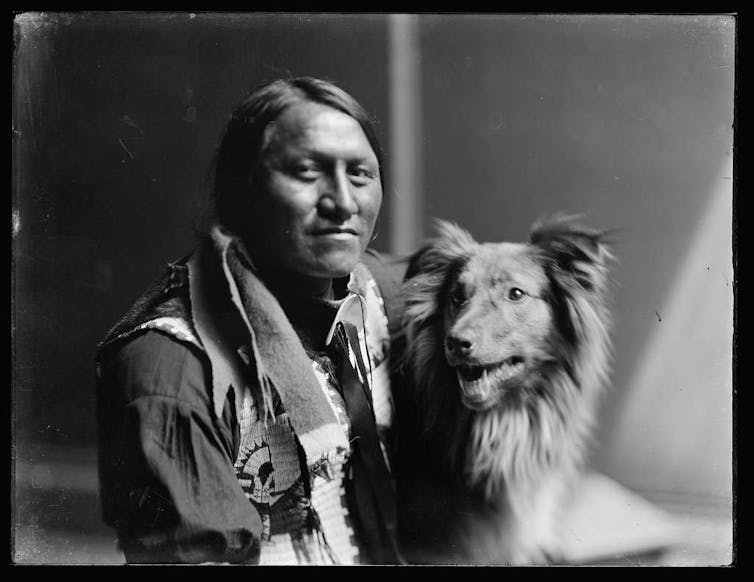
Charging Thunder (George Edward Williams), who was born into the Oglala Lakota tribe of the Sioux Nation, with a shepherd-type dog brought to the Americas by Europeans. Cultural practices involving Indigenous dogs were actively persecuted.
CC BY

Hybridisation can also be beneficial. The acquisition of alleles (a different version of a gene) from another population may improve an animal’s survival in new environments, or make them resistant to new diseases.

The ancestors of modern human populations on the Tibetan Plateau, for example, inherited an allele of the EPAS1 gene from Denisovans (a closely related human species) that improved their ability to live at high altitudes.


Read more:
How breeding with an ancient human species gave Tibetans their head for heights


The dingo debate

Since dingoes were only isolated from other dog populations for a few thousand years, it is not a surprise that they can readily interbreed. The “purity” of dingoes is therefore a great source of conflict between conservationists, farmers and policy makers, and is used by both sides to justify policies to either protect or persecute dingoes.

White dingo with brown markings.
An unusually coloured dingo spotted in Kosciuszko national park, New South Wales.
Michelle J Photography, Cooma NSW Australia, CC BY-NC-ND

Some genetic studies have suggested that dingo-dog hybridisation has not taken place, while others indicate most dingo populations have some level of European dog ancestry. A fundamental issue with these studies is that they require comparison against a “pure” reference population. Given centuries of overlap between dingoes and dogs, it is almost impossible to be sure that modern populations do not have mixed ancestry.

To circumvent this issue, our study sequenced genomes from ancient dingo bones recovered from caves on the Nullarbor Plain in southern Australia. Crucially, this included dingoes that lived and died prior to the arrival of the First Fleet in 1788. Establishing a precolonial baseline of ancestry for dingoes allowed us to to pinpoint the degree of European dog ancestry in dingo populations across Australia today.

Our genetic analysis showed that most dingoes living in the northwest of Australia did not have any detectable European dog ancestry. The opposite was true in the southeast, where almost a quarter of the genome of some dingoes came from European dogs.

Further investigation found that the European ancestry was in fact broken up into small chunks throughout the genome of dingoes, indicating that interbreeding took place at least ten generations (or 30 years) ago.

Aerial baiting with 1080 poison is used to kill introduced mammalian species across Australia and New Zealand.
CC BY-SA

In fact, most of the hybrid mating coincided with the outset of aerial baiting programs in the mid-20th century, when poisoned meat was dropped from helicopters to kill dingoes en masse. This reinforces similar findings in Scottish wildcats, which shows local populations were resistant to interbreeding with invasive (domestic cat) populations until their own numbers declined to the point where finding a suitable mate (another wildcat) became too difficult.

Diversity is the key to success

Superficially, gene flow between dingoes and European dogs sounds like a negative outcome. Our research, however, suggests that dingoes have actually benefited. Hybridisation has led to an increase in genetic diversity in dingoes across southeast Australia, potentially offsetting the negative effects of inbreeding.

We also found evidence that a few alleles, which were transmitted from dogs to dingoes via interbreeding, may provide better protection against infectious diseases brought to the continent by European dogs.

Despite being an introduced species, dingoes are now adapted to Australia’s varied ecosystems. Based on our results, we suggest that instead of prioritising “purity”, future conservation efforts should focus on maintaining large enough populations for natural selection to operate effectively, so that dingoes can maintain their position as Australia’s apex predator.

Hybrids are becoming increasingly common as humans and their domesticates continue to encroach into wild habitats, from Scottish salmon to Andean alpacas. In order to understand the impacts, both positive and negative, of this hybridisation, our results suggest we must first look to the past.

The Conversation

Laurent Frantz receives funding from the European Research Council, and the Deutsche Forschungsgemeinschaft

Greger Larson and Lachie Scarsbrook do not work for, consult, own shares in or receive funding from any company or organisation that would benefit from this article, and have disclosed no relevant affiliations beyond their academic appointment.

ref. How European colonisation has created more animal hybrids – https://theconversation.com/how-european-colonisation-has-created-more-animal-hybrids-264624

Wicked: what lies beneath correcting the way people speak?

Source: The Conversation – UK – By Emma Humphries, Research Fellow, School of Arts, English and Languages, Queen’s University Belfast

“Pink goes good with green.” This is a lesson we learned from Glinda (Ariana Grande) in Wicked part one. But do you remember the line that comes after that?
“Goes well with green.”

A small, easily missed comment from the green-skinned outsider Elphaba (Cynthia Erivo), but one that reveals something important about language and common usage. Hierarchies of “correct” and “incorrect” language are not just found in grammar books and classrooms, but in popular culture too.

From “holding space” to “sex cardigans”, Wicked continues to dominate popular culture, but one thing that has been overlooked is Elphaba’s insistence on correct language.

In the first film, we see Elphaba ostracised and eventually positioned as public enemy number one by the Oz propaganda machine. From the film’s very opening, a flashforward to citizens celebrating Elphaba’s death, her unpopularity is made clear in the song No One Mourns The Wicked.

One way in which the filmmakers signal Elphaba’s unlikeability is through her often awkward, borderline rude social encounters, including when she first meets her frenemy, Glinda. It’s safe to say that the two characters don’t hit it off and Elphaba’s correction seems to upset Glinda.

Glinda: I could care less what others think.

Elphaba: Couldn’t.

Glinda: What?

Elphaba: You couldn’t care less what other people think. Though, I … I doubt that.

In the land of Oz, where people “pronuncify” and “rejocify”, are “disgusticified” and “moodified”, Elphaba’s comments demonstrate the idea that there is only one correct way to use language and that incorrect language should be corrected.

From stage to cinema

Elphaba’s corrections are not in the original stage musical. They were added to the film. The adaptation of a stage show for film offers an opportunity to modernise and change parts of the story that have been controversial or become outdated.

One excellent example of this in Wicked is its improvement of the stage show’s depiction of disability. The addition of language policing, however, is more disappointing. Because when we correct someone’s language, it’s about much more than the words themselves.

Correcting language is not neutral. When we place value on using language correctly, those who fall short often find themselves judged and discriminated against.

The policing of correct language can be seen as a gatekeeping tool, deciding who belongs and who is excluded. This has inevitable consequences for diversity. The way we speak, write and sign can reflect many aspects of our identities: where and how we grew up, our gender, age and race.

Rules and rebellion

With the run time of the films almost doubling that of the stage show, there is much more time devoted to character development in the films. Elphaba’s language pedantry has been added to demonstrate how she can rub people up the wrong way. However, it also suggests an adherence to authority and to socially constructed rules that stands in contrast to her character more broadly.

Elphaba is an outsider who starts the film wanting to be “degreenified”, but by the end of Wicked part one and as a main storyline in Wicked: For Good, she is willing to sacrifice her safety and reputation to do what is morally right, rather than what is socially acceptable.

Adherence to the strict rules of correct language suggests the opposite: a tendency to want to be accepted and to uphold the societal status quo. Elphaba resists social norms in every other respect, yet the film makes her a standard grammar enforcer.

Given that this trait is absent from part two, rather than undermining her personality as a resister, perhaps this further signals Elphaba’s journey from wishing to fit in to fully embracing her outsider status. Indeed, Elphaba’s insistence on correctness speaks to a broader challenge facing anyone positioned as an outsider: having to work that much harder to be accepted.

Glinda’s (famous) need to be popular and her interests in social climbing align with traits of a language enforcer, yet her behaviour tells a different story. She corrects language only once and it concerns her original name, Galinda. When Dr Dillamond, a professor at Shiz University – who also happens to be a goat – struggles to pronounce the “gah” in Galinda, Glinda corrects his pronunciation and berates him.

This moment, present in both the stage musical and the film, does not reflect a desire to uphold the prescriptive rules of the language, but rather a personal motivation. Glinda’s name is central to her self-image and public persona, and protecting that matters to her.

Beyond Oz

In an era when equality, diversity and inclusion initiatives are being rolled back, and languages other than English face renewed marginalisation, Wicked offers a case study in how linguistic hierarchies operate under the radar of popular culture. But there are plenty other examples. Think about Ross in Friends, Ted in How I Met Your Mother and Sheldon in The Big Bang Theory – all notorious language correctors.

Elphaba’s corrections are more than just a shorthand to signal an abrasive character. They reflect the linguistic hierarchies and gatekeeping that exist beyond Oz. Using language “correctly” is a marker of belonging and shows adherence to societal norms.

Across the two films, Elphaba moves from wanting to conform and erase a stigmatised part of her identity, her skin colour, towards rebellion against convention. It’s clear she questions blind adherence to political power, but perhaps this extends further to questioning the rules we construct around language.


Looking for something good? Cut through the noise with a carefully curated selection of the latest releases, live events and exhibitions, straight to your inbox every fortnight, on Fridays. Sign up here.


The Conversation

Emma Humphries receives funding from The Leverhulme Trust and is currently employed by Queen’s University Belfast.

ref. Wicked: what lies beneath correcting the way people speak? – https://theconversation.com/wicked-what-lies-beneath-correcting-the-way-people-speak-270639