It’s December, the weather’s turning, and the holidays are fast approaching. You’ve got to find the perfect gift for your partner, parents or that weird relative you only see once a year. At work, there’s the secret Santa for a colleague you barely know, and the office party you’d rather avoid.
Maybe you’re planning Christmas lunch – is it turkey and all the trimmings? There’s travel to sort out, dodging the rush hour trains or traffic. You might feel obliged to appear merry, even if you’re already exhausted.
Where exactly did this to-do list come from? Many of these pressures – these “got tos” – have their basis in social norms, not actual rules.
Social norms are unwritten rules or expectations that guide our behaviour. They reflect what we perceive as normal or correct in a given situation. Norms can help to create a sense of belonging, set expectations and help us avoid social friction. But norms can and do change.
While social norms can be important for regulating group behaviour and relationships, people can feel pressure to conform to these expectations. Not conforming could have potential consequences – like feeling socially excluded or losing status – but this will depend on the social group. Saying that, you’re allowed to reinterpret norms, question them or ignore them entirely.
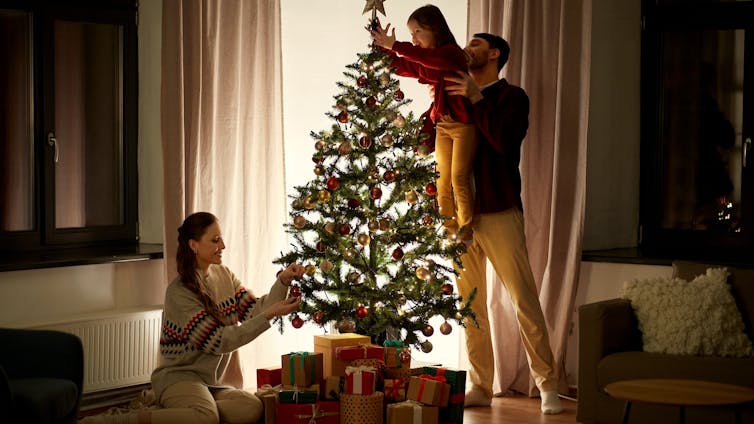
In the UK, buying and sharing gifts, going to the work party, having large family gatherings, wearing Christmas jumpers, putting up decorations, eating and drinking too much and spending more money than usual are common Christmas norms. These norms are context-dependent though. Other countries, cultures and religions may have their own unique norms or not share celebrations at this time of year.
Social norms shape our sense of what we think we should do or feel during the festive season. Such norms can be positive or negative in nature, and may not always be helpful to adhere to.
Christmas norms have many origins. The pressure to buy “the perfect gift” largely emerged from 20th-century mass marketing, which encouraged people to spend more in shops and buy specific products. Other traditions, like sending Christmas cards, pulling crackers or decorating Christmas trees, date back to the Victorian era.
Today, the internet and social media expose us to a stream of photos, posts and adverts presenting an idealised Christmas. Television and film also reinforce polished images of festive harmony. We might see these portrayals weeks or months before Christmas, shaping our expectations – and possible anxieties – about how we ought to celebrate.
Why we follow norms
We tend to follow social norms through conformity: changing our behaviour to align with what we think others are doing or think is important. Sometimes we do this to fit in (known as normative influence). Other times we do it because we believe others know the right thing to do (informational influence).
Several things could make Christmas norms feel powerful.
Social comparison plays a big role. A perfectly staged Instagram photo of a family in matching jumpers, smiling in front of a table piled high with food, can pressure others to match or outdo that ideal. Not meeting such perceived standards may make us feel worse about ourselves in comparison.
Mere exposure can also be important. Simple repeated viewing of others’ Christmas posts on social media can influence what we think is the norm.
We may also fear judgement for not conforming. Having a smaller Christmas, changing traditions or opting out entirely can feel risky if we worry others will see us as stingy, antisocial or a grinch.
Another factor is pluralistic ignorance: assuming everyone else loves and expects full-scale Christmas celebrations. Others might actually prefer a smaller, quieter Christmas, but feel they can’t have one. My research with colleagues frequently finds that people misperceive what others actually think or do, and these misperceptions add extra pressure to conform to an imagined standard.
None of these factors make us irrational. Perceived social norms are a useful guide and can provide comfort, predictability and connection. But when norms become rigid they can generate stress, financial strain and emotional burnout. Rethinking such norms isn’t rebellious – it’s healthy.
How to let go of Christmas norms
Understanding these pressures can help us make conscious choices about which traditions to keep and which to let go. We know that social norms can be flexible, develop and change over time. Most families already have their own variations on Christmas norms and traditions.
Mine certainly does. In the 1990s, we always visited my grandparents on Christmas Eve for a family meal. Grandad, a non-smoker for the rest of the year, was known to treat himself to a Christmas cigar and a whisky. As kids, we were allowed to open a few presents early because Grandma had “spoken to Father Christmas” – and we didn’t argue with her.
Later on, we stopped having turkey on Christmas Day. My brother and I were never that keen; what we really wanted were the Yorkshire puddings and pigs in blankets. Eventually we shifted to different meals altogether, including curries and Mum’s famous spaghetti bolognese. Dad, who liked traditional roast meals, missed turkey – but our neighbours would sneak over a leftover plate across the fence so he didn’t lose out.
None of these changes meant abandoning tradition or rejecting each other. They simply reflected what worked for us. Often, doing Christmas differently opens the door for more honest conversations about what people enjoy and what they find overwhelming.
Our perceptions of what we think we should do can lead us to take on obligations we might not actually want. Notice which norms feel meaningful to you, and which feel burdensome. You could travel less, spend less, do less or simply not feel festive. You can keep some traditions and let others go. You can establish your own Christmas norms – or have none at all.
Robert Dempsey receives funding from the BIAL Foundation for ongoing psychometric research..
Forget Die Hard, Eyes Wide Shut is really the Christmas film hiding in plain sight.
Released in 1999 and set entirely during the festive season, the film follows a doctor, Bill Harford (Tom Cruise), whose wife Alice (Nicole Kidman) admits she once considered an affair. Shaken, he becomes obsessed with pursuing his own sexual encounter and stumbles into an underground world of masked orgies and ritualised desire.
Director Stanley Kubrick chose Christmas after deciding that the original mardi gras setting from Arthur Schnitzler’s novella wouldn’t work in contemporary New York. Christmas offered the closest equivalent. After all, it’s a modern period of ritual excess, indulgence and office-party transgressions.
It’s also a season of overeating, drinking and heightened expectations, which makes it the perfect environment for exploring jealousy, deceit and desire, the film’s defining concerns.
Kubrick also uses Christmas to highlight the thin line between social and sexual ritual. Both are governed by rules, masks and secrecy, and by the privileges of those with enough power or money to ignore the rules altogether.
Eyes Wide Shut (1999) Official Trailer.
In this, Kubrick was curiously prophetic, pointing to the predations of the likes of Jeffrey Epstein. Meanwhile, the lavishness hints at the world of Donald Trump, who, when Kubrick made the film, was just a real estate and hotel entrepreneur.
Christmas is also the season for performing middle-class normality, a performance the film slowly unravels. The festive backdrop disguises the fact that Kubrick recreated New York on London streets and soundstages, contrasting choreographed gaiety with the darker psychological terrain of the story.
The setting also serves a crucial aesthetic purpose. The near-pervasive Christmas lights and decorations suit Kubrick’s love of practical lighting. These are visible, realistic light sources that add texture and colour, contributing to its dreamlike atmosphere. The original story he adapted was called Traumnovelle (German for “dream story”).
There may have been another reason, too. As I’ve written about extensively, Bill functions as a hidden Jewish character like the protagonist of the original book. The pervasiveness of Christmas underscores his sense of being an outsider. As Kyle Broflovski sang in the TV series South Park: “It’s hard to be a Jew on Christmas.”
Eyes Wide Shut depicts the upper-middle-class and moneyed elites of Manhattan, who use those beneath them to “service” their needs. Bill is summoned for his medical expertise when a sex worker overdoses at Victor Ziegler’s lavish party. He might just as easily be a plumber called to fix a leak.
Sex workers fare worse still. In the masked ceremony, the naked participants are staged as tableaux, basically objects, even furniture, for others’ pleasure.
Christmas consumerism also frames Bill and Alice’s marital tensions. The film repeatedly places Bill in service spaces like coffee shops, boutiques, hotels and hospitals. Even the apartment of Domino, the sex worker he meets, is presented as a workplace. On her shelf sits a copy of Introducing Sociology, reinforcing the consumerist theme.
By contrast, the Harfords’ flat, modelled on Kubrick’s own 1960s New York apartment, is warm and inviting. Kubrick lingers on domestic rituals such as brushing teeth, undressing, everyday movement. But even this comfort feels modest beside Ziegler’s townhouse or the opulent mansion where the orgy takes place.
Class anxiety runs through the film. Bill is preoccupied with his status, flashing his medical ID to access restricted spaces like the morgue and a closed costume shop. But such credentials barely get him close to the elite worlds he longs to enter.
To infiltrate them, he must use disguise. Money guides him; his wallet is always full, and his very name, Bill, seems a wry nod to economic power. Affluent by ordinary standards, he is still dwarfed by Ziegler’s wealth.
His masculinity is even more under threat. Alice cuckolds him, shattering his complacent illusion of security. She revels in puncturing his smugness.
Kubrick played cleverly with Tom Cruise’s Mission Impossible persona, simultaneously using and undermining it. Bill’s most heroic act is offering a handkerchief to a model. “That’s the kind of hero I can be,” he says.
We’re not sure whether he’s being self-deprecating. He is flirting, but all his sexual encounters other than those with Alice are unconsummated. The only real act of heroism in the movie is done for him when the mysterious woman saves him at the orgy.
Why was the film so misunderstood?
When Eyes Wide Shut was released, audiences had been waiting 12 years for a new Kubrick film. If you wait 12 years for anything, you’ll probably be disappointed.
Many expected another grand narrative about war, geopolitics or technology. Instead they found a slow, dreamlike study of marital insecurity. And because the film opened in July, most critics missed its subversive Christmas commentary entirely. They didn’t connect the dots.
Kubrick spent his career making subversive films, intellectually and technologically. Eyes Wide Shut was no exception. As his final work, it stands as the ultimate counter-Christmas film, made, fittingly, by a man who knew what it meant to be a lonely Jew at Christmas.
Nathan Abrams has received external funding from government-funded organisations, charities, foundations, and research council grants.
On sait que la consommation d’alcool est dangereuse pour la santé. Mais ses effets ne s’arrêtent pas là. Par exemple, les hommes subissent plus de conséquences liées à leur propre consommation que les femmmes. Ils sont plus touchés par l’agressivité, les accidents et les blessures. Mais lorsqu’un homme boit, les femmes et les enfants qui lui sont proches en paient souvent le prix également.
Je fais partie d’un groupe mondial de chercheurs en santé qui s’est attelé à étudier comment et dans quelle mesure la consommation d’alcool des hommes nuit aux femmes et aux enfants.
Notre étude récente s’appuie sur trois grandes revues de la littérature sur le sujet. Elle porte des résultats obtenus à partir d’études menées dans des pays riches, pauvres et à revenu intermédiaire. Celles-ci portaient sur les préjudices causés aux femmes, aux enfants et aux options politiques visant à réduire la consommation nocive d’alcool chez les hommes. Les analyses ont porté sur 49 études et 11 analyses couvrant la période 1990-2023.
Nous avons synthétisé les données afin d’éclairer les politiques publiques, les pratiques et les futures recherches. Nos résultats suggèrent des pistes de changement systémique et d’amélioration de la santé et du bien-être des femmes et des enfants dans le monde.
Ce que nous avons découvert
Les trois études révèlent que les hommes boivent plus que les femmes. Sous l’effet de l’alcool, ils adoptent parfois des comportements nocifs : agressivité, violence, tension dans la famille, contrôle du partenaire et la coercition sexuelle. Ils s’absentent aussi souvent du foyer pour aller boire et ne mettent pas toujours les besoins des femmes et des enfants en priorité. Quand les hommes dépensent l’argent du ménage pour l’alcool, il n’en reste pas assez pour la nourriture, les frais scolaires ou les médicaments. Cela nuit directement aux femmes et aux enfants.
Les femmes interrogées rapportent les actes de violence et d’agression liés à l’alcool. Il s’agit notamment de coups de poing, de coups de pied, des brûlures et des passage à tabac.
Mais les effets de la consommation d’alcool des hommes ne sont pas toujours visibles. Beaucoup de femmes parlent de préjudices cachés subis avec un partenaire alcoolique : l’embarras, la honte, l’isolement pour éviter les humiliations en public et le sentiment de solitude lié au fait d’avoir un partenaire alcoolique. Ce stress peut conduire à la dépression, à l’insomnie, voire à des pensées suicidaires.
Une femme a déclaré :
Je déteste vraiment ce que l’alcool lui fait. On se dispute à la maison. Ensuite, il débarque ivre à mon travail et exige qu’on parle de notre dispute sur place. Il m’humilie devant mes collègues.
Une autre a dit :
Je ressens une sorte de réaction traumatique lorsque les gens boivent trop autour de moi. Donc je ne fréquente pas beaucoup ce milieu.
Les enfants sont également touchés
Lorsque les hommes boivent de l’alcool, cela peut avoir directement ou indirectement des conséquences préjudiciables aux enfants. Les hommes peuvent mettre en danger la sécurité et le bien-être de leurs enfants en les exposant à leur propre violence, soit comme cibles, soit comme témoins.
Des recherches ont montré que lorsque les enfants grandissent dans des foyers où règne la violence, ils courent le risque de subir toute une série de conséquences négatives. On peut en citer de mauvais résultats scolaires, une faible estime de soi et le fait que les enfants deviennent eux-mêmes auteurs ou victimes de violence. Lorsqu’il y a des disputes à la maison, les enfants deviennent des victimes actives ou silencieuses.
Les études examinées montrent que la consommation d’alcool chez les hommes peut également conduire à la négligence et à la maltraitance des enfants. Les enfants dont les pères boivent beaucoup peuvent ne pas se sentir aussi proches d’eux sur le plan émotionnel, car ils ont peur de leurs pères lorsqu’ils sont ivres. L’alcool peut créer des conflits dans le foyer, dont un désengagement des responsabilités par ou une distanciation progressive.
La consommation d’alcool est souvent considérée comme une question privée, mais elle est influencée par de nombreux facteurs au niveau de la société, de la communauté et du foyer.
Par exemple, les lois et les politiques en matière d’alcool ont une incidence sur la disponibilité de l’alcool, le nombre de points de vente d’alcool dans les quartiers et l’âge approprié pour acheter de l’alcool. La consommation d’alcool a un impact sur le bien-être et la sécurité dans les foyers, les communautés et la société.
Nous avons constaté que les femmes et les enfants des pays pauvres sont les plus touchés par les effets de la consommation d’alcool des hommes, car ils disposent de moins de ressources. De plus, dans ces sociétés, il est plus souvent considéré comme normal que les hommes boivent ou abusent des femmes, comparé aux pays plus riches.
Que peut-on faire pour y remédier ?
Les gouvernements et les autorités sanitaires se concentrent principalement sur la réduction des risques encourus par les buveurs eux-mêmes. Par conséquent, les politiques, les programmes et les services mis en place sont centrés sur l’individu.
Bien que les recherches montrent que les buveurs peuvent être aidés grâce à des programmes de soutien par les pairs comme les Alcooliques Anonymes, ou par un accompagnement psychologique individuel incluant des interventions brèves, ces programmes doivent s’inscrire dans un environnement social et politique qui encourage un changement positif et tient compte des questions de genre.
Notre étude a révélé que les politiques et les programmes doivent tenir compte des préjudices par les autres, en particulier les femmes et les enfants. Une façon d’y parvenir consiste à associer les interventions en matière d’alcoolisme à des interventions communautaires axées sur les préjudices qui touchent spécifiquement les femmes et les enfants. Une première étape utile consiste à concevoir des interventions qui sensibilisent à l’abus d’alcool en tant que problème de santé publique touchant de manière disproportionnée les femmes et les enfants. Il faut combiner ces actions avec avec des programmes de traitement et de dépistage dans les établissements de soins primaires.
On peut aussi instaurer des « zones sèches » où la consommation d’alcool est interdite. Ces zones peuvent couvrir un quartier, une ville ou une région. Mais généralement les restrictions et les interdictions de vente d’alcool ne concernent que les espaces publics comme les parcs et abords des routes.
Les gouvernements du monde entier doivent donner la priorité aux politiques en matière d’alcool qui se sont avérées efficaces et rentables :
réduire la disponibilité et l’accessibilité financière de l’alcool
garantir qu’il ne soit pas vendu à des personnes n’ayant pas l’âge légal pour consommer de l’alcool
limiter l’exposition des enfants à la commercialisation et la publicité de l’alcool.
Cependant, les gouvernements doivent aller plus loin en tenant compte des effets de l’alcool et ses méfaits sur les femmes et les enfants. Les politiques de lutte contre l’alcool ne peuvent pas être séparées des questions de genre et de pouvoir qui, dans de nombreuses sociétés, contribuent à ses méfaits.
Leane Ramsoomar reçoit un financement du Conseil sud-africain de la recherche médicale.
Alors que le train connaît un engouement depuis la fin du Covid-19, les difficultés pèsent sur certains segments du secteur ferroviaire, comme le train de nuit. Le (re)déploiement de ce service populaire et bas carbone est contraint par une pluralité de facteurs.
Que ce soit à l’international ou à l’échelle de la France, la relance du train de nuit se fait attendre au regard de ce qu’annonçait le gouvernement au sortir de la crise du Covid-19. Si le contexte semble favorable avec près de 114 milliards de voyageurs-kilomètre et une hausse de 6 % par rapport à 2023 et de 14 % par rapport à 2019, l’un des parents pauvres du secteur ferroviaire de voyageurs semble être le train de nuit.
Alors que le rapport additionnel à la LOM prévoyait une colonne vertébrale, avec un réseau structurant composé d’une dizaine de lignes, la situation à la fin de 2025 n’est pourtant pas flamboyante. En France métropolitaine, la ligne Paris-Aurillac, ouverte en 2023, est la dernière en date d’un plan de relance ligne par ligne (Paris-Tarbes-Lourdes, Paris-Nice), initié il y a quelques années par l’État.
Le bilan de la relance des dessertes de nuit en Europe est plus négatif, du moins vu depuisla France. Si l’Autriche, par l’intermédiaire de son champion ÖBB, est le fer de lance des lignes européennes depuis quelques années déjà, les liaisons internationales au départ ou à destination de la France peinent à être relancées. Quand elles ne disparaissent pas purement et simplement.
Un exemple du renouveau des lignes internationales
Le cas récent des lignes Paris-Berlin et Paris-Vienne mises en place en décembre 2023 et qui seront arrêtée le 14 décembre prochain, est particulièrement éclairant sur les contraintes fortes qui viennent contrarier la relance du train de nuit à l’échelle européenne. cette réouverture était pourtant présentée comme l’exemple du renouveau des lignes internationales de nuit, notamment suite à l’arrêt en 2021 d’une autre ligne Paris-Milan-Venise opérée par Thello, une entreprise née de l’entente entre Veolia et Trenitalia.
La ligne s’insèrerait pourtant très bien dans les objectifs européens de réduction des émissions de gaz à effet de serre, en sachant que le secteur des transports est le premier émetteur de CO2 en France. Le déploiement de l’usage du train, et du train de nuit en particulier, répond aux objectifs du Green Deal européen annoncé en 2019 avec l’objectif d’une neutralité carbone pour toute l’économie à l’horizon 2050. Pourtant, seulement 2 années plus tard, l’ensemble des partenaires du projet (ÖBB, Deutsche Bahn et SNCF) ont annoncé la fin du service, avec pour principale raison, l’arrêt de la subvention de l’État français.
Pas de compensation au retrait français
À l’origine, la participation de l’État était conditionnée à la mise en place d’une desserte quotidienne entre l’ensemble des villes avec un train comptant 12 wagons, avec séparation en 2 : 6 voitures pour Berlin et 6 pour Vienne. Face au constat de la mise de seulement 3 allers-retours par semaine, l’État français a décidé de suspendre la participation, ce qui a mécaniquement condamné la ligne, dans un contexte où les autres partenaires ne souhaitent pas compenser ce retrait.
Tout n’est pourtant pas perdu pour les lignes internationales de nuit puisque, devant cet échec, l’entreprise belgo-néerlandaise European sleeper constituée sous forme de coopérative a souhaité reprendre la ligne pour une ouverture prévue le 26 mars 2026. Détail non négligeable, l’opérateur, déjà présent sur le segment Bruxelles-Prague, ne bénéficierait pas de subvention publique pour le fonctionnement de la desserte.
Les difficultés d’une relance
À l’image du cas des lignes intérieures en France, cet exemple international souligne toutes les difficultés de relance d’un mode de transport alors qu’il répond à des enjeux de décarbonation du secteur. Cette expérience met en évidence le faisceau de contraintes qui pèsent sur le train de nuit. Elles ne se réduisent pas uniquement au caractère internationale de ce type de ligne, comme les changements de locomotives ou encore la planification des horaires pour plusieurs pays.
En effet, si le taux de remplissage de la ligne était jugé correct (près de 70 %), ce service et plus généralement l’ensemble des trains de nuit sont contraints par un déficit d’investissement dans le matériel roulant. En France, l’État a financé dans le cadre du Plan de relance, une rénovation du matériel, en particulier pour les trains de nuit, qui aujourd’hui a plus de 45 ans. Certaines compagnies, n’ayant pas le matériel en propre, se tournent vers la location notamment dans le cas des Rosco (Rolling Stock Company). Dans ce schéma, des entreprises achètent le matériel roulant et le louent aux compagnies. L’intérêt est de ne pas supporter des coûts d’investissements très importants avec une maintenance intégrée. Néanmoins, le bilan financier est moins intéressant sur l’ensemble de la durée de location.
C’est dans l’air France TV 2025.
À ces contraintes matérielles s’ajoute le pan financier inhérent au fonctionnement des lignes de nuit (équipage, contrôleur) et l’impossibilité de faire plusieurs rotations compte tenu de la longueur des parcours, comparativement à des TER, TGV et même par rapport à l’aérien. Ajoutons le coût du péage et l’utilisation du réseau la nuit qui coïncide avec les phases de travaux. Ces derniers ont eu un impact non négligeable sur les problèmes de ponctualité du Paris-Berlin et du Paris-Vienne.
Concurrence interne
Enfin, last but not least, le train de nuit souffre de la concurrence, y compris dans son propre segment. À titre d’exemple, on peut rappeler l’ouverture d’une liaison à grande vitesse en ICE (InterCity Express) Paris-Berlin direct, depuis décembre 2024, portée par un partenariat entre les opérateurs SNCF et Deutsche Bahn. Le trajet en ICE, c’est-à-dire à grande vitesse, s’effectue en 8 heures avec la desserte de quelques villes intermédiaires comme Strasbourg ou Karlsruhe.
Le train de nuit s’inscrit depuis plusieurs années dans un contexte de fortes incertitudes sur la pérennité de l’offre, du moins dans le cas de la France. Il semble en effet que la SNCF, par ses réticences, souffle le chaud et le froid. Simultanément, aucun opérateur ne semble être à l’heure actuelle en mesure de développer une offre propre, comme en témoigne l’expérience ratée de Midnight Trains pour des questions principalement financières.
Guillaume Carrouet ne travaille pas, ne conseille pas, ne possède pas de parts, ne reçoit pas de fonds d’une organisation qui pourrait tirer profit de cet article, et n’a déclaré aucune autre affiliation que son organisme de recherche.
The increasing teacher shortage is a concerning global crisis. It will reach a shortfall of 44,000,000 teachers by 2030, according to the United Nations Educational Scientific and Cultural Organization.
From rural and remote school districts struggling to recruit staff to urban districts scrambling to cover classrooms, the signs are everywhere: unfilled positions, growing reliance on uncertified substitutes and an overextended workforce.
Canada is no exception. Ontario anticipates a full-blown shortage in core areas like French immersion by 2027. In British Columbia, uncertified teachers filled an estimated 20 per cent of teaching positions in the Peace River South district during 2023–24.
Yet, as our research is examining, internationally educated and experienced teachers (IETs) remain sidelined, underemployed or forced into careers outside education.
In our ongoing study with IETs in the B.C. interior, and in our work there, we’ve seen that many IETs have masters degrees or PhDs.
Findings from a 2024 study conducted on behalf of B.C.’s Ministry of Education and Child Care revealed systemic barriers to certification in the province for internationally educated and experienced teachers, including long wait times, unclear application procedures and high costs. The study included more than 730 survey responses and numerous interviews.
Barriers to teaching
Many internationally experienced and educated teachers who participated in the B.C. ministry study expressed frustration. Some considered abandoning their goal of teaching in B.C. altogether.
Key obstacles included requirements such as completing a new practicum and taking additional coursework at Canadian universities. Many study participants perceived these additional requirements as redundant and exclusionary given their prior qualifications and professional experience.
This begs the question, why are highly qualified IETs less able to secure teaching jobs in Canadian public schools?
Canadian teaching standards
The argument made by Canadian credentialing bodies is that their processes are in place to protect Canadian professional teaching standards. No one would argue with the importance of maintaining high standards, particularly in an education system highly regarded around the world, with students ranking comparatively highly on international tests.
The demographics of internationally educated and experienced teachers mirror the diversity of Canadian classrooms. Despite diverse Canadian classrooms, the teaching workforce remains predominantly white. The systemic distrust for internationally educated and experienced teachers comes at a steep price.
Students lose out on the diversity of perspectives and the cultural wealth these professionals bring. Schools miss out on teachers fluent in multiple languages, familiar with global education and research — and ways of teaching experienced in contexts of migration, displacement and resilience.
Ongoing research
Our ongoing study examines the experiences of 11 IETs who are participating in an orientation to Canadian kindergarten to Grade 12 education course and learning in K-12 classrooms in an interior city of B.C.
Early data from interviews with these study participants, teacher mentors and district administrators confirms the benefits of integrating IETs into our classrooms. Students in K-12 respond positively to seeing a teacher in the classroom who looks like them.
Many of the IETs participating in our study have moved from large metropolitan areas in their country of origin. Their ability to move from cities such as Shanghai, Manila, Jakarta, Delhi, Tokyo — with recorded populations of well over 25 million — to a small semi-rural urban centre of less than 100,000 people shows great adaptability.
While the adjustment requires a reorienting of thinking, these IETs do adjust, demonstrating adaptability. They come to love the open space and access to nature that Canada offers. They also value the sense of community found in small cities.
They want to stay. They are willing to relocate to stay. They need to work, and they want to be teachers. They just need an opportunity to demonstrate skills.
Extensive prior experience, resilience
One factor fuelling Canada’s teacher shortage is burnout. Many leave the profession within just a few years, citing overwhelming workloads, lack of support and mental health strain.
Around 25 to 75 per cent of Canadian teachers report experiencing moderate to severe burnout, with high emotional exhaustion affecting up to three quarters of teachers in some provinces.
Against this backdrop, IETs represent a formidable, yet under-tapped, resource. These educators have already demonstrated resilience. Many have taught in environments with class sizes of 50 or more, managed demanding schedules with little institutional support and thrived where resources are scarce.
Learning curve is expected for many teachers
The concern that internationally educated teachers lack Canadian classroom experience is no different from the learning curve faced by novice teachers educated in Canada.
In contrast, IETs often bring extensive prior experience and resilience.
Fear from employers
The fear — often unspoken — is that recognizing their qualifications would mean lowering standards. But this argument has no validity.
The B.C. Teacher Regulation Branch (TRB) currently grants internationally certified teachers temporary teaching permits, typically valid for three years. But rather than assessing these teachers’ suitability based on demonstrated classroom performance during that period, the TRB requires them to complete multiple additional university courses before obtaining a full B.C. teaching certificate.
The best way to understand existing school systems is to work in them — to teach, to interact with students and colleagues, to participate in the daily life of a school.
By denying internationally trained teachers this route, B.C. undermines its own educational philosophy.
If Canada is serious about addressing the teacher shortage, it must take immediate steps to dismantle credentialing barriers for IETs. Canada cannot afford to let bias stand in the way of solutions. Internationally educated and experienced teachers are not a problem to be fixed — they are part of the solution for a system under strain.
Gloria Ramirez receives funding from The Social Sciences and Research Council of Canada
Victoria Handford and Wei Lin Ang do not work for, consult, own shares in or receive funding from any company or organisation that would benefit from this article, and have disclosed no relevant affiliations beyond their academic appointment.
Even after the Second World War ended, sovereignty over Taiwan was never formally settled. China believes Taiwan must be “reunified” with the motherland, if necessary by force.
Most countries, including Canada and the United States, engage with Taiwan in a non-official capacity and simply “acknowledge” China’s insistence that Taiwan is part of China.
China often asserts the 1943 Cairo Declaration as the legal basis for its claim over Taiwan. However, this unsigned media communiqué lacks legal force under international law, something pointed out by British Prime Minister Winston Churchill in 1955.
At the outbreak of the Korean War, U.S. President Harry Truman stated unequivocally that the “determination of the future status of (Taiwan) must await the restoration of security in the Pacific, a peace settlement with Japan or consideration by the United Nations.”
The 1951 Treaty of San Francisco, which ended the war between Japan and the Allied powers, is a legally binding treaty. While Japan renounced “all right, title and claim” to Taiwan, there was no mention of the People’s Republic of China — established only two years earlier — in terms of Taiwanese sovereignty.
The United Nations has never considered, let alone decided upon, the issue of sovereignty over Taiwan. China often cites the UN’s General Assembly Resolution 2758 in 1971 as another legal basis for its assertion of sovereignty over Taiwan. But that resolution only addresses the status of the People’s Republic of China as the legitimate representative of China and makes no mention of Taiwan.
Takaichi’s remarks are simply a reiteration of the late Japanese Prime Minister Shinzo Abe’s remarks that “a Taiwan emergency is a Japan emergency (台湾有事は日本有事).”
With great power comes great responsibility, and this is true for all states. Threats of invasion, the use of force and non-peaceful means of settling disputes are all prohibited under international law. Undiplomatic rhetoric and distortions of history and the law is also detrimental to peace.
As the recent G7 statement states, the international community has “an interest in the preservation of peace and stability across the Taiwan Strait” as China’s military drills and threats of war jeopardize “global security and prosperity.”
In a world beset by conflict in the Middle East and an enduring war in Ukraine, tensions are again heating up in East Asia. Will cooler heads prevail?
Kuan-Wei Chen is the recipient of a Australian Government Research Training Program scholarship.
Source: The Conversation – France (in French) – By Camille Parmesan, Director, Theoretical and Experimental Ecology Station (SETE), Centre national de la recherche scientifique (CNRS); University of Plymouth; The University of Texas at Austin
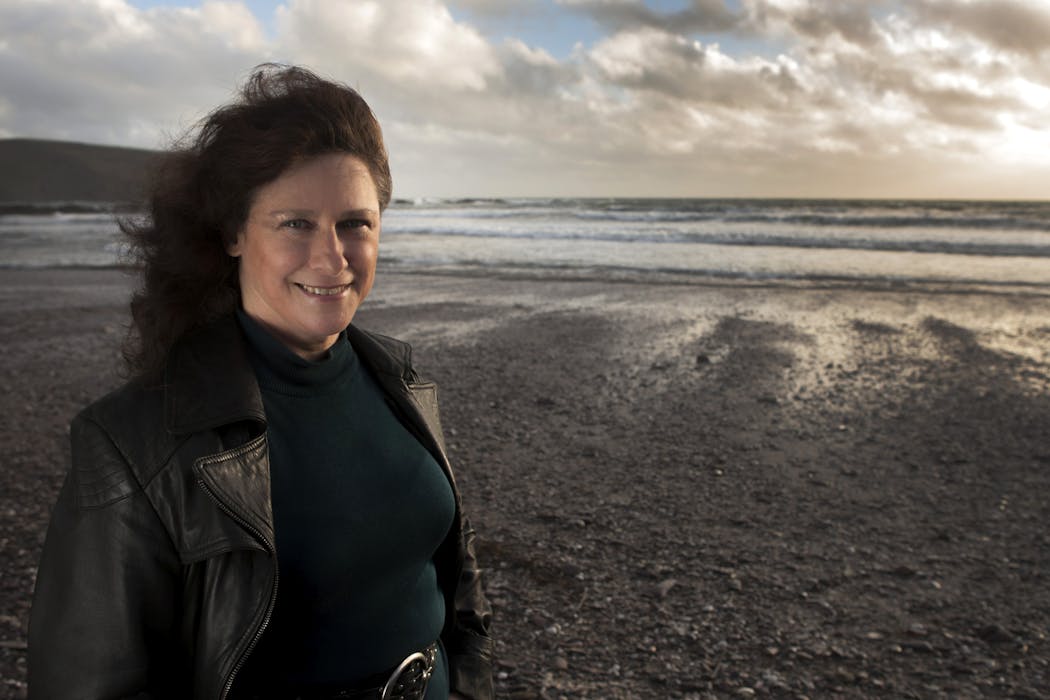
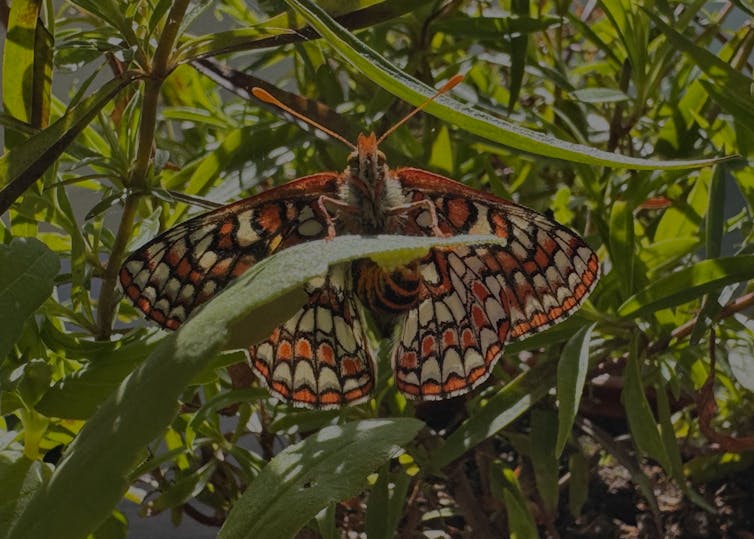
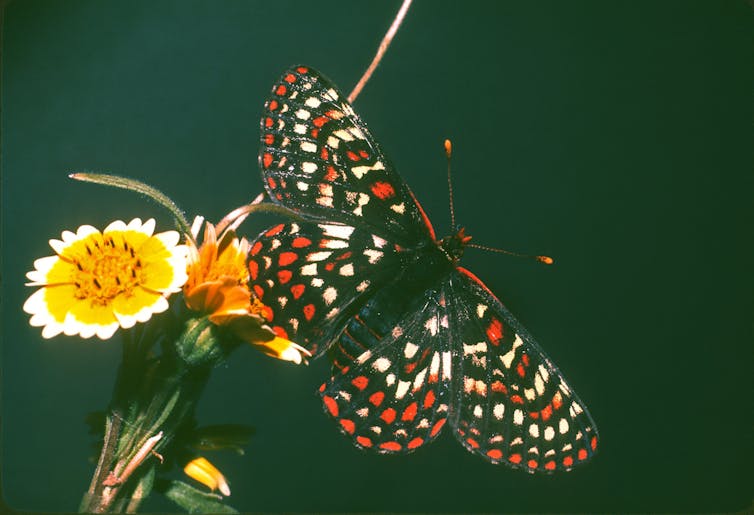
En étudiant les changements d’habitat du papillon damier d’Édith, la biologiste Camille Parmesan a été la première à démontrer l’impact certain du changement climatique sur la faune sauvage. Lloyd Russell, Fourni par l’auteur
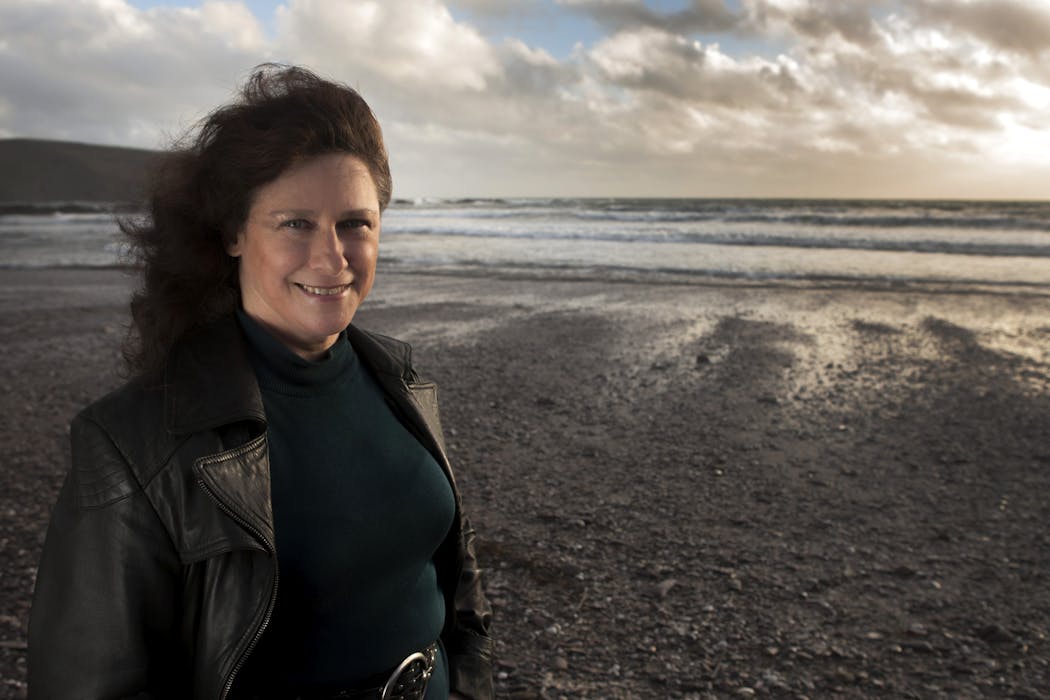
C’est une écologue des États-Unis mondialement connue pour avoir été la première à démontrer l’impact certain du changement climatique sur une espèce sauvage : le papillon damier d’Édith. Ces dernières années, cependant, Camille Parmesan n’est plus seulement célèbre pour son expertise sur l’avenir de la biodiversité dans un monde en surchauffe ou bien pour le prix Nobel qu’elle a reçu avec ses collègues du Giec, mais aussi en raison de son statut de scientifique réfugiée en Europe.
À deux reprises dans sa vie, elle a choisi de déménager dans un autre pays afin de pouvoir continuer à travailler dans un contexte politique favorable à la recherche sur le changement climatique. Elle a ainsi quitté l’Amérique de Trump en 2016, puis la Grande-Bretagne post-Brexit. Elle vit aujourd’hui à Moulis, en Ariège, où elle dirige la station d’écologie théorique et expérimentale du CNRS.
S’entretenir avec elle permet de mieux comprendre comment protéger une biodiversité pleine de surprises, comment faire face à l’hybridation croissante des espèces ou encore que répondre au climatoscepticisme ambiant.
The Conversation : Vos premiers travaux sur les habitats du papillon damier d’Édith vous ont rapidement valu une reconnaissance internationale. Concrètement, comment avez-vous démontré qu’un papillon pouvait être affecté par le changement climatique ? Quels outils avez-vous utilisés ?
Camille Parmesan : Un pick-up, une tente, un filet à papillons, de bonnes lunettes de lecture pour repérer les œufs minuscules et les dégâts causés par les chenilles sur les feuilles, un cahier et un crayon pour prendre des notes ! Sur le terrain, vous n’avez besoin de rien d’autre.
Mais avant de me lancer dans mon travail de terrain, j’ai passé un an à parcourir les musées des États-Unis, quelques autres au Canada, et même à Londres et à Paris, afin de rassembler toutes les données disponibles sur le damier d’Édith. Je recherchais des informations très précises sur sa localisation, par exemple « Il se trouvait à cet endroit, à un mile [1,6 km] de Parsons Road, le 19 juin 1952 ». Car cette espèce vit en petites populations et est sédentaire. Ce processus m’a pris environ un an, car, à l’époque, il n’existait pas d’archives numérisées. Je devais donc examiner des spécimens épinglés et noter à la main les informations relatives à leur collecte.
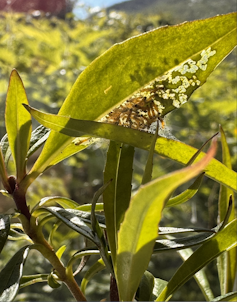
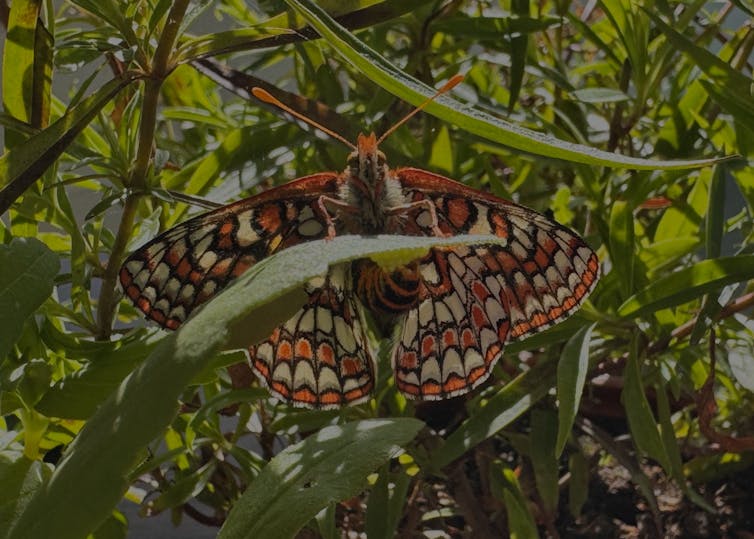
Le damier d’Édith. Singer et Parmesan, Fourni par l’auteur Damiers d’Édith au stade larvaire sur des feuilles de Penstemon. Singer et Parmesan, Fourni par l’auteur
Une fois sur le terrain, mon travail consistait à visiter chacun de ces sites pendant la saison de vol des papillons. Comme cette saison ne dure qu’environ un mois, il faut estimer quand ils voleront à chaque endroit afin de pouvoir effectuer un recensement correct. Pour cela, on commence par rechercher les adultes. Si on n’en voit pas, on ne s’arrête pas là. On recherche des œufs, des traces de toile de soie des jeunes chenilles, des marques de dégâts causés par les larves qui commencent à se nourrir après avoir hiberné…
On examine aussi l’habitat : dispose-t-il d’une quantité suffisante de plantes hôtes saines ou de plantes nectarifères pour nourrir les adultes ? Si l’habitat n’était pas satisfaisant, je n’incluais pas le site en question dans mon étude. Car je souhaitais isoler l’impact du changement climatique d’autres facteurs, tels que la dégradation de l’habitat, la pollution… Sur les sites plus vastes, j’ai souvent examiné plus de 900 plantes avant d’estimer avoir effectué un recensement suffisant.
Aujourd’hui, lorsque vous retournez sur les sites que vous avez examinés ainsi il y a plusieurs décennies, voyez-vous des choses que vous ne pouviez pas voir au début de votre travail ?
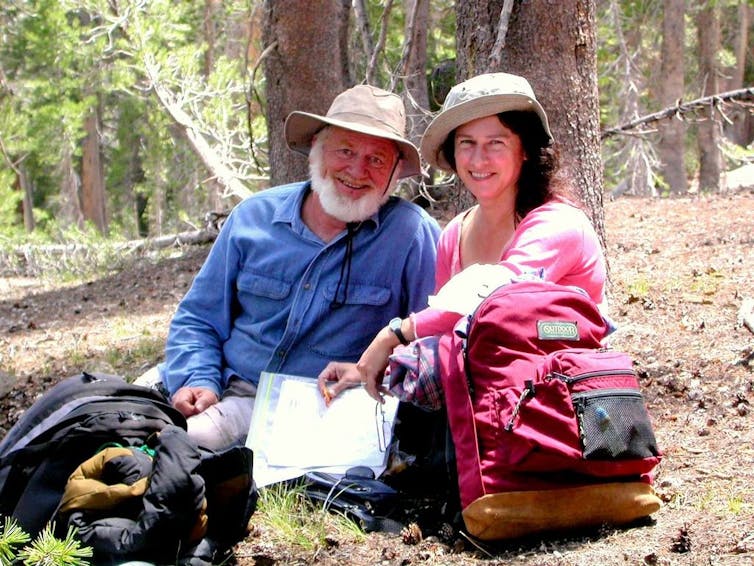
C. P. : Disons que je regarde des choses que je ne regardais pas vraiment lorsque j’ai commencé, il y a quarante ans, ou que mon mari Michael, [le biologisteMichael C. Singer] ne regardait pas lorsqu’il a commencé il y a cinquante ans. Nous avons découvert, par exemple, que la hauteur à laquelle les œufs sont pondus est désormais légèrement plus élevée, ce qui s’avère être une adaptation très importante au changement climatique.
Camille Parmesan et son mari et collègue, le biologiste Michael C. Singer. Fourni par l’auteur
Les œufs sont en fait pondus plus haut parce que le sol devient beaucoup trop chaud. L’été dernier, nous avons mesuré des températures de 78 °C au sol. Ainsi, si une chenille tombe, elle meurt. On peut également voir des papillons se poser et partir immédiatement, car il fait beaucoup trop chaud pour leurs pattes, alors ils s’envolent vers la végétation ou se posent sur vous.
À mes débuts, je n’aurais jamais pensé que la hauteur à laquelle les œufs sont pondus pouvait être importante. C’est pourquoi il est si important pour les biologistes de tout simplement observer l’organisme qu’ils étudient, son habitat, et d’y prêter vraiment attention. Je vois aujourd’hui beaucoup de jeunes biologistes qui veulent se précipiter, attraper le plus possible de spécimen de l’espèce qu’ils étudient, les examiner en laboratoire ou bien les broyer et faire de la génétique. C’est très bien, mais si vous ne passez pas de temps à observer votre espèce et son habitat, vous ne pouvez pas relier tous vos résultats de laboratoire à ce qui se passe réellement dans la nature.
Damier d’Édith femelle et œufs pondus sous une feuille. Singer et Parmesan, Fourni par l’auteur
Grâce à votre travail et à celui de vos collègues, nous savons désormais que les organismes vivants sont fortement affectés par le changement climatique et que de nombreuses espèces doivent modifier leur aire de répartition pour survivre. Mais nous savons également qu’il peut être difficile de prédire où elles pourront persister à l’avenir. Que faire donc pour les protéger ? Quelles terres préserver pour leur permettre de survivre ?
C. P. : C’est la grande question qui tourmente les biologistes spécialisés dans la conservation. Si vous allez à des réunions sur la biologie de la conservation, vous constaterez que beaucoup de gens tombent en dépression parce qu’ils ne savent pas quoi faire.
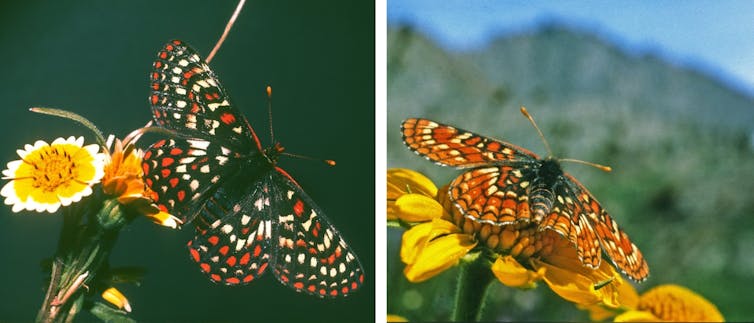
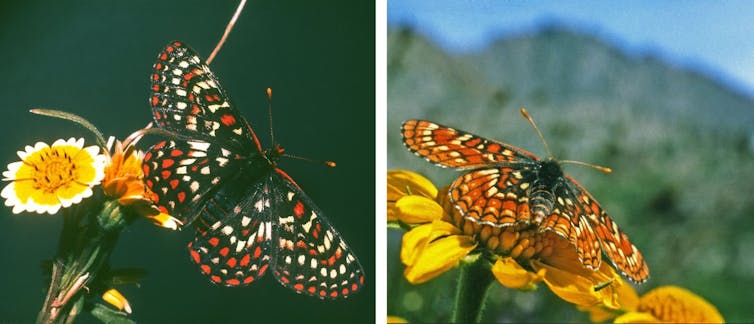
Différences de couleur des damier d’Édith à basse altitude (gauche) et haute altitude (droite). Des recherches menées sur d’autres espèces de papillons montrent que les tons foncés sur les ailes sont une adaptation aux climats plus froids, car ils aident les papillons à se réchauffer au soleil. Singer et Parmesan, Fourni par l’auteur
Nous devons en fait changer notre façon de concevoir la conservation et passer d’une protection stricte à quelque chose qui s’apparente davantage à un bon portefeuille d’assurance. Nous ne connaissons pas l’avenir, nous devons donc élaborer un plan très flexible, que nous pourrons adapter au fur et à mesure que nous observerons ce qui se passe sur le terrain.
En d’autres termes, on ne doit pas s’enfermer dans un seul plan, plutôt partir d’une série d’approches, car vous ne savez pas laquelle fonctionnera.
Nous venons de publier un article scientifique préconisant d’adapter pour la conservation des écosystèmes certaines approches décisionnelles qui existent depuis les années 1960 dans des domaines connus pour leur imprévisibilité, comme l’économie ou la politique urbaine de l’eau. C’est un domaine où l’on ne sait pas à l’avance si l’année suivante sera humide ou sèche. Les urbanistes ont donc mis au point des approches pour faire face à cette incertitude.
Avec les ordinateurs modernes, vous pouvez simuler 1 000 scénarios futurs et vous demander : si nous prenons cette mesure, que se passera-t-il ? Vous constatez alors que certains scénarios sont favorables, d’autres défavorables, et d’autres encore mitigés. À partir de là, il faut chercher un ensemble de mesures dites « robustes », c’est-à-dire qui donnent de bons résultats dans le plus grand nombre de scénarios futurs.
Pour la conservation des écosystèmes, nous avons commencé par utiliser des modèles bioclimatiques standards. Nous avions environ 700 scénarios pour 22 espèces. Il s’avère que si nous nous contentons de protéger les endroits où ces espèces sont présentes aujourd’hui, la plupart des organismes ne survivront pas. Seuls 1 % ou 2 % des scénarios prévoient la présence d’une espèce au même endroit qu’aujourd’hui.
Mais que se passerait-il si on protège l’endroit où elle se trouve actuellement, mais aussi les zones où elle devrait se trouver 30 % du temps, 50 % du temps, 70 % du temps… ? Vous avez comme cela divers seuils. Et, à partir de ces différentes possibilités futures, nous pouvons déterminer, par exemple, que si nous protégeons cet endroit et celui-là, nous pouvons couvrir 50 % des zones où les modèles prédisent que l’espèce persistera à l’avenir. En procédant ainsi, vous pouvez constater que certaines actions sont en fait assez solides, et qu’elles comprennent des combinaisons de conservation traditionnelle et de protection de nouvelles zones en dehors de celles où elles se trouvent actuellement. Protéger les zones actuelles est généralement une bonne chose, mais cela n’est souvent pas suffisant.
Il faut également garder à l’esprit que plus c’est grand, mieux c’est. Nous devons bien sûr continuer à protéger les écosystèmes, et plus les territoires protégés seront grands, mieux ce sera, en particulier dans les zones à forte biodiversité. Il faut continuer à protéger ces endroits, car des espèces vont les quitter, mais aussi d’autres s’y installer. Une zone à forte biodiversité pourrait comme cela finir par abriter un ensemble d’espèces complètement différent de celui qu’on connaît aujourd’hui, tout en restant un haut lieu de biodiversité, parce qu’elle compte par exemple de nombreuses montagnes et vallées et bénéficie d’une grande diversité de microclimats.
À l’échelle mondiale, nous devons disposer de 30 % à 50 % des terres et des océans comme habitat relativement naturel, sans nécessairement exiger une protection stricte.
Entre ces zones, nous avons également besoin de corridors pour permettre aux organismes de se déplacer sans être immédiatement tués. Prenez un ensemble de terres agricoles, des champs de blé par exemple, tout ce qui tente de les traverser risque de mourir. Il faut donc développer des habitats semi-naturels qui serpentent à travers ces zones. Si vous avez une rivière qui traverse ces champs, un très bon moyen d’y parvenir est simplement de créer une grande zone tampon de chaque côté de la rivière afin que les organismes puissent se déplacer. Il n’est pas nécessaire que ce soit un habitat parfait pour une espèce en particulier, il suffit simplement qu’il ne les tue pas.
Un autre point à souligner, et que le grand public ignore souvent, c’est que les jardins de particuliers peuvent aussi servir de corridors. Si vous avez un terrain de taille raisonnable, laissez une partie non tondue, avec des mauvaises herbes. Les orties et les ronces sont des corridors importants pour de nombreux animaux. Cela peut également être fait sur le bord des routes.
Certaines mesures incitatives pourraient encourager cela. Par exemple, accorder des allégements fiscaux aux personnes qui laissent certaines zones privées non développées. Il existe toutes sortes de façons d’aborder la question une fois que l’on a changé d’état d’esprit. Mais pour les scientifiques, donc, le changement important consiste à ne pas mettre tous ses œufs dans le même panier. On ne peut pas se contenter de protéger les sites actuels ni choisir un seul endroit où l’on pense qu’un organisme va se trouver parce que c’est ce que dit votre modèle préféré ou parce que votre collègue au bout du couloir utilise ce modèle.
On ne peut pas non plus sauver tous les sites où une espèce pourrait se trouver à l’avenir, car cela serait trop coûteux et irréalisable. Il faut plutôt constituer un portefeuille de sites à protéger aussi solide que possible, compte tenu des contraintes financières et des partenariats disponibles, afin de s’assurer que nous ne perdrons pas complètement cette espèce. Ainsi, lorsque nous aurons stabilisé le climat, elle disposera d’un habitat à recoloniser et sera saine et sauve.
Une autre question qui préoccupe beaucoup les acteurs de la protection de la biodiversité aujourd’hui est celle de l’hybridation. Comment appréhendez-vous ce phénomène, qui devient de plus en plus courant ?
C. P. : Aujourd’hui, les espèces se déplacent comme elles ne l’ont jamais fait depuis des milliers d’années. Au cours de leurs déplacements, elles se rencontrent désormais régulièrement. Les ours polaires, par exemple, sont contraints de quitter leur habitat en raison de la fonte de la banquise. Cela les oblige à côtoyer des ours bruns et des grizzlis, avec lesquels ils s’accouplent. Il arrive parfois que ces accouplements soient fertiles et donnent naissance à des hybrides.
Historiquement, les biologistes spécialisés dans la conservation ne voulaient pas d’hybridation, ils voulaient protéger les différences entre les espèces, leur comportement, leur apparence, leur régime alimentaire, leur génétique… Ils voulaient préserver cette diversité. De plus, les hybrides ne sont généralement pas aussi performants que les deux espèces d’origine, leur aptitude à survivre est plus réduite. Les gens ont donc essayé de séparer les espèces, et ont parfois été amenés à tuer les hybrides pour y parvenir.
Mais le changement climatique remet tout cela en question. Les espèces se rencontrent sans cesse, c’est donc une bataille perdue d’avance. Nous devons donc repenser notre approche de la biodiversité. Historiquement, préserver la biodiversité signifiait protéger toutes les espèces et toutes les variétés. Mais je pense que nous devons élargir notre réflexion : l’objectif devrait être à présent de préserver une grande variété de gènes.
Car lorsqu’une population présente une forte variation génétique, elle peut évoluer et s’adapter à un environnement qui change à une vitesse incroyable. Si nous luttons contre l’hybridation, nous risquons en fait de réduire cette capacité des espèces à évoluer avec le changement climatique. Pour maintenir une grande diversité post-changement climatique, si jamais ce jour arrive, nous devons conserver autant de gènes que possible, quelle que soit leur forme. Cela peut signifier la perte de ce que nous considérons comme une espèce unique, mais si ces gènes sont toujours présents, ils pourront évoluer assez rapidement, comme nous l’avons vu avec les ours polaires et les grizzlis.
Car au cours des périodes chaudes passées, ces espèces sont entrées en contact et se sont hybridées. Et si l’on regarde tous les fossiles que nous avons, nous perdons la trace des ours polaires pendant certaines périodes, ce qui suggère qu’ils étaient alors très peu nombreux. Mais lorsque le climat s’est refroidi, les ours polaires réapparaissent beaucoup plus rapidement que si leur espèce avait évolué à partir de rien. Ils ont probablement évolué à partir de gènes qui ont persisté chez les grizzlis. Nous avons des preuves que cela fonctionne et que c’est extrêmement important.
Il y a quelque chose qui reste difficile à appréhender pour les non-scientifiques. Nous avons quantité d’exemples remarquables d’adaptation et d’évolution dans la nature, avec, par exemple, des arbres qui modifient la composition chimique de leurs feuilles en réponse à la prédation de certains herbivores, ou bien des papillons qui changent de couleur en fonction de l’altitude et de la température… Mais en même temps, nous assistons à une perte massive de biodiversité à l’échelle mondiale. La biodiversité semble, d’un côté, pouvoir incroyablement bien s’adapter, de l’autre s’effondrer. Ces deux réalités peuvent sembler difficiles à concilier. Comment l’expliqueriez-vous à des profanes ?
C. P. : Cela s’explique en partie par le fait que le changement climatique actuel se produit très rapidement. Il faut également avoir en tête que chaque espèce a une niche physiologique assez fixe dans laquelle elle peut vivre. C’est ce que nous appelons un « espace climatique » [climate space, en anglais], un mélange particulier de précipitations, d’humidité et de sécheresse. Il peut exister certaines variations au sein de cet espace, mais lorsque l’on atteint ses limites, l’organisme meurt. Nous ne savons pas vraiment pourquoi cette limite est si stricte.
Lorsque les espèces sont confrontées à d’autres types de changements, tels que la pollution par le cuivre, la pollution lumineuse et sonore, beaucoup d’entre elles présentent certaines variations génétiques qui leur permettent de s’adapter. Cela ne signifie pas que ces changements ne les affectent pas, mais certaines espèces sont capables de s’adapter. Dans les environnements urbains actuels, par exemple, on observe des moineaux domestiques et des pigeons qui ont réussi à s’adapter.
Il y a donc certaines choses que font les humains face auxquelles certaines espèces peuvent s’adapter. Mais face au changement climatique, la plupart des organismes ne disposent pas des variations génétiques nécessaires pour survivre. La seule chose qui peut apporter de nouvelles variations pour s’adapter à un nouveau climat est soit l’hybridation, qui apporte de nouveaux gènes, soit la mutation, mais c’est un processus très lent. Il faudrait d’un à deux millions d’années pour que les espèces actuelles finissent par évoluer pour s’adapter au climat dans lequel nous entrons.
Si l’on remonte plusieurs centaines de milliers d’années en arrière, à l’époque des glaciations du Pléistocène, lorsque les températures mondiales variaient de 10 °C à 12 °C, on constate que les espèces se sont déplacées. Elles ne sont pas restées sur place pour évoluer.
Mais si l’on remonte encore plus loin, à l’Éocène, les changements étaient encore plus importants, avec des niveaux de CO2 extrêmement élevés, des températures extrêmement chaudes, et des espèces ont disparu. Comme elles ne pouvaient pas se déplacer suffisamment loin, elles se sont éteintes. Cela montre donc que l’évolution face au changement climatique n’est pas quelque chose que l’on peut attendre à l’échelle de quelques centaines d’années. Elle se situe plutôt à l’échelle de centaines de milliers, voire de quelques millions d’années.
Dans l’une de vos publications, vous écrivez : « Les populations qui semblent être très exposées au changement climatique peuvent néanmoins résister à l’extinction, ce qui justifie de continuer à les protéger, à réduire les autres facteurs de stress et à surveiller leurs capacités d’adaptation. » Pouvez-vous donner un exemple de cette réalité ?
C. P. : Bien sûr, je peux vous parler du damier d’Édith, car c’est ce que je connais le mieux. Le damier d’Édith compte plusieurs sous-espèces très distinctes qui sont génétiquement très différentes les unes des autres, avec des comportements et des plantes hôtes distinctes. Une sous-espèce du sud de la Californie a été isolée suffisamment longtemps des autres pour devenir un cas génétique assez particulier. C’est le damier de Quino.
Damier de Quino pondant ses œufs sur Plantago erecta. Larry Gibert et Michael C Singer, Fourni par l’auteur
Il s’agit d’une sous-espèce présente dans la partie sud de l’aire de répartition du damier, qui est très durement touchée par le changement climatique. Elle a déjà perdu une grande partie de ses populations en raison du réchauffement climatique et de la sécheresse. Sa minuscule plante hôte se dessèche trop rapidement. Elle a également beaucoup souffert de l’urbanisation : les étalements de San Diego et de Los Angeles ont détruit la majeure partie de son habitat. On pourrait donc se dire qu’il faut abandonner tout espoir, n’est-ce pas ?
Mon mari et moi étions impliqués dans la planification de l’habitat du damier de Quino au début des années 2000. À cette époque, environ 70 % de sa population avait disparu.
Nous avons alors fait valoir que le changement climatique allait les détruire si nous ne protégions que les zones où ils existaient actuellement, car il s’agissait de sites de faible altitude. Mais nous nous sommes dit : pourquoi ne pas protéger des sites, par exemple à plus haute altitude, où ils n’existent pas encore ?
Il existait des plantes hôtes potentielles à plus haute altitude. Il s’agissait d’espèces différentes qui avaient une apparence bien distincte des plantes habituelles, mais dans d’autres régions, des damiers d’Édith utilisaient des espèces similaires. Nous avons donc amené des papillons de basse altitude vers cette nouvelle plante hôte, et les papillons l’ont appréciée. Cela nous a montré qu’aucune évolution n’était nécessaire. Il suffisait que les damiers de Quino montent à cette altitude, et ils pourraient se nourrir de cette plante et survivre.
Il fallait donc protéger la zone où ils se trouvaient à ce moment-là, afin qu’ils puissent migrer, ainsi que ce nouvel habitat plus élevé.
C’est ce qui a été fait. Par chance, la zone la plus élevée appartenait au service forestier américain et à des communautés autochtones, et ces tribus étaient très heureuses de participer à ce plan de conservation.
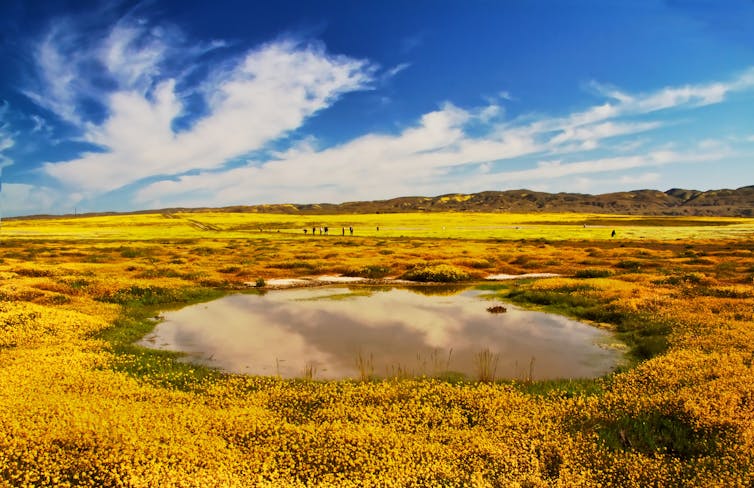
Dans la zone d’origine, une mare vernale a également été restaurée. Les mares vernales sont de petites dépressions dans le sol dont le fond est argileux. Elles se remplissent d’eau en hiver et tout un écosystème s’y développe. Les plantes poussent à partir de graines qui se trouvaient dans la terre sèche et brûlée. On y trouve également des crevettes féeriques et toutes sortes de petits animaux aquatiques. La plante hôte du damier de Quino pousse au bord des mares vernales. Il s’agit d’un habitat très particulier qui s’assèche vers le mois d’avril. À cette période, le damier de Quino a terminé son cycle de vie et est désormais en dormance. Toutes les graines sont tombées et sont elles aussi en dormance. Le cycle recommence ensuite au mois de novembre suivant.
Mare vernale du Carrizo Plain National Monument en Californie. Mikaku/Flickr, CC BY
Malheureusement, San Diego a rasé toutes les mares printanières pour construire des maisons et des immeubles. Afin de protéger le damier de Quino, le service chargé de la protection des espèces menacées a donc restauré une mare vernale sur un petit terrain qui était jonché de déchets et de quads. Ils ont soigneusement creusé une dépression peu profonde, l’ont recouverte d’argile et ont planté de la végétation pour la rendre viable. Ils ont planté entre autres du Plantago erecta, dont se nourrit le damier de Quino.
En trois ans, cette zone restaurée abritait presque toutes les espèces menacées pour lesquelles elle avait été conçue. La plupart d’entre elles n’avaient même pas été introduites. Elles ont simplement colonisé cette nouvelle mare, y compris le damier de Quino.
Par la suite, certains damiers de Quino ont également été trouvés dans des habitats situés à plus haute altitude. Pour être honnête, j’ai été époustouflée. Nous ne savions pas que ce papillon serait capable d’aller en montagne. Je pensais que nous devrions ramasser les œufs et les déplacer. Les distances ne sont pas grandes, quelques kilomètres ou 200 mètres de dénivelé, mais n’oubliez pas que ce papillon ne se déplace généralement pas beaucoup : il reste principalement là où il est né.
Y avait-il un corridor biologique entre ces deux zones ?
C. P. : Il y avait quelques maisons, mais elles étaient très clairsemées, avec beaucoup de broussailles naturelles entre elles. Il n’y avait pas vraiment de plantes hôtes pour les damiers de Quino. Mais cela leur a quand même permis de voler, de trouver en chemin des plantes sauvages à nectar et de ne pas être tués. C’est le plus important. Un corridor n’a pas besoin de soutenir une population. Il suffit qu’il ne la tue pas.
Vous aussi vous avez dû déménager au cours de votre carrière afin de poursuivre vos recherches en écologie sans être affectée par le climat politique. Au cours de l’année écoulée, en France, vous avez été invitée à vous exprimer à plusieurs reprises sur ce sujet et avez fait l’objet de nombreux articles vous décrivant comme une réfugiée scientifique. Aux États-Unis, ce parcours suscite-t-il également la curiosité et l’intérêt des médias ?
C. P. : Beaucoup de collègues, mais aussi des personnes que je connais mais avec lesquelles je n’ai pas nécessairement collaboré, m’ont demandé : « Comment as-tu fait cela ? Est-ce difficile d’obtenir un visa ? Les gens parlent-ils anglais en France ? »
Mais ce qui est intéressant, c’est que les médias américains ne s’y sont pas intéressés. L’attention médiatique est entièrement provenue de l’extérieur des États-Unis – du Canada et d’Europe.
Je ne pense pas que les Américains comprennent l’ampleur des dégâts actuels causés au monde universitaire, à l’éducation et à la recherche. Même ma propre famille ne réalise pas trop cela. C’est difficile de leur expliquer, car plusieurs d’entre eux sont des partisans de Trump, mais on pourrait penser qu’au moins les médias en parleraient.
La plupart des médias ont publié des articles sur les dommages causés à la structure universitaire et à l’éducation, par exemple l’interdiction de certains livres ou la tentative de mettre en place un système éducatif qui n’enseigne que ce que J. D. Vance [le vice-président des États-Unis] veut que les gens apprennent. Mais ces articles ne parlent pas beaucoup des personnes qui partent. Je pense que les Américains peuvent parfois être très arrogants. Ils partent du principe que les États-Unis sont le meilleur pays au monde et que personne ne quitterait les États-Unis pour aller travailler ailleurs.
Et c’est vrai que les [chercheurs aux] États-Unis ont traditionnellement bénéficié d’opportunités incroyables, avec des financements très importants provenant de toutes sortes de sources : des nombreuses agences gouvernementales, finançant divers projets, mais aussi des donateurs privés, des ONG… Tout cela s’est littéralement arrêté net.
Afin d’intéresser les gens à la conservation de la biodiversité et de sortir certains de leur déni, il peut être tentant de mettre en avant certains sujets, tels que l’impact du changement climatique sur la santé humaine. C’est un sujet sur lequel vous avez déjà travaillé. Est-ce qu’il trouve davantage d’écho ?
C. P. : J’ai toujours été intéressée par la santé humaine. Au départ, je voulais faire de la recherche médicale puis j’ai changé d’avis. Mais dès que j’ai commencé à publier les résultats que nous obtenions sur l’ampleur des mouvements des espèces, la première chose qui m’est venue à l’esprit a été : « Les maladies vont, elles aussi, se déplacer. » Le travail de mon laboratoire sur la santé humaine se concentre donc sur la façon dont le changement climatique affecte la propagation des maladies, de leurs vecteurs et de leurs réservoirs. L’une de mes étudiantes a ainsi documenté la propagation de la leishmaniose au Texas, qui s’est déplacée vers le nord en raison du changement climatique.
Au sein du Giec, nous avons également mis en avant que le paludisme, la dengue et trois autres maladies tropicales ont fait leur apparition au Népal, où elles n’avaient jamais été observées auparavant, du moins d’après les archives historiques. Cela est lié au changement climatique, et non aux changements agricoles.
De nouvelles maladies apparaissent également dans le Grand Nord. Mais peu de gens vivent dans cette région. Ce sont surtout des communautés inuites qui sont touchées, ce qui explique pourquoi les politiciens minimisent le problème. En Europe, le moustique tigre se propage en France et apporte avec lui ses maladies.
La leishmaniose est également déjà présente en France. Il n’y a qu’une seule espèce à ce jour, mais les prévisions suggèrent que quatre ou cinq autres espèces pourraient arriver très prochainement. Les maladies transmises par les tiques sont également en augmentation et se propagent vers le nord de l’Europe. Nous constatons donc déjà les effets du changement climatique sur la santé humaine en Europe. Les gens n’en ont tout simplement pas conscience.
Vous avez mentionné votre famille, qui compte des partisans de Trump. Pouvez-vous parler de votre travail avec eux ?
C. P. : Dans ma famille, la seule option envisageable est de ne pas en parler, et sur ça, tout le monde s’accorde. C’est comme ça depuis longtemps pour la politique, et même pour la religion. Nous nous aimons tous, nous voulons nous entendre. Nous ne voulons pas de divisions. Nous avons donc grandi en sachant qu’il y a certains sujets dont on ne parle pas. Parfois, le changement climatique est abordé, cela devient tout de suite difficile, et cela nous rappelle alors pourquoi nous n’en parlons pas. Il n’a donc pas été possible d’avoir une conversation ouverte à ce sujet. J’en suis désolée, mais je ne veux pas perdre ma famille. Je ne vais donc pas non plus essayer de les convaincre. Si un jour cependant, ils veulent un jour en savoir plus, ils savent où me trouver.
Mais j’ai également travaillé avec des personnes qui ont des convictions très différentes des miennes. Lorsque j’étais encore au Texas, j’ai travaillé avec l’Association évangélique nationale. Nous nous accordions sur la nécessité de préserver la biodiversité. Ils la considèrent comme la création de Dieu, je pense simplement que l’humain n’a pas à détruire la Terre et je suis athée, mais cela n’a pas posé de problème. Nous avons donc réalisé ensemble une série de vidéos dans lesquelles j’expliquais les effets du réchauffement climatique. Le résultat était formidable.
Propos recueillis par Gabrielle Maréchaux.
Cet article est publié dans le cadre des 20 ans de l’Agence nationale de la recherche (ANR). Camille Parmesan est lauréate du programme « Make Our Planet Great Again » (MOPGA) géré par l’ANR pour le compte de l’État. L’ANR a pour mission de soutenir et de promouvoir le développement de recherches fondamentales et finalisées dans toutes les disciplines, et de renforcer le dialogue entre science et société.
Camille Parmesan ne travaille pas, ne conseille pas, ne possède pas de parts, ne reçoit pas de fonds d’une organisation qui pourrait tirer profit de cet article, et n’a déclaré aucune autre affiliation que son organisme de recherche.
Source: The Conversation – France (in French) – By Camille Parmesan, Director, Theoretical and Experimental Ecology Station (SETE), Centre national de la recherche scientifique (CNRS); University of Plymouth; The University of Texas at Austin
By studying changes in the habitats of the Edith’s checkerspot butterfly, ecologist Camille Parmesan was the first to demonstrate the definite impact of climate change on wildlife. Lloyd Russell, Fourni par l’auteur
She is an ecologist recognized worldwide for being the first to unequivocally demonstrate the impact of climate change on a wild species: the Edith’s checkerspot butterfly. In recent years, however, Camille Parmesan has been interviewed not only for her expertise on the future of biodiversity in a warming world or for her share in the Nobel Prize awarded to the IPCC, but for her status as a refugee scientist.
Twice in her life, she has chosen to move to another country in order to continue working under political conditions that support research on climate change. She left Trump’s America in 2016, and later post-Brexit Britain. She now lives in Moulis in the Ariège region of southwestern France, where she heads the CNRS’s Theoretical and Experimental Ecology Station.
Speaking with her offers deeper insight into how to protect biodiversity – whose responses to climate change continue to surprise scientists – what to do about species that are increasingly hybridizing, and how to pursue research on a planet that is becoming ever more climate-skeptical.
The Conversation: Your early work on the habitats of the Edith’s checkerspot butterfly quickly brought you international recognition. In practical terms, how did you demonstrate that a butterfly can be affected by climate change? What tools did you use?
Camille Parmesan: A pickup truck, a tent, and a butterfly net, good strong reading glasses to search for very tiny eggs and caterpillar damage to leaves, a notebook and a pencil to write notes in! In the field, you don’t need more than that. But before doing my fieldwork, I had spent a year going around museums all across the USA, a couple in Canada, and even in London and Paris collecting all the records for Edith’s checkerspot. I was looking for really precise location information like ‘it was at this spot, one mile down Parsons Road, on June the 19th, 1952’, because this species lives in tiny populations and is sedentary. That process alone took about a year, since at the time there were no digitized records and I had to look at pinned specimens and write their collecting information down by hand.
Edith’s checkerspot at lower elevation in Pozo, California. Singer & Parmesan, Fourni par l’auteur First instar of Edith’s checkerspot on Penstemon leaves. Singer & Parmesan, Fourni par l’auteur
Once in the field, my work consisted of visiting each of these sites during the butterfly’s flight season. Since the season lasts only about a month, you have to estimate when they will be flying in each location in order to run a proper census. For this, you start by looking for adults. If you do not see adults, you do not stop there. You look for eggs, evidence of web, like bits of silks, damage from the overwintering larvae starting to feed…
You also look at the habitat: does it have a good quantity of healthy host plants? A good quantity of healthy nectar plants for adult food? If the habitat was not good, that location did not go into my study. Because I wanted to isolate the impact of climate change, from other factors like habitat degradation, pollution… At the larger sites, I often searched more than 900 plants before I felt like I had censused enough.
Today, when you go back to the fields you started monitoring decades ago, do you see things you were not able to see at the beginning of your work?
C. P.: I know to look for things I didn’t really look for when I started 40 years ago, or that my husband Michael [the biologist Michael Singer] didn’t look for when he started 50 years ago. For instance, we discovered that the height at which the eggs are laid is a bit higher now, and that turns out to be a really significant adaptation to climate change.
The eggs are being laid higher because the ground is getting far too hot. Last summer, we measured temperatures of 78°C (172.4°F) on the ground. So if a caterpillar falls, it dies. You can also see butterflies landing and immediately flying up, as it is way too hot for their feet and they’ll then fly onto vegetation or land on you.
In my early days, it wouldn’t have occurred to me that the height of where the eggs are laid could be important. That is why it is so important for biologists to simply watch their study organism, their habitat, to really pay attention. I see a lot of young biologists today who want to run in, grab a bunch of whatever their organism is, take it back to the lab, grind it up and do genetics or look at it in the lab. That’s fine, but if you don’t spend time watching your organism and its habitat, you can’t relate all your lab results back to what is actually happening in the wild.
Female Edith’s checkerspot and eggs under the leaf. Singer & Parmesan, Fourni par l’auteur
Thanks to your work and that of your colleagues, we now know that living organisms are greatly affected by climate change and that many species must shift their range in order to survive. But we also know that it can be difficult to predict where they will be able to persist in the future. So what can be done to protect them? Where should we be protecting lands for them?
C. P.: That is the big question plaguing conservation biologists. If you go to the conservation biology meetings, a lot of people are getting depression because they don’t know what to do. We actually need to change the way we think of conservation, away from strict protection toward something more like a good insurance portfolio. We don’t know the future, therefore we need to develop a very flexible plan, one that we can adjust as we observe what’s happening on the ground. In other words, don’t lock yourself into one plan, Start instead with an array of approaches, because you don’t know which one will work.
We just published a paper on adapting, for land conservation, some decision-making approaches that have been around since the 1960s in fields known to be unpredictable, like economics, for instance, or urban water policy, where you don’t know in advance if it is going to be a wet year or a dry year. So urban planners came up with these approaches for dealing with uncertainty.
With modern computers, you can simulate 1000 futures and ask: if we take this action, what is happening? And you see it is good in these futures, but bad in those, and not too bad in others. What you’re looking for is a set of actions that is what they call robust – that performs well across the largest number of futures. For conservation, we did so by starting with standard bioclimatic models. We had about 700 futures for 22 species. It turns out that if we just protect where these species occur today, most organisms don’t survive. Only 1 or 2% of the futures actually contain those species in the same place. But what if you protect where it is now, but also where it’s expected to be 30% of the time, 50% of the time, 70% and so on? You have these different thresholds. And from these different future possibilities, we can determine, for instance, that if we protect this location and that one, we can cover 50% of areas where the models predict the organism persists in the future. By doing that, you can see that some actions are actually pretty robust, and they include combinations of traditional conservation, plus protecting new areas outside of where the species are now. Protecting where it is now is usually a good thing, but it is often not enough.
Another thing to bear in mind is that bigger is better. We do still need to protect lands for sure, and the bigger the better, especially in high biodiversity areas. You still want to protect those places, because species will be moving out, but also moving in. The area might end up with a completely different set of species than it has today, yet still remain a biodiversity hotspot, perhaps because it has a lot of mountains and valleys, and a diversity of microclimates.
On a global scale, we need to have 30 to 50 percent of land and ocean as relatively natural habitat, without necessarily requiring strict protection.
Between these areas we also need corridors to allow organisms to move without being killed immediately. If you have a bunch of crop land, wheat fields for example, anything trying to move through them is likely to die. So you need to develop seminatural habitats winding through these areas. If you have a river going through, a really good way to do this is just have a big buffer zone on either side of the river so that organisms can move though. It doesn’t have to be a perfect habitat for any particular organism, it just has to not kill them. Another point to highlight is that the public often doesn’t realize their own backyards can serve as corridors. If you have a reasonably sized garden, leave part of it unmown, with weeds. The nettles and the bramble are actually important corridors for a lot of animals. This can be done also on the side of roads.
Some incentives could encourage this. For example, giving people tax breaks for leaving certain private areas undeveloped. There are just all kinds of ways of thinking about it once you shift your mindset. But for scientists, the important shift is to not put all your eggs in one basket. You cannot just protect where it is now, or just pick one spot where you think an organism is going because your favorite model says so, or the guy down the corridor from you uses this model. At the same time, you cannot save everywhere a species might be in the future, it would be too expensive and impractical. Instead, you need to develop a portfolio of sites that is as robust as possible, given financial constraints and available partnerships, to make sure we won’t completely lose this organism. Then, when we stabilize the climate and eventually bring it back down, it’s got the habitat to recolonize and become happy and healthy and whole again.
Another issue that is very much on the minds of those involved in biodiversity protection today is hybridization. How do you view this phenomenon, which is becoming increasingly common?
C. P.: Species are moving around in ways they haven’t done in many thousands of years. As they are moving around, they keep bumping into each other. For example, polar bears are forced out of their habitat because the sea ice is melting. It forces them to be in contact with brown bears, grizzly bears, and so they mate. Once in a while, it’s a fertile mating, and you get a hybrid.
Historically, conservation biologists did not want hybridization, they wanted to protect the differences between species, the distinct behavior, look, diet, genetics… They wanted to preserve that diversity. Also, hybrids usually don’t do as well as the original two species, you get this depression of their fitness. So people tried to keep species separate, and were sometimes motivated to kill the hybrids to do so.
But climate change is challenging all of that. The species are running into each other all the time, so it is a losing battle. Also, we need to rethink how we approach biodiversity. Historically, conserving biodiversity meant protecting every species, and variety. But I believe we need to think more broadly: the goal should be to conserve a wide variety of genes.
Because when a population has strong genetic variation, it can evolve and adapt to an incredibly rapidly changing environment. If we fight hybridization, we may actually reduce the ability of species to evolve with climate change. To maintain high diversity after climate change – if that day ever comes – we need to retain as many genes as possible, in whatever form they exist. That may mean losing what we perceive as being a unique species, but if those genes are still there, it can revolve fairly rapidly, and that’s what we’ve seen with polar bears and grizzly bears.
In past warm periods, these species came into contact and hybridized. In the fossil record, polar bears disappear during certain periods, which suggests there were very few of them at the time. But then, when it got cold again, polar bears reappeared much faster than you’d expect if they were evolving from nothing. They likely evolved from genes that persisted in grizzly bears. We have evidence that this works and it is incredibly important.
Something that can be hard for non-scientists to understand is that, on the one hand we see remarkable examples of adaptation and evolution in nature (for instance trees changing the chemistry of their leaves in response to herbivores, or butterflies changing colors with altitude… ) while, on the other hand, we are experiencing massive biodiversity loss worldwide. Biodiversity seems incredibly adaptable, but is still collapsing. These two realities are sometimes hard to connect. How would you explain this to a non-specialist?
C. P.: Part of the reason is that ongoing climate change is happening very quickly. Another reason is that species have a pretty fixed physiological niche that they can live in. It is what we call a climate space, a particular mix of rainfall, humidity and dryness. There is some variation, but when you get to the edge of that space, the organism dies. We don’t really know why that is such a hard boundary.
Color difference between Edith’s checkerspot at low altitude (left) and high altitude (right). Research conducted on other butterfly species shows that dark tones on wings are an adaptation to cooler climates, as it helps butterflies warm up in the sun. Singer & Parmesan, Fourni par l’auteur
When species face other types of changes like copper pollution, light and noise pollution, many of them have some genetic variation to adapt. That doesn’t mean these changes won’t harm them, but some species are able to adjust. For example, in urban environments today, we see house sparrows and pigeons that have managed to adapt.
So there are some things that humans are doing that species can adapt to, but not all. Facing climate change, most organisms don’t have existing genetic variation that would allow them to survive. The only thing that can bring in new variation to adapt to a new climate is either hybridizing – which will bring in new genes – or mutations, which is a very slow process. In 1-2 million years, today’s species would eventually evolve to deal with whatever climate we’re going into.
If you look back hundreds of thousands of years when you had the Pleistocene glaciations, when global temperatures changed by 10 to 12°C, what we saw is species moving. You didn’t see them staying in place and evolving.
Going back even further to the Eocene, the shifts were even bigger, with enormously higher CO2 and enormously warmer temperatures, species went extinct. As they can’t shift far enough, they die off. So that tells you that evolution to climate change is not something you expect on the time scale of a few 100 years. It’s on the time scale of hundreds of thousands to a couple of million years.
In one of your publications, you write: “Populations that appear to be at high risk from climate change may nonetheless resist extinction, making it worthwhile to continue to protect them, reduce other stressors and monitor for adaptive responses.” Can you give an example of this?
C. P.: Sure, let me talk about the Edith’s checkerspot, as that’s what I know the best. Edith’s checkerspot has several really distinctive subspecies that are genetically quite different from each other, with distinct behaviors, and host plants. One subspecies in southern California has been isolated long enough from the others that it is quite a genetic outlier. It’s called the Quino checkerspot.
Quino checkerspot laying eggs on Plantago erecta. Larry Gibert & Michael C Singer, Fourni par l’auteur
It is a subspecies at the southern part of the range, and it’s being really slammed by climate change. It already has lost a lot of populations due to warming and drying. Its tiny host plant just dries up too fast. It’s lost a lot due to urbanization too: San Diego and Los Angeles have just wiped out most of its habitat. So you might say, well, give up on it, right?
My husband and I were on the conservation habitat planning for the Quino Checkerspot in the early 2000s. By that time, about 70% of its population had gone extinct.
My husband and I argued that climate change is going to slam them if we only protected the areas where they currently existed, because they were low elevation sites. But we thought, what about protecting sites, such as at higher elevations, where they don’t exist now?
There were potential host plants at higher elevation. They were different species that looked completely different, but in other areas Edith’s checkerspot used similar species. We brought some low elevation butterflies to this new host plant, and the butterflies liked it. That showed us that no evolution was needed. It just needed the Quino checkerspot to get up that high, and it would eat this, it could survive.
Therefore, we needed to protect the area where they were at the time, for them to be able to migrate, as well as this novel, higher habitat.
That’s what was done. Luckily, the higher area was owned by US Forest Service and Native American tribal lands. These tribes were really happy to be part of a conservation plan.
In the original area, a vernal pool was also restored. Vernal pools are little depressions in the grounds that are clay at the bottom. They fill up with water in the winter and entire ecosystems develop. Plants come up from seeds that were in the dry, baked dirt. You also get fairy shrimp and all kinds of little aquatic animals. The host plant of the Quino checkerspot pops out at the edge of the vernal pool. It is a very special habitat that dries up around April. By that time, the Quino checkerspot has gone through its whole life cycle, and it’s now asleep. All the seeds have dropped and are also dormant. The cycle then starts again the next November.
Vernal pool at Carrizo Plain National Monument in California. Mikaku/Flickr, CC BY
Sadly, San Diego’s been bulldozing all the vernal pools to create houses and condos. So in order to protect the Quino checkerspot, the Endangered fish and wildlife service restored a vernal pool on a small piece of land that had been full of trash and all-terrain vehicles. They carefully dug out a shallow depression, lined it with clay and planted vegetation to get it going. Among other things, they planted Plantago erecta, which Quino checkerspot lives off.
Within three years, this restored land had almost all of the endangered species it was designed for. Most of them had not been brought in. They just colonized this new pool, including Quino checkerspot.
After that, some Quino checkerspot were also found in the higher-environment habitat. I was blown away to be honest. We didn’t know this butterfly would be able to get up the mountain. I thought we’d have to pick up eggs and move them. The distances aren’t large (a few kilometers over, or 200 m upward), but remember that this butterfly doesn’t normally move much – it mostly stays where it was born.
Was there a wildlife corridor between these two areas?
C. P.: There were some houses, but they were very sparse, with lots of natural scrubby stuff in between. There weren’t really host plants for the Quino checkerspots. But it would allow them to fly through, have wild nectar plants on the way and not be killed. That’s the big point. A corridor doesn’t have to support a population. It just has to not kill it.
You too have had to relocate during your career in order to continue your research in ecology without being affected by the political climate. Over the past year in France, you have been asked to speak about this on numerous occasions and have been the subject of many articles describing you as a scientific refugee. In the United States, does this background also generate curiosity and media interest?
C. P.: A lot of colleagues, but also just people I know and have not necessarily collaborated with have asked me: How did you do that? How hard is it to get a visa? Do people speak English in France? But what’s interesting is the media in the USA has taken no interest. The media attention has been entirely outside of the USA, in Canada and Europe.
I don’t think Americans understand how much damage is being done to academia, education and research. I mean, even my own family doesn’t understand how much harm is being done. It’s difficult to explain to them because several of them are Trump supporters, but you would think the media would talk about that.
Most of the media have articles about damage to the university structure and damage to education, banning of books for instance, or the attempt to have an education system that only teaches what JD Vance wants people to learn. But you don’t really have a lot in those articles about people leaving. I think Americans can sometimes be very arrogant. They just presume America is the best and that no one would leave America to work somewhere else.
And it’s true that the USA traditionally has had such amazing opportunities, with so much funding from all kinds: many governmental agencies, funding many different projects, but also private donors, NGOs… All of this really literally stopped just cold.
In order to get people interested in biodiversity conservation and move them out of denial, it can be tempting to highlight certain topics, such as the impact on human health. This is a topic you have already worked on. Does it resonate more?
C. P.: I’ve always been interested in human health. I was going to be a medical researcher early on and I switched. But as soon as I started publishing the results that we were getting on the extent of species movements, the first thing I thought of was, ‘well diseases are going to be moving too’. So my lab’s work on human health focuses on how climate change is affecting where diseases, their vectors, and their reservoirs are spreading. One of my grad students documented the movement of leishmaniasis into Texas, going northward into Texas related to climate change.
In the IPCC we documented malaria, dengue and three other tropical diseases that have moved into Nepal, where they’ve never been before, at least in historical record, and that’s related to climate change, not to agricultural changes.
We also have new diseases emerging in the high Arctic. But not many people live in the high Arctic. It’s the Inuit communities that are being affected, so it gets downplayed by politicians. In Europe,the tiger mosquito is spreading into France, carrying its diseases with it.
Leishmaniasis is also already present in France, one species so far, but predictions suggest that four or five more species could arrive very soon. Tick-borne diseases are also increasing and moving north across Europe. So we are seeing the effect of climate change on human disease risk in Europe right now. People just aren’t aware of it.
You mentioned your family, some of whom are Trump supporters. Are you able to talk about your work with them?
C. P.: In my family, the only option is to not talk about it, and it’s agreed upon by everyone. It’s been that way for a long time about politics, even religion. We all love each other. We want to get along. We don’t want any divisions. So we kind of grow up knowing there are just certain topics you don’t talk about. Occasionally, climate change does come up and it gets difficult and it’s like, that’s why we don’t talk about it. So it’s not been possible to have an open conversation about it. I’m sorry about that, but I’m not going to lose my family. Nor, obviously, just push to convince them. I mean, if they want to know about it, they know where to come.
But I’ve also experienced working with people who have very different beliefs from mine. When I was still in Texas I worked with the National Evangelical Association. We both wanted to preserve biodiversity. They see it as God’s creation, I just think it’s just none of man’s business to destroy the Earth and I am an atheist, but that is fine. We did a series of videos together where I explained the effect of global warming. The result was wonderful.
This article is published as part of the 20th anniversary celebrations of the French Agence Nationale de la Recherche (ANR). Camille Parmesan is a winner of the “Make Our Planet Great Again” (MOPGA) program managed by the ANR on behalf of the French government. The ANR’s mission is to support and promote the development of fundamental and applied research in all disciplines, and to strengthen the dialogue between science and society.
Camille Parmesan ne travaille pas, ne conseille pas, ne possède pas de parts, ne reçoit pas de fonds d’une organisation qui pourrait tirer profit de cet article, et n’a déclaré aucune autre affiliation que son organisme de recherche.
En Allemagne et en Espagne, les oppositions souhaitant censurer un gouvernement doivent se mettre d’accord sur une majorité de rechange : on parle de « censure constructive ». Cette option pourrait-elle aider la France à dépasser la situation de paralysie politique actuelle ?
En France, sous la Ve République, la procédure de la motion de censure a été utilisée plus de 150 fois pour essayer de renverser un gouvernement (article 49.2) ou pour faire adopter une loi sans vote (article 49.3). Mais très peu ont été couronnées de succès. Avant 2024, une seule motion avait été adoptée en 1962 sous le gouvernement de Georges Pompidou. Ce caractère unique de motion victorieuse de 1962 à 2024 est largement dû à l’existence de majorités confortables. Mais depuis 2022 et surtout 2024, avec l’absence de majorité absolue ou même relative, dans le contexte d’une tripartition du système partisan, les chances de réussite sont beaucoup plus grandes.
Michel Barnier en a fait les frais fin 2024 et François Bayrou est aussi tombé en septembre 2025, en demandant la confiance de l’Assemblée nationale (art. 49.1), alors que celle-ci se préparait à le censurer. Dans les deux derniers cas, la censure a été adoptée grâce aux voix des groupes parlementaires de gauche et de droite radicale qui sont trop différents pour pouvoir constituer un gouvernement alternatif.
À défaut de majorité de remplacement, le président peut certes dissoudre en espérant que de nouvelles élections permettent de retrouver une majorité, mais cela semble très peu probable dans notre contexte de forte division des forces politiques et de tripartition du système partisan, à moins que l’élection ne permette de porter au pouvoir une majorité issue du Rassemblement national et de ses alliés. Les situations de blocage et de gouvernements minoritaires risquent donc de devenir plus fréquents.
Comment éviter les blocages à répétition ?
D’autres pays limitent les possibilités de censure en imposant aux partisans de cette dernière de s’être mis d’accord au préalable sur une majorité de rechange, ce qu’on appelle souvent une « censure constructive », formule censée être plus responsable, pour qu’on ne puisse pas renverser le gouvernement sans solution alternative. Seuls quelques pays ont adopté ce type de mesure dans l’Union européenne : l’Allemagne, l’Espagne, la Belgique, la Pologne, la Slovénie, la Hongrie. Il existe aussi parfois au niveau régional ou local. Il existe aussi dans quelques pays hors d’Europe (Arménie, Népal, Tunisie, Lesotho, Fidji, Israël).
En France, cette censure dite constructive existe pour certains territoires ultra-marins (Martinique, Saint-Barthélemy, Saint-Martin, Saint-Pierre-et-Miquelon, Polynésie française) et pour l’Assemblée de Corse. Sur l’Île de beauté, la censure dite constructive existe depuis 2018 (elle a été introduite avec le nouveau statut d’autonomie de la collectivité). Sur le modèle qui fonctionne ailleurs, elle prévoit la possibilité de voter une motion de défiance à l’égard de l’exécutif à la condition qu’une liste du nouvel exécutif soit présentée. Le législateur semble avoir craint une instabilité institutionnelle conduisant à davantage encadrer son fonctionnement que celui de l’Assemblée nationale.
Mais c’est en Allemagne et en Espagne que des motions de censure constructive ont été adoptées depuis le plus longtemps. Que nous enseignent ces pratiques ?
En Allemagne, une culture de responsabilité politique
L’Allemagne avait connu une forte instabilité gouvernementale sous la République de Weimar (1918-1933). Des gouvernements étaient renversés facilement par l’alliance entre les communistes et les nazis. Pour éviter ces renversements par des partis incapables de gouverner ensemble, la loi fondamentale de 1949 stipule que :
« Le Bundestag ne peut exprimer sa défiance envers le chancelier fédéral qu’en élisant un successeur à la majorité de ses membres. » (Article 67)
La défiance doit être proposée par un quart des députés et adoptée à la majorité absolue. La défiance n’est entérinée qu’après un vote à la majorité absolue sur un nouveau chancelier. Il n’y a donc pas de période où le gouvernement sortant ne peut qu’« expédier les affaires courantes », c’est-à-dire assurer le suivi de décisions déjà prises, sans pouvoir innover.
Au plan fédéral, cette procédure de censure constructive n’a été utilisée que deux fois dans l’histoire en Allemagne. La première fut en 1972, lorsque le groupe CDU-CSU a proposé qu’un de ses membres (Rainer Barzel) remplace le chancelier Willy Brandt (SPD). Les chrétiens-démocrates critiquaient particulièrement la politique du gouvernement à l’est de l’Europe. Il a manqué seulement deux voix pour que la censure soit acceptée et que la CDU vienne au pouvoir. Mais le chancelier maintenu, ayant perdu sa majorité absolue, demande la convocation d’élections législatives anticipées qui vont confirmer la légitimité des socialistes alliés aux libéro-centristes du FDP.
Une motion de censure constructive a été mise en œuvre une deuxième et dernière fois en 1982. Helmut Schmitt (SPD) est censuré et remplacé par Helmut Kohl (CDU) au terme d’un débat tendu au Bundestag. Le SPD a fait les frais d’un abandon de la coalition par une large partie des libéraux du FDP qui rejoignent le nouveau gouvernement.
Cette procédure parlementaire a suscité du mécontentement, beaucoup estimant que le chancelier devait être désigné par le peuple au terme d’une élection législative. Celui-ci va d’ailleurs demander au Bundestag de voter sa dissolution pour être confirmé dans les urnes. Il le sera largement en mars 1983.
En Espagne, une culture politique conflictuelle
Depuis la Constitution de 1978, après la mort du général Franco, une procédure de censure constructive a été actée sur le même modèle qu’en Allemagne. Deux tentatives d’utilisation ont échoué en 1980 et en 1987, mais celle de 2018 a été couronnée de succès, permettant de remplacer le gouvernement Rajoy (Parti populaire, PP, droite espagnole) par Pedro Sanchez, leader de la gauche socialiste (PSOE).
En 2017, une motion de censure avait déjà été déposée par Podemos (gauche radicale) contre Mariano Raroy, conservateur au pouvoir depuis 2011, et en 2023 cette procédure a aussi été utilisée par le mouvement d’extrême droite Vox. Dans les deux cas, les motions n’avaient aucune chance de passer, car elles n’étaient quasiment soutenues que par leurs initiateurs (82 voix pour la motion de Podemos et 53 pour celle de Vox). Elles visaient surtout à médiatiser leur opposition au gouvernement en place.
L’exemple espagnol montre que la censure constructive ne permet pas toujours de trouver un gouvernement disposant d’une majorité solide. Le gouvernement de Pedro Sanchez n’a pas été renversé, mais il a aujourd’hui beaucoup de difficultés à faire adopter les lois de sa coalition, tout particulièrement les budgets. Le pays fonctionne toujours avec le budget de 2023, ce qui empêche les ajustements, notamment pour des investissements novateurs.
La Belgique partage avec l’Espagne une tradition politique conflictuelle et l’existence d’une motion constructive, appelée « motion de méfiance ». Celle-ci n’a jamais été mise en œuvre au niveau fédéral et n’a pas empêché la vacance du pouvoir pour des périodes extrêmement longues (541 jours entre 2010 et 2011, 652 jours entre fin 2018 et octobre 2020), car aucune coalition suffisamment large n’arrivait à émerger.
Faut-il adopter une procédure de censure constructive en France ?
La procédure de censure constructive présente des avantages :
Elle limite le succès des motions de censure en empêchant le renversement d’un gouvernement sans qu’existe une solution de rechange. Elle favorise donc la stabilité du pouvoir, même s’il doit fonctionner en « mode dégradé », du fait d’une absence de majorité parlementaire.
Elle devrait inciter les députés des oppositions à négocier des compromis pour trouver des formules de gouvernement larges et novatrices.
Elle évite les périodes de vacance du pouvoir, puisqu’un gouvernement ne peut être démissionné que lorsqu’un autre est choisi.
Mais elle n’évite pas toujours les situations de blocage. Car il n’y a pas toujours une situation de rechange possible, même après de nouvelles élections.
Cette procédure est moins adaptée à la culture politique française qu’à celle de l’Allemagne. Notre crainte des compromissions avec des acteurs politiques qui ont pourtant des orientations assez proches rendrait sa mise en œuvre difficile mais pas indépassable à l’avenir.
De plus, sa constitutionnalité pourrait être problématique dans un système semi-présidentiel comme le nôtre, où le choix du premier ministre est une prérogative du président. On a d’ailleurs vu, depuis 2024, la grande détermination d’Emmanuel Macron à ne pas abandonner ce pouvoir régalien, alors que le macronisme est minoritaire à l’Assemblée nationale et de plus en plus divisé en son sein.
La motion constructive n’est donc pas une solution miracle : si elle est instaurée, elle devrait l’être dans le cadre d’une modification substantielle de la Constitution pour rendre notre régime semi-présidentiel plus parlementaire, et donc réduire la domination présidentielle sur l’ensemble de notre système politique.
Pierre Bréchon ne travaille pas, ne conseille pas, ne possède pas de parts, ne reçoit pas de fonds d’une organisation qui pourrait tirer profit de cet article, et n’a déclaré aucune autre affiliation que son organisme de recherche.
Alors que le modèle économique libéral montre ses limites et que les crises géopolitiques se multiplient, la « culture de paix économique », dont l’Union européenne pourrait être un vecteur clé, apparaît comme un concept susceptible d’offrir une vraie voie d’avenir.
Au cours des dernières décennies, le modèle économique libéral – qui promeut la libre concurrence, la mondialisation des échanges et la recherche de la croissance à tout prix – a dominé la scène internationale. Cependant, cette dynamique s’essouffle aujourd’hui, face à une montée sans précédent des inégalités, des conflits, des défis climatiques et sociaux.
En 2025, les tensions géopolitiques et économiques s’aggravent, sur fond de fragmentation de l’économie planétaire et d’une guerre économique qui avance à visage découvert.
Repenser les fondements de l’économie apparaît maintenant incontournable, pour inscrire la culture de paix économique au cœur des stratégies, des institutions politiques, économiques et éducatives. La survie de l’Europe est en jeu.
Les limites du modèle économique libéral
Le libéralisme économique repose sur l’idée que la libre concurrence et l’interaction des marchés conduisent naturellement à une allocation optimale des ressources, favorisant la croissance et le bien-être général.
Cependant, cette théorie, souvent idéalisée, montre de nombreuses limites concrètes, largement illustrées par les crises économiques, écologiques et sociales récentes.
La précarisation et la fragmentation du marché du travail, l’accroissement de la concentration des richesses et de la puissance économique aux mains d’une minorité ainsi que les failles dans la protection sociale fragilisent la cohésion collective.
L’ignorance persistante des rapports de pouvoir et des dynamiques de domination a façonné le paysage économique en un terrain de conflit, où la violence structurelle (concurrence exacerbée, exploitation, division sociale) est devenue la norme qui nous a menés au bord du chaos.
Parallèlement, la constante recherche de croissance matérielle inflige des dommages sévères à l’environnement. Le modèle fondé sur la consommation exponentielle des ressources naturelles entre en contradiction flagrante avec les limites écologiques planétaires. La dégradation climatique accélérée entraîne insécurité alimentaire, déplacements massifs de populations et intensification des conflits autour des ressources, comme au Sahel, au Moyen-Orient, mais aussi en Ukraine, dont les ressources en lithium sont fortement convoitées.
Par ailleurs, la fragmentation croissante des politiques économiques des États, entre nationalismes économiques et protectionnisme, mine les fondations de la coopération internationale. La multiplicité des sanctions, des représailles commerciales et des guerres tarifaires accentue les risques d’instabilité politique et économique, posant la question d’un épuisement du modèle libéral mondialisé. Il en est ainsi des jeux politiques sur les droits de douane imposés par Donald Trump ou encore des restrictions à la circulation de la main-d’œuvre demandées dans certains pays d’Europe.
Loin d’une simple réfutation idéologique, ces critiques s’appuient sur des données empiriques rigoureuses et une analyse fine des mécanismes de pouvoir économique. Elles soulignent que le libéralisme, dans sa version actuelle, ne parvient plus à incarner un modèle de progrès partagé et durable. Le modèle se trouve en crise, face à une complexité mondiale croissante, ponctuée par la pandémie de Covid-19, les tensions en Ukraine, les crises sociales internes dans de nombreux pays et les urgences climatiques.
Les travaux précurseurs d’Henri Lambert (1921) et d’Henri Hauser (1935), et plus récemment notre ouvrage Osons la paix économique (2017) avaient prédit cette impasse : les racines économiques des conflits dépassent les motifs politiques superficiels, et une organisation sociale centrée sur le financier ne peut mener qu’à la catastrophe, que ce soit sous la forme d’une guerre ou d’une révolution.
C’est la loi du plus fort, et le mimétisme des grandes puissances ne laisse à l’Europe, fracturée et passive, que le risque d’être dépecée ou marginalisée.
Quelle paix à l’heure de la remilitarisation en Europe ?
Le contexte géopolitique rend la question plus brûlante encore.
L’actuel président des États-Unis Donald Trump navigue de crise en crise, tout en accentuant l’imprévisibilité et la polarisation. Sur le continent, la guerre en Ukraine, la montée des populismes, l’explosion des dépenses militaires et le discours des chefs d’état-major font de l’engagement armé une perspective quasiment banalisée.
Andrius Kubilius, le commissaire européen à la défense, appelle à réinventer la Pax Europaea, tout en affirmant la nécessité pour l’Union européenne de se préparer à la guerre sous toutes ses formes. Son ambition : refonder la souveraineté stratégique par une capacité industrielle et une résilience, alors que le spectre du retrait américain plane sur l’Europe.
De la culture de paix économique
Dans ce contexte, depuis presque deux décennies, la culture de paix économique s’impose comme une réponse globale et innovante, visant à réconcilier économie, société et environnement.
La culture de paix économique propose de sortir du cadre guerrier et compétitif du libéralisme, pour repenser l’économie comme espace de coopération, d’émancipation et d’inclusion. La paix économique ne se limite pas à l’absence de guerre ; elle englobe un ensemble de conditions permettant de construire un ordre économique apaisé, juste, démocratique et soutenable. Elle repose sur une anthropologie de l’interdépendance, un rejet de la violence structurelle (compétition, exploitation, exclusion) et une valorisation des liens et du bien commun. Elle exige une transformation des entreprises, mais aussi des institutions – pour développer des pratiques qui réduisent la violence, favorisent l’épanouissement et intègrent la responsabilité écologique, sociale et humaine.
Cette approche prend en compte les dommages induits par la guerre économique larvée, la violence structurelle, la corruption et les inégalités, en mettant l’accent sur la transformation des comportements, la prévention des conflits et la promotion de valeurs communes de responsabilité et de solidarité. Son ontologie se veut simple : la vie est interconnexion et l’économie a pour but de faire vivre ces relations, non pas de les détruire.
Les entreprises sont ainsi invitées à dépasser une simple logique de maximisation du profit pour devenir des actrices de cohésion sociale, de respect des droits humains, d’innovation sociale et de protection de l’environnement.
La culture de la paix économique exige une transformation profonde des mentalités et des pratiques managériales, qui doivent intégrer le souci du bien commun, la promotion de la diversité et de l’inclusion, la santé, le bonheur ainsi qu’une gouvernance éthique renforcée. Mais, pour ce faire, nous devrons accepter une mutation globale de l’éducation des plus jeunes aux futurs leaders, donc sur un temps long… que nous n’avons peut-être pas !
« Pax Economica » et « Pax Europaea »
Si ce changement de paradigme porte une utopie, c’est au sens énoncé par André Gorz :
« À ceux qui rejettent cela comme une utopie, je dis que l’utopie […] a pour fonction de nous donner, par rapport à l’état des choses existant, le recul qui nous permet de juger ce que nous faisons à la lumière de ce que nous pourrions ou devrions faire. »
Ce qui semblait utopique hier est devenu l’évidence historique : la démocratie, l’abolition de l’esclavage, la protection sociale. Toutes furent d’abord jugées irréalistes, avant de transformer durablement nos sociétés. La paix économique s’inscrit dans cette même dynamique : une évolution concrète, progressive et pragmatique de nos pratiques – pas un rêve, mais une trajectoire à décider.
Pour cette évolution, l’Union européenne (UE) dispose d’atouts et de responsabilités majeures. En tant que zone économique intégrée, pionnière dans les politiques de régulation sociale et environnementale, l’UE peut incarner une alternative crédible au système libéral mondial fragmenté et conflictuel.
Consciente des fragilités socio-économiques internes et des tensions géopolitiques environnantes, l’Europe doit renforcer son modèle économique en y intégrant les principes de la culture de paix économique. Cela passe par des politiques publiques favorisant l’équité, la transition écologique, la formation orientée vers la paix et la coopération, mais aussi par une diplomatie économique tournée vers la coopération durable et la prévention des conflits.
La construction de la Pax Europaea s’appuie aussi sur le développement des territoires de paix économique. Dans ces endroits, on expérimentera des pratiques économiques inclusives, durables, et des modèles d’entreprise responsables, à l’image des appels de la chaire Unesco pour une culture de paix économique.
Cinq étapes
Ce changement de paradigme devient une nécessité, si ce n’est une urgence, si l’Europe veut éviter le chaos et échapper à la prédation des grandes puissances. Les dirigeants économiques et politiques ont un rôle d’avant-garde courageux à jouer pour impulser ces transformations. Cinq étapes leur sont proposées comme feuille de route pragmatique.
1. Reconstruire la confiance entre économie et société. Redéfinir la mission de l’entreprise ou de l’institution s’avère nécessaire, en inscrivant son activité dans la contribution au bien commun, en dépassant la recherche exclusive du profit. Ce dernier ne constitue plus l’objectif, mais devient la contrainte nécessaire à la pérennité et aux investissements vers la vie commune heureuse. Cela implique la valorisation de la responsabilité sociale et environnementale (RSE), le respect et la contribution à l’épanouissement de toutes les parties prenantes et la mise en place d’indicateurs intégrant la performance globale.
2. Éduquer les enfants à la culture de paix pour qu’ils puissent pleinement vivre comme des enfants et avoir la possibilité de devenir des adultes et des acteurs responsables, peu importe leur lieu d’implication future dans le tissu économique.
3. Former des managers et leaders d’aujourd’hui et de demain capables d’intégrer les valeurs de la paix économique, au sein d’une éducation globale et d’une transformation culturelle profonde. Leur transmettre toutes les compétences personnelles, sociales et techniques facilitant la confrontation à un monde économique en tension pour avancer de manière pacifiée et productive. Qui veut la paix prépare la paix !
4. Instaurer une culture de paix économique dans les organisations, réinventer des modèles de gouvernance et des modèles d’affaires capables de promouvoir la collaboration et la paix entre l’ensemble des parties prenantes. Développer un climat organisationnel fondé sur le dialogue, la reconnaissance, la coopération et le respect de la diversité est un levier puissant. Cela favorise l’engagement des collaborateurs, la gestion pacifique des conflits, et le développement durable des organisations.
5. Piloter une transition des institutions, non seulement vers plus d’efficacité et de transparence (ODD 16), mais surtout vers une architecture qui empêche la répétition des crises et la violence endémique. Agir activement contre les violences et les corruptions internes et externes. Les entreprises doivent veiller à ne pas financer indirectement des conflits, à lutter contre la corruption dans l’ensemble de la chaîne de valeur, et à soutenir les institutions publiques dans les pays où elles sont implantées. Cette posture exige transparence, formation et adoption de pratiques responsables exemplaires.
Transformation par l’engagement collectif
L’heure est à la responsabilité collective et à la volonté politique. Le modèle libéral, fragilisé par ses contradictions internes et les crises mondiales, ne peut plus répondre seul à la complexité contemporaine. La culture de paix économique offre un projet de transformation systémique, allant de la réinvention du rôle de l’entreprise à la construction d’un ordre international apaisé.
Les dirigeants éclairés, les entreprises responsables, les citoyens engagés, les institutions publiques doivent relever un défi historique : construire un monde économique humain, durable et pacifique pour dessiner le socle d’une Pax Europaea. C’est un défi à la mesure des enjeux du XXIe siècle, un choix de civilisation tournée vers le dialogue, l’éducation et la coexistence – contre la domination, la compétition aveugle et la fragmentation européenne.
Dominique Steiler ne travaille pas, ne conseille pas, ne possède pas de parts, ne reçoit pas de fonds d’une organisation qui pourrait tirer profit de cet article, et n’a déclaré aucune autre affiliation que son organisme de recherche.