Sudan’s civil war: A visual guide to the brutal conflict

Source: The Conversation – Global Perspectives – By Christopher Tounsel, Associate Professor of History, University of Washington
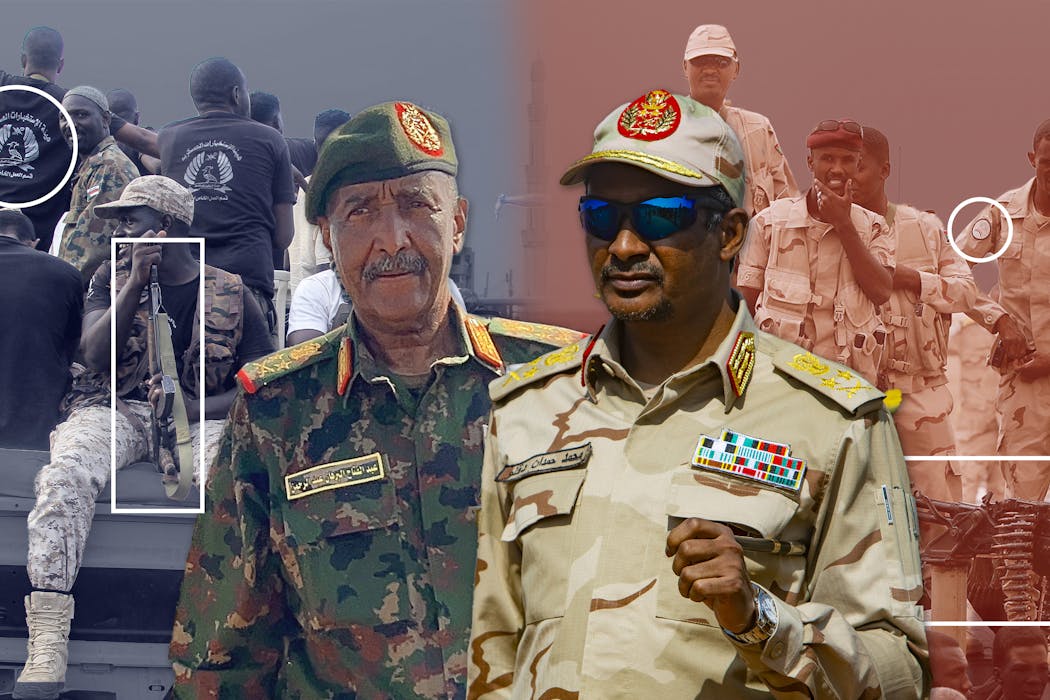
Mahmoud Hjaj/Anadolu Agency via Getty, Ebrahim Hamid, Getty, Hussein Malla/Getty, Anadolu/Getty, The Conversation

Sudan’s brutal civil war has dragged on for more than 2½ years, displacing millions and killing in excess of 150,000 people – making it among the most deadly conflicts in the world today.

As of December 2025, the paramilitary Rapid Support Forces appear to be making gains, seizing a key oil field in central Sudan and forcing the retreat of the Sudanese Armed Forces in key cities in the country’s west.

But fighting has ebbed and flowed throughout the war, with parts of the country changing hands a number of times. It has left a complicated picture of a nation mired in violence. Here’s a visual guide to help understand what is going on and the toll it has taken on the Sudanese population.

What military forces are involved?

Men holding guns and in army gear sit on trucks
Sudanese army soldiers take part in a military parade.
Ebrahim Hamid, Getty

The two main warring parties are the Sudanese Armed Forces (SAF) and the Rapid Support Forces (RSF).

The SAF is the nation’s official military. Prior to the civil war, it was responsible with enforcing the border, protecting the country from foreign entities and maintaining internal security. As of April 2023, the SAF had an estimated force of up to 200,000 people.
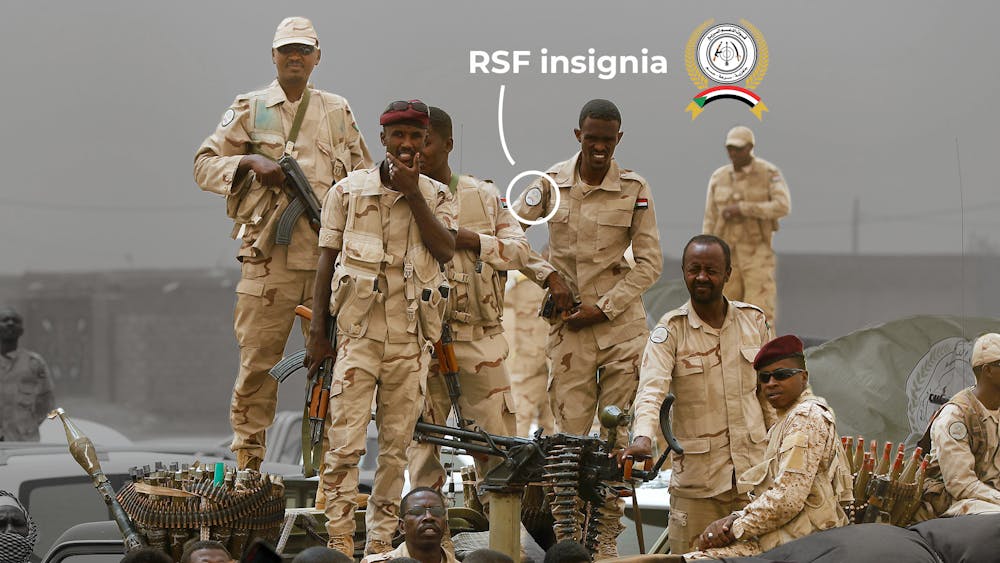
Men in military gard stand in a group.
Members of a Rapid Support Forces unit stand on their vehicle during a military-backed rally.
Hussein Malla/Getty

The paramilitary RSF is a semi-autonomous organization that was created in 2013 to confront rebel groups. Its origins lie in the feared Janjaweed militia that gained international notoriety for its scorched-earth tactics, extrajudicial killings and sexual assaults during a campaign in Darfur between 2003 and 2005.

Rebranding as the RSF, the paramilitary force evolved to become President Omar al-Bashir’s personal security force before al-Bashir’s ouster in 2019.

After that, the RSF and the SAF worked together to stage a 2021 coup against Prime Minister Abdalla Hamdok in 2021. But a power struggle emerged between the leaders of the RSF and SAF amid disagreements over the future direction of the country and whether the RSF would be incorporated into the army.

By the outbreak of the civil war in 2023, the RSF had amassed around 100,000 troops.

Various other armed groups have lent their support to the RSF and SAF during the conflict, including the rebel Sudan People’s Liberation Movement-North, which supports the RSF, and the army-aligned Justice and Equality Movement

Who are the main leaders?

A man in army fatigues stands.
Abdel Fattah al-Burhan visits the Al-Afadh refugee camp in Al Dabbah, Northern State, on Nov. 8, 2025.
Anadolu/Getty

The SAF is led by General Abdel Fattah al-Burhan, the nation’s top military commander and de facto head of state. The longtime soldier rose to the rank of regional commander in 2008 and was promoted a decade later to the position of army chief of staff.

Following Bashir’s 2019 ouster, Burhan was appointed to lead the Transitional Military Council and its successor civilian-military entity known as the Sovereign Council. As leader of the Sovereign Council, Burhan occupied the nation’s highest office.

His reputation has been marred by his own military’s attacks on civilians in Darfur in the early 2000s and, more recently, his reliance on support from Islamist groups.

A man in military uniform and sunglasses.
Mohamed Hamdan Dagalo attends a military graduation ceremony of special forces in Khartoum.
Mahmoud Hjaj/Anadolu Agency via Getty

The RSF leader, Mohamed Hamdan Dagalo, also known as “Hemedti,” was Burhan’s second-in-command.

Born to a poor family that settled in Darfur, Hemedti was part of the Janjaweed militia that President Bashir deployed to crush non-Arab resistance in the country’s west. Becoming leader of the Janjaweed before going on to head the RSF, Hemedti acquired a reputation as a ruthless commander whose brutal methods disturbed some fellow officers.

Where are the weapons, funding coming from?
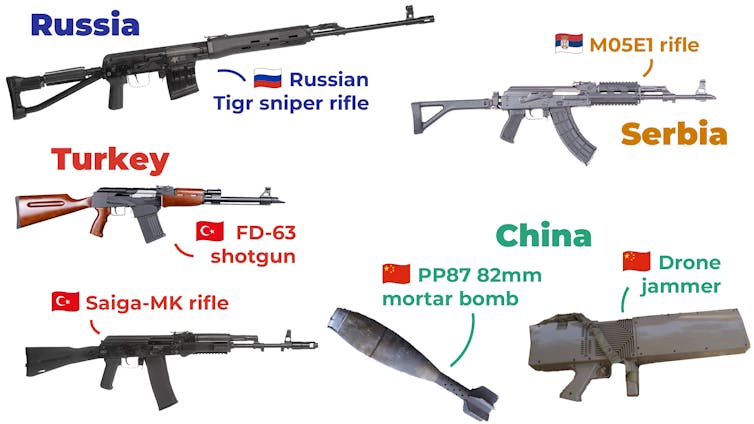
Graphic of guns and bombs fuelling the Sudan conflict
A few of the verified weapons imported and seen being used by both sides of the war.
Amnesty International – New weapons fuelling the Sudan conflict

While the fighting has largely been contained to within Sudan’s boundaries, it is being fueled from outside the country.

Amnesty International has reported that despite a decades-old arms embargo by the United Nations Security Council, recently manufactured weapons and equipment from China, Russia, Turkey and the United Arab Emirates have been used by both sides in the conflict.

The Sudanese government has accused the UAE of providing military assistance to the RSF, which in turn has been accused of using the UAE for illegal gold trafficking.

In addition to providing military assistance, the UAE has been accused of providing economic support for the RSF. In January 2025, the Biden administration sanctioned seven UAE-based companies funding Hemedti.

Saudi Arabia, which sees Sudan as an ally to counter Iran’s regional influence, has provided financial support to the SAF. In October 2025, the SAF-backed government announced that Saudi Arabia planned to invest an additional US$50 billion into Sudan, on top of the $35 billion it has already invested.

Egypt, allied with Burhan in a dispute with Ethiopia over the Grand Ethiopian Renaissance Dam, has supplied the SAF with warplanes and pilots.

Meanwhile, Iran and Russia have each extended support for the Sudanese government. It is believed that Iran, which renewed diplomatic ties with Sudan in October 2023, has provided the SAF with attack drones, while Russia has provided Sudan’s government with diplomatic and military support.

What areas are controlled by whom?

As of December 2025, the RSF and SAF control different halves of the country split along a roughly north-south axis. The SAF controls a little more than half of the country.

The SAF has a stronghold in the nation’s capital Khartoum. In the east, the army controls the city of Port Sudan on the Red Sea coast. The SAF also controls approximately three-quarters of the Sudanese border with Egypt to the north.

Strategically, the areas under SAF control provide the advantages of access to the Red Sea – a crucial transport hub through which 12% of the world’s maritime trade passes – as well as the historic demographic and administrative epicenter of Khartoum, situated at the confluence of the Blue and White Niles, and the livestock-rich Kassala state.

In all, Sudanese researcher Jihad Mashamoun estimates that as of November 2025, the SAF controlled 60% of the country.

Meanwhile, the RSF has consolidated control over Darfur – the massive western region that has been a hub for gold mining and trafficking routes – and the regional capital of el-Fasher, an economic hub connecting routes to Libya to the north, the Nile to the east and Chad to the west.

As researcher Bravin Onditi has noted, el-Fasher’s fall to the RSF in late October eliminated the SAF’s last stronghold in Darfur from which it could assert authority in western Sudan.

Outside of Darfur, the RSF controls most the country’s oil fields, many of the goldfields in central and southwest Sudan, and splits control over important grazing lands with the SAF.

What has been the toll on Sudan’s citizens?

One of the war’s distinguishing horrors has been repeated incidents of civilian killings.

Both sides have been accused of war crimes that include targeted attacks on civilians, medical centers and food systems. Mass killings in Khartoum, Darfur, Kordofan, Gezira, Sennar and White Nile states reflect the general scope of slaughter that has swept the country.

In some instances, this violence has taken on a decidedly ethnic dimension. Human Rights Watch reports that from late April to early November 2023, the RSF and its allied militias systematically sought to remove — including by murder — ethnic Masalit people from El Geneina, capital of West Darfur.

In October 2025, following the RAF’s siege of el-Fasher, the world watched in horror as satellite images of “clusters” consistent with bodies and blood-red discoloration could be seen on the ground. The U.N. Security Council held an emergency meeting condemning the RSF’s killing of nearly 500 people in el-Fasher’s Saudi Maternity Hospital.

More than 9.5 million people are classified as internally displaced, having fled violence. The International Organization for Migration reports that North and South Darfur states host the largest number of internally displaced people, followed by Central and East Darfur states.

Meanwhile, over 4 million have fled to the neighboring countries of Egypt, South Sudan and Chad.

Image sources:

FD-63 – Dağlıoğlu Silah,
Saiga MK .223, Kalashnikov Group,
Tigr DMR, Kalashnikov Group,
M05E1, Zastava Arms,
PP87 82MM mortar bomb, Amnesty International,
CKJ-G7 drone jammer, Amnesty International,
Streit Gladiator, Streit Group,
Terrier LT-79, Streit Group,
INKAS Titan-S, INKAS Armored Vehicles

The Conversation

Christopher Tounsel does not work for, consult, own shares in or receive funding from any company or organization that would benefit from this article, and has disclosed no relevant affiliations beyond their academic appointment.

ref. Sudan’s civil war: A visual guide to the brutal conflict – https://theconversation.com/sudans-civil-war-a-visual-guide-to-the-brutal-conflict-271429
Trump tariffs and warming India-China ties have silenced the Quad partnership … for now

Source: The Conversation – Global Perspectives – By Hyeran Jo, Associate Professor of Political Science, Texas A&M University

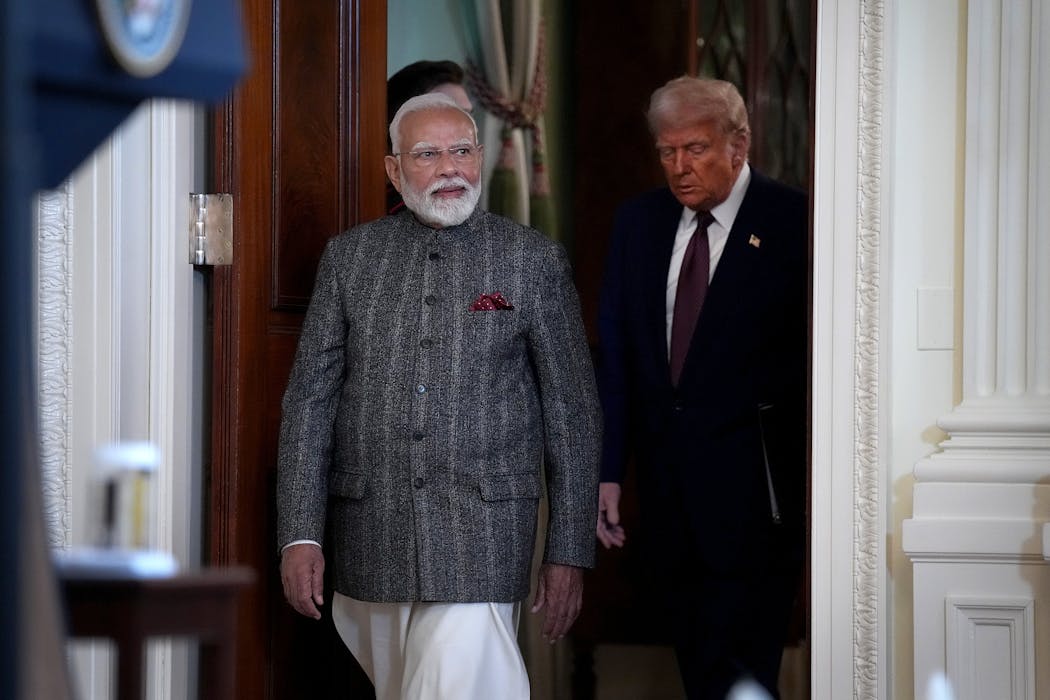
When one diplomatic dance ends, Prime Minister Narendra Modi and President Donald Trump have sought partners elsewhere. Andrew Harnik/Getty Images

When leaders of “the Quad” last met in September 2024, host and then-President Joe Biden declared the partnership between the United States, India, Australia and Japan to be “more strategically aligned than ever before.”

“The Quad is here to stay,” trumpeted Indian Prime Minister Narendra Modi.

Fast-forward a little over a year, however, and the tune has changed.

Leaders of the Quad were due to hold their latest summit in November 2025, with India hosting. But the month came and went, and no event was held. A future date has yet to be announced.

Why the silence? As experts of international institutions and the geopolitics and geoeconomics of the Indo-Pacific, we believe the answers can be found in the calculus of the two largest members involved: India and the U.S.

For the Trump administration, the domestic dividends of the Quad are not immediately obvious. Meanwhile, New Delhi is more concerned about how to position itself amid the great power competition between China and the U.S.

The result is paralysis for the Quad, for now.

The evolution of the Quad

The Quadrilateral Security Dialogue, to give the Quad its full name, began life in 2004.

The Quad 1.0 focused on humanitarian disaster assistance and cooperation after the Indian Ocean tsunami. In 2007, under the vision of then-Japanese Prime Minister Shinzo Abe, the Quad was recast as a platform to promote a free and prosperous Indo-Pacific, with an eye toward maritime security and economic cooperation.

Since then, the Quad has seen many fits and starts. Australia withdrew from the partnership in 2008 when it prioritized trade relations with China. India, too, has at times been tepid about the Quad’s continuation, partly due to its legacy of nonalignment and concerns over managing relations with Beijing.

The Quad 2.0 came to life in 2017 as the four core members coalesced around a shared sentiment of countering China’s rising power.

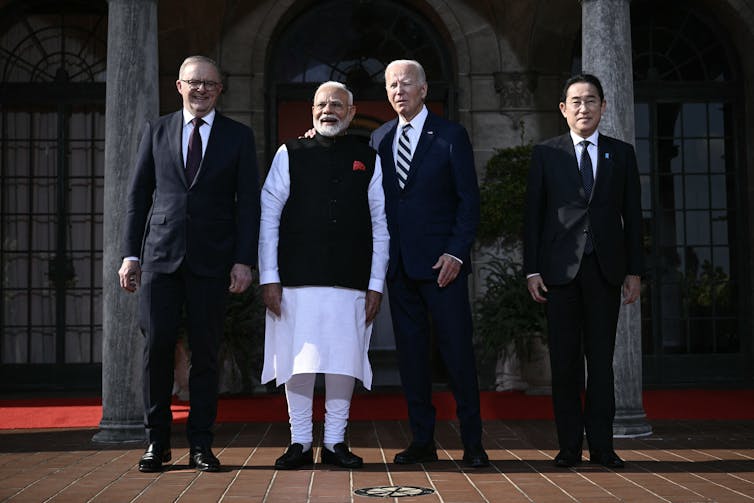
Four men stand for a photo
President Joe Biden participates in a 2024 Quad summit with prime ministers Anthony Albanese of Australia and Narendra Modi of India and Fumio Kishida of Japan.
Brendan Smialowski/AFP via Getty Images

Despite its name, the Quadrilateral Security Dialogue has increasingly gravitated toward nonsecurity agendas, from global health to maritime domain awareness and critical technologies.

Yet even as this emerging Quad 3.0 has foregrounded cooperation around the slogan “development, stability and prosperity,” it is over trade and tariffs that the two largest members of the Quad are not seeing eye to eye.

The eagle and elephant tussle over tariffs

On Aug. 1, 2025, Washington imposed a 25% reciprocal tariff on Indian goods over long-standing trade frictions, notably over access to India’s agricultural market. It was followed by an additional 25% punitive duty for New Delhi’s continued purchases of Russian oil.

The combined 50% U.S. tariff was accompanied by another move that upset New Delhi: new U.S. restrictions on H-1B visas. Some 70% of all holders of the U.S. visas, designed for temporary skilled workers, are Indian nationals.

The rift between New Delhi and Washington widened with India’s decision to attend a meeting in Rio de Janeiro in September of the so-called BRICS nations. That was interpreted as an “anti-U.S.” summit by Washington given its composition of largely Global South nations and other countryies antagonistic to the West, including Russia and China.

As a key member of the BRICS grouping, India’s attendance should have come as no real surprise. Even so, and despite Modi’s decision not to attend personally, the U.S. took umbrage, with U.S. Secretary of Commerce Howard Lutnick criticizing India’s BRICS membership and accusing New Delhi of having “rubbed the United States the wrong way.”

Lutnick’s comments are indicative of the cooling ties between New Delhi and Washington. Since the end of the Cold War, India has been seen by Washington as a democratic ally and a vital U.S. partner in the Indo-Pacific. The two countries have shared strategic and defense partnerships – a foundational aspect of the Quad.

And despite recent tensions, the factors underpinning U.S.-India relations remain constant. The U.S. is India’s largest trading partner, with bilateral trade reaching US$131.84 billion in the 2024-25 fiscal year.

This gives New Delhi not only economic leverage over the U.S. but also a strategic rationale to continue its cooperation with Washington.

A countering ‘Dragon-Elephant’ tango?

Yet at the same time, India appears to be increasingly tilting toward China, both economically and in geopolitics.

Modi visited China during the Shanghai Cooperation Organization summit meeting in August and framed the two countries as development partners, not rivals. This has been interpreted as a rapprochement between China and India after decades of border skirmishes and maritime friction.

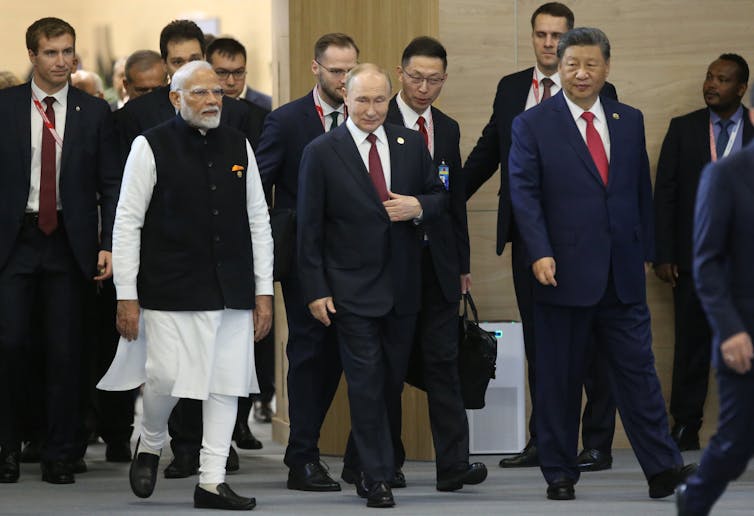
A group of men walk together.
Indian Prime Minister Narendra Modi, Russian President Vladimir Putin and China’s Xi Jinping attend the BRICS leaders summit on Oct. 23, 2024.
Contributor/Getty Images

Earlier this year, Chinese leader Xi Jinping used the term “Dragon-Elephant Tango” to promote a vision of India-China ties based on “mutual achievement.”

Despite the U.S. surpassing China as India’s biggest trading partner in 2021-22, investment ties between New Delhi and Beijing have grown steadily between 2005 and 2025, with only some intermittent friction.

However, what can appear as a tilt toward Beijing is better understood through structural roots in India’s economic realities as well as the country’s long-standing commitment to nonalignment.

The relationship between India and China is marked by significant economic interdependence rather than political convergence. India’s imports are largely coming from China, especially in the areas of machinery, electronics and other intermediate goods.

Yet for all of the convergence, areas of bilateral tensions remain. India’s growing trade deficit with China and Beijing’s ironclad relationship with Pakistan – along with unresolved border issues – limit how far New Delhi is willing to align with Beijing strategically.

Nevertheless, India-China relations are no doubt warming, especially in the wake of Trump’s tariffs. Indicative of that shift were India’s exports to China, which surged by 90% in November to $2.2 billion.

Broader sources of Indian-US tension

It isn’t just the warming China-India relationship that has thrown a wrench into the Quad’s works. The Trump administration’s growing embrace of India’s archrival Pakistan has also soured U.S.-India ties.

Trump’s claim to have mediated an end to the brief Pakistan-India war in May and his subsequent invitation of Pakistan’s army chief to the White House were met with anger in India.

That dispute was mirrored by the one over Russian oil, which had precipitated some of Trump’s tariffs on India. Modi’s government has walked a tightrope between the U.S. and Russia, wanting to keep open the possibility of good relations with Russian President Vladimir Putin, while managing tensions with the U.S. That’s why Putin’s visit to India in December held such symbolic value.

The Modi government stopped short of explicit long-term commitments to new Russian oil purchases and did not chart any new defense deals. In that, as with the issue over Washington’s embrace of Pakistan, India has sought to balance competing camps, creating space to maintain an open door with the U.S. without abandoning India’s strategic autonomy on what nations it does business with.

Optimism amid paralysis

So, how does all this diplomatic tangoing affect the Quad?

The result, it appears, is paralysis at this juncture. But it is important to point out that neither country wants to pronounce the Quad dead. The latest National Security Strategy of the United States explicitly mentions the Quad as part of efforts to “win the economic future” in Asia.

And both nations continue to reaffirm their commitment to the partnership – betting that political conditions will stabilize and that global trends may turn in their favor.

So there are still reasons for guarded optimism. Recent progress in trade negotiations and gradual reductions in Russian oil imports could ease Washington’s skepticism over India.

And for their part, Japan and Australia are trying to keep the momentum going – Japan with its naval and coast guard capabilities and Australia with infrastructure and health initiatives.

If a mutually acceptable trade deal with the U.S. can emerge, and New Delhi can craft an agenda for the Quad framework that is acceptable to the current U.S. administration, a leaders summit could still materialize in 2026.

But the louder the tariff wars between India and the U.S. become, the slimmer the chance for a stronger Quad in the near term.

The Conversation

Hyeran Jo receives funding from the Carnegie Corporation of New York (G-PS-24-62004, Small State Statecraft and Realignment). The statements made and views expressed are solely the responsibility of the author.

Yoon Jung Choi does not receive funding from any organization related to this article. The statements made and views expressed are solely the responsibility of the author.

ref. Trump tariffs and warming India-China ties have silenced the Quad partnership … for now – https://theconversation.com/trump-tariffs-and-warming-india-china-ties-have-silenced-the-quad-partnership-for-now-270606

Le cadeau sous le sapin : ce qu’il dit de notre lien avec nos chiens

Source: The Conversation – in French – By Sandra Friedrich, Doctorante, Santé et société, Université du Québec à Montréal (UQAM)

Chaque année, des millions de chiens, en Occident, trouveront un cadeau sous le sapin. Geste anodin ? Pas tant que ça. Ce rituel révèle non seulement la profondeur du lien qui nous unit à eux, mais aussi notre tendance à prêter à leurs comportements un sens humain.

Ces liens se construisent dans le quotidien : repas, promenades, moments de repos offrent au chien une base sécurisante, favorisent l’attachement et améliorent sa capacité à gérer le stress. Les rituels transforment l’ordinaire en moments porteurs de sens : le cadeau sous le sapin, les jeux du dimanche, les salutations au retour du travail.

Certains chercheurs voient dans la participation active des chiens une preuve de leur subjectivité, car ils anticipent et initient ces activités. L’enthousiasme du chien, ses bonds ou le battement de sa queue font partie intégrante du moment que les humains interprètent comme porteurs de signification.

Nos travaux, menés dans le cadre du doctorat interdisciplinaire santé et société de l’Uqam sous la direction de la professeure Johanne Saint-Charles, montre que ces rituels constituent des moments investis affectivement. Ils participant à ce que nous appelons l’« épaisseur temporelle » du lien : tout ce qui a été vécu ensemble et qui continue de nourrir le présent.

Rituels quotidiens et célébrations annuelles créent une histoire commune, des repères et des attentes réciproques. Si les humains offrent un cadeau à leur chien ou le photographient avec le père Noël, c’est qu’il occupe une place suffisamment importante pour mériter ce geste : il est reconnu comme membre à part entière de la famille.

Mais cette lecture est-elle anthropomorphique ? Quand l’humain voit le chien « participer activement », perçoit-il une vraie intention ou projette-t-il ses propres catégories mentales ? Quand on parle d’un « langage partagé » à propos de ces rituels domestiques, décrit-on une vraie réciprocité ou projette-t-on du sens sur des comportements canins ?

Repenser l’anthropomorphisme

On entend souvent que l’anthropomorphisme – cette tendance à attribuer des motivations, des pensées ou des émotions humaines aux animaux – constituerait une erreur à éviter absolument. La réalité est plus nuancée.


À lire aussi :
Le dégriffage des chats leur génère une douleur à vie. Il est temps de l’interdire


L’anthropomorphisme est un trait quasi universel, mais il peut varier chez ceux et celles qui ont des animaux de compagnie. Les sciences du comportement animal reconnaissent chez le chien des capacités socio-cognitives réelles : lecture des émotions humaines, suivi du regard, mémoire des événements passés… Les recherches ont largement documenté la capacité des chiens à ressentir des émotions primaires perceptibles à travers leurs comportements, à manifester des préférences et à exprimer des attentes. Ces capacités créent les conditions d’une communication humain-chien fonctionnelle.

Le chien produit des expressions lisibles (postures, regards, vocalisations) et les humains les interprètent à travers leurs propres schémas cognitifs. Il en résulte une co-construction de la communication entre espèces : le chien émet, l’humain décode, et la relation se tisse. Mais le risque demeure de sur-interpréter, de plaquer sur l’animal une intériorité calquée sur la nôtre.

Il est peu probable qu’un chien soit jaloux (au sens humain du terme) du cadeau du chat ou qu’il sache qu’il a été sage cette année. S’il déchire frénétiquement le papier d’emballage, cela ne veut pas forcément dire qu’il éprouve de la reconnaissance, mais cela ne signifie pas non plus qu’il ne ressent rien. Dans l’atmosphère festive, ce qui compte pour lui, c’est peut-être l’odeur de la friandise, l’excitation ambiante ou le temps passé avec son humain.


À lire aussi :
La race d’un chien influence sa personnalité – mais son propriétaire aussi


Vers un anthropomorphisme relationnel

L’anthropomorphisme opère donc dans une zone grise. Il s’ancre dans des signaux expressifs réels, mais les interprète via des cadres humains qui peuvent excéder ce que le chien exprime véritablement. Comme dispositif relationnel, il rend le comportement canin intelligible, fluidifie la communication quotidienne et renforce le lien affectif, tout en comportant le risque d’attribuer au chien des états mentaux qu’il ne possède peut-être pas.

Des chercheurs ont mis en place un modèle pour expliquer comment l’anthropomorphisme fonctionne : en utilisant les connaissances humaines comme guide par défaut, une personne peut interpréter les comportements de son chien, prédire ses réactions pour coordonner leurs interactions et combler son besoin de connexion sociale. En ce sens, c’est un outil cognitif permettant le dialogue humain‑chien.

L’anthropomorphisme ne se limite pas à un processus mental : il repose sur l’interaction et transforme la nature même de la relation. Cet anthropomorphisme consiste à traiter le chien comme un interlocuteur doté d’une vie intérieure, sans présumer qu’elle soit identique à la nôtre. En lui attribuant une subjectivité, l’humain positionne le chien comme un partenaire avec lequel il construit quelque chose et non comme un objet sur lequel il agit. Cette posture favorise une attention accrue aux signaux canins et une relation plus riche.

C’est précisément cette double posture, traiter le chien comme un interlocuteur tout en reconnaissant son altérité, que nous avons observée chez les personnes entretenant des relations significatives avec leur chien. Et c’est dans cette posture que les rituels, y compris celui du cadeau de Noël, prennent tout leur sens. Non pas parce que le chien comprendrait la signification de la fête, mais parce que le geste traduit la place qu’il occupe dans la vie de son humain.

Pour le chien, le moment du cadeau représente une expérience riche : stimulation olfactive, interaction ludique, attention exclusive de son humain. Pour ce dernier, c’est l’occasion de réaffirmer un lien. Le rituel partagé n’exige pas une compréhension commune de sa signification. Il suffit qu’il soit vécu ensemble.

Routines et rituels forment la trame matérielle et symbolique de la cohabitation, où le chien n’est pas seulement intégré au quotidien, mais reconnu comme partenaire relationnel à part entière. Ce que les humains disent, font et croient au sujet de leur chien façonne concrètement la relation. Reconnaître une forme d’esprit chez l’animal n’est pas une illusion sentimentale. C’est une construction relationnelle qui permet d’entretenir un lien affectif, moral et pratique avec un être non humain. Le chien y participe : par ses réponses, ses réactions, sa personnalité propre, il contribue à cette relation construite ensemble.

Alors que des millions de personnes magasinent des cadeaux pour leur chien et partagent avec lui une relation qui structure profondément leur quotidien, les cadres institutionnels peinent encore à saisir cette réalité. Interdictions dans les logements locatifs, restrictions d’accès à certains espaces publics : le chien reste souvent un impensé administratif. La relation humain-chien n’est pourtant pas un à-côté de l’existence, mais l’une de ses trames essentielles. Ce décalage entre inclusion affective et invisibilité structurelle constitue l’un des paradoxes de la société québécoise contemporaine.

Pas de cadeau sous le sapin ? Cela ne veut pas dire que vous ne l’aimez pas : vos rituels quotidiens valent tous les cadeaux du monde.

La Conversation Canada

Sandra Friedrich ne travaille pas, ne conseille pas, ne possède pas de parts, ne reçoit pas de fonds d’une organisation qui pourrait tirer profit de cet article, et n’a déclaré aucune autre affiliation que son organisme de recherche.

ref. Le cadeau sous le sapin : ce qu’il dit de notre lien avec nos chiens – https://theconversation.com/le-cadeau-sous-le-sapin-ce-quil-dit-de-notre-lien-avec-nos-chiens-271585

After Canada legalized cannabis, police caught more drunk drivers

Source: The Conversation – Canada – By Michael J. Armstrong, Associate Professor, Operations Research, Brock University

When Canada legalized cannabis in October 2018, there were many concerns about its potential impacts. One of them involved cannabis-impaired driving.

Before legalization, police were already catching more drug-impaired drivers each year. So, people naturally worried that more stoned drivers would appear on the road after legalization.

To lower that risk, the federal government updated its driving laws. Impairment by alcohol or drugs separately was already illegal. In December 2018, Canada also banned impairment by combinations of alcohol and drugs, or by unspecified substances.


Read more:
Cannabis-impaired driving: Here’s what we know about the risks of weed behind the wheel


The government likewise helped police to better enforce those laws. For example, it gave them more power to obtain breath and blood samples from drivers. And it funded more training to help them recognize symptoms of drug impairment.

However, it was unclear how much impaired driving would really increase due to legalizing cannabis.

For example, drivers injured in collisions often test positive for cannabis, but also for other drugs. Cannabis consumers claim they are driving less often after use. And police say that drivers’ symptoms more often imply impairment by stimulants or narcotics than by cannabis.

Given this uncertainty, I decided to dig into the police data.

Police-reported impairment

My research analyzed the annual rates of impaired driving cases that police investigated between 2009 and 2023. The reporting covered four substance categories: alcohol, drugs, drugs-and-alcohol combined and unknown substances.

Note that “drugs” includes cannabis but also other chemicals like opioids and amphetamines. Publicly available data unfortunately don’t name the drugs involved.

I first estimated the trends in alcohol and drug impairment up until 2018. I then calculated how much rates changed from 2019 onward.

I also checked several potential explanations for those changes. Those included the level of legalized cannabis sales and the share of adults consuming cannabis in each province. I also considered each province’s number of police trained in drug recognition and their degree of COVID-19 pandemic restrictions.

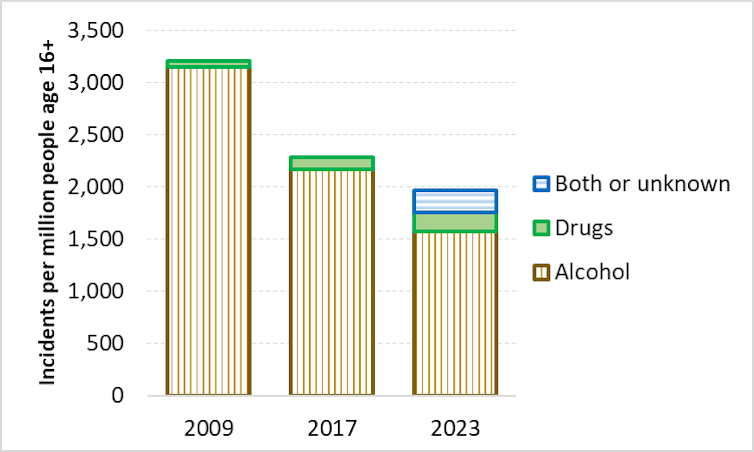
The data showed that during the 15-year study period, alcohol remained the most common impairment category. But its share of all cases dropped from 98 per cent in 2009 to 95 per cent in 2017 and to just 80 per cent in 2023.

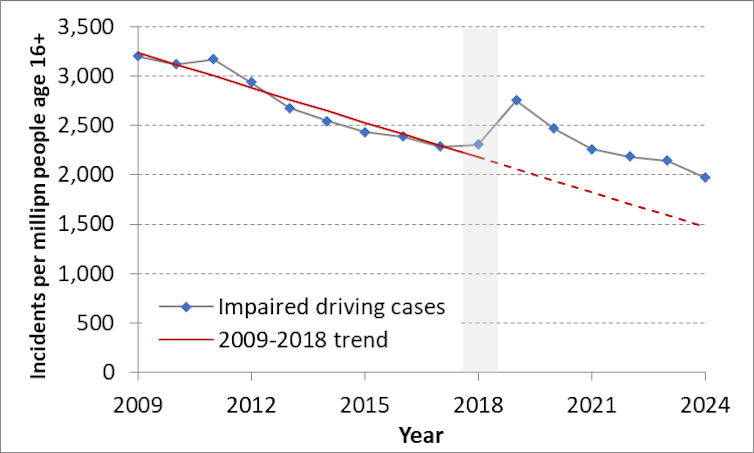
Up until 2018, the total impairment rate also fell each year.

This line chart shows how Canada's impaired driving rates were decreasing from 2009 until 2018, jumped higher in 2019, and then resumed their downward trend from 2020 onward.
Canadian average police-reported impaired driving incidents per million population aged 16+, comparing actual rates to the 2009-2018 trend.
Statistics Canada, CC BY

More drinks and drugs

But in 2019, rates jumped substantially. As a result, police reported 31 per cent more impairment cases during 2019-23 than the 2009-18 trend had projected.

The impairment increases varied between provinces. For example, there was no significant change in Québec and Saskatchewan. But rates doubled in British Columbia and Newfoundland.

Percentage-wise, the drugs category saw the most growth. It averaged 42 per cent higher during 2019-23 than had been projected.

But alcohol impairment rose too. It averaged 17 per cent above its previous trend.

And when counting drivers, alcohol’s growth was larger. The increase in drinking drivers caught by police was four times the increase in drugged drivers.

The new offenses for impairment by drugs and alcohol combined, or by unspecified substances, also contributed to the higher rate.

So, police clearly found more impaired drivers after 2018. But was that because more impaired drivers were on the road? Because police got better at catching them? Or both?

This bar chart shows that overall impairment rates were lower in 2023 than in 2009, but with an increasing proportion due to drugs or drugs and alcohol combined.
Canadian average police-reported impairment rates in 2009, 2017, and 2023, broken down by substance category.
Statistics Canada, CC BY

Constables, COVID and cannabis

My analysis showed the impairment changes were correlated most strongly with the number of police trained in drug recognition. Not surprisingly, when provinces gave police more training, they caught more impaired drivers.

The restrictions that provinces imposed during the COVID-19 pandemic showed the second biggest correlations with impairment. But interestingly, alcohol and drugs diverged: when provinces tightened restrictions, they got less impairment from alcohol but more from drugs.

Presumably, lockdowns meant fewer bars open, and so fewer people driving home drunk. But perhaps lockdowns also meant more laid-off workers using drugs at home before going grocery shopping.


Read more:
Alcohol sales changed subtly after Canada legalized cannabis


Alcohol impairment showed no relationship with the numbers of Canadians consuming cannabis or the amount of cannabis legally sold. That’s not surprising. Canadians didn’t suddenly replace their cabernet with cannabis after legalization.

But it was surprising that drug impairment likewise showed no relationship with cannabis consumer numbers. And it was only weakly correlated with legal sales.

This might imply that most drug impairment came from chemicals other than cannabis. Or perhaps most legal cannabis purchases simply replaced existing illegal ones, rather than adding to total usage.

Consuming responsibly

Overall, Canadian police reported noticeably more drug-impaired and alcohol-impaired driving after 2018. But the growth seemed related mostly to enhanced enforcement and pandemic disruptions, rather than to legalized cannabis. And fortunately, the long-term decline in impaired driving resumed in 2020.

All road users benefit from that continuing decline. And we each play a role in maintaining it. Whether your preferred intoxicant is booze, weed or something else, please consume responsibly. And use designated drivers or public transit to get home.

After all, flashing coloured lights look much nicer on a tree standing in your home than on a police car pulling you over.

The Conversation

Michael J. Armstrong does not work for, consult, own shares in or receive funding from any company or organisation that would benefit from this article, and has disclosed no relevant affiliations beyond their academic appointment.

ref. After Canada legalized cannabis, police caught more drunk drivers – https://theconversation.com/after-canada-legalized-cannabis-police-caught-more-drunk-drivers-272244

Deception and lies from the White House to justify a war in Venezuela? We’ve seen this movie before in run-ups to wars in Vietnam and Iraq

Source: The Conversation – USA – By Betty Medsger, Professor Emeritus of Journalism, San Francisco State University

Military personnel on the amphibious assault ship USS Iwo Jima on Dec. 16, 2025, in Ponce, Puerto Rico, during a U.S. military campaign in the Caribbean and eastern Pacific. Miguel J. Rodriguez Carrillo/AFP via Getty Images

Are Americans about to be led again into a war based on misrepresentations and lies? It’s happened before, most recently with the wars in Iraq and Vietnam.

President Donald Trump and his administration have presented the country’s growing military operations against Venezuela as a war against drug trafficking and terrorism. Trump has designated the government of Venezuela President Nicolas Maduro as a foreign terrorist organization, the first country to ever receive that designation.

The U.S. military has killed at least 99 crew members of small boats that Trump claims, without presenting evidence, were carrying illegal drugs destined for the U.S. The New York Times reports, however, that “Venezuela is not a drug producer, and the cocaine that transits through the country and the waters around it is generally bound for Europe.”

Trump’s administration has justified the bombing of these boats by declaring they are manned by combatants. U.S. Sen. Jack Reed, a Democrat from Rhode Island, told the Intercept news outlet that the administration “has offered no credible legal justification, evidence or intelligence for these strikes.”

There is no war. Yet.

On Dec. 12, 2025, Trump said, “It’s going to be starting on land pretty soon” and announced four days later a “total and complete blockade of all sanctioned oil tankers going into, and out of, Venezuela.”

As Trump increasingly sounds like he is preparing to go to war against Venezuela, it might be helpful to examine the run-ups to the wars in Iraq and Vietnam – two wars based on lies that led, together, to the deaths of 62,744 Americans.

As an investigative journalist who has written about the vast, secret operations of the FBI and the man who ran it for decades, I am well aware of the dangerous ability the government has to deceive the public. I also covered the opposition to the Vietnam war and the release of information years later that revealed that lies were at the heart of the start of both the Vietnam and Iraq wars.

Author Betty Medsger speaks about her story on Donald Trump’s targeting of his perceived enemies and its connection to her book on the FBI.

Fear used to gin up public support

Consider the run-up to the Iraq War.

Fear was the main tool used to convince the public that it was essential for the U.S. to go to war in Iraq. The manufacturing of fear was evident in a speech by Vice President Dick Cheney in August 2002 to a convention of the Veterans of Foreign Wars.

In 2003, Secretary of State Colin Powell addressed the U.N. Security Council on information and intelligence that he believed showed the possibility of weapons of mass destruction in Iraq.

Cheney said, without evidence, that Iraq’s Saddam Hussein was planning to use weapons of mass destruction against the United States and its allies. If the U.S. did not go to war against Iraq, he said, it might experience another Pearl Harbor.

President George W. Bush chose Secretary of State Colin Powell to make the administration’s most prominent public case for going to war in Iraq in a televised speech at the United Nations. Powell was perhaps the most respected official in the Bush administration.

The White House provided Powell with a draft speech. But Powell pressed the CIA regarding what he thought were unsupported claims in the White House draft. Despite his efforts, his speech on Feb. 5, 2003, contained significant unsupported claims, including that Hussein had authorized his military to use poison gas if the U.S. invaded.

“Leaving Saddam Hussein in possession of weapons of mass destruction for a few more months or years is not an option, not in a post-September 11th world,” Powell solemnly declared that day.

He later expressed regret for making the case for war.

“I’m the one who presented it on behalf of the United States to the world,” Powell later said. By then, he said, the speech was “painful” for him personally and would forever be a “blot” on his reputation.

Intelligence agencies pressed to justify war

No weapons of mass destruction existed in Iraq, nor was Hussein connected with al-Qaida, as the Bush administration had said it was. And Iraq did not release poison gas when the U.S. invaded the country. Early postwar assessments of how the U.S. could have invaded Iraq on the basis of serious false claims suggested it happened because the CIA and other intelligence agencies gave President Bush false or inadequate intelligence.

But as extensive official records of pre-war deliberations became available to journalists and others in response to Freedom of Information Act requests, a different explanation emerged.

John Prados, historian at the National Security Archives, discovered an explanation in hundreds of official records that meticulously document the run-up to the war.

They revealed that U.S. intelligence agencies had let themselves be used, he wrote, as “a tool of a political effort, vitiating the intelligence function … They all yielded intelligence predictions of exactly the kind the Bush administration wanted to hear … The intense focus on achieving the conditions for war instead of solving an international problem led to crucial faults in military planning and diplomatic action.”

The administration did not attempt to engage in diplomacy before deciding to go to war. There never was a serious effort, even within the administration, to consider alternatives to war.

George J. Tenet, director of the CIA at the time, later wrote that “based on conversations with colleagues, in none of the meetings can anyone remember a discussion of the central questions: Was it wise to go to war? Was it the right thing to do?”

Most journalists accepted PR at face value

A dearth of serious reporting contributed to the public being ill-informed.

Dan Kennedy, professor of journalism at Northeastern University, recently wrote that only one news organization, the Washington bureau of Knight Ridder – later known as McClatchy – exposed the Bush-Cheney “administration’s lies and falsehoods during the run-up to the disastrous war in Iraq.”

Other reporters relied on the public relations push for war being made to journalists by high-level political appointees in the military, foreign service and intelligence agencies. But Knight Ridder journalists relied on expert, longtime career officers in those agencies who were “deeply troubled by what they regarded as the administration’s deliberate misrepresentation of intelligence, ranging from overstating the case to outright fabrication.”

Lies to Congress and the public also were at the heart of the run-up to the war in Vietnam.

President Johnson reports to Congress and the American people on the Gulf of Tonkin incident, which he said happened off the coast of Vietnam but which was later disputed.

Of the two attacks on a destroyer that the administration of President Lyndon Johnson said required an immediate vast buildup of troops in August 1964, one was provoked by the United States and the other one never happened.

Few if any questions were asked when the House and Senate voted – with only two no votes – on the request for what would be known as the Gulf of Tonkin Resolution. The resolution was used by Johnson and his successor, President Richard Nixon, to keep expanding the war for nearly a decade. By mid-1969, there were 543,400 American troops in Vietnam.

Truth and transparency are crucial

It may seem obvious that the most important lesson to be learned from those wars is that the president and all who contribute to decisions to go to war should tell the truth. But, as shown by the presidents who led the U.S. into wars in Iraq and Vietnam and from Trump’s daily remarks, truth is a frequent casualty.

That increases the need for Congress, the public and the press to demand to be fully informed about these decisions that will be carried out in their name, with their money and with the blood of their sons and daughters. That’s necessary to prevent a president and Congress from making decisions that lead to consequences like these:

In the Iraq War, 4,492 American military members were killed and approximately 200,000 Iraqi civilians were killed. In the Vietnam War, 58,252 American military members were killed, 1.1 million Vietnamese military members were killed, and a staggering 2 million Vietnamese civilians were killed.

The Conversation

Betty Medsger does not work for, consult, own shares in or receive funding from any company or organization that would benefit from this article, and has disclosed no relevant affiliations beyond their academic appointment.

ref. Deception and lies from the White House to justify a war in Venezuela? We’ve seen this movie before in run-ups to wars in Vietnam and Iraq – https://theconversation.com/deception-and-lies-from-the-white-house-to-justify-a-war-in-venezuela-weve-seen-this-movie-before-in-run-ups-to-wars-in-vietnam-and-iraq-272044

RFK Jr. wants to scrutinize the vaccine schedule – but its safety record is already decades long

Source: The Conversation – USA (3) – By Jake Scott, Clinical Associate Professor of Infectious Diseases, Stanford University

Children today receive more vaccines than children did in the past, but due to advances in vaccine technology, today’s shots contain far fewer immune-stimulating molecules. SDI Productions/iStock via Getty Images Plus

The U.S. childhood immunization schedule, the grid of colored bars pediatricians share with parents, recommends a set of vaccines given from birth through adolescence to prevent a range of serious infections. The basic structure has been in place since 1995, when federal health officials and medical organizations first issued a unified national standard, though new vaccines have been added regularly as science advanced.

Vaccines on the childhood schedule have been tested in controlled trials involving millions of participants, and they are continuously monitored for safety after being rolled out. The schedule represents the accumulated knowledge of decades of research. It has made the diseases it targets so rare that many parents have never seen them.

A bar chart showing the U.S. childhood vaccine schedule.
The U.S. childhood vaccine schedule recommends a set of vaccines given from birth through adolescence. The schedule shown here was last updated in August 2025.
Centers for Disease Control and Prevention

But the schedule is now under scrutiny.

On Dec. 16, 2025, the Centers for Disease Control and Prevention adopted its first major change to the childhood immunization schedule, under Kennedy’s leadership. The agency accepted an advisory committee’s vote to drop a long-held recommendation that all newborns be vaccinated against hepatitis B, despite no new evidence that questions the vaccine’s long-standing safety record.

Health and Human Services Secretary Robert F. Kennedy Jr., who has cast doubt on vaccine safety for decades, has said he plans to further scrutinize the vaccines children receive.

I’m an infectious disease physician who treats vaccine-preventable diseases and reviews the clinical trial evidence behind immunization recommendations. The vaccine schedule wasn’t designed in a single stroke. It was built gradually over decades, shaped by disease outbreaks, technological breakthroughs and hard-won lessons about reducing childhood illness and death.

With federal officials now casting doubt on its foundations, it’s helpful to know how it came about.

The early years

For the first half of the 20th century, smallpox vaccination was common, required by most states for school entry. But there was no unified national schedule. The combination vaccine against diphtheria, tetanus and pertussis, known as the DTP vaccine, emerged in 1948, and the Salk polio vaccine arrived in 1955, but recommendations for when and how to give them varied by state, by physician and even by neighborhood.

The federal government stepped in after tragedy struck. In 1955, a manufacturing failure at Cutter Laboratories in Berkeley, California, produced batches of polio vaccine containing live virus, causing paralysis in dozens of children. The incident made clear that vaccination couldn’t remain a patchwork affair. It required federal oversight.

In 1964, the U.S. surgeon general established the Advisory Committee on Immunization Practices, or ACIP, to provide expert guidance and recommendations to the CDC on vaccine use. For the first time, a single body would evaluate the evidence and issue national recommendations.

A CDC poster for oral polio vaccine with a striped bee saying be well.
Polio vaccines, as advertised in this CDC poster from 1963, were administered on a large scale throughout the U.S. starting in 1955.
Centers for Disease Control and Prevention

New viral vaccines

Through the 1960s, vaccines against measles (1963), mumps (1967) and rubella (1969) were licensed and eventually combined into what’s known as the MMR shot in 1971. Each addition followed a similar pattern: a disease that killed or disabled thousands of children annually, a vaccine that proved safe and effective in trials, and a recommendation that transformed a seemingly inevitable childhood illness into something preventable.

The rubella vaccine went beyond protecting the children who received it. Rubella, also called German measles, is mild in children but devastating to fetuses, causing deafness, heart defects and intellectual disabilities when pregnant women are infected.

A Rubella epidemic in 1964 and 1965 drove this point home: 12.5 million infections and 20,000 cases of congenital rubella syndrome left thousands of children deaf or blind. Vaccinating children also helped protect pregnant women by curbing the spread of infection. By 2015, rubella had been eliminated from the Americas.

Technology opens new doors

One limitation of some early bacterial vaccines was that they didn’t work well in infants. Young children’s immune systems couldn’t mount a strong response to the sugar coating on certain bacteria. In the 1980s, scientists developed a method called conjugate vaccine technology, in which sugars on bacterial pathogens are linked to proteins that the immune system – even in infants – can more easily respond to.

The first target of this innovation was a bacterium called Haemophilus influenzae Type b, or Hib. Before vaccination, Hib was the leading cause of bacterial meningitis in American children, causing roughly 20,000 cases of the disease annually and killing hundreds.

The Hib conjugate vaccine was licensed for use in infants in 1990, and within five years Hib disease in young children dropped by more than 99%. Most pediatricians practicing today have never seen a case.

Hepatitis B and the safety net

In 1991, the CDC added hepatitis B vaccination at birth to the schedule. Before then, around 18,000 children every year contracted the virus before their 10th birthday.

Many parents wonder why newborns need this vaccine. The answer lies in biology and the limitations of screening.

An adult who contracts hepatitis B has a 95% chance of clearing the virus. An infant infected in the first months of life has a 90% chance of developing chronic infection, and 1 in 4 will eventually die from liver failure or cancer. Infants can acquire the virus from their mothers during birth, from infected household members or through casual contact in child care settings. The virus survives on surfaces for days and is highly contagious.

Early strategies that targeted only high-risk groups failed because screening missed too many infected mothers. Even today, roughly 12% to 18% of pregnant women in the U.S. are never screened for hepatitis B. Until ACIP dropped the recommendation in early December 2025, a first dose of this vaccine at birth served as a safety net, protecting all infants regardless of whether their mothers’ infection status was accurately known.

This safety net worked: Hepatitis B infections in American children fell by 99%.

Access becomes a right

The schedule’s expansion was enabled by a crucial policy change. From 1989 to 1991, a measles outbreak swept through American cities, causing more than 55,000 cases and over 120 deaths. Investigators found that many infected children had seen doctors but never been vaccinated. Their families couldn’t afford the shots, and the system had failed to catch them.

Measles is one of the most contagious viruses known, and infection can cause lifelong harm and even death in children.

Congress responded by creating the Vaccines for Children program in 1994, which provides free vaccines to children who are uninsured, underinsured or on Medicaid. With cost no longer a barrier, ACIP could recommend vaccines based on science rather than worrying about who could afford them.

A unified standard

For decades, different medical organizations issued their own, sometimes conflicting, recommendations. In 1995, ACIP, the American Academy of Pediatrics and the American Academy of Family Physicians jointly released the first unified childhood immunization schedule, the ancestor of today’s familiar grid. For the first time, parents and physicians had a single national standard.

The schedule continued to evolve. ACIP recommended vaccinations for chickenpox in 1996; rotavirus in 2006, replacing an earlier version withdrawn after safety monitoring detected a rare side effect; and HPV, also in 2006.

Each addition followed the same rigorous process: evidence review, risk-benefit analysis and a public vote by the advisory committee.

More vaccines, less burden

One fact often surprises parents: Despite the increase in recommended vaccines, the number of immune-stimulating molecules in those vaccines, called antigens, has dropped dramatically since the 1980s, which means they are less demanding on a child’s immune system.

The whole-cell pertussis vaccine used in the 1980s alone contained roughly 3,000 antigens. Today’s entire schedule contains fewer than 160 antigens, thanks to advances in vaccine technology that allow precise targeting of only the components needed for protection.

What lies ahead

For decades, ACIP recommended changes to the childhood schedule only when new evidence or clear shifts in disease risk demanded it. Rolling back a long-standing recommendation with no new safety data represents a significant break from that norm.

In June 2025, Kennedy fired all 17 members of ACIP and replaced them) with his own choices, many of whom had a history of anti-vaccine views.

Given this and other unprecedented changes Kennedy has made to vaccine policy in his first year as health secretary, this is unlikely to be the last such reversal.

Members of the CDC Advisory Committee on Immunization Practices sitting at a long table.
On Dec. 5, 2025, the Advisory Committee on Immunization Practices voted to withdraw a long-standing recommendation that all babies receive a dose of the hepatitis B vaccine at birth.
Elijah Nouvelage/Stringer via Getty Images

Kennedy, his newly appointed ACIP panel and others within HHS have pushed to align the U.S. vaccine schedule with European countries such as Denmark, which recommends fewer vaccines. But every country’s schedule reflects its specific disease burden, health care infrastructure and access to care.

Denmark’s more targeted approach works in a small, wealthy country with universal public health care, equitable access and a national registry that tracks every patient. The U.S. health care system is fragmented: Millions are uninsured, many families move between providers, and screening systems have significant gaps.

Major medical organizations, including the American Academy of Pediatrics and the American College of Obstetricians and Gynecologists, have rejected the reversal on hepatitis B’s routine use at birth. More broadly, these organizations and several states, including California, New York and Illinois, have indicated they will continue following established, evidence-based guidelines if federal recommendations diverge on other vaccines in the future.

The Conversation

Jake Scott does not work for, consult, own shares in or receive funding from any company or organization that would benefit from this article, and has disclosed no relevant affiliations beyond their academic appointment.

ref. RFK Jr. wants to scrutinize the vaccine schedule – but its safety record is already decades long – https://theconversation.com/rfk-jr-wants-to-scrutinize-the-vaccine-schedule-but-its-safety-record-is-already-decades-long-271408

Miami’s new mayor faces a housing affordability crisis, city charter reform and a shrinking budget

Source: The Conversation – USA – By Sean Foreman, Adjunct Professor of Political Science, Barry University

Miami Mayor-elect Eileen Higgins speaks to supporters as she celebrates her victory on Dec. 9, 2025. Joe Raedle/Getty Images via Getty Images North America

After its first competitive mayoral election in 20 years, the city of Miami has a new mayor: former Miami-Dade County commissioner Eileen Higgins.

During the heated campaign, both national political parties were active in organizing voters and providing resources. Many high-profile politicians weighed in with endorsements and visits. Notably, Republicans President Donald Trump and Gov. Ron DeSantis endorsed Higgins’ opponent, Emilio Gonzalez. Meanwhile, Democrats Ruben Gallego – a senator from Arizona – and former Transportation Secretary Pete Buttigieg supported Higgins.

Still, Miami’s mayoralty is officially a nonpartisan position. And as the saying goes, there are no Democratic or Republican potholes; they are all of local concern.

I’m a political scientist with a particular interest in local government, and I’ve lived in the Greater Miami area for 30 years.

So what are the “potholes” confronting Miami’s new mayor?

Civility on the dais

Former Mayor Francis Suarez has a charismatic persona, but was not a forceful presence on the dais. During his tenure, City Commission meetings turned into spectacles, with shouting matches, name-calling,
and allegations of corruption.

Higgins, a bilingual, soft-spoken policy wonk, has promised to set a new tone, leading with civility and compassion. The day after the election, she reiterated that promise: “The era of commissioners yelling at one another and threatening to punch one another is going to stop.”

Affordable housing

Affordability and the cost of living were the major substantive campaign issues, with the cost of housing topping the list.

For the second year in a row, the financial services firm UBS lists Miami as the city at highest risk for a housing bubble. Another study ranked the Miami metro area as the least affordable housing market nationally.

Skyscrapers in Miami, with a couple of cranes working in the background.
A lot of the city’s recent growth has occurred in the form of new high-rise condos, which are unaffordable on a working-class salary.
Joe Raedle/Getty Images News via Getty Images North America

The good news: This rise in price appears to be fueled by a strong employment market. But the shortage of housing priced for middle- and working-class families is unsustainable.

While housing supply and prices are largely determined by market forces, government officials can set conditions to promote targeted investments. Higgins has suggested forming a city-run housing trust fund, similar to Miami-Dade County. She has also proposed dedicating city-owned land to affordable housing projects and reforming the city’s permit process.

Charter reform

Charter reform issues, including moving city elections from odd to even years to align with national elections, are on the agenda. Though a court deemed the City Commission’s attempt to move this year’s election invalid, Higgins said she supports moving the election date, pledging to cut her term short to facilitate. This change would require commissioners to hold a referendum and voters to support it.

There also is a debate about changing the size of the City Commission from five to seven or nine commissioners. Higgins supported this idea, noting that other Florida cities the size of Miami have larger commissions. This charter change would also require voter approval, but needs the commission to act or for citizens to initiate the process. The mayor’s role would be to advocate for the need for greater representation of neighborhoods and government responsiveness.

Immigration enforcement

In a city where nearly 60% of the population is foreign-born, immigration issues loom large.

In June 2025, after a contentious meeting, the commission voted 3-2 to approve a 287(g) agreement with Immigration and Customs Enforcement, or ICE, to aid Trump’s enforcement measures.

While Higgins cannot remove the city from the agreement, she plans to minimize Miami’s involvement with immigration enforcement. “There’s no reason in the city of Miami that our police department should be in the job of federal immigration enforcement,” she told the press.

City finances

Municipal budgets have been squeezed by state policies and state Department of Government Efficiency efforts. Recent federal cuts to social service and transportation grants have exacerbated the problem.

Now, state leaders are proposing to eliminate property taxes in 2026, further straining local coffers. Public spending will need to be reduced, or revenues replaced. The mayor makes budget proposals, but it is commissioners who approve them. Higgins will need to lead through persuasion and clear explanations.

The Conversation

Sean Foreman does not work for, consult, own shares in or receive funding from any company or organization that would benefit from this article, and has disclosed no relevant affiliations beyond their academic appointment.

ref. Miami’s new mayor faces a housing affordability crisis, city charter reform and a shrinking budget – https://theconversation.com/miamis-new-mayor-faces-a-housing-affordability-crisis-city-charter-reform-and-a-shrinking-budget-269480

Ces pointes de flèches prouvent-elles la présence d’Homo Sapiens au cœur de l’Eurasie il y a 80 000 ans ?

Source: The Conversation – France in French (2) – By Hugues Plisson, archéologue spécialisé en tracéologie (reconstitution de la fonction des outils préhistoriques par l’analyse de leurs usures), Université de Bordeaux

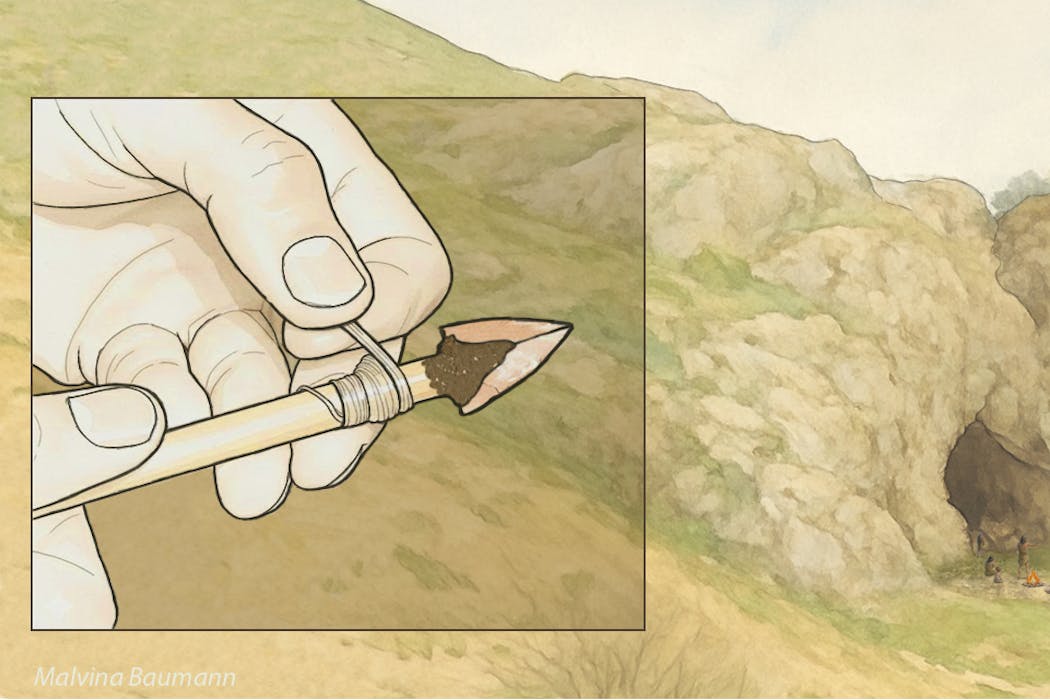
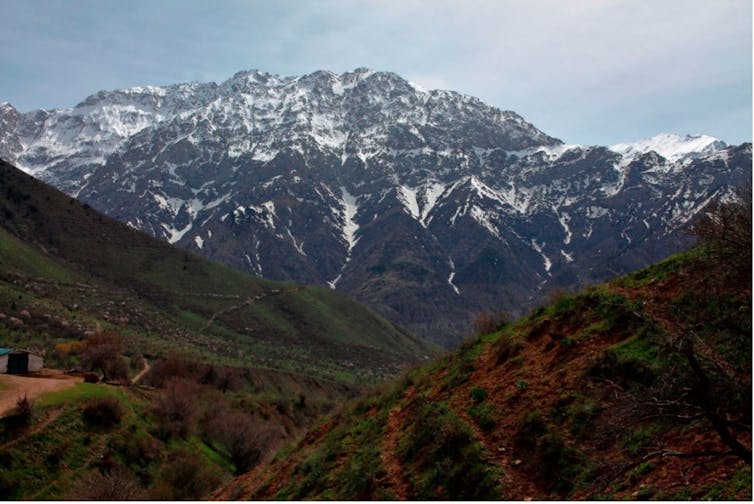
Des pointes de flèche retrouvées en Asie centrale. Malvina Baumann, Fourni par l’auteur

De minuscules pointes de projectile triangulaires ont été identifiées à partir de leurs fractures d’impact dans les plus anciennes couches d’occupation du site d’Obi-Rakhmat en Ouzbékistan, vieilles de 80 000 ans. Elles ont la dimension de pointes de flèches et sont identiques à celles découvertes dans une couche beaucoup plus récente d’un site de la vallée du Rhône, en France, à la toute fin du Paléolithique moyen, correspondant à une incursion d’Homo Sapiens en territoire néanderthalien il y a 54 000 ans. Cette nouvelle étude, publiée dans la revue « PLOS One », apporte un argument décisif pour la réécriture du scénario de l’arrivée d’Homo Sapiens en Europe.


Développés en Europe occidentale et plus particulièrement en France à partir de la seconde moitié du XIXe siècle, les cadres chrono-culturels et anthropologiques de la Préhistoire et les modèles évolutifs qu’ils inspirèrent furent d’abord linéaires et européocentrés : Cro-Magnon descendant de Néanderthal posait les fondements d’une supériorité civilisationnelle dont se prévalait alors cette partie du monde. Ce n’est qu’un siècle plus tard que sera mise en évidence l’origine africaine d’Homo Sapiens et des traits technologiques et sociaux structurants du Paléolithique supérieur occidental, de ~ 45 000 à 12 000 ans avant le présent (productions symboliques, réseaux à grande distance, outillages et armements lithiques et osseux diversifiés).

Les plus anciennes évidences de présence d’Homo Sapiens en Australie vers 65 000 ans précèdent de 10 millénaires celles de l’Europe dont les modalités du peuplement demeurent sujet de discussion. À ce jour, le calage chronologique des toutes premières occupations européennes du Paléolithique supérieur par rapport à celles de l’est du bassin méditerranéen, pourtant regardées comme les plus proches, demeure insatisfaisant. Soit les données sont issues de fouilles trop anciennes pour avoir été suffisamment précises, soit elles ne s’inscrivent pas dans la filiation directe supposée entre le Levant et l’Europe. Les racines mêmes du Paléolithique supérieur initial levantin, malgré la proximité africaine, sont incertaines. Une origine centre asiatique, a été suggérée par l’archéologue Ludovic Slimak en 2023.

Un site en Asie centrale

Vue depuis l’abri d’Obi-Rakhmat sur l’extrémité du Tien Shan.
Fourni par l’auteur

Corridor entre l’ouest et l’est du continent ou zone refuge, selon les phases climatiques, l’Asie centrale n’est encore documentée que par quelques sites paléolithiques, mais qui sont autant de références de l’histoire de la Préhistoire.

Parmi ceux-ci figure l’abri sous roche d’Obi-Rakhmat en Ouzbékistan découvert en 1962. Ce gisement livre sur 10 mètres de stratigraphie, entre 80 000 et 40 000 ans, une industrie lithique qui par certains traits s’inscrit clairement dans la continuité du Paléolithique moyen ancien du Levant mais par d’autres fut rapprochée du Paléolithique supérieur initial. Ce Paléolithique moyen ancien du Levant, associé dans le site de Misliya à de l’Homo Sapiens archaïque, disparut du Proche-Orient vers 100 000 ans. À Obi-Rakhmat, les restes crâniens d’un enfant trouvés dans une couche à ~ 70 000 ans, présentent des caractères regardés comme néanderthaliens et d’autres comme anatomiquement modernes, combinaison pouvant résulter d’une hybridation.

Lames massives mais pointes microlithiques

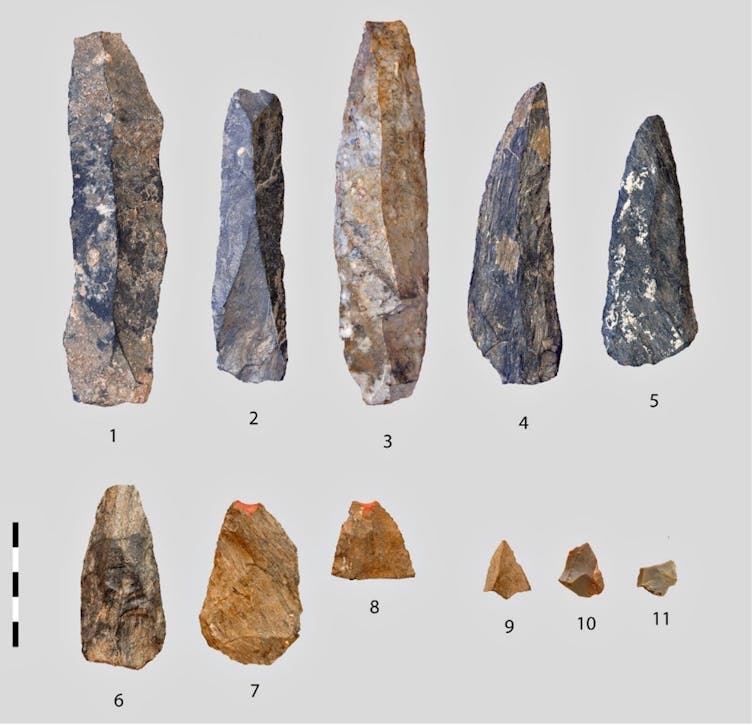
Éléments de l’industrie lithique de la couche 21 d’Obi-Rakhmat : lames brutes (1-2), grande lame retouchée (3), lames retouchées en pointe (4-5), pointes retouchées impactées (6-8), micro pointe Levallois brute (9), micro-pointes brutes impactées (10-11).
Fourni par l’auteur

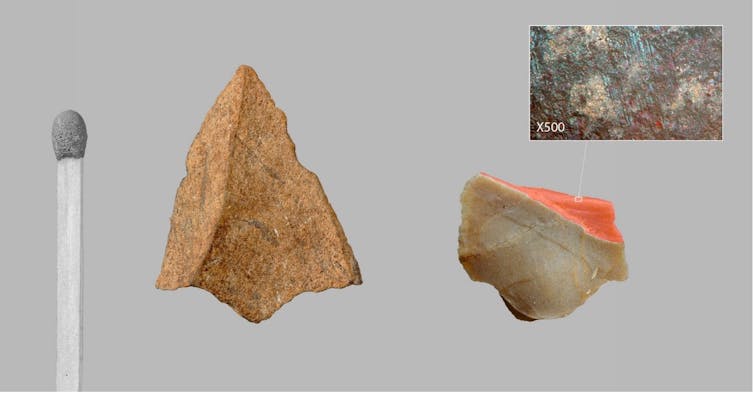
C’est dans ce contexte que notre équipe internationale, dirigée par Andrei I. Krivoshapkin, a identifié dans les couches les plus anciennes de minuscules pointes de projectiles triangulaires. Mesurant moins de 2 cm de large et ne pesant que quelques grammes, elles sont impropres par leurs dimensions et leur fragilité à avoir été montées sur des hampes de lances. Leur étroitesse correspond au diamètre (inférieur ou égal à 8 mm) des hampes documentées ethnographiquement sur tous les continents pour les flèches tirées à l’arc droit.

Deux micro-pointes brutes de la couche 21 du site d’Obi-Rakhmat, l’une intacte, l’autre brisée et rayée par son usage en armature de projectile. L’allumette matérialise leur minuscule dimension.
Fourni par l’auteur

Question de balistique

Les armes perforantes projetées constituent des systèmes complexes dont les éléments ne sont pas interchangeables d’un type d’arme à l’autre, car répondant à des contraintes différentes en intensité et en nature.

L’importante force d’impact des lances tenues ou lancées à la main fait de la robustesse de l’arme un paramètre essentiel, aussi bien en termes d’efficacité que de survie du chasseur, la masse assurant à la fois cette robustesse, la force d’impact et la pénétration. À l’opposé, la pénétration des traits légers tirés à grande distance repose sur leur acuité, car l’énergie cinétique, beaucoup plus faible, procède là essentiellement de leur vitesse, laquelle, à la différence de la masse, décroit très rapidement sur la trajectoire et dans la cible. Cette vitesse ne pouvant être atteinte par la seule extension du bras humain, elle est obligatoirement tributaire de l’emploi d’un instrument de lancer. Les pointes de flèche et celles de lances ou de javelines ne sont donc pas conçues selon les mêmes critères et ne se montent pas sur les même hampes, les dimensions et le degré d’élasticité desquelles sont par ailleurs essentiels en terme balistique. Ainsi, comme en paléontologie où la forme d’une dent révèle le type d’alimentation et suggère le mode de locomotion, les caractéristiques d’une armature fournissent des indices sur le type d’arme dont elle est l’élément vulnérant.

Un armement propre à Sapiens ?

Le minuscule gabarit des pointes d’Obi-Rakhmat ne peut être regardé comme un choix par défaut, car non seulement la matière première lithique de bonne qualité dont on a tiré de grandes lames ne manque pas à proximité du site, mais l’inventaire des traces d’usage relevées à la loupe binoculaire et au microscope met en évidence au sein du même assemblage des pointes retouchées beaucoup plus robustes (15 à 20 fois plus lourdes et 3 à 4 fois plus épaisses) et du gabarit des têtes de lance ou de javeline.

En retournant à la bibliographie et à nos propres travaux sur des outillages du Paléolithique moyen, nous avons constaté que la présence dans un même ensemble d’armatures de divers types, pour partie microlithiques et produites à cette fin, n’était à ce jour connue que dans les sites à Homo Sapiens. Les plus anciennes occurrences documentées sont en Afrique du Sud dans les couches culturelles Pre-Still Bay (plus de 77 000 ans) et postérieures du gisement de Sibudu. Dans l’univers néanderthalien, les pointes lithiques endommagées par un usage en armature de projectile sont rares, elles sont de fort gabarit et ne se distinguent ni par leurs dimensions, leur facture ou leur type de celles employées à d’autres activités que la chasse, telles que la collecte de végétaux ou la boucherie. Cette distinction dans la conception des outillages et des armements prend valeur de marqueur anthropologique.

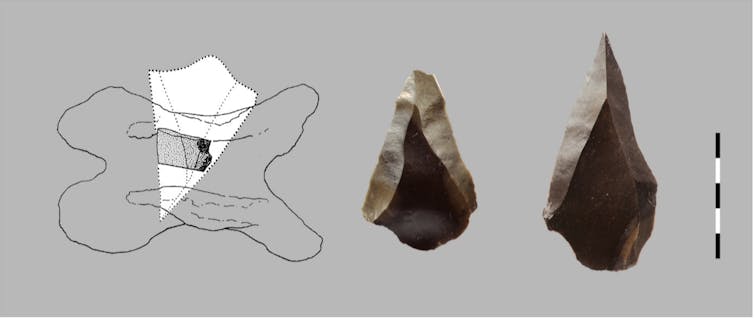
Pointes levallois du site d’Um el-Tlel en Syrie, Paléolithique Moyen récent levantin attribué à Néanderthal. De gauche à droite : reconstitution graphique à partir d’un fragment planté dans une vertèbre d’âne, lame de couteau à plante, lame de couteau de boucherie. Ces pointes polyvalentes sont 2 à 3 fois plus larges que les micro-pointes d’Obi-Rakhmat.
Fourni par l’auteur

En raison de leurs dates respectives, de la distance entre l’Afrique du sud et l’Asie centrale (14 000 km) et de la différence de facture des armatures d’Obi-Rakhmat et de Sibudu (lithique brut de débitage vs lithique façonné ou retouché, osseux façonné), l’hypothèse de foyers d’invention indépendants est la plus vraisemblable.

Des piémonts du Tien Shan à la vallée du Rhône 25 000 plus tard

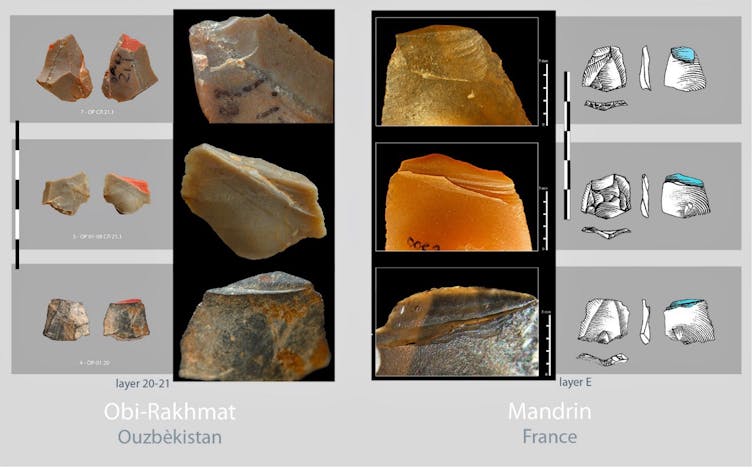
La seule forme d’armature miniature de projectile identique actuellement connue est beaucoup plus récente. Elle fut découverte par Laure Metz, sur le site de Mandrin, en vallée du Rhône en France, qui livra aussi une dent de lait d’Homo Sapiens déterminée par Clément Zanolli. L’ensemble est daté d’environ 54 000 ans, soit une dizaine de milliers d’années avant la disparition des Néanderthaliens locaux. La similitude des micro-pointes d’Obi-Rakhmat et de Mandrin, pourtant séparées par plus de 6 000 km et 25 millénaires, est telle que les unes et les autres pourraient être interchangées sans qu’aucun autre détail que la roche ne trahisse la substitution.

Similitude des micro-pointes d’Obi-Rakhmat et de Mandrin brisées par leur usage en armature de projectile. La localisation et l’extension de leur fracture (surlignement en rouge et en bleu et détail macroscopique) signent l’impact axial.
Fourni par l’auteur

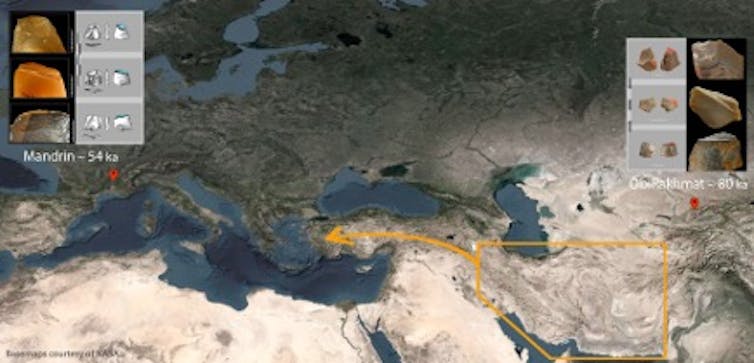
Des travaux récents publiés par Leonardo Vallini et Stéphane Mazières définissent le Plateau perse, à la périphérie nord-est duquel est situé Obi-Rakhmat, comme un concentrateur de population où les ancêtres de tous les non-Africains actuels vécurent entre les premières phases de l’expansion hors d’Afrique – donc bien avant le Paléolithique supérieur – et la colonisation plus large de l’Eurasie. Cet environnement riche en ressources pourrait avoir constitué une zone de refuge propice à une régénération démographique après le goulet d’étranglement génétique de la sortie d’Afrique, à l’interaction entre les groupes et par conséquent aux innovations techniques.

De part et d’autre du plateau perse (encadré orange), identifié génétiquement comme une aire refuge de concentration et développement démographique des Homo Sapiens sortis d’Afrique, Obi-Rakhmat et Mandrin ont en commun, à 25 000 ans et 6 000 km de distance, les mêmes micro-pointes de projectile.
Fourni par l’auteur

Mandrin et Obi-Rakhmat représentent probablement deux extrémités géographiques et temporelles d’une phase pionnière de peuplement telle qu’entrevue par Ludovic Slimak, marquée par ce que les typologues qualifiaient jadis de fossile directeur et qui ici recouvrirait la propagation d’une invention fondamentale propre à Homo Sapiens. Jusqu’à présent passées inaperçues parce que brutes de débitage, minuscules et fragmentaires, il est à parier que les micro-pointes de projectile dont les critères de reconnaissance sont maintenant posés commenceront à apparaître dans des sites intermédiaires entre l’Asie centrale et la Méditerranée occidentale.

Prémisses d’un nouveau scénario du peuplement occidental d’Homo Sapiens

Cette découverte est stimulante à plusieurs titres. Elle valide la cohérence de l’étude du site de Mandrin qui concluait à une brève incursion en territoire néanderthalien de Sapiens armés d’arcs, mais dont plusieurs éléments avaient été critiqués – ce qui est cependant le jeu scientifique habituel lorsqu’une proposition nouvelle s’écarte par trop des connaissances admises – et dont la dimension prédictive n’avait alors pas été considérée.

La similitude des micro-pointes de Mandrin et d’Obi-Rakhmat ne peut être une simple coïncidence. Elle ne porte pas seulement sur leur forme, mais aussi sur leur mode de fabrication, qui requière un réel savoir-faire comme en témoigne la préparation minutieuse de leur plan de frappe avant débitage, et sur leur fonctionnement. On pourra débattre de l’instrument approprié au tir de flèche armées de si minuscules armatures, l’arc étant en filigrane, ou si l’on préfère garder une certaine réserve ne parler que de tir instrumenté, mais cela contraste déjà avec ce que l’on connait des armes de chasse de Néanderthal et de leur conception.

L’autre aspect remarquable, encore peu habituel, est la convergence et la complémentarité de données provenant de la culture matérielle et de la mémoire de nos gènes, qui ne purent s’influencer au regard des dates d’étude et de publication respectives. Les deux conjuguées esquissent la réécriture du scénario de l’arrivée d’Homo Sapiens en Europe : on le pensait venu directement d’Afrique par le chemin le plus court, il y a 45 000 ans, et on le découvre implanté depuis fort longtemps au cœur du continent eurasiatique, bien avant qu’il n’en sorte en quête de nouveaux territoires.

The Conversation

Plisson Hugues a reçu des financements du CNRS et de l’université de Bordeaux

Andrey I. Krivoshapkin ne travaille pas, ne conseille pas, ne possède pas de parts, ne reçoit pas de fonds d’une organisation qui pourrait tirer profit de cet article, et n’a déclaré aucune autre affiliation que son organisme de recherche.

ref. Ces pointes de flèches prouvent-elles la présence d’Homo Sapiens au cœur de l’Eurasie il y a 80 000 ans ? – https://theconversation.com/ces-pointes-de-fleches-prouvent-elles-la-presence-dhomo-sapiens-au-coeur-de-leurasie-il-y-a-80-000-ans-267375

La transition verte, un contrat social à réinventer

Source: The Conversation – in French – By Rawane Yasser, Researcher, Agence Française de Développement (AFD)

Parmi les mesures destinées à atténuer les effets du changement climatique, les politiques fiscales et sociales jouent un rôle central pour garantir une transition écologique équitable. Cela suppose toutefois de prendre en compte les différences de situation et les vulnérabilités propres aux différents groupes sociaux. Des études menées en 2024 par des chercheuses et chercheurs de l’AFD en partenariat avec des universités en Afrique du Sud, en Colombie et au Mexique ont évalué ces dispositifs. Leurs conclusions apportent des pistes concrètes pour que les politiques sociales et fiscales accompagnent efficacement les transitions écologiques non seulement sans accroître les inégalités, mais également en contribuant activement à les réduire.


Le changement climatique constitue sans aucun doute le défi le plus important auquel l’humanité est confrontée.

En menaçant les progrès en termes de réduction de la pauvreté, d’amélioration des conditions de travail et de développement durable, il rend d’autant plus urgents les efforts visant à atténuer ses effets. Cependant, il devient également essentiel d’intégrer les questions d’équité dans les discussions, car les impacts du changement climatique ne sont pas répartis de manière uniforme.

Les transitions écologiques, conçues pour répondre à la crise climatique en évoluant vers un modèle de développement résilient et durable, impliquent de transformer en profondeur nos économies et nos modes de production pour les rendre plus durables. Cependant, ces transitions, pouvant provoquer des chocs socio-économiques et des pertes d’emploi, risquent de creuser les inégalités à travers un impact négatif disproportionné sur les plus vulnérables si la justice n’en constitue pas le socle. Elles sont avant tout un choix de société qui repose sur la répartition des coûts, des opportunités et des protections face aux changements à venir. D’où l’urgence de faire des transitions écologiques des transitions justes.

C’est dans cette perspective que le rôle des politiques sociales et fiscales devient essentiel. Elles doivent être repensées pour construire un contrat social plus équitable qui sera capable de répondre à l’aggravation des inégalités et d’accompagner les changements qu’impliquent les transitions écologiques.

Dans une synthèse des travaux récents menés avec nos partenaires, nous avons analysé comment les politiques sociales et fiscales peuvent être à la fois un facteur d’atténuation des risques de la transition, mais aussi un levier de transformation sociale.

Le cœur de notre analyse est que les transitions écologiques doivent se structurer autour de deux piliers fondamentaux : ne laisser personne de côté et répartir équitablement les coûts et les bénéfices.

Pour ce faire, nous proposons des éclairages et des outils pratiques pour rendre cette équité opérationnelle et concilier objectifs climatiques et sociaux, en mobilisant des exemples de l’Afrique du Sud, du Mexique et de la Colombie.

Nous prenons la transition juste comme point de départ, car elle est de plus en plus reconnue comme le cadre de référence pour la construction d’économies durables. Cette approche met l’accent sur la dimension sociale de la transition écologique et énergétique et souligne la nécessité de garantir les moyens de subsistance des personnes affectées négativement par cette transition. Elle prône une transition inclusive vers une économie sobre en carbone et durable, qui ne laisse personne de côté.

Quels effets des transitions écologiques sur les inégalités ?

Cette approche juste est indispensable en raison des effets potentiellement inégaux des politiques de transitions sur les différents groupes sociaux. La transformation structurelle qu’implique la transition écologique crée à la fois des opportunités et des vulnérabilités, et risque d’exacerber les inégalités existantes. Certains travailleurs seront en mesure de s’adapter et bénéficier des nouvelles technologies bas-carbone, d’autres risquent d’être laissés pour compte.

Certains groupes de la population sont particulièrement exposés à ces risques.

Un travail de recherche mené en Colombie constate que les femmes, les personnes issues d’une formation technique et les travailleurs informels ont moins de chance de pouvoir occuper des « emplois verts », c’est-à-dire des emplois qui contribuent à protéger les écosystèmes et la biodiversité ; réduire la consommation d’énergie, de matériaux et d’eau ou encore de diminuer l’intensité carbone de l’économie.

Introduire des instruments fiscaux – taxes énergétiques, réformes de subventions – peut également produire des effets inégalitaires lorsqu’ils ne sont pas accompagnés de mécanismes de redistribution. Le cas d’une taxe sur les carburants au Mexique le démontre : les ménages à faibles revenus consacrent une part plus importante de leurs revenus à leurs besoins énergétiques, ont une capacité d’adaptation limitée, et sont particulièrement vulnérables aux politiques de transition inéquitables.

Une approche juste des transitions vertes, qui prend en compte ces vulnérabilités, devient donc essentielle. Mais comment traduire efficacement ces principes en politiques sociales et fiscales ?

Quelles politiques sociales pour soutenir une transition juste ?

Pour éviter que les transitions écologiques accentuent les inégalités, nos recherches ont conclu que les politiques sociales doivent soutenir les personnes les plus exposées en identifiant les groupes à risque.

Une étude réalisée sur le secteur minier du charbon en Afrique du Sud établit le profil des travailleurs qui risquent une perte d’emploi suite à une transition énergétique : près de 80 % de ces travailleurs sont des jeunes (entre 15 et 35 ans) employés dans la province de Mpumalanga, au nord-est du pays. Par ailleurs, dans le Mpumalanga, le taux de personnes ni en emploi, ni en études, ni en formation (NEET) s’élève à 45,9 % en 2023 chez les jeunes avec de fortes disparités en termes de genre.

Ces données désagrégées sont importantes car elles permettent d’orienter des politiques ciblées et adaptées aux vulnérabilités spécifiques des différents groupes, ici les jeunes et les femmes. Parmi ces politiques, les priorités les plus urgentes visent à faciliter la transition des jeunes à faibles revenus vers des emplois verts, ainsi que la mise en place des mesures renforçant l’économie des soins (petite enfance, soutien aux familles), pour lutter contre les obstacles limitant la participation des femmes au marché du travail tout en créant des opportunités d’emploi et de la diversification économique.

Le travail de recherche sur les politiques de transitions justes appliquées au secteur minier en Afrique du Sud propose des mesures de protection sociale (aide ponctuelle au revenu, aide à la mobilité, formations et options de retraite anticipée) adaptées aux cohortes spécifiques de travailleurs déplacés en fonction de leur âge et de leurs compétences.

Pour être efficaces, les politiques sociales doivent également investir dans des compétences adaptées aux secteurs émergents (carburants durables, services aux entreprises). Les stratégies de formation doivent aller au-delà des savoir-faire génériques pour privilégier des parcours vers l’emploi, notamment dans les zones fortement dépendantes du charbon comme Nkangala en Afrique du Sud.

L’étude de l’écosystème de compétences des micros, petites et moyennes entreprises révèle des biais structurels des politiques et stratégies actuelles de transition en faveur des grandes entreprises. Des formations spécifiques conçues avec les entreprises pourront également garantir une adéquation avec la demande réelle du marché du travail.

Quelles politiques fiscales pour financer une transition équitable ?

Réorienter les subventions énergétiques pour créer de l’espace fiscal est un premier levier pour une transition juste. Les rediriger vers des investissements verts ciblés socialement – en particulier pour les ménages à faible revenu – élargis à la fois l’espace fiscal et améliore l’équité de la transition. C’est ce que montre les travaux de recherche au Mexique qui proposent de réallouer les subventions à l’électrique vers l’installation de panneaux solaires dans des municipalités stratégiques. Cette reconfiguration des flux financiers permettra de générer une part d’électricité entre 6,9 % et 9,2 % de la consommation régionale totale sans construction de nouvelles centrales et bénéficierait directement aux ménages.

Au-delà des réallocations des ressources existantes, une transition juste nécessite la mobilisation de nouvelles recettes d’une manière progressive et durable. Sans mesures compensatoires adéquates, la fiscalité environnementale risque d’accroître les inégalités. Au Mexique, l’effet régressif d’une taxe sur les carburants a été démontré. Un transfert universel pur serait un mécanisme efficace pour compenser ces effets régressifs. Ça consiste en un montant égal par habitant et inconditionnel pour l’ensemble de la population.

Au-delà des outils et des mesures techniques, ces travaux démontrent la nécessité de repenser notre contrat social. Une transition écologique juste ne se résume pas à corriger des effets indésirables : elle doit redéfinir la manière dont nos sociétés répartissent l’effort, la protection et les opportunités. Les travaux de l’Institut de recherche des Nations unies pour le développement social (UNRISD) rappellent d’ailleurs que sans un nouveau pacte social, fondé sur la justice et la redistribution, les transitions risquent de renforcer les fractures existantes.

Reconnaître que certains supporteront davantage les coûts de la transition – parce que leur emploi, leur territoire ou leurs conditions de vie les exposent plus fortement – est un point de départ essentiel. Dans un contexte de polarisation croissante, remettre la solidarité au centre est indispensable : elle seule permet de maintenir l’adhésion collective face aux transformations à venir.

Une transition juste suppose donc d’assumer collectivement ces asymétries et d’organiser une solidarité réelle : entre générations, entre territoires, entre groupes sociaux. C’est ce qui permettra à la transition verte d’être non seulement possible, mais aussi légitime et durable.

The Conversation

Les auteurs ne travaillent pas, ne conseillent pas, ne possèdent pas de parts, ne reçoivent pas de fonds d’une organisation qui pourrait tirer profit de cet article, et n’ont déclaré aucune autre affiliation que leur organisme de recherche.

ref. La transition verte, un contrat social à réinventer – https://theconversation.com/la-transition-verte-un-contrat-social-a-reinventer-270843

Sex, jazz, liquor and gambling: How Montréal’s nightlife shifted in the mid-20th century

Source: The Conversation – Canada – By Matthieu Caron, Postdoctoral Fellow, Department of History, Simon Fraser University

Montréal street at night, 1963-1967. (BiblioArchives /LibraryArchives/4943640/Flickr), CC BY

The history of Montréal’s night-time regulation reveals how managing nightlife expanded police power and budgets — and how burdensome effects of these changes fell disproportionately on sex workers, the queer community and hospitality industry workers.

For much of the first half of the 20th century, Montréal built a reputation as a North American nightlife capital. Tourists sought out cabarets, jazz clubs and after-hours bars, and moved through the red-light district where sex, gambling and liquor were openly available.

This permissiveness relied on a well-understood but illicit arrangement: police officers, politicians, madams, taxi drivers, performing artists and business owners all participated in a protected nighttime economy.

By the mid-1950s, however, this tolerance became the starting point for one of the largest expansions of police authority in Canadian urban history.

As I examine in my book Montreal After Dark: Nighttime Regulation and the Pursuit of a Global City, Montréal’s political leadership came to see nightlife control not as a marginal issue but as a central measure of civic order and modernity. And that shift transformed the police force.

When night became a policing problem

In the 1940s, the Montréal Police Department was already stretched thin. Officers enforced wartime blackouts, guarded industrial sites and cracked down on sexually transmitted infections among soldiers and civilians.

The Morality Squad (“Escouade de la moralité”) — enlarged during wartime fears over delinquency — patrolled theatres, bars, parks and known queer or youth meeting places.

Young women were frequently arrested for “immoral” behaviour, while queer men faced entrapment and harassment. In this, Montréal’s squad resembled its North American counterparts, variously labelled vice squads — or, in Toronto’s case, the Morality Department, disbanded in the 1930s.

Pursuing a new urban order

Pacifique “Pax” Plante, a city prosecutor, took over the Morality Squad at this time.

He insisted that officers apply laws long ignored, raiding brothels, gambling houses and nightclubs that had operated under longstanding police protection. His crusade threatened the partnerships that sustained Montréal’s nighttime economy, and this led to his dismissal in 1948.


Read more:
Defunding the police requires understanding what role policing plays in our society


But the damage had been done; his campaign pushed the city into the 1950–53 Caron Inquiry, which laid bare a police force deeply entangled in the very nightlife it was meant to regulate.

Cleaning up the city required more than moral zeal. Reformers pursued a new urban order which led to hiring, retraining, centralizing authority and expanding the budget. Nightlife policing became one of the clearest justifications for growth.

Building a modern police force

Two men in black robes with white ties in a black and white photo.
Pacifique Plante, on the right, with Jean Drapeau, left, who served as Montréal mayor between 1954–57 and 1960–86.
(WikiMedia/Le Mémorial du Québec)

After the inquiry, Jean Drapeau’s Civic Action League won the 1954 municipal election on a promise to restore honesty and order. But doing so required rebuilding the police. At mid-century, the force was large but demoralized, discredited by scandal and mistrusted by residents.

Throughout the 1950s and 1960s, the city invested heavily in police professionalization. European consultants from London and Paris reorganized the department, streamlined command structures and introduced new standards of training and discipline — reforms similar to those underway in Chicago and Los Angeles. Hundreds of new officers were hired and night patrols increased. Raids on cabarets, clubs and small bars became routine.

By the late 1960s, the police budget had risen sharply. Montréal’s political atmosphere — defined by protests, marches, labour disputes, dissent and fears of radical activity — gave elected officials strong incentives to keep expanding the force.

The 1969 police and firefighter strike plunged the city into chaos: looting, fires and riots. The municipal administration used the event to argue for further investment in policing, reinforcing an upward spiral in budget growth and authority.


Read more:
Canadian cities continue to over-invest in policing


Growing police budget

Moments of unrest were not daily occurrences, but they created a climate in which constant budget increases appeared necessary.

Tellingly, between the mid-1950s and 1970, Montréal’s police budget grew from $9.6 million to $49.7 million — an increase of more than 400 per cent and far outpacing overall municipal spending.

Yet, the everyday, not the exceptional, absorbed the department’s time. Officers spent their nights patrolling streets, parks, clubs and cabarets, enforcing morality laws and municipal bylaws.

They targeted sex workers, queer men and women and performing artists working after dark. Street checks, like arrests for prostitution charges, shaped the routine work of policing, linking the department’s growth directly to the governance of nighttime public space.

Nighttime surveillance — from enforcing bar hours to policing street sex work — became part of a broader municipal project that linked order, cleanliness and safety to global ambitions.

Expo 67, 1976 Olympics

Women in pastel-coloured 60s mod-inspired matching jackets and skirts.
Hostess uniforms of Expo 67.
(Library and Archives Canada/Bibliothèque et Archives Canada), CC BY

As Montréal formalized its place on the global stage, first during Expo 67 and later during the 1976 Olympics, the policing of nightlife intensified.

For example, fearing that Expo would attract sex workers and petty crime, the city adopted a controversial “anti-mingling” bylaw.

This forbade employees in licensed establishments from sitting, drinking or even talking with customers. Because this bylaw was designed to curb sex workers from soliciting in drinking establishments, police enforced the regulation most aggressively against women.

Dancers, singers, barmaids and hostesses were arrested for ordinary workplace interactions. The bylaw blurred the line between hospitality work and sex work, effectively criminalizing women’s participation in the nighttime economy.

Anti-prostitution bylaws

By the early 1980s, the city — along with other Canadian urban centres — introduced “anti-prostitution” bylaws to expand police powers despite limits imposed by the Supreme Court of Canada. This led to a pan-Canadian review of sex work in society.

These local tools disproportionately targeted women, transgender people and racialized sex workers, who were increasingly arrested simply for being in public spaces at night.

Whose night?

By the ‘80s, Montréal presented itself as a global cultural hub — home to major festivals, theatres and a thriving, “respectable” nightlife. That transformation, however, rested on the continued policing of many of the people who had historically sustained the nighttime economy.

The police department had become one of the city’s largest expenses, and nighttime enforcement one of its most visible activities.

The legacy is visible today. Independent venues face noise complaints, rising regulatory costs and the threat of closure.

The city’s recent support fund for small venues offers some relief, but it doesn’t answer the central question: who is allowed to shape Montréal and its nights, and who is pushed out in the name of order?

Seen from a nocturnal angle, Montréal’s history — like the history of many cities — shows that “safety” is never neutral. From the 1940s onward, expanding police budgets rested on the idea that the night was inherently unruly and needed constant control.

Debates about rights

Rather than allocating resources toward the concerns raised by the feminist Take Back the Night movement or by emerging queer organizations, the city focused on moral regulation — a pattern that consistently targeted those living and working after dark.

A group of women seen walking in the streets, some with protest signs like 'no rape' and 'a nous la nuit' (the night is for us)
The ‘Take Back the Night’ movement stands against sexual violence and asserts the rights of women and gender-diverse people to move freely in, and enjoy, the night.
(Howl Arts Collective/Flickr), CC BY

As cities debate how to sustain their nighttime economies while keeping residents safe, Montréal’s past reminds us that the way we govern the night determines who gets to belong in it.

For policymakers and residents today, the lesson is simple: debates about nightlife are also debates about rights, inclusion and the fair use of public space. Safer nights are built not only through policing, but through investment, participation and recognition of the communities that bring the city to life after dark.

The Conversation

Matthieu Caron does not work for, consult, own shares in or receive funding from any company or organisation that would benefit from this article, and has disclosed no relevant affiliations beyond their academic appointment.

ref. Sex, jazz, liquor and gambling: How Montréal’s nightlife shifted in the mid-20th century – https://theconversation.com/sex-jazz-liquor-and-gambling-how-montreals-nightlife-shifted-in-the-mid-20th-century-268733