Ancient Egyptians and Etruscans pioneered orthodontics, using delicate gold wires and catgut to straighten teeth. It’s a tale that has appeared in dentistry textbooks for decades, portraying our ancestors as surprisingly modern in their pursuit of the perfect smile. But when archaeologists and dental historians finally scrutinised the evidence, they discovered that most of it is myth.
Take the El-Quatta dental bridge from Egypt, dating to around 2500BC. The gold wire found with ancient remains wasn’t doing what we thought at all. Rather than pulling teeth into alignment, these wires were stabilising loose teeth or holding replacement ones in place. In other words, they were functioning as prostheses, not braces.
The gold bands discovered in Etruscan tombs tell a similar story. They were probably dental splints designed to support teeth loosened by gum disease or injury, not devices for moving teeth into new positions.
There are some rather compelling practical reasons why these ancient devices couldn’t have worked as braces anyway. Tests on Etruscan appliances revealed the gold used was 97% pure, and pure gold is remarkably soft.
It bends and stretches easily without breaking, which makes it useless for orthodontics. Braces work by applying continuous pressure over long periods, requiring metal that’s strong and springy. Pure gold simply can’t manage that. Try to tighten it enough to straighten a tooth and it will deform or snap.
Then there’s the curious matter of who was wearing these gold bands. Many were found with the skeletons of women, suggesting they might have been status symbols or decorative jewellery rather than medical devices. Tellingly, none were discovered in the mouths of children or teenagers – exactly where you’d expect to find them if they were genuine orthodontic appliances.
But perhaps the most fascinating revelation is this: ancient people didn’t have the same dental problems we face today.
Malocclusion – the crowding and misalignment of teeth that’s so common now – was extremely rare in the past. Studies of Stone Age skulls show almost no crowding. The difference is down to diet.
Our ancestors ate tough, fibrous foods that required serious chewing. All that jaw work developed strong, large jaws perfectly capable of accommodating all their teeth.
Modern diets, by contrast, are soft and processed, giving our jaws little exercise. The result? Our jaws are often smaller than those of our ancestors, while our teeth remain the same size, leading to the crowding we see today.
Since crooked teeth were virtually non-existent in antiquity, there was hardly any reason to develop methods for straightening them.
That said, ancient people did occasionally attempt simple interventions for dental irregularities. The Romans provide one of the earliest reliable references to actual orthodontic treatment.
Aulus Cornelius Celsus, a Roman medical writer in the first century AD, noted that if a child’s tooth came in crooked, they should gently push it into place with a finger every day until it shifted to the correct position. Although basic, this method is built on the same principle we use today – gentle, continuous pressure can move a tooth.
After the Roman era, little progress occurred for centuries. By the 18th century, however, interest in straightening teeth had revived, albeit through some rather agonising methods.
Those without access to modern dental tools resorted to wooden “swelling wedges” to create space between overcrowded teeth. A small wedge of wood was inserted between teeth. As saliva was absorbed, the wood expanded, forcing the teeth apart. Crude and excruciating, perhaps, but it represented a step towards understanding that teeth could be repositioned through pressure.
Scientific orthodontics
Real scientific orthodontics began with French dentist Pierre Fauchard’s work in 1728. Often called the father of modern dentistry, Fauchard published a landmark two-volume book, The Surgeon Dentist, containing the first detailed description of treating malocclusions.
He developed the “bandeau” – a curved metal strip wrapped around teeth to widen the dental arch. This was the first tool specifically designed to move teeth using controlled force.
Fauchard also described using threads to support teeth after repositioning. His work marked the crucial shift from ancient myths and painful experiments to a scientific approach that eventually led to modern braces and clear aligners.
With advances in dentistry during the 19th and 20th centuries, orthodontics became a specialist field. Metal brackets, archwires, elastics and eventually stainless steel made treatment more predictable.
Later innovations – ceramic brackets, lingual braces and clear aligners – made the process more discreet. Today, orthodontics employs digital scans, computer models, and 3D printing for remarkably precise treatment planning.
The image of ancient people sporting gold and catgut braces is certainly appealing and dramatic, but it doesn’t match the evidence.
Ancient civilisations were aware of dental problems and occasionally attempted simple solutions. Yet they had neither the necessity nor the technology to move teeth as we do now.
The real story of orthodontics doesn’t begin in the ancient world but with the scientific breakthroughs of the 18th century and beyond – a history that’s fascinating enough without the myths.
Saroash Shahid does not work for, consult, own shares in or receive funding from any company or organisation that would benefit from this article, and has disclosed no relevant affiliations beyond their academic appointment.
“Brainrot” is what many people call the chaotic, fast-moving memes, sounds and catchphrases that spread across TikTok, Roblox and online gaming and into playgrounds. An example is the endlessly repeated chant of “six-seven”, which still echoes through houses and schools across the country – to the bewilderment (or annoyance) of many teachers and parents.
But if you’ve ever said “I’ll be back” in a mock-Arnie voice or asked “you talkin’ to me?”, you’ve already engaged in a form of brainrot. The instinct to repeat and remix lines from the culture around us is nothing new.
What has changed is the source material. For young people growing up in a digital world, quotable moments don’t come from films or TV but from TikTok edits, Roblox streams, speedrun memes, Minecraft mods (modifications) and the fast-paced humour of online gaming.
Hearing a child burst into the looping “Skibidi dop dop dop yes yes” audio from the Skibidi Toilet trend, or repeat a surreal line from a Roblox NPC (non-player character), might sound like nonsense to adults. For the younger generation these fragments slot neatly into a fast-paced, highly referential style of humour. Today’s equivalents are faster, more layered and often more chaotic, with that chaos very much part of the appeal.
Although brainrot is often used knowingly and with a touch of irony to describe these phrases, remixing and repeating fragments of media has always been part of how people connect. It creates a shared cultural code, a second language made of references, rhythms and sounds that bind groups together and turn everyday moments into opportunities for humour and social connection. In many ways, this style of communication offers lightness and playfulness in a world that can often feel slow and muted by comparison.
Changing play
Brainrot is changing how children play online. Many adults grew up with video games that were built around structure. In Pokémon, Zelda or Half-Life, you cleared goals, quests and puzzles to reach endings. Even when games were open-world, giving you nearly total freedom to choose what challenges you take on and when, there was an underlying design logic you were meant to follow.
Those experiences shaped how we thought about play, and later how we approached designing games and interactive tools in research. Structure, narrative and pacing felt fundamental.
Watching children engage with today’s digital culture, and particularly with what gets called brainrot, challenges these assumptions. Their experiences aren’t always built around long-form story arcs or carefully crafted mechanics and challenges. Instead, it’s fluid, fragmentary and relentlessly social.
They jump between Roblox games, short TikTok edits, chaotic Minecraft mods and meme-based jokes without losing the thread. What sometimes looks like disjointed overstimulation to adults is entirely coherent to them. They’re fluent in a form of digital literacy that involves stitching together references, humour, audio, images and interactions at high speed.
Brainrot and research
From a research perspective, this has been a timely reminder that how children engage online changes. Young people aren’t abandoning meaningful play, they’re interacting with an online environment that is dramatically different from the one their parents grew up with.
There is research that raises questions about whether switching between short, chaotic bursts of content might affect attention or wellbeing for some users. For example, a recent study found associations between heavy use of short-form video apps and poorer sleep in adolescents, but also noted that higher social anxiety partly explained this pattern.
A broader analysis of a number of research studies reported similar correlations between heavier use and lower scores on attention tasks, as well as higher stress and anxiety. But these findings do not show causation. It remains unclear whether short-form content affects attention, or whether young people with particular cognitive styles simply gravitate towards media that already fits how they process information.
This shift has changed how we design games for learning. Instead of assuming attention must be sustained in a single direction, we think more about how curiosity works in shorter bursts, how play can be modular, and how meaning can emerge from participation rather than instruction.
Brainrot may not be something we’d replicate directly in an educational game, but some of its qualities, its pace, its playfulness, its remixing of ideas, can offer valuable prompts for thinking differently about how young people engage.
The way we learn is constantly evolving and it doesn’t always fit our older frameworks. Rather than resisting that, there’s value in trying to understand it, and in meeting them where they already are.
If we want to understand why brainrot resonates so strongly with children, it helps to see it not as meaningless noise, but as a form of social communication. These references work as inside jokes, but ones that can be remixed endlessly.
This is part of the appeal: brainrot is malleable, collaborative and playful. If you understand it, then you can riff on it, combine it, subvert it, and use it to signal belonging. There’s a enticing level of creativity stitched into the chaos.
There is also an element of self-awareness in much of brainrot culture. Its absurdity isn’t accidental, it’s part of the joke. In that sense it has echoes of earlier artistic or cultural movements that embraced nonsense or playful subversion. One of the key things is that this isn’t something imposed on children by companies or algorithms. Brainrot is something young people choose to build together, adapting and evolving references within their own circles.
Brainrot isn’t evidence that young people are disengaged or unimaginative. It’s a reflection of how they make sense of a digital world that is fast, fragmented and overflowing with ideas.
The authors do not work for, consult, own shares in or receive funding from any company or organisation that would benefit from this article, and have disclosed no relevant affiliations beyond their academic appointment.
Secondhand fashion is booming, yet most brides – even those who care about sustainability – still choose to walk down the aisle in a new wedding dress.
It’s a striking contradiction. Wedding gowns are expensive and resource-intensive to produce. They require large amounts of fabric and water for a garment worn only once. And while many couples are thinking more carefully about the environmental cost of their celebrations, secondhand bridalwear remains the exception rather than the norm.
Our research with UK brides uncovers why so many continue to resist the broader shift toward pre-loved fashion, when it comes to their big day. What we found is that wedding dresses carry cultural and emotional power far beyond their physical form.
For many brides, choosing the dress is a symbolic milestone in the transition from partner to wife. TV shows like Say Yes to the Dress have cemented the idea of a magical, transformative moment. It’s a moment that often involves loved ones, tears and the collective recognition of “the one”. Within this cultural script, the wedding dress is meant to signal the start of a new identity.
We interviewed 18 brides for our study. Many felt that secondhand options disrupt this narrative. Brides revealed to us that wearing a pre-loved dress would feel like stepping into someone else’s story, making it harder for them to imagine their own.
Most brides in our study cared about the environment and liked the idea of greener choices, but sustainability rarely shaped the final decision. Brides often found themselves weighing their personal values against a deeply ingrained emotional script from their childhood about how the wedding should feel and who they aspire to be on the day.
The dress played a central role in this identity transition. Brides used it to express the version of themselves they wanted to present as they became a wife, relying on fit, tailoring and style to craft that image. This made control especially important.
Many felt that secondhand options limited their ability to shape the dress around their identity. They worried about alterations, condition and whether a pre-owned dress could truly carry the personal meaning they envisioned.
Shopping for the dress was also part of this transition. Many brides pictured a boutique appointment with family or friends, where they could try on different versions of themselves and choose “the one”. This moment helped them confirm the role they were stepping into.
Secondhand shopping rarely supports this experience. Charity shops may feel informal or lack privacy, and online platforms remove the chance to feel the fabric or judge the fit. Without a space that carries the emotional weight of the choice, the brides we spoke to felt the transition was disrupted.
Practical issues added further pressure. Secondhand dresses are one-offs, which limits control over size and style, and their condition can be difficult to assess. These barriers weakened brides’ sense of control over how they would look and feel on the day.
Misconceptions reinforced this reluctance. Many brides simply did not know what secondhand options existed or how to navigate them. Some assumed the dresses would be dated, damaged or unhygienic. Without clear guidance or visibility, most brides never explored secondhand seriously, even if they liked the idea in principle.
What secondhand needs to offer
For brides to consider secondhand, the shopping experience must help them feel in control and emotionally connected to the dress. Brides in our study wanted curated boutiques offering fittings, expert guidance and reassurance about cleaning and alterations, all within a calm space where they could imagine themselves on their wedding day.
They also wanted secondhand options to be easier to find and navigate. Presenting pre-loved dresses as unique and meaningful, rather than as compromises, may help them feel like a credible part of the journey into married life.
Brides are not only choosing a dress. They are managing an identity shift. The wedding dress is one of the main items they use to shape who they will be on their wedding day. Sustainability matters, but it rarely outweighs the powerful symbolic and emotional role the wedding dress plays.
Secondhand bridalwear will only thrive if it supports this emotional transition. Greater visibility, stronger emotional resonance and an experience that helps brides feel the dress is truly theirs, may encourage others to choose secondhand without sacrificing the meaning they attach to becoming a wife.
The authors do not work for, consult, own shares in or receive funding from any company or organisation that would benefit from this article, and have disclosed no relevant affiliations beyond their academic appointment.
Source: The Conversation – UK – By Chee Meng Tan, Assistant Professor of Business Economics, University of Nottingham
As China heads into the new year it will start rolling out its 15th five‑year plan, this one is for 2026-2030.
Beijing is doubling down on greening its economy, and aims to hit two major climate goals: “carbon peaking”, where carbon dioxide emissions have reached a ceiling by 2030, and “carbon neutrality”, where net carbon dioxide emissions have been driven down to zero by 2060.
Yet, China’s green push sits uneasily with its energy realities: coal still provides about 51% of its electricity as of mid‑2025, underpinning China’s difficulty in greening its energy system swiftly. Here are five major challenges that will shape China’s green transition as it moves into 2026.
1. Energy transmission and wastage
Imagine standing in western China (for instance in Tibet, Xinjiang and Qinghai), which produces a lot of solar and wind energy. On bright and windy days, these installations generate vast amounts of clean electricity. Yet much of that power goes to waste.
China’s grid can only handle a limited load, and when renewable generation peaks, it risk overloading the power network. So grid operators respond by telling energy producers to dial down output, which is a process called “curtailement”. The result is that electricity from the west often fails to reach eastern economic hubs, such as Beijing, Tianjin, Shandong, Jiangsu, Shanghai, Zhejiang, Fujian and Guangdong, where demand is greatest.
China needs to invest heavily in the ways to transport and store excess energy. The State Grid Corporation of China claims that it will be spending 650 billion yuan (£69 billion) in 2025 to upgrade the power network, and perhaps much more in subsequent years.
The challenge here is sustaining these capital-intensive projects while the broader economy still grapples with the lasting effects of the 2021 property crisis.
China is building massive solar farms, but also coal-fired power stations.
2. Cutting coal without blackouts
Even as China vows to go green and be a world leader in environmental energy, it continues to expand its coal capacity, and has added enough new coal-fired power stations in 2024 to power the UK twice over per annum. This apparent contradiction stems from concerns over energy security.
Beijing is determined to avoid a repeat of the blackouts and power shortages of 2020–2022. Coal provides dependable, round‑the‑clock power that renewables cannot yet fully replace. Yet the steady expansion of coal capacity undercuts China’s climate pledges and highlights ongoing tensions between China’s president, Xi Jinping’s, dual carbon goals and the country’s pressing energy demands, which raises questions about how far political ambition can stretch against economic reality.
3. Taming overcapacity without hurting growth
China’s vast manufacturing strength, which was once an asset, is now posing a problem. The rapid expansion of solar, wind, and electric vehicle industries has created overcapacity across the clean‑tech sector. Factories are producing more panels, turbines, and batteries than the domestic market can absorb. This has created a cut-throat price war, where companies sell at below cost price, which erodes company profits.
Beijing must find a balance between restraining overproduction without choking growth in green industries. This balancing act is politically sensitive, as local governments depend on these industries to create jobs (7.4 million in 2023), and generate substantial revenue. It was estimated that in 2024 green industries contributed 13.6 trillion yuan to China’s economy or 10% of the country’s GDP.
4. Trade tensions from overcapacity
China’s surplus of clean tech such as cheap solar panels, electric vehicles (EVs), and batteries, have triggered trade tensions abroad. In 2023 and 2024, the European Union investigated allegations of Chinese subsidies being poured into EVs, wind turbines and solar panels. Tariffs of up to 35.3% were placed on Chinese EVs. However, tariffs on Chinese solar panels and wind turbines have not been imposed so far.
But, on January 1 2026 the EU’s Carbon Border Adjustment Mechanism (CBAM) comes into effect. The CBAM is a carbon tax that Europeans will pay if imported goods are made using high carbon emissions. While the tax does not explicitly target EVs and solar panels, it will cover carbon-intensive materials used in their production, such as steel and aluminium, which are made using coal-fired plants.
What this means is Chinese clean tech might lose its competitive edge in the European market as customers are driven away from its products. Industrial players might rely on exports to stay afloat given the highly competitive nature of China’s domestic green market, but the CBAM is likely to undermine China’s green industry.
5. Fulfilling green targets locally
Chinese local governments are formally responsible for putting Beijing’s climate policies into practice, but many are expected to implement these policies largely on their own. While provincial authorities typically have more fiscal resources and technical expertise, city-level governments within each province often don’t have the funds to do so, which makes it difficult to deliver on green initiatives in practice.
At the same time, even when local authority leaders are told to achieve climate‑related targets, their career advancement remains closely linked to conventional economic performance indicators such as GDP growth and investment.
All of this helps explain the continued enthusiasm for new coal‑fired power projects. They are framed not only as a fail‑safe in case renewables and grids cannot meet rising demand, but also as avenues for local employment, fixed‑asset investment and fiscal revenue.
China’s continued greening in 2026 will be challenged by all of these issues.
Chee Meng Tan does not work for, consult, own shares in or receive funding from any company or organisation that would benefit from this article, and has disclosed no relevant affiliations beyond their academic appointment.
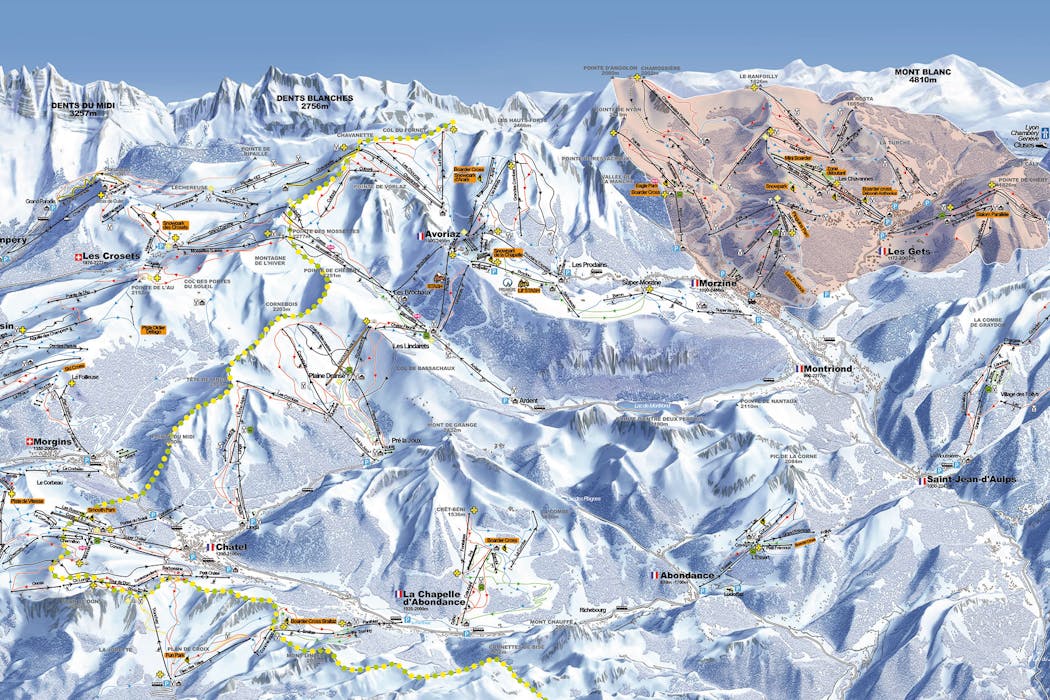
Plan de la station des Portes du Soleil entre France et Suisse, dessiné par Pierre Novat.Pierre Novat
Objets familiers des skieurs, les plans des pistes ne sont pas seulement des outils pratiques : ils sont la promesse d’un paradis bleu et blanc, où la neige est partout et où il fait toujours beau. Mais à mesure que le climat se réchauffe, ces images idéalisées s’éloignent de plus en plus du réel. Elles sont devenues un miroir déformant qui interroge notre rapport aux sports d’hiver.
Maxime Petre, géographe et collectionneur de plans de pistes de ski, a co-écrit cet article et la parution scientifique sur lequel s’appuie celui-ci. Son travail de numérisation des plans de pistes actuels et passés a permis d’illustrer cet article.
Pour le skieur, le plan des pistes est à la fois un outil pratique et une promesse. On va l’étudier depuis la maison – ou l’appartement de location – pour prévoir sa journée à la neige, le déplier sur les pistes avec difficultés à cause des gants. Choisir entre une piste bleue ou rouge, un télésiège ou un téléphérique, autant de choix guidés par ce petit document.
Au-delà de cette fonction repère, le plan des pistes construit aussi un imaginaire : celui d’un hiver immuable, presque utopique, où les flancs des montagnes sont toujours enneigés et le ciel toujours bleu. Pour les plus aisés qui peuvent s’offrir ces loisirs de neige, ces plans perpétuent la magie d’un hiver éternel : toujours le même, d’une blancheur immuable, depuis des décennies.
Ils montrent des images d’une météo idéale, désormais rare dans un contexte de changement climatique et de baisse de l’enneigement, comme nous l’avons récemment exposé dans un article de recherche.
Du plan neige à l’émergence d’un style pictural standardisé
On trouve des plans des pistes dès la création des premières remontées mécaniques. Les premiers plans sont sommaires : il s’agit surtout de photographies annotées avec le tracé des pistes.
Plan de la station d’Auron (Alpes-Maritimes) à la fin des années 1930, après l’inauguration du troisième téléphérique de France. Numérisation : Maxime Petre, éditions Héliogravure Sadag, Bellegarde, Fourni par l’auteur
En témoigne par exemple le plan de la station d’Auron dans les Alpes-Maritimes, où le ski maralpin a pris naissance avec l’inauguration le 30 janvier 1937 du troisième téléphérique de France après Megève et Chamonix.
Mais c’est avec le Plan Neige de 1964 que la montagne française s’oriente massivement vers le tout-ski. Ses effets sont rapidement sensibles : de cinquante stations en 1960, on passera à deux cents en 1975. Pour ces destinations, les plans des pistes deviennent alors des icônes touristiques.
Comme il était alors la règle implicite pour les stations de dimension internationale, Val d’Isère (Savoie) sollicite dans les années 1950 l’Autrichien Heinrich Berannn qui a déjà œuvré du côté des plus grandes destinations de ski comme Gstaad (Suisse), Cortina d’Ampezzo (Italie) ou Sankt Anton Am Arlberg (Autriche). Ceci dénote une sorte de mimétisme alpin pour ces grandes contrées des sports d’hiver.
D’un rebord de falaise, le skieur plonge littéralement sur le centre bourg de Val d’Isère (Savoie), encore clairsemé, en suivant des pistes rouges imaginaires. Numérisation : Maxime Petre, Berann, années 1950-1960, Fourni par l’auteur
Formé aux Beaux-Arts à Lyon, Pierre Novat répond à l’appel de Val d’Isère en 1962 et va dessiner, à sa manière, une série de plans qui fera sa célébrité. Une exposition et un livre lui ont récemment été consacrés.
Pierre Novat, photographié par son fils Arthur Novat. Arthur Novat, CC BY
Les pinceaux de Pierre Novat entrent en action en 1962. Le plan de Heinrich Berann n’est plus à jour : Pierre Novat, Avalin (nom donné aux natifs de Val d’Isère) d’adoption, se charge du nouveau dessin.
La vision de Val d’Isère que développe Pierre Novat diffère de celle de son prédécesseur Heinrich Berann. Numérisation : Maxime Petre, Pierre Novat, années 1960, Fourni par l’auteur
Petits arrangements avec la géographie… et la météo
Mais comment représenter en deux dimensions des pentes aux expositions variées, des sommets emblématiques mais dont la visibilité et la proximité sont diverses ? La filouterie est de mise : chaque plan est, en réalité, une projection arrangée.
« Le crayonné a pour but de se mettre d’accord avec les gens de la station, voir si ça correspond à l’image qu’ils veulent donner de leur station et aux angles de prises de vues, aux ombres portées. Le plus, enfin le principe le plus important, ce qui m’a permis de me rendre utile aux stations, c’est que l’on triche, on triche pas mal. »
Autrement dit, les courbes sont adoucies et les reliefs moins acérés. Tout l’enjeu est d’inviter à la glisse, tout schuss. Ces paysages dessinés sont devenus les images d’Épinal pour représenter les stations de sports d’hiver.
Les plans déforment ainsi la topographie pour tout montrer de la station et de ses points forts, tout en présentant ses pentes comme accessibles. Mais ils enjolivent également la météo. Ils véhiculent une image normalisée d’un temps froid et ensoleillé (ce qu’on voit sur le plan), effaçant les conditions permettant les chutes de neige qui précèdent (et qui ne sont jamais représentées).
Sur les plans, la neige est omniprésente : très blanche ou légèrement bleutée, elle recouvre uniformément les reliefs, parfois jusqu’aux rives du lac Léman, à 500 m d’altitude, jusqu’aux cimes des Dents du Midi à plus de 3000 m – et au Mont-Blanc, évidemment.
Sur le plan ci-dessus du Suisse Winfried Kettler, réalisé pour le compte du domaine international des Portes du soleil (Suisse et France) dans les années 1980, la neige est partout présente, des rives du Léman au sommet du mont Blanc. Vingt ans après, l’objectif reste, ni plus ni moins, d’afficher encore de la neige à toutes les altitudes, comme le montre la carte contemporaine du domaine skiable en 2024.
Une vitrine de plus en plus éloignée du réel
Une telle blancheur continue n’a rien de réaliste : elle suppose la même quantité de neige à toute altitude, sur tous les versants, quelle que soit leur orientation. En réalité, la qualité et l’épaisseur du manteau neigeux varient selon la pente, l’exposition, le vent. Il est bien rare de trouver de la neige au sol à Évian même, comme le représente pourtant l’une des cartes ci-dessus, par exemple !
Sur cette carte des pistes, réalisée par Pierre Novat pour la promotion touristique du Queyras (Hautes-Alpes), le Viso, pourtant italien, s’érige au centre avec un aplomb souverain, focalisant l’attention. Comme toujours, la neige est tombée sur ce territoire de 626 km² de manière complètement uniforme. Numérisation : Maxime Petre, Novat 1981, Fourni par l’auteur
Quant au ciel, il est quasi systématiquement bleu, effaçant les nuages pourtant nécessaires aux chutes de neige. Ce choix n’est pas anodin : il permet à la neige d’étinceler et de révéler un panorama que la météo réelle masquerait. Le plan traduit des choix météorologiques forts réalisés à dessein.
Comment expliquer que l’image des pistes soit un tel miroir déformant ? C’est parce que le plan est aussi un produit d’appel, un objet marketing pour les touristes. Or la neige est l’élément phare pour attirer les skieurs. Et le ciel bleu, promesse de journées radieuses, est un atout supplémentaire qui permet de repartir bronzé. Pierre Novat assumait pleinement cette mise en scène météorologique, à même de séduire à la fois les élus locaux, les gestionnaires de stations et les skieurs.
Aujourd’hui, le plan s’éloigne de plus en plus du réel. Avec le réchauffement climatique, l’enneigement varie fortement selon les massifs, l’altitude ou l’exposition. Pourtant, les plans continuent d’afficher la même blancheur uniforme. Les plans des pistes ont beau afficher encore de la neige, les stations ferment peu à peu faute d’enneigement.
Plan des pistes de la station de Céüze (Hautes-Alpes) au début des années 2000. Numérisation : Maxime Petre, auteur inconnu, années 2000, Fourni par l’auteur
Après huit années d’inactivité, la station de ski de Céüze, dans les Hautes-Alpes, est en cours de démantèlement à l’automne 2025. Le plan des pistes prend alors le statut de relique, souvenir de jours heureux sur cette montagne emblématique du Gapençais.
Ces cartes traduisent-elles une forme de déni climatique ? Il s’agit plutôt d’un rêve, d’une utopie : l’idée que le ski reste possible, toujours, partout, et durant la « saison » de ski. Ces images révèlent une mémoire d’hivers idéalisés et engendrent une forme de solastalgie – ce sentiment de perte face à un paysage qui nous est proche et qui s’efface peu à peu
Sur ce plan de Villard-de-Lans (Isère) dans années 1980, les pistes bénéficiant de neige artificielle sont signalées par un pictogramme. Numérisation : Maxime Petre, Pierre Novat, Fourni par l’auteur
L’enneigement artificiel, déployé à partir des années 1970, vise à garantir la glisse sur le plan technique face aux aléas climatiques.
Le manque de neige dès la fin des années 1980, avec l’« hiver sans neige » 1988-1989, a amené les stations à rendre visibles les canons à neige pour informer leurs visiteurs d’une « garantie neige ».
Sur ce plan de Villard-de-Lans (Isère) dans années 1990, les pistes bénéficiant de neige artificielle sont signalées par la couleur jaune et un pictogramme. Numérisation : Maxime Petre, Pierre Novat, Fourni par l’auteur
Résultat : les pistes pourvues de canons à neige se matérialisent sur les cartes des pistes. De l’icône du flocon de neige aux pistes jaunies, les plans insistent alors sur les potentialités de la neige artificielle. Ces représentations disparaîtront largement plus tard.
Car, dans les années 2020, les contestations se font plus vives. Certaines stations choisissent de ne plus recourir à la neige artificielle, d’autres de la masquer sur leurs plans. Et bien malin celui qui pourrait ainsi déceler dans ce type de plan un lac dédié à la neige de culture : la transparence de ces aménagements s’efface au profit de l’image idéale et policée.
Ces plans peuvent-ils, doivent-ils évoluer, et si oui comment ? Faut-il produire des images plus « authentiques » reflétant le manque de neige ? Mais des images reflétant des pistes brunies par la terre à l’arrivée en station, des chalets enveloppés dans le brouillard et une tempête de neige en altitude seraient-elles aussi attractives au plan touristique ?
Plan des pistes de Cortina d’Ampezzo (Italie). Numérisation : Maxime Petre, Berann 2025, Fourni par l’auteur
Heinrich Berann a longtemps été le panoramiste des olympiades. Malgré son décès en 1999, Cortina, ville hôte des Jeux olympiques d’hiver de 2026, qui vont débuter en février, lui est restée fidèle. Il y a fort à parier que les plans des Jeux olympiques d’hiver 2030, prévus dans les Alpes françaises, ne s’éloigneront guère de ce modèle immuable et vendeur.
Les auteurs ne travaillent pas, ne conseillent pas, ne possèdent pas de parts, ne reçoivent pas de fonds d’une organisation qui pourrait tirer profit de cet article, et n’ont déclaré aucune autre affiliation que leur organisme de recherche.
Face au recul de l’enneigement naturel, la neige de culture est l’outil privilégié par les stations de ski pour sécuriser leurs activités. Mais notre analyse de 56 exploitations de remontées mécaniques alpines sur quinze ans montre que ces investissements n’ont pas eu les effets escomptés. Le bien-fondé économique du soutien public à ces investissements mérite d’être interrogé.
La production de neige, également appelée neige de culture ou neige artificielle, s’est fortement développée ces dernières décennies dans les stations de sports d’hiver. Elle est désormais une pratique courante de gestion de la neige, qui a par le passé facilité l’exploitation des remontées mécaniques face à la variabilité de l’enneigement naturel.
Mais est-il pertinent, d’un point de vue économique, de poursuivre les investissements dans la production de neige pour adapter l’économie des stations de sports d’hiver à la raréfaction de l’enneigement naturel ?
Pour répondre à cette question, nous avons analysé la performance économique de 56 exploitations de remontées mécaniques dans les Alpes françaises entre 2004 et 2019. Nos résultats interrogent la poursuite des investissements dans la production de neige pour adapter l’économie des stations de sports d’hiver au changement climatique.
La production de neige désormais au cœur du modèle du ski
De fait, l’enneigement naturel varie fortement d’une saison à l’autre. Depuis leur création, les domaines skiables sont confrontés à des hivers d’enneigement variables, les plus difficiles étant qualifiés d’« hiver sans neige ». En raison du changement climatique, la fréquence des hivers bien enneigés diminue et celle des hivers mal enneigés augmente.
Les stations situées à moins de 2000 m d’altitude sont déjà affectées. Dans un scénario avec un réchauffement atteignant +4 °C, il est estimé que 98 % des stations européennes seront exposées à un risque très élevé de déficit d’enneigement naturel. Cette menace sur l’enneigement affecte l’économie des exploitants de domaines skiables, ainsi que plus largement l’avenir de l’économie des territoires qui en dépendent.
La production de neige s’est généralisée dans les domaines skiables à partir des années 1990 afin d’accompagner l’enneigement naturel, et a effectivement permis d’atténuer l’impact des hivers mal enneigés. Plus récemment, son recours s’est fortement intensifié afin de continuer à sécuriser l’enneigement – et de préserver la rentabilité de l’exploitation des remontées mécaniques – face à la raréfaction de l’enneigement naturel dans le contexte du changement climatique. Cela implique d’importants investissements, en partie financés avec de l’argent public.
En France, la proportion de pistes de ski équipées pour la production de neige est passée d’environ 14 % en 2004 à 39 % en 2018. Cette dynamique illustre le changement de rôle donné à la production de neige : d’un accompagnement de l’enneigement naturel, elle est devenue la principale stratégie d’adaptation du tourisme hivernal au changement climatique.
Poursuivre ces investissements permet-il aux remontées mécaniques de rester rentables ?
Est-il pertinent, pour l’adaptation de l’économie des stations de sports d’hiver, de poursuivre ces investissements ? Pour le savoir, notre étude de 2024 s’est intéressée aux effets des investissements réalisés dans les équipements de production de neige sur deux indicateurs financiers clés des exploitants de remontées mécaniques : le CA (chiffre d’affaires) et l’EBE (excédent brut d’exploitation).
L’EBE donne un aperçu de la rentabilité économique qu’a une entreprise de par son activité. L’analyse a porté sur un panel de 56 stations situées dans les Alpes françaises, couvrant 15 saisons consécutives de 2004/05 à 2018/19. Ces stations, de taille moyenne à très grande, sont gérées par des exploitants de droit privé, dans le cadre d’une délégation de service public.
Localisation des stations étudiées. Fourni par l’auteur
Pour mesurer l’effet des investissements dans la production de neige, nous avons utilisé des méthodes économétriques permettant d’analyser leur effet spécifique en isolant l’effet des investissements dans la production de neige des autres facteurs influençant l’économie des stations, par exemple l’altitude de la station, sa taille ou encore sa proximité vis-à-vis des agglomérations urbaines. Cela nous a permis d’établir des liens de causalité, plutôt que de simples corrélations.
Qu’en est-il ? Nos résultats montrent que les investissements réalisés durant la période d’observation n’ont pas eu d’effets significatifs sur les CA ou EBE des entreprises gestionnaires de domaines skiables. Cette absence de relation a été observée en particulier lors des saisons les moins bien enneigées, soit les 20 % des saisons avec le plus faible enneigement naturel.
Le meilleur atout des stations ? L’altitude
À l’inverse, au cours des saisons les plus déficitaires en neige naturelle de la période étudiée, les stations situées en altitude ont bénéficié d’un avantage comparatif, ce qui contraste avec les plus importants investissements réalisés dans la production de neige qui ne se sont pas traduits par une amélioration significative de leur performance économique.
Ces résultats peuvent sembler surprenants, compte tenu de la confiance accordée à ces investissements. Ils corroborent pourtant l’état des connaissances scientifiques sur le sujet.
En effet, dès 2003, une étude canadienne suggérait que la poursuite des investissements dans la production de neige pourrait devenir non-rentable au-delà d’un certain seuil où le surcoût dépasse les gains économiques. Des travaux réalisés en 2008, 2013 et 2016 ont démontré, en France comme en Suisse, que l’intérêt économique de ces investissements était positif mais diminuait progressivement. Plus récemment, une étude menée en Espagne en 2020 a démontré, tout comme notre étude, que les derniers investissements réalisés n’ont pas eu d’effets significatifs sur la profitabilité des exploitants de remontées mécaniques.
Ces conclusions n’invitent pas nécessairement à cesser de produire de la neige dans les stations de sports d’hiver.
Elles interrogent toutefois la pertinence de poursuivre les investissements dans ces équipements, dont l’efficacité comme stratégie de long terme pour maintenir la rentabilité des stations de ski apparaît insuffisante face aux évolutions climatiques.
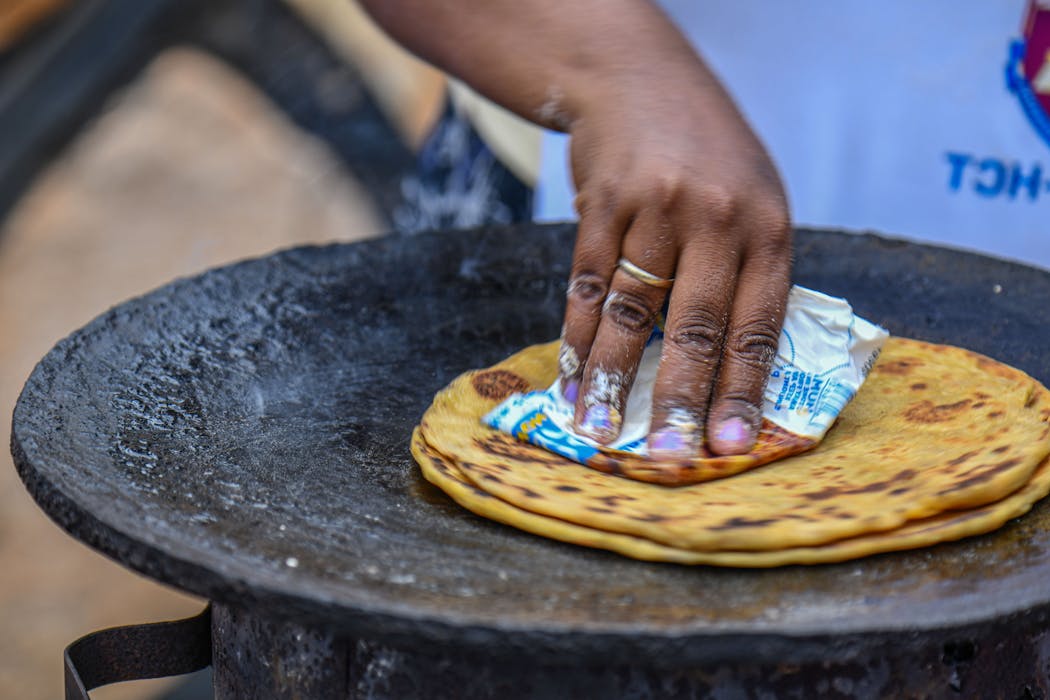
Chapati can be made on the street and paired with meat and vegetables.Ssemmanda Will/Wikimedia Commons, CC BY-SA
As Kenya’s cities grew, more and more people left their rural homes and subsistence farming systems to go to urban settlements like Mombasa to find work. In the city, meals were paid for with cash, a major transformation in Kenya’s food systems.
A new book called Preparing the Modern Meal is an urban history that explores these processes. We asked historian Devin Smart about his study.
What’s the colonial history of Mombasa?
At the turn of the 20th century, the British were expanding their empire throughout sub-Saharan Africa, including the parts of east Africa that would become Kenya.
They built a railway that connected the port town of Mombasa on the Indian Ocean coast with the newly established Protectorate of Uganda in the interior. This created the foundations of the colonial economy and drove urbanisation.
While Nairobi grew in the Kenyan highlands, Mombasa became the most important port in east Africa. The city grew fast as people came to work at the railway, docks and in other parts of the urban economy.
After independence in 1963, cities like Mombasa carried on growing rapidly and more and more people started working in the informal sector, which included making and selling street food.
How did rural people get their food?
During the early 1900s, the cuisines of east Africa’s agrarian (farming) societies were mostly vegetarian. Much of the food people ate was grown in their own fields, though there were also regional markets.
These communities grew lots of staple crops like sorghum, millet, maize, bananas, cassava, and sweet potatoes. They also had legumes, greens, and dairy products as regular parts of their meals.
These ingredients were prepared into a variety of dishes, like the Kikuyu staple irio, a mash of bananas with maize kernels and legumes added to it. The Kamba often ate isio, a combination of beans and maize kernels, while the Luo who lived along the shores of Lake Victoria regularly included a dish called kuon as part of their cuisine. It’s a thick porridge of boiled milled grain (often millet), eaten with fish or vegetables to add contrasting flavours and textures.
In these communities, the daily meal was also defined by seasonal variety. Food changed depending on what was being harvested or what stores of ingredients were dwindling. These were also gendered food systems, with women doing much of the farming work and nearly all the cooking.
In my book, I consider the dramatic changes in how east Africans came by their food when they left these rural food systems for the city.
How was food organised in the city?
In Mombasa, they entered a food system organised around commercial exchange. My study is about Kenya, but the story it reflects is one that’s unfolded on a global scale. The shift from subsistence to commodified food systems, from growing your own to buying it from others, has been one of the central features of the modern world.
By the 1930s, most people in Mombasa bought nearly all their food with cash, visiting small dried-goods grocers, fresh-produce vendors, and working-class eateries. In this urban food system, the seasonal variety of rural cuisines was increasingly replaced by the regularity of commercial supply chains.
Pilau, beans and chapati. Teddykip/Wikimedia Commons, CC BY
This was especially the case with staple grains. In the countryside, people ate a variety of grains, but in Mombasa maize meal and wheat became daily staples eaten year-round, transforming east African foodways.
Migration also changed domestic labour in the kitchen. Many migrant men now lived in homes without women, which meant they had to prepare their own food, often for significant periods of their lives.
However, the idea that cooking was the work of women proved enduring. When women joined these households in the city, they again prepared the family’s meals.
How did street food emerge?
By the 1930s, Mombasa had a fast-growing working class. The majority of the town’s workers spent their days in the industrial district, around the railway and port. Many also had to commute a considerable distance to work.
With the long working day of urban capitalism, returning home for a filling lunch wasn’t practical, which created strong demand for affordable prepared food at midday. As this was happening, many in the city also struggled to find consistent jobs and turned to informal trades like street food to earn a living.
This convergence of supply and demand led to the rapid growth of the street food industry around the 1950s, with people opening eateries in makeshift structures outside the gates to the port and in nearby alleyways, parks, and other open spaces.
What kind of food was served?
At these working-class food spots, a popular dish was chapati, an east African version of the South Asian flatbread. People could complement it with beans, meat, or fried fish, along with githeri, a mixture of maize kernels and beans (similar to isio).
In later decades, ugali, the ubiquitous Kenyan staple made from maize meal, became more common at street food eateries, as did Swahili versions of Indian Ocean dishes like pilau (aromatic rice with meat) and biryani (rice with meat braised in a spice-infused tomato sauce).
How were street food vendors policed?
The business model that made street food work in Mombasa’s economy also brought these vendors into regular conflict with the city’s administration. Street food vendors kept overheads and thus prices low because they avoided rents and licensing fees by squatting on open land in makeshift structures.
But, in an era of urban development and modernisation, many officials desired a different kind of city, one without this kind of informal land use and architecture. Authorities began campaigns to remove these businesses from Mombasa’s landscape, arresting vendors and demolishing their structures.
This also created a tension, though, because the city’s workers, including those at the port and railway who ran the most important transportation choke point in east Africa’s regional economy, needed affordable meals at lunch.
Given that informal trade had become essential to Mombasa’s economy, there were limits on how far these campaigns could be pushed. However, arrests and demolitions did still occur, and sometimes on a dramatic, city-wide scale, which made street food a precarious way to earn a living in Kenya’s port town.
For example, in 2001, the Kenyan government launched a massive demolition campaign to clear informal business structures from city sidewalks, parks and open spaces.
After the demolitions, many rebuilt and reopened their street food businesses, but in less visible parts of town and on side streets rather than main roads. Today, these eateries remain an essential part of Mombasa’s economy and food system.
What do you hope readers will take away from the book?
I hope that readers will see how food history helps us understand the ways that capitalism transformed the modern world.
The regional focus of the book is east Africa, but it explores themes relevant to the history of capitalism more generally, including the gendered division of household labour, the commercialisation of everyday needs and wants, and the political and economic struggles of working-class communities to find space for themselves in modern cities.
The research for this book was supported with funding from the University of Illinois at Urbana-Champaign and West Virginia University.
Et si le confort thermique ne se résumait pas à chauffer plus, mais à chauffer mieux ? Des lits chauffants chinois aux kotatsu japonais, l’Asie a longtemps privilégié des solutions ciblées, sobres et durables face au froid.
Les matins d’hiver à Harbin, où l’air extérieur pouvait vous geler les cils, je me réveillais sur un lit de terre chaude. Harbin, où j’ai grandi, se situe dans le nord-est de la Chine. Les températures hivernales y descendent régulièrement jusqu’à −30 °C et, en janvier, même les journées les plus douces dépassent rarement −10 °C. Avec environ 6 millions d’habitants aujourd’hui, Harbin est de loin la plus grande ville du monde à connaître un froid aussi constant.
Rester au chaud sous de telles températures m’a occupé l’esprit toute ma vie. Bien avant la climatisation électrique et le chauffage urbain, les habitants de la région survivaient à des hivers rigoureux en utilisant des méthodes entièrement différentes des radiateurs et des chaudières à gaz qui dominent de nos jours les foyers européens.
Aujourd’hui, en tant que chercheur en architecture dans une université britannique, je suis frappé par tout ce que nous pourrions apprendre de ces systèmes traditionnels. Les factures d’énergie restent trop élevées et des millions de personnes peinent à chauffer leur logement, tandis que le changement climatique devrait rendre les hivers plus instables. Nous avons besoin de moyens efficaces et peu énergivores pour rester au chaud, sans dépendre du chauffage de l’ensemble d’un logement à l’aide de combustibles fossiles.
Certaines des réponses se trouvent peut-être dans les méthodes avec lesquelles j’ai grandi.
Un lit chaud fait de terre
Mes premiers souvenirs de l’hiver sont liés au fait de me réveiller sur un « kang » – une plateforme-lit chauffée faite de briques de terre, utilisée dans le nord de la Chine depuis au moins 2 000 ans. Le kang est moins un meuble qu’un élément du bâtiment lui-même : une dalle épaisse et surélevée, reliée au poêle familial situé dans la cuisine. Lorsque le poêle est allumé pour cuisiner, l’air chaud circule dans des conduits aménagés sous le kang, réchauffant l’ensemble de sa masse.
Un kang traditionnel chinois, combinant lit et poêle. Google Gemini, CC BY-SA
Pour un enfant, le kang avait quelque chose de magique : une surface chaude et rayonnante qui restait tiède toute la nuit. Mais à l’âge adulte – et aujourd’hui en tant que chercheur – je peux mesurer à quel point il s’agit d’une pièce d’ingénierie remarquablement efficace.
Contrairement au chauffage central, qui fonctionne en réchauffant l’air de chaque pièce, seul le kang (c’est-à-dire la surface du lit) est chauffé. La pièce elle-même peut être froide, mais les personnes se réchauffent en s’allongeant ou en s’asseyant sur la plateforme, sous d’épaisses couvertures. Une fois chauffée, sa masse de plusieurs centaines de kilogrammes de terre compactée restitue lentement la chaleur pendant de longues heures. Il n’y avait pas de radiateurs, pas besoin de pompes, et nous ne chauffions pas inutilement des pièces inoccupées. Comme une grande partie de la chaleur initiale était produite par des feux nécessaires de toute façon pour cuisiner, nous économisions du combustible.
L’entretien du kang était une affaire familiale. Mon père – professeur de littérature chinoise au collège, pas vraiment un ingénieur – est devenu un expert du kang. Empiler avec soin des couches de charbon autour du foyer afin de maintenir le feu toute la nuit relevait du travail de ma mère. Avec le recul, je mesure l’ampleur des compétences et du travail que cela exigeait, ainsi que la confiance que les familles accordaient à un système nécessitant une bonne ventilation pour éviter les risques d’intoxication au monoxyde de carbone.
Mais malgré tous ses inconvénients, le kang offrait quelque chose que les systèmes de chauffage modernes peinent encore à fournir : une chaleur durable avec très peu de combustible.
Des approches similaires en Asie de l’Est
Dans toute l’Asie de l’Est, les manières de se réchauffer par temps froid ont évolué autour de principes similaires : maintenir la chaleur près du corps et ne chauffer que les espaces qui comptent vraiment.
En Corée, l’ancien système ondol fait également circuler de l’air chaud sous des sols épais, transformant toute la surface du sol en plancher chauffant. Le Japon a développé le kotatsu, une table basse recouverte d’une lourde couverture, avec un petit dispositif chauffant placé en dessous pour garder les jambes au chaud. Ils peuvent être un peu coûteux, mais comptent parmi les objets les plus populaires dans les foyers japonais.
Les vêtements étaient eux aussi très importants. Chaque hiver, ma mère me confectionnait un tout nouveau manteau épais et matelassé, qu’elle garnissait de coton fraîchement cardé. C’est l’un de mes souvenirs les plus tendres.
L’Europe avait des idées similaires – puis les a oubliées
Des approches comparables se sont jadis développées en Europe. Les Romains de l’Antiquité, par exemple, chauffaient les bâtiments grâce à des hypocaustes, qui faisaient circuler l’air chaud sous les sols. Au Moyen Âge, les foyers suspendaient de lourdes tapisseries aux murs pour réduire les courants d’air, et de nombreuses cultures utilisaient des coussins moelleux, des tapis chauffés ou des espaces de couchage clos afin de conserver la chaleur.
La généralisation du chauffage central moderne au XXe siècle a remplacé ces pratiques par un modèle plus énergivore : chauffer des bâtiments entiers à une température uniforme, même lorsqu’une seule personne est présente au domicile. Tant que l’énergie était bon marché, ce modèle fonctionnait, malgré le fait que la plupart des logements européens (notamment en France, NDT) soient mal isolés au regard des standards internationaux.
Mais aujourd’hui, alors que l’énergie est redevenue chère, des dizaines de millions d’Européens ne parviennent pas à chauffer correctement leur logement. De nouvelles technologies comme les pompes à chaleur et les énergies renouvelables aideront – mais elles fonctionnent d’autant mieux que les bâtiments qu’elles chauffent sont déjà performants, ce qui permet de fixer des consignes de chauffage plus basses et des consignes de refroidissement plus élevées.
Les approches traditionnelles du chauffage domestique ont donc encore beaucoup à nous apprendre. Le kang et les systèmes similaires démontrent que le confort ne vient pas toujours d’une consommation accrue d’énergie, mais d’une conception plus intelligente de la chaleur.
Yangang Xing ne travaille pas, ne conseille pas, ne possède pas de parts, ne reçoit pas de fonds d’une organisation qui pourrait tirer profit de cet article, et n’a déclaré aucune autre affiliation que son organisme de recherche.
Why did this community burn one woman’s remains in such a visible, spectacular way?Patrick Fahey
Near the equator, the Sun hurries below the horizon in a matter of minutes. Darkness seeps from the surrounding forest. Nearly 10,000 years ago, at the base of a mountain in Africa, people’s shadows stretch up the wall of a natural overhang of stone.
They’re lit by a ferocious fire that’s been burning for hours, visible even to people miles away. The wind carries the smell of burning. This fire will linger in community memory for generations − and in the archaeological record for far longer.
We are a team of bioarchaeologists, archaeologists and forensic anthropologists who, with our colleagues, recently discovered the earliest evidence of cremation – the transformation of a body from flesh to burned bone fragments and ashes – in Africa and the earliest example of an adult pyre cremation in the world.
The pyre was found under a giant boulder near the base of Mount Hora. The site is in Malawi, which is outlined in black within the Zambezian forest (colored green) on the map of Africa. Jessica Thompson and Natural Earth
It’s no easy task to produce, create and maintain an open fire strong enough to completely burn a human body. While the earliest cremation in the world dates to about 40,000 years ago in Australia, that body was not fully burned.
It is far more effective to use a pyre: an intentionally built structure of combustible fuel. Pyres appear in the archaeological record only about 11,500 years ago, with the earliest known example containing a cremated child under a house floor in Alaska.
Many cultures have practiced cremation, and the bones, ash and other residues from these events help archaeologists piece together past funeral rituals. Our scientific paper, published in the journal Science Advances, describes a spectacular event that happened about 9,500 years ago in Malawi in south-central Africa, challenging long-held notions about how hunter-gatherers treat their dead.
Excavators standing at the depth of the pyre at the Hora 1 site in northern Malawi. Jessica Thompson
The discovery
At first it was just a hint of ash, then more. It expanded downward and outward, becoming thicker and harder. Pockets of dark earth briefly appeared and disappeared under trowels and brushes until one of the excavators stopped. They pointed to a small bone at the base of a 1½-foot (0.5-meter) wall of archaeological ash revealed under a natural stone overhang at the Hora 1 archaeological site in northern Malawi.
The bone was the broken end of a humerus, from the upper arm of a person. And clinging to the very end of it was the matching end of the lower arm, the radius. Here was a human elbow joint, burned and fractured, preserved in sediments full of debris from the daily lives of Stone Age hunter-gatherers.
We wondered whether this could be a funeral pyre, but such structures are extremely rare in the archaeological record.
Excavators began finding a thick ash deposit about 2 feet (0.6 meters) under the modern-day surface of the rock shelter. Jessica Thompson
Finding a cremated person from the Stone Age also seemed impossible because cremation is not generally practiced by African foragers, either living or ancient. The earliest evidence of burned human remains from Africa date to around 7,500 years ago, but that body was incompletely burned, and there was no evidence of a pyre.
The first clear cases of cremation date to around 3,300 years ago, carried out by early pastoralists in eastern Africa. But overall the practice remained rare and is associated with food-producing societies and not hunter-gatherers.
We found more charred human remains in a small cluster, while the ash layer itself was as large as a queen bed. The blaze must have been enormous.
When we returned from fieldwork and received our first radiocarbon dates, we were shocked again: The event had happened about 9,500 years ago.
Piecing together the events
We built a team of specialists to piece together what had happened. By applying forensic and bioarchaeological techniques, we confirmed that all the bones belonged to a single person who was cremated shortly after her death.
This was a small adult, probably a woman, just under 5 feet (1.5 meters) in height. In life, she was physically active, with a strong upper body, but had evidence of a partially healed bone infection on her arm. Bone development and the beginnings of arthritis suggested she was probably middle-aged when she died.
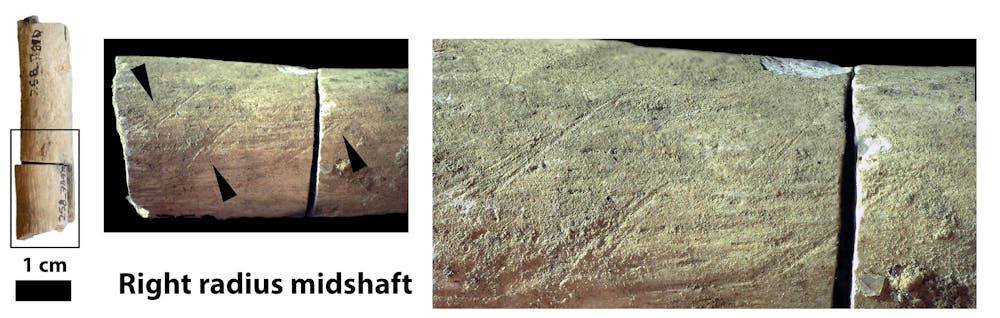
Marks incised on the shaft of the lower arm bone (radius) were inflicted by a stone tool. The bone then turned gray as it burned. The area in the box on the left is enlarged on the right of the image. Jessica Thompson
Patterns of warping, cracks and discoloration caused by fire damage showed her body was burned with some flesh still on it, in a fire reaching at least 1,000 degrees Fahrenheit (540 degrees Celsius). Under the microscope we could see tiny incisions along her arms and at muscle connections on her legs, revealing that people tending the pyre used stone tools to help the process along by removing flesh.
Tiny pointed tools made from local stone were found within the pyre. They were probably made at the same time that it burned. Justin Pargeter
Within the pyre ash, we found many small pointed chips of stone that suggested people had added tools to the fire as it burned.
And the way the bones were clustered inside such a large fire showed that this was not a case of cannibalism: It was some other kind of ritual.
Perhaps most surprisingly, we found no evidence of her head. Skull bones and teeth usually preserve well in cremations because they are very dense. While we can’t know for sure, the absence of these body parts suggest her head may have been removed before or during the cremation as part of the funeral ritual.
A communal spectacle
We determined that the pyre must have been built and maintained by multiple people who were actively engaged in the event. During new excavations the following year, we found even more bone fragments from the same ancient woman, displaced and colored differently from in the main pyre. These additional remains suggest that the body was manipulated, attended and moved during the cremation.
Microscopic analysis of ash samples from across the pyre included blackened fungus, reddened soil from termite structures, and microscopic plant remains. These helped us estimate that people collected at least 70 pounds (30 kg) of deadwood to do the task and stoked the fire for hours to days.
We also learned that this was not the first fire at the Hora 1 site – nor its last. To our astonishment, what had seemed during fieldwork to be a single massive pile of ash was in fact a layered series of burning events. Radiocarbon dating of the ash samples showed that people began lighting fires on that spot by about 10,240 years ago. The same location was used to construct the cremation pyre several hundred years later. As the pyre smoldered, new fires were kindled on top of it, resulting in fused ashes in microscopic layers.
Loose, sandy, burned soil was mixed on top of very thin layers of ash, showing that the pyre was lit over and over again. Flora Schilt
Within a few hundred years of the main event, another large fire was built again at the exact same place. While there is no evidence that anyone else was cremated in the subsequent fires, the fact that people repeatedly returned to the spot for this purpose suggests its significance lived on in community memory.
A new view of ancient cremation
What does all of this tell us about ancient hunter-gatherers in the region?
For one, it shows that entire communities were engaged in a mortuary spectacle of extraordinary scale. An open pyre can take more than a day of constant tending and an enormous amount of fuel to fully reduce a body, and during this time the sights and smells of burning wood and other remains are impossible to hide.
This scale of mortuary effort is unexpected for this time and place. In the African record, complex multigenerational mortuary rituals tied to specific places are generally not associated with a hunting-and-gathering way of life.
It also shows that different people were treated in different ways in death, raising the possibility of more complex social roles in life. Other men, women and children were buried at the Hora 1 site beginning as early as 16,000 years ago. In fact, those other burials have provided ancient DNA evidence showing they were part of a long-term local group. But those burials, and others that came a few hundred years after the pyre, were interred without this labor-intensive spectacle.
What about this person was different? Was she a beloved family member or an outsider? Was this treatment because of something she did in life or a specific hope for the afterlife? Additional excavation and data from across the region may help us better understand why this person was cremated and what cremation meant to this group.
Whoever she was, her death had important meaning not just to the people who made and tended the pyre, but also to the generations that came after.
Jessica C. Thompson has received funding for this research from the Wenner-Gren Foundation, National Geographic Society, and Hyde Family Foundations. She is affiliated with the Yale Peabody Museum and the Institute of Human Origins.
Elizabeth Sawchuk and Jessica Cerezo-Román do not work for, consult, own shares in or receive funding from any company or organization that would benefit from this article, and have disclosed no relevant affiliations beyond their academic appointment.
Source: The Conversation – France in French (3) – By Léo-Paul Barthélémy, Doctorant en sciences de l’information et de la communication, CREM, Université de Lorraine, Université de Lorraine
Certains parient sur l’issue de tel ou tel événement sportif. D’autres sur l’évolution à court terme d’un indicateur économique largement suivi. D’autres encore – parfois les mêmes – engagent des sommes importantes sur des questions nettement plus discutables d’un point de vue moral, comme la prise d’une ville en Ukraine par l’armée russe. Les sites permettant ce type de paris sont en plein essor.
Un marché prédictif n’est pas tout à fait un site de paris. C’est un dispositif de spéculation collective dans lequel des participants achètent et vendent des contrats indexés sur la réalisation d’un événement futur précisément défini (« X aura lieu avant telle date », « Y gagnera l’élection », etc.). Le prix de ces contrats fluctue en fonction de l’offre et de la demande : plus un événement est jugé probable par les participants, plus le contrat associé est recherché et plus son prix augmente.
À la date fixée – ou une fois l’événement tranché – le marché est résolu : si l’événement s’est bien produit, le contrat correspondant est payé à sa valeur maximale, tandis que les contrats perdants deviennent sans valeur. Les gains ou pertes des participants dépendent donc du prix auquel ils ont acheté ou vendu ces contrats avant la résolution.
Parce qu’ils incitent ceux qui disposent de bribes d’informations utiles à investir, et agrègent donc le savoir d’un maximum d’acteurs sur un événement, ces marchés se révèlent souvent étonnamment précis. Aux États-Unis, des marchés de paris très organisés consacrés à l’issue de l’élection présidentielle ont existé de la fin du XIXe siècle jusqu’à la Seconde Guerre mondiale, notamment à New York. Paul W. Rhode et Koleman S. Strumpf ont montré que ces marchés ont fait preuve d’une précision remarquable, à une époque pourtant dépourvue de sondages scientifiques. Dans quinze élections présidentielles entre 1884 et 1940, le candidat favori un mois avant le scrutin a presque toujours remporté l’élection, avec une seule véritable exception.
Les versions décentralisées, comme Polymarket et Kalshi, ajoutent un avantage, selon leurs promoteurs : elles fonctionnent sans intermédiaire central, reposent sur la blockchain et permettent des échanges mondialisés, en résistant aux réglementations nationales (ces sites sont par exemple interdits en France). Mais cette décentralisation a un revers fondamental : le système ne peut pas, à lui seul, savoir ce qui se passe dans le monde réel. Il doit donc s’appuyer sur des oracles, c’est-à-dire des sources externes (médias, bases de données, experts, indicateurs publics) chargées de confirmer si un événement s’est effectivement produit. Lorsque la réalité est ambiguë, ces oracles peuvent être contestés. D’où la nécessité de mécanismes d’arbitrage humains, censés trancher les litiges : votes communautaires, comités de résolution ou décisions manuelles. Ces moments, où l’interprétation humaine reprend le dessus, constituent précisément le point de fragilité des marchés prédictifs décentralisés, car ils ouvrent la porte aux erreurs, aux biais… et parfois aux manipulations.
Entre vulnérabilités et défis informationnels : parier sur la guerre en Ukraine
Ces marchés de prédiction en ligne, en pleine croissance depuis plusieurs années, donnent à leurs utilisateurs la possibilité d’ouvrir des paris sur n’importe quel thème, y compris sur les sujets géopolitiques les plus sensibles.
Dernièrement, on constate l’existence de très nombreux paris portant sur la guerre en Ukraine, particulièrement documentée et suivie, et donc propice à une multiplicité de paris variés : pertes territoriales, échéances de cessez-le-feu, escalade nucléaire ou rencontres entre dirigeants sont au cœur des questions les plus convoitées. Derrière chaque prévision publiée se joue le sort de milliers de personnes dans la vraie vie. Mais pour les joueurs, les drames vécus par des individus concrets sur le terrain relèvent d’un simple jeu de spéculation. Certains de ces paris brassent des dizaines de millions de dollars.
Ce succès s’explique aussi par un environnement propice au développement des cryptomonnaies, dont l’usage ne cesse de croître depuis quelques années.
Capture d’écran du site Polymarket montrant la variété des thèmes sur lesquels les parieurs sont invités à parier. Fourni par l’auteur
Plusieurs prédictions sur la guerre en Ukraine ont été fébrilement relayées durant la première moitié de 2025. Le premier exemple est celui de l’accord minier qui devait être signé par Donald Trump sur l’Ukraine au mois de mars. Malgré l’absence d’un tel accord, la plate-forme a été manipulée par une « baleine crypto » (quelqu’un qui détient une quantité massive d’une cryptomonnaie) qui a pu faire pencher la décision en sa faveur, avec en prime un remboursement impossible pour les parieurs lésés. À ce titre, Polymarket a répondu aux demandes des utilisateurs en précisant que le marché avait été résolu conformément au protocole.
Le second exemple porte sur la tenue du président ukrainien : il était question de parier sur le fait que Volodymyr Zelensky porterait un costume avant juillet 2025. Ce qui semble en apparence assez simple à prouver s’est en réalité avéré extrêmement compliqué, le critère de résolution et de validation du pari ayant été mal défini sur le site.
Derek Guy, spécialiste influent de la mode masculine, a indiqué que « la question était mal formulée » puisque la définition d’un costume peut varier, selon l’aspect technique du vêtement ou de l’attente sociale qu’on lui attribue. Alors que plus de 240 millions de dollars ont été échangés sur ce pari, le débat continue dans les commentaires, plusieurs mois après sa clôture. Courant novembre 2025, on dénombrait près de 100 paris possibles sur divers aspects relatifs à la guerre en Ukraine.
Un autre débat a émergé de la carte interactive Polyglobe, fondée par Le Pentagon Pizza Watch (PPW), un tracker qui surveille l’activité des restaurants autour de bâtiments gouvernementaux américains, en vue d’anticiper des actions stratégiques et militaires importantes. La visualisation des paris Polymarket sur une carte interactive est complétée par des données en sources ouvertes (OSINT), comme des tweets.
Capture d’écran d’une carte de Polyglobe (17/12/2025) représentant la ligne de front dans l’est de l’Ukraine. Fourni par l’auteur
Il s’agissait pour les parieurs de prédire si l’armée russe allait réussir à capturer la ville de Myrhorod d’ici le 15 novembre. Les pronostics se basaient sur une carte du think tank Institute for the Study of War (ISW). Juste avant la clôture du pari, cette carte a indiqué une avancée russe à l’intérieur de la ville. La zone est apparue en rouge, donc aux mains de la Russie ; les parieurs ont été payés ; puis la carte a été corrigée peu de temps après. L’ISW a confirmé par la suite que la modification n’avait pas été approuvée en interne, ajoutant un système d’annotation tout en dénonçant l’utilisation de ses cartes par des spéculateurs.
Polyglobe a rapidement choisi de changer d’outil cartographique, et de passer désormais cette fois-ci par la carte interactive et collaborative de DeepStateMap.Live, qui affiche l’évolution quotidienne de la ligne de front en Ukraine. Les représentants de ce dernier site ont à leur tour dénoncé le réemploi non souhaité de leurs données à des fins de spéculation, PPW finissant par s’excuser et par retirer la carte. Ces changements et rétractations rapides illustrent bien la zone grise réglementaire dans laquelle évoluent ces nouveaux outils spéculatifs.
Capture d’écran d’une carte de DeepStateMap.Live (17/12/2025) représentant la ligne de front dans l’est de l’Ukraine. Fourni par l’auteur
Une culture du jeu qui varie, une technologie qui s’en affranchit
La question morale est inévitable : comment est-il possible de parier sur la guerre, de surcroît dans un contexte où les combats s’intensifient et où les civils ukrainiens sont attaqués quotidiennement ?
Une première piste de réflexion est peut-être celle de la culture du jeu, qui varie considérablement d’un pays à un autre. Dans celle anglo-saxonne, dont est issu le fondateur de Polymarket, il n’existe aucun tabou en ce qui concerne les paris. Au Royaume-Uni, c’est même un « sport national », où il est possible, par exemple, de spéculer sur divers détails de la vie de la famille royale.
Cette conception de la prédiction est très différente de celle que nous avons en France, où l’Autorité nationale des jeux (ANJ) régule, entre autres, les sports sur lesquels il est possible de miser. Au niveau de l’Union européenne, il existe des socles juridiques communs et des initiatives de régulation, mais chaque membre fixe ses propres règles. Celles-ci sont d’autant plus disparates qu’elles sont désormais contournables par la décentralisation offerte par la blockchain, laquelle permet de se passer d’intermédiaires financiers soumis aux réglementations nationales. Le recours aux cryptomonnaies permet ainsi à ces plates-formes de contourner les interdictions bancaires, y compris dans les pays où Polymarket est interdit, comme en France, indépendamment des outils de contournement géographique tels que les VPN.
Au-delà des contraintes juridiques et des offres des bookmakers, ce sont aussi nos valeurs qui influencent nos limites philosophiques de ce qui est acceptable. Rappelons que les spéculations sur l’issue des conflits ne datent pas d’aujourd’hui. Entre autres exemples, en 1691, bien longtemps avant notre ère numérique, des paris avaient été pris en Angleterre sur l’issue de la bataille de Limerick en Irlande, qui opposa les partisans de Jacques II à ceux de Guillaume d’Orange.
Quelles limites pour le marché de la prédiction ?
Indéniablement, ces paris qui relèvent de vie et de mort, de guerre et de paix et d’enjeux géopolitiques lourds, posent des questions morales, mais ils nous interrogent aussi quant à toutes ces données du front rapidement diffusées et réinterprétées. Il est également établi que les jeux de hasard favorisent des problèmes psychologiques et émotionnels, sans occulter leur aspect addictif. Une étude de 2023 pointait les biais structurels qu’ils posent, notamment avec le phénomène de paris irrationnels.
Ce marché nous questionne aussi sur la vérification de l’information : les paris prédisent-ils seulement le cours des événements ou ont-ils un impact sur ces derniers ? Qui est légitime pour définir les contours d’un critère de résolution d’une issue ? La manipulation cartographique évoquée précédemment aurait pu poser des soucis de désinformation conséquents, surtout à un moment crucial de la guerre où chaque kilomètre carré capturé par des soldats est commenté en temps réel dans la presse.
L’instrumentalisation de ces données pour la spéculation menace l’intégrité de notre connaissance de la guerre, en mettant une pression supplémentaire sur les analystes qui traitent déjà de grands volumes d’informations, tout en sapant l’image des cartes militaires en ligne. Ceci est d’autant plus dangereux que des paris similaires existent sur à peu près tous les autres théâtres militaires en cours dans le monde.
Enfin, ces exemples nous rappellent les limites de ces plates-formes décentralisées qui font fi de toutes barrières éthiques et techniques. Miser sur le dresscode d’un président n’a évidemment pas la même signification morale que spéculer sur la capture d’un village de l’oblast de Donetsk. Est-il acceptable de parier sur la sécurité de civils et de mettre cela au même niveau que le résultat d’un match de football ? Il est sans doute temps de fixer une limite, a minima celle de l’empathie, pour éviter que la guerre ne soit reléguée à un divertissement, ce qu’elle n’est certainement pas.
Léo-Paul Barthélémy ne travaille pas, ne conseille pas, ne possède pas de parts, ne reçoit pas de fonds d’une organisation qui pourrait tirer profit de cet article, et n’a déclaré aucune autre affiliation que son organisme de recherche.