Jane Austen’s Paper Trail is a podcast from The Conversation celebrating 250 years since the author’s birth. In each episode, we investigate a different aspect of Austen’s personality by interrogating one of her novels with leading researchers. Along the way, we visit locations important to Austen to uncover a particular aspect of her life and the times she lived in.
For episode seven of Jane Austen’s Paper Trail, we’re doing something a little different. Rather than putting Austen under the microscope ourselves, we’re handing the questions over to you.
Jane Austen is a curious author because the more we learn about her, the more elusive she seems to become. She left behind a remarkably slim paper trail for someone so influential, and much of what we “know” about her has been filtered through family memory, biography and, sometimes, wishful thinking. As Jane Austen’s Paper Trail draws to a close, there are still loose ends to tie up – and that’s where you, our listeners, come in.
We’ve received a virtual sack full of letters from you, ranging from questions about Austen’s religious beliefs to her grasp of contemporary science, and even what she might have made of social media. Unlike Jane’s sister Cassandra Austen, however, we have no intention of throwing your letters into the flames. Instead, three experts join me to debate them – and, where possible, to settle them.
For our first panellist, we’re welcoming back Emma Claire Sweeney from episode four about Austen’s friendships. Sweeney is a senior lecturer in creative writing at the Open University and worked collaborated on a interactive experience with the BBC as part of the Jane Austen: Rise of a Genius.
Returning from episode six about whether Austen was happy is John Mullan, professor of literature at University College London and author of What Matters in Jane Austen. Completing the panel is Lizzie Dunford, director of Jane Austen’s House in Hampshire.
Together, they take your questions seriously, testing what can be answered from the novels, what can be inferred from historical context, and where Austen herself remains stubbornly silent. From faith and feminism to fame and future technology, these questions remind us why Austen continues to fuel our curiosity 250 years after her birth.
Jane Austen’s Paper Trail is hosted by Anna Walker with reporting from Jane Wright and Naomi Joseph. Senior producer and sound designer is Eloise Stevens and the executive producer is Gemma Ware. Artwork by Alice Mason and Naomi Joseph.
Listen to The Conversation Weekly via any of the apps listed above, download it directly via our RSS feed or find out how else to listen here.
A great white shark is a masterwork of evolutionary engineering. These beautiful predators glide effortlessly through the water, each slow, deliberate sweep of the powerful tail driving a body specialised for stealth, speed and efficiency. From above, its dark back blends into the deep blue water, while from below its pale belly disappears into the sunlit surface.
In an instant, the calm glide explodes into an attack, accelerating to more than 60 kilometres per hour, the sleek torpedo-like form cutting through the water with little resistance. Then its most iconic feature is revealed: rows of razor-sharp teeth, expertly honed for a life at the top of the food chain.
Scientists have long been fascinated by white shark teeth. Fossilised specimens have been collected for centuries, and the broad serrated tooth structure is easily recognisable in jaws and bite marks of contemporary sharks.
But until now, surprisingly little was known about one of the most fascinating aspects of these immaculately shaped structures: how they change across the jaw and to match the changing demands throughout the animal’s lifetime. Our new research, published in Ecology and Evolution, set out to answer this.
From needle-like teeth to serrated blades
Different shark species have evolved teeth to suit their dietary needs, such as needle-like teeth for grasping slippery squid; broad, flattened molars for crushing shellfish; and serrated blades for slicing flesh and marine mammal blubber.
Shark teeth are also disposable – they are constantly replaced throughout their lives, like a conveyor belt pushing a new tooth forward roughly every few weeks.
White sharks are best known for their large, triangular, serrated teeth, which are ideal for capturing and eating marine mammals like seals, dolphins and whales. But most juveniles don’t start life hunting seals. In fact, they feed mostly on fish and squid, and don’t usually start incorporating mammals into their diet until they are roughly 3 metres long.
This raises a fascinating question: do teeth coming off the conveyor belt change to meet specific challenges of diets at different developmental stages, just as evolution produces teeth to match the diets of different species?
Previous studies tended to focus on a small number of teeth or single life stages. What was missing was a full, jaw-wide view of how tooth shape changes – not just from the upper and lower jaw, but from the front of the mouth to the back, and from juvenile to adult.
An array of jaws from sharks ranging from 1.2m to 4.4m. Emily Hunt
Teeth change over a lifetime
When we examined teeth from nearly 100 white sharks, clear patterns emerged.
First, tooth shape changes dramatically across the jaw. The first six teeth on each side are relatively symmetrical and triangular, well suited for grasping, impaling, or cutting into prey.
Beyond the sixth tooth, however, the shape shifts. Teeth become more blade-like, better adapted for tearing and shearing flesh. This transition marks a functional division within the jaw where different teeth play different roles during feeding, much like how we as humans have incisors at the front and molars at the back of our mouths.
Even more striking were the changes that occur as sharks grow. At around 3m in body length, white sharks undergo a major dental transformation. Juvenile teeth are slimmer and often feature small side projections at the base of the tooth, called cusplets, which help to grip small slippery prey such as fish and squid.
As sharks approach 3m, these cusplets disappear and the teeth become broader, thicker, and serrated.
In many ways, this shift mirrors an ecological turning point. Young sharks rely on fish and small prey that require precision and an ability to grasp the smaller bodies. Larger sharks increasingly target marine mammals: big, fast-moving animals that demand cutting power rather than grip.
Once great whites reach this size, they develop an entirely new style of tooth capable of slicing through dense flesh and even bone.
Some teeth stand out even more. The first two teeth on either side of the jaw, the four central teeth, are significantly thicker at the base. These appear to be the primary “impact” teeth, taking the force of the initial bite.
Meanwhile, the third and fourth upper teeth are slightly shorter and angled, suggesting a specialised role in holding onto struggling prey. Their size and position may also be influenced by the underlying skull structure and the placement of key sensory tissues involved in smelling.
We also found consistent differences between the upper and lower jaws. Lower teeth are shaped for grabbing and holding prey, while upper teeth are designed for slicing and dismembering – a coordinated system that turns the white shark’s bite into a highly efficient feeding tool.
Scientists measured teeth from nearly 100 white sharks. Emily Hunt
A lifestory in teeth
Together, these findings tell a compelling story.
The teeth of white sharks are not static weapons but living records of a shark’s changing lifestyle. Continuous replacement compensates for teeth lost and damaged, but at least equally important, enables design updates that track diet changes through development.
This research helps us better understand how white sharks succeed as apex predators and how their feeding system is finely tuned across their lifetime.
It also highlights the importance of studying animals as dynamic organisms, shaped by both biology and behaviour. In the end, a white shark’s teeth don’t just reveal how it feeds – they reveal who it is, at every stage of its life.
This research has received in kind support for collection of specimens from the New South Wales Department of Primary Industries and Regional Development through the Shark Management Program. David Raubenheimer has no other relevant relationships or funding to declare.
Ziggy Marzinelli is an Associate Professor at The University of Sydney and receives funding from the Australian Research Council, the Ian Potter Foundation and the NSW Environmental Trust.
Emily Hunt does not work for, consult, own shares in or receive funding from any company or organisation that would benefit from this article, and has disclosed no relevant affiliations beyond their academic appointment.
Source: The Conversation – Global Perspectives – By David Blair, Emeritus Professor, ARC Centre of Excellence for Gravitational Wave Discovery, OzGrav, The University of Western Australia
Last year, astronomers were fascinated by a runaway asteroid passing through our Solar System from somewhere far beyond. It was moving at around 68 kilometres per second, just over double Earth’s speed around the Sun.
Imagine if it had been something much bigger and faster: a black hole travelling at more like 3,000km per second. We wouldn’t see it coming until its intense gravitational forces started knocking around the orbits of the outer planets.
This may sound a bit ridiculous – but in the past year several lines of evidence have come together to show such a visitor is not impossible. Astronomers have seen clear signs of runaway supermassive black holes tearing through other galaxies, and have uncovered evidence that smaller, undetectable runaways are probably out there too.
Runaway black holes: the theory
The story begins in the 1960s, when New Zealand mathematician Roy Kerr found a solution of Einstein’s general relativity equations that described spinning black holes. This led to two crucial discoveries about black holes.
First, the “no-hair theorem”, which tells us black holes can be distinguished only by three properties: their mass, their spin and their electric charge.
For the second we need to think about Einstein’s famous formula E = mc ² which says that energy has mass. In the case of a black hole, Kerr’s solution tells us that as much as 29% of a black hole’s mass can be in the form of rotational energy.
English physicist Roger Penrose deduced 50 years ago that this rotational energy of black holes can be released. A spinning black hole is like a battery capable of releasing vast amounts of spin energy.
A black hole can contain about 100 times more extractable energy than a star of the same mass. If a pair of black holes coalesce into one, much of that vast energy can be released in a few seconds.
It took two decades of painstaking supercomputer calculations to understand what happens when two spinning black holes collide and coalesce, creating gravitational waves. Depending on how the black holes are spinning, the gravitational wave energy can be released much more strongly in one direction than others – which sends the black holes shooting like a rocket in the opposite direction.
If the spins of the two colliding black holes are aligned the right way, the final black hole can be rocket-powered to speeds of thousands of kilometres per second.
Learning from real black holes
All that was theory, until the LIGO and Virgo gravitational wave observatories began detecting the whoops and chirps of gravitational waves given off by pairs of colliding black holes in 2015.
One of the most exciting discoveries was of black hole “ringdowns”: a tuning fork-like ringing of newly formed black holes that tells us about their spin. The faster they spin, the longer they ring.
Better and better observations of coalescing black holes revealed that some pairs of black holes had randomly oriented spin axes, and that many of them had very large spin energy.
All this suggested runaway black holes were a real possibility. Moving at 1% of light speed, their trajectories through space would not follow the curved orbits of stars in galaxies, but rather would be almost straight.
Runaway black holes spotted in the wild
This brings us to the final step in our sequence: the actual discovery of runaway black holes.
It is difficult to search for relatively small runaway black holes. But a runaway black hole of a million or billion solar masses will create huge disruptions to the stars and gas around it as it travels through a galaxy.
They are predicted to leave contrails of stars in their wake, forming from interstellar gas in the same way contrails of cloud form in the wake of a jet plane. Stars form from collapsing gas and dust attracted to the passing black hole. It’s a process that would last for tens of millions of years as the runaway black hole crosses a galaxy.
In 2025, several papers showed images of surprisingly straight streaks of stars within galaxies such as the image below. These seem to be convincing evidence for runaway black holes.
One paper, led by Yale astronomer Pieter van Dokkum, describes a very distant galaxy imaged by the James Webb telescope with a surprisingly bright contrail 200,000 light years long. The contrail showed the pressure effects expected from the gravitational compression of gas as a black hole passes: in this case it suggests a black hole with a mass 10 million times the Sun’s, travelling at almost 1,000km/s.
Another describes a long straight contrail cutting across a galaxy called NGC3627. This one is likely caused by a black hole of about 2 million times the mass of the Sun, travelling at 300km/s. Its contrail is about 25,000 light years long.
If these extremely massive runaways exist, so too should their smaller cousins because gravitational wave observations suggest that some of them come together with the opposing spins needed to create powerful kicks. The speeds are easily fast enough for them to travel between galaxies.
So runaway black holes tearing through and between galaxies are a new ingredient of our remarkable universe. It’s not impossible that one could turn up in our Solar System, with potentially catastrophic results.
We should not lose sleep over this discovery. The odds are minuscule. It is just another way that the story of our universe has become a little bit richer and a bit more exciting than it was before.
David Blair receives funding from the Australian Research Council. He is a member of the ARC Centre of Excellence for Gravitational Wave Discovery and is director of the Einstein-First education project that is developing a modern physics curriculum for primary and middle school science education.
Five years ago, on February 1 2021, Myanmar’s top generals decapitated the elected government. Democratic leaders were arrested, pushed underground or forced into exile.
Since then, the economy has spluttered and foreign investors have headed for the exit. The only growth industries – mostly scam centres, drugs and other criminal activities – enrich those already well-fed.
The military junta has kept its stranglehold via draconian curbs on civil and political liberties. It has bolstered its fighting forces through ruthless conscription, including of child soldiers. They now face rebellions in almost every corner of the ethnically diverse country.
It helps that the military brass can still depend on international support from Russia. China, meanwhile, is playing a careful game to ensure its interests – including prized access to the Indian Ocean for oil and gas – are secured.
And US President Donald Trump’s second term in office has introduced newly unpredictable and detrimental elements to great power politics.
The US government last year cited “notable progress in governance and stability [and] plans for free and fair elections” as justification for removing the Temporary Protected Status designation for immigrants from Myanmar. Although a federal judge blocked this decision a few days ago, this may eventually force previously protected Myanmar citizens to return home.
However, far from being free and fair, the month-long elections that just concluded in Myanmar have been devoid of meaningful democratic practice.
They will entrench the junta and provide little more than a patina of legitimacy that anti-democratic major powers will use to further normalise relations with Myanmar’s military leaders.
Myanmar’s deeply flawed election
The multi-stage elections were being held in only a fraction of the country currently under the military’s authority. Elections were not held in opposition-held territory, so many otherwise eligible voters were disenfranchised.
As such, there is no serious opposition to the military’s proxy, the Union Solidarity and Development Party (USDP). Civil and political space is also heavily restricted, with criticism of the election itself being a criminal offence.
The main opposition would be the National League for Democracy (NLD) party, which has won by a landslide in every national election it has participated in since 1990. But it has been banned, along with dozens of other opposition political parties. Its senior leaders, including Aung San Suu Kyi, have been imprisoned.
Despite recent military gains by the junta, supported by Russian military technology and Chinese government pressure, the lines of control may be starting to solidify into an eventual Balkanisation, or break up, of Myanmar into hostile statelets.
The prospects for a future federalised democratic Myanmar seem increasingly remote.
Since the coup there are many areas now under full opposition control. Take, for instance, a recent declaration of independence by a breakaway ethnic Karen armed group. While they represent only one part of the Karen community in eastern Myanmar, this could well precipitate a flood of similar announcements by other ethnic minorities.
Other groups might declare themselves autonomous and seek backing from governments and commercial and security interests in neighbouring countries such as China, Thailand, India and Bangladesh.
Most neighbouring countries will be uneasy about any further fracturing of Myanmar’s territorial integrity. Some, however, see potential benefits. China, for example, supports some ethnic armed groups to protect its strategic economic assets and maintain stability and influence along its borders.
Will international rulings have any impact?
While the conflict continues at home, Myanmar’s military leadership is defending itself at the International Court of Justice (ICJ) in The Hague. It faces claims it committed genocide against the Muslim Rohingya ethnic minority, particularly during the massacres of 2017.
Given the disdain for international law shown by Russia, China and the Trump administration in the US, any finding against the junta will have limited practical impact anyway.
What next?
Meanwhile, some countries in the the ASEAN bloc appear to be softening their opposition to the junta.
Recently, the Philippines foreign secretary met with Myanmar’s senior military leadership in the country’s first month chairing the bloc. This highlights the conundrum faced by regional leaders.
In the years immediately after the coup, ASEAN sought to keep Myanmar’s junta at arm’s length. But a number of key ASEAN players, particularly the more authoritarian regimes in Southeast Asia, would prefer to find a way to normalise engagement with the generals.
From that perspective, the flawed elections are a chance to embrace superficial democratisation and renewal.
This leaves the Myanmar people – millions of whom have fought hard against the coup and its negative consequences – with invidious choices about how to best pursue their independence and freedom.
There is little positive economic news on the horizon. The IMF projects inflation in Myanmar will stay above 30% in 2026 with a real GDP fall of 2.7%. This would compound an almost 20% contraction since the coup. The currency is worth around one quarter of what it was five years ago at the time of the coup.
In practice, this means many Myanmar families have gone backwards dramatically. An untold number are now entangled in illicit and often highly exploitative businesses.
The military’s proxy, the Union Solidarity and Development Party (USDP), will undoubtedly form government after the elections. But unlike the USDP-led government that formed after the similarly flawed 2010 election, this new administration is unlikely to pursue political and economic liberalisation sufficient to entice opposition forces to play along.
The people of Myanmar have now been betrayed and brutalised by the military far too often to believe their easy promises.
As a pro vice-chancellor at the University of Tasmania, Nicholas Farrelly engages with a wide range of organisations and stakeholders on educational, cultural and political issues, including at the ASEAN-Australia interface. He has previously received funding from the Australian government for Southeast Asia-related projects and from the Australian Research Council. Nicholas is on the advisory board of the ASEAN-Australia Centre, which is an Australian government body established in 2024, and also Deputy Chair of the board of NAATI, Australia’s government-owned accreditation authority for translators and interpreters. He writes in his personal capacity.
Adam Simpson does not work for, consult, own shares in or receive funding from any company or organisation that would benefit from this article, and has disclosed no relevant affiliations beyond their academic appointment.
Source: The Conversation – USA – By Laura Tedesco, Professor of International and Comparative Politics, Saint Louis University – Madrid
A series of shootings by federal immigration agents, including two deaths in Minneapolis, have galvanized intense local and national protests against the Trump administration’s immigration enforcement operations. Federal immigration agents killed Renee Nicole Good, 37 – a mother of three – and Alex Pretti, a 37-year-old nurse, weeks apart in January 2026.
Historically in the U.S., police and other official state security forces have used face coverings almost exclusively during undercover operations to protect agent safety and the integrity of ongoing investigations, according to federal law enforcement sources.
The global human rights group Amnesty International has begun using the phrase “the Trump effect” to describe masking and other administration actions that it believes violate global human rights standards.
Several United Nations principles require that police action be guided at all times by legality, necessity, proportionality and nondiscrimination. Any use of force that does not comply with these principles violates international law.
Amnesty International’s policing guidance is based on these standards. It explains that police must attempt to use nonviolent means first, such as verbal commands, negotiation and warnings.
When force is necessary, officers must use “the least harmful means likely to be effective.” In such cases, proportionality requires that “the harm caused by the use of force may never outweigh the damage it seeks to prevent.”
As nonimmigrant local community members, neither victim would be the apparent target of immigration enforcement operations in Minneapolis.
Argentina’s dictatorship
In both its use of masks and its brazen disregard for proportionality, ICE evokes in me unsettling memories of all-powerful, authoritarian governments that exercise control over life and death.
Between 1976 and 1983, approximately 30,000 people were forcibly “disappeared,” meaning secretly kidnapped, never to be seen again. The vast majority were young men and women involved in labor unions, political organizations or student movements with left-wing ideologies, including Catholic priests and nuns who embraced liberation theology, a movement within the church that interprets the gospel of Jesus Christ through the experiences of poor people and the oppressed.
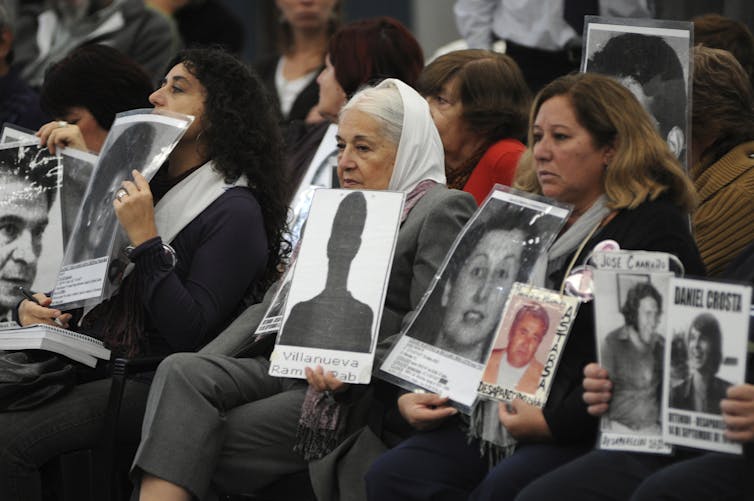
In April 1977, roughly a year after young Argentines first began vanishing, 14 women gathered in the Plaza de Mayo, a central square in Buenos Aires that faces the presidential palace. They were searching for their sons and daughters, who had been detained by the police or the military.
Some of these arrests had taken place at night, in the homes where these young victims lived with their families. In those cases, the women – who came to be known as the Madres de la Plaza de Mayo, or Mothers of the Plaza de Mayo – knew their children had been taken by security forces. In other cases, their children had simply failed to return home. Nothing was known of their whereabouts. They had disappeared.
Even those who had been detained at home had disappeared, too, as their location remained unknown.
Later, the nation would learn that many of the regime’s victims were tortured, then flown in airplanes over the nearby River Plate and dropped into the water on so-called “death flights.” All this information was compiled in a 1984 report written during the first democratic government after military rule and published under the name “Nunca Mas”: Never again.
The dictatorship had imposed a state of siege prohibiting all forms of assembly. To technically evade this restriction, the Mothers walked in circles around the plaza, avoiding the concentration of people in any single location, demanding truth and justice.
The regime reacted by systematically attempting to discredit the grieving women. To weaken their moral authority, state-controlled media labeled them as emotionally unstable “mad women.” The were called Las Locas de Plaza de Mayo instead of the Madres de Plaza de Mayo.
Officials accused the women of exaggerating or inventing kidnappings and sometimes mocked their ever-growing weekly marches. By attacking their credibility and dignity, the dictatorship sought to undermine public sympathy and maintain a climate of fear.
At first, this narrative worked. Early in the dictatorship, many Argentines viewed the Mothers with ambivalence, skepticism or even fear. Others, while privately sympathetic, avoided expressing support due to fear of repression and social consequences.
The government’s attacks were not only rhetorical. In 1977, three of the founding Mothers – Esther de Balestrino, Azucena Villaflor and Mary Ponce de Bianco – disappeared when a group of military personnel stormed the Church of the Holy Cross in Buenos Aires. Twelve other people were abducted. None have ever been found.
The Mothers received substantial support from abroad. International human rights organizations, foreign journalists and religious institutions all played a crucial role in legitimizing their claims and broadcasting their struggle to the world.
France, in particular, helped publicize the Mothers’ cause in Europe, which put diplomatic pressure on the Argentine regime. This international solidarity contributed significantly to breaking the dictatorship’s silence and exposing its crimes.
After democratic elections were held in October 1983, the Mothers continued their efforts to uncover the histories of their children and to find and bury their remains. Many also started working to locate their grandchildren who had been born in captivity and illegally adopted after their parents were disappeared.
Their dedication to recovering their loved ones exposed the full extent of the regime’s atrocities.
Argentines hold images of disappeared people in Buenos Aires during the trial of Argentina’s last dictator in 2010. Rolando Andrade Stracuzzi Source/AP
In 1983, President Raúl Alfonsín, who reestablished Argentine democracy, established the National Genetic Data Bank to identify kinship between the parents and children of the disappeared. Thousands of analyses were conducted on children suspected of being born in captivity and illegally adopted by military families.
More than 120 grandchildren have since been identified.
The Mothers and children of the disappeared have also played a fundamental role in convicting dozens of military officials for crimes against humanity. As direct witnesses to the long-term consequences of forced disappearance, they have repeatedly testified against military officials.
The Mothers’ activism, which continues today, has helped sustain public pressure in Argentina for accountability and to transform private trauma into collective political action.
The killings in Minneapolis inspired me to recount this story for a simple reason: The government can protect, condemn or kill. Argentine history shows that it matters how society reacts to state terrorism.
This story was produced in collaboration with Rewire News Group, a nonprofit news organization that covers reproductive health.
Parts of India, including the capital Delhi, were once again covered in thick smog recently as toxic pollution from industry and crop-burning engulfed the region. Even though India’s National Clean Air Programme has advanced clean air action, air pollution remains a reoccurring problem.
Reliably protecting public health will require tighter co-ordination across orders of governments and departments. Air pollution is shaped by different economic sectors, weather, geography and siloed institutions. Single-sector fixes alone, like pausing construction or banning older vehicles, are unlikely to deliver system-wide change.
That’s why our team conducted a study to map air quality governance in India as an interconnected system, linking the parts that determine what gets measured, what gets enforced, what gets funded and what persists beyond city boundaries.
In addition to the authors of this article, our research team included Christoph Becker and Teresa Kramarz from the University of Toronto, Om Damani and Anshul Agarwal at the Indian Institute of Technology Bombay and Ronak Sutaria from the environmental consultant Respirer Living Sciences.
Our goal was to identify leverage points in current governance where shifts could deliver the greatest pollution-related health benefits.
If we want clean air to be a public service, we need pathways for communities to participate meaningfully. Our research argues for steady funding and training to build community monitoring literacy so accountability and action persist beyond political cycles.
Developing hyper-local monitoring
One hopeful example comes from the city of Bengaluru in the south of the country.
In this case, community groups installed monitors near schools and hospitals, using the data to spotlight the problem and seek court-mandated enforcement — underscoring the need for clear pathways to use community-generated data in enforcement.
The efforts by the communities aren’t meant to be a substitute for government enforcement. The point is to empower communities and give them a real choice in a system where they have very little voice.
The government monitors air pollution to track pollution levels over time and across locations, and to evaluate whether policies and enforcement are improving air quality.
Although India does need to scale monitoring capacities and make them equitable, we already have enough data streams from satellite observations, reference-grade monitors and low-cost sensors.
The real governance gap is in how these data streams can be used for action: standards for calibration in local conditions, quality assurance and control, and protocols for integrating evidence into enforcement and planning.
We recommend certification and quality assurance and control protocols for hyper-local monitoring so agencies can rely on the data for decisions and enforcement.
This data played a critical role in identifying street-level pollution hotspots, evaluating traffic interventions and assessing the impacts of policies such as the city’s Ultra Low Emission Zone. Indian governments can learn from this example.
When data is standardized for defined-decision contexts, it enables decision-making.
Governing the airshed
Air pollution does not respect regional or city boundaries. Yet, the National Clean Air Programme often assigns actions to cities, even when cities cannot control a large share of the pollution they face. For example, even when Delhi tightens local restrictions of cars or construction, at least a dozen coal-fired power plants near the city continue to operate without key pollution filters.
This is why we need governance at the airshed scale. An airshed is a region where local weather and geography, such as mountains, influence how air and pollutants move.
Governments must look at how air pollution spreads in an area, then develop rules for co-ordinating across jurisdictions. That means setting out clear roles for different departments, establishing shared data standards and creating dispute-resolution mechanisms so co-ordinated efforts can address the issue effectively.
Right now, the Clean Air Programme is centred on cutting the level of particulate matter in the air by roughly 20-30 per cent. A more actionable approach is figuring out which sectors are driving the airshed pollution — namely transport, construction, industry, power, waste and household fuels — and what sector-specific targets and timelines would actually lead to healthier air.
India’s Commission for Air Quality Management (CAQM), for example, was created specifically to put airshed-level management into practice across state and jurisdictional boundaries under the National Clean Air Programme.
The hardest part is assigning enforceable responsibilities across ministries (like power, transport, agriculture, industry, urban development) at the national, state and local levels, as well as across states.
For instance, agencies like CAQM (and NCAP more broadly) can take airshed-wide pollution inventories (estimates of how much pollution comes from different sources and sectors across an airshed) and translate them into short-term, sector-by-sector targets for each ministry, with deadlines and clear accountability.
Rewrite the objective to protect health
In our paper, we recommend expanding regulatory goals to include public health protection, in addition to meeting particulate matter targets. Putting health at the centre can shape governmental priorities, pushing agencies to focus first on the sources people are most exposed to.
As Ronak Sutaria, the founder and CEO of Respirer Living Sciences and a co-author of our study, told us:
“Air pollution isn’t an environmental statistic; it’s a public-health emergency that shows up in asthma, heart disease and hospital admissions. When we map air quality at the neighbourhood level and link it to health outcomes, clean air can move from a promise to a right — because communities can see what they’re breathing and what it means for their health, and that changes what polluters can get away with.”
A health-first objective also pushes governance toward equity, because exposure burdens are unevenly distributed across different segments of the population.
Airsheds differ, and so must actions to clean up the air. The value of systems thinking is that it offers a common way to understand what is limiting progress locally and design governance that fits local realities.
The authors do not work for, consult, own shares in or receive funding from any company or organisation that would benefit from this article, and have disclosed no relevant affiliations beyond their academic appointment.
This winter’s Olympic games will not be a normal international sporting event. A cloud of geopolitical tension looms over the Milan Cortina Winter Olympics, as well as the upcoming FIFA Men’s World Cup.
International sports events provide widespread media coverage and brand exposure. That spotlight is particularly attractive for authoritarian and repressive regimes seeking legitimacy on the world stage.
Access to a western audience provides these states with the opportunity to “sportswash” their legitimate authority through a carefully curated image.
Repressive regimes have increasingly pursued this strategy. Research shows that the share of international sporting events hosted by autocracies fell from 36 per cent in 1945-88 to 15 per cent in 1989-2012, but has rebounded to 37 per cent since 2012.
Sportswashing can also work to establish broader global acceptance of repressive regimes, particularly when western institutions accept their wealth and acquiesce to their goals.
There is often a symbiotic relationship between repressive regimes and international sporting organizations. However, the Milan–Cortina Games are unlikely to serve up the sportswashing narratives we have seen recently. Instead, the political stories of the 2026 Winter Olympics are likely to be more explicitly nationalist.
Sport is a powerful vehicle for national rhetoric. It can reinforce a person’s social identity or how they see themselves in relation to others by encouraging people to see themselves as a member of a team or country, and celebrating victory as a collective success or interpreting defeat as a symbolic loss.
Whether it’s tension between the European Union and the U.S. or between Canada and the U.S., there are many story lines that can serve as galvanizing moments for nationalist rhetoric.
The men’s ice hockey tournament at the 1980 winter Olympics in Salt Lake City, Utah, served as a pivotal moment in the Cold War. When the underdog U.S. beat the favoured Soviet Union Red Army team, it was deemed the “Miracle on Ice.”
Given Trump’s threats against Greenland, a Danish territory, the Olympics matchup between the two teams could serve as Denmark’s own “miracle on ice” moment.
A medal table ripe for political spin
Beyond ice hockey, this is shaping up to be a Winter Olympics the U.S. is likely to perform quite well in. Traditional winter powerhouses Norway and Russia are both facing scandals or exclusion.
A successful Winter Olympics could therefore provide political capital at a sensitive moment. Amid his attack on Venezuela and stated goal of acquiring Greenland, major soccer countries and EU powerbrokers — including France and Germany — have started to tentatively reconsider their participation in the 2026 Men’s World Cup, hosted in large part by the U.S.
But first, the 2026 Winter Olympics will serve up a menu of matchups that stand to serve the nationalist goals of Trump, Carney and leaders across the European Union.
Noah Eliot Vanderhoeven does not work for, consult, own shares in or receive funding from any company or organisation that would benefit from this article, and has disclosed no relevant affiliations beyond their academic appointment.
Notre étude nous a permis de constater que près de la moitié des femmes interrogées n’avaient reçu aucun message de prévention avant leur arrivée.
Parmi celles qui y avaient été exposées au cours de leur vie, l’information provenait de moins de deux sources, principalement de proches ou des réseaux sociaux. Les effets étaient tout aussi limités : une légère hausse de moins de 2 % du sentiment d’efficacité à faire face à un agresseur potentiel, mais aucun impact mesurable sur les mythes du viol, le blâme des victimes, la perception du risque ou la connaissance de stratégies de résistance efficaces.
Le problème est plus large. Au Québec, l’Institut de la statistique du Québec (ISQ) a annulé l’enquête qui devait actualiser les données, privant la province d’indicateurs essentiels pour suivre l’évolution des violences sexuelles en milieu postsecondaire.
L’annulation découle probablement en partie de compressions budgétaires qui plombent actuellement le milieu de l’enseignement supérieur et du choix de s’en remettre à l’Enquête sur la santé mentale étudiante, que le ministère croyait suffisante. Or, ses questions beaucoup plus limitées n’ont été posées qu’à une fraction des personnes répondantes et avec un taux de réponse trop faible, rendant les données peu utiles.
La recherche existe, mais elle n’est guère appliquée dans des programmes de prévention.
Trois stratégies
La littérature internationale, notamment la synthèse de plusieurs expertes en prévention de l’agression sexuelle en Amérique du Nord, en 2020, recommande d’articuler trois stratégies complémentaires au collège et à l’université :
Programmes de résistance et d’autodéfense féministe affirmative pour les femmes ;
Programmes visant les normes sociales masculines ;
Formations de témoins actifs.
Ces approches ne sont efficaces que si elles sont cohérentes, ciblées et intensives. Lorsque la prévention est tardive, brève et limitée à des messages généraux, les effets restent faibles.
À l’inverse, des programmes intensifs (jusqu’à 12 heures au cours d’un semestre), structurés et ancrés dans la pratique, comme ceux proposés par un groupe de chercheures à l’Université de Windsor, dont la plus récente remonte à 2023, ont démontré qu’ils peuvent réduire les agressions sexuelles subies par les étudiantes, même lorsqu’ils sont offerts à l’université avec peu d’expositions préalables.
Une prévention universitaire qui n’arrive pas à compenser les lacunes
Parmi nos participantes, 271 ont été suivies durant leur première année universitaire. Leur exposition aux messages de prévention sur les campus était limitée : 93 % des personnes exposées le sont moins de trois heures, principalement via des formations en ligne, et moins de 10 % ont été exposées à du contenu d’autodéfense – alors que les programmes efficaces reposent précisément sur des activités en personne, de plus de trois heures et intégrant un volet d’autodéfense féministe.
Après douze mois, certains résultats sont préoccupants. Nous nous attendions à voir des progrès plus marqués. Or, un seul effet positif existe, mais il est minime : une hausse de 1 à 3 % du sentiment d’efficacité à réagir face à un agresseur. Concrètement, il faut deux sources préventives supplémentaires pour que les participantes augmentent leur sentiment d’efficacité à faire face à un agresseur potentiel d’un seul point sur une échelle de 63 points. Un effet aussi faible a peu de signification pratique.
Deux effets néfastes dominent toutefois. D’abord, les participantes sont moins nombreuses à rapporter qu’elles utiliseraient au moins une stratégie de résistance verbale ou physique ferme (44 %), comme celles enseignées dans les formations d’autodéfense féministes, qu’au début de l’étude (80 %). Cette baisse importante n’est légèrement atténuée que chez les 7 % de participantes ayant reçu trois heures ou plus de prévention sur le campus.
Ensuite, la perception du risque personnel évolue dans une direction contraire à celle recherchée. Les étudiantes très peu exposées (moins d’une heure) développent une perception du risque légèrement plus juste, mieux alignée avec la réalité des violences sexuelles sur les campus.
À l’inverse, celles exposées trois heures ou plus voient leur perception du risque diminuer, illustrant un biais d’optimisme : l’idée que « Cela n’arrive qu’aux autres ».
Ces résultats indiquent qu’en l’absence d’interventions intensives, qui soient ciblées, structurées et adaptées, la prévention universitaire ne compense pas le manque de prévention préalable et peut même conduire à des reculs sur des éléments clés.
Une expertise scientifique disponible, mais sous-utilisée
Dans une perspective de santé publique, la prévention devrait être présente du préscolaire, du primaire et du secondaire jusqu’aux cégeps et aux universités.
Chaque niveau contribue à renforcer les connaissances, à modifier les normes sociales, à développer des stratégies de résistance et à soutenir l’intervention des témoins. Quand ce continuum est absent ou incomplet, les interventions collégiales et universitaires doivent compenser des années de prévention insuffisante.
Déjà des milliers d’abonnés à l’infolettre de La Conversation. Et vous ? Abonnez-vous gratuitement à notre infolettre pour mieux comprendre les grands enjeux contemporains.
Les équipes de recherche universitaires produisent des connaissances rigoureuses sur les programmes efficaces, mais ces données sont encore peu intégrées aux politiques internes, à la programmation de prévention et aux communications institutionnelles.
Le fossé entre la science et l’action demeure un obstacle majeur.
Des balises connues, mais insuffisamment implantées
L’Institut national de la Santé publique du Québec, ainsi que les experts nationaux et internationaux, convergent vers la même conclusion : la prévention doit être multiniveaux, répétée, intensive, ciblée et évaluée en continu.
Les universités sont idéalement positionnées pour montrer la voie : infrastructures de recherche, réseaux d’expertise, accès aux données, capacité d’évaluation, mandat social. Elles pourraient être des leaders dans l’élaboration d’une programmation de prévention solide et continue.
Le constat est clair : la stagnation des taux de violence ne découle pas d’un manque de connaissances, mais d’un manque d’implantation, de cohérence et de continuité. Des solutions existent déjà, ont été testées et sont efficaces. Le défi est désormais de les appliquer de manière systémique et durable, en combinant autodéfense féministe, interventions sur les normes sociales et formations de témoins actifs, afin de protéger véritablement les filles, les jeunes femmes et l’ensemble des communautés.
Membre du comité des partenaires en violence sexuelle du Secrétariat à la condition féminine du gouvernement du Québec, Isabelle Daigneault est membre de l’Ordre des psychologues du Québec et dirige le laboratoire de recherche sur les trajectoires de santé et de résilience des jeunes agressés sexuellement (TRAJETS). Elle est chercheuse membre régulière au Centre de recherche interdisciplinaire sur les problèmes conjugaux et l’agression sexuelle (CRIPCAS), à l’Équipe violence sexuelle et santé (ÉVISSA), financés par les fonds de recherche du Québec, ainsi qu’à la Chaire de recherche sur les violences sexistes et sexuelles en milieu d’enseignement supérieur (VSSMES). Elle a reçu des financements des Instituts de recherche en santé du Canada, du Conseil de recherches en sciences humaines du Canada, du Ministère de l’enseignement supérieur du Québec et de l’Université de Montréal.
Membre du Conseil du statut de la femme pour le gouvernement du Québec et de l’Ordre des psychoéducateurs et des psychoéducatrices du Québec, Geneviève Paquette dirige le Groupe de recherche et d’intervention sur les adaptations sociales de l’enfance financé par l’Université de Sherbrooke et l’Équipe de recherche sur l’adaptation positive et la santé mentale des jeunes exposés à un risque accru d’adversité familiale ou sociale financée par le Fonds de recherche du Québec – Société et culture (FRQSC). Elle est chercheuse membre régulière au Centre de recherche interdisciplinaire sur les problèmes conjugaux et l’agression sexuelle (CRIPCAS) et à la Chaire de recherche sur les violences sexistes et sexuelles en milieu d’enseignement supérieur. Elle a obtenu des financements de recherche provenant des Instituts de recherche en santé du Canada, du Conseil de recherches en sciences humaines du Canada, du FRQSC et du ministère de l’Enseignement supérieur du Québec.
Jacinthe Dion est titulaire de la Chaire de recherche du Canada sur la violence sexuelle chez les jeunes vulnérables, surnommée Aquarelle, et co-titulaire de la Chaire de recherche VISAJ sur la vie et la santé des jeunes. Psychologue et professeure titulaire au Département de psychologie de l’Université du Québec à Trois-Rivières, elle est également membre du Comité scientifique et de gouvernance du Centre de recherche interdisciplinaire sur les problèmes conjugaux et l’agression sexuelle (CRIPCAS) et membre régulière de l’équipe Violence sexuelle et santé (ÉVISSA) et de l’Équipe de recherche sur l’adaptation positive et la santé mentale des jeunes exposés à un risque accru d’adversité familiale ou sociale, financés par le Fonds de recherche du Québec – Société et culture (FRQSC). Elle est aussi membre du Centre d’études interdisciplinaires sur le développement de l’enfant et la famille (CEIDEF). Ses recherches sont financées par le programme de Chaires de recherche du Canada, le Conseil de recherches en sciences humaines, les Instituts de la recherche en santé du Canada (CRSH), l’Agence de la santé publique du Canada, le Secrétariat à la condition féminine du Québec et le Ministère de l’éducation du Québec.
Martine Hébert est titulaire de la Chaire de recherche du Canada sur les traumas interpersonnels et la résilience et cotitulaire de la Chaire interuniversitaire Marie-Vincent sur les agressions sexuelles envers les enfants. Elle dirige l’équipe Violence sexuelle et santé (ÉVISSA) financée par le Fonds de recherche du Québec – Société et culture et elle est chercheuse membre régulière au Centre de recherche interdisciplinaire sur les problèmes conjugaux et l’agression sexuelle (CRIPCAS). Elle est également membre de la Chaire de recherche sur les violences sexistes et sexuelles en milieu d’enseignement supérieur (VSSMES) et de la Chaire de recherche Sécurité et intégrité en milieu sportif (SIMS). Ses recherches sont financées par le programme des Chaires de recherche du Canada, des Instituts de recherche en santé du Canada (IRSC) et de l’Agence de santé publique du Canada (ASPC).
Source: The Conversation – USA – By Susan A. Kaplan, Professor of Anthropology, Director of Peary-MacMillan Arctic Museum and Arctic Studies Center, Bowdoin College
Amid the discussion between U.S. President Donald Trump and Danish and European leaders about who should own Greenland, the Inuit who live there and call it home aren’t getting much attention.
The Kalaallit (Inuit of West Greenland), the Tunumi (Inuit of East Greenland) and the Inughuit (Inuit of North Greenland) together represent nearly 90% of the population of Greenland, which totals about 57,000 people across 830,000 square miles (2.1 million square kilometers).
We are Arcticanthropologists who work in a museum focused on the Arctic and its people. One of the areas we study is a land whose inhabitants call it Kalaallit Nunaat, or land of the Kalaallit. Known in English as Greenland, it is an Indigenous nation whose relatively few people have been working for decades to reclaim their right to self-determination.
Arrivals from the west
For nearly 5,000 years, northwestern Greenland – including the area that is now the U.S. Space Force’s Pituffik Space Base, formerly known as Thule Air Force Base – was the island’s main entry point. A succession of Indigenous groups moved eastward from the Bering Strait region and settled in Siberia, Alaska, Canada and Greenland.
Approximately 1,000 years ago, the ancestors of the Inuit living in Greenland today arrived in that area with sophisticated technologies that allowed them to thrive in a dynamic Arctic environment where minor mishaps can have serious consequences. They hunted animals using specialized technologies and tools, including kayaks, dog-drawn sleds, complex harpoons, and snow goggles made from wood or bone with slits cut into them. They dressed in highly engineered garments made from animal fur that kept them warm and dry in all conditions.
Their tools and clothing were imbued with symbolic meanings that reflected their worldview, in which humans and animals are interdependent. Inughuit families who live in the region today continue to hunt and fish, while navigating a warming climate.
Local people fish from a small boat by an iceberg with an ice cave, near Ilulissat, in 2008. Bryan Alexander, courtesy of the Peary-MacMillan Arctic Museum, Bowdoin College, CC BY-NC-ND
Arrivals from the east
At Qassiarsuk in south Greenland, around the time Inuit arrived in the north, Erik the Red established the first Norse farm, Brattahlíð, in 986, and sent word back to Iceland to encourage others to join him, as described in an online exhibit at the Greenland National Museum. Numerous Norse families followed and established pastoral farms in the region.
As Inuit expanded southward, they encountered the Norse farmers. Inuit and Norse traded, but relations were sometimes tense: Inuit oral histories and Norse sagas describe some violent interactions. The two groups maintained distinctly different approaches to living on the land that rims Greenland’s massive ice sheet. The Norse were very place-based, while the Inuit moved seasonally, hunting around islands, bays and fjords.
As the Little Ice Age set in early in the 14th century, and temperatures dropped in the Northern Hemisphere, the Norse were not equipped to adjust to the changing conditions. Their colonies faltered and by 1500 had disappeared. By contrast, the mobile Inuit took a more flexible approach and hunted both land and marine mammals according to their availability. They continued living in the region without much change to their lifestyle.
A center of activity
In Nuuk, the modern capital of Greenland, an imposing and controversial statue of missionary Hans Egede commemorates his arrival in 1721 to establish a Lutheran mission in a place he called Godthåb.
In 1776, as trade became more important, the Danish government established the Royal Greenland Trading Department, a trading monopoly that administered the communities on the west coast of Greenland as a closed colony for the next 150 years.
By the 19th century some Kalaallit families who lived in Nuuk/Godthåb had formed an educated, urban class of ministers, educators, artists and writers, although Danish colonists continued to rule.
Meanwhile, Kalaallit families in small coastal communities continued to engage in traditional economic and social activities, based on respect of animals and sharing of resources.
On the more remote east coast and in the far north, colonization took root more slowly, leaving explorers such as American Robert Peary and traders such as Danish-Greenlandic Knud Rasmussen a free hand to employ and trade with local people.
People protest President Donald Trump’s desire to own Greenland outside the U.S. consulate in Nuuk, Greenland, in January 2026. AP Photo/Evgeniy Maloletka
The world arrives
A 1944 ad urging U.S. customers to buy shortwave radios touts contact with the people of Greenland as one benefit. Courtesy of the Peary-MacMillan Arctic Museum, Bowdoin College, CC BY-NC-ND
World War II brought the outside world to Greenland’s door. With Denmark under Nazi control, the U.S. took responsibility for protecting the strategically important island of Greenland and built military bases on both the east and west coasts. The U.S. made efforts to keep military personnel and Kalaallit apart but were not entirely successful, and some visiting and trading went on. Radios and broadcast news also spread, and Kalaallit began to gain a sense of the world beyond their borders.
The Cold War brought more changes, including the forced relocation of 27 Inughuit families living near the newly constructed U.S. Air Force base at Thule to Qaanaaq, where they lived in tents until small wooden homes were built.
In 1953, Denmark revised parts of its constitution, including changing the status of Greenland from a colony to one of the nation’s counties, thereby making all Kalaallit residents of Greenland also full-fledged citizens of Denmark. For the first time, Kalaallit had elected representatives in the Danish parliament.
Denmark also increased assimilation efforts, promoting the Danish language and culture at the expense of Kalaallisut, the Greenlandic language. Among other projects, the Danish authorities sent Greenlandic children to residential schools in Denmark.
In Nuuk in the 1970s, a new generation of young Kalaallit politicians emerged, eager to protect and promote the use of Kalaallisut and gain greater control over Greenland’s affairs. The rock band Sumé, singing protest songs in Kalaallisut, contributed to the political awakening.
Sumé, a rock band singing in Kalaallisut, the Greenlandic language, helped galvanize a political movement for self-determination in the 1970s.
In a 1979 Greenland-wide referendum, a substantial majority of Kalaallit voters opted for what was called “home rule” within the Danish Kingdom. That meant a parliament of elected Kalaallit representatives handled internal affairs, such as education and social welfare, while Denmark retained control of foreign affairs and mineral rights.
However, the push for full independence from Denmark continued: In 2009, home rule was replaced by a policy of self-government, which outlines a clear path to independence from Denmark, based on negotiations following a potential future referendum vote by Greenlanders. Self-government also allows Greenland to assert and benefit from control over its mineral resources, but not to manage foreign affairs.
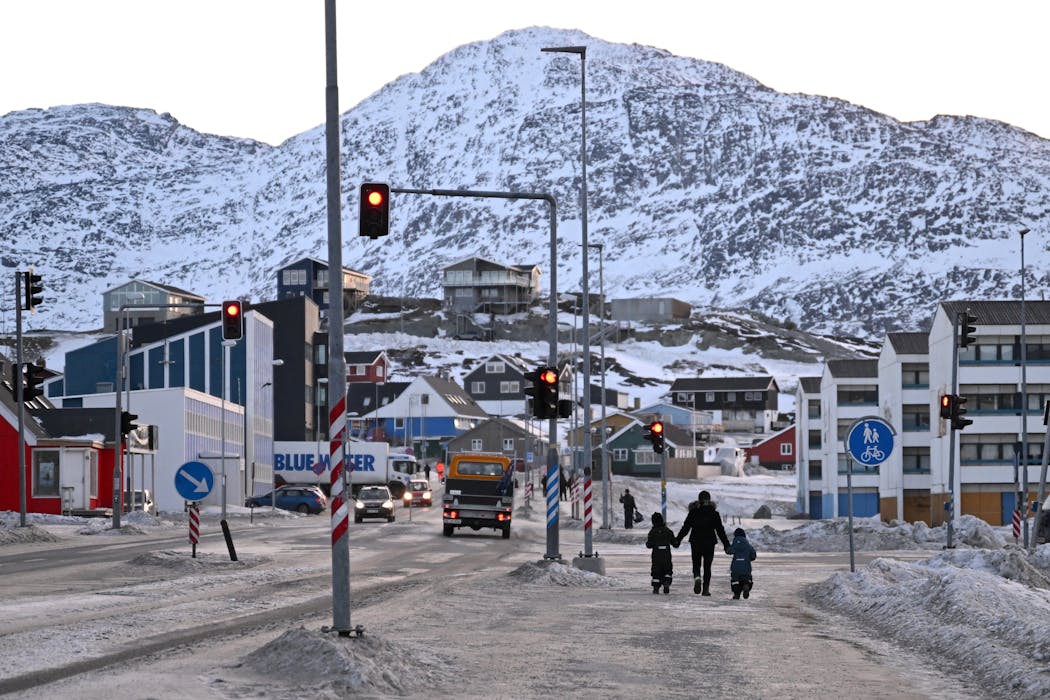
Today, Nuuk is a busy, vibrant, modern city. Life is quieter in smaller settlements, where hunting and fishing are still a way of life. While contemporary Greenland encompasses this range of lifestyles, Kalaallit are unified in their desire for self-determination. Greenland’s leaders have delivered this message clearly to the public and to the White House directly.
Susan A. Kaplan has received funding from NSF, NEH, IMLS, SSHRC and private foundations to pursue anthropological and archaeological research in Nunatsiavut, NL, Canada; and offer Arctic-focused outreach programs, museum exhibits and conferences.
Genevieve LeMoine receives funding from the National Science Foundation, Office of Polar Programs, the National Geographic Society, and the Social Sciences and Humanities Research Council of Canada. She has conducted fieldwork in Avannaata Kommunia, Kalaallit Nunaat in collaboration with Nunatta Katersugaasivia Allagaateqarfialu/Greenland National Musuem and Archives and the University of California, Davis.
On peut encore gagner des années d’espérance de vie en Europe : les régions pionnières en matière de longévité en apportent la preuve, année après année. Pourtant, depuis le milieu des années 2000, tandis que certaines régions avancent, d’autres décrochent. Dans ces dernières, l’allongement de l’espérance de vie est freiné par une mortalité autour de 65 ans qui ne recule plus, voire réaugmente.
Depuis plus d’un siècle et demi, l’espérance de vie progresse régulièrement dans les pays riches. Les gains ont été spectaculaires au XXe siècle, grâce au recul des maladies infectieuses puis aux progrès de la médecine cardiovasculaire.
Cependant, depuis quelques années, une question obsède les experts : et si cette formidable mécanique s’essoufflait ? Dans plusieurs pays occidentaux, les gains d’espérance de vie sont devenus modestes, voire inexistants.
Certains chercheurs y voient le signe que nous approchons d’un « plafond » biologique de la longévité humaine. D’autres, au contraire, estiment que des marges de progression existent encore.
Pour trancher, il ne suffit pas de regarder les chiffres nationaux. En effet, derrière la moyenne d’un pays se cachent des réalités régionales très contrastées. C’est ce que nous avons montré dans une étude tout juste publiée dans Nature Communications. Analysant des données collectées entre 1992 et 2019, elle a porté sur 450 régions d’Europe occidentale regroupant près de 400 millions d’habitants.
Une étude européenne d’une ampleur inédite
Pour mener à bien nos travaux, nous avons rassemblé des données de mortalité et de population en provenance d’instituts statistiques nationaux de 13 pays d’Europe occidentale, de l’Espagne au Danemark, du Portugal à la Suisse.
À partir de ces données originales, nous avons d’abord mené un large travail d’harmonisation, crucial parce que les régions ne sont pas toutes de taille équivalente, et que les données étaient plus ou moins détaillées selon les pays.
Nous avons ensuite reconstitué, entre 1992 et 2019, pour chaque région, l’évolution annuelle de l’espérance de vie à la naissance, un indicateur qui reflète la mortalité à tous les âges. Grâce à des méthodes statistiques avancées, nous avons pu dégager les grandes tendances de fond, au-delà des fluctuations de court terme entraînées par des épisodes tels que la canicule de 2003, ou des épidémies virulentes de grippe saisonnière telle que celle de 2014-2015. Nous arrêtons nos analyses à l’année 2019, car il est aujourd’hui encore trop tôt pour savoir si la pandémie de Covid-19 a impacté ces tendances sur le long terme, ou uniquement entre 2020 et 2022.
Le résultat obtenu nous donne un panorama inédit des trajectoires régionales de longévité en Europe sur près de trente ans, duquel nous pouvons tirer trois enseignements.
Premier enseignement : la longévité humaine n’a pas atteint ses limites
Le premier message fort de notre étude est le suivant : les limites de la longévité humaine ne sont pas encore atteintes. En effet, en nous concentrant sur les régions pionnières qui affichent les niveaux d’espérance de vie les plus élevés (en bleu sur le graphique ci-dessous), nous ne constatons aucune décélération des progrès.
Évolution de l’espérance de vie dans les régions pionnières et en retard d’Europe occidentale, 1992–2019. La ligne rouge (respectivement bleue) représente la moyenne de l’espérance de vie à la naissance des régions appartenant au décile supérieur (respectivement inférieur) de la distribution. La ligne noire indique la moyenne pour l’ensemble des 450 régions. Les valeurs minimale et maximale sont représentées par des symboles distincts, correspondant aux régions concernées. Florian Bonnet, Fourni par l’auteur
Les régions concernées continuent à gagner environ deux mois et demi d’espérance de vie par an pour les hommes, et un mois et demi pour les femmes, un rythme équivalent à celui observé durant les décennies précédentes. Parmi elles figuraient en 2019 les régions du nord de l’Italie, de la Suisse tout comme certaines provinces espagnoles.
Pour la France, on y retrouve des départements tels que Paris, les Hauts-de-Seine ou les Yvelines (aussi bien pour les hommes que pour les femmes), et les départements autour de l’Anjou et de la frontière suisse (uniquement pour les femmes). En 2019, l’espérance de vie y atteignait près de 83 ans pour les hommes, et 87 pour les femmes.
Autrement dit, malgré les inquiétudes récurrentes, rien n’indique à ce jour que la progression de la durée de vie ait atteint un plafond de verre ; l’allongement de l’espérance de vie reste possible. C’est un résultat fondamental, qui nuance les discours alarmistes : il existe encore un potentiel d’amélioration.
Deuxième enseignement : des situations régionales divergentes depuis le milieu des années 2000
Le tableau devient plus sombre quand on se penche sur les régions en retard, indiquées en rouge sur la figure ci-dessus. Dans les années 1990 et au début des années 2000, ces régions connaissaient des gains rapides d’espérance de vie. Les progrès y étaient même plus rapides qu’ailleurs, conduisant à une convergence des espérances de vie régionales en Europe.
Cet âge d’or, cumulant hausse rapide de l’espérance de vie en Europe et réduction des disparités régionales, a pris fin vers 2005. Dans les régions les plus en difficulté, qu’il s’agisse de l’est de l’Allemagne, de la Wallonie en Belgique, ou de certaines parties du Royaume-Uni, les gains d’espérance de vie ont fortement ralenti, atteignant des niveaux quasiment nuls. On ne retrouve pas de départements français parmi ces régions pour les femmes, mais en ce qui concerne les hommes, les départements de la région Hauts-de-France y figurent.
Au final, l’Europe de la longévité est de plus en plus coupée en deux. D’un côté, des régions pionnières qui poursuivent leur progression ; de l’autre, des régions en retard où la dynamique s’essouffle, voire s’inverse. Nous vivons donc une véritable divergence régionale, qui contraste avec l’élan de rattrapage des années 1990.
Troisième enseignement : le rôle décisif de la mortalité entre 55 et 74 ans
Pourquoi un tel basculement ? Au-delà de l’espérance de vie par âge, nous avons cherché à mieux comprendre ce changement spectaculaire en analysant l’évolution des taux de mortalité par âge.
Nous pouvons affirmer que cette divergence régionale ne s’explique ni par l’évolution de la mortalité infantile (qui reste très faible) ni par l’évolution de la mortalité au-delà de 75 ans (qui continue de reculer un peu partout). Elle vient principalement de la mortalité autour de 65 ans.
Dans les années 1990, celle-ci reculait rapidement, grâce à la diffusion des traitements cardiovasculaires et à des changements dans les comportements à risque. Mais depuis les années 2000, ce progrès s’est ralenti. Dans certaines régions, le risque de mourir entre 55 et 74 ans a même commencé à augmenter à nouveau ces dernières années, comme le montrent les cartes ci-dessous.
Variation annuelle en pourcentage de la probabilité de décéder entre 55 et 74 ans chez les hommes (à gauche) et les femmes (à droite) dans 450 régions d’Europe occidentale, entre 2018 et 2019. Florian Bonnet, Fourni par l’auteur
C’est notamment le cas de la plupart des départements du pourtour méditerranéen français pour les femmes, qui apparaissent en rose clair. C’est aussi le cas d’une grande partie de l’Allemagne. Or ces âges intermédiaires sont cruciaux dans la dynamique des gains d’espérance de vie, car un grand nombre de décès s’y concentrent. Une stagnation ou une hausse de la mortalité entre 55 et 74 ans suffit à briser la dynamique d’ensemble.
Même si notre étude ne permet pas de cerner les causes précises expliquant ces évolutions préoccupantes, la littérature récente nous permet d’avancer quelques pistes, qui devront être testées scientifiquement à l’avenir. Parmi elles, on retrouve les comportements à risque, notamment le tabagisme, mais aussi la consommation d’alcool, la mauvaise alimentation, ou le manque d’activité physique, qui sont autant de facteurs qui se concrétisent à ces âges.
Par ailleurs, la crise économique de 2008 a accentué les inégalités territoriales en Europe. Certaines régions ont souffert durablement, fragilisant la santé des populations y vivant, tandis que la croissance est à nouveau vigoureuse dans d’autres régions où les emplois fortement qualifiés se concentrent. Ces facteurs nous rappellent que la longévité n’est pas seulement une affaire de progrès de la médecine, mais qu’elle s’explique aussi par des facteurs économiques et sociaux.
Et demain ?
Notre étude délivre un double message. Oui, il reste possible d’allonger l’espérance de vie. Les régions pionnières en Europe en donnent la preuve : elles continuent à progresser régulièrement, sans signe de plafonnement. Cependant, cette progression n’est pas partagée par tous. Depuis quinze ans, une partie de l’Europe décroche, en particulier à cause de l’évolution de la mortalité autour de 65 ans.
L’avenir de la longévité humaine semble, encore aujourd’hui, moins dépendre de l’existence d’un hypothétique plafond biologique que de notre capacité collective à réduire les écarts d’espérance de vie. En extrapolant les tendances récentes, on peut craindre qu’une Europe à deux vitesses ne se crée, opposant une minorité de territoires qui continuent à repousser les frontières de la longévité, et une majorité de territoires où les progrès s’étiolent.
En clair, la question n’est plus seulement de savoir jusqu’où l’espérance de vie peut grimper, mais surtout quels sont les territoires qui pourront en bénéficier.
Les auteurs ne travaillent pas, ne conseillent pas, ne possèdent pas de parts, ne reçoivent pas de fonds d’une organisation qui pourrait tirer profit de cet article, et n’ont déclaré aucune autre affiliation que leur organisme de recherche.