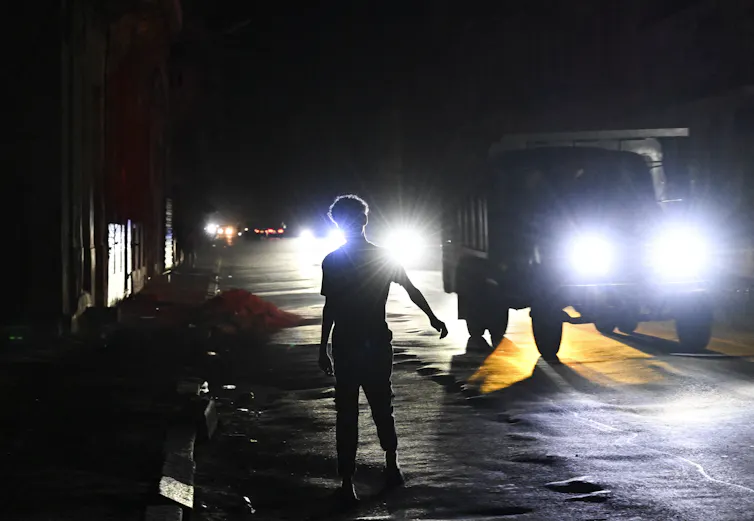
US is less prone to oil price shocks than in past decades

Source: The Conversation – USA (2) – By Amy Myers Jaffe, Director, Energy, Climate Justice, and Sustainability Lab, and Research Professor, New York University; Tufts University

Gas prices are up, but other forces may limit the economic harm to the U.S. Frederic J. Brown/AFP via Getty Images

Oil is a global market, so when prices rise in one place, they rise everywhere. The current war against Iran has already raised oil prices significantly.

Mideast oil production has been slowed by efforts to close the Strait of Hormuz, a key route for oil tankers from the Middle East to the rest of the world, as well as by attacks – and fears of attacks – on oil production, storage and shipment installations.

And this war has also disrupted the flow of liquefied natural gas from Qatar, which controls almost 20% of the global market. That also affects the world economy and supply chains. And shortages of natural gas affect production of fertilizer and aluminium, as well as other key materials.

As a professor who has been studying oil price shocks for two decades, I’m often asked about the effects of rising oil prices on the U.S. economy. The answer to that question has changed over the past two decades.

The global economic picture

Countries that import much of their oil have to pay other countries for that imported oil.

That was a problem for the U.S. back in the 1970s through the early 2000s. The U.S. sent billions of dollars a year abroad to oil-producing countries in the Middle East, Africa and Latin America. That money built up other countries’ economies or sloshed around as financial surpluses that fueled financial market exuberance and asset bubbles that could suddenly pop.

Oil imports increased the U.S. trade deficit in the 1970s and beyond. And as a result, U.S. industries suffered from high energy costs, which forced closures of major U.S. steel plants and iron and copper mines. Falling purchases of cars and other durable goods also stimulated worker layoffs.

A shift in US production

Now, however, the United States is a major producer and exporter of oil and refined petroleum products. Every day, on average, the U.S. exports over 6 million barrels of refined products and over 4 million barrels of crude oil.

The U.S. does still import some crude oil, most of which is heavy oil from Canada handled at certain American refineries on the U.S. Gulf Coast. Factoring in those imports, net U.S. oil trade balance is a positive 2.8 million barrels per day, as contrasted with the mid-2000s, when the balance was a deficit of 12 million barrels per day.

U.S. production comes from 32 states – though mainly from the biggest producers: Texas, New Mexico, North Dakota, Alaska, Oklahoma and Colorado. Because that revenue comes to companies in the U.S., the nation’s gross domestic product is less vulnerable to oil price increases than in the past, when high prices meant more U.S. dollars flowing overseas.

A changed economy

In addition to being less dependent on imports, the U.S. economy is much less oil-intensive than it used to be, producing more economic value with far less oil use today than in the past.

And researchers at the U.S. Federal Reserve report that gasoline prices haven’t been a major contributor to U.S. inflation in recent years. That’s because there are lots of ways Americans use less gasoline, including telecommuting and remote work, online shopping and using electric vehicles and delivery trucks that run on batteries or other fuels.

Still, other economists disagree and say current oil prices, which are above $100 a barrel, could increase current U.S. inflation rates by as much as 1 percentage point.

The mental toll

Though the U.S. is economically less vulnerable to oil-price shocks, there is also a psychological factor. It’s hard not to feel pessimistic when gasoline prices at the local pump are already rising: Bulk market prices are already soaring amid hedging trades and speculative fervor among traders and wholesalers and on U.S. commodity futures markets.

Americans feel pessimistic about consumer spending when gasoline prices are rising. And a study found that high gas prices even make people feel unhappy.

Research also shows that people tend to put off major durable goods purchases, such as automobiles, when oil prices rise sharply. That could mean bad news for the U.S. auto industry.

But it is also possible that high gasoline prices might encourage more Americans to consider buying electric cars. That could help the car companies that were having difficulty moving their electric-vehicle inventories. And for people who own electric vehicles, the war and its resulting price increases can be a reminder of the benefits of living gasoline-free.

More broadly, the war might be yet another reminder of the benefits of diversifying energy sources away from fossil fuels. As my research shows, oil price shocks generally lead to greater investment in clean technologies.

The Conversation

Amy Myers Jaffe does not work for, consult, own shares in or receive funding from any company or organization that would benefit from this article, and has disclosed no relevant affiliations beyond their academic appointment.

ref. US is less prone to oil price shocks than in past decades – https://theconversation.com/us-is-less-prone-to-oil-price-shocks-than-in-past-decades-277709

Alaska’s glacial lakes are expanding, increasing the risk of destructive outburst floods

Source: The Conversation – USA (2) – By Dan McGrath, Associate Professor of Cryospheric Sciences, Colorado State University

A study explored the evolution of several glacial lakes near Bering Glacier, Alaska. Google Earth, AirbusMaxar Technologies, CNES/Airbus

Every summer, people living near the Mendenhall River in Juneau, Alaska, keep a close eye on the water level. When the river level begins to rise rapidly, it’s a sign that Suicide Basin, a small glacier-dammed lake 5 miles up the mountains, has broken through the glacier again and a glacial lake outburst flood is underway.

After nearly 15 straight years of ever-larger and more damaging floods in Alaska’s capital city, the U.S. Army Corps of Engineers is discussing an ambitious and expensive solution: create a permanent drain from the lake that would prevent it from reaching outburst stage.

The initial cost estimates for the project range from US$613 million to $1 billion.

Scientists discuss the glacial outburst floods from Suicide Basin on Mendenhall Glacier above Juneau.

Suicide Basin is just one example of a growing problem from glacial lakes that threaten communities around the world, particularly in the Himalayas and Andes, and is transforming Alaska’s landscape as global temperatures rise.

In a new study, colleagues and I documented the evolution of 140 of the largest glacial lakes in Alaska between 2018 and 2024. We found they are expanding about 120% faster on average today than they were from 1986 to 1999 – more than twice as fast.

Using ice thickness data to reconstruct the shape of the land beneath these glaciers, we found that these glacial lakes could become more than four times larger than they are today as the glaciers melt, increasing the potential for damage to downstream ecosystems and infrastructure from glacial lake outburst floods.

A large glacier terminates in a lake.
Spencer Glacier in the Kenai Mountains: This lake, and the icebergs in the lake, have become a significant tourist attraction along the Alaska Railroad.
Louis Sass

The hazards of glacial lakes

Glacial lakes, often the color of aquamarine gems and sparkling with icebergs, are common around the margins of glaciers around the world. Years of satellite images have documented a dramatic increase in their number, area and volume – a direct response to glaciers retreating as global temperatures rise.

Tenuously held back by moraines – the jumble of rock and sediment deposited by glaciers at their edges – or dammed by glacier ice, these lakes are anything but stable.

A glacial lake with a large cut in the side of its moraine.
Tam Pokhari glacial lake in Nepal had an outburst flood in 1998 after the basin filled with water and broke through its moraine, leaving a deep gash. The resulting flood was estimated at more than 350,000 cubic feet per second, equivalent to approximately 60% of the Mississippi River’s flow.
Jonathan Jacquet/Scott McCoy

Between 1985 and 2020, ice-dammed lakes in Alaska alone broke through their barriers and drained more than 1,150 times. Alaska’s vast landscape and low population density means that the impact of these drainages on human infrastructure was fairly minimal, with a few notable exceptions, including Suicide Basin and Snow Lake, on the Kenai Peninsula.

However, the enormous amount of icy water rushing down rivers with each outburst can transform ecosystems, altering river channels through erosion and sediment deposition, tearing out trees and other vegetation, and damaging fish habitat.

Video shot from a helicopter shows several glacial lakes in Nepal and the aftermath of a glacial lake outburst flood. Nepal Investigative Multimedia Journalism Network

A recent study found that glacial lake outburst floods from moraine-dammed lakes are occurring at an accelerating rate. In the steep, narrow valleys of the Himalayan Mountains, the impact of these events are acute: destroyed hydropower stations, roads and entire villages wiped away, taking hundreds of lives over the years.

More than 15 million people globally live in areas at risk of glacial lake outburst floods. Mapping where these lakes might form and expand can help people living downstream prepare. That’s what we did in Alaska.

Mapping Alaska’s expanding lakes

Glacial lakes can form in a variety of settings: on the surface of glaciers, in side valleys, and at the terminus, or toe, of the glacier. We found that the fastest-growing lakes are those at the toe, and in our work, we showed that many of these lakes reside in deep depressions carved by glacial flow.

We mapped these depressions – known as glacial-bed overdeepenings – by subtracting ice thickness estimates from surface elevations measured by satellites.

We found that more than 80% of the lake growth has occurred in the mapped basins, illustrating how this approach can help locate glacial lakes that are likely to form and expand in the future.

With this information, we found that existing glacial lakes in the region may ultimately expand fourfold, growing by as much as 1,640 square miles (4,250 square kilometers). A glacial lake at the terminus of Malaspina Glacier, the largest glacier by area in southeast Alaska, could expand to cover an additional 570 square miles (1,475 square kilometers) alone. That would create what would be the second-largest lake in Alaska.

As glaciers continue to retreat, new basins will be exposed, many of which could fill with water. In total, more than 5,500 square miles (about 14,200 square kilometers) of overdeepened basins exist in Alaska, pointing to a landscape that is going to look very different in the coming decades to centuries.

When a glacier terminates in a lake, the warmth of the water can speed up the ice’s melting, making the glacier flow faster, thin and retreat, thereby expanding the size of the lake. We found that glaciers that terminate in lakes are shrinking 23% to 56% faster than land-terminating glaciers.

The future as glaciers retreat

Future climate projections combined with sophisticated glacier models indicate that glaciers will cumulatively retreat by 26% to 41% by 2100, spelling the loss of 49% to 83% of all glaciers globally.

This is concerning for numerous reasons. Glacier mass loss is currently the largest contributor to sea-level rise. Melting glaciers also change the water quantity and timing of ice melt that feed major rivers, particularly Asian rivers such as the Indus and Ganges. And they create hazards, such as the outburst floods that originate from glacial lakes.

The landscapes that we know and love are transforming before our eyes, and with these changes come growing concerns about hazards.

The Conversation

Dan McGrath receives funding from the U.S. Geological Survey.

ref. Alaska’s glacial lakes are expanding, increasing the risk of destructive outburst floods – https://theconversation.com/alaskas-glacial-lakes-are-expanding-increasing-the-risk-of-destructive-outburst-floods-275799

Is someone watching you? Facial recognition tech is here and Canada offers little privacy protection

Source: The Conversation – Canada – By Neil McArthur, Director, Centre for Professional and Applied Ethics, University of Manitoba

Amid the recent, dizzying advances in generative AI, it’s been easy to miss the slow but steady progress in facial recognition over the last decade. In the past few months, it has broken containment.

In the United States, Immigration and Customs Enforcement (ICE) has deployed a technology known as Mobile Fortify, which uses facial recognition on officers’ cellphones to “quickly verify subjects of interest during operations.”

In the United Kingdom, the Metropolitan Police scanned 4.2 million people’s faces during 2025 using live facial recognition cameras in public areas across London. And the British government recently promised to further “ramp up facial recognition and biometrics.”

Face scans may soon be everywhere and Canada’s patchwork of privacy rules is not ready to protect us. The most striking gaps concern personal and household surveillance.

Let’s look at three examples.

Ring doorbell cameras

First, there are Ring doorbell cameras. Ring, which is owned by Amazon, has sold its cameras to millions of people around the world, including many in Canada.

Last September, Ring announced it was adding facial recognition to its cameras in the form of its “Familiar Faces” feature, which scans the face of everyone who comes to your door and identifies anyone you have added to a database. That same month, it also announced “Search Party,” an AI feature that activates cameras throughout a neighbourhood to scan outdoor footage to help find a lost dog.

This provoked concerns that these two features — Search Party and facial recognition — will ultimately be combined, allowing Ring to use its network of cameras to track people as well.

These fears were seemingly confirmed by a leaked email from the company founder in which he said, though the feature was “first for finding dogs,” the company’s ultimate goal was to use it to “zero out crime in neighbourhoods.”

Equally concerning, the feature was initially supposed to operate through a partnership with Flock Safety, a surveillance technology company that works with law enforcement. After an outcry, Ring cancelled the partnership.

Meta smart glasses

The second example involves Meta, the parent company of Facebook. The New York Times revealed that Meta wants to add facial recognition to its smart glasses, according to a leaked internal memo. The company sold more than seven million pairs of smart glasses last year.

If the “Name Tag” feature works the way the company apparently hopes, it will allow the glasses to identify anyone the wearer looks at and give them information about that person using Meta’s vast database of user profiles.

Appallingly, the memo stated that the company plans to take advantage of current events in the United States, launching the feature while civil society groups “that we would expect to attack us” have “their resources focused on other concerns.”

Meta’s smart glasses have already been at the centre of a controversy after an investigation by Swedish newspapers Svenska Dagbladet and Goteborgs-Posten reported that subcontractors in Kenya reviewed intimate film and images from Meta glasses of people on the toilet, watching porn and having sex, seemingly unaware they were being recorded.

Police use of facial recognition

A third example is Canadian law enforcement. In 2024, York and Peel regional police in Ontario started using facial recognition software to, in the words of York Police Const. Kevin Nebrija, “help speed up investigations and to identify suspects sooner.”

Nebrija told the CBC that, in terms of privacy, “nothing has changed because security cameras are all around.”


Read more:
AI used by police cannot tell Black people apart and other reasons Canada’s AI laws need urgent attention


In December 2025, Axon, the main supplier of body cameras in Canada, partnered with the Edmonton police department on a pilot project that allowed officers’ body cameras to identify people on a “high-risk” watch list of around 7,000 people.

Canada’s patchwork of privacy rules

Canadian privacy laws currently offer no explicit protections for our biometric data, with the exception of Québec, where Law 25 contains provisions governing its collection and use.

Everywhere else, citizens face an uneven patchwork of general privacy rules. Their application to biometrics depends on who is using the technology and in what context.

When it comes to law enforcement, Section 8 of the Canadian Charter of Rights and Freedoms does protect citizens from unreasonable searches and seizures by the police. However, whether facial recognition qualifies as a search depends in part on whether the target had a reasonable expectation of privacy.

It’s an unresolved question whether biometric scans should be subjected to a higher standard than, say, cellphone cameras, when people are scanned while walking down the street or attending a protest.

Federal law enforcement is also governed by Canada’s Privacy Act, while provinces have their own privacy acts to govern provincial and municipal police. Federal and provincial privacy commissioners, who are tasked with interpreting these acts, have emphasized the sensitivity of biometric data and the importance of due process constraints in the use of facial recognition.

They have not decreed that police must get a warrant to use facial recognition. And neither they nor the courts have ruled on programs like the one in Edmonton, where police say the database only contains known offenders.

Biometric surveillance by corporations

A federal statute — the Personal Information Protection and Electronic Documents Act (PIPEDA) — governs the collection of data by private companies and its use in commercial activity.

Under PIPEDA, companies must obtain meaningful consent before collecting personal information. The law also requires that this data collection has a legitimate purpose, and be reasonable and proportionate to that purpose.

However, the act was written before the emergence of widespread biometric surveillance. It remains unclear how it would apply when companies capture and analyze the faces of people who have no direct relationship with the organization collecting the data.

Is someone watching you?

The most striking gap in our current privacy laws appears when it comes to the actions of private individuals. The laws exempt personal and household surveillance. This means that if someone uses smart glasses or a doorbell camera to identify you or trace your movements, this would normally be legal.

Civil remedies — such as provincial privacy torts or intrusion-upon-seclusion claims — might apply in specific cases where the victim could show there was targeted or harmful misuse. But not all provinces allow such claims. And even in those that do, the legal process is reactive and fact-specific, and it depends on the victim being willing to go to court.

Canada’s privacy framework is not designed for our current moment — one in which mass surveillance is becoming a reality.

Lawmakers need to act. We should demand new, stronger privacy laws, ones that deal explicitly with facial recognition. Otherwise we may find ourselves living in a world that we no longer recognize — but one that recognizes us.

The Conversation

Neil McArthur does not work for, consult, own shares in or receive funding from any company or organisation that would benefit from this article, and has disclosed no relevant affiliations beyond their academic appointment.

ref. Is someone watching you? Facial recognition tech is here and Canada offers little privacy protection – https://theconversation.com/is-someone-watching-you-facial-recognition-tech-is-here-and-canada-offers-little-privacy-protection-276852

The deaf blacksmith who married in 1576 – and the history of sign as a legal language

Source: The Conversation – UK – By Rosamund Oates, Senior Lecturer in History, Manchester Metropolitan University

Medieval manuscript illustration of a man placing a ring on a woman’s finger. British Library Royal MS 6 E VI, fol. 104/Wiki Commons

In February, Leicester Cathedral hosted a British Sign Language (BSL) service celebrating a deaf marriage that took place in the church 450 years ago, in 1576.

The groom was a deaf blacksmith from Leicester named Thomas Tilsey, who made his wedding vows in sign. It was so unusual that the clerk who witnessed the marriage recorded it in full in the parish records. Although the BBC reported that this marriage was “one of the earliest recorded examples of inclusive worship”, by 1576 deaf people had been marrying using sign language for almost 400 years.

These signs were probably not the complex languages we know today as BSL or ASL, but rather what linguists describe as “homesign”: a semi-structured form of signing that develops in small groups of deaf people. However, it was still complicated enough for deaf men and women to rely on friends and family to act as interpreters and structured enough that the 17th century mathematician John Wallis described learning the “language” of deaf signers.

The medieval church’s acknowledgement that signs were equivalent to a spoken language was transformative for deaf people. Sign language recognition unlocked the world, letting deaf people inherit property, go to court and even challenge their hearing friends and family. It is not a straightforward story of inclusion, however, and it is a struggle for equality that continues today, with the British Deaf Association continuing to campaign for the equal access to BSL.

Sign and the law

In 1198, Pope Innocent III issued a decree that deaf people should be able to get married by making their vows in sign language. Since marriage has wide-reaching legal implications, this was a powerful recognition that deaf signers were as capable of consent as anyone else.

These decrees became part of the church law that stretched across Europe, and gradually the principle was applied in other areas too. After the papal ruling, deaf people used sign language to go to court. In England, a court case involving a deaf signer was recorded in 1344, and by the start of Henry VII’s reign it was being routinely taught to legal students that signs could replace vocal speech in property law.

Medieval manuscript illustration showing a wedding.
Grandes Chroniques de France. MS/Wiki Commons

In churches across Europe, including England, deaf people could attend Mass or make their confession using signs. These practices were carried into the new Protestant Church of England.

The significance of recognising sign languages as equivalent to a spoken language can not be overstated. It challenged a long legal tradition, first seen in ancient Rome, that decreed people who were deaf and did not speak were cognitively impaired and should be treated like infants in legal situations.

Since deaf people could neither hear to understand, nor express their consent, lawyers across Europe argued well into the early modern period that they could not make contracts or even be held responsible for crimes.

As late as the 17th century, the barrister Michael Dalton claimed in a legal handbook that “if a man born deaf and dumb killeth another that is no felony, for he cannot know whether he did evil or no”. This reflected a long tradition, often attributed to Aristotle, that speech was necessary for intelligent thought, and was evidence that humans were superior to animals.

Perhaps the greatest test of how far sign language was recognised came when deaf people challenged their hearing family. Another deaf marriage, this time in Jacobean Essex in 1618, involved just that. The groom was a young deaf man called Thomas Speller, who had moved to a nearby village to train as an apprentice, fallen in love with his master’s daughter – Sarah Earle – and wanted to marry her.

Thomas’ mother, Winifred, objected – perhaps because the marriage would mean an end to a significant annuity. She did everything she could to stop the marriage. She complained that Sarah was a fortune hunter, that Thomas was being forced into the marriage against his will and that he was not capable of making informed consent.

The local bishop launched an investigation, but it was only when Thomas and Sarah travelled to London to see a representative of the bishop that the case was concluded. A secretary recorded that Thomas told the bishop’s lawyer that he wanted to marry Sarah, and he did so in sign language. His mother’s concerns were put aside, and a marriage license was issued for the pair to get married. They did so a few weeks later in London, with Thomas using signs to marry Sarah. And while it was unusual – the parish clerk noted “we had never seen the like before” – without Thomas’ mother in the picture, it went off without a hitch.

A couple of decades later, in Bedfordshire, another deaf man – George Blount – married against his parents’ will. This time the problem seems to have been that he married a former family servant, someone they held in low esteem, describing her as “one of our menial servants of unclear parentage”. When George’s father, Giles, believed that he would have to support any children from the marriage he wrote to his local magistrate, claiming that the marriage was invalid since George was not capable of consenting.

Again, there was an investigation, and the witnesses from the wedding and the vicar were interviewed: they all reported that though George couldn’t say the words of the wedding ceremony, he showed his “willingness” to marry and was declared “full of understanding”. The case was rejected, and George and his wife moved away from his parents, going on to have a long and apparently happy marriage.

Despite these success stories, prejudices about deafness and intellectual ability continued even as sign language allowed some men and women to assert themselves. Returning to the marriage of 1576 celebrated in Leicester Cathedral, we can see something of that. Before Thomas Tilsey was allowed to marry, he had to prove to the Mayor of Leicester, to the town council and to the bishop that he was intellectually capable of understanding what marriage was.

In addition, Tilsey’s friends and family had to vouch for him. When it came to the wedding ceremony itself, he had to use pre-approved signs which closely mimicked the service in the prayer book and could be understood by anyone. This was much closer to miming than the signs used by most deaf people.

The Conversation

Rosamund Oates receives funding from the British Academy and Leverhulme Trust.

ref. The deaf blacksmith who married in 1576 – and the history of sign as a legal language – https://theconversation.com/the-deaf-blacksmith-who-married-in-1576-and-the-history-of-sign-as-a-legal-language-276686

Un programme psychoéducatif pour soutenir les survivants d’un AVC et leurs proches

Source: The Conversation – in French – By Laura Monetta, Professeure titulaire. École de sciences de la réadaptation. Programme d’orthophonie, Université Laval

Chaque année, environ 15 millions de personnes dans le monde sont victimes d’un accident vasculaire cérébral (AVC). Environ un tiers d’entre elles conserveront une ou plusieurs séquelles entraînant des répercussions significatives sur leurs actes de la vie quotidienne. Afin de pallier le manque d’information en lien avec la vie après un AVC, j’ai développé en collaboration avec des collègues un programme psychoéducatif destiné à accompagner les personnes ayant survécu à l’AVC et leurs proches.


Les séquelles provoquées par un AVC peuvent impliquer des difficultés au niveau de :

L’hétérogénéité de ces séquelles, combinée à la diversité des habitudes de vie et des rôles sociaux antérieurs de chaque personne, engendre chez les personnes victimes d’un AVC de multiples situations de handicap. Un manque de soutien adéquat ou suffisant des personnes vivant avec les séquelles d’un AVC et de leurs proches peut avoir un impact négatif significatif sur leur sentiment d’efficacité personnelle et leur intégration sociale. Parmi les lacunes notables, on compte un manque d’enseignement des stratégies concrètes applicables à domicile, un manque d’informations sur l’évolution possible des séquelles, ou un manque d’accompagnement pour discuter de la situation vécue et des services existants.

Orthophoniste de formation, je travaille en tant que professeure à l’École de sciences de la réadaptation de l’Université Laval et chercheuse au CIRRIS. Mes travaux portent, entre autres, sur le co‑développement, la validité et l’implantation de programmes réalisés en collaboration avec le milieu communautaire. Ces programmes visent à favoriser l’intégration et la participation des personnes vivant avec des troubles acquis de la communication, notamment celles ayant des séquelles d’un AVC. J’ai co-développé avec l’organisme communautaire ARTERE et un groupe d’experts issus de différents domaines liés à l’AVC le programme L’AVC : par où commencer ?

Quelle prise en charge au Québec ?

Au Québec, lorsque des séquelles persistent à la suite d’un AVC, une prise en charge par les services de santé est prévue : que ce soit à l’hôpital, en centre de réadaptation, ou à domicile lorsque cela est possible. Cependant, la continuité des services de santé ou la transition vers le retour à domicile peut représenter un défi de taille, tant pour les personnes ayant subi l’AVC que pour leurs proches.

Devant cette réalité, l’organisme communautaire ARTÈRE, œuvrant dans la ville de Québec, et des chercheurs de l’Université Laval, ont co-construit le programme psychoéducatif intitulé L’AVC : par où commencer ?

Naissance du programme L’AVC : par où commencer ?

Le programme L’AVC : par où commencer ? a été conçu dans une perspective d’innovation sociale à partir d’un besoin exprimé par l’organisme ARTÈRE qui recevait régulièrement des demandes d’information de la part de personnes ayant survécu à un AVC et de leurs proches.

Ce programme vise à informer les gens sur les caractéristiques de l’AVC, la prévention, les besoins potentiels liés aux séquelles, les enjeux des proches (ex., les enjeux légaux), ainsi qu’à offrir des conseils et des stratégies pouvant améliorer la qualité de vie (au niveau moteur, communicationnel, alimentaire, comportemental, cognitif, de l’autonomie et de la participation sociale).


À lire aussi :
Maladies cardiovasculaires : on connaît l’impact du sexe, mais quel rôle joue le genre ?


Concrètement, comment ça marche ?

Le programme se déroule en présentiel dans le milieu communautaire. Il se divise en 9 séances (1 séance par semaine) articulées autour de 9 thématiques en lien avec l’AVC. Chaque séance dure environ 2h.

Une séance type se déroule comme suit : les personnes participantes au programme visionnent une ou plusieurs capsules vidéo enregistrées par des experts de contenu (médecins, orthophonistes, ergothérapeutes, psychologue, neuropsychologue, avocat, comptable, etc.) en fonction des données scientifiques actuelles. Par la suite, un temps d’échange dédié est organisé avec une personne du milieu communautaire assurant l’animation de la séance. Chaque personne participante a l’opportunité d’exprimer ses ressentis et de partager son vécu par rapport au thème présenté. La personne assurant l’animation modère les temps de parole et ajoute de l’information au besoin.


Déjà des milliers d’abonnés à l’infolettre de La Conversation. Et vous ? Abonnez-vous gratuitement à notre infolettre pour mieux comprendre les grands enjeux contemporains.


Ce format dynamique permet de maintenir l’attention des personnes participantes et de créer des liens entre elles et avec l’organisme. De plus, une personne co-animatrice peut être présente lors des séances. En tant que survivante d’un AVC et personne ayant déjà suivi le programme, la personne co-animatrice apporte un regard complémentaire sur le programme et participe aux échanges de groupe.

Une vidéo de présentation du programme est disponible ici.


À lire aussi :
Les oméga-3 peuvent contribuer à prévenir le diabète et des maladies cardiovasculaires


Étude pilote : Le point de vue des personnes participantes

Les résultats d’une étude pilote effectuée auprès des personnes vivant avec les séquelles d’un AVC et de leurs proches montrent que le programme a permis aux personnes participantes :

  • De se sentir mieux informées à propos des manifestations et signes de l’AVC, des facteurs de risque, des moyens de prévention, des conséquences possibles après l’AVC, des ressources disponibles et des stratégies d’adaptation.

  • De se sentir mieux outillées pour faire face aux suites de l’AVC.

  • De développer un sentiment d’appartenance à un groupe en rencontrant d’autres personnes ayant vécu des expériences similaires.

Le programme répond aux besoins manifestés par les personnes ayant subi un AVC et leurs proches grâce à ces trois aspects principaux.

Un programme aux quatre coins du Québec

Aujourd’hui, le programme L’AVC : par où commencer ? est offert au sein de plusieurs associations/organismes communautaires à travers la province de Québec.

Autant pour les personnes ayant subi un AVC que pour les proches, avoir l’opportunité de discuter et de créer des liens avec des gens vivant une situation similaire constitue une grande richesse.

La mise en place d’un tel programme à l’échelle provinciale et nationale francophone représente une ressource communautaire unique et importante pour les personnes ayant subi un AVC. Le programme permet de combler un besoin actuellement non satisfait pour cette population clinique chez qui il existe encore un manque de services à la suite de la prise en charge par le système de santé.

La Conversation Canada

Laura Monetta a reçu un financement de recherche de la fondation ARTERE pour co-construire le programme: L’AVC par où commencer.

Héloïse Baglione ne travaille pas, ne conseille pas, ne possède pas de parts, ne reçoit pas de fonds d’une organisation qui pourrait tirer profit de cet article, et n’a déclaré aucune autre affiliation que son organisme de recherche.

ref. Un programme psychoéducatif pour soutenir les survivants d’un AVC et leurs proches – https://theconversation.com/un-programme-psychoeducatif-pour-soutenir-les-survivants-dun-avc-et-leurs-proches-272489

We are in a digital version of the enclosures – like the landowners, big tech has power without responsibility

Source: The Conversation – UK – By Nana Nwachukwu, PhD Researcher, Centre for AI-Driven Digital Content Technology (Adapt), Trinity College Dublin

Between the middle of the 18th and 19th centuries, the English parliament passed more than 4,000 Enclosure Acts. These laws allowed the fencing of common lands where villagers had grazed livestock and planted for generations, transferring them largely into private ownership of the aristocracy or the church. Similar dramatic changes to the landscape and society occurred in Scotland and Wales around the same time.

According to the economic historian Karl Polanyi, this was a deliberate construction of a new kind of society. One where resources that had sustained communities through mutual access were converted to commodities, forcing people to depend on markets they did not control.

The commoners were not consulted in this decision process. The laws were drafted by landowners and passed by a parliament of property holders.

I have been thinking about Polanyi’s analysis as I research my PhD on AI governance and accountability. This is because I believe something similar is happening in the digital space, which my research into the Grok sexualised images controversy shed light on.

In July 2025, users discovered that Grok could generate sexualised images of women with a simple text prompt. Under a post, a user would write “put her in a bikini” and Grok obliged. Even requests for nudity were immediately visible to everyone with access to X.

I began documenting these requests, collecting and categorising more than 565 instances over the last quarter of 2025. To me, the Grok controversy represents the endpoint of a longer withdrawal from the responsibilities that once accompanied control of digital infrastructure.


Read more:
The furore over Grok’s sexualised images has begun an AI reckoning


As a former Trusted Facebook Partner, I am familiar with how content moderation used to work. Platforms such as Meta (when it was Facebook) ran programs where activists and civil society organisations could flag harmful content directly to human reviewers for outright removal or labelling. While these arrangements were imperfect, they were a form of negotiated governance where communities retained input into what stayed and what was taken away.

A year ago, Meta announced it was ending its fact-checking program and moving to “community notes” modelled on X’s systems. Users now moderate each other. Meta framed this as a trade-off for free expression. I regard it as a withdrawal of responsibility while retaining control.

In this sense, it mirrors the way the enclosure system enabled landowners first to secure common space for private profit – and then, increasingly, to shirk the responsibilities that were meant to go with this transfer of resources.

Video: BBC News.

Withdrawal of shared governance

Under the old commons system of England, enclosure meant more than fencing land. Lords had duties towards those who worked the land, and the commoners had recognised rights. Even though it was an unequal relationship, it was one negotiated over generations and enforced by local courts.

Enclosure eliminated the commoners’ rights while freeing landlords from their reciprocal duties. What was left was control without obligation or care.

But the English enclosure system did not succeed through legal force alone. It required ideological cover. Authors like Arthur Young and Jethro Tull framed enclosure as part of a broader scientific, rational and experimental innovation in agriculture. Newspapers and pamphlets amplified enclosure as a national economic project that would create employment and drive productivity. Today we are experiencing something similar.

AI is often framed as innovative and productivity enhancing – a catalyst for progress, efficiency and problem solving. This has helped big tech establish dominance. It also obscures the fact that controversies such as the Grok scandal are not a momentary failure of innovation, but a natural outcome for the way this technology has been rolled out.

The acceptable use policy of xAI, which owns Grok, states that “you are free to use the service as you like as long as you use it to be a good human”. These terms prohibit depicting a person’s likeness in a pornographic manner and violating people’s right to privacy or publicity, among other things.

These are the rules that users believe the algorithmic fences of AI content will enforce. However, these terms of service are not necessarily written into the system or model behaviour. Only after the major public outcry did xAI announce it had stopped Grok from technically being able to edit the images of real people in a sexualised way.

Big tech not only controls the technology, but the servers where the data we create is stored. Their invisible algorithms determine what surfaces and what disappears. Their terms of service define what speech is permitted. Today’s digital version of the enclosures is multidimensional.

In response, it’s easy to shrug and say: “Leave and move to a different platform.” Such a reply starts to sound like the advice given to people in abusive relationships.

Regulating the landlords

The path forward requires careful planning. Traditional regulatory approaches struggle when corporations are situated in jurisdictions that regard minimal regulation as a competitive advantage.

We need what I call an “authority awareness framework” for engaging with the landlords of these digital enclosures. This would clearly outline who controls which aspects of AI technology, and what can be done to renegotiate how the system is overseen and regulated.

Such a tool would, I believe, support the implementation of the UK’s proposed AI regulation bill, by giving the proposed auditing authorities a realistic map of power – not unlike the historical enclosure maps that helped to establish limits on what landlords could do to the English commoners centuries ago.

They didn’t get their common land back – but over time they began regulating the landlords. Now we need to do the same with today’s digital landlords, and break their stranglehold for good.

The Conversation

Nana Nwachukwu is on the Advisory Board of the Digital Democracy Initiative and the Tech Project Women’s Initiative (TechHerNG). Her PhD research is funded through the AI Accountability Lab at Trinity College Dublin. Nana consults for Saidot Ltd.

ref. We are in a digital version of the enclosures – like the landowners, big tech has power without responsibility – https://theconversation.com/we-are-in-a-digital-version-of-the-enclosures-like-the-landowners-big-tech-has-power-without-responsibility-276926

COVID vaccination: we now may know why some people developed blood clots

Source: The Conversation – UK – By Richard Buka, Haematology Registrar and Clinical Research Fellow, University of Birmingham

Jonathan McG/Shutterstock.com

COVID vaccines saved millions of lives, but months into the rollout, a small number of people began developing dangerous blood clots in unusual parts of the body. These only happened after vaccines that used a modified adenovirus to deliver its payload – such as the AstraZeneca vaccine. Why these blood clots formed was a mystery – until now.

The condition was named vaccine-induced immune thrombocytopenia and thrombosis, or VITT. It happens when the immune system mistakenly attacks one of the body’s own proteins, called platelet factor 4.

Antibodies that recognise platelet factor 4 are actually part of normal immune responses, but in VITT the antibodies that develop are unusually sticky. They cling on to platelet factor 4, pulling together many molecules and forming large clusters of proteins called “immune complexes”, leading to dangerous blood clots.

Over the last few years, we have been working on the biology of VITT, primarily focusing on how these antibodies activate platelets. However, the way that vaccination triggers these antibodies to form was one of the main mysteries in this disease.

Now an international team of scientists in Australia, Canada and Germany has provided an answer. In an elegant set of experiments, they showed that virtually all patients with VITT share a distinctive pattern in their antibodies.

They studied 100 patients with VITT from around the world. By chance, two of these patients had donated blood in the past, meaning samples were taken before vaccination and stored in German blood service freezers. These samples turned out to be the key that unlocked the mystery.

The team were able to show that the antibodies involved in VITT begin as antibodies that recognise an adenoviral protein called protein VII. These antibodies probably came from the immune system’s memory of earlier adenovirus infections – which are common in childhood and cause mild cold-like symptoms.

During normal immune responses to infection and vaccination, tiny random genetic changes occur in cells that produce antibodies. This is normal and these changes help the immune system refine antibodies so they fight infections more effectively.

In all the patients with VITT, the researchers found the same change. By changing just one small part of the antibody, it suddenly gained the ability to bind platelet factor 4 very strongly.

Two phials of the AstraZeneca COVID vaccine.
The vaccine saved millions of lives.
Giovanni Cancemi/Shutterstock.com

Previous research by the same team had already shown that most patients with VITT carry a particular immune gene variant that shapes the structure of the antibodies they produce.

The new study helps explain why this matters. The mutation identified by the researchers only occurs in antibodies built on this genetic background, allowing them to grab onto platelet factor 4 extremely tightly.

This discovery helps explain why VITT is so rare. Two unlikely events must occur at the same time. First, a person must inherit the particular immune gene variant. Second, a rare mutation must occur in one of the antibody-producing cells responding to the adenovirus. Only when both events happen together does the immune system begin targeting platelet factor 4.

Why do we need to understand VITT?

You might wonder why this is still important. The pandemic is over and surely VITT is no longer seen?

But adenovirus-based vaccines remain an important tool. They are versatile, inexpensive and easy to deploy worldwide. When the next pandemic arrives, vaccines made using this approach could once again save millions of lives.

We also occasionally see patients with syndromes that look exactly like VITT but without any link to vaccination. These cases can sometimes be triggered by viral infections, including adenovirus and cytomegalovirus.

A similar process has also been implicated in people with recurring blood clots over many years, repeated miscarriages and stroke in a newborn baby caused by antibodies from the mother that target platelet factor 4.

Understanding exactly how VITT happens means scientists may now be able to modify future vaccines to avoid triggering this rare immune reaction.

The Conversation

Richard Buka received funding from AstraZeneca to conduct research in an area of medicine unrelated to VITT. He has done consulting work for Pfizer. He is the Chair of HaemSTAR, a UK-wide network of haematology resident doctors interested in malignant haematology. He has previously been supported by the British Heart Foundation and his current post is funded by the UK National Institute of Health and Care Research (NIHR).

Samantha Montague receives funding from the British Heart Foundation (BHF) and was previously funded by the National Institute for Health Research (NIHR) (NIHR135073). The views expressed are those of the author(s) and not necessarily those of the NIHR or the BHF.

ref. COVID vaccination: we now may know why some people developed blood clots – https://theconversation.com/covid-vaccination-we-now-may-know-why-some-people-developed-blood-clots-277702

Les poules font preuve de capacités d’apprentissage et de mémoire surprenantes dès leurs premiers jours de vie

Source: The Conversation – France in French (2) – By Cécile Arnould, Éthologue, Inrae

Un poussin âgé de seulement quelques jours est déjà capable de reconnaître sa mère et d’autres poussins avec lesquels il a été en contact. Deux exemples parmi tant d’autres qui démontrent des capacités cognitives qui pourront vous surprendre. Pour aller plus loin, nous vous proposons de lire un extrait de l’ouvrage Bien-être et comportement des poules domestiques, de Cécile Arnould, publié aux éditions Quae.


Les poules domestiques, comme beaucoup d’autres espèces d’oiseaux, sont capables de mémoriser des informations très précocement. Les embryons peuvent apprendre les caractéristiques des odeurs ou des vocalisations de leur mère. Les poussins âgés de 24 heures reconnaissent leur mère. Ils font la différence entre celle-ci et une autre mère avec laquelle ils n’ont pas été en contact auparavant. Élevés en présence d’un autre poussin, ils font la différence entre ce dernier et un poussin non familier. Dès cet âge, ils peuvent aussi mémoriser les caractéristiques d’un objet.

En effet, les poules domestiques ont une caractéristique propre aux oiseaux nidifuges. Les oiseaux nidifuges sont ceux qui, à l’éclosion, sont complètement développés et qui peuvent donc gambader tout de suite loin de leurs parents. À la différence des jeunes mésanges, qui restent bien au chaud dans leur nid ; ce sont des oiseaux nidicoles. Chez ces espèces nidifuges, on observe chez les poussins un phénomène appelé « empreinte ». Le poussin s’attachera à la première chose avec laquelle il sera en contact à l’éclosion. L’empreinte se met en place entre 1 et 4 jours, période durant laquelle la mère reste sur son nid après l’éclosion de sa couvée. Elle est naturellement dirigée vers sa mère, mais, en l’absence de mère, elle peut être dirigée vers un objet. Des poussins ayant développé une empreinte sur un objet se blottiront contre cet objet plutôt que contre un objet différent, que ce soit par sa forme, sa couleur, etc. L’empreinte peut aussi être dirigée vers une personne ; vous avez peut-être déjà vu Konrad Lorenz (1903-1989), éminent éthologiste ayant décrit ce phénomène chez des oies, suivi d’une ribambelle d’oisons. Lorsqu’il y a empreinte, la mémoire qui se forme possède des caractéristiques différentes de la mémoire classique. Elle se crée plus rapidement et dure plus longtemps.

Au-delà de ce phénomène particulier, dès 2 à 5 jours d’âge, les poussins se souviennent de tâches spatiales qu’ils ont apprises 24 heures auparavant. Par exemple, s’ils ont appris à faire un détour pour rejoindre des congénères, ils se rappellent le chemin qu’ils doivent emprunter. Les poussins sont par ailleurs capables de raisonnements simples. Ils ont la capacité à savoir qu’un objet existe même s’ils ne le voient pas complètement ou pas du tout. On parle de phénomène de permanence des objets. Cette capacité ne se développe qu’après quelques mois chez les enfants. Nous venons de voir qu’un poussin ayant développé une empreinte sur un objet ira se blottir contre lui. Eh bien, ce comportement persistera même si une partie de cet objet est partiellement cachée. Et, mis en présence de deux parois opaques identiques qui peuvent cacher cet objet, les poussins choisiront d’aller vers la paroi où ils ont vu l’objet disparaître complètement. De plus, si ces parois sont inclinées de telle sorte que l’une soit de hauteur et de largeur adéquates pour cacher la totalité de l’objet (paroi A) et l’autre pas (paroi B), les poussins, en l’absence de l’objet, se dirigeront vers la paroi formant un écran compatible avec le fait que l’objet puisse être caché derrière : la paroi A. Ces résultats signifient que les poussins se représentent l’objet même s’ils ne le voient pas ; ils ont une représentation mentale de ce dernier. Ils sont, par ailleurs, capables d’effectuer un raisonnement à partir de cet objet, c’est-à-dire de comparer la taille de cet objet à la taille des cachettes.

Il faut savoir que la poule domestique est une espèce territoriale et sociale avec une organisation hiérarchique. Cela signifie qu’il existe des relations de dominance et de subordination au sein des groupes, chez les coqs comme chez les poules. L’individu A domine l’individu B, qui domine l’individu C, etc. De temps en temps dans cette hiérarchie linéaire, plusieurs individus (par exemple C, D et E) vont avoir le même rang social. Aucun ne dominera les autres. Il suffit en général de quelques jours, pendant lesquels les individus du groupe s’affrontent (coups de bec, combats, poursuites), pour que la hiérarchie se mette en place. Par la suite, les individus connaissent leur place dans la hiérarchie. Les affrontements laissent la place à des menaces ou à des évitements. Les individus mémorisent les caractéristiques des autres individus avec lesquels ils vivent. Les poules domestiques sont capables de faire la différence entre des individus familiers, avec lesquels elles vivent ou qu’elles ont déjà rencontrés, et des individus inconnus. Elles reconnaissent chaque individu de leur groupe à condition que ce groupe ne soit pas trop grand (jusqu’à au moins une trentaine d’individus, voire peut-être cent).

Les poules peuvent aussi apprendre en observant les autres. Des poules juvéniles (d’environ 2 mois) ayant observé des congénères consommer un aliment qu’elles ne connaissent pas en mangeront une plus grande quantité, et mettront moins de temps pour commencer à s’alimenter avec, que celles n’ayant pas eu cette expérience. Des poussins de quelques jours apprennent où trouver un aliment après avoir observé un congénère. De même, après avoir observé un congénère picorer une bille recouverte d’une substance amère, si une bille similaire en apparence, mais non recouverte de cette substance amère, leur est présentée 24 heures plus tard, ils ne la picoreront pas.

Couverture de l’ouvrage « Bien-être et comportement des poules domestiques », paru aux éditions Quae.

Curieusement, une étude montre que les poules adultes apprennent plus vite une tâche d’association, où il faut picorer un bouton pour obtenir une récompense alimentaire, en voyant faire une poule dominante qu’une poule subordonnée. Et ce n’est pas lié à une différence de compétence entre les poules dominantes et subordonnées, les premières n’apprennent pas plus vite que les autres. Il est probable que cet effet soit plutôt le résultat d’une attention plus soutenue envers les individus dominants qu’envers les autres membres du groupe. Les poules peuvent apprendre à donner des coups de bec sur des boutons ou des écrans pour obtenir une récompense. Cette capacité a largement été utilisée, notamment dans les années 1970-1980, pour tester la motivation des poules à accéder à des perchoirs, des espaces de vie plus grands, des substrats pour effectuer des bains de poussière lorsqu’elles avaient été élevées en cage sur un sol grillagé. Ces travaux ont contribué à démontrer quels étaient les besoins des poules domestiques.

The Conversation

Cécile Arnould est l’autrice de « Bien-être et comportement des poules domestiques » dont cet article est un extrait.

ref. Les poules font preuve de capacités d’apprentissage et de mémoire surprenantes dès leurs premiers jours de vie – https://theconversation.com/les-poules-font-preuve-de-capacites-dapprentissage-et-de-memoire-surprenantes-des-leurs-premiers-jours-de-vie-277394

What international law says about the Israeli strikes on Iranian oil facilities

Source: The Conversation – UK – By Saeed Bagheri, Assistant Professor of International Law, University of Reading

Israeli strikes targeted oil facilities near the Iranian capital of Tehran over the weekend. Two oil refineries, both of which had been attacked by Israel in 2025, and two oil storage facilities were hit. According to Iran’s deputy health minister, Ali Jafarian, at least four people were killed by the strikes.

The strikes raise two main questions. First is whether an oil refinery truly qualifies as a legitimate military target under international humanitarian law. And second is whether the rule of proportionality – that military actions are not excessive in relation to their intended aim – should have constrained an attack of this nature.

The principle of distinction forms the cornerstone of the laws governing the conduct of hostilities. It requires parties to an armed conflict to distinguish at all times between civilian and military objects. The Geneva conventions, a set of treaties that establish rules for humane treatment during wars, also say that parties must limit their attacks to military objectives.

Article 52 of the conventions provides the authoritative definition of a military object. It says an object is a legitimate target if it makes an effective contribution to military action by its nature, location, purpose or use. It adds that the destruction of such an object must also offer a definite military advantage in the circumstances prevailing at the time.

Oil refineries showcase the complexity of applying these principles. They convert crude oil into gasoline, diesel and aviation fuel, all of which are essential both for civilian life and military operations. Armed forces may depend on these fuels to operate vehicles, aircraft and naval vessels, sustaining their combat and logistical capabilities.

Disrupting fuel production can therefore weaken the military capability of an adversary. This could make an oil refinery a legitimate target. However, there is no convincing evidence yet that the two targeted facilities near Tehran – the Tondgouyan and Shahran oil refineries – were important sources of fuel for the Iranian military.

Even if an oil refinery contributes to military actions, its importance to the civilian economy remains significant from a legal standpoint. Many states depend on continuous energy supplies for transportation, industry and public services.

Fuel shortages can disrupt public transportation, delay the delivery of food and medical supplies and impede electricity generation. In densely populated urban areas like Tehran, which is home to around 15 million people, such disruptions can have a serious impact on daily life and economic stability.

These considerations are reinforced by Article 54 of the Geneva conventions. This safeguards objects from attack that are considered indispensable for the survival of the civilian population.

The provision explicitly references foodstuffs, water installations and agricultural areas. But its underlying rationale emphasises the importance of protecting systems that are essential to fundamental living conditions, so probably includes energy infrastructure that underpins the operation of water treatment, sanitation and emergency services.

Principle of proportionality

The principle of proportionality provides a mechanism to balance military necessity and humanitarian protection. Article 51 of the Geneva conventions prohibits attacks that are expected to cause incidental civilian harm that is excessive in relation to the anticipated military advantage.

In the case of oil refineries, proportionality analysis should account not only for immediate casualties and structural damage. It should also account for the expected downstream impact on civilian life. This includes the impact of service interruptions, economic disruption, fuel shortages and, perhaps most importantly, reduced air, water and soil quality.

Environmental contamination, particularly degraded water quality, has been documented following attacks on energy facilities in previous conflicts. The most notable instances have been in Kuwait during the 1991 Gulf war, Syria in 2015 and Ukraine since 2022.

Under international humanitarian law, adversaries must take these considerations into account when assessing what is proportionate in the pursuit of military objectives. They must weigh the anticipated military advantage against the broader consequences for civilians who depend on the targeted facilities.

Tehran’s high energy demands mean that damage to refineries that supply fuel to millions could cause severe disruption. It could also cause air and water pollution. The Iranian authorities warned of toxic acid rain immediately after the attacks on Tehran’s oil facilities, and many residents have since reported headaches and difficulty breathing.

These consequences do not appear to have been considered in the Israeli military’s proportionality assessment. No feasible precautions or mitigation measures were reported prior to the attacks. There also does not appear to be evidence that attacking the refineries would yield a definite military advantage.

International humanitarian law does not categorically prohibit attacks on energy infrastructure. But it does require careful, context-specific assessments of the military relevance of an energy facility and the possible civilian harm caused by its destruction.

For now, assessing the legality of the Israeli strikes is difficult. More detail on the role of the refineries in Iran’s military operations and the anticipated military advantage achieved by targeting them will be required before a judgment can be made.

The Conversation

Saeed Bagheri does not work for, consult, own shares in or receive funding from any company or organisation that would benefit from this article, and has disclosed no relevant affiliations beyond their academic appointment.

ref. What international law says about the Israeli strikes on Iranian oil facilities – https://theconversation.com/what-international-law-says-about-the-israeli-strikes-on-iranian-oil-facilities-277875

The Middle East conflict has swiftly exposed economic vulnerability in the region

Source: The Conversation – UK – By Emilie Rutledge, Senior Lecturer in Economics, The Open University

At the end of 2025, the Gulf states received high praise for their economic resilience. According to reports by the World Bank and the World Economic Forum, the region was stable, modern and reliable.

Now the six countries of the Gulf Cooperation Council (GCC) – Bahrain, Kuwait, Oman, Qatar, Saudi Arabia and the United Arab Emirates – are watching on nervously. The economic damage done by what has become a regional conflict, bringing an abrupt loss of stability, could be huge.

Aside from Saddam Hussein’s foray into Kuwait in 1991, these six countries have successfully steered clear of conflict on their home turf over a long perriod. They avoided the revolutionary upheavals which affected Egypt (1952), Iraq, Syria and Iran (1979). They steered clear of any spillover from the long-running Israel-Palestine conflict.

The group was mostly unaffected by the war between Iran and Iraq. And aside from a short-lived uprising in Bahrain in 2011, the GCC emerged largely unscathed from the regional turmoil of the Arab Spring in 2010 which spread from Tunisia and and Egypt and led to violent instability which continues to this day in Libya, Yemen and Syria.

The GCC’s comparative stability underpins its attractiveness as a global hub for money and modernity. Success in luxury tourism has filled places such as Dubai and Abu Dhabi with five (and even a seven) star hotels. Only France has more Michelin-starred restaurants than the United Arab Emirates (UAE). There is cutting-edge technology in Qatar’s energy sector, and a vast AI campus in the UAE.

It is these kinds of projects which led the World Bank and the World Economic Forum to publish glowing reports on the region recently. Both organisations agreed in late 2025 that oil wealth was being wisely invested for the future.

The general view was that the GCC was a place of economic stability and diversity. A director of the World Bank, Safaa El Kogali, said that the region’s embrace of a digital future had been nothing short of “remarkable”.

But US military bases in all GCC countries have come under attack. Drones have hit oil tankers. The Strait of Hormuz, vital for the transit of much of the world’s energy is effectively closed.

Missiles from Iran directly hit three Amazon web service facilities, one in Bahrain and two in the UAE, leading the company to recommend that GCC businesses back up their data and migrate it to data centres in the US.

Stock markets across the world have fallen sharply. Energy bills and petrol prices have soared as oil and gas refineries have been shut in Kuwait, Saudi Arabia, Qatar and the UAE.

Under fire

Despite efforts to diversify economies away from oil, for now the region is still clearly dependent on oil exports and food imports, hence the worries over Hormuz. There are fears for its numerous desalination plants, which provide drinking water (as well as filling infinity pools and keeping golf courses green).

And its status as a safe and sunny sanctuary for conference conveners, influencers, holiday makers and owners of second homes is now being questioned.

Boats in marina surrounded by skyscrapers.
Dubai marina.
frank_peters/Shutterstock

Even if the conflict were to end soon, reputational damage has been done. People are fleeing the area, as images of smoke filled skies fill screens.

This will inevitably dampen foreign direct investment in the immediate future. The course and duration of the conflict will determine the degree to which the region can bounce back and continue to attract holidaymakers and young professionals and those seeking a life with more sun and less tax.

From a geopolitical perspective, the region’s recent success – aside from its vast and easily extracted natural resources – has rested largely on the assumed political stability that was underwritten by hosting US military bases and buying US military hardware. Both of these could now prove to be an economic liability.

The Conversation

Emilie Rutledge does not work for, consult, own shares in or receive funding from any company or organisation that would benefit from this article, and has disclosed no relevant affiliations beyond their academic appointment.

ref. The Middle East conflict has swiftly exposed economic vulnerability in the region – https://theconversation.com/the-middle-east-conflict-has-swiftly-exposed-economic-vulnerability-in-the-region-277666