Source: The Conversation – UK – By Arshin Adib-Moghaddam, Professor in Global Thought and Comparative Philosophies, Inaugural Co-Director of Centre for AI Futures, SOAS, University of London
In a 1974 interview with the shah of Iran, Mohammad Reza Pahlavi, the US journalist Mike Wallace briefly referred to the dispute over the naming of what has been generally called “Sinus Persicus” (Persian Gulf) since ancient times – and what Wallace called “the Gulf”.
Pahlavi asked his interviewer: “Why do you call it ‘the Gulf’? You have been to school, haven’t you?” to which Wallace replied that he had. “What was the name that you read during your school days?” the shah asked. “The Persian Gulf,” Wallace admitted, adding: “But they call it the Arabian Gulf”. “‘They’ can do many things,” Pahlavi concluded – and considered the dispute settled.
This Iran-centric attitude towards the Persian Gulf explains much of Iran’s strategy in the Strait of Hormuz even today. Match this commonly held and historically formed mindset with the geopolitical reality. Iran has the longest shoreline in the Persian Gulf and it controls the entry to the strait via a string of heavily fortified islands. You would imagine that Tehran’s ability to close the strait should have been clear to the decision-makers in Tel Aviv and Washington.
As if that wasn’t enough, Iran has dropped enough hints over the years that it considers its leverage over the strait as a trump card. Tehran has greeted pretty much every crisis it has faced with the assertion of its ability to control the flow of oil and gas through this chokepoint and the threat to restrict traffic through the strait or close the waterway entirely.
Relatively early in the republic’s existence, in 1987-88 – towards the end of the Iran-Iraq war – the Iranian navy mined international waters in the Persian Gulf. It did so in response to the so-called “tanker war”, a series of military assaults by Iran and Iraq against each other’s merchant vessels in the Persian Gulf and strait of Hormuz.
At about the same time, to protect Kuwaiti oil tankers attempting to transit the strait, the US launched Operation Earnest Will, which lasted from July 1987 to September 1988 and was the largest naval convoy operation since the second world war. As one of the major allies of Saddam Hussein’s Iraq, Kuwait’s vessels were drawing fire from Iran.
This internationalisation of the Iran-Iraq war lowered the threshold for further conflict and brought Iran and the US dangerously close to direct confrontation. In April 1988 the US navy launched Operation Praying Mantis against Iran in retaliation for USS Samuel B. Roberts hitting an Iranian mine.
Operation Mantis was the American navy’s largest surface combat action since the second world war. It destroyed several Iranian naval assets for the loss of one helicopter, before the Pentagon took the decision not to escalate and Iran took the US offer to de-escalate.
Lessons should be learned in terms of civilian casualties: the dangers of escalation became apparent at the end of the Iran-Iraq war when in July 1988, Iran Air Flight 655 – a civilian airliner – was shot down in the strait of Hormuz by the USS Vincennes, killing 290 civilians.
Asymmetric warfare
Throughout the 1990s and increasingly in the past two decades, Iran has continued to project its ability to control the strait of Hormuz in response to real and perceived US aggression. To that end, the Iranian navy has finessed its asymmetric strategy of using small fast-attack boats capable of harassing US navy vessels and international shipping. This is “gunboat diplomacy”, Tehran-style.
The strait of Hormuz is one of the world’s most important waterways, with 20% of the global trade in oil flowing through a narrow maritime channel. Wikimedia Commons
Between 2011-12, the then Iranian president Mahmoud Ahmadinejad threatened to close the strait in response to new sanctions from the west over its nuclear energy program. Again, in 2018 when the US president, Donald Trump, withdrew the US from the Iran nuclear deal struck by his predecessor Barack Obama and began to further intensify the sanctions regime against the country, Iran’s president Hassan Rouhani threatened to close the waterway. Neither Ahmadinejad nor Rouhani followed up on the threats, as they largely continued to prioritise diplomacy that would give Iran sanctions relief.
In recent years, whenever the US-Iran stand-off has intensified, Iran has reacted by threatening international shipping through the strait of Hormuz and in the wider Persian Gulf. But in none of those historical instances did Tehran actually follow through in this threat completely. But now it frames the attack from the US and Israel as an “existential” one that threatens Iranian sovereignty and territorial integrity.
This triggers Iran’s civilisational instinct as displayed all those years ago by the last shah. One reading of Persian etymology derives “Hormuz” from the Middle Persian pronunciation of the name of Ahura Mazda, the Zoroastrian deity of the ancient Persian kings. (Another translates the name as a corruption of Hur-Muz – meaning place of dates.)
In Iranian strategic culture, this history gives it the right to act as the hegemon in the Persian Gulf. It is astonishing that US and Israeli strategists were seemingly unaware of this history. They should have known how central the strait of Hormuz has been to Iran’s strategic calculations. Both are now in evidence at this dangerous juncture for the region and the wider world.
Arshin Adib-Moghaddam does not work for, consult, own shares in or receive funding from any company or organisation that would benefit from this article, and has disclosed no relevant affiliations beyond their academic appointment.
For 75 years, Dennis the Menace – wearing his signature red-and-black striped shirt and joined by his scruffy sidekick Gnasher – has been delighting children with his unapologetic mischief.
Dennis the Menace debuted in the Beano comic for children in March 1951 and quickly became a favourite with readers. His name derives from the music hall song Dennis the Menace from Venice, and his distinctive silhouette (very like that of his “Abyssinian wire-haired tripe hound” Gnasher) was first drawn on a cigarette pack in a pub in the Scottish town of St Andrews.
Coincidentally, on the other side of the Atlantic, another “naughty” boy called Dennis made his first appearance a syndicated newspaper comic strip on the same day as British Dennis. In contrast to his British namesake, American Dennis is a blond five year old, with a round face, blue and black striped t-shirt and red dungarees. American Dennis’s mischief comes from his misguided attempts to be helpful, rather than British Dennis’s deliberate misbehaviour.
The appearance of Dennis the Menace has changed somewhat over time, in his height, length of his legs and his possession of a catapult. But his spiked hair, red and black striped jumper, black shorts, knobbly knees and oversized boots have remained.
Like his predecessor William Brown of the Just William books, Dennis has a nemesis – Walter the Softy. Walter has some similarities to William’s enemy Hubert Lane. Both Walter and Hubert are depicted as cowardly, prim and opposed to fun. But, as researchers have explored, there is a somewhat homophobic element to the depiction of Dennis’s menacing of Walter. Walter is portrayed through ballet dancing in a tutu, sewing, playing with dolls and caring for his dog, named Foo-Foo. Dennis’s attitude to Walter was modified in 2012 to limit accusations of homophobia related to his interests in pursuits that are stereotypically considered feminine. He was renamed Walter Brown.
Another thing to have changed with time is the way the strips end. Generally in the 1970s, they’d close with Dennis lying over his father’s knee and getting beaten with a slipper. With the ending of corporal punishment in English state schools in 1986 (independent schools ended it much later, in 1999), teachers beating the Bash Street Kids or Dennis the Menace with a cane was no longer a likely outcome of misbehaviour.
The appeal of ‘naughty’ characters
So what is the appeal of “naughty” characters for children? Researchers have found that different age groups find different things funny. They characterise two types of humour evident in The Beano – disparaging, such as making fun of people, and slapstick. However, despite concerns about the impact of popular reading on the morals of young people that have been evident since the 19th century there is very little evidence of children being led astray by reading about rule-breaking characters.
Instead, comedy can be used to undermine power hierarchies through upending of social status – or, in children’s media, by making fun of adults.
The comeuppance of naughty characters at the end of a story is rarely permanent. For example, in Beatrix Potter’s stories, Peter Rabbit may end up in bed with a cold after disobeying his mother while his well-behaved sisters eat the blackberries they picked, but a few books later, he is back having adventures with his cousin, Benjamin Bunny.
Humorous stories about naughty children provide an imaginative space to be a rule breaker and laugh at powerful adults, to accept the punishment, but to enjoy another day of mischief. Like Peter, Dennis’s irrepressible mischief has made children laugh for generations. Long may he continue to do so.
Alison Baker does not work for, consult, own shares in or receive funding from any company or organisation that would benefit from this article, and has disclosed no relevant affiliations beyond their academic appointment.
Source: The Conversation – in French – By Alexandre Massaux, Chercheur associé à la Chaire Raoul-Dandurand, Université du Québec à Montréal (UQAM)
La guerre à distance que mènent les États-Unis et leurs alliés contre l’Iran repose sur un échange massif de missiles offensifs et de missiles d’interception, dont le coût explose à mesure que les jours passent. En à peine une semaine, Washington aurait déjà dépensé plus de 11 milliards de dollars, dont une part importante en missiles de défense.
Cette économie de la défense est devenue intenable avec l’utilisation massive de drones iraniens peu coûteux, qui obligent à tirer des intercepteurs bien plus coûteux pour les neutraliser. Dans ce contexte, le conflit montre les limites d’une défense exclusivement fondée sur les munitions cinétiques coûteuses, et relance la pertinence des armes à énergie dirigée (comme le laser), dont le coût par tir est beaucoup plus faible.
Je suis un chercheur à la Chaire Raoul-Dandurand. Mes travaux portent sur les conflits armés (en particulier le conflit entre l’Ukraine et la Russie) et sur l’utilisation des nouvelles technologies.
Je propose dans cet article d’analyser la situation au Moyen-Orient (et plus précisément dans les puissances du golfe) et comment les pays se protègent contre les attaques de missiles et de drones, en mettant l’accent sur les différentes technologies utilisées. En particulier, celles qui sont innovantes comme les armes à énergies dirigée.
Des défenses traditionnelles efficaces
Les défenses antimissiles utilisent principalement des intercepteurs de type cinétiques. Cette technologie consiste à envoyer des projectiles sur le vecteur (missile ou drone) ennemi pour le détruire avant qu’il n’atteigne sa destination.
Dans le conflit qui oppose les États-Unis et Israël à l’Iran, le Foreign Policy Research Institute estime que les États-Unis et les pays du Golfe comme l’Arabie Soudite et les Émirats arabes unis utilisent principalement pour se défendre les systèmes Patriot utilisant des missiles PAC-3, et les systèmes THAAD.
De son côté, Israël utilise les systèmes Tamir du Dôme de fer pour les frappes à courte et moyenne distance, et les Arrow 2 et 3 pour les attaques à longue distance. Le système de défense israélien est composé d’un ensemble de couches qui gère différents types de menaces. Ces systèmes fonctionnent avec des radars chargés de détecter les vecteurs ennemis.
Le taux d’interception se situe entre 80 % et 90 % en fonction des pays et du type de vecteur qu’ils doivent neutraliser. Par exemple, les Émirats arabes unis interceptent 90 % des missiles et 94 % des drones dirigés vers leur territoire, selon l’Institute for the Study of War. En 2025, Israël avait un taux de 85 % dans son conflit avec l’Iran.
Une guerre de quantité
Ces défenses antimissiles sont efficaces, mais pas sans défauts et faiblesses. Leur consommation de munitions pour intercepter les attaques ennemies pose notamment problème. Elle suppose en effet une logistique et un ravitaillement soutenu pour maintenir la cadence face aux attaques ennemies.
L’arrivée des drones sur le champ de bataille complique grandement le travail des systèmes antiaériens. Envoyés par centaines, voire par milliers, ces vecteurs bon marché peuvent surcharger les défenses. Les drones utilisés par l’Iran pourraient à cet égard révéler les limites des capacités des défenses antimissiles cinétiques.
La production de missiles Patriot PAC-3 était de 620 en 2025. Une production qui semblait peu adaptée à des conflits de haute intensité. En janvier 2026, le département de la guerre américain a augmenté sa production annuelle à 2000.
On constate une situation similaire pour les THAAD, avec un passage de la production de 96 à 400 missiles par an. Mais cette guerre entraine une forme d’asymétrie : les drones coûtent bien moins cher que les missiles chargés de les intercepter.
Déjà des milliers d’abonnés à l’infolettre de La Conversation. Et vous ? Abonnez-vous gratuitement à notre infolettre pour mieux comprendre les grands enjeux contemporains.
Les drones iraniens
L’Iran utilise des drones-suicides Shahed qui coûteraient quelques dizaines de milliers de dollars. Avec le soutien de la Russie, la production serait estimée à 5000 drones par mois. Ces drones, ayant été largement utilisés en Ukraine par la Russie, poussent les pays occidentaux et les pays alliés au Moyen-Orient à s’inspirer des tactiques ukrainiennes en matière de défense.
L’Ukraine a d’ailleurs envoyé du personnel dans les pays du Golfe afin de les conseiller. Dans la mesure où ces drones se déplacent plus lentement qu’un missile, ils peuvent être interceptés par des canons antiaériens. Contre ce genre de drones, l’Ukraine utilise des blindés GEPARD (produits par l’Allemagne) doté d’une paire canons mitrailleurs ayant une cadence de tir de 1000 coups par minute.
Cette puissance de feu est utile pour intercepter les essaims de drones ennemis. Face à des engins bon marché, l’utilisation de munitions mitrailleuses est plus efficace que des missiles coûteux.
Si, à ce jour, la défense est le fait d’armes utilisant des munitions, des projets de plus en plus concrets sur des armes à énergie dirigée (AED) se développent et commencent à être déployées. Ces dernières utilisent l’énergie électromagnétique plutôt que des munitions cinétiques pour détruire l’adversaire. Les lasers à haute énergie font partie de ce type d’armes : un faisceau d’énergie capable de brûler les cibles ennemies.
Le principal avantage des AED est l’absence de munitions : l’arme n’a besoin que d’être alimentée en électricité. Le coût est en outre dérisoire. Pour les armes laser américaines, il serait de quelques dollars par tir : entre 3$ et 10$ en fonction des sources.
L’administration américaine est intéressée par cette technologie. Le système laser HELIOS a commencé à être développé en 2018 et à être déployé en 2026 sur des navires. Le Pentagone cherche aussi à accélérer son développement.
Israël cherche aussi à compléter son système de défense avec l’« Iron beam » (faisceau de fer), un équivalent du dôme de fer avec des armes lasers.
Un besoin de maturité pour les armes à énergie dirigée
Le conflit entre l’Ukraine et la Russie voit une forte utilisation de drones. Cela a amené les pays à intégrer les AED dans leur stratégie avec, par exemple, le Tryzub ukrainien qui est utilisé pour détruire les drones Shahed. Il est fort probable que les défenses laser soient de plus en plus utilisées afin de contrer les drones.
Néanmoins, les AED présentent quelques limites liées aux propriétés des lasers. Plus la cible est éloignée de l’arme, et plus celle-ci perd en efficacité. En outre, les conditions météorologiques comme la pluie et le brouillard perturbent le faisceau. Comme ces armes génèrent par ailleurs d’importantes quantités de chaleur, l’équipement doit être capable de résister aux surchauffes.
Qu’il s’agisse de défenses cinétiques ou à énergie, l’enjeu est désormais la capacité à détruire des vagues d’attaques avec un coût minimal. Les mitrailleuses et les lasers sont tout désignés pour faire face aux mutations qu’impose la multiplication des drones en matière de défense.
Alexandre Massaux ne travaille pas, ne conseille pas, ne possède pas de parts, ne reçoit pas de fonds d’une organisation qui pourrait tirer profit de cet article, et n’a déclaré aucune autre affiliation que son organisme de recherche.
The snow drought was evident in Park City, Utah, on Feb. 9, 2026. This golf course is normally used for cross-country skiing in winter.Mario Tama/Getty Images
Across much of the Western United States, winter 2026 was the year the snow never came. Many ski resorts got by with snowmaking but shut down their winter operations early. Fire officials and water supply managers are worried about summer.
Where I live in Boise, Idaho, temperatures hit the low 80s Fahrenheit (high-20s Celsius) in mid-March. The same heat dome sent temperatures soaring to 105 F (40 C) in Phoenix.
Ordinarily, water managers and hydrologists like me who study the Western U.S. expect the mountain snowpacks to be at their fullest around April 1. Snowpacks are natural reservoirs of water that farms and communities depend on through the hot, dry summer. Their snow water equivalent, meaning the amount of liquid water in the snowpack, is seen as a bellwether for water supplies.
But the 2026 water year has been anything but ordinary. In fact, its snow drought has few historical analogs.
Data from the U.S. Department of Agriculture’s Natural Resources Conservation Service shows that out of approximately 70 river basins across the Western U.S., only five are at or above the 1991-2020 median snow water equivalent for this time of year. Most of those are clustered around the Yellowstone region of western Wyoming and eastern Idaho.
By contrast, 11 basins have less than 25% of the 1991-2020 median, and more than half are below 50%. The headwaters of critically important rivers, including the Colorado, the Columbia and the Missouri, are peppered with basins that are far below historical averages.
Just because the Western U.S. is in a snow drought doesn’t mean it isn’t getting precipitation. Temperatures have been high enough since the start of the water year in October that a lot of what normally would have fallen as snow fell as rain instead.
The West experienced a very warm December at all but the highest elevations, but strong storms also drenched large parts of the region. Washington state was swamped with rain that triggered flooding and melted the existing snowpack.
The total area of the Western U.S. with snow cover has been exceptionally low compared to the years 2001 to 2025. National Snow and Ice Data Center
Temperatures in January were less extreme but still warmer than historical averages. However, precipitation in January was far below the 1991-2020 average throughout much of the region. February brought precipitation conditions closer to historical averages, but temperatures were much warmer than normal.
The Western U.S., therefore, got a triple whammy: Two of the three critical snow-accumulation months were too warm, and the third was too dry.
Water worries ahead
So what does this mean for water supplies and river flows?
Water managers in Wyoming and Washington are already signaling that some water rights holders – cities, irrigation districts, individual farms and industries can take limited amounts of water from rivers, canals and aquifers – can expect to receive less than their full allotment of water in 2026. It’s not unreasonable to expect other states to soon follow suit.
Throughout the Western U.S., water rights are administered according to the Doctrine of Prior Appropriation – those who hold the oldest legitimate claims to water from a river, reservoir or aquifer are entitled to receive their allotments first.
Junior water rights holders who may be at risk of receiving less than their full allotment of water likely have difficult decisions ahead related to the planting and management of their crops. The challenges are compounded by the likelihood of increases in fertilizer and transportation costs associated with the ongoing war in Iran.
Another big concern is whether the historic snow drought is setting up the West for a bad fire season. That’s still an open question.
Rain has meant moisture is available now for plants to grow, but the lack of snowpack that normally keeps meltwater flowing through summer raises concerns about whether those plants will dry out, leaving them ready to burn.
Fire is a historically important feature of the forest and rangeland ecosystems of the West, and these ecosystems are to some degree adapted to large swings in conditions from year to year and season to season.
Because precipitation across much of the West is close to historical averages, there is snow in some of the highest-elevation mountains. And at lower elevations, some of the precipitation that fell as rain likely remains in the soils.
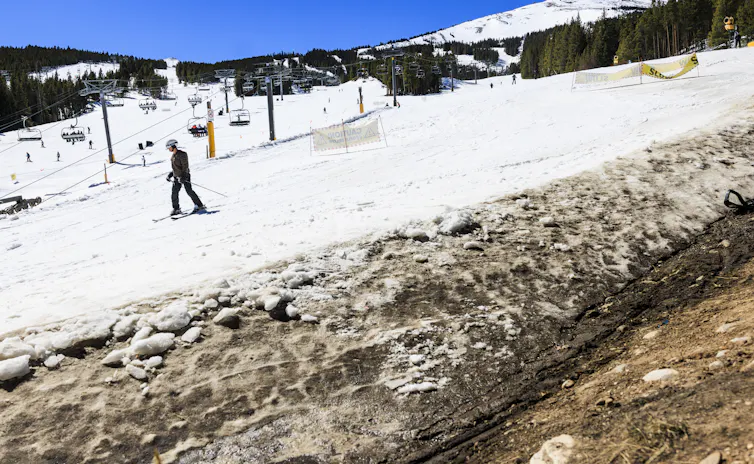
Snowmaking kept slopes skiable amid high temperatures in March 2026 in Breckenridge, Colo., but it wasn’t hard to find dry, exposed land nearby. Michael Ciaglo/Getty Images
Weather conditions in the late spring and summer – how much rain falls and how hot and dry conditions become – will play critical roles in determining the shape forests and rangelands will be in for fire season.
What this winter suggests about the future
The record-low snowpack may be a harbinger of what a warmer future will look like in the region. Many researchers have investigated how climate change will influence snowpacks and water supply throughout the Western U.S., but questions and critical challenges remain.
Deux mois après la finale de la CAN 2025 disputée jusqu’à son terme sur le terrain avec un score de 1-0, le Jury d’appel de la Confédération africaine de football (CAF) a décidé d’infliger une défaite au Sénégal sur tapis vert (3-0) au profit du Maroc. Le motif invoqué : la sortie de l’équipe du Sénégal du terrain pendant une dizaine de minutes.
La décision de la CAF fondée sur les articles 82 et 84 du règlement, entre en contradiction avec le choix initial de l’arbitre de reprendre et de mener le match jusqu’à son terme. Comment comprendre ce basculement juridique d’un résultat acquis sur le terrain ? Que dit le droit du sport à ce sujet ? Et quelles en sont les implications ? Dans cet entretien avec The Conversation Africa, Abdoulaye Sakho, spécialiste du droit du sport, donne quelques éléments de réponse.
Quels sont les fondements de cette décision ? Que prévoient les règlements en cas d’abandon de match ?
Les fondements textuels de la décision du Jury d’appel de la CAF sont à trouver dans le chapitre 35 du règlement de la CAN qui est consacré au retrait des équipes. Ici, sont particulièrement visés les articles 82 et 84.
Ainsi, le Jury d’appel de la CAF a décidé,
en application de l’article 84 du Règlement de la Coupe d’Afrique des nations (CAN), de déclarer l’équipe nationale du Sénégal forfait lors de la finale de la TotalEnergies CAF Coupe d’Afrique des Nations Maroc 2025 (« le match »), le résultat étant homologué sur le score de 3-0 en faveur de la Fédération royale marocaine de football (FRMF).
La qualification juridique est un enjeu central de cette décision. Là où certains évoquent un “abandon de match”, le jury retient la notion de “retrait” telle que définie par le règlement. Or, en droit de manière générale, ou en droit du sport de manière spécifique, la qualification est déterminante. Elle conditionne le régime juridique applicable et, par conséquent, l’issue du litige. C’est un peu comme le diagnostic du médecin qui doit administrer une posologie, si on se trompe dans le diagnostic, cela pourrait déboucher sur le résultat non souhaité.
Pourquoi la CAF a-t-elle écarté la décision de l’arbitre de poursuivre le match ?
Il est difficile de se prononcer avec certitude sur la motivation du Jury d’appel. Par contre, on peut supposer que le Jury d’appel de la CAF a procédé à son choix en toute souveraineté en sa qualité d’organe indépendant de la CAF. On peut considérer qu’il a exercé son pouvoir souverain d’appréciation en choisissant de ne pas retenir un élément pourtant central dans cette affaire : la poursuite du match jusqu’à son terme.
C’est son droit le plus absolu ! J’avoue ne pas avoir bien compris la motivation de ce choix. Pourtant, en l’espèce, il est constant que l’arbitre n’a pas opté pour l’arrêt définitif du match. Face au retrait de certains membres de l’équipe sénégalaise, il a préféré une suspension temporaire suivie d’une reprise plutôt que le retrait définitif qui aurait consacré l’abandon du match par la partie sénégalaise.
Cette reprise du match sous le magistère de l’arbitre est essentielle dès lors que la loi 5 de l’International Football Association Board (IFAB) confère à l’arbitre un pouvoir discrétionnaire,
« toute autorité pour faire respecter les Lois du jeu …, arrêter, suspendre ou arrêter définitivement le match pour toute infraction aux lois ou en raison d’interférences extérieures ».
Aucune durée prédéterminée n’impose, par exemple, un seuil au-delà duquel un match devrait être considéré comme abandonné. L’intérêt ici est qu’il n’est pas imposé pas de délai du genre 10, 15 ou 20 minutes après lequel un match doit être abandonné. En l’occurrence, l’arbitre est le véritable maître du jeu. Il a fait son choix et ce choix s’impose à tous, « erga omnes », diraient les juristes puristes car, dit encore la loi 5 :
les décisions de l’arbitre sur des faits en relation avec le jeu sont définitives, y compris la validation d’un but et le résultat du match. Les décisions de l’arbitre et de tous les autres officiels de match doivent toujours être respectées.
Un tel cas s’est-il déjà produit à ce niveau de compétition ?
Je n’ai pas une information fiable sur un cas similaire dans une finale de CAN. C’est vraiment inédit dans une finale continentale.
Le monde du football a horreur de revenir sur le résultat du terrain. C’est donc tout à fait exceptionnel que cela arrive à l’image de ce match Afrique du Sud/Sénégal pour les éliminatoires de la coupe du monde de 2018 qui avait été rejoué, parce qu’il a été prouvé que l’arbitre du match, « corrompu » par des parieurs, avait pris une décision qui avait eu une « influence illégale sur le résultat du match ».
Il existe aussi des cas célèbres de matchs interrompus dans l’histoire du football africain. J’ai en mémoire la finale de Ligue des champions 2019 Wydad/Espérance de Tunis. Les joueurs marocains du Wydad Casablanca avaient refusé de reprendre le jeu après un but refusé et aussi le refus de l’arbitre de consulter la VAR (qui était en panne).
Après plus d’une heure de conciliabule, l’arbitre siffle la fin du match en constatant l’abandon du Wydad. La sentence finale du TAS retient que le refus de reprendre le jeu constituait un abandon au sens du code disciplinaire de la CAF et l’équipe marocaine perd le match par forfait. Ici, la différence avec la finale de 2025 de la CAN est que le Sénégal a repris le match qui est allé jusqu’à son terme, alors que le Wydad n’avait jamais repris à l’époque.
Le Sénégal peut-il faire appel de cette décision et quelles sont ses chances ?
Bien sûr. Il a déjà, d’ailleurs, fait appel. Il est de notoriété en droit du sport que lorsqu’une autorité sportive a rendu une décision définitive comme c’est le cas ici avec la décision du Jury d’appel de la CAF, le Tribunal arbitral du sport peut être saisi pour juger la décision par un acte appelé « déclaration d’appel » avec un droit de greffe de 1000 francs suisses (1279 dollars américains).
Il y a un échange de mémoire, une plaidoirie et le TAS rend sa sentence. Il me semble également que la FSF aurait déposé une demande de suspension de la décision de la CAF. Ce qui va lui permettre de garder son titre jusqu’à la sentence définitive du TAS qui devrait arriver dans quelques mois.
Cette affaire est un vrai cas d’école pour le droit du sport car elle mobilise plusieurs problématiques de droit du sport qu’il n’est pas possible de traiter dans le cadre étroit de cet entretien ainsi : l’interprétation des règlements sportifs, les pouvoirs de l’arbitre sur le jeu, la composition des organes juridictionnels, la question de l’estoppel (éthique) dans une procédure juridictionnelle en cours, la gouvernance des organisations sportives.
Abdoulaye Sakho does not work for, consult, own shares in or receive funding from any company or organisation that would benefit from this article, and has disclosed no relevant affiliations beyond their academic appointment.
« Dans la vie, il y a des cactus », chantait Jacques Dutronc. Il y en a même beaucoup d’espèces différentes : les cactus, champions de la lenteur de croissance, comptent parmi les groupes de plantes se diversifiant le plus vite au monde. Pourquoi certaines familles de plantes évoluent-elles rapidement quand d’autres, au contraire, stagnent ? Même Darwin s’est, en son temps, cassé les dents sur ce mystère. Une étude s’est intéressée aux fleurs de cactus, qui pourraient détenir la clé de l’explication.
La question de savoir pourquoi certaines branches du vivant se diversifient en milliers d’espèces, tandis que d’autres restent peu ramifiées, a façonné la biologie évolutive depuis Charles Darwin.
Mon collègue et moi avons publié une nouvelle étude sur les fleurs de cactus qui pourrait aider à élucider ce mystère ancien.
Depuis plus d’un siècle, les scientifiques considèrent que les fleurs adaptées à un pollinisateur ou à un environnement donné sont les moteurs de l’évolution et créent alors une nouvelle diversité. Nos recherches remettent en question cette idée, ce qui pourrait changer la façon dont les scientifiques appréhendent les forces à l’origine de la biodiversité dans le monde végétal.
Les cactus sont l’incarnation même de la croissance lente. Un saguaro imposant peut mettre une décennie à grandir d’un centimètre, et le peyotl psychédélique met des décennies à atteindre sa maturité. Pourtant, la famille des cactus est l’un des groupes végétaux qui évolue le plus rapidement sur Terre. Au cours des 20 à 35 derniers millions d’années, environ 1 850 espèces de cactus ont vu le jour.
Bien que cela puisse sembler lent, à l’échelle géologique, c’est un clin d’œil. À titre de comparaison, environ un quart des 415 autres familles de plantes à fleurs comptent cinq espèces ou moins. Ces familles de plantes ne se sont jamais diversifiées aussi rapidement que les cactus.
On imagine souvent les déserts comme des paysages immuables et impitoyables, mais ils peuvent être le théâtre d’une innovation évolutive rapide.
Les scientifiques ont établi un lien entre la grande diversité des espèces de cactus et la spécialisation des pollinisateurs, selon laquelle les fleurs de cactus s’adaptent à des pollinisateurs particuliers, tels que les abeilles, les papillons de nuit ou les colibris. Une autre théorie attribue le succès évolutif des cactus à l’expansion des déserts au cours des 30 derniers millions d’années, alors qu’une grande partie des Amériques est devenue plus sèche et plus dégagée.
Les cactus semblaient correspondre parfaitement à cette idée. Leurs fleurs vont de petites fleurs discrètes à de grandes fleurs qui s’épanouissent la nuit. Certaines sont pollinisées par les abeilles, d’autres par les colibris, les papillons de nuit ou les chauves-souris.
Les fleurs de cactus sont éphémères et magnifiques. Elles ne durent souvent que quelques jours et sont attendues avec impatience par les passionnés de cactus. Les fleurs courtes sont généralement associées à la pollinisation par les abeilles, tandis que les formes tubulaires plus longues ont évolué à plusieurs reprises pour s’adapter aux chauves-souris, aux colibris et aux papillons de nuit.
Cependant, mon étude de 2024, qui a porté sur un échantillon d’espèces bien plus large que les études précédentes, a révélé que ni l’aridité ni la pollinisation – les deux principales hypothèses avancées pour expliquer la diversité des cactus – ne constituaient une explication convaincante de la biodiversité des cactus. Cela a remis en cause une idée établie de longue date, remontant à Darwin, qui suggérait que des fleurs spécialisées, c’est-à-dire parfaitement adaptées à leur environnement, pouvaient favoriser la formation de nouvelles espèces végétales.
Mes collègues et moi-même avons récemment publié une base de données écologique sur les cactus (CactEcoDB), qui fournit des données sur les caractéristiques et les arbres phylogénétiques des cactus afin d’aider les chercheurs à comprendre leurs origines et leur futur. Lorsque nous avons analysé ces données dans un article récent publié dans la revue Biology Letters, nous avons découvert une tendance inattendue. Nous avons compilé des données sur la longueur des fleurs de plus de 750 espèces de cactus, révélant une gamme extraordinaire, allant de fleurs de deux millimètres à des fleurs de la taille d’une grande assiette. Cette variation reflète une adaptation à des pollinisateurs très différents.
En analysant l’arbre phylogénétique des cactus, nous avons observé que la vitesse à laquelle la taille des fleurs évolue est le moteur de la formation de nouvelles espèces, tant à l’échelle des temps récents qu’à celle des temps évolutifs lointains. La sélection naturelle ne semble privilégier aucune taille de fleur en particulier. Elle a néanmoins provoqué, tout au long de l’arbre évolutif des cactus, des vagues répétées de changements rapides vers des tailles différentes.
La conclusion est simple mais puissante : ce n’est pas la présence d’un type de fleur ou d’un pollinisateur en particulier qui détermine l’évolution des cactus. C’est la vitesse à laquelle l’évolution des types de fleurs se produit, quel qu’en soit le résultat, petites ou grandes fleurs. Les espèces aux fleurs plus petites ou plus grandes peuvent rapidement donner naissance à de nouvelles espèces de cactus, à condition qu’elles aient évolué rapidement au cours de leur histoire évolutive.
Pourquoi c’est important
Ceci a des conséquences pour la conservation des espèces. Notre étude suggère que la capacité d’une plante à évoluer, essentielle pour survivre à des périodes de changements environnementaux et d’extinctions – comme celle que connaît actuellement la Terre –, est plus importante que n’importe quelle adaptation spécifique.
La protection de la biodiversité ne consiste pas seulement à sauver les espèces que nous observons aujourd’hui, mais aussi à préserver le potentiel évolutif qui permet l’apparition de nouvelles espèces. Certaines espèces peuvent sembler stables ou banales aujourd’hui, mais recèlent ainsi un immense potentiel d’évolution à l’avenir.
Près d’un tiers des espèces de cactus sont aujourd’hui menacées d’extinction. C’est l’un des taux les plus élevés parmi tous les groupes végétaux, et nous risquons de perdre des lignées évolutives entières de cactus, pas seulement des espèces.
Protéger les cactus, et la nature en général, consiste ainsi à protéger le processus évolutif continu qui permet à la vie de s’épanouir dans certains des environnements les plus hostiles de la Terre.
Jamie Thompson a reçu des financements de The Leverhulme Trust.
Fruit du consortium de quatre instituts de recherche français et de la Fondation One Science Montpellier, PlantNet enregistre en moyenne par jour de 100 000 à 700 000 utilisateurs actifs dans le monde et est accessible dans plus de 50 langues.Plantnet.org, Fourni par l’auteur
On l’appelle souvent le « Shazam des plantes ». Avec une simple photo, elle permet à qui le veut d’identifier une plante. L’application mobile PlantNet est aujourd’hui bien connue des randonneurs ou des curieux du monde entier qui veulent identifier une plante. Mais peu savent que cet outil est également précieux pour les scientifiques, pour lesquels elle a été initialement conçue.
Détection des espèces de plantes invasives, carte des allergies potentielles au pollen, découverte potentielle de nouvelles espèces, les possibilités des données collectées par ses utilisateurs sont aussi nombreuses que prometteuses. Retour, avec le botaniste Pierre Bonnet (Cirad) et le chercheur en informatique Alexis Joly (Inria), deux des concepteurs de l’application, sur cet outil qui a permis à certains de jouer à Pokémon Go avec les plantes et à d’autres de faire avancer les connaissances.
The Conversation : Que sait-on des utilisateurs actuels de PlantNet ?
Pierre Bonnet et Alexis Joly : Une étude d’impact réalisée il y a quelques années identifiait 12 % d’utilisation professionnelle, que ce soit pour la recherche, la gestion du territoire, pour l’agriculture ou bien l’enseignement. L’immense majorité des utilisateurs de PlantNet l’utilise donc par curiosité ou par intérêt personnel.
Si, on regarde maintenant qui utilise PlantNet et où dans le monde, on voit que cela reflète les usages des technologies dans le monde. En Asie, on a pas mal d’usagers jeunes, car ce sont eux qui sont les plus connectés. On peut aussi constater que la flore chinoise, qui est pourtant très riche, est très peu représentée à travers les usagers de l’application, et cela s’explique notamment par le fait que les plateformes non étatiques ou non chinoises, qui ne sont pas portées par des entreprises ou partenaires chinois, pénètrent beaucoup moins ce marché-là.
Les zones tropicales sont les plus riches en biodiversité, est-ce que PlantNet est particulièrement présent dans ces pays ?
P. B. et A. J. : Le Brésil est en huitième position avec un peu plus de 600 000 utilisateurs annuels. L’Indonésie et l’Inde sont, elles, dans le top 20. Actuellement, le gros de l’activité de PlantNet est encore en Europe et en Amérique du Nord. Plusieurs choses expliquent cela. Déjà, PlantNet a été amorcé en France et en Europe, et a donc été davantage promu et médiatisé dans cette région du monde. En suivant les demandes de ses usagers, l’application a aussi été, dans un premier temps, adaptée à la flore française et méditerranéenne avant d’être, petit à petit, étendue à d’autres flores européennes, puis nord-américaines, puis tropicales.
Il faut aussi avoir en tête qu’en zone tropicale, la richesse en espèces est, certes, beaucoup plus élevée, mais les capacités d’accès sont souvent plus limitées. Le réseau routier est moins développé, la connectivité 3G peut être mauvaise, notamment en zones montagneuses forestières.
Sur le terrain, la biodiversité végétale peut aussi être plus complexe à photographier, si l’on pense, par exemple, aux nombreuses plantes tropicales qui sont épiphytes, c’est-à-dire qui poussent sur une autre plante, notamment au niveau de la canopée. Quand on parle d’arbres qui font plusieurs dizaines de mètres de haut, cela devient tout de suite plus complexe à photographier.
Tout cela fait que la flore tropicale reste considérablement moins connue. La flore européenne est couverte presque à 100 % par PlantNet. Pour celle des pays tropicaux, on se situe à quelques dizaines de pour cent. Cette réalité n’est cependant pas propre à PlantNet, on la retrouve également dans l’ensemble des bases de données institutionnelles, notamment car cela coûte plus cher de couvrir les zones tropicales.
Mais l’on travaille malgré tout avec des partenaires, au Costa Rica, en Guyane, au Brésil, au Cameroun, à Madagascar, en Malaisie, notamment pour étendre la couverture du nombre d’espèces.
Sous les tropiques ou ailleurs, que peut-on noter sur les plantes que les utilisateurs cherchent à identifier ? Les plantes les plus courantes sont-elles les plus demandées ou pas forcément ?
P. B. et A. J. : Il y a forcément une corrélation, car les plantes très rares sont forcément peu observées. Mais on constate également que certaines plantes sont très communes, mais intéressent peu, car elles sont « discrètes ». Cela peut être les adventices (mauvaises herbes, ndlr) des cultures, les plantes qu’on trouve en bord de route mais qui n’ont pas de fleurs remarquables, qui sont pollinisées par le vent avec des fleurs grêles verdâtres, telles que les espèces de fétuques (Festuca spp.), ou de bromes (Bromus spp.). Elles sont moins observées parce qu’elles sont moins attractives en fait. On peut aussi noter qu’on a une bonne représentation des arbres là où certaines herbacées ou plantes épiphytes vont être extrêmement peu observées.
Les gens observent en fait souvent les plantes qui leur plaisent, ou les plantes qui leur semblent utiles. On a comme ça beaucoup de requêtes sur les fruits, les baies, les prunes, sans doute parce que les gens veulent savoir si elles sont consommables ou pas.
Mais cet enjeu des plantes utiles pour l’humain n’était, au départ, pas du tout l’objectif principal du projet PlantNet. On a cependant dû se l’approprier pour répondre à un usage attendu de ce côté-là, mais on reste modéré dans le volume d’informations que l’on donne.
En parallèle, on travaille de plus en plus avec des personnes qui étudient la santé animale, soit en santé humaine et qui utilisent le service ou les données de PlantNet pour leurs propres travaux. On a comme cela des personnes qui ont travaillé sur ToxiPlant qui identifie les plantes toxiques pour les chevaux. On échange aussi avec des médecins sur les cas d’usage de PlantNet pour identifier les plantes allergisantes, notamment celles générant des allergies cutanées. On a également des échanges avec l’agence régionale de suivi de la qualité de l’air, ATMO Occitanie, qui utilise les données qu’on partage avec elle sur les plantes en fleurs recensées à travers PlantNet et qui les intègre dans ses modèles d’estimation de la qualité de l’air liés à la charge pollinique.
Y a-t-il certaines plantes qui gagneraient à être davantage prises en photo ?
P. B. et A. J. : Oui. Il y a des plantes qui nous intéressent, ou qui intéressent nos partenaires, mais pour lesquelles on a très peu de données. Ce sont, par exemple, des plantes allergisantes pour les allergies respiratoires, comme les genévriers mâles, qui, lorsque leurs cônes sont ouverts, libèrent le pollen.
Ces cônes sont très discrets. Les genévriers sont donc photographiés, mais rarement avec des illustrations permettant de connaître le stade de développement des cônes. Ils suscitent pourtant des allergies, donc certains de nos partenaires voudraient collecter des données à ce sujet. On espère y remédier à travers des mécanismes d’animations soit directement à travers la plateforme, soit à travers les réseaux sociaux pour susciter de l’intérêt pour la collecte de données sur ce type de plantes ou bien sur des plantes rares qui sont menacées et pour lesquelles il y a des enjeux de conservation, telles que Marsilea strigosa Willd. et Arenaria provincialis Chater & P. Halliday.
On a aussi le cas de certaines plantes qui nous intéressent pour l’agriculture, des adventices, par exemple, qu’on a peu identifiées au stade de jeunes pousses, telles qu’Imperata cylindrica (L.) Raeusch. ou que Galium aparine L.
Pour identifier une plante, votre application propose de prendre plusieurs types de photos : des photos de fleurs, de feuille, de fruit, d’écorce, de la plante entière. Quels sont les types de données que vous avez le plus ?
P. B. et A. J. : Ce sont les fleurs, notamment parce que les périodes où PlantNet est le plus utilisé sont les saisons de nombreuses floraisons, le printemps, le début de l’été. Les fleurs sont alors des motifs attractifs qui déclenchent l’observation. Ce sont aussi les clés visuelles les plus performantes, celles qu’ont beaucoup utilisées les botanistes dans le passé.
Sur PlantNet, après les fleurs, on constate un degré de performance décroissant avec les fruits, les feuilles et ensuite les rameaux et écorces, qui sont plus difficiles parfois aussi à prendre en photo, même si l’on encourage toujours les utilisateurs à utiliser plusieurs critères (fleur et fruit, fleur et feuille…) à chaque fois pour maximiser leur chance d’identification correcte.
Que se passe-t-il si PlantNet ne trouve pas de correspondance entre la photo prise et une espèce connue ?
P. B. et A. J. : La gestion de l’ignorance reste un problème très difficile pour toutes les IA, celle de PlantNet ne fait pas exception. Certaines espèces sont très peu représentées, et il est très dur d’apprendre au modèle à faire la différence entre quelque chose qui est très rare dans la base de données d’apprentissage et quelque chose qu’on n’a pas du tout. On cherche du coup plutôt à quantifier l’incertitude, décider quand le modèle est incertain ou pas. On travaille avec notre équipe sur la création d’intervalles de confiance. C’est pour cela que, dans ces cas-là, l’application proposera plusieurs espèces.
Mais une réalité rend ce travail difficile : les nouvelles espèces ressemblent souvent à des espèces déjà connues. On pense qu’une nouvelle espèce va être très folklorique visuellement, mais ce n’est pas nécessairement le cas.
Il y a aussi la problématique des plantes ornementales, hybrides. Il y a toujours des créations de plantes. On les couvre, mais moins bien que le reste actuellement, même si on essaie de pallier cette difficulté.
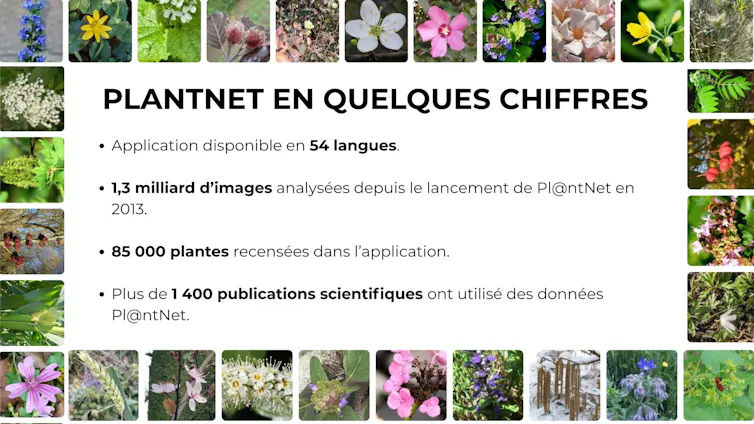
On tâche aussi tout simplement de recenser de plus en plus de plantes. PlantNet couvre aujourd’hui 85 000 espèces sur les 400 000 estimées, sachant qu’on en découvre 2 000 nouvelles par an. Ces découvertes sont faites par des taxonomistes du monde entier, notamment via le réseau World Flora Online, qui regroupe plusieurs dizaines d’universités, d’herbiers, de jardins botaniques, et que PlantNet a rejoint en 2025.
En se rapprochant de ces réseaux-là, on va pouvoir améliorer les cas où PlantNet a de faibles performances, notamment lorsque des espèces nouvelles émergent grâce au travail de ce réseau de taxonomistes qui fait progresser la connaissance en divisant, par exemple, ce qu’on pensait jusque-là être une seule espèce, mais qui en représente, en fait, plusieurs ou, à l’inverse, en regroupant ce qu’on pensait être différentes espèces mais qui se révèle en réalité n’être qu’une seule plante.
Si l’on revient maintenant aux plus de 10 % d’usagers qui utilisent PlantNet dans le cadre de leur travail, qui sont-ils ? Quels sont ces travaux ?
P. B. et A. J. : Les données de PlantNet sont très utiles pour les modèles de distribution d’espèces qui cherchent à prédire quelles espèces se trouvent où. Il y a certes des biais dans nos données, en fonction de là où les gens vont, là où les gens ne vont pas, mais elles peuvent aider à mieux comprendre les facteurs qui influencent ces distributions, notamment le changement climatique. Cela permet de répondre à des questions comme « Est-ce que les espèces vont se déplacer ou pas » ou « Quel est l’impact humain sur ces distributions ? » Beaucoup d’écologues vont pour cela télécharger les données PlantNet et les coupler à d’autres données pour faire ces modèles de distribution.
Les données de PlantNet peuvent aussi aider aussi pour la détection des espèces envahissantes qui sont souvent notables par leur dimension, leur densité, leur aspect visuel, leur nouveauté, comme Carpobrotus edulis (L.) N.E.Br ou Mirabilis jalapa L. On échange à ce sujet avec l’Office français de la biodiversité, qui s’intéresse à l’usage de caméras embarquées pour détecter la présence de plantes envahissantes, afin de contenir leur expansion dans les zones où elles seraient détectées.
On a aussi des travaux en cours pour mieux caractériser les espèces présentes dans les milieux agricoles et reconnaître les pathogènes végétaux qu’il s’agisse de virus, de bactéries, de champignons…
Y a-t-il eu aussi des usages qui vous ont surpris ?
P. B. et A. J. : La chose la plus surprenante était peut-être de découvrir ce musée hollandais où PlantNet était utilisé pour reconnaître les plantes présentes sur les tableaux.
On a aussi parfois des surprises en voyant des personnes utiliser PlantNet pour identifier un tatouage de plante, le motif végétal d’une toile cirée… Il y a aussi les usages ludiques (par exemple, l’application Explorama ou l’application Tree Quest qui utilise notre service d’identification automatisé). PlantNet soutient la diversité des usages possibles, non pas en cherchant à les intégrer, mais plutôt en diffusant le service de reconnaissance. On a comme ça plus de 20 000 comptes qui utilisent le service de reconnaissance PlantNet pour intégrer ce service soit dans leur propre application mobile, application web, soit dans leur workflow de traitement de données.
Et quels sont, sinon, les usages qui pourraient être développés de PlantNet à votre avis ?
P. B. et A. J. : On a traité un peu plus de 1,3 milliard de requêtes d’identification. Il y a dans ces données énormément de matières pour caractériser des milieux, des espèces… Cependant, ces données sont encore difficilement exploitables de par leur volumétrie. Il y a probablement à l’intérieur de toutes ces photographies des espèces nouvelles, des données sur des espèces qui n’existent pas ailleurs. Il y a aussi, dans les clichés postés, dans les arrière-plans des plantes photographiées, des informations potentiellement intéressantes sur les communautés associées, sur les milieux dans lesquels ces plantes sont. Ce n’est pas l’objet premier de la photographie, mais ce sont des données potentiellement très intéressantes sur les associations végétales, pour l’instant inexploitées.
On a peu exploité nos données pour étudier l’impact des changements climatiques très rapides actuels. PlantNet a, à cet égard, des données nombreuses sur les cinq à dix dernières années qui pourraient permettre de mieux comprendre comment les plantes réagissent à ces changements rapides. D’une année sur l’autre, on peut noter beaucoup de variabilité, mais, pour l’instant, on a du mal à mesurer cet impact.
Comment un utilisateur de PlantNet peut-il faire pour aider à toutes ces recherches possibles ?
P. B. et A. J. : Ce qui nous aide le plus, c’est d’utiliser la plateforme en s’identifiant, ça augmente nettement les bénéfices pour la recherche. En créant un compte, les gens acceptent des conditions d’usage et facilitent la réexploitation pour la recherche. De plus, plus les données sont de qualités, plus elles sont pertinentes pour les activités de recherches. La géolocalisation est, par exemple, très précieuse. Elle est aussi bénéfique pour l’utilisateur avec une qualité de détermination potentiellement plus élevée.
Il faut aussi avoir en tête que PlantNet est un consortium ouvert. C’est encore trop peu connu, même si on a eu récemment eu l’adhésion du CNRS, et reçu des demandes d’adhésion d’universités étrangères. Cette adhésion permet à nos adhérents de plus largement bénéficier de la plateforme, et d’y contribuer pour en permettre l’évolution dans leurs domaines d’expertises.
Propos recueillis par Gabrielle Maréchaux.
Pierre Bonnet a reçu des financements de la commission européenne (projets HORIZON GUARDEN – 101060693 et MAMBO – 101060639) ainsi que de l’agence nationale de la recherche (PEPR AgroEcoNum – 22-PEAE-0009).
Alexis Joly a reçu des financements de la commission européenne (projets HORIZON GUARDEN et MAMBO) ainsi que de l’agence nationale de la recherche (PEPR AgroEcoNum).
Source: The Conversation – UK – By Keith Godfrey, Professor of Epidemiology and Human Development, University of Southampton
A father’s health can affect both pregnancy outcomes and the infant’s health.muse studio/ Shutterstock
When we think about preparing for a healthy pregnancy and baby, most advice focuses on women. Such advice might include good nutrition, taking dietary supplements, avoiding alcohol or smoking and managing their medications and health conditions. But growing evidence shows that men’s health also plays a vitally important role in pregnancy and child development.
In a new review of research on health before pregnancy and parenthood (referred to as “preconception health”), we found that the health and life experiences of boys and men can have important influences on pregnancy outcomes and the wellbeing of future children in several ways.
To understand the role of men’s preconception health, we reviewed studies published from 2000 to 2025 from fields including medicine, biology, psychology and social science. Rather than focusing only on the period just before pregnancy, we looked at research examining how men’s health and experiences throughout their lives – from their own time in the womb through to adolescence and adulthood – can affect families later on.
The research explored factors such as men’s physical health, their health-related behaviour, mental health, environmental exposures and social conditions. This included how fathers influence their partner’s health and the family environment their children grow up in.
This broader perspective shows that men’s influence on pregnancy and child outcomes goes far beyond simply providing half of the baby’s genetic inheritance.
The affect of men’s health
As set out in our review, one important pathway through which a father’s health can affect both pregnancy outcomes and the infant’s health is through sperm health.
Factors such as age, the father’s nutrition, whether he smokes, is overweight or obese, has an unhealthy alcohol intake, experiences stress and his level of exposure to pollution or chemicals can all influence so-called non-coding nucleic acid (RNA) signals carried in sperm. These signals can affect how genes act in the early stages of the baby’s development, which can subsequently impact long-term health outcomes in children.
For example, one study of over 500,000 couples found higher odds of birth defects (including cleft lip, digestive tract anomalies and congenital heart disease) when fathers reported drinking alcohol before pregnancy.
Older father’s age (particularly those who conceived a child after the age of 35) is also linked with both risk of birth complications as well as a child’s likelihood of being diagnosed with autism spectrum disorder. These links are stronger than those seen with a mother’s age.
Research involving millions of fathers and children has additionally shown that depression in fathers is linked with higher risks of depression in their children.
Some research even suggests that experiences earlier in life may play a role. For example, studies have linked nutrition and environmental exposures such as food shortage or abundance during boys’ pre-teen years with health outcomes in the next generation.
But biology is only part of the picture, as described in our review.
Men also influence pregnancy through their relationships with their partners. Supportive partners are consistently linked with healthier pregnancies. Women who feel supported are more likely to attend antenatal appointments, avoid smoking or alcohol, maintain healthier diets and experience lower levels of stress and depression during pregnancy.
Another pathway is through parenting. A father’s mental health, stress levels and childhood experiences can influence how he interacts with his children after birth.
For example, men who experienced adversity growing up – such as poverty, neglect or trauma – are more likely to experience anxiety or depression later in life. This can affect family relationships and parenting.
This means that experiences during a boy’s childhood can have ripple effects decades later, shaping the environment his own children grow up in.
What this means for families
Taken together, the evidence from our review shows the importance of shared responsibility for pregnancy and parenthood.
Improving men’s health before pregnancy benefits not only men themselves but also their partners and future children. Yet most health advice about preparing for pregnancy still focuses almost entirely on women. In many countries, there is little information or support available for men who want to prepare for fatherhood.
Raising awareness is an important first step. Research shows that many men want to be involved in planning for pregnancy and supporting their partners – but they often don’t realise how their own health may influence outcomes.
For men who hope to become fathers, general health guidance needs to be followed: avoid smoking, limit alcohol, maintain a healthy weight, manage stress and seek medical advice for ongoing health conditions. Just as important, strong and supportive relationships between partners can help create healthier environments for future parenthood.
Our review suggests it’s time to rethink how we approach preparing for pregnancy. Instead of focusing only on women before pregnancy, a more effective approach should involve supporting the health and wellbeing of both boys and girls throughout their lives.
This includes addressing wider social factors such as education, mental health support, economic stability and childhood adversity. Experiences early in life shape later health behaviour and relationships, influencing the next generation.
Most healthcare systems are also simply not designed to support father’s involvement in preparation for pregnancy and parenthood. But men need to be included in conversations about reproductive health and couples should be supported to approach pregnancy preparation together.
More research is still needed to better understand the biological and social pathways linking men’s health to pregnancy and child outcomes. But our review makes one message clear: the health of the next generation does not begin with pregnancy – it begins much earlier, in the early lives and wellbeing of both parents.
Keith Godfrey receives funding from the National Institute for Health and Care Research (NIHR Senior Investigator (NF-SI-0515-10042) and NIHR Southampton Biomedical Research Centre (NIHR203319)) and the Wessex Medical Trust, Gerald Kerkut Charitable Trust and Rosetrees Trust.
Danielle Schoenaker receives funding from the National Institute for Health and Care Research (NIHR) through an NIHR Advanced Fellowship (NIHR302955) and the NIHR Southampton Biomedical Research Centre (NIHR203319).
Gold has long enjoyed a reputation as a financial “safe haven” during stormy times. But over the past few months of geopolitical chaos and market panic, the precious metal has moved more like a roller coaster than a steady ship at anchor.
In late January, the gold price surged to an all-time high near US$5,600 per ounce – effectively double what it was a year earlier. It’s lost about 20% since then, sliding sharply while major conflict broke out in the Middle East.
To be clear, gold is still at lofty heights by historical standards, up almost 300% over the past decade. Much of this surge has been driven by “financialisation”.
Put simply, more ways of investing in gold on paper – with complex financial products called derivatives and funds that track its price – have seen a boom in speculation by institutional and retail investors.
But this year’s wild swings in price should shatter any remaining illusion that gold is always a safe haven. To understand why, we need to look at how modern financial markets work – and in particular, why an oil shock is different to other crises.
Umbrellas and storm shelters
To protect their wealth, investors often seek assets that are either “hedges” or “safe havens”.
A hedge is an investment that generally moves in the opposite direction to the rest of the market on average over a normal, long-term period.
Think of a hedge like holding an umbrella above your head every single day. You’ll stay drier than everyone else when it rains, but you’ll also block out on some of the sunshine (potential gains) when it doesn’t.
Hedging can reduce risks – but limit potential gains for an investor. Suresh tamang/Pexels
A safe haven, on the other hand, is an investment that generally moves in the opposite direction to the rest of the market only during sudden periods of extreme stress or crashes.
It’s like a storm shelter you only run to during a hurricane.
Where does gold fit?
In a 2016 research study, colleagues and I found gold had some of the qualities of a safe haven, particularly for share markets in Australia, the United States, Germany and France.
During the 2008 global financial crisis, gold was the most stable commodity among the precious metals we studied. Its price did drop, but it avoided the catastrophic losses seen in other precious metals.
It had similar safe haven qualities in 2011, when ratings agency Standard & Poor’s (S&P) downgraded the US’ AAA credit rating to AA+ for the first time in history and many global stock markets fell.
Importantly, those market shocks came out of the financial system itself (a banking system failure and a credit downgrade).
Today, the world faces something fundamentally different: a massive energy shock due to interrupted oil supplies and major damage to oil and gas facilities in the Middle East.
Why an oil shock is different
Traditional finance textbooks will tell you that when a war breaks out, inflation spikes or stock markets crash, investors typically engage in what’s called a “flight to quality” – fleeing riskier assets and moving their money somewhere seen to be safer (such as gold).
In a 2025 research paper, colleagues and I offer a more nuanced view. Crucially, we incorporated data from more recent periods of stock market turbulence, including the COVID pandemic, where gold’s safe haven properties were more muted.
We found gold is still a go-to choice for investors moving out of riskier investments. But it is not an untouchable storm shelter.
Instead of standing completely separate from the panic during a crisis, gold absorbs some of the volatility from both the stock market and energy markets, which can cause its price to fall.
Gold isn’t always a safety net. Market chaos can drag its price down. Marko Ivanov/Unsplash
Ripple effects
Why? For one, market chaos means some large investors may be forced to sell gold to cover other losses or meet financial obligations, such as margin calls (where a lender demands funds to cover the falling value of an asset).
For other large investors, the recent price rally may have created an opportunity to sell high and take profits, or rebalance their investment portfolios.
But there is also the fact gold does not have as much essential intrinsic value as something like oil. There is not much industrial demand for it compared to other commodities.
In a severe crisis, forced to chose between a commodity like oil and gold, what does global industry really need? Oil.
Rock, paper, gold
The different ways people are investing in gold is another important factor. Over several decades, gold has become increasingly “financialised”.
Now, it can be bought and sold with ease on “paper” via speculative, complex financial instruments called derivatives, or in increasingly popular exchange traded funds which track the price of gold.
With these funds, you aren’t buying gold itself. You’re buying an asset whose price is designed to track the price of gold in some way.
Today, a massive rise in speculative investment means that commodity prices depend on far more than real-world supply and demand.
Because global investors now hold gold derivatives and conventional stocks at the same time, the risk of exposure to common market shocks has drastically increased.
Rand Low does not work for, consult, own shares in or receive funding from any company or organisation that would benefit from this article, and has disclosed no relevant affiliations beyond their academic appointment.
On October 6 1973, the Yom Kippur War – mainly involving Egypt, Syria and Israel –triggered one of the biggest energy crises of the 20th century. Eleven days later, several Arab members of the Organization of the Petroleum Exporting Countries (OPEC) announced they would stop selling oil to countries supporting Israel and would cut production.
The effect was immediate. Within a few months, global oil prices quadrupled.
After decades of price stability, the world faced a severe shortage. Petrol stations ran dry, with some displaying a red flag to signal empty pumps; drivers queued for hours.
In parts of the US, fuel was rationed by licence plate number. By March 1974, time spent waiting in line had raised the cost of petrol by around 50%, because drivers were also “paying” through lost time — hours that could otherwise have been spent working.
Across Europe, governments imposed fuel-saving measures. The Netherlands and West Germany introduced car-free Sundays, while Britain cut speed limits to reduce petrol consumption.
Today, as the United States and Israel continue a widening war against Iran, energy markets have again reacted: disruptions in the Strait of Hormuz, a key artery for global oil, have pushed prices above US$100 per barrel, echoing the supply shocks of the 1970s.
These pressures make it timely to revisit 1973 and why its effects were so economically severe.
When OPEC gained influence
The scale and persistence of the 1973 oil shock reflected not just the embargo itself, but how it interacted with the economic system at the time.
One important shift was that the US stopped being the world’s main “backup supplier” of oil. For decades, American production had been large enough that output could increase when global supply tightened, but production peaked around 1972.
Without this buffer, markets became far more sensitive to disruptions. At the same time, oil-producing countries in the Middle East gained political leverage by coordinating production through OPEC, strengthening their influence over prices.
Moreover, the international monetary system that had kept postwar inflation under control had collapsed in 1971. This agreement, known as Bretton Woods, had tied currencies to the US dollar. The result was that oil prices, like most commodity prices, were already rising before the embargo began.
Inflation surged, and so did wages
Higher oil prices pushed up the cost of almost everything. Transport became more expensive. Electricity bills increased. Businesses faced higher production costs and passed these costs onto consumers.
Inflation surged across many advanced economies. Workers tried to protect their living standards by asking for higher pay. In many countries, strong labour unions negotiated big wage increases to keep up with rising prices.
Expectations made the shock worse: fearing shortages, firms and households stocked up, reducing available supply and pushing prices even higher.
The economic consequence of this shock was a decade of stagflation: high inflation amid stagnating growth.
Governments tried several ways to respond. Some countries, such as the US, introduced price controls to limit how much petrol companies could charge. Others, such as the UK and France, imposed rationing rules to manage shortages.
Trouble for central banks
Central banks also faced difficult choices: raising interest rates could reduce inflation by slowing borrowing and spending. But higher rates also risked pushing the economy deeper into recession.
During the 1970s, many central banks including the US Federal Reserve struggled to strike the right balance. The Fed kept cutting interest rates to support the economy, but this only added to inflation.
The result was an “inflationary psychology” where expectations of higher prices become self-fulfilling.
The world today has stronger defences against an oil shock. Central banks now have clear mandates to keep inflation low and the credibility to act quickly. Research suggests the economic impact of oil price shocks has declined over time because wages adjust faster, central banks act decisively to keep inflation in check, and oil now makes up a smaller share of the economy.
Recent shocks confirm this transformation: the Russian invasion of Ukraine pushed up energy prices and inflation, but did not trigger a deep recession.
There is another difference as well. Today, high oil prices may encourage investment in renewable energy, and have the potential to accelerate the shift toward cleaner energy sources.
Modern economies are better prepared
The events of 1973 still offer an important lesson.
The damage caused by an energy shock depends not only on the size of the disruption but also on the economic environment in which it occurs. In the 1970s, heavy dependence on oil, rigid wage systems and uncertain economic policy amplified the crisis.
Modern economies are better prepared. Constraints on energy supply, however, remain real and the disruption to the Strait of Hormuz highlights this uncertainty. The duration and objectives of the current conflict remain unclear, and uncertainty itself is costly to businesses and the economy.
History is therefore less useful for prediction than for perspective. The size of a supply shock is only one piece of the puzzle; what matters is the system it hits, how long the shock persists and how it affects expectations.
Laura Panza does not work for, consult, own shares in or receive funding from any company or organisation that would benefit from this article, and has disclosed no relevant affiliations beyond their academic appointment.