Source: The Conversation – Canada – By Ali Ameli, Assistant Professor, Department of Earth, Ocean and Atmospheric Sciences, University of British Columbia
In a landscape that can flip quickly from soaking up water to sending it downstream, small differences in how wet the wetlands are can be the difference between a manageable spring and a damaging flood.(USFWS Mountain-Prairie), CC BY
In recent years, the Prairies have seen bigger swings in climate conditions — very wet years followed by very dry ones. That makes an already unpredictable landscape even harder to forecast, with real consequences for flood preparedness and water quality.
The challenge is the landscape itself. Much of the Canadian Prairies sit within the Prairie Pothole Region, a landscape dotted with millions of shallow wetlands and depressions. Water doesn’t simply run downhill into a stream, it is stored first. Then, once enough wetlands fill, water begins to spill from one to the next, and only after that does it connect into channels.
Why does this matter now? In a landscape that can flip quickly from soaking up water to connecting it downstream, small differences in how wet the wetlands are can be the difference between a manageable spring season and a damaging flood. The problem is that in many watersheds, we don’t have the local measurements needed to tell whether wetlands are still retaining water or are close to connecting and releasing it downstream.
Across the Canadian Prairies — from southern Alberta through Saskatchewan to Manitoba — streamflow monitoring is sparse, and many watersheds have no gauges. These devices measure water levels and flow rates in rivers and streams, and, less commonly, water levels in wetlands.
Communities in the Red River Basin, the Assiniboine watershed and rural municipalities throughout the Prairie provinces often have limited warning when water conditions shift. This affects flood preparedness, agricultural water management and our understanding of how water is stored and moves through Prairie landscapes, with implications for water quality.
What we see again and again is this: the same rainfall or snowmelt can produce very different streamflow, depending on how much water is already sitting in the network of wetlands.
But understanding the mechanism is not the same as being able to make reliable predictions in an unmeasured watershed. That’s the core problem my colleagues and I tackled in our new study: how to merge Prairie Pothole physics with modern artificial intelligence (AI) so we can estimate both streamflow and wetland water storage in places where measurements are not available.
Predicting streamflow
I’ve spent years working on fill–spill–connection behaviour and why it makes Prairie streamflow so hard to predict. I’ve also studied what happens when wetlands are drained or changed — how some wetlands do a much better job than others at reducing floods, and how losing wetlands can make it harder for the landscape to hold onto water during dry spells.
Many people think predicting streamflow is mostly about inputs: rainfall and, in the Prairie Pothole Region, snowmelt. If a storm is big enough — or if spring melt is large — rivers rise. In many landscapes, that intuition is reasonable. In Prairie Pothole landscapes, it often fails.
Here, a large fraction of rain and snowmelt goes into storage first. Early in spring, much of the meltwater fills wetlands rather than running off directly. Later, after enough filling, pathways “switch on” and water begins moving into channels. The same rain event can produce very different streamflow depending on how full the wetland network already is.
The hard part is determining how full that network is. It isn’t directly observable from standard weather data. Because the system behaves in a threshold-like way, where small changes in how much water is stored in wetlands can trigger large changes in runoff, the Prairie Pothole Region is among the hardest places to predict streamflow.
Previous approaches have each faced limitations. Modelling every wetland in detail requires maps and information that often don’t exist at the scale needed. Relying on AI alone can also struggle, because the key factor — how full the wetlands are — isn’t directly visible in the usual input data.
Combining physics with AI
In our new study, we built a model that embeds fill–spill–connection physics directly into an AI framework, rather than asking AI to learn this behaviour from data alone. Fill–spill–connection physics describes how water fills wetlands, spills once they are full and connects to downstream rivers and streams.
It depends on a few key parameters: how much water the pothole network can hold before spilling, and how quickly the connected area expands as the landscape wets up. We use AI to learn how these parameters vary across the region, shaped by soils, climate and topography. Instead of treating each watershed as a totally separate problem, the model learns regional patterns that can be applied to watersheds without streamflow records.
We tested the approach across 98 watersheds spanning the Prairie Pothole Region. In tests designed to mimic unmeasured watersheds, our model predicted streamflow more reliably than AI models that do not represent these physical processes.
Importantly, it also captured wetland storage dynamics: the year-to-year fluctuations in how much water the pothole network holds. When we compared that storage signal with satellite-based wetland inundation maps, the year-to-year ups and downs lined up well.
What this changes
The same rainfall or snowmelt can produce very different streamflow, depending on how much water is already sitting in the wetland network. (Flickr/USFWS Mountain-Prairie), CC BY
Being able to estimate both flow behaviour and wetland water storage in these watersheds opens practical possibilities.
First, it can support flood preparedness by helping identify when a watershed is getting close to the point where wetlands start to connect and release water downstream. In the Prairie Pothole Region, flood risk isn’t only about how much rain falls in a day. It’s also about whether wetlands are full enough that new water will be routed, not stored.
Second, it can help describe how watersheds differ across the Prairies: which areas tend to hold onto water longer, which connect more easily and where streamflow is likely to be more variable from year to year. That kind of regional picture is difficult to build when monitoring is sparse.
Third, it offers a bridge between process understanding and modern data-driven tools. This is not AI replacing hydrology, it is hydrology making AI more reliable in places where the mechanism matters.
For Prairie communities and land managers working in watersheds without gauges, better predictions of when water will be stored — and when it will connect and flow — would be a practical step forward.
Ali Ameli receives funding from the Natural Sciences and Engineering Research Council of Canada.
The commission was struck following a series of high-profile cases of abuse and maltreatment in sport. These involved Swimming Canada, Gymnastics Canada and most notably Hockey Canada.
Although the commission was initiated ostensibly to investigate abuse, maltreatment and safety, its recommendations go much further.
They suggest sweeping governance reforms to the Canadian sport system. Calls for system-wide change have been made since the early stages of this process.
A fragmented system that enables harm
The commission has made 98 calls to action to address safe sport and system alignment. The calls are wide-ranging and suggest the need for system-wide structural and governance reforms.
The report is framed around several key issues.
The commission identified that abuse and maltreatment are widespread, systemic and ongoing in Canadian sport. They noted that power imbalances within the sport system have created a culture of silence that allows harmful behaviours to continue. They also noted that the sport system is fragmented and disorganized, and that chronic underfunding has made attempts at change ineffective.
Broadly, they suggested that these and other issues have made sport participation increasingly inaccessible and out of reach for many Canadians.
The commission also acknowledged that issues of access and safety in sport disproportionately affect equity-deserving groups.
As such, they acknowledged the need to support Indigenous-led sport programs and to improve representation of women, people with disabilities and people of diverse racial and ethnic backgrounds within leadership and governance.
Plans to fix sport is clear — execution isn’t
While the commission made 98 calls to action, we review only a few themes here. Many of these recommendations were released and discussed in the context of the preliminary report; the final report solidifies some important details on the commission’s recommendations moving forward.
The commission called for four national strategies: one for sport infrastructure, one for equity, diversity and inclusion, one for disability sport and one for participation. Each strategy would require a concrete action plan with progress tracked and evaluated.
The commission also called for the development of a national tool for tracking sport and physical activity data, an approach that other countries have had in place for decades. They aptly note that effective monitoring, evaluation and policymaking must be supported by reliable data.
Abuse and maltreatment in sport demand a co-ordinated national response.
The commission was unequivocal about this need. It acknowledged the progress already made on safe sport but was clear that good intentions are no longer enough. What’s needed now is deliberate, co-ordinated action: a multilateral sport framework alongside bilateral funding agreements with provinces and territories.
At the centre of the safe sport recommendations is the need for a fully independent, streamlined complaint mechanism and consistent screening processes agreed upon across jurisdictions.
The commission was clear that structural change must be matched by cultural change. This must be backed by a public awareness campaign and a centralized safe sport education program.
The commission also recommended sweeping structural reforms. They called for the creation of a Crown corporation to improve arm’s-length oversight, system alignment and universal governance standards.
Sport organizations, it argued, must stop operating in silos. That means merging vertically and horizontally, adopting shared service models and subjecting themselves to efficiency reviews.
The commission was unambiguous on funding: investment has been wholly inadequate. It called for a multi-year funding strategy addressing safety, access and inclusion in sport.
Critically, budgets need to be adjusted for inflation without delay, and backed by transitional funding to ease the shift.
Why reform may stall — again
So what could this mean for sport in Canada?
Much of the lengthy report is background information that scholars have long been writing about. Advocates were raising concerns about harassment and abuse in sport long before the development of our first national sport policy in 2002.
As such, the details in this report will be of no surprise to those involved in sport.
The real question that will determine the impact of this report comes down to accountability. The commission has made many potentially impactful recommendations, but it’s also recognized that these recommendations are almost exclusively directed at the federal government.
However, sport exists in a system where much of the change will need to take place at the provincial, territorial and community levels.
The report acknowledges the complexity of change within Canada’s federated multilevel governance system. Tellingly, it heard directly from insiders who doubted reform was possible if the same people remained at the table. The structural fix of a new Crown corporation is aimed at enforcing accountability and leadership change.
Will this government take bold and decisive action to address these recommendations? Will it commit the resources necessary to facilitate governance reform? Will it exercise political leverage to get provinces and territories on board? And importantly, will future governments continue this work in the long term?
Many Canadians will recall the Truth and Reconciliation Commission and the 94 Calls to Action that were published in 2015. Recent tracking suggests that after 10 years, progress on 45 per cent of those calls is currently stalled or not started. This doesn’t bode well for a new set of calls to action in exceptionally turbulent times.
Ultimately, change will require more than policy change. It demands political will at every level of government and a public willing to push for it.
Kyle Rich receives funding from the Social Sciences and Humanities Research Council of Canada.
Laura Misener receives funding from Social Sciences and Humanities Research Council of Canada
The electric bike on the road in Kenya.Photo: Lewis Seymour, CC BY
Across much of Africa, motorcycles are not leisure vehicles. They are workhorses. They carry commuters, schoolchildren, goods, medicines and deliveries. For millions of people, they provide the most affordable and accessible form of transport, while also creating livelihoods for riders and small businesses.
As part of a team of electrical and industrial engineers at Stellenbosch University, I work (and go on adventures!) to see if that share can be increased.
When our team rode a locally manufactured electric motorbike from Kenya to South Africa in 2024, charging it with only solar power and battery storage along the way, we were not only testing a vehicle. We were testing whether Africa could build and power its own electric mobility future.
The journey covered roughly 6,000km via cities, rural roads and border posts, showing that electric two-wheelers are not a distant dream for sub-Saharan Africa. They are already practical, and they point to a much bigger opportunity.
Feasible transition
Electric motorcycles with battery swapping fit the realities of mobility demand in African countries: relatively short daily trips, constant use, tight operating margins and the need for low-cost transport. It’s already been estimated that electrifying this segment will reduce total cost of ownership for riders by 35%-40%, improve urban air quality, cut greenhouse gas emissions and lower dependence on imported fuel.
Our own research suggests this transition is both technically and economically feasible.
Together, these findings suggest that electric micromobility in Africa is not only technically viable, but can be paired with local solar systems in ways that improve affordability, resilience and access.
An industrial opportunity
Africa should not simply become a market for electric vehicles designed and manufactured elsewhere. It should become a place where they are built, adapted and improved for African conditions. The continent’s mobility needs are specific. Vehicles must cope with rough roads, heavier loads, long operating hours and uneven access to charging. A motorcycle designed for Europe or Asia is not always right for a boda-boda rider in Kenya or a delivery rider in South Africa.
In one study, we developed and validated a physics-based model twin of an electric motorcycle under African operating conditions, showing that energy use can be predicted with good accuracy from real trips, terrain and payload. This digital twin can be used in virtual assessments of electric fleet deployments.
Local production would also create local jobs. It can create opportunities in assembly, fabrication, battery integration, electronics, software, data analytics, servicing and charging infrastructure. It would give young engineers, technicians and entrepreneurs a foothold in an industry that is already growing quickly.
But that growth will not happen on its own. It needs policy support. Ethiopia banned imports of internal combustion engine vehicles in 2024. This rapidly accelerated EV adoption and altered the economics of vehicle imports. South Africa’s belated 150% tax incentive for local electric vehicle production is a step in the right direction.
Tapping into local resources
Sub-Saharan Africa has some of the best solar resources in the world. At the same time, many communities still face unreliable grid electricity or no access at all. That may sound like a barrier to electrified transport, but it is also an opportunity.
Compared with large cars or buses, small vehicle batteries are far easier to charge from decentralised solar systems. Solar-powered charging points, battery swap stations, mini-grids and storage systems can all support electric motorcycles where conventional infrastructure is weak.
Charging has already been demonstrated on solar-hybrid mini-grids, particularly for rural electric two-wheelers, with documented cases in Nigeria and operator-led deployments in Sierra Leone.
Our research has found that decentralised solar can help power this transition: a school-centred solar trading model serving households and electric motorbikes achieved payback periods of under five years in favourable cases and improved supply reliability for external users by about 60%.
This matters especially in rural and peri-urban areas, where mobility poverty is often most severe. A locally manufactured electric motorcycle charged with solar power is more than a cleaner vehicle. It is a tool for inclusion. It can improve access to jobs, education, healthcare and markets while reducing exposure to fuel price shocks.
That is why this transition should not be framed only as a climate issue. It is a development issue.
Policy needs
African governments must make it easier to produce and sell electric vehicles locally. At present, many local manufacturers face the strange situation where importing a finished vehicle is cheaper and simpler than building one domestically. High duties on components, inconsistent regulations, costly certification, weak access to finance and uncertain policy signals all work against local industry.
If governments are serious about industrial development, electric micromobility is a practical place to start. Support could include lower tariffs on components for local assembly, tax incentives for domestic manufacturing, development finance, clear technical standards and public procurement policies that create dependable demand. The aim should not be permanent protection, but smart support that helps African firms scale and compete.
Governments must support cross-border collaboration. Africa’s challenges are shared, but our responses are often fragmented. Countries create separate standards, separate pilot projects and separate industrial plans, even when their transport needs and energy constraints are remarkably similar. This duplication makes progress slower and more expensive.
Many African borders were imposed in colonial times. They do not reflect the deeper connections between economies, people or problems. Fuel insecurity, unemployment, poor public transport, congestion and unreliable electricity are not isolated national problems. They are regional realities. The response should therefore also be regional.
That means harmonised standards, easier trade in locally made vehicles and components, shared research platforms and coordinated industrial policy. A larger, more integrated African market would help manufacturers scale up, reduce costs and justify investment in skills and supply chains. It would also allow innovations developed in one country to spread more quickly across the continent.
Electric mobility policy must be linked to energy policy, especially solar energy.
From talk to action
Our journey from Nairobi to Stellenbosch, now told in our seven-episode documentary series, Recharging Hope, was not a publicity stunt. It was a practical demonstration that locally made electric motorbikes, powered by solar energy, can work across African roads and real African conditions. The question is no longer whether this future is possible. It is whether policy and investment will help Africa build it for itself.
With the right policies, partnerships and investment, electric micromobility can help the region move people more affordably, build local industry more confidently and use the power of the African sun more fully.
Africa’s mobility future should be built in Africa and powered by its own abundant renewable energy.
MJ (Thinus) Booysen receives funding from the Western Cape Government Motorised Transport (GMT) and South Africa’s Transport Education Training Authority (TETA).
Les systèmes agroforestiers, comme TRAILS, permettent de documenter des travaux combinant productivité et biodiversité.Alain Rival/Cirad, Fourni par l’auteur
On estime qu’un produit de supermarché sur deux contient aujourd’hui de l’huile de palme. À l’heure où il semble difficile de se passer de cette ressource, une chose reste néanmoins possible et même prometteuse : pratiquer l’agroforesterie pour que les plantations de palmiers à huile ne soient plus une menace pour la biodiversité.
La culture du palmier à huile est fréquemment associée à la déforestation tropicale et à l’érosion de la biodiversité. De fait, en Asie du Sud-Est, l’expansion rapide des plantations industrielles au cours des dernières décennies a profondément transformé les paysages, fragmentant les forêts et réduisant l’habitat d’espèces emblématiques, comme les orangs-outans ou les éléphants de Bornéo. Cette trajectoire a durablement ancré l’idée selon laquelle la production d’huile de palme serait fondamentalement incompatible avec la conservation de la nature.
Cette opposition entre production agricole et biodiversité repose toutefois en grande partie sur un modèle agricole spécifique, celui de la monoculture intensive. Elle tend à masquer l’existence d’alternatives pionnières, capables de concilier production et fonctions écologiques dans les paysages tropicaux.
Ces autres façons de produire de l’huile de palme sont pourtant cruciales à développer à l’heure où le palmier à huile reste la culture oléagineuse la plus productive au monde. À surface égale, il produit en moyenne 4 à 10 fois plus d’huile que le soja, le colza ou le tournesol. Remplacer l’huile de palme par ces alternatives nécessiterait donc beaucoup plus de terres agricoles, avec un risque de déplacer la déforestation plutôt que de la réduire.
Par ailleurs, la demande mondiale en huiles végétales reste très élevée et continue de croître, portée par des usages alimentaires, cosmétiques et industriels en pleine expansion. Dans ce contexte, une sortie totale de l’huile de palme apparaît difficile à court terme.
L’enjeu principal n’est donc pas seulement de substituer une huile à une autre, mais de transformer les modes de production du palmier à huile qui ont peu changé depuis le début du XXᵉ siècle.
Les fragilités du modèle dominant
Introduite en Asie du Sud-Est à l’époque coloniale par les puissances européennes, la culture du palmier à huile – originaire d’Afrique de l’Ouest – a ensuite été largement développée en Indonésie et en Malaisie selon des modèles agricoles intensifs hérités de cette période. Les plantations conventionnelles sont ainsi conçues pour maximiser les rendements à court terme, en reposant sur des peuplements très homogènes et une forte intensification des pratiques. Cette simplification des écosystèmes s’accompagne toutefois d’effets négatifs bien documentés : appauvrissement des sols, pollution des eaux, dépendance accrue aux engrais et aux pesticides chimiques, perte d’habitats pour la faune et la flore
ainsi qu’une plus grande vulnérabilité aux parasites et ravageurs. Ces derniers peuvent entraîner des pertes de rendement importantes, de l’ordre de 30 % en moyenne lorsque les populations ne sont pas maîtrisées.
Avec le changement climatique, ces fragilités deviennent plus visibles. L’augmentation des températures, la multiplication des vagues de chaleur et la variabilité accrue des précipitations exposent les plantations à des stress thermiques et hydriques croissants. Dans ce contexte, la question n’est plus seulement de freiner l’expansion agricole, mais aussi de transformer, afin de les rendre plus robustes face au changement climatique, les plantations existantes, qui occupent déjà des millions d’hectares en zone tropicale.
L’agroforesterie comme voie alternative
L’agroforesterie, qui associe arbres et cultures agricoles sur une même parcelle, est reconnue pour sa capacité à concilier production agricole et maintien des fonctions écologiques vitales. De nombreux travaux montrent que les systèmes agroforestiers tropicaux peuvent héberger une biodiversité relativement élevée, notamment pour les oiseaux et les insectes, tout en assurant des niveaux de production significatifs, par exemple dans les plantations indonésiennes de cacao.
Contrairement à l’idée selon laquelle biodiversité et productivité seraient nécessairement antagonistes, certaines agroforêts tropicales atteignent des niveaux de rendement élevés tout en conservant une diversité biologique conséquente – parfois même supérieure à celle de forêts dégradées environnantes pour certains groupes, comme les chauves-souris ou les plantes non vascularisées (fougères, mousses). Ces résultats ont contribué à renouveler le regard porté sur les plantations tropicales, longtemps considérées comme incompatibles avec les objectifs de conservation.
Tester l’agroforesterie dans les plantations de palmiers à huile
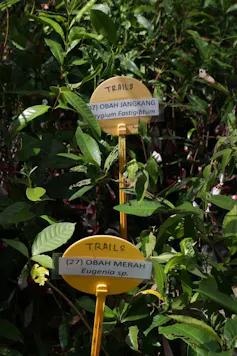
Appliquée au palmier à huile, l’agroforesterie reste encore peu développée à grande échelle. Les craintes d’une baisse de rendement, la complexité technique des systèmes à mettre en place, et les contraintes de gestion expliquent en partie cette situation. C’est précisément pour tester ces hypothèses à l’échelle réelle qu’a été lancé le projet Transitionning to Agroecological Innovative Landscapes in Sabah, East Malaysia (TRAILS), d’agroforesterie à taille réelle.
Le projet couvre 38 hectares (ha) d’essais installés dans une plantation commerciale de 8 000 ha, dans le bassin de la rivière Kinabatangan, dans l’État de Sabah, dans la partie malaisienne de l’île de Bornéo. Il s’appuie sur des dispositifs de plantation spécifiquement conçus pour le palmier à huile, combinant différentes densités et différents types d’associations d’arbres forestiers natifs afin d’optimiser à la fois les performances agronomiques et les fonctions écologiques des plantations.
Les pépinières d’espèces forestières natives alimentent l’ensemble des projets de reforestation du bassin de la Kinabatangan. Fourni par l’auteur
Contrairement à l’image classique de cultures poussant à l’ombre de grands arbres, les palmiers à huile forment déjà une canopée relativement basse et régulière. L’agroforesterie consiste ici à introduire d’autres espèces d’arbres au sein des parcelles, soit entre les rangées, soit en petits groupes, afin de créer une végétation plus diversifiée et structurée en plusieurs étages. On obtient ainsi un paysage où les palmiers coexistent avec des arbres de tailles et de formes variées, rompant avec l’uniformité des plantations conventionnelles. La question de la compétition pour la lumière est centrale, elle va conduire à des choix d’espèces aux architectures complémentaires : certaines laissent filtrer la lumière, d’autres occupent des strates différentes de la canopée.
Des schémas de plantation innovants
Les systèmes agroforestiers testés dans le cadre du projet TRAILS reposent de fait sur des schémas de plantation innovants. Les espèces forestières sont sélectionnées pour leur compatibilité écologique avec le palmier à huile, leur architecture et leur capacité à structurer l’espace sans entrer en compétition excessive pour la lumière, l’eau ou les nutriments. Les espèces introduites sont choisies pour leur complémentarité avec le palmier à huile.
Dans la vallée de la Kinabatangan, des projets de restauration menés notamment par différents intervenants locaux, comme la coopérative villageoise Kopel ou l’ONG Hutan, utilisent des espèces locales, comme Octomeles sumatrana (binuang), Nauclea sp. ou des figuiers (Ficus). Certaines ont une croissance rapide et améliorent le microclimat, d’autres tolèrent les sols inondés ou développent des racines profondes, limitant la compétition pour l’eau et les nutriments.
Ces arbres permettent de moduler l’ombrage, d’améliorer les microclimats et de diversifier la structure verticale des plantations. Les figuiers fournissent des ressources alimentaires clés pour la faune tout au long de l’année. Ces choix de conception jouent un rôle déterminant dans les performances attendues du système : elles font l’objet d’analyses détaillées dans les travaux récents menés au Sabah.
Productivité et biodiversité : un compromis moins difficile qu’attendu
L’une des principales interrogations concernant l’intégration de l’agroforesterie dans les plantations de palmiers à huile porte sur son impact potentiel sur la productivité. Les premiers résultats obtenus au Sabah montrent que les palmiers cultivés en association avec des arbres forestiers peuvent maintenir, dans les stades précoces étudiés jusqu’à présent, des niveaux de production comparables à ceux des monocultures conventionnelles.
L’intégration d’arbres dans les plantations, qu’il s’agisse de palmiers à huile ou d’autres cultures, modifie sensiblement le microclimat des parcelles. La présence d’une végétation plus diversifiée et stratifiée permet de réduire les températures au sol de 2 à 5 °C, grâce à l’ombrage et à l’évapotranspiration des arbres, tout en maintenant une humidité plus élevée et en limitant l’évaporation de l’eau dans les sols. Les arbres jouent également un rôle de brise-vent, réduisant la vitesse du vent et l’érosion. L’ensemble de ces effets atténue les stress hydriques et thermiques et renforce la résilience des cultures face aux aléas climatiques.
En parallèle, les bénéfices pour la biodiversité sont significatifs. Plus de 60 espèces d’oiseaux ont été recensées dans les parcelles agroforestières, contre généralement moins de 20 à 30 espèces dans les plantations de palmiers à huile conventionnelles, souvent dominées par quelques espèces généralistes. L’augmentation de la diversité végétale au sein des plantations favorise, pour sa part, la présence d’oiseaux et d’autres groupes faunistiques qui contribue à restaurer certaines fonctions écologiques, comme la régulation des insectes ravageurs ou la dispersion des graines, dans des paysages fortement fragmentés. Dans des régions comme la Kinabatangan, ces systèmes plus complexes peuvent également améliorer la qualité de l’habitat et la connectivité écologique pour certaines espèces, en complément des forêts restantes.
Comme l’a souligné un article récent, les dispositifs agroforestiers pourraient rendre les paysages dominés par le palmier à huile plus favorables aux déplacements de la faune sauvage. Ces espaces peuvent notamment bénéficier à des espèces en danger d’extinction, telles que les orangs-outans, les éléphants ou les macaques, capables de traverser des plantations, mais aussi à des animaux moins emblématiques, tels que les civettes, ou encore à de nombreux oiseaux forestiers et chauves-souris, qui utilisent ces zones comme habitats intermédiaires ou corridors entre fragments de forêt.
Un levier face au changement climatique
Au-delà de ses effets positifs sur la biodiversité, l’agroforesterie constitue également un levier important d’adaptation au changement climatique dans les plantations tropicales. L’intégration d’arbres au sein des parcelles permet de réduire les températures au sol, d’améliorer la rétention d’eau dans les sols et de limiter l’érosion, contribuant ainsi à renforcer la résilience des systèmes agricoles face aux perturbations climatiques.
Ces aménagements peuvent aussi améliorer les conditions de travail dans les plantations, notamment en apportant de l’ombre et en atténuant l’exposition des travailleurs à des chaleurs extrêmes, un enjeu sanitaire de plus en plus important dans les régions tropicales. En effet, les travailleurs agricoles sont directement confrontés aux effets du changement climatique : températures plus élevées, pluies plus irrégulières ou périodes de sécheresse plus fréquentes rendent le travail en plein air encore plus pénible. Ces conditions peuvent également affecter la productivité des cultures, ce qui accentue la précarité économique des travailleurs et la vulnérabilité des filières agricoles.
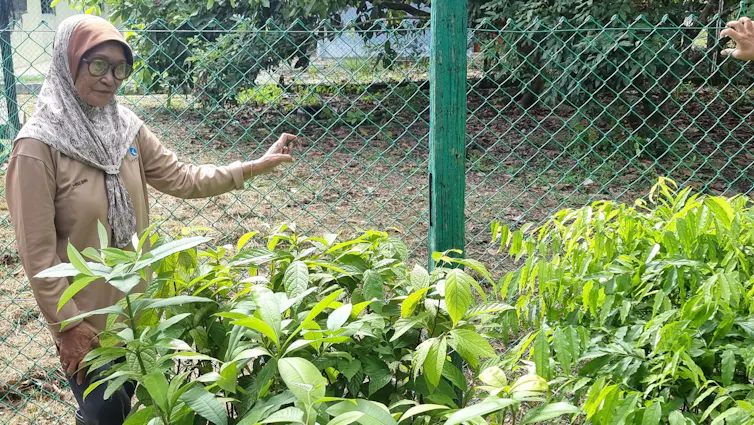
Les plants de pépinières font l’objet d’une attention particulière auprès des groupes de femmes du projet TRAILS. Alain Rival, Cirad, Fourni par l’auteur
Ces activités sont accompagnées de formations techniques en agroforesterie et en gestion durable des terres, contribuant au renforcement des compétences locales et à la diversification des moyens de subsistance dans une zone rurale assez isolée. Cette implication continue des communautés locales est essentielle pour garantir l’appropriation des systèmes agroforestiers et leur pérennité à long terme.
La plaine de la Kinabatangan est un hotspot de biodiversité désormais intégré à la Kinabatangan Biosphere Reserve (KBR) de l’Unesco. Alain Rival, Cirad, Fourni par l’auteur
Vers des paysages multifonctionnels
La reconnaissance de la plaine de la Kinabatangan comme réserve de biosphère de l’Unesco souligne l’importance de modèles agricoles capables de s’articuler avec des objectifs de conservation à l’échelle du paysage (Unesco, 2023).
Les approches agroforestières expérimentées au Sabah s’inscrivent pleinement dans cette logique intégrée. Sans remplacer les forêts tropicales intactes, les systèmes agroforestiers à base de palmiers à huile peuvent contribuer à transformer les paysages agricoles en leviers complémentaires de conservation et de résilience écologique.
Cet article a été réalisé avec Isabelle Lackman, de l’ONG Hutan, et Sempe Burhan, de la Melangking Oil Palm Plantations.
Alain Rival a reçu des financements Le Fonds de solidarité pour les projets innovants (FSPI), un dispositif de financement ministère de l’Europe et des Affaires étrangères.
Le projets TRAILS recoit le soutien financier de l’APF (Alliance pour la Protection des Forets), ainsi que des sociétés Ferrero et Saint Hubert.
Denis Fabre, Marc Ancrenaz et Philippe Guizol ne travaillent pas, ne conseillent pas, ne possèdent pas de parts, ne reçoivent pas de fonds d’une organisation qui pourrait tirer profit de cet article, et n’ont déclaré aucune autre affiliation que leur poste universitaire.
Les conséquences des violences conjugales ne s’arrêtant pas à la porte des entreprises, certaines d’entre elles les ont intégrées dans leur politique de diversité, d’égalité et d’inclusion. Panorama des outils proposés par certaines firmes du CAC 40.
Parmi les victimes de violences conjugales, nombreuses sont celles qui occupent un emploi. Quand elles partent travailler, elles quittent le domicile et leur agresseur. Face à cette évidence, le milieu professionnel peut constituer un espace de protection, de ressources et de socialisation. En conséquence, il peut aussi devenir un acteur à part entière de la lutte contre les violences conjugales.
Les violences conjugales passent la porte de l’entreprise
Dans toute organisation, il existe inévitablement des personnes confrontées à des violences conjugales. Ces violences ont des répercussions significatives sur la vie professionnelle. Elles peuvent entraîner des retards, des absences répétées, une baisse de concentration, une fatigue chronique ou encore une diminution de la qualité du travail. Les relations avec les collègues ou avec l’encadrement peuvent également se dégrader parce que la personne victime se trouve en situation d’épuisement psychologique, émotionnel ou physique. La victime risque d’ailleurs d’être perçue comme un ou une collègue moins fiable.
La convention d’Istanbul rappelle que les violences faites aux femmes ne relèvent pas de simples conflits privés, mais qu’elles constituent l’expression d’un système où la domination, la discrimination et les stéréotypes de genre créent un terrain favorable à l’emprise et à la violence. Ces violences sont à la fois la cause et la conséquence des inégalités entre les femmes et les hommes. Elles s’enracinent dans des rapports de pouvoir déséquilibrés et contribuent, en retour, à limiter l’autonomie personnelle, économique et professionnelle des femmes.
Pour une organisation, ne pas intégrer ce sujet dans sa stratégie d’égalité, de diversité et d’inclusion revient à ignorer un obstacle important et invisible à l’égalité réelle. Depuis quelques années, plusieurs grands groupes (dont Kering, L’Oréal, BNP Paribas, Carrefour, SNCF et EDF) se sont engagés dans des initiatives collectives comme le réseau OneInThreeWomen, créé en 2018, qui incite les employeurs à inscrire la prise en charge des violences conjugales dans leur stratégie de diversité et d’inclusion.
Des bonnes pratiques
Plusieurs organisations, en France et à l’international, ont déjà intégré la lutte contre les violences conjugales dans leurs engagements en matière d’égalité entre les femmes et les hommes. Voici quelques axes d’action issus de ces retours d’expérience.
De grandes entreprises ont lancé des campagnes de sensibilisation en interne (affichages, newsletters spécifiques, podcasts…) pour faire connaître l’ampleur du problème et les ressources disponibles. Certaines formations ciblent les managers, le personnel RH, les services sociaux ou de santé au travail, afin de mieux repérer les signaux d’alerte et réagir correctement. De son côté, Kering a choisi de sensibiliser progressivement tous ses collaborateurs, du vendeur en boutique jusqu’aux membres du comité exécutif, en s’appuyant sur des associations spécialisées.
BNP Paribas, avec son pôle d’action sociale au sein des RH, intègre les violences conjugales dans l’écoute des collaborateurs en difficulté. Ce type de service interne permet de briser l’isolement de la victime en lui proposant écoute, conseils et orientation vers les associations spécialisées.
« Le maintien dans l’emploi est une priorité absolue », déclare BNP Paribas, qui peut par exemple proposer à une victime un changement de site géographique si sa sécurité l’exige. Chez EDF, les services sociaux sont aussi au centre des dispositifs à destination des victimes de violences conjugales, et peuvent permettre la demande de mesures de soutien comme un hébergement temporaire ou des aides financières.
Certaines entreprises ont choisi d’accorder les jours d’absences rémunérées ; par exemple, trois jours d’absence rémunérés à La Poste pour effectuer les démarches (dépôt de plainte, rendez-vous médicaux, relogement…) nécessaires. Outre les congés, la flexibilité du temps de travail peut aussi être cruciale : aménagement d’horaires afin de permettre à la personne de disposer de temps pour les démarches inhérentes aux violences.
Un écosystème de soutien
Souvent, les victimes ne savent pas vers qui se tourner pour obtenir de l’aide, tandis que les entreprises, de leur côté, ne disposent pas toujours de l’expertise nécessaire. C’est pourquoi certains groupes établissent des partenariats avec des associations spécialisées pour orienter les salariées concernées vers des professionnel·les formé·es et proposer des interventions, formations ou ateliers de sensibilisation. En unissant leurs forces avec le tissu associatif, les employeurs contribuent à créer un écosystème de soutien autour de la victime.
Certains partenariats vont plus loin, c’est le cas entre EDF et l’association FIT Une femme, un toit, avec la réalisation de recherche-action et la co-construction de dispositifs adaptés aux réalités de terrain et enrichis par l’expertise associative, ce qui permet à l’entreprise et à l’association de monter en compétences mutuellement.
Ministère chargé de l’égalité entre les femmes et les hommes, 2024.
Formaliser l’engagement et garantir de nouveaux droits
Certaines entreprises inscrivent leur engagement dans leurs politiques RH avec la signature d’une charte – qu’elle soit interne à l’entreprise ou interentreprises, par exemple la charte OneInThreeWomen.
D’autres entreprises ont fait le choix de l’intégration des violences conjugales dans les accords collectifs relatifs à l’égalité professionnelle entre les femmes et les hommes, ce qu’ont fait des entreprises pionnières, comme Orange, EDF, SNCF, Korian, La Poste, Carrefour, Legrand. Ces engagements négociés avec les partenaires sociaux garantissent de nouveaux droits et les moyens alloués, ils témoignent de la vision partagée entre direction et syndicats de la reconnaissance des conséquences professionnelles des violences conjugales et du rôle du milieu professionnel auprès des victimes.
Considérer les violences conjugales comme un objet à part entière des politiques d’égalité, de diversité et d’inclusion constitue une évolution culturelle majeure dans le monde du travail.
Cela suppose de reconnaître que les violences conjugales ne relèvent pas uniquement de la sphère personnelle ou sociétale, mais qu’elles constituent également un enjeu organisationnel. Il s’agit dès lors d’un nouveau défi managérial, dans la continuité des engagements en faveur de l’égalité entre femmes et hommes, qui doit permettre, en partenariat avec les politiques publiques de lutte contre les violences et les associations féministes spécialistes de l’accompagnement des victimes, de construire un environnement favorable à la sortie des violences.
Séverine Lemière est membre de l’association FIT une femme un toit. Elle mène des recherches-actions avec EDF.
Olga Lelebina ne travaille pas, ne conseille pas, ne possède pas de parts, ne reçoit pas de fonds d’une organisation qui pourrait tirer profit de cet article, et n’a déclaré aucune autre affiliation que son organisme de recherche.
Le groupe Slayer au Hellfest, en 2017.Photo Corentin Charbonnier, Fourni par l’auteur
Vingt ans après la loi de 2005 sur l’égalité des droits des personnes en situation de handicap, l’accessibilité des lieux culturels a nettement progressé en France. Mais la participation réelle des publics concernés reste limitée. Une expérimentation menée entre une pension de famille et le Hellfest, en Loire-Atlantique, montre en quoi l’inclusion ne se résume pas à des aménagements techniques.
Un samedi de juin 2023, au milieu des dizaines de milliers de festivaliers réunis au Hellfest (Clisson, Loire-Atlantique), six habitants d’une pension de famille découvrent pour la première fois l’un des plus grands festivals de France. Certains vivent avec des troubles psychiques, d’autres avec des limitations physiques et pourtant, tous participent à une expérience singulière : explorer ce que signifie réellement l’« inclusion » dans un événement culturel singulier. Cette expérimentation, menée avec des résidents de la pension de famille de l’Orangerie, une structure gérée par la Croix-Rouge française, invite à repenser en profondeur la manière dont les institutions culturelles abordent le handicap. Car malgré les progrès réalisés ces dernières années, l’accès à la vie culturelle reste encore limité pour de nombreuses personnes en situation de handicap.
Tenir compte du handicap invisible
Depuis la loi française de 2005 sur l’égalité des droits des personnes handicapées, les lieux culturels ont considérablement amélioré leur accessibilité physique : rampes d’accès, plateformes réservées, signalétique adaptée. Mais un paradoxe demeure : malgré ces aménagements, les personnes en situation de handicap participent encore relativement peu à la vie culturelle et associative. Si le handicap visible est de fait perceptible, le handicap invisible, notamment psychique ou cognitif, reste pour le grand public, méconnu. La diversité des troubles et de leur prise en soin entrave leur plein exercice de la citoyenneté et donc leur participation à des évènements culturels. Le contexte des festivals ne peut être de ce fait limité à la simple implantation d’un accès physique adapté.
Vivre un festival autrement
En s’appuyant sur l’expertise de professionnels, de bénévoles et en expérimentant, les initiatives portées par le Hellfest permettent de proposer une autre approche de l’accessibilité. Par exemple, pour les personnes malentendantes, des gilets vibrants permettant de ressentir physiquement les vibrations de la musique sont proposés. Certains concerts sont aussi partiellement traduits en langue des signes.
Ces dispositifs illustrent une idée simple : l’accessibilité ne consiste pas forcément à reproduire une expérience standard pour tous, mais à permettre des manières différentes de vivre un même événement. Pour les participants de la pension de famille de l’Orangerie, l’expérience du festival s’avère à la fois fascinante et déstabilisante. Les structures monumentales du site, l’intensité sonore ou la densité de la foule peuvent susciter autant d’émerveillement que d’appréhension. Mais ces réactions contrastées révèlent aussi une réalité souvent oubliée : les personnes vivant avec un handicap psychique ne sont pas condamnées à rester à l’écart de ces expériences culturelles. Elles peuvent y participer pleinement, à condition que les conditions soient adaptées et préparées et devenir ainsi expertes de leurs conditions d’accessibilité.
L’inclusion commence bien avant l’événement
Pendant plus d’un an, les participants ont préparé, avec le soutien de leur encadrant, moniteur-éducateur de formation, leur venue : visites du site à vide, participation à la tournée Warm-Up du festival, repérage des espaces accessibles, organisation du suivi médical ou logistique. Cette phase d’anticipation a permis aux résidents de se familiariser progressivement avec l’environnement du festival et d’en réduire les incertitudes.
Le projet n’est pas né d’une décision institutionnelle. Il a été proposé par une résidente lors d’une réunion collective de la pension de famille, puis discuté et adopté par le groupe. Autrement dit, les participants n’ont pas simplement été « inclus » dans un dispositif : ils ont contribué à construire eux-mêmes leur participation.
Une inclusion qui mobilise tout un écosystème
L’inclusion culturelle repose rarement sur un seul acteur. Dans cette expérimentation, plusieurs organisations ont joué un rôle déterminant : la pension de famille de l’Orangerie, la Croix-Rouge française, l’association Culture du cœur, mais aussi des mécènes du festival. Chacun contribue à résoudre une partie des difficultés : financement, accompagnement social, logistique, accès aux billets ou médiation culturelle. Cette configuration rappelle que l’inclusion culturelle est un processus collectif impliquant de multiples organisations. Elle s’imbrique ainsi pleinement dans une démarche partenariale, essentielle au travail social.
Cet écosystème ne peut fonctionner sans le rôle clé de certains acteurs, capables de relier des univers qui communiquent peu entre eux et donc de rendre les frontières entre ces acteurs moins imperméables. Éducateurs spécialisés, médiateurs culturels ou réalisateur, familiers du travail social, peuvent ainsi agir comme des « acteurs-frontières ». Leur rôle consiste à traduire les attentes et les contraintes de chaque milieu (institutions sociales, organisateurs culturels, participants) afin de rendre possible la coopération.
Le metal, un terrain inattendu
Cette expérimentation (dont le documentaire Rendre l’enfer accessibletémoigne avec sincérité) invite à repenser les politiques publiques d’accessibilité culturelle, encore largement centrées sur l’adaptation physique des infrastructures. Trois pistes émergent : (1) élargir la définition du handicap prise en compte dans les politiques culturelles, afin d’intégrer davantage les handicaps psychiques ou invisibles, (2) soutenir financièrement les démarches de co-construction avec les publics concernés, et pas seulement les investissements matériels, et (3) former et reconnaître les acteurs-frontières, qui jouent un rôle essentiel dans la mise en relation des différents partenaires.
Souvent associé à une esthétique radicale ou marginale, le metal apparaît rarement dans les débats sur les politiques culturelles. Avec une identité historiquement construite autour de communautés de fans fortement engagées et solidaires, certaines initiatives d’inclusion trouvent un terrain favorable pour se développer : elles ne sont pas sans faire écho à l’éthos de l’identité metal : partager un moment collectif, au-delà des distinctions sociales ou physiques, à l’instar des valeurs qui façonnent ce genre musical et véhiculées par certains groupes tels que Gojira.
Les auteurs ne travaillent pas, ne conseillent pas, ne possèdent pas de parts, ne reçoivent pas de fonds d’une organisation qui pourrait tirer profit de cet article, et n’ont déclaré aucune autre affiliation que leur organisme de recherche.
La pyramide El Castillo à Chichén Itzá, au Mexique actuel. Lors des équinoxes, les ombres sur la pyramides semblent guider le dieu serpent vers le sommet.Noémie Combe, Fourni par l’auteur
Mille ans avant l’Europe, les Mayas résolvaient déjà des équations complexes. Armés du seul regard et d’une patience infinie, ils scrutaient le ciel et prédisaient avec précision les éclipses et les trajectoires des planètes.
Embarquons pour un voyage dans des temps reculés. Nous sommes sur les territoires des actuels Mexique, Guatemala, Bélize, Honduras et Salvador. C’est dans ce cadre luxuriant que les Mayas ont bâti un héritage extraordinaire : une astronomie stupéfiante, des mathématiques avancées, une architecture audacieuse et une écriture hiéroglyphique riche.
Ainsi, les cités mayas étaient orientées vers les astres. À Chichén Itzá (actuellement au Mexique), lors des équinoxes, les ombres sur la pyramide El Castillo semblent animer la progression du dieu serpent Kukulkan le long des marches – un phénomène comparable s’observe à El Tajín.
Chichén Itza et le serpent à l’équinoxe (Giulio Magli). Source : Polimi OpenKnowledge.
Les « codex », leurs traités astronomiques, sont un des rares témoignages survivants de ces savoirs. Le plus célèbre est le codex de Dresde. Son mystère est double : l’énigme de ses symboles – glyphes serrés, colonnes de chiffres, divinités codifiées – et celle de son destin.
Comment ce manuscrit du Yucatán a-t-il traversé l’Atlantique pour échouer dans une bibliothèque de Saxe ? La théorie dominante veut que l’Espagnol Hernán Cortés (1485-1547) l’ait envoyé en Europe après la conquête du Mexique, parmi les objets précieux offerts à la cour madrilène. Le manuscrit aurait circulé en Europe avant d’aboutir à Vienne, où, en 1739, le directeur de la bibliothèque royale de Dresde Johann Christian Götze le racheta à un propriétaire le jugeant « incompréhensible et sans valeur », ignorant qu’il tenait l’un des documents astronomiques les plus sophistiqués jamais produits. Götze le rapporta à Dresde, où il est toujours conservé aujourd’hui.
Extrait du « codex de Dresde », à lire de gauche à droite. Le personnage au nez ornementé, suspendu à droite, est le dieu maya de Mars – la « bête de Mars ». Sa présence confirme que tous les calculs de cette page concernent Mars et ses cycles. Codex de Dresde, Princeton University Library
Sur la page du codex de Dresde concernent Mars et ses cycles se trouve une suite de nombres : 78, 156, 234, 312, 390, 780. Chaque terme est un multiple de 78. On observe par ailleurs que cette suite est presque une suite arithmétique (une suite telle que la différence entre deux termes consécutifs doit être égale à une constante), mais le dernier terme déroge : il vaut 10 × 78 (au lieu de 6 × 78).
Le 78 correspond à un dixième de la « période synodique » de Mars, c’est-à-dire le temps pour retrouver la même position dans le ciel, vue depuis la Terre, soit 780 jours. Les Mayas l’avaient calculée avec une précision remarquable : 780 jours contre 779,94 jours aujourd’hui. Les cinq premiers termes balisent les étapes intermédiaires, et le dernier marque le cycle complet.
Le zodiaque maya comptait 13 constellations le long de l’écliptique, et Mars met 260 jours (13 × 20) pour le parcourir. Trois traversées complètes du zodiaque maya correspondent exactement à 780 jours. Cette durée de 260 jours correspond aussi au Tzolk’in, le calendrier rituel maya, ce qui permet d’aligner parfaitement le rythme de Mars et le calendrier. Ainsi, la suite de nombres sur le codex formait une table de navigation céleste.
Les éclipses lunaires
Une autre page du codex présente une nouvelle suite de nombres : 9 360, 9 537, 9 714, 9 891, 10 039. Jusqu’à 9 891, chaque valeur augmente de 177 jours (9 183 + 177 = 9 360, 9 360 + 177 = 9 537, 9 537 + 177 = 9 714, 9 714 + 177 = 9 891). Mais ici encore, le dernier terme rompt le schéma : 10 039 = 9 891 + 148, révélant un second cycle.
Ceci n’est pas une erreur : si la période synodique de la Lune est de 29,5 jours environ, toutes les pleines lunes ne donnent pas lieu à une éclipse. L’intervalle entre deux éclipses consécutives correspond à 5 ou 6 lunaisons (soit 148 ou 177 jours).
En effet, l’orbite de la Lune est inclinée d’environ 5° : les éclipses ne se produisent qu’au voisinage d’un nœud orbital. Le Soleil y passe tous les 173,31 jours (la saison d’éclipses), et il s’écoule nécessairement 5 ou 6 lunaisons entières entre deux éclipses.
Schéma expliquant pourquoi toutes les pleines Lunes ne résultent pas en éclipses. Noémie Combe, Fourni par l’auteur
Le système mathématique des Mayas
La sophistication mathématique des Mayas transparaît jusque dans leur quotidien. Ils pratiquaient instinctivement ce que l’on appelle aujourd’hui l’arithmétique modulaire. Le principe en est simple : plutôt que de considérer la valeur d’un nombre, l’arithmétique modulaire s’intéresse uniquement au reste qu’il laisse après division par un nombre de référence – le modulo (ici, modulo 20). Les Mayas, sans jamais employer ce vocabulaire, appliquaient précisément cette logique, et ce, bien avant que le mathématicien allemand Carl Friedrich Gauss (1777-1855) n’en pose les bases formelles au tournant du XIXᵉ siècle. Aujourd’hui, on trouve un écho de ce genre de mathématiques dans des domaines aussi contemporains que la cryptographie et la sécurité informatique.
En langage moderne, ces calculs s’interprètent comme des opérations dans l’anneau ℤ/20ℤ. Cette notion d’anneau est l’une des pierres angulaires des mathématiques contemporaines, au cœur de l’algèbre abstraite de la fin du XIXᵉ siècle. Parmi ses fondateurs figure le mathématicien Richard Dedekind (1831–1916).
Les pages du codex recèlent encore bien des zones d’ombre et de mystère. Qui sait quels secrets dorment encore dans les colonnes de glyphes du codex, attendant d’être dévoilés ?
Noémie Combe ne travaille pas, ne conseille pas, ne possède pas de parts, ne reçoit pas de fonds d’une organisation qui pourrait tirer profit de cet article, et n’a déclaré aucune autre affiliation que son organisme de recherche.
On savait que la qualité du sperme déclinait avec les années. De nouveaux travaux révèlent que les spermatozoïdes s’altèrent également durant les périodes d’abstinence, ce qui pourrait avoir des conséquences en matière de fertilité.
En matière de reproduction, la biologie féminine est souvent vue comme un implacable compte à rebours. Les femmes naissent en effet avec une réserve d’ovocytes qui durera leur vie entière. Cela signifie que l’âge d’une femme et celui de ses ovocytes coïncident généralement. Autrement dit, plus une femme avance en âge, plus ses ovocytes vieillissent.
La reproduction masculine est régie, quant à elle, par des mécanismes différents. Les spermatozoïdes sont produits de manière continue à partir de la puberté, et peuvent être stockés dans les voies génitales avant l’éjaculation. En d’autres termes, l’âge d’un homme et celui de ses spermatozoïdes ne sont pas forcément les mêmes. Mais qu’advient-il des gamètes mâles durant cette période d’attente ?
Les hommes souhaitant procréer se voient fréquemment conseiller d’observer une période d’abstinence sexuelle de quelques jours avant d’avoir une relation sexuelle, afin de permettre une augmentation de la concentration en spermatozoïdes de leur éjaculat. S’il est avéré que l’abstinence accroît la numération spermatique, le volume éjaculé n’est pas l’unique facteur déterminant le degré de fertilité.
Les résultats de notre nouvelle étude démontrent que chez l’être humain (ainsi que chez d’autres espèces animales), les spermatozoïdes qui sont stockés durant les périodes d’abstinence subissent un processus de « sénescence » et voient en réalité leur qualité s’altérer.
Nous savions déjà que la fertilité masculine décline avec l’âge. Déterminer si la durée de stockage des spermatozoïdes contribue à ce déclin est d’autant plus opportun à notre époque que l’activité sexuelle semble en recul, en particulier chez les jeunes. Conjuguée à la tendance mondiale au report de la parentalité, cette évolution pourrait accroître encore la baisse de la fécondité observée à l’échelle du globe.
Stress et épuisement
Dans le cadre de nos travaux, nous avons compilé les données portant sur la semence de près de 55 000 hommes ayant participé à 115 études publiées dans des revues scientifiques. Nos analyses indiquent que lorsqu’un homme s’abstient d’éjaculer, la santé de ses spermatozoïdes décline de manière significative. Leur capacité de déplacement (mobilité spermatique) et leur viabilité s’amenuisent, tandis que leur ADN subit davantage de lésions.
Nous avons identifié deux causes probables à ces phénomènes. La première est le stress oxydatif (que l’on peut schématiquement considérer comme une sorte de « rouille » biologique) qui s’accumule dans les spermatozoïdes et peut les endommager. La seconde est l’épuisement énergétique : à l’inverse de la plupart des cellules, les spermatozoïdes sont extrêmement actifs, mais n’ont qu’une capacité limitée à reconstituer leurs réserves d’énergie. En cas de stockage prolongé, ils se retrouvent tout simplement à court de carburant…
Avant de fournir un échantillon de sperme destiné à être analysé, ou à être employé dans le cadre d’un traitement destiné à améliorer la fertilité ou une procédure de type FIV (fécondation in vitro), l’Organisation mondiale de la santé préconise une période d’abstinence allant de deux à sept jours. Cependant, nos travaux laissent entendre que des délais plus courts pourraient s’avérer préférables pour optimiser la qualité spermatique des échantillons.
Ces observations corroborent une découverte récente selon laquelle, dans le cadre d’une procédure de FIV, une éjaculation survenant moins de 48 heures avant le prélèvement améliore les résultats des traitements par rapport à des durées d’abstinence plus longues.
Elles sont également en ligne avec une hypothèse formulée par les biologistes évolutionnistes. Nous savons que chez les primates, la masturbation, qui entraîne des éjaculations fréquentes, améliore la qualité des éjaculats. Ce constat, mis en perspective avec nos propres résultats, suggère que la masturbation masculine pourrait présenter un avantage adaptatif : elle permettrait l’évacuation des spermatozoïdes stockés et altérés.
La détérioration du sperme ne se produit pas seulement lorsque celui-ci est stocké dans l’organisme masculin. Elle peut également survenir après l’accouplement, lors du stockage au sein des voies génitales féminines. Si les spermatozoïdes humains ne survivent que quelques jours chez la femme, dans d’autres espèces animales, telles que les fourmis, les abeilles ou les chauves-souris, le sperme peut être conservé dans le corps des femelles pendant plusieurs mois, voire plusieurs années, avant d’être employé pour fertiliser les œufs.
De la faune à l’humain : une constante biologique
Afin de vérifier si l’altération du sperme durant le stockage correspond à un schéma biologique universel, nous avons examiné les données de 56 études couvrant 30 espèces animales différentes, incluant des oiseaux, des abeilles, des reptiles et divers mammifères. Là encore, nous avons constaté que la qualité spermatique déclinait effectivement durant la phase de stockage. Les pères ayant stocké leur sperme avant l’éjaculation ou les mères l’ayant conservé avant la fertilisation ont produit des embryons dont les chances de survie étaient moindres.
Selon nous, ces résultats ne sont pas uniquement dus à la dégradation de l’ADN. Il se pourrait également que, par rapport aux spermatozoïdes fraîchement produits, les spermatozoïdes stockés présentent un profil d’expression génique différent (autrement dit, que les gènes qui sont activés chez eux soient dans une configuration différente).
Fait intéressant, le sperme s’altère à un rythme plus lent chez les femelles que chez les mâles. Cela pourrait s’expliquer par le fait que les femelles de diverses espèces qui stockent les spermatozoïdes ont développé des organes spécialisés qui sécrètent des antioxydants. Ces substances nourrissent et protègent les spermatozoïdes stockés, prolongeant ainsi leur durée de vie fonctionnelle.
De nombreux troubles de la fertilité dépendent de facteurs qui échappent à notre contrôle. Ils peuvent être la conséquence de notre exposition à des polluants environnementaux, au stress, ou résulter de notre bagage génétique. La durée de stockage du sperme, en revanche, est un paramètre aisément modifiable. Nos travaux suggèrent qu’en perspective d’une fécondation, il pourrait être intéressant de privilégier des spermatozoïdes issus d’une éjaculation récente. Cette intervention simple, en optimisant la qualité séminale, pourrait offrir un gain substantiel en matière de fertilité.
Rebecca Dean bénéficie d’une bourse Daphne Jackson financée par le NERC.
Irem Sepil bénéficie d’un financement du BBSRC et de la Royal Society.
Krish Sanghvi ne travaille pas, ne conseille pas, ne possède pas de parts, ne reçoit pas de fonds d’une organisation qui pourrait tirer profit de cet article, et n’a déclaré aucune autre affiliation que son organisme de recherche.
Dans un contexte où l’islam est régulièrement présenté comme un défi pour la cohésion nationale, la Grande Mosquée de Paris publie un guide, Musulmans en Occident. Pratique cultuelle immuable, présence adaptée, destiné à « adapter » la présence musulmane au cadre français. Son interprétation de termes, tels que séparatisme, jihād, laïcité, ou islamophobie, déplace la compréhension de ce qu’est – et n’est pas – l’islam. Par exemple, le guide réinscrit la laïcité dans une généalogie islamique, ou considère le « séparatisme » comme un phénomène extérieur à la doctrine.
La Grande Mosquée de Paris, par l’intermédiaire de la commission dite « religieuse » chargée de la rédaction du guide, propose une interprétation de certains termes centraux du débat sur l’islam de France à travers son guide Musulmans en Occident. Pratique cultuelle immuable, présence adaptée. Héritière d’une histoire d’institutionnalisation étroitement liée à l’État, la Grande Mosquée occupe une position d’interface : elle se présente comme partenaire des pouvoirs publics pour encadrer un islam compatible avec le cadre laïc et républicain.
Dans le même temps, elle se situe en tension, ou en compétition, avec d’autres pôles de représentation (fédérations, courants, instances nationales successives), ce qui relativise sa capacité à parler au nom de « l’islam de France ». Son entreprise de redéfinition est particulièrement intéressante concernant certains termes controversés tels que séparatisme, jihād, laïcité ou islamophobie.
Séparatisme
Lorsque le mot « séparatisme » est mobilisé dans le débat public, il renvoie à l’idée d’une contre-société islamiste menaçant la cohésion nationale. Dans le discours des Mureaux du 2 octobre 2020, Emmanuel Macron désigne un projet politico-religieux visant à soustraire certains groupes à la loi commune et à fragiliser l’unité républicaine. Le terme fonctionne comme une catégorie englobante : il relie radicalisation, influences étrangères, repli communautaire et menace sécuritaire dans une même matrice interprétative.
La Grande Mosquée ne conteste ni l’existence de phénomènes de repli ni la légitimité de l’État à intervenir. Mais elle soutient que la notion, telle qu’elle est mobilisée par les responsables politiques et les médias, ne possède pas d’équivalent doctrinal dans la tradition islamique classique. Les catégories médiévales parfois convoquées pour suggérer une logique intrinsèque de séparation, comme dār al-islām et dār al-ḥarb, sont replacées dans leur contexte historique et géopolitique.
En mobilisant des principes juridiques d’adaptation, comme la darūra (la nécessité) ou la recherche de la maṣlaḥa (l’intérêt commun), ainsi que des références scripturaires, notamment le verset 14 de la sourate 49 valorisant la pluralité des peuples, le guide défend une thèse claire : le repli séparatiste ne procède d’aucune obligation religieuse.
Le déplacement est décisif. Là où le discours politique tend à inscrire le « séparatisme » dans une problématique structurelle touchant à l’islamisme et, plus largement, à l’organisation du religieux, le guide en fait un phénomène contingent, extérieur à la doctrine. Sans nier le terme, il le circonscrit et en fait un problème social ou politique, à travers le concept de « citoyenneté musulmane » (muwāṭana), comprise comme l’affirmation de la compatibilité entre la pratique religieuse et l’adhésion aux valeurs démocratiques, tout en le privant de fondement théologique. Ce faisant, la Grande Mosquée ne s’oppose pas frontalement à l’action publique, elle en redéfinit les implications religieuses.
Jihād
Un mécanisme comparable apparaît à propos du « jihād », autre mot devenu central dans les représentations sécuritaires.
Dans l’espace médiatique, il est largement assimilé à la violence armée. Le guide propose une lecture appuyée sur des usages textuels et juridiques classiques : il rappelle d’abord l’étymologie (« effort, lutte ») et met au premier plan le combat intérieur contre ses propres faiblesses, souvent désigné dans la tradition comme « jihād majeur ». Le Coran qualifie d’ailleurs une fois le jihād de « grand » (Q 25:52). La dimension armée, qualifiée de « jihād mineur », n’est pas niée, mais strictement encadrée : défense contre une agression, protection des opprimés, respect de limites précises interdisant toute violence indiscriminée (Q 2:190). Cette approche n’efface pas l’histoire des usages violents du terme, elle en conteste la centralité doctrinale. Autrement dit, ce qui structure la perception publique, la violence, devient une dimension secondaire et conditionnelle, tandis que l’effort moral est présenté comme le cœur normatif du concept.
Dans cette perspective, la guerre n’est pas désignée par jihād dans le texte coranique, qui recourt plutôt à qitāl (« combat armé »), voire à ḥarb, pour désigner la guerre au sens strict. La conflictualité n’y apparaît toutefois jamais comme un horizon autonome : elle est pensée dans une tension normative avec les notions de paix et de réconciliation – ṣulḥ, ṣalāḥ ou iṣlāḥ – qui visent à restaurer l’ordre face au fasād (« désordre, corruption »).
Le guide reprend la définition juridique de référence de la laïcité – liberté de conscience, neutralité de l’État, loi de 1905 –, mais il la met en parallèle avec des versets coraniques et avec la Charte de Médine (622), présentée comme un précédent historique de coexistence entre communautés religieuses sous une autorité commune. Ce rapprochement ne vise pas seulement à démontrer une compatibilité formelle. Il tend à réinscrire la laïcité dans une généalogie islamique, en suggérant que le pluralisme relève aussi de ressources internes à la tradition.
À travers ce déplacement, les rédacteurs du glossaire reconfigurent le cadre d’évaluation. La laïcité ne fonctionne plus uniquement comme une norme externe à laquelle l’islam devrait se conformer, mais comme un principe pouvant être mis en correspondance avec des catégories internes à la tradition. Le rapport implicite d’asymétrie s’en trouve transformé : l’islam n’est plus seulement sommé de prouver sa compatibilité, il est présenté comme disposant déjà de ressources permettant de penser la coexistence dans un cadre politique commun.
Islamophobie
L’entrée « islamophobie » révèle une autre facette de cette entreprise. Le terme y est défini comme une forme de discrimination visant des personnes en raison de leur appartenance réelle ou supposée à l’islam, ancré dans le droit de la lutte contre les discriminations. Or, les pouvoirs publics privilégient souvent l’expression « actes antimusulmans », estimant que « islamophobie » peut brouiller la distinction entre critique d’une religion, protégée par la liberté d’expression, et haine envers des individus. Cette réserve contraste avec la reconnaissance du terme dans certaines instances internationales, comme l’illustre l’instauration par les Nations unies d’une journée internationale de lutte contre l’islamophobie.
Dans ce contexte, le guide ne développe pas longuement cette controverse, mais il l’intègre à sa manière en faisant figurer dans le glossaire le néologisme « musulmanophobie », présenté comme une alternative moins controversée, car centré sur les personnes plutôt que sur la religion. Ce choix est révélateur de la démarche d’ensemble. Conscients des résistances que suscite le terme, les rédacteurs privilégient un mot de rechange qui préserve la réalité discriminatoire tout en désamorçant le débat sémantique, illustrant ainsi, à l’échelle d’un seul mot, la logique même du takyīf (« adaptabilité »).
Adaptabilité ou islam de France ?
Ces redéfinitions obéissent à une logique d’ensemble, dont la clé de lecture est la notion d’« adaptabilité ». Le guide la formule à travers le concept de takyīf, qu’il présente comme une capacité à ajuster l’application des normes au contexte et aux situations concrètes, et en fait la deuxième entrée du glossaire. L’ajustement au contexte y est présenté non comme une concession à la modernité occidentale, mais comme une exigence propre à la tradition juridique islamique. L’islam n’y apparaît pas comme un bloc figé en confrontation avec la République, mais comme une tradition dotée d’une capacité d’interprétation et d’ajustement internes.
Le choix de placer l’« adaptabilité » (takyīf) au cœur de la démarche n’est pas anodin face à la notion d’« islam de France », centrale dans les discours politiques récents. Les deux notions recouvrent des logiques distinctes.
L’« islam de France » suppose une reformulation normative, où c’est l’islam lui-même qui est appelé à se redéfinir structurellement et à intérioriser des normes extérieures à sa tradition. L’« adaptabilité » (takyīf) procède d’une tout autre démarche : ajuster les modalités de présence au contexte français en puisant dans les ressources propres de la tradition islamique. Dans le premier cas, l’impulsion vient de l’extérieur, dans le second, elle est revendiquée comme interne.
Changer les termes du débat ?
Le guide de la Grande Mosquée de Paris ne mettra certainement pas fin aux désaccords. Il opère cependant un geste important en refusant que les catégories forgées dans l’arène politique définissent seules le sens des termes qui structurent le débat public sur l’islam. Cette intervention survient dans un moment où l’islam est saisi dans l’espace public à travers une inflation de dénominations qui ne se limitent pas à des mots isolés, mais qui prennent souvent la forme de syntagmes récurrents – islam radical, islam modéré, islam religieux, islam politique – constituant progressivement un micro-système terminologique qui organise ce débat. Dans cette dynamique, chaque nouvelle catégorie agit comme un acte de nomination : elle sélectionne certains traits, en écarte d’autres et contribue à fixer une représentation particulière de l’islam dans la société française. Le débat ne porte donc pas seulement sur des réalités sociales, mais sur les opérations discursives par lesquelles ces réalités sont constituées comme problèmes publics.
Dans un contexte politique où ces opérations de nomination tendent à se multiplier, se pose aussi la question de l’adresse même de ce glossaire. À bien des égards, son destinataire implicite ne semble pas tant être les musulmans de France que les acteurs publics avec lesquels se négocient les termes mêmes du débat. Le geste consistant à redéfinir ces mots apparaît ainsi moins comme une simple clarification interne que comme une tentative d’intervenir, par le langage, dans la manière dont l’islam est qualifié et gouverné.
Ali Mostfa ne travaille pas, ne conseille pas, ne possède pas de parts, ne reçoit pas de fonds d’une organisation qui pourrait tirer profit de cet article, et n’a déclaré aucune autre affiliation que son organisme de recherche.
En trois ans à peine, l’intelligence artificielle générative s’est imposée comme un outil incontournable dans les routines de recherche des étudiants, bousculant leur façon d’apprendre tout en remodelant aussi profondément leur rapport aux livres, même dans des filières comme les sciences humaines où ils ont longtemps eu une place centrale.
Dans un paysage saturé d’informations, quelles stratégies les étudiants européens développent-ils pour mener leurs recherches académiques ? Entre quête d’efficacité et pression du temps, ils privilégieraient les contenus « rentables », préférant souvent s’appuyer sur l’IA pour obtenir des synthèses plutôt que de consulter les sources primaires.
C’est ce que nous apprend le baromètre des compétences informationnelles initié par le réseau des bibliothécaires de l’alliance universitaire européenne CIVICA. Les résultats de cette enquête transnationale, menée en partenariat avec l’Ifop, témoignent d’un écosystème en tension et pointent un risque de mésusage des IA génératives. Ils permettent aussi d’interroger des tendances de fond de nos sociétés, comme le rapport au livre.
Jusqu’ici central dans les apprentissages, en particulier dans des filières comme les sciences humaines, le livre, en format numérique ou papier, est-il désormais supplanté par d’autres ressources et outils ?
Google et ChatGPT d’abord… les bibliothèques ensuite ?
Pour un étudiant, mener des recherches, lire des ouvrages, élargir les apprentissages est depuis toujours une condition essentielle à sa réussite. À mesure que l’océan informationnel s’étend, y naviguer devient plus complexe, voire plus anxiogène.
Et si l’IA permettait non seulement d’accéder à cette « bibliothèque universelle » mais aussi de « l’ingurgiter » sans la lire, et de court-circuiter ainsi un chemin perçu comme semé d’embûches jusqu’au texte original dans son intégralité ?
Les efforts déployés pour la recherche d’information sont limités pour la plupart des répondants, mais une importante minorité y consacre « beaucoup » de temps. Cette activité prend de l’ampleur à mesure que les étudiants avancent dans les études. Alors que 41 % y consacrent de deux à cinq heures par semaine, une proportion tout aussi importante (41 %) y consacre six heures et plus, 24 % des doctorants déclarant même y passer plus de dix heures hebdomadaires.
Près de 55 % des répondants évoquent le stress généré par l’abondance de sources, la part monte à 62 % dans la population des doctorants, voire à 64 % pour les étudiants en droit.
Ils cherchent, pensent savoir le faire… mais le font-ils efficacement compte tenu de la très grande hétérogénéité des interfaces et de la complexité des périmètres documentaires de chacun de ces réservoirs ? Les bibliothécaires académiques constatent au quotidien la fragilité de leurs compétences en la matière.
Interrogés sur leurs connaissances de base, les étudiants se sentent confiants, mais leur confiance s’érode lorsqu’il s’agit des compétences les plus techniques. Environ 73 % se sentent à l’aise pour trouver des informations et 71 % pour évaluer leur fiabilité, mais ce chiffre tombe à 58 % pour la gestion des références bibliographiques et à 54 % pour l’utilisation des bases de données universitaires.
La recherche sur Internet est le point d’entrée par défaut (71 %) ; on entend par là des moteurs de recherche généraliste type Google que 67 % des étudiants en master déclarent utiliser et 49 % des doctorants. Ces derniers privilégient cependant les moteurs académiques du type Google Scholar (76 % versus 49 %).
Les répondants déclarent que l’IA générative est devenue – en à peine trois ans – un usage courant (61 %), en deuxième place des réponses, devant les listes de lectures fournies par les enseignants (59 %) et loin devant les catalogues des bibliothèques (38 %). Le déclaratif sur l’usage de l’IA à des fins académiques est très différent selon l’université de l’étudiant. Cette grande dispersion des niveaux d’usage révèle également une grande variété selon les niveaux et les disciplines et l’accompagnement institutionnel et académique.
Livres imprimés : un usage contrasté selon le niveau et la discipline
En 2025, le numérique fragmente le temps étudiant, envahit les temps morts et impose des arbitrages fondés sur la rentabilité académique. Dans ce contexte, comment trouver le temps de « lire » ?
À la proposition « Ma charge de travail universitaire est tellement lourde et les délais tellement courts que je n’ai pas assez de temps pour une lecture approfondie et critique » 73 % des étudiants de niveau bachelors acquiescent, 76 % des masters et 69 % des doctorants. Sept étudiants en master sur dix déclarent même « la plupart du temps, je lis des résumés de livres ou d’articles plutôt que des livres/articles entiers » (4,5 sur 10 pour les doctorants) !
Si l’on constate une érosion des prêts d’ouvrages imprimés et de la consultation électronique dans toutes les bibliothèques universitaires du monde, qu’en est-il concrètement des pratiques étudiantes ?
Seuls 17 % des répondants citent les livres et/ou les e-books parmi leurs sources « les plus utiles ou pertinentes » pour le travail académique, mais ils sont 46 % à déclarer les utiliser. Ce décalage est important : on utilise le livre, mais on ne le considère pas comme ressource de référence. C’est particulièrement vrai pour les bachelors et les étudiants en sociologie du panel de l’alliance CIVICA où les écarts sont les plus élevés. A contrario, c’est pour les doctorants et les étudiants en histoire qu’il est le plus faible. Les réponses par niveau (LMD) ou par discipline montrent des situations très différentes entre usage et utilité perçue par sous-population, comme on peut le lire sur le graphique suivant.
On mesure un usage des livres imprimés globalement faible mais cette moyenne recouvre des réalités très polarisées : si 28 % des répondants déclarent les utiliser pour rechercher des informations liées à leurs travaux, c’est le cas pour 25 % en master vs 45 % en doctorat ; 75 % en histoire vs 14 % en Affaires publiques.
Fourni par l’auteur
Et si, au lieu d’une prise de distance des étudiants par rapport au livre imprimé, on assistait simplement à une spécialisation des usages en fonction des besoins, de l’offre éditoriale et du type de travaux dans chaque discipline ? Les faibles utilisateurs de livres imprimés peuvent consulter des articles en ligne, par exemple.
Les livres imprimés semblent être devenus une ressource de niche, surtout mobilisée par les doctorants, dans des travaux nécessitant de la littérature approfondie ou dans des domaines où le numérique est moins développé. Pour les plus jeunes, manque de temps, faible rentabilité académique, ou manque d’appétence pour la lecture sont parmi les explications que l’on peut avancer à cette désaffection massive, même s’il existe toujours de gros lecteurs.
Quel usage des e-books ?
S’ils ne lisent plus sur papier, le font-ils en ligne comme l’ont pensé bien des médias ? Près de 65 % des étudiants disent préférer la version numérique au papier quand ils ont le choix entre les deux versions, surtout les doctorants (75 %) plus que les bachelors (63 %), témoignant d’une accoutumance avec les années d’études à une lecture plus pratique du support numérique et une meilleure compréhension de l’écosystème des publications scientifiques en ligne.
Fourni par l’auteur
L’usage déclaré des e-books est en moyenne 6 points plus élevé que celui de l’imprimé (12 pour les bachelors !), pour autant seulement 33 % des répondants déclarent les utiliser ; 22 % les utilisent tout le temps ou fréquemment, 12 % quelques fois ; mais 67 % rarement ou jamais ! On constate donc que le support n’est pas la solution à ce problème.
Globalement, 75 % des étudiants en master déclarent donc ne pas utiliser les ouvrages imprimés, et 72 % les ouvrages numériques, un constat qui pose beaucoup de questions. Les étudiants de master semblent privilégier d’autres types de ressources, notamment les bases de données académiques.
Pour beaucoup, retrouver rapidement les ouvrages recommandés peut devenir un obstacle : listes de lecture dispersées, références incomplètes, faible visibilité des exemplaires disponibles ou des versions numériques… Autant de freins qui poussent certains étudiants à se tourner vers des sources plus facilement accessibles, même si elles sont parfois moins fiables ou moins adaptées.
Adoption massive mais confiance mitigée
Concomitamment à ces évolutions qui percutent le rapport à l’imprimé, l’IA est devenue un outil incontournable pour les étudiants, mais cette adoption massive ne s’accompagne pas d’une confiance équivalente dans les contenus générés ni de recommandations institutionnelles claires.
L’IA n’est pas systématiquement considérée comme pertinente sur le plan académique. L’écart entre l’utilisation fréquente et l’utilité perçue suggère des pratiques hétérogènes : certains étudiants s’appuient sur l’IA comme un outil d’aide courant, tandis que d’autres l’utilisent occasionnellement ou restent sceptiques quant à sa valeur académique.
Environ un étudiant sur deux ferait confiance à l’IA pour générer des idées pour un projet de recherche. La confiance s’effondre lorsque l’IA est utilisée pour la recherche de sources et le référencement. Les étudiants attribuent une note élevée à l’IA pour la traduction (86 % de fiabilité) et une note relativement élevée pour la synthèse (71 %) et la compréhension de concepts complexes (69 %), mais leur confiance chute fortement pour la recherche d’articles scientifiques (38 %) et la suggestion de sources (32 %), précisément là où les erreurs peuvent compromettre la qualité académique.
En l’espace de trois ans, le recours à l’IA pour contourner la lecture directe d’un texte, obtenir un résumé ou extraire les idées phares s’est imposé comme une pratique courante, nouvelle étape de cette mutation des pratiques lectorales des jeunes étudiée dès la fin du siècle dernier. Un rapport « utilitariste » au livre s’impose dans un écosystème informationnel en pleine mutation où la tentation des intermédiaires qui facilitent l’accès et l’appropriation des contenus peut être considérée comme un risque ou une opportunité.
Cet article a été écrit par Cécile Touitou, responsable de la cellule « prospective » de la bibliothèque de Sciences Po, avec la collaboration de Sophie Forcadell, chargée de mission université européenne CIVICA à la bibliothèque de Sciences Po Paris.
Cécile Touitou est présidente de la commission CN 46-8 de l’Afnor “Information et documentation – Qualité, statistiques et évaluation des résultats”.
Sophie Forcadell est membre des bibliothèques académiques LIBER.