It has become a given in Westminster circles that Keir Starmer’s tenure as prime minister could be nearing its end. This is because, fairly or unfairly, the UK public have made up their minds – and they do not like him.
Labour MPs know this all too well, having seen the level of animosity on the doorstep during recent election campaigns in England, Wales and Scotland. They just didn’t immediately know what to do about it. But then Wes Streeting quit as health secretary, criticising Starmer in his resignation letter for what he said was a “vacuum” where political vision was required.
Recent UK history is full of precedents when prime ministers found their position untenable. For the Conservatives, Theresa May, Boris Johnson and Liz Truss were all removed eventually. But such a course of action comes with costs: to party unity, to market sentiment, and in terms of how the voters view political shenanigans.
This is why, until now, the more thoughtful voices in the Labour party either kept their counsel or argued for caution. But a significant number of Labour MPs believe that a change at the top is now inevitable.
Streeting, Rayner or Burnham
From the right of the party, Streeting, the combative former health secretary, is the key figure to challenge Starmer. But he still requires the backing of at least 81 fellow Labour MPs.
A Streeting bid for the leadership would be supported by much of the media, but what many regard as his lukewarm re-tread of old Blairite orthodoxies would limit his appeal with the party membership. And members play a significant role in leadership contests.
By contrast, a likely candidate of the so-called “soft left”, former deputy prime minister Angela Rayner, has now cleared up her tax affairs and is more popular with the party rank-and-file. But she would alienate much of the London commentariat.
What neither Streeting nor Rayner possess is genuine cut-through with the wider British public. And this is where the current mayor of Greater Manchester, Andy Burnham, comes in. Burnham does not have a parliamentary seat and, although he intends to contest the Makerfield constituency made vacant by Josh Simons’ decision to step aside, it is not guaranteed that he will win. Given Labour’s current unpopularity, the party cannot assume it would win a by-election anywhere.
And even if Burnham did scale that hurdle, there is a real danger that his replacement as the Labour candidate for the mayoralty would lose to Reform UK. This would allow party opponents to portray Burnham’s move as an indulgence at the expense of the party.
Nevertheless, if the political stars were to align and Burnham navigates his passage back to Westminster in time for a leadership challenge, he would be a formidable opponent. Burnham not only outpolls his main rivals among Labour members, he also enjoys rare net approval ratings with the public (+6, compared with -12 for Rayner and -20 for Streeting). Labour MPs will be paying particular attention to those numbers.
There is strong reason to believe that Rayner will have a crucial role in how this plays out. This could either be by standing for leader herself or through working with Burnham. Either way, she is in an incredibly influential position.
And what would Labour and the country look like under new leadership? The revolving door at the top partly reflects the extent of the challenges (economic, political, cultural) that the country faces. Voters have not seen rises in their real living standards for two decades, are truly angry and deeply polarised.
The UK is divided on how to go forward, and so is the Labour Party. That is why potential challengers to Starmer really should be careful what they wish for. Much of the political instability of recent years is down to the collective obsession with politics as a short-term and personality-based kind of show business.
But this ignores the more worrying long-term developments in financial markets that indicate that there is no faith in the UK’s ability to tackle its structural problems any time soon. The eventual winner of Labour’s leadership drama may inherit the throne just as money markets’ patience with the UK runs out.
Charles Lees does not work for, consult, own shares in or receive funding from any company or organisation that would benefit from this article, and has disclosed no relevant affiliations beyond their academic appointment.
People who shop at the more than 8,700 farmers markets operating in the U.S. either year-round or seasonally generally fall into six distinct groups. Three of them are more interested in farmers markets than the others. I study local food systems as a strategic communications scholar, and that’s the main takeaway from a study that I conducted with several colleagues.
As we explained in the March 2026 edition of British Food Journal, people who fall into those groups have different levels of interest in farmers markets but also have some things in common. Most people who shop at them are motivated to go because they want healthy, fresh food, they support local farmers and they think going to the farmers market is fun.
For both studies, we pulled survey data from a nationally representative sample of 5,141 U.S. consumers that was conducted Aug. 2-11, 2023. It had a margin of error of plus or minus 1.8 percentage points.
Researchers define farmers markets and local food in different ways. So we asked respondents to simply think of farmers markets as places where they can buy food directly from more than one vendor and where all or most of the items are locally grown, raised or made. We defined local food as being grown in their state or 250 miles or less from their homes.
Highly engaged, health-focused and emerging interest
We determined that about 18% of those surveyed are “highly engaged” farmers market shoppers. They care a lot about food and enjoy buying, preparing and eating fresh food. They are excited about many aspects of farmers markets, which are places where this group shops for a variety of reasons, such as supporting local farmers, buying nutritious, delicious food and connecting with community.
Nearly 65% of these shoppers were women. This group was the most diverse, with 27% of respondents identifying as Hispanic, 20% Black and 4% multiracial. They also had significantly lower average annual household incomes than other groups, averaging US$40,000-$50,000.
We found that another 18% of the people surveyed were “health-focused.” Like the highly engaged shoppers, they make buying and eating healthy food a high priority. However, this group doesn’t enjoy cooking as much. The health-focused group tends to avoid genetically modified foods, as well as convenient options like takeout food, frozen dinners and microwave-ready meals.
About 58% of them were women and their average age was 57, making them the oldest of the groups. Roughly 70% of the health-focused group was white, making it less diverse than the highly engaged group but more diverse than some of the other groups.
Finally, about 19% of the respondents were what we called “emerging interest” farmers market shoppers. They value convenience and learning about food. This group was the most likely to see going to the farmers market as a fun activity.
Emerging interest shoppers were nearly evenly split by gender, with 52% women. Their average age was 44 years old, making them the youngest of the groups.
We also identified three groups of consumers who were less interested in farmers markets than the highly engaged, health-focused and emerging interest shoppers, even if some of them do occasionally shop at the markets anyway.
About 16% of farmers market shoppers are people we identified as “convenience” shoppers. They are more likely to eat frozen dinners and buy takeout. They rarely cook meals from scratch using produce and other fresh ingredients.
About 43% of them say they never or rarely shop at a farmers market. Around 59% of them are men and 37% are people of color.
Tashana Small sells mac and cheese ‘cupcakes’ topped with pulled pork, Buffalo chicken tenders and Cajun shrimp at a farmers market on Long Island in 2023. Erica Marcus/Newsday RM via Getty Images
Roughly 17% of these shoppers fall into a “practical” category. They methodically plan their grocery shopping and are among the least interested in farmers markets, with more than half saying that they either rarely or never shop at them.
Practical consumers were close to evenly split by gender; 53% were women. Their income tended to be the highest of the groups, typically in the $60,000-$75,000 range.
We called the 12% of the shoppers in the final group we surveyed “uninvolved.” This group showed very little interest in farmers markets or any other food-related activities. About 3 in 4 rarely or never go to farmers markets. Nearly 70% of uninvolved farmers market shoppers were men and 76% were white.
When someone in the uninvolved group goes to a farmers market, they may be going out of happenstance or because someone in their life wants them to go – not due to any personal interest.
If you forget, you’ll miss it
We believe this information could help farmers markets better serve their customers and perhaps attract more shoppers.
People can, of course, go to farmers markets for more than one reason, and not everybody fits neatly into one of these categories. And everyone we surveyed had something in common: Forgetting to go was the biggest reason shoppers of all kinds didn’t make a trip to the farmers market in a given week.
Bret Shaw’s work tied to this article was supported by the U.S. Department of Agriculture National Institute of Food and Agriculture (USDA NIFA, award no. 2023-68006-38984).
I was texting a museum director friend in Asia recently. We were discussing whether a trip to this year’s “artworld Olympics”, the Venice Biennale, justified the carbon release.
I felt ambivalent. The main exhibition is curated by Koyo Kouoh, whose 2016 edition of Ireland’s Biennale, EVA International, on the 1916 Easter Rising centennial I had admired. Kouoh died of cancer earlier this year. Her posthumously realised Venice Biennale, titled In Minor Keys, seemed a final opportunity to appreciate the subtle, intelligent work of Africa’s leading curator.
Against the lure of Kouoh’s exhibition, though, was a queasy realisation that the Biennale seemed to be ideologically backsliding. Russia and Israel, both accused of war crimes, were controversially participating.
Alongside the huge guest-curated show of contemporary art, the Biennale invites countries to present exhibitions they curate themselves in national pavilions in the Giardini di Biennale and citywide venues. Following Putin’s full-scale invasion of Ukraine in 2022, Russia was excluded, its pavilion remaining shuttered throughout the 59th and 60th editions. But last year Giorgia Meloni’s government appointed rightwing ideologue Pietro Buttafuoco as Biennale director.
Buttafuoco revoked Russia’s exclusion. He also facilitated the relocation of Israel’s exhibition from its usual Giardini pavilion to a high security cul-de-sac in the Biennale’s second official venue, the massive Arsenale.
“This biennale seems cursed,” texted my friend. Despite feeling hypocritical about the environmental burden, I booked a flight to Venice.
Angry protests and violent reprisals
In the weeks leading up to the exhibition, my friend’s suggestion looked increasingly on point. A complicated choreography of war, state violence and activism began to play out. They culminated during the Bienniale preview in angry protests and violent reprisals.
The Art Not Genocide Alliance (ANGA) gathered 236 curators, artists and art workers to campaign for Israel’s exclusion and improved conditions for cultural workers.
When Kouoh’s international jury refused to consider Israel and Russia for the Biennale’s prestigious Golden Lion awards, artist Belu-Simion Fainaru, who was representing Israel, threatened them with legal action, according to the Italian news agency Adnkronos and arts publication Hyperallergic. The jury resigned. Their subsequent silence has not been explained.
Relieved of the professional all-female expert jury that Kuouh appointed, Buttafuoco instated a Eurovision-style audience prize. At the time of writing, over 70 artists have withdrawn from the awards in protest.
Like an artwork, a curse is a performative utterance at the nexus of ritual symbolism and magic. People like to believe that art, unlike curses, is a force for good. But as I argue in my book The Deployment of Art, there is a long history of state co-option of art and artists in the service of malign agendas of state violence. To me, The 61st Biennale seems one such example.
In a statement on the Biennale website, Buttafuoco amplifies the spiritual dimensions of Kouoh’s vision. “It is an exhibition permeated with spirit, with a sacredness that puts the person, the human being, back at the heart of things … looking to the sky once more.”
Much art in the main exhibition is hard to square with such whimsy. Pio Abad’s precise critical drawings of everyday objects of imperial plunder, like houseplants and chocolate, alongside stolen Benin bronzes. Walid Raad’s series of found photographs of beds slept in by Palestine Liberation Organization leader Yasser Arafat. Joana Hadjithomas and Khalil Joreige’s extraordinary sculptural excavation of the lost ancient city of Orthosia, hidden beneath a buried refugee camp in southern Lebanon.
But other works better serve Buttafuoco’s vague, obfuscating narratives of “sacredness” and “spirituality”.
In the Arsenale, an uprooted olive tree that recalls images of the desecration of Palestinian olive groves rotates on a plinth to the perverse accompaniment of tinkly ballerina music. This work by Theo Eshetu is titled Garden of the Broken Hearted, but the accompanying label doesn’t explain why the tree was uprooted, or from where, only that it “stands as a poetic reflection of impermanence”.
Alfredo Jaar’s “shrine” to base materials, a thrumming scarlet cathedral titled The End of the World meanwhile, so overwhelms the senses that I felt faint. I later saw a young woman collapsed outside it, attended by paramedics. Numerous other works draw on ritual traditions and spiritual practices from “the powerhouse of Africa” (Buttofuocco’s term).
Police presence was pervasive throughout the previews. Armed, helmeted officers held a line around Pussy Riot’s demonstration at the Russian pavilion, where protesters released blue, yellow and pink smoke canisters chanting “bloody Russian art” and “curated by Putin, corpses included”.
On the final preview day, as many pavilions closed early in strike protest, police stomped through the Giardini in heavily armed groups ten or 20 strong. At 4.30pm a peaceful crowd of ANGA protesters, many with young children in pushchairs or carried on shoulders, marched from the Giardini to the Arsenale where riot police used batons to beat them back. Surveillance helicopters hovered over the city until long after midnight.
Visions of hell
When future art historians study the 61st Biennale, they may notice a poster slogan from the ANGA protest: “Palestine is the Future of the World.” Meanwhile, visitors would do well to venture beyond the Giardini and Arsenale to an unofficial collateral exhibition organised by the Museo Moderno Buenos Aires.
Taking its title from John Milton’s description of hell, Darkness Visible: The Long Shadow of the Dictatorship brings together a trans-generational group of artists. Their work has been shaped by a regime of state terror (1976-83) that implemented a systemic policy of kidnappings, torture, murder and the forced disappearance of thousands.
Darkness Visible positions art as a vehicle for understanding history, protecting memory and human rights, and engaging in activism against state violence. One photograph by Marcelo Brodsky documents a demonstration by the Madres de Plaza de Mayo demanding information about their forcibly disappeared children. Brodsky’s mother (whose son was disappeared) appears in the image holding a banner that draws connections between second world war concentration camps in Warsaw and ESMA, a clandestine torture and extermination centre used by the Argentinian junta during the dictatorship.
As I contemplated this image, the exhibition’s curator Victoria Noorthoorn explained: “We wanted to present this show in Venice now because our Argentinian artists have much to say about fear, violence, pain and trauma that remain as scars from Argentina’s repressive regime. Their work reminds us of the need to protect core values: human and civic rights, democracy, freedom of expression and artistic creation.”
The protests I witnessed in Venice were marked by real anger, solidarity but also moments of tenderness and joy. A hopeful sign of how art and artists might imaginatively reinvent future biennales, undo the cursed present and lead us away from the darkness closing in.
Clare Carolin does not work for, consult, own shares in or receive funding from any company or organisation that would benefit from this article, and has disclosed no relevant affiliations beyond their academic appointment.
Nucléaire, hydrogène, électrification, capture du carbone : la transition énergétique semble offrir une pluralité de solutions pour décarboner nos économies. Mais derrière cette diversité apparente, un phénomène plus discret est à l’œuvre. Chaque choix technologique oriente durablement les trajectoires possibles, en renforçant certaines options et en en marginalisant d’autres. Loin d’être strictement une affaire d’innovation, la transition énergétique est un processus de sélection et de verrouillage des futurs.
Une transition réduite à un problème technique
Dans les discours politiques et économiques dominants, la transition énergétique est fréquemment pensée comme un problème d’optimisation technologique. Les scénarios de décarbonisation produits par des institutions comme l’Agence internationale de l’énergie ou le Groupe d’experts intergouvernemental sur l’évolution du climat identifient des combinaisons de technologies permettant d’atteindre la neutralité carbone, en fonction de leur coût, leur maturité et leur potentiel de réduction des émissions.
Ainsi, cette approche instrumentale tend à présenter les technologies comme un ensemble de variables ajustables au service d’un objectif global. Il s’agirait d’identifier les solutions jugées les plus performantes pour orienter la transition vers une réduction des émissions de gaz à effet de serre, puis d’en assurer le déploiement à grande échelle.
Or, comme l’ont montré les travaux en études sociales des sciences et des politiques, et comme le soulignent plusieurs rapports de la Banque mondiale et de l’OCDE, les technologies énergétiques ne s’insèrent pas dans des systèmes neutres. Au contraire, elles s’intègrent aux infrastructures existantes, et contribuent à les formuler, à en définir les contours et à structurer les réponses possibles.
Dans le domaine énergétique, cette dimension est particulièrement décisive dans la mesure où les systèmes techniques sont étroitement imbriqués aux institutions en place, aux modèles économiques et aux univers sociaux complexes. Dès lors, la transition énergétique ne se résume pas à une substitution de technologies « brunes » par des technologies « vertes ». Elle constitue plutôt un processus de conditionnement et de développement structurel des systèmes sociotechniques au sein duquel les choix technologiques jouent un rôle structurant.
Les technologies comme dispositifs d’orientation des trajectoires
La littérature sur les transitions sociotechniques souligne que les systèmes énergétiques évoluent à l’intérieur de cadres tracés par les modèles antérieurs. Cette dépendance résulte partiellement de contraintes techniques, puisque chaque technologie mobilise des infrastructures spécifiques, des chaînes d’approvisionnement distinctes et des acteurs différents.
Par exemple, le développement de filières hydrogène à grande échelle, fortement promu dans les stratégies canadiennes et européennes, suppose des investissements importants dans les réseaux de transport et de stockage et la mise en place d’infrastructures spécifiques adossées aux réseaux gaziers existants. Ce choix tend à favoriser la continuité avec certains modèles industriels et énergétiques, notamment dans les secteurs difficiles à électrifier. À l’inverse, une stratégie axée sur l’électrification directe des usages implique une transformation plus profonde des infrastructures et des modes de consommation, mais offre des gains d’efficacité énergétique significatifs.
Déjà des milliers d’abonnés à l’infolettre de La Conversation. Et vous ? Abonnez-vous gratuitement à notre infolettre pour mieux comprendre les grands enjeux contemporains.
Ces choix, bien qu’ils s’apparentent à de simples décisions techniques, recèlent une orientation précise des flux financiers et façonnent les compétences industrielles disponibles. Progressivement, chaque nouvelle infrastructure, chaque investissement, chaque standard technique contribue à réduire les alternatives envisageables.
Les trajectoires alternatives sont de moins en moins nombreuses et difficilement réversibles même à court terme. Plus déterminant encore, et comme le souligne le rapport du Programme des Nations unies pour l’environnement, les décisions d’investissement actuelles auront des effets décisifs sur le portrait énergétique des décennies à venir.
La construction du « réalisme technologique »
L’un des effets les plus subtils de ces dynamiques réside dans la manière dont elles redéfinissent ce qui est perçu comme « réaliste » ou « crédible » dans le débat public. À mesure qu’une technologie gagne en visibilité et en soutien institutionnel, elle s’impose comme une évidence, reléguant d’autres options au second plan.
Ce phénomène peut être analysé à travers la notion de « construction sociale des attentes » (sociotechnical expectations). Selon cette notion, les promesses associées à certaines technologiques jouent un rôle central dans l’orientation des investissements et des politiques publiques. Les technologies ne sont donc pas seulement évaluées en fonction de leurs performances actuelles, mais aussi des futurs qu’elles promettent.
Dans ce contexte, certaines solutions, comme la capture du carbone ou l’hydrogène, bénéficient d’une forte visibilité, en partie parce qu’elles s’inscrivent dans des cadres industriels et institutionnels existants. À l’inverse, des approches telles que la sobriété énergétique ou la réduction structurelle de la demande restent marginalisées, non pas en raison de leur inefficacité, mais parce qu’elles ne correspondent pas aux logiques dominantes d’innovation et de croissance.
Pourtant, le rapport Net Zero Lifestyle souligne que les changements de comportement des ménages et, plus largement, des pratiques d’usage de l’énergie pourraient contribuer à près de 40 % des réductions d’émissions nécessaires dans les scénarios compatibles avec 1,5 oC.
Cette asymétrie traduit une hiérarchie implicite entre les solutions, dans laquelle les technologies participant au maintien des structures économiques existantes sont privilégiées. Ainsi, le « réalisme » technologique est construit et contribue à orienter la transition vers certaines trajectoires au détriment d’autres et ainsi réduire progressivement les futurs possibles.
La neutralité technologique et la sélection implicite des futurs
Pris dans leur ensemble, ces mécanismes montrent que chaque choix technologique engage implicitement la configuration du système énergétique correspondant (centralisé ou décentralisé, intensif ou sobre, continu ou transformatif). Une fois ces décisions prises, elles tendent à renforcer et à limiter la capacité à envisager des alternatives.
Dans les sphères politiques publiques, l’idée de neutralité technologique est invoquée comme ne privilégiant aucune technologie particulière et laissant le marché déterminer les solutions les plus efficaces. Dans les faits, cette neutralité est en grande partie illusoire. Les choix technologiques sont toujours orientés, que ce soit par des investissements publics, des incitatifs fiscaux ou des cadres réglementaires. Et ces choix ont des effets durables sur les trajectoires de transition.
Reconnaitre cette dimension n’est pas synonyme d’un abandon de l’innovation, mais nous engage plutôt à rendre explicites les arbitrages qui sous-tendent les politiques énergétiques et à ouvrir le débat sur les futurs que les technologies contribuent à construire ou à exclure. Chaque technologie porte en elle une certaine vision du futur. Nous ne sommes plus face à la question de savoir quelles technologies sont « vertes », mais de comprendre ce qu’elles rendent possible, car la transition énergétique n’est pas une voie vers la transformation de nos sources d’énergie, mais constitue, plus fondamentalement, une occasion d’orienter les futurs accessibles à nos sociétés.
Rachida Bouhid ne travaille pas, ne conseille pas, ne possède pas de parts, ne reçoit pas de fonds d’une organisation qui pourrait tirer profit de cet article, et n’a déclaré aucune autre affiliation que son organisme de recherche.
Source: The Conversation – UK – By Shiv Yucel, DPhil Candidate in Geography and the Environment, University of Oxford
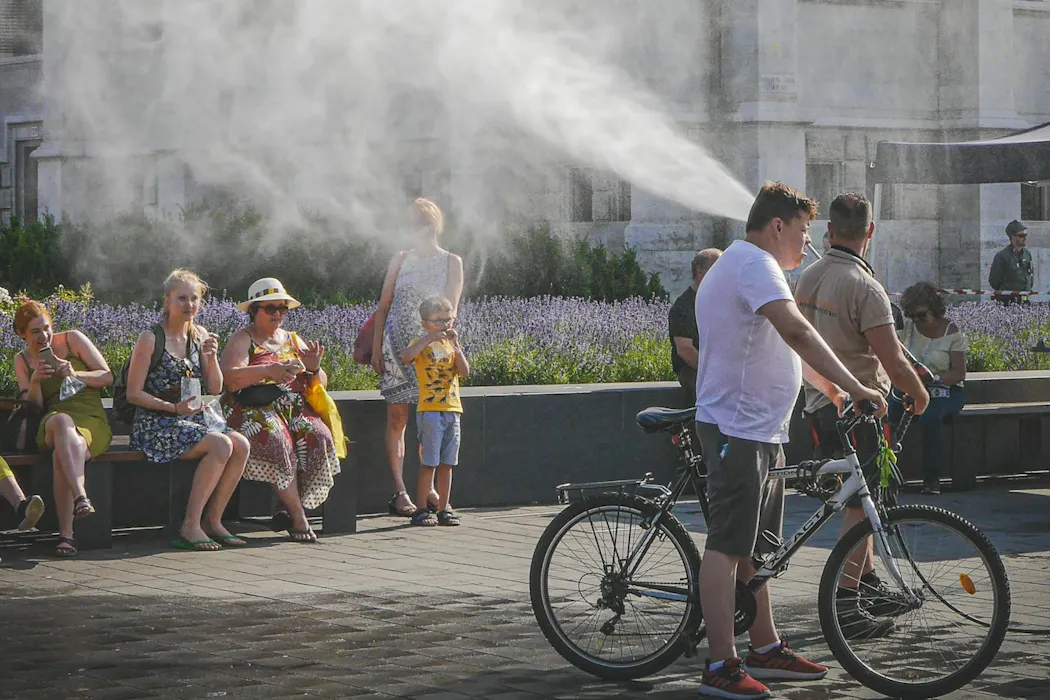
Heatwaves are a growing global threat to human health, wellbeing and livelihoods.
Across 12 major European cities during the summer of 2025, a ten-day period of extreme heat led to 2,300 deaths – 1,500 of them were attributed to climate change amplifying temperatures by 1-4°C. Heatwaves were responsible for nearly half a million global deaths every year from from 2000 to 2019.
In addition to their health risks, European heatwaves in 2025 contributed to regional glaciers melting and wildfires hitting the largest area on record, according to a new report.
And it’s not just Europe, globally 2025 was ranked as one of three hottest years on record. Heatwaves are not going away: even after emissions targets are met, heatwaves will not return to pre-industrial levels for at least 1,000 years.
These plans typically include early-warning systems, coordination between health and social authorities, and public messaging urging people to stay cool. People can try to implement a variety of measures, including staying in a cool environment, avoiding strenuous activity, drinking more water and wearing lighter clothes. These are theoretically simple steps, which is why heatwave deaths are so often called needless and preventable. But the realities of everyday life make adaptation far more complicated.
How people stay cool is closely tied to existing social inequalities, making heatwaves a nuisance for some and a catastrophe for others. Older people, for instance, have reduced abilities to regulate body temperatures, are more likely to have underlying health conditions that amplify risks and may lack networks of social support during disasters. Income divides create other risk factors such as who owns air conditioning and who can afford to run it. Other factors include who can work in a cool office or work from home, versus those doing outdoor or manual labour in the heat.
Unlike hurricanes or wildfires, which force widespread evacuations, life generally does not stop when heatwaves occur. People are forced to adapt while also meeting their ongoing daily obligations. Government advice might be to stay cool during the hottest part of the day which could be in conflict with a person’s rigid workplace schedule.
There are no maximum safe working temperatures in the UK, for instance. Staying at home can be the safest option if you have air conditioning. Yet during the catastrophic 2021 Pacific Northwest heatwave in the US and Canada, the vast majority of deaths in British Columbia happened in people’s own overheated homes, where there was inadequate air conditioning or fans.
Data from the Global Climate Highlights 2025 report. ECMWF/EU, CC BY-ND
How are people coping?
Recent research examines how people adapt their daily activities when dangerous summer heatwaves occur. Using mobile phone location data across seven countries – Brazil, China, France, India, Nigeria, Turkey and the United States – the study shows that people around the world are changing their daily lives to stay cool, ranging from leisure activities to work obligations.
These adaptations vary widely and reflect existing inequalities. People tend to withdraw into their homes during heatwaves, regardless of whether their country has widespread air conditioning or existing heat plans. In some places, people visit workplaces less (notably in France), though not everyone can afford to do so.
In others, people cut back on food shopping or going to the pharmacy as temperatures rise, essential for maintaining households and health (as the research shows has happened during heatwaves in the United States). Places for shopping and recreation – which may have air conditioning – as well as parks may serve as important refuges for those who cannot cool down at home.
Staying cool requires more than awareness and good decision-making – structural barriers, such as having to stay at work during high heat, severely limit people’s access to cooling.
Our research highlights that governments also need to pay closer attention to the space and time constraints people face, and policy efforts should grant people the flexibility to follow their advice. Research on Mexico, for example, found that those aged 18 to 35 were disproportionately likely to die from extreme heat, despite being physiologically less vulnerable than older people. This may be attributed to greater rates of outdoor work with little flexibility to use cooler spaces.
Setting maximum safe working temperatures, relative to local extremes, or allowances for flexible working hours could limit occupational health risks. Both could give workers the choice of where to spend the hottest hours of the day. There is already a precedent for climate-related leave. Spain introduced paid leave following the 2024 Valencia floods. But flexibility alone is not enough if people have nowhere to go nearby that is cool.
Governments need to focus on making accessible cool spaces available, especially in areas with low air conditioning ownership and in dense urban neighbourhoods. This means opening libraries, community centres and other public buildings as cooling centres, with extended hours and access to water. These provisions are currently absent from the UK’s heat plan, for example. Even as home air conditioning ownership rises, these investments in cool public spaces will remain essential. Air conditioning uptake will be limited by income, leaving many people in a continued state of cooling poverty.
Heatwaves are no longer a distant or occasional threat. They are a recurring feature of modern life in many places that are not used to experiencing them. Alongside early warning systems, public messaging and longer-term measures such as urban greening to reduce temperatures, governments need to do far more to help people stay cool when extreme temperatures hit.
Shiv Yucel receives funding from Social Sciences and Humanities Research Council of Canada, and the Canadian Centennial Scholarship Fund.
In December 2025, the parliament of Victoria — Australia’s second-most populous state — delivered a formal apology to First Peoples for laws and policies that “took land, removed children, broke families, and tried to erase culture.”
The motion, introduced by Premier Jacinta Allan as a milestone in Victoria’s ongoing treaty process, passed by a vote of 56-27. The opposition coalition voted against it and has pledged to repeal the underlying treaty legislation within 100 days if it wins November’s state election.
The apology was barely out of the premier’s mouth before its credibility was contested.
For Canadians watching from a distance, the parallels are hard to miss. And the pattern is the point: across democracies, the cost of apologizing badly can exceed the cost of staying silent.
The apology paradox
In my research on government apologies, the explanation is psychological as much as political. Governments apologize to restore their own trustworthiness, but apologies only succeed when they focus squarely on rehumanizing victims.
That inversion is the apology paradox, and it has practical implications for whether reconciliation is successful.
The canonical case is Willy Brandt’s 1970 Kniefall, when the West German chancellor unexpectedly knelt before the Warsaw Ghetto memorial. The silent gesture is still remembered 55 years on, long after Germany’s formal verbal apologies have faded. It was well-received because Brandt absorbed a political cost without trying to extract a benefit.
Analyses on political apologies have found effective apologies function as a costly signal: when governments sacrifice something tangible, such as political capital, money or policy commitments, victimized communities see genuine contrition.
Other research identifies four ingredients of a complete apology: acknowledging the wrong, accepting responsibility, expressing remorse and committing to concrete reparations. Most government apologies fail that test.
Consider F.W. de Klerk’s 1997 statement to South Africa’s Truth and Reconciliation Commission.
On its face, it was comprehensive: “Apartheid was wrong. I apologize…” Under questioning, however, de Klerk distanced National Party leadership from torture, murder and rape by state agents, and did not commit to any material amends.
Victims rejected it. De Klerk sought a position of pride rather than shame: the apology tried to rehumanize the apologizer without addressing what victims had suffered. That is almost always a sign of a sub-standard apology.
Learning from Canada
Canada has its own experiences with weak apologies. In 1998, Jean Chretien’s government responded to findings about residential schools with a Statement of Reconciliation read by junior minister Jane Stewart at a lunchtime ceremony. The prime minister was absent.
The content was not the problem; the symbolism told Indigenous Canadians the government was not serious. A decade later, Stephen Harper apologized in Parliament, alongside a $1.9-billion settlement, an independent assessment process and a Truth and Reconciliation Commission.
Harper publicly credited a political rival, NDP Leader Jack Layton, with persuading him, an admission that surprised observers. Harper’s earlier apology to Chinese Canadians for the Head Tax went further, reframing Chinese immigrants’ “back-breaking labour” as essential to building the country.
In other words, victimized groups wait to see whether words will lead to real change. It is also important to acknowledge that the Head Tax was a limited grievance involving a defined group of victims, while residential schools were part of an ongoing colonial relationship with effects that endure today. Some apologies are therefore far more difficult than others.
When apologies face criticism
That difficulty is amplified by a nationalism trap. For citizens who strongly identify with national identity, acknowledging past injustice can feel like personal indictment, fuelling backlash that erodes the apology in victims’ eyes.
Brandt faced exactly this as conservative opposition questioned his patriotism. In Australia, Victoria’s coalition opposition has framed the First Peoples treaty as a divisive imposition, and that criticism, not the apology’s wording, may determine whether it survives.
There is a structural risk to further consider. Promising to do better raises the standard the apologizer will be judged against. When Canada ultimately failed to implement the Truth and Reconciliation Commission’s recommendations, when violence against Indigenous women continued, when over-representation in the criminal justice system persisted, Harper’s from years earlier apology lost credibility. Trust, once broken twice, becomes exponentially harder to restore.
Hence the paradox: an apology must be costly to improve the reputation of the apologizer, but an apology made with that benefit in mind lowers the cost and signals self-interest. The best way to apologize involves making the victims the primary focus, not the apologizing state. Apologies that prioritize rehumanizing victims prove more effective at rehumanizing apologizers too.
That is the test Victoria now faces, and one Canada keeps facing. The Victorian premier’s words last December were strong. Whether that apology leads to meaningful change depends less on what was said than on whether the treaty institutions survive November. Canadians should watch carefully.
Reza Hasmath does not work for, consult, own shares in or receive funding from any company or organisation that would benefit from this article, and has disclosed no relevant affiliations beyond their academic appointment.
Source: The Conversation – Canada – By Ted Scott, PhD Student, Department of Geography – Climate and Coastal Ecosystems Group, University of British Columbia
The cumulative heat in summers is rising, meaning there is less relief from warm temperatures once summer begins.(Unsplash/Evgeniy Beloshytskiy)
Do you have the sense that summers feel different than when you were younger? That they start earlier, arrive quickly and remain intense until the fall? If you live in the mid-latitudes of either the Northern or Southern Hemispheres, chances are you answered yes.
For many, the idea of a longer and warmer summer conjures up images of spending more time at the beach, playing sports or enjoying family picnics, but there are concerning downsides. Summer is also the season of wildfires, droughts and heatwaves, like the June 2021 heat dome in the Pacific Northwest of North America.
Recent research shows that devastating heat dome event was amplified by its proximity to the summer solstice, which is the calendar start of summer, and by ground already dried out from earlier spring warmth. Earlier starts to the warmest season are making preconditions worse in areas prone to wildfire, extending fire seasons.
My colleagues and I at the University of British Columbia recently published research into how summer conditions are lasting longer and transitions into and out of summer are becoming more abrupt.
The cumulative heat in summers is rising, meaning there is less relief from warm temperatures once the season begins. Human-driven climate change is impacting the warmest season of the year. These changes challenge our expectations of the natural seasonal cycle being gradual and predictable.
To allow for a flexible definition of summer length, we defined typical summer weather based on daily average temperatures during the warmest 25 per cent of days from 1961 to 1990. This gave us a threshold daily temperature to define when summer began and ended in a given year and location.
We found that the number of days with typical summer weather has been growing 1.5 times faster over the past 30 years than in priorreports. On average, in mid-latitude regions, summers have lengthened by around six days every decade since 1990. These rates are similar across land, ocean and coastal areas.
We examined 10 cities using local weather station data, including Paris, St. Petersburg and Tokyo. A few of the cities stood out: in my hometown of Minneapolis, Minn., summertime has been lengthening by almost one additional day every year since 1990.
Toronto summers are gaining an average of eight days every decade, with summer conditions lasting four weeks longer now than in 1990. Sydney, Australia, added 1.5 additional days in each of those years. Sydney summers now last over one-third of the year.
Impacts of accumulating heat
The buildup of heat during summer is also rising quickly; it’s three times faster over land since 1990. As heat builds up in more areas, cooling demand can be expected to increase.
This change is not confined to continental interiors but is also happening in coastal areas. Perceived as favourable with their maritime climates, these areas face growing populations and often higher climate risk.
The percentage of Canadians with air conditioning varies by province and by income, but we know those who are most vulnerable struggle to stay cool.
Incentives for heat pumps will help those who can afford to make the switch, and have the benefit of also replacing natural gas heating in the winter, but regardless of cooling method, electricity needs will rise.
Longer summers and earlier starts will undoubtedly also affect agriculture, perhaps encouraging earlier planting. However, a complication is that the hours of daylight are not shifting. The impact of seasonal changes on farming practices and food supply is an active area of study.
Many other aspects of society are linked to the timing of the summer season, like the start and end of the school year, or outdoor sports. How should we adjust if it’s simply too warm for strenuous outdoor activity, whether it’s recreational or work-related?
If these trends continue, we can expect further impacts on the planting season, the timing and pace of snowmelt and the connection with water supply, the length of the fire season, and especially on the energy demand for cooling.
Governments and experts have a lot of work to do to mitigate and adapt to the consequential changes humans have brought about through our dependence on fossil fuels.
These changes to summer are noticeable because they are already disrupting lives. While some places will still occasionally have cooler years and significantly warmer years, the data tells us the trends for summers are headed in one direction.
Ted Scott does not work for, consult, own shares in or receive funding from any company or organisation that would benefit from this article, and has disclosed no relevant affiliations beyond their academic appointment.
Source: The Conversation – in French – By Clotilde Policar, Professeure, directrice des études sciences à l’ENS, École normale supérieure (ENS) – PSL
Rosalind Franklin, la « dark lady » de l’ADN, mourrait le 16 avril 1958 d’un cancer de l’ovaire. Cristallographe avertie, spécialiste d’analyses de structure moléculaire, elle commence sa carrière indépendante (après sa thèse) à Paris au CNRS. Que nous apprend son histoire sur l’exclusion des femmes des carrières scientifiques ?
Dans les années 1950, une véritable course scientifique pour la découverte de la structure de l’ADN est lancée. Elle implique principalement trois équipes, celle de Linus Pauling à Caltech (États-Unis), et deux au Royaume-Uni : celle de James Watson et Francis Crick à Cambridge et celle de Maurice Wilkins du département de biophysique du King’s College à Londres dirigé par John Randall.
C’est dans ce contexte que ce dernier propose à Rosalind Franklin de monter sa propre équipe d’analyse structurale pour étudier la structure de l’ADN : l’enjeu est de taille, et Rosalind Franklin s’installe à Londres en janvier 1951. Les relations sont très vite tendues avec Maurice Wilkins, qui ne la vit pas comme une chercheuse indépendante (on dirait aujourd’hui « principal investigator »), mais plutôt comme travaillant dans son équipe, comme sa collaboratrice, voire son assistante ainsi que la désigne Watson. John Randall est probablement responsable de ne pas l’avoir accueillie dans des conditions claires pour ses collègues.
Elle travaille avec un doctorant, Raymond Gosling, et cherche à aligner les fibres d’ADN pour enregistrer des clichés de diffractions aux rayons X. Un des problèmes expérimentaux est l’existence de deux structures entremêlées dont la proportion dépend du degré d’humidité. Rosalind Franklin se propose de préparer un échantillon avec une unique structure pour avoir une image plus claire et elle y parvient. Le cliché n°51, devenu célèbre, lui permet d’obtenir, avec Raymond Gosling, la preuve expérimentale de la structure hélicoïdale. Mais ce cliché est dévoilé à James Watson par Maurice Wilkins : il lui a été transmis par Raymond Gosling, et il n’y a aucune trace d’un accord de Rosalind Franklin (ni Watson, ni Wilkins n’évoquent Franklin quand ils relatent cet échange dans leurs livres respectifs).
Ce cliché est la pierre angulaire expérimentale qui manquait aux réflexions de Watson et Crick sur la structure de l’ADN. Ils rédigent alors un article qu’ils destinent à Nature. Leur proposition a le mérite de justifier la stabilité de la structure en interaction par paires via des liaisons hydrogène : c’est important mais ne devrait pas occulter l’apport de Franklin dont le travail constitue la preuve expérimentale de la double hélice avec la présence du squelette phosphate à l’extérieur de la structure.
Les publications dans Nature
En 1953, John Randall, rencontrant l’éditeur de Nature, Lionel Brimble, apprend la publication imminente de la proposition de Watson et Crick, et il le convainc, sans évoquer celui de Franklin, de publier l’article de Wilkins, lui aussi sur la structure de l’ADN. Rosalind Franklin, déjà lassée par l’environnement peu inclusif de King’s College, est sur le départ pour aller à Birkbeck College où elle arrivera en mars 1953. Elle a déjà quasiment terminé de rédiger son propre travail sur l’ADN. Il lui fallut, apprenant que l’article de Watson et Crick et celui de Wilkins allaient être publiés, exiger elle-même, alors que l’avancée de sa recherche était parfaitement connue à King’s College, que le sien paraisse dans le même numéro.
Trois articles seront donc publiés en 1953, l’un après l’autre, sous un chapeau commun « Molecular structure of nucleic acids » : l’article de Watson et Crick, qui apparaît en premier, celui de Wilkins puis celui de Franklin. Une note de l’article de Watson et Crick indique clairement que leur proposition théorique repose sur les travaux expérimentaux, non publiés jusqu’alors, de Wilkins et de Franklin.
Remerciements de Watson et Crick article Nature. Traduction : Nous sommes très reconnaissants au Dr Jerry Donohue pour ses conseils et ses remarques constructives, notamment en ce qui concerne les distances interatomiques. Nous avons également été inspirés par la connaissance de la nature générale des résultats expérimentaux non publiés et des idées du Dr M. H. F. Wilkins, du Dr R. E. Franklin et de leurs collaborateurs au King’s College de Londres. L’un d’entre nous (J.D.W.) a bénéficié d’une bourse de la Fondation nationale pour la paralysie infantile.
Aujourd’hui, les canons d’un article scientifique veulent qu’on décrive tout d’abord les résultats « bruts », expérimentaux, qui sont analysés, décodés, pour amener à une discussion plus théorique des implications de ce qui a été mis au jour. Ici, l’éditeur a mis l’article théorique devant les deux articles expérimentaux. Certes sous un chapeau commun « Molecular structure of DNA », mais qui, aujourd’hui, est uniquement référencé (Web of science fin 2025) comme lié à l’article de Watson et Crick ! C’est sans doute, justement, parce qu’il est le premier de la série de trois. N’aurait-on pas pu imaginer un unique article avec les contributions expérimentales appuyant la proposition théorique ?
Est-ce important ? Il semble que oui : même si les nombres de citations doivent être manipulés avec précaution, on doit constater que le premier article, celui de Watson et Crick, est cité plus de 12 000 fois, alors que celui de Franklin et Gosling, ca. 1140 fois et celui de Wilkins, Stokes et Wilson ca. 740 fois (chiffres issus du site Web of science fin 2025).
Le Nobel : les femmes oubliées
On dit souvent que Rosalind Franklin n’a pas pu avoir le prix Nobel avec Watson, Crick et Wilkins en 1962 car il n’est pas décerné à titre posthume. Mais, on oublie alors que la règle qui l’interdit date de 1974. Avant 1962, au moins deux prix Nobel ont été attribués à titre posthume (Erik Axel Karlfeldt en 1931 et Dag Hammarskjöld en 1961). Mais voilà, il y a trois lauréats au prix de 1962, nombre maximal pour un prix Nobel, et Rosalind Franklin a été le « quatrième homme » (!), comme ce fut le cas de Jocelyn Bell, découvreuse des pulsars ou de Lise Meitner pour la fission nucléaire. Alors que le prix Nobel n’affiche qu’un peu plus de 6 % de lauréates, beaucoup sont citées comme étant sur cette « quatrième » marche !
Rosalind Franklin a été systématiquement écartée d’un réseau d’échanges (y compris d’échange de données, celles du cliché 51) et de discussions dans un environnement fortement sexiste. Par exemple, le salon des enseignants-chercheurs à King’s College est à l’époque interdit aux femmes. Or, ces endroits permettent des rencontres informelles cruciales dans les rapports entre scientifiques.
« Malheureusement, cela reste vrai : le titre d’un article publié dans Nature (en 2022) « Les femmes sont moins reconnues que les hommes dans le domaine scientifique », en dit long. La diversité, l’équité et l’inclusion sont des concepts que certains considèrent encore comme des modes passagères et comme un anathème pour la « bonne » science. L’histoire de l’ADN prouve pourtant qu’ils sont les fondements d’une collaboration fructueuse et du progrès scientifique ».
Une exclusion insidieuse pérenne : que faire ?
Il est important de faire évoluer le vocabulaire : pourquoi ne pas choisir de parler de la « double hélice de Franklin, Watson et Crick » ? Et surtout il faudrait raconter cette histoire, en cours à l’école, au lycée, à l’université : c’est aussi de notre responsabilité en tant qu’enseignants, enseignantes, universitaires de transmettre des messages à nos publics étudiants sur la place des femmes en sciences. S’il ne s’agit évidemment pas de taire les noms de Watson et Crick, pensons, de manière inclusive, à mentionner ceux de Franklin et des autres femmes scientifiques : Jeanne Barret en botanique, Ada Lovelace pionnière de la programmation informatique, Lise Meitner et la découverte de la fission nucléaire, Maud Menten pour les modèles cinétiques de catalyse enzymatique, Marie Tharp pour les cartes des fonds sous-marins et sa contribution à la théorie de la tectonique des plaques, Marthe Gautier dans le contexte de la découverte de l’origine chromosomique du syndrome de Down, Chien-Shiung Wu pour ses études sur les interactions faibles, Jocelyn Bell pour les pulsars, et toutes les autres…
Les oublier, c’est ancrer chez les jeunes femmes l’idée que le monde de la science est fait pour les hommes et les en exclure : c’est le mécanisme aujourd’hui bien connu de la menace du stéréotype, concept proposé en 1995 par Claude Steele et Joshua Aronson : le stéréotype (par exemple, « les femmes sont moins douées que les hommes en sciences », « les garçons sont moins doués que les filles en dessin »), même s’il est sans fondement biologique, induit chez celles et ceux qui le connaissent, et particulièrement qui en sont victimes, un comportement qui le confirme.
Comme Rosalind Franklin, les femmes sont toujours partiellement exclues des lieux de sciences et des lieux de pouvoir scientifique mais c’est plus subtil qu’une salle des professeurs exclusivement masculine comme c’était le cas à King’s College. Le film Picture a Scientist notamment nous en montre des exemples : parcours de recrutement puis de carrière plus difficiles, espaces de travail plus réduits, parole non entendue, efforts plus importants demandés aux femmes, ou même réflexions faites sur les tenues vestimentaires…
Il faut en parler et promouvoir le recueil de données genrées pour permettre l’identification de ces biais, prérequis à leur prise en compte et aux actions pour les contrer. Si c’est souvent fait pour documenter les effets de genre sur les recrutements (et vérifier que les processus sont vertueux), cela n’est pas ou peu le cas pour les conditions de travail (soutien aux activités des femmes, allocations d’espace de travail, bureaux partagés ou non, contributions aux tâches collectives, sursollicitation singulièrement pour des tâches peu gratifiantes pour la carrière en lien avec l’exigence de quotas…). Ne faut-il pas envisager, le temps que la parité devienne effective, des mesures compensatoires pour que les femmes ne soient pas pénalisées dans les carrières scientifiques ? On pourrait penser à renforcer les aides au moment du congé maternité par exemple : sans défavoriser les collègues masculins, cela contribuerait à rendre, par là même, ces carrières plus accueillantes pour les jeunes filles. Car, aujourd’hui plus que jamais, face aux défis qui menacent notre planète, nous avons besoin de tous les cerveaux pour trouver des solutions et on ne peut pas se permettre d’exclure de facto la moitié de la population ! Beaucoup de chemin reste à parcourir pour une société scientifique plus juste et plus efficace !
Je remercie vivement Sophie Vriz d’avoir attiré mon attention sur la note de Watson et Crick dans l’article de 1953, Elisabeth Bouchaud de m’avoir signalé que l’interdiction des prix Nobel posthumes date de 1974 et pour sa magnifique série de pièces de théâtre « Les Fabuleuses » à la Reine Blanche, Dominique Guianvarc’h de m’avoir signalé le nom “dark lady” de l’ADN, et à toutes celles et tous ceux qui, comme Bernold Hasenknopf, systématiquement, chaque année, citent les femmes scientifiques dans leurs cours.
Clotilde Policar ne travaille pas, ne conseille pas, ne possède pas de parts, ne reçoit pas de fonds d’une organisation qui pourrait tirer profit de cet article, et n’a déclaré aucune autre affiliation que son organisme de recherche.
Les êtres humains ont toujours eu le goût du jeu. Mais pendant la majeure partie de notre histoire, le jeu n’a laissé que peu de traces. Contrairement aux outils ou aux ossements, les jeux se conservent rarement, et les plaisirs éphémères qu’ils procurent sont encore plus difficiles à retrouver.
La récente découverte de dés vieux de 12 000 ans, publiée dans American Antiquity, apporte un nouvel éclairage sur le caractère ludique des sociétés humaines dans un passé lointain.
L’archéologue Richard J. Madden a identifié 565 dés provenant de sites à travers l’Amérique du Nord, notamment dans le Wyoming, le Colorado et le Nouveau-Mexique. Ils datent du XIXe siècle et remontent jusqu’à 12 000 ans. La reconnaissance de ces artefacts comme étant des dés repousse de plusieurs milliers d’années les preuves matérielles du jeu chez l’homme, à travers ce que Madden interprète comme des preuves de jeux de hasard et de paris. Il estime que les Amérindiens jouaient aux dés 6 000 ans avant tout le monde.
Pour identifier ces objets comme des dés, Madden a rassemblé des données sur des objets comparables issues de publications archéologiques et de bases de données sur les vestiges, en s’appuyant sur une étude antérieure exhaustive des objets de jeu amérindiens.
Des dés binaires
Ces objets ne ressemblent pas aux dés à six faces que nous utilisons aujourd’hui. Il s’agit plutôt de dés binaires : des pièces plates, rondes ou rectangulaires marquées d’un côté et vierges de l’autre. Si vous êtes un fan de Donjons et Dragons comme nous, vous pourriez appeler un tel dispositif de lancer un d2. En effet, on peut comparer le lancer de l’un de ces dés anciens à un tirage au sort avec une pièce de monnaie – bien que cette découverte souligne également que les dés sont bien plus anciens que les pièces.
Richard Madden parle de sa découverte.
Lorsqu’on évalue des recherches révolutionnaires de ce type, il est essentiel de réfléchir à la nature des vestiges archéologiques de ce passé très lointain. Nous dépendons d’un éventail très limité d’objets, car beaucoup ne survivent pas dans le sol. Souvent, lorsque nous jouons, même aujourd’hui, nous n’utilisons aucun objet matériel. Pensez à un jeu de chat ou de cache-cache. Imaginez maintenant un jeu similaire se déroulant il y a 12 000 ans. Un archéologue pourrait-il jamais en trouver des traces ?
Même lorsque le jeu nécessite du matériel, comme dans les jeux de société, les traces ne sont souvent pas conservées.
En effet, des études ethnographiques des études ont montré que les gens jouent fréquemment à des jeux de société d’une manière qui ne laisse aucune trace archéologique. Pour de nombreux jeux, les gens creusent des trous et tracent des lignes au sol pour le transformer en plateau, et utilisent des pierres, des graines, des coquillages et même des excréments d’animaux séchés comme pions.
Les objets naturels font également l’affaire : des bâtons à deux extrémités et des cauris (coquillages) peuvent servir de dés binaires. Ce n’est pas seulement une pratique du passé ou propre à des contrées lointaines : partout dans le monde, on joue chaque jour en utilisant de manière créative toutes sortes d’objets – bouchons de bouteille, boîtes de conserve, ficelle, bâtons, cailloux et autres bricoles – qui ne sont pas facilement identifiables comme des jouets. C’est pourquoi, pour nous, archéologues qui étudions le jeu, les dés constituent des découvertes spéciales, car ce sont sans ambiguïté des outils qui servent à jouer.
Les dés anciens
Les archéologues trouvent des dés plus souvent que vous ne le pensez, sous toutes sortes de formes intéressantes. L’un des exemples les plus célèbres est celui des os astragales, les os de la cheville d’animaux à sabots (principalement des moutons et des chèvres). Ils possèdent quatre faces distinctes et ont été couramment utilisés comme dés.
L’un des jeux les plus anciens de l’histoire de l’humanité, le jeu des 20 cases (une version ultérieure du Jeu royal d’Ur), est connu pour avoir utilisé de tels dés, car des os d’astragale ont été retrouvés dans les tiroirs des boîtes de jeu. Dans de nombreux cas, plutôt que de prélever ces os sur des animaux abattus, les gens les reproduisaient dans d’autres matériaux tels que la pierre, le verre ou le métal. Des exemplaires en ivoire ont été découverts avec les jeux qui se trouvaient dans la tombe égyptienne de Toutankhamon. Cela suggère que les gens n’ont commencé à fabriquer des objets ressemblant à des dés qu’après avoir déjà utilisé des objets naturels adaptés à ce même usage.
Dans son étude, Madden soutient que les dés témoignent d’une évolution continue des jeux qui impliquent une dimension économique. Nous souhaitons orienter ce débat dans une autre direction. Le jeu existe en dehors du cadre des jeux d’argent ou des jeux qui impliquent des transactions, et l’analyse contextuelle nécessaire pour identifier véritablement le jeu d’argent dans le passé fait défaut dans cette étude. De plus, cette étude aborde le jeu exclusivement sous un angle fonctionnaliste, en particulier à travers des cadres évolutifs et économiques.
Nous avons fait valoir ailleurs que des études comme celles-ci tiennent rarement compte d’un point fondamental : le jeu existe souvent pour le seul plaisir de jouer. Parfois, on lance la pièce pour gagner, mais souvent, on la lance juste pour s’amuser.
Bien que nous ne soyons pas convaincus que ces anciens peuples amérindiens géraient des réseaux de jeux d’argent, il s’agit d’une découverte passionnante. Ce que ces dés, ainsi que d’autres trouvés dans des contextes archéologiques à travers le monde, mettent en évidence, c’est la beauté fascinante du jeu, aujourd’hui comme par le passé. Ainsi, la prochaine fois que vous lancerez des dés, sachez que vous participez au même esprit ludique – le suspense, la joie, la déception d’un mauvais lancer – que celui que ressentaient déjà les gens il y a 12 000 ans.
Aris Politopoulos a reçu des financements au titre de la subvention de démarrage « Archaeological Futures » et du prix Ammodo Science Award for Groundbreaking Research pour le projet Past♥Play. Aria est membre du conseil d’administration de la fondation Stichting VALUE.
Angus Mol a reçu des financements du Conseil néerlandais de la recherche (NWO) dans le cadre de la bourse NWO-VIDI « Playful Time Machines » et du prix Ammodo pour la recherche scientifique novatrice, pour le projet Past♥Play. Il est membre du conseil d’administration de la fondation VALUE.
Walter Crist a reçu des financements du programme COST (Coopération européenne en science et technologie) pour le projet GameTable : Techniques informatiques pour le patrimoine des jeux de société, et de Game-in-Lab pour le projet « Play and the City » : Étude du patrimoine culturel des jeux de la ville de Rome. Il siège au conseil d’administration de l’Institut chypriote-américain de recherche archéologique (CAARI).
The opening headlines from the summit between Donald Trump and Xi Jinping in Beijing signal an openness on the Chinese side towards stabilising relations with the US. In his opening remarks, the Chinese president noted that China and the US “should be partners not rivals”. But he warned Trump that a crisis over Taiwan could lead to “clashes and even conflicts”.
With Xi also indicating that there will be more opportunities for US companies to do business in China, the stage is set for a relatively successful summit. Both sides can claim it as a success because it offers some concrete benefits in the form of a trade war avoided and at least the prospect of cooperation on global issues such as the Iran war. It also sets a generally more positive tone for relations between the two countries.
Such an outcome is particularly troubling for Russia’s president, Vladimir Putin, who will see his relevance and leverage diminished by more stable and predictable US-China relations. Putin’s aspirations to position Russia as a great power depend on Moscow either being strategically useful to Washington and Beijing, or gaining leverage with them by demonstrating a capacity to be disruptive.
However, on both counts, Putin’s hand has been substantially weakened. His war against Ukraine is no longer a priority issue for the US, with the two main American interlocutors in peace talks, Steve Witkoff and Jared Kushner, focused on negotiations with Iran.
Putin’s latest phone call with Trump on April 29 will have been disappointing for the Russian leader. His offer to take Iran’s highly enriched uranium to Russia was reportedly rebuffed by Trump, who told him to focus on “ending the war with Ukraine”. And days later the Kremlin was forced to scale back its annual military parade in Moscow, due to concerns that it could be targeted by Ukrainian forces.
On the Chinese side, things are possibly even more troubling. The last face-to-face meeting between Xi and Putin took place in September 2025. They have only held one video conference since then. A Kremlin statement during the Trump-Xi summit that Putin will visit China soon smacks more of desperation than confirmation.
Putin’s leverage
While Putin appears sidelined in the US-China relationship, he is not without cards of his own. Major global issues – including wars in Ukraine and Iran, energy security and the future of the international order – are still connected to Russia. This provides Putin with a degree of leverage in his relations with both Xi and Trump.
But exercising this leverage comes with significant risks, especially in areas where Chinese and US interests are more aligned with each other than with Russia. Take the case of the Iran war as an example.
Russia benefits most from this conflict continuing. The disruption it is causing to global energy flows has pushed up oil and gas prices, keeping Moscow’s war economy afloat. It has also reduced the flow of US arms to Ukraine. Unsurprisingly, therefore, Russia has expanded its support for Iran – from intelligence and cyber support to providing unjammable drones.
While Russian support is unlikely to enable Iran to win the war, it will give the regime in Tehran more time to avoid defeat and increase the costs for the US, its regional allies and the global economy. This is not going to play well with Trump, who is under mounting domestic pressure to wind down the war in Iran.
Beijing has offered Iran some support throughout the war, for example by helping it bypass western sanctions on the export of its oil. But there are clear limits to how far China will go. For China, its relationship with the US is far more important than the one with Iran. This tilts the balance of preferences in Beijing towards an end of the conflict rather than towards its continuation.
This does not mean that China and the US will now align against Russia. Relations between Russia and China are longstanding and deep across a range of issues. Their “no-limits partnership” may be increasingly asymmetric, but there is still a great deal of anti-American and anti-western alignment between them.
The US under Trump is also more ambivalent about its stance on Russia than under previous administrations. Trump’s transactional foreign policy – and his urge to make deals rather than pursue a consistent strategy – is something Russia will continue to try to leverage to its own advantage.
Ahead of the Trump-Xi summit, Kremlin spokesman Dmitry Peskov released a statement in which he said “the path to the implementation of a whole range of economic projects will be open” if the White House agrees to decouple trade from the war in Ukraine. This indicates that Moscow is fully aware of this opportunity – as well as the challenge to offer the US something China cannot.
The Xi-Trump summit is a party to which Putin was not invited. The fact that the US and China seem to be heading towards a period of better-managed relations indicates that his efforts to make his presence felt have largely failed. This does not bode well for his aspirations to restore Russia to its Soviet-era status as a great power – but it does not imply that he will give up.
Stefan Wolff is a past recipient of grant funding from the Natural Environment Research Council of the UK, the United States Institute of Peace, the Economic and Social Research Council of the UK, the British Academy, the NATO Science for Peace Programme, the EU Framework Programmes 6 and 7 and Horizon 2020, as well as the EU’s Jean Monnet Programme. He is a Trustee and Honorary Treasurer of the Political Studies Association of the UK and a Senior Research Fellow at the Foreign Policy Centre in London.