Was the Air India crash caused by pilot error or technical fault? None of the theories holds up – yet

Source: The Conversation – Global Perspectives – By Guido Carim Junior, Senior Lecturer in Aviation, Griffith University

Over the weekend, the Indian Aircraft Accident Investigation Bureau released a preliminary report on last month’s crash of Air India flight 171, which killed 260 people, 19 of them on the ground.

The aim of a preliminary report is to present factual information gathered so far and to inform further lines of inquiry. However, the 15-page document has also led to unfounded speculation and theories that are currently not supported by the evidence.

Here’s what the report actually says, why we don’t yet know what caused the crash, and why it’s important not to speculate.

What the preliminary report does say

What we know for certain is that the aircraft lost power in both engines just after takeoff.

According to the report, this is supported by video footage showing the deployment of the ram air turbine (RAT), and the examination of the air inlet door of the auxiliary power unit (APU).

The RAT is deployed when both engines fail, all hydraulic systems are lost, or there is a total electrical power loss. The APU air inlet door opens when the system attempts to start automatically due to dual engine failure.

The preliminary investigation suggests both engines shut down because the fuel flow stopped. Attention has now shifted to the fuel control switches, located on the throttle lever panel between the pilots.

This is what the fuel switches look like, with the throttle lever above them.
Aircraft Accident Investigation Bureau

Data from the enhanced airborne flight recorder suggests these switches may have been moved from “run” to “cutoff” three seconds after liftoff. Ten seconds later, the switches were moved back to “run”.

The report also suggests the pilots were aware the engines had shut down and attempted to restart them. Despite their effort, the engines couldn’t restart in time.

We don’t know what the pilots did

Flight data recorders don’t capture pilot actions. They record system responses and sensor data, which can sometimes lead to the belief they’re an accurate representation of the pilot’s actions in the cockpit.

While this is true most of the time, this is not always the case.

In my own work investigating safety incidents, I’ve seen cases in which automated systems misinterpreted inputs. In one case, a system recorded a pilot pressing the same button six times in two seconds, something humanly impossible. On further investigation, it turned out to be a faulty system, not a real action.

We cannot yet rule out the possibility that system damage or sensor error led to false data being recorded. We also don’t know whether the pilots unintentionally flicked the switches to “cutoff”. And we may never know.

As we also don’t have a camera in the cockpit, any interpretation of pilots’ actions will be made indirectly, usually through the data sensed by the aircraft and the conversation, sound and noise captured by the environmental microphone available in the cockpit.

We don’t have the full conversation between the pilots

Perhaps the most confusing clue in the report was an excerpt of a conversation between the pilots. It says:

In the cockpit voice recording, one of the pilots is heard asking the other why did he cutoff. The other pilot responded that he did not do so.

This short exchange is entirely without context. First, we don’t know who says what. Second, we don’t know when the question was asked – after takeoff, or after the engine started to lose power? Third, we don’t know the exact words used, because the excerpt in the report is paraphrased.

Finally, we don’t know whether the exchange referred to the engine status or the switch position. Again, we may never know.

What’s crucial here is that the current available evidence doesn’t support any theory about intentional fuel cutoff by either of the pilots. To say otherwise is unfounded speculation.

We don’t know if there was a mechanical failure

The preliminary report indicates that, for now, there are no actions required by Boeing, General Electric or any company that operates the Boeing 787-8 and/or GEnx-1B engine.

This has led some to speculate that a mechanical failure has been ruled out. Again, it is far too early to conclude that.

What the preliminary report shows is that the investigation team has not found any evidence to suggest the aircraft suffered a catastrophic failure that requires immediate attention or suspension of operations around the world.

This could be because there was no catastrophic failure. It could also be because the physical evidence has been so badly damaged that investigators will need more time and other sources of evidence to learn what happened.

Why we must resist premature conclusions

In the aftermath of an accident, there is much at stake for many people: the manufacturer of the aircraft, the airline, the airport, civil aviation authority and others. The families of the victims understandably demand answers.

It’s also tempting to latch onto a convenient explanation. But the preliminary report is not the full story. It’s based on very limited data, analysed under immense pressure, and without access to every subsystem or mechanical trace.

The final report is still to come. Until then, the responsible position for regulators, experts and the public is to withhold judgement.

This tragedy reminds us that aviation safety depends on patient and thorough investigation – not media soundbites or unqualified expert commentary. We owe it to the victims and their families to get the facts right, not just fast.

The Conversation

Guido Carim Junior has received funding from Boeing R&D Australia to conduct research projects in the past five years.

– ref. Was the Air India crash caused by pilot error or technical fault? None of the theories holds up – yet – https://theconversation.com/was-the-air-india-crash-caused-by-pilot-error-or-technical-fault-none-of-the-theories-holds-up-yet-261102
How do you stop an AI model turning Nazi? What the Grok drama reveals about AI training

Source: The Conversation – Global Perspectives – By Aaron J. Snoswell, Senior Research Fellow in AI Accountability, Queensland University of Technology

Anne Fehres and Luke Conroy & AI4Media, CC BY

Grok, the artificial intelligence (AI) chatbot embedded in X (formerly Twitter) and built by Elon Musk’s company xAI, is back in the headlines after calling itself “MechaHitler” and producing pro-Nazi remarks.

The developers have apologised for the “inappropriate posts” and “taken action to ban hate speech” from Grok’s posts on X. Debates about AI bias have been revived too.

But the latest Grok controversy is revealing not for the extremist outputs, but for how it exposes a fundamental dishonesty in AI development. Musk claims to be building a “truth-seeking” AI free from bias, yet the technical implementation reveals systemic ideological programming.

This amounts to an accidental case study in how AI systems embed their creators’ values, with Musk’s unfiltered public presence making visible what other companies typically obscure.

What is Grok?

Grok is an AI chatbot with “a twist of humor and a dash of rebellion” developed by xAI, which also owns the X social media platform.

The first version of Grok launched in 2023. Independent evaluations suggest the latest model, Grok 4, outpaces competitors on “intelligence” tests. The chatbot is available standalone and on X.

xAI states “AI’s knowledge should be all-encompassing and as far-reaching as possible”. Musk has previously positioned Grok as a truth-telling alternative to chatbots accused of being “woke” by right-wing commentators.

But beyond the latest Nazism scandal, Grok has made headlines for generating threats of sexual violence, bringing up “white genocide” in South Africa, and making insulting statements about politicians. The latter led to its ban in Turkey.

So how do developers imbue an AI with such values and shape chatbot behaviour? Today’s chatbots are built using large language models (LLMs), which offer several levers developers can lean on.

What makes an AI ‘behave’ this way?

Pre-training

First, developers curate the data used during pre-training – the first step in building a chatbot. This involves not just filtering unwanted content, but also emphasising desired material.

GPT-3 was shown Wikipedia up to six times more than other datasets as OpenAI considered it higher quality. Grok is trained on various sources, including posts from X, which might explain why Grok has been reported to check Elon Musk’s opinion on controversial topics.

Musk has shared that xAI curates Grok’s training data, for example to improve legal knowledge and to remove LLM-generated content for quality control. He also appealed to the X community for difficult “galaxy brain” problems and facts that are “politically incorrect, but nonetheless factually true”.

We don’t know if these data were used, or what quality-control measures were applied.

Fine-tuning

The second step, fine-tuning, adjusts LLM behaviour using feedback. Developers create detailed manuals outlining their preferred ethical stances, which either human reviewers or AI systems then use as a rubric to evaluate and improve the chatbot’s responses, effectively coding these values into the machine.

A Business Insider investigation revealed xAI’s instructions to human
“AI tutors” instructed them to look for “woke ideology” and “cancel culture”. While the onboarding documents said Grok shouldn’t “impose an opinion that confirms or denies a user’s bias”, they also stated it should avoid responses that claim both sides of a debate have merit when they do not.

System prompts

The system prompt – instructions provided before every conversation – guides behaviour once the model is deployed.

To its credit, xAI publishes Grok’s system prompts. Its instructions to “assume subjective viewpoints sourced from the media are biased” and “not shy away from making claims which are politically incorrect, as long as they are well substantiated” were likely key factors in the latest controversy.

These prompts are being updated daily at the time of writing, and their evolution is a fascinating case study in itself.

Guardrails

Finally, developers can also add guardrails – filters that block certain requests or responses. OpenAI claims it doesn’t permit ChatGPT “to generate hateful, harassing, violent or adult content”. Meanwhile, the Chinese model DeepSeek censors discussion of Tianamen Square.

Ad-hoc testing when writing this article suggests Grok is much less restrained in this regard than competitor products.

The transparency paradox

Grok’s Nazi controversy highlights a deeper ethical issue: would we prefer AI companies to be explicitly ideological and honest about it, or maintain the fiction of neutrality while secretly embedding their values?

Every major AI system reflects its creator’s worldview – from Microsoft Copilot’s risk-averse corporate perspective to Anthropic Claude’s safety-focused ethos. The difference is transparency.

Musk’s public statements make it easy to trace Grok’s behaviours back to Musk’s stated beliefs about “woke ideology” and media bias. Meanwhile, when other platforms misfire spectacularly, we’re left guessing whether this reflects leadership views, corporate risk aversion, regulatory pressure, or accident.

This feels familiar. Grok resembles Microsoft’s 2016 hate-speech-spouting Tay chatbot, also trained on Twitter data and set loose on Twitter before being shut down.

But there’s a crucial difference. Tay’s racism emerged from user manipulation and poor safeguards – an unintended consequence. Grok’s behaviour appears to stem at least partially from its design.

The real lesson from Grok is about honesty in AI development. As these systems become more powerful and widespread (Grok support in Tesla vehicles was just announced), the question isn’t whether AI will reflect human values. It’s whether companies will be transparent about whose values they’re encoding and why.

Musk’s approach is simultaneously more honest (we can see his influence) and more deceptive (claiming objectivity while programming subjectivity) than his competitors.

In an industry built on the myth of neutral algorithms, Grok reveals what’s been true all along: there’s no such thing as unbiased AI – only AI whose biases we can see with varying degrees of clarity.

The Conversation

Aaron J. Snoswell previously received research funding from OpenAI in 2024–2025 to develop new evaluation frameworks for measuring moral competence in AI agents.

– ref. How do you stop an AI model turning Nazi? What the Grok drama reveals about AI training – https://theconversation.com/how-do-you-stop-an-ai-model-turning-nazi-what-the-grok-drama-reveals-about-ai-training-261001

Even a day off alcohol makes a difference – our timeline maps the health benefits when you stop drinking

Source: The Conversation – Global Perspectives – By Nicole Lee, Adjunct Professor at the National Drug Research Institute (Melbourne based), Curtin University

d3sign/Getty

Alcohol has many negative effects on our health, some of which may surprise you. These include short-term impacts such as waking up with a pounding head or anxiety, to long-term effects including cancer.

If you are thinking about taking some time off alcohol, you’ll find many quick wins and long-term gains for your health.

How long will you have to wait to feel the benefits?

We’ve made a timeline – based on scientific research – that shows what you might feel in the first days, weeks, months and years after taking a break from alcohol.

Some benefits start immediately, so every day without alcohol is a win for your health.

After one day

Alcohol takes around 24 hours to completely leave your body, so you may start noticing improvements after just one day.

Alcohol makes you need to urinate more often, causing dehydration. But your body can absorb a glass of water almost immediately, so once alcohol is out of your system alcohol dehydration is reduced, improving digestion, brain function and energy levels.

Alcohol also reduces the liver’s ability to regulate blood sugar. Once alcohol leaves the system, blood sugar begins to normalise.

If you are a daily drinker you may feel a bit worse to start with while your body adjusts to not having alcohol in its system all the time. You may initially notice disrupted sleep, mood changes, sweating or tremors. Most symptoms usually resolve in about a week without alcohol.

After one week

Even though alcohol can make you feel sleepy at first, it disrupts your sleep cycle. By the end of an alcohol-free week, you may notice you are more energetic in the mornings as a result of getting better quality sleep.

As the body’s filter, the liver does much of the heavy lifting in processing alcohol and can be easily damaged even with moderate drinking.

The liver is important for cleaning blood, processing nutrients and producing bile that helps with digestion.

But it can also regenerate quickly. If you have only mild damage in the liver, seven days may be enough to reduce liver fat and heal mild scarring and tissue damage.

Even small amounts of alcohol can impair brain functioning. So quitting can help improve brain health within a few days in light to moderate drinkers and within a month even for very heavy dependent drinkers.

Bodies of man and woman sitting on a couch with tv remote and glasses of wine.
Alcohol damages your liver, but it’s very good at regenerating and healing itself.
skynesher/Getty

After one month

Alcohol can make managing mood harder and worsen symptoms of anxiety and depression. After a few weeks, most people start to feel better. Even very heavy drinkers report better mood after one to two months.

As your sleep and mood improve you may also notice more energy and greater wellbeing.

After a month of abstinence regular drinkers also report feeling more confident about making changes to how they drink.

You may lose weight and body fat. Alcohol contains a lot of kilojules and can trigger hunger reward systems, making us overeat or choose less healthy foods when drinking.

Even your skin will thank you. Alcohol can make you look older through dehydration and inflammation, which can be reversed when you quit.

Alcohol irritates the gut and disrupts normal stomach functioning, causing bloating, indigestion, heartburn and diarrhoea. These symptoms usually start to resolve within four weeks.

One month of abstinence, insulin resistance – which can lead to high blood sugar – significantly reduces by 25%. Blood pressure also reduces (by 6%) and cancer-related growth factors declines, lowering your risk of cancer.

After six months

The liver starts to repair within weeks. For moderate drinkers, damage to your liver could be fully reversed by six months.

At this point, even heavy drinkers may notice they’re better at fighting infections and feel healthier overall.

Man looks out the window drinking a beer.
Just a month without alcohol can you make more confident about sticking to changes.
Yue_/Getty

After one year or more

Alcohol contributes to or causes a large number of chronic diseases, including heart disease, stroke, type 2 diabetes, and seven different types of cancer, as well as mental health issues. All of these risks can be reduced by quitting or cutting back on alcohol.

Alcohol increases blood pressure. High blood pressure (hypertension) is the top risk factor for death in the world. A small 2mmHg increase in blood pressure above the normal range (120mmHG) increases death from stroke by 10% and from coronary artery disease by 7%.

Cutting back on alcohol to less than two drinks a day can reduce blood pressure significantly, reducing risk of stroke and heart disease. Reducing blood pressure also reduces risk of kidney disease, eye problems and even erectile dysfunction.

With sustained abstinence, your risk of getting any type of cancer drops. One study looked at cancer risk for more than 4 million adults over three to seven years and found the risk of alcohol-related cancer dropped by 4%, even for light drinkers who quit. Reducing from heavy to moderate drinking reduced alcohol-related cancer risk by 9%.

Making a change

Any reduction in drinking will have some noticeable and immediate benefits to your brain and general health. The less you drink and the longer you go between drinks, the healthier you will be.

Whether you aim to cut back or quit entirely, there are some simple things you can do to help you stick with it:

If you are still wondering about whether to make changes or not you can check your drinking risk here.

If you have tried to cut back and found it difficult you may need professional help. Call the National Alcohol and other Drug Hotline on 1800 250 015 and they will put you in touch with services in your area that can help. You can also talk to your GP.

We would like to thank Dr Hannah MacRae for assistance in identifying the research used in this article.

The Conversation

Nicole Lee works as a paid evaluation and training consultant in alcohol and other drugs. She has previously been awarded grants by state and federal governments, NHMRC and other public funding bodies for alcohol and other drug research. She is CEO of Hello Sunday Morning.

Dr Katinka van de Ven is the Research Manager of Hello Sunday Morning. She also works as a paid evaluation and training consultant in alcohol and other drugs. Katinka has previously been awarded grants by state governments and public funding bodies for alcohol and other drug research.

– ref. Even a day off alcohol makes a difference – our timeline maps the health benefits when you stop drinking – https://theconversation.com/even-a-day-off-alcohol-makes-a-difference-our-timeline-maps-the-health-benefits-when-you-stop-drinking-249272

Can’t work out without music? Neither could the ancient Greeks and Romans

Source: The Conversation – Global Perspectives – By Konstantine Panegyres, Lecturer in Classics and Ancient History, The University of Western Australia

Wikimedia Commons, CC BY-SA

These days when you see people exercising, they’re usually also listening to music, whether they’re at the gym, or out jogging on the street.

It makes sense, as studies have shown listening to music can help you get the most out of a workout.

Somehow the ancient Greeks and Romans knew this too, long before modern science was there to back it.

A more than 2,000-year-old habit

In his oration To the People of Alexandria, the Greek writer Dio Chrysostom (40-110 CE) complained about a phenomenon he saw all the time.

Dio wrote people loved to listen to music in their daily activities. According to him, music could be found in the courtroom, in the lecture theatre, in the doctor’s room, and even in the gym.

“Everything is done to music […] people will presently go so far as to use song to accompany their exercise in the gymnasium,” Dio wrote.

But exercising to music wasn’t a new thing in his day. This practice has been recorded across the ancient Greek and Roman worlds from the earliest times, and as far back as the poems of Homer (circa 800 BCE).

Why exercise to music?

There are many depictions of professional athletes training, or competing, to the accompaniment of music in ancient Greek vase paintings.

In one vase painting from the 5th century BCE, a group of athletes trains while a musician plays the aulos, a type of ancient pipe instrument.

Young men exercising to the sound of an aulos player (an ancient wind instrument).
Wikimedia

The ancient writer Plutarch of Chaeronea (46-119 CE) tells us music was also played while people wrestled or did athletics.

Athenian writer Flavius Philostratus (circa 170-245 CE) offers clues as to why. In a book about gymnastics, Philostratus wrote music served to stimulate athletes, and that their performance might be improved through listening to music.

Today’s researchers have proven this to be true. One 2020 study involving 3,599 participants showed listening to music during exercise had many benefits, such as reducing the perception of fatigue and exertion, and improving physical performance and breathing.

Singing and trumpets

Since ancient people didn’t have electronic devices, they found other ways to exercise to music. Some had music played by a musician during their exercise routine. Others sang while they exercised.

Singing while playing ball games was particularly popular. In Homer’s Odyssey (circa 8th century BCE), Nausicaa, the daughter of the King of Phaeacia, plays a ball game with her girl friends, and they all sing songs as they play.

Similarly, the historian Carystius of Pergamum (2nd century BCE) wrote the women of his time “sang as they played ball”.

Another popular activity was dancing to music. Dancing was widely regarded as a gymnastic exercise people could do for better health.

One famous advocate of the benefits of dancing as exercise was the great Athenian philosopher Socrates (circa 470-399 BCE). According to the historian Diogenes Laertius (3rd century CE), “it was Socrates’ regular habit to dance, thinking that such exercise helped to keep the body in good condition”.

Exercising to music was depicted in several ancient Greek vase painting.
Wikimedia, CC BY-NC-SA

Apart from individuals using music in their personal exercise, soldiers also did training exercises, and marched to battle, to the sound of trumpets.

Don’t skip leg day

There was a belief in ancient Greek and Roman that music and exercise played an important role in shaping and developing the body and soul.

The ideal was harmony and moderation. The body and soul needed to be balanced and proportionate in all their parts, without any excess. As such, doing one kind of exercise too often, or exercising one body part excessively, was frowned upon.

The physician Galen of Pergamum (129-216 CE) criticised types of exercise that focused too much on one part of the body. He preferred ball games as they exercised the whole body evenly.

Immoderation in music – that is, listening to too much, or listening to music that was too emotional – was also sometimes frowned upon.

For example, the Athenian philosopher Plato (circa 428-348 BCE) famously argued most music should be censored as it can stir the passions too strongly. Plato thought only simple and unemotional music, listened to in moderation, should be allowed.

If the ancients could see today’s people running along the pavement with music thumping in their ears, they would surely be amazed. And they’d probably approve – as long as it wasn’t being done in excess.

The Conversation

Konstantine Panegyres does not work for, consult, own shares in or receive funding from any company or organisation that would benefit from this article, and has disclosed no relevant affiliations beyond their academic appointment.

– ref. Can’t work out without music? Neither could the ancient Greeks and Romans – https://theconversation.com/cant-work-out-without-music-neither-could-the-ancient-greeks-and-romans-258069

Cycling can be 4 times more efficient than walking. A biomechanics expert explains why

Source: The Conversation – Global Perspectives – By Anthony Blazevich, Professor of Biomechanics, Edith Cowan University

You’re standing at your front door, facing a five kilometre commute to work. But you don’t have your car, and there’s no bus route. You can walk for an hour – or jump on your bicycle and arrive in 15 minutes, barely breaking a sweat. You choose the latter.

Many people would make the same choice. It’s estimated that there are more than a billion bikes in the world. Cycling represents one of the most energy-efficient forms of transport ever invented, allowing humans to travel faster and farther while using less energy than walking or running.

But why exactly does pedalling feel so much easier than pounding the pavement? The answer lies in the elegant biomechanics of how our bodies interact with this two-wheeled machine.

A wonderfully simple machine

At its heart, a bicycle is wonderfully simple: two wheels (hence “bi-cycle”), pedals that transfer power through a chain to the rear wheel, and gears that let us fine-tune our effort. But this simplicity masks an engineering that perfectly complements human physiology.

When we walk or run, we essentially fall forward in a controlled manner, catching ourselves with each step. Our legs must swing through large arcs, lifting our heavy limbs against gravity with every stride. This swinging motion alone consumes a lot of energy. Imagine: how tiring would it be to even swing your arms continuously for an hour?

On a bicycle, your legs move through a much smaller, circular motion. Instead of swinging your entire leg weight with each step, you’re simply rotating your thighs and calves through a compact pedalling cycle. The energy savings are immediately noticeable.

But the real efficiency gains come from how bicycles transfer human power to forward motion. When you walk or run, each footstep involves a mini-collision with the ground. You can hear it as the slap of your shoe against the road, and you can feel it as vibrations running through your body. This is energy being lost, literally dissipated as sound and heat after being sent through your muscles and joints.

Walking and running also involve another source of inefficiency: with each step, you actually brake yourself slightly before propelling forward. As your foot lands ahead of your body, it creates a backwards force that momentarily slows you down. Your muscles then have to work extra hard to overcome this self-imposed braking and accelerate you forward again.

Kissing the road

Bicycles use one of the world’s great inventions to solve these problems – wheels.

Instead of a collision, you get rolling contact – each part of the tyre gently “kisses” the road surface before lifting off. No energy is lost to impact. And because the wheel rotates smoothly so the force acts perfectly vertically on the ground, there’s no stop-start braking action. The force from your pedalling translates directly into forward motion.

But bicycles also help our muscles to work at their best. Human muscles have a fundamental limitation: the faster they contract, the weaker they become and the more energy they consume.

This is the famous force-velocity relationship of muscles. And it’s why sprinting feels so much harder than jogging or walking – your muscles are working near their speed limit, becoming less efficient with every stride.

Bicycle gears solve this problem for us. As you go faster, you can shift to a higher gear so your muscles don’t have to work faster while the bike accelerates. Your muscles can stay in their sweet spot for both force production and energy cost. It’s like having a personal assistant that continuously adjusts your workload to keep you in the peak performance zone.

A graphic with a cyclist and a pedestrian.
Cycling can be at least four times more energy-efficient than walking and eight times more efficient than running.
The Conversation, CC BY

Walking sometimes wins out

But bicycles aren’t always superior.

On very steep hills of more than about 15% gradient (so you rise 1.5 metres every 10 metres of distance), your legs struggle to generate enough force through the circular pedalling motion to lift you and the bike up the hill. We can produce more force by pushing our legs straight out, so walking (or climbing) becomes more effective.

Even if roads were built, we wouldn’t pedal up Mount Everest.

This isn’t the case for downhills. While cycling downhill becomes progressively easier (eventually requiring no energy at all), walking down steep slopes actually becomes harder.

Once the gradient exceeds about 10% (it drops by one metre for every ten metres of distance), each downhill step creates jarring impacts that waste energy and stress your joints. Walking and running downhill isn’t always as easy as we’d expect.

Not just a transportation device

The numbers speak for themselves. Cycling can be at least four times more energy-efficient than walking and eight times more efficient than running. This efficiency comes from minimising three major energy drains: limb movement, ground impact and muscle speed limitations.

So next time you effortlessly cruise past pedestrians on your morning bike commute, take a moment to appreciate the biomechanical work of art beneath you. Your bicycle isn’t just a transport device, but a perfectly evolved machine that works in partnership with your physiology, turning your raw muscle power into efficient motion.

The Conversation

Anthony Blazevich does not work for, consult, own shares in or receive funding from any company or organisation that would benefit from this article, and has disclosed no relevant affiliations beyond their academic appointment.

– ref. Cycling can be 4 times more efficient than walking. A biomechanics expert explains why – https://theconversation.com/cycling-can-be-4-times-more-efficient-than-walking-a-biomechanics-expert-explains-why-257120

Why Texas Hill Country, where a devastating flood killed more than 130 people, is one of the deadliest places in the US for flash flooding

Source: The Conversation – USA (2) – By Hatim Sharif, Professor of Civil and Environmental Engineering, The University of Texas at San Antonio

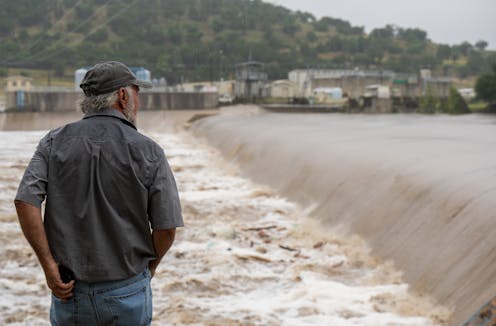
A Kerrville, Texas, resident watches the flooded Guadalupe River on July 4, 2025. Eric Vryn/Getty Images

Texas Hill Country is known for its landscapes, where shallow rivers wind among hills and through rugged valleys. That geography also makes it one of the deadliest places in the U.S. for flash flooding.

In the early hours of July 4, 2025, a flash flood swept through an area of Hill Country dotted with summer camps and small towns about 70 miles northwest of San Antonio. More than 130 people died in the flooding. The majority of them were in Kerr County, including more than two dozen girls and counselors at one summer camp, Camp Mystic. Dozens more people were still unaccounted for a week later.

The flooding began with a heavy downpour, with more than 10 inches of rain in some areas, that sent water sheeting off the hillsides and into creeks. The creeks poured into the Guadalupe River.

A river gauge at Hunt, Texas, near Camp Mystic, showed how quickly the river flooded: Around 3 a.m. on July 4, the Guadalupe River was rising about 1 foot every 5 minutes at the gauge, National Weather Service data shows. By 4:30 a.m., it had risen more than 20 feet. As the water moved downstream, it reached Kerrville, where the river rose even faster.

Flood expert Hatim Sharif, a hydrologist and civil engineer at the University of Texas at San Antonio, explains what makes this part of the country, known as Flash Flood Alley, so dangerous.

What makes Hill Country so prone to flooding?

Texas as a whole leads the nation in flood deaths, and by a wide margin. A colleague and I analyzed data from 1959 to 2019 and found 1,069 people had died in flooding in Texas over those six decades. The next highest total was in Louisiana, with 693.

Many of those flood deaths have been in Hill County. It’s part of an area known as Flash Flood Alley, a crescent of land that curves from near Dallas down to San Antonio and then westward.

The hills are steep, and the water moves quickly when it floods. This is a semi-arid area with soils that don’t soak up much water, so the water sheets off quickly and the shallow creeks can rise fast.

When those creeks converge on a river, they can create a surge of water that wipes out homes and washes away cars and, unfortunately, anyone in its path.

Hill Country has seen some devastating flash floods. In 1987, heavy rain in western Kerr County quickly flooded the Guadalupe River, triggering a flash flood similar to the one in 2025. Ten teenagers being evacuated from a camp died in the rushing water.

San Antonio, at the eastern edge of Hill Country, was hit with a flash flood on June 12, 2025, that killed 13 people whose cars were swept away by high water from a fast-flooding creek near an interstate ramp in the early morning.

Why does the region get such strong downpours?

One reason Hill Country gets powerful downpours is the Balcones Escarpment.

The escarpment is a line of cliffs and steep hills created by a geologic fault. When warm air from the Gulf rushes up the escarpment, it condenses and can dump a lot of moisture. That water flows down the hills quickly, from many different directions, filling streams and rivers below.

As temperature rise, the warmer atmosphere can hold more moisture, increasing the downpour and flood risk.

A tour of the Guadalupe River and its flood risk.

The same effect can contribute to flash flooding in San Antonio, where the large amount of paved land and lack of updated drainage to control runoff adds to the risk.

What can be done to improve flash flood safety?

First, it’s important for people to understand why flash flooding happens and just how fast the water can rise and flow. In many arid areas, dry or shallow creeks can quickly fill up with fast-moving water and become deadly. So people should be aware of the risks and pay attention to the weather.

Improving flood forecasting, with more detailed models of the physics and water velocity at different locations, can also help.

Probabilistic forecasting, for example, can provide a range of rainfall scenarios, enabling authorities to prepare for worst-case scenarios. A scientific framework linking rainfall forecasts to the local impacts, such as streamflow, flood depth and water velocity, could also help decision-makers implement timely evacuations or road closures.

Education is particularly essential for drivers. One to two feet of moving water can wash away a car. People may think their trucks and SUVs can go through anything, but fast-moving water can flip a truck and carry it away.

Officials can also do more to barricade roads when the flood risk is high to prevent people from driving into harm’s way. We found that 58% of the flood deaths in Texas over the past six decades involved vehicles. The storm on June 12 in San Antonio was an example. It was early morning, and drivers had poor visibility. The cars were hit by fast-rising floodwater from an adjacent creek.

This article, originally published July 5, 2025, has been updated with the death toll rising.

The Conversation

Hatim Sharif does not work for, consult, own shares in or receive funding from any company or organization that would benefit from this article, and has disclosed no relevant affiliations beyond their academic appointment.

– ref. Why Texas Hill Country, where a devastating flood killed more than 130 people, is one of the deadliest places in the US for flash flooding – https://theconversation.com/why-texas-hill-country-where-a-devastating-flood-killed-more-than-130-people-is-one-of-the-deadliest-places-in-the-us-for-flash-flooding-260555

When disasters fall out of the public eye, survivors continue to suffer – a rehabilitation professional explains how sustained mental health support is critical to recovery

Source: The Conversation – USA (3) – By Lee Ann Rawlins Williams, Clinical Assistant Professor of Education, Health and Behavior Studies, University of North Dakota

In Kerrville, Texas, Leighton Sterling watches the rushing floodwaters along the Guadalupe River on July 4, 2025. Eric Vryn via Getty Images News

The devastating losses from the historic flooding in Texas Hill Country on July 4, 2025, are still coming into grim focus, with 121 deaths confirmed and more than 100 still missing as of July 10.

As emergency responders focus on clearing debris and searching for victims, a less visible and slower disaster has been unfolding: the need for ongoing mental health support long after headlines fade.

This phase is no less critical than restoring power or rebuilding bridges. Disasters destabilize emotional well-being, leaving distress, prolonged recovery and long-term impacts in their wake long after the event is over.

Without sustained emotional support, people and communities face heightened risks of prolonged trauma and stalled recovery.

As an educator and practitioner focused on disability and rehabilitation, I explore the intersection of disaster recovery and the impact of disasters on mental health. Both my research and that of others underscore the vital importance of support systems that not only help people cope in the immediate aftermath of a disaster but also facilitate long-term healing over the months and years that follow – especially for vulnerable populations like children, older adults and people with disabilities.

The emotional toll of disasters

Natural disasters disrupt routines, displace families and challenge people’s sense of control and security. In the immediate aftermath, survivors often experience shock, grief, anxiety and sleep disturbances. Often these symptoms may evolve into chronic stress, depression, post-traumatic stress disorder or a combination of these conditions.

A 2022 study found that Texans who experienced two or more disasters within a five-year span had significantly poorer mental health, as reflected by lower scores on standardized psychological assessments, which highlights the cumulative toll repeated disasters can have on mental well-being.

After Hurricane Katrina ravaged New Orleans in 2005, nearly a third of survivors continued to experience poor mental health years later.

And reports following Hurricane Maria in Puerto Rico in 2017 revealed surging rates of anxiety, depression and suicidal thoughts, especially in areas where services remained unavailable for extended periods of time.

There are actionable ways to make a difference in the recovery process.

Strained recovery systems

Disaster response understandably focuses on immediate needs like rescue operations, providing post-disaster housing and repairing damaged infrastructure. In addition, short-term mental health supports such as mobile health clinics are often provided in the immediate aftermath of a disaster.

However, although emergency services are deployed quickly after a disaster, long-term mental health support is often delayed or under-resourced, leaving many people without continued care during the recovery period, especially in remote or rural communities, exposing deep structural gaps in how recovery systems are designed.

One year after Hurricane Harvey devastated parts of Texas in 2017, more than 90% of Gulf Coast residents reported ongoing stress related to housing instability, financial hardship or displacement. Yet less than 10% of people stated that they or someone in their household had used mental health services following the disaster.

Hurricane Helene in 2024 similarly tested the resilience of rural mental health networks in western North Carolina. The storm damaged roads and bridges, schools and even local clinics.

This prompted a news organization, North Carolina Health News, to warn of rising “trauma, stress and isolation” among residents as providers scrambled to offer free counseling despite legal barriers stemming from licensing requirements to provide counseling across state borders. State health officials activated community crisis centers and helplines, while mobile mental health teams were dispatched from Tennessee to help those impacted by the disaster. However, state representatives stressed that without long-term investment, these critical supports risk being one-off responses.

These events serve as a powerful reminder that while roads and buildings can often be restored quickly, emotional recovery is a slower, more complex process. Truly rebuilding requires treating mental health with the same urgency as physical infrastructure. This requires investing in strong mental health recovery systems, supporting local clinics, sustaining provider networks and integrating emotional care into recovery plans from the start.

Surrounded by community members and volunteers, an emotionally distraught woman speaks to the governor of Texas.
In Hunt, Texas, Gov. Greg Abbott speaks to volunteers and community members during a news conference on July 8, 2025.
Brandon Bell via Getty Images News

Finding mental health support following a disaster

Lessons learned from previous disasters and an abundance of research show how sustained mental health supports can help people recover and build resilience.

These six lessons are particularly helpful for finding needed mental health support following a disaster:

  • If you’re feeling overwhelmed after a disaster, you’re not alone, and help is available. Free and confidential support is offered through resources like the Disaster Distress Helpline (1-800-985-5990 or text TalkWithUs to 66746), which connects you to trained counselors 24/7.

  • Many communities offer local mental health crisis lines or walk-in centers that remain active well after the disaster passes. Check your county or state health department’s website for updated listings and information.

  • Even if physical offices are closed, many clinics now offer virtual counseling or can connect you with therapists and medication refills remotely. If you’ve seen someone before, ask if they’re still available by phone or video.

  • After major disasters, states often deploy mobile health clinics that include mental health services to shelters, churches or schools. These temporary services are free and open to the public.

  • If someone you care about is struggling, help them connect with resources in the community. Share hotline numbers, offer to help make an appointment or just let them know it’s OK to ask for support. Many people don’t realize that help is available, or they think it’s only for more “serious” problems. It’s not.

  • Mental health support doesn’t always arrive right away. Keep an eye on local news, school updates or health department alerts for new services that may become available in the weeks or months after a disaster.

Disasters don’t just damage buildings; they disrupt lives in lasting ways.

While emotional recovery takes time, support is available. Staying informed and sharing resources with others can help ensure that the road to recovery isn’t traveled alone.

The Conversation

Lee Ann Rawlins Williams does not work for, consult, own shares in or receive funding from any company or organization that would benefit from this article, and has disclosed no relevant affiliations beyond their academic appointment.

– ref. When disasters fall out of the public eye, survivors continue to suffer – a rehabilitation professional explains how sustained mental health support is critical to recovery – https://theconversation.com/when-disasters-fall-out-of-the-public-eye-survivors-continue-to-suffer-a-rehabilitation-professional-explains-how-sustained-mental-health-support-is-critical-to-recovery-260781

Disasters don’t disappear when the storm ends – cascading hazards, from landslides to floods, are upending risk models

Source: The Conversation – USA (2) – By Brian J. Yanites, Associate Professor of Earth and Atmospheric Science. Robert Shrock Professor of Surficial and Sedimentary Geology, Indiana University

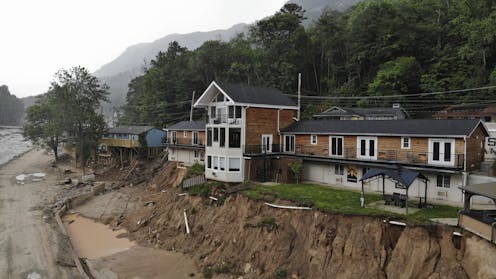
The Carter Lodge hangs precariously over the flood-scoured bank of the Broad River in Chimney Rock Village, N.C., on May 13, 2025, eight months after Hurricane Helene. AP Photo/Allen G. Breed

Hurricane Helene lasted only a few days in September 2024, but it altered the landscape of the Southeastern U.S. in profound ways that will affect the hazards local residents face far into the future.

Mudslides buried roads and reshaped river channels. Uprooted trees left soil on hillslopes exposed to the elements. Sediment that washed into rivers changed how water flows through the landscape, leaving some areas more prone to flooding and erosion.

Helene was a powerful reminder that natural hazards don’t disappear when the skies clear – they evolve.

These transformations are part of what scientists call cascading hazards. They occur when one natural event alters the landscape in ways that lead to future hazards. A landslide triggered by a storm might clog a river, leading to downstream flooding months or years later. A wildfire can alter the soil and vegetation, setting the stage for debris flows with the next rainstorm.

Two satellite maps of the same location. One shows changes to the river, loss of trees and landslides.
Satellite images before (top) and after Hurricane Helene (bottom) show how the storm altered landscape near Pensacola, N.C., in the Blue Ridge Mountains.
Google Earth, CC BY

I study these disasters as a geomorphologist. In a new paper in the journal Science, I and a team of scientists from 18 universities and the U.S. Geological Survey explain why hazard models – used to help communities prepare for disasters – can’t just rely on the past. Instead, they need to be nimble enough to forecast how hazards evolve in real time.

The science behind cascading hazards

Cascading hazards aren’t random. They emerge from physical processes that operate continuously across the landscape – sediment movement, weathering, erosion. Together, the atmosphere, biosphere and the earth are constantly reshaping the conditions that cause natural disasters.

For instance, earthquakes fracture rock and shake loose soil. Even if landslides don’t occur during the quake itself, the ground may be weakened, leaving it primed for failure during later rainstorms.

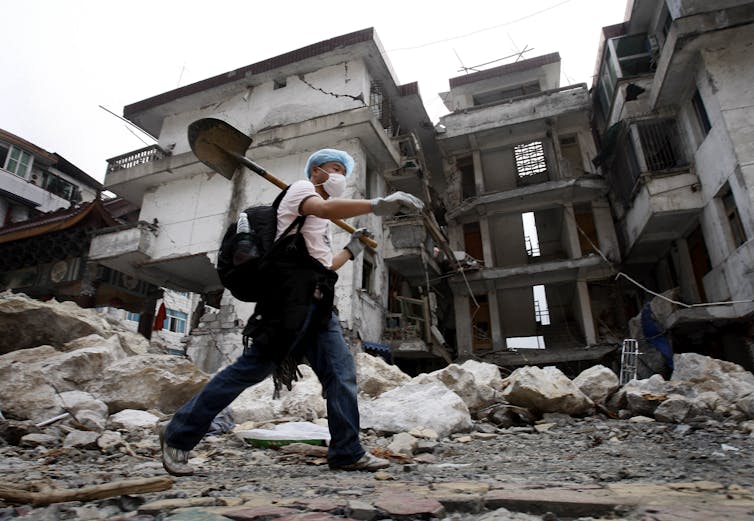
That’s exactly what happened after the 2008 earthquake in Sichuan Province, China, which led to a surge in debris flows long after the initial seismic event.

A volunteer carrying a shovel over his shoulder walks past boulders and a severely damaged building.
A strong aftershock after a 7.8 magnitude earthquake in Sichuan province, China, in May 2008 triggered more landslides in central China.
AP Photo/Andy Wong

Earth’s surface retains a “memory” of these events. Sediment disturbed in an earthquake, wildfire or severe storm will move downslope over years or even decades, reshaping the landscape as it goes.

The 1950 Assam earthquake in India is a striking example: It triggered thousands of landslides. The sediment from these landslides gradually moved through the river system, eventually causing flooding and changing river channels in Bangladesh some 20 years later.

An intensifying threat in a changing world

These risks present challenges for everything from emergency planning to home insurance. After repeated wildfire-mudslide combinations in California, some insurers pulled out of the state entirely, citing mounting risks and rising costs among the reasons.

Cascading hazards are not new, but their impact is intensifying.

Climate change is increasing the frequency and severity of wildfires, storms and extreme rainfall. At the same time, urban development continues to expand into steep, hazard-prone terrain, exposing more people and infrastructure to evolving risks.

The rising risk of interconnected climate disasters like these is overwhelming systems built for isolated events.

Yet climate change is only part of the equation. Earth processes – such as earthquakes and volcanic eruptions – also trigger cascading hazards, often with long-lasting effects.

Mount St. Helens is a powerful example: More than four decades after its eruption in 1980, the U.S. Army Corps of Engineers continues to manage ash and sediment from the eruption to keep it from filling river channels in ways that could increase the flood risk in downstream communities.

Rethinking risk and building resilience

Traditionally, insurance companies and disaster managers have estimated hazard risk by looking at past events.

But when the landscape has changed, the past may no longer be a reliable guide to the future. To address this, computer models based on the physics of how these events work are needed to help forecast hazard evolution in real time, much like weather models update with new atmospheric data.

An aerial view of a river with evidence of a landslide. Broken trees look like toothpicks scattered about, and the river flow is partially blocked.
A March 2024 landslide in the Oregon Coast Range wiped out trees in its path.
Brian Yanites, June 2025
An aerial view of a river with evidence of a landslide. Broken trees look like toothpicks scattered about, and the river flow is partially blocked.
A drone image of the same March 2024 landslide in the Oregon Coast Range shows where it temporarily dammed the river below.
Brian Yanites, June 2025

Thanks to advances in Earth observation technology, such as satellite imagery, drone and lidar, which is similar to radar but uses light, scientists can now track how hillslopes, rivers and vegetation change after disasters. These observations can feed into geomorphic models that simulate how loosened sediment moves and where hazards are likely to emerge next.

Researchers are already coupling weather forecasts with post-wildfire debris flow models. Other models simulate how sediment pulses travel through river networks.

Cascading hazards reveal that Earth’s surface is not a passive backdrop, but an active, evolving system. Each event reshapes the stage for the next.

Understanding these connections is critical for building resilience so communities can withstand future storms, earthquakes and the problems created by debris flows. Better forecasts can inform building codes, guide infrastructure design and improve how risk is priced and managed. They can help communities anticipate long-term threats and adapt before the next disaster strikes.

Most importantly, they challenge everyone to think beyond the immediate aftermath of a disaster – and to recognize the slow, quiet transformations that build toward the next.

The Conversation

Brian J. Yanites receives funding from the National Science Foundation.

– ref. Disasters don’t disappear when the storm ends – cascading hazards, from landslides to floods, are upending risk models – https://theconversation.com/disasters-dont-disappear-when-the-storm-ends-cascading-hazards-from-landslides-to-floods-are-upending-risk-models-259502

Qui fait la culture ? Le modèle français à l’épreuve des tensions budgétaires

Source: The Conversation – France (in French) – By Fabrice Raffin, Maître de Conférence à l’Université de Picardie Jules Verne et chercheur au laboratoire Habiter le Monde, Université de Picardie Jules Verne (UPJV)

La programmation du festival des arts de rue de Ramonville, organisé par l’association Arto, près de Toulouse, a dû être réduite d’un tiers en 2025 du fait des coupes budgétaires. Mathieu Lacout, CC BY-ND

Réductions budgétaires et logiques de concurrence mettent sous tension les différents acteurs de la culture publique. Une recomposition silencieuse du modèle français serait-elle en cours ?


Depuis un an, les coupes budgétaires annoncées par l’État et les collectivités territoriales bouleversent l’écosystème culturel français. Ces réductions sont plus complexes à appréhender qu’elles n’en ont l’air. Il demeure qu’elles ont un effet structurel majeur : elles mettent en tension les différents acteurs du secteur culturel public, dont l’équilibre reposait sur des soutiens croisés (État, régions, départements, villes). De plus, elles ravivent d’anciennes lignes de fracture entre ces acteurs de la culture inégalement dotés, renvoient à des conceptions différentes de la culture, et interrogent plus largement la pertinence du modèle français d’action culturelle fondé sur l’intervention publique.

Quatre grandes familles de professionnels face à la crise

La crise actuelle révèle avec acuité la coexistence, au sein du monde de la culture subventionnée, de quatre grandes familles d’acteurs aux logiques différentes – et parfois concurrentielles.

Un premier type d’acteur est constitué des structures les plus historiquement installées : théâtres nationaux, centres dramatiques, scènes nationales, opéras, musées nationaux, conservatoires. Elles concentrent environ 75 % des crédits d’intervention du ministère de la Culture affectés au spectacle vivant et bénéficient d’une multisubvention stable et pluriannuelle. Ce sont aussi elles qui disposent d’un personnel permanent (direction, technique, administration), et qui structurent l’agenda culturel national. Mais leur centralité symbolique et économique est aujourd’hui questionnée : ces structures restent souvent centrées sur une offre culturelle relevant des Beaux-Arts, de la création contemporaine, du patrimoine artistique. Actrices de la culture légitime, inscrites dans une logique de démocratisation culturelle et centrées sur des questions artistiques, elles apparaissent parfois éloignées des pratiques et des attentes de la population. De plus, leur gouvernance verticale fait parfois obstacle à l’expérimentation ou à l’inclusion.


Du lundi au vendredi + le dimanche, recevez gratuitement les analyses et décryptages de nos experts pour un autre regard sur l’actualité. Abonnez-vous dès aujourd’hui !


Compagnies indépendantes et collectifs artistiques

Les compagnies indépendantes et collectifs artistiques constituent un deuxième groupe d’acteurs qui apparaît de plus en plus dépendant du premier. Ils sont essentiellement financés sur projets, via appels à candidatures, aides à la création ou conventionnements limités dans le temps. Ces équipes sont au cœur de la création contemporaine, mais subissent de plein fouet les logiques de sous-traitance qui les assignent à un rôle d’exécutants, contraints de s’adapter aux conditions imposées par les institutions détentrices des lieux, des moyens et de la visibilité. Près de 80 % des compagnies n’ont aucun lieu de diffusion en propre, ce qui les oblige à négocier en permanence avec les institutions pour diffuser leur travail. Le Syndicat des Cirques et Compagnies de Création (SCC) a d’ailleurs rejeté, en février 2025, la « Charte des relations entre équipes artistiques et lieux » proposée par le Syndeac, l’une des principales organisations professionnelles du secteur culturel public, estimant que le texte renforçait cette logique de sous-traitance.

Secteur associatif et citoyen

Le tiers secteur culturel (associatif et citoyen) regroupe lui les initiatives culturelles locales citoyennes, souvent portées par des associations, des tiers-lieux, des collectifs d’habitants ou des structures hybrides. Ces acteurs incarnent une vision décentrée de la culture, centrée sur l’animation des territoires, les droits culturels, et la co-construction de l’offre avec les habitants. Loin des canons de la culture classique des grandes institutions, elles apparaissent plus en phase avec les pratiques culturelles réelles des Français et les dynamiques locales : pratiques amatrices, participation, ancrage dans les réseaux locaux. Si la logique artistique et la création peuvent irriguer ces initiatives, elles sont avant tout orientée vers l’animation, l’événementiel, l’expression et la créativité des habitants. Les coupes budgétaires fragilisent en priorité ces structures, car elles dépendent le plus des financements croisés et ne disposent ni de réserves ni de financements d’État direct. En mai 2025, le collectif MCAC (Mobilisation et Coopération Arts et Culture) mettait ainsi en avant dans une lettre ouverte à la ministre de la Culture que près d’une structure sur deux a subi des coupes de la part d’au moins deux niveaux de collectivités, menaçant la pérennité d’écosystèmes locaux entiers.

Le clown Typhus Bronx devant une foule au festival de Ramonville en septembre 2024
Le clown Typhus Bronx au festival des arts de rue de Ramonville en 2024. Organisé par une association, le festival a vu sa programmation diminuer d’un tiers en 2025 en raison des coupes budgétaires.
Mathieu Lacout, CC BY-ND

Les agents territoriaux

Enfin, un quatrième groupe d’acteurs, moins visibles, regroupe les agents territoriaux chargés de la mise en œuvre concrète des politiques culturelles au sein des collectivités locales : chargés de mission, médiateurs culturels, responsables des affaires culturelles dans les mairies, départements ou régions. Au fil des lois de décentralisation, les collectivités territoriales ont acquis un rôle majeur dans la gestion et le développement culturel. Elles ont ainsi pris en charge des compétences clés comme le soutien à la création artistique, la diffusion, l’éducation artistique et culturelle, la médiation culturelle, ou encore animent des projets d’inclusion sociale. Leur action repose souvent sur des partenariats avec des structures associatives, des établissements scolaires ou des institutions artistiques. Lorsque les budgets culturels sont revus à la baisse – ou coupés comme dans la Région Pays de la Loire – les conséquences sont immédiates : suppression de projets éducatifs, gel des subventions aux associations partenaires, fermeture temporaire ou définitive d’équipements culturels, etc. Ne sachant plus comment maintenir leur action sans moyens, ces agents expriment depuis quelques mois un profond sentiment de découragement, voire de désespoir.

Concurrentes plutôt qu’irréconciliables ?

Il serait excessif de dire que ces familles d’acteurs sont « irréconciliables » : des coopérations existent, des passerelles aussi. Mais la réduction de moyens observable depuis septembre 2025 les met en compétition directe pour l’accès aux subventions, aux lieux, à la reconnaissance institutionnelle. Cette mise en concurrence accentue les asymétries, renforce le pouvoir des structures les mieux dotées, et tend à marginaliser les formes plus fragiles et expérimentales.

Dans ce contexte, les débats sur la gouvernance, sur les droits culturels ou sur la légitimité des modèles économiques prennent une tournure conflictuelle. Le rejet de la Charte du Syndeac par le SCC, mentionné plus haut, en est un symptôme : derrière un désaccord sur les conditions de travail, se cache une fracture sur la définition même du pacte culturel républicain. Le SCC revendique ici une parole singulière, celle de « ceux qui font », en opposition à « ceux qui ont ». Plus qu’un désaccord financier ou professionnel, c’est un désaccord sur les fondements mêmes du pacte culturel. Qui décide ? Qui produit le sens ? Qui est légitime pour parler au nom de « la culture » ?

La poursuite du désengagement budgétaire, même marginal, risque ainsi de déséquilibrer durablement le modèle français de soutien à la culture. Elle renforce les logiques de sélection, de concentration des moyens, et affaiblit les formes culturelles les plus proches des publics éloignés de l’offre institutionnelle.

The Conversation

Fabrice Raffin ne travaille pas, ne conseille pas, ne possède pas de parts, ne reçoit pas de fonds d’une organisation qui pourrait tirer profit de cet article, et n’a déclaré aucune autre affiliation que son organisme de recherche.

– ref. Qui fait la culture ? Le modèle français à l’épreuve des tensions budgétaires – https://theconversation.com/qui-fait-la-culture-le-modele-francais-a-lepreuve-des-tensions-budgetaires-260359

Lemurs can help save Madagascan forests, but first we need to protect them

Source: The Conversation – Canada – By Colombe Nirina Sehenomalala, PhD candidate, Anthropology, Université de Montréal

Most people’s encounters with lemurs have occurred through their representations in popular children’s media, like Zoboomafoo or Madagascar. However, most people don’t know that lemurs play an important role in forest renewal and that they’re currently in grave danger from climate change.

In my home country of Madagascar, there is an amazing array of creatures that are not found anywhere else in the world. Madagascar is a biodiversity hotspot, and approximately 90 per cent of plant and animal species on this island are endemic.

Among them are lemurs, a group of primates that are not only the flagship symbols of the island’s fauna, but also one of the key players in the health and stability of Madagascar’s ecosystems because they do the very important work of dispersing seeds.

I am a primatologist who researches the interactions between infant-and-mother lemur dyads in wild. Their bond is a reminder of what we stand to lose, as it shows care, learning and viability. When forests disappear, so does this fragile bond, and a whole way of life we can never replace.

Lemurs’ habitats and survival are increasingly being threatened by human activities such as deforestation, forest resource exploitation and hunting. There is an urgent need for conservation projects that involve local communities in preserving Madagascar’s unique biodiversity.

a bent over branch in a rainforest
A lemur trap encountered in the field during our research.
(C.N. Sehenomalala), CC BY

Charismatic animals

Due to their charisma, media attention and their biological significance, lemurs attract tourists and researchers to Madagascar. The viability of lemurs is essential to the island’s future, both economically but especially in terms of protecting biodiversity. As they eat fruits from trees like ebony, mammea and wild coffee and then scatter seeds through their droppings, they help new plants grow.

Among the 105 lemur species of Madagascar, Propithecus candidus, commonly known as the silky sifaka, is one of the most endangered species. Only around 250 of them are currently living in the wild.

As their name implies, silky sifakas have visually striking long white hair, and they can only be found in the misty, mountainous rainforests of northeastern Madagascar.

Silky sifakas are primarily active during the daytime, and can travel very quickly through the trees by vertically clinging to them and leaping from tree to tree using their powerful legs. They have highly specialized diets consisting of leaves, flowers and fruits like Diospyros pervilleana, a native ebony species from Madagascar.

A BBC Nature documentary clip on silky sifakas.

Observing mothers and infants

I have spent 10 years studying and following lemurs daily. During my fieldwork in northeastern Madagascar, I closely observed how deforestation and habitat fragmentation affect silky sifaka females and their young.

I studied these females during their lactation season in three different forest contexts: Marojejy National Park (a mostly untouched primary rainforest), Makira Natural Park (a mix of old-growth and re-generating forest) and Anjanaharibe-Sud Special Reserve (known as COMATSA-Sud, a primary forest with heavily degraded areas).

At each forest, the forest canopy, which provides both shelter and food for the lemurs, measured above 10 metres at all sites, but was semi-open, which is a sign of habitat degradation. A semi-open canopy allows more light to permeate the forest canopy, but it also exposes animals to predators and decreases the quantity of high-quality food.

Mothers’ movements and behaviours

One clear difference between the three sites is how mother–infant pairs move and use space. In Marojejy, where the forest is more continuous even if the canopy is partly open, mothers and babies stay within fairly fixed areas, following the same paths and resting spots.

But in places like Makira and COMATSA-Sud, where the forest is broken up into separate patches, mothers have to travel farther and more unpredictably, moving between these isolated patches. This extra travelling causes them to burn more energy and face higher risks from predators and hunters.

These differences show that fragmentation doesn’t just affect food availability, but also changes how these lemurs move and survive.

Forest fragmentation affects lemurs’ social behaviour and grouping patterns to deal with low food availability. It also impacts their health and development; a poor diet causes malnourishment in the lemurs.

a white lemur feeds another one
Lemurs are social animals, but scarce resources can cause competitive behaviours to emerge.
(Simponafotsy/Wikimedia Commons), CC BY

Poor nutritional quality

While the food availability for silky sifakas in northeastern Madagascar during the lactation season is relatively abundant, it is of low nutritional quality.

This leads to increased stress and competition as dominant lactating females, desperate to feed their infants, attack subordinates to accumulate more nutrients to produce higher quality milk.

As offspring start to feed on non-milk foods, the poor nutritional quality of available plants after weaning can lead to poor health and stunted growth.

Engaging the community

The decline of lemur populations, particularly silky sifakas, shows the need for urgent conservation action. Continued monitoring — as well as sustained support and funding for Malagasy scientists — is crucial for long-term lemur and biodiversity conservation.

When it comes to the effects of human activity, this decline — habitat fragmentation, global climate change and deforestation — is the result of large-scale activites such as extraction, tourism and state infrastructural development.

Education and awareness campaigns are crucial, both in Madagascar and internationally, to inform people about lemurs’ habitat needs and what can be done to prevent their extinction.

Conservation will never be successful without building an appreciation of the environmental, cultural and economic value of lemurs and the forests they inhabit.

The Conversation

The authors do not work for, consult, own shares in or receive funding from any company or organisation that would benefit from this article, and have disclosed no relevant affiliations beyond their academic appointment.

– ref. Lemurs can help save Madagascan forests, but first we need to protect them – https://theconversation.com/lemurs-can-help-save-madagascan-forests-but-first-we-need-to-protect-them-256300