At the end of a long day, who has time to check the detailed nutrition information on every single product they toss into their shopping basket?
To eat healthily, some people prefer to stick to a simple rule: choose products with a short ingredient list. The idea is foods with just a few ingredients are less processed, more “natural” and therefore healthy.
But is this always the case? Here’s what the length of an ingredient list can and can’t tell you about nutrition – and what else to look for.
How ingredient lists work
You can find an ingredient list on most packaged food labels, telling you the number and type of ingredients involved in making that food.
Ingredients must be listed in order of ingoing weight. This means items at the beginning of the list are those that make up the bulk of the product. Those at the end make up the least.
Food labels also include a nutrition information panel, which tells you the quantity of key nutrients (energy, protein, total carbohydrates, sugars, total fat, saturated fat and sodium) per serving.
This panel also tells you the content per 100 grams or millilitres, which allows you to work out the percentage.
Whole foods can be packaged, too
Products with just one, two or three items in their ingredient list are generally in a form that closely reflects the food when it was taken from the farm. So even though they come in packaging, they could be considered whole foods.
“Whole foods” are those that have undergone zero to minimal processing, such as fresh fruit and vegetables, lentils, legumes, whole grains such as oats or brown rice, seeds, nuts and unprocessed meat and fish.
To support overall health, the Australian Dietary Guidelines recommend eating whole foods and limiting those that are highly processed.
Many whole foods, such as fresh fruits and vegetables, don’t have an ingredient list because they don’t come in a packet. But some do, including:
canned or frozen vegetables, such as a tin of black beans or frozen peas
canned fish, for example, tuna in springwater
plain Greek yoghurt.
These sorts of food items can contribute every day to a healthy balanced diet.
What is an ultra-processed food?
A shorter ingredient list also means the product is less likely to be an ultra-processed food.
This describes products made using industrial processes that combine multiple ingredients, often including colours, flavours and other additives. They are hyperpalatable, packaged and designed for convenience.
Ultra-processed foods often have long ingredient lists, due to added sugars (such as dextrose), modified oils, protein sources (for example, soya protein isolate) and cosmetic additives – such as colours, flavours and thickeners.
Some examples of ultra-processed foods with long ingredient lists include:
meal-replacement drinks
plant-based meat imitations
some commercial bakery items, including cookies or cakes
instant noodle snacks
energy or performance drinks.
If a food is heavily branded and marketed it’s more likely to be an ultra-processed food – a created product, rather than a whole food that hasn’t changed much since the farm.
Nutrition is more than a number
Choosing products with a shorter ingredient list can work as a general rule of thumb. But other factors matter too.
The length of an ingredient list doesn’t tell us anything about the food’s nutritional content, so it’s important to consider the type of ingredients as well.
Remember that items are listed in order of their ingoing weight, so if sugar is second or third on the list, there is probably a fair bit of added sugar.
For instance, a food product may have only a few ingredients, but if the first, second or third is a type of fat, oil or sugar, then it may not be an ideal choice for every day.
You can also check the nutrition information panel. Use the “per serve” column to check the nutrients you’d get from eating one serve of the food. If you want to compare the amount of a nutrient in two different foods, it’s best to look at the per 100g/mL column.
Some examples of foods with relatively short ingredient lists but high amounts of added fats and sugars include:
potato crisps
chocolate
soft drink.
Alcoholic beverages such as beer or wine may also have only a few ingredients, but this does not mean that they should be consumed every day.
You can also keep an eye out for cosmetic ingredients, which don’t have any nutritional value. These include colours, flavours, emulsifiers, thickeners, sweeteners, bulking agents and gelling agents.
It sometimes takes a bit of detective work to spot cosmetic ingredients in the list, as they can come under many different names (for example, stabiliser, malted barley extract, methylcellulose). But they are usually always recognisable as non-food items.
If there are multiple non-food items included in an ingredient list, there is a good chance the food is ultra-processed and not ideal as an everyday choice.
The bottom line? Choosing foods with a shorter ingredient list can help guide you choose less processed foods. But you should also consider what type of ingredients are being used and maintain a varied diet.
Margaret Murray does not work for, consult, own shares in or receive funding from any company or organisation that would benefit from this article, and has disclosed no relevant affiliations beyond their academic appointment.
Earlier this year, we asked a group of older adults what music they listened to when feeling lonely, and why. We discovered music was a powerful coping mechanism and source of escapism.
Other studies have also found listeners use music “to keep them company”. Such reports suggest music might be able shape listeners thoughts and imagination to provide social solace.
But can we establish scientifically how music affects imagination? In short, can music really be good company? Our latest research tried to find out.
Music and mental images
It’s common to experience mental imagery – that is a mental simulation or imagining something that is not there – while listening to music. Studies have found 77% of music listeners online, 73% of participants in the lab, and 83% of concert-goers report experiences of mental imagery during music listening.
What’s going on here? To get a better understanding, we previously carried out a series of experiments with mental imagery and music.
We showed participants a small clip from a video game called Journey, which featured a small figure travelling towards a mountain. We then asked them to imagine the continuation of the journey.
Participants reported how vivid or life-like their imagination was. In addition, they provided details on distance and time travelled in their mind and shared detailed descriptions of their imagined journeys.
Across multiple studies, we asked hundreds of participants to do the task in silence or while listening to various types of music. We observed much more vivid and emotionally positive imagination when listening to music. In addition, listeners’ imagined longer distances and time travelled when listening to music compared to silence.
Participants were shown a short clip from the video game Journey, either with or without music, and were asked to imagine a continuation of the journey towards the mountain in the distance. Thatgamecompany
Music shapes listeners’ imagination
Previous research has also found that what people imagine while listening to music often forms elaborate imagined stories. These share greater similarity among listeners with a shared cultural background.
Thoughts and themes in the imagined stories are shaped by the music. For example, heroic-sounding music induces empowering themes into imagined content.
Occurrences of new events in these imagined stories also tend to be similar between listeners, and are related to the pattern of musical tension and relief.
So there is strong scientific support for the idea that music can indeed affect what is imagined. But can it specifically induce imagined social interactions?
Our latest study is the first to explicitly investigate this question.
Does music make imagination more social?
We asked 600 participants to perform the imaginary journey task, either in silence or while listening to Italian, Spanish or Swedish folk music. To understand the potential effect of vocals and the meaning of lyrics on imagined content, the music was presented with or without lyrics to the participants, half of whom were native speakers and the other half non-speakers of the respective languages.
We then used tools from natural language processing – a set of computational methods for analysing language – to find underlying topics across participants’ reports of their imagined journeys.
Imagined themes of social interactions were more common while listening to music than during silence. Herff et al. / Scientific Reports
One topic stood out: social interaction. Not only was it the predominant topic in participants’ reports of what they imagined, but it was also much stronger while listening to music compared to silence.
This suggests music can indeed affect social thought. The effect was stable regardless of whether listeners’ understood the lyrics or whether there even were lyrics in the first place.
But we can go one step further.
We used a generative AI system which produces images from text prompts (Stable Diffusion) to visualise participants’ descriptions of their imagined journeys.
Example images generated from descriptions during silence (left: ‘I imagined a dark walk, without emotions, alone, looking for some hope’) and music (right: ‘I imagined a walk in the mountains with my family, all together, happy and carefree, we played, we laughed’). Herff et al. / Scientific Reports
By combining the natural language processing model with the image generator, we could visualise what the language processing model had learned to be a “stereotypical” representation of content imagined during silence and music listening.
What the computational model learned people tend to imagine during silence (left) and music (right). Herff et al. / Scientific Reports
The results of the computational model were further supported with manual annotations that showed three times more social interactions in journeys imagined during music listening compared to silence.
A shared imagination of music
Finally, we showed the images created from the descriptions to another group of people.
These people were able to pick out which images showed content imagined during music listening, and which showed content imagined while in silence – but they were only able to do it when listening to the same music that inspired the image.
This shows there is a shared understanding, or “theory of mind” of what another person might imagine while listening to a piece of music.
Taken together, our results suggest music can indeed be good company.
The authors do not work for, consult, own shares in or receive funding from any company or organisation that would benefit from this article, and have disclosed no relevant affiliations beyond their academic appointment.
The military junta that overthrew Myanmar’s democratically elected government in 2021 is preparing the ground for national elections in December and January.
The junta’s hope is these deeply flawed elections would consolidate its power and provide it with a fig leaf of legitimacy.
Helping its cause are moves by the Trump administration indicating it may be looking to bring the Myanmar junta in from the cold.
A week ago, US President Donald Trump removed sanctions on some allies of Myanmar’s generals and their military-linked companies, a move condemned by the UN special rapporteur on human rights in Myanmar.
Then came reports the Trump administration was exploring opportunities to access Myanmar’s rare earth minerals in an effort to sideline its strategic rival, China.
An election charade
On July 31, Myanmar’s military regime cancelled the nationwide state of emergency it had kept in place since the coup, a necessary precondition from 2008 for holding elections under the military-authored constitution.
Hours later, however, it reimposed a state of emergency in dozens of townships where opposition forces are either in control or gaining ground. It then declared martial law in these areas.
This underlined the junta’s lack of control over much of the country, which would make holding a free and fair election virtually impossible.
Last year, the military was unable to conduct a full census to be used to compile voter rolls. It was only able to count 32 million people in just over half the country’s townships; it had to estimate another 19 million people in areas outside its control.
This week’s order also handed power from the commander-in-chief of the military to a head of state, which was presented as a return to civilian governance. However, power didn’t actually change hands – Min Aung Hlaing, the leader of the coup and military, remains in control as acting president.
Opposition groups have said they will boycott the election, which the UN special rapporteur for Myanmar called a “fraud”.
Myanmar’s rare earths bonanza
Myanmar’s generals may also try to use Trump’s apparent interest in the country’s rare earths as leverage in their attempt to normalise relations with the United States ahead of a poll.
China is not only a large miner of rare earths, it dominates the processing required to use them, accounting for around 90% of global refining.
Rare earth mining has exploded in northern Kachin State since the coup, much of which is controlled by the Kachin Independence Organization (KIO), an ethnic armed group that opposes the junta.
Late last year, it seized two important rare earth mining towns from the military and demanded a greater role in taxing exports to China, which initially closed the border in response.
However, trade soon resumed after the two sides reached a deal on export taxes.
No path forward for Trump
Two different proposals have reportedly been put to Trump for ways to access Myanmar’s rare earth deposits. One would entail opening talks with the junta; the other talking directly with the KIO.
Part of this effort could entail Trump reducing the punitive 40% tariffs his administration imposed on Myanmar to sweeten the deal.
Yet, challenges remain to making this a reality. The mines are located in the contested war-torn mountains of northern Myanmar bordering China, which are controlled by the KIO. There is no real infrastructure capable of transporting exports to India’s remote northeastern states in the opposite direction. The only other export route is south through territory controlled by the junta or other ethnic armed groups.
In addition, any attempt by the US and its allies to extract thousands of tons of rare earth material away from China’s borders would likely anger Beijing. It could pressure the KIO by reducing fuel and food imports coming from China.
The group’s independence and ability to fight the junta relies on trade with China. It would not take long for such an agreement to fall apart.
Finally, rare earths mining is extremely polluting and dangerous. Even under Trump, it is unlikely US companies would gamble on the inevitable reputational and legal risks that would accompany such a project, especially in a war zone.
No reasons for warming relations
In essence, any attempt by the Trump administration to secure rare earths from Myanmar through any intermediary will not go anywhere.
There is therefore no justification, on any grounds, for the Trump administration to reduce sanctions on Myanmar’s generals or their cronies.
Likewise, although the junta is attempting to legitimise its brutal rule by offering a patina of constitutional processes, its elections will not bring real change to the country.
Myanmar’s people have repeatedly demonstrated over the past four decades, in every remotely free and fair election, that they do not want the military involved in the governance on their country.
If the junta does go ahead with this election, the world’s governments should call it out for the farcical charade of democracy it will represent. This includes the administration in Washington.
Adam Simpson does not work for, consult, own shares in or receive funding from any company or organisation that would benefit from this article, and has disclosed no relevant affiliations beyond their academic appointment.
It can be used from preschool to high school in the province, but it is notably used in secondary schools and in regions where the number of students learning the language of schooling is high, such as Montréal.
Students who do not speak French well enough to be placed in the mainstream class are placed in the welcoming class for French learning. Students in high school study mainly French, but also math, arts and physical education. This happens separately from students attending the mainstream class.
I collected and analysed different types of data: documents, school observations and interviews with 37 school workers and seven students to learn about their experiences and views on the subject.
My research suggests that, even though the welcoming class is considered a “transition” to the mainstream class, the reality is more complicated.
In fact, some students may never get to the mainstream class. My research results reveal long stays in the welcoming class, immigrant students being placed below the age level of the students in the mainstream class and placements in general adult education and special education.
Challenges for immigrant students
Some students may stay years in the welcoming class if they are not considered ready to be placed in the mainstream class.
For some older teenagers who arrive without language skills of the host society, there are great chances that they can, after secondary school, be sent to adult education. They can end up studying with adults much older than them, which can influence their motivation.
According to school workers I interviewed in my study, only some of the students meet the requirements of the host environment in terms of performance and behaviour and can therefore achieve educational success.
The students who fail to adapt can be seen as having individual or cultural “deficits” – for example, learning difficulties or academic delays. Some school workers highlighted structural issues of the host environment. They notably mentioned viewing school systems as under-resourced to meet immigrant students needs.
My research suggests what is meant to be a temporary support becomes a sorting mechanism to stream immigrants into an educational track that can lead to limits on higher education and lower-paying employment.
Thus, there is a need to critically look at how the decisions are made to place and keep students in the welcoming class and who they serve.
Families not sufficiently informed
According to students in my study, they (and their parents) are not sufficiently informed about the education system in their host province.
Consequently, they tend to accept placement decisions – in the welcoming class, general adult education and special education – without fully understanding the implications.
Long stays in the welcoming class, as well as special education and adult education placements, can have profound consequences in the lives of immigrant students, especially those who are racialized, come from low-income backgrounds or have experienced interrupted schooling.
Based on the accounts of students in my study, being placed in the welcoming class, special education or adult education can deepen dynamics of othering. As other researchers have noted, “specialized” or “separate” forms of education often add to how students are viewed through a lens of difference, especially racialized, linguistic and cultural difference.
However, this is not to suggest that people in school systems who facilitate placements to the welcoming class, special education or adult education lack good intentions for immigrant students.
Many school workers seem to be doing their best under difficult conditions. It is a systemic issue, rooted in the structure of the school system. Nevertheless, if the system itself reproduces inequalities, acknowledging good intentions is not enough.
Thus, to create equitable education for all students, it is essential to:
1) ensure immigrant families have clear and accessible information about their rights and options by providing adequate support such as translation services, and by ensuring full student and parent participation in decision-making.
3) consider inclusive models inside the mainstream classroom by providing sufficient school resources to facilitate a broader range of placement options.
In these ways, by moving to more flexible, equitable and student-centred approaches, our school systems can practise different ways of supporting student academic success.
The research carried out during the doctoral program received financial support from the Fonds de recherche du Québec – Société et Culture (FRQSC) and the Social Sciences and Humanities Research Council of Canada (SSHRC).
Each month, members receive a newsletter with my selection and review, along with a link to an electronic discussion board to comment on the books. All are welcome to join and there are no fees.
Reading has been associated with improved personal well-being, since it can decrease stress and promote a sense of calmness. (Unsplash/Eliott Reyna)
If you seek to be proactive with maintaining your mental health, or are mildly concerned about how well you are doing (the mental health continuum model of “green, amber and red” zones might help you consider this), self-help books are among the resources that can provide a supportive option until you have access to a professional, or in conjunction to working with a trained professional.
Kross, a professor and leading expert on emotion regulation, explores the science of emotion and provides several evidence-based strategies to help you manage it in a healthy way.
One of the most powerful statements in the book is the very last one Kross makes: “We have the power to shift our lives,” which illustrates our capacity to improve well-being.
This book is a must-read for anyone interested in emotion regulation.
Good Anxiety: Harnessing the Power of the Most Misunderstood Emotion by Wendy Suzuki with Billie Fitzpatrick
Neuroscience professor Suzuki takes you on a science-filled journey of how anxiety works in our brains and how you can change those pathways for a more positive experience.
Three themes that emerge centre around making time for meditation, exercise and sleep. These elements may help you move from bad to good anxiety.
The notion of good anxiety is about coping and changing our perceptions and reactions to anxiety so that it becomes a strength and motivator; “our superpower,” as Suzuki notes.
Suzuki provides numerous guided strategies to help make the shift to good anxiety.
The Resilient Teen: 10 Key Skills to Bounce Back from Setbacks & Turn Stress Into Success by Sheela Raja
Raja, a clinical psychologist and professor, provides evidence-based strategies to help teens build their resilience, which is the ability to maintain well-being when stressors arise.
Using the strategies described can help readers develop resiliency.
This is a book for teens, and those who interact with teens, who want techniques to help deal with stress and anxiety.
Breathing is My Superpower: Mindfulness Book for Kids to Feel Calm and Peaceful by Alicia Ortego
This book features the character Sophia, who describes several child-friendly breathing techniques to help regulate emotions.
Some basic yoga techniques also are described to help ease anxiety. The techniques in the book can be practised by a child alone or with an adult.
Ruby Finds a Worry by Tom Percival
‘Ruby Finds a Worry’ by Tom Percival. (Bloomsbury Publishing)
This is a child-friendly picture book on how worry can grow and become more difficult to manage if ignored.
By helping another child who experiences worry, the character Ruby learns that talking about worry can help manage it.
This book can be used as an entry point to talk to children about their emotions.
Reading for Well-Being podcast
Podcasts provide several benefits for health and well-being. Listeners can gain access to leading experts around the world and content may be presented in a way that helps people gain a deeper understanding of the subject matter.
I created the Reading for Well-Being podcast to facilitate my book club’s knowledge mobilization (providing research findings in a manner that can be used by the general public).
I interview the authors of my selected book club picks to help listeners better understand the science and strategies for improved well-being. Book club members can submit questions to the authors in advance of an episode’s recording.
Reading books about wellness or self-help can be a useful tool in coping with stress and anxiety associated with going back to school. But, remember, choose books that are written by professionals with advanced training from reputable institutions. For severe anxiety, seek help from a doctor or trained mental health professional.
Joanna Pozzulo receives funding from the Social Science and Humanities Research Council.
Source: The Conversation – Canada – By James McKendry, Assistant Professor in Nutrition and Healthy Aging, University of British Columbia
Protein is having its moment: From grocery store shelves to Instagram feeds, high-protein foods are everywhere. Food labels shout their protein content in bold, oversized fonts, while social media overflows with recipes promising to pack more protein into your favourite dishes.
And according to the International Food Information Council’s Food and Health Survey, “high protein” topped the list of popular eating patterns in 2024. But does the hype match the science?
Yes and no.
Protein is essential to good health and boosting protein intake can support healthy aging and fitness goals, but the rush to pile on grams — often driven by marketing more than medical need — raises questions. How much do you really need? Can you overdo it? What’s the best source of protein?
This article breaks down the facts, debunks common myths and answers the most pressing questions about protein today.
What is dietary protein and why do we need it?
Protein is one of the three essential macronutrients your body needs in large amounts, alongside carbohydrates and fats. While carbs and fats are primarily used for energy, protein plays a more structural and functional role. It helps build and repair tissues, supports immune health and produces enzymes, hormones and other vital molecules.
Proteins are made of amino acids. Your body can make some amino acids, but nine must come from food. These are called essential amino acids. That’s why protein is a daily dietary requirement, not just a delicious post-workout bonus.
Unlike fat and carbohydrates, which the body can store for later use, protein doesn’t have a dedicated storage system. That means you need to replenish it regularly. In extreme situations — like prolonged fasting or severe illness — your body will break down its own muscle to release amino acids for energy and repair. It’s a last-resort mechanism that underscores just how essential protein is for survival.
How much protein do people need?
The amount of protein an individual needs to consume each day may vary based on age, physical activity levels and the presence of health conditions. However, the recommended dietary allowance (RDA) for daily protein intake is the same for almost everyone: 0.8 grams of protein per kilogram of body weight per day (g/kg/d).
For example, a woman weighing 65 kilograms should aim to consume approximately 52 grams of protein daily.
An important caveat is that the RDA is set to prevent protein deficiency, not to promote optimal health. Older adults who have a reduced ability to utilize the nutrients they consume, athletes whose bodies need more substrate for tissue growth and repair, and pregnant or breastfeeding individuals whose protein intake is shared with another being, often need more protein. Sometimes as much as 1.2 to 2 grams per kilogram of body weight. Therefore, an older person of the same body mass (65 kilograms) might need between 78 g and 130 g of protein daily, far exceeding the RDA.
Is there such a thing as too much protein?
While several expert groups agree that consuming more protein can be beneficial in certain situations — particularly for older adults — there is probably little to no advantage in consuming protein amounts exceeding two grams per kilogram per day.
A prominent social media influencer recently claimed that post-menopausal women must consume protein within a very short window (~45 minutes) after exercise, or any benefits from exercise will quickly dissipate and they will lose all their muscle. This is absolutely not the case.
The idea of an “anabolic window” — a brief period after exercise when recovering muscles make the best use of protein — has long been debunked. Perhaps more accurately described as a garage door rather than an anabolic window, there is a generous period of at least 24 hours to consume protein after exercise.
This means your muscles remain sensitive to the muscle-building effects of protein for a long time after exercise. So, focusing your efforts on consuming enough protein each day is much more important than stressing about guzzling your protein shake in the changing room immediately following your workout.
As long as you’re eating enough protein each day, feel free to consume it on a schedule that fits your daily routine.
But if increasing the amount of protein that you eat at each meal helps you feel fuller and curb your appetite, you may be a little less likely to overeat or indulge in sweet treats.
And with the increasing off-label use of Type 2 diabetes medications such as GLP-1 agonists, which significantly reduce appetite, putting protein on your plate first might — and it’s a considerable might — help slow muscle loss that accompanies this drastic weight loss. However, this is rather speculative, and resistance exercise will probably be your best option for slowing muscle loss while on these medications.
Protein is found in a wide variety of foods, from animal sources such as meat, fish, eggs and dairy to plant-based options like legumes, soy products, whole grains, nuts, seeds and even some vegetables. Protein is also widely available as a nutritional supplement, with whey, casein and collagen being among some of the most popular options.
Animal proteins often contain more of the essential amino acids and are more bioavailable, meaning they are easier for the body to absorb and use. However, a well-planned plant-based diet can also supply all the essential amino acids the body needs — it just takes a bit more variety and intention.
If that wasn’t enough, and you find yourself trying to wrap your head around food labelling, you’re not the only one. When it comes to high-protein products seen all over the grocery store, meat, dairy, shakes and bars are no longer the only options. Now, consumers are bombarded with high-protein popcorn, chips and even candy. Most of these, like diets promoted by influencers, are unnecessary “health halo” gimmicks.
My advice would be to follow a varied, whole-food, protein-forward diet — much like the dietary guidelines. And whatever your preferred protein source — animal- or plant-based — fill about a quarter of your plate or bowl at breakfast, lunch and dinner.
This approach will greatly support your overall health, especially when combined with a diverse diet rich in fruits, vegetables and whole grains, along with regular physical activity.
The bottom line is that protein is an essential nutrient, and consuming enough of it daily is crucial for maintaining good health. But meeting your body’s protein needs doesn’t need to be complicated.
James McKendry receives funding from The University of British Columbia and The Natural Sciences and Engineering Research Council (NSERC) of Canada
En 2023, le taux de pauvreté a dépassé 15 % en France. Cela n’est pas tant le résultat d’une conjoncture économique défavorable que la conséquence de changements structurels emportant des mutations de long terme. Le sujet mérite d’autant plus d’être observé car, au-delà de la situation des personnes concernées, il remet en cause la stabilité des institutions politiques.
En 2023, la France a enregistré un taux de pauvreté monétaire record, atteignant 15,4 %, soit un niveau inédit depuis 1996. La question de la soutenabilité du modèle socio-économique des démocraties occidentales revient au premier plan. Cette progression de la pauvreté ne relève pas uniquement d’un choc conjoncturel, mais témoigne d’une mutation plus profonde du rapport entre croissance, redistribution et cohésion sociale. Le retour de la pauvreté de masse, y compris dans des catégories jusqu’ici intégrées au salariat protégé, signale une possible rupture de régime dans la promesse implicite d’ascension sociale et de protection des plus vulnérables.
La conjoncture n’explique pas tout
Le taux de pauvreté monétaire a atteint 15,4 % en France en 2023, soit le niveau le plus élevé depuis 1996. Cette progression significative (+0,9 point en un an, soit environ 650 000 personnes supplémentaires) interroge profondément les fondements socio-économiques des pays développés. Loin d’un simple effet de conjoncture (inflation, crise énergétique ou guerre en Ukraine), cette inflexion marque une tendance structurelle : la multiplication des zones de précarité latente – vulnérabilité économique persistante, souvent masquée par l’emploi ou des ressources instables, mais exposée au moindre choc – dans les segments inférieurs et médians de la distribution des revenus.
Les déterminants structurels de l’augmentation de la pauvreté sont multiples : montée des emplois atypiques (et ubérisation), stagnation des salaires réels pour les déciles médians, dualisation du marché du travail, déformation du partage de la valeur ajoutée au détriment du facteur travail et réduction de l’investissement public dans certains services collectifs essentiels. À cela s’ajoutent des dynamiques territoriales inégalitaires où les zones rurales, périurbaines et certains centres urbains dégradés cumulent désindustrialisation, isolement social et sous-dotation en infrastructures publiques comme privées.
Figure – Évolution comparée des niveaux de vie (D1, D5, D9) en France, 1996–2023, avant et après redistribution. – Source : Insee
Lecture : les courbes montrent l’évolution des revenus des 1er, 5e et 9e déciles, en euros constants (base 100 en 2008). Avant redistribution, les écarts sont beaucoup plus prononcés, notamment entre D1 et D9. L’effet redistributif réduit significativement ces écarts, mais ne suffit pas à inverser les dynamiques inégalitaires de long terme. La stagnation du bas de l’échelle (D1) reste visible même après transferts sociaux, alors que le haut (D9) progresse nettement.
Des amortisseurs sociaux de moins en moins opérants
Si les transferts sociaux jouent encore un rôle crucial dans la réduction de la pauvreté (le taux brut atteindrait 21,7 % sans redistribution), leur efficacité relative diminue. Non seulement ils ne parviennent plus à enrayer la montée tendancielle de la pauvreté, mais ils peinent aussi à répondre à la complexité des situations contemporaines : travailleurs pauvres, jeunes diplômés sous-employés, femmes seules avec enfants ou encore retraités vivant sous le seuil de pauvreté (1288 euros).
Ce glissement progressif traduit une rupture dans le compromis fordiste sur lequel reposait la cohésion des économies occidentales : emploi stable, protection sociale contributive et croissance redistributive. Il met également en tension la soutenabilité politique du modèle social à mesure que les classes moyennes perçoivent ces transferts comme moins universels et plus segmentés.
Ce phénomène n’est pas propre à la France : les économies occidentales dans leur ensemble connaissent une montée d’une pauvreté dite « intégrée », c’est-à-dire présente au sein même du salariat. Dans les pays de l’OCDE, plus de 7 % des travailleurs sont aujourd’hui pauvres, signe que l’emploi ne protège plus systématiquement du besoin. Cette évolution remet en cause le postulat selon lequel le marché du travail constitue un vecteur naturel d’intégration économique et sociale. En parallèle, les écarts de niveau de vie entre les déciles extrêmes s’élargissent, accentuant la fragmentation du tissu social.
Les classes moyennes déstabilisées
Au-delà de la pauvreté en tant que phénomène statistique, c’est l’évolution relative des positions sociales qui alimente un sentiment profond de déclassement. Les classes moyennes, longtemps considérées comme les piliers de la stabilité démocratique et de la croissance domestique, sont désormais prises en étau. D’un côté, la paupérisation des actifs précaires et la fragilité de l’emploi fragmenté ; de l’autre, l’accumulation exponentielle de capital chez les 10 % les plus riches et plus encore chez les 1 % supérieurs. Il est ici essentiel de distinguer les flux de revenus (salaires, prestations) des stocks patrimoniaux, dont la concentration alimente des écarts croissants sur le long terme, indépendamment des efforts individuels.
Cette polarisation résulte de dynamiques économiques profondes : concentration du capital immobilier et financier, désindexation salariale, évolution défavorable du capital humain dans les secteurs intermédiaires et fiscalité régressive dans certains segments. Les gains de productivité ne se traduisent plus par des hausses de salaire ; la fonction d’utilité des agents tend à se contracter dans les déciles intermédiaires et les effets de seuils fiscaux, sociaux ou réglementaires amplifient les discontinuités dans les trajectoires de vie.
Perte de foi dans la promesse méritocratique
On assiste ainsi à une recomposition en sablier de la structure sociale : précarité durable en bas, enrichissement du haut, et effritement du centre. Dans ce contexte, la perception d’une mobilité sociale bloquée, ou, pire, inversée renforce le désengagement civique, la frustration relative et la radicalisation des préférences politiques. Ce que révèlent les indicateurs de pauvreté ne relève donc pas uniquement d’un appauvrissement objectif mais bien d’une perte d’espérance en la promesse méritocratique au cœur de la légitimation démocratique.
France 24 – 2025.
La situation est d’autant plus préoccupante que les variables d’ajustement traditionnelles comme l’éducation, le travail qualifié ou l’accession à la propriété ne jouent plus leur rôle d’ascenseur. L’immobilité relative des positions intergénérationnelles, combinée à l’explosion du coût de l’entrée dans la classe moyenne (logement, études, santé), tend à enfermer les individus dans leur position initiale. Autrement dit, la pauvreté s’ancre dans des dynamiques d’exclusion durables plus difficilement réversibles que par le passé.
Une crise de soutenabilité du contrat social démocratique
L’universalité du filet de sécurité et la promesse de mobilité sociale ascendante constituaient les deux piliers implicites du contrat social des économies libérales avancées, or ces deux fondements sont aujourd’hui ébranlés. L’universalité tend à se fragmenter sous l’effet de ciblages budgétaires croissants et d’un tri social plus restrictif dans l’accès aux droits sociaux. La mobilité, quant à elle, est de moins en moins portée par les fonctions traditionnelles de l’école, de l’emploi et du logement.
La question centrale devient donc : nos démocraties disposent-elles encore des moyens économiques et politiques pour corriger les déséquilibres que leur propre trajectoire historique a produits ? Plusieurs options sont sur la table : réforme de la fiscalité sur les hauts patrimoines, réinvestissement dans les infrastructures sociales, redéfinition des politiques d’emploi, expérimentation de mécanismes de revenu minimum garanti, remise à zéro du modèle social. Mais leur mise en œuvre se heurte à une contrainte majeure : le consentement fiscal des classes moyennes, précisément celles dont la position socio-économique est la plus fragilisée.
Le taux de pauvreté à 15,4 % est plus qu’un indicateur social. Il traduit une perte d’efficacité du modèle redistributif, une fragmentation des trajectoires individuelles et une mise en tension du pacte démocratique. Le défi est donc double : restaurer une forme d’égalité réelle tout en reconstruisant les conditions d’un consentement collectif à la solidarité.
Hugo Spring-Ragain ne travaille pas, ne conseille pas, ne possède pas de parts, ne reçoit pas de fonds d’une organisation qui pourrait tirer profit de cet article, et n’a déclaré aucune autre affiliation que son organisme de recherche.
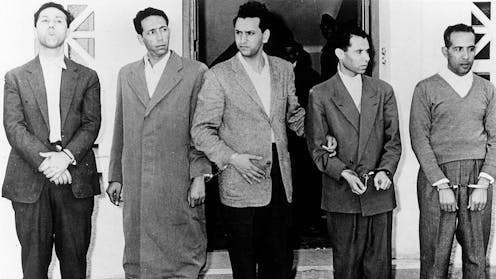
De gauche à droite, les dirigeants du Front de libération nationale algérien, Ahmed Ben Bella, Mohamed Boudiaf, Hocine Aït Ahmed, Mostefa Lacheraf et Mohamed Khider, arrêtés par l’armée française après le détournement de leur avion reliant Rabat à Tunis, le 22 octobre 1956.Picryl, CC BY
La Kabylie reste le théâtre d’un face-à-face politique et idéologique avec Alger, enraciné dans les divisions du mouvement national algérien. Ce texte rassemble une série de constats et de réflexions nourris par plus d’un demi-siècle d’observation et d’engagement – une observation que l’on pourrait qualifier de participante – au sein de la principale région berbérophone d’Algérie : la Kabylie.
À bien des égards, la Kabylie peut être vue comme un condensé de l’histoire politique de l’Algérie depuis son indépendance. Condensé caractérisé par la continuité des pratiques de répression et de neutralisation d’une région qui s’est trouvée maintes fois en opposition frontale avec le pouvoir central.
En 1982, à l’occasion du vingtième anniversaire de l’indépendance de l’Algérie, le chanteur kabyle Ferhat Mehenni du groupe Imaziɣen Imula composait et interprétait une chanson dont le refrain disait à peu près ceci :
« Vingt ans de dictature déjà,
Sans compter ce qui nous attend »
Le futur fondateur du Mouvement pour l’autonomie de la Kabylie (MAK, 2001) n’imaginait certainement pas que sa chanson, quarante ans plus tard, serait encore d’une tragique actualité. Quarante ans plus tard, le caractère autoritaire et répressif du régime algérien n’a fait que se renforcer et se généraliser et la Kabylie en a fait, et en fait, la cruelle et permanente expérience. Certes, cette situation concerne bien sûr l’ensemble de l’Algérie, mais elle se présente pour cette région sous une forme à la fois récurrente, quasiment systémique, et particulièrement diversifiée.
À ce sujet, on me permettra de mentionner ici un souvenir personnel. La première fois que j’ai rencontré, fin 1981 ou début 1982 à Paris, le grand historien algérien Mohamed Harbi, celui-ci, au cours de la conversation, constatant chez ses interlocuteurs une certaine naïveté et improvisation, nous déclara :
« Vous êtes des boy-scouts ! Ne savez-vous pas que les plans de mise en état d’alerte de l’armée algérienne sont fondés sur deux scénarios uniquement : une guerre sur la frontière algéro-marocaine et une insurrection armée en Kabylie ? »
Cette spécificité kabyle est déterminée par un ensemble de facteurs historiques, sociologiques, culturels bien connus : un particularisme linguistique et culturel marqué, une densité démographique élevée, le maintien d’une tradition communautaire villageoise forte, une scolarisation significative ancienne, une émigration précoce et massive vers la France et une politisation sensible des élites et de l’émigration ouvrière… On trouvera une présentation précise de ces paramètres dans mon dernier ouvrage Berbères aujourd’hui.
Kabyles et Berbères : luttes incertaines (éditions L’Harmattan, 2022).
Continuité d’une répression multiforme
Depuis 1962, la Kabylie a connu à peu près toutes les formes de répression envisageables :
L’intervention militaire directe dès 1963 pour mater la rébellion armée du Front des forces socialistes (FFS) de Hocine Aït Ahmed (septembre 1963-juin 1965), qui tentait de s’opposer à la mise en place du système de parti unique et au régime autoritaire du tandem Ben Bella- Boumediene. Intervention qui se soldera par des centaines de morts et des centaines d’arrestations, de détentions arbitraires et de tortures sauvages.
La répression violente de manifestations pacifiques. On n’évoquera ici que les événements de grande ampleur, pour un historique détaillé, on se reportera à l’article de Chaker et Doumane (2006). Parmi ces événements, le printemps berbère de 1980 (entre mars et juin) ; les manifestations du printemps 1981 ; celles de juin 1998 à la suite de l’assassinat, dans des conditions suspectes, du chanteur Matoub Lounès ; et surtout celles du « printemps noir » de 2001-2002 qui seront sévèrement réprimées et se solderont par au moins 130 morts et des milliers de blessés.
La répression judiciaire récurrente aboutissant à des centaines d’arrestations et condamnations de manifestants et à de nombreuses condamnations des meneurs par la Cour de sûreté de l’État.
L’interdiction et la répression de toute tentative d’organisation légale notamment celle de la Ligue algérienne des droits de l’homme, créée autour de feu maître Abdennour Ali Yahia, dissoute en tant que « ligue berbériste » en 1985 (plus d’une dizaine de ses membres ont été arrêtés et sévèrement condamnés et maltraités).
Les assassinats ciblés d’opposants politiques, y compris à l’étranger : parmi les plus importants, on citera celui de Krim Belkacem (Francfort, 1970) et celui d’Ali Mecili (Paris, 1987).
Des manipulations par les services secrets contre de prétendus groupes terroristes ou armés : affaire des poseurs de bombes (1974), affaire de Cap Sigli (1978).
Cette affaire s’est soldée en novembre 2022 par une parodie de justice à l’issue de laquelle ont été prononcés, en moins de trois jours, 102 lourdes condamnations. On vient donc d’atteindre un degré tout à fait inédit dans la répression, sans doute symptomatique d’une crise profonde au sein du régime et/ou d’une volonté de liquider en Algérie toutes les oppositions politiques significatives en les criminalisant.
Dans tous ces cas, la presse officielle s’est déchaînée contre « les ennemis de l’unité nationale, les agents de l’impérialisme et du néo-colonialisme, du Maroc, du sionisme, voire les agents des services secrets occidentaux ». Le but étant de démanteler des groupes ennemis de l’État et de la nation, et de ressouder le peuple autour de ses dirigeants.
Et bien sûr, une répression culturelle structurelle, pendant une trentaine d’années, inscrite officiellement dans les orientations idéologiques, les Constitutions et les lois de l’État algérien qui définissaient l’Algérie comme un pays exclusivement arabe et musulman (Ce n’est qu’en 2016 que le tamazight a accédé au statut de langue nationale et officielle). Le paramètre berbère étant considéré comme ayant disparu ou devant disparaître, car susceptible de porter atteinte à l’unité de la nation. C’était la position tout à fait officielle du FLN et notamment de sa commission culture, totalement investie par le courant arabiste.
Continuité d’une politique de neutralisation
Une autre permanence de la politique de l’État central par rapport à la région est la neutralisation de ses élites politiques et culturelles par intégration dans l’appareil d’État et ses structures satellites. Je ne parle évidemment pas du rôle considérable qu’ont joué les Kabyles au sein de l’appareil d’État, en particulier dans ses sphères technocratiques et sécuritaires, pendant les deux ou trois premières décennies qui ont suivi l’indépendance. Cette surreprésentation des Kabyles dans ces secteurs était une conséquence directe à la fois de leur implication forte dans la guerre de libération et de données socio-culturelles plus anciennes, notamment la formation d’élites locales assez nombreuses.
Je pense en fait surtout à ce que j’ai appelé ailleurs « la nouvelle politique berbère » qui se met progressivement en place à partir de la fin des années 1980/début 1990. En réalité, les premiers signes de cette évolution sont décelables dès 1985, après l’apparition des premières actions terroristes islamistes : certains milieux du pouvoir, son aile « moderniste », ont tenté dès cette époque une approche des milieux berbéristes.
Jusque-là, une grande partie des élites politiques, intellectuelles et culturelles kabyles était globalement dans une relation d’opposition au pouvoir central, du fait même de l’ostracisme prononcé contre le paramètre berbère. Exclue de l’espace institutionnel, la mouvance berbère s’est développée pendant deux à trois décennies en dehors et largement contre le système étatique algérien, particulièrement en émigration. Que ce soit dans le champ de la culture et de la langue ou dans le champ politique, ces deux courants se recoupant largement, en particulier autour du FFS de Hocine Aït Ahmed.
À partir de la fin des années 1980 et le début des années 1990 se dessine progressivement une nouvelle ligne politique officielle, plus tolérante à la berbérité et à ses élites représentatives politiques et culturelles.
Le contexte politique global de cette évolution est bien connu : il est clairement déterminé par la montée en puissance des islamistes qui deviennent pour le pouvoir le danger principal.
Cette nouvelle politique berbère va explicitement se mettre en place pendant la décennie 1990, avec Mohamed Boudiaf et, surtout, avec la prise de pouvoir par les généraux : des composantes significatives du courant berbère soutiendront le pouvoir militaire au nom de la lutte contre les islamistes. Cette politique va s’accentuer et s’accélérer pendant la période Bouteflika. Un des axes majeurs de cette nouvelle orientation, incarnée par la ministre de la culture Khalida Toumi Messaoudi à la longévité exceptionnelle (2002-2014), sera l’intégration systématique des élites culturelles kabyles et la prise en charge de la langue et de la culture berbères dans le cadre d’une politique de gestion patrimoniale et nationale. Le 10 avril 2002, une révision de la Constitution algérienne ajoute l’article 3bis, qui reconnaît le berbère comme langue nationale. Au fond, il s’agit d’une opération méthodique d’intégration d’un paramètre et d’une élite jusque-là hors système d’État.
On notera d’ailleurs qu’une politique similaire peut être observée au Maroc dans le cadre de ce que j’ai appelé « la makhzénisation » de la culture et des élites berbères marocaines. Dans ce pays, cette opération d’intégration a été cependant beaucoup plus aisée, car les élites politiques et intellectuelles berbères marocaines, à l’exception notable de celles du Rif, ont toujours été parties prenantes du système politique.
Dans les deux cas, il s’agit clairement d’une entreprise de neutralisation et de dépossession : la langue et la culture berbères ne sont pas l’apanage des régions berbérophones ou des berbérophones, mais celui de l’État, incarnation de la nation unie et indivisible. Le discours officiel et les réformes constitutionnelles de 2002 et de 2016 en Algérie (et celles de 2011 au Maroc) sont parfaitement explicites et adoptent des formulations strictement parallèles : la langue et la culture berbères font partie du patrimoine indivis de la nation.
Sur ce point précis, la filiation avec la tradition politique et juridique jacobine française est flagrante ; j’ai montré ailleurs (Chaker 2022, chapitre 7) que la République française avait développé exactement le même type d’approche à propos des langues régionales de France : les experts du gouvernement français ont ainsi affirmé, en 1999, que « le breton (le basque, etc.) n’appartient pas aux Bretons ou à la Bretagne, mais au patrimoine indivis de la nation française ».
Le but évident de cette affirmation, en contradiction manifeste avec la réalité historique et sociolinguistique, étant d’éviter de reconnaître des droits spécifiques à des minorités linguistiques, situation qui pourrait aisément dériver vers des revendications autonomistes ou fédéralistes.
Salem Chaker ne travaille pas, ne conseille pas, ne possède pas de parts, ne reçoit pas de fonds d’une organisation qui pourrait tirer profit de cet article, et n’a déclaré aucune autre affiliation que son organisme de recherche.
Source: The Conversation – UK – By Nicholas John Wheeler, Professor of International Relations, Department of Political Science and International Studies and Non-Resident Senior Fellow at BASIC, University of Birmingham
The world entered its nuclear epoch 80 years ago on August 6 1945. The US dropped an atomic bomb on the Japanese city of Hiroshima, killing between 70,000 and 140,000 civilians by the end of that year.
A stark reminder of this immense destructive power came recently. On August 1, US president Donald Trump announced the redeployment of two submarines – presumably Ohio-class subs carrying ballistic missiles – in response to what he called “highly provocative statements” by Russia’s former president Dmitry Medvedev.
It may have been empty posturing by Trump. But one Ohio-class submarine (the US Navy has 14 in its fleet) carries approximately 90 warheads, each with destructive power many times greater than the bombs dropped on Hiroshima and, three days later, Nagasaki.
As the world remembers the devastation wrought by these bombings, the threat of nuclear conflict remains a persistent threat to humanity.
Frisch-Peierls memorandum
For many years it was believed that building an atomic weapon was not feasible given the amount of uranium-235 required for a bomb. This assumption changed in March 1940 when two refugee physicists – Rudolf Peierls and Otto Frisch, who both worked at the University of Birmingham – produced in secret what became known as the Frisch-Peierls memorandum.
Their memorandum showed that a powerful atomic bomb could be built using only a small amount of uranium-235. What drove Frisch and Peierls was fear that Nazi Germany might build the bomb first.
They wrote: “If one works on the assumption that Germany is, or will be, in the possession of this weapon … The most effective reply would be a counter-threat with a similar bomb. It would obviously be too late to start production when such a bomb is known to be in the hands of Germany, and the matter seems, therefore, very urgent.”
The Frisch-Peierls memorandum was submitted to the British government as a warning. Prime Minister Winston Churchill heeded the message, establishing the Maud committee a month later to investigate the military potential of atomic energy.
It reported in secret in July 1941, urging production of a bomb and Britain’s cooperation with the US in this endeavour. In a now-famous line, the committee said: “No nation would care to risk being caught without a weapon of such decisive possibilities.”
The demonstration of what the atomic bomb was capable of at Hiroshima, and then at Nagasaki, spurred others to follow the committee’s logic. The Soviet Union, fearing a US atomic monopoly, tested its first bomb in 1949. Britain joined the nuclear club in 1952, followed by France in 1960 and China in 1964.
It is widely accepted that Israel had developed nuclear capability by the early 1970s, though it has maintained a position of ambiguity. India and Pakistan became declared nuclear powers in 1998 and North Korea followed in 2006.
While factors such as national ambition and status played a role in proliferation, a key driving force was fear, fear of adversaries achieving a lasting strategic advantage and, in the case of North Korea, an external attack.
Fear’s centrality to the nuclear story is not only in relation to its role as a driver of proliferation. Nuclear fear has also been a key source of restraint. The most dramatic manifestation of this was the October 1962 Cuban missile crisis.
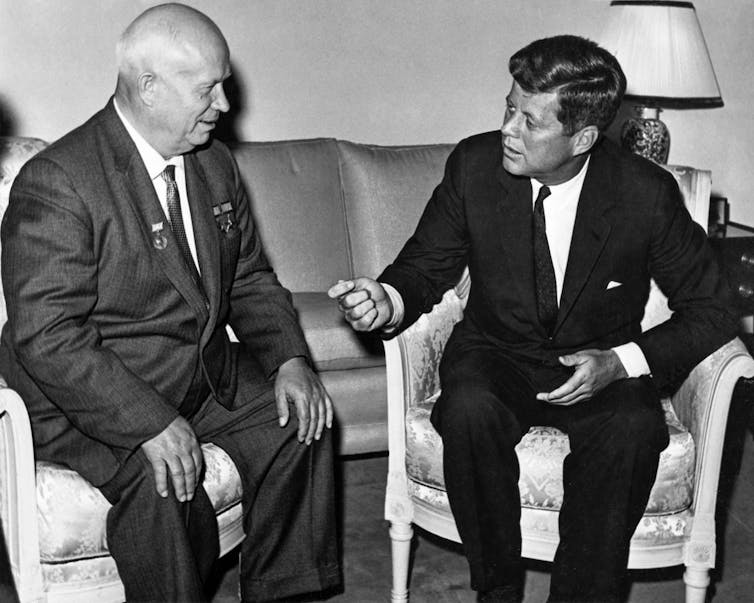
As I have argued elsewhere, shared fear of nuclear catastrophe led the then US president, John F. Kennedy, and his Soviet counterpart Nikita Khrushchev to develop empathy and trust. This was a key factor in the peaceful resolution of the crisis.
John F. Kennedy meeting with Nikita Khrushchev during a 1961 summit held in Vienna. US Department of State
However, nuclear fear – and the deterrence it makes possible – is a fragile basis on which to safeguard humanity’s future. The world may have avoided the use of nuclear weapons since August 1945 through a combination of prudent statecraft and good luck. But how long is it before some combination of bad luck and reckless risk-taking leads to the use of nuclear weapons once again?
Russian nuclear sabre-rattling over Ukraine and the May 2025 conflict between India and Pakistan, unleashing military force between two nuclear-armed states, are warnings that the ever-present threat of nuclear weapons still hangs over humanity.
In the cold war’s climate of deep distrust and nuclear fear, the US and Soviet Union at least had some shared guardrails and channels of communication. Arms control agreements agreed after the Cuban missile crisis limited superpower competition through the 1960s and 1970s. They continued to restrain US-Soviet competition in the early 1980s.
Nowadays, however, arms control has all but collapsed while reliable and trusted channels of communication between major nuclear adversaries are virtually non-existent. The prospects for regulating the nuclear arms competition between Russia, the US and China are bleak.
Replacing fear with trust
To mark the 80th anniversary of the advent of the nuclear epoch, the Nobel Laureate Assembly – a gathering of Nobel laureates and nuclear experts at the University of Chicago – warned in its 2025 Declaration for the Prevention of Nuclear War that: “Ultimately, security cannot be built on fear.”
If the bomb was born out of fear, then ensuring it is never used again requires replacing fear with trust. Ten years into the nuclear epoch, Albert Einstein and philosopher Bertrand Russell issued a manifesto signed by 11 signatories. It was created principally as a trust-building project between the east and west.
The manifesto concluded: “We appeal as human beings to human beings: remember your humanity, and forget the rest. If you can do so, the way lies open to a new paradise; if you cannot, there lies before you the risk of universal death.”
We now face the same choice the manifesto laid bare. One path leads to annihilation, the other to survival through a recognition of our common humanity.
Japan gives expression to that common humanity every August when Hiroshima and Nagasaki hold their peace memorial ceremonies. Remembering the victims and those who continue to suffer from the effects of the atomic bombings, these memorials look to a future where nuclear weapons no longer exist.
The nuclear bomb may have been born in fear. But only the building of trust, which may spring from that fear, can ensure it is never used again.
I have received past funding from the Economic and Social Research Council and the Open Society Foundations.
Source: The Conversation – UK – By Cat Acheson, Research Associate, School of Social and Political Science, University of Edinburgh
Plastics are everywhere – they’re even in you right now – and are making many of us sick. Now, global negotiators are fighting over whether that matters.
As 180 countries meet in Geneva to seek agreement on a global treaty on plastic pollution, a landmark review published in medical journal The Lancet has made the stakes clear. Plastics, the evidence shows, are a threat to human health – from womb to grave.
They’re linked to miscarriages, birth defects, heart disease and cancer. Plastics are harming people at every stage of the plastics lifecycle – from initial oil extraction to the production and use of plastic products, and their eventual disposal via landfill, incinerator or just being left in the environment.
Yet the possibility of a strong, health-centred treaty hangs in the balance. Campaigners, scientists and healthcare groups are pushing for strong measures to cap production and ban hazardous chemicals. But petrochemical producers and industry lobbyists are pushing back – arguing, against mounting evidence, that plastics are essential to saving lives.
The UN meeting in Geneva is the culmination of several years of negotiating. In theory, delegates will agree on a global treaty by August 15.
The current draft text, which will be the basis for these negotiations, contains provisional elements which could make a real difference. These include cutting plastic production (Article 6), banning plastic products and chemicals that are hazardous to humans or the environment (Article 3), and a section dedicated to protecting human health (Article 19).
But some negotiators oppose these elements, and there is a risk they will be watered down or scrapped entirely in the final treaty.
The so-called Like-Minded Group of countries – many of whose members are petrochemical producers including Saudi Arabia, China, Iran, and Russia – has led the opposition to a health-centred treaty. They have done so by arguing that plastics are in fact essential for protecting health, due to the role of single-use plastic in modern medicine.
For example, Kuwait’s submission to the previous negotiating round in Busan, South Korea, last year called concerns about plastic “not inclusive”, and cited medical devices as proof that plastic saves lives. Saudi Arabia has opposed the inclusion of a dedicated article on health, arguing that this would divert the treaty away from its core purpose of managing plastic waste.
Since almost all plastic is made from oil or gas, these petrostates have a clear incentive to maintain the status quo of plastic production and dependency. No wonder they want to focus on managing waste, rather than making less in the first place.
Less than 10% of the world’s plastic is recycled. Clare Louise Jackson / shutterstock
Plastics industry lobbyists have also been accused of “infiltrating” the negotiations and wielding outsized influence. They too have pushed the narrative that plastics are essential for human health – for example, with posters displayed in Busan which claimed “plastics save lives”.
These lobby groups are pushing for healthcare plastics to be exempted from the treaty entirely, which would provide a significant loophole for plastic producers.
As evidence grows of the ways plastics are harming humans, claims they are necessary to safeguard our health are looking increasingly far-fetched. Of course, plastics are everywhere in modern healthcare. But in most cases, and especially with single-use plastics, they can and should be replaced with a less harmful alternative.
Civil society groups, scientists and healthcare professionals are building momentum for a strong health-centred treaty. The international nongovernmental organization Health Care Without Harm has coordinated an open letter rejecting exemptions for the health sector. Signed by 65 organisations representing 48 million health workers across 88 countries, it calls for a treaty that tackles the full plastics lifecycle – and says cutting unnecessary plastic in healthcare is both possible and necessary to protect patients.
The Scientists’ Coalition, made up of independent experts, has been instrumental in bringing evidence of plastics’ health effects into the debate, while groups like the Global Alliance for Incinerator Alternatives have been pushing for the treaty to recognise that plastics, and especially their disposal, affect marginalised populations hardest. They argue that justice for the most affected people and places should be at the heart of the treaty.
The global plastics treaty is an unprecedented opportunity to take decisive, coordinated action to tackle one of the planet’s biggest threats. At stake in Geneva is whether health will stay at the heart of this treaty – or be sacrificed under pressure from industry and petrostates.
Cat Acheson receives funding from The Wellcome Trust for a project which partners with Health Care Without Harm.
Alice Street received a Wellcome Discovery Award for the project: ‘After the Single Use: Rethinking Medical Devices for Reuse, Resilience and Renewal’, which partners with Health Care Without Harm.
Rob Ralston is a member of Scientists’ Coalition for an Effective Treaty.