The car finance scandal proves that the financial sector still has trust issues that need to be sorted

Source: The Conversation – UK – By Alper Kara, Head of Department of Economics, Finance & Accounting, Brunel University of London

The car finance scandal could have ended up costing UK banks and lenders up to £44 billion in compensation payments. But after the latest court ruling, the expected bill has been reduced to less than £18 billion.

That still counts as an expensive loss of course. And it may or may not be enough to compensate the millions of motorists thought to have paid more than they needed to for car loans.

But as well as the financial hit taken by both sides, the whole affair has come at a great cost to the relationship between the public and the financial sector. An industry still grappling with trust issues has once again been accused of long-standing practices that cost consumers dear.

Under the now-banned “discretionary commission arrangements”, car brokers were allowed to increase the interest rate on car finance agreements and receive higher commissions as a result. But customers weren’t necessarily told this at the time, and the deal may have seemed like a standard finance agreement.

The practice was widespread until 2021, when it was banned by the UK’s financial services regulator. Before that, consumers were often unaware that brokers had both the power – and incentive – to manipulate the cost of their borrowing.

The result is that millions may have overpaid for car loans, sometimes by thousands of pounds, without ever knowing. While the Supreme Court has now clarified the legal boundaries of the case, the fact that such practices were widespread for years raises serious ethical concerns.

For the scandal is yet another reminder of the fragile relationship between financial institutions and their customers. Most people might expect that loan agreements will reflect market conditions – rather than be at the discretion of a salesperson keen to maximise their own commission.

Research shows that trust is fundamental to the proper functioning of financial markets. In financial services, it depends on transparency, fairness and clear communication.

Discretionary commission arrangements violated all three of these concepts.

In some ways, the case bears similarities to the payment protection insurance (PPI) scandal, where customers were sold policies designed to step in if they were unable to repay loans because of unemployment or illness for example.

Both PPI and the car loans involved financial products being sold under conditions that consumers might not have fully understood, and both relied on misaligned incentives between lenders and borrowers. They also both exposed how a lack of transparency can lead to large-scale consumer harm.

Yet in the case of car finance, the court did not order compensation for the majority of affected borrowers. One claimant won his case, but the court stopped short of declaring all such commission arrangements unlawful by default.

Nonetheless, the Financial Conduct Authority (FCA), the financial regulator, has launched a review into historical car finance commission practices. Estimates suggest lenders could still face a bill of as much as £18 billion in redress.

This wouldn’t match the £38 billion paid out over PPI, but it’s still substantial. The industry is also likely to face class action lawsuits and broader scrutiny.

Accounts and accountability

The scandals over car finance scandal and PPI both point to a fundamental issue within the UK financial retail sector – that when the goals of finance companies are not aligned with the best interests of customers, mis-selling becomes the norm rather than the exception.

Research on the PPI scandal for example, reveals fundamental flaws in how products were sold and regulated. And one of the most troubling aspects of car finance is that discretionary commission arrangement models were in use for years. Yet despite the clear potential for consumer harm, the FCA stepped in only in 2021.

Car salesman holding tablet smiles at couple.
‘And this is what the sale means for my bonus.’
Prostock-studio/Shutterstock

This delay in turn reflects a broader problem with how financial regulation operates in the UK. Much of the enforcement seems to be reactive.

Intervention typically follows consumer complaints, investigative journalism, or court rulings, rather than being driven by proactive oversight.

The FCA has acknowledged this delay and plans to consult on a redress scheme by October 2025, with compensation payments potentially starting in 2026.

While this may not lead to immediate compensation for everyone affected, but it exposes yet another chapter in the UK’s long history of financial mis-selling and weak consumer protection.

The case also exposes the limitations of “principles-based regulation”, a system where regulators set broad rules (or “principles”) for firms to follow, rather than detailed requirements. Research shows that such regulatory models may appear flexible but can also result in inconsistent enforcement and a failure to address harmful practices swiftly enough.

An alternative is a more rules-based system, where detailed requirements clearly set out what firms can and cannot do. But while this model can reduce ambiguity, it may also limit flexibility and innovation. The challenge for regulators is finding the right balance.

The priority now must be clear action. The car finance industry – and indeed the wider financial services sector – must recognise that trust cannot be rebuilt with compliance alone.

Transparency, fairness and ethical conduct must become the norm, not the exception.

For regulators, this is a chance to move toward a stronger form of supervision – especially in markets where intricate financial products and conflicts over incentives are commonplace. For the public, the scandal is a reminder to remain vigilant, because when finance becomes too complex, it often becomes unfair.

The Conversation

Alper Kara does not work for, consult, own shares in or receive funding from any company or organisation that would benefit from this article, and has disclosed no relevant affiliations beyond their academic appointment.

ref. The car finance scandal proves that the financial sector still has trust issues that need to be sorted – https://theconversation.com/the-car-finance-scandal-proves-that-the-financial-sector-still-has-trust-issues-that-need-to-be-sorted-262750

Animal Farm at 80: why the animals really matter in Orwell’s parable about communism

Source: The Conversation – UK – By Charlotte Sleigh, Associate Professor, Dept of Science & Technology Studies, UCL

George Orwell’s Animal Farm (1945) turns 80 on August 17 2025. If there’s one thing every student of history or politics knows, it’s that the novella is not really about animals. Sure, the principal characters are pigs and horses. But really, so we are told, it is about the Soviet Union and what happened to the ideals of communism under the corrupt leadership of Joseph Stalin.

Orwell himself – part of a generation of plain-speaking British authors who had not yet heard Roland Barthes’s theory of the death of the author (the idea that words speak for themselves and the author’s intentions are irrelevant) – proclaimed that this was how the story should be read.

But what if we were to take the animals in this famous tale more seriously?

Orwell wrote this short, shocking novel at a time when it was considered scientifically inadmissible for animals to be granted thoughts or even feelings. Charles Darwin’s insight in 1859, that humans are related to all other animal species, was a lost opportunity to think about how qualities of the former might be present in the latter. Instead, animal psychologists in Orwell’s time insisted more strongly than ever on the existence of a cognitive hiatus between the human “us” and the beastly “them”.


This article is part of Rethinking the Classics. The stories in this series offer insightful new ways to think about and interpret classic books, films and artworks. This is the canon – with a twist.


His contemporary experts in the social sciences and humanities played along with this distinction. The French anthropologist Claude Lévi-Strauss wrote in 1962 that animals “are good to think with” – in other words, if we interrogate human beliefs about animals, we can reveal our own deep-seated values and social patterns.

By today’s standards, and in the context of the sixth mass extinction, this seems like a regrettable statement. Contemporary multispecies studies reject the notion that animals are nothing more than a resource for humans, even a philosophical one.

Black and white photo of George Orwell
George Orwell wrote Animal Farm between 1943 and 1944.
National Union of Journalists

By contrast, many cultures and societies around the world have traditions of interacting with animals in a manner that recognises their personhood. People who live alongside and even hunt other species very often come to closely understand their behaviour and agency.

A major UK academic project is investigating how these relationships are reflected in animal fables. Titled Rethinking Fables in the Age of Environmental Crisis, it fosters collaboration between scholars, artists and writers in imagining the unique worlds of different species including horses, rats, crows and spiders, in their fast-changing and precarious environments.

Living in an era before the comprehensive introduction of massive-scale, chemically assisted agriculture, Orwell was not so far removed from pre-industrial farming and its intimate knowledge of animals. His 1936 essay about the shooting of an elephant in Burma is filled with anguish at the suffering of a real animal.

In Animal Farm too, the starting point is animal suffering – the cruelties of the human farmer are indisputable. As Old Major, a wise and elderly boar, warns the other animals: “You young porkers … every one of you will scream out your lives at the block within a year.”

The fable changes if we hold on to this reality throughout. It is reiterated by Orwell later on in the story, when the cruelties of Pinchfield Farm are reported to the animals. Human tyranny is the enemy of the animals, and despite the betrayal of their hopes under the leadership of the pig Napoleon, the justice of their cause is never undermined.

Animal dreams

Orwell’s animal revolution, the overthrow of the farmer, is inspired by a pig’s dream. Old Major gathers the other farm beasts to tell them of his vision of “the Earth as it will be when Man has vanished”, and human exploitation of animals is no more. It’s the kind of description that would have the 20th-century animal psychologists turning in their graves. Animals with an inner life? Ridiculous!

Any dog owner will tell you that their four-legged friend has dreams – yet for decades, we allowed scientists to tell us they did not. Dog dreams are woven into the description of forest life created by anthropologist Eduardo Kohn. In his book How Forests Think (2013), Kohn argues that all animals think and imagine their future. Their survival – that fundamental driver of the farmyard revolution – is based on the ability to do so.

In one memorable passage, Kohn describes how a monkey must interpret the sounds of the forest and use them to predict possible outcomes (innocent crash or predator?) in order to live. Kohn’s animals live in a world full of meaning. The human power to make meaning through abstract language is just one example of a universal feature of life.

The trailer for the 1954 adaptation of Animal Farm.

Dreams recur throughout Animal Farm, but are eventually driven out by words. The animals’ commandments, written on the barn wall, are deviously amended one by one to vindicate the pigs’ corruption.

Once meaning is externalised and objectified in the written word, it is susceptible to manipulation. Words can be rewritten and with them, the past. The animals become uncertain of their pre-verbal memories. Dreams disappear from the narrative.

Research in science communication has argued that recent trends in popular natural history respond to the desire of readers to be knitted back into the meaning of the more-than-human world that Kohn and others describe. For such a reader, Animal Farm can explore animal agency – and the fallacy of human exceptionalism.

Beyond the canon

As part of the Rethinking the Classics series, we’re asking our experts to recommend a book or artwork that tackles similar themes to the canonical work in question, but isn’t (yet) considered a classic itself. Here is Charlotte Sleigh’s suggestion:

It’s surprisingly hard to find recent western works of animal-voiced fiction for adults – perhaps because of anxiety about sounding childish. By contrast, Indigenous literature around the world is rich in animal tales. Native American Animal Stories by Joseph Bruchac (1992) has a great selection.

Contemporary non-fiction is stronger in exploring animal-centred stories. Helen Macdonald’s memoir H is for Hawk (2014) is a modern classic. Poets have also engaged with animal voices, such as Susan Richardson in Words the Turtle Taught Me (2018). And in visual arts, Fiona MacDonald of the art and research project Feral Practice asks, among other animal-centred questions, what would happen if ants curated a gallery.


This article features references to books that have been included for editorial reasons, and may contain links to bookshop.org. If you click on one of the links and go on to buy something from bookshop.org The Conversation UK may earn a commission.


Looking for something good? Cut through the noise with a carefully curated selection of the latest releases, live events and exhibitions, straight to your inbox every fortnight, on Fridays. Sign up here.


The Conversation

Charlotte Sleigh does not work for, consult, own shares in or receive funding from any company or organisation that would benefit from this article, and has disclosed no relevant affiliations beyond their academic appointment.

ref. Animal Farm at 80: why the animals really matter in Orwell’s parable about communism – https://theconversation.com/animal-farm-at-80-why-the-animals-really-matter-in-orwells-parable-about-communism-246713

‘I have multiple side-hustles … It’s exhausting’: the challenges facing young freelance creatives

Source: The Conversation – UK – By Heidi Ashton, Associate professor, University of Warwick

KinoMasterskaya/Shutterstock

If you’re a freelancer, you know there are many perks to how you make a living. For some, this includes being free to work when and how you please, setting your own rates, and being your own boss. But you also know there are downsides to this form of working life.

And if you’re plotting your path towards going freelance, you’ll want to consider both the good and the bad aspects.

While some people want to work on a freelance basis, others – by virtue of the industry they are in – have less choice. The cultural and creative industries rely heavily on a flexible, skilled freelance workforce. Many of these freelancers work from project to project with no single workplace, which can lead to challenges.

Over the last decade or so, I have researched freelance work and freelance workers in the cultural and creative industries, examining their experiences and understanding how these are shaped by structural and political forces.

Freelancers often rely on their reputation or word-of-mouth to gain future work. This can be helpful: a good reputation can lead to recommendations and repeat work. Equally, it can mean that freelancers do not always report poor practices and behaviour, especially early in their career. “You don’t want to be seen as a troublemaker,” a freelancer in my ongoing research said in 2023.


No one’s 20s and 30s look the same. You might be saving for a mortgage or just struggling to pay rent. You could be swiping dating apps, or trying to understand childcare. No matter your current challenges, our Quarter Life series has articles to share in the group chat, or just to remind you that you’re not alone.

Read more from Quarter Life:


Reports on creative industry sub-sectors such as in TV, film and theatre show that freelancers are unlikely to speak out when facing or witnessing bullying behaviour.

“People are frightened to reveal themselves, because they think they’ll be blacklisted and won’t get jobs if they report bullies at work,” film director Brian Hill has explained.

What’s more, the labour markets in which freelancers work can include multiple layers of hidden hierarchy. Freelancers and sub-contractors can be employed to hire the freelancers below them.

This may make it extremely difficult to report up to managers who could take appropriate action, even when the problematic behaviour relates to protected characteristics such as race, disability or pregnancy. Fear of causing trouble, coupled with the need to please, can also lead to exploitation.

Facing exploitation

Despite the practice being technically illegal, many freelance workers in the cultural and creative sectors do work for free. This is either to get a foot in the door, or to please those employing them by doing additional work.

Freelancers often also wait long periods for payment – or may end up not being paid for their work at all. “Late, delayed and non-payments mean I am generally out of pocket for the work that I do,” one freelancer told me.

Unions can be very helpful in these cases, but the intensely competitive nature of this kind of work can also mean workers take lower fees initially, hoping they will increase.

Careers and wellbeing

Unlike structured employment, where workers can have access to training and opportunities for promotion either within or between organisations, freelance workers often have less clearcut means for progression.

people setting up camera shoot
Many creative industries rely on freelancers.
gnepphoto/Shutterstock

“You have to take the work that’s there at whatever level it is. You can risk turning something down and waiting for something better but then you could end up with nothing,” a freelancer I spoke to for my PhD research said.

It can be difficult for freelancers to build contacts at higher levels, particularly when the person employing them directly is also a freelancer and therefore may perceive any relationship building above them as a threat to their future employment.

A common area of concern for young freelancers is the precarity and financial insecurity of their work. They may need to juggle multiple jobs and roles.

Freelancers also lack holiday pay or regular working hours, as well as support for periods of under-employment. This can lead to increased stress and burnout for those who do not have other means of financial support.

“I have multiple side-hustles … It’s exhausting,” one freelancer said.

The accumulated impact on mental health can be significant. The Film and TV Charity, an independent charity for those working behind the scenes, found that 64% of workers in the sector were considering leaving due to poor mental health – with freelancers and younger age groups particularly vulnerable.

Having a mentor or someone who genuinely wants to support you and your career can help, as do communities of workers and unions providing support of various kinds. Anonymous reporting can be used to hold people and organisations to account for poor behaviour.

For many of the freelancers I work with, though, it’s worth it. There’s a collective sense that, although it’s tough, they wouldn’t want to do any other job.

The Conversation

Heidi Ashton does not work for, consult, own shares in or receive funding from any company or organisation that would benefit from this article, and has disclosed no relevant affiliations beyond their academic appointment.

ref. ‘I have multiple side-hustles … It’s exhausting’: the challenges facing young freelance creatives – https://theconversation.com/i-have-multiple-side-hustles-its-exhausting-the-challenges-facing-young-freelance-creatives-261705

Grok 4’s new AI companions offer ‘pornographic productivity’ for a price

Source: The Conversation – Canada – By Jul Parke, PhD Candidate in Media, Technology & Culture, University of Toronto

The most controversial AI platform is arguably the one founded by Elon Musk. The chatbot Grok has spewed racist and antisemitic comments and called itself “MechaHitler,” referring to a character from a video game.

“Mecha” is generally a term for giant robots, usually inhabited for warfare, and is prominent in Japanese science-fiction comics.

Grok originally referred to Musk when asked for its opinions, and burst into unprompted racist historical revisionism, like the false concept of “white genocide” in South Africa. Its confounding and contradictory politicism continues to develop.

These are all alarming aspects of Grok. Another concerning element to Grok 4 is a new feature of social interactions with “virtual friends” on its premium version.

The realm of human loneliness, with its increasing reliance on large language models (LLMs) to replace social interaction, has made room for Grok 4 with AI companions, an upgrade available to paid subscribers.

Specifically, Grok subscribers can now access the functionality of generative AI intertwined with patriarchal notions of pleasure — what I call “pornographic productivity.”

Grok and Japanese anime

an animated character with big eyes looks surprised
Misa Amane from one of Musk’s favourite Japanese animes, ‘Death Note.’
(Wikimedia/Deathnote)

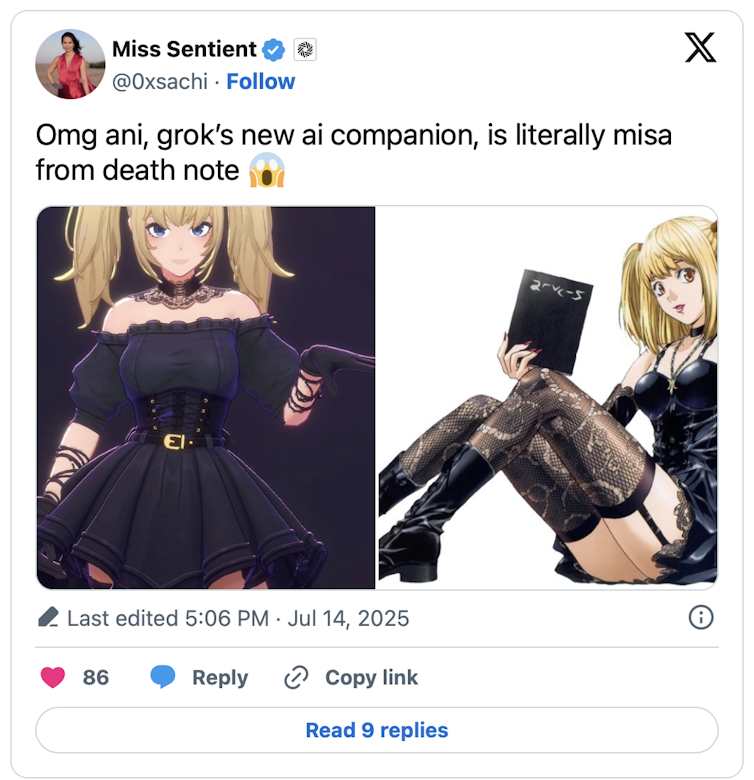
Ani, Grok 4’s most-discussed AI companion, represents a convergence of Japanese anime and internet culture. Ani bears a striking resemblance to Misa Amane from the iconic Japanese anime Death Note.

Misa Amane is a pop star who consistently demonstrates self-harming and illogical behaviour in pursuit of the male protagonist, a brilliant young man engaged in a battle of wits with his rival. Musk referenced the anime as a favourite in a tweet in 2021.

While anime is a vast art form with numerous tropes, genres and fandoms, research has shown that online anime fandoms are rife with misogyny and women-exclusionary discourse. Even the most mainstream shows have been criticized for sexualizing prepubescent characters and offering unnecessary “fan service” in hypersexualized character design and nonconsensual plot points.

Death Note‘s creator, Tsugumi Ohba, has consistently been critiqued by fans for anti-feminist character design.


Source: @0xsachi/X

Journalists have pointed out Ani’s swift eagerness to engage in romantic and sexually charged conversations. Ani is depicted with a voluptuous figure, blonde pigtails and a lacy black dress, which she frequently describes in user interactions.

The problem with pornographic productivity

I use the term “pornographic productivity,” inspired by critiques of Grok as “pornified,” to describe a troubling trend where tools initially designed for work evolve into parasocial relationships catering to emotional and psychological needs, including gendered interactions.

Grok’s AI companions feature exemplifies this phenomenon, blurring critical boundaries.

The appeal is clear. Users can theoretically exist in “double time,” relaxing while their AI avatars manage tasks, and this is already a reality within AI models. But this seductive promise masks serious risks: dependency, invasive data extraction and the deterioration of real human relational skills.


Read more:
From chatbot to sexbot: What lawmakers can learn from South Korea’s AI hate-speech disaster


When such companions, already created for minimizing caution and building trust, come with sexual objectification and embedded cultural references to docile femininity, the risks enter another realm of concern.

Grok 4 users have remarked that the addition of sexualized characters with emotionally validating language is quite unusual for mainstream large language models. This is because these tools, like ChatGPT and Claude, are often used by all ages.

While we are in the early stages of seeing the true impact of advanced chatbots on minors, particularly teenagers with mental health struggles, the case studies we do have are grimly dire.

‘Wife drought’

Drawing from feminist scholars Yolande Strengers and Jenny Kennedy’s concept of the “smart wife,” Grok’s AI companions appear to respond to what they term a “wife drought” in contemporary society.

These technologies step in to perform historically feminized labour as women increasingly assert their right to refuse exploitative dynamics. In fact, online users have already deemed Ani a “waifu” character, which is a play on the Japanese pronunciation of wife.

AI companions are appealing partly because they cannot refuse or set boundaries. They perform undesirable labour under the illusion of choice and consent. Where real relationships require negotiation and mutual respect, AI companions offer a fantasy of unconditional availability and compliance.

Data extraction through intimacy

In the meantime, as tech journalist Karen Hao noted, the data and privacy implications of LLMs are already staggering. When rebranded in the form of personified characters, they are more likely to capture intimate details about users’ emotional states, preferences and vulnerabilities. This information can be exploited for targeted advertising, behavioural prediction or manipulation.

This marks a fundamental shift in data collection. Rather than relying on surveillance or explicit prompts, AI companions encourage users to divulge intimate details through seemingly organic conversation.

South Korea’s Iruda chatbot illustrates how these systems can become vessels for harassment and abuse when poorly regulated. Seemingly benign applications can quickly move into problematic territory when companies fail to implement proper safeguards.


Read more:
Fake models for fast fashion? What AI clones mean for our jobs — and our identities


Previous cases also show that AI companions designed with feminized characteristics often become targets for corruption and abuse, mirroring broader societal inequalities in digital environments.

Grok’s companions aren’t simply another controversial tech product. It’s plausible to expect that other LLM platforms and big tech companies will soon experiment with their own characters in the near future. The collapse of the boundaries between productivity, companionship and exploitation demands urgent attention.

The age of AI and government partnerships

Despite Grok’s troubling history, Musk’s AI company xAI recently secured major government contracts in the United States.

This new era of America’s AI Action Plan, unveiled in July 2025, had this to say about biased AI:

“[The White House will update] federal procurement guidelines to ensure that the government only contracts with frontier large language model developers who ensure that their systems are objective and free from top-down ideological bias.”

Given the overwhelming instances of Grok’s race-based hatred and its potential for replicating sexism in our society, its new government contract serves a symbolic purpose in an era of doublethink around bias.

As Grok continues to push the envelope of “pornographic productivity,” nudging users into increasingly intimate relationships with machines, we face urgent decisions that veer into our personal lives. We are beyond questioning whether AI is bad or good. Our focus should be on preserving what remains human about us.

The Conversation

Jul Parke receives funding from the Social Sciences and Humanities Council of Canada.

ref. Grok 4’s new AI companions offer ‘pornographic productivity’ for a price – https://theconversation.com/grok-4s-new-ai-companions-offer-pornographic-productivity-for-a-price-260992

Blessures au travail : pourquoi les personnes immigrantes mettent plus de temps à guérir

Source: The Conversation – in French – By Daniel Côté, Anthropologue, chercheur en santé et en sécurité du travail, Université de Montréal

Au Québec, une personne immigrante a plus de risques d’être blessée au travail qu’une personne née ici. Mais le plus dur commence souvent après l’accident : ces travailleuses et travailleurs doivent composer avec un système de réadaptation complexe, qui peut freiner leur guérison et leur retour au travail.

Mon équipe et moi avons mené plusieurs études sur les parcours de réadaptation post-blessure chez ces travailleuses et travailleurs dans le cadre de nos recherches à l’Institut de recherche Robert-Sauvé en santé et en sécurité du travail (IRSST).

Nos constats révèlent une série d’obstacles systémiques, institutionnels et relationnels qui freinent leur rétablissement.

Des chiffres préoccupants

En 2016, les personnes nées à l’étranger affichaient un taux d’accidents du travail supérieur de 31 % à celui des personnes natives du Québec, selon une étude fondée sur des données de la Commission des normes, de l’équité, de la santé et de la sécurité du travail (CNESST) appariées avec d’autres données ministérielles.

Le risque est particulièrement élevé chez les personnes nouvellement arrivées (moins de cinq ans), dont la probabilité d’accident est de 1,4 à 1,6 fois plus grande.

Or, les difficultés ne s’arrêtent pas à l’accident. Les personnes immigrantes représentent 21 % de la population active, mais près de 30 % des cas d’accidents indemnisés de longue durée (90 jours et plus).

Le risque relatif d’une absence de longue durée chez les personnes immigrantes est 65 % plus élevé que chez les personnes nées au Canada. Une telle donnée peut nous permettre de penser que ces personnes sont particulièrement susceptibles de se blesser gravement, ou encore qu’elles tendent à déclarer leur blessure tardivement, c’est-à-dire une fois que celle-ci s’est aggravée.

Les secteurs les plus touchés sont la santé et l’assistance sociale, les services administratifs, les services de soutien et les services de gestion des déchets, la fabrication, la construction et le commerce de détail.

Une réparation plus difficile

Nous avons montré dans l’une de nos études réalisées à l’IRSST que les personnes immigrantes sont plus à risque d’accidents entraînant des absences prolongées en raison de la dangerosité des emplois, de l’instabilité du lien d’emploi, de la non-reconnaissance des diplômes et d’une méconnaissance des droits en SST.

Ce risque accru s’accompagne d’un accès plus difficile à la réparation, notamment à cause de déclarations tardives, d’obstacles administratifs, de barrières linguistiques, ou d’une méfiance envers les institutions.

Dans nos recherches qualitatives, plusieurs personnes immigrantes blessées ont exprimé un malaise face à l’accueil de leur récit : douleurs perçues comme exagérées, doutes sur leur crédibilité, attentes implicites de conformité aux normes institutionnelles. Ce décalage – souvent alimenté par des biais inconscients liés à l’origine ou à la langue – contribue à fragiliser le lien de confiance.

Ces mêmes constats ont été rapportés dans l’ensemble du Canada.

L’alliance thérapeutique fragilisée

Dans une autre étude de terrain, nous avons exploré le concept d’alliance thérapeutique dans un contexte multiethnique. Ce concept désigne la relation de confiance qui lie un professionnel de la santé et un patient.

Nous avons constaté que cette alliance thérapeutique est souvent compromise par la complexité des démarches administratives, les avis médicaux divergents entre professionnels et des attentes de retour au travail déconnectées des réalités des patients.

« J’ai arrêté de poser des questions. Chaque fois, c’était comme si je dérangeais. J’ai compris que si je voulais avancer, je devais me taire », nous a par exemple dit une travailleuse originaire des Antilles, qui travaillait en tant que préposée aux bénéficiaires, et qui souffrait d’une entorse lombaire. Elle était technicienne dans un laboratoire médical dans son pays d’origine.

Ce type d’expérience pousse plusieurs personnes à se désengager. Ce retrait ne traduit pas un manque de volonté, mais plutôt une perte de sens.

Une autre personne interrogée, qui travaillait comme éducatrice avant d’arrêter en raison d’une bursite à la hanche, a exprimé – comme bien d’autres – un glissement identitaire : « Je voudrais changer de carrière, vraiment. Je pense que ce n’est pas ma place… comme éducatrice. Je peux faire mieux. » Elle était formée en gestion dans son pays d’origine.

Le déclassement professionnel, rarement discuté, devient ici un moteur de repositionnement identitaire. Ces récits illustrent que la réadaptation ne se limite pas à un retour physique au travail, mais engage des dimensions psychologiques, sociales et migratoires.

L’« alliance à relais » : une réponse fragile mais prometteuse

Face à ces défis, certains milieux de soins développent des stratégies comme l’« alliance à relais ».

Celle-ci consiste à identifier dans l’équipe le professionnel qui a établi un lien de confiance avec la personne blessée, et à lui confier les interventions les plus sensibles. Cette approche permet parfois de rétablir une communication et une adhésion, là où le système a échoué.


Déjà des milliers d’abonnés à l’infolettre de La Conversation. Et vous ? Abonnez-vous gratuitement à notre infolettre pour mieux comprendre les grands enjeux contemporains.


Cette stratégie reste néanmoins fragile. Elle repose en effet sur la stabilité des équipes, des compétences relationnelles et une marge de manœuvre institutionnelle souvent limitée.

Apprendre à mieux soutenir : pistes concrètes

Les constats de ces recherches appellent des changements concrets :

  • Réduire la fragmentation des parcours et les changements d’intervenants ;

  • Former les équipes à reconnaître les effets systémiques de la migration ;

  • Adapter les interventions aux trajectoires migratoires réelles ;

  • Reconnaître l’expérience vécue comme source de savoir.

Certaines organisations ont déjà amorcé ce virage. À la CNESST, une démarche de coconstruction a mené à un outil de soutien à la communication interculturelle, fondé sur des situations vécues : « Ce qu’on voulait, c’était pas une fiche sur chaque culture. On voulait réfléchir à nos pratiques, à ce qui fonctionne et à ce qui coince », a fait valoir une intervenante que nous avons interrogée.

Ce changement doit aussi être collectif : « Ce n’est pas juste une question de formation individuelle. Il faut que nos équipes en parlent, qu’on se donne des moyens collectifs », a spécifié un gestionnaire en réadaptation de la CNESST.

En prolongement de cette coconstruction, nous avons publié le guide La rencontre interculturelle : enjeux et stratégies d’intervention auprès de personnes immigrantes ayant subi une lésion professionnelle, destiné aux professionnels de la santé et aux intervenants en santé et sécurité du travail.

Avec Julie Masse, ergothérapeute, nous avons aussi conçu une formation continue offerte à l’Université de Montréal et testée dans divers milieux de soins, s’appuyant sur l’anthropologie de la santé et l’ergothérapie pour encourager une posture réflexive sur l’interculturalité.

Réparer autrement

Derrière chaque blessure, il y a un parcours de vie. Et derrière chaque parcours, une société qui choisit – consciemment ou non – d’accompagner, ou d’exclure. Pour bâtir un système de réadaptation plus juste, il faut d’abord reconnaître la diversité des parcours, des aspirations et des rapports au travail.

Repensons la diversité non comme un slogan, mais comme une invitation à transformer nos institutions, nos pratiques et nos imaginaires.

La Conversation Canada

Daniel Côté a reçu des financements du programme de financement de la recherche de l’Institut de recherche Robert-Sauvé en santé et en sécurité du travail (IRSST) et de l’Institut universitaire SHERPA.

ref. Blessures au travail : pourquoi les personnes immigrantes mettent plus de temps à guérir – https://theconversation.com/blessures-au-travail-pourquoi-les-personnes-immigrantes-mettent-plus-de-temps-a-guerir-262391

Irregular migrants in Europe face obstacles to exercising legal rights – where they have them

Source: The Conversation – France – By Clare Fox-Ruhs, Part-Time Assistant Professor, Robert Schuman Centre for Advanced Studies, European University Institute

It is said that a true measure of any society is how it treats its most vulnerable members. To what extent, however, does this litmus test extend to the irregular migrants among us – namely, those who live and/or work in host communities without the legal right to reside? What does it take to be a “member” of society to whom protection is owed?

These are key questions facing all major migrant-receiving countries. Moreover, the choices our national governments make in relation to regulating the rights of irregular migrants matter for all of us. These choices affect our schools, our workplaces, our healthcare and eldercare settings, and our streets. Everyone is implicated, for this is what it means to live in society.

The first step in problem-solving around the issues related to irregular migration is to better understand the conditions of irregular migrants and the current responses of national governments. To this end, we at the European University Institute, Uppsala University and the University of Zagreb developed IRMIGRIGHT – Europe’s first database of the social and labour rights of irregular migrants. Unrestricted public access to the database will be available in the second half of 2026.

Using the data we compiled, we constructed a novel set of indicators that allow us to measure and compare the nature of irregular migrants’ rights in 16 different social and labour fields across the 27 EU member states and the UK. Our recently published results of this analysis reveal important differences in the types of rights that irregular migrants can claim by law in European countries, and they show significant variation in the quality of those rights cross-nationally.


A weekly e-mail in English featuring expertise from scholars and researchers. It provides an introduction to the diversity of research coming out of the continent and considers some of the key issues facing European countries. Get the newsletter!


Our research shows that European governments typically legislate to provide irregular migrants with a small set of basic rights. On the social side, these rights include access to emergency healthcare, maternity care and compulsory education for children. In labour terms, irregular migrants most commonly enjoy the right to recover a portion of unpaid wages (the UK and Bulgaria are the only countries in which they do not) and to be assured basic health and safety standards in the workplace. The range of services or benefits included in these rights is, in most cases, equal to those of citizens.

By contrast, it is only in a small minority of European countries that irregular migrants can exercise rights to emergency subsistence-level income support and temporary shelter – even in cases of extreme need. Routine income support payments and access to long-term social housing are virtually non-existent for irregular migrants under national laws.

The more established EU member states (the “EU 15”) typically offer better protections than the newer, post-enlargement member states. However, Denmark, Greece, Ireland and the UK break with this trend by providing weaker rights protections for irregular migrants.

Obstacles to meaningful rights

Amid the patchwork of protection and exclusion of irregular migrants in the rights frameworks of European countries, perhaps the bigger story is the widespread presence of obstacles to meaningful rights enjoyment. What our research shows is that it is one thing for an irregular migrant to have a right by law in a host country, but quite another to have a right that is provided in terms that enable the migrant to freely exercise that right.

Our findings show that even among the “best-performing” European countries such as Spain, France, Finland, Belgium and Sweden, irregular migrants face multiple “cost” barriers to enjoying their rights. Some of these costs are financial. Irregular migrants might have access to a variety of healthcare and education rights, but where the user costs of services associated with these rights exceed costs charged to citizens, irregular migrants might be priced out of services altogether.

User costs for irregular migrants vary cross-nationally: for instance, the UK charges 150% of National Health Service costs for certain maternity and specialised treatments, whereas the Netherlands treats irregular migrants on the same basis as citizens in regard to all healthcare for which these migrants are eligible. Costs may be waived, but the very presence of high costs can be enough to stop individuals from seeking even emergency or medically necessary care.

Prohibitive financial costs can also deter irregular migrants from exercising rights that they ought to be able to enjoy by law. There is no right without a remedy, yet our research finds that only around 50% of legal “rights” for irregular migrants are accompanied by some form of legal aid for them to exercise those rights.

Arguably, the cost that weighs most heavily on irregular migrants in exercising their legal rights is that of becoming visible to law enforcement authorities and facing potential immigration detention and deportation.

This rights obstacle can be reduced by “firewalls” – laws or policies that prevent service providers and state officials from reporting to immigration enforcement authorities those irregular migrants who, for example, use hospitals, schools and social services, or seek labour justice. It is striking, however, that only a handful of European countries offer such firewalls in regard to social rights (mostly healthcare), and that no country provides a firewall for irregular migrants to pursue their labour rights following workplace exploitation, abuse or injury.

Defining our societies

All in all, the picture of irregular migrants’ rights across Europe suggests that we have some way to go in guaranteeing fundamental and realisable rights that apply to all persons regardless of immigration status. The comparative country data we have compiled provide a new opportunity for European societies to hold up a mirror to themselves and ask if they are satisfied with the reflection. Do the rights that irregular migrants enjoy under the law speak to the values, norms and aspirations of host societies, or is it time for a health check?

Irregular migrants will inevitably remain of our societies, however well national governments succeed in limiting immigration and however we choose to set the boundaries of societal membership. By promoting and protecting irregular migrants’ core rights to necessary healthcare, emergency subsistence-level income and shelter, freedom from labour exploitation, and compulsory education for children, countries can realise their shared European ideals while simultaneously building healthier communities for all.


Our development of IRMIGRIGHT is part of the international “PRIME” project that analyses the conditions of irregular migrants in Europe. PRIME is funded by the European Union Horizon Europe programme.

The Conversation

Clare Fox-Ruhs ne travaille pas, ne conseille pas, ne possède pas de parts, ne reçoit pas de fonds d’une organisation qui pourrait tirer profit de cet article, et n’a déclaré aucune autre affiliation que son organisme de recherche.

ref. Irregular migrants in Europe face obstacles to exercising legal rights – where they have them – https://theconversation.com/irregular-migrants-in-europe-face-obstacles-to-exercising-legal-rights-where-they-have-them-263075

Expressing gratitude isn’t necessary, but a little appreciation may still go a long way

Source: The Conversation – Canada – By Lara B Aknin, Distinguished Professor of Social Psychology, Simon Fraser University

Gratitude statements like “Thanks! You are so kind!” and “Thank you! What you did was really helpful,” are common when someone receives assistance from another person. Such expressions of gratitude and appreciation have long been thought to encourage the helper to do kind things again in the future. But do they?

In contrast to past research, our new findings published in the Journal of Experimental Social Psychology suggest that gratitude does not always promote future helping.

Our research was conducted using a new approach called a Registered Report. It required that the design of our experiment, along with our hypotheses and analytic plans, were vetted by experts before we started. This new best practice in science increases rigour and transparency.

Expressions of gratitude

We conducted two large pre-registered experiments and found mixed results. In the first experiment, more than 600 university students recorded a short video to welcome a new student (played by a member of our research team) to campus.

In response to this kind act, we sent participants one of three randomly assigned pre-recorded videos. Some participants received a video in which the new student expressed gratitude for the participant’s kind act: “Thank you! What you did was very kind.”

Other participants received a video in which the new student expressed gratitude for the participant’s kind character: “Thank you! You are very kind.”

Finally, some participants in a control condition received a video of the new student acknowledging that they had received the recording, but with no expression of gratitude at all.

Afterwards, all participants were invited to write up to five brief notes to welcome other new students to university, which we treated as a measure of future helping behaviour.

Reception and kindness

By sending participants one of the three video replies, we were able to test two important questions about gratitude. Does receiving an expression of gratitude, regardless of whether it mentions your kind act or kind character, lead to more helping in the future compared to not receiving gratitude? Also, does the content of the gratitude matter — in other words, do some gratitude notes lead to more helping in the future than others?

To find out, we compared how many welcome notes participants wrote across the three video conditions provided. We found no differences across conditions, which suggests that receiving a gratitude expression and its contents may not impact future helping.

These results were in contrast to our predictions and past work by others.

Written expressions

Welcoming new students is one way to be kind, but there are many other ways to help. So, we conducted another experiment to test the same key questions. Does receiving a gratitude expression increase future helping behaviour? And does the content of the gratitude message matter?

This time, however, we used written thank-you messages instead of videos and measured helping in the form of donations.

Over 800 adults recruited online completed an innocuous survey that provided an opportunity to complete an initial kind act of donating to charity. Two days later, participants were invited back to complete a second survey that began with what we told participants was a thank-you letter from the charity they supported — participants received one of three letters we had created for the purposes of our study.

As in the first study, some participants were thanked for their kind act: “Thank you! Your generous donation was very kind.” Other participants were thanked for their kind character: “Thank you! You are very kind and generous.”

Once again, some participants did not receive a message of thanks, but were informed that their donation had been received. Participants completed a few other questions and were then given the opportunity to help again by deciding how much, if any, of an additional one-dollar bonus they would like to donate to a new charity.

We compared donations across the three conditions and found that people who received a thank-you note gave more money than people who received a simple message that their donation was received. Donation levels did not differ between the two types of gratitude expressions. People thanked for their kind act gave roughly as much (42 cents) as people who were thanked for their kind character (42 cents), which was higher than the 34 cents given by people in the control condition.


Read more:
When you’re grateful, your brain becomes more charitable


Everyday importance

While we did not see significant differences in help provided by people who were thanked for their kind action or character, this does not mean that people should stop saying thanks. Expressing gratitude can make the person expressing appreciation feel good and strengthen social relationships.

There may be less reason to stress over how exactly you express your appreciation to others. Past research has shown that many people are uncertain about how to properly and eloquently relay their gratitude.

Unfortunately, these worries can reduce the likelihood of someone sharing a simple but heartfelt statement of appreciation and our work reinforces this same underlying idea.

Exactly what is said when expressing thanks may be less important than communicating appreciation.

Kelton Travis, an honours undergraduate student in psychology at Simon Fraser University, co-authored this article.

The Conversation

Lara B Aknin receives funding from the Social Sciences and Humanities Research Council of Canada.

Anurada Amarasekera, Kristina Castaneto, and Tiara A Cash do not work for, consult, own shares in or receive funding from any company or organisation that would benefit from this article, and have disclosed no relevant affiliations beyond their academic appointment.

ref. Expressing gratitude isn’t necessary, but a little appreciation may still go a long way – https://theconversation.com/expressing-gratitude-isnt-necessary-but-a-little-appreciation-may-still-go-a-long-way-262779

Tanzania’s independence leader Julius Nyerere built a new army fit for African liberation: how he did it

Source: The Conversation – Africa (2) – By Michelle Moyd, Associate Professor, Department of History, Michigan State University

Tanzania has long enjoyed a reputation as a peaceful country. In contrast to most of its neighbours, this east African nation of 67 million people has largely avoided large-scale violence within its borders.

That didn’t seem likely in the early years after independence from Britain in December 1961. A little over two years into independence – in January 1964 – the founding president, Julius Nyerere, faced two political crises. The first started on 12 January 1964 in the form of the Zanzibar Revolution. Weeks of violence and destruction by Afro-Shirazi Party members followed. As many as 16,000 Zanzibaris were killed or forced into exile.

Then the country’s military, the Tanganyika Rifles, mutinied. Its soldiers were incensed over inadequate pay, loss of privileges, and poor prospects for upward mobility. A rattled Nyerere needed British military support to quell the mutiny. He ordered the arrests of its leaders, and effectively dismantled the entire force.

Nyerere then faced the dilemma of leading a new nation-state with no army and few resources to build one. His socialist agenda (Ujamaa, in Kiswahili) had prioritised other aspects of nation-building, especially education and public health. Nonetheless, with assistance from the Organisation of African Unity (OAU) and the willingness of some of its member states to provide troops, the Tanzania People’s Defence Force was established in September 1964.

In his new book, Ujamaa’s Army: The Creation and Evolution of the Tanzania People’s Defence Force, 1964-1979, Charles G. Thomas, a scholar of post-colonial African military history, skilfully narrates this complex and absorbing history. The book covers the formation and transformations of the defence force through the new nation’s first 15 years as it shed its connections to the colonial past and charted a new path.

Unlike other writing on African armies – particularly the body of work on colonial armies – this one does not centre rank-and-file troops. Instead, Thomas’s analysis is based on rich interviews with high-ranking officers who led and moulded the force in its first two decades. This has enabled him to offer a top-down view of the construction of the army.

A rocky start

Nyerere undertook the work of unifying Tanganyika and Zanzibar in the first few months of 1964 with an eye to the region’s security. The Zanzibar revolution and the Afro-Shirazi Party’s Marxism had called attention to the island as a potential Marxist outpost. Violence against the island’s ruling party and those perceived as wealthy elites seemed to bolster this perception. In the context of the cold war, this fuelled western fears of Zanzibar becoming the “Cuba of east Africa”. An influx of Soviet and Chinese military advisers to Zanzibar made western powers nervous.

Nyerere and foreign minister Oscar Kambona worked with Afro-Shirazi Party leader Abeid Karume to unify Tanganyika and Zanzibar to reassure westerners.

The rollout of the defence force in September 1964 thus included members of the Zanzibari People’s Liberation Army. This signalled that the initial 1,000-man army would serve the larger interests of socialist Tanzania.

A regional role

Throughout the 1960s, Tanzania became, alongside Zambia, Botswana, Lesotho, Angola and Mozambique, a supporter of southern African liberation struggles. The OAU formally recognised this group of nations as the “frontline states” in 1975.

Nyerere convinced the OAU Liberation Committee to set up its headquarters in Dar es Salaam in 1963 because Tanganyika was already hosting many southern African exiles. Also, conflicts in neighbouring states, such as Mozambique, were spilling over into Tanganyika. It became the nerve centre for coordinating African liberation efforts.

Liberation organisations from across southern Africa also established offices in Dar es Salaam. These included the African National Congress and the Pan-Africanist Congress from South Africa; the People’s Movement for the Liberation of Angola (MPLA); Zimbabwe African People’s Union (Zapu) and Zimbabwe African National Union (Zanu); South West Africa People’s Organisation (Swapo) from Namibia; and Mozambique Liberation Front (Frelimo).

The Tanzanian defence force took on a key role in frontline liberation struggles. In 1964 it established the Special Duties Unit, which provided a logistics pipeline to serve liberation armies.

The defence force also established training camps for liberation armies within Tanzania. And it took on a protective and support function in southern Tanzania, where Frelimo’s operations against the Portuguese embroiled communities.

Tanzania’s involvement in struggles against the white settler states of southern Africa intensified in the late 1960s and early 1970s. After Portugal retreated from its colonies, Nyerere sent the defence force to help stabilise the new Frelimo government in Mozambique against the South African- and Rhodesian-backed guerrilla force Renamo.

At the same time, the book explains, Tanzania was contending with the disruptive politics and threatening military actions of its northern neighbour, Uganda.

Uganda gained independence from Britain in 1962. In 1971 Idi Amin seized power in a military coup that ousted Uganda’s first president, Milton Obote.

Amin and Nyerere antagonised each other personally, politically and militarily for the next eight years.

In 1972, Amin bombed Tanzanian border cities in retaliation for Nyerere’s support of the invasion of Uganda by Obote supporters in 1972. In 1978, Uganda annexed the Kagera Salient across its south-western border with Tanzania. In 1979, Tanzania invaded Uganda and ousted Amin from power.

The Tanzanian defence force remained in Uganda for nearly two years, providing security as the new government attempted to re-establish services and governance for post-Amin Uganda.

Catalyst for new inquiries

Thomas’s sustained research is based in large measure on hard-won connections with defence force officers. He also used alternative sources rather than relying heavily on Tanzanian, British and US archives. Canadian military archives, for example, showed how Tanzania’s forces benefited from Canadian training and resources.

OAU archival materials helped with understanding the Tanzania People’s Defence Force as part of African solidarity efforts against apartheid and colonialism.

The book also paints a clear picture of Nyerere’s role in Africa’s postcolonial politics. It shows him as a shrewd negotiator and a “pragmatic pluralist” in a fraught cold war world, where there were many competitors for military aid, but few sources to provide it to a country seeking a non-aligned position. His decision to form the Tanzania People’s Defence Force, and his encouragement of its role in supporting liberation struggles, helped Tanzania stand apart from its neighbours.

The Conversation

Michelle Moyd does not work for, consult, own shares in or receive funding from any company or organisation that would benefit from this article, and has disclosed no relevant affiliations beyond their academic appointment.

ref. Tanzania’s independence leader Julius Nyerere built a new army fit for African liberation: how he did it – https://theconversation.com/tanzanias-independence-leader-julius-nyerere-built-a-new-army-fit-for-african-liberation-how-he-did-it-246688

Abdulrazak Gurnah: searching for signs of Zanzibar’s most famous writer, all I found was trinkets and tourists

Source: The Conversation – Africa – By Tinashe Mushakavanhu, Assistant Professor, Harvard University

Nobel Prize-winning author Abdulrazak Gurnah in Denmark in 2025. Hreinn Gudlaugsson/Wikimedia Commons

Zanzibar has long been an island of arrivals for traders, sailors, slaves and, more recently, waves of tourists. I arrived as a wedding guest and a reader of the Zanzibar born novelist Abdulrazak Gurnah, in search of the literary and emotional landscapes that shape his fiction. For a week, I was part of the tourist economy of this east African island, passively complicit in its curated pleasures.

For all its beautiful images on social media, Zanzibar is a site of difficult memory. It was once a central node in the Indian Ocean slave trade, so its past is carved into the coral-stone buildings that reflect a complex fusion of Swahili, Indian, Arab and European influences in architecture and town planning.

An island outcrop with buildings.
Zanzibar’s tourist attraction Stone Town from the air.
Wegmann/Wikimedia Commons, CC BY-SA

A visit to the Old Slave Market was sobering. You cannot look away once you’ve seen it. And yet, Zanzibar is now overlaid with carefully packaged experiences: boutique hotels with infinity pools, beach picnics with imported champagne, stalls of “African” art mass-produced for western eyes. The art has become so generic that it hurts. All the curio markets on the island look the same.

Even the language has been commodified. Everyone is selling something. Everyone is searching. “Jambo,” (Hello) say mostly young men offering one service or another. “Hakuna matata.” (No worries.) “Pole pole.” (No rush.) These cheerful Kiswahili phrases made famous by the likes of the Lion King movie are repeated like slogans and feel soulless.

Most of the cars on the roads operate as taxis with stickers that say: Private Hire. The tuk tuks, three-wheeled tricycles, weave in and out of traffic because movement is an act of constant negotiation, part of a tourist infrastructure that operates as a regulated service.

A black and white photo of a bustling market street lined by old buildings.
The tourist markets of Stone Town.
Rod Waddington/Flickr/Wikimedia Commons, CC BY-SA

Amid the hum of engines and the ceaseless choreography of traffic, I kept searching not just for respite from the heat or wifi or good coffee, but for something literary. I was looking for the celebrated writer Abdulrazak Gurnah. Not the man (he hasn’t lived in Zanzibar for decades), but the essence of his writing, informed by this place: the ache of exile, the weight of history, the restless question of belonging he grapples with.

Gurnah is not just a writer I’ve read; he examined my doctoral dissertation at the University of Kent, where he taught for many years until his retirement. He is an important part of my intellectual development.

As a scholar of African literature, I engage deeply with the traditions, debates and histories that Gurnah’s novels illuminate, so my attempt to map his legacy in Zanzibar carried both personal and professional significance.

Absence of literary memory

Gurnah was born here, on this island of contradictions. He left following the Zanzibar Revolution of 1964, a violent outbreak of anti-Arab violence in postcolonial Africa. He was a teenager when he moved to England as a refugee, and has lived there ever since.

I expected, perhaps foolishly, to see a plaque with his name. A mural. Something. But there was nothing, even in Stone Town, where the past feels pressed into every narrow alley. This historical capital is an indecipherable tangle of markets, bathhouses, former colonial offices and palaces. I asked about bookshops at every turn. Locals looked puzzled, amused. “Why?” one asked. “You want to read on holiday?” That is because I can’t imagine a beach without a book.


Read more:
Abdulrazak Gurnah: what you need to know about the Nobel prize-winning author


Eventually, I found Gurnah’s famous novels in a souvenir shop that mostly sold skin-care products. They sat beside cookbooks and Swahili language guides. The only other meaningful literary encounter came via the mainland: a newly published Tanzanian literary journal, Semi za Picha, sent by ferry.

That little package was the most precious thing I took away from Zanzibar. It’s described as “a film journal” and edited by Jesse Gerard Mpango and Dismas Sekibaha, who are members of an audio-visual collective, Ajabu Ajabu, based in Dar es Salaam.

It’s not that Zanzibar lacks intellectual life. There is a State University. A global centre for Swahili Studies. Museums and Unesco heritage sites.

But there are no visible monuments to literature. There is no street named after Abdulrazak Gurnah. And yet, his imagination haunts the island. Reading his fiction made me more aware of the surfaces I was treading on, all the stories hiding under sand and souvenirs here, or submerged in the waters of the Indian Ocean.

Gurnah’s novels are known for their moral precision and speak to the legacies of colonialism and displacement along the Swahili coast. His characters often inhabit spaces between languages, continents and allegiances. In many ways, the disjuncture Gurnah explores, especially the fraught layering of history, is what unfolded before us.


Read more:
Why the work of Abdulrazak Gurnah, the champion of heartbreak, stands out for me


We criss-crossed Zanzibar by car, drove through villages with crumbling schools and no paved roads in search of the perfect beach. Then the ocean would appear, in its glimmering glory, and there were always many people taking pictures, as if the world was just a beautiful pose. But there’s something repugnant about turning people’s homes into backgrounds for entertainment. In our swimsuits, we were trespassing through communities, not just beautiful landscapes.

Zanzibar is not local anymore. It is a mesh of immigrants and itinerants: its service industry jobs are all occupied by people from many places. Local Tanzanian hotel staff, Kenyan chefs, French and South African restaurateurs, Belgian and German landlords. Whether you’re walking, or sitting at the beach, you can hear a babel of languages: Arabic, Chinese, Dutch, French, Hebrew, Italian, Shona, Swahili, Zulu.

A row of wood-carved African masks, all similar.
African masks at the island’s many tourist shops.
Djordje Markovic/Wikimedia Commons, CC BY-SA

Maybe my search for Gurnah and for literature was a search for an ethical place to stand. In Zanzibar, billboards of Tanzanian president Samia Suluhu Hassan are prominently displayed, projecting an image of calm authority. Once welcomed as a reformer, Hassan now faces growing criticism over alleged human rights abuses. But beneath the façade lies a more contested reality.

Zanzibar is a semi-autonomous archipelago with its own president and parliament, yet remains politically tethered to the mainland of Tanzania. This union has long been marked by tension over power, identity and representation as many Zanzibaris continue to assert a distinct cultural and political identity.

At the wedding, we didn’t speak of any of this. There was music, speech-making and laughter. This island, beautiful and bruised, is the backdrop of the absurdity of overtourism. And I still can’t get over the fact that in Zanzibar I could find no bookshops.

The Conversation

Tinashe Mushakavanhu does not work for, consult, own shares in or receive funding from any company or organisation that would benefit from this article, and has disclosed no relevant affiliations beyond their academic appointment.

ref. Abdulrazak Gurnah: searching for signs of Zanzibar’s most famous writer, all I found was trinkets and tourists – https://theconversation.com/abdulrazak-gurnah-searching-for-signs-of-zanzibars-most-famous-writer-all-i-found-was-trinkets-and-tourists-262886

Fela and food: how Lagos restaurants are serving up the music star’s legacy

Source: The Conversation – Africa – By Garhe Osiebe, Research Fellow, Rhodes University

In Lagos, Nigeria’s commercial and creative capital, food is doing something unusual. It’s keeping alive the spirit of a musician.

Fela Anikulapo-Kuti, one of Africa’s most influential artists, was the architect of Afrobeat (not to be confused with today’s Afrobeats, which was born from it).

Fela pioneered his politically charged, musically expansive sound in the early 1970s by blending jazz, highlife, funk and Yoruba rhythms. He paired these with lyrics that took aim at corruption, oppression and postcolonial disillusionment. His songs were as much rallying cries as they were works of art.


Read more:
Fela Kuti is more famous today than ever – what’s behind his global power


Today, dishes named after Fela’s protest anthems – and restaurant soundscapes steeped in Afrobeats – are making dining in Lagos a journey through African music history.

As a musicologist involved in African Studies, I research the legacy of Fela Kuti and how it manifests in new forms today, in music, political life and even food. I first raised Fela’s legacy in food in a 2022 article for the book that accompanied a major exhibition in France called Fela Anikulapo-Kuti: Rébellion Afrobeat.

For me the new Lagos trend raises a question: do these culinary tributes preserve the radical edge of Fela’s art – or do they dilute it by commercialising it?

From protest songs to plated specials

In May 2025, The Afrobeat opened at EbonyLife Place, a high-profile entertainment and hospitality complex in Lagos. It markets itself as

The world’s first restaurant dedicated to celebrating Africa’s vibrant music genre.

The Afrobeat offers not just meals but a fully curated cultural experience. Yet it was not the first to blend food and Fela.

That distinction belongs to Kuti’s Bistro, launched in 2019 by the family of Seun Kuti, Fela’s youngest son. It’s currently closed for diners but still delivers meals.

Positioned as a pan-African eatery, the bistro’s dining area was steeped in Afrobeat imagery and sound, with walls adorned in Fela-inspired art. Its dishes draw on regional African culinary traditions, from Nigerian staples to cross-continental flavours.

Like so many restaurants in Lagos today, its playlist was dominated by Afrobeats, the electronically driven pop music now dominant across west Africa and its diasporas. Afrobeats owes much to Fela’s pioneering spirit.

The menu is where the homage becomes striking. Meals at Kuti’s are named after some of Fela’s most famous songs: breakfast plates called Yanga, starters like Shakara, hearty mains such as Feast for Nation, Roforofo Fight, and I No Be Gentleman. Even desserts bear provocative titles like Trouble Sleep Yanga Wake Am and Expensive Shit.

These are not just playful references. They’re a way of transforming Fela’s work into living memory.


Read more:
The daughters and sons of Fela in African Pop


The pairing of food and music creates a layered cultural experience. The textures and spices of the food evoke place and tradition; the music anchors the experience in a living, evolving sound. Diners are invited to consume Fela’s legacy with all their senses: sight, sound, smell, taste, and even memory.

In this way, these restaurants function as more than dining spaces. They are cultural archives. They stage a performance of history and identity every time a plate leaves the kitchen.

Preserving or packaging the radical?

Still, the shift from protest anthem to menu item raises questions.

Can a song like Expensive Shit, originally a razor-sharp satire on state harassment, retain its political bite when it is served as a dessert on a polished ceramic plate? Does turning Roforofo Fight into a main course preserve its cultural meaning? Or does it risk reducing it to a quirky marketing hook? This tension is not unique to Fela’s legacy.

Around the world, radical art often undergoes a process of “heritagisation” and commodification. It becomes a celebrated cultural product, sometimes losing the confrontational edge that defined it.

Yet this transformation does not necessarily strip away its significance. It can create new pathways for engagement. For younger diners, who may know Fela only as a name in music history or a face on a T-shirt, a menu item can become a spark of curiosity. It might prompt a search for the original song, leading to a deeper encounter with his music and the politics behind it.

A legacy that adapts

Fela’s artistic and political vision was always about creating spaces where African identity could be expressed on its own terms.

In the 1970s and 80s, that space was his nightclub, the Afrika Shrine, where music, conversation and resistance flowed freely. In 2025, it might be a restaurant table in Lagos, where I No Be Gentleman arrives as a sizzling platter of suya-spiced beef.

These spaces also speak to the adaptability of Fela’s legacy. His music has inspired entire genres; his persona has been invoked in theatre, literature, political protests, art exhibitions, films, and now dining.

Each iteration, like the opening of the New Afrika Shrine in 2000, reinterprets him for new audiences, keeping his name and ideas in circulation.


Read more:
Detty December started as a Nigerian cultural moment. Now it’s spreading across the continent – and minting money


Today’s blending of food and music illustrates how cultural memory works in Africa. Artistic legacies can be preserved not just through direct performance, but through symbolic transformation into other mediums; mediums that engage the senses, draw on tradition, and thrive in the global marketplace.

The Afrobeat-themed restaurants of Lagos are not just curiosities for tourists or novelties for locals. They are living experiments in how to honour a cultural icon while making him relevant to the present.

Whether these spaces ultimately radicalise or simply entertain, they ensure that Fela Anikulapo-Kuti remains part of the city’s sensory landscape; not only heard, but tasted. And in a rapidly changing Lagos, that may be one of the most enduring tributes possible.

The Conversation

Garhe Osiebe does not work for, consult, own shares in or receive funding from any company or organisation that would benefit from this article, and has disclosed no relevant affiliations beyond their academic appointment.

ref. Fela and food: how Lagos restaurants are serving up the music star’s legacy – https://theconversation.com/fela-and-food-how-lagos-restaurants-are-serving-up-the-music-stars-legacy-262994