Sur la banquise qui fond, où sont passés les phoques à capuchon ?

Source: The Conversation – France (in French) – By Tiphaine Jeanniard-du-Dot, Chercheuse en biologie et écologie marine, La Rochelle Université

Le phoque à capuchon doit son nom à la capacité qu’ont les mâles de remplir d’air une poche qu’ils ont sur le sommet de la tête et de gonfler une de leurs cloisons nasales, à la fois pour impressionner les autres mâles et pour séduire les femelles. Tiphaine Jeanniard-du-Dot , Fourni par l’auteur

Que se passe-t-il quand l’espèce animale que l’on étudie commence à disparaître ? Certains biologistes marins qui étudient le phoque à capuchon doivent aujourd’hui se poser la question. Car, avec la banquise qui fond et les changements brutaux qui perturbent l’Arctique, cette espèce hors du commun est devenue de plus en plus difficile à surveiller.


C’est un mystère qui reste encore sans réponse. Où sont passés les phoques à capuchon ? En 2023, alors qu’une équipe de scientifiques qui étudie cette espèce hors du commun survolait la banquise flottante canadienne, ils n’en ont vu aucun. Depuis 1992, année où le suivi de leur population a commencé, cette absence était une première. Depuis, les phoques ne sont pas revenus. Nous ne sommes, nous non plus, pas retournés survoler cette zone l’année suivante, car, en 2024, la banquise elle-même avait virtuellement disparu. Et s’il n’y a plus de banquise, il n’y aura pas de phoque à capuchon, une espèce qui dépend de cet écosystème, pour vivre, se reproduire, se nourrir.

Pour la biologiste marine que je suis, être témoin de la disparition d’une population de phoque emblématique, que j’ai suivie pendant plusieurs années, est une catastrophe écologique qui rend le réchauffement climatique très concret, même s’il se passe loin de nos yeux.

C’est également édifiant de voir comment des changements environnementaux brusques peuvent impacter une espèce qui a, pourtant, su s’adapter et prospérer jusque-là dans un contexte des plus hostiles.

Le phoque à capuchon est ainsi présent dans une seule région du monde : la banquise flottante en Arctique, entre le Canada et le Svalbard, un archipel au nord de la Norvège. C’est de ce fait un animal peu connu, mais pourtant tout à fait fascinant. Il doit son nom à une particularité notable des mâles. Ces derniers ont la capacité de remplir d’air une poche qu’ils ont sur le haut de leur tête, en plus de gonfler une de leurs cloisons nasales en un ballon rouge protubérant, pour à la fois impressionner les autres mâles et séduire les femelles.
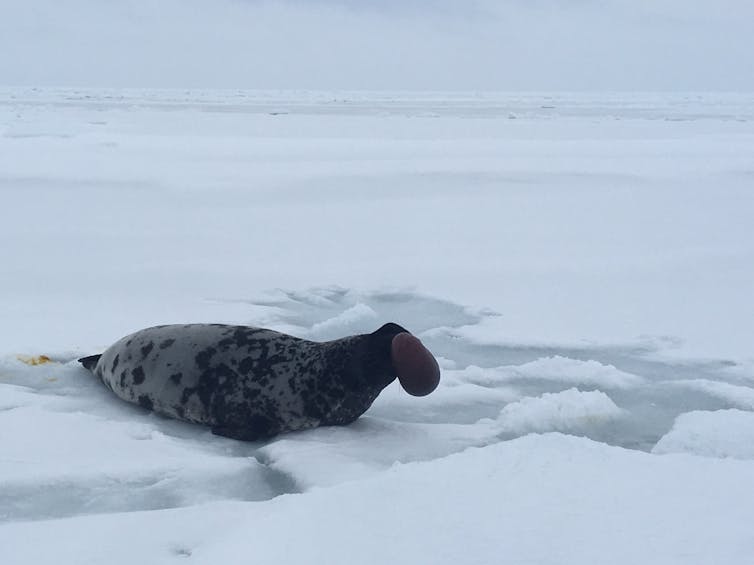
Un phoque à capuchon mâle sur la banquise canadienne
Un phoque à capuchon mâle sur la banquise canadienne.
Tiphaine Jeanniard-du-Dot, Fourni par l’auteur

Ces dernières ne sont pas en reste. Les phoques à capuchon ont la lactation la plus courte connue chez les mammifères, puisque les mères allaitent leur petit sur la banquise pendant trois à quatre jours seulement. Celui-ci prend environ sept kilogrammes par jour pour doubler son poids de naissance, avant d’être sevré et de devenir autonome.

Phoque à capuchon juvénile
Phoque à capuchon juvénile.
Tiphaine Jeanniard-du-Dot, Fourni par l’auteur

S’il se sépare alors de sa mère, le jeune phoque à capuchon ne quittera, par contre, jamais vraiment la banquise. Il y retournera toute sa vie pour sa période de mue, qui advient une fois par an, pour se reproduire à son tour, pour se reposer et pour accéder à des zones de pêche. Mais cette banquise arctique se réchauffe quatre fois plus vite que le reste du globe, ce qui entraîne des changements physico-chimiques dans les océans.

La fonte des glaces due à l’augmentation des températures en est le plus évident, mais on observe également une diminution de la salinité de l’eau de mer, un changement des courants, un approfondissement de la couche de mélange, la partie superficielle des océans très productive en nutriments. Tous ces changements impactent les écosystèmes marins, du phytoplancton jusqu’aux prédateurs tout en haut de la chaîne alimentaire, comme les phoques à capuchon. Cette place, ainsi que leurs grandes capacités de plongée à des profondeurs allant jusqu’à 1 000 mètres et leurs longues migrations dans les eaux arctiques, en font de très bons bio-indicateurs des changements climatiques et de la santé de leur habitat.

Près de trente ans de données sur une espèce remarquable

Mais toutes ces caractéristiques les rendent aussi particulièrement vulnérables aux changements environnementaux.

Dans une recherche récemment publiée, nous avons étudié avec mon équipe deux populations distinctes – l’une dans l’Atlantique nord-ouest canadien, l’autre en mer du Groenland – pour mieux comprendre les impacts des changements de conditions écologiques locales sur cette espèce clé particulièrement sensible à la perte de la banquise. Le but était d’identifier les pressions spécifiques que chaque population subit dans un océan en mutation rapide et les conséquences sur leur distribution ou sur leur capacité à se nourrir.

En combinant le suivi d’animaux en mer grâce à des balises enregistreuses avec des analyses biochimiques, nous avons pu retracer leurs déplacements et comportements de plongée, analyser leur régime alimentaire et évaluer leur efficacité à trouver de la nourriture, et cela, sur plusieurs décennies. Cette incroyable série de données temporelle, réunie grâce à une collaboration entre la France, le Canada, la Norvège et le Groenland, couvre une période de presque trente ans – qui comprend donc la période de réchauffement la plus rapide et intense en Arctique.

In fine, ce que l’on cherche à savoir, c’est ce qu’il adviendra de cette espèce hors du commun si nous continuons sur la même trajectoire climatique.

Pour s’adapter au réchauffement du climat, les populations doivent changer leurs comportements

Les résultats de notre étude sont étonnants : les phoques à capuchon montrent des réactions contrastées face aux bouleversements climatiques. Si certaines populations canadiennes ont donc, ces dernières années, perdu leur lieu de reproduction avec la fonte de la banquise, l’ensemble des populations de phoques étudiées peuvent, elles, adopter des stratégies assez variées.

Au sein de la population de l’Atlantique nord-ouest, les individus se reproduisant dans le golfe du Saint-Laurent, au Canada, privilégient les eaux froides et côtières pour trouver leur nourriture et ont vu leurs zones d’alimentation et de mue se déplacer vers le nord, suivant le recul des eaux froides et la migration de leurs proies.

De plus, leurs plongées pour se nourrir en profondeur sont plus longues que par le passé, ce qui indique qu’ils ont maintenant plus de difficultés à trouver et à attraper leurs proies. Proies qui sont également différentes que dans les années 1990, probablement à cause d’un bouleversement de l’écosystème et du type de proies disponibles dans leur habitat, de plus en plus similaires à celles de l’Atlantique. On parle alors d’« atlantification » de ces zones arctiques.

Les projections climatiques indiquent, par ailleurs, une réduction de l’habitat favorable aux phoques à capuchon de l’Atlantique nord-ouest dans les décennies à venir, ce qui pourrait évidemment, à plus ou moins long terme, entraîner une « crise du logement » et une compétition féroce si toutes les espèces de l’Arctique sont réduites à migrer vers un habitat nordique de plus en plus réduit. Cette réduction de l’habitat favorable semble particulièrement intense pour les phoques du golfe du Saint-Laurent.

Le devenir d’une des populations que nous surveillions jusqu’alors et que nous n’avons plus revue depuis 2023 reste encore mystérieux. Où sont allées les femelles pour mettre bas et fournir un habitat stable à leurs petits ? Les colonies reproductrices ont-elles fusionné vers le nord ? Que se passera-t-il d’ailleurs pour cette espèce quand l’Arctique connaîtra des étés sans glace à l’aune de 2040-2050 ? Les grands prédateurs comme les ours polaires vont-ils s’ajouter aux menaces qui pèsent sur ces animaux, s’ils se rapprochent des côtes pour pallier le manque de banquise ?

Ces questions restent, pour l’instant, en suspens pour l’incroyable phoque à capuchon de l’Atlantique Nord-Ouest, tout comme celle de son avenir dans ces eaux froides arctiques en pleine mutation.

Les phoques à capuchon ont la lactation la plus courte connue chez les mammifères, puisque les mères allaitent leur petit sur la banquise pendant trois à quatre jours seulement. Celui-ci prend environ sept kilogrammes par jour pour doubler son poids de naissance avant d’être sevré et de devenir autonome.
Tiphaine Jeanniard-du-Dot, Fourni par l’auteur

En plus du climat, les populations subissent d’autres pressions

En revanche, la population des phoques à capuchon de la mer du Groenland paraît, elle, moins inféodée aux eaux très froides pour se nourrir. Contre toute attente, ces phoques ont d’ailleurs déplacé leurs zones d’alimentation vers l’est, s’éloignant du Groenland pour se rapprocher des côtes norvégiennes. Les projections montrent aussi que ces zones auront tendance à s’élargir et à se déplacer encore plus vers l’est – et non, à se rétrécir et à se déplacer vers le nord, comme les phoques de l’Atlantique Nord-Ouest.

Il ne faudrait cependant pas s’en réjouir trop vite. Car l’agrandissement de l’habitat favorable de ces phoques à capuchon de la mer du Groenland ne signifie pas forcément que l’environnement global est satisfaisant. Cette population a, en effet, connu un effondrement dramatique d’environ 85 % de son effectif depuis les années 1950, sans signe de rétablissement. Ce déclin suggère que d’autres facteurs que l’aire d’alimentation favorable pourraient contrebalancer les bénéfices d’un habitat théorique plus vaste : par exemple, les changements dans les écosystèmes ou dans les chaînes alimentaires, l’augmentation de la prédation, l’éloignement entre les zones de reproduction et les zones d’alimentation, qui pourrait obliger les phoques à parcourir de plus grandes distances pour se nourrir, ou, encore, les effets durables de la chasse commerciale aujourd’hui interdite.

Un avenir incertain

Tous ces constats montrent que les phoques à capuchon ne réagissent pas de manière uniforme aux pressions environnementales. Chaque population fait face à des défis spécifiques, liés à ses spécificités comportementales et adaptatives, à sa localisation, à l’évolution de ses proies et à l’histoire de ses interactions avec les humains. Les variabilités individuelles ou populationnelles peuvent conférer à l’espèce dans son ensemble une capacité d’adaptation plus grande aux défis environnementaux auxquels elle fait face.

En revanche, si des espaces clés de leur cycle de vie disparaissent, comme c’est le cas pour la population du golfe du Saint-Laurent dont les sites de reproduction sur la glace ont récemment disparu, on peut s’attendre à des extinctions locales plus rapides que d’autres. Si l’avenir de l’incroyable phoque à capuchon en Arctique reste incertain, son cas souligne en revanche l’importance d’adopter des stratégies de conservation différenciées, adaptées aux réalités écologiques locales.

The Conversation

J’ai été employée par le Ministère de Pêches et Océans Canada, ou j’ai démarré ma recherche sur les phoques à capuchon.

ref. Sur la banquise qui fond, où sont passés les phoques à capuchon ? – https://theconversation.com/sur-la-banquise-qui-fond-ou-sont-passes-les-phoques-a-capuchon-259920

Israel’s plan for massive new West Bank settlement would make a Palestinian state impossible

Source: The Conversation – UK – By Leonie Fleischmann, Senior Lecturer in International Politics, City St George’s, University of London

The Israeli government has approved a plan for construction of a massive new settlement bloc in the controversial E1 area in the occupied West Bank.

In reviving a project first proposed in 1994, which will comprise about 3,500 new dwellings in a line across the West Bank, finance minister Bezalel Smotrich laid bare the intentions of his government. He declared that “approval of construction plans in E1 buries the idea of a Palestinian state, and continues the many steps we are taking on the ground as part of the de facto sovereignty plan”.

E1 (“East 1”) refers to 12 square kilometres of unsettled land east of Jerusalem. It sits inside the boundaries of the third most populous Israeli settlement in the West Bank, Ma’ale Adumim.

In 1975, Israel expropriated 30 sq km of land on which seven Palestinian villages had once stood. Here they built Ma’ale Adumim, one of three Israeli settlement blocs that form an “outer ring” around the Israeli-defined municipal boundaries of Jerusalem.

Israeli authorities refer to these blocs as “facts on the ground”. They were initiated in the West Bank by the Israeli government after the 1967 War to ensure that Israeli population centres were protected from potential attacks.

Today, almost 40,000 Israelis live in Ma’ale Adumim – largely secular Israelis and diaspora Jews who have moved to Israel. Far from the makeshift Israeli outposts that are scattered across the rural West Bank, Ma’ale Adumim was designated a city by Israel in 2015. It is considered by the majority of Israeli Jews to be a permanently protected settlement bloc, which will be retained through land swaps in any final agreement with Palestinians.

The E1 development plan would involve a significant expansion of the existing settlement. All settlement building in East Jerusalem and the West Bank is deemed illegal under international law, but the E1 plans are particularly controversial.

At the heart of the controversy is the viability of a Palestinian state. Israeli construction in E1 would cut the West Bank into two separate parts, rendering it impossible to establish a contiguous Palestinian state with East Jerusalem as its capital.

In addition, according to an objection lodged by the Israeli pressure group Peace Now, Israeli construction in E1 would negatively affect the economic development of a future Palestinian state.

Its objection argues the E1 area is essential for expansion of an urban metropolis necessary for economic growth, and is the only land in East Jerusalem suitable for further development in the Palestinian part of the city. It states that E1 should therefore be left for Palestinian rather than Israeli development.

Political threat

The plan to develop E1 was first proposed in 1994 by Israel’s then-prime minister, Yitzhak Rabin, to make sure Ma’ale Adumim was part of a “united Jerusalem”. This was subsequently reaffirmed by Shimon Peres during his prime ministership in 1996, as part of proposed territorial swaps in the framework of a permanent peace agreement.

In 2005, those plans were frozen after the US administration under George W. Bush told Israel that settlement in E1 would “contravene American policy”.

Map of the West Bank.
The proposed E1 development, linking up with the settlement of Ma’ale Adumim, would make a Palestinian state based on contiguous land in the West Bank impossible.
Honest Reporting, CC BY-SA

The plan was reignited by Israel’s current prime minister, Benjamin Netanyahu, in 2012, in retaliation for the United Nations’ extension of non-member status to Palestine. But it was then put on hold for eight years due to international pressure.

In 2020, a week ahead of the third national elections held in Israel in a single year, Netanyahu pledged to revive the E1 project, with the hope of securing votes and to court the ultra-nationalist parties into a potential coalition. In 2022, Netanyahu renewed the E1 construction plans, weeks before then-US president Joe Biden was due to visit Israel.

Opposition and support

Each time the plans have been proposed, the decision to advance construction has been met with both internal and international condemnation. On June 9 2023, the planning hearing was “indefinitely” postponed following a call between Netanyahu and Biden’s secretary of state, Antony Blinken.

In response to the most recent announcement to reinstate the plans, the European Union put out a statement expressing concern. It urged Israel “to desist from taking this decision forward, noting its far-reaching implications and the need to consider action to protect the viability of the two-state solution”.

However, Donald Trump now appears to be breaking with the position of previous US administrations. It was recently reported in the Jerusalem Post that the Trump administration supports the reactivation of the development plans. A spokesperson for the US State Department said “a stable West Bank keeps Israel secure and is in line with this administration’s goal to achieve peace in the region”.

Israel’s latest attempt to initiate construction in E1 shows that, while the plans have consistently been delayed, they have never been abandoned. The question is why did Smotrich, with the apparent approval of Netanyahu, make this announcement now?

The answer is most likely that, with the international focus firmly on the continued assault on Gaza, the Israeli government believes it has the breathing space to press ahead with its commitment to building settlements across the West Bank.

Alongside the proposed Israeli takeover of Gaza City, the promise by Smotrich that 2025 would be Israel’s “Year of Sovereignty” – and with it the end of a future Palestinian state – appears to be coming ever closer.

The Conversation

Leonie Fleischmann does not work for, consult, own shares in or receive funding from any company or organisation that would benefit from this article, and has disclosed no relevant affiliations beyond their academic appointment.

ref. Israel’s plan for massive new West Bank settlement would make a Palestinian state impossible – https://theconversation.com/israels-plan-for-massive-new-west-bank-settlement-would-make-a-palestinian-state-impossible-263451

Why bad arguments sound convincing: 10 tricks of logic that underpin vaccine myths

Source: The Conversation – Global Perspectives – By Hassan Vally, Associate Professor, Epidemiology, Deakin University

The biggest lie those who create and spread misinformation perpetrate is that they want you to think for yourself. They warn their target audience not to be “sheep” and not to let themselves be told what to believe by “mainstream” voices, the “deep state” or other bogey men.

But in a classic case of misdirection, at the same time they warn you about this, they deploy a range of manipulative tricks to ensure you don’t actually think clearly or independently.

One of these tactics is to seduce you into subscribing to “logical fallacies”. These are flawed patterns of reasoning that sound convincing but lead to false or misleading conclusions.

Logical fallacies are like optical illusions of thought: convincing on the surface, but ultimately an apparition. Like a magician who tries to convince you he really has pulled a rabbit from a hat, getting you to fall for logical fallacies is a sleight of hand that aims to trick you into believing something is true that isn’t.

But when you know how a magic trick works, it no longer fools you. If you recognise the most common logical fallacies and understand how they work, they very quickly lose their power. Once you can see behind the curtain, the illusion fades, and you begin to understand things as they really are.

Here are ten of the most common ones you need to be on the lookout for when it comes to vaccine misinformation.

1. Appeal to nature fallacy

Typical claim:

Vaccines are unnatural, so they must be bad.

Fallacy: Assumes that natural is always better or safer, which is not logically or scientifically valid. Plenty of natural substances are very harmful or deadly, and plenty of man-made products, including many medicines, are life-saving.

2. Slippery slope fallacy

Typical claim:

If we allow vaccine mandates, next we’ll lose all medical freedom.

Fallacy: Assumes a minor or reasonable action will inevitably spiral into something more extreme and implausible. This is one of the easiest logical fallacies to spot and relies on stretching logic to its breaking point in order to provoke fear. Politicians particularly like this tactic.

3. Ad hominem fallacy

Typical claim:

You can’t trust that doctor, he’s obese and doesn’t know how to look after himself.

Fallacy: Attacks the person instead of engaging with their argument or evidence. This is usually the go-to strategy when one either has no evidence to back up what they are saying or doesn’t have any capacity to engage with the evidence.

4. False dichotomy fallacy

Typical claim:

You either trust vaccines blindly or you’re a free thinker.

Fallacy: Ignores the nuanced middle ground and oversimplifies the choices. Often this is a version of the “you’re either with us or against us” ploy. It frames the debate so that one option is clearly unreasonable, creating the false impression that the right choice is obvious.

5. Straw man fallacy

Typical claim:

Pro-vaccine people think vaccines are perfect and have no risks.

Fallacy: This may be the most relied upon tactic by those spreading vaccine misinformation. It relies on misrepresenting the evidence to make it easier to attack. It often involves a number of different tactics such as distorting, cherry picking or oversimplifying the evidence. RFK Jr is a big fan of this tactic.

6. Post hoc fallacy (false cause)

Typical claim:

My child got sick after a vaccine, so the vaccine caused it.

Fallacy: Confuses correlation with causation without considering other explanations. Just because two events occur at about the same time doesn’t mean one caused the other. The false belief that the MMR vaccine causes autism stems from a single fraudulent study that wrongly inferred causation from a mere correlation.


Read more:
If ‘correlation doesn’t imply causation’, how do scientists figure out why things happen?


7. Bandwagon fallacy (appeal to popularity)

Typical claim:

Millions of people are questioning vaccines so there must be something wrong.

Fallacy: Assumes that a widespread belief is equivalent to truth. This is also called the “illusory truth effect” and it’s one of the main reasons misinformation has such an influence on social media. When people find themselves in echo chambers where they are led to believe a view is commonly held, even when it is obviously untrue, they are more likely to believe it. Humans are wired up to follow the herd.

8. Anecdotal fallacy

Typical claim:

I know someone who got vaccinated and still got sick so vaccines can’t work.

Fallacy: Uses personal stories instead of statistical or scientific evidence. This is equivalent to the reference to the grandmother who smoked a pack of cigarettes a day and lived to be 100 years old. It’s often the go-to strategy when there is no evidence to support a claim. Apart from the fact these anecdotes are usually not verifiable, anecdotes are no substitute for rigorous scientific evidence.

9. Perfectionist fallacy

Typical claim:

Vaccines aren’t 100% safe and effective, so they are useless.

Fallacy: Rejects a good solution (vaccines) because it is not perfect. No medical intervention is 100% risk-free. Even something universally used like aspirin can have side effects, and so an extension of this logic is that every single therapeutic intervention is useless because it is not perfect, which is absurd.

10. Base rate fallacy

Typical claim:

More vaccinated people are getting sick, so vaccines don’t work.

Fallacy: In a highly vaccinated population, most people will be vaccinated and inevitably some vaccinated people will still get sick. While the absolute numbers of vaccinated people who get sick will outnumber those who did not get vaccinated and got sick, this is misleading as the proportion will be much smaller due to the sheer numbers of vaccinated individuals in the population.

In a nutshell

We live in a time where bad-faith actors are easily able to spread deliberate misinformation. Therefore, we all need to educate ourselves in the tactics and tricks used by these con artists, so we’re not fooled.

Being able to recognise how logical fallacies are used to make misleading arguments seem persuasive is one of the things we can do to protect ourselves. The good news is, once you understand the most commonly used logical fallacies, it’s harder be to fooled.

The Conversation

Hassan Vally does not work for, consult, own shares in or receive funding from any company or organisation that would benefit from this article, and has disclosed no relevant affiliations beyond their academic appointment.

ref. Why bad arguments sound convincing: 10 tricks of logic that underpin vaccine myths – https://theconversation.com/why-bad-arguments-sound-convincing-10-tricks-of-logic-that-underpin-vaccine-myths-261778

‘I hadn’t gone out there to save anybody’: a deep dive into the manosphere fails to address its harms

Source: The Conversation – Global Perspectives – By Simon Copland, Honorary Fellow in Sociology, Australian National University

Eric McLean/Unsplash

New, extreme, and often bizarre social movements and communities are popping up around the world. As each one arises, journalists and academics are pumping out books that do “deep dives” into these communities.

In liberal sociologist Arlie Hochschild’s Strangers in Their Own Land, published in 2016, she looks at the Tea Party voters who who would become Donald Trump’s MAGA base. And in her 2021 book, QAnon and On, Australian journalist Van Badham investigated the QAnon conspiracy theory.

Such books can give us real insight into why these communities grow and develop – in turn, helping us address both extremism, and its impact on the broader community. Yet, such deep dives can be risky. At times, they turn into journalistic sideshows that simply give these communities more (unneeded) attention.

In his third book, Lost Boys, Guardian journalist James Bloodworth adds to this catalogue. As I did in my own, research-based recent book, he conducts a “deep dive” into the manosphere: a loose network of blogs, forums and social media channels dedicated to “men’s rights”, anti-feminism and extreme misogyny.


Review: Lost Boys: A Personal Journey Through the Manosphere – James Bloodworth (Atlantic)


He attends a manosphere conference. He participates in seduction workshops: events where manosphere leaders teach men how to pick up women, often involving going onto the street or into bars, where men “practice” on women in real life. And he interviews manosphere leaders, seeking to understand this community.

He asks:

Why are so many men susceptible to the sinister beliefs these groups promote? What does the emergence of these communities say about Western society? And what can we do about it?

While the book asks these big, important questions, it struggles to actually answer any of them. Bloodworth doesn’t really formulate a clear argument about the manosphere, and it is unclear what his stance is in relation to the community.

Instead, his meandering book unfortunately tells us more about how not to do these types of investigations than about the manosphere itself.

Behind the scenes of the manosphere

James Bloodworth.
Atlantic Books

Lost Boys begins promisingly. Bloodworth takes us back to being a 23-year-old, awkward, young straight man, when he spent thousands of dollars to take a seduction course. He reassures us he didn’t believe a lot of the manosphere stuff – but, like many other men, just wanted more confidence in picking up women.

His course ended up on a night out in the West End of London, where he nervously avoided trying to use the techniques he’d been taught, until his instructor encouraged him, using slogans like “your organ is a spear”. Despite his anxiety, Bloodworth eventually began approaching women in a bar, feeling deflated after he was pushed by his instructor, but was flatly rejected.

I hoped this was going to take us somewhere exciting and different. Accounts from men who have been sucked into these communities in the past are few and far between – particularly from someone who can then turn their experience into a major book. A genuine reflection on how Bloodworth ended up in this place at that time – and how we could take those lessons to other men – could be very interesting.

Unfortunately, that moment is left behind after the opening chapters. The rest of the book lacks this personal touch. Instead, we get a meandering and broad description of the manosphere that jumps from major player to major player.

He details the rise of Canadian psychologist Jordan Peterson and his campaigns against political correctness and examines the violent attack of manosphere adherent Lyndon McLeod, who murdered five people in Colorado in 2021. He concludes by documenting the accusations against notorious self-proclaimed misogynist and manosphere influencer Andrew Tate.

Yet, these descriptions add little to our knowledge. Bloodworth tells us who these figures are, what they believe and how they become famous, but not much more.

He interviews some of these figures, such as former pickup artist Anthony “Dream” Johnson – the so-called “president of the manosphere”, who organised the annual 21 Convention manosphere conference. Even these interviews, which are briefly described, offer very little.

They yield no actual new information about these men, how they operate, or what is going on behind the scenes.

Major sins

This isn’t the major sin of the book, however. This comes about halfway through, when Bloodworth travels to the United States. He starts with a trip to Florida, where he attends multiple talks at the 21 Convention, the so-called “Woodstock of the manosphere” (last organised in 2023, though cancelled that year). The 21 Convention included talks from manosphere leaders about the evils of feminism and how men can become masculine again, as well as tips for seduction and how to live.

This moment, I am sure, was full of trepidation and fear: conference participants would have been unlikely to welcome an undercover journalist seeking to document their ideas. But Bloodworth reports on it almost as if he is going to a science show: he details the content of each talk he attends, then moves on. Again, it lacks a personal touch, and there’s not even much reflection of what this content actually means.

Things get worse when he travels to Las Vegas to participate in a “Men of Action” course, hosted by dating and performance coach Michael Sartain. The course promises men to “learn how to meet incredible women, make high status friends, and attend exclusive venues”.

Some academics, such as feminist media and culture studies scholar Rachel O’Neill, who embedded herself in seduction communities in London for her PhD, have taken this approach, to great effect. O’Neill uses her research to fully investigate the underlying economy of this community, exposing it for the business fraud it is.

Bloodworth, however, goes even further than O’Neill: he doesn’t just attend the course, but also takes up a role in coaching the young men. While he is a little unclear in the book about how he managed to get this role and what he was doing, in a later interview with GQ Magazine, he explained.

I was invited to do it by one of the people who was working for [Sartain]. I’d take a group of men to the club – the big nightclubs in Vegas, like Omnia, Encore, XS – supervise them and make sure they weren’t being weird.

He also explains that he never hid who he was; organisers knew he was a journalist.

As a coach, Bloodworth explains how he took men to clubs and provided them tips on how to approach women. (He does say, at times, he tries to guide students in a “certain direction”, less sexist than their official teachings).

In doing so, he provides some interesting titbits, including a section where students complain about how “shallow and disingenuous” the techniques are. In another moment, he overhears sexist commentary repeating classic ideas from within the manosphere. One man says “women nowadays only want attention from the most valuable men in the world”.

‘I hadn’t gone out there to save anybody’

Despite some of these minor insights, however, I found this extremely problematic. As Bloodworth himself explains, the techniques used in these courses are based on extremely sexist stereotypes, and often involve coercion and manipulation. “The problem with courses like this one is that men are essentially being taught to view women as prettifying props: ornamentation for their high-status content,” he writes.

These courses are also terrible for the men themselves. They teach unrealistic ideas about what it is to be a man, and terrible notions of how they should engage with women.

Despite acknowledging all this, Bloodworth still helps to lead a course. This could have been worth it if he explored some of these ethical qualms – or if he managed to gain some valuable new insight. But he doesn’t.

At the end of his trip to Vegas, for example, Bloodworth offers little actual analysis. He concludes:

It was time for me to leave Vegas. I hadn’t gone out there to save anybody; but I didn’t want to participate (inadvertently or otherwise) in making anybody worse either. I was exhausted by the merry-go-round of electric pastel clubs, narcoleptic bedtimes and pay-as-you-go sincerity. They could keep their Lambos, ripped jeans, velvet ropes, red-carpet events, bikini competitions, Playboy playmates, high-status social networks, Facetuned deltoids and Dan Bilzerian. I just wanted to get home and have a nice cup of tea, even if it wouldn’t generate a lot of heat on the “gram”.

This just leaves more questions. How did he feel giving men dodgy advice on how to improve their lives? Did he have ethical qualms about participating in an inherently sexist industry?

Bloodworth doesn’t even attempt to answer any of these questions.

How not to do it

This was the major problem with Lost Boys. For me, the book is a perfect guide on how not to engage in deep dives on extreme communities. For a book seeking to understand the manosphere, it seems to lack any purpose, let alone a point of view. It feels like the project of a journalist who gets a thrill out of “going undercover” and reporting his heroics.

This may be OK for other topics, but when it comes to the manosphere, it is not good enough. This community is creating real violence: primarily for women, the victims of the sexism emanating from it, but also for the men who get sucked into the space. To embed yourself within these spaces without any seeming attempt to do something about this harm may be a thrill for the journalist, but in the end it just adds to the pain these communities cause.

Here, I cannot help but compare Lost Boys to Jamie Tahsin and Matt Shea’s 2024 book on Andrew Tate, Clown World, described as “part Gonzo journalism, part masculinity rabbit hole”.

For a short period, Tahsin and Shea become close to Tate, even participating in one of his infamous War Room programs. But they are unflinchingly critical of him and his cronies. They used their opportunity not just to challenge him, but also to do real investigations into his dodgy dealings. In particular, they uncovered the first criminal allegations against Tate – and their journalism played a role in him facing criminal charges in the UK.

Unlike Bloodworth, Tahsin and Shea took a position. They used their journalism and writing to expose the fault lines in these communities, producing real-life outcomes.

Time for a sideshow is over

While promising in its scope, therefore, Bloodworth’s book fails. While he asks the question of why so many men are attracted to the manosphere, he seems unable to even try to answer it. And in writing it, he fell into into common journalistic traps we need to be avoiding while studying these communities.

He treats the manosphere as a sideshow to be gawked at, even when acknowledging the real harm it can do. He spends too much time simply describing rather than analysing, which just ends up giving them more attention. And he offers nothing substantive that can help us deal with the community.

And the worst sin of all: Bloodworth centres himself. The book’s subtitle, “a personal journey through the manosphere” makes clear from the outset that this is its central premise. But in practice, it makes the book seem like it’s more about trying to have an adventure in an extreme community than trying to make a real impact.

When it comes to the manosphere and the far-right, the time for a journalistic sideshow is over. These spaces have been described enough, and its leaders have been interviewed to death. At this critical global period, we must be clear about why we are researching these communities – and how our work can help reduce their harm. Lost Boys does not do this.

The Conversation

Simon Copland does not work for, consult, own shares in or receive funding from any company or organisation that would benefit from this article, and has disclosed no relevant affiliations beyond their academic appointment.

ref. ‘I hadn’t gone out there to save anybody’: a deep dive into the manosphere fails to address its harms – https://theconversation.com/i-hadnt-gone-out-there-to-save-anybody-a-deep-dive-into-the-manosphere-fails-to-address-its-harms-261468

Are you really an ISFJ? The truth about personality tests – and why we keep taking them

Source: The Conversation – Global Perspectives – By Kelvin (Shiu Fung) Wong, Senior Lecturer in Clinical Psychology, Swinburne University of Technology

Shutterstock

Personality tests have become increasingly popular in daily life. From hiring to dating, they promise to help us understand who we are and how we are similar, or different, to others.

But do these tests paint an accurate picture? And could it be harmful to take them too seriously?

What are personality tests?

A personality test is an instrument designed to elicit a response that may reveal someone’s “personality” – that is, their patterns of behaving and thinking across different situations.

These tests can take the form of self-reporting questionnaires, such as the Myers-Briggs Type Indicator (first developed in the 1940s) and the Big Five Inventory (developed in the 1990s).

Or they may be “projective” tests, where the individual talks freely about their interpretation of ambiguous stimuli. One famous example of this is the Rorschach inkblot test, developed in the early 1920s by Swiss psychiatrist Hermann Rorschach.

The first card in the Rorschach inkblot test. There are ten cards in total.
Wikimedia

Early beginnings

Personality testing isn’t new. Historical texts from across the globe suggest humans have been interested in understanding and categorising personality for thousands of years.

Around 400 BCE, Greek philosopher Hippocrates suggested an individual’s temperament was influenced by the balance of four bodily fluids, known as “humours”.

Even earlier, around 1115 BCE, government officials in ancient China examined the behaviour and character of individuals to determine their suitability for different jobs in the public system.

However, the systematic and scientific development of tools to understand and categorise personality only began in the 20th century.

One of the first was developed in 1917 by the United States army to predict how new recruits may react to war, and whether they were at risk of “shell shock” (now classified as post-traumatic stress disorder). The goal was to identify individuals who may be unsuitable for combat.

This assessment had 116 “yes” or “no” items, including questions about somatic symptoms, social adjustment, and medical and family history. Examples included “Have you ever fainted away?” and “Do you usually feel well and strong?”. Those who scored highly were referred to a psychologist for further assessment.

Since then, thousands of similar “personality” tests have been developed and used across clinical, occupational and educational settings. Many of these, such as the Myers-Briggs test, have gained mainstream appeal thanks to the internet and media.

Why are we drawn to these tests?

The answer to this lies not in the specific characteristics of the tests, but in the deep-seated psychological need they promise to satisfy.

The drive to understand oneself starts at an early age and continues throughout life. We ask ourselves questions such as “who am I?” and “how do I fit into the world?”

Personality tests are a simple way to get answers to these difficult questions. It can be quite comforting – even exhilarating – to see yourself reflected in the results.

According to American psychologist Abraham Maslow’s theory of human needs, people are driven towards self-improvement and “self-actualisation”, which broadly refers to the realisation of one’s potential.

So, people may be drawn to personality tests in the hope that knowing their personality “type” will help them make better choices for their personal growth, whether that’s in their career, relationships, or health.

Maslow also identified another human need: the need for belonging. Learning your personality type, and the types of those around you, is one way to find “your kind of people”. According to social identity theory, finding a group we feel we belong to feeds back into our sense of who we are.

The Barnum effect

It’s worth noting there is psychological research which questions the validity and reliability of the Myers-Briggs test.

One of the main critiques is that completing the test more than once within a short period of time can generate different results (what is called poor “test-retest reliability”). Since personality is generally stable in the short-term, you would ideally expect the same results.

Furthermore, Myers-Briggs and similar tests use broad, positive, and sufficiently vague language when describing personality types. In doing so, they effectively harness the “Barnum effect” or “Forer effect”: the tendency for people to accept general statements as unique descriptions of themselves.

Sound familiar? That’s because horoscopes do the same thing. The results of horoscopes and personality tests can “feel right” because they are designed to resonate with universal human experiences and aspirations.

That said, personality tests are still routinely used in research and clinical practice – although experts suggest using measures that are proven to be scientifically sound.

One common test used in clinical practice is the revised form of the Minnesota Multiphasic Personality Inventory (MMPI-2-RF). This 338-item test measures problematic personality traits that may impact an individual’s mental health.

While it has its own set of problems, the MMPI-2-RF is useful in accurately assessing for symptoms of personality disorders, and predicting how different personality traits may impact treatment outcomes.

Taking tests too seriously

If you pigeonhole yourself into a rigid personality type, you run the danger of limiting yourself to the boundaries of this label. You may even use the label to excuse your own or others’ problematic behaviours as “just ESTP things”.

Moreover, by seeing the world purely through these simplified categories, we may ignore the fact that personality can evolve over long periods. By putting others, or ourselves, into a box, we fail to see people as individuals who are capable of change and growth.

While there’s nothing wrong with taking a personality test for fun, out of curiosity, or even to explore aspects of your identity, it’s important to not get too attached to the labels – lest they become all that you are.

The Conversation

The authors do not work for, consult, own shares in or receive funding from any company or organisation that would benefit from this article, and have disclosed no relevant affiliations beyond their academic appointment.

ref. Are you really an ISFJ? The truth about personality tests – and why we keep taking them – https://theconversation.com/are-you-really-an-isfj-the-truth-about-personality-tests-and-why-we-keep-taking-them-261183

From sea ice to ocean currents, Antarctica is now undergoing abrupt changes – and we’ll all feel them

Source: The Conversation – Global Perspectives – By Nerilie Abram, Chief Scientist, Australian Antarctic Division and Professor of Climate Science, Australian National University

Antarctica has long been seen as a remote, unchanging environment. Not any more.

The ice-covered continent and the surrounding Southern Ocean are undergoing abrupt and alarming changes. Sea ice is shrinking rapidly, the floating glaciers known as ice shelves are melting faster, the ice sheets carpeting the continent are approaching tipping points and vital ocean currents show signs of slowing down.

Published today in Nature, our new research shows these abrupt changes are already underway – and likely to significantly intensify in the future.

Several authors of this article have witnessed these startling changes during fieldwork on the ice. These changes spell bad news for wildlife, both iconic and lesser known. But the changes will reach much further. What’s happening in Antarctica right now will affect the world for generations to come, from rising sea levels to extreme changes in the climate system.

antarctica, iceshelf with blue ice looming at back and sea ice at the front over water.
Antarctica’s enormity can give the illusion of permanence. But abrupt changes are arriving.
David Merron Photography/Getty

What is an abrupt change?

Scientists define an abrupt change as a climatic or environmental shift taking place much faster than expected.

What makes abrupt changes so concerning is they can amplify themselves. For example, melting sea ice allows oceans to warm more rapidly, which melts more sea ice. Once triggered, they can be difficult or even impossible to reverse on timescales meaningful to humans.

While it’s common to assume incremental warming will translate to gradual change, we’re seeing something very different in Antarctica. Over past decades, the Antarctic environment had a much more muted response overall to human-caused climate warming compared to the Arctic. But about a decade ago, abrupt changes began to occur.

Shrinking sea ice brings cascading change

Antarctica’s natural systems are tightly interwoven. When one system is thrown out of balance, it can trigger cascading effects in others.

Sea ice around Antarctica has been declining dramatically since 2014. The expanse of sea ice is now shrinking at double the rate of Arctic sea ice. We found these unfolding changes are unprecedented – far outside the natural variability of past centuries.

The implications are far reaching. Sea ice has a reflective, high-albedo surface which reflects heat back to space. When there’s less sea ice, more heat is absorbed by darker oceans. Emperor penguins and other species reliant on sea ice for habitat and breeding face real threats. Less sea ice also means Antarctica’s ice shelves are more exposed to waves.

sea ice in antarctica in late summer, large chunks of ice floating on ocean.
The expanse of ocean covered by sea ice began shrinking in 2014 and the rate is accelerating.
Ted Mead/Getty

Vital ocean currents are slowing

The melting of ice is actually slowing down the deep ocean circulation around Antarctica. This system of deep currents, known as the Antarctic Overturning Circulation, plays a critical role in regulating Earth’s climate by absorbing carbon dioxide and distributing heat.

In the northern hemisphere, the Atlantic Meridional Overturning Circulation is facing a slowdown.

We’re now observing a similar risk in Southern Ocean currents. Changes to the Antarctic Overturning Circulation may unfold at twice the rate of the more famous North Atlantic counterpart.

A slowdown could reduce how much oxygen and carbon dioxide the ocean absorbs and leave vital nutrients at the seafloor. Less oxygen and fewer nutrients would have major consequences for marine ecosystems and climate regulation.

Melting giants

The West Antarctic Ice Sheet as well as some regions of East Antarctica are now losing ice and contributing to sea level rise. Ice loss has increased sixfold since the 1990s.

The West Antarctic Ice Sheet alone has enough ice to raise global sea levels by more than five metres – and scientists warn we could be nearing the point where this ice sheet could collapse even without substantial further warming, though this might take centuries to millennia.

These enormous ice sheets represent the risk of a global tipping point. They contribute the greatest uncertainty to projections of future sea level rise because we don’t know just how quickly they could collapse.

Worldwide, at least 750 million people live in low-lying areas near the sea. Rising sea levels threaten coastal infrastructure and communities globally.

Wildlife and ecosystems under threat

Antarctica’s biological systems are also undergoing sudden shifts. Ecosystems both under the sea and on land are being reshaped by warming temperatures, unreliable ice conditions and human activity bringing pollution and the arrival of invasive species.

It’s essential to protect these ecosystems through the Antarctic Treaty, including creating protected areas of land and sea and restricting some human activities. But these conservation measures won’t be enough to ensure emperor penguins and leopard seals survive. That will require decisive global action to reduce greenhouse gas emissions.

Which future?

Antarctica is often seen as a symbol of isolation and permanence. But the continent is now changing with disturbing speed – much faster than scientists anticipated.

These abrupt changes stem largely from the extra heat trapped by decades of unchecked greenhouse gas emissions. The only way to avoid further abrupt changes is to slash emissions rapidly enough to hold warming as close to 1.5°C as possible.

Even if we achieve this, much change has already been set in motion. Governments, businesses and coastal communities must prepare for a future of abrupt change. What happens in Antarctica won’t stay there.

The stakes could not be higher. The choices made now will determine whether we face a future of worsening impacts and irreversible change or one of managed resilience to the changes already locked in.

The Conversation

Nerilie Abram received funding from the Australian Research Council (ARC).

Ariaan Purich receives funding from the Australian Research Council (ARC).

Felicity McCormack receives funding from the Australian Research Council (ARC).

Jan Strugnell receives funding from the Australian Research Council (ARC).

Matthew England receives funding from the Australian Research Council (ARC).

ref. From sea ice to ocean currents, Antarctica is now undergoing abrupt changes – and we’ll all feel them – https://theconversation.com/from-sea-ice-to-ocean-currents-antarctica-is-now-undergoing-abrupt-changes-and-well-all-feel-them-262615

How can Western countries back up Palestine recognition with action? Here are 4 ways to pressure Israel

Source: The Conversation – Global Perspectives – By Amin Saikal, Emeritus Professor of Middle Eastern Studies, Australian National University; Vice Chancellor’s Strategic Fellow, Victoria University; Adjunct Professor of Social Sciences, The University of Western Australia

Italian Defence Minister Guido Crosetto said recently the Israeli cabinet has “lost its reason and humanity” in Gaza, reflecting a widespread view around the world.

Israeli Prime Minister Benjamin Netanyahu’s staunch defiance over the Gaza war has led many Western states to recognise the state of Palestine in recent weeks. More could come before the UN General Assembly meeting in September, too.

These Western leaders have used strong words to push for a two-state solution to the Israeli-Palestinian conflict. As Australian Foreign Minister Penny Wong said when Australia pledged to recognise Palestine:

There is a risk there will be no Palestine left to recognise if the international community don’t move to create that pathway to a two-state solution.

Recognition of a Palestinian state sends a strong message of the world’s revulsion to the Netanyahu government’s actions in Gaza. However, it is unlikely to make much of a difference on the ground without Israel and the United States agreeing to move forward on a two-state solution.

So, how can Western states give teeth to their recent pledges to recognise a Palestinian state? What kind of pressure would actually work?

1. Suspend trade deals and arms exports

Israel is by no means self-sufficient. It is very much dependent on the US for its defence capability and economic and financial wellbeing, as well as military supplies coming directly and indirectly from other Western countries.

Germany has now taken the lead in this respect by suspending military exports to Israel over its decision to expand the war. Slovenia also banned all weapons trade with Israel this month.

Other Western nations should be more transparent about the exports of specific parts to a global supply chain that Israel can access, such as those for F-35 jets, and be willing to block these.

In addition, Spanish Prime Minister Pedro Sanchez has advocated for the European Union to suspend its trade deal with Israel for breaching an article “on respect for human rights and democratic principles”.

Suspending the deal in full would require unanimous agreement among all 27 EU members. A partial suspension is possible, however, if just 15 EU members agree.


Read more:
EU sanctions against Israel: here’s what’s on the table


2. A strong US stand on a two-state solution

Western states could also put pressure on US President Donald Trump to persuade Israel that its future peace and prosperity depends on a two-state solution.

The US has long supported a two-state solution as a core policy. However, the US ambassador to Israel, Mike Huckabee, recently suggested this might be changing. Trump has not endorsed a two-state solution nor a new US position on it.

Given Netanyahu’s long-held opposition to a two-state solution, this might be a tough sell. However, Trump could be compelled to take a firm stand on the issue, given American public opinion is gradually shifting against Israel.

This is also reflected in assertions by some key MAGA supporters, such as the strategist Steve Bannon, Congresswoman Margorie Taylor Greene and media personality Tucker Carlson, as well as some far-right podcasters. They have questioned America’s support of Israel and, in some cases, called for an end to American aid to the country.

Trump is a transactional leader and could be amenable to pressure from his base and outside allies.

3. Push for an oil embargo

An oil embargo on Israel and its supporters is another means of pressure.

Earlier this year, Israel granted exploration licenses for natural gas deposits off its coast to a consortium of oil companies, including British Petroleum (BP) and Azerbaijan’s SOCAR.

Israel imports nearly three-quarters of its crude oil from three countries: Azerbaijan, Kazakhstan and Gabon. It relies on this crude oil and refined petroleum to fuel its fighter jets, tanks and bulldozers.

Gabon is a member of the Organisation of the Petroleum Exporting Countries (OPEC); Azerbaijan and Kazakhstan are part of an expanded group called OPEC+.

Where do Israel’s oil imports come from?

The Organisation of Arab Petroleum Exporting Countries (part of OPEC) implemented such an embargo against the United States and other countries in 1973 in retaliation for supporting Israel in the 1973 Arab-Israeli War and its seizure of Egyptian and Syrian land afterwards. Israel itself was cut off, too.

It proved effective. The embargo prompted Henry Kissinger, then-national security advisor in the Nixon administration, to engage in “shuttle diplomacy” between Israel, Egypt and Syria. This led to force disengagement agreements in early 1974, and the lifting of the oil embargo.

It also contributed to the diplomatic path that eventually resulted in the Camp David Accords between Israel and Egypt, with US President Jimmy Carter’s mediation, in 1978.

Under the accords, Israel withdrew from the Sinai Peninsula in return for a peace treaty with Egypt. A framework for Palestinian autonomy and self-government was also agreed to. However, subsequent talks on the path forward broke down for a number of reasons – among them Israel’s refusal to make concessions on key issues – much to Carter’s fury.

Israel also refused to withdraw from Syria’s Golan Heights, which it later annexed.

4. Move to suspend Israel from the UN

A final option is the threat of suspending Israel from the United Nations. This has been advocated by the UN special rapporteur on human rights in the Palestinian territories, Francisca Albanese, and Malaysian Prime Minister Anwar Ibrahim.

Suspending a member from the UN is not easy. It requires the consent of the General Assembly, as well as the recommendation of the Security Council, which counts Israel’s steadfast ally, the US, as a member.

Nonetheless, the forthcoming UN General Assembly meeting in September would be a suitable time to heighten this threat. The assembly’s resolutions are not binding, but it is still a tool for the international community to apply pressure.

In the 1970s, for example, the General Assembly moved to suspend South Africa’s membership over its apartheid system of government. Although the Security Council blocked South Africa’s expulsion, it remained suspended in the General Assembly until 1994.

These measures are now needed to maximise the pressure on Netanyahu’s leadership to relent on a two-state solution. Whether Western countries have the political will to go beyond mere recognition and implement them is another question.

The Conversation

Amin Saikal does not work for, consult, own shares in or receive funding from any company or organisation that would benefit from this article, and has disclosed no relevant affiliations beyond their academic appointment.

ref. How can Western countries back up Palestine recognition with action? Here are 4 ways to pressure Israel – https://theconversation.com/how-can-western-countries-back-up-palestine-recognition-with-action-here-are-4-ways-to-pressure-israel-263273

Pediatricians’ association recommends COVID-19 vaccines for toddlers and some older children, breaking with CDC guidance

Source: The Conversation – USA (3) – By David Higgins, Assistant Professor of Pediatrics, University of Colorado Anschutz Medical Campus

The AAP’s guidance on COVID-19 vaccines differs substantially from that of the CDC. Images By Tang Ming Tung/DigitalVision via Getty Images

For 30 years, vaccine recommendations from the Centers for Disease Control and Prevention have aligned closely with those from the American Academy of Pediatrics, or AAP. But on Aug. 19, 2025, the AAP published new vaccine recommendations that diverge from those of the CDC.

The pediatrician association’s move comes on the heels of unprecedented changes made earlier this year by Robert F. Kennedy Jr., as head of the Department of Health and Human Services, in how the government approves and issues guidance on vaccines.

The biggest difference is in the AAP’s guidance around COVID-19 vaccines for children. This new guidance comes as COVID-19 cases are once again rising across the U.S. and many parents and providers are confused by unclear guidance from federal health authorities about whether children should be vaccinated.

In a Q&A with The Conversation U.S., David Higgins, a pediatrician, preventive medicine physician and vaccine delivery researcher from the University of Colorado Anschutz Medical Campus, explains the new guidance and what it means for parents. Higgins is also a member of the American Academy of Pediatrics.

What are the AAP’s new vaccine recommendations?

The AAP recommends that all children 6 to 23 months old receive a complete COVID-19 vaccine series, consistent with recommendations for this age group in previous years.

For children and adolescents ages 2 to 18, the AAP now advises a single dose if they are at higher risk, a change from previous years, when vaccination was recommended for all in this age group. Children at higher risk include those who have certain chronic medical conditions, who live in long-term care or group settings, who have never been vaccinated, or who live with family members at high risk.

The AAP also recommends that COVID-19 vaccines remain available for any child or adolescent whose parent wants them to be protected, regardless of risk status. In all cases, the most updated version of the vaccine should be used.

How do these recommendations differ from CDC guidance?

The difference is substantial. The CDC currently advises what it calls “shared clinical decision-making” for children ages 6 months to 17 years who are not moderately or severely immunocompromised. This means the decision is left up to individual discussions between families and their health care providers, but the vaccine is not treated as a routine recommendation. These current guidelines were made after Kennedy bypassed the agency’s normal independent review process.

That framework can be confusing for families and difficult for providers to implement. By contrast, the AAP recommendations identify the ages and conditions where the risk is highest while also supporting vaccine availability for any families who want it.

Toddlers engaged in an activity at a wooden table in a classroom.
It’s not clear whether families will be able to access routine COVID-19 vaccines for children this fall.
Pancake Pictures/Connect Images via Getty Images

Why are they diverging?

The AAP has been publishing vaccine guidance since the 1930s, long before the CDC or the Advisory Committee on Immunization Practices, an independent panel of experts that advises the CDC, existed.

Since 1995, the two groups have generally issued essentially identical vaccine guidance. But this year, the federal government dismissed the advisory committee’s panel of independent scientists and immunization experts, raising questions about the credibility of CDC guidance. At the same time, misinformation about vaccines continues to spread.

In response, the AAP decided to publish independent recommendations based on its own review of the latest evidence. That review showed that although the risks for healthy older children have declined compared with the early years of the pandemic, young children and those with specific conditions remain especially vulnerable. Additionally, a review of evidence by an independent expert group called the Vaccine Integrity Project, also released on Aug. 19, 2025, confirmed that there are no new safety concerns and no decline in the effectiveness of COVID-19 vaccines.

COVID-19 continues to cause hospitalizations and deaths in children and remains a leading cause of serious respiratory illness.

Will parents be able to follow these recommendations?

This is still unclear. The AAP recommendations do not automatically guarantee insurance coverage.

By law, insurance plans and the federal Vaccines for Children program, which provides vaccines for eligible children who might not otherwise be vaccinated due to cost or lack of insurance, are tied to Advisory Committee on Immunization Practices recommendations. Unless insurers and policymakers act to align with the AAP recommendations, there is a risk that parents would be forced to pay the costs out of pocket.

Vaccine supply may also be an issue. Currently, only two COVID-19 vaccines are available for children under 12. Moderna’s vaccine is approved only for children with at least one high-risk condition, while Pfizer’s authorization for younger children may not be renewed. If that happens, any remaining Pfizer doses for this age group may be unusable, leaving a shortfall in available vaccines for children.

Finally, implementation may differ depending on the type of provider. Some vaccine providers, such as pharmacists, operate under policies tied strictly to CDC recommendations, which may make it harder to follow AAP’s schedule unless rules are updated.

What happens next?

Parents and providers are likely to face continued confusion, just as COVID-19 cases rise as children return to school. Much will depend on whether the Advisory Committee on Immunization Practices updates its own recommendations at its upcoming meeting, expected in September, and whether pediatric COVID-19 vaccines remain available.

Until then, parents can speak with their pediatricians to understand the best protection for their children.

The Conversation

David Higgins volunteers as Vice President of the Colorado Chapter of the American Academy of Pediatrics and as a board member of Immunize Colorado. He was not involved in the development or publication of the American Academy of Pediatrics’ immunization guidelines. The views and opinions expressed in this article are solely his own and do not represent those of the American Academy of Pediatrics.

ref. Pediatricians’ association recommends COVID-19 vaccines for toddlers and some older children, breaking with CDC guidance – https://theconversation.com/pediatricians-association-recommends-covid-19-vaccines-for-toddlers-and-some-older-children-breaking-with-cdc-guidance-263522

Réunions séparées avec Poutine et Zelensky : Trump fait le jeu de la Russie

Source: The Conversation – in French – By James Horncastle, Assistant Professor and Edward and Emily McWhinney Professor in International Relations, Simon Fraser University

Depuis 2022, l’Ukraine n’a jamais été dans une situation aussi vulnérable, alors que les combats se poursuivent sans relâche et que les frappes contre les infrastructures civiles deviennent de plus en plus courantes.

Les dirigeants mondiaux en appellent désormais à la fin du conflit. On pourrait croire que les rencontres du président américain Donald Trump avec les dirigeants ukrainien et russe constituent une approche équilibrée. En réalité, c’est bien la Russie qui en profite.

Sommet en Alaska

Après sa récente rencontre avec le président russe Vladimir Poutine en Alaska, Trump a déclaré ce sommet « très utile ». Prié de l’évaluer sur une échelle de 1 à 10, le président a déclaré que la rencontre méritait la plus haute note en raison du climat de bonne entente.

Mais s’ils se sont si bien entendus, c’est parce qu’il n’a pas été question de la raison même d’un tel sommet : l’agression russe en Ukraine. Cette approche s’est avérée fort « utile » pour Poutine et la Russie — d’autant que ni l’Ukraine ni aucun de ses alliés n’avait été invité au sommet.

Ce format a suscité une vive consternation. En Ukraine, on redoutait la conclusion d’un accord sans son consentement. Côté européen, c’est la menace d’invasion et le révisionnisme russes qui suscitent la crainte.

Avant le retour de Trump au pouvoir en 2025, l’Ukraine profitait d’un front largement uni entre l’OTAN et l’Union européenne. Cette unité s’est affaiblie depuis, et encore davantage avec ce sommet, au bénéfice de la Russie.

Un cessez-le-feu parti en fumée

Poutine et ses négociateurs ont ainsi obtenu une concession majeure de Trump lors du sommet : sa renonciation à réclamer un cessez-le-feu.

Pour l’Ukraine et ses alliés, il s’agissait pourtant d’une condition fondamentale pour toute négociation de paix — a fortiori depuis que la Russie intensifie ses attaques contre les villes et les civils ukrainiens.

Enfin, la nature même de la réunion en Alaska contribue à légitimer l’invasion russe auprès de l’opinion internationale.

Bien que les Européens et les Nord-Américains l’admettent difficilement, la Russie a su entretenir l’ambivalence d’une grande partie de l’Asie, de l’Afrique et de l’Amérique latine — et même à y obtenir du soutien.

Toutefois, les condamnations prononcées contre la Russie par plusieurs organisations internationales, dont l’ONU, en refroidissaient plusieurs, notamment l’interdiction de voyager prononcée par la Cour pénale internationale.

Mais la consécration diplomatique américaine, en accueillant Poutine sur son sol, a sapé les condamnations de ces institutions.

Zelensky à Washington

Les avantages que Poutine a obtenus de Trump en Alaska ont exigé une réponse immédiate de l’Ukraine. Le président Volodymyr Zelensky a rapidement organisé une réunion à la Maison-Blanche. Et il s’y est déplacé en compagnie de plusieurs dirigeants européens, dont la présidente de la Commission européenne, Ursula von der Leyen, et le président français, Emmanuel Macron.

Le secrétaire d’État Marco Rubio a insisté sur le fait que leur présence ne visait pas à empêcher Trump d’intimider Zelensky dans le Bureau ovale, comme il l’avait fait précédemment.

Chose certaine, les dirigeants européens étaient là pour empêcher Trump de contraindre le dirigeant ukrainien à faire des concessions préjudiciables à leurs propres intérêts.

Le message publié par Trump sur les réseaux sociaux avant la réunion avait de quoi inquiéter. Il y faisait porter la responsabilité de la paix à Zelensky, affirmant que l’Ukraine devait accepter la perte de la Crimée et ne jamais adhérer à l’OTAN.

Soigneuse mise en scène

Pour cette rencontre, le président Zelensky, qui portait le costume, a remis une lettre de la première dame ukrainienne à Melania Trump.

Ces efforts de mise en scène, soigneusement orchestrés par le protocole ukrainien, visaient à flatter l’égo trumpien. La manœuvre a en partie marché à en juger par sa réaction : il aurait jugé Zelensky « fabuleux » dans son costume, selon un journaliste — le même qui avait critiqué le président ukrainien pour sa tenue en février lors de sa visite malheureuse.

Durant cette rencontre, Trump n’a pas exclu que des soldats américains puissent contribuer au rétablissement de la paix en Ukraine. Selon les observateurs, une telle présence serait une condition fondamentale à une paix durable.

Bien qu’il ne s’y soit pas opposé, Trump n’a pas non plus pris d’engagement ferme à cet égard. Quelques heures plus tard, il a soutenu au contraire qu’il offrirait du soutien aérien sans mettre de troupes au sol.

Il a toutefois déclaré qu’il s’efforçait d’organiser une réunion trilatérale avec Poutine et Zelensky.

Ce qui reste à voir, étant donné sa propension à revenir sur les déclarations.

Espoir contre réalité

Rappelons toutefois que l’une des principales promesses de campagne de Trump était de ne pas impliquer les États-Unis dans des « guerres étrangères sans fin ». Le déploiement de soldats américains en Ukraine compromettrait le soutien de sa base politique, laquelle est déjà divisée quant à sa gestion du dossier Jeffrey Epstein.

La cordialité de la rencontre de Trump avec Zelensky et les dirigeants européens permet de nourrir certains espoirs parmi les partisans de l’Ukraine dans les jours à venir.

Mais tout optimisme doit être tempéré par les dégâts causés par le sommet Trump-Poutine en Alaska. Le président américain aurait même interrompu les réunions à Washington pour appeler Poutine.

Le refus de Trump de prendre des engagements fermes en présence de Zelensky et des dirigeants européens réunis signifie que la Russie est parvenue à faire valoir ses intérêts au détriment de l’Ukraine et des perspectives d’une paix durable à long terme.

La Conversation Canada

James Horncastle ne travaille pas, ne conseille pas, ne possède pas de parts, ne reçoit pas de fonds d’une organisation qui pourrait tirer profit de cet article, et n’a déclaré aucune autre affiliation que son organisme de recherche.

ref. Réunions séparées avec Poutine et Zelensky : Trump fait le jeu de la Russie – https://theconversation.com/reunions-separees-avec-poutine-et-zelensky-trump-fait-le-jeu-de-la-russie-263491

Faire de l’IA une force de progrès plutôt qu’une menace

Source: The Conversation – in French – By Simon Blanchette, Lecturer, Desautels Faculty of Management, McGill University

L’intelligence artificielle (IA) bouleverse le monde du travail, mais elle offre aussi d’immenses possibilités. Plutôt que de la subir, préparons-nous à en faire un véritable moteur de transformation et de progrès.

L’IA, bien que loin d’être nouvelle, progresse à une vitesse vertigineuse. Plus récemment, l’émergence de l’intelligence générale artificielle (IGA), une forme d’IA capable de comprendre et d’apprendre n’importe quelle tâche humaine, alimente de nombreuses inquiétudes.

Cette anxiété est légitime : la rapidité des avancées technologiques et la perspective de systèmes capables d’apprendre de manière autonome comme pourrait le faire l’IGA nourrissent la crainte d’une perte de contrôle et de bouleversements massifs sur le marché du travail.

Si ces craintes sont compréhensibles, elles ne doivent pas nous faire oublier l’essentiel : l’IA est là pour durer. Il est donc impératif de continuer à planifier la transition. Faire l’autruche n’est pas une option.

De la peur à l’action : un changement de posture nécessaire

La peur de l’IA est compréhensible. Comme toute innovation majeure, elle provoque un réflexe d’inquiétude, surtout lorsqu’il s’agit de technologies capables d’automatiser des tâches cognitives. Des figures influentes comme Sam Altman, PDG d’OpenAI, estiment que « des millions d’emplois sont à risque », tandis que Bill Gates va jusqu’à prédire que les humains ne seront bientôt plus nécessaires « pour la plupart des choses ».

Ces propos chocs nourrissent un sentiment d’urgence et, parfois, un fatalisme qui détourne l’attention des véritables questions : comment s’y préparer concrètement ?

Les données récentes incitent à relativiser. Selon le Future of Jobs Report 2025 du Forum économique mondial, près de 78 millions d’emplois nets devraient être créés d’ici 2030. Oui, les compétences exigées évolueront profondément, mais il demeure que l’IA entraîne surtout un déplacement des rôles, pas une disparition massive du travail.

Dans un contexte où la pénurie de main-d’œuvre et de compétences demeure un enjeu critique pour les entreprises, l’IA peut en fait faire partie de la solution si elle est bien utilisée. Mais sur ce plan ,le Canada tire de l’arrière en termes d’adoption de l’IA dans les entreprises. Adopter l’IA de manière plus large pourrait faire progresser le PIB de 5 à 8 % au cours de la prochaine décennie.


À lire aussi :
L’IA ne révolutionnera pas la gestion des entreprises… au contraire


Oui, il est essentiel de surveiller les dérives potentielles de l’IA, mais il est tout aussi urgent de faire passer le discours de la peur à celui des opportunités.

Reconfigurer les emplois, pas les éliminer

Les scénarios de remplacement massif de travailleurs ne reflètent pas encore la réalité de mes recherches et de mon expérience, il en ressort que l’IA provoque davantage une reconfiguration des emplois que leur disparition pure et simple. Il existe également beaucoup de variations à travers les secteurs. Les tâches évoluent, mais des nouveaux rôles émergent, souvent plus qualifiés et porteurs de valeur. L’important est d’accompagner les employés dont les fonctions sont en mutation.

Dans mon rôle de consultant et de formateur, j’ai accompagné plusieurs entreprises ayant automatisé certaines fonctions ou départements, en soutenant la gestion du changement par l’élaboration de stratégies de transition et de requalification. Peu d’entre elles ont eu recours à des licenciements ; la plupart ont plutôt investi dans la formation de leurs employés et les ont redéployés vers des postes difficiles à pourvoir ou des rôles de supervision liés à l’automatisation. Cette approche leur a permis d’optimiser l’utilisation de leurs équipes tout en répondant à leurs besoins opérationnels.


Déjà des milliers d’abonnés à l’infolettre de La Conversation. Et vous ? Abonnez-vous gratuitement à notre infolettre pour mieux comprendre les grands enjeux contemporains.


Faire de l’IA une transformation maîtrisée

L’erreur principale est de voir l’IA comme une révolution soudaine. En réalité, elle fait partie d’une évolution plus large des entreprises et nécessite les mêmes clés pour réussir :

  • Une vision claire et partagée : les dirigeants doivent expliquer pourquoi et comment l’IA s’intègre à la stratégie de l’entreprise ;

  • Une communication continue et transparente : informer régulièrement réduit l’incertitude et limite les rumeurs ;

  • Une implication active des équipes : impliquer les employés dès le départ, écouter leurs préoccupations et valoriser leurs idées favorise l’adhésion et crée des ambassadeurs internes tout en diminuant la résistance ;

  • Une expérimentation progressive : commencer par des projets pilotes, apprendre des erreurs et ajuster en cours de route.

Certes le rythme des changements est plus rapide. Toutefois, les organisations qui appliquent ces pratiques solides de gestion du changement sont 1,6 fois plus susceptibles de dépasser leurs objectifs liés à l’IA que celles qui n’en tiennent pas compte.

Investir dans les compétences : le véritable avantage concurrentiel

Voir l’IA comme un changement important, c’est aussi comprendre que les compétences deviennent un atout clé. D’ici 2030, près de 40 % des compétences essentielles aujourd’hui auront changé. Cela montre l’importance de former et d’améliorer les compétences, un enjeu essentiel. Pour y parvenir, il faut :

Comme je le soulignais récemment, cette transition ne peut réussir que si elle est inclusive. Les initiatives liées à l’IA doivent tenir compte des inégalités existantes en milieu de travail et dans la société.

L’IGA : anticiper sans céder à la spéculation ?

Encore un peu science-fiction, l’IGA, si elle atteint son potentiel, aura sans doute des impacts plus profonds encore, car elle pourrait accomplir des tâches cognitives complexes de manière quasi autonome. Mais le principe reste le même : une organisation qui a appris à intégrer l’IA actuelle comme une transformation structurée sera beaucoup mieux préparée pour les vagues suivantes.

Cette perspective soulève des questions fondamentales sur l’évolution du travail humain. Quelles compétences resteront exclusivement humaines ? Comment préparer nos organisations à cette transition potentielle ? L’histoire des transformations technologiques suggère que l’adaptation humaine surpasse souvent les prédictions les plus pessimistes.

En d’autres termes, l’IGA n’exige pas de nouvelles règles de base, elle exige seulement de les appliquer avec plus de rigueur et de rapidité.

Plutôt que de rester paralysés par une menace hypothétique, qui, certes, finira par se concrétiser, mobilisons notre énergie pour la gérer de manière proactive. Restons alertes et agiles.

Choisir l’action plutôt que la résignation

L’IA et l’IGA ne sont pas des forces incontrôlables : ce sont des transformations à gérer, avec proactivité, intelligence et humanité. Eh oui, les enjeux de sécurité et les risques de dérives sont réels, mais il est possible de les encadrer, de les mitiger et de les réglementer. L’Union européenne l’a démontré en 2024 avec l’AI Act, le premier cadre juridique mondial à imposer des règles strictes fondées sur les risques et à garantir une supervision humaine. Au Canada, même si le projet de loi C‑27 n’a pas été adopté, il a lancé un débat essentiel sur la gouvernance de l’IA au pays. C’est une question de leadership, de gouvernance et de concertation. Des conversations à avoir maintenant et à poursuivre activement.

Le choix est devant nous : subir cette transformation ou la diriger.

Les organisations qui l’ont compris dès maintenant transforment déjà ces changements en avantage concurrentiel. Celles qui attendront risquent, elles, d’être réellement dépassées.

La Conversation Canada

Simon Blanchette ne travaille pas, ne conseille pas, ne possède pas de parts, ne reçoit pas de fonds d’une organisation qui pourrait tirer profit de cet article, et n’a déclaré aucune autre affiliation que son organisme de recherche.

ref. Faire de l’IA une force de progrès plutôt qu’une menace – https://theconversation.com/faire-de-lia-une-force-de-progres-plutot-quune-menace-259860