Story time – at home, at nursery and at school – is where young children encounter the magic of books. Reading stories to young children is a pleasurable activity in itself, but it also lays the foundation for language and literacy development and has social and emotional benefits.
Parents and teachers can further expand the benefits of story time by getting children involved in what’s known as dialogic reading – engaging in conversations about stories. This means using questions to get children talking about the book. This talk can deepen children’s knowledge and understanding, and help them learn about language. It can include asking what children remember about plot points to encourage their recall of the book, and asking “why” questions about characters’ choices.
A wealth of evidence has highlighted the significance of these kind of conversations during story time. It has benefits for reading enjoyment, reading motivation, parent-child attachment and parental confidence.
Dialogic reading affects children’s vocabulary as well as their literacy outcomes. One particular study divided 36 children with vocabulary delays into groups taking part in shared reading or shared dialogic reading. While both groups showed improvements, the dialogic reading group had significantly larger gains in vocabulary.
It has benefits for reading enjoyment, reading motivation, parent-child attachment and parental confidence.
Language and communication is a prime area of the early years foundation stage in England – the guidelines for the education and development of children aged from birth to five. What’s more, the practice of dialogic reading is a valuable way to develop young children’s “oracy” – the ability to articulate ideas when speaking, listen carefully and communicate effectively.
However, curriculum pressures can make it difficult for teachers to prioritise story time at school. Policy directives that prioritise decoding skills – reading instruction that focuses on the ability to understand how letters and groups of letters represent sounds. This leaves less time for the development of oracy skills.
Oracy education
In 2024, the Oracy Commission, an independent body campaigning to embed oracy across the curriculum, published a report highlighting oracy’s importance. It pointed out that oracy prepares young children and pupils for the demands of their future lives: it’s needed to give a presentation, argue an idea, and take part confidently in university seminars and work meetings. The report noted that access to high-quality oracy education is not universal.
Oracy in education was a key part of the current Labour government’s election manifesto. But its absence from the interim report of an ongoing review into curriculum and assessment has campaigners worried.
My research project Talk with Tales for Children has worked to improve early years teachers’ skills in using dialogic reading techniques with three- and four-year-olds. The programme uses traditional tales, such as Goldilocks and the Three Bears. In addition to questions such as “what can you see on this page?” and “what happened next?”, practitioners are also encouraged to ask questions that provoke childrens’ thinking. These include “would it be good or bad to eat someone else’s porridge?” and “was Goldilocks brave?”
The early findings suggest that high-quality training through this programme has improved early years teachers and practitioners’ interactions during shared reading and enhanced childrens’ listening and attention, thinking skills and enjoyment of and engagement with stories.
The language, social, and emotional benefits of story time mean it should be seen as a fundamental part of the early years curriculum – rather than a luxury or an add-on.
Fufy Demissie receives funding from the Educational Endowment Foundation
New research using Nasa’s powerful JWST telescope has identified a planet 41 light years away which may have an atmosphere. The planet is within the “habitable zone”, the region around a star where temperatures make it possible for liquid water to exist on the surface of a rocky world. This is important because water is a key ingredient that supports the existence of life.
If confirmed by further observations, this would be the first rocky, habitable zone planet that’s also known to host an atmosphere. The findings come from two newstudies published in the journal Astrophysical Journal Letters.
The habitable zone is partly defined by the range of temperatures generated by heat from the star. The zone is located at a distance from its star where temperatures are neither too hot nor too cold (leading to it occasionally being nicknamed “the Goldilocks zone”).
But exoplanets (worlds orbiting stars outside our solar system) capable of hosting liquid water often also need an atmosphere with a sufficient greenhouse effect. The greenhouse effect generates additional heating due to absorption and emission from gases in the atmosphere and will help prevent evaporation of water into space.
Together with an international team of colleagues, we trained the largest telescope in space, Nasa’s JWST, on a planet called Trappist-1 e. We wanted to determine whether this rocky world, which lies in its star’s habitable zone, hosts an atmosphere. The planet is one of seven rocky worlds known to orbit a small, cool “red dwarf” star called Trappist-1.
Rocky exoplanets are everywhere in our galaxy. The discovery of abundant rocky planets in the 2010s by the Kepler and Tess space telescopes has profound implications for our place in the Universe.
Most of the rocky exoplanets we’ve found so far orbit red dwarf stars, which are much cooler than the Sun (typically 2500°C/4,500°F, compared to the Sun’s 5,600°C/10,000°F). This isn’t because planets around Sun-like stars are rare, there are just technical reasons why it is easier to find and study planets orbiting smaller stars.
Red dwarfs also offer many advantages when we seek to measure the properties of their planets. Because the stars are cooler, their habitable zones, where temperatures are favourable to liquid water, are located much closer in comparison with our solar system, because the Sun is much hotter. As such, a year for a rocky planet with the temperature of Earth that orbits a red dwarf star can be just a few days to a week compared to Earth’s 365 days.
Transit method
One way to detect exoplanets is to measure the slight dimming of light when the planet transits, or passes in front of, its star. Because planets orbiting red dwarfs take less time to complete an orbit, astronomers can observe more transits in a shorter space of time, making it easier to gather data.
During a transit, astronomers can measure absorption from gases in the planet’s atmosphere (if it has one). Absorption refers to the process whereby certain gases absorb light at different wavelengths, preventing it from passing through. This provides scientists with a way of detecting which gases are present in an atmosphere.
Crucially, the smaller the star, the greater the fraction of its light is blocked by a planet’s atmosphere during transit. So red dwarf stars are one of the best places for us to look for the atmospheres of rocky exoplanets.
Located at a relatively close distance of 41 light years from Earth, the Trappist-1 system has attracted significant attention since its discovery in 2016. Three of the planets, Trappist-1d, Trappist-1e, and Trappist-1f (the third, fourth, and fifth planets from the star) lie within the habitable zone.
JWST has been conducting a systematic search for atmospheres on the Trappist-1 planets since 2022. The results for the three innermost planets, Trappist-1b, Trappist-1c and Trappist-1d, point to these worlds most likely being bare rocks with thin atmospheres at best. But the planets further out, which are bombarded with less radiation and energetic flares from the star, could still potentially possess atmospheres.
We observed Trappist-1e, the planet in the centre of the star’s habitable zone, with JWST on four separate occasions from June-October 2023. We immediately noticed that our data was strongly affected by what’s known as “stellar contamination” from hot and cold active regions (similar to sunspots) on Trappist-1. This required a careful analysis to deal with. In the end, it took our team over a year to sift through the data and distinguish the signal coming from the star from that of the planet.
Our star-corrected JWST transmission spectrum of Trappist-1e’s atmosphere which could either be fit by the blue wiggles, suggestive of an atmospheric signal, or the orange flat line suggestive of no atmosphere at all. The white shows how these two possibilities overlap and thus the challenge to interpret our initial TRAPPIST-1e observations. JWST
We are seeing two possible explanations for what’s going on at Trappist-1e. The most exciting possibility is that the planet has a so-called secondary atmosphere containing heavy molecules such as nitrogen and methane. But the four observations we obtained aren’t yet precise enough to rule out the alternative explanation of the planet being a bare rock with no atmosphere.
Should Trappist-1e indeed have an atmosphere, it will be the first time we have found an atmosphere on a rocky planet in the habitable zone of another star.
Since Trappist-1e lies firmly in the habitable zone, a thick atmosphere with a sufficient greenhouse effect could allow for liquid water on the planet’s surface. To establish whether or not Trappist-1e is habitable, we will need to measure the concentrations of greenhouse gases like carbon dioxide and methane. These initial observations are an important step in that direction, but more observations with JWST will be needed to be sure if Trappist-1e has an atmosphere and, if so, to measure the concentrations of these gases.
As we speak, an additional 15 transits of Trappist-1e are underway and should be complete by the end of 2025. Our follow-up observations use a different observing strategy where we target consecutive transits of Trappist-1b (which is a bare rock) and Trappist-1e. This will allow us to use the bare rock to better “trace out” the hot and cold active regions on the star. Any excess absorption of gases seen only during Trappist-1e’s transits will be uniquely caused by the planet’s atmosphere.
So within the next two years, we should have a much better picture of how Trappist-1e compares to the rocky planets in our solar system.
Hannah Wakeford receives funding from UK Research and Innovation (UKRI) framework under the UK government’s Horizon Europe funding guarantee for an ERC Starter Grant (grant number EP/Y006313/1).
Ryan MacDonald has recieved funding from NASA through the NASA Hubble Fellowship grant HST-HF2-51513.001, awarded by the Space Telescope Science Institute, which is operated by the Association of Universities for Research in Astronomy, Inc., for NASA, under contract NAS 5-26555.
In 1751, the English painter William Hogarth created a nightmarish depiction of the London slum of St Giles. The familiar spire of the parish church towered over a scene of human ruin. This is Gin Lane, an imagined thoroughfare where the consumption of gin has deprived the inhabitants of sense, finances – and in some instances life.
At the heart of the image, Hogarth depicted a series of steps on which different characters illustrated the gin drinker’s descent from propriety to death. At the top of the steps, residents deposited their goods with the prosperous pawnbroker, including a carpenter who handed over his saw – a reminder that gin disrupts industry.
Just below on the steps is a drunken mother whose eagerness to take a pinch of snuff causes her baby to slip from her arms to its death below. The drunken mother is the most striking aspect of Hogarth’s image, a focal point that represents how gin detaches the drinker from their closest bonds and duties. Beneath the mother, reclines an emaciated gin drinker whose skeletal features hint at his imminent death. He even lacks the strength to hold his gin glass.
This article is part of Rethinking the Classics. The stories in this series offer insightful new ways to think about and interpret classic books, films and artworks. This is the canon – with a twist.
Gin Lane was one of two contrasting Hogarth visions of life in England’s capital in which the fortunes of Londoners were shaped by the drinks they consumed. The inhabitants of the other, Beer Street (1751), are artisans enjoying a foaming tankard during their long day of work.
A blacksmith and paviour (person who lays paving) are in the foreground, while a man tasked with carrying a sedan chair quenches his thirst in the background.
Beer Street is a scene of industriousness in which draughts were consumed without disrupting the effort of the day. High in the scene, a group of workers enjoys beer shared from a jug while a tailor toasts them from a nearby window. The inhabitants’ prosperity has just one noticeable consequence in the tattered premises of the pawnbroker.
While Gin Lane can be read as a commentary on the dangers of vice, I believe it also comments on another significant development in 18th-century London – the growth of the funeral trade.
Birth of the undertaker
Just above the shoulder of the drunken mother are two coffins. One lies on the ground as a body is placed in it and the other is suspended outside the premises of an undertaker. This latter coffin was a shop sign, which could be seen across the city in the mid- to late-18th century. Undertaking was a developing trade that had many advocates. These undertakers were artisans or traders who supplemented their existing businesses with funerary work.
Undertakers were primarily middlemen who sourced the items required for a funeral, as well as providing items from their own stock. A carpenter acting as undertaker, for example, might build a coffin himself, before turning to ironmongers, drapers and painters for other elements of funerary display.
The supplemental nature of early undertaking enabled many people to adopt the title and some of the most successful eventually specialised fully in funerary work. In the closing decades of the 17th century, the earliest undertakers organised the elaborate funerals of elites, having previously supplied goods for these occasions. As the trade spread, its development was driven by profit and therefore thrived in urban centres where there were more prospective customers.
Detail of the undertaker’s shop in Gin Lane by William Hogarth (1751). Royal Academy of Arts
The presence of the undertaker’s shop in Hogarth’s Gin Lane is a reflection of the trade’s increasing popularity beyond the early origins in funerals of the elite.
By the mid-18th century, undertaker-led funerals were a common sight on the city’s streets, travelling from bereaved households to parish churches. The upstart trade had drawn criticism as early as 1699 when the author Thomas Tryon argued that undertakers were diminishing the worth of the funerary customs of the elites. And for many critics, there was no group thought less deserving of funerary spectacle than the gin-drinking poor.
Critiquing the undertaker
Hogarth’s inclusion of the undertaker was also a comment on the motives of the developing trade and the worth of its service. In Gin Lane, he emphasised the way that undertakers profited from the misfortune and misery of others.
He places the undertaker’s shop at the heart of a ruined street, where other trades have failed and the residents lie incapacitated and dying. His message is clear – the undertaker gains from the loss of others and so is little different from the other thriving businesses of the fictional street, the pawnbroker and the gin shop.
The open coffin and the distant funeral party, detail from Gin Lane by William Hogarth (1751). Royal Academy of Arts
The opened coffin and distant funeral party can also be read as a comment on the worth of the funerary products that underpinned the trade’s success. The lidless coffin is presented as little more than a box to contain the half-naked remains of the woman who is lowered into it. And the depiction of the dead woman reminds us that the coffin does nothing for its inhabitant – its purpose is purely aesthetic.
A uniform aesthetic is important to the funerary party, wearing hatbands and mourning cloaks as they wander through the tattered background. Yet the neatly attired procession is lost within the image and fails to hold the attention of the neighbourhood. The cost of these items cannot influence the attitudes of those outside of the funeral. Through these small details, Hogarth reminds the viewer that funerary goods are a hollow expenditure, which cannot improve the circumstances of the dead or the bereaved.
Much as the inhabitants of Gin Lane ruin themselves in pursuit of gin, so might the viewer waste their money on funerary goods that do not serve any practical purpose. As such, Hogarth’s work is more than a simple comment on the consequences of the gin craze – it’s a wider critique of how 18th-century Londoners spent their money.
Beyond the canon
As part of the Rethinking the Classics series, we’re asking our experts to recommend a book or artwork that tackles similar themes to the canonical work in question, but isn’t (yet) considered a classic itself. Here is Dan O’Brien’s suggestion:
Juan Manuel Echavarría has used photography to document how people experience death in a time of crisis and brutality. His work Réquiem NN (2006-13) uses imagery of graves in a Colombian cemetery to explore how people’s treatment of the dead is both an act of dignity and a form of resistance.
Réquiem NN depicts graves used for unidentified bodies that have been recovered from Colombia’s Magdalena River as a result of civil war. We see each grave in two periods, bringing to life the act of mourning, which has been performed for the unnamed dead, and revealing how the living use the graves to record the names of victims who were their own relatives.
Looking for something good? Cut through the noise with a carefully curated selection of the latest releases, live events and exhibitions, straight to your inbox every fortnight, on Fridays. Sign up here.
Dan O’Brien does not work for, consult, own shares in or receive funding from any company or organisation that would benefit from this article, and has disclosed no relevant affiliations beyond their academic appointment.
L’histoire de la pervenche de Madagascar, dont sont extraits des anticancéreux majeurs, est une des belles histoires de la pharmacopée. Mais le mode de production actuel peu rentable et coûteux de ces molécules thérapeutiques conduit à des pénuries dont pâtissent les malades. Face à ces enjeux, une équipe de l’Université de Tours développe une « bioproduction » des molécules anticancéreuses indépendamment de la plante… dans des levures de boulanger.
Sous son air de fleur toute simple, la pervenche de Madagascar cache de grands pouvoirs. Originaire de l’île de Madagascar, cette jolie plante vivace aux pétales roses ou blancs, d’abord nommée Vinca rosea puis reclassifiée Catharanthus roseus, n’est pas seulement une vedette ornementale dans nos parcs en France. Elle est à l’origine de médicaments essentiels, notamment en cancérologie.
Une plante de médecine traditionnelle
Si vous visitez quelques pays tropicaux, vous pourrez vite vous retrouver face à cette plante, dans les jardins, sur les trottoirs, à la lisière des forêts, aux abords des plages…
Dans ces régions, C. roseus est une plante médicinale de première importance. Depuis des siècles, fleurs, feuilles ou racines, en infusion, en décoction ou en jus, sont utilisées en médecine traditionnelle pour traiterl’hypertension artérielle, les infections cutanées, les troubles respiratoires, la dengue ou encore le diabète. C’est cette dernière indication qui, dans les années 1950, attire l’attention de deux scientifiques canadiens Robert L. Noble et Charles Beer.
La découverte de deux anticancéreux majeurs
En testant des extraits de la plante sur des rats, ils n’observent aucune modification sur la glycémie (le taux de sucre dans le sang, ndlr) mais constatent une chute brutale des globules blancs. Ils isolent de ces extraits un premier composé : la vinblastine.
Dans le même temps, c’est la course à la découverte de nouvelles molécules actives. Les plantes médicinales sont une cible de choix et sont étudiées en masse. La compagnie pharmaceutique Eli Lilly teste l’activité antitumorale de nombreux extraits dont ceux de C. roseus. L’extrait de pervenche de Madagascar prolonge la vie de souris atteintes de leucémie. Elle isole des feuilles un deuxième composé : la vincristine.
Lors d’un congrès en 1958, la rencontre des équipes canadienne et états-unienne aboutit à une collaboration fructueuse conduisant, quelques années plus tard, à l’approbation par l’US Food Drug Administration (FDA) de l’utilisation de la vinblastine (Velbe) et de la vincristine (Oncovin) comme médicaments anticancéreux.
Une révolution en chimiothérapie
L’élucidation de leur structure chimique montre que ce sont des alcaloïdes retrouvés très majoritairement chez les plantes. Ils sont appelés vinca-alcaloïdes. À partir de ces produits naturels, un premier dérivé semi-synthétique (la vinorelbine, Navelbine) est produit par l’équipe du Pr Pierre Potier de l’Institut de chimie des substances naturelles à Gif-sur-Yvette (Essonne), qui s’intéresse depuis quelques années à leur synthèse. Suivront d’autres dérivés (vinflunine [Javlor], vindésine [Eldisine]) qui enrichissent l’arsenal thérapeutique.
Ces molécules cytotoxiques ciblent une structure dynamique essentielle à la division des cellules tumorales appelée fuseau mitotique et stoppent la prolifération de ces cellules.
Les molécules, produites par l’industrie pharmaceutique par une méthode mise au point par l’équipe du Pr Potier, impliquent la condensation chimique de deux précurseurs, la vindoline et la catharantine, pour obtenir les vinca-alcaloïdes biologiquement actifs.
Un rendement dérisoire, un coût exorbitant et des pénuries
Malheureusement, la plante produit ces molécules en très faible quantité, l’obtention de 1 g de vincristine nécessitant une tonne de feuilles. La pervenche de Madagascar est donc cultivée à grande échelle, notamment en Inde et utilisée comme matière première.
Ce mode de production, basé sur l’exploitation unique d’une ressource végétale disponible principalement « à l’étranger », explique le coût élevé des traitements (plusieurs dizaines de millions de dollars pour 1 kg de vincristine) et des ruptures d’approvisionnement des vinca-alcaloïdes, comme en 2019 et en 2021, ce qui a conduit à des difficultés pour traiter les patients aux États-Unis et en France, notamment.
Ces tensions ont poussé le gouvernement français à classer la vincristine parmi la liste des médicaments essentiels, dont la production doit être sécurisée et relocalisée sur le territoire national.
Percer les secrets de production de la pervenche de Madagascar
Des approches alternatives doivent être développées. Depuis la fin des années 1970, des équipes de recherche du monde entier, dont notre unité de recherche « Biomolécules et biotechnologies végétales (BBV) » de l’Université de Tours, s’efforcent de décrypter les voies de synthèse des vinca-alcaloïdes et de déterminer quelles sont les enzymes végétales, ces catalyseurs biologiques, qui conduisent à leur production.
Et si la solution venait de la levure de boulanger ? Ce champignon (Saccharomyces cerevisiae), utilisé pour fabriquer notre pain, est sans danger pour l’humain, facile à manipuler et à cultiver.
Les années 2000 ont en effet vu l’émergence de nouvelles technologies permettant la production de molécules naturelles dans des organismes hétérologues microbiens tels que la levure Saccharomyces cerevisiae, avec un premier succès : la production d’artémisinine, médicament originellement extrait de l’armoise annuelle (Artemisia annua) et utilisé pour combattre le paludisme.
Cette stratégie appelée bioproduction permet ainsi de transformer les levures en « cellules-usines » capables de produire des molécules complexes indépendamment de la plante.
En 2018, un consortium international, dont notre équipe fait partie, combinant connaissances de la pervenche de Madagascar et expertises en bioproduction obtient un financement européen (Horizon 2020), (projet MIAMi) pour développer une levure productrice de vinca-alcaloïdes.
Pari réussi : publiés dans la prestigieuse revue Nature en 2022, nos travaux révèlent le succès du transfert de plus de 34 gènes codant les enzymes végétales impliquées dans la synthèse des vinca-alcaloïdes.
Nous disposons désormais de « cellules-usines » de levures produisant les deux précurseurs, vindoline et catharanthine, nécessaires pour la synthèse de la vinblastine. Les recherches actuelles visent désormais à améliorer les rendements et à passer progressivement à l’échelle industrielle.
Source : Université de Tours.
La pervenche de Madagascar, un modèle pour l’avenir
L’histoire ne s’arrête pas là. La pervenche de Madagascar a livré quelques-uns de ses secrets et est désormais une plante phare, modèle sur lequel on peut s’appuyer. Ces avancées ouvrent la porte à la bioproduction d’autres produits naturels rares issus des plantes mais aussi des organismes marins et possédant des activités thérapeutiques.
C’est le cas de l’étoposide, un autre anticancéreux majeur produit par la pomme de mai (Podophyllum peltatum), sur lequel notre équipe travaille particulièrement afin de relocaliser sa production en région Centre-Val de Loire.
De nouveaux médicaments à inventer
Au-delà de la reproduction de l’existant, cette stratégie ouvre la voie à l’invention de nouvelles molécules par ingénierie des levures qui pourraient ainsi modifier la structure initiale. Cela permettrait de moduler leur activité pharmacologique et d’étendre ainsi les possibilités d’utilisation thérapeutique.
Le projet MIAMi a été financé par le programme de recherche et d’innovation Horizon 2020 de l’Union européenne dans le cadre de la convention de subvention n°814645.
Le projet ETOPOCentre visant à sécuriser l’approvisionnement en étoposide a été financé dans le cadre du programme Ambition Recherche Développement (ARD) CVL Biomédicaments (Région Centre Val de Loire).
Les études sur l’alstonine ont été financées dans le cadre du projet MIACYC (ANR-20-CE43-0010).
Source: The Conversation – France in French (3) – By Isabel María Martín Monzón, Profesora Titular Área de Psicobiología. Facultad de Psicología. Universidad de Sevilla, Universidad de Sevilla
Le yoga améliore la posture, renforce les muscles, préserve la santé cardiovasculaire et réduit les douleurs chroniques. En revanche, ses effets sur le cerveau et sur l’esprit sont moins connus.Prostock-studio/Shutterstock
On connaissait déjà les bienfaits de la pratique régulière du yoga pour le corps. On découvre que cette activité physique agit également sur le cerveau. Le yoga pourrait ainsi aider à lutter contre le stress et à préserver les capacités cognitives des seniors.
Aujourd’hui, grâce à nos connaissances sur la science et le cerveau, nous pourrions peut-être affirmer quelque chose de similaire concernant le yoga. Même si beaucoup la considèrent comme une simple routine physique ou une mode passagère, cette activité est en fait un outil puissant pour prendre soin de notre esprit.
Les postures élégantes, les étirements doux et la respiration profonde ne sont pas seulement un moyen de détendre le corps ou d’augmenter la souplesse. Ils sont la porte d’entrée vers une transformation plus profonde : celle du cerveau. Cela peut sembler poétique ou exagéré, mais la science commence à le confirmer par des preuves.
Le yoga, comme une gymnastique cérébrale
Nous avons presque tous déjà entendu parler des bienfaits du yoga pour le corps. Il s’agit d’une activité physique qui améliore la posture, renforce les muscles, préserve la santé cardiovasculaire et réduit les douleurs chroniques. Cependant, ses effets sur l’esprit et le cerveau sont moins connus.
Des études scientifiques ont démontré que sa pratique régulière augmente la neuroplasticité, c’est-à-dire la capacité du cerveau à se réorganiser et à créer de nouvelles connexions neuronales. Cet effet est dû, en partie, à l’augmentation d’une protéine appelée BDNF (facteur neurotrophique dérivé du cerveau) qui est essentielle à l’apprentissage, à la mémoire et à la réparation neuronale.
Le plus intéressant est le fait que ces bénéfices sont observés en quelques semaines de pratique seulement et chez des personnes de tous âges. Les résultats montrent une amélioration de fonctions cognitives comme l’attention, la mémoire de travail et la vitesse de traitement. Le cerveau, comme le reste du corps, répond à un entraînement régulier.
Contre le stress et ses effets sur le cerveau
Le stress chronique est très nocif pour notre cerveau. Nous vivons dans une société qui glorifie la précipitation, la productivité sans pause et le multitâche. Tout cela active de manière excessive notre axe hypothalamo-hypophyso-surrénalien, ce qui augmente les niveaux de cortisol, l’hormone du stress. À petites doses, le cortisol est utile, mais lorsqu’il est élevé de manière chronique, il endommage l’hippocampe (qui est essentiel à la mémoire), réduit la concentration et affaiblit la régulation émotionnelle.
C’est là que le yoga a beaucoup à dire. Divers essais ont montré que sa pratique régulière réduit de manière significative l’activation de cet axe du stress. Les niveaux de cortisol diminuent, la fréquence cardiaque se stabilise et le système nerveux parasympathique – qui nous aide à nous reposer, à digérer et à nous régénérer – prend le contrôle.
C’est comme passer d’un état d’alerte constante à un état de calme réparateur. Le cerveau, reconnaissant, commence à mieux fonctionner.
La méditation modifie le cerveau
La méditation est un élément essentiel de nombreuses formes de yoga, même si elle n’est pas toujours pratiquée dans les cours de yoga modernes. C’est également l’une des activités qui a le plus d’impact sur le cerveau que nous connaissons.
Des études d’imagerie par résonance magnétique ont montré que les personnes qui méditent fréquemment ont un plus grand volume de substance grise dans des régions clés du cerveau telles que l’hippocampe (mémoire), le cortex préfrontal (prise de décision, attention, empathie) et l’insula (conscience corporelle et émotionnelle).
Ces changements peuvent être observés même après de courtes périodes (à peine huit semaines) de pratique quotidienne. Le plus précieux : aucune expérience préalable ni retraite spirituelle n’est requise. Seule la constance est nécessaire. Comme pour toute compétence, l’important est la régularité.
Un bouclier contre le déclin cognitif et le vieillissement
Avec l’âge, le cerveau perd du volume et de l’efficacité. Certaines fonctions ralentissent, la mémoire faiblit, se concentrer devient plus difficile. Mais ce n’est pas une fatalité. Il existe des moyens de protéger le cerveau contre les effets du temps. Le yoga pourrait en être un.
Plusieurs études ont montré que les personnes âgées qui pratiquent le yoga présentent de meilleures performances cognitives, une meilleure connectivité cérébrale et une réduction de la détérioration structurelle dans des zones clés du cerveau. Même ceux qui commencent à le pratiquer après 60 ans ou 70 ans peuvent constater une amélioration de leur attention, de leur mémoire et de leur bien-être émotionnel.
Ces bénéficies ne se limitent pas au domaine cognitif. La pratique régulière du yoga produit des effets positifs à un niveau holistique. Grâce à divers mécanismes neurobiologiques, elle exerce une action anti-vieillissement : elle réduit le stress oxydatif, améliore la fonction mitochondriale et immunitaire, module l’inflammation chronique et préserve la longueur des télomères (les extrémités des chromosomes, ndlr), marqueurs essentiels du vieillissement cellulaire.
Cela a des implications considérables. Dans un monde qui vieillit rapidement, promouvoir des activités telles que le yoga peut être une stratégie accessible, non pharmacologique et peu coûteuse pour prévenir la démence, rester jeune plus longtemps et améliorer la qualité de vie tout au long de notre existence.
Au-delà du corps
Les gens s’adonnent au yoga pour des raisons très diverses. Certains cherchent à étirer leur dos, d’autres à mieux dormir, d’autres encore veulent simplement trouver un moment de paix dans un monde qui ne s’arrête jamais. Ce qu’ils ne savent peut-être pas, c’est qu’en pratiquant le yoga, ils cultivent un esprit plus clair, un cerveau plus sain et une vie mentale plus riche.
Tout comme la musique transforme ceux qui la pratiquent, le yoga façonne et protège ceux qui s’y adonnent. C’est une façon de revenir à son corps, mais aussi de reconstruire son esprit. De se connecter à soi-même, mais aussi à une vie plus épanouie.
Car, peut-être, comme le dirait Damásio, si le corps donne naissance à l’esprit, alors prendre soin de son corps grâce à des pratiques telles que le yoga, c’est aussi prendre profondément soin de ce que nous sommes.
Isabel María Martín Monzón ne travaille pas, ne conseille pas, ne possède pas de parts, ne reçoit pas de fonds d’une organisation qui pourrait tirer profit de cet article, et n’a déclaré aucune autre affiliation que son organisme de recherche.
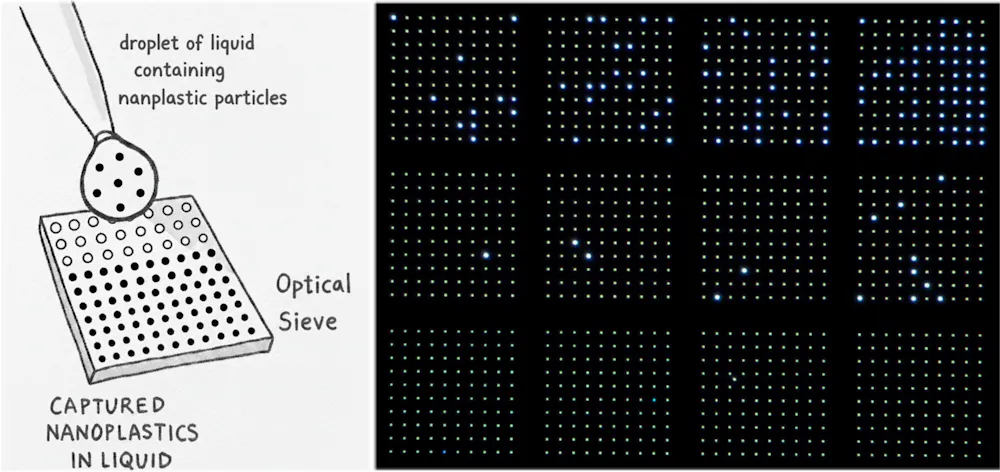
Nanoplastic particles are captured by cavities in the optical sieve.Lukas Wesemann and Mario Hentschel
Plastic pollution is everywhere: in rivers and oceans, in the air and the mountains, even in our blood and vital organs. Most of the public attention has focused on the dangers of microplastics. These are fragments smaller than 5 millimetres.
But an even smaller class of fragments, nanoplastics, may pose a greater risk to our health and our environment. With diameters of less than a micrometre (one millionth of a metre), these tiny particles can cross important biological barriers and accumulate in the body. Because they’re so tiny, detecting nanoplastics is extremely difficult and expensive. As a result, determining the extent of their impact has been largely guesswork.
A cheap, easy and reliable way to detect nanoplastics is the first step in addressing their potential impact. In our new study published today in Nature Photonics, my colleagues and I describe a simple, low-cost method that detects, sizes and counts nanoplastics using nothing more than a standard microscope and a basic camera.
Breaking down into ever-smaller pieces
What makes plastics useful is their durability. But that is also what makes them problematic.
Plastics do not disappear. They are not broken down by the ecosystem in the same way as other materials. Instead, sunlight, heat and mechanical stress slowly split the plastic apart into ever-smaller fragments. Larger pieces become microplastics, which eventually become nanoplastics once they are less than a micrometre in size.
At such a small size, they can pass through important biological safeguards such as the blood–brain and placental barriers. They can then start to accumulate in our organs, including our lungs, liver and kidneys. They can also carry other contaminants into our bodies, such as pollutants and heavy metals.
Plastics are not broken down in the ecosystem in the same way as other materials. Brian Yurasits
Yet, despite these dangers, real-world data on nanoplastics are scarce.
Today, detecting and sizing particles below a micrometre often relies on complex separation and filtration methods followed by expensive processes, such as electron microscopy. These methods are powerful. But they’re also slow, costly and usually confined to advanced laboratories.
Other optical laboratory techniques, such as dynamic light scattering, work well in “clean” samples. However, they struggle in “messy” real-world samples such as lake water because they cannot easily distinguish plastic from organic material.
An optical sieve
To address these issues, our international team from the University of Melbourne and the University of Stuttgart in Germany set out to make detection simple, affordable and portable.
The result of our collaborative work is an optical sieve: an array of tiny cavities with different diameters etched into the surface of a type of semiconductor material called gallium arsenide. Essentially, a collection of tiny holes, invisible to the naked eye, in a flat piece of a suitable material.
Physicists call these cavities “Mie voids”. Depending on their size, they produce a distinct colour when light is shone on them. When a drop of liquid containing nanoplastics flows over the surface, the nanoparticles will tend to settle into cavities that closely match their size.
Then, with a chemical rinse, mismatched particles wash away while matched ones stay tightly held in place by electromagnetic forces.
The optical sieve consists of a cavities of different sizes. When pouring a droplet of liquid containing nanoplastics over it, the particles get captured by the cavities of matching size and a colour change is directly visible in a microscope image. Lukas Wesemann
That part is simple. But it wouldn’t make the process cheaper or more portable if it still required a large, expensive electron microscope to visualise the trapped particles.
But here’s the key: when a particle is captured inside a cavity, it changes the colour of that cavity. This means filled cavities are easily distinguishable from empty ones under a standard light microscope with an ordinary colour camera, often shifting from bluish to reddish hues.
By observing colour changes, we can see which cavities contain particles. Because only certain-sized particles fill certain-sized cavities, we can also infer their size.
In our experiments, using nothing but our optical sieve, a standard light microscope and a simple camera, we were able to detect individual plastic spheres down to about 200 nanometres in diameter – right in the size range that matters for nanoplastics.
Nanoplastic particles with a size below one micrometer. Lukas Wesemann and Mario Hentschel
Putting it to the test
To validate the concept, we first used polystyrene beads in a clean solution. We observed clear colour changes for particles with diameters between 200 nanometres and a micrometre.
We then tested a more “real-world” sample, combining unfiltered lake water (including biological material) with clean sand and plastic beads of known sizes: 350 nanometres, 550 nanometres and a micrometre.
After depositing this mixture onto the optical sieve and then giving it a rinse, we were able to see distinct bands of filled cavities with diameters that matched the beads we had added.
This confirmed the optical sieve had successfully detected the nanoplastic particles in the lake water sample and determined their sizes. Importantly, this did not require us to separate the plastics from the biological matter first.
What’s next?
Our new method is a first step in developing a cheap, easy and portable method for routine monitoring of waterways, beaches and wastewater, and for screening biological samples where pre-cleaning is difficult.
From here, we are exploring paths to a portable, commercially available testing device that can be adapted for a range of real-world samples, especially those like blood and tissue that will be crucial in monitoring the impact of nanoplastics on our health.
The author would like to acknowledge the contribution of Lukas Wesemann to this article.
Shaban Sulejman receives funding from The University of Melbourne under a Ernst & Grace Matthaei Scholarship, the Australian Government Research Training Program Scholarship, and the Australian Research Council.
Source: The Conversation – Global Perspectives – By Marguerite Johnson, Honorary Professor of Classics and Ancient History, School of Historical and Philosophical Inquiry, The University of Queensland
Helen and Paris depicted on an Ancient Greek vase, 380–370 BC.Wikimedia Commons
The Trojan War is a legend that sprang from a distant memory of a real Greek incursion into the Bronze Age city of Troy (in modern day Türkiye). This may have taken the form of annual piracy raids and/or encounters based on control of the Aegean Sea.
These real life encounters between Greeks and Trojans, led to the destruction of Troy circa 1150 BCE (likely though warfare and fire). Over hundreds of years, they were transformed into oral tales.
Collectively known as the Trojan War Cycle, these tales were later committed to writing. They were retold and readapted over centuries in Greek and Roman antiquity, with writers and artists changing and adding to the basic plotline to suit their own purposes. Adaptations of the hundreds of stories that make up this cycle continue today, particularly in theatre.
The immediate cause of the legendary war, as storytellers have told it, was the abduction of King Menelaus’s wife Helen, Queen of Sparta, by the Trojan prince, Paris. (In the shame-based culture of Bronze Age Greek society, this act was deeply humiliating for a man, especially a king).
In response to the kidnapping, Menelaus’s brother, Agamemnon, King of Mycenae (a city in the Peloponnese), led a military campaign against Troy. The city of around 10,000 people was surrounded and held under siege for ten years.
The war ended with the ingenious deception of the Trojan Horse. This huge wooden beast was offered to the Trojans as a so-called gift from the Greeks, but secretly contained Greek soldiers. Once inside the city, they crept out, threw open the gates to their fellow Greeks and so began the city’s final days.
Giovanni Domenico Tiepolo, The Procession of the Trojan Horse in Troy. Wikimedia Commons, CC BY-SA
Is any of it true?
Most of us may find it strangely romantic to believe in a heroic quest for a stolen queen rather than accept that the city of Troy ultimately fell as a result of strategic and economic assaults at the hands of the Mycenaean Greeks.
Indeed, the actual city of Troy has been located, complete with two archaeological sublayers. Experts have found evidence that attests to the city’s destruction by siege. Similarly, the site of Bronze Age Mycenae, a palatial structure, as old as the particular sublayers of Troy, has been identified at the place of origin for the Greek expeditions.
But such physical sites cannot prove the historical existence of Helen, Achilles and the other superstars of the storytellers.
Such heroes and heroines most likely came into being as the stories developed, although some characters may have been partially based on historic leaders, their wives and families.
Part of the excavated city of Troy today. Marguerite Johnson, CC BY
The Iliad’s account
The Iliad (c. eighth century BCE) is the earliest example of how the shadowy, inglorious invasion of a prosperous city was transformed into a monumental national epic. Other stories tell aspects of the myth, for example Euripides’ tragedy, The Trojan Women (415 BCE).
Attributed to the poet Homer, the Iliad chronicles some weeks in the last year of the war. Composed in dactylic hexameter and divided into 24 “books” (chapters, if you will) that culminate in 15,693 lines of poetry, it is the definitive masterpiece of war literature.
Moving from the Greek encampment along the shores of northwest Asia Minor (modern-day Türkiye) to the fortified citadel of Troy (the modern-day city of Hisarlik) at the mouth of the Dardarnelles, the Iliad evokes the lives of both Greek and Trojan warriors as well as those of civilians.
As a war narrative, its battle scenes are visceral and drenched in blood, evoking both courage and cowardice, and certainly not for the squeamish. Yet it also captures the devastation war brings to children, wives, mothers, men too old to fight and hostages, along with soldiers.
The poem opens with an internal feud among the Greeks themselves, centring on the animosity between Agamemnon, and Achilles, leader of the Myrmidons (from modern-day Thessaly), who is also fighting for the Greeks.
At the heart of this bitter dispute are two hostages. Chryseis, daughter of the Trojan priest of Apollo, Chryses, has been taken by Agamemnon as a sex slave following a raid. Briseis was awarded to Achilles during a similar incursion.
The god Apollo sends a plague upon the Greeks as a result of Agamemnon’s refusal to return Chryseis to her father. Achilles – enraged and acting above his station – publicly confronts Agamemnon, demanding he return the young woman. Humiliated, Agamemnon eventually agrees but, in order to regain his preeminent status, takes Briseis from Achilles.
This scene evokes what modern people might recognise as combat fatigue. There is tension around decision-making, confused thinking, mistrust and anger. This personal feud depicts both men, not only as larger than life warriors, but also as complex human beings enduring almost unendurable conditions.
While such a situation may seem irrelevant in an epic that tells such a monumental tale, explicating the horrors of war on such a grand and devastating scale, the reality is quite the opposite.
Firstly, it is a reminder that war can be banal. Indeed, the “mini war” over two sex slaves seized during raiding parties reenacts the overarching “super war” at Troy, reinforcing the vanity of the human condition as well as the recklessness and even malignancy propelling some conflicts.
Karl Friedrich Deckler, ‘The Farewell of Hector to Andromaque and Astyanax’ Wikimedia, CC BY
Interestingly, the story of the Trojan Horse, the death of Achilles, and the many other instalments that constitute the Trojan War Cycle, do not interest the poet who compiled the Iliad. These are tales told elsewhere, in the fragments that remain of other epics, in the songs of lyric poets and in some of the extant tragedies of playwrights, right up to the literature and art of Late Antiquity.
Rather, Homer is interested in the stories of the humans trapped in the crossfire. For example, in Book Six of the Iliad, Hector, a Trojan prince and Troy’s greatest warrior, farewells his wife, Andromache, and his infant son, Astyanax, as he prepares to return to the battlefield. Andromache, who senses her husband is soon to die, says:
[…] for me it would be far better
to sink into the earth when I have lost you, for there is no other
consolation for me after you have gone to your destiny –
only grief […]
The Trojan Women
Andromache’s story and those of other women after the fall of Troy are of particular interest to Greek tragic playwrights of the fifth century BCE. The most powerful of the extant plays on this theme is Euripides’ The Trojan Women. The play consists of the voices of the four women who mourn the death of Hector at the hands of Achilles in the last book of the Iliad: Cassandra, the Trojan princess; Hecuba, the Queen of Troy; Andromache; and, finally, Helen herself.
To emphasise the suffering in war, the Chorus (the traditional collective narrators in Greek plays) is comprised of captive Trojan women, representing the nameless and forgotten human collateral.
This tragedy has been retold and re-imagined since its original production, including a heralded Australian adaptation by Barrie Kosky and Tom Wright in 2008.
Euripides details the fate of Cassandra, the princess also taken as a sex slave by Agamemnon; Hecuba, the wife of Priam, the last king of Troy, who is enslaved to Odysseus, King of Ithaca, and Andromache, indentured to Neoptolomus, son of Achilles. As for Helen, she is vilified as having caused the Trojan War, although in this play she, too, is a victim of war as she must beg her husband for her life.
The horror and inhumanity expressed in The Trojan Women culminates in the Greek execution of Astyanax, the baby son of Andromache and Hector. The tiny body is prepared for burial by his grandmother, Hecuba, while Andromache wails and Troy burns.
The endless interpretations of the siege of Troy in both literature and art can show courage and the triumph of the human spirit in the face of the worst of adversities. Yet others show that heroism is debatable and mutable, victory comes with loss of humanity, and women and children are always the victims.
Marguerite Johnson does not work for, consult, own shares in or receive funding from any company or organisation that would benefit from this article, and has disclosed no relevant affiliations beyond their academic appointment.
The Chinese military parade that had the world talking last week was more than just pageantry. It was a declaration that Chinese leader Xi Jinping sees himself in a race against time to secure his place in history.
For Xi, who has just turned 72, unification with Taiwan is not just a policy aim; it is the crown jewel that would elevate him above Mao Zedong and cement his reputation as the greatest leader in modern Chinese history.
The timing and staging of the parade underscored this urgency, a showcase of power before an audience of foreign leaders and cameras at a high-stakes anniversary event in Beijing.
Mao, the founder of the People’s Republic of China, unified the country under Communist rule, but left it poor and isolated.
Xi’s mission is to finish the job by formally ending the Chinese civil war that pitted the Communists against the Nationalists and annexing the island of Taiwan to lock in his place in the party pantheon.
But waiting is dangerous. Inside the Chinese Communist Party, loyalty is transactional and rivals constantly watch for weaknesses.
In 2012, for example, Bo Xilai, a rising star and once-close ally of Xi’s, suffered a dramatic and very public downfall. The scandal could easily have consumed Xi, but he turned it into an opportunity, using Bo’s downfall to cement his own rise.
That episode remains a cautionary tale in Beijing’s elite politics: power must never falter; momentum must never slip.
More than a decade later, Xi has removed or sidelined nearly every rival and manoeuvred himself into a third term. However, he still governs with the urgency of someone who knows how quickly fortunes can turn.
US catching up on hypersonic missiles
Abroad, the strategic equation is also changing.
For years, Beijing enjoyed a headstart in hypersonic weapons, anti-ship missiles and industrial production. China’s air and advanced missile defence systems have been designed to threaten US carrier strike groups and complicate allied operations across East and North Asia.
But Washington may soon close the gap. The Pentagon requested nearly US$7 billion (A$10.6 billion) in hypersonic missile program funding in the fiscal year 2024–25, while private firms are accelerating innovation in reusable missile testbeds and propulsion.
The US Navy is repurposing Zumwalt-class destroyers for its Conventional Prompt Strike hypersonic system, giving the navy its first maritime platform capable of hypersonic strike. Sea-based demonstrations of the new system are planned as soon as the program matures.
Every step narrows China’s military advantage.
US shipbuilding looking for revival, too
The industrial rivalry between China and the US is a similar story.
China currently dominates global commercial shipbuilding, a dual-use foundation that also supports naval expansion.
A recent analysis found one Chinese shipbuilder alone built more ships by tonnage in 2024 than the entire US industry has produced since the second world war. Foreign ship orders are underwriting this building capacity, which can rapidly pivot to naval platforms.
This edge has continued in 2025. Xi is counting on this industrial base to give China an edge in a future conflict over Taiwan.
However, US and allied investments in shipbuilding are starting to respond.
The Trump administration has set up a White House office dedicated to fixing US shipbuilding, while the Pentagon has requested US$47 billion (A$71 billion) for Navy ship construction in its annual budget.
Japan and South Korea, both major shipbuilders, have also added significant resources to their shipbuilding capacity in an acknowledgement of the changing power structures in East and North Asia. US politicians recently visited both countries to secure greater assistance in boosting US building capacity, too.
China is also getting older
More urgent still is the demographic clock. China’s population shrank by about two million in 2023, the second straight annual decline, as births fell to nine million, half the 2017 level.
The working-age cohort is shrinking, while the number of people over 60 years old is expected to rise to roughly a third of China’s population by the mid-2030s. This will be a major drag on growth and strain on social systems.
Demography is not destiny, but it compresses timelines for leaders who want to lock in strategic gains.
America’s competitive advantage
There is a final, often overlooked problem. The most efficient political-warfare system of the modern era is capitalism – the engine of competition that rewards adaptation and punishes failure.
The US still possesses a uniquely deep capacity for “creative destruction” – it constantly churns through firms and ideas that power long-term growth and reinvention.
That dynamism is messy, decentralised and often uncomfortable. However, it remains America’s strategic ace: it can retool industries, scale breakthrough technologies and absorb shocks faster than any centrally directed system.
China can imitate many things, but it cannot easily replicate that market-driven ecosystem of risk capital, failure tolerance and rapid reallocation.
All of this explains why Xi wants the world to believe China’s rise is unstoppable and unification with Taiwan is inevitable.
But inevitability is fragile. Beijing’s “win without fighting” approach, which involves grey-zone coercion, economic leverage and an incremental, “salami-slicing” approach to territorial claims in the South China Sea, has worked because it relies on patience and subtlety. The more Xi accelerates, the more he risks miscalculation.
A forced attempt to seize Taiwan would be the most dangerous gamble of his rule. If the People’s Liberation Army falters, the consequences would be severe: strategic humiliation abroad, political turbulence at home, and a punctured narrative of inevitability that sustains party authority.
Sun Tzu’s greatest victory is the one won without fighting, but only when time favours patience. For Xi Jinping, time is not on his side.
Ian Langford does not work for, consult, own shares in or receive funding from any company or organisation that would benefit from this article, and has disclosed no relevant affiliations beyond their academic appointment.
Source: The Conversation – USA (2) – By Jeremy J. Michalek, Professor of Engineering & Public Policy, Professor of Mechanical Engineering, Carnegie Mellon University
Hitting the brakes on electric vehicles will clearly mean less progress in reducing transportation emissions and less strategic U.S. leadership in a key technology of the future. But in a new study, my colleagues at Carnegie Mellon University and I find that fewer electric vehicles will also mean less investment to clean up the electricity sector.
But in 2025, Congress passed and Trump signed the One Big Beautiful Bill Act, which eliminated most of the incentives. U.S. investment in EV-related production has collapsed.
Electric vehicles are cleaner
As a scholar of electric vehicle technology, economics, environment and policy, I have conducted numerous peer-reviewed scientific studies characterizing benefits and costs of electric vehicles over their life cycle, from production through use and end of life. When charged with clean electricity, electric vehicles are one of the few technologies in existence that can provide transportation with near-zero emissions.
With today’s electricity grid, EV emissions can vary, depending on the mix of electricity generators used in the region where they are charged, driving conditions such as weather or traffic, the specific vehicles being compared, and even the timing of charging. But EVs are generally better for the climate over their life cycle today than most gasoline vehicles, even if the most efficient gas-electric hybrids are still cleaner in some locations. EVs become cleaner as the electricity grid becomes cleaner, and, importantly, it turns out that EVs can even help make the electricity grid cleaner.
In its efforts to prevent the government from regulating greenhouse gas emissions, the Trump administration is now claiming that emissions from cars and trucks are “not meaningful” contributors to climate change. But in reality, a technology that cleans up both transportation and electricity at the same time is a big deal.
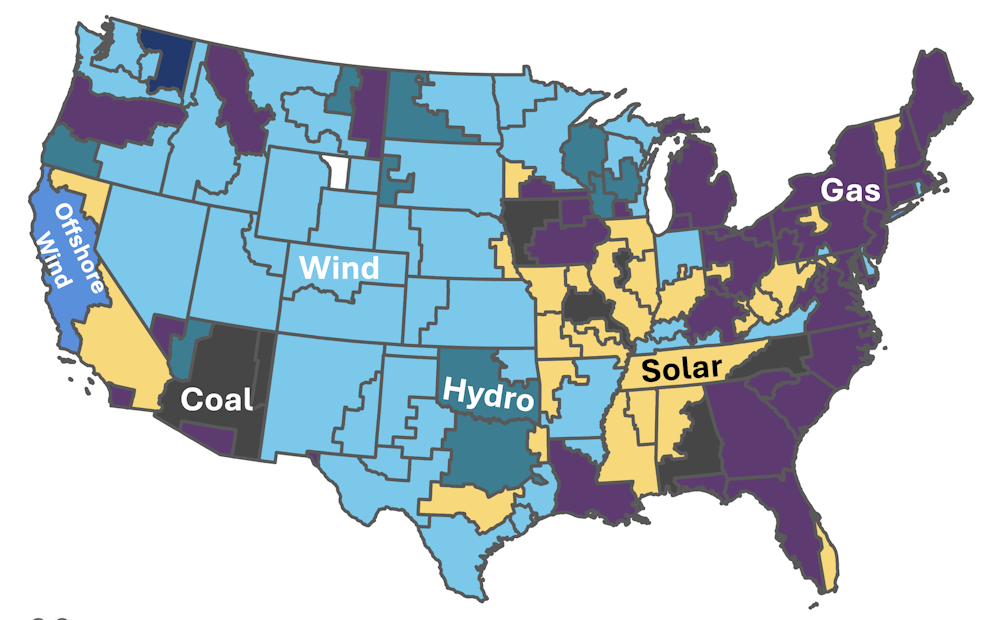
Across most of the U.S., adding electricity demand, such as from increasing the use of electric vehicles, would spark development of clean-energy power plants to meet that rising need. Michalek et al.
An opportunity for cleaner electricity
Our research has found that turning away from electric vehicles does more than miss a chance to curb transportation emissions – it also misses an opportunity to make the nation’s electricity supply cleaner.
In our paper, my co-authors Lily Hanig, Corey Harper and Destenie Nock and I looked at potential scenarios for electric vehicle adoption across the U.S. from now until 2050. We considered situations ranging from cases with no government policies supporting electric vehicles to cases with enough electric vehicle adoption to be on track with road maps targeting overall net-zero greenhouse gas emissions by 2050.
In each of these scenarios, we calculated how the nation’s power grid and electricity generators would respond to electric vehicle charging load.
We found that when there are more electric vehicles charging, more power plants would need to be built – and because of cost competitiveness, most of those new power plants would be solar, wind, battery storage and natural gas plants, depending on the region.
Once wind and solar plants are built, they are cheaper to operate than fossil fuel plants, because utilities don’t need to buy more fuel to burn to make more electricity. That cost advantage means wind and solar energy gets used first, so it can displace fossil-fuel generation even when EVs aren’t charging.
A virtuous – or vicious – cycle
Our analysis reveals that what’s good for climate in the transportation sector – eliminating emissions from vehicle tailpipes – is also good for climate in the power sector, supporting more investment in clean power and displacing more fossil fuel-powered generation.
As a result, encouraging electric vehicle adoption is even better for the climate than many people expected because EV charging can actually cause lower-emitting power plants to be built.
Gasoline vehicles can’t last forever. The cheap oil will eventually run out. And EV batteries have gotten so cheap, with ranges now comparable to gas cars, that the global transition is already well underway. Even in the U.S., consumers are adopting more EVs as the technology improves and offers consumers more for less. The U.S. government can’t single-handedly stop this transition – it can only decide how much to lead, lag or resist. Rolling back electric vehicle incentives now means higher emissions, less clean energy investment and weaker U.S. competitiveness in a crucial industry of the future.
Our findings show that slowing electric vehicle adoption doesn’t just affect emissions from transportation. It also misses opportunities to help build a cleaner power sector, potentially locking the U.S. into higher emissions from its top two highest-emitting sectors – power generation and transportation – while the window to avoid the worst effects of climate change is closing.
Jeremy J. Michalek currently receives funding from Toyota Research Institute and the National Renewable Energy Laboratory to study electric vehicle battery recycling and reuse and from the Technology Competitiveness and Industrial Policy Center to study global supply of critical battery materials. He has received funding from a diverse group of sources in the past, such as the National Science Foundation, the Department of Energy, the Department of Transportation, the Environmental Protection Agency, the National Bureau of Economic Research, the Alfred P. Sloan Foundation, the Electric Power Research Institute, Ford Motor Company, Toyota Motor Corporation, the Center for Applied Environmental Law and Policy, and other organizations. He has consulted for the US Environmental Protection Agency. The views expressed here are his own.
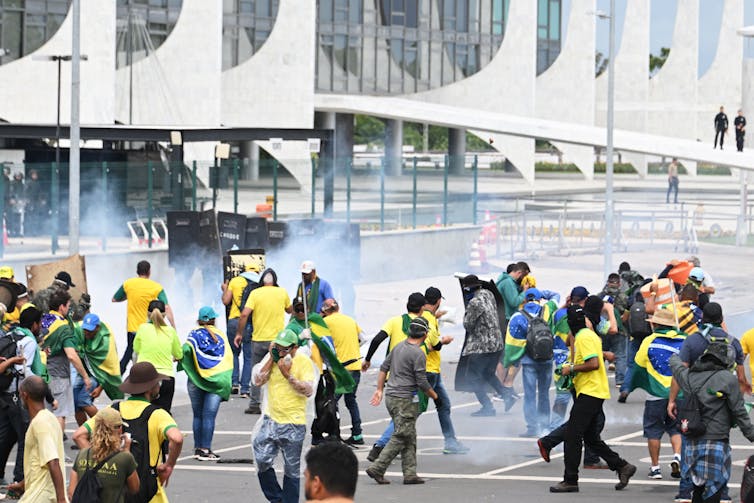
Brazil’s Supreme Court is expected to deliver a verdict by Sept. 12 over charges that the former president and key aides plotted to overturn Bolsonaro’s 2022 election defeat to Luiz Inácio Lula da Silva. Prosecutors allege that Bolsonaro and others discussed a scheme to assassinate Lula and incited a riot on Jan. 8, 2023, in hopes that Brazil’s military would intervene and return Bolsonaro to power.
But not all coup plotters are held accountable for their actions. And even when they are – it doesn’t necessarily mark the end of their political ambitions.
Supporters of former President Jair Bolsonaro clash with police outside the Planalto Palace in Brasilia on Jan. 8, 2023. Evaristo Sa/AFP via Getty Images
Coup and punishments
Plotting a coup is risky business. Some of those who attempt to seize or usurp power unconstitutionally are killed during their takeover bid, particularly when security forces loyal to the incumbent leader foil the attack. Christian Malanga, an exiled former army captain who led a violent attempt to seize power in the Democratic Republic of Congo, is one such example. He was killed in the ensuing shootout in May 2024.
But most leaders of failed coups survive.
And although they typically face punishment, the severity of consequences varies greatly; it often depends on whether the attempt is a self-coup, which is a power grab by an incumbent leader, or an attempt to oust a sitting government.
Some coup plotters and their co-conspirators are charged in a court and, if convicted, sent to prison. Malanga’s American co-conspirators were ultimately sentenced to life in prison in April 2025.
Still, it could be worse – failed coupists are often punished outside of independent courts, where the penalty is often more severe. Coup plotters have been summarily executed or sentenced to death by a military tribunal or a “people’s court.” The longtime Zairean dictator Mobutu Sese Seko executed over a dozen junior officers and civilians after his government uncovered an alleged coup plot in 1978.
One recent estimate suggests 40% of coup conspirators suffer relatively light punishment. Many coup backers are simply demotedor purged from the government without facing trial or execution. An especially popular move is to send coup plotters into exile to discourage their supporters from mobilizing against the regime. Former Haitian president Dumarsais Estimé was forced into exile after his self-coup attempt failed in May 1950; he died in the U.S. a few years later.
Punishment doesn’t always end threat
The problem facing governments is that failed putschists pose a lingering political threat. Ousted leaders often plot “counter-coups” to return to power. For example, former president of the Philippines Ferdinand Marcos, after being ousted in the 1986 People Power movement, masterminded coup plots from exile, though he never returned to power.
Some succeed, such as David Dacko, who returned from exile to grab power in the Central African Republic in 1979, but only with the help of French forces.
Even when convicted or exiled, coup plotters may be later freed. Some members of Brazil’s Congress have already introduced a bill that could grant Bolsonaro amnesty.
A few former failed coup leaders manage to come to power later. Ghana’s Jerry Rawlings led a failed coup in May 1979 but went on to seize power in subsequent coups in June 1979 and 1981; Hugo Chavez was convicted and jailed for leading a failed coup in 1992 but ended up being elected president in Venezuela in 1998.
Though Bukele temporarily backed down, he faced no legal or political backlash. His party won a legislative supermajority in 2021, and he won reelection in 2024. Bukele’s ruling party recently lifted presidential term limits, allowing him to potentially rule for life.
The good news about punishing unsuccessful coup plotters is that because they’ve failed, they do not have to be coaxed out of power. Thus, holding them accountable for their actions should deter future plotters from attempting the same thing. In contrast, for a leader who has done unsavory things while still in office – such as killing domestic dissidents or committing war crimes – the threat of punishment once they leave power can backfire by giving them a reason to fight to stay in power.
In the long term, failed coup leaders who escape punishment are more likely to make a political comeback.
When defeated at the polls, both Donald Trump and Bolsonaro tried to overturn the official results. Both attempted to altervotetotals after they had lost andblock an election winner from being inaugurated.
In contrast, a conviction for Bolsonaro would make it unlikely he could follow the same path to political resurrection. Even if he’s eventually pardoned, a guilty verdict makes him ineligible to compete again for Brazil’s presidency.
Joe Wright received funding for research on coups from the National Science Foundation and the Minerva Research Initiative.
John Joseph Chin does not work for, consult, own shares in or receive funding from any company or organization that would benefit from this article, and has disclosed no relevant affiliations beyond their academic appointment.