Michelangelo hated painting the Sistine Chapel – and never aspired to be a painter to begin with

Source: The Conversation – USA (2) – By Anna Swartwood House, Associate Professor of Art History, University of South Carolina

From a young age, Michelangelo prized drawing and sculpture above painting. Ian Nicholson/PA via Getty Images

When a 5-inch-by-4-inch red chalk drawing of a woman’s foot by Michelangelo sold at auction for US$27.2 million on Feb. 5, 2026, it blew past the $1.5 million to $2 million it was expected to receive.

Experts believe it to be a study for the figure of the Libyan Sibyl, a female prophet who appears on the ceiling of the Sistine Chapel in Rome. Michelangelo painted the iconic frescoes from 1508 to 1512, but he first sketched out the overall composition and details in a series of preparatory drawings. Only around 50 of these drawings survive today.

This was an exciting sale for reasons outside that eye-popping sum. Held in private collections for centuries, the drawing only came to light after the owner sent an unsolicited photo to Christie’s auction house. There, a drawings expert recognized it as one of the relatively few remaining studies for the Sistine frescoes.

As an art historian who specializes in the Italian Renaissance, I’m excited about the sale not because of the money it fetched, but because of the attention it has brought to Michelangelo’s lifelong devotion to drawing, a medium he prized over painting.

‘Not my art’

Art historians know a lot about Michelangelo through the letters and poems he penned, along with two biographies written in his lifetime by intimates Giorgio Vasari and Ascanio Condivi.

In 1506, Pope Julius II put Michelangelo’s sculpting work on a papal tomb at St. Peter’s Basilica on hold, redirecting the funds intended for the tomb to the renovation of the basilica itself.

Michelangelo responded by closing his studio. He ordered his workshop assistants to sell off its contents, abandoned 90 wagonloads’ worth of marble and left Rome in disgust.

In 1508, Julius and his intermediary, Cardinal Francesco Alidosi, were able to lure Michelangelo back to Rome with the promise of a 500-ducat payment and a contract to paint the Sistine. Despite accepting, the artist went on to complain relentlessly about his new commission. He wrote to his father that painting “is not my profession” and told the pope that painting “is not my art.”

Sculpture, not painting, was central to Michelangelo’s identity.

In the Condivi biography, which Michelangelo approved and helped shape, the artist is said to have abandoned painter Domenico Ghirlandaio’s workshop around 1490 to train in the Florence sculpture garden of powerful arts patron Lorenzo de’ Medici. Michelangelo would later joke that he became a sculptor as an infant, thanks to the breast milk of his wet nurse, who was the daughter of stonemasons.

Beyond his enthusiastic embrace of sculpture and resentment over the Sistine – what he called the “tragedy of the tomb” – Michelangelo found painting in fresco to be backbreaking work.

A yellowed piece of paper with text written in Italian and a doodle of a man straining to paint an image on a ceiling.
Michelangelo griped about painting the Sistine Chapel in a poem he sent to his friend Giovanni da Pistoia.
Wikimedia Commons

“I’ve grown a goiter from this torture,” he wrote to his friend Giovanni da Pistoia in an illustrated poem. “My stomach’s squashed under my chin, my beard’s pointing at heaven, my brain’s crushed in a casket, my breast twists like a harpy’s. My brush, above me all the time, dribbles paint so my face makes a fine floor for droppings!”

“My painting is dead,” he concludes. “I am not in the right place – I am not a painter.”

A grand design

The caricature that accompanies Michelangelo’s poem shows not only a cantankerous and restless mind, but also his use of drawing to reflect its inner workings.

The early 16th century witnessed a rise of drawing, with Michelangelo leading the way. Rather than simply copying or providing models for painting, drawing became understood as an important intellectual, exploratory and creative exercise

Michelangelo’s biographer Vasari famously used the term “disegno” to mean both a physical drawing and a work’s overall “design” or concept, giving the artist an almost godlike creative power.

This double meaning is reflected in the title of the hugely popular 2017 exhibition of Michelangelo’s drawings at the Metropolitan Museum of Art in New York”: “Michelangelo: Divine Draftsman and Designer.”

Michelangelo created many drawings for the Sistine that reflected the different meanings of “disegno.” There were his sketches of models, along with his architectural renderings and schemes to organize the huge space. Then there were the full-size “cartoons” he drew to transfer his designs directly onto the ceiling itself.

Sketches of architectural forms and human limbs from various angles.
Michelangelo’s scheme for the decoration of the vault of the Sistine Chapel, along with his studies of arms and hands.
© The Trustees of the British Museum, CC BY-SA

The good foot

Michelangelo also made many studies of individual body parts and gestures for the Sistine, including eyes, hands and feet.

In a drawing for the Sistine ceiling that’s now in the British Museum, various hands – perhaps modeled after his own – repeat across the right side of the page. Feet were especially important to the overall design of the human figure, and they stand at the intersection of Michelangelo’s interests in Classical art and human anatomy.

Contrapposto, or the Classical “counter-poise,” was the iconic stance for standing figures in paintings and sculptures. It features the trunk of the body centered over one leg with its foot planted, and the other bent with the foot perched on the toe. Michelangelo’s “David” stands in contrapposto, and even doctors today are impressed by the anatomical precision of the muscles and veins of each foot.

A white, marble-carved foot.
The relaxed left foot of Michelangelo’s ‘David.’
Franco Origlia/Getty Images

The Christie’s red chalk drawing of the foot was likely done from a live model, with Michelangelo showing the elegance of the Libyan Sibyl prophetess through her dramatically arched foot.

In the finished fresco, Sibyl’s body is a kind of elegant machine. The musculature of her extended arms, her coiled torso and her pointed toe all work in concert. This small drawing shows how the charged energy of a single body part could contribute to the overall “disegno” of the massive fresco.

While the process of painting the ceiling was arduous, the process of conceiving it through drawing was obviously rewarding for Michelangelo.

Colorful painting of a young woman posing from a seated position, twisting toward viewers while holding open a large book.
The finished fresco of the Lybian Sybil in the Sistine Chapel.
Wikimedia Commons

Drawing as the linchpin

Despite the popularity of the Sistine frescoes, Michelangelo rarely returned to painting after completing them. In 1534, Pope Clement VII commissioned him to paint the “The Last Judgment” on the altar wall of the Sistine Chapel. But only after Clement died later that year – and Clement’s successor, Pope Paul III, gave Michelangelo the extraordinary title of Chief Architect, Sculptor, and Painter to the Vatican Palace – did the artist begin work on the altar wall.

While many people today may think of the Sistine frescoes or Leonardo da Vinci’s “Mona Lisa” when they think of the Italian Renaissance, those artists did not think of themselves primarily as painters.

In a famous letter of introduction to the Duke of Milan, Ludovico Sforza, Leonardo elaborates on his many skills in creating fortifications, infrastructure and weaponry. He boasts about his ability to build bridges, canals, tunnels and catapults. Only after 10 paragraphs does he include a single sentence admitting that he, in addition, “can carry out sculpture in marble, bronze, or clay, and in painting can do any kind of work as well as any man.”

Like Michelangelo’s, Leonardo’s drawings show a voracious mind at work. They explore, rather than simply observe, everything from military machines to human anatomy. In 1563, Michelangelo would go on to be named master of the Accademia del Disegno in Florence, which aimed to teach drawing and design as the underlying skills necessary for sculpture, architecture and painting.

Drawing, it turns out, was the art that unified the many pursuits of the “Renaissance Man.”

The Conversation

Anna Swartwood House does not work for, consult, own shares in or receive funding from any company or organization that would benefit from this article, and has disclosed no relevant affiliations beyond their academic appointment.

ref. Michelangelo hated painting the Sistine Chapel – and never aspired to be a painter to begin with – https://theconversation.com/michelangelo-hated-painting-the-sistine-chapel-and-never-aspired-to-be-a-painter-to-begin-with-275788

Picky eating starts in the womb – a nutritional neuroscientist explains how to expand your child’s palate

Source: The Conversation – USA (3) – By Kathleen Keller, Professor of Nutritional Sciences, Penn State

Bitter vegetables can be an acquired taste. d3sign/Moment via Getty Images

It’s 5:45 p.m. and you’ve just arrived home after a long day at work. You’d like nothing more than a glass of pinot and to binge old episodes of your favorite show. Into the kitchen comes young Sally, your food-adventurous 8-year-old. “I’m hungry, what’s for dinner?”

Sally has never met a food she’s afraid to try. Visions of her savoring the tangy brine of an oyster and joyously slurping spicy ramen noodles dance in your head.

Before you can give her an answer, Billy, your 4-year-old picky eater, shouts, “Mac and cheese!” from the living room. Billy rotates between three entrées: macaroni and cheese from a box, chicken nuggets (only dino shaped) and pasta (only spaghetti).

You sigh and wonder how such diverse creatures ended up in the same family.

If this scenario rings a bell, you are not alone. As a nutritional neuroscientist and a parent, I have spent the better part of my professional and personal life thinking about why children eat the foods they do.

Understanding how food preferences develop can help parents teach kids to enjoy a diverse, varied and healthy diet.

Nature vs. nurture?

Are genes to blame in the case of picky eaters like Billy? While genes can have some influence, they often explain only a small part of the story.

People are born liking the taste of sweet and disliking the taste of bitter. These traits are thought to be protective in that they can help drive someone toward sources of calories – which are often sweet, such as fruits or breast milk – and away from potential toxins or poisons, which are often bitter. As an example of these innate preferences, one study found that pregnant moms who consumed sweet carrot capsules had babies who smiled on the ultrasound, while those who ingested bitter kale capsules had babies who grimaced for the camera, suggesting early on their dislike for bitter vegetables.

Child looking down at bowl of food with a frown, face propped up against hand on dinner table
Dinner was not a hit.
Milky Way/Moment via Getty Images

In addition to these innate responses, there are genes that affect your ability to taste bitter compounds. These compounds, called thioureas, are similar to those found in cruciferous vegetables. People who inherit genes that make them sensitive to these bitter compounds – about 70% of the U.S. population – tend to also be more sensitive to other bitter tastes in foods. Because of this, they may dislike foods such as raw broccoli, black coffee and grapefruit.

However, there are plenty of people who develop a liking for bitter foods, even though their first experience with them might have been unpleasant. Case in point, the growing popularity of bitter IPA beers.

Another gene that can influence food preferences is the gene that makes cilantro taste soapy. Those born with a version of this olfactory gene – up to 20% of the U.S. population – are sensitive to aldehyde compounds that tend to taste soapy. Because of this taste, they often dislike cilantro.

Pavlov and food preferences

While genes by themselves explain only a small part of taste, a person’s interactions with food in the environment are particularly influential when it comes to what they want for dinner.

Ivan Pavlov was a 19th-century experimental physiologist who showed that dogs could be taught to salivate at the sound of a bell. He put them through a conditioning period in which mealtime was repeatedly paired with the sound of a bell. Most pets have some ability to learn to associate environmental cues – such as a food bowl or the sound of their owners’ commands – with food.

In the early 1980s, psychologist Leann Birch conducted a series of studies showing that people develop food preferences using a process similar to Pavlov’s classical conditioning. When the taste of a food is associated with positive experiences – such as an influx of calories, release of reward chemicals in the brain or the pleasing tones of a mother’s voice – these positive experiences can enhance how much a person likes a food. On the other side of the coin, negative experiences, such as a painful stomachache or a punishment associated with eating a food – “You have to eat all of your vegetables or no screen time!”– can often decrease how much someone likes a food.

Babies even begin learning about food before they are born. In a classic study by biopsychologist Julie Mennella, pregnant moms who drank carrot juice four days a week during their pregnancy or while breastfeeding had babies who were more accepting of carrot-flavored cereal when it was first presented to them. Flavors that are passed through amniotic fluid to the developing fetus prime the future baby to accept the cuisine of the family.

Side profile of child nibbling on cracker from an open lunchbox in cafeteria
Supportive food environments can encourage kids to expand their palate.
Catherine Falls Commercial/Moment via Getty Images

Hope for picky eaters

The good news is that for most children, picky eating is a phase that tends to decline as they reach school age. And if children are growing at a healthy pace, it’s often not something to be too concerned about.

For parents who want to help their kids expand their palates, the most important thing you can do is give your child repeated opportunities to taste foods without pressuring or coercing them. Some children need 12 or more taste experiences with a new food before they will accept it. Some children will also be open to trying foods at school or day care, even if they won’t try them in front of you.

As for Sally and Billy, you’ve managed to get dinner on the table right on time. Your latest invention: kimchi mac and cheese and baked cauliflower, with extra Sriracha for Sally. You’re hoping the familiar shape of the boxed mac and cheese noodle might tempt Billy into taking a bite. And if not, there’s always tomorrow.

The Conversation

Kathleen Keller receives funding from The National Institutes of Health, The United States Department of Agriculture, Dairy Management Inc., McCormick Science Institute

ref. Picky eating starts in the womb – a nutritional neuroscientist explains how to expand your child’s palate – https://theconversation.com/picky-eating-starts-in-the-womb-a-nutritional-neuroscientist-explains-how-to-expand-your-childs-palate-275643

Meekness isn’t weakness – once considered positive, it’s one of the ‘undersung virtues’ that deserve defense today

Source: The Conversation – USA (3) – By Timothy J. Pawl, Professor of Philosophy, University of St. Thomas

Meekness used to be considered a positive trait – not being powerless, or a doormat. Halfpoint images/Moment via Getty Images

What do you envision when you think of meekness?

You probably see a mousy doormat, someone sheepishly acquiescing to the will of the stronger. When Jesus says, “Blessed are the meek, for they shall inherit the earth,” you might think that those wimps will hand it over without a whimper or word of objection to stronger, more ambitious people. The philosopher Friedrich Nietzsche called meekness “craven baseness.”

Indeed, one of the Oxford English Dictionary’s definitions is “inclined to submit tamely to oppression or injury, easily imposed upon or cowed, timid.” Meekness, then, is a weakness. Why would you ever want to be meek?

The same goes for docility, often characterized as a near neighbor of meekness. We can get a feel for its usage these days from the Corpus of Contemporary American English, where one finds that a docile person is slow, controllable, obedient, submissive, compliant, passive and under control.

Or consider condescension. You likely envision someone self-important looking down her nose at a service worker, or some insufferable prig unwilling to come off his high horse to mingle with the peasants. Being condescending, far from being a virtue, is universally acknowledged as a vice.

Meekness, docility and condescension: three traits with no cultural capital today. And yet, our ancestors typically understood these traits to be virtues. How in the world could that be?

As any philosopher will tell you, in a case of seeming disagreement, you need to settle the definitions of the words in play. How many arguments have been abruptly dissolved by someone saying, “Oh, that’s what you mean”? When we check the meaning of these three terms, I think we come to see that there’s been a switcheroo. As I’ve found in my philosophical research and teaching, some of the virtues that were most celebrated in yesteryear but now go undersung are traits that can help us lead good lives, even now.

Forgotten virtues

Consider meekness – but allow me to start with a little vignette.

In 2018, mixed martial-arts champion Matt Serra was having a family meal in a restaurant when a belligerent drunken man entered, threatening servers and patrons. Serra could have knocked him out cold. But instead, he calmly pinned him, waiting for security to arrive.

A similar trait is on display when exasperated parents react with control, harried teachers don’t rise to students’ provocations, and police de-escalate situations. In each case, they kept control of their emotions, especially their anger. One common feature of these stories is that the person wasn’t powerless; rather, it was precisely because they understood how much power they had that they used restraint.

Such a trait – excellence with respect to one’s anger – used to be called meekness. We hear an echo of this original meaning even today in horse training, where to “meek” a horse means training it to subjugate its great power to its master, not letting its passions take control. Likewise, meekness once meant not becoming weak, but subjugating power to reason – not letting anger take control.

A person rides a brown horse galloping across a field, with trees in the background.
‘Meeking’ a horse means more than subduing it.
Mint Images RF via Getty Images

In the Gospels, when Jesus calls himself meek, it is the same Greek word used for a meek horse: “praus.” A horse is not weaker on account of being meeked; no Greek warrior wanted a wimpy steed. The horse retains its strength, now safeguarded by self-control.

This is quite a different notion of meekness than we find in our contemporary lexicon. Yet in its traditional sense, the word names a trait almost everyone deeply values. No one wants her best friend, child, teacher, coach or deputy to be unable to control her anger.

Such control is an important character trait for living a good life, but we no longer have a concept for it. What term do people use today for being disposed to pick battles prudently, not letting anger cloud one’s judgment, not being easily baited into action they’ll come to regret – without being easily biddable or callous to real injustices? “Self-control,” a broad category that covers facing temptations, enduring difficulties and myriad things in between, is too broad a notion to do the work.

Nor do we have a word for someone excellent at receiving instruction and insights – but at the same time who’s unafraid to think for herself, to disregard the advice of a snake-oil salesman. That used to be called docility.

Condescension, the most surprising of the three, now suggests someone deigning to speak down from their lofty height. Yet it once described excellence at respecting people, regardless of their social status: easily connecting with those on a lower rung so they feel seen and valued, but without causing embarrassment or awkwardness. What term do we have now for inculcating such an important trait?

Why words matter

To be clear, I’m not here from the Language Reclamation League. I’m not necessarily advocating for a return to older language – and certainly not just because it is older. But without replacements for ethical concepts we’ve lost, we’re faced with a moral void, unable even to conceptualize the goodness that we want to see in ourselves and those we love.

Maybe you think that not much is lost. Bridges fall when engineers can’t distinguish varieties of physical strength; what’s lost if people can’t distinguish varieties of character strength?

An engineer in a yellow safety vest and white hard hat speaks into a walkie-talkie as he surveys a building site.
Precise language matters for character formation, too.
Tanison Pachtanom/E+ via Getty Images

To my mind, there are at least three reasons why it is important to have some term or other for these traits.

First, there’s good psychological evidence that goals of approach – “I want to get healthy,” “I want to get financially stable” – are a stronger motivation for us than avoidance goals – “I want to stop being sick,” “I want not to be poor.” Approach goals typically yield more effort, more satisfaction and more well-being. But they require naming the moral virtue you want to cultivate.

Second, the positive traits named by these old virtues are what you really want. You don’t merely want your loved ones to stop acting out of wrath. You want them to be able to restrain their power in the face of their anger. You are ignorant of your real goal if you don’t have a concept for it.

Third, consider the detriment caused by not having shared language for an ethical concept. The philosopher Miranda Fricker has written of the time before the term “sexual harassment” was coined in 1975. She provides multiple instances of women being wronged in the workplace, but being unable to articulate that wrong to those in power, owing to a lack of a shared label for it. And not only that, but the lack of an adequate concept prevented the victims from fully understanding the wrong themselves.

Having positive concepts for the traits we want to enable in ourselves and others is essential, then, to the moral life. The fact that we’ve let several go the way of “blatherskite” and “bumfuzzled” is telling.

We still have terms for a bloviating windbag or being bewildered, so we don’t need those archaic, though admittedly fun, words to express important truths. But when it comes to undersung virtues, we do need some way to highlight character traits that help form us into our best selves – even if the words of yesteryear no longer fit the bill.

The Conversation

Timothy J. Pawl received funding from The John Templeton Foundation for research on the topic of this article.

ref. Meekness isn’t weakness – once considered positive, it’s one of the ‘undersung virtues’ that deserve defense today – https://theconversation.com/meekness-isnt-weakness-once-considered-positive-its-one-of-the-undersung-virtues-that-deserve-defense-today-276360

Why Stephen Colbert is right about the ‘equal time’ rule, despite warnings from the FCC

Source: The Conversation – USA – By Seth Ashley, Professor of Communication, Boise State University

CBS says it warned Stephen Colbert that an interview with a politician could trigger an FCC rule requiring broadcasters to give political candidates equal access to the airwaves. The Late Show With Stephen Colbert/YouTube

Talk show host Stephen Colbert made headlines on Feb. 17, 2026, when he wrapped a network statement in a dog-waste bag and tossed it in the trash.

He did it live, while on air.

The move came after CBS lawyers reportedly told him he could not broadcast a scheduled interview with Democratic Texas Senate candidate James Talarico on his show, Late Night with Stephen Colbert. According to Colbert, the network warned him that broadcasting the interview could trigger the Federal Communications Commission’s equal time rule, which requires broadcasters to allow political candidates equal access to the nation’s airwaves.

CBS said it gave Colbert “legal guidance” that airing the segment could raise equal time concerns and suggested other options.

Colbert countered that in decades of late-night television, he could not find a single example of the rule being enforced against a talk show interview. He ultimately posted his Talarico interview on YouTube instead, where broadcasting rules don’t apply.

As a media scholar, I believe Colbert is right about the law. Congress has deliberately protected editorial discretion to prevent equal time rules from chilling political speech. And the FCC has extended this privilege to shows like his.

To understand why, you have to go back to 1959 and to a forgotten fight over the role of broadcasting in a democratic society.

Amending ‘equal time’

Because the airwaves have been viewed as a scarce public resource, radio and television broadcasting have been regulated to balance the First Amendment rights of the press with public interest obligations. That includes the need to provide reasonable access to the airwaves for candidates for office – so citizens can hear what they have to say, whether in the form of paid advertising or unpaid news coverage.

After first appearing in the Radio Act of 1927, the equal time provision was codified in Section 315 of the Communications Act of 1934.

That law created the FCC and still governs the use of the nation’s airwaves today. It requires broadcast licensees to provide “equal opportunities” to legally qualified candidates in a given election if they allow one candidate to “use” their facilities. The requirement was intended to prevent broadcasters from favoring one candidate over another and to foster robust political debate that would serve the public interest.

But the statute did not clearly define what counted as a “use.”

That ambiguity was a known issue, but it came to a head in 1959, when Lar Daly, a fringe Chicago mayoral candidate, filed a complaint with the FCC. He argued that if stations aired news clips of his opponents – including the incumbent mayor – as part of their routine coverage, he was entitled to equal time on air.

A man holding a placard and wearing a hat speaks for another man in a black and white photo.
Sen. Charles Percy, R-Ill., left, talks with Lar Daly, who protests the lack of equal time on television.
AP Photo/Paul Cannon

The FCC agreed. And it created a ruling that meant even routine news coverage of a candidate could trigger equal time obligations.

Broadcasters immediately warned that the decision would make political journalism nearly impossible. If every news interview or campaign clip required providing comparable time to every rival – including minor or fringe candidates – stations would either have to book everyone or drastically scale back political coverage.

NBC president Robert Sarnoff issued a thinly veiled threat in a message that was not lost on politicians who would be affected by the change: “Unless the gag is lifted during the current session of the Congress, a major curtailment of television and radio political coverage in 1960 is inevitable.”

Later that year, Congress stepped in and amended Section 315 to create explicit exemptions for “bona fide” newscasts, news interviews, news documentaries and on-the-spot coverage of news events. As my colleague Tim P. Vos and I note in our research on the history of the amendment, Congress rejected calls to repeal equal time altogether.

Instead, lawmakers preserved the rule for candidate-sponsored advertising while shielding news programming. Persuaded by broadcasters, lawmakers determined that professional journalism, guided by norms of balance and fairness, would best serve democratic discourse.

In signing the 1959 legislation, President Dwight D. Eisenhower highlighted the “continuing obligation of broadcasters to operate in the public interest and to afford reasonable opportunity for the discussion of conflicting views on important public issues.”

Eisenhower concluded by appealing to the good intentions of the nation’s broadcasters: “There is no doubt in my mind that the American radio and television stations can be relied upon to carry out fairly and honestly the provisions of this Act without abuse or partiality to any individual, group, or party.”

The talk show exemption

Over the decades, the FCC has interpreted the 1959 exemptions broadly.

Programs ranging from Meet the Press to The Jerry Springer Show to The Tonight Show and other interview-based broadcasts have been treated as “bona fide news interviews,” even when hosted by comedians. That’s why Colbert’s claim that there is no enforcement history against late-night talk shows is accurate.

It’s important to remember that equal time still applies in other contexts. If a candidate purchases or receives airtime for an advertisement, opponents are entitled to comparable access.

Equal time also applies to non-exempt entertainment programming, such as Saturday Night Live. Donald Trump’s hosting gig on SNL in November 2015 triggered an equal time request from four opposing primary candidates. And NBC obliged by providing a comparable amount of airtime for their campaign messages.

A man in suit in tie speaks in front of a microphone.
Federal Communications Commission chairman Brendan Carr testifies before Congress in Washington on Jan. 14, 2026.
AP Photo/Jose Luis Magana

FCC Chairman Brendan Carr recently signaled he was considering eliminating the talk-show exemption, arguing that some programs are “motivated by partisan purposes.”

As of now, no legal change has occurred. And it seems to me that CBS has acted out of caution, responding to political and regulatory pressure rather than to an actual rule change. That makes this episode unusual: The equal time rule was perhaps applied indirectly, through corporate self-censorship, not through direct FCC enforcement.

Why this moment matters

Either way, the Colbert incident highlights the growing restrictions on editorial independence during the second Trump administration – either imposed by government threat or corporate fear.

Whether through direct regulatory intervention or indirect corporate influence, this incident and others like it show an increased willingness to interfere with the editorial independence of media producers.

The dispute is part of what some critics view as an ongoing effort by the Trump administration to silence criticism. Trump is no fan of Colbert and has targeted comedians before.

CBS already announced in 2025 that Colbert’s show will be canceled in May 2026, leading many to suggest CBS was trying to appease Trump and his FCC, particularly ahead of a then-pending merger that required FCC approval.

The 1959 amendment that created the equal time exemption aimed to preserve editorial independence and protect free expression by limiting equal time claims and ensuring vibrant political discourse. The decision reflected a judgment that professional editorial discretion, not mandatory equivalence, best served citizens.

If the FCC alters the exemption, it would represent a major shift in U.S. media policy and would almost certainly face legal challenges. The government has an important role to play in promoting free expression and protecting free speech, but this is a good time to be wary of efforts to alter regulations to control content.

The Conversation

Seth Ashley does not work for, consult, own shares in or receive funding from any company or organization that would benefit from this article, and has disclosed no relevant affiliations beyond their academic appointment.

ref. Why Stephen Colbert is right about the ‘equal time’ rule, despite warnings from the FCC – https://theconversation.com/why-stephen-colbert-is-right-about-the-equal-time-rule-despite-warnings-from-the-fcc-276559

Supreme Court rules against Trump’s emergency tariffs – but leaves key questions unanswered

Source: The Conversation – USA (2) – By Kent Jones, Professor Emeritus, Economics, Babson College

It has been raining tariffs … until now? Aaron Schwartz/Getty Images

President Donald Trump’s economic agenda took a major hit when the Supreme Court struck down many of his most sweeping tariffs. While Trump has options to restore some of the tariffs, he’s losing his most powerful tool to impose them almost at will as a bargaining chip with other countries.

In a 6-3 decision on Feb. 20, 2026, the court ruled that Trump’s use of the International Emergency Economic Powers Act of 1977 to unilaterally impose tariffs on other countries was unconstitutional. Since January 2025, Trump has used the act to impose tariffs on nearly every other country.

As a trade economist, I wasn’t particularly surprised by the ruling. In the oral arguments, several justices were openly skeptical about the president’s ability to claim virtually unlimited powers to set tariffs without specific congressional language to authorize them. While the ruling answers some questions about the legality of Trump’s tariffs, it leaves many others unanswered.

What are the tariffs the court ruled against?

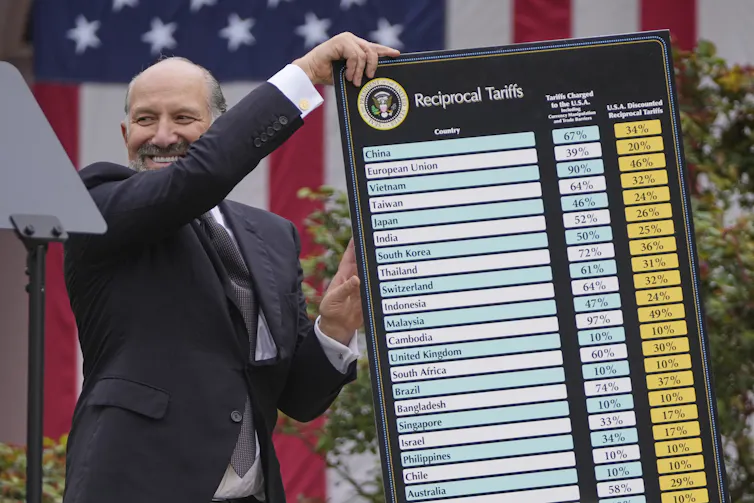
The tariffs that the court ruled are illegal include the “reciprocal” tariffs Trump imposed to match the value of trade barriers set by other countries. They ranged from 34% on China to a baseline of 10% for the rest of the world.

They also include a 25% tariff on some goods from Canada, China and Mexico over those countries’ supposed failure to curb the flow of fentanyl into the U.S.

By striking down these tariffs, the Supreme Court will presumably force U.S. tariff schedules to revert to the status quo before they were imposed on April 2, 2025, or “liberation day,” as Trump called it.

Why did the Supreme Court rule against the tariffs?

Most of the tariffs Trump has imposed used the International Emergency Economic Powers Act to provide legal justification. While the law allows the president to respond to economic emergencies with measures such as embargoes and asset seizures, it does not specifically authorize the use of tariffs imposed unilaterally.

This was a major point made in the Supreme Court decision. In every other statute available to the president to use tariffs, there is specific language stating the way in which tariffs can be imposed, language that is absent in the International Emergency Economic Powers Act statute.

The majority decision, in which the court’s liberal justices were joined by three of its conservatives, determined that the president overreached his powers to set tariffs, based on Article 1, Section 8, of the U.S Constitution. Any delegation of tariff-making powers in an emergency to the president must be consistent with this provision.

It is also noteworthy that Trump openly declared that one of the benefits of the tariffs was how much revenue they bring in. But the majority decision noted that this represented an unauthorized presidential power to tax, which is also governed by the Article 1, Section 8, provision that assigns this power exclusively to Congress.

a white man in a suit gestures in front of a podium with the presidential seal on it
President Donald Trump, during a meeting with governors, called the ruling a ‘disgrace.’
AP Photo/Evan Vucci

What does this mean for Trump’s trade policy?

Trump used the International Emergency Economic Powers Act tariffs as leverage to negotiate numerous bilateral deals with U.S. trading partners. Now that the tariffs have been declared unconstitutional, many countries may demand that the deals be renegotiated.

The decision does not cover all of the administration’s tariffs, including national security tariffs imposed under Section 232 for specific industries such as autos, steel and aluminum, and Section 301, a statute that allows the president to impose tariffs against individual countries if they have imposed unfair or discriminatory trade actions against the U.S. This covers some of the tariffs on imports from China.

What other options does Trump have to achieve similar results?

Trump has often used or threatened to use International Emergency Economic Powers Act tariffs for political reasons, including against Brazil over its prosecution of a former president, Mexico over immigration and Canada over its plans to sign a trade deal with China, and other reasons.

The Supreme Court decision will make it more difficult for Trump to use tariffs and tariff threats in that way. One outcome is that constitutional limits the justices set on presidential tariff-making powers should constrain the justification of tariffs for political reasons.

The main avenues for new tariffs in response to the Supreme Court decision are sections 232 and 301. The president could potentially try to get Congress to pass new legislation expanding his tariff powers, but that seems unlikely in an election year.

However, it is important to understand that he chose to use the International Emergency Economic Powers Act as the mainspring of his trade policy because he interpreted it as providing him with full discretion in the unlimited power to impose tariffs without further congressional constraints.

In order to impose similar tariffs under Section 232, for example, each tariff order must be focused on a single industry, and the Commerce Department must issue a report documenting the emergency as it applies to that industry. Presumably, Trump will be preparing to use Section 232 for a large numbers of industries in addition to those currently covered by that statute.

For at least some of the countries with which Trump has already negotiated bilateral trade deals, many of their exports would not be covered by Section 232 tariffs, hence the likelihood that those countries will demand a renegotiation.

Will US companies get refunds for the tariffs they’ve already paid?

The Supreme Court decision appears not to address the question of tariff rebates, but many companies have already indicated that they will demand them.

In principle, any U.S. company in possession of tariff receipts documenting their payment of tariffs would be eligible for a refund if the Supreme Court approves this remedy.

What are the political consequences of this decision?

Since public opinion about Trump’s tariffs is already negative, the president will have to deal with a likely backlash against any attempts to replace the rejected tariffs with new ones.

It will be interesting to see how Republicans in Congress react to Trump’s tariff strategy in view of the upcoming midterm elections. For example, Republicans from states that border Canada may push back against further efforts to curb trade with their northern neighbor.

This may impose a further constraint on Trump’s tariff policy.

The Conversation

Kent Jones does not work for, consult, own shares in or receive funding from any company or organization that would benefit from this article, and has disclosed no relevant affiliations beyond their academic appointment.

ref. Supreme Court rules against Trump’s emergency tariffs – but leaves key questions unanswered – https://theconversation.com/supreme-court-rules-against-trumps-emergency-tariffs-but-leaves-key-questions-unanswered-276561

Probability underlies much of the modern world – an engineering professor explains how it actually works

Source: The Conversation – USA – By Zachary del Rosario, Assistant Professor of Engineering, Olin College of Engineering

Probability can explain why a coin flip has a 50/50 chance of landing heads versus tails, but it also can be used for more powerful applications. Monty Rakusen/DigitalVision via Getty Images

Probability underpins AI, cryptography and statistics. However, as the philosopher Bertrand Russell said, “Probability is the most important concept in modern science, especially as nobody has the slightest notion what it means.”

I teach statistics to engineers, so I know that while probability is important, it is counterintuitive.

Probability is a branch of mathematics that describes randomness. When scientists describe randomness, they’re describing chance events – like a coin flip – not strange occurrences, like a person dressed as a zebra. While scientists do not have a way to predict strange occurrences, probability does predict long-run behavior – that is, the trends that emerge from many repeated events.

Left: A person in a zebra costume. Right: A coin in mid-air after being flipped. A hand is visible with thumb extended upward.
We may say ‘random’ to describe strange occurrences (person dressed as zebra), but probability describes chance events (a coin flip).
Zebras in La Paz, Bolivia by EEJCC, Own Work CC A-SA 4.0; https://commons.wikimedia.org/wiki/File:Zebra_La_Paz.jpg _ , CC BY-SA

Modeling with probability

Since probability is about events, a scientist must choose which events to study. This choice defines the sample space. When flipping a coin, for example, you might define your event as the way it lands.

Coins almost always land on heads or tails. However, it’s possible – if very unlikely – for a coin to land on its side. So to create a sample space, you’d have two choices: heads and tails, or heads, tails and side. For now, ignore the side landings and use heads and tails as our sample space.

Next, you would assign probabilities to the events. Probability describes the rate of occurrence of an event and takes values between 0% and 100%. For example, a fair flip will tend to land 50% heads up and 50% tails up.

To assign probabilities, however, you need to think carefully about the scenario. What if the person flipping the coin is a cheater? There’s a sneaky technique to “wobble” the coin without flipping, controlling the outcome. Even if you can prevent cheating, real coin flips are slightly more probable to land on their starting face – so if you start the flip with the coin heads up, it’s very slightly more likely to land heads up.

In both the cheating and real flip cases, you need an appropriate sample space: starting face and other face. To have a fair flip in the real world, you’d need an additional step where you randomly – with equal probability – choose the starting face, then flip the coin.

Three bar graphs displaying probabilities for different outcomes. The 'Fair' Flip assigns equal probability (50%) to both heads and tails. The Real Flip assigns 51% to the Starting Face and 49% to the Other Face. The Cheater's Flip assigns 100% to the Starting Face.
The probabilities for different coin-flipping scenarios.
Zachary del Rosario, CC BY-SA

These assumptions add up quickly. To have a fair flip, you had to ignore side landings, assume no one is cheating, and assume the starting face is evenly random. Together, these assumptions constitute a model for the coin flip with random outcomes. Probability tells us about the long-run behavior of a random model. In the case of the coin model, probability describes how many coins land on heads out of many flips.

But instead of using a random model, why not just solve the coin toss using physics? Actually, scientists have done just that, and the physics shows that slight changes in the speed of the flip determine whether it comes up heads or tails. This sensitivity makes a coin flip unpredictable, so a random model is a good one.

Frequency vs. probability

Probability differs from frequency, which is the rate of events in a sequence. For example, if you flip a coin eight times and get two heads, that’s a frequency of 25%. Even if the probability of flipping a coin and seeing heads is 50% over the long run, each short sequence of flips will come out different. Four heads and four tails is the most probable outcome from eight flips, but other events can – and will – happen.

Frequency and probability are the same in one special setting: when the number of data points goes to infinity. In this sense, probability tells us about long-run behavior.

A bar chart of probabilities for all possible outcomes of eight 'fair' coin flips. Four heads has the highest probability (~27%), and the distribution is symmetric around four heads.
Probabilities for all possible outcomes of eight ‘fair’ coin flips.
Zachary del Rosario, CC BY-SA

Applications to AI, cryptography and statistics

Probability isn’t just useful for predicting coin flips. It underlies many modern technological systems.

For example, AI systems such as large language models, or LLMs, are based on next-word prediction. Essentially, they compute a probability for the words that follow your prompt. For example, with the prompt “New York” you might get “City” or “State” as the predicted next word, because in the training data those are the words that most frequently follow.

But since probability describes randomness, the outputs of a LLM are random. Just like a sequence of coin flips is not guaranteed to come out the same way every time, if you ask an LLM the same question again, you will tend to get a different response. Effectively, each next word is treated like a new coin flip.

Randomness is also key to cryptography: the science of securing information. Cryptographic communication uses a shared secret, such as a password, to secure information. However, surprising randomness isn’t good enough for security, which is why picking a surprising word is a bad choice of password. A shared secret is only secure if it’s hard to guess. Even if a word is surprising, real words are easier to guess than flipping a “coin” for each letter.

You can make a much stronger password by using probability to choose characters at random on your keyboard – or better yet, use a password manager.

Finally, randomness is key in statistics. Statisticians are responsible for designing and analyzing studies to make use of limited data. This practice is especially important when studying medical treatments, because every data point represents a person’s life.

The gold standard is a randomized controlled trial. Participants are assigned to receive the new treatment or the current standard of care based on a fair coin flip. It may seem strange to do this assignment randomly – using coin flips to make decisions about lives. However, the unpredictability serves an important role, as it ensures that nothing about the person affects their chance to get the treatment: not age, gender, race, income or any other factor. The unpredictability helps scientists ensure that only the treatment causes the observed result and not any other factor.

So what does probability mean? Like any kind of math, it’s only a model, meaning it can’t perfectly describe the world. In the examples discussed, probability is useful for describing long-term behaviors and using unpredictability to solve practical problems.

The Conversation

Zachary del Rosario has received funding from the National Science Foundation and Toyota Research Institute.

ref. Probability underlies much of the modern world – an engineering professor explains how it actually works – https://theconversation.com/probability-underlies-much-of-the-modern-world-an-engineering-professor-explains-how-it-actually-works-273332

Enforcing Prohibition with a massive new federal force of poorly trained agents didn’t go so well in the 1920s

Source: The Conversation – USA – By Richard F. Hamm, Professor of History, University at Albany, State University of New York

Coast Guardsmen stand in front of two truckloads of liquor seized on April 14, 1931, after a battle between three policemen and several alcohol smugglers near Falmouth, Mass. AP Photo

As the actions of agents with U.S. Immigration and Customs Enforcement come under intense scrutiny, it’s worth noting that a little more than 100 years ago, another expansion of federal policing – to enforce national Prohibition – also sparked nationwide concern.

As a U.S. history scholar, I know both the government agencies charged with enforcing national Prohibition in the early 20th century and with mass deportation in the early 21st century were hastily expanded. They were asked to achieve difficult objectives and were staffed by sometimes poorly trained people who at times resorted to violence.

National prohibition enforcement

When Congress approved the Volstead Act in 1919 that outlawed the manufacture, sale and transportation of alcoholic liquors, it purposely limited the number of Prohibition enforcement officials due to pressure from powerful dry lobbying groups, which supported the prohibition of alcohol sales and consumption. These groups thought the majority of the Prohibition policing would be done by states.

The Volstead Act also exempted Prohibition agents from civil service laws, which would have required job applicants to pass certain minimum standards. The exemption was written into the law because the prohibitionist lobby only trusted committed “drys” – people resolutely dedicated to maintaining an alcohol-free society – to do the enforcing, and they thought that they would control the appointments.

For the first years of Prohibition, the Bureau of Prohibition belonged to a division of the Bureau of Internal Revenue – some were converted alcohol tax collectors. Then they became part of the Bureau of Prohibition in the Treasury Department. And in 1930, they moved to the Department of Justice.

These moves to various bureaus and departments reflected attempts to curtail corruption, reduce the influence of the prohibitionists on staffing, and increase effectiveness. Despite the moves, funding and training for Prohibition agents never improved. Additionally, in an effort to cut government spending during the Great Depression, the Herbert Hoover administration cut Prohibition agents’ per diem pay from US$6 to $5.

The initial group of Prohibition agents were either committed prohibitionists or “political hacks with little law enforcement experience,” according to author W. J. Rorabaugh. The hacks, Rorabaugh wrote, soon outnumbered the prohibitionists.

Several men dump beer from kegs into a lake.
Prohibition agents dump beer into Lake Michigan in Chicago on Oct. 9, 1919.
Bettmann/Getty Images

In 1927, Federal Circuit Judge William S. Keynon said that “three-fourths of the 2,500 dry agents are ward heelers and sycophants named by the politicians.” The assistant attorney general in charge of Prohibition enforcement, Mabel Walker Willebrandt, said that Prohibition agents were “as devoid of honesty and integrity” as those who violated Prohibition laws.

When Prohibition agents were placed under the civil service, 60% of them failed their civil service tests. In a six-year period beginning in 1920, 752 Prohibition officials lost their jobs for delinquency or misconduct. Drunkenness and bribery were the two main reasons for dismissal.

In 1930, the 1,450 front-line Prohibition agents dwarfed the 350 FBI field agents across the country. They were the largest federal law enforcement body, and they were busy.

From 1921 to 1930, they averaged over a half-million arrests per year. They seized over 45,000 automobiles, and by their own account, Prohibition agents killed 89 people.

However, the Association Against the Prohibition Amendment calculated that about 1,000 people were killed in enforcing Prohibition.

Endemic violence

Federal officials authorized Prohibition agents’ use of violence. One official told U.S. Sen. Wesley Jones, a strong prohibitionist, that some bootleggers “deserve a good killing, and I am not losing any sleep if now and then a bootlegger is killed.”

But Prohibition agents did not just shoot criminals. The Washington Herald detailed in 1929 a pattern of reckless use of force, with prohibition agents shooting at the tires of escaping cars and accidentally firing weapons. In 1924, within blocks of the U.S. Capitol, a Prohibition agent who was firing at a fleeing car carrying a bootlegger accidentally shot Sen. Frank L. Greene of Vermont. Greene, wounded in the head, never fully recovered the use of one arm.

The author Daniel Okrent illustrated the link between trigger-happy officers and shoddy recruitment and training when he detailed the case of “the first agent to kill a suspect bootlegger in the line of duty.” The Prohibition agent had been accepted into service under a false name. He was not a stranger to killing, as he had killed a man when he was 14. He had also served multiple prison terms. Indeed, he was given his badge when “still incarcerated at Dannemora State Prison,” according to Okrent.

A man dressed in military gear throws a tear gas canister in the air.
A federal agent lobs a tear gas canister toward protesters in Minneapolis on Jan. 24, 2026.
Kerem Yucel/ AFP via Getty Images

The parallels between Prohibition and the Trump administration’s mass deportation tactics are not identical. Prohibition was more unpopular in much of the country compared with mass deportation. And Congress was not willing to adequately pay for Prohibition enforcement, while it has generously funded ICE.

Several reports detail ICE’s recent massive expansion. In early January 2026, the agency announced it grew by 120%, adding 12,000 agents to the existing force of 10,000, which raised concerns among lawmakers about lowered training standards to meet recruitment targets. Other accounts reveal lax vetting, insufficient training and past officer misconduct.

But both efforts share important similarities. They were hastily built, with agents who were asked to do something very difficult, and staffed by sometimes poorly trained people who were authorized to use force.

The Conversation

Richard F. Hamm does not work for, consult, own shares in or receive funding from any company or organization that would benefit from this article, and has disclosed no relevant affiliations beyond their academic appointment.

ref. Enforcing Prohibition with a massive new federal force of poorly trained agents didn’t go so well in the 1920s – https://theconversation.com/enforcing-prohibition-with-a-massive-new-federal-force-of-poorly-trained-agents-didnt-go-so-well-in-the-1920s-276258

Individual donors provide only a small slice of university research funding – but Jeffrey Epstein’s ties with academics show why screening matters

Source: The Conversation – USA (2) – By Brian Herman, Vice President for Research, University of Minnesota

The recent release of Jeffrey Epstein’s emails shows a wide net of contacts – including academics at prominent universities. Brendan Smialowski/AFP via Getty Images

Yale University, Columbia University and the University of California, Los Angeles are among the schools that have recently placed professors on leave, seen faculty resign or made other changes over faculty members’ ties to Jeffrey Epstein.

The University of Arizona, for example, canceled a science conference scheduled for April 2026, following the news that several speakers and organizers were named in the Epstein files. Astrobiologist Stuart Hameroff, for example, wrote on the social platform X on Feb. 6, 2026, that he “obtained one-time funding” for a conference from Epstein.

Bard College’s president, Leon Botstein, is among other academic leaders and researchers who have said that they met with Epstein for fundraising purposes – though, as The New York Times reports, Epstein rarely delivered on the money he promised for research and other purposes.

“There is a tremendous drive to acquire money to support the work of faculty and staff. The pressure has always been there – but you can still approach that in an ethically and morally acceptable way,” said Brian Herman, a former vice president for research at the University of Minnesota, in an interview that has been edited for length and clarity.

Amy Lieberman, the education editor at The Conversation U.S., spoke with Herman to understand how philanthropy for colleges and universities works, and what standards and safeguards are in place to help ensure that this money is given in an ethical manner.

A graphic shows cartoon people building different things and standing on ladders, near a large dollar sign.
Universities across the country are under pressure to fund research – and, in return, improve or maintain their college rankings.
iStock/Getty Images Plus

How is research at universities typically funded?

Funding to support university research comes from a variety of different sources.

Most university research funding – approximately 53%-55% of that supportcomes from the federal government, like the National Institutes of Health and the National Science Foundation.

About 8% of total funding comes from a number of private foundations and nonprofits, like the American Cancer Society.

Universities can also request that state and federal legislators allocate funding in their yearly appropriations bills for research. This involves negotiations between universities and their state and federal legislators. State and local agencies provide about 5% of total university research funding.

Universities themselves fund between 25%-26% of research, and businesses give 6%.

Other sources of funding, including individual donors, account for about 3% of the money that funds university research.

These individuals might be alumni of the university, have another kind of connection to the school or are personally interested in a specific area of expertise of the university. Or, they could be grateful patients who had medical issues solved by the university’s medical school.

How do universities connect with private donors?

Universities typically have fundraising offices that oversee relationships with donors.

Donor and university partnerships involve significant negotiations about how the money will be invested. Universities typically will work with faculty members with expertise in the area of research a donor wants to support and put together a research proposal. The prospective donor then reviews the plan and decides whether they want to support the research.

After universities receive and invest a donation, they give donors a progress report on the investment.

Private donors give money to the university, and not to an individual faculty member. This allows proper accounting and controls on how the money is used, to make sure they support the intended research and adhere to university policies.

How do universities screen donors for conflicts of interest, for example?

All universities have compliance offices that set up a compendium of policies that guide how they accept private funding.

The schools try to make sure there is no financial conflict of interest for the donor, researcher or institution – or a conflict of interest between people performing the research and those providing the funding.

There is practically always a need to strike a balance between managing potential conflicts appropriately and being able to obtain the resources necessary for a university to conduct its work.

Do universities typically screen for donors who have committed a crime?

Most universities screen potential donors.

The larger the dollar amount in question, the more substantive the screening is. Many universities have policies on this issue. It is likely that universities will strengthen these policies based on recent events related to the Epstein case. They will want to become more stringent with screening to make sure that their donors are not morally compromised.

For example, universities can conduct background checks on potential donors.

But if the donation is small, it is possible that a university would not conduct a background check. So, a faculty member could seek $5,000 for a conference and approach a donor individually and not involve the rest of the university in the donation.

How could the Epstein case influence how universities screen donors?

I expect that universities will enact more policies and procedures that guard against a situation like what we are seeing in the Epstein files. Universities may require more substantive checks on all donations independent of size and source. They are also likely to carry out more training of faculty, staff and administrators on how to secure individual donor support.

If universities have not already done so, I think they should instruct faculty members not to directly contact a donor or legislator on behalf of the university. They should also increase the penalties for university employees who do not comply with this policy.

In some cases, researchers may have an idea that is not aligned strategically with how the university is raising philanthropic funds. They may go looking for their own money. This doesn’t happen a lot, but it does happen, and universities will have to become more vigilant about these types of situations.

In reality, money is necessary to do most everything at universities, including paying faculty and staff, purchasing research supplies and even keeping the lights on in the research labs. Money is also a metric that is used as a measure of success and the ranking of a university – meaning, getting more money can lead to a higher ranking.

University leaders are facing natural pressure to raise money. There is a tremendous drive to acquire money to support the work of faculty and staff. This can create significant pressure to acquire funding – but this must always be done in an ethically and morally appropriate way.

The Conversation

Brian Herman does not work for, consult, own shares in or receive funding from any company or organization that would benefit from this article, and has disclosed no relevant affiliations beyond their academic appointment.

ref. Individual donors provide only a small slice of university research funding – but Jeffrey Epstein’s ties with academics show why screening matters – https://theconversation.com/individual-donors-provide-only-a-small-slice-of-university-research-funding-but-jeffrey-epsteins-ties-with-academics-show-why-screening-matters-276345

How Dracula became a red-hot lover

Source: The Conversation – USA (2) – By Stanley Stepanic, Assistant Professor of Slavic Languages and Literatures, University of Virginia

In Luc Besson’s ‘Dracula,’ the titular character is a hopeless romantic. Vertical

The Lord of Vampires. The King of the Undead. The Ultimate Lover. All refer to the immortal Count Dracula, who originally appeared in Bram Stoker’s 1897 novel.

Yet the character’s fame has sprung more from his 200-plus cinematic resurrections, beginning with “Dracula’s Death” in 1921 and, most recently, in Luc Besson’s “Dracula,” which premiered in the U.S. in February 2026.

Besson’s rendition has received particular attention for its focus on personal passion. Originally titled “Dracula: A Love Tale,” the film features a protagonist who is not simply a monster, but a lover. The New York Times called the movie “extravagantly silly” and described actor Caleb Landry Jones’ performance of the classic monster as “deliciously operatic: less villain, more virtuoso in love.”

Meanwhile, in London, Dracula as lover also features as a theme in Cynthia Erivo’s new West End production, in which she plays the Count and 22 other characters. A smaller, recent production out of Washington, D.C., titled “Dracula: A Comedy of Terrors” presents the Count similarly, though with a hilariously deviant LGBTQ+ bite.

In other words, Dracula has come a long way from his days as a lecherous, old creep, a shift that can be attributed, in part, to evolving attitudes on love, gender and sexuality.

‘Even his breath was rank’

When Stoker first published “Dracula,” the character appeared at the end of a long line of literary vampires, from Lord Ruthven in John Polidori’s “The Vampyre” (1819) to Sir Francis Varney in “Varney the Vampire” (1845-1847).

A bald, skinny, elderly vampire with hollow eyes.
In the 1922 German film ‘Nosferatu, A Symphony of Horror,’ the vampire, Count Orlok, appears like his repulsive and predatory literary predecessors.
Frederic Lewis/Hulton Archive via Getty Images

These vampires were all decrepit, revolting and predatory old men, and Stoker’s Count Dracula was no different. In the novel, one character notes Dracula’s “course” hands, the “extraordinary pallor” of his skin and his “extremely pointed” ears; atop his “lofty domed forehead,” his hair grew “scantily” upon his head. Even his “breath was rank.”

Another character describes Dracula as possessing “not a good face,” adding that it was “hard, and cruel.”

The first surviving feature-length film adaptation of “Dracula” was the 1922 German film “Nosferatu: A Symphony of Horror,” which cribs the plot and characters from Stoker’s novel. In it, Count Orlok – essentially a bootleg version of Dracula – looks ratlike, emaciated and pallid.

Seduction game

Little about Stoker’s Dracula or Count Orlok screamed “lover,” though there’s arguably an implicit sexuality in the way he attacks and stalks his victims.

Instead, Dracula gained his “lover” label from later appearances on screen.

The earliest example appears in the 1944 film “House of Frankenstein,” where Rita (Anne Gwynne) is initially concerned by Dracula’s presence. Later, however, she finds herself “no longer afraid” after he places a ring onto her index finger, which magically fits to her precise shape.

At the end of this scene, as she longingly looks into his eyes, he announces he will come for her the next day, as if it were all a budding tryst.

Count Dracula is more handsome Lothario than old lech in ‘House of Frankenstein.’

The evolution of Dracula’s character mirrored changes in more general perceptions of gender, sexuality and violence that occurred after World War II, when popular culture started to chip away at the centrality of the nuclear family. As books, films and TV shows explored themes like lust, infidelity, same-sex relationships and divorce, images of vampires became more complex.

In the 1958 film “Dracula,” for example – titled “Horror of Dracula” in the U.S. – Dracula (Christopher Lee) is a predator who breaks into the homes of married women.

Yet there’s also a hint of romance. In one particular scene, he assaults Mina Holmwood (Melissa Stribling). But Mina appears to eventually give in, and they share a brief, passionate kiss. The British Board of Film Classification even censored the scene, seeing it as a step too far in a film already replete with sexual overtones.

Director Terence Fisher later recalled telling Stribling to depict her character as though she “had one whale of a sexual night, the one of your whole sexual experience. Give me that in your face!”

Lover or monster?

By the 1970s, sexuality became even more of a pronounced theme in vampire-related media, mirroring broader cultural changes in views of human sexuality.

Comic books such as “Vampirella” presented the vampire as a hypersexualized, feminine, erotic symbol of power, while films such as “The Vampire Lovers” explored themes like lesbianism, though not in a way that was entirely explicit.

In the film “Count Dracula’s Great Love” (1973), Dracula falls head over heels for a young girl named Karen, who ends up rejecting his advances. Near the end of the film, the lovesick vampire bemoans, “For the first time, love brings a finish to the life of Dracula,” before driving a stake into his heart with his own hands.

Shortly thereafter, a made-for-TV “Dracula” features Dracula’s search for his dead wife.

A woman with black hair and a red dress passionately kisses a man with long black hair.
Winona Ryder and Gary Oldman share a kiss in a scene from the 1992 film ‘Bram Stoker’s Dracula.’
Columbia Pictures/Getty Images

The “search for a dead lover” would become a central theme in future films. For example, in Francis Ford Coppola’s “Bram Stoker’s Dracula” (1992), viewers learn that Dracula leaves Transylvania for England to pursue a reincarnation of his dead wife.

This yearning was a borrowed concept. In the Gothic soap opera “Dark Shadows” (1966-1971), the character Barnabas Collins (Jonathan Frid) tries to replicate his romance with his long-dead lover, Josette, by attempting to supernaturally control the living body of a girl named Maggie Evans (Kathryn Leigh Scott) so that she mimics Josette.

The concept of a vampire pining for a lost love – especially one from a lost era – marked a significant evolution in vampire media.

In the 1970s comic book series “The Tomb of Dracula,” the Count has a human wife named Domini; through magical means, he’s even able to conceive a child with her. Thanks to his romance, he can now “understand things such as peace and rest and love.”

Despite Dracula-as-lover now being such a well-worn trope, the ever-adaptable Count is also ready for his traditional scare duties, most recently in Robert Egger’s “Nosferatu” (2024). Whether he’s a lover, a monster or both, Dracula represents the idea of the vampire as a mirror of human experience. Romance can sometimes teeter between love and pain. Passion can sometimes be scary. So when you next see him on stage or screen, don’t be surprised if his fervent love also comes with a sharp bite.

The Conversation

Stanley Stepanic does not work for, consult, own shares in or receive funding from any company or organization that would benefit from this article, and has disclosed no relevant affiliations beyond their academic appointment.

ref. How Dracula became a red-hot lover – https://theconversation.com/how-dracula-became-a-red-hot-lover-275789

Menstrual pads and tampons can contain toxic substances – here’s what to know about this emerging health issue

Source: The Conversation – USA (3) – By Jenni Shearston, Assistant Professor of Integrative Physiology, University of Colorado Boulder

Studies have found small amounts of toxic heavy metals and other potentially harmful substances in some menstrual pads and tampons. zoranm/E+ via Getty Images

About half of the global population menstruates at some point in their lives. Disposable products, such as tampons and pads, are some of the most popular products used around the globe to manage menstrual flow.

Unfortunately, studies have shown that many personal care products, including shampoo, lotion, nail polish and menstrual products, contain hazardous chemicals. Items used in or near the vagina are of particular concern because they are in contact with vaginal mucous membranes – the moist tissue lining the inside of the vagina that secretes mucus. These tissues can absorb some chemicals very efficiently.

People use menstrual products 24 hours a day for multiple days monthly, over the course of many years. Tampons, which are used internally, are surrounded by the permeable vaginal mucous membrane for up to eight hours at a time.

I am an environmental epidemiologist, and I study chemical exposure, its sources and its health effects. As a person who menstruates, I also must make my own decisions around menstrual products and manage the challenge of finding accurate information about women’s health risks, which receive less research attention and funding than men’s health.

In 2024, I co-authored the first paper that detected metals in tampons, including toxic metals like lead and arsenic. My colleagues and I also wrote a review paper that surveyed the scientific literature and found about two dozen studies measuring chemicals in menstrual products.

The various chemicals that these studies detected were typically at concentrations low enough to make their health impact unclear. However, they included chemicals known to disrupt the endocrine system, which makes and controls hormones that are essential for bodies to function.

The next question after detection of toxic heavy metals in tampons is whether these substances can be absorbed into the body.

How contaminants get into menstrual products

The first modern tampon in the U.S. was patented in 1931. Nearly a century later, tampons still are made primarily from cotton, rayon or a blend of the two.

Chemicals may get into tampons and other menstrual products in a number of ways. Some chemicals, like heavy metals, are present in soil, either naturally or due to pollution, and may be absorbed by cotton plants.

Other chemicals, such as zinc, may be intentionally added to menstrual products to prevent the growth of harmful bacteria. Still others, such as phthalates – synthetic chemicals used to manufacture plastics – may leach into menstrual products from plastic packaging or be added as part of a fragrance.

Research suggests that these chemicals are present in a large proportion of menstrual products – we found lead present in all 30 tampons we tested. What we don’t yet know is if these chemicals can get into people’s bodies in a high enough concentration to cause health effects in either the reproductive system or elsewhere in the body.

Limited federal regulations

The U.S. Food and Drug Administration regulates tampons, menstrual cups and scented menstrual pads as Class II medical devices, which carry moderate to medium risk. Unscented menstrual pads are Class I medical devices, which are considered low-risk. These categories are based on the risk the device may present to a consumer who uses it in the intended way.

FDA guidance for Class II devices offers only a few general guidelines with respect to chemicals. For menstrual tampons and pads, it recommends – but does not require – that products should not contain two specific dioxin products or “any pesticide and herbicide residues.” Dioxins are a chemical by-product of the bleaching process to whiten cotton, and they are associated with cancer and endocrine disruption. Using non-chlorine bleaching methods can reduce dioxin formation.

The most stringent regulation of tampons in the U.S. occurred after an illness called toxic shock syndrome became a public concern in the 1970s and 1980s. Menstrual toxic shock syndrome occurs when the bacteria Staphlococcus aureus grows in the vagina on inserted menstrual products and releases a toxin called TSST-1. This substance can be absorbed through the vaginal mucosa and cause a variety of symptoms, including fever, high blood pressure, shock and even death.

During this epidemic, in which at least 52 cases were recorded and seven people died over a period of eight months, tampons were associated with the syndrome – especially a highly absorbent tampon called Rely, which was pulled from the market.

In response, the FDA created a task force that recommended standardizing the tampon absorbencies and advised consumers to use the lowest absorbency for their flow. This is why tampons in the U.S. now come in a range of absorbencies, from light through regular to super and ultra, so that users can choose the level they need while minimizing risk of toxic shock.

Living in a ‘soup of chemicals’

Just because a chemical is present in a menstrual product doesn’t mean it can get into the body. However, chemicals like lead and arsenic are known threats to human health. So it’s important to study whether harmful chemicals present in menstrual products could contribute to health problems.

Humans in the modern world live in what expert toxicologist Linda Birnbaum, former director of the National Institute of Environmental Health Sciences, calls a “soup of chemicals.” Simply being present on Earth means being exposed to many chemicals, at different concentrations, all at once. This makes it difficult to unravel the relationship between a single chemical exposure and health.

Nonetheless, science has shown that chemical exposure from at least one menstrual product – vaginal douches – does affect health. Vaginal douching is the process of washing or cleaning the inside of the vagina with water or other fluids.

The American College of Obstetricians and Gynecologists recommends avoiding this process, which can harm healthy bacteria in the vagina, increasing the risk of vaginal infections and other diseases.

In addition, a 2015 study found that women who use vaginal douches have higher concentrations of a chemical called monoethyl phthalate in their urine. Exposure to this substance is associated with reproductive health problems, such as reduced fertility and increased pregnancy risk.

Can these chemicals be absorbed?

Scientists are working now to determine what concentrations of metals and other chemicals can leach out of tampons and other menstrual products. One 2025 study estimated that volatile organic compounds, a group of chemicals that vaporize quickly, can be absorbed through the vaginal mucosa. Volatile organic compounds may be added to menstrual products as part of fragrances, adhesives or other product components.

My team and I are now shifting our focus to the relationship between menstrual product use, various chemicals, and menstrual pain and bleeding severity. We want to see whether some chemicals will be elevated in menstrual blood, whether these chemical levels are higher in people who use tampons, and whether the chemicals are associated with greater menstrual pain and bleeding.

States are starting to act on this issue. For example, in 2024, Vermont became the first U.S. state to ban multiple chemicals from disposable menstrual products. California bans PFAS, a widely used group of highly persistent chemicals, from menstrual products. New York adopted a law in December 2025 barring multiple toxic chemicals from menstrual products.

California also enacted a law in October 2025 that requires manufacturers of disposable tampons and pads to measure concentrations of arsenic, cadmium, lead and zinc in their products, and to share those measurements with the state, which can publish them. More information like this will help support informed choices for millions of consumers who rely on menstrual products every month.

The Conversation

Jenni Shearston receives funding from the United States National Institutes of Health.

ref. Menstrual pads and tampons can contain toxic substances – here’s what to know about this emerging health issue – https://theconversation.com/menstrual-pads-and-tampons-can-contain-toxic-substances-heres-what-to-know-about-this-emerging-health-issue-268470