Spotted lanternflies love grapevines, and that’s bad for Pennsylvania’s wine industry

Source: The Conversation – USA (2) – By Flor Acevedo, Assistant Professor of Entomology, Penn State
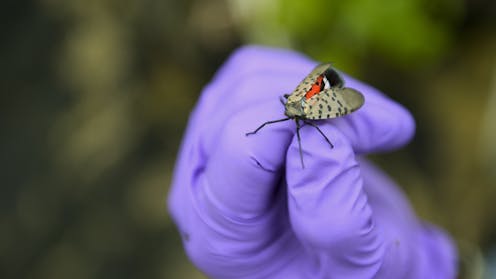
Adult spotted lanternflies infest areas of Pennsylvania from July to December. Lauren A. Little/MediaNews Group/Reading Eagle via Getty Images

Spotted lanternfly season is back in Pennsylvania. The polka-dotted, gray-and-red-winged adult insects make their appearance each July and tend to hang around until December. It’s an unwelcome summer ritual that started in 2014 when the invasive pests were first detected in the U.S.

The Conversation U.S. talked to Flor Acevedo, an assistant professor of entomology at Penn State University, about the bugs and her research on how lanternflies are threatening the state’s vineyards and wine industry.

Does Pennsylvania have many vineyards?

Pennsylvania has more than 400 wineries with about 14,000 acres planted in vineyards, according to the Pennsylvania Wine Association. The industry generates about US$7 billion in total economic activity. Erie County, where I live, has about 70% of Pennsylvania’s vineyard acreage, with the rest scattered across the state.

What do lanternflies do to grapevines?

The spotted lanternfly feeds on many plants, but its preferred hosts are the Tree of Heaven, an invasive plant introduced to Philadelphia from China in 1784, and grapevines.

Person wearing beige protective hat inspects the leaves of a plant
Entomologist Flor Acevedo counts spotted lanternflies on a Tree of Heaven plant.
Flor E. Acevedo

Extensive feeding by these sap-sucking insects can weaken grapevines and, when combined with other stressors such as diseases or frosty winters, can kill the vines. While spotted lanternflies feed on other important crops such as apple trees, they have been lethal only to grapevines and Tree of Heaven plants.

Feeding can also reduce yield and fruit quality, which affects juice and wine quality.

Tell us about your lanternfly experiments

My lab initially investigated whether spotted lanternflies could survive to adulthood and reproduce when feeding exclusively on grapevines. This would help us determine whether the insects could thrive in regions with extensive grapevine cultivation.

We found they do survive, but their fitness is severely reduced. Insects feeding solely on grapevines had high mortality, slower development and laid fewer eggs when compared with those that had access to a mixed diet of Tree of Heaven and grapevines.

Our next question was whether different grapes would be equally suitable for spotted lanternfly survival and reproduction. In the U.S. we grow native grapevines such as Concord and muscadine as well as vines of European origin. We found that spotted lanternflies did not survive to adulthood when they fed only on muscadine grapevines.

We have also partnered with colleagues specialized in plant science, food science and agricultural economics to investigate the effects of spotted lanternfly feeding on grapevine yield and wine and juice quality.

This research group enclosed both red and white grapevines – Cabernet Franc and Chardonnay – in mesh cages in the field and infested them with between 20 and 350 spotted lanternflies per vine. We wanted to determine the effect of constant adult insect feeding on grapevine yield, fruit sugars and phenolics, which are chemical compounds that are important for wine color, flavor and aroma. We also wanted to know the density of infestation that would induce changes in yield and fruit and wine quality.
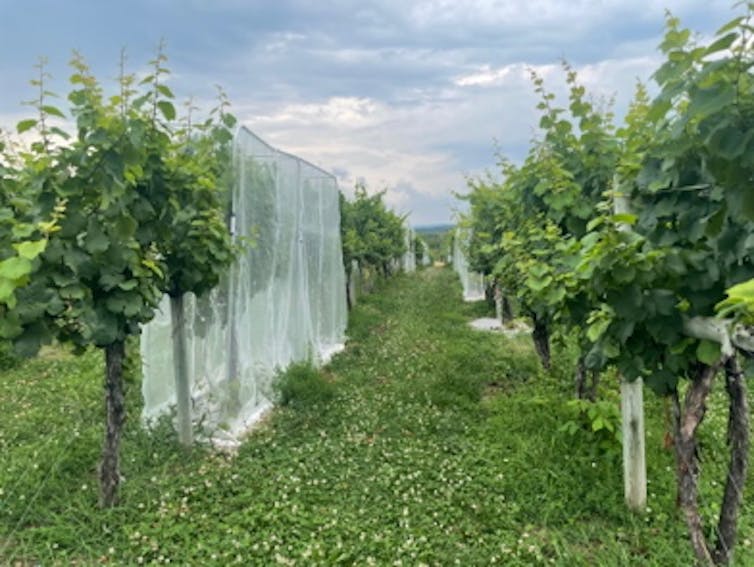
Rows of small trees in a field, some of them covered with mesh curtains
Researchers infested grapevines with lanternflies to see how they affect yield and fruit quality.
Flor E. Acevedo

We found a decrease in sugar content in the fruit within a single season, as well as a decrease in phenolics in red wine. We also found a reduction in yield after the second year of consecutive insect feeding.

These findings suggest that, if not controlled, spotted lanternfly adult feeding could reduce income to growers by reducing yield and could affect the wine industry by reducing the quality of the drink.

How worried are Pennsylvania winemakers and how are they responding?

Perceptions vary depending on whether the winery or vineyard is in an area that has already been infested.

Those that have been dealing with lanternflies for a few years have established protocols for pest monitoring and applying insecticides. But those that haven’t experienced it yet are concerned about the insect’s arrival on their properties.

Owners of organic vineyards are also concerned, but there are few of those in this region.

Wineries are being affected by spotted lanternflies in at least two ways. First, for those that grow grapes, lanternflies have increased their costs due to the extra labor and insecticide applications needed to control them. Second, for wineries that are agrotourism sites, they need to keep outdoor seating spaces neat and free from lanternflies.

Black insects with white polka dots crawl across stem of plant with green leaves
Spotted lanternfly nymphs crawl across a Tree of Heaven stem.
Natalie Kolb/MediaNews Group/Reading Eagle via Getty Images

As an entomologist, what do you find most fascinating about these creatures?

Most insects that feed on plants lay their eggs close to a food source for the young to feed on when they hatch. But spotted lanternflies lay their eggs on almost anything – car tires, field equipment, rocks, fabrics, old wood, cardboard. This behavior facilitates the insect’s dispersal, as eggs can be easily transported without being noticed. Once the eggs hatch, the nymphs search for young plant shoots or herbaceous plants to eat.

Anything else people in Pennsylvania should know as they see lanternflies again this summer?

I think it’s important for the public to know that, as pretty as some of us may find spotted lanternflies, these insects are invasive, damaging and affecting the state economy. Everybody can help stop the spread of these insects by killing and avoiding transporting them at any living stage.

Spotted lanternflies lay eggs in masses. These masses look like light grayish-brown, mudlike or puttylike patches, typically about an inch long, and they are found on various surfaces. At any life stage the insects can be killed by squishing them, immersing them in hand sanitizer or freezing them for several days.

Read more of our stories about Philadelphia and Pennsylvania.

The Conversation

Flor Acevedo has received funding for her research from the USDA Crop Protection and Pest Management program (2023-70006-40597), the Pennsylvania Department of Agriculture, the Pennsylvania Wine Marketing and Research Board, the New York Wine and Grape Foundation, the Penn State University College of Agriculture, and the John H. and Timothy R. Crouch Endowment Grant for Viticulture, Enology, and Pomology Research.

ref. Spotted lanternflies love grapevines, and that’s bad for Pennsylvania’s wine industry – https://theconversation.com/spotted-lanternflies-love-grapevines-and-thats-bad-for-pennsylvanias-wine-industry-260374
Inequality has risen from 1970 to Trump − that has 3 hidden costs that undermine democracy

Source: The Conversation – USA (2) – By Nathan Meyers, Ph.D. candidate in sociology (September 2025 degree conferral), UMass Amherst

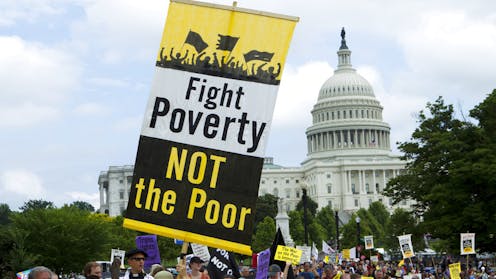
Demonstrators march outside the U.S. Capitol during the Poor People’s Campaign rally at the National Mall in Washington on June 23, 2018. AP Photo/Jose Luis Magana

America has never been richer. But the gains are so lopsided that the top 10% controls 69% of all wealth in the country, while the bottom half controls just 3%. Meanwhile, surging corporate profits have mostly benefited investors, not the broader public.

This divide is expected to widen after President Donald Trump’s sweeping new spending bill drastically cuts Medicaid and food aid, programs that stabilize the economy and subsidize low-wage employers.

Moreover, the tax cuts at the heart of the bill will deliver tens of billions of dollars in benefits to the wealthiest households while disproportionately burdening low-income households, according to analyses by the nonpartisan Congressional Budget Office and Joint Committee on Taxation. By 2033, the bottom 20% will pay more in taxes while the top 0.1% receive $43 billion in cuts.

I am a sociologist who studies economic inequality, and my research demonstrates that the class-based inequalities exacerbated by the Trump bill are not new. Rather, they are part of a 50-year trend linked to social cleavages, political corruption and a declining belief in the common good.

The roots of class-based inequality

The decades following World War II were broadly prosperous, but conditions began changing in the 1970s. Class inequality has increased enormously since then, according to government data, while income inequality has risen for five decades at the expense of workers.

Economists usually gauge a country’s economic health by looking at its gross domestic product as measured through total spending on everything from groceries to patents.

But another way to view GDP is by looking at whether the money goes to workers or business owners. This second method – the income approach – offers a clearer picture of who really benefits from economic growth.

The money that goes to labor’s share of GDP, or workers, is represented by employee compensation, including wages, salaries and benefits. The money left over for businesses after paying for work and materials is called gross operating surplus, or business surplus.

The share of GDP going to workers rose 12% from 1947 to 1970, then fell 14% between 1970 and 2023. The opposite happened with the business surplus, falling 18% in the early postwar decades before jumping 34% from 1970 to today.

Meanwhile, corporate profits have outpaced economic growth by 193% since 1970. Within profits, shareholder dividends as a share of GDP grew 274%.

As of 2023, labor had lost all of the economic gains made since 1947. Had workers kept their 1970 share of GDP, they would have earned $1.7 trillion more in 2023 alone. And no legislation or federal action since 1970 has reversed this half-century trend.

When more of the economy goes to businesses instead of workers, that poses serious social problems. My research focuses on three that threaten democracy.

1. Fraying social bonds and livelihoods

Not just an issue of income and assets, growing class inequality represents the fraying of American society.

For instance, inequality and the resulting hardship are linked to worse health outcomes. Americans die younger than their peers in other rich countries, and U.S. life expectancy has decreased, especially among the poor.

Moreover, economic struggles contribute to mental health issues, deaths of despair and profound problems such as addiction, including tobacco, alcohol and opioid abuse.

Inequality can disrupt families. Kids who experience the stresses of poverty can develop neurological and emotional problems, putting them at risk for drug use as adults. On the other hand, when minimum wages increase and people begin saving wealth, divorce risk falls.

Research shows inequality has many other negative consequences, from reduced social mobility to lower social trust and even higher homicide rates.

Together, these broad social consequences are linked to misery, political discontent and normlessness.

2. Increasing corruption in politics

Inequality is rising in the U.S. largely because business elites are exercising more influence over policy outcomes, research shows. My related work on privatization explains how 50 years of outsourcing public functions – through contracting, disinvestment and job cuts – threatens democratic accountability.

Research across different countries has repeatedly found that higher income inequality increases political corruption. It does so by undermining trust in government and institutions, and enabling elites to dominate policymaking while weakening public oversight.

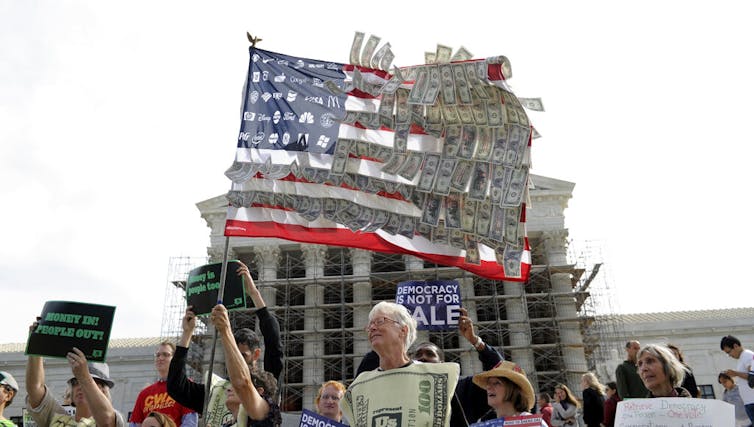
Since 2010, weakened campaign finance laws driven by monied interests have sharply increased corruption risks. The Supreme Court ruled then in Citizens United to lift campaign finance restrictions, enabling unlimited political spending. It reached an apex in 2024, when Elon Musk spent $200 million to elect Trump before later installing his Starlink equipment onto Federal Aviation Administration systems in a reported takeover of a $2.4 billion contract with Verizon.

Research shows that a large majority of Americans believe that the economy is rigged, suggesting everyday people sense the link between inequality and corruption.

People attend a protest.
Demonstrators gather outside the Supreme Court in Washington as the court heard arguments on campaign finance in 2013.
AP Photo/Susan Walsh

3. Undermining belief in the common good

National aspirations have emphasized the common good since America’s founding. The Declaration of Independence lists the king’s first offense as undermining the “public good” by subverting the rule of law. The Constitution’s preamble commits the government to promoting the general welfare and shared well-being.

But higher inequality historically means the common good goes overlooked, according to research. Meanwhile, work has become more precarious, less unionized, more segmented and less geographically stable. Artificial intelligence may worsen these trends.

This tends to coincide with a drop in voting and other forms of civic engagement.

The government has fewer mechanisms for protecting community when rising inequality is paired with lower taxes for the wealthy and reduced public resources. My research finds that public sector unions especially bolster civic engagement in this environment.

Given increasing workplace and social isolation, America’s loneliness epidemic is unsurprising, especially for low earners.

All of these factors and their contribution to alienation can foster authoritarian beliefs and individualism. When people become cold and distrustful of one another, the notion of the common good collapses.

Inequality as a policy outcome

News coverage of the Trump bill and policy debate have largely centered on immediate gains and losses. But zoomed out, a clearer picture emerges of the long-term dismantling of foundations that once supported broad economic security. That, in turn, has enabled democratic decline.

As labor’s share of the economy declined, so too did the institutional trust and shared social values that underpin democratic life. Among the many consequences are the political discontent and disillusionment shaping our current moment.

Republicans hold both chambers of Congress through 2026, making significant policy changes unlikely in the short term. Democrats opposed the bill but are out of power. And their coalition is divided between a centrist establishment and an insurgent progressive wing with diverging priorities in addressing inequality.

Yet democratic decline and inequality are not inevitable. If restoring broad prosperity and social stability are the goals, they may require revisiting the New Deal-style policies that produced labor’s peak economic share of 59% of GDP in 1970.

The Conversation

Nathan Meyers does not work for, consult, own shares in or receive funding from any company or organization that would benefit from this article, and has disclosed no relevant affiliations beyond their academic appointment.

ref. Inequality has risen from 1970 to Trump − that has 3 hidden costs that undermine democracy – https://theconversation.com/inequality-has-risen-from-1970-to-trump-that-has-3-hidden-costs-that-undermine-democracy-259104

Why do so many American workers feel guilty about taking the vacation they’ve earned?

Source: The Conversation – USA (2) – By Karen Tan, Assistant Professor of Tourism and Hospitality Management, Middle Tennessee State University

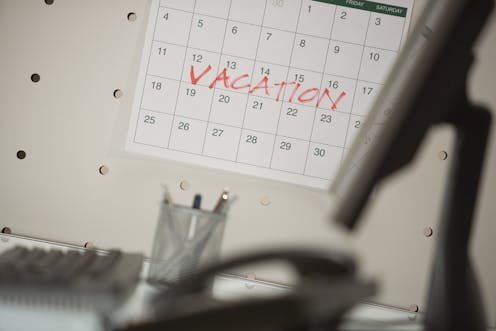
The U.S. is the only advanced economy that doesn’t legally mandate a minimum number of vacation days. Comstock Images/Stockbyte via Getty Images

“My dedication was questioned.”

“Managers or upper management have looked down upon taking time off.”

“People think that maybe you’re not as invested in the job, that you’re shirking your duties or something.”

These are just a few of the responses to questions I asked during a study I conducted on vacation guilt among American workers.

More than 88% of full-time, private sector workers in the U.S. receive paid time off. This benefit is ostensibly in place to improve employee morale and well-being.

Yet a 2024 Pew Research Center survey found that nearly half of American workers don’t take all the vacation days they’ve been allotted. And many of them feel as if they’re discouraged from using their time off. Ironically, what’s supposed to be a source of relaxation and restoration morphs into a stressor: As vacations approach, feelings of doubt and guilt creep in.

I’m from Singapore. Upon moving to the U.S. in 2016, I was surprised at how pervasive vacation guilt appeared to be.

Compared with many of the other countries where I’ve lived or worked, American culture seems to prioritize mental health and wellness. I assumed these attitudes extended to the American workplace.

Surprisingly, though, I noticed that many of my American friends felt guilty about taking time off that they’d earned. So as a scholar of tourism and hospitality, I wanted to understand how and why this happened.

Vacation guilt

To carry out the study, I collaborated with tourism scholar Robert Li. We interviewed 15 workers who had experienced feelings of guilt over taking time off. We also administered an online survey to 860 full-time employees who received paid time off from their employers.

We wanted to know whether employees felt less respected or believed that their bosses and colleagues saw them in a worse light for taking time off. Maybe they feared being seen as slackers or, worse, replaceable.

We found that 1 in 5 respondents to our survey experienced vacation guilt, and these concerns made them think twice about following through with their vacation plans. For those who eventually did take a vacation, they often tried to ease their guilt by going for fewer days. They might also apologize for taking a vacation or avoid talking about their vacation plans at work.

Some of the people we interviewed had pushed through their hesitation and taken their vacation as planned. Yet all of these employees believed that they’d been penalized for taking time off and that it led to poor performance reviews, despite the fact that their paid vacation days had been a clearly articulated, earned benefit.

The US is an outlier

The U.S. is the only advanced economy that doesn’t legally mandate a minimum number of vacation days. On top of that, only a handful of states require workers to be compensated for their unused vacation days.

Meanwhile, the law in other advanced economies entitles employees to a minimum amount of annual paid leave. The EU, for example, mandates at least 20 days per year on top of paid public holidays, such as Christmas and New Year’s Day, with a number of EU member countries requiring more than 20 days of paid vacation for full-time employees. Even in Japan, which is notorious for its workaholic culture, employees are entitled to a minimum of 10 days of paid leave every year.

Throughout much of the U.S., whether paid vacation time is offered at all depends on an employer’s generosity, while many employees face a “use-it-or-lose-it” situation, meaning unused vacation days don’t roll over from one year to the next.

Of course, not all workers experience vacation guilt. Nonetheless, the guilt that so many workers do feel may be symbolic of broader issues: an unhealthy workplace culture, a toxic boss or a weak social safety net.

For paid time off to serve its purpose, I think employers need to provide more than vacation days. They also need to have a supportive culture that readily encourages employees to use this benefit without having to worry about repercussions.

The Conversation

The journal publication on which this article was based was supported by the inaugural Seed Funding Forum, Fox
School of Business, Temple University, USA.

ref. Why do so many American workers feel guilty about taking the vacation they’ve earned? – https://theconversation.com/why-do-so-many-american-workers-feel-guilty-about-taking-the-vacation-theyve-earned-254913

School smartphone bans reflect growing concern over youth mental health and academic performance

Source: The Conversation – USA (2) – By Margaret Murray, Associate Professor of Public Communication and Culture Studies, University of Michigan

New laws that ban smartphones or social media for youth are being introduced across several Western nations. SeventyFour/iStock via Getty Images

The number of states banning smartphones in schools is growing.

New York is now the largest state in the U.S. to ban smartphones in public schools. Starting in fall 2025, students will not be allowed to use their phones during the school day, including during lunch, recess or in between classes. This bell-to-bell policy will impact almost 2.5 million students in grades K-12.

By banning smartphones in schools, New York is joining states across the country. The bans are happening in both traditionally liberal and conservative states.

Alabama, Arkansas, Nebraska, North Dakota, Oklahoma and West Virginia all passed legislation in 2025 that requires schools to have policies that limit access to smartphones. The policies will go into effect in the 2025-2026 school year. This brings the total to 17 states, plus Washington, D.C., that have phone-free school legislation or executive orders.

I’m a professor who studies communication and culture, and while writing a book about parenting culture, I’ve noticed the narrative around smartphones and social media shifting over the past decade.

A turning tide

A group of students stare down at their phones in a classroom.
Statewide cellphone policies are gaining momentum, with many states aiming to restrict use of the devices in classrooms.
Thomas Barwick/Digital Vision via Getty Images

According to the Pew Research Center, 67% of American adults support banning smartphones during class time, although only 36% support banning them for the entire school day. Notably, a majority of Republican, Democratic and independent voters all support bans during class time.

More broadly, parent-led movements to limit children’s use of smartphones, social media and the internet have sprung up around the country. For example, the Phone-Free Schools Movement in Pennsylvania was launched in 2023, and Mothers Against Media Addiction started in New York in March 2024. These organizations, which empower parents to advocate in their local communities, follow in the footsteps of organizations such as Wait Until 8th in Texas and Screen Time Action Network at Fairplay in Massachusetts, which were formed in 2017.

The concerns of these parent-led organizations were reflected in the best-selling book “The Anxious Generation,” which paints a bleak picture of modern childhood as dominated by depression and anxiety brought on by smartphone addiction.

Phone-free schools are one of the four actions the book’s author, Jonathan Haidt, recommended to change course. The other three are no smartphones for children before high school, waiting until 16 for social media access, and allowing more childhood independence in the real world.

Haidt’s research team collaborated with The Harris Poll to survey Gen Z. They found that almost half of those age 18-27 wish social media had never been invented, and 21% wish smartphones had never been invented. About 40% of Gen Z respondents supported phone-free schools.

The Pew Research Center found that almost 40% of kids age 8-12 use social media, and almost 95% of kids age 13-17 use it, with nearly half of teens reporting that they use social media almost constantly.

Phone-free schools are also part of the larger trend of states and nations resisting Big Tech, the large technology companies that play a significant role in global commerce.

In May 2025, two U.S. senators introduced the Stop the Scroll Act, which would require mental health warnings on social media.

New laws that ban smartphones or social media for youth are being introduced across several Western nations. Australia has banned all social media for those under 16.

After a fatal stabbing at a middle school in eastern France on June 10, French President Emmanuel Macron announced the same day that he wants the European Union to set the minimum age for social media at 15. He argued that social media is a factor in teen violence. If the EU doesn’t act within a few months, Macron has pledged to enact a ban in France as soon as possible.

The impact on learning

Students sit at a desk in a classroom using smartphones, while a teacher in the background looks on.
Research suggests that students are less focused in class when they have access to cellphones.
isuzek/E+ via Getty Images

Although this trend of restricting use of phones in school is new, more states may adopt smartphone bans in the future. Bell-to-bell bans are viewed as especially powerful in improving academic performance.

Some research has suggested that when children have access to a smartphone, even if they do not use it, they find it harder to focus in class. Initial research has found that academic performance improves after the bans go into effect.

Test scores fell across the U.S. during the pandemic lockdown and have not returned to prepandemic levels. Some states, such as Maine and Oregon, are almost a full year behind grade level in reading. Not a single state has recovered in both math and reading.

Statewide bans free local school districts from having to create their own technology bans, which can lead to heated debates. Although a majority of adults approve of banning smartphones in class, 24% oppose it for reasons such as wanting to be able to contact their kids throughout the day and wanting parents to set the boundaries.

However, 72% of high school teachers say that phones are a major distraction. Anecdotally, schools report that students like the bans after getting used to the change.

The Conversation

I signed the Wait Until 8th pledge mentioned in the article, promising not to give my kids a smartphone or social media until at least the end of 8th grade.

ref. School smartphone bans reflect growing concern over youth mental health and academic performance – https://theconversation.com/school-smartphone-bans-reflect-growing-concern-over-youth-mental-health-and-academic-performance-259962

Why Texas Hill Country, where a devastating flood killed more than 120 people, is one of the deadliest places in the US for flash flooding

Source: The Conversation – USA (2) – By Hatim Sharif, Professor of Civil and Environmental Engineering, The University of Texas at San Antonio

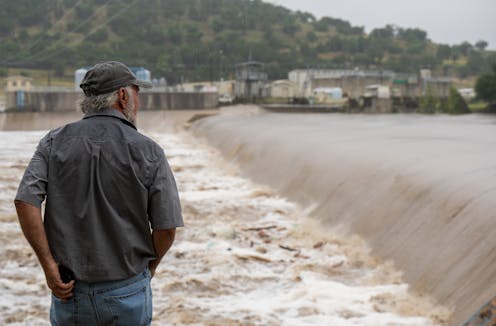
A Kerrville, Texas, resident watches the flooded Guadalupe River on July 4, 2025. Eric Vryn/Getty Images

Texas Hill Country is known for its landscapes, where shallow rivers wind among hills and through rugged valleys. That geography also makes it one of the deadliest places in the U.S. for flash flooding.

In the early hours of July 4, 2025, a flash flood swept through an area of Hill Country dotted with summer camps and small towns about 70 miles northwest of San Antonio. More than 120 people died in the flooding. The majority of them were in Kerr County, including more than two dozen girls and counselors at one summer camp, Camp Mystic. Dozens of people were still unaccounted for a week later.

The flooding began with a heavy downpour, with more than 10 inches of rain in some areas, that sent water sheeting off the hillsides and into creeks. The creeks poured into the Guadalupe River.

A river gauge at Hunt, Texas, near Camp Mystic, showed how quickly the river flooded: Around 3 a.m. on July 4, the Guadalupe River was rising about 1 foot every 5 minutes at the gauge, National Weather Service data shows. By 4:30 a.m., it had risen more than 20 feet. As the water moved downstream, it reached Kerrville, where the river rose even faster.

Flood expert Hatim Sharif, a hydrologist and civil engineer at the University of Texas at San Antonio, explains what makes this part of the country, known as Flash Flood Alley, so dangerous.

What makes Hill Country so prone to flooding?

Texas as a whole leads the nation in flood deaths, and by a wide margin. A colleague and I analyzed data from 1959 to 2019 and found 1,069 people had died in flooding in Texas over those six decades. The next highest total was in Louisiana, with 693.

Many of those flood deaths have been in Hill County. It’s part of an area known as Flash Flood Alley, a crescent of land that curves from near Dallas down to San Antonio and then westward.

The hills are steep, and the water moves quickly when it floods. This is a semi-arid area with soils that don’t soak up much water, so the water sheets off quickly and the shallow creeks can rise fast.

When those creeks converge on a river, they can create a surge of water that wipes out homes and washes away cars and, unfortunately, anyone in its path.

Hill Country has seen some devastating flash floods. In 1987, heavy rain in western Kerr County quickly flooded the Guadalupe River, triggering a flash flood similar to the one in 2025. Ten teenagers being evacuated from a camp died in the rushing water.

San Antonio, at the eastern edge of Hill Country, was hit with a flash flood on June 12, 2025, that killed 13 people whose cars were swept away by high water from a fast-flooding creek near an interstate ramp in the early morning.

Why does the region get such strong downpours?

One reason Hill Country gets powerful downpours is the Balcones Escarpment.

The escarpment is a line of cliffs and steep hills created by a geologic fault. When warm air from the Gulf rushes up the escarpment, it condenses and can dump a lot of moisture. That water flows down the hills quickly, from many different directions, filling streams and rivers below.

As temperature rise, the warmer atmosphere can hold more moisture, increasing the downpour and flood risk.

A tour of the Guadalupe River and its flood risk.

The same effect can contribute to flash flooding in San Antonio, where the large amount of paved land and lack of updated drainage to control runoff adds to the risk.

What can be done to improve flash flood safety?

First, it’s important for people to understand why flash flooding happens and just how fast the water can rise and flow. In many arid areas, dry or shallow creeks can quickly fill up with fast-moving water and become deadly. So people should be aware of the risks and pay attention to the weather.

Improving flood forecasting, with more detailed models of the physics and water velocity at different locations, can also help.

Probabilistic forecasting, for example, can provide a range of rainfall scenarios, enabling authorities to prepare for worst-case scenarios. A scientific framework linking rainfall forecasts to the local impacts, such as streamflow, flood depth and water velocity, could also help decision-makers implement timely evacuations or road closures.

Education is particularly essential for drivers. One to two feet of moving water can wash away a car. People may think their trucks and SUVs can go through anything, but fast-moving water can flip a truck and carry it away.

Officials can also do more to barricade roads when the flood risk is high to prevent people from driving into harm’s way. We found that 58% of the flood deaths in Texas over the past six decades involved vehicles. The storm on June 12 in San Antonio was an example. It was early morning, and drivers had poor visibility. The cars were hit by fast-rising floodwater from an adjacent creek.

This article, originally published July 5, 2025, has been updated with the death toll rising.

The Conversation

Hatim Sharif does not work for, consult, own shares in or receive funding from any company or organization that would benefit from this article, and has disclosed no relevant affiliations beyond their academic appointment.

ref. Why Texas Hill Country, where a devastating flood killed more than 120 people, is one of the deadliest places in the US for flash flooding – https://theconversation.com/why-texas-hill-country-where-a-devastating-flood-killed-more-than-120-people-is-one-of-the-deadliest-places-in-the-us-for-flash-flooding-260555

What is the ‘Seven Mountain Mandate’ and how is it linked to political extremism in the US?

Source: The Conversation – USA (3) – By Art Jipson, Associate Professor of Sociology, University of Dayton

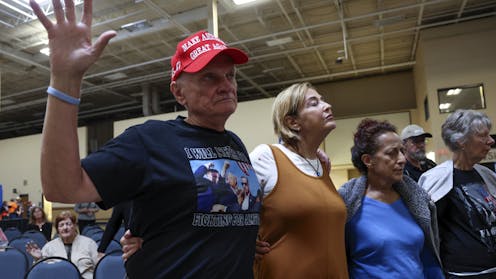
People pray before Republican vice presidential nominee J.D. Vance at a town hall hosted by Lance Wallnau on Sept. 28, 2024, in Monroeville, Pa. AP Photo/Rebecca Droke

Vance Boelter, who allegedly shot Melissa Hortman, a Democratic Minnesota state representative, and her husband, Mark Hortman, on June 14, 2025, studied at Christ for the Nations Institute in Dallas. The group is a Bible school linked to the New Apostolic Reformation, or NAR.

The NAR is a loosely organized but influential charismatic Christian movement that shares similarities with Pentecostalism, especially in its belief that God actively communicates with believers through the Holy Spirit. Unlike traditional Pentecostalism, however, the organization emphasizes modern-day apostles and prophets as authoritative leaders tasked with transforming society and ushering in God’s kingdom on Earth. Prayer, prophecy and worship are defined not only as acts of devotion but as strategic tools for advancing believers’ vision of government and society.

After the shooting, the Christ for the Nations Institute issued a statement “unequivocally” denouncing “any and all forms of violence and extremism.” It stated: “Our organization’s mission is to educate and equip students to spread the Gospel of Jesus Christ through compassion, love, prayer, service, worship, and value for human life.”

But the shooting has drawn attention to the school and the larger Christian movement it belongs to. One of the most important aspects of NAR teachings today is what is called “the Seven Mountain Mandate.”

The Seven Mountain Mandate calls on Christians to gain influence, or “take dominion,” over seven key areas of culture: religion, family, education, government, media, business and the arts.

With over three decades of experience studying extremism, I offer a brief overview of the history and core beliefs of the Seven Mountain Mandate.

‘Dominion of Christians’

The Seven Mountain concept was originally proposed in 1975 by evangelical leader Bill Bright, the founder of Campus Crusade for Christ. Now known as “Cru,” the Campus Crusade for Christ was founded as a global ministry in 1951 to promote Christian evangelism, especially on college campuses.

United by a shared vision to influence society through Christian values, Bright partnered with Loren Cunningham, the founder of Youth With A Mission, a major international missionary training and outreach organization, in the 1970s.

The Seven Mountain Mandate was popularized by theologian Francis Schaeffer, who linked it to a larger critique of secularism and liberal culture. Over time, it evolved.

C. Peter Wagner, a former seminary professor who helped organize and name the New Apostolic Reformation, is often regarded as the theological architect of the group. He developed it into a call for dominion. In his 2008 book “Dominion! How Kingdom Action Can Change the World,” he urged Christians to take authoritative control of cultural institutions.

For Wagner, “dominion theology” – the idea that Christians should have control over all aspects of society – was a call to spiritual warfare, so that God’s kingdom would be “manifested here on earth as it is in heaven.”

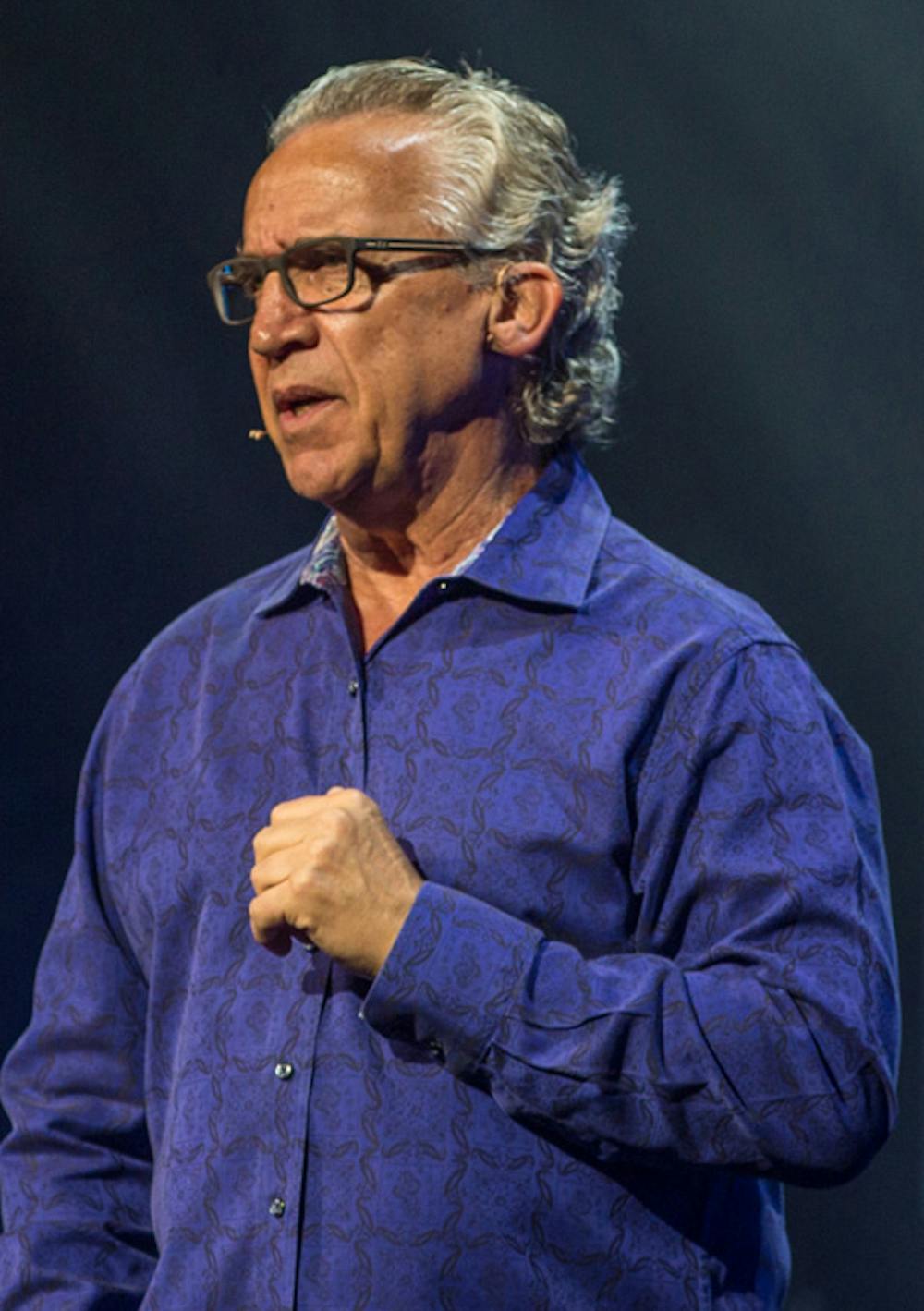
A gray-haired man wearing glasses and a blue shirt.
Bill Johnson.
Doctorg via Wikimedia Commons

Since 1996, Bill Johnson, a senior leader of Bethel Church, and Johnny Enlow, a self-described prophet and Seven Mountain advocate, among others, have taken the original idea of the Seven Mountain Mandate and reshaped it into a more aggressive, political and spiritually militant approach. Spiritual militancy reflects an aggressive, us-vs.-them mindset that blurs the line between faith and authoritarianism, promoting dominion over society in the name of spiritual warfare.

Their version doesn’t just aim to influence culture; it frames the effort as a spiritual battle to reclaim and reshape the nation according to their vision of God’s will.

Lance Wallnau, another Christian evangelical preacher, televangelist, speaker and author, has promoted dominion theology since the early 2000s. During the 2020 U.S. presidential election, Wallnau, along with several prominent NAR figures, described Donald Trump as anointed by God to reclaim the “mountain” of government from demonic control.

In their book “Invading Babylon: The 7 Mountain Mandate,” Wallnau and Johnson explicitly call for Christian leadership as the only antidote to perceived moral decay and spiritual darkness.

The beliefs

Sometimes referred to as Seven Mountains of Influence or Seven Mountains of Culture, the seven mountains are not neutral domains but seen as battlegrounds between divine truth and demonic deception.

Adherents believe that Christians are called to reclaim these areas through influence, leadership and even, if necessary, the use of force and to confront demonic political forces, as religion scholar Matthew Taylor demonstrates in his book “The Violent Take It By Force.”

Diverse perspectives and interpretations surround the rhetoric and actions associated with the New Apostolic Reformation. Some analysts have pointed out how the NAR is training its followers for an active confrontation. Other commentators have said that the rhetoric calling for physical violence is anti-biblical and should be denounced.

NAR-aligned leaders have framed electoral contests as struggles between “godly” candidates and those under the sway of “satanic” influence.

Similarly, NAR prophet Cindy Jacobs has repeatedly emphasized the need for “spiritual warfare” in schools to combat what she characterizes as “demonic ideologies” such as sex education, LGBTQ+ inclusion or discussions of systemic racism.

In the NAR worldview, cultural change is not merely political or social but considered a supernatural mission; opponents are not simply wrong but possibly under the sway of demonic influence. Elections become spiritual battles.

This belief system views pluralism as weakness, compromise as betrayal, and coexistence as capitulation. Frederick Clarkson, a senior research analyst at Political Research Associates, a progressive think tank based in Somerville, Massachusetts, defines the Seven Mountain Mandate as “the theocratic idea that Christians are called by God to exercise dominion over every aspect of society by taking control of political and cultural institutions.”

The call to “take back” the culture is not metaphorical but literal, and believers are encouraged to see themselves as soldiers in a holy war to dominate society. Some critics argue that NAR’s call to “take back” culture is about literal domination, but this interpretation is contested.

Many within the movement see the language of warfare as spiritually focused on prayer, evangelism and influencing hearts and minds. Still, the line between metaphor and mandate can blur, especially when rhetoric about “dominion” intersects with political and cultural action. That tension is part of an ongoing debate both within and outside the movement.

Networks that spread the beliefs

This belief system is no longer confined to the margins. It is spread widely through evangelical churches, podcasts, YouTube videos and political networks.

It’s hard to know exactly how many churches are part of the New Apostolic Reformation, but estimates suggest that about 3 million people in the U.S. attend churches that openly follow NAR leaders.

At the same time, the Seven Mountain Mandate doesn’t depend on centralized leadership or formal institutions. It spreads organically through social networks, social media – notably podcasts and livestreams – and revivalist meetings and workshops.

André Gagné, a theologian and author of “American Evangelicals for Trump: Dominion, Spiritual Warfare, and the End Times,” writes about the ways in which the mandate spreads by empowering local leaders and believers. Individuals are authorized – often through teachings on spiritual warfare, prophetic gifting, and apostolic leadership – to see themselves as agents of divine transformation in society, called to reclaim the “mountains,” such as government, media and education, for God’s kingdom.

This approach, Gagné explains, allows different communities to adapt the action mandate to their unique cultural, political and social contexts. It encourages individuals to see themselves as spiritual warriors and leaders in their domains – whether in business, education, government, media or the arts.

Small groups or even individuals can start movements or initiatives without waiting for top-down directives. The only recognized authorities are the apostles and prophets running the church or church network the believers attend.

The framing of the Seven Mountain Mandate as a divinely inspired mission, combined with the movement’s emphasis on direct spiritual experiences and a specific interpretation of scripture, can create an environment where questioning the mandate is perceived as challenging God’s authority.

Slippery slope

These beliefs have increasingly fused with nationalist rhetoric and conspiracy theories.

A white flag bearing the words 'An Appeal to Heaven,' featuring a green pine tree, with the American flag displayed beneath it.
The ‘Appeal to Heaven’ flags symbolize the belief that people have the right to appeal directly to God’s authority when they think the government has failed.
Paul Becker/Becker1999 via Flickr, CC BY

A powerful example of NAR political rhetoric in action is the rise and influence of the “Appeal to Heaven” flags. For those in the New Apostolic Reformation, these flags symbolize the belief that when all earthly authority fails, people have the right to appeal directly to God’s authority to justify resistance.

This was evident during the Jan. 6, 2021, Capitol insurrection, when these flags were prominently displayed.

To be clear, its leaders are not calling for violence but rather for direct political engagement and protest. For some believers, however, the calls for “spiritual warfare” may become a slippery slope into justification for violence, as in the case of the alleged Minnesota shooter.

Understanding the Seven Mountain Mandate is essential for grasping the dynamics of contemporary efforts to align government and culture with a particular vision of Christian authority and influence.

The Conversation

Art Jipson does not work for, consult, own shares in or receive funding from any company or organization that would benefit from this article, and has disclosed no relevant affiliations beyond their academic appointment.

ref. What is the ‘Seven Mountain Mandate’ and how is it linked to political extremism in the US? – https://theconversation.com/what-is-the-seven-mountain-mandate-and-how-is-it-linked-to-political-extremism-in-the-us-260034

This tropical plant builds isolated ‘apartments’ to prevent battles among the aggressive ant tenants it relies on for survival

Source: The Conversation – USA – By Guillaume Chomicki, Professor of Evolutionary Biology, Durham University

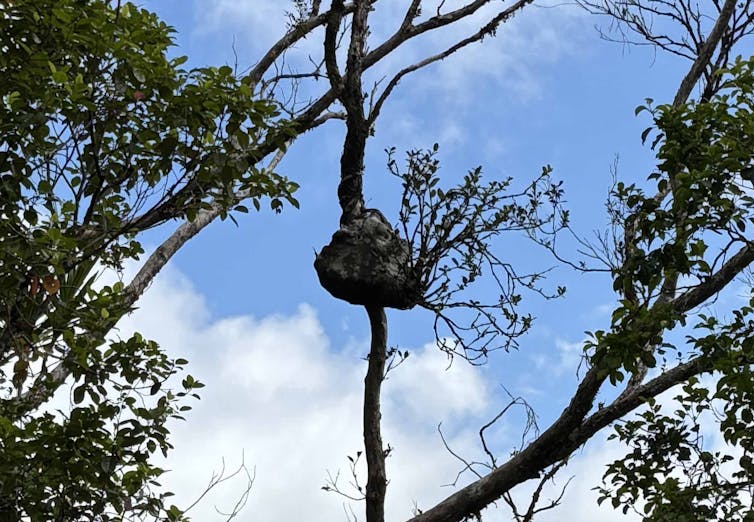
When aggressive ant species come in contact, deadly conflicts ensue G. Chomicki

In the middle of the South Pacific, a group of Fijian plants have solved a problem that has long puzzled scientists: How can an organism cooperate with multiple partners that are in turn competing for the same resources? The solution turns out to be simple – compartmentalization.

Imagine an apartment building where unfriendly neighbors might clash if they run into each other, but smart design keeps everyone peacefully separated. In our new research published in the journal Science, we show how certain plants build specialized structures that allow multiple aggressive ant species to live side by side inside them without ever meeting.

Ants and plants cooperate in Fijian rainforest

Squamellaria plants are epiphytes – meaning they don’t have roots attached to the ground, and instead grow on another plant for physical support. They live high up in the rainforest canopy, in the South Pacific.

Because they don’t have direct access to the soil’s nutrients, Squamellaria plants have evolved an original strategy to acquire what they need: In a mutually beneficial relationship, they grow structures that appeal to ants looking for a place to live. This kind of long-term relationship between species – whether helpful or harmful – is called symbiosis.

Here’s how it works in this case. The base of the Squamellaria plant stem forms a swollen, hollow structure called a domatium – a perfect place for ants to live. Domatia gradually enlarge to the size of a soccer ball, containing ever more plant-made houses ready for ants to move into. Each apartment can house a colony made up of thousands of ants.

A bulbous plant attached to a branch in a canopy
A multicompartment Squamellaria (S. tenuiflora) in its natural habitat: rainforests in Fiji. This large plant likely contains a dozen or more compartments.
G. Chomicki

The relationship between the ants and the plants is mutualistic, meaning both parties benefit. The ants gain a nice sturdy and private nest space, while the plants gain essential nutrients. They obtain nitrogen and phosphorus from the ants’ feces and from detritus – including dead insects, plant bits and soil – that the ants bring inside the domatium.

However, tropical rainforest canopies are battlegrounds for survival. Ants compete fiercely for nesting space, taking over any hollow branch or space under tree bark. Any Squamellaria ant house would thus be at risk of being colonized and taken over by other incoming ants, disrupting the existing partnership.

Until now, it was unclear how the cooperative relationships between ants and plants remain stable in this competitive environment.

Walls keep the peace

Our first hint about what keeps the peace in the Squamellaria real estate came when we discovered several ant species living in the same plant domatium. This finding just didn’t make sense. How could aggressively competing ant species live together?

We investigated the structure of domatia using computed-tomography scanning, which revealed an interesting internal architecture. Each plant domatium is divided into distinct compartments, with thick walls isolating each unit. Independent entrances prevent direct contact between the inhabitants of different units. The walls safeguard the peace as they prevent encounters between different ant species.

A close-up view of the domatium, showing three overlapping regions in different colors
A 3D model of a Squamellaria tenuiflora domatiium based on CT-scanning data reveals its compartmentalization. Each color-coded cavity is a distinct ‘ant apartment,’ isolated of the others, but connected to the outside.
S. Renner & G. Chomicki

Back in the lab, when we removed the ant apartments’ walls, placing inhabitants in contact with their neighbors, deadly fights broke out between ant species. The compartmentalized architecture is thus critical in preventing symbiont “wars” and maintaining the stability of the plant’s partnership with all the ants that call it home. By minimizing deadly conflicts that could harm the ants it hosts, this strategy ensures that the plant retains access to sufficient nutrients provided by the ants.

This research reveals a new mechanism that solves a long-standing riddle – the stability of symbioses involving multiple unrelated partners. Scientists hadn’t previously discovered aggressive animal symbionts living together inside a single plant host. Our study reveals for the first time how simple compartmentalization is a highly effective way to reduce conflict, even in the most extreme cases. The ant colonies are living side by side, but not really together.

What’s next

The key to conflict-free living of multipartner symbioses discovered in these Fijian plants – compartmentalization – is likely important in other multispecies partnerships. However, it remains unknown whether compartmentalization is widespread in nature. Research on cooperation between species has long focused on pairwise interactions. Our new insights suggest a need to reinvestigate other multispecies mutualistic symbioses to see how they maintain stability.

The Conversation

Guillaume Chomicki receives funding from UKRI.

Susanne S. Renner received previous funding from the German Research Foundation (DFG)

ref. This tropical plant builds isolated ‘apartments’ to prevent battles among the aggressive ant tenants it relies on for survival – https://theconversation.com/this-tropical-plant-builds-isolated-apartments-to-prevent-battles-among-the-aggressive-ant-tenants-it-relies-on-for-survival-260674

Justice Department efforts to strip citizenship from naturalized Americans likely violate constitutional rights

Source: The Conversation – USA – By Cassandra Burke Robertson, Professor of Law and Director of the Center for Professional Ethics, Case Western Reserve University

New American citizens recite the Oath of Allegiance during a naturalization ceremony in Miami on Aug. 17, 2018. AP Photo/Wilfredo Lee

The Trump administration wants to take away citizenship from naturalized Americans on a massive scale.

While a recent Justice Department memo prioritizes national security cases, it directs the department to “maximally pursue denaturalization proceedings in all cases permitted by law and supported by the evidence” across 10 broad priority categories.

Denaturalization is different from deportation, which removes noncitizens from the country. With civil denaturalization, the government files a lawsuit to strip people’s U.S. citizenship after they have become citizens, turning them back into noncitizens who can then be deported.

The government can only do this in specific situations. It must prove someone “illegally procured” citizenship by not meeting the requirements, or that they lied or hid important facts during the citizenship process.

The Trump administration’s “maximal enforcement” approach means pursuing any case where evidence might support taking away citizenship, regardless of priority level or strength of evidence. As our earlier research documented, this has already led to cases like that of Baljinder Singh, whose citizenship was revoked based on a name discrepancy that could easily have resulted from a translator’s error rather than intentional fraud.

A brief history

For most of American history, taking away citizenship has been rare. But it increased dramatically during the 1940s and 1950s during the Red Scare period characterized by intense suspicion of communism. The United States government targeted people it thought were communists or Nazi supporters. Between 1907 and 1967, over 22,000 Americans lost their citizenship this way.

Everything changed in 1967 when the Supreme Court decided Afroyim v. Rusk. The court said the government usually cannot take away citizenship without the person’s consent. It left open only cases involving fraud during the citizenship process.

After this decision, denaturalization became extremely rare. From 1968 to 2013, fewer than 150 people lost their citizenship, mostly war criminals who had hidden their past.

A man dressed in a suit and tie speaks and points his right index finger.
Sen. Joseph McCarthy appears at a March 1950 hearing on his charges of communist infiltration at the State Department.
AP Photo/Herbert K. White

How the process works

In criminal lawsuits, defendants get free lawyers if they can’t afford one. They get jury trials. The government must prove guilt “beyond a reasonable doubt” – the highest standard of proof.

But in most denaturalization cases, the government files a civil suit, where none of these protections exist.

People facing denaturalization get no free lawyer, meaning poor defendants often face the government alone. There’s no jury trial – just a judge deciding whether someone deserves to remain American. The burden of proof is lower – “clear and convincing evidence” instead of “beyond a reasonable doubt.” Most important, there’s no time limit, so the government can go back decades to build cases.

As law professors who study citizenship, we believe this system violates basic constitutional rights.

The Supreme Court has called citizenship a fundamental right. Chief Justice Earl Warren in 1958 described it as the “right to have rights.”

In our reading of the law, taking away such a fundamental right through civil procedures that lack basic constitutional protection – no right to counsel for those who can’t afford it, no jury trial, and a lower burden of proof – seems to violate the due process of law required by the Constitution when the government seeks to deprive someone of their rights.

The bigger problem is what citizenship-stripping policy does to democracy.

When the government can strip citizenship from naturalized Americans for decades-old conduct through civil procedures with minimal due process protection – pursuing cases based on evidence that might not meet criminal standards – it undermines the security and permanence that citizenship is supposed to provide. This creates a system where naturalized citizens face ongoing vulnerability that can last their entire lives, potentially chilling their full participation in American democracy.

The Justice Department memo establishes 10 priority categories for denaturalization cases. They range from national security threats and war crimes to various forms of fraud, financial crimes and, most importantly, any other cases it deems “sufficiently important to pursue.” This “maximal enforcement” approach means pursuing not just clear cases of fraud, but also any case where evidence might support taking away citizenship, no matter how weak or old the evidence is.

This creates fear throughout immigrant communities.

About 20 million naturalized Americans now must worry that any mistake in their decades-old immigration paperwork could cost them their citizenship.

A two-tier system

This policy effectively creates two different types of American citizens. Native-born Americans never have to worry about losing their citizenship, no matter what they do. But naturalized Americans face ongoing vulnerability that can last their entire lives.

This has already happened. A woman who became a naturalized citizen in 2007 helped her boss with paperwork that was later used in fraud. She cooperated with the FBI investigation, was characterized by prosecutors as only a “minimal participant,” completed her sentence, and still faced losing her citizenship decades later because she didn’t report the crime on her citizenship application – even though she hadn’t been charged at the time.

A woman accepts a small American flag handed to her from a man across a counter.
A woman receives a U.S. flag after passing her citizenship interview in Newark, N.J., on May 25, 2016.
AP Photo/Julio Cortez

The Justice Department’s directive to “maximally pursue” cases across 10 broad categories – combined with the first Trump administration’s efforts to review over 700,000 naturalization files – represents an unprecedented expansion of denaturalization efforts.

The policy will almost certainly face legal challenges on constitutional grounds, but the damage may already be done. When naturalized citizens fear their status could be revoked, it undermines the security and permanence that citizenship is supposed to provide.

The Supreme Court, in Afroyim v. Rusk, was focused on protecting existing citizens from losing their citizenship. The constitutional principle behind that decision – that citizenship is a fundamental right which can’t be arbitrarily taken away by whoever happens to be in power – applies equally to how the government handles denaturalization cases today.

The Trump administration’s directive, combined with court procedures that lack basic constitutional protections, risks creating a system that the Afroyim v. Rusk decision sought to prevent – one where, as the Supreme Court said, “A group of citizens temporarily in office can deprive another group of citizens of their citizenship.”

The Conversation

The authors do not work for, consult, own shares in or receive funding from any company or organization that would benefit from this article, and have disclosed no relevant affiliations beyond their academic appointment.

ref. Justice Department efforts to strip citizenship from naturalized Americans likely violate constitutional rights – https://theconversation.com/justice-department-efforts-to-strip-citizenship-from-naturalized-americans-likely-violate-constitutional-rights-260353

Why recycling solar panels is harder than you might think − an electrical engineer explains

Source: The Conversation – USA (2) – By Anurag Srivastava, Professor of Computer Science and Electrical Engineering, West Virginia University

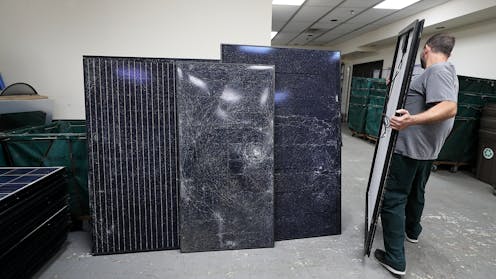
Broken and worn-out solar panels can be recycled, but it’s not easy. Suzanne Kreiter/The Boston Globe via Getty Images

It’s hard work soaking up sunlight to generate clean electricity. After about 25 to 30 years, solar panels wear out. Over the years, heating and cooling cycles stress the materials. Small cracks develop, precipitation corrodes the frame and layers of materials can start to peel apart.

In 2023, about 90% of old or faulty solar panels in the U.S. ended up in landfills. Millions of panels have been installed worldwide over the past few decades – and by about 2030, so many will be ready to retire that they could cover about 3,000 football fields.

As an electrical engineer who has studied many aspects of renewable energy, recycling solar panels seems like a smart idea, but it’s complicated. Built to withstand years of wind and weather, solar panels are designed for strength and are not easy to break down.

A vast field of solar panels.
All of these solar panels will need to be disposed of one day – perhaps by being recycled.
David McNew/Getty Images

The cost conundrum

Sending a solar panel to a landfill costs between US$1 and $5 in the U.S. But recycling it can cost three to four times as much, around $18. And the valuable materials inside solar panels, such as silver and copper, are in small amounts, so they’re worth about $10 to $12 – which makes recycling a money-losing prospect. Improvements in the recycling process may change the economics.

But for now, it’s even hard to reclaim the glass in solar panels. Many layers are glued together and need to be separated before they can be melted down for reuse. And if the separation is not precise enough, the glass that is recovered won’t be of high enough quality to use in making other solar panels or windows. It will be suitable only for lower-quality uses such as fill material in construction projects.

Other panels, usually older ones, may contain small amounts of toxic metals such as lead or cadmium. It can be difficult to tell whether toxic materials are present, though. Even experts have trouble, in part because current tests, such as the toxicity characteristic leaching procedure, can give inaccurate results. Therefore, many companies that own large numbers of solar panels just assume their panels are hazardous waste, which increases costs for both disposal and recycling. Clearer labels would help people know what a solar panel contains and how to handle it.

If someone wants to recycle a solar panel, and is willing to bear the cost, there aren’t many places in the U.S. that are willing to do it and are equipped to be safe about it.

People in reflective vests and protective clothing use tools to take apart a large item.
Recycling solar panels can involve detailed manual labor.
AP Photo/Gregory Bull

Designing for a new life

Despite the Trump administration’s cuts to subsidies for solar projects, millions of solar panels are already in use in the U.S., and millions more are expected to be installed worldwide in the coming years. As a result, the solar industry is working on ways to minimize waste and repeatedly reuse materials.

Some ideas include sending used solar panels that still work at least a bit to developing nations, or even reusing them within the U.S. But there are not clear rules or processes for connecting reused panels to the power grid, so reuse tends to happen in less common, off-grid situations rather than becoming widespread.

Future solar panels could also be designed for easier recycling, using different construction methods and materials, and improved processing systems.

Making panels last longer – perhaps as long as 50 years – using more durable materials, weather-resistant components, real-time monitoring of panel performance and predictive maintenance to replace parts before they wear out would reduce waste significantly.

Building solar panels that are more easily disassembled into separate components made of different materials could also speed recycling. Components that fit together like Lego bricks – instead of using glue – or dissolvable sealants and adhesives could be parts of these designs.

Improved recycling methods could also help. Right now, panels are often simply ground up, mixing all of their components’ materials together and requiring a complicated process to separate them out again for reuse. More advanced approaches can extract individual materials with high purity. For example, a process called salt etching can recover over 99% of silver and 98% of silicon, at purity levels that are appropriate for high-end reuse, potentially even in new solar panels, without using toxic acids. That method can also recover significant quantities of copper and lead for use in new products.

A person uses a shovel to reach into a large bin of crushed material.
Crushing solar panels can make different materials easier to recover from various components.
AP Photo/Gregory Bull

A shared journey

Increasing the practice of recycling solar panels has more than just environmental benefits.

Over the long term, recovering and reusing valuable materials may prove more cost-effective than continually buying new raw materials on the open market. That could lower costs for future solar panel installations. If they are fully reused, the value of these recoverable materials could reach over $15 billion globally by 2050.

In addition, recycling panels and components reduces American reliance on materials imported from overseas, making solar power projects less vulnerable to global disruptions.

Recycling also keeps toxic materials out of landfills. That can help ensure a shift to clean energy doesn’t create new or bigger environmental problems. Also, recycling solar panels emits far less carbon dioxide than manufacturing panels from raw materials.

There are already some efforts underway to boost solar panel recycling. The Solar Energy Industries Association trade group is working to collect and share information about companies that recycle solar panels.

Governments can provide tax breaks or other financial incentives for using recycled materials, or ban disposing of solar panels in landfills. California, Washington, New Jersey and North Carolina have enacted laws or are studying ways to manage solar panel waste, with some even requiring recycling or reuse.

These efforts are important steps toward addressing the growing need for solar panel recycling and promoting a more sustainable solar industry.

The Conversation

Anurag Srivastava receives funding from the US Department of Energy and National Science Foundation to work on renewable energy integration into the grid. He is an IEEE Fellow and member of the IEEE Power and Energy Society and CIGRE working groups.

ref. Why recycling solar panels is harder than you might think − an electrical engineer explains – https://theconversation.com/why-recycling-solar-panels-is-harder-than-you-might-think-an-electrical-engineer-explains-259115

How weather changes cause migraines – a neurologist explains the triggers and what you can do to ease the pain

Source: The Conversation – USA (3) – By Danielle Wilhour, Assistant Professor of Neurology, University of Colorado Anschutz Medical Campus

Migraines can be debilitating – and frustrating when triggered by weather you can’t control. fizkes/iStock/Getty Images Plus

“Is it just me, or is there a storm coming?”

If you are one of the 39 million Americans in the U.S. living with migraines, there’s a good chance an intense headache will begin when the weather shifts.

You aren’t alone. Studies find 30% to 50% of people with migraines identify some type of weather change as a trigger, making it the most commonly reported migraine source.

Yet, it’s also one of the most puzzling.

Some people are more sensitive to weather

As a neurologist and headache specialist practicing in Colorado, a place with frequent weather shifts, patients often tell me that weather is one of their biggest migraine triggers. The results can disrupt work, school and social plans, and create a sense of helplessness.

Doctors still don’t fully understand why some brains are more sensitive to environmental changes.

What we do know is that people with migraines have especially sensitive nervous systems, and that certain environmental changes – like shifts in air pressure, temperature, humidity and air quality – can activate pathways in the brain that lead to pain.

What’s going on in the brain during migraines? TEDx.

Key ways weather can trigger migraines

Weather triggers can vary from person to person, but there are a few common migraine culprits:

Barometric pressure changes, or changes in atmospheric pressure, are among the most commonly cited triggers.

When a storm system moves in, the air pressure drops. Some scientists believe this change may affect the pressure inside your head or how blood vessels in your brain dilate and constrict.

One theory is that changes in barometric pressure may cause a small imbalance in the pressure between the inside of your skull and the outside environment. That might directly stimulate pain-sensitive nerves in the head, triggering inflammation and the start of a migraine.

Others point to inflammation, the way the brain processes sensory input, and changes in serotonin levels – which play a key role in activating migraine.

Temperature extremes, with very hot or very cold days, or sudden changes in temperature, can throw off the body’s internal balance. High humidity or rapid shifts in moisture levels can have a similar effect.

Air pollutants like ozone and nitrogen dioxide can cause inflammation in the nerves that play a role in migraines.

Bright sunlight can also be especially bothersome, likely due to heightened sensitivity to light and an overactive visual processing system in the brain.

Lightning and strong winds may also be linked to migraine attacks in certain individuals.

In short, weather changes can act as stressors on a brain that’s already wired to be more sensitive. The exact triggers and responses vary from person to person, but the research suggests that the interaction between weather and our biology plays a significant role for a subset of patients with migraines.

Steps you can take to reduce the pain

You can’t change the weather, but you can be proactive. Here are a few tips to help weather-proof your migraine routine:

  1. Track your migraines and watch the forecast: Use a migraine diary or app to track when attacks occur, along with weather conditions. Patterns may emerge, such as attacks a day before rain or during temperature changes, that will allow you to adjust your schedule or medication plan.

  2. Develop healthy eating, sleeping and exercise habits: Dehydration, poor sleep and skipped meals can magnify the effects of weather triggers, so keeping your body on an even keel helps reduce vulnerability. Regular exercise and a healthy diet can also help.

  3. Create a migraine-friendly environment: On days when the sun is harsh or the humidity is high, stay inside. Sunglasses, eye masks or even blue-light glasses can be helpful. Some people find that certain earplugs are able to reduce pressure changes felt in the middle ear.

  4. Try meditation, mindfulness techniques or biofeedback, which teaches people to moderate their physiological responses, such as muscle responses and breathing. These strategies can help your nervous system become less reactive over time, which can be especially helpful when dealing with uncontrollable triggers like weather.

  5. Consider pretreatment: If you know a storm is likely to trigger your migraines, you can keep rescue medications close by or even preemptively treat yourself during weather events.

  6. Look into preventive treatment: If weather triggers frequent migraines, talk to your health care provider about preventive treatments – medications, supplements or neuromodulation devices – which can be used on a regular basis to reduce migraine occurrence.

The bigger picture

It’s important to remember that while weather can be a trigger, it’s rarely the only one. Migraine is usually the result of a perfect storm of factors: genetic susceptibility, hormones, stress, sleep, food and, yes, the weather.

That’s why identifying your personal triggers and building a plan, if necessary, with the support of a medical provider, can make a big difference in managing migraines.

Weather-related migraine can be one of the most frustrating triggers because it feels completely out of your hands. However, with knowledge, tracking and the right treatment strategies, you can take back a sense of control.

The Conversation

Danielle Wilhour does not work for, consult, own shares in or receive funding from any company or organization that would benefit from this article, and has disclosed no relevant affiliations beyond their academic appointment.

ref. How weather changes cause migraines – a neurologist explains the triggers and what you can do to ease the pain – https://theconversation.com/how-weather-changes-cause-migraines-a-neurologist-explains-the-triggers-and-what-you-can-do-to-ease-the-pain-258899