What are small modular reactors, a new type of nuclear power plant sought to feed AI’s energy demand?

Source: The Conversation – USA (2) – By Leonel Lagos, Associate Professor of Construction Management; Director of Research, Applied Research Center, Florida International University

Workers examine an experimental small modular reactor at a research institute in China. Liu Kun/Xinhua via Getty Images)

As U.S. electricity demand rises and technology companies seek to build more and larger data centers to drive artificial intelligence systems, the main question arising is how to generate all that power.

According to the International Energy Agency, large-scale data centers around the world used about 460 terawatt-hours of electricity in 2022, a figure that analysts expect to continue rising years into the future.

One potential solution being proposed is nuclear energy – produced by existing large-scale nuclear power plants, reactivated old ones, new ones that might be constructed with government subsidies, and other, smaller types of nuclear plants that are in development and not yet available.

The discussion around powering AI data centers, in particular, has involved a type of nuclear power plant called a small modular reactor. According to the International Atomic Energy Agency, there are about 70 different designs being researched and developed around the world, including reactors that could one day serve small or remote communities, military applications and even ships at sea or spacecraft.

Proponents say these reactor designs provide consistent power without climate-changing carbon emissions. They can also be located close to places that need their energy, reducing dependence on the electricity grid. They are still years from being commercially available: Demonstration projects may begin construction before 2030, with commercial ones reaching operation perhaps by the mid-2030s. And there is not yet a plan from the U.S. Department of Energy to handle the radioactive waste they would generate.

I am an engineer whose work focuses on the nuclear industry, including waste handling and decommissioning of nuclear reactors. Here’s what this type of reactor is, how it works and what it can do:
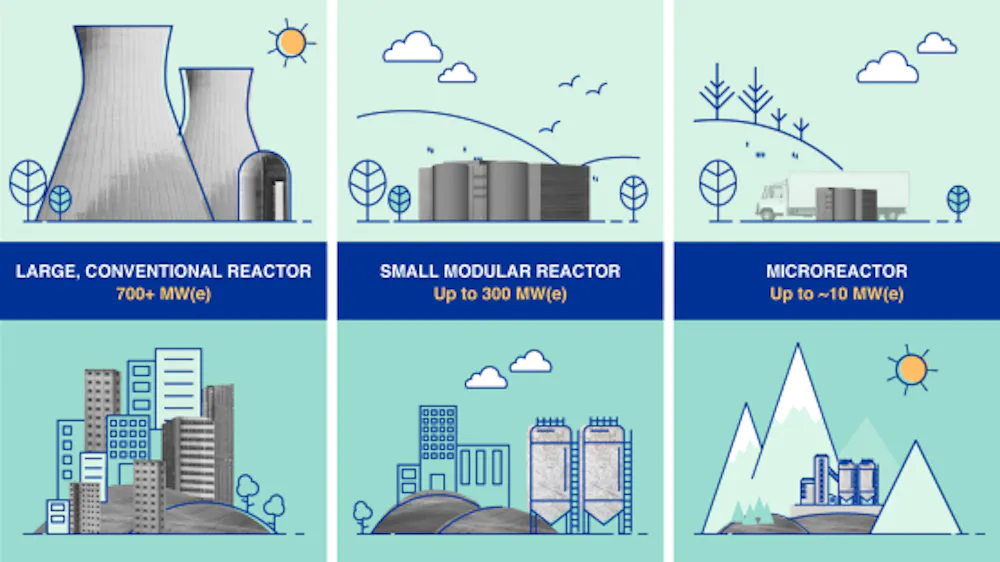
A diagram showing three types of reactors – large, conventional reactors, labeled '700+MW(e)', small modular reactors, labeled 300+MW(e), and microreactors, labeled 'up to 10 MW(e)'
Small modular reactors, at the top, are in between the other two sizes of reactor, and serve different sizes of communities, at the bottom.
A. Vargas/IAEA

The basics

There are three general sizes of nuclear reactors – only one of which, conventional nuclear plants, has been built commercially. Conventional plants are built in permanent locations on large plots of land around reactor cores as tall as 30 feet (10 meters). They usually generate more than 1,000 megawatts of power, enough to supply 700,000 to 1 million homes.

The other types are still being researched and are considerably smaller. Microreactors have cores that are small enough to fit into the trailer of a semitruck. They can be installed on land about as big as a football field and generate less than 20 megawatts.

Small modular reactors are in between. Their cores are roughly 9 feet (3 meters) across and 18 feet (6 meters) tall. The entire operation occupies an area of about 50 acres and can generate up to 300 megawatts of electricity.

Because of the reactors’ size, they can be built in factories from various components and then be shipped by truck, rail or water to the location where they are assembled.

All the different types of small modular reactors generate heat the same way: by splitting heavy atoms and capturing the heat into a variety of materials – like water, liquid metal or molten salt – that circulate through water to generate steam that drives a turbine.

They are also designed with safety features to reduce the risk and severity of accidents that might release radiation or radioactive material into the surroundings. For instance, passive systems and those based on fundamental principles like gravity can terminate nuclear reactions before they reach levels where explosions or leaks might occur. These reactors also produce less heat and have far smaller amounts of nuclear material than traditional large reactors, which can reduce the radioactivity risk as well.

A large green item is on a pier next to a ship and a crane.
The green-wrapped core module of a small nuclear reactor is readied for transfer to a ship.
Liu Xuan/VCG via Getty Images

Construction and deployment

Small modular reactors are well-suited to provide electricity in remote places or regions without a large power grid – places where large nuclear power plants are impractical.

Their compact design and flexible placements make them ideal for small geographical regions or industrial installations, like desalination plants, or in countries just starting to develop nuclear power.

They can be built and put into operation within two or three years – more quickly than the decade or longer it can take to secure permits and construction of standard nuclear power plants and complete construction of a large nuclear plant.

There remains a range of technical challenges before small modular reactors can actually be built and put into use. These include relatively straightforward questions like how many people are needed to operate each reactor, and more complex decisions about refinements to safety regulations, both in the U.S. and internationally. It’s also not yet clear what the best way is to manage the transport of radioactive materials, especially for reactors that use coolants other than water, which could produce new forms of radioactive waste.

Understanding the fuel

Larger nuclear power plants use fuel that is about 5% uranium-235, the element that splits in a nuclear reaction, releasing heat. But many small modular reactor designs use a different fuel, with between 5% and 20% uranium-235.

This different fuel, called “high-assay low-enriched uranium,” lets the reactors generate more electricity from a smaller volume of fuel material. And though it contains significantly more uranium than standard nuclear fuel, it remains far below the concentration of 90% uranium-235 that is used in nuclear weapons.

The more concentrated fuel also allows reactors to run longer between refueling and reduces the amount of radioactive waste that remains after the fuel is spent.

A person stands in front of a complicated piece of machinery.
An engineer at a French research center works on equipment as part of efforts to develop a small modular reactor.
Nicolas Tucat/AFP via Getty Images

US efforts

The U.S. Department of Energy is working to develop domestic manufacturing of this type of uranium for small modular reactors, to avoid being dependent on foreign sources.

Under a government contract, a Maryland-headquartered nuclear fuel company called Centrus Energy has produced nearly 1 ton (920 kilograms) of that fuel since 2023 under a contract estimated to cost taxpayers US$120 million. In mid-2025, Centrus received a $110 million contract extension to produce that amount again by the middle of 2026.

The Department of Energy is distributing the fuel Centrus has made to five companies for demonstrations and development projects.

Managing waste

All nuclear plants require safe handling of the fuel and the resulting waste. There is no permanent place to store nuclear waste in the U.S. Most nuclear waste is stored on the land around the reactors where it was generated.

The Department of Energy says it is trying to find a place to temporarily store waste from small modular reactors, but that process has been tied up in the courts for years and may not be resolved anytime soon.

Other industrial uses

In addition to delivering electricity, small modular reactors can also directly generate large amounts of heat.

That can be useful for desalination plants, which use both electricity and heat to convert seawater into fresh water for drinking and irrigation. Remote mining operations also often need both heat and power to operate equipment, ensure living quarters are habitable and process minerals.

Small modular reactors may also be useful on university campuses. A microreactor planned for the University of Illinois will provide power and steam to campus buildings, while also teaching students how to operate nuclear plants, and offer research and demonstration opportunities for more reactor improvements in the future.

The Conversation

Leonel Lagos does not work for, consult, own shares in or receive funding from any company or organization that would benefit from this article, and has disclosed no relevant affiliations beyond their academic appointment.

ref. What are small modular reactors, a new type of nuclear power plant sought to feed AI’s energy demand? – https://theconversation.com/what-are-small-modular-reactors-a-new-type-of-nuclear-power-plant-sought-to-feed-ais-energy-demand-268628

Federal funding cuts are only one problem facing America’s colleges and universities

Source: The Conversation – USA (2) – By Roger Meiners, Goolsby-Rosenthal Endowed Chair of Economics, University of Texas at Arlington

American colleges and universities are often nonprofits, but they often operate in many of the same ways that businesses do. tc397/iStock/Getty Images Plus

Higher education is under stress. The highest-profile threat has been the Trump administration’s efforts to cut funding to several universities, including Harvard, Columbia and Northwestern.

Research universities heavily depend on federal money to conduct research and carry out other areas of work. For example, after tuition, federal money allocated for research made up 40% of the total revenue for two major research universities – Johns Hopkins University and Massachusetts Institute of Technology – in the 2022-23 academic year.

Since January 2025, the Trump administration has terminated various federal grants for universities valued between US$6.9 billion and $8.2 billion.

While there’s been a lot of public attention to the federal government’s financial pressure on universities, universities have been experiencing financial pressure from other sources.

Understanding that is key for applicants and parents to understand their bargaining position when choosing whether and where to pursue a college degree.

As scholars of public administration and economics and former university administrators, we think parents and college applicants need to understand this economic landscape to make smart choices about making such a major investment. Here are four key things to know.

1. Universities are an industry

Most American private colleges and universities are nonprofits, but they still care about revenue. These schools aren’t responsible to shareholders, but they may respond to pressure from alumni, students, employees, donors, boards, the federal government and, if the schools are public universities, state governments.

And like businesses, nonprofit colleges and universities need money. As a result, despite what you might think, most colleges are not particularly selective. Though they don’t advertise that fact, hundreds of schools will take any student who meets minimal academic requirements and can pay tuition.

The added cost of teaching additional students is minimal when there are empty seats, so admitting more students can lead to an increase in revenue for most schools.

This is important because colleges’ costs – largely staff salaries and building maintenance – are hard to cut and are mostly fixed. Those costs must be spread across fewer students when there are unfilled seats.

As the number of people who go to college is declining, colleges need to respond to people’s skepticism about the value of degrees – but change is difficult

Becoming a smaller school is challenging. If students show less interest in foreign language study and more interest in data science classes, the school cannot have a German language professor suddenly teach data science.

As a result, colleges can become stuck with faculty who teach course students don’t want to take.

Unlike business leaders, who may be rewarded for fixing a failing company by laying off workers, university leaders who eliminate faculty positions become unpopular among their peers. This can reduce their chance to advance their careers at their current universities or switch to a new school.

A young woman hangs a plant under a lofted bed with a brick wall against it. Another woman stands nearby her near a window.
A college freshman gets her new dorm room ready with her mother at Colorado State University in Fort Collins, Colo., in August 2025.
RJ Sangosti/MediaNews Group/The Denver Post via Getty Images

2. Schools have to work to admit students

Colleges enrolled 8.4% fewer students in 2024 than when attendance peaked at 21 million in 2010. As a result, schools must increasingly compete harder to attract students.

One way is to offer a better price, meaning lower tuition. Like most elite schools, Harvard has a listed price of about $60,000 for tuition alone in one academic year – and nearly $87,000 when food, housing and other services are included. Few students actually pay that amount, though the exact percentage getting a discount is not public information.

The average net price a Harvard student paid in 2023-24 was $17,900, as colleges offered either financial aid, straight-up discounts or scholarships.

Most schools engage in this sort of price discrimination, the term economists use to describe charging different prices to different customers based on their willingness to pay. In some ways, this is much like airlines selling seats on the same flights at different prices.

3. Schools have a declining foreign customer base

Another enrollment remedy for colleges and universities to boost tuition revenue has been focusing on admitting international students, who typically pay full price.

One-fourth of all international students in the U.S. come from China, while another quarter come from India.

Most schools have not pursued this strategy of expanding foreign enrollment as aggressively as Columbia University, where international students approach 40% of the student body.

By comparison, international undergraduate students made up 6% of Columbia’s undergraduate student population in 2000, and 12% in 2011.

But the revenue that international students generate is not a guarantee. Foreign student enrollment declined 17% from fall of 2024 to 2025.

In part, that’s because of some students’ inability to get a visa or fear their authorization to study in the U.S. will be revoked.

Rising competition from universities in Australia, Canada and the United Kingdom, combined with stricter U.S. visa policies and geopolitical tensions with China, have led to rapid declines in Chinese students enrolling at American schools.

The number of Chinese undergraduate and graduate students attending U.S. colleges and universities has dropped from 317,299 in 2019 to 265,919 in the 2024-25 school year.

This change has increased the financial strain on American colleges and universities, many of which have grown accustomed to having large numbers of international students who pay their own way.

A group of young people wear light blue graduation robes and throw their caps into the air. They stand outside of a large building with columns.
Chinese graduates throw their hats into the sky at their graduation from Columbia University in May 2016.
Xinhua/Li Muzi via Getty Images

4. The value of the product is in question

With recent changes to federal loan forgiveness programs, some students and their parents are questioning the value of a college degree.

Just 22% of Americans said in 2024 that a college degree is worth the cost, if a student has to borrow money to get it.

The University of Texas system – made up of nine universities and four medical schools – shares information on the average income of graduates for every degree program after graduation.

In the case of the University of Texas at Arlington, the average salary for a drama, theater arts and stagecraft major is $14,933 one year after graduation. This amount goes up to $39,608 10 years after graduation, resulting in a negative $324,210 return on the price of college over that first decade.

Of course, some degrees pay off. A University of Texas at Arlington graduate with a degree in civil engineering earns an average of $67,920 one year after college and $105,377 10 years after graduation, demonstrating a positive return on investment of $1.15 million.

We believe that universities and colleges should reform to address the next generation’s uncertainty about higher education.

College applicants should be asking hard questions. What is the data on graduates’ earnings compared to the cost of their program? Where are graduates employed?

If more people treated buying a college degree with the same care they use to buy their first home – an equivalent investment – colleges and universities would feel pressure to become more transparent for students and parents. They would also become more aligned with the rapidly evolving demands of the workplace.

The Conversation

The authors do not work for, consult, own shares in or receive funding from any company or organization that would benefit from this article, and have disclosed no relevant affiliations beyond their academic appointment.

ref. Federal funding cuts are only one problem facing America’s colleges and universities – https://theconversation.com/federal-funding-cuts-are-only-one-problem-facing-americas-colleges-and-universities-268974

A hard year for federal workers offers a real-time lesson in resilience

Source: The Conversation – USA (2) – By Anne Pisor, Assistant Professor of Anthropology and Demography, Penn State

Imagine going from having a book club with your co-workers to seeing them only on a Signal chat where every member has to be vetted – and the main conversation topic is when you might lose your job.

That’s what it was like for workers at one federal agency earlier this year.

“I’d never seen anything like the sort of organization that happened during the RIFs (layoffs, or reductions in force) in supporting each other with news, information and job resources,” said Anthony, a federal worker who’d been with the agency for almost a decade before his position was eliminated. He asked that his real name and other identifying details not be published, out of fear of retaliation.

Anthony’s not alone. So far in 2025, tens of thousands of federal workers have lost their jobs. And during the shutdown, approximately 600,000 were threatened with layoffs.

But something else happened alongside the cuts: Federal workers began building support networks online – connecting with colleagues inside their agencies and with strangers outside them.

I’m an anthropologist, which means I study human nature and human diversity, and I’m an expert in how people cooperate to manage risk. Watching federal workers use social media to provide mutual support offered a rare real-time view of the process. To deepen my understanding, I interviewed several federal workers who work in different parts of government.

They told me that in the past, federal workers haven’t always interacted with their co-workers outside of work, much less connected across federal agencies. But thanks to online platforms, that’s changing.

As they’ve faced RIFs, operational changes from the Department of Government Efficiency (or DOGE) and the longest government shutdown in history, current and former federal workers have come together in online spaces to support one another. The result is a vivid example of how people create resilient networks, often spanning group boundaries and distance, in response to uncertainty and threats.

Reaching out across groups and across distance

In 2025, federal workers built social networks like the ones we study in my lab. When experiencing widespread shocks – things such as droughts or mass job loss – humans past and present have relied on relationships that stretch beyond the individuals affected. Often that means getting support from people at a distance, and it can also mean reaching out across groups.

When just a few people reach across groups, social scientists call these connectors “brokers.” They often move information across groups. As a user of LinkedIn and Bluesky, I have observed that federal workers in positions of power, or who have been recently RIFed and thus have less to lose, are often brokers, because with visibility comes risk of retribution. These brokers share information on where to find unemployment benefits or how to sign petitions calling for scientific independence.

There are even more connections spanning distance and agencies when workers can remain anonymous. Platforms such as Reddit and Bluesky are places where workers feel safer to speak freely. There, workers can share information and also frustration, little wins, and some laughs.

What’s more, as my lab has shown, these long-distance relationships can also bolster collective action – working toward a shared goal, often across space and across groups, such as federal agencies.

For example, Julia Simon – who agreed to let me use her name but asked that other identifying details be withheld – has a friend who works at the same federal agency as her but lives in a different part of the country. This year, her friend suggested that Julia join the Federal Unionists Network. Members from across agencies provide mutual support and work together toward change in their union – the American Federation of Government Employees – and beyond.

“I’ve felt that within my own local and district I’ve been seen as too radical so my ideas tend to get shot down or ignored,” Simon told me in an interview. “But finding a group of other AFGE activists who have similar views and goals has been validating.”

Hunkering down among trusted others

That said, when people fear surveillance and possible retaliation, they may not reach out to long-distance connections. Instead, networks often shift toward tight-knit clusters, reducing risk of exposure and increasing trust.

In 2025, many federal workers leaned into private Signal chats with their co-workers. Users are vetted before they can join Signal chats to help workers feel safer in these spaces.

When workers were faced with RIFs, a visit from DOGE or the government shutdown, Signal chat activity would increase, workers told me.

“The content was largely ‘I heard from our division director that the RIF notices will go out Friday’ or ‘If you’re comfortable with it, here’s a Zoom workshop on how to manage your emotions during layoffs,’” Anthony said. At their peak, he told me, these chats had hundreds of participants.

Mason, furloughed from a different agency during the shutdown, gave another example. “Today, there are about a dozen messages among federal employees who are trying to provide information and support to each other about applying for unemployment benefits,” he said in an interview.

Though these Signal groups are tight-knit, long-distance relationships still are a source of information – bringing news from spouses and friends at other agencies and content from Reddit, LinkedIn and Bluesky.

For some workers, the most important benefit of these Signal chats is the sense of community they provide.

“These group chats and communities sprung up because we were being terrorized and we only had each other for support,” Anthony said. “I remember seeing some wild statistic early on that said a lot of folks support DOGE’s mission – from our side, it was like, ‘Guess we’re on our own.’ I can’t tell you how many times I heard, ‘Nobody is coming to save us’ – so that’s why we needed these groups.”

Learning from federal workers’ experiences

These stories from federal workers are a reminder of how hundreds of thousands of Americans working for the public may be experiencing uncertainty, fear, loss and isolation this year.

They also offer important lessons on how to build the resilient networks that sustain us as people.

First, if you feel you cannot trust others, trust can emerge in highly connected clusters that can pool information and take action. As Anthony highlighted, forming these clusters can provide individuals with a sense of community.

Second, connections spanning groups and distance open doors for transmitting information and, as Julia experienced, for engaging in collective action. Long-distance relationships can also help you access things that can be hard to find, such as information about what’s next, support with food or loans, and even new job opportunities.

These resilient networks are a reminder that online platforms have a silver lining. Many news stories focus on how social media use can negatively affect people’s mental health or social relationships. What federal workers highlight, however, is that the effect of online platforms on your well-being can depend on how you use them.

LinkedIn, Reddit, Signal and other platforms can allow you to create and sustain networks that might be impossible to have in person, either because trust is low or simply because you’re busy. Online platforms allow people to build tight-knit clusters or to have more long-distance relationships at greater distances than ever before.

So whether you’re looking for like-minded others, people who can help you face something you’ve never faced before, or a sense of community when you’ve lost so much, online platforms remain an important tool to help us find each other.

The Conversation

Anne Pisor receives funding from the National Science Foundation, National Institutes of Health, and Penn State Social Science Research Institute. She has a long-distance social relationship with a source for this article.

ref. A hard year for federal workers offers a real-time lesson in resilience – https://theconversation.com/a-hard-year-for-federal-workers-offers-a-real-time-lesson-in-resilience-270272

The marketing genius of Spotify Wrapped

Source: The Conversation – USA (2) – By Ishani Banerji, Clinical Assistant Professor of Marketing, Clemson University

Charli XCX performs during a celebration of the annual release of Spotify Wrapped in 2022 in Los Angeles. Kevin Winter/Getty Images for Spotify

Even before this year’s Spotify Wrapped drops, I have a hunch what mine will reveal.

I’m guessing I’ll be among Spotify’s top 1% of listeners for an obscure 2004 track titled “Rusty Chevrolet” by the Irish band Shanneyganock. I heard it first thanks to my son, whose friend had been singing it on the swings at school. My son found it utterly hilarious, and it’s been playing in our house nonstop ever since.

Like parents all over the world, I’ll rue how my son’s musical tastes have hijacked my listening history. But I’ll also be tickled to learn that our household is one of the few even listening to it.

Spotify Wrapped is an annual campaign by the popular streaming music platform. Since 2015, the streaming service has been repackaging user data – specifically, the listening history of Spotify’s users over the past year – into attractive, personalized slideshows featuring, among other data points, your top five songs, your total listening time and even your “listening personality.” (Are you a “Replayer,” a “Maverick” or a “Vampire”?)

As a consumer behavior researcher, I’ve thought about why these lists get so much attention each year. I suspect that the success of Spotify Wrapped may have a lot to do with how the flashy, shareable graphics are connected to a couple of fundamental – and somewhat contradictory – human needs.

Individuality and belonging

In 1991, social psychologist Marilynn Brewer introduced what she coined “optimal distinctiveness theory.”

She argued that most people are torn between two human needs. On the one hand, there’s the need for “validation and similarity to others.” On the other hand, people want to express their “uniqueness and individuation.” Thus, most of us are constantly striving for a balance between feeling connected to others while also maintaining a sense of our own distinct individuality.

At Thanksgiving, for example, your need for connection is likely more than satisfied. In that moment, you’re surrounded by family and friends who share a lot in common with you. In fact, it can feel so fulfilled that you may start craving the opposite: a way to assert your individuality. Maybe you choose to wear something that really reflects your personality, or you tell stories about interesting experiences you’ve had in the past year.

In contrast, you may feel relatively isolated when you move to a new town and feel a stronger need for connection. You may wear the styles and brands you see your neighbors and co-workers wearing, pop into popular cafes and restaurants, or invite people over to your home in an effort to make new friends.

Have it your way

When people buy things, they often make choices as a way to satisfy their needs for connection and individuality.

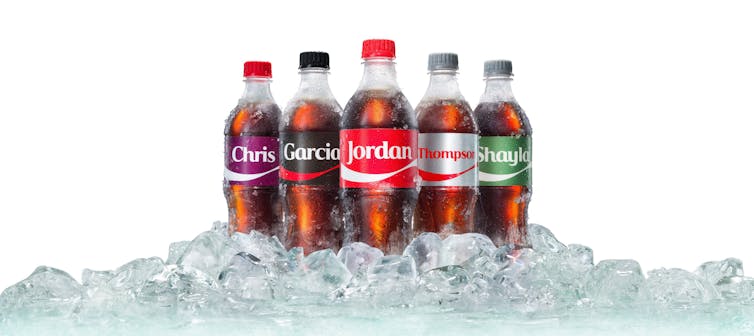
Brands recognize this and usually try to entice consumers with at least one of these two elements. It’s partly why Coca-Cola started releasing bottles featuring popular names on the labels as part of its “Share a Coke” campaign. The soft drink remains the same, but grabbing a Coke with your name on it can cultivate a sense of connection with everyone else who has it. And it’s why Apple offers custom, personalized engravings for products such as its AirPods and iPads.

Five soft drink bottles, each featuring labels with a different name.
Coca-Cola’s ‘Share a Coke’ campaign taps into optimal distinctiveness theory.
AP Photo/Business Wire

Spotify Wrapped works because it nails the balance between competing needs: the desire to belong and the desire to stand out. Seeing the overlap between your lists and those of your friends fosters a sense of connection, and seeing the differences is a signal of your (or your kids’!) unique musical taste. It gives me a way to say, “Sure, I’ve been listening to ‘Soda Pop’ nonstop like everyone else. But I’m probably the only one playing ‘Rusty Chevrolet’ on repeat.”

Text reading 'YOUR WRAPPED IS HERE.' is projected onto a black backdrop, visible over a silhouette of a large crowd.
What will be your most-listened-to songs of 2025?
John Phillips/Getty Images for Spotify

The Wrapped campaign is also smart marketing. Spotify turns listeners’ unique, personal listening data into striking visuals that are tailor-made for posting to social media accounts. It’s no wonder, then, that the Wrapped feature has led to impressive engagement: On TikTok, the hashtag #SpotifyWrapped garnered 73.7 billion views in 2023. The annual campaign has earned numerous honors, including a Cannes Lion and several Webby Awards, otherwise known as the “Oscars of the Internet.”

It’s been so successful that it’s inspired a wave of copycats: Apple Music, Reddit, Uber and Duolingo now release similarly personalized “year-in-reviews.”

None, however, has managed to achieve the same level of cultural impact as Spotify Wrapped. So, when Spotify Wrapped 2025 drops, what will be on your list? And will you brag, hide or laugh at what it says about you?

The Conversation

Ishani Banerji does not work for, consult, own shares in or receive funding from any company or organization that would benefit from this article, and has disclosed no relevant affiliations beyond their academic appointment.

ref. The marketing genius of Spotify Wrapped – https://theconversation.com/the-marketing-genius-of-spotify-wrapped-270135

Why one theologian’s advice for a bitterly divided nation holds true today

Source: The Conversation – USA (3) – By Michael Bruening, Professor of History, Missouri University of Science and Technology

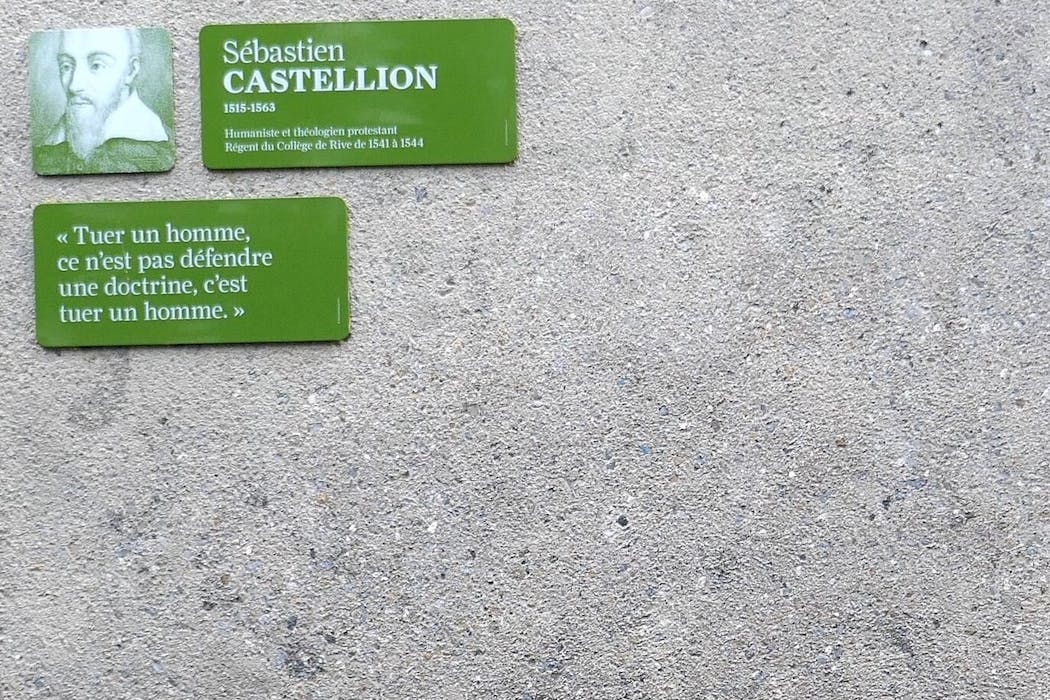
A monument to Sebastian Castellio in Geneva – using a French spelling of his name – reads, ‘Killing a man is not defending a doctrine; it is killing a man.’ MHM55/Wikimedia Commons, CC BY-SA

Ideological division was tearing the country apart. Factions denounced each other as unpatriotic and evil. There were attempted kidnappings and assassinations of political figures. Public monuments and art were desecrated all over the country.

This was France in the middle of the 16th century. The divisions were rooted in religion.

The Protestant minority denounced Catholics as “superstitious idolaters,” while the Catholics condemned Protestants as “seditious heretics.” In 1560, Protestant conspirators attempted to kidnap the young King Francis II, hoping to replace his zealous Catholic regents with ones more sympathetic to the Protestant cause.

Two years later, the country collapsed into civil war. The French Wars of Religion had begun – and would convulse the country for the next 36 years.

I am a historian of the Reformation who writes about the opponents of John Calvin, a leading Protestant theologian who influenced Reformed Christians, Presbyterians, Puritans and other denominations for centuries. One of the most significant of Calvin’s rivals was the humanist Sebastian Castellio, whom he had worked with in Geneva before a bitter falling out over theology.

Soon after the first war in France broke out, Castellio penned a treatise that was far ahead of its time. Rather than join in the bitter denunciations raging between Protestants and Catholics, Castellio condemned intolerance itself.

He identified the main problem as both sides’ efforts to “force consciences” – to compel people to believe things they did not believe. In my view, that advice from nearly five centuries ago has much to say to the world today.

Foreseeing the carnage

Castellio rose to prominence in 1554 when he condemned the execution of Michael Servetus, a medical doctor and theologian convicted of heresy. Servetus had rejected the standard Christian belief in the Trinity, which holds that the Father, Son and Holy Spirit are three persons in one God.

A dark-colored statue of a downcast, seated man, positioned in front of trees and bushes.
A monument to Michael Servetus, who was condemned for heresy and executed, in Geneva.
Iantomferry/Wikimedia Commons, CC BY-SA

Already condemned by the Catholic Inquisition in France, Servetus was passing through Geneva when Calvin urged his arrest and advocated for his execution. Servetus was burned alive at the stake.

Castellio condemned the execution in a remarkable book titled “Concerning Heretics: Whether They are to be Persecuted and How They are to be Treated.” In it, Castellio questioned the very notion of heresy: “After a careful investigation into the meaning of the term heretic, I can discover no more than this, that we regard those as heretics with whom we disagree.”

In the process, he laid the intellectual foundations for religious toleration that would come to dominate Western political philosophy during the Enlightenment.

But it took centuries for religious toleration to take hold.

In the meantime, Europe became embroiled in a series of religious wars. Most were civil wars between Protestants and Catholics, including the French Wars of Religion, a series of conflicts from 1562 to 1598. These included one of the most horrific events of the 16th century: the St. Bartholomew’s Day Massacre of 1572, when thousands of Protestants were slain in a nationwide bloodbath.

Castellio had seen the carnage coming: “So much blood will flow,” he had warned in a treatise 10 years earlier, “that its loss will be irremediable.”

A painting in faded colors shows a plaza in a medieval city, with scenes of people slaughtering each other and throwing bodies in a river.
‘The St. Bartholomew’s Day Massacre,’ by 16th-century artist François Dubois.
Cantonal Museum of Fine Arts/Wikimedia Commons

Remembering the Golden Rule

Castellio’s 1562 book, “Advice to a Desolate France,” was a rarity in the 16th century, for it sought compromise and the middle ground rather than the religious extremes.

With an extraordinarily modern sensibility, he decided to use the terms each side preferred for themselves, rather than the negative epithets used by their opponents.

“I shall call them what they call themselves,” he explained, “in order not to offend them.” Hence, he used “Catholics” rather than “Papists” and “evangelicals” rather than “Huguenots.”

Castellio pulled no punches. To the Catholics, referring to decades of Protestant persecution in France, he said: “Recall how you have treated the evangelicals. You have pursued and imprisoned them … and then you have roasted them alive at a slow fire to prolong their torture. And for what crime? Because they did not believe in the pope, the Mass, and purgatory. … Is that a good and just cause for burning men alive?”

To the Protestants, he complained, “You are forcing them against their consciences to attend your sermons, and what is worse, you are forcing some to take up arms against their own brothers.” He noted that they were using three “remedies” for healing the church, “namely bloodshed, the forcing of consciences, and the condemning and regarding as unfaithful of those who are not entirely in agreement with your doctrine.”

A sepia-colored illustration of a man with a long goatee, wearing a black jacket with buttons.
A portrait of Sebastian Castellio, made by 18th-century printmaker Heinrich Pfenninger.
Sepia Times/Universal Images Group via Getty Images

In short, Castellio accused both sides of ignoring the Golden Rule: “Do not do unto others what you would not want them to do unto you,” he wrote. “This is a rule so true, so just, so natural, and so written by the finger of God in the hearts of all,” he asserted, that none can deny it.

Both sides were trying to promote their vision of true religion, Castellio said, but both were going about it the wrong way. In particular, he warned against trying to justify evil behavior by appealing to its possible effects: “One should not do wrong in order that good may result from it.”

In another essay, he made the same point to argue against torture, writing that “Evil must not be done in order to pursue the good.” Castellio was the anti-Machiavelli; for him, the ends did not justify the means.

Force doesn’t work

Finally, “Advice to a Desolate France” argued that forcing people to your own way of thinking never works: “We manifestly see that those who are forced to accept the Christian religion, whether they are a people or individuals, never make good Christians.”

Americans, I believe, would do well to bear Castellio’s words in mind today. The country’s two dominant political parties have become increasingly polarized. Students are reluctant to speak out on controversial topics for fear of “saying the wrong thing.” Americans increasingly think in binary terms of good and evil, friends and enemies.

In the 16th century, Christians failed to heed Castellio’s advice and continued to kill each other over differences of belief for another hundred years. It would be wise to apply his ideas to today’s bitter divisions.

The Conversation

Michael Bruening does not work for, consult, own shares in or receive funding from any company or organization that would benefit from this article, and has disclosed no relevant affiliations beyond their academic appointment.

ref. Why one theologian’s advice for a bitterly divided nation holds true today – https://theconversation.com/why-one-theologians-advice-for-a-bitterly-divided-nation-holds-true-today-266457

Empathy and reasoning aren’t rivals – new research shows they work together to drive people to help more

Source: The Conversation – USA (3) – By Kyle Fiore Law, Postdoctoral Research Scholar in Sustainability, Arizona State University

What motivates people to donate their time or money to make the world better? Alistair Berg/DigitalVision via Getty Images

For years, philosophers and psychologists have debated whether empathy helps or hinders the ways people decide how to help others. Critics of empathy argue that it makes people care too narrowly – focusing on individual stories rather than the broader needs of society – while careful reasoning enables more impartial, evidence-based choices.

Our new research, forthcoming in the academic journal PNAS Nexus, a flagship peer-reviewed journal of the National Academy of Sciences, suggests this “heart versus head” argument is too simple. Empathy and reasoning aren’t rivals – they work together. Each one on its own predicts more generous, far-reaching acts of assistance. And when they operate side by side, people tend to help in the fairest ways – not favoring some over others – and in ways that touch the most lives.

We studied two groups that regularly help others at personal cost. One consisted of living organ donors who gave kidneys to strangers. The other included “effective altruists,” who use evidence and logic to direct substantial portions of their income or careers toward causes that save the most lives per dollar, such as fighting extreme poverty or preventable illness.

All participants completed survey measures of empathy – essentially, how much they care about and are moved by others’ suffering. They also completed survey measures of reasoning. These assess how often people slow down, reflect and think through things before deciding what to do.

We also examined how these abilities related to a range of altruistic judgments and behaviors, from hypothetical choices – such as deciding whether to help a close friend or a distant stranger – to real-world donations.

On average, organ donors scored higher on empathy, and effective altruists scored higher on reflective reasoning – slowing down and thinking things through. But across all participants, both traits were linked to broader, more outward-looking helping. People with either an elevated heart or head, and especially those with both compared with average adults, tended to support distant others and focus on helping as many people as possible.

Even among organ donors, whose empathic ability is far above average adults’, empathy did not make them biased toward those who were close or familiar. When we measured their altruistic judgments and real-world donations, they were just as likely as average adults, and sometimes even more likely, to favor causes that saved the greatest number of lives.

These patterns challenge the assumption that empathy can narrow moral concern. In practice, we found, empathy can broaden it.

Why it matters

A Black woman in a red apron over a blue top walks with an older white woman holding food packets.
Relying on reason alone isn’t enough to inspire people to help strangers.
Jose Luis Pelaez Inc./Digital Vision via Getty Image

Many of today’s most urgent problems – poverty, climate change, global health – depend on motivating people to care about strangers and to use limited resources effectively.

Appeals to empathy alone may inspire giving but not necessarily the most effective giving. Appeals to reason alone can leave people unmoved, as often facts and numbers don’t stir anyone to care. Our findings suggest that the most powerful approach may be to pair empathy’s motivation with reasoning’s direction.

Empathy provides the emotional spark – a reminder that others’ suffering matters. Reasoning helps steer that motivation toward where help will have the greatest impact. Together, they encourage helping that is both compassionate and consequential.

What’s next

Future research needs to determine how empathy and reasoning can be strengthened in everyday decision-making. Could emotional stories paired with clear evidence about what works best help people choose actions that do the most good?

We also don’t yet know whether people who focus their giving beyond the boundaries of their immediate social circles, like effective altruists, pay any social cost for doing so – perhaps by inadvertently signaling less investment in close others. Promisingly, early evidence from organ donors shows that those who help strangers often maintain strong, stable relationships with their closest friends and family members.

Perhaps most importantly, researchers need to rethink how altruism is understood. Psychology lacks a clear framework for explaining how empathy and reasoning work together, for whom they work best, and the situations where they come apart.

Developing that kind of model would reshape how we think about helping – when helping expands, when it stalls, and why. While such core questions remain, the present findings offer reason for optimism.

The Research Brief is a short take on interesting academic work.

The Conversation

The research relevant to this article was funded by the John Templeton Foundation.

Stylianos Syropoulos does not work for, consult, own shares in or receive funding from any company or organization that would benefit from this article, and has disclosed no relevant affiliations beyond their academic appointment.

ref. Empathy and reasoning aren’t rivals – new research shows they work together to drive people to help more – https://theconversation.com/empathy-and-reasoning-arent-rivals-new-research-shows-they-work-together-to-drive-people-to-help-more-266913

Flat Earth, spirits and conspiracy theories – experience can shape even extraordinary beliefs

Source: The Conversation – USA – By Eli Elster, Doctoral Candidate in Evolutionary Anthropology, University of California, Davis

A belief in ghosts could be a way to explain a strange experience while asleep. ‘The Nightmare’ by Johann Heinrich Füssli/Wikimedia Commons

On Feb. 22, 2020, “Mad” Mike Hughes towed a homemade rocket to the Mojave Desert and launched himself into the sky. His goal? To view the flatness of the Earth from space. This was his third attempt, and tragically it was fatal. Hughes crashed shortly after takeoff and died.

Hughes’ nickname – Mad Mike – might strike you as apt. Is it not crazy to risk your life fighting for a theory that was disproven in ancient Greece?

But Hughes’ conviction, though striking, is not unique. Across all recorded cultures, people have held strong beliefs that seemed to lack evidence in their favor – one might refer to them as “extraordinary beliefs.”

For evolutionary anthropologists like me, the ubiquity of these kinds of beliefs is a puzzle. Human brains evolved to form accurate models of the world. Most of the time, we do a pretty good job. So why do people also often adopt and develop beliefs that lack strong supporting evidence?

In a new review in the journal Trends in Cognitive Sciences, I propose a simple answer. People come to believe in flat Earth, spirits and microchipped vaccines for the same reasons they come to believe in anything else. Their experiences lead them to think those beliefs are true.

Theories of extraordinary belief

Most social scientists have taken a different view on this subject. Supernatural beliefs, conspiracy theories and pseudoscience have struck researchers as totally impervious to contrary evidence. Consequently, they have assumed that experience is not relevant to the formation of those beliefs. Instead, they’ve focused on two other explanatory factors.

The first common explanation is cognitive biases. Many psychologists argue that humans possess mental shortcuts for reasoning about how the world works. For instance, people are quite prone to seeing intentions and intelligence behind random events. A bias of this kind might explain why people often believe that deities control phenomena such as weather or illness.

The second factor is social dynamics: People adopt certain beliefs not because they’re sure that they’re true but because other people hold those beliefs, or they want to signal something about themselves to others. For example, some conspiracy theorists may adopt strange beliefs because those beliefs come with a community of loyal and supportive co-believers.

Both of these approaches can partly explain how people come to hold extraordinary beliefs. But they discount three ways that experience, in tandem with the other two factors, can shape extraordinary beliefs.

vast grassy landscape with blue sky and white clouds
Science says one thing, but your eyes tell you the Earth looks pretty darn flat.
sharply_done/E+ via Getty Images

1. Experience as a filter

First, I propose that experience can act as a filter. It determines which extraordinary beliefs can successfully spread throughout a population.

Take the flat Earth theory as an example. We know with absolute certainty that it’s false, but it’s no more or less wrong than a theory that the Earth is shaped like a cone. So what makes flat Earth so much more successful than this equally incorrect alternative?

The answer is as obvious as it seems – the Earth looks flat when you’re standing on it, not cone-shaped. Visual evidence favors one extraordinary belief over the others. Of course, scientific evidence clearly shows that the Earth is round; but it’s not surprising that some people prefer to trust what their eyes are telling them.

2. Experience as a spark

My second argument is that experience acts as a spark for extraordinary beliefs. Strange experiences, such as auditory hallucinations, are difficult to explain and understand. So people do their best to explain them – and in doing so, they come up with beliefs that seem fittingly strange.

For this pathway, sleep paralysis is a good case study. Sleep paralysis happens in the space between sleeping and waking – you feel like you’re awake, but you can’t move or speak. It’s terrifying and quite common. And interestingly, sufferers usually feel like there’s a threatening agent sitting on their chest.

As a scientist, I interpret sleep paralysis as the result of neural confusion. But it’s not difficult to picture how someone without a scientific background – that is, nearly every human being in history – might interpret the experience as evidence of supernatural beings.

3. Experience as a tool

To me, the third potential route to extraordinary beliefs is especially intriguing. In many cases, people don’t just develop extraordinary beliefs; they develop immersive practices that make those beliefs feel true.

For instance, imagine that you’re a farmer living in the highlands of Lesotho in southern Africa, where I conduct ethnographic fieldwork. You suffer a series of miscarriages, and you want to know why. So you go to a traditional healer – she tells you that you can learn the answer from your ancestors by drinking a hallucinogenic brew. You drink the brew. Soon after, you begin to see spirits; they speak to you and explain your misfortune.

Shaman in colorful outfit and necklaces ladles from a clay pot
A shaman might administer a psychoactive substance that affects how you experience the world around you.
Luis Acosta/AFP via Getty Images

Clearly, an experience like this one might reinforce your belief in the existence of spirits. Such immersive practices – such as prayer, ritualistic dance and the religious use of psychoactive substances – create evidence that makes the associated beliefs feel true.

What’s next?

Extraordinary beliefs are not inherently good or bad. In particular, religious beliefs provide meaning, security and a sense of community for billions of people.

But some extraordinary beliefs are sources of serious concern: Misinformation about science and politics is rampant and immensely dangerous. By recognizing how those beliefs are shaped by experience, researchers can find better ways to combat their spread.

Just as importantly, though, my suggested perspective might encourage more compassion and kinship toward people who hold beliefs that seem very different from yours. They are not “mad” or insincere. Like any other human being, they think the evidence is on their side.

The Conversation

Eli Elster does not work for, consult, own shares in or receive funding from any company or organization that would benefit from this article, and has disclosed no relevant affiliations beyond their academic appointment.

ref. Flat Earth, spirits and conspiracy theories – experience can shape even extraordinary beliefs – https://theconversation.com/flat-earth-spirits-and-conspiracy-theories-experience-can-shape-even-extraordinary-beliefs-271145

Winter storms blanket the East, while the US West is wondering: Where’s the snow?

Source: The Conversation – USA (2) – By Adrienne Marshall, Assistant Professor of Geology and Geological Engineering, Colorado School of Mines

Much of the West has seen a slow start to the 2026 snow season. Hyoung Chang/The Denver Post

Ski season is here, but while the eastern half of the U.S. digs out from wintery storms, the western U.S. snow season has been off to a very slow start.

The snowpack was far below normal across most of the West on Dec. 1, 2025. Denver didn’t see its first measurable snowfall until Nov. 29 – more than a month past normal, and one of its latest first-snow dates on record.

But a late start isn’t necessarily reason to worry about the snow season ahead.

Adrienne Marshall, a hydrologist in Colorado who studies how snowfall is changing in the West, explains what forecasters are watching and how rising temperatures are affecting the future of the West’s beloved snow.

Weather map show precipitation outlook, with a strip across Colorado, Utah and up to Oregon in a band with equal chances of wetter or drier conditions.
The National Weather Service Climate Prediction Center’s seasonal outlook for January through March 2026 largely follows a typical La Niña pattern, with warmer and drier conditions to the south, and wetter and cooler conditions to the north.
NOAA

What are snow forecasters paying attention to right now?

It’s still early in the snow season, so there’s a lot of uncertainty in the forecasts. A late first snow doesn’t necessarily mean a low-snow year.

But there are some patterns that we know influence snowfall that forecasters are watching.

For example, the National Oceanic and Atmospheric Administration is forecasting La Niña conditions for this winter, possibly switching to neutral midway through. La Niña involves cooler-than-usual sea-surface temperatures in the Pacific Ocean along the equator west of South America. Cooler ocean temperatures in that region can influence weather patterns across the U.S., but so can several other factors.

La Niña – and its opposite, El Niño – don’t tell us what will happen for certain. Instead, they load the dice toward wetter or drier conditions, depending on where you are. La Niñas are generally associated with cooler, wetter conditions in the Pacific Northwest and a little bit warmer, drier conditions in the U.S. Southwest, but not always.

When we look at the consequences for snow, La Niña does tend to mean more snow in the Pacific Northwest and less in the Southwest, but, again, there’s a lot of variability.

A map show the snowpack in most of the West is more than 50% below normal.
Scientists often gauge snow conditions by snow-water equivalent, a measure of the amount of water stored in a snowpack. Most of the Western U.S. was far below normal on Nov. 30, 2025. Parts of the Southwest were above normal, but this early in the season, normal is very low to begin with in many of those areas.
USDA Natural Resources Conservation Service

Snow conditions also depend heavily on individual storms, and those are more random than the seasonal pattern indicated by La Niña.

If you look at NOAA’s seasonal outlook maps, most of Colorado and Utah are in the gap between the cooler and wetter pattern to the north and the warmer and drier pattern to the south expected during winter 2026. So, the outlook suggests roughly equal chances of more or less snow than normal and warmer or cooler weather across many major ski areas.

How is climate change affecting snowfall in the West?

In the West, snow measurements date back a century, so we can see some trends.

Starting in the 1920s, surveyors would go out into the mountains and measure the snowpack in March and April every year. Those records suggest snowfall has declined in most of the West. We also see evidence of more midwinter melting.

How much snow falls is driven by both temperature and precipitation, and temperature is warming

In the past few years, research has been able to directly attribute observed changes in the spring snowpack to human-caused climate change. Rising temperatures have led to decreases in snow, particularly in the Southwest. The effects of warming temperatures on overall precipitation are less clear, but the net effect in the western U.S. is a decrease in the spring snowpack.

When we look at climate change projections for the western U.S. in future years, we see with a high degree of confidence that we can expect less snow in warmer climates. In scenarios where the world produces more greenhouse gas emissions, that’s worse for snow seasons.

Should states be worried about water supplies?

This winter’s forecast isn’t extreme at this point, so the impact on the year’s water supplies is a pretty big question mark.

Snowpack – how much snow is on the ground in March or April – sums up the snowfall, minus the melt, for the year. The snowpack also affects water supplies for the rest of the year.

The West’s water infrastructure system was built assuming there would be a natural reservoir of snow in the mountains. California relies on the snowpack for about a third of its annual water supply.

However, rising temperatures are leading to earlier snowmelt in some areas. Evidence suggests that climate change is also expected to cause more rain-on-snow events at high elevations, which can cause very rapid snowmelt.

a man stands on a road that is flooded on both sides as far as the camera can see.  Trees are surrounded by flood water on one side.
When snow melts quickly, it can cause flooding. That happened in 2023 in California, when fast melting from a heavy snow season flooded wide areas of farmland and almond orchards covering what was once Tulare Lake.
Luis Sinco/Los Angeles Times via Getty Images

Both create challenges for water managers, who want to store as much snowmelt runoff as possible in reservoirs so it’s available through the summer, when states need it most for agriculture and for generating hydropower to meet high electricity demand. If the snow melts early, water resource managers face some tough decisions, because they also need to leave room in their reservoirs to manage flooding. Earlier snowmelt sometimes means they have to release stored water.

When we look at reservoir levels in the Colorado River basin, particularly the big reservoirs – Lake Powell and Lake Mead – we see a pattern of decline over time. They have had some very good snow and water years, and also particularly challenging ones, including a long-running drought. The long-term trends suggest an imbalance between supply and growing demand.

What else does snowfall affect, such as fire risk?

During low-snow years, the snowpack disappears sooner, and the soils dry out earlier in the year. That essentially leaves a longer summer dry period and more stress on trees.

There is evidence that we tend to have bigger fire seasons after low-snow winters. That can be because the forests are left with drier fuels, which sets the ecosystem up to burn. That’s obviously a major concern in the West.

Snow is also important to a lot of wildlife species that are adapted to it. One example is the wolverine, an endangered species that requires deep snow for denning over the winter.

What snow lessons should people take away from climate projections?

Overall, climate projections suggest our biggest snow years will be less snowy in anticipated warmer climates, and that very low snow years are expected to be more common.

But it’s important to remember that climate projections are based on scenarios of how much greenhouse gas might be emitted in the future – they are not predictions of the future. The world can still reduce its emissions to create a less risky scenario. In fact, while the most ambitious emissions reductions are looking less likely, the worst emissions scenarios are also less likely under current policies.

Understanding how choices can change climate projections can be empowering. Projections are saying: Here’s what we expect to happen if the world emits a lot of greenhouse gases, and here’s what we expect to happen if we emit fewer greenhouse gases based on recent trends.

The choices we make will affect our future snow seasons and the wider climate.

This article has been updated to correct the references to Denver, which saw one of its latest snowfalls on record.

The Conversation

Adrienne Marshall receives funding from the National Science Foundation, the National Oceanic and Atmospheric Administration, the United States Geological Survey, the Colorado Department of Transportation, and the Alfred P. Sloan Foundation, and has received previous funding from the Carnegie Institution of Washington.

ref. Winter storms blanket the East, while the US West is wondering: Where’s the snow? – https://theconversation.com/winter-storms-blanket-the-east-while-the-us-west-is-wondering-wheres-the-snow-270928

High-speed rail moves millions throughout the world every day – but in the US, high cost and low use make its future bumpy

Source: The Conversation – USA – By Stephen Mattingly, Professor of Civil Engineering, University of Texas at Arlington

The Amtrak NextGen Acela is a new high-speed train that runs between Washington, D.C. and Boston. Saul Loeb/AFP via Getty Images

High-speed rail systems are found all over the globe. Japan’s bullet train began operating in 1964. China will have 31,000 miles (50,000 kilometers) of high-speed track by the end of 2025. The fastest train in Europe goes almost 200 mph (320 kph). Yet high-speed rail remains absent from most of the U.S.

Stephen Mattingly, a civil engineering professor at the University of Texas at Arlington, explains why high-speed rail projects in much of the country so often go off track.

Dr. Stephen Mattingly discusses the problems that come with implementing high-speed rail in the U.S.

The Conversation has collaborated with SciLine to bring you highlights from the discussion, edited for brevity and clarity.

How is high-speed rail different from conventional trains?

Stephen Mattingly: With conventional rail, we’re usually looking at speeds of less than 80 mph (129 kph). Higher-speed rail is somewhere between 90, maybe up to 125 mph (144 to 201 kph). And high-speed rail is 150 mph (241 kph) or faster. There’s also a difference in the infrastructure for these different rail lines.

Is there anything in the U.S. that’s considered high-speed rail?

Mattingly: The Acela train operates in the Northeast Corridor and serves Boston, New York City, Philadelphia, Baltimore and Washington, D.C. In some parts of the corridor, the Acela runs on infrastructure that accommodates the train’s maximum 150 mph (241 kph) speed.

Why has the U.S. been slow to adopt this?

Mattingly: Except for some in the northeastern U.S., not many cities have enough travel between them and are at the correct distance to support an investment in high-speed rail, because it’s not necessarily going to take a huge number of cars off the road. Trains are not a replacement for auto travel; they compete more directly with air.

High-speed rail competes best with air when the trip is between one-and-a-half to three hours. Within that range, a train’s door-to-door travel time is typically faster than air. That’s because of the additional security time required for air travel: sitting around in the airport, the time it takes to load and unload and all of that.

For longer distances – more than three hours – the train’s travel time starts to get noncompetitive with air. That’s because for every three or four hours of high-speed rail travel, air travel only takes one hour.

Go lower than that – a trip of less than an hour-and-a-half – and cars become the more attractive choice.

That said, what are the advantages of high-speed rail?

Mattingly: First, the environmental benefit is an advantage. High-speed rail has lower carbon emissions than air travel, especially on a per passenger basis. You can load more people onto a train than most planes.

Then, of course, its speed makes it a viable way to commute when compared with conventional rail. Our current Amtrak system, outside the Northeast Corridor, is really a leisure travel mode, as opposed to business travel mode.

What large-scale projects are in the works here in the U.S.?

Mattingly: Some higher-speed rail is in Florida, and Brightline, a private train company, is proposing to improve the existing line with more of a high-speed capability. There’s also a proposed line in Texas to run between Dallas and Houston.

The Texas project has a lot of challenges with eminent domain, which is the right of government to take private property for public use after providing compensation. A federal grant to help fund the line was recently terminated, and a strategic partner pulled out of the project. With delays, costs inevitably begin to increase.

California’s high-speed rail project for its Central Valley actually has about 120 miles (193 kilometers) of track laid down. And it’s working on slowly building that out. There are some other proposals in the Pacific Northwest, but those are more ideas than projects at this point.

When these systems are proposed, they’re often positioned as a replacement for auto travel. But I’m incredibly skeptical that auto travel will significantly decrease with a new public transit mode that deposits you within a larger metropolitan destination, which may not even have the public transportation to take you to your final destination.

Regional networks of high-speed rail could connect more exurban or rural areas to hub airports and enhance economic development in these regions. In this case, a public high-speed rail system could receive public money, just like the federal government has done with the interstate highway system and all the other road investments that we’ve made over the past century and longer.

But I’m not sure that high-speed rail will be a solution for congested freeways between cities for any place outside of the Northeast Corridor.

What is your central message about high-speed rail?

Mattingly: I love high-speed rail as a technology. For specific applications, it’s beneficial, especially from an environmental perspective. But the country has to be very careful in its choices on where those public investments in high-speed rail would actually make sense and be worthwhile investments. So I’m hesitant to make large investments without really understanding what the outcomes are.

SciLine is a free service based at the American Association for the Advancement of Science, a nonprofit that helps journalists include scientific evidence and experts in their news stories.

The Conversation

Stephen Mattingly receives funding from the United States Department of Transportation, National Cooperative Highway Research Program, Federal Aviation Administration, National Science Foundation, Texas Department of Transportation, Oregon Department of Transportation, Washington Department of Transportation, California Department of Transportation, Texas General Land Office, North Central Texas Council of Governments, Dallas Area Rapid Transit, City of Arlington, City of Dallas and Caruth Foundation.

Stephen Mattingly is a member of the American Society of Civil Engineers, Institute of Transportation Engineers, Transportation Research Board, American Association for the Advancement of Science, and the president of the International Professional Association for Transport & Health.

ref. High-speed rail moves millions throughout the world every day – but in the US, high cost and low use make its future bumpy – https://theconversation.com/high-speed-rail-moves-millions-throughout-the-world-every-day-but-in-the-us-high-cost-and-low-use-make-its-future-bumpy-266205

Why protecting Colorado children from dying of domestic violence is such a hard problem

Source: The Conversation – USA – By Kaitlyn M. Sims, Assistant Professor of Public Policy, University of Denver; Institute for Humane Studies

More than one-third of homicides of women are perpetrated by intimate partners, and there has been a steady increase in domestic violence-related deaths of children. Alvaro Medina Jurado/Getty Images

A record number of Colorado children died in 2024 as a result of domestic violence, despite a statewide reduction in overall homicide.

Of the eight children who died, five were involved in active custody disputes. These deaths took place when families faced high stress but also when legal systems should have been well placed to intervene. Multiple children were killed alongside a sibling or a parent.

As a researcher studying domestic violence, crime and anti-violence policy, I have watched these numbers with a sense of resignation rather than surprise.

Domestic violence homicide is persistent. Local, state and federal governments spend millions of dollars each year to operate hotlines, fund shelters and engage in prevention programs for victims of domestic violence. Yet more than one-third of homicides of women are still perpetrated by intimate partners. And there has been a steady increase nationally in domestic violence-related deaths of children over the past 20 years.

It’s clear that something is different about domestic violence that resists our attempts to reduce overall violent crime. But researchers have struggled to identify exactly what those differences are in ways that can inform effective policy.

To start addressing these deaths, we first need to effectively measure them, a task that is more challenging than one might expect.

Measuring domestic violence

Studying domestic violence is, at best, difficult — not least because data is highly limited.

Researchers often try to ask causal questions about what works to prevent domestic violence. To do this, they use large-scale national datasets, including the Uniform Crime Reporting Program and the National Incident-Based Reporting System. However, these datasets are often incomplete or have inconsistent reporting from responding agencies.

Law enforcement may not recognize and interpret a fatality as resulting from domestic violence if abuse was not previously reported. It is particularly challenging to identify whether a death involved dating or sexual partners unless witnesses who knew the victim closely cooperate with the investigation.

Additionally, the vast majority of victims of domestic abuse do not contact law enforcement or seek medical care. Often, this is due to fears that police will not believe them or that their abuser will find out. Parents may worry their abuser could take custody of their children, or that calling 911 will instigate child welfare system involvement.

The result is that half of the perpetrators of domestic violence fatalities in Colorado in 2024 did not have a prior domestic violence-related arrest. Only one-fifth had been previously convicted of domestic violence.

Domestic violence affects more than intimate partners

Domestic violence affects more than intimate partners or spouses. It can also affect siblings, roommates and even neighbors, co-workers or bystanders. These are collateral victims – people harmed by domestic violence without directly being part of the abusive relationship.

9News reports on the increase in domestic violence-related deaths in 2024.

Colorado and Wisconsin have expanded their definition of domestic violence fatalities to account for some of these collateral deaths. For years, Colorado has included abusers who died by suicide, or whom law enforcement killed in the line of duty, in statewide counts. But states disagree on how wide to cast the net, making comparisons between states difficult.

These fatality reviews are further hamstrung by the boundary between domestic violence and child abuse.

In Colorado, deaths due to child abuse and neglect are counted in the Domestic Violence Fatality Report only if the death can be traced to violence between intimate partners. Children can therefore get lost in the count when violence between parents or caregivers is hidden behind closed doors.

What we don’t know can hurt us

These data gaps present challenges to understanding, predicting and preventing domestic violence. Policymakers struggle to gather up-to-date information to make effective public safety policy, including over how and when to detain alleged abusers before their day in court.

In Colorado, pretrial detention recommendations are made using a rigid scoring rubric. This rubric includes the accused’s prior criminal sentences or time served in jail or prison. However, it does not include information about domestic violence protection orders or prior charges that did not result in conviction.

In general, this is a well-intended policy that upholds the principle of “innocent until proven guilty.” But in domestic violence cases, it creates a catch-22. The vast majority of abusers have never been found guilty in court. This can be due to dropped charges, lack of victim cooperation or unclear evidence. These abusers can have long histories of abusive behavior that aren’t visible to a judge when making pretrial detention decisions.

Designing effective prevention and response

Despite these challenges, policymakers have made substantial steps forward.

In 2022, the national Bipartisan Safer Communities Act closed the so-called “boyfriend loophole” whereby married individuals convicted of domestic violence offenses were prohibited from gun ownership but dating partners were exempt. This is particularly important given that the majority of firearm mass shootings in the U.S. are domestic violence-related.

States and counties nationally are improving the way courts assign pretrial detention and arrest and charge offenders. Mandatory arrest policies require law enforcement to make an arrest when they suspect abuse. No-drop orders prevent abusers from intimidating survivors into dropping charges.

However, these laws have limited effectiveness and introduce new harms, including increasing domestic violence homicides. Colorado’s own mandatory arrest law has been criticized for increasing arrests of victims of domestic violence. This can threaten victims’ own custody of their children and cause further economic precarity, increasing the risk of lethal violence.

Because laws and law enforcement cannot do everything or support every survivor, solutions must come from outside of the criminal-legal system. Community-based services and programs such as emergency housing, counseling and cash assistance help survivors to overcome barriers to safety.

Adams County, Colorado, unveils new Family Justice Center to help domestic violence survivors.

However, access to these programs and services varies. Not all counties – in Colorado or most other states – have emergency domestic violence shelters. Recent federal funding cuts threaten many programs’ continued operations. Even when programs exist, local availability of housing and services can limit service providers’ effectiveness for their adult clients and their children.

Failing to effectively measure, prevent and respond to domestic violence can be a matter of life and death. Given how survivors’ needs vary, policymakers need to recognize that policy solutions and programs are not one-size-fits-all. And tailored, local policy solutions require improved data and better resources.

Read more of our stories about Colorado.

The Conversation

Kaitlyn M. Sims receives funding from the Wisconsin Department of Children and Families, the Arnold Ventures Foundation, and the Institute for Humane Studies.

ref. Why protecting Colorado children from dying of domestic violence is such a hard problem – https://theconversation.com/why-protecting-colorado-children-from-dying-of-domestic-violence-is-such-a-hard-problem-268836