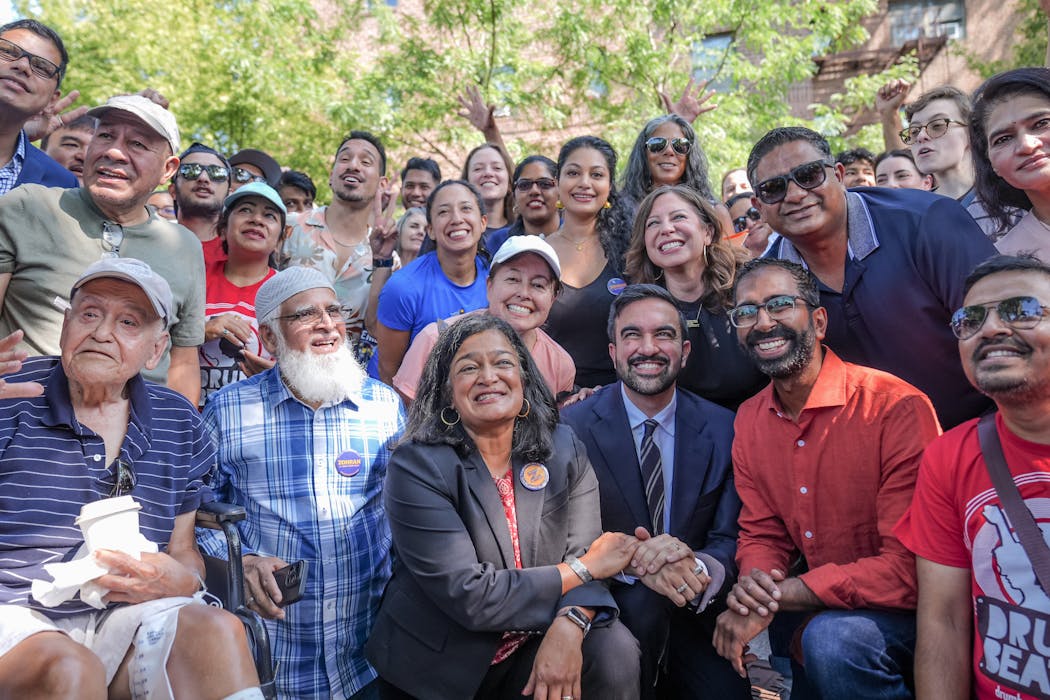
Zohran Mamdani’s child care plan could transform New York and beyond

Source: The Conversation – USA – By Simon Black, Associate Professor of Labour Studies, Brock University

Assembly member Zohran Mamdani attends a news conference on universal child care at Columbus Park Playground on Nov. 19, 2024, in New York City. Michael M. Santiago/Getty Images

Zohran Mamdani, the 34-year-old New York State Assembly member and democratic socialist, was elected New York City’s mayor on Nov. 4, 2025, after pledging to make the city more affordable through policies that include freezing rents, providing free public buses and a network of city-owned grocery stores.

During his campaign, Mamdani’s promises clearly resonated with New Yorkers struggling with the high cost of living.

Of all of Mamdani’s campaign commitments, free high-quality child care for every New Yorker from 6 weeks to 5 years old – while boosting child care workers’ wages to match that of the city’s public school teachers – could be the most transformative.

The cost of child care in New York City is expensive. More than 80% of families with young children cannot afford the average annual cost of US$26,000 for center-based care. A recent study found that families with young children are twice as likely to leave the city as those without children. The study identified housing and child care costs as key drivers of migration out of the city.

New York’s child care problem mirrors a nationwide system that is seen by many experts as broken. U.S. families spend between 8.9% and 16% of their median income on full-day care for one child. And prices have been rising: Between 1990 and 2024, the cost of day care and preschool rose 263%, much faster than overall inflation.

Despite high prices, child care workers are poorly paid: In 2024, the median pay for child care workers, who are mostly women and often women of color, was $15.41 an hour, or $32,050 a year. That’s nearly at the bottom of all occupations when ranked by annual pay. Additionally, child care programs face high turnover, and it’s difficult for them to recruit and retain qualified staff. Program quality suffers as a result.

As a feminist scholar who has written extensively about child care, I believe Mamdani’s promise of free universal child care, with decent pay for child care staff, could transform the politics and the reality of child care in New York and beyond.

An example to the nation

During the Great Depression, the Works Projects Administration, a New Deal agency created to combat unemployment, established 14 emergency nursery schools in New York. Opened between 1933 and 1934, these schools were primarily intended to offer employment opportunities to unemployed teachers, but they also became a form of de facto child care for parents employed on various work-relief projects.

With the onset of World War II, rising numbers of women took up jobs in the city’s war industries.

In 1941, the lack of adequate child care prompted the administration of Mayor Fiorello La Guardia to fund a handful of already existing nursery schools, including the New Deal nurseries whose federal funding had dried up. New York became the only U.S. city to provide publicly subsidized child care services.

New York provided an example to the nation, and between 1943 and 1945, wartime child care centers were established in hundreds of cities under the federal government’s Lanham Act of 1941. It’s the closest the U.S. has come to establishing a universal child care system.

While most wartime child care centers were shuttered at war’s end, in New York a citywide grassroots mobilization of parents forced the city to keep its centers operating. It marked the first peacetime allocation of municipal tax dollars for child care programs.

People hold signs at a news conference.
People hold signs as they attend a news conference at Columbus Park Playground, Nov. 19, 2024, in New York City.
Michael M. Santiago/Getty Images

Building blocks

In the 1960s, under the liberal administration of Mayor John Lindsay, public child care in New York City was expanded, and in 1967 child care workers organized a union, AFSCME Local 205 Day Care Employees.

After a bitter three-week strike in 1969 to protest low wages and poor working conditions, child care workers won a contract that included a wage scale comparable to that of elementary school teachers in the city’s public school system. The contract also included a training program that allowed them to upgrade their skills and get credit for it.

When President Richard Nixon vetoed federal child care legislation in 1971 that would have provided federal funding for child care programs across the nation, New York’s child care movement took to the streets to demand universal child care, even if the federal government refused to fund it. Groups like the Day Care Forum and the Committee for Community Controlled Child Care staged demonstrations on the city’s Triborough Bridge – since renamed the Robert F. Kennedy Bridge – and set up a one-day “model day care center” on the lawn of City Hall.

Public child care services survived the city’s fiscal crisis of 1975, largely due to the activism of working-class communities who fought against day care closures.

Though far from universal, the child care system in New York today boasts the largest publicly supported system in the country, and can serve as the building blocks for Mamdani’s plan.

Transformative beyond New York

Mamdani’s campaign estimated that his universal child care plan would cost $6 billion annually. To fund his policies, Mamdani has proposed an increase of the state’s corporate tax rate and raising the city’s income tax by 2 percentage points on New Yorkers earning more than $1 million a year. While Mamdani will need the assistance of Gov. Kathy Hochul to raise taxes, Hochul supports universal child care, even if she disagrees on how to pay for it.

Universal child care has positive economic impacts, including more women in the workforce and more money in the pockets of parents to spend in the economy. Research from the liberal Center for American Progress concluded that the availability of affordable high-quality child care would lead 51% of stay-at-home parents to find work, and about a third of employed parents to work more hours.

In New York, the disposable income of families could increase by up to $1.9 billion due to the avoidance of child care costs.

One year from the U.S. midterms, Americans remain worried about the cost of basic needs. And majorities of both Democrat and Republican voters say the cost of child care is a major problem, and they want government to prioritize helping families pay for it.

If he can find the money to pay for it, with universal child care, Mamdani could blaze a trail that other policymakers follow.

The Conversation

Simon Black does not work for, consult, own shares in or receive funding from any company or organization that would benefit from this article, and has disclosed no relevant affiliations beyond their academic appointment.

ref. Zohran Mamdani’s child care plan could transform New York and beyond – https://theconversation.com/zohran-mamdanis-child-care-plan-could-transform-new-york-and-beyond-268462

Dick Cheney’s expansive vision of presidential power lives on in Trump’s agenda

Source: The Conversation – USA – By Graham G. Dodds, Professor of Political Science, Concordia University

Vice President Dick Cheney appears at a Washington D.C., event in 2007. AP Photo/Charles Dharapak

This is an updated version of a story that first published on Oct. 7, 2025.

Former Vice President Dick Cheney will be remembered for many things. He was arguably the most powerful vice president in American history. He was a paragon of conservatism. He was the
architect of many of the more extreme measures in President George W. Bush’s “war on terror.”

But Cheney’s legacy, after his death on Nov. 3, 2025, will also include a crucial development that dates back a half-century, when he served as President Gerald Ford’s chief of staff. Based on his experience in the Ford administration, Cheney felt that Congress had overreacted in its efforts to rein in the presidency after the abuses of President Richard Nixon. He thought that the assertive Congress of the 1970s had gone too far and had emasculated the presidency, making it nearly impossible for the president to get things done.

As Cheney told an interviewer in 2005: “I do have the view that over the years there had been an erosion of presidential power and authority, that it’s reflected in a number of developments – the War Powers Act. … I am one of those who believe that was an infringement upon the authority of the President. … A lot of the things around Watergate and Vietnam, both, in the ’70s served to erode the authority, I think, the President needs to be effective especially in a national security area.”

Cheney’s experience in the Ford years set in place a decades-long effort to enhance presidential power, to reinvigorate an office that he believed Congress had wrongly diminished. When Bush surprisingly picked Cheney to be his vice president in July 2000, Cheney finally had a chance to right that perceived wrong.

Bush was happy to expand his own power, and the Bush administration made bold assertions of presidential power in a variety of areas. In many instances, Bush and others sought to justify his actions by invoking the unitary executive theory, a conservative thesis that calls for total presidential control over the entire executive branch.

Now, nearly two decades later, President Donald Trump is using this theory to push his agenda. He set the tone for his second term by issuing 26 executive orders, four proclamations and 12 memorandums on his first day back in office. The barrage of unilateral presidential actions has not yet let up.

These have included Trump’s efforts to remove thousands of government workers and fire several prominent officials, such as members of the Corporation for Public Broadcasting and the chair of the Commission on Civil Rights. He has also attempted to shut down entire agencies, such as the Department of Education and the U.S. Agency for International Development.

For some scholars, these actions appear rooted in the psychology of an unrestrained politician with an overdeveloped ego.

But it’s more than that.

As a political science scholar who studies presidential power, I believe Trump’s recent actions mark the culmination of the unitary executive theory, which is perhaps the most contentious and consequential constitutional theory of the past several decades.

A prescription for a potent presidency

In 2017, Trump complained that the scope of his power as president was limited: “You know, the saddest thing is that because I’m the president of the United States, I am not supposed to be involved with the Justice Department. I am not supposed to be involved with the FBI, I’m not supposed to be doing the kind of things that I would love to be doing. And I’m very frustrated by it.”

The unitary executive theory suggests that such limits wrongly curtail the powers of the chief executive.

Formed by conservative legal theorists in the 1980s to help President Ronald Reagan roll back liberal policies, the unitary executive theory promises to radically expand presidential power.

There is no widely agreed upon definition of the theory. And even its proponents disagree about what it says and what it might justify. But in its most basic version, the unitary executive theory claims that whatever the federal government does that is executive in nature – from implementing and enforcing laws to managing most of what the federal government does – the president alone should personally control it.

This means the president should have total control over the executive branch, with its dozens of major governmental institutions and millions of employees. Put simply, the theory says the president should be able to issue orders to subordinates and to fire them at will.

President Donal Trump appears seated in the oval office.
President Donald Trump signs executive orders in the Oval Office next to a poster displaying the Trump Gold Card on Sept. 19, 2025.
AP Photo/Alex Brandon

The president could boss around the FBI or order the U.S. attorney general to investigate his political opponents, as Trump has done. The president could issue signing statements – a written pronouncement – that reinterpret or ignore parts of the laws, like George W. Bush did in 2006 to circumvent a ban on torture. The president could control independent agencies such as the Securities and Exchange Commission and the Consumer Product Safety Commission. The president might be able to force the Federal Reserve to change interest rates, as Trump has suggested. And the president might possess inherent power to wage war as he sees fit without a formal authorization from Congress, as officials argued during Bush’s presidency.

A constitutionally questionable doctrine

A theory is one thing. But if it gains the official endorsement of the Supreme Court, it can become governing orthodoxy. It appears to many observers and scholars that Trump’s actions have intentionally invited court cases by which he hopes the judiciary will embrace the theory and thus permit him to do even more. And the current Supreme Court appears ready to grant that wish.

Until recently, the judiciary tended to indirectly address the claims that now appear more formally as the unitary executive theory.

During the country’s first two centuries, courts touched on aspects of the theory in cases such as Kendall v. U.S. in 1838, which limited presidential control of the postmaster general, and Myers v. U.S. in 1926, which held that the president could remove a postmaster in Oregon.

In 1935, in Humphrey’s Executor v. U.S., the high court unanimously held that Congress could limit the president’s ability to fire a commissioner of the Federal Trade Commission. And in Morrison v. Olson the court in 1988 upheld the ability of Congress to limit the president’s ability to fire an independent counsel.

Some of those decisions aligned with some unitary executive claims, but others directly repudiated them.

Warming up to a unitary executive

In a series of cases over the past 15 years, the Supreme Court has moved in an unambiguously unitarian, pro-presidential direction. In these cases, the court has struck down statutory limits on the president’s ability to remove federal officials, enabling much greater presidential control.

These decisions clearly suggest that long-standing, anti-unitarian landmark decisions such as Humphrey’s are on increasingly thin ice. In fact, in Justice Clarence Thomas’ 2019 concurring opinion in Seila Law LLC v. CFPB, where the court ruled the Consumer Financial Protection Bureau’s leadership structure was unconstitutional, he articulated his desire to “repudiate” the “erroneous precedent” of Humphrey’s.

Several cases from the court’s emergency docket, or shadow docket, in recent months indicate that other justices share that desire. Such cases do not require full arguments but can indicate where the court is headed.

In Trump v. Wilcox, Trump v. Boyle and Trump v. Slaughter, all from 2025, the court upheld Trump’s firing of officials from the National Labor Relations Board, the Merit Systems Protection Board, the Consumer Product Safety Commission and the Federal Trade Commission.

Previously, these officials had appeared to be protected from political interference.

President George W. Bush appears with several soldiers.
President George W. Bush signed statements in 2006 to bypass a ban on torture.
AP Photo/Pablo Martinez Monsivais, File

Total control

Remarks by conservative justices in those cases indicated that the court will soon reassess anti-unitary precedents.

In Trump v. Boyle, Justice Brett Kavanaugh wrote, “whether this Court will narrow or overrule a precedent … there is at least a fair prospect (not certainty, but at least a reasonable prospect) that we will do so.” And in her dissent in Trump v. Slaughter, Justice Elena Kagan said the conservative majority was “raring” to overturn Humphrey’s and finally officially embrace the unitary executive.

In short, the writing is on the wall, and Humphrey’s may soon go the way of Roe v. Wade and other landmark decisions that had guided American life for decades.

As for what judicial endorsement of the unitary executive theory could mean in practice, Trump seems to hope it will mean total control and hence the ability to eradicate the so-called “deep state.” Other conservatives hope it will diminish the government’s regulatory role.

Kagan recently warned it could mean the end of administrative governance – the ways that the federal government provides services, oversees businesses and enforces the law – as we know it:

“Humphrey’s undergirds a significant feature of American governance: bipartisan administrative bodies carrying out expertise-based functions with a measure of independence from presidential control. Congress created them … out of one basic vision. It thought that in certain spheres of government, a group of knowledgeable people from both parties – none of whom a President could remove without cause – would make decisions likely to advance the long-term public good.”

If the Supreme Court officially makes the chief executive a unitary executive, the advancement of the public good may depend on little more than the whims of the president, a state of affairs normally more characteristic of dictatorship than democracy.

Judicial approval of the unitary executive theory might well have pleased Cheney by enshrining a significant means of enhancing presidential power. But ironically, the former vice president would be displeased for such power to be accessible to the current president, whom Cheney criticized, calling Trump a “threat to our republic.”

The Conversation

Graham G. Dodds does not work for, consult, own shares in or receive funding from any company or organization that would benefit from this article, and has disclosed no relevant affiliations beyond their academic appointment.

ref. Dick Cheney’s expansive vision of presidential power lives on in Trump’s agenda – https://theconversation.com/dick-cheneys-expansive-vision-of-presidential-power-lives-on-in-trumps-agenda-269071

SETI’s ‘Noah’s Ark’ – a space historian explores how the advent of radio astronomy led to the USSR’s search for extraterrestrial life

Source: The Conversation – USA – By Gabriela Radulescu, Guggenheim Postdoctoral Fellow, Smithsonian Institution

The planetary radar, built in 1960 in Crimea, from which the Morse signal ‘MIR, Lenin, USSR’ was sent in November 1962. National Radio Astronomy Observatory Archive

As humans began to explore outer space in the latter half of the 20th century, radio waves proved a powerful tool. Scientists could send out radio waves to communicate with satellites, rockets and other spacecraft, and use radio telescopes to take in radio waves emitted by objects throughout the universe.

However, sometimes radio telescopes would pick up the artificial radio signals from telecommunications. This interference threatened sensitive astronomy observations, causing inaccurate data and even damaging equipment. While this interference frustrated scientists, it also sparked an idea.

During the Cold War, a new field emerged at the intersection of radio astronomy and radio communications. It put forward the idea that astronomers could search for radio communications from possibly existing extraterrestrial civilizations. Astronomy usually dealt with observing the universe’s natural phenomena. But this new field made the detection of technologically, or artificially produced radio waves, the object of a natural science.

This field has continued today and is now called the search for extraterrestrial intelligence, or SETI. SETI encompasses all that scientists do to search for intelligent life beyond Earth. It includes one of the original uses of radio telescopes: to study signals from across the galaxy in hopes of detecting intelligent messages.

When the idea behind SETI was first proposed and pursued in the 1960s, only two countries, the U.S. and the USSR, had the technical capability for it. As the only space powers at the time, they were the key actors affected by radio frequency interference.

As a historian of science, I’ve worked to make sense of what happened throughout the history of Soviet SETI during the space race by analyzing a range of primary sources. SETI captured the scientific imagination of many prominent Soviet astronomers in the 1960s and early 1970s.

Astronomers have not yet confirmed any detection of radio signals – or any other kinds of signs – from extraterrestrial civilizations. But many scientists are still searching, even as their bold ideas run into obstacles. Some evidence suggests humans might be the only intelligent life in the universe.

Soviet SETI: The golden age of radio astronomy

SETI is intertwined with the profound changes brought by radio astronomy. Up until the second part of the 20th century, scientists could see astronomical objects and phenomena only in optical or visible light. Optical light is the same kind of light that the human eye is sensitive to.

After World War II, scientists figured out that they could peacefully use radar antennas, developed for use in that war, to detect radio signals coming from objects out in the universe. Deciphering these signals allowed researchers to study astronomical objects in the universe. They learned, for example, about the most abundant element: hydrogen.

In the former Soviet Union, the prominent radio astronomy pioneer Iosif Samuilovich Shklovsky played a key role in detecting radio signals from hydrogen.

Scientists knew that every chemical element would absorb certain wavelengths of light and reflect others, and the light signals that an object absorbed or reflected could tell astronomers what element it was. Most hydrogen could not be observed directly in optical light, so astronomers didn’t spot it out in space until they started looking beyond the visible light spectrum.

Shklovsky figured out how to detect hydrogen with radio waves, which helped astronomers map the distribution and motion of hydrogen gas in and between galaxies.

Historians generally consider the year 1960 the start of the golden age of radio astronomy. After the detection of hydrogen, astronomers discovered previously unknown types of stars, such as pulsars and quasars. These phenomena offered scientists new insights into the nature of astrophysical phenomena and fundamental physics.

A journal cover in Russian
The Priroda issue in which Shklovsky’s article ‘Is Communication with Intelligent Beings of Other Planets Possible?’ was published.
Priroda/RAS

Shklovsky later grew fascinated with the possibility of using radio waves to contact other intelligent beings in the universe. In 1960, he published an article on this topic in one of the country’s most prestigious scientific journals.

Shklovsky’s article soon expanded into a widely popular book called “Universe, Life, Intelligence,” published in 1962. That same year, the USSR’s Academy of Sciences sent its first radio message in the direction of Venus from a radar in Crimea.

The experiment involved bouncing radio signals off the surface of Venus to transmit the following words using Morse code: Lenin, USSR and mir, which in Russian means both world and peace. Even though statistically increasing radio interference risk, this message was mainly symbolic. The Soviet Union wanted to depict its technological might and wasn’t expecting to communicate with extraterrestrials. Soviet SETI was thus not yet a real pursuit.

A man sitting at a desk, writing with a pen.
Iosif S. Shklovsky at a SETI conference in Soviet Russia in 1975.
NRAO/AUI/NSF

Starting an organized search

Shklovsky and the majority of other radio astronomers pursuing the search for extraterrestrial intelligence were all located in central Russia at the time. The USSR Academy of Sciences was also located there. But this group needed more formal measures to move their search from a few initiatives into a coordinated effort.

Due to concerns over unwanted public attention, the scientists organized a conference far from Moscow, at the Byurakan Astrophysical Observatory in the Soviet Republic of Armenia, in 1964. At this conference, researchers formed a group specifically dedicated to studying artificial radio signals from space. With this group, SETI became a top-down, state-led activity.

A journal cover reading 'CETI' in Cyrillic – which stands for SETI in English – in big letters, with a picture of a galaxy
A 1971 Conference Proceedings volume focused on SETI (CETI in Cyrillic) and was published in Russian.

With this validation, scientists could now theoretically look for artificial signals, potentially from an alien origin. However, any discussions about artificial radio signals were subject to strict government surveillance, given the fact that military satellites depended on them, too.

Soviet scientists faced several obstacles. For example, their own government’s secrecy made coordination difficult. The Cold War also set limits on developing SETI internationally. However, they had a green light to search and study peculiar signals they suspected had artificial origin.

International collaboration

Efforts to collaborate internationally on artificial signals culminated in 1971 with a symposium, again at Byurakan. There, about 50 scientists – the majority from the U.S. and the USSR, but also some from Czechoslovakia, Hungary, the U.K. and Canada – agreed to disagree on how to best conduct SETI.

Some in attendance compared this gathering to Noah’s Ark, because an almost equal number of prominent scientists from East and West of the Iron Curtain managed to meet that year. And the gathering took place in Armenia at the foot of Mount Ararat, located in neighboring Turkey. This mountain is where archaeologists believe Noah’s Ark may have beached.

After almost a week of discussion at Byurakan, the two geopolitical blocks designated an official SETI group. That group still exists today, and it still connects researchers all around the world who conduct SETI research. Given the secrecy around radio signals in space, this international SETI group marked a momentous diplomatic achievement at the height of the Cold War.

A black and white photo of a group of people gathered by a large hill, and a black and white photo of writing reading 'Pamir Expedition, Search for Single pulses from Extra-ter. civilizations'
Postcard with Soviet scientists conducting SETI experiments in the Pamir region of Tajikistan, with a note on the back to their U.S. correspondent.
NRAO/AUI/NSF

SETI started in the Soviet Union with a few strong Moscow-based initiatives. It continued through group events in Armenia – from the first state-level Soviet conference to the international one.

SETI is the first and only domain of astronomy to study artificial radio signals themselves. It indirectly addressed radio frequency interference during a time when these frequencies were highly unregulated.

Stakeholder countries eventually addressed their radio frequency interference issues with international agreements on radio frequency usage and allocation. An international committee approved a feasible and comprehensive radio frequency allocation plan for the first time in the 1970s. This plan has been revised and renewed ever since. Today, space scientists and astronomers use an internationally agreed upon plan to minimize this interference.

Remarkably, SETI began even before this allocation plan. SETI continues its rich legacy today by continuing to search for signals – and along the way discovering new astrophysical objects and phenomena.

The Conversation

Gabriela Radulescu has received funding from the Smithsonian National Air and Space Museum as a Guggenheim Postdoctoral Fellow (2024-2025), from the American Institute of Physics for a Grant-in-Aid, as well as from the Elsa-Neumann Scholarship and the Technical University of Berlin Coordinating Office for Women’s Advancement and Gender Equality for her doctoral research.

ref. SETI’s ‘Noah’s Ark’ – a space historian explores how the advent of radio astronomy led to the USSR’s search for extraterrestrial life – https://theconversation.com/setis-noahs-ark-a-space-historian-explores-how-the-advent-of-radio-astronomy-led-to-the-ussrs-search-for-extraterrestrial-life-262402

2 ways you can conserve the water used to make your food

Source: The Conversation – USA (2) – By Huma Tariq Malik, Ph.D. Student in Soil and Crop Sciences, Colorado State University

Irrigation equipment waters an alfalfa field in Kansas. AP Photo/Charlie Riedel

As the world’s climate warms and droughts and water shortages are becoming more common, farmers are struggling to produce enough food. Farmers continue to adapt, but there are ways for you to help, too.

For decades, farmers have sought to conserve water in agriculture, with a focus on improving irrigation efficiency. That has included decreasing the practice of flood irrigation, in which water flows through trenches between rows of plants. Instead, many farmers are adopting more precise methods of delivering water to plants’ roots, such as sprinklers and drip systems.

In recent years, policymakers, researchers and consumers have come to look more closely at opportunities to conserve water throughout the entire process of growing, shipping, selling and eating food. Working with colleagues, we have identified several key ways to reduce water used in agriculture – some of which directly involve farmers, but two of which everyone can follow, to help reduce how much water is used to grow the food they eat.

Some work for farmers

Farmers can match crops to local land, water and climate conditions to reduce stress on scarce resources and make food production more sustainable in the long run. That could include reducing the amount of alfalfa and other hay crops used to feed livestock, or swapping out wheat and sorghum and instead planting corn and potatoes.

The condition of the soil also matters. Many farmers have focused on short-term productivity, relying on fertilizers or frequent tillage to boost yields from one season to the next. But over time, those practices wear down the soil, making it less fertile and less able to hold water.

Soil is not just a surface to grow things on. It is a living system that can be built and fed or depleted. Practices such as planting cover crops in the off-season to protect the soil, reducing tillage, applying compost and rotating different types of crops can all help soil hold more water and support crops even during droughts.

A choice for consumers

Adapting on-farm practices addresses only part of the water conservation effort. While crops are grown in fields, they move through a vast network of processors, distributors, supermarkets and households before being eaten, wasted or lost. At each link in this chain, consumers’ choices determine how much agricultural water is ultimately saved.

People’s dietary preferences, in particular, play a major role in agricultural water use. Producing meat requires significantly more water than growing plant-based foods.

Per capita, Americans consume nearly three times the global average amount of meat each year.

While eliminating meat altogether is not everyone’s goal, even modest shifts in diet, whether reducing overall meat consumption or selecting proteins that use less water to produce, can ease the strain. Producing a pound of beef requires an estimated 1,800 gallons of water, compared with about 500 gallons for a pound of chicken.

Replacing all meat with the equivalent quantities of plant-based foods with comparable nutrition profiles could cut the average American’s food-related water use by nearly 30%. Even replacing a small amount of meat with plant-based foods or meats that require less water can make a difference.

While a single meal may seem inconsequential, if multiplied across millions of households these choices translate into meaningful water savings.

Discarded food and plant waste sits in a pile.
How much water did it take to grow all this discarded food?
Sarah Reingewirtz/MediaNews Group/Los Angeles Daily News via Getty Images

A second savings opportunity

Perhaps the simplest and most powerful step people can take to save water used in agriculture is to cut back on food waste.

In the United States, 22% of total water use is tied to producing food that ultimately goes uneaten.

In developing countries, losses often result from limited storage and transportation, but in high-income nations like the United States, most waste happens at the retail and household level. In the U.S., households alone account for nearly 50% of all food discarded nationwide.

This creates a major opportunity for everyone to contribute to water conservation. Understanding the water embedded in different foods can make people more mindful about what ends up in the trash.

And on top of feeling good about helping the environment, there’s a financial reward: Wasting less food also means saving the money spent on food that would have gone to waste.

The Conversation

Huma Tariq Malik receives funding from USDA.

Thomas Borch receives funding from NSF, USDA, and NOAA.

ref. 2 ways you can conserve the water used to make your food – https://theconversation.com/2-ways-you-can-conserve-the-water-used-to-make-your-food-267501

Oklahoma tried out a test to ‘woke-proof’ the classroom. It was short-lived, but could still leave a mark

Source: The Conversation – USA (2) – By Emery Petchauer, Visiting Professor, Teachers College, Columbia University

Oklahoma’s short-lived PragerU teacher assessment was one of the final projects under former Superintendent Ryan Walters, who resigned in September 2025. eyegelb/iStock/Getty Images Plus

Oklahoma has become a testing ground for reshaping public school curriculum to reflect conservative viewpoints, Make America Great Again priorities and a push for Christian nationalism in the classroom.

Oklahoma’s former state education Superintendent Ryan Walters oversaw several controversial education policies in recent years, including mandating in 2024 that all Oklahoma public teachers incorporate the Bible into their lesson plans.

Walters resigned from his position in September 2025 to lead Teacher Freedom Alliance, a conservative advocacy group that opposes teachers unions.

One unprecedented move Walters made was adopting a teacher assessment called The America-First Assessment, designed by PragerU, a conservative nonprofit media company. Walters said the purpose of this exam, which went live in August 2025, was to screen out “woke indoctrination.”

By authorizing this assessment, Walters signed off on a conservative and far-right political organization having a say in which prospective teachers from out of state receive their Oklahoma teaching licenses.

The exam was short-lived. Walters’ replacement, Lindel Fields, announced at the end of October 2025 that Oklahoma would no longer use this assessment. Fields also rescinded the Bible mandate for Oklahoma schools.

But other states could still adopt the exam, free of charge. The exam and its controversy offers a window into the current politicization of state education systems, this time with respect to the licensing of teachers.

As an education researcher, I have written about other teacher assessments and some of the issues surrounding them, such as screening out Black teachers.

Walter’s “anti-woke” teacher exam is a unique kind of experiment. The test was not made by a professional assessment company and does not legitimately assess professional knowledge related to the subjects teachers teach.

A white man with brown hair, a navy blazer and white shirt stands in front of an American flag and bows his head, alongside other people who stand near him.
Ryan Walters bows his head in prayer alongside the state’s Board of Education members in April 2023, during his time as Oklahoma’s education superintendent.
Sue Ogrocki/Associated Press

A politicized test for teachers

The America-First exam consists of 34 multiple-choice questions that ask about the U.S. Constitution, government, religious liberty, history and Supreme Court cases. One question asks, “What are the first three words of the Constitution?” Another question asks, “What does the Second Amendment protect?” Other questions inquire about gender and sex, with questions like, “What is the fundamental biological distinction between males and females?” and “Which chromosome pair determines biological sex in humans?”

Walters made the political purpose of the exam clear.

“We have to make sure that the teachers in our classrooms, as we’re recruiting these individuals, aren’t a bunch of woke, Marxist activists,” Walters said in August 2025.

Walters has also said the exam was designed to specifically root out liberal teacher applicants who might fill teacher vacancies in Oklahoma and bring progressive training on race and gender with them, or what Walters called “blue state indoctrination.”

When the test went live in August, it expanded to all teachers from other states trying to get a license to teach in Oklahoma.

An exam you cannot fail

The America-First Assessment is not like the typical licensure exams made by professional assessment companies. These other exams cover the specific subject matter teachers should know to do their job: math for math teachers, science for science teachers, and so on.

Instead of a subject-specific focus, the America-First Assessment is mostly aligned with President Donald Trump’s “America first” talking points, particularly through its focus on gender and sex.

The most striking aspect of the exam, however, is that it is impossible to fail. If you don’t know the first three words of the U.S. Constitution, you can guess answers until you get it right. In fact, the test will advance to the next question only after you register a correct answer. Everyone who finishes the test will get 100% correct.

As a result, as some observers have pointed out, the exam resembles a political ideology test and not a legitimate assessment of professional knowledge.

Unlike the SAT, which considers its content proprietary, legally protected information, many of the America-First Assessment questions are publicly available.

Further, unlike established exams such as the SAT and GRE, the America-First exam has no technical information about how it was designed or what the questions are supposed to measure. As a result, the exam resembles a “MAGA loyalty test,” according to American Federation of Teachers President Randi Weingarten.

A conservative media company expands into teacher assessment

The America-First Assessment’s unique format and political content reflect the priorities of PragerU, the conservative media company that created it.

Conservative radio host Dennis Prager founded PragerU in 2009. The company produces educational and entertainment videos rooted in conservative ideology.

PragerU’s more than 5,000 online videos include short segments such as “Make Men Masculine Again,” “How Many Radical Islam Sleepers are in the United States?” and “America Was Founded on Freedom Not Slavery.” Prominent far-right influencers including Ben Shapiro, Candace Owens and Charlie Kirk have appeared in videos.

PragerU’s primary YouTube page has more than 3.4 million subscribers.

Scholarly analysis of PragerU videos have found the content minimizes the impact of slavery and promotes misinformation on topics including climate change.

In its children’s video “Frederick Douglass: The Outspoken Abolitionist,” the fictionalized cartoon of Douglass warns children to “stay away from radicals” who want to change the American system rather than work within it. “Our system is wonderful, and our Constitution is a glorious liberty document. We just need to convince enough Americans to be true to it,” he concludes.

In 2021, the company launched PragerU Kids, an offshoot targeting school-age children and educators with lesson plans, worksheets and other learning materials tied to its videos. Some other states, including Florida, New Hampshire and Montana, have approved PragerU’s videos as curriculum for their public schools to consider using since 2023.

The company’s move into teacher assessments in 2025 expands its influence beyond curriculum into who can earn a teaching license.

A group of books are seen stacked together.
Copies of the Bible are displayed in August 2024 at the Bixby High School library in Bixby, Okla.
Joey Johnson/Associated Press

A possible strategy for other states

Both Walters and PragerU CEO Marissa Streit pitched the exam as an option for all “pro-America” states at its launch in August 2025. Some conservative policy analysts have also praised this strategy’s goals of ridding public schools of all “woke” teachers.

As a result, it is unlikely this is the last people will hear of PragerU or other private media companies trying to screen teachers.

The Conversation

Emery Petchauer does not work for, consult, own shares in or receive funding from any company or organization that would benefit from this article, and has disclosed no relevant affiliations beyond their academic appointment.

ref. Oklahoma tried out a test to ‘woke-proof’ the classroom. It was short-lived, but could still leave a mark – https://theconversation.com/oklahoma-tried-out-a-test-to-woke-proof-the-classroom-it-was-short-lived-but-could-still-leave-a-mark-266546

Singles’ Day is a $150B holiday in China. Here’s why I think ‘11/11’ will catch on in the US

Source: The Conversation – USA (2) – By Peter McGraw, Professor of Marketing and Psychology, University of Colorado Boulder

On Nov. 11 each year, a curious holiday takes over China. What began among Nanjing University students in the 1990s as a tongue-in-cheek counter to Valentine’s Day has exploded into the world’s largest shopping event: Singles’ Day.

The date, 11/11, was chosen because the four ones resemble “bare sticks,” Chinese slang for singles. Today, the holiday generates more than US$150 billion in annual sales, exceeding those on Black Friday and Amazon Prime Day combined.

As a bachelor, behavioral economist and business school professor, I study how single living is transforming consumer behavior and market dynamics. My work has convinced me that Singles’ Day, or something like it, could resonate far beyond Asia. Here’s why.

A profitable solo boom, starting in Asia

The unmarried will soon make up the majority in many countries, and this shift is already reshaping culture and commerce across Asia.

It’s not a coincidence that Singles’ Day emerged in China. The country’s one-child policy, in effect from 1980 to 2015, led many families to prefer sons – creating a gender imbalance that left millions of men without potential female partners. At the same time, rising education and career opportunities have given many women the independence to forgo traditional marriage altogether.

You can see a similar pattern across East Asia. In Japan, single-person households now outnumber those of married couples with children. In South Korea, one-person households reached nearly 36% in 2023, the highest share on record. Together, these shifts are fueling what Japanese call “ohitorisama,” or the “party of one,” and what Koreans describe as “honjok,” or “alone tribe,” cultures: movements that celebrate independence and self-reliance.

Businesses across Asia have seized the opportunity, catering to independent lifestyles with offerings such as single-seat karaoke booths and movie theaters designed for solo patrons. Singles’ Day is a prime example of companies capitalizing on this shift.

Each year, retailers across Asia embrace the occasion with themed promotions, presales and limited-edition product launches. Companies such as Xiaomi release exclusive smartphones, while Nike introduces new sneakers every Singles’ Day. Even airlines have joined in: Singapore’s Jetstar Asia once offered 111,111 discounted seats, positioning solo travel as an empowering experience.

Singles’ Day 2024 saw unprecedented interest – and sales – outside of China, CNBC noted.

Singles’ Day channels massive spending power – reframing singlehood as something to celebrate rather than lament – and shows how a retail event can feed a cultural shift. In the U.S. and across much of the rest of the world, meanwhile, businesses remain wed to an outdated assumption: that marriage is everyone’s destiny. It’s not.

Single in America

Right now, half of American adults are unmarried, and half of those singles aren’t seeking a relationship.

In 1960, only 10% of American adults would remain single for life. Today, some forecasts show that 25% of millennials, who are now between 29 and 44, and 33% of Gen Z who are 13 to 28, will never marry. While the average age of first marriage was just 21 in 1960, today it has risen to 29.

Through my Solo project – which includes a book, podcast and TED talk – I explore how widely single people’s goals vary, both in relationships and beyond.

By understanding singles’ diverse goals and lifestyles, American businesses can gain a competitive edge with targeted communication, innovative products and tailored services. Singles aren’t a monolith. My research identifies four main types:

  • “Somedays” aspire to find “the one” and settle down. They are the group businesses usually market to.

  • “Just Mays” share that goal but aren’t waiting around for it – they’re investing in homes, traveling solo and pursuing independent ambitions in the meantime.

  • “New Ways” reject the idea that traditional marriage is the default, experimenting with models such as “living apart together,” polyamory or platonic partnerships.

  • “No Ways” are opting out of the dating market entirely. Most do so not out of bitterness but because they have more important goals – or because they simply enjoy single life.

This diversity matters. “Somedays” may respond to dating apps and matchmaking services. “Just Mays” and “New Ways” gravitate toward experiences, hobbies and personal growth. “No Ways” are alienated by romance-centric messaging and instead embrace autonomy and community.

To explore how Singles’ Day might be received in North America, I surveyed nearly 400 U.S. singles ages 24 to 59. The most common ways they said they’d celebrate were by finding a date, treating themselves to a gift or practicing self-care.

American companies and the solo economy

In many industries, a 2% demographic shift ought to trigger an all-hands marketing meeting. So how can the decades-long rise of single living still go largely overlooked by most companies in the U.S.?

To be fair, there have been glimmers of recognition in recent years. For example, in 2021, Visible Wireless repositioned its “family plans” to “friends and family plans without the family drama.” In 2024, Norwegian Cruise Line introduced studio cabins for solo travelers, tackling the long-standing and dreaded “single supplement.” Similarly, IKEA, after offering a Valentine’s dinner only for couples in 2024, pivoted this year to an inclusive promotion: “Bring a loved one, a good friend, or the whole family.”

But those are the exceptions rather than the rule. What should U.S. brands do to appeal to this growing market? Here’s my advice:

  • Rethink assumptions about dating and belonging. Not all singles seek romance. Create meaningful nonromantic experiences that reflect solo lifestyles – singles-themed events, community nights or “bring-a-friend (or don’t)” offers.

  • Segment by goals, not just age. A 25-year-old solo traveler and a 60-year-old empty-nester may both respond to a message about independence.

  • Tailor offerings for people who live – and do things – alone. The “rightsizing” trend is already underway: smaller grocery packs, single-serve meal kits, compact appliances and studio-friendly furniture. Travel and entertainment can follow suit with solo pricing, seating and perks that don’t penalize independence.

I teach my business students to ask, “Is there a market?” and “Can we serve it profitably?” The answers here are obvious. Singles are everywhere. They’re dining alone, traveling solo, buying homes and spending billions. And yet they remain largely overlooked in a world built for two.

The rise of Singles’ Day in Asia shows what happens when businesses take singles seriously: consumer innovation, cultural relevance and record-breaking profits. I expect the U.S. will follow – whether reluctantly or enthusiastically. The only question in my mind is: When?

The Conversation

I have a book (“Solo: Building a Remarkable Life of Your Own”) and a podcast (“Solo – The Single Person’s Guide to a Remarkable Life”) that are relevant to this article.

ref. Singles’ Day is a $150B holiday in China. Here’s why I think ‘11/11’ will catch on in the US – https://theconversation.com/singles-day-is-a-150b-holiday-in-china-heres-why-i-think-11-11-will-catch-on-in-the-us-266566

Declining union membership could be making working-class Americans less happy and more susceptible to drug overdoses

Source: The Conversation – USA (2) – By Samia Islam, Professor of Economics, Boise State University

Protesters gather at a union-organized rally outside the U.S. Capitol in February 2025. Allison Robbert/AFP via Getty Images

When fewer people belong to unions and unions have less power, the impact goes beyond wages and job security. Those changes can hurt public health and make people more unhappy.

We’re economists who research labor and health issues. Those are two of the main findings of studies that we have conducted.

More unionization, more happiness

In the first study on this topic that we published in 2023, we found that increasing levels of union membership tends to make working-class people happier.

We zeroed in on a question in the General Social Survey, which the University of Chicago makes available. It asks respondents to choose whether they are “very happy,” “somewhat happy” or “not at all happy” with their life.

We found that, from 1993 to 2018, when the share of workers in counties along the borders of states with and without right-to-work laws who belong to unions rose by 1 percentage point, the average level of happiness for low-income residents moved 15% closer toward being “very happy” – a seemingly modest but noticeable change.

Right-to-work laws let workers skip paying union dues when they’re employed by a company that has negotiated a contract with a labor union. In states without right-to-work laws, those dues are mandatory. As a result, right-to-work laws weaken unions’ ability to negotiate better working conditions and reduce the share of workers who belong to unions.

But a higher rate of union membership didn’t significantly affect the happiness of higher-income people.

Right-to-work laws

The first right-to-work laws were adopted by states in the 1940s. After a long lull, the pace picked up around 2000. These laws were in force in 26 states as of late 2025.

Four of those states made the switch between 2001 and 2015: Oklahoma in 2001, Indiana in 2012, Michigan in 2012 and Wisconsin in 2015. We used data collected in these four states to conduct what is known in economics as an “event study” – a research method that provides before-and-after pictures of a significant change that affects large numbers of people.

Michigan repealed its right-to-work law in 2024, but our data is from 2001-2015, and Michigan became a right-to-work state during that period and remained one for the rest of that time.

Less unionization, more opioid overdoses

In a related working paper that we plan to publish in an upcoming edition of an academic journal, we looked into other effects of right-to-work laws. Specifically, we investigated whether, as more states adopted those laws, the gradual decline in union strength those statutes produce was contributing to an increase in opioid overdoses.

We used a research technique called the synthetic control method to assess whether declining union power has affected the number of opioid overdoses.

We drew our data from a variety of sources, including the Treatment Episode Data Set, the Centers for Disease Control and Prevention’s Multiple Cause of Death database, the Census Bureau’s Current Population Survey, the union membership and coverage database, and the Bureau of Labor Statistics’ Survey of Occupational Injuries and Illness and Census of Fatal Occupational Injuries.

We found that both fatal and nonfatal opioid overdoses increased within six years of the enactment of right-to-work laws in all four of the states we studied.

We primarily found a connection between opioid overdoses and right-to-work laws among men and male teens between ages 16 and 64 – making them of working age – with dangerous jobs, such as roofing or freight moving, and little job security. They were people who tend to feel more job stress because they don’t have control over their work tasks and schedules.

We didn’t observe those same results for women or deaths from non-opioid drugs, such as cocaine.

Lower levels of unionization are linked to weaker job security and reduced workplace protections, previous research has shown. Our work suggests these factors may play a role in increasing demand for opioids.

Declining union membership

The share of U.S. workers who belong to unions has fallen by half in the past four decades, declining from just over 20% in 1983 to a little under 10% in 2024.

Because unions advocate for better and safer working conditions, they can raise wages and living standards for their members. Interestingly, some of these benefits can also extend to people who don’t belong to unions.

An opioid use disorder crisis has devastated communities across the U.S. for more than 25 years. The death toll from drug overdoses soared from 17,500 in 2000 to 105,000 in 2023. The number of overdose deaths did fall in 2024, to about 81,000, but it remains historically high. Most fatal drug overdoses since the crisis began have been caused by opioids.

Throughout this crisis, government policies have focused largely on reducing the supply of prescription opioids, such as OxyContin, and illegal opioids, especially fentanyl, distributed outside the health care system.

Causes of despair

Despite successful interventions to shut down pill mills – clinics that prescribe opioids without a valid medical reason – and expand access to prevention and treatment, drug overdoses remain a leading cause of death.

And we believe that our findings support results from earlier studies that determined despair is not just an emotional or biological reaction – it can also be a response to social and economic conditions.

We are continuing to research the connections between union membership and public health. The next question we are working on is whether a decline in union membership can have a multigenerational impact, going beyond the workers employed today and affecting the lives of their children and grandchildren.

The Conversation

The authors do not work for, consult, own shares in or receive funding from any company or organization that would benefit from this article, and have disclosed no relevant affiliations beyond their academic appointment.

ref. Declining union membership could be making working-class Americans less happy and more susceptible to drug overdoses – https://theconversation.com/declining-union-membership-could-be-making-working-class-americans-less-happy-and-more-susceptible-to-drug-overdoses-264970

Diane Keaton’s $5M pet trust would be over the top if reports prove true – here’s how to ensure your beloved pet is safe after you are gone

Source: The Conversation – USA (2) – By Allison Anna Tait, Professor of Law, University of Richmond

Diane Keaton loved her dog, Reggie.

The award-winning actor, director and real estate entrepreneur frequently posted photos and video clips of the golden retriever on her social media accounts. After she died on Oct. 11, 2025, at 79, some news outlets reported that she left US$5 million of her estimated $100 million estate to her dog.

I’m a law professor who teaches about wills, trusts and other forms of inheritance law. Every semester, I teach my students how they can help clients provide for their pets after death. Because they, like many Americans, love their pets and want to know how to take care of them, this topic always piques their interest.

Diane Keaton was very open about her devotion to her dog, Reggie.

Writing pets into a will

An estimated 66% of all U.S. households include at least one pet. Many Americans consider their cats, dogs, tortoises or other animals to be part of their family, and their spending on those nonhuman relatives is immense. In 2024, they paid a total of about $152 billion for goods and services to feed and otherwise support their pets.

Taking good care of your pets can go beyond buying them treats and sweaters. It can include leaving clear directions to ensure their needs are met once you’re gone. There are several ways that you can do this.

The first is through your will. You can’t give your pet money directly in your will, because the law says that pets are property, like your books or your dishes.

You can, however, leave a bequest, the technical term for a gift to a person or a cause listed in a will, to someone who will be the animal’s caretaker. That bequest can include directions that the money be spent meeting the pet’s needs.

It’s worth it to also name an alternate or contingent caretaker in case the first person you name does not want to or cannot take on that responsibility, or they die before you or the animals you’ve provided for in the will.

Choupette’s life of luxury

German fashion designer, photographer and creative director Karl Lagerfeld, who died in 2019 at 85, was someone who made the mistake of leaving money directly to his fluffy Birman cat, Choupette. It worked out for Choupette, though.

The cat was, according to several reports, still alive in 2025 and eating meals out of the porcelain bowls that Lagerfeld bought for her. Choupette is cared for at great expense and in the utmost luxury by Françoise Caçote, the designer’s former housekeeper. The cat even had a 13th birthday party at Versailles.

Another pet owner who did right by her pet was the comedian, producer and red carpet interviewer Joan Rivers.

Rivers had two rescue dogs in Manhattan and two more dogs in California when she died in 2014 at age 81. Rivers had made provisions for their care in her will.

A petite woman holding a tiny dog stands next to three men on a TV set.
The late Joan Rivers, right, seen on the set of her short-lived talk show in 1987, planned ahead for her dogs’ care.
Bettmann via Getty Images

Creating pet trusts

If you’d like an arrangement that’s more secure than a will, then you might want to opt for a pet trust, another celebrity favorite. These kinds of trusts were not possible until the 1990s, because pets were not considered true beneficiaries – meaning they couldn’t sue the trustee.

But in the 1990s, states began to change their rules to allow for pet trusts. Today, pet trusts are valid in the whole country, although the rules vary slightly from state to state.

To establish a pet trust, you or a lawyer must draw up a trust document that names two important people: a trustee and a caretaker. The trustee is the person who will manage the money you leave in trust. They will make distributions to the caretaker that you select.

You must also specify how the money is to be spent meeting the animal’s needs and who would get any money that could be left in the trust when the pet dies. Typically, these trusts take effect at the owner’s death, just like other provisions in a will.

Drafting a pet trust can be free, if you use an online template and get no legal guidance. The same thing might cost around $100 if you use an online service such as Legal Zoom that provides directions. More commonly, however, pet trusts are part of a broader estate plan, and costs range depending on how complicated your estate is.

When the rich go overboard

One of the most over-the-top pet trusts came from Leona Helmsley, the New York hotel and real estate mogul known widely as the “Queen of Mean.” She was famous for her pettiness and tough management style and for landing in prison for tax evasion.

When Helmsley died in 2007, she left her dog, a Maltese named Trouble who had reportedly bitten members of her staff, a $12 million trust fund. Most of Helmsley’s estate went to the Helmsley Charitable Trust, but she made individual gifts to several relatives, and the gift to Trouble was larger than any of those.

The grandchildren, upset that Trouble got more money than they did, took the case to court, where the probate judge was less than impressed by Trouble’s luxury lifestyle and knocked down the amount in trust to $2 million. The other $10 million flowed back to her family’s foundation, where the bulk of the estate went in the first place.

Lesson learned: Your dog can have a trust fund, but don’t go overboard.

Bequests for pets can be challenged – in which case it’s up to courts to determines how much they think is reasonable for the pet’s need. In Helmsley’s case, $12 million was found to be excessive. And maybe with good reason. Trouble still had a nice life with fewer millions. The dog died in December 2010 after several years in Sarasota, Florida, at a Helmsley-owned hotel.

Other pet owners who aren’t celebrities have used pet trusts as well, such as Bill Dorris, a Nashville businessman without any human heirs. He left his dog, Lulu, $5 million.

Pet-loving celebrities who loved all the pets

Finally, there’s a lesson to be learned from British fashion designer and icon Alexander McQueen, who was worth £16 million ($21 million) when he died in 2010 at the age of 40. McQueen left £50,000 ($66,000) in a trust for his two bull terriers so that they would be well cared for during the remainder of their lives.

McQueen also included a bequest of £100,000 ($132,000) to the Battersea Dogs and Cats Home in his will to help fund the care of some of the millions of other animals out there that need the basics of food and shelter.

Animal shelters, in the U.K., the United States and other countries, help rescue and protect animals, and these animals need more help than the Choupettes and Troubles of the world.

So, my advice is that you go ahead and create a pet trust for your cat. But don’t forget to give some money in your will – and ideally while you’re alive – to help the vast majority of the millions of companion animals who need new homes every year. None of them have trust funds.

What becomes of Reggie, Keaton’s golden retriever, and her estate remains to be seen. Keaton, who starred in hit movies such as “Annie Hall,” “Reds” and “The First Wives Club,” isn’t the first celebrity to leave millions of dollars to a pet. And it’s unlikely that she will be the last.

The Conversation

Allison Anna Tait does not work for, consult, own shares in or receive funding from any company or organization that would benefit from this article, and has disclosed no relevant affiliations beyond their academic appointment.

ref. Diane Keaton’s $5M pet trust would be over the top if reports prove true – here’s how to ensure your beloved pet is safe after you are gone – https://theconversation.com/diane-keatons-5m-pet-trust-would-be-over-the-top-if-reports-prove-true-heres-how-to-ensure-your-beloved-pet-is-safe-after-you-are-gone-268173

America’s teachers are being priced out of their communities − these cities are building subsidized housing to lure them back

Source: The Conversation – USA (2) – By Jeff Kruth, Assistant Professor of Architecture, Miami University

Developers of Wendy’s Village, an affordable housing complex planned for teachers in Colorado Springs, Colo., completed their first homes in July 2025. WeFortify

For much of the 20th century, teaching was a stable, middle-class job in the U.S. Now it’s becoming a lot harder to survive on a teacher’s salary: Wages have been stagnant for decades, according to a study from the Economic Policy Institute, and teachers earn 5% less than they did a decade ago when adjusting for inflation.

That’s one reason why there’s a widespread teacher shortage, with tens of thousands of positions going unfilled. At the same time, according to a 2022 report from the Annenberg Institute at Brown University, there are more than 160,000 underqualified teachers in the classroom, meaning they don’t meet full certification or credentialing standards.

This issue has become particularly acute as housing costs have risen sharply across the country over the past decade. Why become a teacher if it means you’ll struggle to put a roof over your head?

In response, many states and cities, from California to Cincinnati, are exploring ways to attract and retain teachers by developing education workforce housing – affordable housing built specifically for public school teachers and staff to make it easier for them to live near where they work. In doing so, they seek to address aspects of both the teacher shortage and housing crisis.

Fertile land for housing

At Miami University in Ohio, we work to make it easier for students to pursue teaching careers – and that includes addressing affordable housing issues in communities where they work.

A key element of this work involves collaborating with local education agencies to either build, subsidize or find housing for teachers.

Local education agencies are tasked with the administrative functions of a school district, and they often own large tracts of land.

This land can be used to build new school buildings or community health clinics. But it can also be used to build housing – a particularly attractive option in cities where land can be scarce and expensive.

California has been at the forefront of these efforts. The state’s school districts own more than 75,000 acres of potentially developable land. Meanwhile, more than one-third of the state’s public school employees are rent-burdened, meaning they spend more than 30% of their income on housing costs.

California’s Teacher Housing Act of 2016 set up a framework for local education agencies to build and develop housing on their land. Since then, education workforce housing complexes have been developed across the state, ranging from San Francisco’s Shirley Chisolm Village to 705 Serramonte in Daly City, California.

The San Francisco Unified School District celebrated the opening of Shirley Chisolm Village, the city’s first educator housing development, in September 2025.

The nuts and bolts of education workforce housing vary.

It can be financed by traditional sources, such as private philanthropy and government funds. But it can also be funded through financial tools such as certificates of participation, which allow outside investors to provide funding up front and later receive a return on their investment through rental income.

In some cases, teachers are offered reduced rents for just a few years as they start their careers. In others, they’re given the opportunity to purchase their home.

Third party management companies often oversee the projects, since local education agencies usually aren’t interested in property management. This also reduces the potential for any direct disputes between employer and employee. Many programs require only that residents be employees of the school district when they enter the program, meaning if someone leaves their job, they will not be displaced.

In April 2025, UCLA’s CITYLab and the Center for Cities and Schools published a study highlighting some of the benefits and challenges of nine educator workforce housing projects built in California.

The complexes ranged in size, from 18 to 141 dwelling units, with heights that ranged from two to six stories. The researchers found that tenants were largely satisfied with their living situations: They paid rents at far below market rate, and they praised the apartment design. They also highlighted their shorter commutes.

From tiny homes to factory conversions

Since 2020, educator housing has been proposed or developed in Arkansas, Colorado, Florida, Nevada and South Carolina.

In Fort Stockton, a small, rural town in West Texas, the school district bought a motel in 2022 and converted it into teacher housing. In Arizona, the Chino Valley Unified School District built tiny homes for its teachers in 2023, renting them at US$550 per month.

The Chino Valley Unified School District built tiny homes for its workers in 2023.

In Baltimore, more than 775 teachers have recently been housed thanks to initiatives such as the Union Mill project, an 86,000-square-foot historic building converted into teacher apartments that range in price from $700 to $1200 per month.

Teacher housing does more than give educators an affordable place to live. It can forge lasting relationships. A recent assessment of teacher housing in Los Angeles found that the community spaces and programs offered on site strengthened bonds among the residents, leading to friendships and working relationships that lasted for years.

A spacious living space featuring a billiards table, chairs, tables and a large, built-in bookcase filled with books.
A community room in Norwood Learning Village, a 29-unit affordable housing development for Los Angeles Unified School District employees.
© Alexander Vertikoff for Thomas Saffron and Associates and Norwood Learning Village

Building community inside and outside the classroom

Here in Cincinnati, our own graduates now working in schools also benefit from affordable housing options.

Through a partnership between Miami University and St. Francis Seraph, early career teachers from our TEACh and Urban Cohort programs have access to affordable housing.

In 2024, the Archdiocese of Cincinnati converted an old church property in Cincinnati’s Over-the-Rhine neighborhood into teacher apartments, which recent graduates can rent at a reduced rate. Most young teachers otherwise wouldn’t be able to afford living in this area.

A group of people smile as two women cut a red ribbon.
In 2024, the Archdiocese of Cincinnati collaborated with Miami University to convert Francis Seraph Church in the city’s Over-the-Rhine neighborhood into affordable housing for recent teaching graduates.
Miami University Communications and Marketing, CC BY-SA

“I wouldn’t be able to spend my beginning years as an educator in the community without access to affordable housing,” Nicholas Detzel, a graduate teacher now living in the converted space, told us in an interview.

“Living in the community has been an amazing experience and helps you know your students on a completely different level,” he added. “It has also helped me relate to students about knowing what is going on in our community.”

Teachers like Detzel who live in Over-the-Rhine can walk or take public transportation to the local schools where they work.

Perhaps more importantly, they can better understand the world of their students. They can learn the streets that students avoid, the parks and community spaces that become popular after-school hangouts, and what community organizations offer summer programming. Ultimately, teachers grounded in the life of the community can build relationships outside of the walls of school that contribute to more trust in the classroom.

Providing affordable housing for teachers and staff also helps retention rates, particularly as many younger teachers leave the profession due to low pay and burnout.

Teacher housing programs are still in their infancy. There are roughly 3.2 million public school teachers nationwide, and there are probably fewer than 100 of these developments completed or in progress.

Yet more and more districts are expressing interest, because they help alleviate two major concerns affecting so many American communities: affordable housing and a quality education.

While the need for affordable housing spans both lower- and middle-class families, teachers or not, forging alliances between schools and affordable housing providers can serve as one path forward – and possibly serve as a model for other trades and professions.

The Conversation

Jeff Kruth is affiliated with Affordable Housing Advocates in Cincinnati, Ohio.

Tammy Schwartz does not work for, consult, own shares in or receive funding from any company or organization that would benefit from this article, and has disclosed no relevant affiliations beyond their academic appointment.

ref. America’s teachers are being priced out of their communities − these cities are building subsidized housing to lure them back – https://theconversation.com/americas-teachers-are-being-priced-out-of-their-communities-these-cities-are-building-subsidized-housing-to-lure-them-back-263510

Congress has been dodging responsibility for tariffs for decades – now the Supreme Court will decide how far presidents can go alone

Source: The Conversation – USA (2) – By Bedassa Tadesse, Professor of Economics, University of Minnesota Duluth

On Nov. 5, the U.S. Supreme Court will hear one of the most consequential trade cases in decades. The justices will decide whether a president can rely on a Cold War–era emergency law, the International Emergency Economic Powers Act, to impose sweeping import duties on a vast share of what the United States buys from abroad.

At stake is more than the scope of presidential power. The case highlights a deeper question of accountability: Who should decide what Americans pay for imported goods – the president acting alone, unelected judges reading emergency laws broadly, or the elected representatives who must face voters when prices rise?

When tariffs end up in court, it’s usually because Congress has failed to act. Over the past few decades, lawmakers have ceded much of their trade authority to presidents eager to move quickly – and the courts have been left to clean up the mess. Each new lawsuit makes it seem as though judges are running the economy when, in fact, they’re being pulled into policy questions they’re neither trained nor elected to answer.

As an economist, not a lawyer, I view this as more than a constitutional curiosity. It’s about how the world’s largest economy makes decisions that ripple through global markets, factory floors and family budgets. A duty on steel may help a mill in Ohio while raising bridge-construction and car-buying costs everywhere else. A tariff on electronics might nudge assembly onshore yet squeeze hospital and school budgets that depend on those devices.

These are choices about distribution – who gains, who pays, and for how long – that demand analysis, transparency and, above all, democratic ownership.

How did the US get here?

Congress didn’t exactly lose its tariff power; it gave it away.

The Constitution assigns “Taxes, Duties, Imposts and Excises” to Congress, not the White House. Historically, Congress set tariff lines in law – consider the Smoot–Hawley Tariff Act of 1930. The pivot began with the Reciprocal Trade Agreement Act of 1934, which let presidents adjust rates within limits via executive agreements. In the 1960s and ’70s, Congress passed laws expanding the president’s authority over trade, granting new powers to restrict or adjust imports without a separate congressional vote if certain conditions are met.

In my view, two key incentives drove the drift: blame avoidance and gridlock. Tariffs are redistributive by design: They benefit some sectors and regions while imposing costs on others. Casting a vote that helps steelworkers in one state but raises prices for builders in another is politically risky. Delegating to the White House allowed lawmakers to sidestep the fallout when prices rise or when jobs shift.

And as polarization intensified, the bargaining that once produced workable compromises became increasingly complex. Broad emergency statutes and open-ended delegations became the path of least resistance – fast, unilateral and insulated from negotiation. Over time, exceptions became the norm, and courts were tasked with resolving the gray areas.

That’s a poor way to run economic policy.

Judges interpret statutes and precedent; they don’t run general equilibrium models, forecast inflation paths or map supply chain rerouting. Evidence in court is confined to a single case file. Remedies are blunt: They are either to uphold, strike down or send back. Tariff design, by contrast, is about calibration: how high, how long, which sectors, which exclusions, what off-ramps, what triggers for renewal or repeal.

When lawsuits substitute for legislation, countries drift into policy by injunction. Companies see rules whipsaw; projects are delayed or shelved; households experience price swings that feel arbitrary; trading partners retaliate against policies they see as improvisational.

A matter of accountability

Accountability sits at the center of the problem. Most judges aren’t elected; lawmakers are. Lifetime tenure protects judicial independence – good for rights, bad for setting taxes. No one can vote out a court when tariffs push up the price of a school Chromebook or a contractor’s rebar.

Members of Congress, by contrast, must explain themselves. They can hold hearings, commission impact analyses, hear from unions and small businesses, and then defend the trade-offs. If tariffs save jobs in one town but raise prices nationwide, voters know exactly whom to reward or punish. That democratic link is why the Constitution places “Duties and Imposts” in the hands of Congress.

None of this means paralysis when it comes to trade policy. The United States has done this before – via trade-promotion and fast-track authorities that set clear goals and required renewal votes – while the EU and Japan have paired swift action with built-in legislative oversight.

Congress can be nimble without being reckless. Best practices for tariffs include setting clear targets using accessible language, having independent analysts conduct reviews before and after a tariff is put in place, and having diplomacy baked into a broader trade-security strategy that reports retaliation risks.

The challenge facing the court

In my view, the Supreme Court’s role here is both modest and vital: to enforce the statute and the constitutional line.

If a general emergency law doesn’t clearly authorize sweeping, long-duration tariffs, it’s not activism to say so plainly. It’s boundary-keeping that returns the pen to Congress. What I think the court should avoid is appearing to write the tariff code from the bench. That swaps democratic ownership for judicial improvisation and guarantees more litigation as a strategy.

In theory, a more public, accountable system would also free everyone to focus on what they do best. That means economists measuring who gains and who pays, lawmakers weighing trade-offs and answering to voters, and courts enforcing the rules – not designing the policy.

The Conversation

Bedassa Tadesse does not work for, consult, own shares in or receive funding from any company or organization that would benefit from this article, and has disclosed no relevant affiliations beyond their academic appointment.

ref. Congress has been dodging responsibility for tariffs for decades – now the Supreme Court will decide how far presidents can go alone – https://theconversation.com/congress-has-been-dodging-responsibility-for-tariffs-for-decades-now-the-supreme-court-will-decide-how-far-presidents-can-go-alone-268555