AI’s errors may be impossible to eliminate – what that means for its use in health care

Source: The Conversation – USA – By Carlos Gershenson, Professor of Innovation, Binghamton University, State University of New York
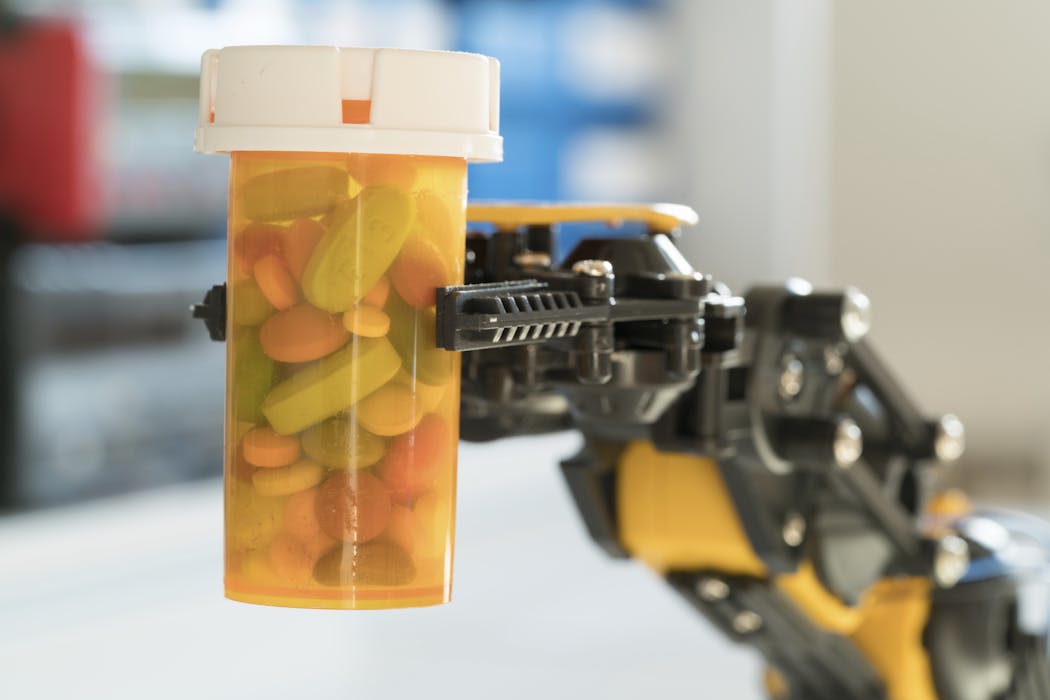
Federal legislation introduced in early 2025 proposed allowing AI to prescribe medication. Wladimir Bulgar/Science Photo Library via Getty Images

In the past decade, AI’s success has led to uncurbed enthusiasm and bold claims – even though users frequently experience errors that AI makes. An AI-powered digital assistant can misunderstand someone’s speech in embarrassing ways, a chatbot could hallucinate facts, or, as I experienced, an AI-based navigation tool might even guide drivers through a corn field – all without registering the errors.

People tolerate these mistakes because the technology makes certain tasks more efficient. Increasingly, however, proponents are advocating the use of AI – sometimes with limited human supervision – in fields where mistakes have high cost, such as health care. For example, a bill introduced in the U.S. House of Representatives in early 2025 would allow AI systems to prescribe medications autonomously. Health researchers as well as lawmakers since then have debated whether such prescribing would be feasible or advisable.

How exactly such prescribing would work if this or similar legislation passes remains to be seen. But it raises the stakes for how many errors AI developers can allow their tools to make and what the consequences would be if those tools led to negative outcomes – even patient deaths.

As a researcher studying complex systems, I investigate how different components of a system interact to produce unpredictable outcomes. Part of my work focuses on exploring the limits of science – and, more specifically, of AI.

Over the past 25 years I have worked on projects including traffic light coordination, improving bureaucracies and tax evasion detection. Even when these systems can be highly effective, they are never perfect.

For AI in particular, errors might be an inescapable consequence of how the systems work. My lab’s research suggests that particular properties of the data used to train AI models play a role. This is unlikely to change, regardless of how much time, effort and funding researchers direct at improving AI models.

Nobody – and nothing, not even AI – is perfect

As Alan Turing, considered the father of computer science, once said: “If a machine is expected to be infallible, it cannot also be intelligent.” This is because learning is an essential part of intelligence, and people usually learn from mistakes. I see this tug-of-war between intelligence and infallibility at play in my research.

In a study published in July 2025, my colleagues and I showed that perfectly organizing certain datasets into clear categories may be impossible. In other words, there may be a minimum amount of errors that a given dataset produces, simply because of the fact that elements of many categories overlap. For some datasets – the core underpinning of many AI systems – AI will not perform better than chance.

A portrait of seven dogs of different breeds.
Features of different dog breeds may overlap, making it hard for some AI models to differentiate them.
MirasWonderland/iStock via Getty Images Plus

For example, a model trained on a dataset of millions of dogs that logs only their age, weight and height will probably distinguish Chihuahuas from Great Danes with perfect accuracy. But it may make mistakes in telling apart an Alaskan malamute and a Doberman pinscher, since different individuals of different species might fall within the same age, weight and height ranges.

This categorizing is called classifiability, and my students and I started studying it in 2021. Using data from more than half a million students who attended the Universidad Nacional Autónoma de México between 2008 and 2020, we wanted to solve a seemingly simple problem. Could we use an AI algorithm to predict which students would finish their university degrees on time – that is, within three, four or five years of starting their studies, depending on the major?

We tested several popular algorithms that are used for classification in AI and also developed our own. No algorithm was perfect; the best ones − even one we developed specifically for this task − achieved an accuracy rate of about 80%, meaning that at least 1 in 5 students were misclassified. We realized that many students were identical in terms of grades, age, gender, socioeconomic status and other features – yet some would finish on time, and some would not. Under these circumstances, no algorithm would be able to make perfect predictions.

You might think that more data would improve predictability, but this usually comes with diminishing returns. This means that, for example, for each increase in accuracy of 1%, you might need 100 times the data. Thus, we would never have enough students to significantly improve our model’s performance.

Additionally, many unpredictable turns in lives of students and their families – unemployment, death, pregnancy – might occur after their first year at university, likely affecting whether they finish on time. So even with an infinite number of students, our predictions would still give errors.

The limits of prediction

To put it more generally, what limits prediction is complexity. The word complexity comes from the Latin plexus, which means intertwined. The components that make up a complex system are intertwined, and it’s the interactions between them that determine what happens to them and how they behave.

Thus, studying elements of the system in isolation would probably yield misleading insights about them – as well as about the system as a whole.

Take, for example, a car traveling in a city. Knowing the speed at which it drives, it’s theoretically possible to predict where it will end up at a particular time. But in real traffic, its speed will depend on interactions with other vehicles on the road. Since the details of these interactions emerge in the moment and cannot be known in advance, precisely predicting what happens to the the car is possible only a few minutes into the future.

AI is already playing an enormous role in health care.

Not with my health

These same principles apply to prescribing medications. Different conditions and diseases can have the same symptoms, and people with the same condition or disease may exhibit different symptoms. For example, fever can be caused by a respiratory illness or a digestive one. And a cold might cause cough, but not always.

This means that health care datasets have significant overlaps that would prevent AI from being error-free.

Certainly, humans also make errors. But when AI misdiagnoses a patient, as it surely will, the situation falls into a legal limbo. It’s not clear who or what would be responsible if a patient were hurt. Pharmaceutical companies? Software developers? Insurance agencies? Pharmacies?

In many contexts, neither humans nor machines are the best option for a given task. “Centaurs,” or “hybrid intelligence” – that is, a combination of humans and machines – tend to be better than each on their own. A doctor could certainly use AI to decide potential drugs to use for different patients, depending on their medical history, physiological details and genetic makeup. Researchers are already exploring this approach in precision medicine.

But common sense and the precautionary principle
suggest that it is too early for AI to prescribe drugs without human oversight. And the fact that mistakes may be baked into the technology could mean that where human health is at stake, human supervision will always be necessary.

The Conversation

Carlos Gershenson does not work for, consult, own shares in or receive funding from any company or organization that would benefit from this article, and has disclosed no relevant affiliations beyond their academic appointment.

ref. AI’s errors may be impossible to eliminate – what that means for its use in health care – https://theconversation.com/ais-errors-may-be-impossible-to-eliminate-what-that-means-for-its-use-in-health-care-251036

AI-generated political videos are more about memes and money than persuading and deceiving

Source: The Conversation – USA – By Lisa Fazio, Associate Professor of Psychology, Vanderbilt University

Politicians are posting AI-generated videos of themselves and their opponents. Screenshots by The Conversation

Zohran Mamdani as a creepy trick-or-treater, Gavin Newsom body-slamming Donald Trump and Hakeem Jeffries in a sombrero. This is not the setup to an elaborate joke. Instead, these are all examples of recent AI-generated political videos. New easy-to-use tools – and acceptance of those tools by politicians – means that these fake videos are quickly becoming commonplace in American politics.

Perhaps the most interesting thing about many of the videos is how clearly fake they are. Rather than trying to deceive the viewer into thinking a depicted event actually happened, the videos serve a different purpose. President Trump didn’t post a video of himself wearing a crown in a fighter jet dumping feces on a group of protesters because he wanted people to believe that the flight actually happened. He likely did it to express his feelings about the protest and to create an in-joke with his followers.

Fears about the political implications of AI-generated videos have been around since the term deepfakes was coined in 2017. Steady improvements in the technology mean that distinguishing real from fake could become a significant threat. But today’s use of AI imagery is largely about making memes and making money – in other words, typical social media content.

Getting a rise out of people

Internet platforms use algorithms designed to keep people engaged, and that typically means promoting content that stirs emotions. AI-generated political videos often provoke an emotional response – amusement or outrage.

People are more likely to share information when it is emotionally arousing. For example, people are more likely to pass along urban legends that elicit feelings of disgust, and news articles that are emotionally charged are more likely to make the New York Times list of most emailed articles. Similar patterns occur online, where emotional content is much more likely to go viral than nonemotional content.

In addition, strong emotions can interfere with people’s ability to detect false information. People are worse at distinguishing between true and false political news headlines when they are experiencing stronger emotions – for instance, enthusiasm, excitement or fear. Thus, emotionally appealing AI-generated videos are both more likely to spread and reduce people’s ability to judge whether they are real or fake.

Online politics

Creating and sharing AI videos is also a powerful way for people to demonstrate their allegiances and show their political identities. “I am a Trump supporter, so I post AI videos of ICE detainees crying to own the libs” or “I am a Democrat and so I share Governor Newsom’s AI-video of JD Vance talking about couches to show that I’m in on the joke.”

What’s new in recent months is that campaigns and politicians are using AI-created videos, not just their supporters. An analysis from The New York Times showed that Trump commonly uses AI imagery to “attack enemies and rouse supporters”.

These new tools also allow for active participation in the political process. Rather than simply watching politicians and voting, citizens can play an active role in shaping the conversation between elections.

Information and technology researcher Kate Starbird has written about similar dynamics in the ways that everyday Americans found “evidence” for voter fraud in the 2020 election. Politicians told the public that voter fraud was going to occur, and then when voters saw things that they did not understand when voting, such as the use of Sharpie pens to mark ballots, they interpreted that action as evidence of voter fraud. Politicians then circulated that evidence online to support the false narrative.

New AI tools make this cycle of participatory disinformation even simpler. Instead of reinterpreting actual events as evidence for a false claim, people can easily generate that evidence themselves.

AI video at volume

AI video creation tools make it incredibly easy for people to churn out hundreds of videos, post them online and simply see what content becomes popular and goes viral. In fact, that’s exactly what seems to have happened with recent AI-generated videos of raids by Immigration and Customs Enforcement. According to an investigation by 404 media, Facebook user “USA Journey 897” used to post a variety of real videos of police activity as well as absurd AI videos of people carrying whales and riding tigers.

However, after the release of a new version of OpenAI’s Sora video generator on Sept. 30, 2025, the account switched entirely to posting multiple fake videos of deportations every day. Most of the videos accumulated hundreds of thousands of views, and one fake video of a Walmart employee being detained had over 4 million views.

Typically these accounts are hosted overseas and exist to earn money through creator incentive programs. These incentives create an environment where social media no longer informs people about the world, but instead serves as a fun-house mirror, presenting back to us the world that we want to see – or at least the version of the world that will capture our attention and outrage.

AI-generated political ads are stretching ethical boundaries.

Flowing into the internet

It’s not always easy for people to detect which videos are real and which are AI-generated. A recent audit by the publication Indicator found that platforms regularly fail to properly label AI content. Researchers posted over 500 AI-generated images and videos across Instagram, LinkedIn, Pinterest, TikTok and YouTube. Less than one-third were properly labeled as AI-generated, and even posts generated by the platform’s own AI tools were often missed.

For years, the great fear concerning political deepfakes was that they were going to fool people into believing something happened that didn’t. They still might, but at the moment, AI-generated political videos are a mix of entertainment and memes, legitimate attempts at persuasion, and ways of capturing attention for money.

In other words, they are now just like the rest of the internet. Most of what we see and share is meant to entertain, some is meant to inform and persuade, and a great deal exists solely to monetize our attention.

The Conversation

Lisa Fazio does not work for, consult, own shares in or receive funding from any company or organization that would benefit from this article, and has disclosed no relevant affiliations beyond their academic appointment.

ref. AI-generated political videos are more about memes and money than persuading and deceiving – https://theconversation.com/ai-generated-political-videos-are-more-about-memes-and-money-than-persuading-and-deceiving-268977

The Ivies can weather the Trump administration’s research cuts – it’s the nation’s public universities that have the most to lose

Source: The Conversation – USA (2) – By Todd L. Pittinsky, Professor of Technology and Society, Stony Brook University (The State University of New York)

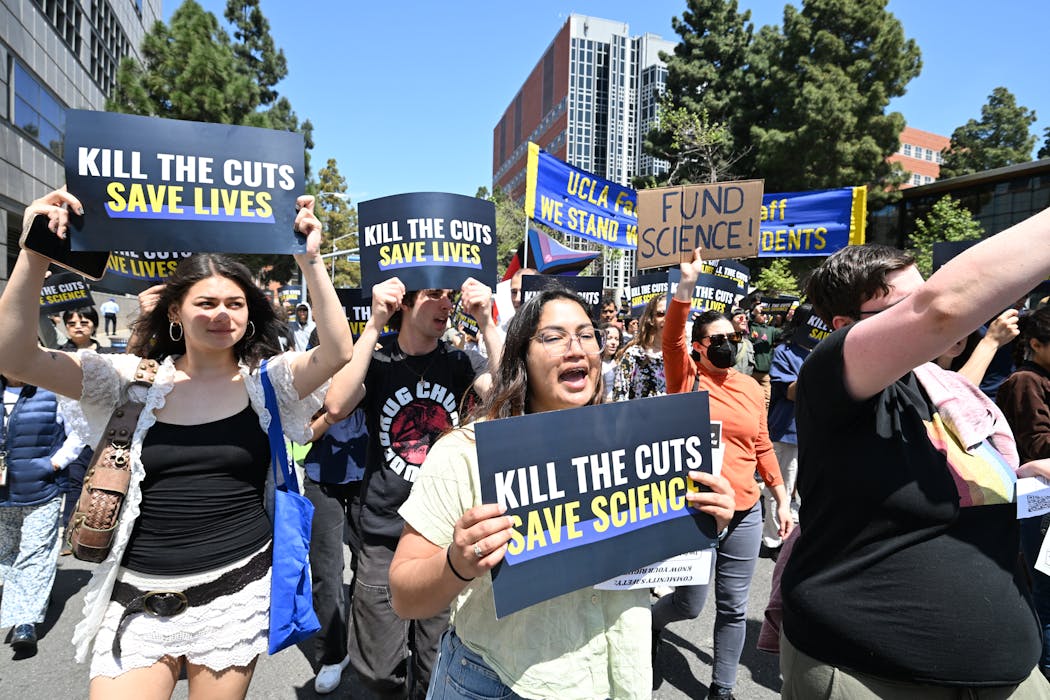
UCLA students and researchers protest the Trump administration’s funding cuts for research, health and higher education in April 2025. Robyn Beck/AFP via Getty Images

Most of the media coverage of the federal government’s recent cuts in federal research money for universities has focused on its effects on a handful of elite Ivy League universities, such as Harvard, Columbia and Cornell.

“When you take money away from a Columbia or a Harvard or other institutions, you’ve just taken away funds from the best researchers,” Toby Smith, the senior vice president for government relations at the Association of American Universities, told CNN in April 2025.

But these schools account for only a small fraction of the nation’s scientific output that federal research money helps generate.

In my view, too many policy discussions and debates obsess over what happens on the campuses of elite colleges. Meanwhile, public universities quietly power the nation’s research engine.

The Ivies do play a critical role in advanced research. But the nation’s public universities make up the backbone of U.S. innovation – research powerhouses such as the University of Michigan, the University of Texas at Austin, Georgia Institute of Technology and Stony Brook University, where I teach.

These places train the overwhelming majority of science, technology, engineering and mathematics graduates for the U.S. workforce and run the lion’s share of federally funded science and engineering research.

Slashing research and development

U.S. colleges and universities spend more than US$108.8 billion annually on research and development, of which about 55% – roughly $60 billion – comes from federal funding via agencies such as the National Institutes of Health and the National Science Foundation. Together, the country’s eight Ivy League schools received approximately $4.6 billion of federal university research and development funding in 2023 – or 7.8% of all federal research and development funding allocated to academia.

In 2023, meanwhile, the University of Washington, Georgia Institute of Technology, the University of California, San Diego, and the University of Michigan, Ann Arbor, each received over $1 billion in federal research funds.

The Trump administration’s federal research and development funding cuts are largely tied to what are called “indirect costs.”

Direct costs fund researcher salaries and lab supplies. Indirect costs support the infrastructure that makes research possible and compliant with federal guidelines: lighting, heating and cooling for labs; high-speed data networks; security; and administrative staff who handle payroll and ensure adherence to federal safety and ethics standards.

In 2025, the Trump administration decided to cap indirect costs for grants awarded by the National Institutes of Health and the National Science Foundation at 15% of the total grant. Traditionally, universities have negotiated their own rates based on documented overhead expenses, with many institutions citing indirect cost rates between 50% and 70%.

Many aspects of the 15% cap have been paused as they’re being challenged in court. Should these cuts go through, it would be incredibly disruptive for universities that have counted on this funding.

However, outside of the battle over indirect costs, many research projects simply lost funding or experienced major delays. Over the past year, thousands of grants have been frozen, terminated or left unfunded.

Ivy League institutions are much better equipped to weather the storm.

In 2021, Forbes reported that the collective endowment of the eight Ivies was approximately $192.6 billion – led by Harvard’s $53.2 billion and Yale’s $42.3 billion. Supporters of Trump’s funding cuts have argued that this immense, tax-exempt financial arsenal could significantly subsidize their overhead costs, rather than relying on taxpayers to do so. While endowments don’t serve as a blank check, schools can still pull from them in times of need.

In contrast, public universities are far more dependent on federal funds to sustain labs, staff and graduate programs. In 2021, the entire Texas public university system – the University of Texas at Austin, Texas A&M, the University of Houston, the University of Texas at Dallas and Texas Tech – held an endowment of around $40 billion, more than $10 billion less than Harvard’s.

Public schools are the training ground

This isn’t to argue that the Ivies should have their research funding cut, while public universities ought to be spared. It’s to shift the focus of the conversation to who stands to lose the most: the public universities that educate the vast majority of the U.S.’s future scientists and fuel most of the nation’s scientific output.

The Ivy League’s geographic reach is extremely concentrated, situated across just seven states, all in the Northeast. Public four-year institutions are located in all 50 states and draw from a much more economically and racially diverse population. They award the vast majority of engineering degrees in the U.S., with more than 144,701 given out in 2023, or more than 70% of the nation’s total.

Purdue University awarded 3,827 engineering degrees that year, with Texas A&M conferring 3,704. By contrast, Cornell University granted just 820 engineering degrees – the most among the Ivies, but just 25th nationally.

Elite schools, including the Ivies, have increasingly steered graduates into finance, law or consulting. Just 2.72% of Yale’s 2024 graduating class was employed as engineers six months after graduation. Meanwhile, public universities serve as the top feeder schools for major defense and aerospace firms.

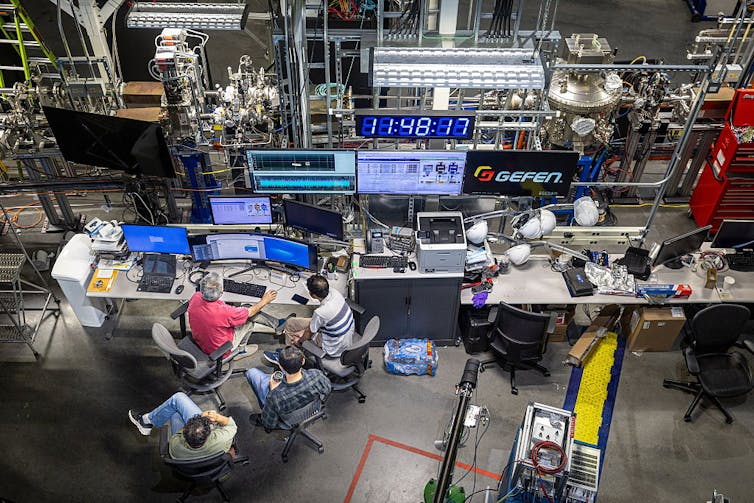
Stony Brook University’s College of Engineering and Applied Sciences enrolled over 5,600 students in fall 2024, making it one of the top producers of engineering talent in New York. The university manages the Department of Energy’s Brookhaven National Laboratory, which uses advanced tools such as particle colliders to make discoveries in physics, energy, materials and biology. It’s one of a handful of universities that directly operate a national lab.

A bird's-eye view of a group of scientists surrounded by an array of electronic equipment.
The U.S. Department of Energy’s Brookhaven National Laboratory in Brookhaven, N.Y., is managed by Stony Brook University.
J. Conrad Williams Jr./Newsday RM via Getty Images

Collateral damage

The Trump administration has argued that federal research funding cuts are necessary because too many dollars have been allocated for social policy goals, whether it’s $349,985 to train engineers to “enable engineering for social justice” or $600,000 to teach aerospace engineering students “critical consciousness and sensitivity to injustices within social systems.”

While federal law bars the Department of Education from influencing curriculum, the National Science Foundation faces no such constraint. Too much funding, it claimed, went to research that strayed from the federal agencies’ core scientific mandates and crowded out the kind of critical research that underpins U.S. innovation.

While I think fiscal responsibility and mission creep merit attention, cuts that are too dramatic and too indiscriminate risk gutting the high-impact research that is essential to national security and technological leadership, much of which takes place at public institutions. Fields from supercomputing and wireless communications to biothreat countermeasures and health sciences will and have felt the pain of widespread cuts.

A graduate wearing a black cap decorated with the phrase 'Truss Me I'm an Engineer.'
An engineering graduate celebrates during the 73rd commencement ceremony for California State University, Long Beach, in 2022.
Brittany Murray/MediaNews Group/Long Beach Press-Telegram via Getty Images

Federal research funding is not merely academic spending. It is an important national investment that directly fuels local and national economic growth. It supports high-wage jobs and “innovation districts” centered on university and federal laboratories.

The future of scientific research funding isn’t a debate over how much government help the privileged Ivies ought to receive.

It’s a question of whether public universities will be given the resources to nurture the next generation of scientists, drive bold discoveries and keep America at the forefront of scientific innovation for generations to come.

The Conversation

Todd L. Pittinsky is a Professor of Technology, AI & Society in the College of Engineering and Appled Sciences at Stony Brook University (SUNY).

ref. The Ivies can weather the Trump administration’s research cuts – it’s the nation’s public universities that have the most to lose – https://theconversation.com/the-ivies-can-weather-the-trump-administrations-research-cuts-its-the-nations-public-universities-that-have-the-most-to-lose-267197

Polytechnic universities focus on practical, career-oriented skills, offering an alternative to traditional universities

Source: The Conversation – USA (2) – By Kelly Droege, Assistant Professor, University of Wisconsin-Stout

Unlike traditional research universities and private liberal arts colleges, polytechnic universities tend to offer apprenticeships and microcredentials, all geared toward giving students practical skills they can use in the workforce. iStock/Getty Images Plus

For decades, a four-year college degree was widely seen as the standard path to getting most midlevel jobs in the United States. It was the expected entry point for getting a job as a marketing specialist, project manager, IT support analyst, among other roles.

But this expectation is shifting. Many fields – including cybersecurity, health care and advanced manufacturing – are facing significant shortages in skilled workers. The gap between available skilled jobs and workers is likely to push employers to rethink what they require from job candidates over the next decade.

A major demographic shift will also play a role. Between 2024 and 2032, an estimated 18.4 million experienced workers with education beyond high school are expected to retire, according to September 2025 findings by Georgetown University’s center on education and the workforce.

Only 13.8 million younger workers with similar education levels are expected to enter the workforce during the same period, these findings show. This trend will also make it harder for employers to fill roles that traditionally require a college degree.

At the same time, 25 states over the past few years have enacted legislation and executive orders to remove college degree requirements for people applying for some public sector jobs, signaling a shift in how essential college degrees are for getting hired for some kinds of work.

These shifts underscore a broader trend: A four-year degree is no longer essential for many kinds of work.

Hiring data tells a similar story. As of January 2024, 52% of U.S. job postings on Indeed did not mention any formal education requirement, up from 48% in 2019. Job postings requiring at least a bachelor’s degree also dropped from 20.4% to 17.8% between 2018 and 2023.

As hiring expectations change – influenced in part by advances in artificial intelligence – employers may struggle to find candidates who already have the right job-specific skills.

With over 20 years of experience as professors who also train employees in industries such as manufacturing, health care and business information technologies, we believe that college degrees shouldn’t be mandatory for some jobs.

A large white, modern looking building is seen against a bright blue sky.
Florida Polytechnic University is one of several polytechnic universities in the U.S. offering a STEM and career-focused education.
John Greim/LightRocket via Getty Images

A widening gap

Nearly half of recent college graduates say they feel unprepared for entry-level work, and 56% cite a lack of job-specific skills as the biggest issue, according to a 2025 report by Cengage Group, an education and workforce training company.

Alternative pathways – apprenticeships, certifications and on-the-job training – can give workers practical skills and help employers fill crucial roles more quickly.

Employers dropping degree requirements is only one step toward this goal. We think it is also important that prospective college students and their families are aware of educational opportunities besides a traditional four-year degree.

Understanding polytechnic universities

Some people think of higher education in terms of traditional liberal arts colleges or research universities. But there are also polytechnic universities, which focus on hands-on, career-aligned learning and emphasize strong STEM and technical programs. These schools often prepare students for exactly the kinds of jobs employers struggle to fill.

There are about 10 major polytechnic universities in the U.S. Some well-known polytechnic universities are California Polytechnic State University in San Luis Obispo, California, Worcester Polytechnic Institute in Worcester, Massachusetts, and State University of New York Polytechnic Institute in Marcy and Albany, New York.

Instead of offering a wide range of liberal arts majors, polytechnic universities offer majors such as engineering, robotics, construction management and information technology.

A central feature of these schools is applied learning – hands-on labs, real-world projects and problem-solving experiences.

Polytechnic students can earn bachelor’s and master’s degrees, but they also can often get short-term certificates in fields such as human resources, instructional design, project management and digital marketing. Many programs also include apprenticeships, such as workplace training specialists.

Students can also pursue microcredentials, which involve short course sequences that build targeted skills, such as business writing or engineering mechanics. These options give students more flexible and affordable ways to learn without committing to a traditional four-year degree.

Polytechnic universities also tend to cost less than research universities and private colleges, and students can use federal financial aid or private loans to attend.

There are some limitations. Polytechnic schools generally offer fewer majors, usually within STEM fields. Their alumni networks may be smaller, and we have found that some people perceive them as less prestigious than traditional universities because they focus more on teaching than on research.

Real world relevance

In March 2025, we asked 10 online instructors at different polytechnic universities how they bring career-focused learning into their classes.

Our research, which will likely be published in 2026, shows that every instructor tried to make their courses feel relevant to real workplaces.

Some instructors used simulations in the course. Others shared examples from their own industry backgrounds with students. All agreed that students learn best when they can clearly connect their coursework to their career goals.

One of the most effective strategies is hiring instructors with deep industry experience. Their professional networks help programs stay aligned with the skills employers currently value.

Not every college wants to become a polytechnic, and not every student wants that style of education.

However, traditional universities can still learn from this model by adding more applied learning, embedding essential job skills into their programs, and partnering more closely with industry. These changes can better prepare students to succeed in the workforce.

The Conversation

Kelly Droege works for the University of Wisconsin – Stout, a polytechnic institution.

Laura Reisinger does not work for, consult, own shares in or receive funding from any company or organization that would benefit from this article, and has disclosed no relevant affiliations beyond their academic appointment.

ref. Polytechnic universities focus on practical, career-oriented skills, offering an alternative to traditional universities – https://theconversation.com/polytechnic-universities-focus-on-practical-career-oriented-skills-offering-an-alternative-to-traditional-universities-268349

Even with Trump’s support, coal power remains expensive – and dangerous

Source: The Conversation – USA (2) – By Hannah Wiseman, Professor of Law, Penn State

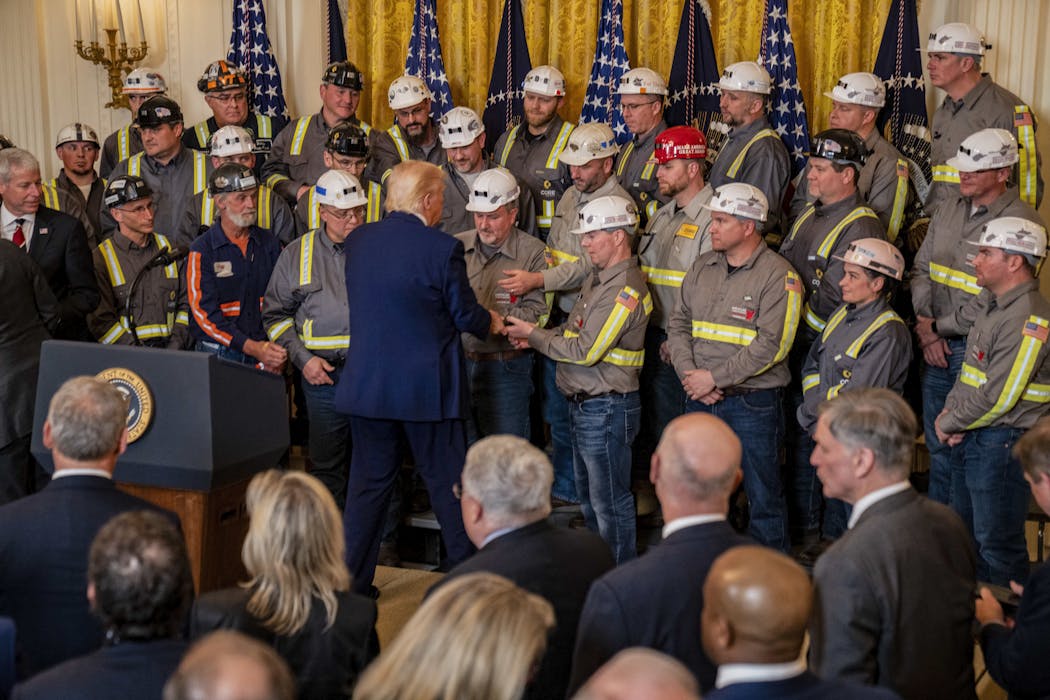
President Donald Trump has aligned himself with the coal industry, including at this meeting in April 2025. Andrew Thomas/Middle East Images/AFP via Getty Images

As projections of U.S. electricity demand rise sharply, President Donald Trump is looking to coal – historically a dominant force in the U.S. energy economy – as a key part of the solution.

In an April 2025 executive order, for instance, Trump used emergency powers to direct the Department of Energy to order the owners of coal-fired power plants that were slated to be shut down to keep the plants running.

He also directed federal agencies to “identify coal resources on Federal lands” and ease the process for leasing and mining coal on those lands. In addition, he issued orders to exclude coal-related projects from environmental reviews, promote coal exports and potentially subsidize the production of coal as a national security resource.

But there remain limits to the president’s power to slow the declining use of coal in the U.S. And while efforts continue to overcome these limits and prop up coal, mining coal remains an ongoing danger to workers: In 2025, there have been five coal-mining deaths in West Virginia and at least two others elsewhere in the U.S.

A large industrial area with towers, a rail line and large buildings with large metal connections.
A coal-fired power plant in Michigan has remained open at Trump administration orders.
Jim West/UCG/Universal Images Group via Getty Images

A long legacy

Until 2015, coal-fired power plants generated more electricity than any other type of fuel in the U.S. But with the rapid expansion of a new type of hydraulic fracturing, natural gas became a cheap and stable source for power generation. The prices of solar and wind power also dropped steadily. These alternatives ultimately overcame coal in the U.S. power supply.

Before this change, coal mining defined the economy and culture of many U.S. towns – and some states and regions, such as Wyoming and Appalachia – for decades. And in many small towns, coal-related businesses, including power plants, were key employers.

Coal has both benefits and drawbacks. It provides a reliable fuel source for electricity that can be piled up on-site at power plants without needing a tank or underground facility for storage.

But it’s dirty: Thousands of coal miners developed a disease called black lung. The federal government pays for medical care for some sick miners and makes monthly payments to family members of miners who die prematurely. Burning coal also emits multiple air pollutants, prematurely killing half a million people in the United States from 1999 through 2020.

Coal is dangerous for workers, too. Some coal-mining companies have had abysmal safety records, leading to miner deaths, such as the recent drowning of a miner in a sudden flood in a West Virginia mine. Safety reforms have been implemented since the Big Branch Mine explosion in 2010, and coal miner deaths in the U.S. have since declined. But coal mining remains a hazardous job.

A stone plaque with names carved on it, between two statues of coal miners.
A memorial honors coal miners who died on the job in Harlan County, Ky.
Jim West/UCG/Universal Images Group via Getty Images

A champion of coal

In both of his terms, Trump has championed the revival of coal. In 2017, for example, Trump’s Department of Energy asked the Federal Energy Regulatory Commission to pay coal and nuclear plants higher rates than the competitive market would pay, saying they were key to keeping the U.S. electricity grid running. The commission declined.

In his second term, Trump is more broadly using powers granted to the president in emergencies, and he is seeking to subsidize coal across the board – in mining, power plants and exports.

At least some of the urgency is coming from the rapid construction of data centers for artificial intelligence, which the Trump administration champions. Many individual data centers use as much power as a small or medium city. There’s enough generation capacity to power them, though only by activating power plants that are idle most of the time and that operate only during peak demand periods. Using those plants would require data centers to reduce their electricity use during those peaks – which it’s not clear they would agree to do.

So many data centers, desperate for 24/7 electricity, are relying on old coal-fired power plants – buying electricity from plants that otherwise would be shutting down.

A long train of cargo cars carrying a black substance stretches to the horizon.
The sun rises on a coal train outside Ritzville, Wash.
Visions of America/Joseph Sohm/Universal Images Group via Getty Images

Limits remain

Despite the Trump adminstration’s efforts to rapidly expand data centers and coal to power them, coal is more expensive than most other fuels for power generation, with costs still rising.

Half of U.S. coal mines have closed within the past two decades, and productivity at the remaining mines is declining due to a variety of factors, such as rising mining costs, environmental regulation and competition from cheaper sources. Coal exports have also seen declines in the midst of the tariff wars.

The U.S. Department of the Interior’s recent effort to follow Trump’s orders and lease more coal on federal lands received only one bid – at a historically low price of less than a penny per ton. But in fact, even if the government gave its coal away for free, it would still make more economic sense for utilities to build power plants that use other fuels. This is due to the high cost of running old coal plants as compared to new natural gas and renewable infrastructure.

Natural gas is cheaper – and, in some places, so are renewable energy and battery storage. Government efforts to prevent the retirement of coal-fired power plants and boost the demand for coal may slow coal’s decline in the short term. In the long term, however, coal faces a very uncertain future as a part of the U.S. electricity mix.

The Conversation

Hannah Wiseman is affiliated with the Center for Progressive Reform. Along with a team of other Penn State researchers, she also received a seed grant from the Penn State Institute of Energy and the Environment for a project entitled “Assessing distributional effects of coal-fired power plant operations on pollution and health.”

Seth Blumsack receives funding from the U.S. National Science Foundation, NASA, the Alfred P. Sloan Foundation and the Heising Simons Foundation.

ref. Even with Trump’s support, coal power remains expensive – and dangerous – https://theconversation.com/even-with-trumps-support-coal-power-remains-expensive-and-dangerous-269668

From early cars to generative AI, new technologies create demand for specialized materials

Source: The Conversation – USA – By Peter Müllner, Distinguished Professor in Materials Science and Engineering, Boise State University

The development of new computing technologies drives the demand for improved materials. Yuichiro Chino/Moment via Getty Images

Generative artificial intelligence has become widely accepted as a tool that increases productivity. Yet the technology is far from mature. Large language models advance rapidly from one generation to the next, and experts can only speculate how AI will affect the workforce and peoples’ daily lives.

As a materials scientist, I am interested in how materials and the technologies that derive from them affect society. AI is one example of a technology driving global change – particularly through its demand for materials and rare minerals.

But before AI evolved to its current level, two other technologies exemplified the process created by the demand for specialized materials: cars and smartphones.

Often, the mass adoption of a new invention changes human behavior, which leads to new technologies and infrastructures reliant upon the invention. In turn, these new technologies and infrastructures require new or improved materials – and these often contain critical minerals: those minerals that are both essential to the technology and strain the supply chain.

The unequal distribution of these minerals gives leverage to the nations that produce them. The resulting power shifts strain geopolitical relations and drive the search for new mineral sources. New technology nurtures the mining industry.

The car and the development of suburbs

At the beginning of the 20th century, only 5 out of 1,000 people owned a car, with annual production around a few thousand. Workers commuted on foot or by tram. Within a two-mile radius, many people had all they needed: from groceries to hardware, from school to church, and from shoemakers to doctors.

Then in 1913, Henry Ford transformed the industry by inventing the assembly line. Now, a middle class family could afford a car: Mass production cut the price of the Model T from US$850 in 1908 to $360 in 1916. While the Great Depression dampened the broad adoption of the car, sales began to increase again after the end of World War II.

A black and white photo of two men in an old car.
Henry Ford at wheel, with John Burroughs and Thomas Edison in back seat of a Model T.
Bettmann/Contributor via Getty Images

With cars came more mobility, and many people moved farther away from work. In the 1940s and 1950s, a powerful highway lobby that included oil, automobile and construction interests promoted federal highway and transportation policies, which increased automobile dependence. These policies helped change the landscape: Houses were spaced farther apart, and located farther away from the urban centers where many people worked. By the 1960s, two-thirds of American workers commuted by car, and the average commute had increased to 10 miles.

Public policy and investment favored suburbs, which meant less investment in city centers. The resulting decay made living in downtown areas of many cities undesirable and triggered urban renewal projects.

An overhead shot of a neighborhood made up of neat lines of houses and roads.
Access to cars led to more spread-out neighborhoods, like this one in Milton, Ontario.
SimonP/Wikimedia Commons, CC BY-SA

Long commutes added to pollution and expenses, which created a demand for lighter, more fuel-efficient cars. But building these required better materials.

In 1970, the entire frame and body of a car was made from one steel type, but by 2017, 10 different, highly specialized steels constituted a vehicle’s light-weight form. Each steel contains different chemical elements, such as molybdenum and vanadium, which are mined only in a few countries.

While the car supply chain was mostly domestic until the 1970s, the car industry today relies heavily on imports. This dependence has created tension with international trade partners, as reflected by higher tariffs on steel.

The cell phone and American life

The cell phone presents another example of a technology creating a demand for minerals and affecting foreign policy. In 1983, Motorola released the DynaTAC, the first commercial cellular phone. It was heavy, expensive and its battery lasted for only half an hour, so few people had one. Then in 1996, Motorola introduced the flip phone, which was cheaper, lighter and more convenient to use. The flip phone initiated the mass-adoption of cell phones. However, it was still just a phone: Unlike today’s smartphones, all it did was send and receive calls and texts.

A large, clunky phone.
The Motorola DynaTAC 8000X was the first commercially available cellphone. With innovations and better materials, cellphones later became smaller, more lightweight and adopted touch screens.
Redrum0486/Wikimedia Commons, CC BY-SA

In 2007, Apple redefined communication with the iPhone, inventing the touch screen and integrating an internet navigator. The phone became a digital hub for navigating, finding information and building an online social identity. Before smartphones, mobile phones supplemented daily life. Now, they structure it.

In 2000, fewer than half of American adults owned a cellphone, and nearly all who did it only sporadically. In 2024, 98% of Americans over the age of 18 reported owning a cellphone, and over 90% owned a smartphone.

Without the smartphone, most people cannot fulfill their daily tasks. Many individuals now experience nomophobia: They feel anxious without a cellphone.

Around three quarters of all stable elements are represented in the components of each smartphone. These elements are necessary for highly specialized materials that enable touch screens, displays, batteries, speakers, microphones and cameras. Many of these elements are essential for at least one function and have an unreliable supply chain, which makes them critical.

An infographic showing the elements used in each component of a smartphone
Smartphones contain around 80% of all known stable chemical elements, including some rare earth metals.
Andy Brunning/Compound Interest 2023, CC BY-NC-ND

Critical materials and AI

Critical materials give leverage to countries that have a monopoly in mining and processing them. For example, China has gained increased power through its monopoly on rare earth elements. In April 2025, in response to U.S. tariffs, China stopped exporting rare earth magnets, which are used in cellphones. The geopolitical tensions that resulted demonstrate the power embodied in the control over critical minerals.

Six small piles of minerals.
Piles of rare earth oxides praseodymium, cerium, lanthanum, neodymium, samarium and gadolinium.
Peggy Greb/USDA-ARS

The mass adoption of AI technology will likely change human behavior and bring forth new technologies, industries and infrastructure on which the U.S. economy will depend. All of these technologies will require more optimized and specialized materials and create new material dependencies.

By exacerbating material dependencies, AI could affect geopolitical relations and reorganize global power.

America has rich deposits of many important minerals, but extraction of these minerals comes with challenges. Factors including slow and costly permitting, public opposition, environmental concerns, high investment costs and an inadequate workforce all can prevent mining companies from accessing these resources. The mass adoption of AI is already adding pressure to overcome these factors and increase responsible domestic mining.

While the path from innovation to material dependence spanned a century for cars and a couple of decades for cell phones, the rapid advancement of large language models suggests that the scale will be measured in years for AI. The heat is already on.

The Conversation

Peter Müllner received funding from federal, state, and private organizations including the National Science Foundation, the Department of Energy, the Department of Defense, the National Institutes of Health, the Idaho Global Entrepreneurial Mission, the Micron Foundation, and the Osher Lifelong Learning Institute.

ref. From early cars to generative AI, new technologies create demand for specialized materials – https://theconversation.com/from-early-cars-to-generative-ai-new-technologies-create-demand-for-specialized-materials-269241

Trump administration’s immigrant detention policy broadly rejected by federal judges

Source: The Conversation – USA – By Cassandra Burke Robertson, Professor of Law and Director of the Center for Professional Ethics, Case Western Reserve University

Federal agents search for undocumented immigrants in Chicago on Nov. 6, 2025. Scott Olson/Getty Images

In federal courtrooms across America, a pattern has emerged in cases in which immigrants are being rounded up and jailed without a hearing. That’s a departure from fundamental constitutional protections in the U.S. that provide the right to a hearing before indefinite imprisonment.

In response, federal judges are systematically rejecting the Trump administration’s attempt to drastically expand who can be locked up without a hearing while awaiting deportation proceedings.

The Trump White House policy has been challenged in at least 362 cases in federal district courts, according to a recent ruling by U.S. District Judge Lewis A. Kaplan. Challengers have prevailed in 350 of those cases – decided by over 160 different judges sitting in about 50 different courts across the United States.

Behind those numbers are thousands of people whose freedom hangs in the balance while courts decide whether their imprisonment is lawful.

Trump administration officials claim they are targeting only “the worst of the worst” in immigration enforcement. Yet nearly three-quarters of people detained had no criminal history at all. Of those with criminal histories, many involved only minor offenses such as traffic violations.

The immigrants are in civil immigration proceedings to determine whether they can remain in the United States. Yet under the administration’s new policy, many are being held in jail-like facilities indefinitely, including “state-run prisons located in remote areas, soft-sided tent structures, military bases, and even in prisons in other countries,” according to a report from the Migration Policy Institute think tank.

As a law professor who studies due process in immigration proceedings, I view the overwhelming judicial consensus against this policy as the federal courts performing their essential constitutional function: checking executive overreach. The courts are enforcing fundamental due process protections.

Whether this consensus will prevail, however, depends on appeals courts and, ultimately, the Supreme Court.

Men dressed in military gear stand near a car.
U.S. Customs and Border Patrol Commander Gregory Bovino, center, stands with agents in Metairie, La., on Dec. 3, 2025.
Adam Gray/AFP via Getty Images

A radical reinterpretation

The current controversy centers on a policy shift the Department of Homeland Security implemented in July 2025.

In an internal memo, DHS reinterpreted decades-old immigration law to classify virtually all undocumented immigrants in the U.S. as “applicants for admission” who are subject to mandatory detention under the Immigration and Nationality Act.

For 30 years, this provision applied primarily to people apprehended at the border shortly after entering the country. The new interpretation extends it to anyone present in the U.S. illegally. That includes people who entered years or decades ago, have established families and businesses and are pursuing legal pathways to remain in the U.S.

The practical effect of the change is that people who were previously entitled to request release on bond while their deportation cases proceeded are now subject to automatic, indefinite detention without court review of whether their imprisonment is justified.

Courts overwhelmed by petitions

Within months of the July policy announcement, more than 700 emergency habeas petitions – legal challenges to unlawful imprisonment – reached federal courts nationwide.

In Michigan alone, U.S. District Judge Hala Jarbou – a Trump appointee – received more than 100 individual cases from detainees challenging their imprisonment. Then, 97 additional detainees filed a joint lawsuit. Cases arose across the country as immigrants who were arrested at workplaces, courthouses or during routine check-ins with immigration officers asked federal courts to order their release or grant them bond hearings.

The Trump administration has fought these cases on multiple fronts. It has argued that the detention policy is lawful and that federal courts lack jurisdiction to review it at all. The government has invoked provisions of the Immigration and Nationality Act that it claims strip courts of jurisdiction over certain immigration decisions.

Protesters gather in front of a federal building.
Protesters gather outside an Immigration and Customs Enforcement processing facility in Broadview, Ill., on Nov. 21, 2025.
AP Photo/Nam Y. Huh

But federal judges have largely rejected these jurisdictional arguments. They have found that courts retain the power to review whether detentions comply with the Constitution and federal law.

As one district court judge explained, accepting the government’s position would mean the executive branch could detain noncitizens indefinitely without ever having to justify that detention to a court. It’s a result that would raise “serious constitutional concerns” about suspending habeas corpus, the fundamental right to challenge unlawful imprisonment.

Judge Kaplan similarly concluded that the “current administration’s unilateral decision that all noncitizens … are to be mandatorily detained affords to such individuals no process, let alone due process. It is unconstitutional.”

An explanation on what “due process” means.

The policy’s ripple effects extend beyond the courts.

Immigration and Customs Enforcement detained a record 66,000 people in November 2025 – more than any previous administration had ever held at one time. The American Immigration Council, which advocates for immigration rights, documented 23 deaths in ICE detention during fiscal year 2025. The previous four years combined saw 24 such deaths.

A nationwide remedy

The piecemeal nature of hundreds of individual court rulings creates its own problems. Each emergency petition requires rushed briefing and a hearing. That strains the courts and detained immigrants’ ability to secure representation. Outcomes can vary based on which judge hears a case, creating geographic disparities in who remains detained and who is released.

That’s why the November decision in Maldonado Bautista v. Santacruz is potentially transformative. U.S. District Judge Sunshine S. Sykes certified a nationwide class of noncitizens subject to the policy and separately ruled that the government’s interpretation of the law was wrong – detainees are entitled to bond hearings. Combined with the nationwide class certification, this ruling could require the Trump administration to provide bond hearings to thousands of people currently in mandatory detention.

But implementation has been uneven. Immigration judges – who are Justice Department employees, not independent federal judges – have responded inconsistently to Judge Sykes’ order.

In a recent immigration court decision in Memphis, Tenn., a judge denied a bond hearing request. The judge stated that further guidance from the Executive Office for Immigration Review, a Department of Justice office, was required before complying with Sykes’ order.

Attorneys representing the class say they’ve seen similar resistance from some immigration judges, while others have begun granting bond hearings. They plan to return to federal court in January 2026 to present evidence of this confusion and seek further relief.

The near-unanimous rejection by federal judges – insulated from political pressure by lifetime appointments – demonstrates why the Constitution grants judges life tenure. Federal courts remain the final check when executive action threatens fundamental due process rights.

The Conversation

Cassandra Burke Robertson does not work for, consult, own shares in or receive funding from any company or organization that would benefit from this article, and has disclosed no relevant affiliations beyond their academic appointment.

ref. Trump administration’s immigrant detention policy broadly rejected by federal judges – https://theconversation.com/trump-administrations-immigrant-detention-policy-broadly-rejected-by-federal-judges-271076

2026’s abortion battles will be fought more in courthouses and FDA offices than at the voting booth

Source: The Conversation – USA – By Rachel Rebouché, Professor of Law, The University of Texas at Austin

Medication abortions are increasingly common in states with abortion bans. Anti-abortion forces are pushing the courts and the White House to gut that access. Charlie Neibergall/AP Images

In 2026, the biggest battles over abortion will not be at the polls.

There will be a few contested measures on state ballots. Next year, Nevada’s government will ask residents to approve constitutional protection for abortion rights for the second time, as required by state law. The same measure passed in 2024 with just over 64% of the vote.

Virginians will likely see a similar ballot initiative. In November 2025, voters there cemented a majority for Democrats in the state legislature, and the House of Delegates is expected to put forth an abortion rights ballot measure to voters in 2026.

Anti-abortion proponents in Missouri want to undo an amendment protecting abortion rights that voters passed in 2024. They’re advancing a new measure that could strip residents of the reproductive rights that are now constitutionally enshrined.

However, the most consequential questions about abortion in 2026 could be answered at the federal level, by the Trump administration or in the courts. As a scholar of reproductive health law, I’m watching how federal judges and agencies respond to conservative efforts to restrict or end people’s access to mailed abortion medication.

Medication abortion in the courts

Over 25 years ago, the Food and Drug Administration approved mifepristone – one of two drugs commonly paired together to end a pregnancy. Since that time, medication abortion has been closely regulated by the FDA and is under attack.

In 2022, the Alliance for Hippocratic Medicine, a coalition of anti-abortion physicians, sued the FDA for approving mifepristone in 2000 and for each time the agency eased a restriction on mifepristone thereafter, in 2016 and 2021. The complaint argued that the FDA failed to consider evidence establishing the harm caused by medication abortion – claims roundly rejected by decades of rigorous, peer-reviewed research.

The Supreme Court in 2024 ruled that the Alliance for Hippocratic Medicine lacked standing to sue because FDA regulation of medication abortion caused no actual injury to the doctors it represented, who do not prescribe mifepristone or perform abortions.

Yet the case lives on in lower federal courts. There is ongoing litigation, and politicians are taking up the fight over mailed medication abortion.

Kansas, Missouri and Idaho intervened in the Alliance lawsuit in 2023, seeking to establish standing, and Louisiana sued the FDA in a separate case challenging the FDA’s regulation of mifepristone.

The pending actions focus on the FDA’s decision in 2021 to lift the requirement that patients pick up mifepristone in person, which has permitted patients to receive medication abortion by mail. These states claim this development is dangerous and threatens their right to enforce their abortion bans.

In October 2025, a federal court in Hawaii came to a different conclusion. The court concluded that because mifepristone is very safe, the FDA must reconsider whether the drug necessitates any restrictions at all.

The politics of medication abortion

The dispute over medication abortion is playing out in Washington, D.C., too.

In 2025, 51 Republican senators and 22 Republican attorneys general asked the FDA to reinstate the 2021 in-person restriction and upend the transit of abortion pills.

In response to Republicans’ push to restrict or withdraw the availanlity of mifepristone, 47 Democratic senators and 20 attorneys general issued letters supporting mifepristone’s safety. The letters questioned a pledge by Health and Human Services Secretary Robert F. Kennedy Jr. and his FDA chief to commence a “review” of the drug. The Democratic senators’ letter pressed the agency to remove all remaining restrictions on mifepristone.

In early December, Bloomberg reported that the FDA had quietly postponed its planned mifepristone “review” until after the 2026 midterm elections.

The battle over telehealth abortion care

Decades of research demonstrates that medication abortion is safe and effective. When commenced before 10 weeks’ gestation, the two-drug method is effective about 98% of the time. Complications, such as infection or hemorrhage, are rare; they occur in perhaps a fraction of a percent of all medication abortions.

Yet courts and legislators cannot agree on basic facts, in part due to widespread disinformation about abortion care, and anti-abortion forces have waged a concerted national campaign to stop mailed abortion pills.

Today, no part of the medication abortion process needs to be done in person: The patient, provider and pharmacy can all interact virtually.

Mailed medication abortion is popular nationwide, particularly in states with abortion bans. Because of mailed medication abortion, the average number of abortions nationwide has actually increased since the U.S. Supreme Court in 2022 overturned Roe v. Wade, reversing abortion protections under the U.S. Constitution.

Providers in so-called “shield” states are a key reason for this. Eight U.S. states have laws that shield providers from civil, criminal and professional consequences for delivering reproductive health care to out-of-state patients.

In these shield states, doctors may prescribe abortion medication no matter where the patient lives, so long as that care is delivered by a provider licensed and located in the shield state, complying with the shield state’s laws.

These laws are the subject of legal conflicts between anti-abortion states and shield states.

Late in 2024, Texas sued a doctor in New York, a shield state, for violating Texas abortion and licensure laws. In early 2025, Louisiana indicted the same New York physician.

Texas won its case in a Texas court and then asked New York to enforce the judgment of more than $100,000 in fines and fees. A New York court has refused to do so, citing its shield law. New York also rejected Louisiana’s request to extradite the doctor to stand trial for the same reason.

On Dec. 4, 2025, Texas officially enacted the first bill in the country that explicitly targets shield laws. Passed in September 2025, HB 7 allows private citizens to file lawsuits against a person or entity for attempting or intending to mail abortion pills into the state.

Watch the courts and the FDA

Having written about shield laws extensively, I believe these interstate conflicts will land, sooner or later, before the Supreme Court. Right now, state and federal courts are deciding the issues.

If judges determine that shield laws are unconstitutional or that the FDA acted illegally, courts could substantially alter people’s ability to gain access to medication abortion.

So could the FDA. If it reimposes an unnecessary restriction on mifepristone, meaning the drug would no longer be widely available through telehealth, that decision would curb how 1 in 4 women in the U.S. receive abortion care today.

But opinion polls indicate that the majority of Americans do not think abortion should be illegal in all circumstances, and they vote accordingly.

In November 2025, Democrats won significant elections, for example, in New Jersey, Virginia and Pennsylvania. Abortion was absent from ballots in these states this year, but these races still held significance for abortion rights.

The election of a pro-choice governor and legislature in Virginia, for example, all but guarantees that abortion will continue to be legal in the last Southern state to protect broader abortion rights. Likewise, Pennsylvanians opted to keep the state supreme court’s liberal majority, which struck down the state prohibition on Medicaid payment for abortion.

In 2024, two years after the fall of Roe v. Wade, 14 states put forth ballot initiatives to enshrine abortion as a constitutional right. Eleven passed.

With little political support to pass a nationwide abortion ban, making it illegal to mail abortion pills is the most immediate way to obstruct reproductive health care in states with abortion bans.

The question for abortion in 2026, then, is: Will courts or federal forces do what democratic processes cannot?

This story was published in collaboration with Rewire News Group, a nonprofit newsroom dedicated to covering reproductive and sexual health.

The Conversation

Rachel Rebouché does not work for, consult, own shares in or receive funding from any company or organization that would benefit from this article, and has disclosed no relevant affiliations beyond their academic appointment.

ref. 2026’s abortion battles will be fought more in courthouses and FDA offices than at the voting booth – https://theconversation.com/2026s-abortion-battles-will-be-fought-more-in-courthouses-and-fda-offices-than-at-the-voting-booth-269328

New industry standards and tech advances make pre-owned electronics a viable holiday gift option

Source: The Conversation – USA (2) – By Suvrat Dhanorkar, Associate Professor of Operations Management, Georgia Institute of Technology

It’s easier than ever to repair or recycle electronic devices. Elisa Schu/picture alliance via Getty Images

Electronic gifts are very popular, and in recent years, retailers have been offering significant discounts on smartphones, e-readers and other electronics labeled as “pre-owned.” Research I have co-led finds that these pre-owned options are becoming increasingly viable, thanks in part to laws and policies that encourage recycling and reuse of devices that might previously have been thrown away.

Amazon, Walmart and Best Buy have dedicated pages on their websites for pre-owned devices. Manufacturers like Apple and Dell, as well as mobile service providers like AT&T and Verizon, offer their own options for customers to buy used items. Their sales rely on the availability of a large volume of used products, which are supplied by the emergence of an entire line of businesses that process used, discarded or returned electronics.

Those developments are some of the results of widespread innovations across the electronics industry that supply chain researcher Suresh Muthulingam and I have linked to California’s Electronic Waste Recycling Act, passed in 2003.

Recycling innovation

Originally intended to reduce the amount of electronic waste flowing into the state’s landfills, California’s law did far more, unleashing a wave of innovation, our analysis found.

We analyzed the patent-filing activity of hundreds of electronics firms over a 17-year time span from 1996 to 2012. We found that the passage of California’s law not only prompted electronics manufacturers to engage in sustainability-focused innovation, but it also sparked a surge in general innovation around products, processes and techniques.

Faced with new regulations, electronics manufacturers and suppliers didn’t just make small adjustments, such as tweaking their packaging to ensure compliance. They fundamentally rethought their design and manufacturing processes, to create products that use recycled materials and that are easily recyclable themselves.

For example, Samsung’s Galaxy S25 smartphone is a new product that, when released in May 2025, was made of eight different recycled materials, including aluminum, neodymium, steel, plastics and fiber.

Combined with advanced recycling technologies and processes, these materials can be recovered and reused several times in new devices and products. For example, Apple invented the Daisy Robot, which disassembles old iPhones in a matter of seconds and recovers a variety of precious metals, including copper and gold. These materials, which would otherwise have to be mined from rock, are reused in Apple’s manufacturing process for new iPhones and iPads.

How do consumers benefit?

In the past two decades, 25 U.S. states and Washington D.C. have passed laws requiring electronics recycling and refurbishing, the process of restoring a pre-owned electronic device so that it can function like new.

The establishment of industry guidelines and standards also means that all pre-owned devices are thoroughly tested for functionality and cosmetic appearance before resale.

Companies’ deeper engagement with innovation appears to have created organizational momentum that carried over into other areas of product development. For example, in our study, we found that the passage of California’s law directly resulted in a flurry of patents related to semiconductor materials, data storage and battery technology, among others. These scientific advances have made devices more durable, repairable and recyclable.

For the average consumer, the recycling laws and the resulting industry responses mean used electronics are available with similar reliability, warranties and return policies as new devices – and at prices as much as 50% lower.

The Conversation

Suvrat Dhanorkar does not work for, consult, own shares in or receive funding from any company or organization that would benefit from this article, and has disclosed no relevant affiliations beyond their academic appointment.

ref. New industry standards and tech advances make pre-owned electronics a viable holiday gift option – https://theconversation.com/new-industry-standards-and-tech-advances-make-pre-owned-electronics-a-viable-holiday-gift-option-270347

From FIFA to the LA Clippers, carbon offset scandals are exposing the gap between sports teams’ green promises and reality

Source: The Conversation – USA (2) – By Brian P. McCullough, Associate Professor of Sport Management, University of Michigan

Under team owner Steve Ballmer, in the checkered shirt, the LA Clippers have cut their greenhouse gas emissions, but their carbon offsets raise questions. Ric Tapia/Icon Sportswire via Getty Images

If you go to a pro sports event today, there’s a good chance the stadium or arena will be powered at least in part by renewable energy. The team likely takes steps to reduce energy and waste. Some even claim to have net-zero greenhouse gas emissions, meaning any emissions they still do produce they offset by paying for projects, such as tree-planting, that reduce greenhouse gases elsewhere.

The venue upgrades have been impressive – Seattle’s hockey and basketball arena runs on 100% renewable energy, makes its rink ice from captured rainwater, and offers free public transit for ticket holders.

But how much of the teams’ offset purchases are actually doing the good that they claim?

It’s an important question, in part because fans may ultimately pay for those offsets.

A soccer player directs the ball with his head while leaping high into the air. The stands behind him are packed.
Lionel Messi of Argentina controls the ball during the FIFA World Cup Qatar 2022 final match. FIFA drew criticism for claiming the games were carbon neutral while relying heavily on sometimes questionable carbon offsets.
Julian Finney/Getty Images

The cost of carbon offsetting in sports varies by organization, with no industry standard for who pays. Some teams and leagues absorb costs through their operational budgets, treating carbon neutrality as a core responsibility. Others pass costs to consumers: Some teams add sustainability fees to ticket prices to offset each attendee’s carbon footprint. The payment model ultimately reflects whether an organization views offsetting as an institutional obligation or a shared responsibility with fans.

Carbon offsets in sports are also in the news, with scandals erupting around them in connection with sports from FIFA’s 2022 World Cup to basketball’s LA Clippers.

As sport management researchers, we have been following offset agreements and other sustainability commitments that teams and sports leagues such as FIFA have been making to see whether they translate into measurable environmental outcomes. We see lots of good intentions but also a disturbing amount of failures and outright fraud.

Where sports teams’ emissions come from

The vast majority of a sports team’s climate footprint comes from team’s and fans’ travel, which they have little control over. Leagues can reduce teams’ travel somewhat with creative scheduling, but unlike other industries, sports teams have few ways to reduce the bulk of their emissions.

What many of them do instead is offset those travel emissions by buying carbon credits.

Carbon credits are generated by projects that reduce greenhouse gases in the atmosphere or prevent greenhouse gas emissions. Many of those projects involve planting trees to remove carbon dioxide from the atmosphere; others expand clean energy to reduce fossil fuel use. Each carbon credit is supposed to represent the reduction or prevention of one metric ton of carbon dioxide.

However, carbon offset projects have come under scrutiny in recent years. Tree-planting projects, the most common type, take time to meet their promise as the trees grow, and wildfires and logging can wipe out the benefit. Studies have found that companies tend to buy cheap, low-quality carbon credits, which run a risk of exaggerating their carbon reduction claims or providing results that would have happened anyway, leaving no real climate benefit.

Unfortunately, several teams, perhaps unknowingly, have been purchasing fraudulent or low-quality credits.

Reputations at risk

FIFA brought the sports world’s carbon offset problem into the spotlight during the 2022 Qatar World Cup.

FIFA claimed the event would be carbon neutral, but that claim relied on creative accounting that understated the event’s construction and travel emissions. Organizers also used low-quality offsets. Many of those offsets were renewable energy projects with a high likelihood of being built anyway.

A year after the tournament, FIFA had completed offset purchases for less than a third of the World Cup’s estimated emissions, the nonprofit Carbon Market Watch found. And Switzerland’s advertising regulator ordered FIFA to stop claiming the World Cup had been “carbon neutral.”

A view across the stands during a game at Fenway Park under the lights.
In 2022, the Boston Red Sox announced a plan to route a portion of the proceeds from every ticket purchased at Fenway Park to a carbon offset project run by Aspiration. Aspiration later went bankrupt, and a ProPublica investigation found it had planted far fewer trees to store that carbon than promised.
Werner Kunz/Wikimedia Commons, CC BY-SA

The Clippers and baseball’s Boston Red Sox ran into problems when they publicly partnered with Aspiration, a now-bankrupt finance technology company and carbon credit broker, to meet their “carbon neutral” claims.

The Clippers had a US$300 million partnership with Aspiration that included paying the company at least $56 million for carbon credits in mid-2022, The New York Times reported. Both teams also had plans with Aspiration to offer fans a way to buy carbon credits to cover their own travel when purchasing tickets.

However, Aspiration officials claimed to have supported millions more tree-plantings than what had actually happened, a ProPublica investigation found. Aspiration co-founder Joe Sanberg pleaded guilty in 2025 to wire fraud involving false statements about financing to secure loans and attract investors, who lost at least $248 million.

The Aspiration partnership is also under investigation by the NBA over an endorsement deal the company made with Clippers all-star Kawhi Leonard at about the same time and questions about whether it was used to violate the league’s salary cap. Team owner Steve Ballmer, who personally invested at least $50 million in Aspiration, told ESPN he and the team did nothing wrong. “They conned me,” he said.

While the scandal focused on financial fraud and the salary cap, it also raised questions about the team’s sustainability claim.

Without verification, who knows?

In some cases, the value of offset projects is difficult to verify, even when trees are being planted nearby.

The Seattle Sounders FC declared itself the first carbon-neutral professional soccer team in North America in 2019 by cutting its waste, water and energy use and offsetting its remaining emissions through the nonprofit organization Forterra, which plants trees in the Puget Sound region.

While the effort positioned the club as a sustainability leader, the offsets lacked what’s known as third-party verification. Similar to how organic food must be certified by reputable agencies, third-party validation of carbon credits ensures credits truly represent the removal of carbon from the atmosphere or avoided emissions.

Without verification, it’s unclear whether claimed emission reductions are permanent, accurately tracked and transparently reported.

Potential legal consequences

Even the most prominent venues are susceptible to issues with unreliable credits.

Climate Pledge Arena in Seattle has been celebrated as the world’s first “zero-carbon” certified arena, with electric Zambonis, recycled materials, renewable energy and free public transit. It represents one of the most ambitious pushes to develop sustainable sport infrastructure globally.

A view from the upper deck of a large hockey arena. Two Zambonis are cleaning the ice.
Hockey rinks need energy to keep the ice frozen. Seattle’s Climate Pledge Arena has lowered its emissions with solar power from a local array and has even electried its Zambonis. But reports have raised questions about the quality of carbon offsets it purchased.
AP Photo/Maddy Grassy

To offset unavoidable construction emissions, the arena’s owner relied on carbon credits tied to projects meant to reduce rainforest loss in Colombia. However, an analysis by the carbon rating company Calyx Global found that while the arena’s credits may prevent some deforestation, the numbers likely overstate the benefits.

A 2023 report suggested that over 90% of rainforest carbon credits from the leading certifier of offsets lack evidence that they reduced deforestation. The certifier disputed that conclusion but is working to revise its review process.

When credits fail to offset real emissions, that erodes public trust and can expose organizations to potential legal consequences.

Delta Air Lines, for example, is facing a lawsuit over its carbon neutrality claim. The suit alleges that Delta misled passengers by describing itself as a “carbon-neutral airline” while relying on carbon offset projects that were ineffective or “junk.”

Time for some strategic reassessment

These and other failures in the carbon credit market suggest the industry needs to fundamentally reassess how sports teams achieve their climate goals.

To provide meaningful sustainability commitments, sports organizations and facilities can start at home by lowering their fossil fuel use and increasing their energy efficiency. Many arenas do this.

People walk under a canopy with solar panels above.
Fans walk under solar panels at NRG Stadium in Houston.
Tom Pennington/Getty Images

Leagues can design game schedules to reduce team and fan travel. Many of the Paris Olympics venues in 2022, for example, were connected by subway or bus. The 2026 FIFA World Cup, in contrast, has venues hundreds of miles apart across North America, meaning potentially higher emissions from fan travel.

Where offsets will still play a role, teams can ensure that they partner with verified carbon credit providers that deliver measurable, transparent carbon reductions.

In a field where public trust and reputation matter as much as performance, the sports industry cannot afford foul play on climate. We believe a shift toward strategies that cut emissions first, and then use only the most credible offsets, will be the difference between striking out and leading the sustainability game.

The Conversation

The authors do not work for, consult, own shares in or receive funding from any company or organization that would benefit from this article, and have disclosed no relevant affiliations beyond their academic appointment.

ref. From FIFA to the LA Clippers, carbon offset scandals are exposing the gap between sports teams’ green promises and reality – https://theconversation.com/from-fifa-to-the-la-clippers-carbon-offset-scandals-are-exposing-the-gap-between-sports-teams-green-promises-and-reality-270428