How a niche Catholic approach to infertility treatment became a new talking point for MAHA conservatives

Source: The Conversation – USA (3) – By Emma Kennedy, Assistant Professor of Christian Ethics, Villanova University

‘Restorative reproductive medicine’ has become a buzzword in some conservative circles, among people morally opposed to in vitro fertilization Jose Luis Pelaez Inc/DigitalVision via Getty Images

Along the 2024 presidential campaign trail, Donald Trump pledged to make in vitro fertilization, or IVF, free – part of his party’s wider push for a new American “baby boom.”

But in October 2025, when the administration revealed its IVF proposal, many health care experts pointed out that it falls short of mandating insurance companies to cover the procedure.

Since Trump returned to the White House, it has become clear just how fraught IVF is for his base. Some conservative Christians oppose IVF because it often involves destroying extra embryos not implanted in the woman’s uterus.

According to Politico, anti-abortion groups lobbied against a requirement for employers to cover IVF. Instead, some vouched for “restorative reproductive medicine” – a term that has been around for decades but has received much more attention, especially from conservatives, in the past few months.

Proponents of restorative reproductive medicine tend to present it as an alternative to IVF: a different way of treating infertility, focused on treating underlying causes. But the approach is controversial, and some practitioners closely link their treatments to Catholic teachings.

As a scholar of religion, I study U.S. Catholics’ varied perspectives on infertility, seeking to understand how religious beliefs and practices influence physicians’ and patients’ choices. Their perspectives help provide a more nuanced understanding of Christianity’s role in the U.S. reproductive and political landscape.

Defining restorative reproductive medicine

Clinics that advertise themselves as offering restorative reproductive medicine try to diagnose underlying issues that could make conception difficult, like endometriosis. Typically, a patient and provider will closely monitor the patient’s menstrual cycle to identify potential abnormalities. Interventions include hormone therapies, medications, supplements, surgeries and lifestyle changes.

An open notebook shows rows of pink and white test strips, one for each day, with March dates written beside them.
Some approaches to treating infertility focus on analyzing the patient’s menstrual cycle.
Iana Pronicheva/iStock via Getty Images Plus

Much of the approach resembles the initial testing used to evaluate patients in mainstream reproductive endocrinology and infertility clinics. However, restorative reproductive medicine clinics do not typically offer IVF or other assisted reproductive technologies.

Depending on who you ask, proponents are not necessarily opposed to IVF; they see their treatments as another option to explore. Some clinicians, however, closely link their treatment offerings to their religious commitments and opposition to abortion.

Restorative reproductive medicine has prompted criticism from professional medical organizations. The American Society for Reproductive Medicine issued a statement in May 2025 calling it a “rebranding” of standard infertility treatment, with “ideologically driven restrictions that could limit patient care.” The American College of Obstetricians and Gynecologists issued a brief warning that it is a “nonmedical approach” that threatens to impede access to IVF.

These critics are concerned that the focus on lifestyle changes and surgery may not address patients’ difficulties conceiving, while putting them through other unsuccessful treatments.

Church teachings

Today, restorative reproductive medicine is often described as gaining steam with conservative Christians and the “Make America Healthy Again,” or MAHA, movement. Its roots, though, are decades old, and largely Catholic.

Part of the Catholic Church’s objection to IVF stems from a concern that unused embryos are often discarded and destroyed. The church’s position is that all embryos ought to be treated with the same respect afforded a person – one of the key reasons its teachings oppose abortion.

Disapproval of IVF also stems from the church’s official teachings on marriage. According to this teaching, marriage has two chief ends, which it calls “procreation and union”: Typically, procreation is understood to mean having children, while union involves physical, emotional and spiritual intimacy. In this understanding, sexual intercourse should preserve what the church calls an “inseparable connection” between these two meanings.

The Catholic Church opposes artificial contraception because its goal is to block procreation. Instead, Catholics are encouraged to use “Natural Family Planning” – tracking a woman’s cycle so that couples can choose to abstain from sex during fertile periods. Similarly, it opposes artificial insemination and IVF because, by moving fertilization out of the body and into the lab, the process separates procreation from the act of sexual intercourse.

Survey data suggests most U.S. Catholics do not agree with these official stances, nor do they follow them.

Catholic doctors who do agree with official church teachings, however, have played a key role in developing infertility treatments that align with them. One of the most influential is Dr. Thomas W. Hilgers, who co-developed a “Natural Family Planning” method called the Creighton Model. In the early 1990s, he also developed NaProTechnology, an approach that seeks to identify fertility issues using cycle tracking, and then treat them with various medical and surgical interventions.

The NaProTechnology approach could be said to fall under the umbrella of restorative reproductive medicine, but it has mostly been used by Catholic reproductive health clinics and hospitals. Catholic physicians’ networks promote it, as do parishes and dioceses.

Navigating infertility

For Catholics who share the church’s official perspective on IVF, NaProTechnology and the clinics offering it are often a welcome alternative. Several of the Catholic women I interviewed as part of my academic research had also been to mainstream fertility clinics, but they felt that those providers did not offer much apart from IVF.

By contrast, the clinics offering NaProTechnology were often cheaper, in part because they do not offer IVF. They were also easier to navigate, since clinicians shared these patients’ religious views. Many felt that the providers were able to spend more time with them, helped them learn about their bodies, and were committed to understanding underlying issues beyond infertility.

However, others found clinics offering NaProTechnology to be lacking, often because clinicians weren’t up front about its limitations, especially when it comes to male infertility. Some patients felt that clinicians weren’t willing to admit drawbacks, for fear it would encourage couples to try IVF.

A rumpled medical gown with a light-blue print sits on top of an examining table.
Infertility treatments are a confusing landscape for many women.
Catherine McQueen/Moment via Getty Images

Most Catholics dealing with infertility, however, find themselves in mainstream clinical settings that offer IVF. Women I interviewed who opted for IVF were frank in their critiques of church teachings and their skepticism of Catholic clinics. Many took issue with the underlying assumption that the people who ought to be procreating are heterosexual, married couples and that conception is usually possible without the help of IVF.

However, many of these women were also dissatisfied with the approach that mainstream clinics take. Some felt that those clinics were focused on profit – a concern shared by some scholars scrutinizing the fertility industry. Some women also felt pressured to genetically test their embryos for chromosomal abnormalities and to discard unused embryos, even after explaining to staff that destroying them would be out of step with their moral commitments.

Understanding patient experiences in either kind of clinic helps underscore the difficulties many people face navigating infertility – and the stakes of policy reform.

The Trump administration’s plan largely maintains the status quo for IVF access while making more room for alternative treatments. But it intensifies questions about how the government responds to religious beliefs about reproductive health care, especially disagreements about the moral status of embryos. For now, patients and providers will continue to navigate a fractured landscape.

The Conversation

Emma Kennedy is affiliated with the Center for Genetics and Society.

ref. How a niche Catholic approach to infertility treatment became a new talking point for MAHA conservatives – https://theconversation.com/how-a-niche-catholic-approach-to-infertility-treatment-became-a-new-talking-point-for-maha-conservatives-265461


Black-market oil buyers will push Venezuela for bigger discounts following US seizure – starving Maduro of much-needed revenue

Source: The Conversation – USA (2) – By Francisco J. Monaldi, Wallace S. Wilson Fellow in Latin American Energy Policy, Rice University

A video posted on Attorney General Pam Bondi’s X account shows the moment an oil tanker was seized by U.S. forces off the coast of Venezuela. U.S. Attorney General’s Office/X via AP

The U.S. seizure of an oil tanker off the Venezuelan coast looks designed to further squeeze the economy of President Nicolás Maduro’s country.

The Dec. 10, 2025, operation – in which American forces descended from helicopters onto the vessel – follows months of U.S. military buildup in the Caribbean and was immediately condemned by the Venezuelan government as “barefaced robbery and an act of international piracy.”

But what exactly is the Trump administraion’s aim in going after the tanker, and how could this impact the already beleaguered economy of Venezuela? The Conversation U.S. turned to Rice University’s Francisco J. Monaldi, an expert on Latin American energy policy, for answers.

What do we know about the tanker that was seized?

The seized tanker, which according to reports is a 20-year-old vessel called the Skipper, is a supertanker that can carry around 2 million barrels of oil.

According to the Trump administration, the vessel was heading to Cuba. But because of the size of the ship, I strongly suspect that the final destination was likely China – tankers the size of the seized one don’t tend to be used to take oil across the Caribbean to Cuba. The ones used for that task are far smaller.

This particular tanker was sanctioned by the U.S. Treasury in 2022 due to it carrying prohibited Iranian oil. At the time, it was claimed that the ship – then called Adisa – was controlled by Russian oil magnate Viktor Artemov and was engaged in an oil smuggling network.

Attorney General Pam Bondi released a video of the seizure on X.

So the latest U.S. seizure was, on the surface, unrelated to the sanctions placed on Venezuela by U.S. authorities in 2019 and expanded in 2020 to include secondary sanctions – that is, on countries that do business on the targeted nation or company.

As such, Venezuelan officials have said this is unprecedented. And they are largely right. While there have been a few occasions in which Iranian tankers have been seized due to sanctions busting, this is the first time that there has been a seizure of a vessel departing Venezuela and with a Venezuelan crew.

The Trump administration has signaled that it is not only seizing the cargo but the ship itself – which would represent a significant loss for the company owning the ship. The loss will be borne by the company, not Venezuela, as it was under a “Free on Board” contract, meaning that as soon as it left Venezuela the buyer takes responsibility for it.

Nonetheless, this is a significant escalation of the pressure campaign on Venezuela, which looks set to continue. Reuters has reported that around 30 other tankers near Venezuela have some kind of sanction against them. They form part of a large shadow fleet that try to skirt sanctions through hiding their identity while transporting oil from Russia, Venezuela and Iran.

The signal from U.S. officials is that they are prepared to go after more vessels and further squeeze Venezuela’s oil revenues through fresh sanctions.

How often they will seize vessels is not known, but the clear threat from the White House is that the U.S. will continue with this seizure campaign.

How important are oil exports to Venezuela?

Venezuela’s economy is tremendously dependent on oil production.

We do not have exact figures, as the Venezuela government has not published them in seven years, but most analysts believe oil constitutes north of 80% of all of the country’s exports – some even put this figure above 90%.

Most of that oil goes to the black market, and a majority ends up with independent refiners in China. State-owned enterprises in China tend not to buy this oil because they do not want to fall foul of the sanctions regime. But Beijing tends to turn a blind eye to tankers heading to non-state entities, especially if those tankers have hidden their true identity so it doesn’t look like they are coming from Venezuela.

Oil rigs are seen on a large body of water.
Oil production makes up a large chunk of Venezuela’s economy.
Federico Parra/AFP via Getty Images

Around 80% of Venezuelan oil goes to China in this way; around 17% goes to the U.S. through a license awarded by the U.S. Treasury to oil giant Chevron. And 3% goes to Cuba, which tends to be subsidized by the Venezuelan government.

Venezuela’s economy itself is also very dependent on oil, with the sector making up about 20% of total GDP, more than any other industry. And when it comes to government income, the oil sector makes up north of 50%.

How have US actions affected Venezuelan oil production?

It is important to know that even before U.S. sanctions began in 2019, Venezuela’s oil production was in severe decline.

In 1998, before Hugo Chávez, the leftist military officer who became a populist president, came to power, oil production peaked at around 3.4 million barrels a day. By the time Chávez died and Maduro succeeded him in 2013, it had fallen to 2.7 million barrels a day.

When U.S. sanctions targeting the state-owned oil company, Petróleos de Venezuela, were enacted in 2019, production was down to 1.3 million barrels a day – but that had already been affected by the other financial sanctions that came in two years earlier.

The oil sanctions of 2019 closed the U.S. market, taking away half a million barrels a day that at the time headed from Venezuela to the U.S. As a result, Venezuela had to increase oil sales to India and China.

But then the 2020 secondary sanctions, which apply to countries doing business with Venezuela, came in. As a result, Europe and India stopped buying Venezuelan oil, meaning that its only markets were Cuba and China. Of course, that year also saw the onset of the COVID-19 pandemic, which resulted in a massive cooling of the oil market globally.

Venezuelan oil production collapsed to 400,000 barrels a day that year. Today it has recovered to around 1 million barrels a day. This has been helped by the U.S. allowing Chevron – which, after Petróleos de Venezuela, is the second-largest oil company operating in the country – to continue production.

How does Venezuela get around oil sanctions?

Venezuela relies on a shadow fleet to help it skirt U.S. sanctions. These vessels hide their identity by using false flags and false names.

Companies often take a tanker that is going to be retired and change the identity, put on a new coat of paint and make sure transponders – devices that transmit radio signals to give a map reading – are doctored so that it looks like the ship is in a different place altogether.

These ships arrive in Venezuela, pick up oil and then set sail. Sometimes they then transfer the cargo to another ship – which carries huge environmental risks. And then it arrives typically in Malaysia, where it takes on a Malaysian identity and on it goes to China.

What impact has this latest seizure had on the price of oil?

The seizure had little impact on global oil prices, because of exiting oversupply and due to the fact that Venezuela makes up only around 1% of the overall market. That could change, depending on how aggressive the U.S. gets. But the Trump administration will be mindful that it doesn’t want to see domestic prices rise as a result.

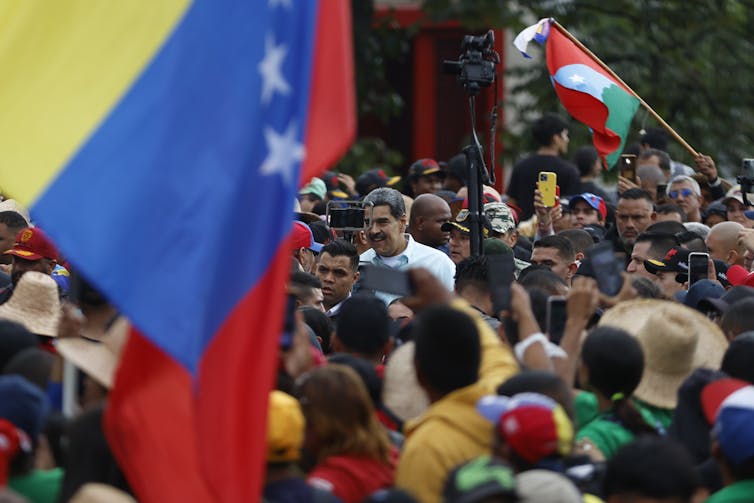
A man in white stands in the center of a large crowd.
Venezuelan leader Nicolás Maduro faces growing pressure over his country’s economic problems.
Pedro Rances Mattey/Anadolu via Getty Images

As to the price of Venezuelan oil, that could be more drastic. Venezuelan oil is already sold at a discount on the black market because of the existing risk relating to the sanctions. This latest action is likely to widen these discounts even further.

In addition, Venezuela has until now required companies to pay some of the payment for oil cargo upfront – and a lot will be unwilling to do so now, due to high costs involved in a U.S. seizure. For example, a tanker of 2 million barrels, even with the current discount, will be worth around US$100 millon – no one wants to risk that much money. So very few buyers will be willing to prepay. Instead they will expect Venezuela to share the risk.

The bottom line for Maduro is that the only way to get someone to buy Venezuelan oil amid the heightened risk of this moment is to offer higher discounts with fewer prepayments. Besides discounts, export volumes could also be affected and that in turn would lead to production cuts, which are costly to reverse.

And all this will further choke off the already limited revenue that Maduro is relying on to keep Venezuela’s government functioning.

The Conversation

Francisco J. Monaldi does not work for, consult, own shares in or receive funding from any company or organization that would benefit from this article, and has disclosed no relevant affiliations beyond their academic appointment.

ref. Black-market oil buyers will push Venezuela for bigger discounts following US seizure – starving Maduro of much-needed revenue – https://theconversation.com/black-market-oil-buyers-will-push-venezuela-for-bigger-discounts-following-us-seizure-starving-maduro-of-much-needed-revenue-271896

As a former federal judge, I’m concerned by a year of challenges to the US justice system

Source: The Conversation – USA – By John E. Jones III, President, Dickinson College

The Trump administration in 2025 has blown up many legal norms and rules in pursuit of its goals. Gearstd/iStock Getty Images Plus

The public has been hearing from a lot of federal judges over the past year, much more than normal. That’s because many of them are concerned about the Trump administration’s commitment to the rule of law.

Dickinson College President John E. Jones III was appointed as a federal judge by President George W. Bush and spent 20 years on the bench after being confirmed unanimously by the U.S. Senate in 2002. Jones spoke with The Conversation U.S. senior politics editor, Naomi Schalit, about America’s legal landscape after almost a year of Donald Trump’s presidency.

What does the case just argued at the Supreme Court about the president’s ability to fire leaders at independent agencies tell you about Donald Trump’s presidency?

We’ve seen a progression over time, with both Republican and Democratic presidents, where there’s been a stronger and stronger chief executive. But there’s been nothing like this administration, where the president has fired members of heretofore independent agencies. Having listened to oral arguments, which at times can be misleading, there’s very little question that the Supreme Court is going to overturn the “Humphreys Executor” precedent.


Read more:
Supreme Court ignores precedent instead of overruling it in allowing president to fire officials whom Congress tried to make independent


What it means is that this president will have the opportunity to
utterly remake all of these independent agencies now. He’s going to take people out, root and branch, and put folks in who are either with the program or they’re not going to get appointed.

So this case is emblematic of Trump’s approach to presidential power?

He does not recognize and does not want among his appointees – certainly we see this in the Cabinet – any modicum of independence. You’re either with him 100% or you’re against him. Now that will extend to these independent agencies, and that means that the measured sort of regulations that have existed for a long time are going to be disrupted and maybe even eliminated.

A statue of a woman, thinking, in front of the pillars of a large, white building.
The Contemplation of Justice statue outside the U.S. Supreme Court in Washington, D.C.
Stefani Reynolds/AFP via Getty Images

This year has seen unusual amounts of activity in the Supreme Court’s shadow docket. What is the significance of that?

This is the court’s emergency docket. If the court takes these cases, they order a very abbreviated briefing and they decide the matter very quickly. Typically, this is a problem for lower court judges, as the cases are decided with very little explanation.

Sometimes months and months intervene before the court gets back to that case and renders a full and complete determination. One example would be the birthright citizenship case that came up to the court on the shadow docket. The court rendered an interim decision about whether U.S. District Court judges could issue orders stopping nationwide enforcement of Trump policies. They didn’t rule on the merits of the birthright citizenship case.

Since then, there have been conflicting decisions across the country. You have circuits that have ruled on the question and other circuits that haven’t ruled on it at all. So depending on where you live in the United States, you may or may not be subject to what heretofore has been the accepted interpretation of the 14th Amendment.

This administration’s clear strategy – to flood the zone by simply challenging every adverse decision against it in the lower courts – means there are an unprecedented number of cases coming up to the Supreme Court. It just means that there’s utter confusion in the lower courts, and it’s been the subject of a lot of dissatisfaction among lower court judges. It really puts the federal court system into a state of uncertainty and chaos, and obviously it’s not good for the public.

U.S. attorneys are nominated by the president and confirmed by the Senate. Congress limits how long interim U.S. attorneys can serve in these positions. But the Trump administration has circumvented those limits, keeping a number of interim U.S. attorneys on the job past the 120-day limit. These cases have been challenged in court. Why is this conflict notable?

What the president has attempted to do flies in the face of legislation that says that these interim appointments are limited to 120 days. Every court has found that the president’s appointment or attempted appointment beyond the first 120 days is unlawful and unconstitutional. It is a limitation on the president’s power.

If the president’s version were correct, you could just have endless interim appointments without any involvement by the Senate. This is a place where the courts have, in effect, upheld the integrity of the advice-and-consent system and the constitutional role of the Senate.

Trump ordered the Department of Justice to prosecute James Comey and Letitia James, among others. He has also granted massive numbers of pardons and commutations. What are your thoughts on these?

My takeaway as an American citizen and as a former judge is that at bottom, President Trump simply lacks respect for our system of justice.

I don’t think you can find otherwise when on your first day in office you issue over 1,000 pardons for people who were justifiably convicted or pled guilty to what was, by any account, an insurrection on Jan. 6, 2021. He has pardoned countless people since then, including a former president of Honduras who his own administration prosecuted and for which there was abundant evidence that he was a drug trafficker. He’s blowing up boats in the Caribbean without, in my view, any rationale that’s grounded in law. The president believes the law is whatever he says it is at any given moment.

A woman in a white pantsuit walks next to a man in a blue suit, white shirt and red tie.
President Donald Trump and U.S. Attorney General Pam Bondi, seen here in March 2025, appear to work in lockstep, where the president’s wishes set the Justice Department’s agenda.
Andrew Harnik/Getty Images

As to the Department of Justice, I think that’s one of the most worrisome things about this administration. There is a seamless interface between the White House and the Department of Justice that is problematic, and it is quite clear that the Department of Justice will do anything that the president wants.

I think we’re in a very, very difficult and dark place when the president by fiat can simply order his attorney general to prosecute a person. And I think every American should worry about a world where that takes place without any buffer.

The administration has a documented pattern of disobeying or sidestepping court orders. Your thoughts?

The way our system is supposed to work is that people can disagree with lower court decisions, but they have to obey them, unless they’re stayed by application to a higher court. The administration seems to have decided that they’re going to write U.S. district judges out of the picture and simply disregard their orders.

When I served as a U.S. District Court judge, I always understood that I had pretty awesome power to do things. That power was to be used sparingly and carefully, but when I ordered something, I expected that that order would be followed.

That is the nature of the rule of law and our system of justice that now has been turned on its head by this administration.

The second point is that I would wish that our Supreme Court
would take a stronger stand against this kind of gamesmanship in the lower courts. Those who serve in the third branch – the nation’s courts – are all in this together. There has to be more attention given to an administration that has really gone rogue in terms of how they treat the orders of U.S. District Court judges.

I don’t think the public has ever heard more from judges or former judges or retired judges than they are hearing right now. That includes you, president of a university, former federal judge, saying things that I think the public isn’t accustomed to hearing from either current or former judges. What’s going on?

What’s happening is that judges who come from all stripes, philosophically and party affiliations, are deeply concerned and offended about the tenor of the times, and they feel the need, as I do, to become active and to rally to the support of our system of justice. Imperfect though it may be, I’ve always regarded it as the fairest and best system in the world.

The Conversation

John E. Jones III is affiliated with Keep Our Republic’s Article Three Coalition.

ref. As a former federal judge, I’m concerned by a year of challenges to the US justice system – https://theconversation.com/as-a-former-federal-judge-im-concerned-by-a-year-of-challenges-to-the-us-justice-system-271571

Songbirds swap colorful plumage genes across species lines among their evolutionary neighbors

Source: The Conversation – USA – By David Toews, Associate Professor of Biology, Penn State

Some bird species on neighboring tips of the evolutionary tree can interbreed, with interesting genomic results. Kaleb Anderson

People typically think about evolution as a linear process where, within a species, the classic adage of “survival of the fittest” is constantly at play. New DNA mutations arise and get passed from parents to offspring. If any genetic changes prove to be beneficial, they might give those young a survival edge.

Over the great span of time – through the slow closing of a land bridge here or the rise of a mountain range there – species eventually split. They go on evolving slowly along their own trajectories with their own unique mutations. That’s the process that over the past 3.5 billion years has created the millions of branches on the evolutionary tree of life.

However, new genome sequencing data reveals an unexpected twist to this long evolutionary story. It turns out that the boundaries between species on their own branches of this tree are a little more permeable than previously thought. Rather than waiting around for new mutations to solve a particular problem, interbreeding between different species can introduce ready-made genetic advantages.

Unraveling the story of life, one genome at a time

man holds a small grey bird with red on its face up with one hand
The author with a red-faced warbler (Cardellina rubrifrons), one of the wood warbler species included in the study.
Kevin Bennett

As an evolutionary biologist, I’ve been studying the stories written in the genomes of animals for over two decades. I focus mostly on colorful songbirds called wood warblers that hail from North, Central and South America. There are approximately 115 species in total, and they come in a dazzling array of bright colors.

Some of these birds might be familiar to you, such as the brilliant Blackburnian warbler (Setophaga fusca), which lights up the tops of the pine trees in the eastern forests of the U.S. and Canada during spring and summer. Other warbler species might be less familiar, like the pink-headed warbler (Cardellina versicolor), which lives only in the highlands of Guatemala and southern Mexico.

The story of these New World warblers was written within the past 10 million years or so – relatively recently in evolutionary terms. They’re all, in effect, “evolutionary neighbors,” sitting next to each other at the tips of the crown of the tree of life. In my team’s most recent work, led by evolutionary biologist Kevin Bennett, we gathered a massive amount of data from warbler genomes – over 2 trillion base pairs, from nearly every species of warbler – to learn more about their evolutionary history.

We found that some species have unexpectedly leaped over evolutionary hurdles by sharing solutions to evolutionary problems. We are now learning from this kind of data that species aren’t just vertical, evolutionary silos, as we once thought. Instead, there is much more horizontal “cross talk” among the branches of the evolutionary tree.

These warblers now join Amazonian butterflies, cichlid fish in Africa, as well as our own hominid lineage, as exemplars of this process of evolutionary sharing.

a nest filled with baby birds, one faces up with its mouth open
Nestlings in a hybrid zone between golden-winged (Vermivora chrysoptera) and blue-winged warblers (V. cyanoptera). Hybrid chicks that grow up to ‘backcross’ with one of their parent species can introduce new genes into the mix for a population.
Abigail Valine

How does evolutionary sharing actually occur?

Genetic sharing among evolutionary neighbors all happens through hybrids: the offspring produced when individuals from two species mate. Famous hybrids include offspring between polar and grizzly bears – affectionately called “pizzly” bears – as well as mules, the offspring of horses and donkeys.

But unlike mules, which are sterile and cannot reproduce, in instances of natural warbler hybrids, we think these rare offspring can sometimes “backcross”: They breed with one of the parental species, ultimately moving genes across species boundaries. These hybrids are the genetic conduit by which genes are shared across the branches in the evolutionary tree.

But aren’t we all taught in biology class that species can’t interbreed with other species? Isn’t that what helps define a species?

In reality, biology always has its exceptions and fuzzy edges. And this is one: Species result from the very gradual process of speciation, which typically takes millions of years. The taxonomic boxes we humans like to put around “species” don’t typically capture the blurry borders around lineages early in this long process, when otherwise distinct plants and animals can still interbreed.

Indeed, my lab has described many interspecies and intergenus hybrids in warblers, including at least one arising from both. We’ve also identified “hybrid zones” between very closely related species, where hybridization is rampant.

And if the genes within these hybrids are beneficial in the recipient species, they’ll spread – just like a new, beneficial mutation passed to an offspring. In this case, it’s not just a single mutation but can be a whole new complement of mutations in multiple genes.

small bright yellow bird sits on a branch
Wood warblers need particular genes to help them process and deposit certain pigment molecules in what they eat to make brightly colored feathers, like in this yellow warbler.
Marc Guitard/Moment via Getty Images

Shared genes solve ‘evolutionary problems’

Our most recent work in wood warblers shows that the evolutionary solutions they’re sharing are related to their coloration.

In this family of birds, we previously identified genes related to their carotenoid-based coloration. Carotenoid pigments give birds their brilliant orange, yellow and red plumes – colors that are exemplified by the aptly named yellow warbler. But birds, like all vertebrates, can’t synthesize carotenoid pigments on their own. They need to obtain carotenoids from their diet and then chemically process them.

But processing carotenoids appears to be an evolutionary hurdle that not all birds have jumped and a rather difficult problem to solve. Our genome sequencing shows that these warblers have more shared carotenoid genes than other shared genes in their genome, and it’s likely that different versions of carotenoid-processing genes improve the recipients fitness.

One carotenoid-processing gene, called beta-carotene oxygenase 2, or BCO2, has been shared several times within this single family of birds. Moreover, BCO2 appears to be so popular that it shows second-order sharing: passing from one species to another, and then on to a third.

A sign of quality on the mating circuit

My colleagues and I think these genes are so popular because male warblers use these carotenoid colors to attract females that have a discerning eye. Male birds obtain carotenoids from the insects they eat. The idea is that the more colorful a male is, the higher the quality of its diet.

From across the forest, the males’ rich carotenoid colors are signaling that they’d be good dads with good genes. Biologists call this kind of display an “honest signal.” And if males obtain a new gene that allows them to process carotenoids more efficiently, it’s likely to spread faster and farther into the species, as the brighter males will potentially have greater mating success.

Our research with warblers demonstrates how evolution can shuffle genes across the thin lines between species. These close evolutionary neighbors sometimes share DNA, including potentially beneficial mutations, by mating across the species lines defined by humans’ classification systems.

We suspect that the more we look, the more we’ll find this kind of borrowing among evolutionary neighbors. As we unravel the stories told in the genomes of nature’s problem-solvers, it’s likely we’ll find that their threads are deeply intertwined.

The Conversation

David Toews works for Pennsylvania State University. He receives funding from The National Science Foundation.

ref. Songbirds swap colorful plumage genes across species lines among their evolutionary neighbors – https://theconversation.com/songbirds-swap-colorful-plumage-genes-across-species-lines-among-their-evolutionary-neighbors-268846

‘Are you married?’ Why doctors ask invasive questions during treatment

Source: The Conversation – USA (3) – By Jill Inderstrodt, Assistant Professor of Health Policy and Management, Indiana University

The demographic data collected at doctor’s visits is useful to medical researchers. MoMo Productions/DigitalVision via Getty Images

It’s a rare occasion when my worlds of biomedical informatics and serialized lesbian melodrama fandom collide.

But that’s exactly what happened earlier this summer when two of my favorite actresses appeared on a popular podcast. I was excited to hear them talk about their new book and their history of working together, so I was confused but delighted when their conversation took a turn toward my area of expertise – electronic health records.

One actress noted that on a recent trip to the optometrist, she was asked about her ethnicity. “And I was like, what difference does it make?” she said.

The host chimed in with her experience of being asked similarly personal questions before a mammogram. “Like, it doesn’t matter if I’m married or not. It doesn’t matter if I’m white or Asian, you know?” she remarked.

Listening to the host and actresses question a process that, to me, seems straightforward and purposeful served as a stark reminder of the chasm that often exists between how researchers like me use patient data and a patient’s actual experience of clinical data collection.

For those of us who use demographic data collected during health care encounters to conduct research and design interventions, it does matter whether patients answer their doctor’s demographic questions. But as a patient myself, I can see how these questions might seem unnecessary and even invasive.

So it may help to understand why your doctors collect this data, how researchers use it and what medical discoveries might be possible when we know more about who patients are.

patient sitting on table looks at doctor filling out form on clipboard
Your doctor’s questions might sometimes seem arbitrary and invasive.
Natalia Gdovskaia/Moment via Getty Images

Why your data matters

When you answer the demographic questions your doctor logs in your electronic health record, you’re doing more than disclosing personal information. You’re adding one small piece to a giant puzzle of data that allows researchers like me to see a bigger picture.

Your health information can help us understand who gets sick and why. It might even be used to design real health interventions.

As a researcher focused on improving health and health care for moms and their babies, I consider myself lucky to live in Indiana, a state with one of the nation’s most comprehensive health information exchanges. These exchanges are interconnected networks of hospital system electronic health record databases from all over the state that allow researchers like me to learn about how individuals and groups experience health and medical care.

For example, my colleagues and I in the Indiana University Better AI for a Strong Rural Maternal and Child Health Environment Lab use this data to train machine learning models that predict preeclampsia, a life-threatening condition of high blood pressure during pregnancy, before a mom gets really sick.

We could use only clinical data: diagnoses, labs and vital readings like blood pressure that contribute to the outcome of preeclampsia. But for conditions like preeclampsia, Black moms are diagnosed at higher rates than their white counterparts. Research shows that race and racism can be major contributing factors to this disparity.

In order to predict preeclampsia accurately and use these predictions to help doctors monitor, diagnose and treat the condition, my team needs to factor in other information that can illuminate these different outcomes, called social determinants of health.

Social determinants of health are the parts of ourselves and our environments that drive our health status. Race itself isn’t a social determinant of health, but racism is. This includes structural racism, like a ZIP code’s history of school segregation or redlining. If available, we also include information you might have given at your doctor’s visit, like if you haven’t had enough food to eat in the past month, or if you have a history of intimate partner violence or homelessness.

Because there is more variation within races than between them, race alone actually tells us very little. Including social determinants of health in our datasets provides added context as to how you move about the world, what resources you have access to and how your environment might shape your health.

Social determinants of health are the environmental and social conditions that can affect the health of individuals and communities.

Putting the pieces together

This is why your cardiologist asks about your marital status. Your response might help researchers understand why single moms are more likely to have cardiovascular disease than their married counterparts. And telling your optometrist your race is one of the only ways to learn what role race might play in patients using weight loss drugs experiencing vision loss.

Other researchers have used data from electronic records to determine how many people in a geographic area or of a certain demographic group have diabetes, to predict dementia and even to track gum disease.

During the COVID-19 pandemic, researchers used data from electronic health records to determine what types of people were getting sick. They investigated COVID-19 patients’ race, geography and insurance status. Researchers continue to use this data to track long COVID, a condition that health professionals still don’t completely understand.

Honoring patient privacy

Of course, these health information exchanges are careful about how and with whom they share patient data. The data is tailored to the needs of the study and shared in compliance with the Health Insurance Portability and Accountability Act, or HIPAA.

For instance, for my most recent preeclampsia study, the health care system sent a dataset that contained limited pieces of personal information, like the baby’s birth date, the mom’s birth date – since we often need to know how old she was when she gave birth – and their ZIP code so we can see trends in preeclampsia across geographic areas.

The data wasn’t allowed out of the health system’s virtual private network, so the data remains within our firewall. This ensures that the data remains safe. And all of this must be approved by our university’s institutional review board, a rigorous process that ensures our research can’t harm participants.

Improving health care for everyone – including you

All of this research drives innovation and serves as a basis for the programs, protocols and policies that improve health – from you as an individual all the way to the national and even global level.

Your doctor can use the information you provide to recommend services or therapies for you. For instance, if your doctor finds out through check-in questioning that you haven’t had enough food in the past month, they can refer you to a nutrition program, sometimes run by the hospital system itself. If you were married at your last appointment but now list your marital status as “separated,” your doctor can check in with you to see if you need any additional mental health or social services.

While it’s normal for these personal questions to feel a little uncomfortable, it helps to remember that there is a good reason your doctor is asking them. Your data can help move medical research forward.

The Conversation

Jill Inderstrodt receives funding from US Centers for Disease Control and Prevention and National Institutes of Health.

ref. ‘Are you married?’ Why doctors ask invasive questions during treatment – https://theconversation.com/are-you-married-why-doctors-ask-invasive-questions-during-treatment-268268

How one Florida program reduced preterm births – and how it could serve as a model for other communities

Source: The Conversation – USA (3) – By Loveline Chizobam Phillips, Ph.D. Candidate, George Mason University

Preterm birth is the second-leading cause of infant deaths. Pressmaster/iStock via Getty Images Plus

One in 10 babies in the U.S. – nearly 374,000 infants – were born preterm in 2023, meaning before 37 weeks of pregnancy. More than 15% were very preterm, meaning they were born before 32 weeks. A full-term pregnancy lasts 40 weeks.

Florida’s rate is slightly higher, at about 1 in 9 babies born preterm. In an average week, 456 of the 4,257 babies born in the state will be preterm, and 75 of those will be very preterm.

According to the March of Dimes, preterm birth and low birthweight-related health complications cause 37.5% of infant deaths nationwide. This makes preterm birth the second-leading cause of infant deaths, after birth defects. Preterm babies who survive infancy are susceptible to health complications later in life, including cerebral palsy and learning disabilities.

Preterm and low-birthweight babies – those weighing less than 5.5 pounds (2,500 grams) – are far more likely to go to the neonatal intensive care unit, or NICU. Very preterm infants tend to have the longest NICU stays, averaging around 43 days.

Beyond the emotional toll this takes on a family, preterm births and their resulting health complications carry substantial financial costs. The average NICU admission in 2021 cost around US$71,000. And economists estimated the lifetime societal cost of all preterm babies born in 2016, from birth to subsequent disability care, at $25.2 billion.

We are a public policy Ph.D. student and public policy researcher focusing on health policy and population health outcomes.

Recently, we were sifting through the data on preterm and low birthweight rates in the U.S., in search of places that are doing better than average at preventing preterm births. And that is what we found in the Central Hillsborough Healthy Start program, which serves a cluster of Tampa ZIP codes with roughly 177,000 residents.

In 2008, this program published records showing 30% lower preterm and low-birthweight rates among families at highest risk. Peer-reviewed evaluations link participation in the program to substantial reductions in preterm and low-birthweight outcomes.

These remarkable improvements remained consistent through 2020.

When we looked at what this program is doing, we found a set of practices that can serve as a model for other counties in Florida and around the U.S. to lower preterm birth rates, saving money and, more importantly, lives.

Screening for risk factors

The program does early screening for risk factors of preterm birth using Florida’s Healthy Start prenatal risk screen at the pregnant person’s first prenatal visit. This screening has been proven to correctly flag a good share of higher-risk pregnancies, while avoiding many false alarms, helping scarce services reach families who need them most.

This is key, because the risk of preterm birth isn’t spread out evenly across all pregnancies. The neighborhoods that Central Hillsborough Healthy Start serves include many young, Black, unmarried, low-income families that are eligible for Medicaid. All of these factors place them at high risk for preterm birth.

Early screening allows the Healthy Start program to identify mothers at highest risk and tailor its resources to assist them.

Measuring against the rest of the state

The Florida Healthy Start prenatal risk screen is available throughout the state. Florida created Healthy Start in 1991 precisely to reduce infant deaths and low birthweight through universal prenatal and infant risk screening, community coalitions and coordinated services.

While Florida’s preterm birth rate in 2023, the most recent year for which there is data, was 10.7%, Hillsborough County tracked slightly below the U.S. average of 10.4% at about 10.2% of the county’s 16,900 births.

That difference may seem small, but it represents 85 fewer preterm babies in Hillsborough County, and at the average rate of $71,000 per NICU admission, that’s about $6 million in hospital spending avoided in a single year.

Two nurses look at an infant lying in an incubator.
Infants born preterm must remain in the NICU until their organs develop enough to keep them alive without medical support.
andresr/E+ via Getty Images

In addition, statewide, 14.8% of Black infants were born preterm in 2023, slightly higher than the 14.65% average across the U.S. In Hillsborough County in the same year, it was 13.9%.

Among pregnant women without a partner, participation reduced very preterm births by 52% and halved the rate of very low-birthweight babies – that is, babies weighing less than 3.3 pounds (1,500 grams).

Obese mothers in the program had a 61% lower chance of extremely preterm birth, which means birth before 28 weeks of pregnancy, than comparable women elsewhere in Florida. Even exposure to air pollution, a known risk factor for preterm birth, was less harmful among women in the program.

So what has Central Hillsborough Healthy Start been doing differently?

The Central Hillsborough Healthy Start model

The model used by Central Hillsborough Healthy Start is practical and straightforward.

After early screening, nurses make home visits and help coordinate patient care for mothers in the program.

Central Hillsborough Healthy Start also provides prenatal education, depression screening and programs to help pregnant mothers improve their health and decrease harmful practices such as smoking or substance abuse. These programs are critical, because obesity, diabetes, hypertension and smoking during pregnancy are significant risk factors for preterm births.

The program also helps to connect patients to resources they may need during and after pregnancy by making personal introductions to community partners such as women and infant resource specialists in women, infants and children, or WIC, clinics.

Healthy Start workers also connect patients to interconception care for healthy birth spacing between pregnancies, which can help prevent future preterm births. Studies show that more than 30% of U.S. mothers who give birth preterm conceived their baby less than 18 months after having their previous child.

The Healthy Start staff use Florida’s coordinated intake and referral approach to track referrals and follow up across partners. This is vital to helping the program’s staff see who has been contacted, which services were delivered and whether referrals took place. They can then follow up if necessary.

Stability and sustainability

Central Hillsborough Healthy Start operates through a local nonprofit, REACHUP Inc., in partnership with the University of South Florida and the Hillsborough Healthy Start Coalition.

Its funding comes primarily from the federal government through the Health Resources and Services Administration’s national Healthy Start program. The program’s current federal funding extends into 2029. But proposed changes to the federal budget threaten to eliminate this funding altogether.

The program’s budget is supplemented by local partners, including Hillsborough County, which helps sustain operations despite federal uncertainty.

Locally, the Hillsborough coalition’s portfolio includes programs that work together like one team, sharing information so families keep getting help even when one grant ends. These partnerships with local community organizations allow the program to remain stable.

A model for others

Looking at the data, we believe Central Hillsborough Healthy Start has succeeded by using the same basic approach for everyone, then customizing. Everyone gets screened early and set up with nurse visits. Then, its adds what each family needs so that support fits real life.

The Central Hillsborough story shows that health disparities are not inevitable. And this model can serve as a feasible blueprint for other communities. With early identification, consistent support and sustained investment, the outcomes for mothers and babies can improve dramatically.

Read more stories from The Conversation focused on Florida.

The Conversation

The authors do not work for, consult, own shares in or receive funding from any company or organization that would benefit from this article, and have disclosed no relevant affiliations beyond their academic appointment.

ref. How one Florida program reduced preterm births – and how it could serve as a model for other communities – https://theconversation.com/how-one-florida-program-reduced-preterm-births-and-how-it-could-serve-as-a-model-for-other-communities-268058

Tariffs 101: What they are, who pays them, and why they matter now

Source: The Conversation – USA (2) – By Kent Jones, Professor Emeritus, Economics, Babson College

The U.S. Supreme Court is currently reviewing a case to determine whether President Donald Trump’s global tariffs are legal.

Until recently, tariffs rarely made headlines. Yet today, they play a major role in U.S. economic policy, affecting the prices of everything from groceries to autos to holiday gifts, as well as the outlook for unemployment, inflation and even recession.

I’m an economist who studies trade policy, and I’ve found that many people have questions about tariffs. This primer explains what they are, what effects they have, and why governments impose them.

What are tariffs, and who pays them?

Tariffs are taxes on imports of goods, usually for purposes of protecting particular domestic industries from import competition. When an American business imports goods, U.S. Customs and Border Protection sends it a tariff bill that the company must pay before the merchandise can enter the country.

Because tariffs raise costs for U.S. importers, those companies usually pass the expense on to their customers by raising prices. Sometimes, importers choose to absorb part of the tariff’s cost so consumers don’t switch to more affordable competing products. However, firms with low profit margins may risk going out of business if they do that for very long. In general, the longer tariffs are in place, the more likely companies are to pass the costs on to customers.

Importers can also ask foreign suppliers to absorb some of the tariff cost by lowering their export price. But exporters don’t have an incentive to do that if they can sell to other countries at a higher price.

Studies of Trump’s 2025 tariffs suggest that U.S. consumers and importers are already paying the price, with little evidence that foreign suppliers have borne any of the burden. After six months of the tariffs, importers are absorbing as much as 80% of the cost, which suggests that they believe the tariffs will be temporary. If the Supreme Court allows the Trump tariffs to continue, the burden on consumers will likely increase.

While tariffs apply only to imports, they tend to indirectly boost the prices of domestically produced goods, too. That’s because tariffs reduce demand for imports, which in turn increases the demand for substitutes. This allows domestic producers to raise their prices as well.

A brief history of tariffs

The U.S. Constitution assigns all tariff- and tax-making power to Congress. Early in U.S. history, tariffs were used to finance the federal government. Especially after the Civil War, when U.S. manufacturing was growing rapidly, tariffs were used to shield U.S. industries from foreign competition.

The introduction of the individual income tax in 1913 displaced tariffs as the main source of U.S. tax revenue. The last major U.S. tariff law was the Smoot-Hawley Tariff Act of 1930, which established an average tariff rate of 20% on all imports by 1933.

Those tariffs sparked foreign retaliation and a global trade war during the Great Depression. After World War II, the U.S. led the formation of the General Agreement on Tariffs and Trade, or GATT, which promoted tariff reduction policies as the key to economic stability and growth. As a result, global average tariff rates dropped from around 40% in 1947 to 3.5% in 2024. The U.S. average tariff rate fell to 2.5% that year, while about 60% of all U.S. imports entered duty-free.

While Congress is officially responsible for tariffs, it can delegate emergency tariff power to the president for quick action as long as constitutional boundaries are followed. The current Supreme Court case involves Trump’s use of the International Emergency Economic Powers Act, or IEEPA, to unilaterally change all U.S. general tariff rates and duration, country by country, by executive order. The controversy stems from the claim that Trump has overstepped his constitutional authority granted by that act, which does not mention tariffs or specifically authorize the president to impose them.

The pros and cons of tariffs

In my view, though, the bigger question is whether tariffs are good or bad policy. The disastrous experience of the tariff war during the Great Depression led to a broad global consensus favoring freer trade and lower tariffs. Research in economics and political science tends to back up this view, although tariffs have never disappeared as a policy tool, particularly for developing countries with limited sources of tax revenue and the desire to protect their fledgling industries from imports.

Yet Trump has resurrected tariffs not only as a protectionist device, but also as a source of government revenue for the world’s largest economy. In fact, Trump insists that tariffs can replace individual income taxes, a view contested by most economists.

Most of Trump’s tariffs have a protectionist purpose: to favor domestic industries by raising import prices and shifting demand to domestically produced goods. The aim is to increase domestic output and employment in tariff-protected industries, whose success is presumably more valuable to the economy than the open market allows. The success of this approach depends on labor, capital and long-term investment flowing into protected sectors in ways that improve their efficiency, growth and employment.

Critics argue that tariffs come with trade-offs: Favoring one set of industries necessarily disfavors others, and it raises prices for consumers. Manipulating prices and demand results in market inefficiency, as the U.S. economy produces more goods that are less efficiently made and fewer that are more efficiently made. In addition, U.S. tariffs have already resulted in foreign retaliatory trade actions, damaging U.S. exporters.

Trump’s tariffs also carry an uncertainty cost because he is constantly threatening, changing, canceling and reinstating them. Companies and financiers tend to invest in protected industries only if tariff levels are predictable. But Trump’s negotiating strategy has involved numerous reversals and new threats, making it difficult for investors to calculate the value of those commitments. One study estimates that such uncertainty has actually reduced U.S. investment by 4.4% in 2025.

A major, if underappreciated, cost of Trump’s tariffs is that they have violated U.S. global trade agreements and GATT rules on nondiscrimination and tariff-binding. This has made the U.S. a less reliable trading partner. The U.S. had previously championed this system, which brought stability and cooperation to global trade relations. Now that the U.S. is conducting trade policy through unilateral tariff hikes and antagonistic rhetoric, its trading partners are already beginning to look for new, more stable and growing trade relationships.

So what’s next? Trump has vowed to use other emergency tariff measures if the Supreme Court strikes down his IEEPA tariffs. So as long as Congress is unwilling to step in, it’s likely that an aggressive U.S. tariff regime will continue, regardless of the court’s judgment. That means public awareness of tariffs ⁠– and of who pays them and what they change ⁠– will remain crucial for understanding the direction of the U.S. economy.

The Conversation

Kent Jones does not work for, consult, own shares in or receive funding from any company or organization that would benefit from this article, and has disclosed no relevant affiliations beyond their academic appointment.

ref. Tariffs 101: What they are, who pays them, and why they matter now – https://theconversation.com/tariffs-101-what-they-are-who-pays-them-and-why-they-matter-now-271576

Time banks could ease the burden of elder care and promote connection

Source: The Conversation – USA (2) – By Chao Guo, Professor of Nonprofit Management, University of Pennsylvania

Older people may need help getting the hang of using technology. Maskot/GettyImages

Long-term care for older people is challenging for everyone. The costs are high and the quality of care is unpredictable at best, often falling short.

The U.S. health care system is so hard to navigate that experts can find it aggravating. Even when people who need help with activities of daily living – a list that includes getting dressed, preparing meals and bathing – receive the care they need, they may still experience social isolation. And it can take a relentless emotional toll on caretakers, be they family members or trained professionals.

We are researchers of government, business and nonprofits. Together, we are seeking innovative solutions to pressing social problems such as the aging population and the growing need for long-term care.

In our ongoing research, we’re exploring a promising concept that could potentially ease some of these burdens: time banking, a community-based mutual aid system that treats everyone’s time as equally valuable.

A global demographic shift

By 2050, 1 in 6 people around the world will be over 65, up from 1 in 11 in 2019, the United Nations projects. By the late 2070s, older adults could outnumber children under 18 for the first time in human history.

Caring for a growing number of older people with a shrinking number of younger people is expensive and complicated. A 2022 Kaiser Family Foundation survey found that 90% of respondents could not afford the estimated US$100,000 annual cost of nursing home care, and even the roughly $60,000 cost of in-home assistance was beyond the reach for most U.S. families.

These high costs are compounded by a growing shortage of professional caregivers. The U.S. Bureau of Labor Statistics estimates that nearly 9 million new direct-care workers, such as nursing assistants, home health aides and personal care aides, will be needed in the next decade to care for the people who will need their services.

Yet a 2023 survey by the American Health Care Association found that 77% of nursing homes face staffing shortages, and 95% report difficulty hiring.

A large group of older people gathers.
The share of people over 65 is growing quickly around the world.
kei_gokei/iStock via Getty Images Plus

Time banking origins

Time banking emerged in Japan in 1973 through the work of Teruko Mizushima, a housewife who became a social activist. It was later popularized in the United States by Edgar Cahn, a lawyer who dedicated his life to making society more fair.

The idea is simple: One hour of help equals one time credit, regardless of the task or its market value.

Members earn time credits by assisting others. The options are endless, but here are some examples: They can drive someone to an appointment, prepare a meal or teach basic skills, such as how to knit or change a tire. After they’ve earned credits, participants can spend them when they need support themselves. So, if you dedicated a total of 60 hours helping others, you could then redeem 60 hours at a future date in the form of someone caring for you.

Mizushima’s Volunteer Labor Bank in Osaka, the world’s first time bank, used a time-based complementary currency known as “love currency,” which members could save for later use or transfer to their relatives.

Hour Exchange Portland, one of the longest-running time banks in the U.S., is a system where neighbors have traded services using time credits for nearly three decades. It’s among hundreds of time banks operating in the country.

Resonating with the realities of aging

We have designed our research to facilitate a comparative investigation of time-banking practices across countries and regions. In the past two years, we have conducted interviews and convened focus groups with dozens of time bank participants and adults who were either middle-aged or over 65 in the U.S. and China.

Our findings suggest that time banking might be particularly helpful in solving three problems associated with aging that conventional systems fail to address: the affordability of care, the scope of care, and social isolation.

First, as the cost of paid care rises, time credits offer a new way to obtain basic assistance without spending more money. For many families, the ability to pay with their time instead of their money could make caring for their loved ones more affordable.

Time banking also brings visibility to types of labor that market-based systems routinely overlook or undercompensate: emotional support, companionship, help with small daily routines, and patient explanations for how new technologies work. These forms of care are rarely paid for, yet they are central to maintaining independence and dignity.

Perhaps more importantly, time banking fosters connections because it doesn’t simply reward transactions. Instead, it assigns value to many kinds of human interactions.

Our interviews indicated that services are exchanged through a wide range of activities: practicing calligraphy with someone else, teaching Tai Chi, reading aloud to someone who is visually impaired, or checking in with a neighbor to remind them to take their medication.

These exchanges are less about specialized skills and more about showing up for one another. They broaden the caregiving ecosystem and remind older adults that they remain essential members of their communities.

As we learned, when older adults engage in time banking, they feel seen, useful and woven into the fabric of community life.

An older woman bends over as she vacuums her carpet.
Some basic chores get harder to handle as you age.
Iuliia Burmistrova/Moment via Getty Images

A path forward

Creating time banks that can make it easier for families to handle their elder care responsibilities would require meeting numerous challenges.

Some are inherent in time banks. For example, it’s hard to sustain high levels of participation, meet the diverse needs of a time bank’s members, reduce the risks of some members exploiting the system, and pay for administrative costs.

Other challenges are more specific to elder care. For example, it might not be feasible to maintain reciprocity among members, as those who are frail tend to be on the receiving end of time-banked services and can’t easily give back.

But by analyzing the pros and cons of various designs, our research team hopes to develop a time-banking model tailored to elder care.

The Conversation

The authors do not work for, consult, own shares in or receive funding from any company or organization that would benefit from this article, and have disclosed no relevant affiliations beyond their academic appointment.

ref. Time banks could ease the burden of elder care and promote connection – https://theconversation.com/time-banks-could-ease-the-burden-of-elder-care-and-promote-connection-264541

The dystopian Pottersville in ‘It’s a Wonderful Life’ is starting to feel less like fiction

Source: The Conversation – USA (2) – By Nora Gilbert, Professor of Literary and Film Studies, University of North Texas

To many Americans, George Bailey’s dystopian nightmare is disquietingly familiar. Paramount

Along with millions of others, I’ll soon be taking 2 hours and 10 minutes out of my busy holiday schedule to sit down and watch a movie I’ve seen countless times before: Frank Capra’sIt’s a Wonderful Life,” which tells the story of a man’s existential crisis one Christmas Eve in the fictional town of Bedford Falls.

There are lots of reasons why this eight-decade-old film still resonates, from its nostalgic pleasures to its cultural critiques.

But when I watch it this year, the sequence where Bedford Falls transforms into the dark and dystopian “Pottersville” will resonate the most.

In the film, protagonist George Bailey, who’s played by Jimmy Stewart, is on the brink of suicide. He seems to have achieved the hallmarks of the American dream: He’s taken over his father’s loan business, married the love of his life and fathered four excessively adorable children. But George feels stifled and beaten down. His Uncle Billy has misplaced US$8,000 of the company’s money, and the town’s resident tyrant, Mr. Potter, is using the mishap to try to ruin George, who’s his last remaining business competitor.

An angel named Clarence is tasked with pulling George back from the brink. To stop him from attempting suicide, Clarence decides to show George what life would have been like if he’d never been born. In this alternate reality, Bedford Falls is called Pottersville, a place Mr. Potter runs as a ruthless banker and slumlord.

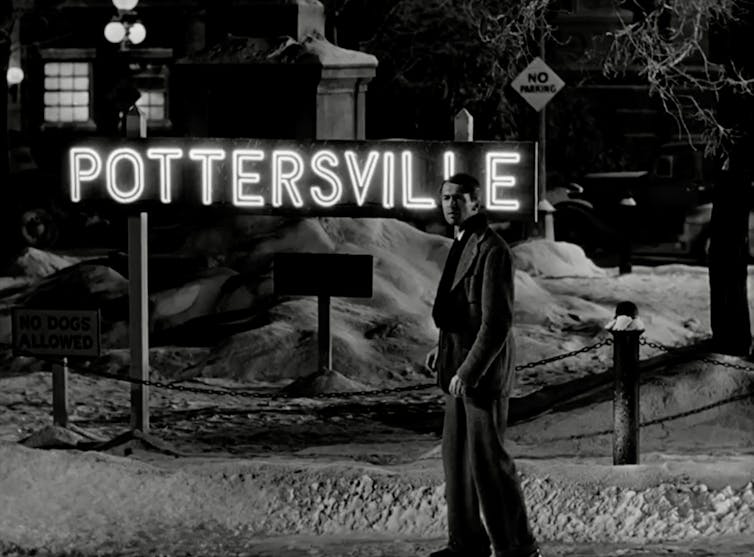
Movie still of young man walking through a dark, snowy town and passing by a bright sign reading 'Pottersville.'
Pottersville, the dark, dystopian version of Bedford Falls, is a place characterized by vice and moral decay.
Paramount

Having previously written about “It’s a Wonderful Life” in my book on literary and film censorship, I can’t help but see parallels between Pottersville and the U.S. today.

Think about it:

In Pottersville, one man hoards all the financial profits and political power.

In Pottersville, greed, corruption and cynicism reign supreme.

In Pottersville, hard-working immigrants like Giuseppe Martini who were able to build a life and run a business in Bedford Falls have vanished.

In Pottersville, homeless addicts like Mr. Gower and nonconformist “pixies” like Clarence are scorned and ostracized, then booted out of the local watering hole.

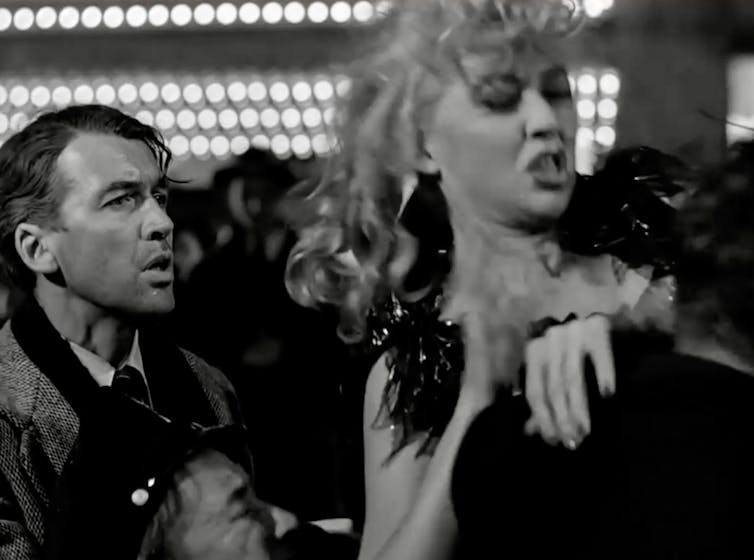
In Pottersville, cops arrest people like Violet Bick while they’re at work and haul them away, kicking and screaming.

Black-and-white movie still of a young women being dragged away by the police as a worried young man looks on.
Violet Bick gets dragged away by the Pottersville police as George looks on.
Paramount

But what horrifies George the most about Pottersville is how desensitized the people living in it seem to be to its harshness and cruelty – how they treat him like he’s the crazy, deranged one for wanting and expecting things to be different and better.

This is what the current political moment feels like to me. There are days when the latest headlines feel so jarringly unprecedented that I find myself thinking, “Can this be happening? Can this be real?”

If you think these comparisons are a bit of a stretch, consider when “It’s a Wonderful Life” was made, and the frame of mind Capra was in when he made it.

Frank Capra, anti-fascist

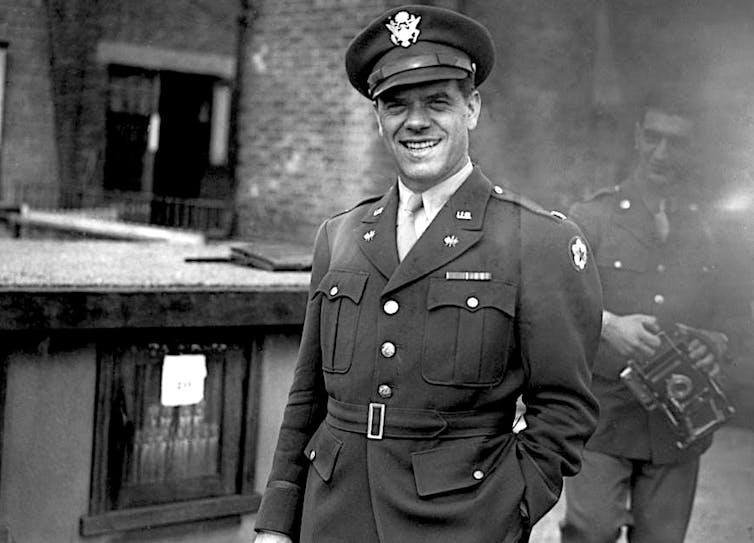
In 1946, Capra was just returning to Hollywood filmmaking after serving for four years in the U.S. Army, where the Office of War Information had tasked him with producing a series of documentary films about World War II and the lead-up to it. Even though Capra hadn’t been on the front lines, he’d been immersed in the sounds and images of war for years on end, and he had become acutely familiar with Germany, Italy and Japan’s respective rises to fascism.

Young man posing and smiling while wearing a military uniform.
Frank Capra served in the U.S. Army during World War II.
Keystone/Hulton Archive via Getty Images

When deciding on his first postwar film, Capra recalled in his autobiography that he specifically “knew one thing – it would not be about war.” Instead, he chose to adapt a short story by Philip Van Doren Stern, “The Greatest Gift,” that Stern had originally sent to friends and family as a Christmas card in 1943.

Stern’s story is certainly not about war. But it’s not exactly about Christmas, either.

As Stern writes in his opening lines:

“The little town straggling up the hill was bright with colored Christmas lights. But George Pratt did not see them. He was leaning over the railing of the iron bridge, staring down moodily at the black water.”

The protagonist contemplates suicide because he’s “sick of everything” in the small-town “mudhole” he’s stuck in – until, that is, a “strange little man” gives him the chance to see what life would be like if he’d never been born.

It was Capra and his team of screenwriters who added the sinister Henry F. Potter to Stern’s short, simple tale. The Potter subplot encapsulates the film’s most trenchant, still-resonant themes: the unfairness of socioeconomic injustices; the pervasiveness of corporate and political corruption; the threat of monopolized power; the need for affordable housing.

These themes had, of course, run through many of Capra’s prewar films as well: “Mr. Deeds Goes to Town,” “You Can’t Take It with You”“Meet John Doe” and “Mr. Smith Goes to Washington,” the last of which also starred Jimmy Stewart.

But they take on a different kind of weight in “It’s a Wonderful Life” – a weight that’s especially visible on the weathered face of Stewart, who himself had just returned from a harrowing four-year tour of duty as a fighter pilot in Europe.

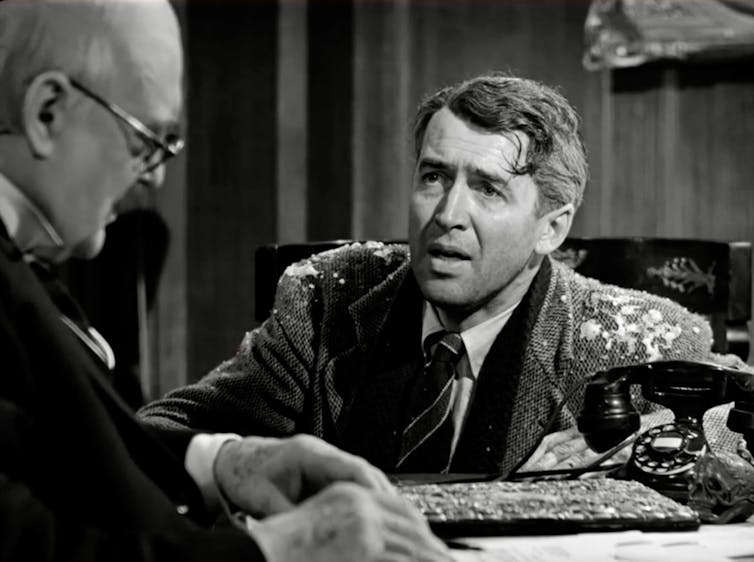
The idealistic vigor with which Stewart had fought crooked politicians and oligarchs as Mr. Smith is replaced by the bitterness, exhaustion, frustration and desperation with which he battles against Mr. Potter as George Bailey.

Black-and-white movie still of a distraught man with snow on his jacket.
George Bailey feels helpless in the face of corruption and cruelty.
Paramount

Life after Pottersville

By the time George has begged and pleaded his way out of Pottersville, the lost $8,000 is no longer top of mind. He’s mainly just relieved to find Bedford Falls as he had left it, warts and all.

And yet, the Bedford Falls that George returns to isn’t quite the same as the one he left behind.

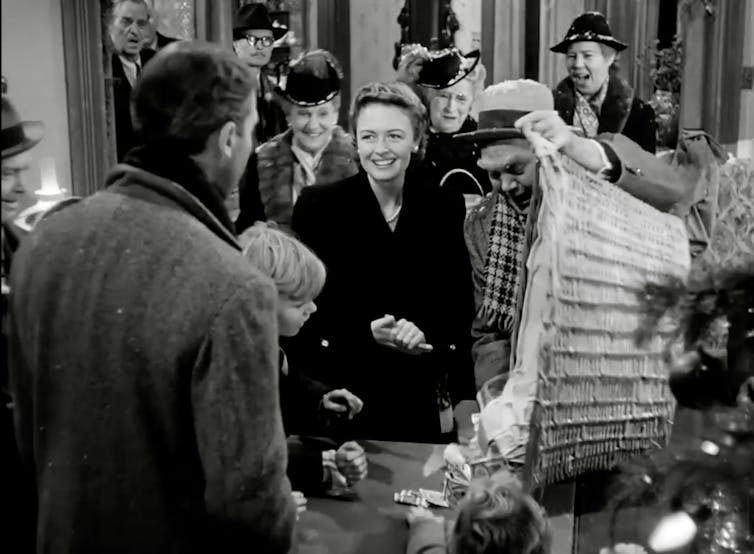
In this Bedford Falls, the community rallies together to figure out a way to recoup George’s missing money. Their pre-digital version of a GoFundMe page saves George from what he’d feared most: bankruptcy, scandal and prison.

And even though his wife, Mary, tries to attribute this sudden wave of collectivist, activist energy to some sort of divine intervention – “George, it’s a miracle; it’s a miracle!” – Uncle Billy points out that it really came about through more earthly organizing means: “Mary did it, George; Mary did it! She told some people you were in trouble, and they scattered all over town collecting money!”

A group of smiling people dump a large basket of cash on a desk.
The residents of Bedford Falls come together to save George from financial ruin.
Paramount

But the question of whether George actually wins his battle against Potter is a murky one.

While the typical Capra protagonist triumphs by defeating vice and exposing subterfuge, George never even realizes that Potter is the one who got hold of his money and tried to ruin his life. Potter is never held accountable for his crimes.

On the other hand, George is able to learn, from his time in Pottersville, what a crucial role he plays in his community. George’s victory over Potter, then, lies not in some grand final act of retribution, but in the incremental ways he has stood up to Potter throughout his life: not capitulating to Potter’s bullying or intimidation tactics; speaking truth to power; and running a community-centered business rather than one guided by greed and exploitation.

In recent months, there have been similar acts of protest, large and small, in the form of rallies, boycotts, immigrant aid efforts, subscription cancellations, food bank donations and more.

That doesn’t mean the U.S. has made it out of Pottersville, however.

Each day, more head-spinning headlines appear, whether they’re about masked agents terrorizing immigrant communities, the dismantling of anti-corruption oversights, the consolidation of executive power or the naked display of political grift.

Zuzu’s petals are still missing. Clarence still hasn’t gotten his wings.

But this holiday season, I’m hoping it will feel helpfully cathartic to go with George Bailey, for the umpteenth time, through the dark abyss of his dystopian nightmare – and come out with him, stronger and wiser, on the other side.

The Conversation

Nora Gilbert does not work for, consult, own shares in or receive funding from any company or organization that would benefit from this article, and has disclosed no relevant affiliations beyond their academic appointment.

ref. The dystopian Pottersville in ‘It’s a Wonderful Life’ is starting to feel less like fiction – https://theconversation.com/the-dystopian-pottersville-in-its-a-wonderful-life-is-starting-to-feel-less-like-fiction-270759

Hanukkah celebrates both an ancient military victory and a miracle of light – modern Jews can pick from either tradition

Source: The Conversation – USA (3) – By Joshua Shanes, Emanuel Ringelblum Professor in Jewish History, University of California, Davis

The main ritual of Hanukkah is the lighting of the menorah. skynesher/ E+ via Getty Images

Friends and family will come together to celebrate, share gifts and eat traditional foods as the eight-day Jewish festival of Hanukkah begins on Dec. 14, 2025.

Hanukkah commemorates the rededication of the Second Temple in Jerusalem, the center of ancient Judean worship, in 164 B.C.E. It had been defiled by the Seleucid king Antiochus IV Epiphanes and was recaptured by Judean forces. Judean culture had been transformed by Greek influence for centuries, but Antiochus attempted to quash Judean religious distinctiveness altogether. This led to a rebellion by the Hasmonean family, known also as the Maccabees. They established a dynasty that lasted until the conquest by Rome in 63 B.C.E.

The story is preserved in the Books of the Maccabees, written during the second and first centuries B.C.E. Some Christians consider the texts part of the Bible, though Jews today do not. The first rabbis working 2,000 years ago left it out of the Jewish Bible.

As a scholar of modern Jewish religion and politics, I have always been fascinated by the ways in which modern Jews pick and choose from the well of tradition to construct a form of Jewishness they feel is authentic.

Hanukkah serves as a prime example of this process.

What does the holiday celebrate?

The eight-day holiday has two traditional components. On the one hand, its liturgy gives thanks to God for the military victory. This reflects the original pre-rabbinic core of the holiday, which was declared by the new Hasmonean dynasty to celebrate its triumph.

The primary ritual of the holiday, however, is the lighting of the Hanukkah menorah. It celebrates the legend of a single flask of pure oil found in the Temple that was sufficient for just one day, but miraculously burned for eight.

A black-and-white sketch depicts several soldiers destroying statues and other things, while others with stern expressions stand alongside them.
A sketch illustrating Judas Maccabeus’ orders to priests to cleanse the temple sanctuary.
Sepia Times/Universal Images Group via Getty Images

The earliest version of this story appears in the Talmud – the main collection of rabbinic laws and commentary – some 500 years after the story occurred. The founders of Rabbinic Judaism – the Judaism of the past 2,000 years – were apparently uncomfortable with its military message and reshaped the holiday to give it new meaning.

In the words of historian Malka Simkovich, “Instead of glorying military prowess, the holiday instead glorifies the unconditional and miraculous divine light that Jews can depend on, even in the gloomiest of darkness.” This reflects Rabbinic Judaism’s tendency to reread biblical and other texts about land and power as metaphors for spiritual growth and faith.

Though popular today, Hanukkah is traditionally a minor holiday on which work is permitted. Over time, it developed into a celebration emphasizing family and children, games and gifts and special foods.

Modernity brings new meanings

In the 19th century, this shared meaning of the holiday changed. In America and parts of Europe, Jews experienced emancipation and economic mobilization and sought ways to integrate into their local national communities.

As Jews became more integrated into wider society, Hanukkah served as an opportunity to celebrate at a time of year when their Christian neighbors were doing the same. They continued to celebrate the holiday in its rabbinic, spiritual meaning, however. As the pioneering European Hebrew newspaper Hamagid wrote in 1857: “More than we recall the physical valor of the Maccabees, we understand the war as a struggle for spiritual deliverance from Greek culture.”

Then came Zionism, the Jewish nationalist movement born in the 1880s in Europe, that defined Jews as a modern nation rather than just a religion. It hoped one day to establish a home in Palestine, the site of the ancient Israelite kingdoms. They used Jewish traditions, especially pre-rabbinic biblical traditions about Jews living in that land, to prove the validity of their worldview.

Zionists quickly adopted Hanukkah as their most important holiday. They did this for a variety of reasons, but most important was its easy reformulation into a secular nationalist festival.

Zionism remakes Hanukkah

Hanukkah was not merely repackaged by Zionists in Europe; it was totally transformed from a relatively minor holiday into the central annual celebration of the movement.

Moreover, while the miracle of the oil defined traditional celebrations, it was specifically the military victory that defined Zionist ones. For the fledgling nationalist movement, the ancient story gave a historical example of Jewish heroes who successfully fought to expel foreign invaders from their homeland.

They exemplified the “new Jew,” the “Jew of muscle” that their leaders promoted, in contrast to the European stereotype of Jews as weak or bookish.

The role of God and even the Temple was limited; the story was refocused on the nation and its military struggle for freedom and independence. Hanukkah offered weapons, heroes and victories, writes historian Francois Guesnet: “It was an occasion to confront the glorious past with the needs of the contemporary national re-awakening.”

At the same time, Zionist Hanukkah celebrations also connected the movement to Jewish religious observance, thereby appealing to traditional groups without alienating its secular core. After all, Hanukkah was a traditional Jewish celebration, and since work is allowed, they were not violating any ritual laws with their events.

Orthodox leaders did not buy it.

In Sanz, for example – a city today in Poland – the Zionists’ first Hanukkah celebration in 1900 raised a storm of protest by local Hasidic leaders. They accused the Zionists of desanctifying the holiday and defiling the Hanukkah miracle. They even complained that the Zionists defiled the Star of David by using it in their signage and directed that the emblem be torn off the Holy Ark in the synagogue.

Over time, the Zionists’ version of Hanukkah largely won, especially in Israel. Zionists brought these values into the new Jewish state that they succeeded in creating in 1948. But it has also been embraced by many Jews in the diaspora.

Other meanings persist

The rabbinic tradition has not disappeared. There are still ultra-Orthodox Jews who reject the Zionist return to pre-rabbinic traditions of the Book of Maccabees, for example. There are also many liberal Jews, especially young Jews, who reject the infusion of Zionism into their Jewish identity.

These numbers have grown in recent years due to Israel’s actions in the Gaza Strip and the West Bank.

The Book of Maccabees describes the battle against Antiochus being preceded by a battle against Jews who sided with him. As a result, it has become almost an annual tradition for Jews to accuse each other of representing that traitorous group and to claim that one’s own camp represents the true Jews.

A man and a woman dressed in black bending down while lighting candles placed inside a glass box mounted on a wall.
An ultra-Orthodox Jewish man and woman light candles on the second night of Hanukkah, in the Mea Shearim neighborhood of Jerusalem, on Dec. 13, 2017.
Menahem Kahana/AFP via Getty Images

Some Jews will write editorials and social media posts about how Hanukkah “proves” that Zionism is the authentic interpretation of Jewish tradition. Some even question why non-Zionist or anti-Zionist Jews bother lighting candles. Their opponents respond with articles about Hanukkah’s history as a rabbinic holiday and how it has been reinterpreted since the start of the Zionist movement.

Each argues that their own interpretation is the correct one.

In truth, Judaism is constantly being made and remade. Is Hanukkah’s “real” meaning the Zionist return to pre-rabbinic sources? Or is it the rabbinic spiritualization of the holiday and its metaphor of bringing light into darkness? There is no clear answer.

In other words, both sides have sources to support their interpretation. Zionists can draw on the military imagery featured in the First Book of Maccabees and other sources. For those who prefer the holiday as presented by the rabbis who founded Rabbinic Judaism 2,000 years ago, there is an equal wealth of material, including in the prayers recited in synagogues.

The rabbis assigned a special reading from the later biblical books for each Sabbath and holiday. Their choice for the Sabbath of Hanukkah – Zechariah 2:14-4:7 – is revealing: “This is the word of the Lord to Zerubbabel, saying: ‘Not by military might and not by physical power, but by My spirit,’ says the Lord of Hosts.”

The Conversation

Joshua Shanes does not work for, consult, own shares in or receive funding from any company or organization that would benefit from this article, and has disclosed no relevant affiliations beyond their academic appointment.

ref. Hanukkah celebrates both an ancient military victory and a miracle of light – modern Jews can pick from either tradition – https://theconversation.com/hanukkah-celebrates-both-an-ancient-military-victory-and-a-miracle-of-light-modern-jews-can-pick-from-either-tradition-271624