Landmark lawsuit finds that social media addiction is a feature, not a bug

Source: The Conversation – UK – By Quynh Hoang, Lecturer in Marketing and Consumption, Department of Marketing and Strategy, University of Leicester

A Los Angeles jury has delivered a landmark verdict: Meta and YouTube were negligent in the design and operation of their platforms, causing a young woman known in court documents as Kaley, or KGM, to become addicted to social media.

The tech giants must now pay her a total of US$6 million in damages – $3 million compensatory and $3 million punitive.

She claimed the platforms’ design features got her addicted to the technology and exacerbated her depression, anxiety, body dysmorphia and suicidal thoughts.

The jury found that Meta bore 70% of the responsibility and YouTube 30%, meaning Meta will pay $4.2 million and Google’s YouTube $1.8 million. Both companies have said they will appeal.

The verdict came a day after a separate New Mexico jury ordered Meta to pay US$375 million for failing to protect children from predators on Instagram and Facebook.

Kaley filed her lawsuit in 2023, when she was 17. She claimed that she began using social media as a young child and alleged that features such as infinite scroll, autoplay, algorithmically timed notifications and beauty filters were addictive.

TikTok and Snap were originally named as defendants but settled before the trial began for undisclosed sums. Meta and YouTube proceeded to a seven-week trial in Los Angeles Superior Court.

The case is the first of three bellwether trials scheduled in the California state proceedings – test cases selected to gauge how juries respond to the core legal arguments – drawn from a pool of more than 1,600 plaintiffs, including over 350 families and 250 school districts.

The outcome of this first trial was always likely to have consequences far beyond one young woman’s case.

Bypassing big tech’s legal shield

The legal strategy that made this trial possible was a deliberate departure from previous attempts to sue social media companies. Historically, platforms have been shielded by Section 230 of the 1996 Communications Decency Act, which protects internet companies from liability for content posted by their users.

The plaintiff’s lawyers sidestepped this entirely by arguing that the harm arose not from what users posted, but from how the platforms were engineered – treating Instagram and YouTube as defective products rather than neutral publishers.

The jury heard internal Meta documents that proved damaging. One memo read: “If we wanna win big with teens, we must bring them in as tweens.” Another showed that 11-year-olds were four times as likely to keep returning to Instagram compared with competing apps, despite the platform’s own minimum age requirement of 13.

A former Meta engineering director turned whistleblower, Arturo Béjar, testified about how features like infinite scroll exploit the brain’s reward system. Meta CEO Mark Zuckerberg himself took the stand – his first jury testimony on child safety – and was questioned about his decision to retain beauty filters despite internal research flagging their impact on young girls’ body image.

The jury rejected the companies’ central defence: that Kaley’s struggles were primarily the result of a difficult home life and pre-existing conditions rather than platform design.

In finding that the companies had acted with “malice, oppression or fraud”, they opened the door to the additional punitive damages that brought the total to US$6 million.

Both companies will appeal, and the process could take years. In the meantime, a second important trial is scheduled for this summer, and a separate federal case in Oakland involving school districts is also advancing. The pressure on platforms to settle the thousands of remaining cases will grow considerably.

Long-term impact?

For users, the immediate practical picture is less clear. Meta and YouTube are unlikely to make significant changes to their platforms while the appeals process plays out. Any redesign – if it comes – is likely to be incremental and carefully managed to minimise disruption to the engagement model that drives their revenues.

But there is a harder question the verdict does not answer: will it actually change anything? Meta and YouTube are companies worth hundreds of billions of dollars. A US$6 million damages award is not going to restructure the attention- and surveillance-driven economy.

My research on digital overuse – based on in-depth interviews with digital users and studies of online communities discussing digital overuse and detox – shows that even people who are fully aware of the problem and genuinely want to reduce their screen time find it extraordinarily difficult to do so.

This is not because they lack willpower, but because the features driving compulsive use are not bugs in the system. They are the system, built to maximise engagement and advertising revenue.

For years, big tech has placed the burden of managing screen time squarely on individuals and parents – encouraging screen time limits, digital detoxes, and parental controls while continuing to engineer products specifically designed to defeat exactly that kind of self-regulation.

The jury has pushed back against that logic. Whether courts, regulators, and legislators will push hard enough to force genuine structural redesign remains to be seen. However, the European Commission has already made the preliminary finding that TikTok’s addictive design features are in breach of the EU’s Digital Services Act.

What this verdict does, at minimum, is shift the ground. For the first time, a jury has confirmed what researchers have argued for years: this is not a story of weak willpower or bad parenting. It is, at least in part, a story of deliberate product design. That matters – even if the real fight is still to come.

The Conversation

Quynh Hoang does not work for, consult, own shares in or receive funding from any company or organisation that would benefit from this article, and has disclosed no relevant affiliations beyond their academic appointment.

ref. Landmark lawsuit finds that social media addiction is a feature, not a bug – https://theconversation.com/landmark-lawsuit-finds-that-social-media-addiction-is-a-feature-not-a-bug-279390

Iran was always going to close the Strait of Hormuz

Source: The Conversation – UK – By Jonathan Este, Senior International Affairs Editor, Associate Editor, The Conversation

This is the text from The Conversation UK’s World Affairs Briefing email. Sign up here to receive weekly analysis of the latest developments in international relations, direct to your inbox.


The five-day deadline to open the Strait of Hormuz handed to Iran by Donald Trump on Monday expires some time tomorrow and the Islamic Republic needs to “get serious before it is too late” – or so the US president has announced on his TruthSocial platform.

You’ll recall that this deadline replaced another deadline which was due to expire on Monday night, after which the US and Israel would obliterate Iran’s power plants and plunge the country into darkness. Happily Trump pulled back from this plan, reporting that talks were progressing very well, so he would extend the deadline until March 27.

For their part, Iranian officials denied that negotiations were even underway, while US officials said contacts were at a very early stage. This has prompted speculation that the US president was seizing even the most informal of contacts as an “off ramp” to save face over not following through with his threat.

Certainly Trump’s oft-repeated assurance that the war in Iran has been won and that Iran’s senior officials (whoever remains after Israel’s highly successful campaign of assassinations) are “begging” the US to make a deal looks a rather optimistic assessment from the US president.

Far from collapsing in a heap after the death of the former supreme leader, Ali Khamenei, the regime is showing its resilience. Its targeting of US installations in the region are hurting the Gulf states and there are signs that Israel’s Iron Dome is fracturing in parts under the volume of Iranian missile attacks (this reportedly also happened during the 12-day war last year). Conservative estimates are that the war is costing the US and Israel more than US$1 billion £740 million) a day.


TruthSocial

But it has been Iran’s ability to shut down traffic through the Strait of Hormuz that has arguably turned this into a world war, despite the unwillingness of many of America’s allies, particularly in Europe, to get involved. An estimated 20% of the world’s gas and oil transit the strait each day along with other vital supplies. Or at least it did before the end of February. Now very little is getting through and the consequences are being felt globally.

It’s not as if the US and Israel couldn’t anticipate that Iran would react to their attacks by closing down the strait. Arshin Adib-Moghaddam, an expert in Iranian history at the SOAS, University of London, walks us through nearly five decades in which Iran responded to every crisis by threatening to close the strait. Is is, he argues, a key plan in Iran’s security policy.


Read more:
Iran has been threatening to close the Strait of Hormuz for years – it’s a key part of Tehran’s defence strategy


Meanwhile, it appears that the US is dusting off a 15-point peace plan it developed in May last year and which has already been rejected by Iran.

Critics say the chances of Iran acquiescing to the plan were negligible then and remain so now. It calls for Iran to give up all its uranium and agree to hand control of its civil nuclear programme to an outside panel. And, controversially, it seeks to control what Iran spends the money it gains if sanctions are relaxed.

This has prompted analysts to ask whether this plan was simply produced to give the US an explanation as to why it changed its mind over hitting Iran’s power plants. Bamo Nouri and Inderjeet Parmar, experts in international politics at City St George’s, University of London, think it the resurfacing of this plan is the strongest indication yet that Washington is beginning to fear that it has become embroiled in an unwinnable war.


Read more:
‘Girl math’ may not be smart financial advice, but it could help women feel more empowered with money


Certainly this conflict has not gone the way Trump and his Israeli counterpart Benjamin Netanyahu might have wanted. But – as with the closure of the Strait of Hormuz, this should have been predictable. Jason Reifler, a political scientist at the University of Southampton, asserts that the US in particular, has embarked on this conflict with no clear goals or thought-through strategy.

Map of Straits of Hormuz
The Strait of Hormuz is one of the world’s most important waterways, with 20% of the global trade in oil flowing through a narrow maritime channel.
Wikimedia Commons

Failing to ask for authorisation via the United Nations (and for America, the the US congress) was a bad start, meaning the war had a legitimacy deficit from the word go. The reason for launching the conflict has veered from halting Iran’s nuclear programme to regime change and back again. And the strategy of assassinating Iran’s leadership has produced a rally-round-the-flag effect that few had anticipated.

Add to that the devastatingly effective use of drones by Iran (which the war planners in the US and Israel must surely have picked up on from the experience in Ukraine), means that the two countries are often forced to counter munitions worth US$20,000 with missiles worth millions of dollars. Meanwhile, the pain from Iran’s closure of the closing the strait will only get worse.


Read more:
Iran war lacks strategy, goals, legitimacy and support – in the US and around the world


Holy war?

The US defense secretary, Pete Hegseth, held a religious service at the Pentagon yesterday, at which he called on god to “grant this task force clear and righteous targets for violence”. Hegseth appears to see this as a holy war in which he has clearly cast himself as a crusader, even sporting a tattoo reading, “Daus vult” (god wills it) – reportedly the rallying cry for the attempt to “liberate the Holy Land” in the 11th century.

Toby Matthiesen, senior lecturer in global religious studies at the University of Bristol observes here the way in which all parties to this conflict have used religion to garner support. Of course, claiming the approval of one’s chosen deity is a time-honoured tactic that even Nazi Germany tried. But it feels a little incongruous in the 21st century.

You could be forgiven for thinking that the sight of Donald Trump in the middle of a prayer huddle in the Oval Office was an amusing oddity. But Benjamin Netanyahu’s reference to the Old Testament story of the Amalekites, whom god told the children of Israel to annihilate, “men and women, children and infants, cattle and sheep, camels and donkeys” is frankly chilling. Parts of the Islamic world has flocked to Iran’s defence (although not with particular enthusiasm in the Sunni countries of the Gulf, which Iran is bombarding with ballistic missiles).


Read more:
God on their side: how the US, Israel and Iran are all using religion to garner support


Trang Chu and Tim Morris, meanwhile, believe that this conflict has been nearly five decades in the making. Just as Iran has always denied the right of Israel to exist as a Jewish state, many people in the US and Israel have long been committed to the destruction of Iran as a theocracy. Accordingly the way the two sides talk about each other has hardened over the years. Language on each side no longer reflects a criticism of their adversary’s behaviours, it has become a verdict on their moral character.

So to Iranians, the US is the “Great Satan”, while Iran is described in America as part of an “axis of evil”. Our experts believe that, this language “not only describes the enemy, but actively participates in creating it”. The observe that once you start to think these sorts of things about your adversaries, the idea of engaging in negotiation tends to become secondary to the desire to simply defeat or destroy them. Which is terribly dangerous, as we’re seeing.


Read more:
How the words that Iran and America use about each other paved the way for conflict


Sign up to receive our weekly World Affairs Briefing newsletter from The Conversation UK. Every Thursday we’ll bring you expert analysis of the big stories in international relations.


The Conversation

ref. Iran was always going to close the Strait of Hormuz – https://theconversation.com/iran-was-always-going-to-close-the-strait-of-hormuz-279371

Could this energy crisis be worse for the global economy than COVID?

Source: The Conversation – UK – By Adi Imsirovic, Lecturer in Energy Systems, University of Oxford

Alex_An_Der/Shutterstock

Despite reports of negotiations between the US and the Iranian regime, the Strait of Hormuz remains effectively closed to most oil tankers, with only a small number of vessels being allowed to pass. The result is a loss of roughly 11 million barrels per day (mbd) of oil and petroleum liquids to the global market. This represents just over 10% of global supply.

At first glance, a 10% disruption may not sound catastrophic. But in oil markets, even a 10% imbalance between supply and demand can have very large economic effects.

To understand the scale of the disruption, it is useful to compare it with the height of the COVID pandemic in 2020. During global lockdowns, empty roads, grounded aircraft and deserted bus and railway stations became normal as travel and economic activity collapsed. At that time, global oil demand fell by about 8mbd, the largest demand shock in history.

Today’s situation is the opposite. Instead of a collapse in demand, the world is experiencing a large supply shock. But the impact on everyday life could end up looking similar: reduced travel, higher transport costs, slower economic activity and pressure on household budgets.

The reason is that both oil supply and oil demand are very inflexible in the short term. People still need to drive to work, goods still need to be transported and aircraft still need fuel. When supply falls suddenly, prices must rise significantly to force demand down.

For now, the release of emergency oil stocks is helping to cushion the initial impact, particularly in developed economies. Members of the International Energy Agency (IEA) are required to hold emergency stocks equivalent to at least 90 days of oil consumption, and several countries also maintain strategic petroleum reserves.


Read more:
These are shaky times for oil markets. An expert explains what a prolonged war will mean for prices


Countries such as the US, China and Japan can therefore offset supply disruptions for a limited period. However, these reserves are not a long-term solution. If the conflict continues for months rather than weeks, stockpiles will be depleted.

The situation is much more serious for developing countries. Many countries in Asia, Africa and South America hold very limited commercial reserves and are much more vulnerable to supply disruptions and price spikes. For these economies, elevated oil prices quickly translate into higher food prices, inflation and economic instability.

The first shortages would probably appear not in petrol, but in diesel and jet fuel. Gulf oil producers are major exporters of middle distillates, and their crude oil grades produce large quantities of diesel and jet fuel when refined.

airbus a380 coming in to land at heathrow airport in london over trees and landing lights.
Jet fuel could be one of the first commodities to be hit.
Benjamin_Barbe/Shutterstock

Diesel is particularly important because it fuels trucks, ships, construction equipment and agricultural machinery. So a diesel shortage affects food supply, construction, mining and global trade – not just transport. Petrol shortages would follow as crude oil supply tightens further, and eventually shortages would spread across all petroleum products.

Oil is not just used for transport fuel. It is also a key input into petrochemicals for the production of plastics, fertilisers, chemicals, synthetic materials and many industrial processes. This means the effects of a major oil supply disruption spread across the entire economy.

Shortages or price increases could affect everything from food production and packaging to electronics, construction materials and clothing. The economic effects of an oil shock are therefore much broader than simply higher petrol prices.

Protectionism could make everything worse

One of the biggest risks during a supply crisis is export restrictions and protectionism. Governments often try to protect domestic consumers by freezing prices and banning exports of fuel or crude oil, but this usually makes the global shortage worse.

Government price freezes only discourage production and supply, and encourage consumers to keep burning fuel. Protectionism is even worse. There are already signs of this happening – some countries (China, for example) are restricting exports of petroleum products such as diesel and jet fuel. When countries hoard fuel, global markets become tighter and prices rise even further.

The biggest risk would be if the US restricted oil exports in order to protect domestic consumers. The US is now the world’s largest oil producer, producing more than 20mbd of oil and petroleum liquids. But it is also one of the world’s largest consumers. However, it still exports significant volumes, particularly to Europe.

The US has banned oil exports before. In 1975, following the Arab oil embargo (when in 1973 Arab states refused to supply oil to countries, including the US, that had supported Israel in the Yom Kippur war), the US banned exports of crude oil. The ban was lifted only in 2015. If such a ban were introduced today, it would be likely to cause major supply shortages and price increases, especially in Europe.

If the Strait of Hormuz remains closed for a prolonged period, or if the conflict escalates further, global losses of exports from the Persian Gulf could approach the 20mbd of oil and petroleum products.

Under these circumstances, the economic and social effects could be severe. Transport could become more expensive and less frequent, air travel would be severely curtailed, inflation would rise and economic growth would slow significantly. In extreme scenarios, the disruption to daily economic life could resemble the COVID period (and probably worse). But this time it would be caused by a shortage of energy.

For now, markets are relying on emergency stock releases and hopes of a geopolitical de-escalation. But if not, the world economy could face an unprecedented energy shock, with far-reaching and unpredictable consequences.

The Conversation

Adi Imsirovic does not work for, consult, own shares in or receive funding from any company or organisation that would benefit from this article, and has disclosed no relevant affiliations beyond their academic appointment.

ref. Could this energy crisis be worse for the global economy than COVID? – https://theconversation.com/could-this-energy-crisis-be-worse-for-the-global-economy-than-covid-279284

How the war in Iran is already affecting UK farmers and food production

Source: The Conversation – UK – By Caroline Flanagan, Head of School, Agriculture, Anglia Ruskin University

The price of red diesel used by farmers is rising fast. Mark I Walker/Shutterstock

The conflict in Iran and the disruption to the strait of Hormuz are already starting to affect UK farmers. The closure of this vital shipping route threatens supplies of two essential agricultural necessities: fuel and fertiliser.

The immediate impact on farmers has been a sharp increase in the cost of red diesel – the rebated fuel widely used in agriculture – which has already risen by approximately 60%, far outpacing increases seen at retail fuel pumps for car owners.

Concerns for farmers include the cost of fertiliser, particularly nitrogen. As the key nutrient driving growth in two key crop groups grown extensively in the UK, cereals and oilseeds, nitrogen is essential for achieving high yields. A wheat crop may require over 200kg per hectare during the growing season, depending on soil conditions, weather, and yield expectations.

The UK imports around 60% of its nitrogen fertiliser. Although much of this supply does not originate directly from the Middle East, global market dynamics mean prices are highly sensitive to disruptions. Around one-third of the global fertiliser trade passes through the strait of Hormuz, contributing to price increases of approximately £50 per tonne, compared to early 2025, and is expected to rise more if the conflict continues.

UK fertiliser traders are finding prices are changing so fast that they can’t update their daily lists. The NFU president Tom Bradshaw has raised concerns about farmers not being given a confirmed price until stocks are delivered.

While most farmers buy fertiliser in bulk ahead of the growing season, the longer-term outlook is already a concern.

Much will depend on the duration of Middle Eastern tensions and whether the strait reopens in time for fertiliser purchasing decisions this autumn, ready for next year’s crops.

Unlike the 2022 fuel price shock following the invasion of Ukraine – which was partially offset by higher commodity prices – current market conditions offer little expectation of improved crop prices.

Difficult calculations

Farmers are, therefore, being forced into difficult calculations: weighing the cost of nitrogen against likely crop prices, reassessing how to balance the crop’s agrochemical inputs, including fertiliser, and awaiting clarity on the future of Environmental Land Management Schemes (Elms). Elms are government schemes in England aimed at supporting farmers to make environmentally beneficial changes to their land.


Read more:
How the Iran war could create a ‘fertiliser shock’ – an often ignored global risk to food prices and farming


Even before the current conflict started, industry bodies such as the National Farmers’ Union had raised concerns about the viability of arable farming under sustained cost pressures.

The government has also acknowledged these challenges, commissioning the Competition and Markets Authority (CMA) to investigate supply issues affecting fertiliser and agricultural fuel. The CMA has said it will monitor price rises caused by the current international conditions. In response to the crisis, the UK government has just announced proposals to support more varied types of fertiliser.

All these factors raise broader concerns for the UK, where food self-sufficiency stands at around 62% – a potentially precarious position in an increasingly uncertain global landscape.

Farming landscape

UK crops are currently looking generally robust, after a strong autumn with ideal conditions for sowing winter crops and a favourable start to spring. Early signs point to a promising 2026 harvest.

But optimism is tempered by ongoing economic pressure. Farm gate prices (the price if a customer bought direct from a farmer) remain stubbornly low, as UK farmers compete with imports produced under lower environmental and regulatory standards

Simultaneously, the transition away from legacy EU support payments has left a significant income gap. Replacement schemes under the Environmental Land Management Schemes were paused in 2025 and are only expected to resume later this year, creating further uncertainty.

The Department for Environment, Food and Rural Affairs (Defra) latest figures forecast average arable farm income fell to £17,000 in the year to February 2026 – the lowest level since 2004–05. The drop reflects a mix of difficult seasonal conditions and global oversupply in key crops such as cereals and oilseeds. Dairy farm income was much higher at £224,000 for the same period.

Fertiliser shortages are set to hit farmers around the world.

The industry is rapidly embracing innovation and the government is backing farmers with measures to strengthen fertiliser supply resilience. Together with rising costs, these shifts have helped drive a 50% reduction in nitrogen use over the past four decades.

Precision agriculture (which uses technology to refine decisions) has boosted efficiency further, enabling farmers to tailor fertiliser use to the needs of specific fields.

There are other potential innovations that could help. Tesco for example, is working with farmers and manufacturers to develop lower-carbon fertilisers made from food waste, algae, poultry manure, and industrial by-products.

Global fertiliser markets may be volatile, but in the short term shoppers are unlikely to see that uncertainty reflected in everyday food prices. A 2022 Sustain report, found that farmers often receive less than 1% of the profit from supermarket sales, meaning their tiny share leaves little room for fertiliser costs to influence the final price on the shelf. For now, any rise or fall in the price of bread, flour, cakes or biscuits is far more likely to come from supermarket pricing tactics or broader supply‑chain pressures than from shifts in global fertiliser markets.

That’s not to say fertiliser costs never filter through – a prolonged conflict could still nudge prices up for shoppers. Crops respond dramatically to fertiliser levels, so even modest reductions in nitrogen use can produce disproportionately large declines in yield. All that could translate into thousands of tonnes of lost crops, which would make food more expensive in the future.

The Conversation

The authors do not work for, consult, own shares in or receive funding from any company or organisation that would benefit from this article, and have disclosed no relevant affiliations beyond their academic appointment.

ref. How the war in Iran is already affecting UK farmers and food production – https://theconversation.com/how-the-war-in-iran-is-already-affecting-uk-farmers-and-food-production-279032

Wolf Worm by T. Kingfisher – a brilliantly creepy, skin-crawling work of southern gothic fiction

Source: The Conversation – UK – By Daniel Cook, Professor of English Literature, University of Dundee

Wolf Worm by T. Kingfisher begins innocently enough: Sonia Wilson, an anxious young scientific illustrator, has been hired to draw the vast insect collection of the reclusive entomologist (insect expert) Dr Halder at his North Carolina manor house.

Something’s not quite right from the off. No one meets her on her arrival and she wonders whether her new employer really expects her to walk ten miles from the train station to his house? Old Halder is not one for practical details, the tight-lipped locals warn her. Harmlessly eccentric or maddeningly distracted? Intrigue surrounds the doctor.

T. Kingfisher is known for slow-burn books that offer rich rewards, and Wolf Worm is no different. The ominous signs come early. Weeds lurk in the corners of the unkempt garden and swarms of insects appear in the oddest of places throughout the house – bugs get into everything, Mrs Kent the housekeeper reveals matter of factly.

Sonia feels as though she has fallen into the kind of fairy tale where a wicked fairy demands she spins her watercolour illustrations into gold. Really, she has fallen into a creepy-crawly horror novel. Her days and nights are filled with delirious bouts of sleep, imperfect drawings, and scientific discovery. All the while, the mysterious Dr Halder works largely off the page.

When he does appear, Halder’s speeches are eerie and unsettling. “Do you know why it is called a screw-worm?” he asks his guest. Sonia provides a logical explantion: that the spiral ridge merely resembles a screw. But this induces an unpleasant leer from the doctor, who goes on to describe in grim detail the action of the burrowing ridges that anchor themselves into living flesh and are nearly impossible to remove. Dr Halder then casually taps a jar filled with hundreds of dead parasitic screw-worms, letting us know the insect horrors surrounding Sonia are far from hypothetical.

Screwworm parasite, a flesh-eating larvae.
Light Spring/Shutterstock

As with any other astute protagonist in a gothic novel, Sonia is consistently aware that something about her situation is “off” (a word she frequently uses). Animals behave strangely throughout. People avoid answering questions. Like Dracula’s Jonathan Harker, a late-Victorian gothic counterpart whose words she inadvertently borrows, she can barely suppress her shudders.

In a neat turn on the overly curious protagonist trope, Sonia’s knowledge of entomology develops as she works on her illustrations for her employer. As that knowledge grows, so does her discomfort.

The house and its environs steadily grow equally uncomfortable and these settings overwhelm the lead character in wholly novel ways. She habitually rationalises her experiences. For instance, if you hear a horrible sound in the woods and you don’t know what it is, she reasons, then it is probably a fox. Something is certainly making a noise in the basement: is it a disturbed prisoner? No, it’s more likely a tortured creature of some kind, she convinces herself.

It becomes harder to spin explanations, however, when she finds human remains. Like the more ghoulish doctors of 19th-century literature, such as Dr K in Robert Louis Stevenson’s The Body Snatcher or the eponymous vivisectionist in HG Wells’s The Island of Doctor Moreau, or even the real-life pioneer of anatomy studies Robert Knox, the entomologist has extended his studies to include the flesh of living subjects. And the results are truly gruesome.

Wolf Worm represents the best kind of neo-Victorian gothic: disturbing in its scope but never gratuitous, intimate and personal but always refusing to let the reader settle. For those who love historical fiction with a focus on science and artistry, and set in big creepy houses, this book will leave your skin crawling till the very end.

This article features references to books that have been included for editorial reasons, and may contain links to bookshop.org; if you click on one of the links and go on to buy something, The Conversation UK may earn a commission.

The Conversation

Daniel Cook does not work for, consult, own shares in or receive funding from any company or organisation that would benefit from this article, and has disclosed no relevant affiliations beyond their academic appointment.

ref. Wolf Worm by T. Kingfisher – a brilliantly creepy, skin-crawling work of southern gothic fiction – https://theconversation.com/wolf-worm-by-t-kingfisher-a-brilliantly-creepy-skin-crawling-work-of-southern-gothic-fiction-279165

Land animals evolved from ocean ancestors – new study unravels the genetics behind the transition

Source: The Conversation – UK – By Jialin Wei, PhD Candidate in Biological Science, University of Bristol

Mikael Damkier/Shutterstock

The transition from water to land is a question that still intrigues scientists. Those ancient organisms would have needed to adapt to several new challenges to life out of water. So, how did they do it?

In a 2025 study, my colleagues and I tried to understand the genetic basis of adapting to life on land by comparing the genetic material of 150 living animals. We discovered that some adaptations to land are universal, while others are found only in a few lineages.

Animal life started in water over 600 million years ago. Around 500 million years ago animals began their journey from water to land. Known as the Cambrian period, this is one of the biggest evolutionary shifts in Earth’s history, that paved the way for all modern land-based ecosystems.

Although green plants transitioned to land just once around 500 million years ago, animals colonised land at multiple points in time independently. This makes animal life on land a striking example of “convergent evolution” – the process in which different lineages evolve solutions to the same problem. Each of these “jumps” onto land opened up new habitats and had a dramatic effect on the atmosphere and water cycle. This in turn created the modern ecosystems we live in.

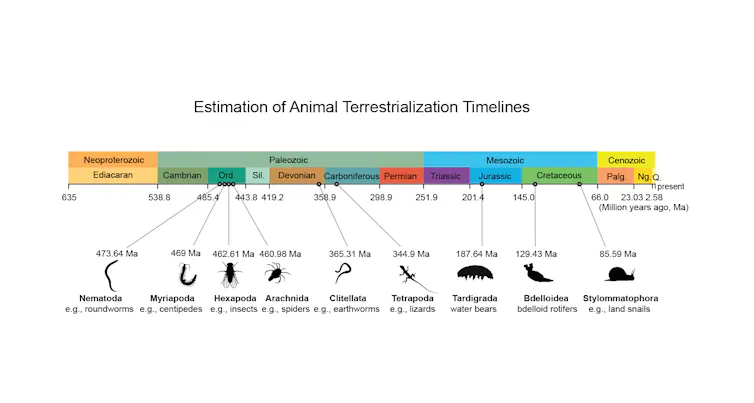
Colour coded timeline of when different animal lineages evolved a more land based lifestyle.
Estimation of animal terrestrial evolution timelines. Timeline dates are posterior means (weighted averages representing the most likely timing).
Jialin Wei, CC BY-NC-ND

In our Nature paper, my colleagues and I explored these habitat transitions from a genetic perspective. First, we compared the genomes of more than 150 species across the animal kingdom to identify which genes are shared by different lineages. Then, using the evolutionary tree of animals, we mapped which branches of the tree those genes emerged or were lost in.

We found that most transitions to land were accompanied by a large gene turnover, with many gene gains and reductions happening at the same time. The ability of genomes to gain and lose genes played a key role in animal adaptation to new habitats.

Making the leap

This discovery led us to ask what these genes do and wonder why some were retained while others disappeared. Using analytical techniques and powerful computer tools, we found that genes repeatedly gained across distantly related landbased lineages were involved in functions related to dehydration. They were also often related to stress response (such as temperature, UV radiation, contaminants found on land, and toxic compounds from plants). The genes that were lost or diminished were often linked to regeneration, diet and biological clocks such as day and night cycles.

Life’s move from water to land profoundly reshaped the planet itself. As life ventured onto land, it changed Earth’s cycles, removing CO₂ from and increasing the amount of oxygen in the atmosphere. Land-based life also weathered rocks, which made them release more minerals like calcium into the ecosystem.

These findings suggest that genetic changes drove shifts in biological functions, which in turn became key drivers of the transition from water to land.

Some animals still need humid surroundings to thrive. For example, earthworms live in moist soil. In contrast, insects and mammals can live entirely on dry land. Interestingly, we found that semi-terrestrial species (mostly tiny invertebrates) tend to share more adaptations. For example, functions related to blood circulation and nutrient absorption that help them survive in soil.

Fully land-based animals seemed to evolve a wider diversity of adaptation strategies. We discovered gene innovations specific to certain lineages, such as genes for shell formation and mucus secretion in land snails and innate immunity genes in land vertebrates. Land-based animals evolved more reinforced and specialised barrier defences for life on land. These distinct traits reveal the unique evolutionary histories shaped by ecology, physiology and chance.

Our study also sheds light on when these transitions happens. We identified three major waves of water to land transitions over the past 500 million years, during the Ordovician (485–443 million years ago), Devonian–Carboniferous (419–298 million years ago) and Cretaceous periods (145–66 million years ago). These waves began with early land arthropods, such as insects, and ended with land snails like those found in our gardens.

These periods were probably triggered by dramatic ecological and geological shifts. For example the rise of early land plants and the creation of seasonal habitats that created new environments and opportunities for land-based animals.

Previous research has mostly focused on specific land animal lineages. However, our study brings these transitions together, offering the first comprehensive view of how and when animals conquered the land.

This study offers a glimpse into what might happen if we could replay the tape of life: some genetic changes seem inevitable, appearing again and again, as life adapts to land, while others are rare. Our research shows how evolution continuously finds new solutions to the challenges of life on Earth.

The Conversation

Jialin Wei is supported by University of Bristol-China Scholarship Council joint-funded Scholarship.

ref. Land animals evolved from ocean ancestors – new study unravels the genetics behind the transition – https://theconversation.com/land-animals-evolved-from-ocean-ancestors-new-study-unravels-the-genetics-behind-the-transition-278609

Why is the US going back round the Moon with Artemis II? A space policy expert explains

Source: The Conversation – UK – By Gemma Ware, Host, The Conversation Weekly Podcast, The Conversation

Final preparations are underway for NASA’s Artemis II mission, the first crewed mission around the Moon for more than 50 years. Four astronauts, three men and one woman, will spend 10 days aboard the Orion spacecraft, going further into space than any other humans as they orbit the Moon and return to Earth.

Issues caused by a fuel leak while testing the Space Launch System rocket used for the mission meant launch windows in February and March were missed. Now NASA is targeting early April for launch.

The mission is the next step of the Artemis programme, which plans to land astronauts back to the Moon by 2028. China has its own programme targeting a full crewed mission to the lunar surface by 2030.

In this episode of The Conversation Weekly podcast we speak to Scott Pace, director of the Space Policy Institute at George Washington University about why NASA is sending people back round the Moon. Pace worked in space policy for the George W. Bush Administration, followed by a stint at NASA before his appointment as the executive secretary of the National Space Council during the first Trump administration, where he worked on the launch of the Artemis programme.

No human has set foot on the Moon since Gene Cernan climbed back aboard Apollo 17 in 1972. Pace says that once the Americans had beaten the Russians to the Moon “the geopolitical reason for continuing those missions really wasn’t there”.

Today, Pace believes the “geopolitical purpose for being on the Moon is to be there a lot”. He compares the Moon to Antarctica, arguing that the US and its allies have influence over Antarctica in part because they put 3,000 people on the ice every summer. “Rules are made by people who show up,” he says. It matters to him if China beats the US back to the Moon, “if China drives all the standards and the operating norms”.

For Pace, this means it’s important to up the flight rate to the lunar surface by building capacity to send more than one crewed mission a year. He thinks Artemis’s partnerships with commercial space partners will be crucial to achieving this.

“What we’re seeing now with Artemis is NASA and industry learning how to fly to the Moon, and then making a decision about what will be a sustainable future for doing this,” says Pace. “That is a current debate that will shape what happens after Artemis II.”

Listen to the interview with Scott Pace on The Conversation Weekly podcast and read an article based on the interview here. This episode was written and produced by Katie Flood and Gemma Ware. Mixing by Eleanor Brezzi and theme music by Neeta Sarl.

Newsclips in this episode from WTKR News 3, ABC News, International Astronautical Federation, CBS News,Space Policy and Politics and NBC News and British Movietone/AP.

Listen to The Conversation Weekly via any of the apps listed above, download it directly via our RSS feed or find out how else to listen here. A transcript of this episode is available via the Apple Podcasts or Spotify apps.

The Conversation

Scott Pace is an advisor for Sierra Space and is a member of the Board of Trustees for the Planetary Science Institute, and the Board of Advisors for the National Security Space Association. He was a political appointee in the Administrations of George W. Bush (2002-2008) and Donald J. Trump (2017-2020). He is the Director of the Space Policy Institute at the Elliott School of International Affairs, at George Washington University, Washington, D.C.

ref. Why is the US going back round the Moon with Artemis II? A space policy expert explains – https://theconversation.com/why-is-the-us-going-back-round-the-moon-with-artemis-ii-a-space-policy-expert-explains-279229

The Swedish concept of ‘döstädning’ or death cleaning is about more than just getting rid of things

Source: The Conversation – UK – By Lynn Akesson, Professor Emerita of Ethnology in the Department of Arts and Cultural Sciences, Lund University

The Swedish painter Margareta Magnusson died on March 12 aged 92. She became famous in 2017 for coining the smart and humorous concept of döstädning in a book known in English as The Gentle Art of Swedish Death Cleaning. The book was rapidly translated into an impressive number of languages, exporting the notion of death cleaning internationally.

Death cleaning is a decluttering practice where you go through what you own and get rid of things so that, when you die, the process of sorting your affairs is easier on your loved ones.

The year the book was published, the concept found its way into the Swedish Language Council’s annual list of new words. These annual lists feature new expressions that, the council hopes, say “something about today’s society and the year that has passed”. This undoubtedly holds true for death cleaning.

While döstädning quickly became part of everyday Swedish language, the habit of cleaning out belongings before dying was not entirely new. It is, however, no coincidence that the concept appeared when it did rather than, say, in the 1950s when ordinary homes were not yet so crowded with things. The increasing need for death cleaning has to do with living in a consumer society amid an accelerating overflow of possessions.

In earlier times, the importance of setting matters right before death was more concerned with relations: with God, relatives, friends, enemies, neighbours and so forth. In a Christian context, this last rite is known as Commendation of the Dying, known also as death bed rites.

In 1734, the establishment of an estate inventory, or bouppteckning, (a comprehensive list of a deceased person’s assets, property and debts at the time of death) became mandatory in Sweden by law. Although the law was not strictly enforced in its first decades, the inventories that do exist from this time are fascinating.

These early inventories belong to a range of people, from wealthy noblemen to widows of limited means with no more possessions than a set of clothing and few kitchen utensils. Many things listed were manufactured at home, and the few items that were purchased were highly valued. In a society like this, there was no need for death cleaning in the sense of clearing out. On the contrary, objects were passed on between generations or sold at well-attended local auctions.

Death cleaning is a form creating order and tidiness, which have often come with moral narratives closely tied with them. In this, the role of death cleaning now and in the past does have something in common.

In both cases, a person’s posthumous reputation is at stake, and leaving behind an untidy home or unsolved personal matter tells an unwanted story to the living of the person who has passed. Different stories can be crafted by getting rid of belongings or leaving them in good condition to pass on. What a person’s death cleaning looks like is a matter shaped by time and culture.

In memories collected by The Folk Life Archives at Lund University of the decades around 1900, people stress the importance of well-filled cabinets and cupboards as part of an impressive estate inventory. Such bounty was also meant to elicit admiration among visitors at the local auction. At that time, it was important to demonstrate good housekeeping by displaying your possessions, the more the better. Reading The Gentle Art of Swedish Death Cleaning, talking to people engaged in death cleaning and in my general work, I have seen how, nowadays, the same effect is achieved by leaving behind a minimum of things.

This change in cultural preferences naturally reflects changes in material conditions. In societies where goods are relatively easy to acquire – both in terms of cost and availability – we all have a lot more. As such, death cleaning has become a good deed. Not burdening surviving relatives with sorting through unwanted items has become an act of love and care. However, it is worth noting that the idea of death cleaning is an ideal not everybody can live up to. Many people still find it difficult to part with their belongings.

The international fascination with the Swedish art of death cleaning invites reflection on widespread fantasies of the Nordic region. Media representations of Scandinavia frequently emphasise tropes of minimalism and emotional restraint. Such framing may contribute to the global appeal of döstädning, yet risks obscuring the more complex and culturally grounded logic underpinning the practice.

Positioned within Swedish everyday life, death cleaning is less an exotic cultural curiosity and more a meaningful negotiation of material abundance, kinship responsibilities and existential reflection.

The Conversation

Lynn Akesson does not work for, consult, own shares in or receive funding from any company or organisation that would benefit from this article, and has disclosed no relevant affiliations beyond their academic appointment.

ref. The Swedish concept of ‘döstädning’ or death cleaning is about more than just getting rid of things – https://theconversation.com/the-swedish-concept-of-dostadning-or-death-cleaning-is-about-more-than-just-getting-rid-of-things-279030

The television will not be revolutionised: HBO Max’s UK launch shows how streaming now resembles the TV it replaced

Source: The Conversation – UK – By Anthony Smith, Lecturer in Screen Studies, University of Salford

The Warner Bros. Discovery streaming service HBO Max has launched in the UK. If you’re trying to work out the best way to access its content, you are faced with a choice that surely shouldn’t be this complicated.

You could subscribe to HBO Max Basic with Ads, which provides access to HBO shows like Euphoria and The White Lotus, and some films in Full HD. However, Warner Bros movies that have recently ended their theatrical run, such as the Oscar-winning Sinners and One Battle After Another, will not be available via this tier.

Alternatively, you could sign up to the Sky-owned Now platform’s new Entertainment & HBO Max Membership. This tier automatically includes the same HBO Max Basic content with ads, but displayed at a lower screen resolution. Want your Now service to match the picture quality of HBO Max’s cheapest tier? For that, you’ll need Now’s Boost add-on at an increased cost.

Neither option gives you everything, and both require you to read the small print to fully understand the restrictions they impose. And this is before you have even considered the other six monthly subscription plans HBO Max is offering at launch and the various price points available on Now. By the time you’ve weighed it all up, you might ask, wasn’t streaming supposed to make watching television simpler?

A Knight of the Seven Kingdoms is another prequel series to Game of Thrones on HBO Max.

The erosion of simple streaming

When the subscription video-on-demand (SVOD) sector emerged in the late 2000s and early 2010s with Netflix at its forefront, it was marketed as something liberating. It was presented as offering a clean break from the linear broadcast, cable and satellite television services it sought to replace. Viewers could watch what they wanted, when they wanted, free of commercial interruption, and at their own pace. The sector promised a personalised viewing experience free from broadcasters’ schedules.

Yet the range of options facing UK viewers at the launch of HBO Max appears to be at odds with the sector’s founding promise of convenience and autonomy. As my colleague Laura Minor and I argue in our book Television Goes Back to the Future: Rethinking TV’s Streaming Revolution (2025), streaming platforms have already begun eroding that promise.

For instance, many SVOD services now regularly adopt weekly episode releases for series rather than the full-season drops that once distinguished streaming from traditional broadcasters. A further example is the sector’s introduction of ad-supported tiers, reintroducing the commercial interruption that subscription platforms originally promised to leave behind.

HBO Max’s UK launch, however, generates a more specific kind of friction for consumers. That is, its arrival creates uncertainty over what viewers are getting, from whom, and at what cost – a confusion rooted in the shared history between HBO and Sky in the UK.

For 15 years, British viewers have associated HBO’s prestige programming with Sky. The channel Sky Atlantic was launched in 2011 largely as a vehicle for HBO shows after Sky secured exclusive UK rights to them. Series like Game of Thrones, The Sopranos and Succession all had their UK home on Sky Atlantic. For many British viewers, HBO content has become synonymous with Sky programming.

Now, with HBO Max having arrived as a standalone service, that cultivated brand association has been distorted but not cleanly severed – Sky and Warner Bros Discovery struck an updated distribution agreement in 2024 ensuring an ongoing relationship between the two companies. This branding muddle was evident in the weeks leading up to HBO Max’s launch, when the hit Game of Thrones prequel series A Knight of the Seven Kingdoms was identified on the Now platform as Sky Atlantic programming, while HBO Max’s own UK page branded it as an HBO Original.

Both descriptions were technically accurate, but for a viewer trying to make sense of the streaming landscape, the effect was disorientating. Now has since relabelled the show as HBO Max content to coincide with the HBO Max launch, but the example illustrates the deeper confusion about where HBO content now sits in the UK market, caught between a long-standing association with Sky and a new platform asserting its own identity.

Uncertainty about HBO Max’s future adds to the complexity of the platform’s launch. Paramount Global agreed to acquire Warner Bros Discovery in late February 2026, and Paramount’s CEO David Ellison has confirmed plans to ultimately merge HBO Max and Paramount+ into a single streaming service.

How the combined service will operate and how the shift will affect existing UK subscriptions remains entirely unclear. HBO Max, then, has arrived in the UK as a platform that may not exist in its current form for long. Viewers are being asked to familiarise themselves with a new platform and navigate its relationship with Sky and Now, while its parent company simultaneously plans to fold it into something else.

The brand muddle stemming from HBO’s entanglement with Sky, and the corporate uncertainty over what Paramount Global intends to do with the HBO Max service are specific to this case.

However, the broader confusion surrounding HBO Max’s UK launch is symptomatic of a streaming sector that has come to resemble the television landscape it aimed to revolutionise. Viewers are now confronted by a sprawl of overlapping brands, tiers and add-ons that demands the kind of careful navigation more commonly associated with conventional cable and satellite TV packages.

This is a trend that looks set to continue, with analysts noting that streamers are becoming increasingly focused on bundling strategies and diversifying the range of subscription tiers they offer. This means the experience of subscribing to streaming services in 2026 feels more like a return to complexities it was supposed to move beyond – rather than a liberation from them.

This article features references to books that have been included for editorial reasons, and may contain links to bookshop.org; if you click on one of the links and go on to buy something, The Conversation UK may earn a commission.

The Conversation

Anthony Smith does not work for, consult, own shares in or receive funding from any company or organisation that would benefit from this article, and has disclosed no relevant affiliations beyond their academic appointment.

ref. The television will not be revolutionised: HBO Max’s UK launch shows how streaming now resembles the TV it replaced – https://theconversation.com/the-television-will-not-be-revolutionised-hbo-maxs-uk-launch-shows-how-streaming-now-resembles-the-tv-it-replaced-277932

BBC gets a new director general: how others have fared in the hardest job in UK media

Source: The Conversation – UK – By Simon Potter, Professor of Modern History, University of Bristol

Matt Brittin has been named the new director general of the BBC. He joins the broadcaster after almost two decades working at Google: he was its president in Europe, the Middle East and Africa before leaving in 2024. He is already on the board of the Guardian Media Group.

The director general is the most senior executive at the BBC. The first director general was John Reith (later Lord Reith), a near legendary figure who dominated the organisation during its foundational period in the 1920s and 1930s.

Reith played a key role in establishing broadcasting in Britain and creating the BBC. He had an obsession with controlling all elements of the BBC’s work and was determined to increase his own power at the expense of subordinates and of the BBC’s board of governors.

Reith made the director general the most powerful office in the BBC. That power has since been diluted over the decades, but in theory the director general still has oversight of all the varied aspects of the BBC’s work. They must also defend the corporation from public criticism and take responsibility when things go wrong. Given the amount of criticism that the BBC has faced in recent years, this may be the hardest job in the UK media.

Crucially, the director general is regarded as editor-in-chief of BBC news content, and ultimately carries the can when problems arise in its current affairs coverage. This has brought down several directors general in the past.

In 2011, George Entwistle resigned over revelations concerning the BBC and the Jimmy Savile sexual abuse scandal, and his mishandling of unfounded allegations broadcast by the BBC concerning Lord McAlpine. Entwistle only served 54 days in post.

Tim Davie resigned from the top job last year amid accusations that BBC current affairs coverage had breached its own editorial code on impartiality. Most notably, footage of a speech by Donald Trump had been misleadingly edited when shown on Panorama. The BBC still faces an unprecedented $10bn (£7.5bn) lawsuit from the US president.

Brittin will need to deal with these editorial issues. One of his first tasks will be to hire a new CEO of News, as Deborah Turness resigned along with Davie.

He will also have to lead the BBC into a brave new world. The TV licence system, which provides the BBC with most of its funding, is likely to be drastically reformed or abolished entirely. This may be accompanied with major changes in how the BBC is run and functions, as its royal charter is renewed over the coming year.

More and more of us are replacing analogue radio and live television with streaming. With his tech background, Brittin may be well placed to lead the BBC through this transition. He also faces the unenviable task of defending the BBC against inevitably escalating criticism during the charter review period. Candidates for the job do not seem to have been lining up at the doors of Broadcasting House.

Changing the BBC

How have previous directors general fared in times of profound change? The BBC struggled to find an effective leader during the second world war until William Haley, an experienced newspaper editor and director, was appointed. Haley expertly steered the BBC through the final stages of the war and into peacetime, navigating difficult questions about government intervention, possible commercial competition and, with the rise of TV, technological change.

Haley significantly altered the BBC’s radio offering to provide listeners with more choice, and set out to reestablish its television service, fending off the threat of commercial competition for almost a decade.

In the 1960s, Hugh Carleton Greene (brother of the novelist Graham Greene), shook up British broadcasting yet again, helping the BBC adapt to the possibly existential challenge posed by a young and feisty ITV. Greene focused on providing crowd-pleasing entertainment, but also pushed the boundaries of taste and opinion by establishing the political satire show That Was The Week That Was, and supporting hard-hitting dramas like Cathy Come Home and Up The Junction.

Haley and Greene both demonstrated what a confident director general, intent on securing the changes that would allow the BBC to survive, could achieve.

Old BBC microphone
Past directors general have navigated the BBC through times of peace, and war.
seeshooteatrepeat/shutterstock

A more divisive figure was John Birt, later Baron Birt, who held the post from 1992 to 2000. Birt had made his name working for the BBC’s competitors in commercial TV. He was a devotee of new ideologies of corporate leadership and change. At the BBC he was determined to break up the dominance of its powerful departmental leaders and to impose central control.

In the wake of scandals over public affairs coverage that toppled one of his predecessors, Alasdair Milne, Birt demanded adherence to a new editorial code. And in order to prevent Margaret Thatcher’s government privatising the BBC, he set up a complex system of internal markets and external programme commissioning. Business consultants and highly-paid senior managers were recruited from the private sector to spearhead reform. Over 10,000 staff were laid off. Some people thought that Birt saved the BBC, but the playwright Dennis Potter likened him to a Dalek.

Brittin, like Birt, is an outsider to the BBC. Will he be a Dalek, or The Doctor that the BBC needs to vanquish its political and commercial adversaries? Appointing a leader from the world of big tech might give the BBC a valuable weapon in a media landscape dominated by the US-based streaming giants.

Brittin may also have the corporate leadership skills needed to bring a large, fiendishly complex organisation full of independently minded people through the massive changes that seem necessary if the BBC is to survive and flourish. Whether he has the equally crucial skills needed to be the public face of the BBC, defending it on-air and in the press against its many assailants, remains to be seen.

The Conversation

Simon Potter does not work for, consult, own shares in or receive funding from any company or organisation that would benefit from this article, and has disclosed no relevant affiliations beyond their academic appointment.

ref. BBC gets a new director general: how others have fared in the hardest job in UK media – https://theconversation.com/bbc-gets-a-new-director-general-how-others-have-fared-in-the-hardest-job-in-uk-media-279263