Decades of putting others first – the toll it takes on women’s bodies

Source: The Conversation – UK – By Lowri Dowthwaite-Walsh, Lecturer, Psychology, University of Lancashire

Giulio_Fornasar/Shutterstock.com

Midlife can bring an unsettling realisation for many women: the years spent caring for others, raising children, managing work, running households and maintaining family life have taken a toll on their bodies.

Women in midlife may face a greater risk of chronic health issues due to decades of what psychologists call “self-silencing” – putting others’ needs first and holding back your own feelings. This pattern prioritises caregiving and maintaining harmony in relationships, often leading women to suppress their own needs, avoid conflict and hold back their true feelings.

Common forms of self-silencing include pleasing people, suppressing emotions, inhibiting self-expression and carefully monitoring what they say in order to avoid upsetting others.

Midlife itself is a period of significant transition, involving physical, hormonal, social and psychological changes. For women who tend to self-silence, this stage of life can bring additional strain. Studies show they may report greater mental and physical health symptoms, such as low mood, fatigue, poor sleep and increased aches and pains.

A tired looking mother in front of her toddler.
The years of looking after others eventually take their toll.
Nicoleta Ionescu/Shutterstock.com

A growing number of studies suggest that long-term patterns of emotional suppression and stress in relationships are associated with a range of health problems, including depression, heart disease and stroke. Some research has also associated these patterns with metabolic conditions such as diabetes and chronic inflammatory illnesses, including autoimmune disorders and cancer.

Although these studies cannot show that self-silencing directly causes these conditions – only that the patterns tend to occur together – the findings have been consistent. A study from the University of Plymouth, for example, found that women with fibromyalgia were more likely to report a history of childhood trauma alongside lifelong patterns of self-silencing.

For many people, these coping styles begin early in life. Children growing up in threatening or unstable environments may learn to minimise their own needs, hide distress or avoid conflict as a way of protecting themselves. Over time, this way of keeping safe becomes an ingrained way of relating to others.

Midlife is often when women reach a crisis point and seek support – though accepting help can be difficult for those who are used to neglecting their own needs. They often become highly skilled at coping alone and may play down their struggles because they don’t want to burden others.

Learning to put yourself first

Research consistently shows that social support can have a positive effect on wellbeing. Sharing emotions with a supportive person can buffer against the physiological effects of stress, and practical support with everyday responsibilities can reduce feelings of being overwhelmed and the isolation that often comes with self-silencing.

Health professionals and therapists can also play an important role. Trauma-focused therapies such as EMDR and IFS can help women process childhood trauma, ease depression, improve health and reduce chronic pain.

Research in women’s health also recognises that when women do not assert their needs, it can generate anger and resentment. Left unexpressed, these feelings can lead to chronic depression.

Assertiveness training – delivered by psychotherapists and coaches – supports women to express their needs, opinions and boundaries in a clear and respectful manner, developing strategies to communicate preferences, say no and protect their time and space. Building these skills can reduce psychological distress and improve confidence and self-esteem.

Alongside assertiveness, psychologists recognise the importance of self-compassion – offering ourselves the same care, understanding and kindness we would extend to a loved one.

Kristen Neff, a professor and pioneer in the field, recommends three key practices: recognising and validating feelings of pain and suffering; acknowledging that suffering is a shared human experience; and maintaining mindful awareness of emotions, rather than being overwhelmed by them. In practice, this means reminding yourself that things are hard right now, that you are not alone and that you will get through it.

Further research has found real health and wellbeing benefits for women in midlife who practise self-compassion. Those who do tend to feel less stressed, and are more likely to maintain healthy habits that improve their health.

Neither self-compassion nor assertiveness are quick fixes, but both can play an important role in protecting emotional and physical health. When women learn to recognise their own needs, assert their boundaries and offer themselves kindness rather than criticism, they reduce feelings of stress – and the negative effects this has on the body.

For generations, women have been encouraged to care for others and maintain harmony in relationships – valuable and much-needed qualities. But they can come at a personal cost when women feel unable to express their own needs alongside them.

Understanding the links between social expectations, emotional expression and health may open up important conversations about how we can best support women to care for others without abandoning themselves.

The Conversation

Lowri Dowthwaite-Walsh does not work for, consult, own shares in or receive funding from any company or organisation that would benefit from this article, and has disclosed no relevant affiliations beyond their academic appointment.

ref. Decades of putting others first – the toll it takes on women’s bodies – https://theconversation.com/decades-of-putting-others-first-the-toll-it-takes-on-womens-bodies-278001

SNL UK is a welcome comedy of errors – what to watch, listen to and read this week

Source: The Conversation – UK – By Naomi Joseph, Arts + Culture Editor, The Conversation

When it was announced that Saturday Night Live would launch a UK version there were a lot of naysayers, including me. I’m not a total hater, there have been sketches I’ve found genuinely funny in recent years – like this one poking fun at the incomprehenisbility of the metric system. However, on the whole, SNL is not my kind of comedy, there’s something too obvious about its type of humour.

Most people would probably agree that American humour and British humour are different. We love comedy sketch shows, but ours are darker, more sarcastic and absurdist. Would SNL UK try to imitate the original or would it boldly forge its own path? Based on the first episode, the showrunners have gone with a bit of both, using the tried-and-tested format, but applying a British sensibility as much as possible.

Now I wouldn’t say I loved every minute of it and neither did our reviewer, TV comedy expert Tom Hemingway. There were bloated sketches, dud jokes, cringey performances – but also moments that shone. For instance, Ania Magliano and Paddy Young’s Weekend Update had some solid and daring political jokes, including one particularly brilliant one about helium and the Strait of Hormuz. Then there was the mad comedy attack, “45 Seconds with Fouracres”, where he dashed through Irish accents in a skit about “what kind of Irish is your grandad?”

It was imperfect, but I don’t think we’ve had something like it that dares to try and fail on British TV in a while. It was like being at a live comedy show where things are a bit unpolished and some jokes soar while others crash spectacularly. I think its bravery should be commended, and it will be interesting to see how it grows as all involved become more confident with the format, and learn what works best and how to finesse it.

We would love hear what you think makes American and British humour different, let us know in the comments.

Saturday Night Live is on Saturday on Sky1 and streaming on Now TV


Read more:
Saturday Night Live UK’s first episode was a ratings success and had some shining moments that prove it can work


Absurd and serious

Want something a bit more familiar? Then why not watch the podcast, The Harry Hill Show. Yes, you read that right: watch a podcast. The absurdist comedy show has been dubbed a “vodscarf” by its host, the comedian Harry Hill. It draws on his televisual background of abusurdist comedy, and repackages it in the podcast format, featuring interviews with special guests and unique experts, a range of weird games and many an intentionally incomprehensible segment.

In this piece, media expert James McLean writes about how the show is tapping into the trend for people to watch podcasts on YouTube rather than to just listen to them. Traditionally, the experience of watching a podcast is not markedly different from listening as the video just tends to be of the hosts and their guests speaking behind mics.

However, in this wacky hour-long show, the visuals add a lot to the audio. Camera work, set design, visual gags and more all play a part in Hill’s show, which is downright bizarre and surreal. Enjoy Hill jigging the hot new dance “the Andy Burnham” with comedian Nish Kumar; marvel as poet John Cooper Clark manages to “Name that Seed” from a variety pack of more than 8,000; and watch as singer Self Esteem learns about Mary, Queen of Scots and more.

The Harry Hill Show can be found on Youtube and other podcasting platforms


Read more:
More people are watching podcasts – how The Harry Hill Show could signal the backward-looking future of the medium


Looking for something a bit more serious? Irish writer Colm Tóibín has a new collection of short stories out called The News from Dublin. Across nine tales, Tóibín explores displacement and the many emotions that come with it.

These stories take readers from Argentina to Ireland, offering intimate portraits of people shaped by history, disappointment, tragedy, grief and the long shadows of secrecy. Our reviewer noted that each story is “rendered with quiet precision and emotional intelligence”.

The News from Dublin by Colm Tóibín is out now

Obsessive characters

Wolf Worm, the new book from T Kingfisher (the pen name of US author Ursula Vernon) crawls with mystery and a lot of bugs. Set in 1899, the southern gothic novel follows Sonia Wilson, an anxious young scientific illustrator, who has been hired to draw the vast collection of insects of the reclusive entomologist (insect expert) Dr Halder at his North Carolina manor house.

Bugs are everywhere, but it’s not just that which is making Sonia’s skin crawl; darker things are clearly at work in the Carolina woods. Animals are acting strangely, sounds in the house are disconcerting, and her employer, so deep in his peculiar scientific work, remains an elusive puzzle. A harrowing tale of obsession and scientific ambition, our gothic literature expert Daniel Cook dubbed it “the best kind of neo-Victorian gothic literature”.

Wolf Worm by T Kingfisher is out now


Read more:
Wolf Worm by T. Kingfisher – a brilliantly creepy, skin-crawling work of southern gothic fiction


Obsession takes a different form in Hooked, the new book from Asako Yuzuki, author of the bestselling crime novel Butter. Hooked follows two women in their thirties who have struggled to form connections and are mired in loneliness until they strike up an unlikely friendship.

Eriko is a career-driven woman with a stable income, working for a trading company. Shōko is a housewife and blogger who writes about her daily life with her husband. What starts off as a positive, if somewhat intense, connection soon turns sour when Eriko becomes worryingly possessive. In this review, Japanese fiction expert Nozomi Uematsu explains the real loneliness epidemic behind the trend for books about single lonely women in Tokyo.

Hooked by Asako Yuzuki is out now


Read more:
Hooked by Asako Yuzuki: a biting tale of female loneliness and obsession


Do you think makes American and British humour different? Let us know how in the comments below


This article features references to books that have been included for editorial reasons, and may contain links to bookshop.org. If you click on one of the links and go on to buy something from bookshop.org The Conversation UK may earn a commission.

The Conversation

ref. SNL UK is a welcome comedy of errors – what to watch, listen to and read this week – https://theconversation.com/snl-uk-is-a-welcome-comedy-of-errors-what-to-watch-listen-to-and-read-this-week-279363

New discoveries are showing how human anatomy is far from settled

Source: The Conversation – UK – By Michelle Spear, Professor of Anatomy, University of Bristol

New Africa/Shutterstock.com

Leaf through a textbook, watch a wellness influencer or listen in at the gym, and it can feel as though the human body has already been mapped to exhaustion. Every muscle named, every nerve traced. Everything understood and readily available.

Most people recognise at least a few anatomical terms – “traps”, “glutes”, “biceps”. After centuries of dissection, microscopy and medical imaging, it seems reasonable to assume the work is done. Surely anatomy, as a discipline, must be complete?

It isn’t. Not even close.

Since the publication of De Humani Corporis Fabrica by Andreas Vesalius in 1543 – the first comprehensive anatomy book based on direct observation of human dissection – anatomy has carried an air of authority. Vesalius famously corrected centuries of inherited error, challenging the ancient physician Galen through direct observation of the human body. His work helped establish anatomy as an evidence-based science.

Three hundred years later, Gray’s Anatomy by Henry Gray reinforced the impression that the body had finally been catalogued, indexed and neatly organised – a system mapped and fully explained.

But textbooks create a misleading sense of certainty. They present the body as stable, universal and fully agreed upon. Real anatomy is messier than that.

The illusion of completeness

Much of early topographical anatomy – the careful mapping of structures in relation to one another – depended on cadavers obtained through grave robbery.

“Resurrectionists” – body snatchers – exhumed the recently buried, disproportionately targeting the poor, the institutionalised and those without family protection or the financial means to guard graves. These bodies were then sold to anatomists, who relied on them for dissection and teaching.

Working conditions for early anatomists were difficult, and the limitations considerable.

Lighting was poor. Bodies were often malnourished or diseased. Post-mortem change had already altered tissue planes. Sample sizes were small and opportunistic. Demographic information was largely absent, beyond what could be inferred from appearance. The bodies of women were sometimes dissected but rarely reported.

Yet it was under precisely these conditions that anatomists produced the observations that became the foundation of classical anatomical topography.

The anatomical “norm” that emerged from these studies was therefore constructed from a narrow and socially stratified sample.

None of this diminishes the extraordinary technical skill of early anatomists. Their observational ability was remarkable. But the conditions under which they worked inevitably shaped what they saw – and what they missed.

So when we ask whether anatomy is finished, we might also ask a more uncomfortable question: was it ever truly complete in the first place? This question matters scientifically as well as ethically.

For much of the 20th century, anatomical investigation slowed dramatically. By the 1960s, relatively few cadaveric studies were being published worldwide. The assumption was simple: the human body had already been mapped.

Medical education continued, of course, but much of it focused on teaching established knowledge rather than generating new anatomical observations. That apparent stability masked a deeper problem: much of the knowledge had been inherited rather than tested.

Improved imaging techniques, renewed cadaveric research and a growing awareness of anatomical variation have triggered something of a renaissance in anatomical study. Structures once overlooked or poorly described are being re-examined.

Far from being finished, anatomy is rediscovering just how incomplete its map of the human body may be.

Beyond the ‘standard’ human body

One of the most important shifts in modern anatomy has been recognising that variation is the rule rather than the exception. Textbooks present a “typical” body for teaching, but real human anatomy sits along a spectrum.

Human anatomy varies across several dimensions at once. Differences exist between males and females, across the lifespan as the body develops and ages, and between populations shaped by genetics and environment.

Beyond these broad patterns lies enormous individual variation: blood vessels may follow different routes, muscles may be absent or duplicated, and even the folding patterns of the brain differ from person to person. The “standard” anatomy shown in textbooks is therefore best understood not as a universal blueprint, but as a simplified reference point within a wide biological range.

This variation matters far beyond the operating theatre. Differences in nerves, vessels and joints can alter how diseases reveal themselves, influence how scans are interpreted and shape patterns of movement and injury.

Subtle differences in joint alignment may affect the risk of conditions, such as osteoarthritis, while variations in vascular anatomy can influence susceptibility to stroke or aneurysm. Understanding anatomical diversity is therefore central not only to surgery, but also to diagnosis, medical imaging, biomechanics and the study of disease itself.

Even after centuries of study, the human body continues to yield new anatomical insights. Structures once overlooked – from previously unrecognised lymphatic vessels around the brain to overlooked ligaments in the knee – are being re-examined. Familiar tissues are being understood in new ways, and the map of the body is still being revised.

People should know more about their bodies. Greater understanding helps people advocate for their own health and engage more confidently with care. But it is worth remembering that the canonical anatomy presented in textbooks is best understood as a teaching model, not a perfect representation of biological reality. The more closely we study the human body, the more we realise there is still much to learn.

The Conversation

Michelle Spear does not work for, consult, own shares in or receive funding from any company or organisation that would benefit from this article, and has disclosed no relevant affiliations beyond their academic appointment.

ref. New discoveries are showing how human anatomy is far from settled – https://theconversation.com/new-discoveries-are-showing-how-human-anatomy-is-far-from-settled-277844

AI makes rewilding look tame – and misses its messy reality

Source: The Conversation – UK – By Mike Jeffries, Associate Professor, Ecology, Northumbria University, Newcastle

‘Create an image of what rewilding in England looks like’, according to ChatGPT. Image generated by The Conversation using ChatGPT., CC BY-SA

Humans have always imagined the natural world. From Ice Age cave paintings to the modern day, we depict the animals and landscapes we value – and ignore those we don’t.

Now artificial intelligence is doing the imagining for us. And when asked to picture “rewilded” Britain, it produces landscapes that are strikingly similar – and tame.

Two geographers at the University of Aberdeen recently did exactly this. In their research they present examples of how widely used AI chatbots (Gemini, ChatGPT and others) generated images of rewilded landscapes in the UK. The bots were prompted with commands such as “Can you produce an image of what rewilding in Scotland looks like?” or “Create an image of what rewilding in England looks like”, tailored to each bot’s style.

The authors recognise that the commands are very general, but that gives the bots free rein. The images generated were then compared using both the composition (for example point of view, scale, lighting) and content (what is in the picture and what is not, primarily the habitat types, species or humans).

A landscape without risk

The AI rewilded landscapes were all very similar, all but one featuring distant hills, grading politely to a valley foreground of open meadow or heath with a stream or pool. A golden light plays across the scenes, illuminating foreground flowers. Ponies and deer feature routinely, plus the occasional Highland cow. Perhaps unsurprisingly there were no humans, nor any human presence shown by buildings or other artefacts.

Two AI-generated images of rewilded landscapes
Images generated by the Aberdeen researchers using ChatGPT of rewilding in Scotland (left) and England (right). Note the similarity to the image generated by The Conversation using the same prompt (at the top of this article).
Wartmann & Cary / ChatGPT, CC BY-SA

There was also no mess, no decay, no death, no animals likely to provoke a sharp intake of breath. No wolves, lynx, bears or bison, the creatures that routinely haunt the real arguments about rewilding.

Two AI-generated images of rewilded landscapes
Copilot’s take on rewilding in Scotland (left) and England (right).
Wartmann & Cary / ChatGPT, CC BY-SA

The pictures were achingly dull, polite, as the authors point out “ordered and harmonious bucolic”.

Only experts get the messy version

AI really can generate images of ecologically accurate rewilding. This one made with Gemini, for instance, captures the messiness and chaos of a genuinely rewilded British landscape:

Gemini prompt: ‘A hyper-realistic, wide-angle landscape photograph of the British countryside 50 years after a large-scale rewilding project. The scene is defined by ‘ecological messiness’ and structural diversity: thickets of thorny scrub like blackthorn and hawthorn transitioning into expanding groves of self-seeded oak and birch. No straight lines or mown grass. The ground is a mosaic of tall tussocky grasses, rotting fallen logs (deadwood), and muddy wallows created by free-roaming herbivores. In the mid-ground, a small herd of Exmoor ponies or Iron Age pigs are rooting through the undergrowth. The vegetation is dense and layered, featuring wild dog rose, brambles, and stands of willow in damp hollows. The lighting is the soft, dampened silver of a British overcast afternoon, highlighting the textures of lichen, moss, and wet leaves. No fences, no roads, no manicured edges—just a complex, tangled, and thriving wild ecosystem.‘
Gemini / The Conversation, CC BY-SA

However, it only does this when given highly specific instructions about species, landscapes, habitat types, and so on. In other words, you need to know what a rewilded landscape should look like in order to get a convincing image of one.

For most users, the result is something else entirely: a lowest common denominator vision of nature.

AI is copying our sanitised vision of the future

The sanitised AI landscapes produced in the recent study are not surprising. The Aberdeen researchers note the models draw inspiration from available sources, including the social media and websites of environmental initiatives and NGOs promoting rewilding such as Cairngorm Connect and Knepp Estate Rewilding. Their visuals often used aerial perspectives, from inaccessible vantage points using drones. Animals tended to be both iconic but also lovable such as beavers or wildcats.

People and our structures such as homes or farm buildings were largely missing. Reptiles, amphibians and invertebrates were notably absent too.

Wolves, bison, rewilded forest
Rewilding images are more accurate when they display natural processes like scavenging or storm damage. (Image generated by The Conversation using Gemini and a detailed prompt).
The Conversation / Gemini, CC BY-SA

A particular concern of the authors’ is that the imagery used by the NGOs excludes processes, species and people who might challenge a narrow, conventional view of prettified nature. No wonder the AI was conjuring the sanitised landscapes, although actual rewilding routinely creates landscapes that are an aesthetic challenge, in particular messy, scrubby terrain.

We’ve always argued about what nature should look like

Visual imagery has long had a powerful influence on our view of nature. Wild landscapes in the UK were regarded with disdain by the more genteel classes. The writer Daniel Defoe, in his 1726 travelogue touring throughout Britain, characterised the Lake District as “All Barren and wild, of no use or advantage to man or beast…Unpassable hills…. All the pleasant part of England is at an end”. He wasn’t a fan.

The Romantic movement turned this bias on its head and venerated the sublime or sometimes terrible beauty of the landscape. For example Caspar David Friedrich’s famed painting of 1818, Wanderer above a sea of fog, with a lone adventurer gazing into the distant view of summits and clouds from a crag.

There is a touch of the sublime to the AI landscapes, certainly the viewpoint from on high. However a challenge for rewilding projects is that the resulting landscapes can be distinctly ugly and messy, certainly, neither wistfully pretty nor the dramatic sublime.

AI-generated image of wild pigs and horses in a rewilded Britain
The messy reality of a rewilded Britain. (Image generated by The Conversation using Gemini and a detailed 376 word prompt).
The Conversation / Gemini, CC BY-SA

Rewilded sites are often scrubby and untidy. This can be on a large scale as natural processes kick in and open habitat scrubs over. Scrub habitat can be superb for wildlife, for example the Knepp Estate credits the regeneration of willow scrub for the return of iconic butterfly the purple emperor. The trouble is that scrub looks untidy and uncared for.

This has become a particularly common criticism of nature recovery projects, especially in urban settings: road verges unmown, weeds in pavements, parks less manicured. Some researchers call it an aesthetic backlash. The AI wildscapes are largely free of scrub which is no surprise because this does not feature much on the image sources the AI drew upon. This is a risk for projects in the real world. If the public comes to expect nature recovery to look neat and picturesque, then the messy reality may be harder to accept.

No scrub, no wolves, no people. AI has created a very tame rewilding.

The Conversation

Mike Jeffries does not work for, consult, own shares in or receive funding from any company or organisation that would benefit from this article, and has disclosed no relevant affiliations beyond their academic appointment.

ref. AI makes rewilding look tame – and misses its messy reality – https://theconversation.com/ai-makes-rewilding-look-tame-and-misses-its-messy-reality-279351

Lady Gaga’s Mayhem Ball reveals the gothic tradition behind modern celebrity

Source: The Conversation – UK – By Harriet Fletcher, Senior Lecturer in Media and Communication, Anglia Ruskin University

The Mayhem Ball – the concert tour for Lady Gaga’s 2025 album Mayhem – is set to conclude in April after a global run. The tour delivered everything fans have come to expect from the artist: spectacle, innovation and, above all, immersion in a gothic world.

The production is bursting with macabre theatricality, including concepts and images associated with the gothic tradition. Skeletons, doppelgängers, zombies, candelabra, cloaks, veils, dreams and nightmares are incorporated into intricate set designs and showstopping costumes. Themes of pain, death and rebirth frame the whole narrative of the show.

Gaga has often made interesting use of gothic motifs, so much so that she was a key source of inspiration for my new book Gothic Celebrity: Fame and Immortality from Lord Byron to Lady Gaga. In it, I examine the intersection of celebrity culture and the gothic across literature, visual media and popular culture.

I started writing the book in 2016, inspired by a significant wave of celebrity deaths and the public’s reactions to these losses – including David Bowie, Prince and George Michael. These deaths unsettled many people because modern celebrity culture has established an expectation of the celebrity’s immortality.

Fame, immortality and the gothic

Described by some as the first celebrity, the Romantic poet Lord Byron’s posthumous fame was maintained in the years following his death by various cultural artefacts. These included a statue in Cambridge University’s Trinity College and two illustrated books published by William and Edward Finden in the 1830s.

In the 21st century, digital technology now serves this purpose. Three years after her death, actor Carrie Fisher was digitally resurrected for her role as Princess Leia in the 2019 Star Wars film The Rise of Skywalker with the help of CGI. Holograms of deceased celebrities have also been used for music performances, such as in 2020 for An Evening with Whitney: The Whitney Houston Hologram Tour.

Abracadabra by Lady Gaga, one of the songs from the album Mayhem.

In western culture, our relationship with celebrities revolves around a tension between renewal and decay. We want celebrities to be immortalised; we do not want them to age or die. Technological preservation or the reinvention of a celebrity’s image in a new context reinforces immortality, ageing or dying disrupts it. Gothic can be found in these moments of disruption.

My research has found that celebrities have continually been represented in gothic ways. Mortality and immortality are central themes in these gothic representations, whereby the celebrity is often portrayed as decaying, dead or undead.

The notoriously hideous portrait in Oscar Wilde’s 1890 Gothic novel The Picture of Dorian Gray establishes a useful motif for exploring the deterioration of a celebrity’s flawless image. In the novel’s context of Victorian fashionable society, Dorian Gray is celebrated for his remarkable beauty. However, his decaying portrait embodies the horror of this beauty not being preserved, reflecting both the inevitability of ageing and the precarity of visual media.

This motif is later reimagined in the celebrity portraits of the pop artist Andy Warhol. Warhol’s Marilyn Diptych, created in the months following Marilyn Monroe’s death in 1962, mimics the appearance of a decaying portrait to symbolise Monroe’s death and question the perceived immortality of celebrities in the late 20th century.

In gothic novels, a celebrity’s immortality is often symbolised by the eternally youthful vampire. John Polidori’s 1819 short story The Vampyre established this archetype. In the story, the enchanting Regency gentleman Lord Ruthven – modelled after Lord Byron, who was friends with Polidori – returns from the dead in vampiric form.

Polidori’s tale inaugurates a tradition of eternally youthful vampires modelling celebrity that extends all the way to the post-millennium. In fact, Lady Gaga has played one such character in the anthology television series American Horror Story (2011-). In an episode titled Hotel, she plays a vampire called The Countess who adapts to the modern world by reinventing her image.

Lady Gaga’s gothic celebrity

What makes this phenomenon particularly compelling is the degree to which celebrities can choose to manage or even initiate their affiliation with the gothic. My research has found that there are many celebrities who form dialogues with gothic texts. This is done by producing, starring in or inspiring them. These celebrities also self-consciously construct images that can be described as gothic. Lady Gaga is the perfect example.

A recurring theme in her music performances is her interest in the undead. In the music video for her song Bad Romance (2009), she emerges from a coffin-like container inscribed with the word “Monster”. Later in the same video, she is seen lounging on a bed and smoking a cigarette next to a charred carcass.

The music video for Bad Romance.

Uncanny echoes of this gothic iconography appear in Gaga’s recent Mayhem Ball performances. During her song Perfect Celebrity (2025), she is laying in a sandpit caressing a skeleton, surrounded by skeleton backing dancers. The show’s climax sees Gaga dramatically resurrected after the set is engulfed in flames. She is wheeled back on stage by dancers in plague doctor costumes, who operate on her lifeless body before she is spectacularly reanimated for a show-stopping rendition of Bad Romance.

These performances, in which Gaga is frequently depicted as undead or resurrected, represent more than just an aesthetic interest in the macabre. They are reflections of our enduring fixation with death. In this way, celebrities can play a crucial role in interrogating such profound concerns. Both gothic and celebrity culture are vehicles for exploring how modern western society processes its deepest anxieties.

This article features references to books that have been included for editorial reasons, and may contain links to bookshop.org. If you click on one of the links and go on to buy something from bookshop.org The Conversation UK may earn a commission.

The Conversation

Harriet Fletcher does not work for, consult, own shares in or receive funding from any company or organisation that would benefit from this article, and has disclosed no relevant affiliations beyond their academic appointment.

ref. Lady Gaga’s Mayhem Ball reveals the gothic tradition behind modern celebrity – https://theconversation.com/lady-gagas-mayhem-ball-reveals-the-gothic-tradition-behind-modern-celebrity-277788

NHS dissatisfaction is falling – is this a turning point or is something else at play?

Source: The Conversation – UK – By Joseph Freer, Academic Clinical Fellow, Population Health, Queen Mary University of London

For a health service long defined by waiting lists, staff shortages and steady erosion of public confidence, the latest figures offer something unfamiliar: a sense that the mood is shifting. A new survey by The King’s Fund and Nuffield Trust records a six-point increase in satisfaction, and the sharpest fall in dissatisfaction with the NHS since 1998.

Puzzlingly, while overall satisfaction rose, there was no corresponding rise in satisfaction with each individual NHS service: GPs, A&E, dentistry and hospital care. There are two possible explanations for this.

The first explanation is that services did genuinely improve, but the survey simply did not poll enough people about each individual service to reliably detect small improvements.

There are some tentative signs that the NHS may be improving. Hospital waiting lists fell by around 200,000 in the year following the 2024 general election – down from a record high of 7.8 million in 2023. GP appointments have risen by 8.3 million in the past year.

But the picture is uneven. In October 2025, waits of over four weeks for GP appointments were at a record 4.1 million, and 12-hour waits in A&E hit an all-time high in January 2026.

A report from the Health Foundation suggested that the drop in waiting lists isn’t only because hospitals are treating more patients. Instead, some of the decrease may be because patients are being taken off the list for administrative reasons, such as missing appointments, rather than actually receiving treatment.

The second explanation is that the NHS has not shifted, but the political context has. A study of 21 European countries found that patients’ actual experiences of care only explain about 10% of how satisfied they are with the health system. Most of how people feel about the health system is influenced by things outside it, like what they expect, the political climate and what they see in the media.

In a study published in the BMJ, researchers tracked how the NHS was reported in the media between August and November 1991. During that time, overall public dissatisfaction dropped by almost eight percentage points, even though the services hadn’t really changed.

Dissatisfaction with individual services did not change over that period. The researchers’ explanation was that people answer questions about specific services, such as A&E, on the basis of their personal experience. But a general question about the NHS as an institution additionally draws on political views, social attitudes and media coverage. In this case, a new policy called the Patient’s Charter changed how the media talked about the NHS. Waiting lists, which used to be reported as a sign of crisis, were now presented as targets the government was trying to improve.

A similar shift in the wider context happened between 2024 and 2025. In 2024, the survey was conducted just after the election, when health secretary Wes Streeting said the NHS was “broken”. Experts at the Nuffield Trust and the King’s Fund suggested this negative message may have stopped the usual boost in public satisfaction that often follows a new government.

By contrast, the 2025 survey took place just after the government published its new ten-year NHS plan, when the tone had shifted from talking about a “broken” system to focusing on fixing and improving it.

A change in context, not in care

Sharp rises and falls in satisfaction in the wake of political announcements have multiple precedents. When the coalition government’s health and social care bill attracted intense critical media coverage in 2011, satisfaction fell 12 points in a single year, which was widely attributed to public anxiety about the reforms.

Conversely, in 2019, satisfaction jumped from 53% to 60%, despite worsening waiting times and staff shortages. The Nuffield Trust and King’s Fund concluded the rise was probably due to the announcement of a funding settlement worth an extra £20.5 billion per year, which had received substantial media coverage throughout 2019.

The increase in satisfaction in the 2025 survey was statistically significant (in other words, unlikely to be due to chance) among Labour and Liberal Democrat voters, but not among supporters of the Conservatives or Reform. This pattern is also not new.

Following the 1997 election, the first survey afterwards recorded an eight percentage point rise in satisfaction, driven disproportionately by Labour voters’ views. It was hard to attribute such a rapid rise in satisfaction to anything the NHS had actually done in the time since Labour took office. Indeed, that bounce faded within two years.

Satisfaction only began its sustained rise when substantial investment reached frontline services in the early 2000s, eventually peaking at 70% in 2010 – the highest in the survey’s history, and 44 percentage points above this year’s figure.

These two explanations may have operated together. But the weight of the evidence – a Labour voter-concentrated improvement, individual service satisfaction that has remained at historic lows, and a fall in dissatisfaction of precisely the scale the 1991 research attributes to media framing – points more towards a change in context than a change in care.

That distinction matters. A shift in public mood, however welcome, does nothing for the person waiting 18 months for a hip replacement, or unable to get through to their GP. The survey measures how people feel about the NHS. It says less about what the NHS is doing for their health.

The Conversation

Joseph Freer receives funding in the form of salary from the NHS and Queen Mary University of London. He was previously funded by the National Institute for Health and Care Research.

ref. NHS dissatisfaction is falling – is this a turning point or is something else at play? – https://theconversation.com/nhs-dissatisfaction-is-falling-is-this-a-turning-point-or-is-something-else-at-play-279385

Airlines are facing yet more turbulence – expert assesses what they need to get through it

Source: The Conversation – UK – By Loizos Heracleous, Professor of Strategy, Warwick Business School, University of Warwick

Russ Heinl/Shutterstock

The war in the Middle East swiftly led to the cancellation of thousands of flights across the Persian Gulf. The crisis in the industry is severe, but aviation is no stranger to existential shocks. Over the last four decades it has faced the COVID pandemic, the 2008 recession, the September 11 attacks, the Gulf war and Sars.

This time around, the conflict wiped US$53 billion from the market value of the world’s 20 largest airlines in just its first three weeks.

Despite facing recurrent shocks, the industry provides a necessary service and often has state-level support – and so has survived. But it has not thrived. Aviation has been plagued by thin margins, frequent losses and a heavy and inflexible asset base in its fleets of aircraft (including long-term leasing arrangements). It also faces a long list of risks.

This war will be remembered as one of aviation’s greatest tests, delivering a pincer attack on the industry. On one side, fuel prices have doubled, with jet fuel surging from around US$87 to between US$150 and US$200 per barrel. On the other, revenue is in freefall due to closed hubs and suspended flights.

Fuel is typically the largest single component of airline operating costs, at around a quarter to a third of expenditure. It is also the most volatile. This is then followed by labour at around 25% and aircraft ownership costs at around 10–15%.

When fuel prices swing upwards they can wipe out an entire year’s profits, depending on the percentage that is unhedged (not acquired at a fixed price in advance). If at the same time revenue is collapsing, it is a perfect storm. At the end of 2025, the International Air Transport Association (IATA) forecast a profit of US$41 billion for the industry in 2026. But this now seems unattainable.

The race to survive

Only about one in seven airlines that have ever existed are still operating today. And while around 5,000 airlines have held international aviation codes over the years, only around 700 are now active. Bankruptcy is endemic in the industry, and the markets are already pricing in a higher risk of failure from the war.

The airlines most likely to fail are those with weak balance sheets, low operational efficiency, no state backing, and little or no fuel hedging (which leaves them fully exposed to sharp rises in costs).

Yet within this brutal landscape, a handful of airlines have not merely survived successive crises but have consistently outperformed. This includes budget carriers, such as Ryanair, and flag carriers, such as Singapore Airlines.

What these airlines have in common, regardless of market segment, is cost discipline, high levels of agility and close alignment between their operations and their strategy (that is, ensuring that what they offer is in line with what flyers expect from them). This drives higher customer satisfaction. These are the capabilities that produce resilience in a crisis – and a faster bounce-back when it ends.

Ryanair is not directly exposed to Gulf routes. In fact, the crisis is boosting its demand, with a surge in European short-haul bookings reported as travellers avoid the Middle East.

But beyond this boost, Ryanair is one of the most efficient and profitable airlines in the world, with around 80% of its fuel hedged at around US$67 per barrel for the next year. Ryanair systematically locks in fuel prices 12 to 18 months ahead through forward contracts – a strategy that sacrifices potential savings if prices fall in exchange for certainty.

But this hedged figure is now a fraction of current spot prices. The airline is on track to become debt-free by May this year, with net cash exceeding €1.5 billion, a position that can only be dreamt about by most airlines.

And Ryanair is a textbook example of cost leadership – its efficiency delivers low fares for adequate quality, with 90% of its seats consistently occupied. Its cost base is so low that it can attract customers with fares that competitors cannot match.

singapore airlines jet on the apron at Changi airport, Singapore
Singapore Airlines is known for its highly efficient operations.
Jeang Herng/Shutterstock

Singapore Airlines, on the other hand, does have routes that transit the Gulf corridor. Yet on other measures, it has similar strengths. A majority of its fuel is hedged, it has a strong balance sheet and its operations are highly efficient.

Singapore Airlines is what strategists call an “ambidextrous” organisation; one that pursues seemingly contradictory objectives that most companies find impossible to reconcile, such as exceptional quality at low operational cost.

It positions itself on being consistently ranked among the world’s best airlines. On the one hand it accomplishes this through continuous innovation – things like its ultra-exclusive “suites” class or Starlink connectivity in-flight.

But this level of service is coupled with intense cost discipline. Singapore Airlines has for decades had one of the lowest cost figures in its segment. The focus on efficiency is constant. In 2025 the airline initiated a partnership with OpenAI to find more ways to streamline operations.

It’s also a dual-brand model, pairing the premium Singapore Airlines with the low-cost carrier Scoot. This allows the company to compete across segments without diluting either brand.

The lessons here are strategic and timeless, and they remain true to what aviation experts and strategists know about competitive advantage. Strive for operational efficiency. Build a strong balance sheet. Align your business model to your competitive positioning so that your customers keep returning (and will rush to return after a crisis).

But these principles are simple to state and difficult to execute. This is precisely why so few airlines manage it.

The Conversation

Loizos Heracleous does not work for, consult, own shares in or receive funding from any company or organisation that would benefit from this article, and has disclosed no relevant affiliations beyond their academic appointment.

ref. Airlines are facing yet more turbulence – expert assesses what they need to get through it – https://theconversation.com/airlines-are-facing-yet-more-turbulence-expert-assesses-what-they-need-to-get-through-it-279362

Airlines are facing yet more turbulence. An expert assesses what it will take to survive

Source: The Conversation – UK – By Loizos Heracleous, Professor of Strategy, Warwick Business School, University of Warwick

Russ Heinl/Shutterstock

The war in the Middle East swiftly led to the cancellation of thousands of flights across the Persian Gulf. The crisis in the industry is severe, but aviation is no stranger to existential shocks. Over the last four decades it has faced the COVID pandemic, the 2008 recession, the September 11 attacks, the Gulf war and Sars.

This time around, the conflict wiped US$53 billion (£40 billion) from the market value of the world’s 20 largest airlines in just its first three weeks.

Despite facing recurrent shocks, the industry provides a necessary service and often has state-level support – and so has survived. But it has not thrived. Aviation has been plagued by thin margins, frequent losses and a heavy and inflexible asset base in its fleets of aircraft (including long-term leasing arrangements). It also faces a long list of risks.

This war will be remembered as one of aviation’s greatest tests, delivering a pincer attack on the industry. On one side, fuel prices have doubled, with jet fuel surging from around US$87 to between US$150 and US$200 per barrel. On the other, revenue is in freefall due to closed hubs and suspended flights.

Fuel is typically the largest single component of airline operating costs, at around a quarter to a third of expenditure. It is also the most volatile. This is then followed by labour at around 25% and aircraft ownership costs at around 10–15%.

When fuel prices swing upwards they can wipe out an entire year’s profits, depending on the percentage that is unhedged (not acquired at a fixed price in advance). If at the same time revenue is collapsing, it is a perfect storm. At the end of 2025, the International Air Transport Association (IATA) forecast a profit of US$41 billion for the industry in 2026. But this now seems unattainable.

The race to survive

Only about one in seven airlines that have ever existed are still operating today. And while around 5,000 airlines have held international aviation codes over the years, only around 700 are now active. Bankruptcy is endemic in the industry, and the markets are already pricing in a higher risk of failure from the war.

The airlines most likely to fail are those with weak balance sheets, low operational efficiency, no state backing, and little or no fuel hedging (which leaves them fully exposed to sharp rises in costs).

Yet within this brutal landscape, a handful of airlines have not merely survived successive crises but have consistently outperformed. This includes budget carriers, such as Ryanair, and flag carriers, such as Singapore Airlines.

What these airlines have in common, regardless of market segment, is cost discipline, high levels of agility and close alignment between their operations and their strategy (that is, ensuring that what they offer is in line with what flyers expect from them). This drives higher customer satisfaction. These are the capabilities that produce resilience in a crisis – and a faster bounce-back when it ends.

Ryanair is not directly exposed to Gulf routes. In fact, the crisis is boosting its demand, with a surge in European short-haul bookings reported as travellers avoid the Middle East.

But beyond this boost, Ryanair is one of the most efficient and profitable airlines in the world, with around 80% of its fuel hedged at around US$67 per barrel for the next year. Ryanair systematically locks in fuel prices 12 to 18 months ahead through forward contracts – a strategy that sacrifices potential savings if prices fall in exchange for certainty.

But this hedged figure is now a fraction of current spot prices. The airline is on track to become debt-free by May this year, with net cash exceeding €1.5 billion (£1.3 billion), a position that can only be dreamt about by most airlines.

And Ryanair is a textbook example of cost leadership – its efficiency delivers low fares for adequate quality, with 90% of its seats consistently occupied. Its cost base is so low that it can attract customers with fares that competitors cannot match.

singapore airlines jet on the apron at Changi airport, Singapore
Singapore Airlines is known for its highly efficient operations.
Jeang Herng/Shutterstock

Singapore Airlines, on the other hand, does have routes that transit the Gulf corridor. Yet on other measures, it has similar strengths. A majority of its fuel is hedged, it has a strong balance sheet and its operations are highly efficient.

Singapore Airlines is what strategists call an “ambidextrous” organisation; one that pursues seemingly contradictory objectives that most companies find impossible to reconcile, such as exceptional quality at low operational cost.

It positions itself on being consistently ranked among the world’s best airlines. On the one hand it accomplishes this through continuous innovation – things like its ultra-exclusive “suites” class or Starlink connectivity in-flight.

But this level of service is coupled with intense cost discipline. Singapore Airlines has for decades had one of the lowest cost figures in its segment. The focus on efficiency is constant. In 2025 the airline initiated a partnership with OpenAI to find more ways to streamline operations.

It’s also a dual-brand model, pairing the premium Singapore Airlines with the low-cost carrier Scoot. This allows the company to compete across segments without diluting either brand.

The lessons here are strategic and timeless, and they remain true to what aviation experts and strategists know about competitive advantage. Strive for operational efficiency. Build a strong balance sheet. Align your business model to your competitive positioning so that your customers keep returning (and will rush to return after a crisis).

But these principles are simple to state and difficult to execute. This is precisely why so few airlines manage it.

The Conversation

Loizos Heracleous does not work for, consult, own shares in or receive funding from any company or organisation that would benefit from this article, and has disclosed no relevant affiliations beyond their academic appointment.

ref. Airlines are facing yet more turbulence. An expert assesses what it will take to survive – https://theconversation.com/airlines-are-facing-yet-more-turbulence-an-expert-assesses-what-it-will-take-to-survive-279362

Sex Pistols at 50: how punk’s most notorious band became part of the mainstream

Source: The Conversation – UK – By Adam Behr, Reader in Music, Politics and Society, Newcastle University

“Ever get the feeling you’ve been cheated?” John Lydon’s closing words before stalking off stage at San Francisco’s Winterland Ballroom in January 1978, concluding the Sex Pistols’ US tour, have echoed ever since. They’re a bitter bookend to a fractious spell in the limelight. Barely three years had passed since the band’s first gig and less than two since they exploded into the national consciousness.

Lydon’s words marked an ending, but the start was almost as combustible. Fifty years ago, on March 30 1976, the Sex Pistols played a pivotal gig at London’s 100 Club. Photographer P.T. Madden recalled the small, but select, crowd and the sense of momentum:

My main memory is thinking, this is extremely important. It is not like any other gig I have ever been to. It has an atmosphere of expectation which is totally exciting. This means something and there is no one here.

A venue and a moment

The 100 Club, a basement venue on Oxford Street with a history stretching back to the 1940s, had already hosted generations of musical growth in jazz and rhythm and blues. In 1976 it became a focal point for a new, abrasive sensibility. Alongside key gigs at Manchester’s Lesser Free Trade Hall and Kensington’s Nashville Rooms, it helped crystallise what punk looked, sounded and felt like.

In September, the two-day 100 Club Punk Special brought together emerging acts like Siouxsie and the Banshees, The Clash and The Damned, consolidating a scene that was coalescing around an aesthetic of nihilistic confrontation and musical minimalism. The Pistols were not alone in this but became its most visible face.

Their rise was swift. The band was signed to EMI by October 1976, only to be dropped within months amid controversy stoked by the band and their manager Malcom McLaren. A key flash-point was the furore surrounding an expletive-laden chat show interview with Bill Grundy.

Their debut single, Anarchy in the UK, released the following month, was a blunt declaration of intent. A rapid sequence of label changes followed, culminating in the 1977 album Never Mind the Bollocks, anchored by the incendiary single God Save the Queen. It was banned by the BBC and independent radio stations during the Silver Jubilee.

The Pistols’ opening salvo flared brightly and briefly, its intensity bound up with the conditions that produced it.

A soundtrack for disaffection

The optimism of the 1960s had curdled. Economic decline, an oil price shock, rising inflation and industrial unrest led to the three-day week of 1974 (in which commercial electricity use was restricted to three consecutive days per week), presaging 1978-79’s “winter of discontent”.

The 1976 sterling crisis saw chancellor Denis Healey turn cap-in-hand to the International Monetary Fund for a loan to stabilise the UK economy. This underscored a sense of the post-war economic consensus running aground. Rising youth unemployment deepened a pervasive feeling of stagnation and exclusion.

The Sex Pistols became the most recognisable expression of this broader cultural mood: caustic, disillusioned and sceptical of authority. Their salience was amplified by media outrage, oscillating between fascination and moral panic. Contemporary reports of local authority venues banning punk acts reinforced the perception of a movement defined by exclusion and resistance.

The roots of this approach were not exclusively British. Across the Atlantic, bands like the Ramones had begun stripping rock music back to its raw essentials in the early 1970s. Clubs like New York’s CBGB saw a defiant, unpolished aesthetic take shape. The Pistols and their peers translated and intensified this within a distinctly British landscape.

Cultural theorist Dick Hebdige framed punk as “homology”: the different elements of a sub-culture – clothing, art, and music – resonating with one another. Torn clothing, safety pins and aggressive performance articulated a confrontational, knowingly chaotic stance. The Pistols did not just express disaffection, they gave it visible and audible form.

From rupture to routine

Revolutions often reproduce what they set out to overthrow. Pete Townshend – once a critic of the old order, later a “rock dinosaur” target of punk – described apparent change leaving underlying power structures intact: “meet the new boss, same as the old boss”. The Pistols’ implosion seemed to confirm this pattern of established practices reasserting themselves. But what followed was less disappearance than transformation into a different kind of cultural object – not a unified movement, but a musical style absorbed into mainstream culture.

After Winterland, the band’s remnants were repurposed through a mixture of opportunism and myth-making. Sid Vicious’s notoriety was a factor. The Virgin-produced, McLaren-narrated film The Great Rock’n’Roll Swindle also offered a fictionalised, satirical account of their rise and fall, blurring the line between history and performance.

Thereafter, the Sex Pistols’ trajectory resembled that of many rock acts they had ostensibly sought to disrupt. Lawsuits, reunions and reissues followed. Lydon’s legal battles with McLaren, and later with bandmates underscored the tensions between artistic expression and commercial control. Reunion tours, documentaries such as The Filth and the Fury, and ongoing commemorations (like this) have all contributed to their canonisation.

What began as a rupture in popular music culture became incorporated into its institutional frameworks. The Pistols’ career has been endlessly revisited and repackaged.

Even institutions that once recoiled from punk have, over time, folded it into their own symbolic repertoire. In 2016, the BBC’s flagship current affairs programme Newsnight closed with the God Save the Queen in deadpan response to a Conservative MP’s call for the national anthem to mark Britain’s departure from the EU. What was once treated as cultural contagion became pressed into service as establishment punctuation.

But this should not obscure the force of the original moment. In 1976, the Sex Pistols did more than generate headlines. They captured a particular moment of social disaffection and cultural experimentation that remains emblematic of how music, style and social context aligned to produce something both fleeting and enduring.

If their later career followed familiar patterns, that raw, disruptive and unresolved moment continues to resonate – long after Lydon’s final, sardonic question at Winterland.

The Conversation

Adam Behr has received funding from the Arts and Humanities Research Council and the British Academy.

ref. Sex Pistols at 50: how punk’s most notorious band became part of the mainstream – https://theconversation.com/sex-pistols-at-50-how-punks-most-notorious-band-became-part-of-the-mainstream-279421

A flesh-eating fly is advancing towards the US border – can it be stopped?

Source: The Conversation – UK – By Richard Wall, Emeritus Professor, School of Biological Sciences, University of Bristol

The New World screwworm (Cochliomyia hominivorax) has now reached a Mexican state that borders on Texas. Judy Gallagher, CC BY

A flesh eating parasitic fly has spread north through Mexico to within a few hundred miles of the US southern border.

The New World screwworm (Cochliomyia hominivorax) lays its eggs in open wounds and in the orifices of live, warm-blooded animals – including, occasionally, humans. The maggots then devour the animal’s flesh, causing devastating lesions that can quickly kill the infested host.

Before the 1950s, it was found in the southern states of the US, where cattle infestations caused heavy financial losses for beef producers. But, during the second half of the 20th century, eradication efforts pushed it out of North and Central America.

In the past few years, however, screwworm control has unravelled, with cases spiking across Central America. The fly has now spread north through Mexico, reaching two Mexican states – Tamaulipas and Nuevo Leon – that share a border with Texas.

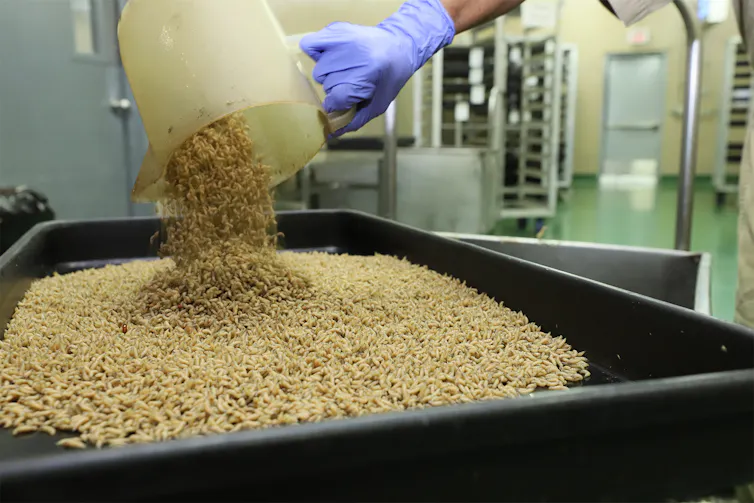
The method that was used to eradicate the fly is known as the sterile insect technique (SIT). This involves breeding vast numbers of a target species, sterilising them, usually with radiation, and then releasing the males.

The sterile males mate with wild females, which then produce no offspring. By continuously swamping the wild population with sterile males, the wild groups go extinct.

To be effective, SIT has a number of critical requirements. One of the most important is that the immigration of fertile females into areas where outbreaks are already under control must be very limited (and ideally zero). If fertile females are allowed to reinvade, the population will reestablish.

The technique therefore works best on isolated or island populations. In other circumstances, barriers and continuous surveillance need to be maintained to prevent immigration and immediately stamp out any incursions.

SIT has been used many times on a vast number of pests over the past 80 years –
with mixed results. The eradication of screwworm from the US, Mexico and central America was its greatest success.

The natural range of the New World screwworm fly extends from the southern states
of the USA through Central America and the Caribbean Islands to northern Chile,
Argentina and Uruguay. In North America, the fly used to spread north and west each summer from its overwintering areas near the US-Mexican border.

Historically, its effects were devastating. In 1935, during a screwworm epidemic, there were approximately 230,000 cases in livestock and 55 in humans in the state of Texas. Female screwworm lay batches of 200-300 eggs in open wounds and orifices. The catastrophic lesions caused as the maggots feed are known as myiasis.

Large-scale SIT for New World screwworm started in Florida in 1957-59 and was
gradually rolled out to the west. Effective control by the US was achieved in 1966.

Subsequently, using rearing facilities in Mexico, the fly was pushed back through Central America and was held at a barrier at the Darien Gap in Panama using continuous release and surveillance.

Occasional incursions in the US have still occurred. In the summer of 2016, screwworm infestation was identified in deer in the Florida Keys. Such incursions clearly demonstrated that any relaxation of the control and surveillance effort could allow the return of this devastating parasite.

The recent breakdown of screwworm control has seen thousands of cases confirmed in animals and humans across Panama, Costa Rica, Nicaragua, Honduras and Mexico.

The insect’s continuing northward spread now raises the risk of a costly US reinvasion. The US Department of Agriculture estimates that an outbreak in Texas could cost livestock producers more than US$700 million (£526 million) per year.

There are several probable reasons for the breakdown of screwworm control. Maintaining barriers, rearing facilities and surveillance operations are expensive. US federal budget cuts, along with reduced foreign aid, hit screwworm control programmes in Central America and weakened surveillance.

Screwworm larvae.
Since the 1990s, a facility in Panama has produced sterile flies in order to maintain a biological barrier at the Darien Gap, on the country’s border with Colombia.
Copeg

The UN’s Food and Agriculture Organization’s (FAO) global health security programme, with responsibility for transboundary animal disease management, reduced its screwworm surveillance as US funding was withdrawn in March 2025.

Loss of control over the illegal movement of cattle, lacking veterinary inspections, may also have been a contributing factor. Alongside this, in many countries there has been an ongoing loss of expertise as experienced veterinary entomologists have retired and not been replaced.

Traditional applied entomology has been viewed as dated in the face of, for example, modern molecular and genetic approaches to the identification of species. The retired entomologists have taken with them a generation of experience of screwworm control and insect pest management in general – the essential underlying knowledge on which other approaches often depend.

As a result, considerable efforts are now required to resume control of this pest and prepare for future outbreaks. Significant new US federal funding for screwworm control has just been announced. But given that the pest is now re-entrenched in Central America, it may be too late to quickly reestablish regional control using SIT. As such, a fall back on insecticides seems like the only fix for immediate problems.

The rearing facilities for sterile insects in Mexico were shut down after screwworm was pushed out of North and Central America in the latter half of the 20th century. However, refurbishment is currently underway to allow them to restart producing sterile flies by summer 2026.

A new facility at Moore Airbase in Edinburg, Texas, close to the southern border, is being built. However, the suggestion that it is Mexico’s responsibility to prevent flies entering the US seems fanciful.

There are several important lessons that emerge from this history. The first is that insects don’t respect borders. International cooperation is required for management at a geographically relevant scale. Unwillingness to support the efforts of less economically robust neighbours, or international organisations such as the FAO, may well come back to bite.

The cost of maintaining the barrier in Panama was almost certainly significantly less than the costs of what will now be needed to achieve preparedness, or what will be incurred by US livestock producers if there is a persistent outbreak.

Finally, new pests and parasites (even some of the ones that seem to be under control) are an ever-present threat, particularly given greater global travel and the effects of climate change. Ignoring them, deprioritising research and control, failing to train the next generation of veterinary entomologists and hoping for the best, is not a viable strategy.

The Conversation

I am grateful to Nancy Hinkle, University of Georgia, for reading an earlier version of this article.

ref. A flesh-eating fly is advancing towards the US border – can it be stopped? – https://theconversation.com/a-flesh-eating-fly-is-advancing-towards-the-us-border-can-it-be-stopped-279200