The ‘chicken ick’: why we suddenly become disgusted by foods we used to like

Source: The Conversation – UK – By Lorenzo Stafford, Associate Professor in Psychobiological Psychology, University of Portsmouth

There are many reason why you might have suddenly got the ‘ick.’ Amorn Suriyan/ Shutterstock

Have you ever suddenly gone off a food you used to love? This is something people on social media have been talking about – specifically when it comes to chicken.

Users report suddenly becoming disgusted by chicken, sometimes even mid-bite – despite having been able to eat the food just fine previously. The phenomenon is commonly referred to online as the “chicken ick”.

My research is centred on how our sensory system (mainly smell and taste) affects our behaviour. When it comes to the “ick”, it’s all about how we deal with our disgust response.

There are a number of reasons why you might suddenly become “weird” about a food that you used to be fine with. If this has ever happened to you, the good news is there are ways to get over it.

The first reason relates to a change in the way the food is presented.

Maybe one time you noticed your chicken tasted, smelled or looked different than it did other times. This can lead to a mismatch in what’s expected, which can cause your feelings towards that food to suddenly change.

It might also be related to whether you prepared the chicken in a different way to normal. Adding a new ingredient which changes the smell or flavour profile of the dish can also trigger feelings of disgust.

Another possible reason has to do with what you were doing before you got the “ick.”

If you were scrolling on social media looking at unappetising meals before starting to cook your own meal, this can influence the way you subsequently feel about your own food.

Or, if you were preparing the dish near someone who expressed disgust (even if they only made a face), this can influence your own disgust response. The reason this occurs is explained by the human tendency to mimic others via mirror neurons (brain cells that are involved in empathy and imitation) and the related process of emotional contagion – the unconscious process of “catching” the emotion of others.

Some of us are also more sensitive to experiencing disgust than others.

Disgust is an emotion that protects us from things that could potentially harm us – such as foods that are spoiled or unsafe to eat.

Work has shown that people who rate themselves as being more sensitive to feelings of disgust also exhibit higher “ick” tendencies in a dating context (a sudden aversion to a romantic partner). This suggests that people with higher habitual levels of disgust might be more likely to experience the chicken “ick” phenomenon.

Another important factor is how hungry you are at the time.

If you aren’t very hungry, you might be more particular about unexpected food features – such as a different smell, texture or flavour.

On the other hand, when you’re really hungry, you understandably tend to be less sensitive to disgust and may be less likely to notice things that might otherwise have turned you away.

Interestingly, our research found a similar effect also happens when participants were given alcohol. The higher a participant’s blood alcohol level, the lower their sensitivity to disgust.

So, it could be that certain states of being make us more or less likely to experience the “chicken ick.”

A pregnant woman standing next to a stove holds up a raw, seasoned chicken breast. She looks at it in disgust.
Disgust is heightened during pregnancy.
Nicoleta Ionescu/ Shutterstock

Gender might also have an effect.

Research on disgust shows women have a higher sensitivity to disgust than men. It’s theorised that such gendered differences in disgust sensitivity developed as an evolutionary response to be choosier when selecting potential mates and protect offspring from disease.

Disgust is also heightened during pregnancy and appears to be related to immune function.

How to get over it

If you’re someone who has developed the chicken “ick” before, there are two key things you can try to get over this feeling:

Try preparing your chicken differently next time. Your disgust might be linked to the specific way the food was prepared. The next time chicken is on your menu, try cooking it differently (such as using a different recipe or seasoning) or use a different cut of meat (such as chicken breast instead of thighs or wings). This might help you to unlearn your disgust.

Have someone else cook for you. If the texture or smell of the chicken (particularly raw chicken) has put you off of it, try having a loved one prepare the meal for you or go out to eat. This might make it easier for you to eat the cooked dish. Or, buy pre-cooked options from the supermarket that only need to be reheated so you don’t have to handle the raw chicken.

Removing the cues that cause the “ick” in the first place should act as a reset so you can enjoy the food again.

If that still does not work, it could be that you’ve formed a negative association with the food which needs to be “unlearned.”

In this case, it could take a little more time to retrain yourself. Some suggestions for doing this involve pairing food with something positive (such as a favourite food or listening to your favourite music while eating your meal) or even by changing the colour of plateware. By repeating this a number of times, you’ll condition yourself to the pleasant response – and will hopefully be over your chicken “ick.”

The Conversation

Lorenzo Stafford does not work for, consult, own shares in or receive funding from any company or organisation that would benefit from this article, and has disclosed no relevant affiliations beyond their academic appointment.

ref. The ‘chicken ick’: why we suddenly become disgusted by foods we used to like – https://theconversation.com/the-chicken-ick-why-we-suddenly-become-disgusted-by-foods-we-used-to-like-278345

Selling stolen art is tricky, so why even bother heisting it? An expert explains

Source: The Conversation – UK – By Anja Shortland, Reader in Political Economy, King’s College London

It took less than three minutes for an organised crime gang to steal a Renoir, Matisse and a Cezanne painting collectively worth around €9 million (£7.8m) from a private museum near Parma, Italy in March 2026. This is the second high profile art heist in recent months, after the theft of jewellery worth €9.5 million (£8.25m) from Paris’s Louvre in October 2025.

The items stolen are clearly valuable. But, as an expert in the governance of criminal markets, I can tell you acquiring the goods is only the first step. Turning this loot into cash is fraught with risk .

The Italian government takes the protection of its cultural heritage seriously, with a whole department of the Carabinieri (Italian police) devoted to the theft of arts and antiquities. This department scans the global art trade for forged, stolen and illegally exported treasures, demanding their return.

There is little chance of selling the stolen masterpieces on the international art market – even at a knockdown price. Whereas in the past dealers and auction houses might have turned a blind eye to the fishy origins of an outstanding artwork, over the past two decades the norms and procedures of the market have tightened considerably.

Anyone who buys art without checking whether a former owner has registered their interest in the object fails the bona fide (good faith) test. This means that they cannot obtain a good title and so the legal property right remains with the person or institution the artwork was stolen from. Also sales of stolen art where the seller sidestepped due diligence can be voided, meaning the money must be returned.

So reputable dealers and auction houses take their duty of care very seriously. At the very least they check the freely accessible Interpol database of stolen art before the sale. However, private databases – like that of the Art Loss Register – provide greater peace of mind, listing many more lost and stolen objects and limit searching to those with a legitimate interest in an object. When a register finds that someone is trying to bring a stolen artwork into the open market, they collect and pass on all information that could lead the police to its location or the people involved in its sale or storage.

Anything fresh from a museum wall is therefore unsaleable – unless it is jewellery that can be broken up and sold as (expensive) scrap. So, what might be the financial motivation behind this theft?

A Bond-style villain ordering favourite paintings to adorn their lair is an unlikely explanation. Yes, paintings could be stolen to order, but buying art on the open market to launder money is less risky. With high rewards for information or the return of stolen artworks, security and omerta (the code of silence) would have to be completely watertight when displaying stolen treasures.

On the other hand, “rewards for information” could be a motivation for theft in itself. In the middle of the last century, insurers regularly paid “finders” with so little scrutiny that high-value art theft became a profitable low-risk occupation. Institutions like the Art Loss Register broke that cosy coexistence and instead used any leads to help the police conduct recoveries and sting operations.

Nowadays, it is only safe to negotiate a deal over a “finder’s fee” when a stolen object has changed hands so many times that the line to the original thieves is lost in the mist of time. Even so, the ultimate “finder” would be lucky to realise more than 10% of the painting’s value, which they would also likely have to share with the thieves and various shady underworld owners along the way.

However, there is a third reason to steal artworks. Organised crime groups sometimes use stolen artworks as bargaining chips to negotiate more lenient punishment. For example, the Dresden jewellery thieves kept a few pieces of their haul aside to use their recovery to negotiate shorter sentences. Penitentos (“repentant ones”) who want to leave mafia organisations also sometimes provide information on the whereabouts of missing treasures. If there is a perception that stolen artworks can used to reduce a prison sentence or financial compensation package, their underworld value can grow far beyond the finder’s fee.

While it is difficult to verify the assertion that stolen artworks are used as collateral in drug deals, several unique treasures have indeed been retrieved from properties owned by senior mafiosi. These works have not been found in temperature controlled galleries, but rolled up in dank places that make museum curators weep with despair. Let us hope that the beautiful artworks from Parma are treated with respect until we see them again.

This article features references to books that have been included for editorial reasons, and may contain links to bookshop.org. If you click on one of the links and go on to buy something from bookshop.org The Conversation UK may earn a commission.

The Conversation

Anja Shortland does not work for, consult, own shares in or receive funding from any company or organisation that would benefit from this article, and has disclosed no relevant affiliations beyond their academic appointment.

ref. Selling stolen art is tricky, so why even bother heisting it? An expert explains – https://theconversation.com/selling-stolen-art-is-tricky-so-why-even-bother-heisting-it-an-expert-explains-279700

Javier Milei’s inflation ‘miracle’ in Argentina is a warning to the world, not a blueprint

Source: The Conversation – UK – By Can Cinar, Honorary Visiting Researcher, City St George’s, University of London

On paper, the numbers look astonishing. The annual rate of inflation in Argentina has plummeted from 211% in 2023 to 31.5% by the end of 2025.

President Javier Milei is taking plenty of credit for the drop. And he spent some time on Wall Street last month, pitching his “chainsaw” approach to public spending as a triumph against inflation.

But as a political economist who has tracked the cyclical history of economic crisis in Argentina, I see a much grimmer story unfolding.

For the drop in inflation is certainly not a victory for Argentine productivity. It’s a byproduct of a deliberate and engineered collapse in people’s wages.

Milei hasn’t fixed the engine of Argentina’s economy, he has simply turned it off. Since he took office in 2023, the country’s manufacturing output has dropped dramatically, with over 2,000 businesses shutting down and 73,000 jobs lost.

In the automotive sector, factories are operating at just 24% of capacity.

These aren’t just dry statistics. Real wages have been crushed so hard that demand for Argentine goods has evaporated. If a manufacturer is only using a third of its machinery because nobody can afford their goods, they lose their ability to put up prices, and inflation rates stop rising.

By drastically reducing demand, Milei has not solved the inflation puzzle. He has simply removed some of the pieces, by making the population too poor to participate in the Argentine economy.

On top of this, the fear of mass unemployment means workers have no choice but to accept an ever smaller share of the nation’s economic pie. Again, low wages serve to prevent the upward spiral of prices.

So the supposed victory over inflation is actually the institutionalisation of lower wages and a lower standard of living for most people.

A recently passed law (officially named “labour modernisation”) reinforces this new reality. It has effectively increased many workers’ hours and reduced their protections, making labour both cheaper and more disposable.

The new legislation has been criticised as a return to working practices of the 19th century. Far from modernising work, it is about normalising a lower wage share of GDP and ensuring that the shrinking slice of the national income for the Argentine worker isn’t just a temporary emergency, but a permanent feature of the model.

And while the government highlights 4% GDP growth forecasts for 2026, that growth is focused in sectors like agriculture, mining and lithium, which create very few jobs. For the average urban worker the economy hasn’t recovered – it has simply bottomed out at a new, lower standard of living.

Wages down, inflation down

That doesn’t mean that the drop in inflation counts for nothing. There has been a genuine sense of relief after the triple-digit chaos of 2023.

The simple ability to shop at a supermarket without the price of goods changing dramatically in days will mark a deep psychological shift for many Argentinians.

But that shift is not based on solid ground. Inflation hasn’t been tamed by a more efficient economy – it has been starved into submission.

Yet remarkably, Milei’s “miracle” is already being packaged for export. From the radical fiscal cuts proposed by Trump in the US to the nationalist platforms of Orbán in Hungary and the Vox party in Spain, Milei and his model are being touted as a blueprint for other economies struggling with inflation.

But what looks like a triumph to some is, in reality, a deepening social crisis. Milei’s Argentina is not a blueprint to be followed. It is a warning of what happens when the cure for inflation is more lethal than the disease itself.

For this level of wage suppression is a stark reminder of Argentina’s economic crisis of 2001, a period of total state failure, sovereign default, bank freezes and 20% unemployment that left a permanent scar on the national psyche.

To have surpassed that level of wage suppression today is a damning indictment of Milei’s approach. But while 2001 was a sudden collapse of a monetary system, the 2026 reality is a slow, institutionalised asphyxiation.

The question for the coming years is how such a model can possibly be sustained. Milei has left the country with no economic levers to pull for a genuine recovery.

With negative net reserves, a domestic market in ruins, and multi-billion dollar IMF and private debts hanging over the country, the government’s path is now dictated entirely by a desperate need for dollars that turns every domestic policy into a plea for foreign capital.

This has created an economic vacuum in which there is no credit for small businesses, no surplus for public investment and no consumer demand to entice private capital back into the real economy.

That is why the administration’s pitch to New York investors in March was essentially a desperate plea for capital to fill this void. But Wall Street is not generally in the business of building factories or creating jobs in Argentina.

If anything, its investors will be looking for easy short-term profits in a newly deregulated market. And what emerges then is an economically divided Argentina. On one side of this will be a thriving enclave of mining and agribusiness designed for the global market, and on the other, a vast urban industrial wasteland where millions of Argentinians struggle desperately to make ends meet.

The Conversation

Can Cinar does not work for, consult, own shares in or receive funding from any company or organisation that would benefit from this article, and has disclosed no relevant affiliations beyond their academic appointment.

ref. Javier Milei’s inflation ‘miracle’ in Argentina is a warning to the world, not a blueprint – https://theconversation.com/javier-mileis-inflation-miracle-in-argentina-is-a-warning-to-the-world-not-a-blueprint-278840

What the government’s plan for social cohesion gets wrong about community division

Source: The Conversation – UK – By Adam Coutts, Senior Research Fellow, Department of Sociology, University of Cambridge

Alex Segre/Shutterstock

The government’s new social cohesion action plan, Protecting What Matters, is frank about its urgency: “Social cohesion is … not just a good in and of itself. It is also a vital front in the resilience of our national security.”

The 2024 Southport attacks and subsequent disorder, rising religious hate crime, unrest over migration policy and domestic extremism have all forced the issue of community division. Yet the government’s answer, built around integration, interfaith dialogue and civic ceremonies, mistakes the symptom for the disease.

“Cohesion” is vague, unmeasurable and elastic enough to mean whatever the government of the day needs it to mean. People describe the places they love as close-knit and safe, not “cohesive”.

A better framework would be community resilience: the measurable capacity of neighbourhoods to absorb shocks, resist divisive narratives and recover from crises. You cannot integrate people who are isolated, impoverished and without the infrastructure to bring them together. COVID laid bare what the evidence already showed: communities with stronger social infrastructure and higher levels of social capital demonstrated greater resilience to the pandemic’s social and economic shocks.

The government strategy does contain a chapter on “resilient communities”. However, it frames resilience narrowly, as emergency management of religious and political extremism, rather than as the everyday and routine fabric that makes any form of solidarity possible at all.

The missing piece

There is an extraordinary gap in Protecting What Matters. While there is acknowledgement of the effects of “visible deterioration of public services”, the word “poverty” does not appear once. The plan frames division through religion, identity and Islamophobia, which are outcomes and proxies, not root causes.

A study of over 15,000 residents across 839 English and Welsh neighbourhoods, validated by a 2024 analysis of the Understanding Society dataset, shows that deprivation, not diversity, erodes trust, participation and neighbourliness. Once you control for poverty, diversity is associated with higher volunteering and charitable giving. The crisis of solidarity is a crisis of resources, not cultural difference.

There is an undertone of nostalgia in the government’s plea for communities to “integrate”, a wistfulness for tight-knit mining towns where everyone knew their neighbour. But those communities were built on something material: secure jobs, union membership, working men’s clubs and shared economic fate.

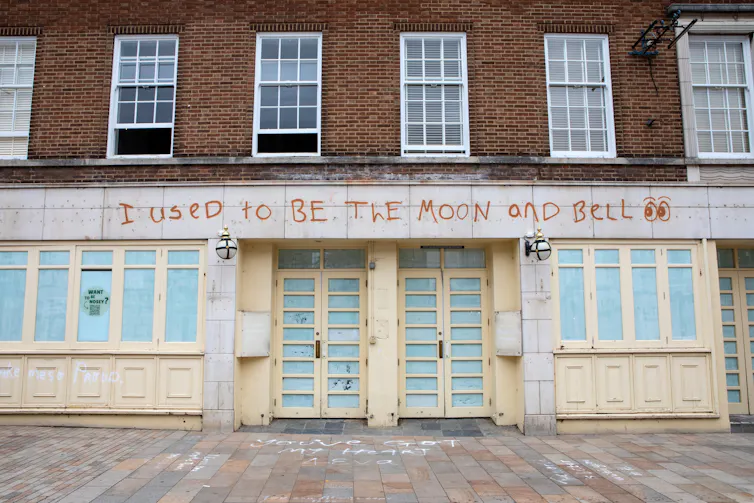
More in Common’s 2025 polling finds that 44% of Britons sometimes feel like strangers in their own country – a figure that could be read as evidence of cultural division. But More in Common’s own analysis shows this alienation is concentrated in economically left-behind areas, not diverse ones. People do not feel like strangers because their neighbours look different. They feel like strangers because the institutions that once made them feel they belonged – clubs, pubs, unions and jobs – have gone.

A boarded-up pub with graffiti across the top reading 'I used to be the moon and bell'
The loss of social infrastructure has been devastating to communities across Britain.
chrisdorney/Shutterstock

The argument that more homogenous communities are more cohesive is seductive, but weak. Britain’s most ethnically diverse neighbourhoods are not its least cohesive – they are, as Manchester researchers found, its healthiest. Mining towns were cohesive despite being male-dominated, often racially exclusive and economically coercive. The lesson is to replicate not their demographics, but the material conditions: jobs, institutions and shared infrastructure that give people a reason to show up.

Work provides far more than income: it furnishes identity, routine and daily social connection. Unemployment is not merely an economic condition; it is an isolating one.

A recent randomised controlled trial by the Department for Work and Pensions found that structured group job-search workshops improved both mental health and employment outcomes among benefit claimants, precisely because they restored the social support, routine and shared purpose that work normally provides. Community resilience cannot be separated from economic development. Departments such as DWP and Jobcentre Plus have a direct stake in the social capital agenda.

Building resilient communities

Research I have conducted at the Independent Commission on Neighbourhoods (ICON) and a recent Joseph Rowntree report show that social infrastructure is key to resilience, but that different communities have different needs.

New housing developments need parks and primary schools from day one: accessible spaces that create early encounters and establish trust between newcomers. Established but deprived communities need to restore what has been stripped away, whether the pub, the library or the community centre. Sports facilities build bridging connections across difference, faith buildings deepen bonds within communities and civic spaces create the linking ties between residents and institutions. The task is to match the infrastructure to the social capital gap, not apply a single template everywhere.

The real test, which my colleagues and I call the “Wet Wednesday Night Test”, is whether your investment in social infrastructure gets 14 people to turn up for football (or cub scouts, or a book group) on a wet Wednesday in February. Nobody comes to “build social capital”. They come because the pitch is free, the lights work and there are hot showers. The pint afterwards does more for integration and social capital than any strategy document ever will.

Photo focused on a football sitting on grass while players celebrate in the background
People don’t show up to the football pitch to ‘build social cohesion’.
Natee K Jindakum/Shutterstock

ICON’s research, drawing on over 100 peer-reviewed studies, shows that social infrastructure generates £3.50 for every £1 invested. Every £10,000 invested prevents an estimated £105,000 in riot damages.

During the 2011 riots, 71% of incidents occurred in areas ranked among the most deprived 10% of England – the same year in which 287 community centres had closed. The government described this as a “social cohesion” problem; it was a social infrastructure problem.

The government’s £5 billion Pride in Place programme makes a start at investing in communities. But more investment is needed to address the challenges in our most deprived neighbourhoods, where people face life expectancy four years below the national average.

A serious approach would use existing schools, job centres and childcare settings as social hubs, and make public transport free for under-18s so that young people can move around their own towns. And, it would tackle the poverty, insecure work and collapse of institutions that once gave people a reason and the means to show up for each other.

Build those foundations and what politicians call “cohesion” will follow. Nobody will use that word to describe what they feel when they step outside of their front door. They will just say it is a good place to live. That is enough.

The Conversation

Adam Coutts does not work for, consult, own shares in or receive funding from any company or organisation that would benefit from this article, and has disclosed no relevant affiliations beyond their academic appointment.

ref. What the government’s plan for social cohesion gets wrong about community division – https://theconversation.com/what-the-governments-plan-for-social-cohesion-gets-wrong-about-community-division-278702

Home or away? Why planning a sustainable holiday is about more than swapping planes for trains

Source: The Conversation – UK – By Sarah Barfield Marks, PhD Researcher, Department of Psychology, University of Bath

As we emerge from a relentlessly gloomy winter in the UK, many are itching for a holiday in the sun. For some that means seeking warmer climates abroad and hopping on a plane to get there.

But as climate change brings wetter winters to the UK, flying for holidays is fuelling rapidly rising aviation emissions. And addressing this not only needs a shift towards climate-friendly travel but a reimagining of where holidays take place.

For years we’ve been sold the promise of guilt-free flying through green technologies such as sustainable aviation fuels and carbon offsetting from polluting airlines.

But all come with significant limitations and none are ready to deliver the emissions reductions we need within the time we have. Ultimately, without curbing demand, current climate policies will not deliver any major emissions reductions in aviation. That makes it more important to reduce how much we fly.

In the UK, aviation is set to become the largest emitting sector by 2040 and this rise is being driven primarily by leisure travel. This includes vacations and visiting family or friends with the majority of departing passengers flying for holidays.

Beyond switching planes for trains

The good news is the growth in aviation emissions isn’t being caused by your annual holiday to Spain. Most flights are taken by a relatively small number flying several times a year, with 70% of flights taken by just 15% of people. This group is also more likely to take frequent short-haul flights which could be replaced by train. Shifting the behaviour of this elite group (from planes to trains) would have a significant impact on cutting emissions.

Trains are significantly better for the climate compared to flying, with a single flight from London to Berlin clocking up the same amount of carbon as 11 trips by train.

As a researcher focusing on how to promote flight-free holidays to reduce aviation emissions, I used to find this reassuring. We didn’t necessarily need to change where we went for holidays. We just needed to get frequent flyers on trains instead of planes.

But, sadly, it itsn’t that simple. Recent research has found the majority of UK aviation emissions actually come from long-haul leisure flights. So even if all flights on routes that could be completed by rail in under 24 hours were replaced, this would only address around 14% of UK aviation emissions.

Reducing aviation emissions therefore requires not only getting frequent flyers to shift from planes to trains, but asking wider questions about where people want to go and why.

Rethinking what a ‘proper’ holiday looks like

Reducing demand for flying isn’t just a structural challenge addressing cheap flights and expensive trains, but also a social one. Five minutes scrolling on Instagram bombards you with bucket list destinations and influencers implying a life well lived is a passport full of stamps.

Since the rise of budget airlines in the 1990s, flying for holidays has become increasingly normalised socially, despite largely remaining something only a relatively wealthy few do regularly. And the pull isn’t just about cost and convenience.

Research shows if cost and time weren’t an issue, people say they would fly more. Flying has become a means to an end in reaching the exotic, unfamiliar and – crucially for British people – the sun.

Tourists associate distance with novelty, contributing to domestic holidays being less popular than those abroad. There’s almost a hierarchy of destinations where places furthest away and more novel feel more desirable. My ongoing research on how people talk about holidays reflects this – some questioned whether the UK even counts as a holiday.

I have found that holidays in far-away places seemed to impress participants more than those spent in the UK and Europe, often with responses such as “wow” and “amazing”. Destinations further afield were referred to as “grand”, “swanky”, “extravagant” and “big”, contrasting with the language used when discussing holidays closer to home with “only”, “little” and “just”. In this way, the places we visit on holiday act as social currency in conversations. Being well travelled grants us cultural capital, the accumulated knowledge and experience of the world signalling social status.

But ideas of a good holiday are open to change. In one survey, half of the respondents said they flew less because they knew someone who had given up flying due to climate change. So social influence works in both directions.

Some, for example those part of the slow travel movement, are already resisting the idea that closer destinations are somehow lesser. Participants in our ongoing research described planning trips around where they can feasibly get to by train, making the journey part of the holiday or foregrounding quality time with loved ones over the destination.

This isn’t about giving up holidays abroad and foregoing the sun, especially if you’re only flying to a European destination once or twice a year. Structural change, like fairer pricing and better rail connections, is also essential (and long overdue) if people are to make changes.

Even taking the train from London to Edinburgh costs on average 60% more than flying and this will persist until airlines are taxed fairly and train tickets are made the same price or cheaper than plane tickets. These are policies which the public supports.

So as we look ahead to summer it’s worth asking if what we’re actually longing for – whether it be warmth, rest, adventure, quality time, cultural interest or a change of scenery – really requires a long-haul flight (or lots of short-haul flights). A sustainable holiday starts with asking that question before deciding where to go.

The Conversation

Sarah Barfield Marks does not work for, consult, own shares in or receive funding from any company or organisation that would benefit from this article, and has disclosed no relevant affiliations beyond their academic appointment.

ref. Home or away? Why planning a sustainable holiday is about more than swapping planes for trains – https://theconversation.com/home-or-away-why-planning-a-sustainable-holiday-is-about-more-than-swapping-planes-for-trains-277802

How Sweden’s communal laundries shield renters from rising energy bills

Source: The Conversation – UK – By Tullia Jack, Associate Professor, Service Studies, Lund University

Many Swedish apartment blocks built in the 1960s and 1970s have shared laundry facilities. Cathy Xiao Chen/Shutterstock

People in many parts of the world are worried about rocketing energy bills as the conflict in the Gulf continues. But for the majority of renters in Sweden’s apartment blocks, this is not so much of an immediate concern.

Part of the reason for this is that many buildings have communal laundries where washing machines and dryers (as well as water and heating) are provided and the cost is included in the rent.

In Sweden, nearly one third of all water and energy is consumed domestically, with two thirds of this through activities relating to cleanliness. Electricity for washing and drying clothes also accounts for a substantial share of residential electricity use.

Communal laundries are one of Sweden’s environmental success stories. They began as part of the post-war million homes project, when modern apartment blocks were equipped with shared tvättstugor (laundry rooms) instead of individual residents having to buy their own machines. These rooms usually have a handful of semi-industrial washing machines, dryers and drying rooms serving an entire building. Access is through a communal booking system, and use is free to residents of the building. That set-up is efficient because it means share use of generally high-quality machines which encourages people to use full loads of washing.

I live in the Swedish city of Lund. Since I met my husband 11 years ago he’s been the go-to person for laundry, and takes the loads down to the communal room. For our family, using this facility is convenient because someone else takes care of maintenance and servicing of the machines and we don’t pay extra for washing clothes. It’s all included in the rent, which is negotiated for the building annually.

Tvättstugor rose to prominence during the Swedish government’s widespread building programme of the 1960s and 1970s, as part of a commitment to improving living conditions and creating a fairer society.

Clean running water, reasonably priced central heating and access to a laundry were part of a broader social project: raising living standards collectively, through shared infrastructure. This often meant that shared facilities such as laundry rooms and heating were included in the rent at no extra cost. This means that many people living in apartment blocks dotted around many Swedish cities don’t have to worry about too much about hikes in energy costs for washing, or heating, if, as expected, household energy prices rise this summer, due to the conflict in the Gulf.

Around 51% of Sweden’s housing is in these apartment blocks (2.3 million homes). And a survey of tenants in Sweden in 2020 found that around 53% have access to the tvättstuga.

How communal laundries save resources

If each household in Sweden had its own appliances, the material stock of machines – and future waste – would escalate quickly. A tvättstuga, by contrast, can serve dozens of residences with just a few semi-industrial machines that are built to last, maintained professionally and replaced strategically. It is a denser, leaner way of organising cleanliness.

Shared laundry spaces change how often we wash. Interviews and time-use data suggest that people with easy access to their own machine tend to wash more frequently, with smaller loads. If the washing machine is in the next room and energy and water are relatively cheap, it is tempting to wash “just in case”, or to avoid the minor inconvenience of airing clothes or dabbing away a single stain. When you have to book a slot, carry clothes down to the basement and work within a fixed time window, the calculation shifts. People batch their washing, fill machines properly and think twice before throwing something in after a single wear.

Communal laundries also make technological improvement easier. Upgrading a handful of machines in a shared space is far more straightforward than relying on hundreds of individual households to replace old appliances. Shared infrastructure can be a powerful lever: change the system once, and many people benefit.

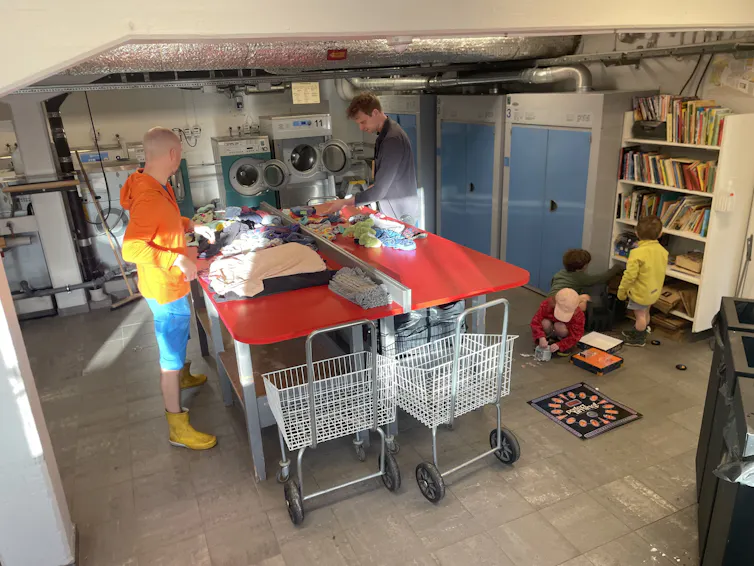
But tvättstugor are also social spaces. Where I live the laundry room doubles as a small community centre. There’s a children’s book swap, a noticeboard with local events, and a steady trickle of neighbourly encounters. My husband has his gang of dads that he sees there every Sunday. They chat while folding, sharing tips about laundry liquid and life. Negotiations over booking times, cleaning lint filters and wiping benches are not always idyllic – there are passive-aggressive notes and the odd conflict – but they are also a form of everyday democracy. We learn, in a very concrete way, how to share resources, negotiate conflict, respect common rules and live together.

Two men folding the washing in the author's communal laundry area.
Two dads folding the washing in the author’s communal laundry area.
Tullia Jack, CC BY

Despite the environmental and social benefits, communal laundries are disappearing from new housing schemes. Many municipal housing companies are not including tvättstugor in new builds. This is a shame because it’s not possible to solve the energy crisis individually.

We need shared infrastructures – from tvättstugor to public transport to district heating (a centralised heating system that distributes heat to a range of buildings). Sweden shows how these facilities can work in practice: these shared laundry rooms spread costs, reduce waste and nudge people towards sufficiency. Just as importantly, they give us a reason to meet, compromise and practice our negotiation skills. This can help us build the solidarity needed to tackle the climate crisis.

The Conversation

Tullia Jack receives funding from Formas, grant number 2024-02280.

ref. How Sweden’s communal laundries shield renters from rising energy bills – https://theconversation.com/how-swedens-communal-laundries-shield-renters-from-rising-energy-bills-279415

Learning from autistic teachers could change schools for the better

Source: The Conversation – UK – By Rebecca Wood, Senior Lecturer in Inclusive Education, University of Glasgow

PeopleImages/Shutterstock

As a researcher in autism and education and a former secondary school teacher, it took me a while to realise that autistic school staff were rarely included in conversations about inclusion and diversity in schools.

With colleagues, I started the Autistic School Staff Project in 2019, focusing on the experiences, needs and aptitudes of autistic teachers and other education staff.

Our findings show that autistic school staff can experience significant sensory issues in school. These can be from bright, flickering lights, odours from the canteen, and crowding in corridors or during meetings. The greatest impact of all comes from noise: shouting from children and staff during break times, the clang of the school bell and the roar of traffic when windows are open in the summer.

Interestingly, it’s not only a question of volume levels. Whispering from children and humming from technology can also be highly distracting and contribute to feelings of fatigue and overload.

Autistic teachers also told us that the ways neurotypical colleagues communicated and interacted with them could be disorientating and exclusionary. Staff meetings that seemed to lack focus, chit-chats in the school corridor, gossip and school politics could be experienced as confusing and irrelevant.

At the same time, autistic teachers felt their own communication style of being direct and to the point could be misunderstood as rudeness. Similarly, staff social events were often not enjoyed by autistic teachers, even though neurotypical colleagues seemed to really rate them. Changes announced at the last minute by the school leadership team, with instructions that did not seem to make sense, could be highly stressful for autistic teachers. Covering for absent teachers was also found to be very unsettling.

Blurred figures in school corridor
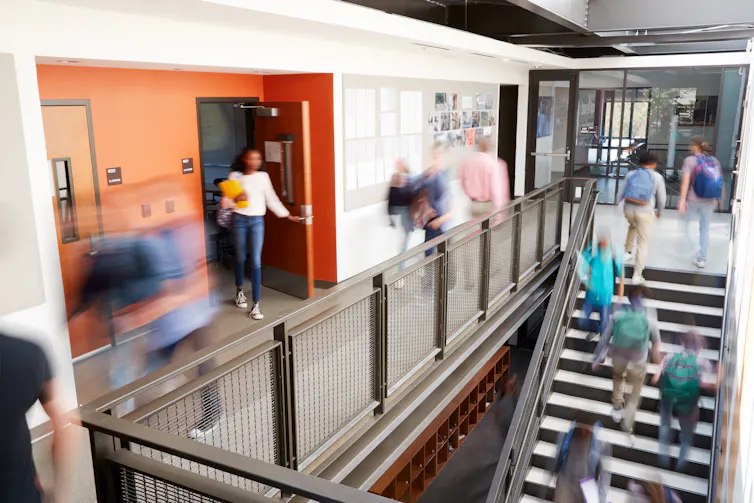
Noisy school environments can cause sensory issues for autistic teachers.
Shutterstock

Most tellingly, a number of participants felt they could not be open about being autistic. A key reason for this concerned negative and stigmatising attitudes towards autism that they had to face in school. The teachers also said that autistic children could be poorly treated. Autistic teachers sometimes had to sit through autism training, conducted on the assumption that no-one present was autistic, where the same negative attitudes were evident.

As a result, autistic school staff could be extremely wary about sharing with anyone that they were autistic. They worried that this information would have a negative impact on their careers. Suppressing an autistic identity, known as masking, has been linked with mental health issues.

While some of our participants had been able to disclose being autistic in school, and had even had a good experience of this, others said that it had made life even harder. This was because attitudes would change towards them in a negative way, or they might not even be believed.

Passion and support

Fortunately, a number of positives also came out of our study. Monotropism – a key autistic trait that denotes a tendency to have very intense interests – can mean that autistic teachers develop strong subject expertise and teach with passion. Even the job itself links with monotropic tendencies, as autistic teachers told us that they loved their work and were highly motivated by it. In addition, autistic teachers felt that they were very thorough and organised.

Above all, autistic teachers felt they were making a significant contribution to supporting inclusion in school. They were sensitive to the needs of neurodivergent children and others at risk of marginalisation, and were willing to try alternative approaches with children who were struggling. One teacher said:

I never gave up on a child because I think probably too many people gave up on me. I could see myself in a lot of the children.

In addition, some of those who had been open about being autistic were valued by colleagues because of their insights in relation to neurodiversity. Autistic teachers also felt that they could be a role model for autistic children and their parents.

Autistic teachers are a valuable part of the school workforce and are already making an important contribution to inclusion. However, it’s important to remove the barriers they can face across their careers.

This includes providing more flexibility and support for autistic student teachers. Making recruitment practices inclusive and accessible – such as by providing questions in advance, and offering in-person and remote options for interviews – would also benefit autistic teachers, as would developing neurodiversity-inclusive school communities.

Participants were clear that autism training should be run by autistic people, and that withdrawing to a quiet space should not be misinterpreted by colleagues as being anti-social. Addressing the sensory impacts of schools would benefit both children and staff. Providing staff with agency in decision-making can be empowering. We also need to reconsider the conventional role of the teacher, and question if the current format of standard duties, such as parents’ evenings and covering for absent colleagues, should be re-evaluated through a neurodiversity-inclusive lens.

The Conversation

Rebecca Wood has received funding from the ESRC and the John and Lorna Wing Foundation.

ref. Learning from autistic teachers could change schools for the better – https://theconversation.com/learning-from-autistic-teachers-could-change-schools-for-the-better-279257

Is yo-yo dieting bad for you? Here’s what the latest research shows

Source: The Conversation – UK – By Adam Collins, Associate Professor of Nutrition, University of Surrey

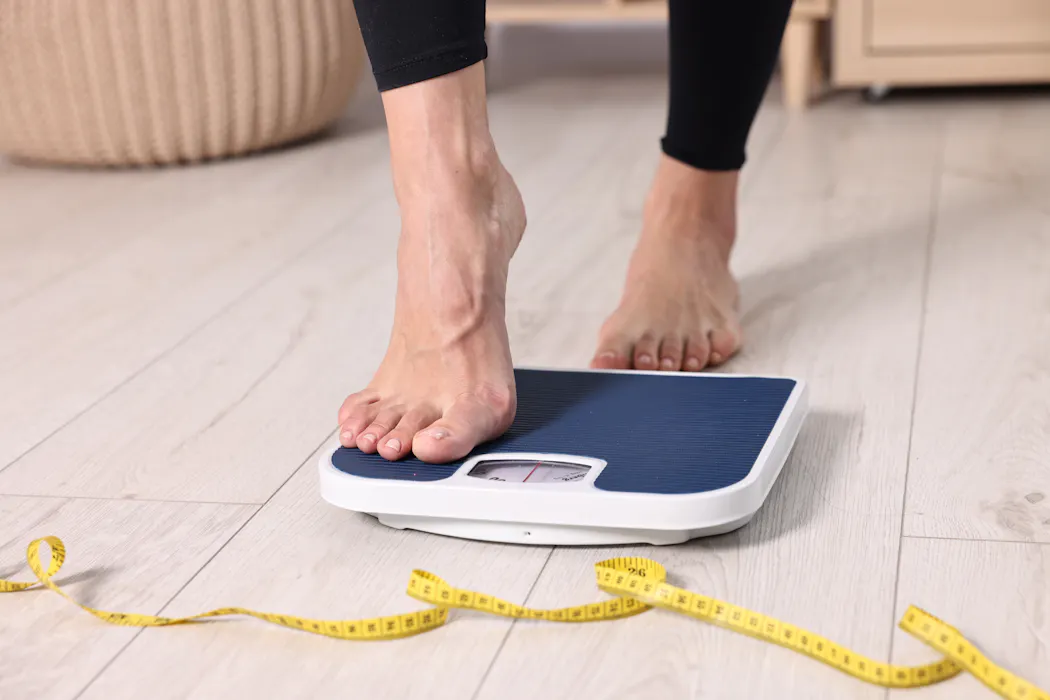
Weight recidivism is common after weight loss. New Africa/ Shutterstock

The only thing harder than losing weight is keeping it off. Many people who lose weight find themselves stuck in the cycle of “yo-yo dieting” – losing weight and gaining it all (and sometimes more) back again.

Research on yo-yo dieting has long indicated it can be harmful for your health. But a recent paper has now suggested yo-yo dieting might not be as unhealthy as we’ve been led to believe.

This recent paper, published in BMC Medicine, presents the findings of two separate weight loss trials that were conducted five years apart.

The first trial (trial 1) looked at 278 participants who were overweight or obese. Participants were randomised to follow either a low-fat or low-carb Mediterranean diet – either with or without exercise. All participants lost a comparable amount of weight at the end of the 18-month trial. But those who incorporated exercise achieved the biggest decrease in visceral fat (a dangerous type of fat that is stored around the organs).

The second trial (trial 2) was conducted five years later. Similar to trial 1, the 294 participants followed a Mediterrean-style diet for 18 months. But this time, one group ate a diet very high in polyphenol-rich foods (naturally-occurring plant compounds which have been linked to health benefits such as lower risk of chronic disease). The second group ate a normal Mediterranean diet, while the third group followed normal healthy diet guidelines.

While both Mediterrnanean diet groups lost weight and saw improvements in their overall health, the polyphenol group lost more visceral fat.

A unique aspect of trial 2 was that it included around 80 participants from trial 1. Some of these participants weighed more than they did at the start of the first trial. Such weight recidivism is common following weight loss. This is due to various biological and physiological functions that reduce metabolism and increase hunger, causing people to regain weight and store fat.

The authors compared the people who rejoined the research project against their health and weight status at the start of trial 1. They assessed body weight and other aspects of health – including body fat and blood sugar levels. Despite the re-joiners weighing around the same (if not more) than they did at the start of trial 1, they had lower levels of abdominal fat and visceral fat five years later.

Their metabolic health was also better than it was at the start of the first trial, based their blood lipid (fat) levels, cardiovascular health and blood sugar control.

On the surface, this appears to be good news – suggesting participants retained some of the health benefits of the weight they lost the first time around, despite regaining the weight.

Yet, the results suggest that the very adaptations which helped the re-joiners stay healthy despite regaining weight could potentially have repercussions later. To understand why this is the case requires a grasp of how the body responds to a calorie deficit.

Weight loss and body fat

Our fat stores (known as adipose tissue) serve as our main energy (calorie) buffer when there’s no food to provide that fuel. These stores are sacrificed to cover the energy shortfall, causing fat cells to shrink. Visceral fat is the first to go, followed by the more beneficial fat cell stores.

But when people stop dieting, the body puts priority on regaining lost fat. Indeed, our body replenishes fat stores far more quickly than it does muscle or protein stores. More importantly, in response to this shrinkage, the body compensates by making more fat cells. It does this to help the body better cope the next time there’s a fuel crisis.

A digital depiction of fat cells circulating in the body.
The body responds to weight loss by creating more fat cells.
Spectral-Design/ Shutterstock

So dieting literally makes you fatter in the long run. But thankfully, this will most likely be healthier subcutaneous fat (in the hips, thighs, buttocks and torso) instead of around the organs as harmful visceral fat.

So even though you’ll be carrying excess weight, you’ll experience fewer of the metabolic issues caused by unwanted visceral fat – such as insulin resistance and high cholesterol, which elevate your risk of cardiovascular disease and diabetes.

But with the higher capacity to store fat comes the risk of overshooting your original weight. This may also have implications for yo-yo dieting.

The weight loss cycle

In the paper, the re-joiners who took part in trial 2 did manage to lose weight again. But, on average, they lost slightly less than the trial’s first-timers. That said, when all of the participants from trial 2 were followed up five years later, the re-joiners from trial 1 had regained less, too. They had also retained more of the health benefits of losing weight.

Taking stock of the whole weight-loss journey, it appears that those who regained weight and then joined trial 2 are at a comparable place at the end of ten years to those who just did trial 1.

But there are a few caveats to the trial’s findings.

First, the paper only examined body fat. It didn’t provide any information on lean tissue (such as muscle). This is important, as when we lose weight we lose both fat and muscle. Given muscle’s importance for a healthy metabolism, a lack of muscle could result in even greater weight gain.


Read more:
Weight loss: why you don’t just lose fat when you’re on a diet


It’s also not clear whether regaining weight changes the nature of muscle tissue. There are two key types of muscle fibre. Type 1 is smaller and more efficient at burning fat. Type 2 is larger, faster and more powerful – important for explosive exercise.

If an overall loss of muscle results in muscle fibres changing from type 1 to type 2, this could increase risk of health problems – including sarcopenic obesity and earlier onset of age-related health issues associated with muscle loss.

Overall, the paper shows us that weight loss is still beneficial for your health – even if it requires a few attempts to get to your goal weight. But to avoid potentially gaining more weight the second time around, it’s key to establish good diet and lifestyle changes that are sustainable long-term.

The Conversation

Adam Collins is affiliated with Form Nutrition Ltd as consultant Head of Nutrition

ref. Is yo-yo dieting bad for you? Here’s what the latest research shows – https://theconversation.com/is-yo-yo-dieting-bad-for-you-heres-what-the-latest-research-shows-278932

Could a solar storm derail the Artemis II mission?

Source: The Conversation – UK – By Clive Dyer, Visiting Professor, Surrey Space Centre, University of Surrey

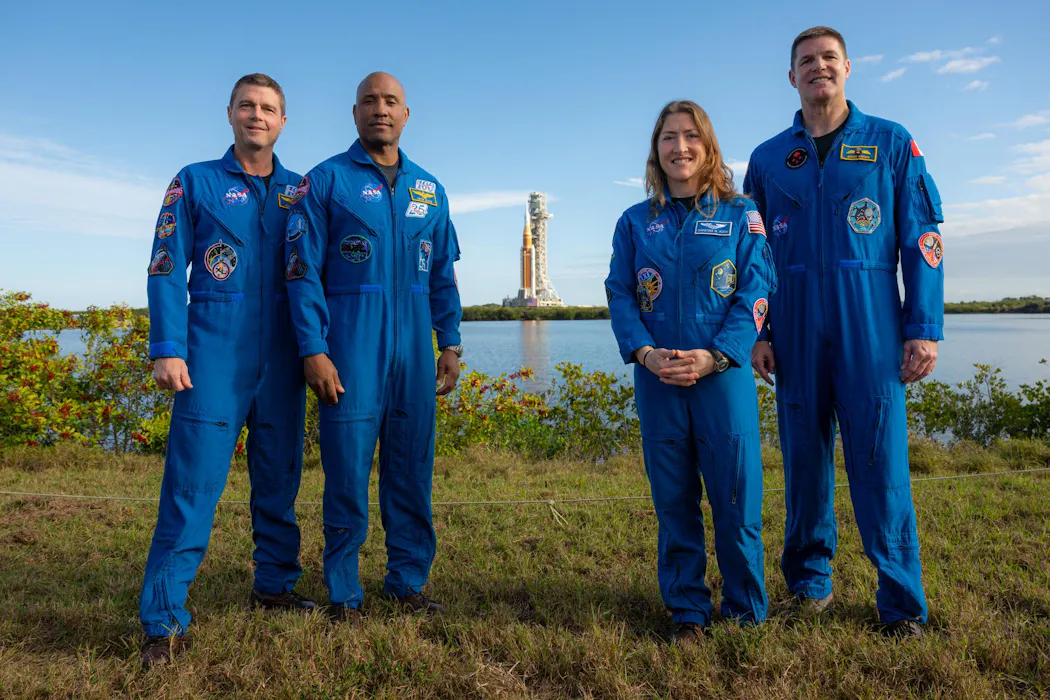
The Artemis II astronauts, (L-R) Reid Wiseman, Victor Glover, Christina Koch and Jeremy Hansen, pose with the Space Launch System rocket. Nasa / John Kraus

Every mission to deep space is fraught with danger. A hardware failure during launch, an equipment malfunction far from Earth, or a small space rock hitting the vehicle are all scenarios astronauts will train for.

As humans set off for the Moon for the first time in more than 50 years, one persistent threat they face is from solar radiation.

Intense bursts of radiation from the Sun, known as solar particle events, can endanger the lives of space travellers, particularly those venturing beyond low Earth orbit (LEO). During these events, high speed, charged particles stream out from the Sun and into space.

Exposure to these particles could lead to radiation sickness or, in the worst cases, prove fatal. On space stations and other crewed vehicles travelling in LEO, astronauts are afforded a high degree of protection by the magnetic bubble surrounding Earth (the magnetosphere).

But in interplanetary space, where Artemis II is headed, humans are much more exposed to outpourings of solar radiation.

The Sun’s magnetic activity fluctuates on a cycle lasting roughly 11 years. During this cycle, sunspots (areas of reduced temperature caused by intense magnetic fields) can cause eruptions known as flares, as well as solar particle events. These rise and fall in frequency with the solar cycle.

Solar activity (represented here by sunspot numbers) fluctuates on an 11-year cycle.
Noaa

The current solar cycle reached its maximum, when the Sun is generally at its most active, in 2024 and is now in a slowly declining phase leading to the minimum, when the Sun is quietest. The current cycle should reach the minimum in 2031.

Not all solar cycles are the same and the current one has been rather undistinguished in terms of activity, as was the previous cycle that reached maximum in 2014. Recently, however, the Sun woke from its slumber.

On November 11 2025, a large solar particle event increased ground level radiation by about 145% for two hours, as measured by the University of Surrey’s neutron monitor at the Met Office station at Lerwick, Shetland.

The Earth’s magnetosphere acts as a shield, protecting the planet from solar particles.
Esa

This was also detected by University of Surrey SAIRA (Smart Atmospheric Ionising Radiation) monitors installed on two transatlantic flights and on rapid response meteorological balloon flights at Lerwick, Cambourne and near Utrecht in the Netherlands.

Work is in hand to unscramble this complex event to determine the radiation increases worldwide using the University of Surrey computer model MAIRE (Model for Atmospheric Ionising Radiation Effects). This calculates radiation levels at aviation altitudes for normal atmospheric conditions, as well as for enhanced radiation events caused by increased solar activity.

Three immediate research papers are in production to describe the radiation monitors and their calibration, to summarise the flight data and to compare the data with available models.

A close call

The solar particle event on November 11 2025 serves to tell us that, whatever the probabilities might be, the Sun can always take us by surprise.

To underline the importance of such events for deep space missions, let’s rewind the clock to 1972. At the time, the Sun was in a similar declining phase in its 11-year cycle as we are today. Then, between August 2 and August 11 1972, the Sun unleashed one of the largest solar particle events of the space age.

Apollo 16
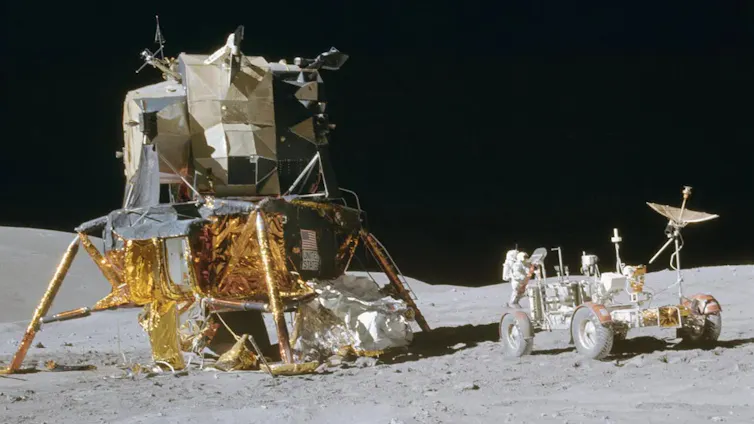
A massive solar particle event occurred between the Apollo 16 (pictured) and Apollo 17 missions in 1972.
Nasa / Charles M. Duke Jr

This gigantic release of charged particles from the Sun occurred in between the Apollo 16 (April 1972) and Apollo 17 (December 1972) missions to the Moon.

This event was much bigger than the one in November 2025 – by a factor of 40. If it had taken place while astronauts were in space, the radiation dose could have caused severe illness or even have been fatal.

The Apollo crews had a lucky escape. But the solar particle event made an impact on on Earth. The ensuing geomagnetic storm is thought to have caused 4,000 US-laid mines to spontaneously detonate in Hanoi harbour during the Vietnam war, causing confusion and alarm on both sides.

Orion
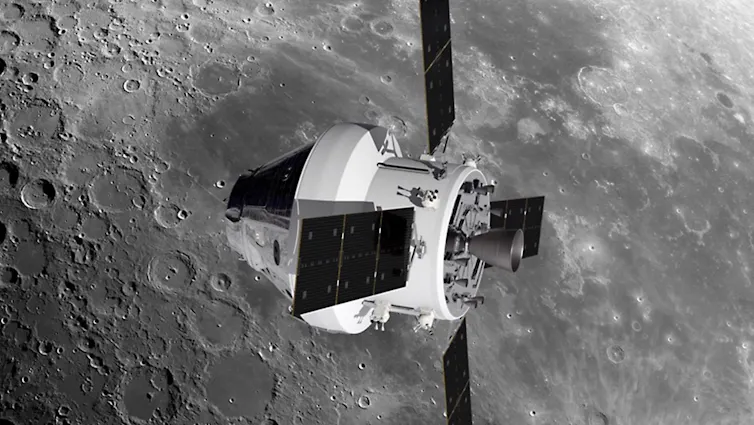
Travelling to the Moon means astronauts are no longer protected by the Earth’s magnetic bubble, or magnetosphere.
Nasa

There are ways to prepare for similar events in future. The most dangerous aspect of this radiation is its high energy component, which can penetrate shielding on spacecraft. The Surrey Space Centre Space Environment & Protection team are currently working on a detector, called the High Energy Proton instrument, that definitively measures this high energy component of solar particle radiation.

It does this through the light flashes emitted when the particles transit a transparent medium at velocities exceeding the speed of light. Astronauts often report seeing such flashes of light, even with their eyes closed, that can be caused by solar particles or high-energy cosmic rays passing through the retina or optic nerve.


Read more:
Why has it taken so long to return to the Moon?


Advance warning

The University of Surrey radiation detectors could now fly on a lunar orbiting mission towards the end of the decade. On this mission, they will characterise the danger to lunar bases as well as to the Earth. Nasa is planning to spend US$20 billion (£15 billion) on a base at the south pole of the Moon. A separate outpost is planned by China and Russia.

Radiation warning systems can give astronauts the time they need to retreat to storm shelters within a base or spacecraft where increased and specially designed shielding is used.

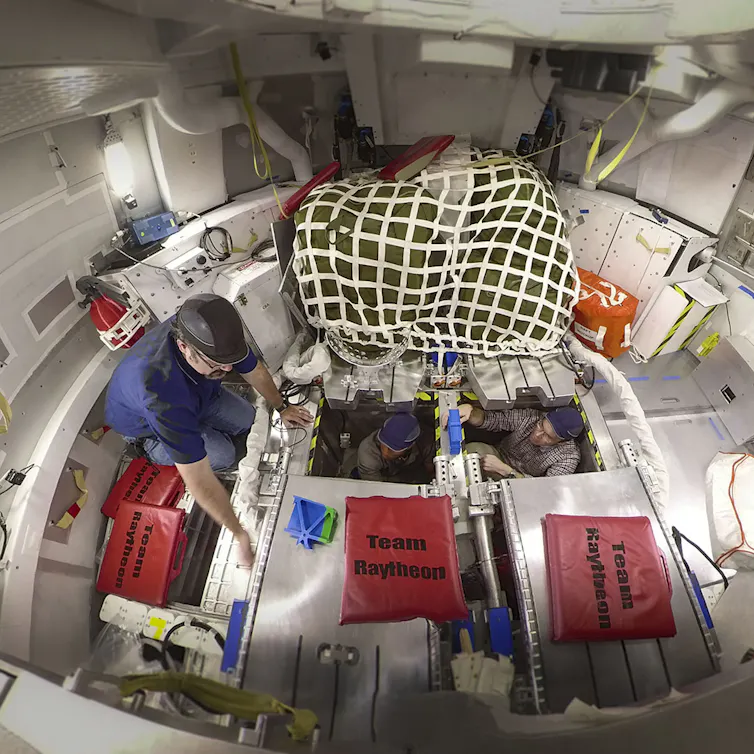
Engineers use storage lockers as a radiation shelter inside a mockup of Orion.
Nasa

If astronauts travelling in Orion – the spacecraft used on Artemis II – receive advance word of a solar storm, they are instructed to get into storage lockers in the floor of the spacecraft. This places the crew next to Orion’s heat shield, making this area one of the most protected parts of the vehicle.

Warning systems can also help on Earth. During periods of high solar radiation, controllers could instruct aircraft to fly at lower altitudes and latitudes – and in extreme cases remain grounded.

Computing revolution

One big difference between the Apollo and Artemis missions is in the rapid development of microelectronics since the 1960s and 70s. This has led to trillion-fold increases in computer memory density and thousand-fold improvements in speed.

The Apollo computers were pioneering, but struggled to cope with the workload as Neil Armstrong and Edwin “Buzz” Aldrin descended to the lunar surface during the Apollo 11 mission in 1969. However, there is a downside to this as the technology packed into modern spacecraft is vulnerable to radiation.


Read more:
Heat shield safety concerns raise stakes for Nasa’s Artemis II Moon mission


The charge depositions from individual particles often exceed the amount required to change the state of the computer memory bits. In some cases it could destroy the device. It is now arguable whether the greater hazard from solar particle events is to astronaut health or to the flight electronics aboard spacecraft.

In 1972, the Apollo astronauts were very lucky. In this new age of exploration, when so many nations have designs on travel to deep space, we can’t afford to leave astronaut safety to the whims of fortune.

The Conversation

Clive Dyer does not work for, consult, own shares in or receive funding from any company or organisation that would benefit from this article, and has disclosed no relevant affiliations beyond their academic appointment.

ref. Could a solar storm derail the Artemis II mission? – https://theconversation.com/could-a-solar-storm-derail-the-artemis-ii-mission-279613

Silence: a brief literary history

Source: The Conversation – UK – By Kate McLoughlin, Professor of English Literature, University of Oxford

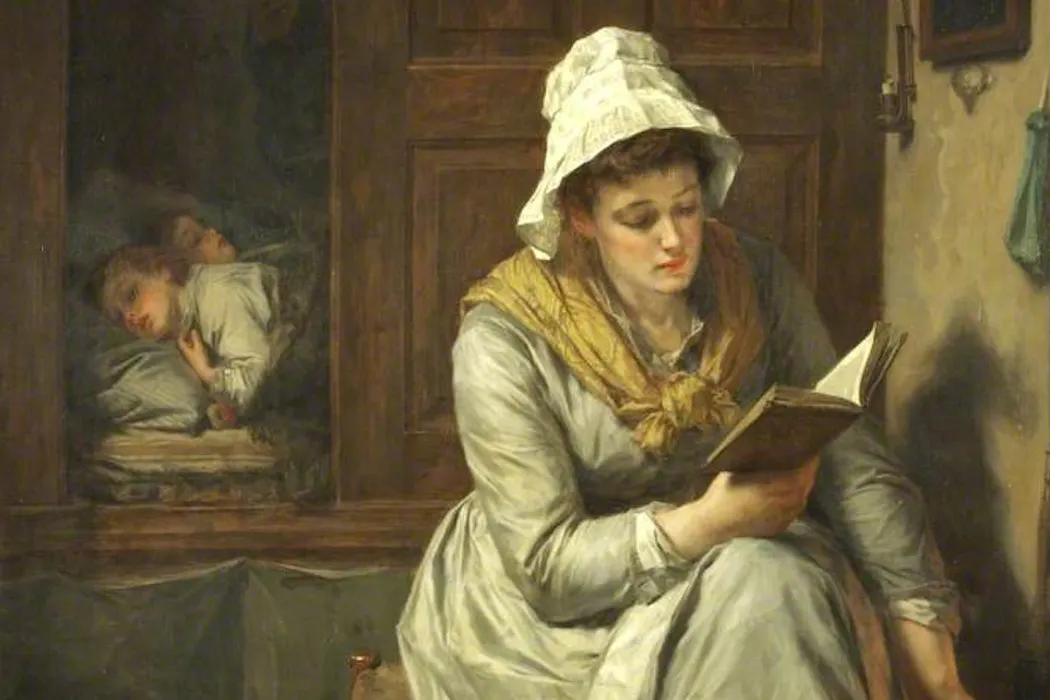
When Children Are Asleep by Thomas Faed (1885). Walker Art Gallery

Literature expresses complex and nuanced ideas – the powerful feelings that define us as human beings and the detailed observations that illuminate all aspects of our lives. It does so with words put together with consummate skill.

So, surely silence is a nothingness, an affront to the communication of both rational argument and strong emotion – literature’s opposite, even its anathema?

Well, no. In my new book Silence: A Literary History, I’ve set out to show that, over 1,200 years, English literature has spoken to us – and spoken to us eloquently – through silences as well as through words. Without silences, both formal and thematic, we wouldn’t have the exquisite hush of medieval lullabies, the suspenseful secrets of the realist novel, or the jagged fragmentation of modernist poetry.

We would lose implicitness, a good deal of ambiguity, much precision, a powerful mode of protest and a variety of moods. Iago would explain exactly why he wanted to destroy Othello in Shakespeare’s play. The dog would bark in the night time in The Hound of the Baskervilles, by Arthur Conan Doyle. And D.H. Lawrence’s sex scenes would come with a running commentary.

The start of silence

If silence has a starting point in English literary history, it’s a man at sea. The 9th-century poem The Wanderer, composed in the Old English language of the Anglo-Saxons, communicates the sheer strangeness of silence via an alien grey seascape in which the protagonist is utterly alone.

This silence is composed not of complete noiselessness – the hail beats on the waves and a seabird occasionally mews – but of an intense and total absence of human voices.

A reading of The Wanderer.

The poem conveys the difficulty of this silence – its wretched, aching loneliness and its perpetual reminder of lost happiness. But it also portrays silence as a duty, the mark of a seasoned warrior forged by Graeco-Roman stoicism, the Germanic hero ethos and Christian asceticism.

And it confronts readers, here at the very beginnings of English literature, with a silent inner voice: the necessary basis of an interior life.

Scroll on 1,200 years. En route, we will take in the tongue-tied silences of Renaissance love poetry, the green silences of 18th-century pastoral scenes and the dumbfounded wonder of the romantic sublime.

We will pause, awestruck, at Tennyson’s great epic of speechless grief, In Memoriam. We will relish the social silences of the Victorian novel, from the hilariously awkward to the emotionally profound.

The fascism-bordering silences of Modernism will make us shiver, before we ponder 20th-century experiments with visual, acoustic and dramatic silences. And we will arrive at the genre-defying, multimedia poetry collection that is Jay Bernard’s Surge (2019).

Voices that we cannot hear

In 2016, Bernard took up a residency at the George Padmore Institute in London, an archive dedicated to radical Black history in Britain. The New Cross fire, which in 1981 had killed 13 young Black people, was playing on their mind. And then on June 14 2017, as Bernard puts it: “Grenfell happened”.

Bernard was sickened by the similarities: “The lack of closure, the lack of responsibility and the lack of accountability” at the centre of both conflagrations.

Surge’s response takes its title from a remark by the Black activist Darcus Howe, one of the organisers of the Black People’s Day of Action in 1981: “When you surge and you don’t deal with the question, barbarism expresses itself.”

Jay Bernard talks about their work.

Speaking over the barbarism, Surge registers a gamut of other silences as it winds between the New Cross and Grenfell fires, and historic and ongoing injustices to Black people.

There is the “muffling” of the New Cross fire by the police, and the details that were literally “tippex’d out” of the file. The silence of the media cannot dispel the weighty silences of the ghostly dead. Then there are the silences that surround transness: hiddenness, rejection and defiance of conventional categories.

With this last issue, we can scroll back up the centuries again. The 13th-century romance Silence, written in Old French by a Cornishman, Heldris de Cornualle, relates the legend of a girl-child being brought up as a boy called Silence because women are forbidden to inherit their parents’ estates. This causes a furious argument between the characters of Nature and Nurture, which anticipates our own age’s differences over transness by eight centuries.

“They have insulted me,” complains Nature, “by acting as if the work of Nurture / were superior to mine!”

But Reason, on behalf of Nurture, urges Silence to resist Nature’s blandishments, or “you will never train for knighthood afterwards. / You will lose your horse and chariot.”

Nature is the winner in the story, but the poem is able to accommodate Silence as both male and female – effortlessly embracing apparent contradictions in such lines as “he was a girl”.

painting of a woman reading in reeds
Woman Reading in the Reeds, Saint-Jacut-de-la-mer by Édouard Vuillard (1909).
The Fitzwilliam Museum

I believe noticing silences in literature makes us better readers. We come to recognise that some things are better left unsaid – indeed, that some things can’t be said. As a result, our antennae become attuned to literature’s stock-in-trade: the indirect and the inexplicit.

Importantly, we become aware of who hasn’t spoken. All this means we gain a better understanding of what communication is, and how we interact with other people. As our reading acquires a new, slower tempo and a new rhythm, our interpretations change.

What can silences speak to us about? Some of the profoundest aspects of our existence: our understanding of what makes a self; our sense of sacredness; our most powerful and intimate feelings; our place in the natural world; our capacity for wonder. All we have to do is notice.

The excerpt from Silence: A Thirteenth-Century French Romance was translated by Sarah Roche-Mahdi. This article features references to books that have been included for editorial reasons, and may contain links to bookshop.org. If you click on one of the links and go on to buy something from bookshop.org The Conversation UK may earn a commission.

The Conversation

Kate McLoughlin was awarded a Major Research Fellowship by the Leverhulme Trust to write Silence: A Literary History.

ref. Silence: a brief literary history – https://theconversation.com/silence-a-brief-literary-history-277903