In The Stranger François Ozon captures the many ambiguities of Albert Camus’s novel

Source: The Conversation – UK – By Debra Kelly, Professor of French and Francophone Studies, Cultural Historian, University of Westminster

Director François Ozon’s new film adaptation of Albert Camus’s novel L’Étranger (The Outsider, 1942) confronts a considerable task: turning a brief, philosophical novel into a cinematic experience.

Though the book is short, it is dense and readers often discover it requires multiple readings. Camus’s spare prose conceals profound questions about morality, society and human existence. Translated into over 75 languages with millions of copies sold, The Outsider has inspired stage, screen, radio and even graphic and manga adaptations. It has long been a set text in schools and universities, often perplexing young readers, just as it did a young Ozon. This film offers an invitation to return and reflect on Camus’ work.

The story follows Meursault (Benjamin Voisin), a French-Algerian office worker living in Algiers. The novel famously opens with the death of his mother, whose funeral he attends with apparent emotional detachment. He begins a relationship with Marie (Rebecca Marder), who formerly worked in the same office and becomes involved with Raymond (Pierre Lottin), a neighbour entangled in a violent dispute.

The trailer for The Stranger.

Meursault’s life changes dramatically when he shoots a young Arab man on a sun-drenched beach. The act leads to his arrest and the second part of the novel focuses on his imprisonment and trial. Throughout, Meursault remains a detached observer of the absurdity of existence and the moral expectations of society.

Ozon’s adaptation closely follows this narrative while expanding certain perspectives giving the film its own vitality and richness.

Camus and the challenges of adaptation

In a recent Curzon audience Q&A, Ozon observed that this is a novel every reader has already visualised and staged in their own mind. The director faced not only the expectations of readers’ imagined versions of the story but also the iconic stature of Camus himself.

Born into a poor French settler family in Algeria, afflicted by tuberculosis, Camus rose to become a journalist, playwright, actor, philosopher, member of the French Resistance, world-famous novelist and Nobel laureate (in 1957). His death at the age of 46 in a fatal car accident little more than two years later, with an unused train ticket to Paris in his pocket, added a mythic aura to his life and work.

Shot compellingly in black and white, Ozon’s film moves fluidly between the opening 1930s archive images of Algiers to the film’s recreated streets and natural landscapes with their play of light and shadow. The heat of the sun, the glare of the sea and the tactile presence of sand are central to the story, while also reflecting Camus’s own love of Algeria’s natural riches.

Camus described the story as both abstract and intensely physical – rooted in flesh and heat. Ozon’s film captures that tension between the intellectual and the sensory.

The title of the novel sets up the ambiguities of interpreting and adapting it. Published as The Outsider in the UK and The Stranger in the US, both titles seemingly settle the possibilities of Meursault’s status.

In French, “étranger” may mean stranger, foreigner or outsider – a multiplicity Ozon preserves in his adaptation. Voisin, incarnating Meursault’s stillness and silences on screen, moves between these roles. Among the French quarter’s neighbours, cafes and small businesses, he is just another man. Algerian passers-by, merely glimpsed here, are the strangers, foreigners, outsiders.

Among the Arab prisoners Meursault is imprisoned with, he is suddenly “the foreigner”. The film traces his inexorable shift from detached observer to condemned outsider. The confrontation with the chaplain, a climactic moment in the novel, is key to Ozon’s own vision. Here, Meursault refuses conventional consolation, embodying the “rebel” of Camus’s later philosophical work.

Reclaiming Camus’s ambiguities

The colonial context of L’Etranger has often been politically contested. Camus’s unfinished autobiographical novel, Le Premier Homme (The First Man, 1994) was found at the scene of his death. It reflects his position on Algeria (and on poverty, class and education), which is more complex than trial by the political convictions of various critics allows.

Camus’s detachment from Algerian nationalist movements, along with his choice not to name Arab characters in his fiction (or to avoid them altogether), drew sustained criticism from the French Left and Algerian nationalists in the 1950s and 60s. His vision of a multicultural Algeria – seen by some as utopian and by others as implicitly racist – was later criticised by postcolonial scholars as well. However, these ambiguities are inseparable from Camus’s literary and moral vision and his lived experience.

Ozon’s adaptation speaks to contemporary audiences by giving form to these ambiguities. By expanding the presence of his lover Marie, Ozon provides subtle insights into Meursault, a man condemned because he doesn’t play the game and refuses to lie, as Camus later described him in a 1955 American edition of the novel. Ozon also gives agency to the murdered man’s sister Djemila (also nameless in the novel). These female performances provide the film’s emotional centre.

The film’s careful attention to Algeria, both past and present, meanwhile, reframes The Stranger as a story not just of one man, but of a society. Following the bloody civil war in 1990s Algeria, Camus was “recuperated” by Algerian dissidents against the rise of fundamentalism and reclaimed by new generations of Algerian writers. The final scene of the film honours the murdered “Arab” with the name Moussa, which has been taken from Kamel Daoud’s knowing re-telling, Meursault, Contre-enquête (The Meursault Investigation; 2012).

In doing so, Ozon takes his own place in reclaiming Camus’s moral fable in all its ambiguities. The Stranger retains Camus’s philosophical challenge: to confront the absurdity of existence without surrendering to despair.

This article features references to books that have been included for editorial reasons, and may contain links to bookshop.org. If you click on one of the links and go on to buy something from bookshop.org The Conversation UK may earn a commission.

The Conversation

Debra Kelly does not work for, consult, own shares in or receive funding from any company or organisation that would benefit from this article, and has disclosed no relevant affiliations beyond their academic appointment.

ref. In The Stranger François Ozon captures the many ambiguities of Albert Camus’s novel – https://theconversation.com/in-the-stranger-francois-ozon-captures-the-many-ambiguities-of-albert-camuss-novel-279718

Undertone: this creepy sound horror is utterly terrifying

Source: The Conversation – UK – By Laura O’Flanagan, PhD Candidate, School of English, Dublin City University

Undertone is the terrifying feature film debut from Canadian director Ian Tuason, which promises to be the “scariest movie you will ever hear”.

Evy (Nina Kiri) is a podcast host caring for her dying mother (Michèle Duquet) at home. Told only from Evy’s perspective, the film moves from initially creepy to utterly horrifying over a tense, tight 93-minute running time.

Evy’s Undertone podcast explores supernatural phenomena. Her co-host Justin (Adam DiMarco) is in another time zone, so they record online in the middle of the night, Evy’s time. This veers close to the “witching hour”, but as Evy is the podcast’s resident sceptic – the voice of reason opposing Justin’s belief in the paranormal – she is unbothered. Until she’s not.

For this week’s instalment, Evy and Justin react to a series of mysterious recordings involving a couple: Jessa (Keana Lyn Bastidas), who has begun talking in her sleep, and her husband Mike (Jeff Yung), who records her. These clips lend the story a naturally escalating structure, as the material grows increasingly distressing and the sense of dread intensifies.

As elements from the recordings seep into Evy’s world and her sense of reality begins to shift, Kiri proves superb in the role. Alone onscreen aside from her unconscious mother, she balances a raw fragility with intense emotional control. Kiri carries the film almost entirely, with supporting characters reduced to voices in her headphones or on her phone.

Undertone’s domestic setting has an uncanny familiarity to it, with soft furnishings, lamps and religious artwork bathed in cold, often unpredictably flickering light. Compounding the disquiet is the fact that Tuason used his childhood home in Toronto as his filming location, inspired by caring for his own ailing parents.

The result is an uneasy intimacy which blurs the line between personal memory and horror. This, combined with Evy’s mother’s impending death and the harrowing implications of the audio clips, makes the film a disturbing yet consistently absorbing experience.

At times, though, Tuason leans too heavily on religious iconography to generate unease, diluting some of the originality. The film also flirts with shock value using inherently distressing subject matter, rather than fully earning its impact.

Sound as terror

Sound design is Undertone’s real strength. As podcast host Justin says: “Don’t be afraid of the dark, be afraid of the silence.”

The film captures the sound of podcasting with close, warm, immaculately clear voices and achieves an intimate, studio-polished quality. Building the sense of unease, there are authentic-sounding sleep-talking recordings, nursery rhymes played backwards, exaggerated household noises such as taps and whistling kettles, and prolonged silences.

Other horror films such as Berberian Sound Studio, The Black Phone and Keeper have harnessed the unsettling potential of sound in recent years, exploring the eerie power of disembodied voices.

This is a lineage Undertone joins while carving out a more intimate horror. Tuason’s film also makes narrative use of the podcast hosts’ editing skills to great effect, as they speed up, slow down, reverse and replay the recordings over and over, trying to glean some sense from them. In doing so, sound becomes Undertone’s primary source of terror, placing its audience in the same position as Evy.

Undertone is a confident debut from Tuason, who understands exactly where the film’s power lies. By grounding its horror in voice and sound, the film becomes an experience that feels immediate and inescapable.

In placing us so firmly within Evy’s singular perspective, Undertone crosses the boundary between listener and participant, resulting in a work which fulfils its promise of terror. It is not for the faint of heart.

The Conversation

Laura O’Flanagan does not work for, consult, own shares in or receive funding from any company or organisation that would benefit from this article, and has disclosed no relevant affiliations beyond their academic appointment.

ref. Undertone: this creepy sound horror is utterly terrifying – https://theconversation.com/undertone-this-creepy-sound-horror-is-utterly-terrifying-279915

Children going through family courts face increased risk of self-harm, new research finds

Source: The Conversation – UK – By Amanda Marchant, Research Assistant & PhD Candidate in Mental Health, Swansea University

Family courts step in at some of the hardest moments in a child’s life, when parents separate or when there are concerns about their safety.

We already know that children involved in care proceedings are more likely to self-harm. But most children who come into contact with family courts are there because of disputes between parents, not safeguarding concerns. Until now we have known comparatively little about these children or what happens to them after court proceedings end.

For the first time, our research tracked self-harm over time in these children. We found that children who go through the family courts, whether because of parental separation or welfare concerns, are more likely to self-harm than those who do not.

This doesn’t mean the courts themselves are causing harm. This increased risk is more likely linked to the circumstances that lead families to court in the first place. Family courts are an often-missed opportunity to offer help.

We analysed anonymised family court records alongside routinely collected health data for more than 700,000 children between 2011 and 2018. Around 17,000 had been involved in private cases – usually disputes over finances or living arrangements after separation. Another 5,500 were involved in public cases, where local authorities step in over concerns about a child’s welfare.

The risk of self-harm was about twice as high after private cases and more than three times as high after public ones.

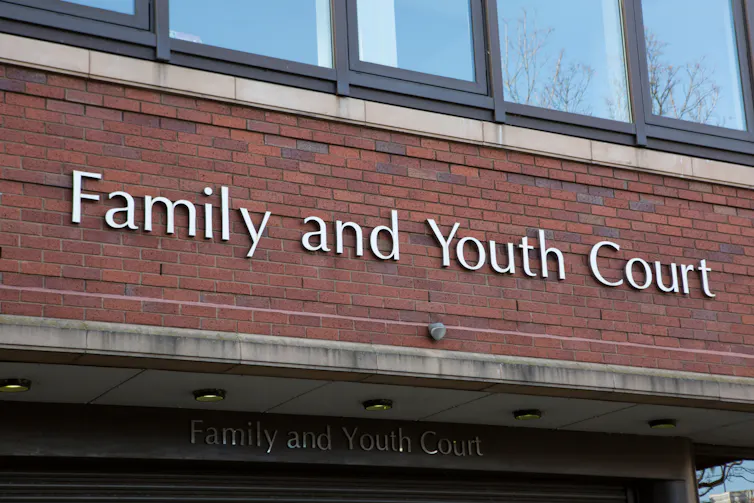
Exterior of a building with the sign Family and Youth Court
Children involved in family court were more likely to self-harm than those with no court contact.
Diana Parkhouse/Shutterstock

Previous research shows that families in contact with courts often face challenges beyond the courtroom. They are more likely to live in deprived areas and to experience mental or physical health problems, in both caregivers and children. These factors are already known to increase the risk of self-harm in young people.

Historically, people designing services for families have not always had enough data to guide the decisions made in family courts. Evidence now shows elevated risks not just of self-harm but for a range of adverse outcomes, including depression, anxiety and poorer educational attainment. Yet family courts receive far less public attention than many other issues affecting young people.

A warning sign we shouldn’t ignore

Self-harm is relatively common in adolescents. Most young people who self-harm do not go on to die by suicide. However, it is one of the clearest signals of distress and one of the strongest risk factors for suicide. This makes early identification and support especially important.

Children who come into contact with family courts should be a priority for support.

Parental separations are common. Many children experience them and their effects can be underestimated and downplayed because of that. Around one in ten separating families turn to family courts to resolve disputes, often as a last resort because of the financial and emotional costs. It may also reflect high levels of conflict between parents.

The decisions made during these proceedings can be life changing for children. Where families reach the point of involving family courts, we should ensure that support is available for the whole family, especially for children.

Family courts are in a unique position. They come into contact with children and families, with complex and intersecting needs, at important moments that have the potential to shape the rest of their lives.

We believe that contact with the courts should be seen as an opportunity to identify the needs of these families and offer practical, timely support to children and their families. This might include wider networks such as schools, community services and primary care or to provide clearer pathways to specialist mental health support where needed.

Decisions made in family courts have the potential to shape children’s lives at critical moments. These moments should be seen as signals of need, not just legal milestones. If we act on them, we have a real chance to support children at the point they need it most.

The Conversation

Amanda Marchant receives funding from Health and Care Research Wales (HCRW).

Ann John receives funding from MRC, Health and Care Research Wales and NIHR.

ref. Children going through family courts face increased risk of self-harm, new research finds – https://theconversation.com/children-going-through-family-courts-face-increased-risk-of-self-harm-new-research-finds-278263

May elections: what five politics experts are looking out for

Source: The Conversation – UK – By Jonathan Tonge, Professor of Politics, University of Liverpool

Darren Baker/Shutterstock

On May 7 2026, voters in England, Scotland and Wales will head to the polls. Parliamentary elections are taking place in the devolved Welsh Senedd Cymru and Scottish Parliament, and local elections for over 4,850 councillor roles could have huge implications for local governments throughout England. With all to play for, we asked five experts to tell us what they will be keeping their eye on.

Can Reform compete across the UK?

Jonathan Tonge, Professor of Politics, University of Liverpool

The 2026 elections will reveal whether Reform UK will peak as an English nationalist party, or if they can compete as a genuine nationwide force. Last year’s local elections confirmed that Reform can seriously harm the Conservatives. This year, contests are across councils held mainly by Labour, making the English elections about Reform’s threat to Keir Starmer’s party.

Nigel Farage’s party, which currently has eight MPs, has led opinion polls in England since May 2025, when it won the highest vote in English local elections. Reform took control of ten councils (from a starting point of zero), and gained nearly 700 new councillors. Of these, eight were county council gains from the Conservatives, with another taken from a Liberal Democrat-led coalition. The tenth gain was from Labour in the only metropolitan borough contested, Doncaster.

Reform’s likely gains in English councils aren’t guaranteed elsewhere in the UK however. The party’s polling in Scotland is around ten percentage points behind what it is in England. It may be that Reform is battling Labour for second place, while the Scottish National Party (SNP) continues to dominate.

Reform’s polling in Wales is higher (in the mid-to-high-20% range) but again, the real battle is with Labour for runner-up, as Plaid Cymru seems set to top the poll.

Scottish Parliament, Senedd Cymru, Birmingham Council dome
Elections in the Scottish Parliament, Senedd Cymru, and local councils across England will drastically reshape the UK’s political landscape this May.
Wangkun Jia/shutterstock, trabantos/shutterstock, Juan Garcia Hinojosa/Shutterstock


Read more:
Why did the polls get the Caerphilly byelection wrong? They ignored the fact Reform is an English nationalist party


Local results could force tricky coalitions

Alex Nurse, Reader in Urban Planning, University of Liverpool

Local elections are often concerned with local issues – think potholes and bin collections. Councils are also obliged by law to spend a lot of their time and budget on initiatives like adult social care, but these issues are often lost in the broad brush strokes of election campaigns.

It will be interesting to see how the ascendant Greens and Reform present their vision for local government, and what compromises they make to win over local voters. In the recent Gorton and Denton byelection, Green candidate Hannah Spencer made scarce mention of the environment and instead focused heavily on the cost of living and the broader social contract. Similarly, Reform’s promise to mimic the US Department of Government Efficiency (Doge) following the 2025 elections came up short after its newly elected councillors found local authorities already cut to the bone from years of austerity.

I’ll also be watching to see how the fragmented opinion polls translate into council seats. While we might be expecting a wipeout for Labour and the Conservatives, it remains to be seen how many councils the other parties will win wholesale, and where there will be situations of no overall control, requiring tricky coalition building. This might involve attempts to form a coalition of like-minded councillors, as seen in Bristol. However, the reality is often that parties attempt to go it alone, by entering minority government and living vote by vote, as seen in places like Sheffield or Wirral.


Read more:
How ordinary neighbourhoods became battlegrounds in the politics of ‘broken Britain’


Challenges to inclusive Scottish identity

Murray Leith, Professor of Political Science and Director of the Centre for Migration, Diaspora, Citizenship and Identity, University of the West of Scotland

The SNP has long predicated its sense of national identity on a civic and inclusive
Scottishness. Its message throughout the past 19 years has been that anyone who believes in Scotland can be Scottish. While other parliamentary parties have challenged and attacked myriad SNP platforms and policies in the last two decades, none disagree with this political elite consensus.

However, this agreement has not been as duly accepted by people in Scotland who
are less accepting of incomers and migrants (from the rest of the UK and beyond) claiming Scottish identity. Scotland has shifted from an emigrant nation to an immigrant nation in recent years. Without immigration, Scotland’s population would have shrunk. While migration policy remains reserved to Westminster, it looms large in the minds of voters – so much so, that the SNP has made devolving immigration power to Scotland one of its 14 key manifesto pledges.

Reform UK is openly challenging this inclusive and welcoming political consensus. In his first speech, Malcolm Offord, Reform’s Scottish leader spoke of strangers and uncontrolled immigration destabilising communities. Given recent polling and the possibility that Reform may be the official opposition in the next Scottish parliament, the SNP may soon be facing an opposition that proposes a less inclusive vision of Scottishness.

A potentially huge turnover on councils

Hannah Bunting, Senior Lecturer in Quantitative British Politics and Co-director of The Elections Centre, University of Exeter

In the English local elections, I’m keeping an eye out for how many incumbents lose their seats. We know that voters are disillusioned with the two main parties and looking for alternatives. Last year in the 2025 locals, and in many council byelections since, less than 40% of Labour and Conservative incumbents were re-elected. According to our data at The Elections Centre, this figure hasn’t dropped below 70% since 1973.

There are also many more vacancies this year compared to 2025, with Labour defending half of the nearly 5,000 up for grabs, and the Conservatives defending another quarter of them. If this rate of losses continues, we are going to see thousands of new councillors elected, with huge implications for local governments.

Two Labour strongholds, Sunderland and Barnsley, are currently polling in favour of Reform, as is Walsall, which has been held by the Conservatives since 2004. The Greens are making headway in the inner boroughs of London, and councils with “no overall control” may be more common than ever in the capital after these contests. Labour has the furthest to fall, and all eyes will be on how many gains Reform and the Greens make, alongside how many areas turn to the Liberal Democrats as an alternative.


Read more:
What the Caerphilly byelection could reveal about Reform, Labour and Wales’ political future


A proportional system in the Senedd

Anwen Elias, Reader in Politics, Aberystwyth University

Changes to the way Welsh voters elect the Senedd – a proportional system where one vote is cast for a political party’s list of candidates across 16 new constituencies – will require parties to campaign very differently compared to previous elections. The extent to which they can adapt will affect how they perform.

Under the previous electoral system, most Senedd members (40 out of 60) were elected under first-past-the-post, with the rest elected through proportional regional lists. There was an incentive to focus attention and resources on key seats where a political party had the best chances of winning. Under the new system parties will need to gain support from across Wales if they want to ensure a strong presence in the Senedd.

This requires a different kind of campaign strategy and organisation, which is likely to be especially challenging for parties with fewer resources. Within constituencies – some of which are huge – political parties will have to mobilise activists in areas where historically they might not have had a much presence or electoral support. Parties with the available resources for a coordinated national campaign and a strong media, and social media, presence will have a clear advantage under this new system.

The Conversation

Alex Nurse receives funding from the Economic and Social Research Council.

Anwen Elias receives funding from the Economic and Social Research Council.

Hannah Bunting receives funding from the Economic and Social Research Council (ESRC).

Murray Leith has previously received funding from the European Union and the Scottish Government. He is a member of the Electoral Reform Society.

Jonathan Tonge does not work for, consult, own shares in or receive funding from any company or organisation that would benefit from this article, and has disclosed no relevant affiliations beyond their academic appointment.

ref. May elections: what five politics experts are looking out for – https://theconversation.com/may-elections-what-five-politics-experts-are-looking-out-for-279260

Five warning signs that rivers are polluted – even when they look clean

Source: The Conversation – UK – By Jess Neumann, Associate Professor of Hydrology, University of Reading

Howard Pimborough/Shutterstock

After months of relentlessly miserable weather for most of the UK, spring brings renewed enthusiasm for spending time outdoors hiking, wild swimming, paddling or on walks.

Millions of people visit lakes and riversides every year. Yet with constant, and sadly necessary, reminders about sewage and water pollution, it’s not surprising that people are increasingly worried about whether the water they see is safe.

Cocktails of contaminants created by sewage systems, agricultural pollutants and urban runoff are currently at the forefront of public, scientific and regulatory focus.

Not one UK river was free from chemical contamination, and only 14% were classified as having “good ecological status” at the last assessment.

In 2024 alone, raw and partially treated sewage was discharged in to watercourses for more than 3.6 million hours. With around 15,000 sites regularly discharging effluent, in addition to ongoing inputs from agriculture, transport and other industries, the 2025 results due to be published this year are not expected to show significant improvement.

Given this, many people who spend time around rivers want to know how to identify pollution.

A sewage pipe pours water into a river.

diegorayaces/Shutterstock

It’s worth remembering that pollution isn’t always visible.

River contaminants take many forms. Some, like oil sheens, excrement, sanitary products and fly-tipping are visible and often odorous. Others such as nutrients including phosphates and nitrates, heavy metals, microplastics, and chemicals like ammonia and Pfas “forever chemicals” are invisible to the naked eye.


Read more:
Why we keep swimming in polluted waters – researchers


Pollutants may enter rivers from points such as discharge pipes, but also from farmland or roads, making them difficult to trace. Assuming you’re not armed with specialist pollution testing kit, identifying contamination often relies on observing indirect signs. Here are five indicators to look out for along with the conditions in which they are most likely to appear:

1. Sewage fungus

Look out for a pungent, gelatinous, fuzzy carpet along the river bed, often found downstream of sewage outfall pipes.

Although not technically a fungus, these slimy, brownish-grey growths of bacteria and microorganisms thrive in nutrient-rich waters. Sewage fungus reduces oxygen levels in water, suffocating and physically smothering aquatic life.

2. Algal blooms

Look out for thick green mats or scum on the surface of the water, often looking like pea soup or spilled paint in green, blue-green, or brownish-black colours. Odours may be musty, earthy or grassy.

Algae is a natural part of aquatic ecosystems. Warm and dry weather combined with overloads of nitrogen and phosphorus nutrients, can trigger excessive algal growth. Algal blooms block light and use up available oxygen during their decomposition in a process known as eutrophication. The effects of algal blooms, especially blue-green algae can be catastrophic to aquatic life, and toxic to humans and pets.

3. Murky water

Look out for colours that are different to what’s expected, and cannot be easily explained by what you know about the local landscape.

Sewage tends to present as grey, cloudy or milky, sometimes accompanied by bubbles, foam and a foul odour. Green or blue-green is indicative of algal blooms. Unusual colours like orange, red, yellow, or black may suggest industrial leaching or chemical dumping. Soil erosion can cause large quantities of suspended solids giving rivers a murky brown appearance that reduces light penetration and can suffocate organisms.

However, not all colours are a cause for concern. Heavy rain will naturally suspend particles and transport sediments giving rivers a temporary murky appearance. Local geology and soils may result in tea-coloured water caused by high iron content, or oily sheens caused by aerobic iron-fixing bacteria in boggy areas. You may even spot harmless dyes used by water companies and contractors to trace drainage leaks and misconnections.

4. White foam

Look out for bright white or milky-grey foam that doesn’t easily disperse. It is often accompanied by a perfume, soapy or detergent-like smell.

Man-made foam from sewage, detergents, fire-fighting activities, pesticide runoff and industrial processes causes oxygen depletion in water. They can contain noxious forever chemicals known to cause serious health conditions in humans and wildlife.

Understanding river foam requires a discerning eye – not all foam is bad. Natural foam, while aesthetically unpleasant, can be formed by decaying leaves and plants. White-to-brown in colour, natural foam smells earthy or slightly fishy. It can collect in large clumps and is common on windy days, following heavy rain and in turbulent and nutrient-rich waters. In the absence of other environmental impacts like dead fish, algal blooms, or obviously stagnant water, natural foam is rarely problematic.

5. Aquatic life

Look out signs of distress including fish gasping at the surface, dead fish, or unusual behaviour from animals that live in and around the river.

Pollution causes a decrease in dissolved oxygen, which alongside drought and temperature extremes are leading causes of fish deaths and wildlife distress.

The presence of species such as kingfishers, water voles, frogs and riverflies indicate a cleaner river environment. A prolonged and noticeable absence of wildlife using the river is a concerning sign.

Interpreting the signs and taking action

Even with these indicators, identifying pollution is not always clear-cut. Many of these signs can overlap or have natural explanations, making it difficult to draw firm conclusions based on appearance alone.

To build a clearer picture, it’s important to consider additional information. For example:

  • Are there unusual smells?
  • Is there a visible discharge point nearby?
  • Have there been reports of people or animals becoming ill after contact with the water?
  • Has there been recent sewage discharge in the area?
    In England, water companies provide near real-time data on sewage discharges through monitoring systems. However, these show how long spills occur, not the volume or concentration of pollutants, so they offer only part of the picture.

If you suspect serious pollution, it should be reported immediately to the relevant environmental authority.

While the current state of our waterways is concerning, understanding the signs of pollution and taking action are important steps toward improvement. Being well informed could help avoid turning your day out on the water into an unpleasant and potentially unhealthy experience for you and your friends and family.

The Conversation

Jess Neumann works at the University of Reading as an Associate Professor of Hydrology. She is a trustee of River Mole River Watch, a water quality charity who work with, advise, and receive funding from environmental and conservation organisations and agencies, water companies, commercial services, local authorities and community groups. She is a Director of the UK Chapter for the International Association for Landscape Ecology.

ref. Five warning signs that rivers are polluted – even when they look clean – https://theconversation.com/five-warning-signs-that-rivers-are-polluted-even-when-they-look-clean-279881

I was in Georgia in the late 1980s: I observed how tradition survived harsh Sovietisation and rapid transformation

Source: The Conversation – UK – By Karina Vamling, Professor emerita of Caucasus Studies, Malmö University

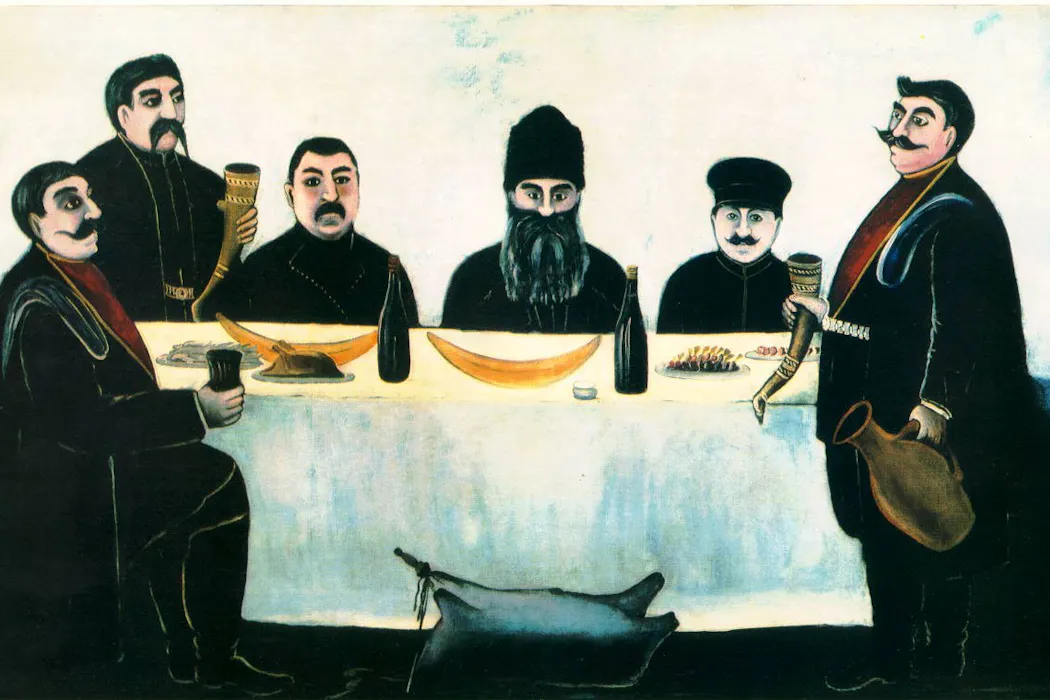
Begos’ Friends by Georgian painter Niko Pirosmani, painted in the 1910s. At a keipi or festive supra, the tamada holds a kantsi (horn) and introduces a toast.
Wikiuka/Wikimedia

When Soviet president and Communist party secretary Mikhail Gorbachev introduced the policies of perestroika (reconstruction) and glasnost (openness) in the mid-1980s, it marked the beginning of cautious reforms of the Soviet Union. Georgia, or the Georgian Soviet Socialist Republic, to give it its full name at the time, was on the periphery of the union.

Far from Moscow, it lay hidden on the other side of the Caucasus mountain range on the edge of the Black Sea. As a doctoral candidate in linguistics on a research grant to Tbilisi University, I spent one year living there, between 1987 and 1988. I was conducting research on the Georgian language.

Travel at the time was very difficult, and could only happen via Moscow. I did not return to Sweden for the duration of my stay. In the recent publication, We Witnessed the Soviet Break-Up: Five Scandinavian Researchers on the Final Years of the USSR, Seen From the Caucasus, I detail how this gave me a front-row seat from which to observe the speed at which society was shifting – and how language was key to that transformation. I also observed how old cultural traditions had endured despite decades of Communist propaganda and harsh Sovietisation.

Rapid transformation

The May Day parade was long one of the key moments in the Soviet calender. I witnessed the last time it was held in central Tbilisi, in 1987. People were carrying red flags. Banners declaiming “Glory to the Communist party” and “Glory to our multinational Soviet Fatherland” were draped on the main buildings.

Next year, however, the national movement across the republic was pushing for a free Georgia. In November 1988, many took part in a hunger strike in front of the Georgian parliament against changes in the constitution that would reduce the rights of the Georgian republic. Protesters wanted what they termed the “Russification of Georgia” to come to an end.

Georgian society was multiethnic and multilingual, counting Russians and Georgians alongside Armenians, Azerbaijanis, Abkhaz, Ossetians, Greeks and many others. Georgian was the main language within the Georgian education system as well as in broadcasting and the press and, technically, according to Article 6 of the Constitution of Soviet Georgia recognised as the republic’s official language. However, during the Soviet period, Russian speakers could easily live and work in Georgia without knowing Georgian: Russian was the lingua franca for inter-ethnic communication within the republic and the Soviet Union at large.

As a non-Indo-European language, Georgian boasts its own script and a written history that dates back to the 5th century AD. It is a cornerstone of the Georgian identity. Within the wider push for greater political freedom, Georgians now fought for the implementation of the constitutional status of Georgian. This included increased demands for knowledge of Georgian in workplaces and administration, while also investing in teaching Georgian as a second language.

Efforts were made to develop Georgian terminology in technology, science and other fields where Russian had been dominant. Citizens who had little or no knowledge of Georgian were under pressure to learn.

Enduring traditions

Despite decades of Sovietization, social and family life remained underpinned by old patriarchal traditions.

During my time in the country, I was welcomed with more openness and engagement, and less suspicion, than during the three years I had spent in Moscow. I experienced the extent to which hospitality was an ancient Georgian virtue. “A guest is a gift from God,” local people would say.

Georgians were proud of their cuisine and ancient wine production. When a guest entered a home, the dinner table would quickly transform into a feast, what is know as a “supra”. This came with its own specific structure and rules. The man of the house would assume the role of toastmaster (tamada), and the wife and female members of the family would prepare and serve the food. They would be called in from the kitchen for a toast in honour of the women. In some traditional families, the men would sit at one end of the table, and the women and children at the other.

These traditions were discernible across the different cultural communities within Georgia. Tensions at the time were growing between Tbilisi and the central Soviet authorities in Moscow, and within Georgia itself, with minorities in the autonomous entities of Abkhazia and South Ossetia.

In the summer of 1989, the first violent Abkhaz-Georgian clashes took place. I was on a day trip, travelling from Sokhumi, the capital of the Autonomous Republic of Abkhazia, to a wedding in a small town called Zugdidi in the Megrelia region when violence broke out. Unable to return to Sokhumi as planned, I ended up spending one week with a family on the outskirts of the town.

Being there was like stepping back in time. The household was run by a young woman called Tsira, who, as a widow, dressed all in black. According to tradition, she would remain in black for the rest of her life. Her eldest son, who was 12-13 years old at the time, appeared to be seen as the man of the house.

Tsira’s neighbours came round and my friends from Sokhumi sat with them, discussing the conflict in Megrelian, the local language. Tsira prepared food, chicken and maize porridge over an open fire in a small wooden hut in the yard. Smoked cheese hung from the ceiling.

At one point, we visited the cemetery. Tsira sat on a stone bench by a black marble bust of her husband while relatives and guests sat around the grave. The women brought out Soviet champagne and food. I observed how toasting and eating bread dipped in wine were important in a ritual of honour and remembrance.

These religious practices showed how, within the official atheism of Soviet society, Georgian Orthodox traditions persisted – as they still do today. Another such religious practice common in Georgia during Soviet times was to hold a commemorative supra 40 days after a person had passed away. During this period, the men were not supposed to shave. The 40 days are considered the time it takes for the soul to reach heaven and God.

In 1990, I heard the crowd shouting “occupiers, occupiers” in front of the general staff of the Caucasian Military District in Tbilisi. The newly adopted Soviet law, dubbed the “law of non-secession” made the idea that the Soviet Union might break up feel a utopian dream. And yet it did, merely a year later. Georgia declared independence from the Soviet Union on April 9 1991 and the split was finalised on December 26 with the dissolution of the USSR.

In the intervening decades, the ethnopolitical conflicts that were fomenting during this early post-Soviet period have only deepened, not least following the Russo-Georgian war of 2008. Today, they remain largely unresolved and the situation in Georgia, highly volatile.

The Georgian language, however, has reclaimed the media, education and the streets. Russian has been replaced by English among the young generation of Georgians who do not carry this Soviet heritage.

The Conversation

Karina Vamling received funding from the Swedish Institute, Åke Wiberg Foundation, Swedish Network for European Studies in Political Science and the Längman Cultural Foundation. She is affiliated to the research group Russia, Ukraine and the Caucasus Regional Research (RUCARR), Malmö University, Sweden.

ref. I was in Georgia in the late 1980s: I observed how tradition survived harsh Sovietisation and rapid transformation – https://theconversation.com/i-was-in-georgia-in-the-late-1980s-i-observed-how-tradition-survived-harsh-sovietisation-and-rapid-transformation-276911

Hands off my hat! The hidden power of headwear and ‘hatiquette’ in early modern England – new study

Source: The Conversation – UK – By Bernard Capp, Emeritus Professor of History, University of Warwick

Roundhead and cavalier soldiers, wearing partisan hats, face each other and urge their dogs to attack each other (1643). State Library Victoria, Melbourne , CC BY-SA

Around 8pm on a cold February evening in 1733, a gentleman named Francis Peters was returning to his home near Knightsbridge, London, in a hackney cab, when someone knocked on the wooden shutters of the door. An armed horseman thrust a pistol inside, demanded Peters’s money and valuables and snatched a ring from his finger. Peters handed them over without fuss. But when the thief also snatched his hat and wig, he protested vigorously, though in vain – the robber rode away with his booty.

The puzzle, to the modern reader, is that the hat was worth only five shillings – far less than the watch (worth £4), the ring and the cash he had already handed over. So why make such a fuss?

Woodcutting showing three Levellers wearing hats
Levellers wearing their hats.
Bodleian Libraries, University of Oxford

The robber was later arrested and Peters made a point of going to see him in Newgate Prison as he awaited trial. He told him it had been bad manners to take his hat. The Old Bailey trial records tell us that the highwayman apologised.

Historically, hats had a significance that went far beyond fashion and keeping the head warm. For any respectable man in Tudor, Stuart and Hanoverian England, to go hatless was almost unthinkable, while for people lower down the social scale, it suggested total destitution. Suspects awaiting trial were often desperate to obtain a hat before appearing in court, to present at least a shred of respectability. But what made it so unthinkable for respectable men to appear hat-less?

As my new research explains, the power of social convention is certainly one part of the answer. Another is contemporary concerns over health and the belief that it was important to keep the head warm at all times. Wearing a nightcap, after all, was common practice. Peters raised his own health concerns when he pleaded with the highwayman. A man who wore a wig as well as a hat would generally have had his head shaved, so the theft left him bare-headed and vulnerable on a cold winter night.

Madness and status

There was another factor, too – the association of a bare head with madness, which was familiar through images of the shaven inmates of Bedlam. The strength of that association can be seen through another strange story – that of Thomas Ellwood, the teenage son of an Oxfordshire gentleman.

In 1659, by chance, Ellwood and his father had come across the Quakers, a new movement at the time. Thomas was intrigued but his father was appalled, and forbade him to attend any Quaker meetings. Thomas sneaked away regardless, even after his father had beaten him and banished him from the dinner table.

Eventually his father found a bizarre tactic that did work: he confiscated all his son’s hats. Many years later, Ellwood explained in his autobiography that the move had rendered him effectively a prisoner for many months, “unless I would have run about the country bare-headed, like a mad-man: which I did not see it my place to do”. He would have appeared deranged, and he recognised the shame that such behaviour would bring to a gentleman’s family.

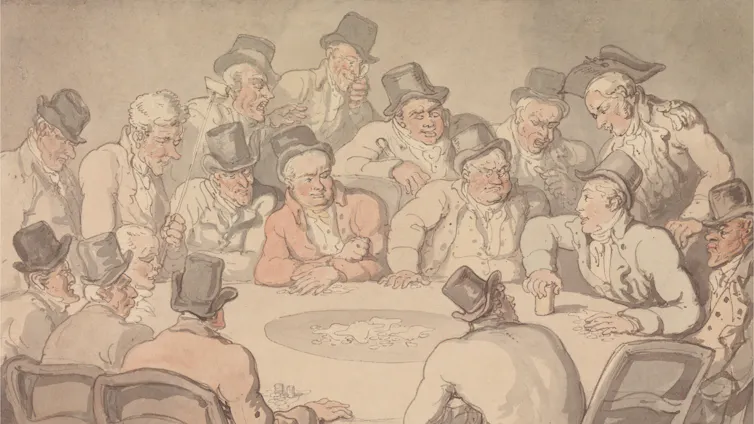
Painting of men wearing top hats
Hats were an indicator of status in early modern England. The only man not wearing a hat in this illustration is a servant in the gaming house and so a social inferior.
Yale Center for British Art, Paul Mellon Collection, CC BY

As that concern suggests, the hat also had a far wider significance in this period as a marker of status and in associated gestures of deference. Unlike today, almost everyone wore a hat or, in the case of labourers and poor artisans, a flat cap. And convention required men and boys to doff the hat or cap in the presence of someone of higher status – a parent, master, employer, gentleman, magistrate, peer, or monarch.

Though there was no law to underpin “hat-honour”, the convention was firmly enforced. Many people who had grown up with this convention may have accepted it as part of the natural order of things, but having to “bow and scrape” to a harsh landlord, for example, was deeply resented by others. And in times of political upheaval, such as the civil wars of the 1640s, hat-honour could take on an ideological significance.

John Lilburne was a leader of the radical Leveller movement that was pressing for social reforms and a more accountable form of government. He refused to doff his hat when he was summoned to appear before the House of Lords for publishing illicit tracts, and announced his defiance in a pamphlet.

Many other radical leaders made similar gestures of defiance. Most notorious were the early Quakers, who refused on principle to doff their hats to anyone, explaining it as a gesture against the sin of pride and vanity.

Changing fashions

Refusing hat honour was an overt gesture of defiance associated with radicals, whether political, religious. But after the civil war of the 1640s ended with parliament’s victory over Charles I, the political order was turned upside down, and such gestures might now appeal to the defeated royalists.

At the trial of the king in January 1649, Charles himself refused to remove his hat when brought into court. As sovereign, he refused to recognise any superior on earth, or to accept that any court had the right to try him.

The importance of hat-honour gradually faded in later centuries, as manners became more informal and crowded cities made it ever less practicable. And finally, in the 1960s, the practice of men wearing hats abruptly ceased, for reasons that remain largely unexplained. The “swinging sixties” celebrated youth, informality and the rejection of old, hidebound conventions – and that cultural shift may provide at least a part of the answer.

The Conversation

Bernard Capp does not work for, consult, own shares in or receive funding from any company or organisation that would benefit from this article, and has disclosed no relevant affiliations beyond their academic appointment.

ref. Hands off my hat! The hidden power of headwear and ‘hatiquette’ in early modern England – new study – https://theconversation.com/hands-off-my-hat-the-hidden-power-of-headwear-and-hatiquette-in-early-modern-england-new-study-280175

Can the Middle East ceasefire hold?

Source: The Conversation – UK – By Jonathan Este, Senior International Affairs Editor, Associate Editor, The Conversation

This is the text from The Conversation UK’s World Affairs Briefing email. Sign up here to receive weekly analysis of the latest developments in international relations, direct to your inbox.


It’s still not clear who will turn up in Islamabad tomorrow for the first round of talks aimed at turning the 14-day ceasefire in the Iran war into a permanent end to the crisis. Indeed, it’s not at all certain that the ceasefire will still even exist by then.

To anyone following events, there seemed little, if any, gap between reports that Pakistan had brokered a truce between the warring parties and news that Israel was continuing to attack Hezbollah in Lebanon. But from then the story followed a depressingly familiar path. Iran – backed by Pakistan – claimed that the ceasefire also covered Lebanon. Israel said that it didn’t and it would continue to pound Hezbollah targets there.

For his part, the US president, Donald Trump, said that as far as he was concerned, Israel’s assault on Lebanon was a “separate skirmish”, albeit one of considerable brutality in which 1,400 people were either killed or wounded.

We asked Scott Lucas, of the Clinton Institute at University College Dublin for his take on some of the most important issues which may affect the talks.


Read more:
Why is Israel continuing to attack Lebanon, despite the ceasefire? Expert Q&A


The ceasefire was always going to be fragile, even without Israel’s intervention. There’s clearly no goodwill or trust between the warring parties. Trump was less than two hours away from launching an attack on Iran’s civilian infrastructure, including its power plants and its bridges – a bombardment so monumental that, as he put it: “A whole civilisation will die tonight, never to be brought back again”.

Tehran, for its part, was spitting defiance back at Washington, while calling on its people to form human chains across bridges and around power plants.

Nicholas Wheeler, an international relations expert at the University of Birmingham who has been investigating the role of trust in diplomacy, believes there’s a big difference between a mutual lack of trust between warring parties, and active distrust. In the former situation there is the potential for trust to develop. But in this case – as Iranian foreign minister, Abbas Araghchi noted recently, the US has now twice attacked Iran during ongoing negotiations, so – he says – there is “zero trust” in the US from Tehran’s point of view.

Trump’s failure to bring the Israeli prime minister, Benjamin Netanyahu, to heel over Israel’s continuing bombardment of Lebanon can only make matters worse.


Read more:
Iran ceasefire: trust will be vital but it’s in short supply right now


And so Iran has not opened the Strait of Hormuz, which was America’s most important demand. We must wait to see what events, both in the Middle East and at the negotiations in Islamabad, will bring. The ceasefire had allowed both Tehran and Washington to declare a victory – which certainly seemed to be something in which the Trump administration placed a great deal of value. Both the US president and his defense secretary, Pete Hegseth, were trumpeting that line on Wednesday – Hegseth going so far as to say that the Iranian military was rendered completely ineffective and that the country’s leadership “begged” for a ceasefire.

Iran also declared victory. And Bamo Nouri and Inderjeet Parmeer of City St George’s, University of London, believe that Tehran has more reason to do so. For one thing, the Islamic Republic has demonstrated resilience in the face of the might of US and Israeli firepower that aimed to destroy it. It has shown that it can use its control of Hormuz to thrown global energy markets into considerable disarray. And, under the terms of the ceasefire accepted by the US president, it is Iran’s ten-point plan which will form the basis of negotiations.


Read more:
Middle East conflict: this ceasefire may have made Iran stronger


Changing world order

The US president, meanwhile, has repeated his criticisms of America’s Nato allies and, according to German news magazine Der Speigel, has issued what European diplomats are calling “an ultimatum” for European member states to send military assistance to the Strait of Hormuz within days.

Trump has been highly critical of Nato as a whole – and several of its member states specifically – because he believes they haven’t done enough to help the US and Israel against Iran. On April 1, he raised the possibility of the US quitting Nato altogether.

But he’s unlikely to pull America out of its transatlantic alliance, writes Paul Whiteley, who gives us three reasons why it’s either not in the US president’s interests or America’s to turn his back on the alliance it has led for nearly eight decades.


Read more:
Three reasons Donald Trump won’t pull the US out of Nato


The emergence of Pakistan as a key interlocutor in all this will have come as something of a surprise to many. But the country has emerged, along with Saudi Arabia, Egypt and Turkey, as part of an important power bloc with influence in the Middle East, writes Natasha Lindstaedt, professor in the Department of Government at the University of Essex.

Lindstaedt argues that these countries want an end to the dominant roles played by both Israel and Iran in the region. The war in Gaza has appalled the Islamic world and put paid to any hopes – certainly for the near future – of any normalisation of relations of the sort envisaged by Donald Trump’s Abraham Accords. And all are also tired of the force for tensions and destabilisation that Iran has represented for nearly five decades.

As Lindstaedt points out, they’re a powerful bunch: Pakistan has nuclear weapons, Saudi Arabia has loads of oil, Egypt controls access to the Suez Canal and Turkey is a member of Nato: “Taken together, they represent the most politically and militarily influential Muslim-majority countries in the world,” she concludes.


Read more:
Pakistan, Turkey, Egypt and Saudi Arabia emerge as a new regional power bloc amid Iran war


Meanwhile in Hungary

Hungarians head to the polls on Sunday for elections which will determine who is to be the country’s next prime minister. The long-time incumbent, Viktor Orbán, faces a stiff challenge from his former political ally, Péter Magyar. Polls show he is seriously up against it.

So the US president dispatched J.D. Vance to campaign alongside the prime minister in a bid to mobilise the country’s far-right eurosceptics. Zsofia Bocskay, of Central European University, sets the scene for what she believes could be a turning point for Hungarian politics.


Read more:
Hungary election: how a new opponent has forced Viktor Orbán into the first genuinely competitive race in 16 years


Birmingham University’s Stefan Wolff, meanwhile, believes that the fall in support for Orbán despite all the help from Washington, reflects a Europe-wide disenchantment with Trump, especially in light of the US president’s apparently warm relationship with Vladimir Putin, a leader many feel poses a very real threat to their security.


Read more:
Hungarian election exposes tensions at the heart of Donald Trump’s plans to boost the far-right in Europe


Sign up to receive our weekly World Affairs Briefing newsletter from The Conversation UK. Every Thursday we’ll bring you expert analysis of the big stories in international relations.


The Conversation

ref. Can the Middle East ceasefire hold? – https://theconversation.com/can-the-middle-east-ceasefire-hold-280307

Drinking water contaminated with ‘forever chemicals’ during pregnancy linked to an increased risk of childhood asthma – new study

Source: The Conversation – UK – By Annelise Blomberg, Associate Researcher in Occupational and Environmental Medicine, Lund University

MVelishchuk/Shutterstock

Pfas, or per- and polyfluoroalkyl substances, are a group of human-made chemicals found in everything from food packaging to firefighting foam. Often called “forever chemicals” due to their persistence in the environment, they can affect our health and disrupt our immune system.

Pfas cross the placenta, so that when a woman is pregnant, she shares some of the Pfas in her body with her unborn child. While most of us are routinely exposed to low levels of Pfas, some communities are exposed to far higher levels from nearby pollution sources, like factories and military fire training areas.

Our new study shows that in one of these at-risk communities, children were more likely to develop asthma if their mothers were exposed to very high Pfas levels during pregnancy.

In 2013, water testing in Ronneby, a town in the southern Swedish county of Blekinge, uncovered extremely high levels of Pfas in one of the town’s two municipal water supplies – more than 200 times higher than the other supply.

swedish town and river
Ronneby, Sweden.
Antony McAulay/Shutterstock

The source of the contamination was a type of fire-fighting foam called aqueous film-forming foam. This chemical mixture containing Pfas is used to extinguish fuel fires. It had been used in firefighting training at a nearby military airbase since the 1980s. Contaminated runoff from the airbase had eventually reached the drinking water. This resulted in high concentrations of two forever chemicals known as PFOS (perfluorooctane sulphonic acid) and PFHxS, among other Pfas.

After that discovery, residents were switched to the town’s other water source. But even though residents now had clean water, their past Pfas exposure could not be reversed. By measuring Pfas directly in the dried blood spots of newborn babies whose mothers had lived in Ronneby, we have shown that Pfas contamination was already present in these children in the mid-1980s. This exposure persisted, undetected, for over 30 years. When the mothers in our study were pregnant, they had no idea that they were exposed.

Connecting contamination to childhood asthma

In Sweden, all residents are given a unique personal identity number. This can be used to link government registry information like place of birth, residential history, annual income and family relations to hospital records. This enables population-level health research that might not be possible in most other countries.

Using Swedish national health and population registers, we followed 11,488 children who were born between 2006 and 2013 in Blekinge county through to the age of 12. We estimated whether and when children would develop asthma using a combination of medical diagnoses and prescription drug records. Healthcare is free of charge for children and easily accessible throughout Blekinge county, so most children with asthma receive treatment.

We didn’t have a blood sample from all 11,488 children, so we couldn’t measure their Pfas exposure directly. This lack of measured exposure usually limits how we can study Pfas health effects in children.

But because Pfas exposure in Ronneby depended so strongly on their drinking water source, we could link mothers’ address history to the municipal water distribution records. This enabled us to identify which mothers received contaminated water at their home in the years before they had a child. Presumably, those women had higher Pfas in their body as a result.

We divided mothers into four groups, from background exposure (living outside of Ronneby) to very high exposure (living at a contaminated address continuously for the five years preceding delivery).

Next, we compared the rates of childhood asthma across the four prenatal exposure groups. We also accounted for other factors that could influence asthma risk, including maternal smoking during pregnancy, the child’s birth order and several measurements of socioeconomic status.

child using asthma inhaler
Children whose mothers had very high Pfas exposure during pregnancy were about 40% more likely to develop asthma than children in the background exposure group.
SeventyFour/Shutterstock

We found that children whose mothers had very high Pfas exposure during pregnancy were about 40% more likely to develop asthma than children in the background exposure group. Children in the intermediate exposure groups did not have higher risk. We then directly compared very high-exposed children to a carefully matched group of similar background-exposed children. We found that 27% of the very high-exposed group developed asthma by age 12, compared to 16% of the background-exposed group.

This study is one of the first to identify a link between Pfas exposure and asthma in childhood. Unlike earlier research, we were able to include children with very high Pfas exposure before birth – and we only saw an effect in this very high group, which may explain the inconsistent results of previous studies.

One possibility is that the potentially harmful effects of Pfas on lung function only occur at very high exposure. Another possibility is that, even if Pfas has an effect at lower levels, it only becomes serious enough for a diagnosis at very high exposure.

Ronneby is not an anomaly. There are more than 13,000 sites across Europe where firefighting foam contamination is likely. Our research offers important insights into the potential health effects of this contamination in affected communities. Asthma is one of the most common chronic diseases in children. If high Pfas exposure contributes to this public health burden, it is a burden that has gone largely unrecognised until now.

The Conversation

Annelise Blomberg receives funding from European Union’s Horizon Europe program under the Marie Skłodowska-Curie Postdoctoral Fellowships (grant number 101058697) and the Swedish Research Council for Health, Working Life and Welfare (FORTE, grant number 2024-00748). Views and opinions expressed are those of the authors only and do not necessarily reflect those of the European Union or the European Research Executive Agency (REA), and neither the European Union or the REA can be held responsible for them.

Anna Saxne Jöud receives funding from the Swedish Research Council for Health, Working Life and Welfare (grant number 2020-00112).

Christel Nielsen receives funding from Formas – the Swedish Research Council for Sustainable Development, the Jan Hain Foundation for Scientific Clinical Medical Research, the Crafoord Foundation, and the Royal Physiographic Society in Lund.

ref. Drinking water contaminated with ‘forever chemicals’ during pregnancy linked to an increased risk of childhood asthma – new study – https://theconversation.com/drinking-water-contaminated-with-forever-chemicals-during-pregnancy-linked-to-an-increased-risk-of-childhood-asthma-new-study-278736

Why is Israel continuing to attack Lebanon, despite the ceasefire? Expert Q&A

Source: The Conversation – UK – By Scott Lucas, Professor of International Politics, Clinton Institute, University College Dublin

The ceasefire in the Middle East is on shaky ground. Israel continued its bombardment of Lebanon on Wednesday, claiming its activities there are not part of the deal with Iran. These attacks killed at least 254 people across Lebanon and injured over 800 more in what was Israel’s largest offensive of the war so far.

Iran responded by closing the Strait of Hormuz again and threatened a “regret-inducing response” if the strikes continue. Donald Trump subsequently warned that US strikes on Iran would resume if it did not comply with the ceasefire. We spoke to Scott Lucas, an expert in Middle East politics at University College Dublin, who addresses several key issues.

Why is there confusion about whether Lebanon was included in the ceasefire?

Part of the problem is the nature of diplomacy in 2026. The Trump camp and Pakistan’s prime minister, Shahbaz Sharif, who has been a key mediator between the US and Iran since the start of the war, both issued statements on social media instead of coordinating the release of an agreed text.

That said, there should be no confusion. Sharif’s social media post made clear that the ceasefire also applies to Israel’s campaign in Lebanon. He wrote: “I am pleased to announce that the Islamic Republic of Iran and the United States of America, along with their allies, have agreed to an immediate ceasefire everywhere including Lebanon and elsewhere, EFFECTIVE IMMEDIATELY.”

Trump also accepted that later peace talks in Pakistan would be based on Iran’s ten-point plan, which he described as a “workable basis on which to negotiate”. One of Iran’s demands is for “an end to attacks on Iran and its allies”. This includes the Israeli strikes against Hezbollah in Lebanon.

Why then is Israel still attacking Lebanon?

Israel’s prime minister, Benjamin Netanyahu, does not have an interest in ending the war until he establishes something he can claim as a “victory”. Israel’s objective in Iran is regime change. At the start of the war, Netanyahu announced that the “goal of the operation is to put an end to the threat from the Ayatollah regime in Iran”.

Trump’s goals in Iran are less clear. He entered the war pledging to prevent Iran from obtaining a nuclear weapon, destroy its missile capability, break its regional proxies, eliminate its navy and create an opening for regime change. But Iran’s regime is still in place and the Trump camp now appears willing to enter into negotiations with it.

So Netanyahu’s focus shifts to Lebanon and expansion of the Israeli occupation in the south of the country. Attacks will continue until that is achieved. The situation is similar to Gaza, where Israel now occupies 53% of the territory after its two years of attacks.

By presenting a victory over the threat of Hezbollah, pushing the group further from the Israeli border, Netanyahu can try to bolster his support at home despite any disappointment over the inconclusive outcome of the war in Iran.

Will Israel’s actions push the Gulf states closer to Iran?

For the first time since the start of the US and Israel’s war on February 28, the Iranian and Saudi Arabian foreign ministers have spoken by phone. In a statement following the call on April 9, the Saudi foreign ministry said the two men “reviewed the latest developments and discussed ways to reduce tensions to restore security and stability in the region”.

However, this is only a tentative beginning to repair the damage of the past six weeks. Gulf states are unhappy that the US exposed them to Iran’s retaliation by embarking upon the war, but that does not erase their anger with Tehran over the extent of the damage Iranian attacks have caused to energy infrastructure in the region.

Reports suggest that Saudi Arabia and the United Arab Emirates have in recent weeks even been pressing the Trump camp to “finish the job” in Iran with ground operations to vanquish the regime. That option appears to have been paused for now. However, it is not off the table if the US-Iran negotiations collapse.

Where does all of this leave Donald Trump?

Angry, frustrated and uncertain what to do next. Trump’s bluster on April 7, in which he said “a whole civilization will die tonight” unless Iran reached a deal, was always an expression of weakness rather than strength. The plan A for regime surrender, with the killing of the Iranian supreme leader Ali Khamenei and dozens of commanders and officials, did not have a plan B for when the remaining leaders refused to concede and instead struck back.

With Iran controlling the Strait of Hormuz and choking off Gulf shipping, including of oil and gas, the Trump camp was reduced to either ground operations or talks. Trump snatched at the latter amid military advice of the difficulties of a ground assault and domestic opinion that is largely opposed to further escalation.

But he did so by handing Iran the diplomatic initiative. Now the White House is trying to pull it back, including by giving Israel the green light to continue its assault in Lebanon. The US is now denying that Lebanon was ever included in the ceasefire deal, with Trump calling it a “separate skirmish”.

The situation in the Middle East thus remains extremely volatile as delegates from the US and Iran head to the Pakistani capital of Islamabad for crunch talks on April 10.

The Conversation

Scott Lucas does not work for, consult, own shares in or receive funding from any company or organisation that would benefit from this article, and has disclosed no relevant affiliations beyond their academic appointment.

ref. Why is Israel continuing to attack Lebanon, despite the ceasefire? Expert Q&A – https://theconversation.com/why-is-israel-continuing-to-attack-lebanon-despite-the-ceasefire-expert-qanda-280302