The UK could make migrants wait up to 20 years before becoming settled – making it one of the longest waits in the world

Source: The Conversation – UK – By Matilde Rosina, Assistant Professor in Global Challenges, Brunel University of London

Savvapanf Photo/Shutterstock

The UK government is planning to make it significantly harder for migrants to obtain permanent residence. If the proposals go ahead, the UK would become more restrictive than most other high-income democracies. In the case of refugees it would create a situation that is arguably without precedent among peer countries.

The UK’s home secretary, Shabana Mahmood, intends to double the qualifying period for indefinite leave to remain (ILR) (the UK’s form of permanent residence) from five to ten years for most migrants, and increase it up to 20 for some.

Eligibility requirements would also tighten. Migrants would need a clean criminal record (removing the previous 12-month sentence threshold), a higher English language standard and earnings above £12,570 per year for at least three years. This will disproportionately affect those least likely to be in full-time employment, including dependants of people on work visas, family visa holders and refugees.

The ten-year baseline for settlement would then be adjusted up or down based on individual circumstances. High-skilled workers, including NHS nurses and doctors, or those earning above £125,140, for instance, could qualify after five or three years respectively. Those on family visas (such as those married to a British citizen) or who are judged to be making efforts at “integration” such as by volunteering in the community could qualify after five to seven years. Those who have claimed benefits would have to wait up to 20 years, while for those who have entered the country illegally or overstayed their visa would have to wait up to 30 years to settle.


Read more:
Labour’s plan for migrants to ‘earn’ permanent residency turns belonging into an endless exam


For low-skilled workers, the qualifying period would start at 15 years. For refugees it would be 20, with no reductions available unless the person works or studies. In this case, their status would convert to a Protection Work and Study visa, subject to review every 30 months.

The government has cited the increasing number of people granted settlement as one of the drivers behind the reforms. This figure has been rising since 2017, reaching 163,000 in the year ending June 2025. The Home Office projects this figure will increase significantly over the next five years.

The reforms are also framed as a response to irregular migration. The government has cited the Danish model as inspiration, arguing that the longer timeframe will “strongly discourage” entry without documents and reduce the “pull factors” attracting people to the UK. However, research suggests that deterrence-based policies like this are a weak tool for reducing immigration: decisions to migrate are driven primarily by conditions in countries of origin, not by entitlements in destination countries.


Read more:
Is the Rwanda plan acting as a deterrent? Here’s what the evidence says about this approach


The Home Office has claimed these amendments do not require legislation, meaning they do not need to be put to a parliamentary vote. But opponents have signalled the intention to force a symbolic vote to make their views clear. Much of the concern has to do with the plans to apply the changes retrospectively.

An international outlier

These proposals would make the UK an outlier compared to other major economies. In the EU, the closest equivalent to ILR is the long-term resident status for third country nationals. This requires people to live in the EU on a valid visa for at least five years, and confers long-term residence with limited conditions. This exists alongside national schemes, such as Italy’s Permesso di Soggiorno UE per soggiornanti di lungo periodo and Germany’s Niederlassungserlaubnis that follow a similar approach.

Denmark and Ireland are the only two EU member states that opted out of the EU-level scheme. These countries have special arrangements for immigration and asylum policy (just like the UK did, before Brexit). They set their thresholds at eight and five years respectively, with Denmark’s reducible to four in some cases.

The UK government claims that making refugee status temporary and increasing the time for permanent residency contributed to asylum applications reaching a 40-year low in Denmark in 2025. However, this drop coincided with broader EU-wide trends in asylum flows, making it difficult to attribute the decline to domestic policy changes alone.

Among Anglophone countries, the picture is similar. The US green card confers permanent residence without a formal minimum years requirement. Though in practice, the vast majority of employment-based applicants previously held a temporary visa. Canada has no blanket time requirements, and refugees admitted through resettlement schemes can obtain permanent residency immediately.

Raising the standard qualifying period for permanent residence to ten years would make the UK more restrictive than most other comparable democracies in Europe and North America, and one of the strictest globally. Extending it to 20 years for refugees would make the UK’s approach unprecedented among peer countries.

These new requirements are closer to those of some of the hardest countries to achieve permanent residency such as Qatar and Japan, which require 20 and ten years respectively, for most cases.

An NHS sign outside of a a chemist's.
Evidence shows ‘pull factors’ such as healthcare benefits are not primary drivers of migration.
David G40/Shutterstock

Research suggests that migration policies which make migrants’ status temporary make them less likely to integrate. In particular, a study on Denmark found that making permanent residence harder to obtain for refugees reduced the chances of them being employed. People who believed they could not meet the new requirements became discouraged and disengaged from the labour market – the opposite of what the government wanted.

The UK’s proposed changes risk producing a similar dynamic, trapping people into what has been described as an “extended limbo”. Given these risks, the government should be careful in treating this approach as an end in itself when it comes to increased immigration.

The Conversation

Matilde Rosina does not work for, consult, own shares in or receive funding from any company or organisation that would benefit from this article, and has disclosed no relevant affiliations beyond their academic appointment.

ref. The UK could make migrants wait up to 20 years before becoming settled – making it one of the longest waits in the world – https://theconversation.com/the-uk-could-make-migrants-wait-up-to-20-years-before-becoming-settled-making-it-one-of-the-longest-waits-in-the-world-279036

Steroid injections for joint pain: everything you need to know about using them

Source: The Conversation – UK – By Sarah Golding, Postgraduate MSK Lecturer, School of Sport, Rehabilitation and Exercise Sciences, University of Essex

Steroid injections offer a rapid, effective way of reducing joint pain. crystal light/ Shutterstock

Osteoarthritis affects around 600 million people globally. It causes pain, stiffness and reduced joint function – most commonly in the knees, hands and hips.

There’s currently no cure for osteoarthritis. Many people manage the condition through exercise, maintaining a healthy weight, using walking aids and medications.

Commonly used medications include anti-inflammatories and opioids. While these help some, they also carry downsides – including significant side-effects, particularly in over-60s, and risk of addiction from long-term opioid use.

Joint replacement surgery can be very effective for relieving pain and improving mobility, but waiting lists in the last two years hit an all time high, due to increasing demands and reduced capacity since the COVID pandemic.

Surgery also carries risks such as infection, blood clots and nerve damage. Joint replacement surgery is typically suitable for those with advanced stage osteoarthritis.

So how else can osteoarthritis be treated?

Corticosteroid injections, commonly known as steroid injections or cortisone, have been used for joint pain for more than 70 years. They offer a rapid, effective way of reducing pain.

Corticosteroids are anti-inflammatory drugs able to reduce inflammation and pain associated with osteoarthritis. Injecting corticosteroid directly into the joint means it has maximum effect where needed, while minimising effects on the rest of the body.

The effects of steroid injections can last for months, reducing the need for surgery and reliance on prescription drugs. Those most likely to benefit from steroid injections have persistent pain which disrupts sleep and function, and who find other medications unsuitable or ineffective.

But as effective as steroid injections can be, their effects will vary from person to person. They may not be as effective in severe cases of osteoarthritis, as they only reduce inflammation and cannot repair damaged or lost cartilage.

Steroid injections may also risk accelerating arthritis or causing bone problems in some people, particularly if used in high doses or too often. Routine use in early stages of osteoarthritis is therefore generally avoided. This is because steroid injections can damage cartilage and bone cells which may further weaken and damage the joint.

Steroid injections may also not be suitable for people already taking high doses of steroids for other health problems (such as rheumatoid arthritis or asthma), and those who have a weakened immune system or are otherwise unwell. Taking too much artificial steroid affects the body’s production of natural steroid, which is essential for our metabolism.

Steroid injections may increase risk of infection following surgery if an injection has been given beforehand. For this reason, the majority of surgeons a minimum of three months between your last injection before surgery.

Although side-effects from steroid injections are fortunately rare, people need to be aware of these to make an informed decision about treatment. These can include: infection, allergic reaction, bleeding, bruising, skin colour changes, temporary flare in pain, bone and joint changes and increased blood sugar levels in those with diabetes.

A female doctor or nurse wearing blue scrubs injects a needle into a patient's knee. The patient is seated on the examination table.
Steroid injections should only be performed every three to four months.
aslysun/ Shutterstock

It’s advised that injections aren’t performed more than every three to four months to reduce risk of side-effects and accelerating the arthritis. With hip injections there is need to be more cautious due to risks of cartilage and bone damage from even just one injection .

Managing joint health

Depending on the country, you may be able to have a steroid injection done by your GP, a nurse or a physiotherapist.

Within the UK, first contact physiotherapists working in primary care are accessible in the same way the GP is, many are trained and can offer early access to steroid injections. Injections may be provided within a GP surgery, however hip and spine injections are usually guided by ultrasound or X-ray imaging, which may only be available within a hospital.

Since injections can temporarily reduce osteoarthritis pain, this provides a window of opportunity within which to start exercising. Exercise is important for managing osteoarthritis, as it can strengthen joint-supporting muscles and reduce pain. Physical activity can even be beneficial for those planning to undergo joint replacement surgery as it can improve pain, function and length of hospital stay after surgery.

After injection, it’s recommended people initially rest for a few days, but then gradually increase the amount of exercise they undertake. A physiotherapist can advise on the best types of exercise you can do to help manage your osteoarthritis.

Addressing other contributing factors is essential for managing osteoarthritis, as well. There’s strong evidence linking various metabolic factors to osteoarthritis – such as obesity, diabetes, high cholesterol and high blood pressure. These factors increase inflammation within the body, which affects cartilage in joints. Losing weight where needed is also hugely beneficial in reducing strain on joints.

For those who may not want to use steroid injections, there are other options.

Hyaluronic acid injections, for instance. These help our natural joint lubrication, called synovial fluid. In osteoarthritis, synovial fluid has less viscosity and levels are reduced. Hyaluronic acid is also believed to work as an anti-inflammatory.

Similar to steroid injections, they can reduce pain and increase movement and function. They may be more beneficial to people with earlier stage osteoarthritis and may theoretically have fewer negative effects to cartilage. There may also be value in combining the two types of injection.

Hyaluronic acid has a similar safety profile to corticosteroid, with few reported side-effects. It may, however, take up to 12 weeks for effects to show – though the benefits can last up to six months.

Accessibility is limited in the UK, hyaluronic acid is not currently recommended within NICE guidelines, primarily due to cost effectiveness, so may only be available to those privately funding their care.

Joint injections are not a cure for osteoarthritis. They can have variable effects, and work best combined with other management approaches (such as weight loss and exercise). But with long wait times for surgery, they may offer a valuable way to reduce pain and manage the condition.

The Conversation

Sarah Golding works for the University of Essex, who provide teaching for healthcare professionals on injection therapy.

ref. Steroid injections for joint pain: everything you need to know about using them – https://theconversation.com/steroid-injections-for-joint-pain-everything-you-need-to-know-about-using-them-279491

Cubans living abroad now hold the key to their country’s uncertain future

Source: The Conversation – UK – By Amalendu Misra, Professor of International Politics, Lancaster University

Since the early days of Cuba’s 1950s revolution – which overthrew the US-backed dictatorship of Fulgencio Batista and replaced it with a socialist government led by Fidel Castro – the Cuban diaspora have played a large role in determining the island nation’s economic and political landscape.

The first wave of predominantly wealthy, white Cuban emigrants have for decades campaigned for a watertight embargo against their homeland. Many fled immediately after the revolution succeeded in 1959, primarily to the US, and have largely refused to visit their homeland on principle.

More recent Cuban emigrants who have left the island (again overwhelmingly to the US) since the economic crisis of the 1990s, are generally less affluent and have less political clout. They have forged cross-border links with friends and family members who remain on the island. Through the remittances they send back, these people are now a vital source of foreign currency for Cuba.

The regime in Havana has traditionally maintained a disdainful attitude towards the Cuban diaspora. In the early waves of migration, Cuba’s government officially referred to those who emigrated as gusanos (worms) – traitors aiming to overthrow the government. Expat investment in Cuba was subsequently banned.

But following recent negotiations with the US, this policy posture has changed significantly. After decades of restricting its relationship with the diaspora, the Cuban government announced in March 2026 that it would allow Cuban emigrants residing in places like the US to return to the country, invest in the private sector and own businesses.

In an interview with NBC News on March 16, Cuba’s minister of foreign trade and investment, Oscar Pérez-Oliva Fraga, said: “Cuba is open to having a fluid commercial relationship with US companies and also with Cubans residing in the United States and their descendants.”

Washington’s blessings

The policy change comes as Cuba desperately attempts to rescue its devastated economy. A slew of economic and fuel embargoes imposed by the US government since Donald Trump returned to the White House in January 2025 have led to a severe crisis in the country.

Many Cubans are struggling to find food, medicine and other essential goods, while severe energy shortages are causing periods of complete blackout across the nation. The situation has become so dire that, for the first time in six decades, sporadic protests have broken out against the Cuban government.

In one of these protests, people in the central city of Morón ransacked a Communist Party headquarters. Videos on social media showed a group of people approaching the building with flaming objects, shouting “freedom, freedom” as they threw them inside.

The current state of affairs in Cuba has presented the US with an opportunity to orchestrate regime change – something it has sought for years. And proclamations by Trump and his secretary of state, Marco Rubio, suggest this may well be the US government’s intention.

In comments made to reporters in March, Trump said he believes he will have “the honour of taking Cuba”. He added: “Whether I free [Cuba], take it – I could do anything I want with it. You want to know the truth? They’re a very weakened nation right now.”

Rubio, who is the son of Cuban emigrants and has traditionally been hawkish about delivering regime change in Cuba, then declared: “Who’s going to invest billions of dollars in a communist country run by incompetent communists? … Giving people economic and political freedom is important, but they come hand in hand. They come together.”

Despite this rhetoric, many in Washington remain cautious about triggering an outright collapse of the regime. State collapse would almost certainly lead to an increase in the flow of Cuban refugees to the US – something the Trump administration wants to avoid.

While weakened, the regime in Havana remains in place. The extended Castro family still wields considerable power and influence in the country. The men leading the talks with the US, Fraga and Raúl Rodríguez, are two of Fidel Castro’s great-nephews.

Cuba’s president, Miguel Díaz-Canel, has said he will not resign under US pressure. He told NBC News on April 9 that “the concept of revolutionaries giving up and stepping down [is] not part of our vocabulary”.

Russia’s deputy foreign minister, Sergei Ryabkov, later said that Moscow, a longstanding ally of the regime in Havana, had no intention of abandoning Cuba.

Despite publicly calling for fundamental reform to the power structure in Havana, Washington’s approach towards Cuba seems primarily aimed at using its leverage to encourage the regime to make concessions that diminish the island’s value to US adversaries.

The US government has encouraged Havana to open its doors to expat investment before. Under the presidency of Barack Obama, who is credited with reestablishing diplomatic relations with Havana in 2009 after half a century of diplomatic blockades, the flow of people and remittances between the US and Cuba expanded.

This warming of relations created some opportunities for increased investment in Cuba, both by US citizens and Cuban emigrants. But the Cuban government maintained significant restrictions on large investments by Cubans living abroad, which hindered the full potential of foreign investment.

Fast forward to today, and the far more desperate economic and political situation in Cuba has made the regime in Havana more open to the demands of the US to restructure its governance. At this juncture, Cuba’s diaspora can be a much-needed catalyst for change in their home country.

The Conversation

Amalendu Misra is a recipient of British Academy and Nuffield Foundation Fellowships.

ref. Cubans living abroad now hold the key to their country’s uncertain future – https://theconversation.com/cubans-living-abroad-now-hold-the-key-to-their-countrys-uncertain-future-279695

South Africa’s farmers aren’t yet replacing chemical fertilisers with sustainable alternatives – this is why

Source: The Conversation – UK – By Mokgadi Miranda Hlongwane, Lecturer, Department of Chemistry, Tshwane University of Technology

Green bean plants in one of the small-scale farms in Phiring village, South Africa. Mokgadi Hlongwane, CC BY-NC-ND

The growing use of toxic agricultural chemicals including fertilisers is also driving a scaling up of sustainable agrochemical alternatives.

In South Africa, I’ve been exploring why small-scale farmers resist switching to these more cost-effective and environmentally friendly solutions, such as “biological fertilisers”. Rural small-scale farmers are hesitant about these non-toxic bacterial alternatives because they aren’t readily available or widely understood.

One such biological fertiliser is made from rhizobia. This bacteria converts atmospheric nitrogen into a nutritional form that can be absorbed easily by the roots of plants known as legumes. This process is called “nitrogen fixing”.

Biological fertilisers harness the power of these nitrogen-fixing bacteria to enhance the growth of legume crops such as bambara nuts, common bean and soybean, by making soil nutrients more available. Legumes are cost-effective and protein-rich crops.

My PhD research showed how rhizobia improves the growth of cancer bush, a multipurpose plant native to South Africa. Rhizobia also enhances the therapeutic effect of medicinal plants such as cancer bush, which is traditionally used as an anti-inflammatory treatment or to boost the immune system.

Some rhizobia tolerate extreme environmental conditions and can enhance plant growth even during drought. Rhizobia also improve soil health, increase microbial diversity and nutrients.

Unlike chemical fertilisers which easily wash away when it rains, rhizobia-based biological fertilisers persist in the soil for a long time. This means repeat applications aren’t often required.

Growing up in rural South Africa, I saw how small-scale farmers were hugely dependent on chemical fertilisers. Today, many of these farmers today are aware of the negative effects of synthetic chemical fertilisers. Yet they continue to use them.

Chemical fertilisers reduce soil fertility and pollute the environment. Synthetic agricultural chemicals like these can cause eutrophication – when nutrients such as phosphorus and nitrogen overload streams and rivers, causing excessive algal growth. This depletes oxygen in the water and poisons aquatic life.

In contrast, Rhizobia-based fertiliser technology is cost-effective, non-toxic and sustainable. But even with hundreds of these fertilisers now on the market, their adoption among small-scale farmers remains very low.

Reasons for reluctance

To understand why farmers resist adopting sustainable alternatives, I spent a day in Phiring, a village in Limpopo Province, South Africa. This farming community still relies heavily on financial support from the government to pay for agricultural supplies such as fertilisers.

I spoke to 15 farmers about their cultivation practices and perceptions of both rhizobia-based and chemical fertilisers. Restricted access to biological fertilisers and limited knowledge about their correct application discouraged them from switching. Most farmers wanted to know where to buy biological fertilisers and how best to use them.

One farmer noticed that his farm had a low crop yield compared to more recently established farms. The soil on his land had probably deteriorated due to extendsive use of chemical fertilisers over a decade.

Some farmers wrongly assumed that crops treated with biological fertilisers would grow slowly, rot quickly and have a low crop yield. As a result, they had not tried these alternatives to chemical fertilisers.

Convenience and access

This challenge is compounded by the abundant supply of chemical fertilisers. The Comprehensive Agricultural Support Programme is an initiative from the Department of Agriculture, Forestry and Fisheries that supports small-scale farmers across South Africa. It provides vast amounts of chemical fertilisers for free.

Research on the low uptake of climate‑smart agriculture technologies identifies limited funding, low awareness and poor access to agricultural inputs as key barriers. Providing biological fertilisers through the same government programme would significantly increase adoption.

The farmers told me that their choice of cultivation practices is influenced both by convenience and access. Most farmers learn from their peers and seldom follow the instructions from the fertiliser manufacturers, so are likely to over- or underdose.

They rarely conduct soil analysis. This makes it difficult to select fertilisers that are suitable for their land, soil conditions or crop. In these cases, soil health further deteriorates and crop productivity declines.

The farmers I spoke to acknowledged their lack of knowledge about fertiliser applications, cultivation systems and available alternatives.

When legume crops are treated with rhizobia fertilisers, the increased nutrients and microbial diversity in the soil can also benefit non-legumes such as maize and wheat. this can happen through intercropping (simultaneously planting non-legume with legumes) or rotational cropping (planting legumes in one season and another crop in the same field the next).

There is huge potential for farmers to gain by switching from conventional agrochemicals to rhizobia-based fertilisers – but first, the financial constraints and misconceptions must be addressed.

The Conversation

Mokgadi Miranda Hlongwane receives funding from the South African National Research Foundation and the Elsevier Foundation.

ref. South Africa’s farmers aren’t yet replacing chemical fertilisers with sustainable alternatives – this is why – https://theconversation.com/south-africas-farmers-arent-yet-replacing-chemical-fertilisers-with-sustainable-alternatives-this-is-why-278144

Five tips to make your memory work more effectively

Source: The Conversation – UK – By Elva Arulchelvan, Lecturer in Psychology and PhD Researcher in Psychology and Neuroscience, Trinity College Dublin

ImageFlow/Shutterstock

As a researcher investigating how electric brain stimulation can improve people’s powers of recollection, I’m often asked how memory works – and what we can do to use it more effectively. Happily, decades of research have given us some clear answers to both questions.

Memory essentially operates in three stages, with different brain regions contributing to each one.

Sensory memory, which can last only milliseconds, registers raw information such as sights, sounds and smells. These are first processed by the brain’s five primary sensory cortices (visual cortex for sights, auditory cortex for sounds and so on).

Working (short-term) memory holds and manipulates a small amount of information over several seconds or more. Think of this as your brain’s mental workspace: the system that lets you do mental arithmetic, follow instructions and comprehend what you’re reading. So it mainly involves the prefrontal cortex – the front part of your brain that supports attention, decision-making and reasoning.

Finally, long-term memory stores information more permanently, from minutes to a lifetime. This includes both “explicit” memories (facts and life events) and “implicit” ones (skills, habits and emotional associations).

For long-term memories, the hippocampus and temporal lobes – located deep within the brain, around the sides of your head near your temples – contribute largely to memories involving facts or life events, while the amygdala (near the hippocampus), cerebellum (at the back of the brain) and basal ganglia (deep in the brain) process emotional or procedural memories.

Illustration of the parts of the brain involved in memory.

Anshuman Rath/Shutterstock

Working memory often acts as a conscious gateway to long-term memory – but it has its limits. In 1956, the American psychologist George Miller proposed that we can only hold about seven “chunks” of information in our working memory at any time.

While the exact number is debated to this day, the principle holds: working memory is limited. And that limitation can shape how effectively we learn and remember things.

But you can also get your memory working more effectively. Here are five easy steps for improving both your working and long-term memory.

1. Put your phone away

Smartphones reduce your working memory capacity. Even just having a phone nearby – no matter if it’s face down and on silent – can reduce performance on memory and reasoning tasks.

The reason is that part of your brain is still subtly monitoring it. Even resisting the urge to check notifications consumes mental resources – which is why researchers sometimes call smartphones a “brain drain”. The solution is simple: put your phone in another room when you need to focus. Out of sight really does free up mental capacity.

2. Stop your mind racing

Stress and anxiety can take up valuable mental space. When you’re worrying about something or are distracted by racing thoughts, part of your working memory is already in use.

Relaxation training and mindfulness practices can improve both working memory and academic performance, probably by reducing stress levels. And if meditation feels intimidating, try breathing techniques such as “cyclic sighing”. Inhale deeply through your nose, take a second shorter inhale, then slowly exhale through your mouth. Repeating this for five minutes can calm the nervous system and create better conditions for learning.

3. Get chunking

Everyone can expand their working memory using the technique of chunking – grouping information into meaningful units. In fact, you probably already do it to remember some phone numbers or lists of words – breaking long sequences into bite-size chunks that your brain can recall as a mini-group.

Video: National Geographic.

The same principles apply if you’re delivering a presentation, to help your audience remember your key points more effectively. Chunking would involve grouping ten case studies, say, into three or four themes, each with a short headline and single key takeaway.

Repeat this structure on each slide: one idea, a few supporting details, then move on. By organising information into meaningful patterns, you reduce cognitive load and make it more memorable.

4. Become a retriever

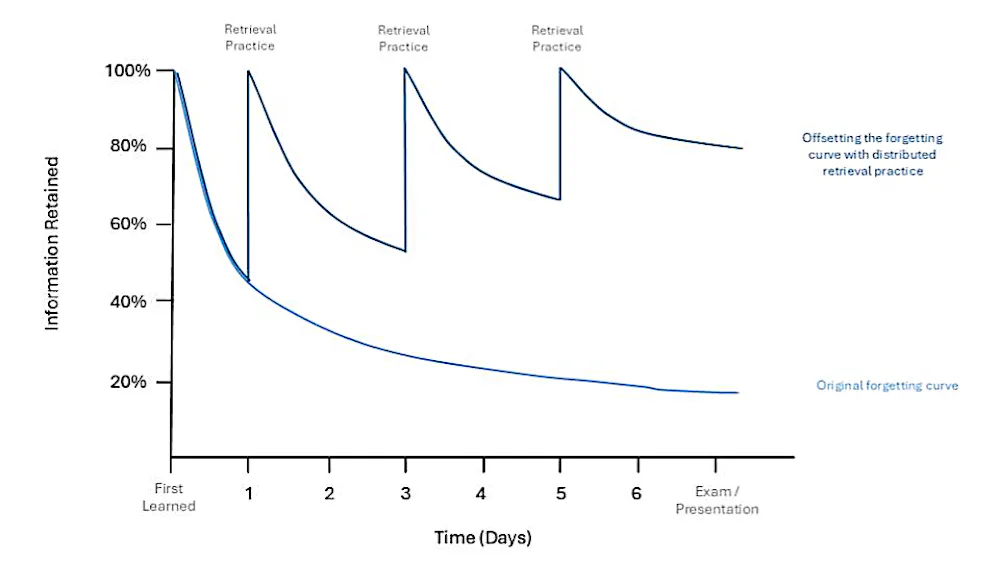
In the 19th century, German psychologist Hermann Ebbinghaus demonstrated how quickly we forget information after learning it. Within about 30 minutes, we lose roughly half of what we have learned, with much more fading over the next day. Ebbinghaus called this the forgetting curve. The light blue line on the chart below illustrates this.

The forgetting curve – and how to disrupt it

Chart showing how rest and retrieval reduces the rate of memory loss.

Elva Arulchelvan, CC BY-SA

However, there is a way of ensuring that more sinks in when you are trying to learn a lot of information in a short period of time: retrieval practice.

When preparing to give a talk or studying for an exam, rather than simply rereading your notes, keep testing how much you remember. Use flash cards, answer practice questions, or try explaining the material out loud without notes.

Memory works through associations. Each time you successfully retrieve information, you link the material to new prompts, examples and contexts. This builds more cues to accessing the information, and strengthens each memory pathway. Often when we “forget”, the memory isn’t gone – we just lack the right retrieval cue.

5. Give yourself a break

Research shows that memory is more effective when study or practice sessions are spread out, rather than massed together. If you are studying for an exam, build solid blocks of downtime into your revision schedule. The dark blue line on the chart above illustrates how spacing out your practice sessions can help you remember more information over time, by adjusting Ebbinghaus’s forgetting curve.

One study suggests leaving gaps between each revision session that equate to 10-20% of the time left until your exam or presentation. So, if your deadline is five days away and you do hours of revision a day, you should still take between a half and full day off in between sessions. In other words, don’t overdo it – you probably won’t see the rewards!

If you only remember one thing from this article about improving memory, make it this. Memory isn’t just about intelligence, it’s about strategy. Small changes in how you study or work can make a real difference in how well, and how long, you remember crucial information.

The Conversation

Elva Arulchelvan does not work for, consult, own shares in or receive funding from any company or organisation that would benefit from this article, and has disclosed no relevant affiliations beyond their academic appointment.

ref. Five tips to make your memory work more effectively – https://theconversation.com/five-tips-to-make-your-memory-work-more-effectively-280327

Feeling distracted? How hobbies can help you find ‘flow state’ and save your brain

Source: The Conversation – UK – By Valerie van Mulukom, Visiting Lecturer in Psychology, Coventry University

Raev Denis/Shutterstock

We live in what has been called the “distraction economy”: an environment full of triggers that are engineered to demand our attention at every turn. The result is often fragmented attention, loss of focus and sometimes even increased rumination and anxiety.

Becoming fully absorbed in an activity is rare. Think of a time a film was so engrossing that you didn’t reach for your phone – the film-watching experience was no doubt the better for it. You can actively seek out this experience, which is known as “flow”. Hobbies are a great way to find a flow state and make outside distractions – work emails, unread messages, breaking news and chores – disappear.

The concept of flow was developed by Hungarian-American psychologist Mihaly Csíkszentmihályi. In his seminal 1990 book on the topic, he describes flow as: “A state in which people are so involved in an activity that nothing else seems to matter; the experience is so enjoyable that people will continue to do it even at great cost, for the sheer sake of doing it.”


Hobbies can bring joy, wellbeing, and focus to our busy lives, but so many of us don’t have one. If you’re ready to replace scrolling with stitching, or hustle with horticulture, The Hobby Starter Kit (a new series from Quarter Life) will help you get going.


Reviews of neuroscientific evidence show that being in a flow state reduces mind wandering by suppressing brain activity in the so-called default mode network. This set of brain regions covers much of the self-referential processing we do, including our inner critic. Being able to “go with with flow” is thus directly related to not having such reflective or ruminative thoughts.

The reduction of the mind-wandering brain activation means there can be more efficient activation of attention networks. During a simulated car-racing task, researchers showed that objective mental effort and gaze focus were highest during flow conditions, even though participants reported the experience as more effortless. Flow doesn’t mean less attention – it means that attention is so efficiently allocated to the task that self-monitoring and distraction fall away.

However, flow is not the same as “hyperfocus”. In fact, they can be negatively correlated with each other. In a study with 85 college students with and without attention deficit hyperactivity disorder (ADHD), students with clinically significant ADHD symptoms reported higher hyperfocus, but lower flow on many measures. The key difference seems to lie in control: flow is directed and intentional, whereas hyperfocus tends to happen to you. But that raw capacity for absorption may be an asset – with the right conditions, like clear goals and a well-matched challenge, it could be channelled into genuine flow.

How to find your flow

Hobbies are a great mechanism for finding a flow state. Sports have been extensively researched as a flow-inducing activity. In a study of 188 junior tennis players, concentration on the task and sense of control were the two aspects of flow that most strongly predicted whether a player won or lost their match. However, it is not just about winning. A study with 413 young athletes aged 12-16, found that participants who were focused on effort and improvement, rather than winning, reported more flow.

Music is another rich domain for flow. In a survey of daily practice, 35 music students aged 12-18 indicated that concentration, emotion and clear goals were central to achieving flow. Eighty percent of the teenagers reported that being able to choose their own repertoire was a highly significant motivational factor.

Another study found that the balance between the challenge of a musical passage and the musician’s perceived skill consistently predicted the flow experience. Flow might also buffer against performance anxiety: when 27 student musicians were tracked over the course of a semester, it was found that when flow was at its highest, performance anxiety was at its lowest, and vice versa.

A young woman focuses on playing an electric piano
Playing music is a known source of flow.
Reshetnikov_art/Shutterstock

If neither sports nor music are your thing, you may want to consider games. In a project I recently ran with a student, we investigated flow during tabletop role-playing games such as Dungeons and Dragons, and compared it to video games. Being in a flow state was associated with greater satisfaction with social interactions with friends, in particular for those who played tabletop games.

For those who play video games, gaming was associated with high monotropic flow – being so absorbed it is difficult to quit playing. These findings align with other research showing that a flow state during gaming can be so absorbing it makes you go to bed later – something to consider before picking up a new hobby.

Another form of role-playing is theatre and drama. In my previous work, I found that acting students experience significantly more flow than psychology students when they imagine scenarios as fictional people (like Romeo and Juliet), but not when imagining scenarios as oneself or one’s best friend. This reflects the effects of developing a practised skill. And, staying in a flow state while acting might ultimately culminate in a high-level performance.

Committing to a hobby and finding your flow might not only help you reduce outside noise (work or social media distractions), but also your own internal noise, such as mind wandering or rumination. Becoming fully absorbed in an activity is rare in the world of distractions, but can pay off for your brain.

The Conversation

Valerie van Mulukom does not work for, consult, own shares in or receive funding from any company or organisation that would benefit from this article, and has disclosed no relevant affiliations beyond their academic appointment.

ref. Feeling distracted? How hobbies can help you find ‘flow state’ and save your brain – https://theconversation.com/feeling-distracted-how-hobbies-can-help-you-find-flow-state-and-save-your-brain-278738

Does marriage prevent cancer? And who benefits the most?

Source: The Conversation – UK – By Justin Stebbing, Professor of Biomedical Sciences, Anglia Ruskin University

Funda Demirkaya/Shutterstock.com

Marriage, it turns out, may come with a side‑effect no one puts in the vows: people who have been married seem less likely to develop cancer than those who have never married at all.

That is the provocative finding from a large new study that has raised interesting questions about what really keeps us healthy over a lifetime. If marriage shows up in the data as “protective”, is it love that matters, the piece of paper, or something much bigger hiding in the background?

In this analysis, researchers looked at cancer diagnoses in more than 4 million adults across 12 US states, representing a population of over 100 million people. They focused on cancers diagnosed after the age of 30 between 2015 and 2022 – a modern snapshot taken in an era when same‑sex marriage is legal nationwide, so marriage includes more people than ever.

Everyone was divided into two camps: those who were or had ever been married, including divorced and widowed people, and those who had never married at all. Around one in five adults landed in this never‑married group, a sizeable minority whose health has often been overlooked in traditional family‑centred research.

When the researchers compared the numbers, the gap was impossible to ignore. Men who had never married were about 70% more likely to develop cancer than men who had married at some point, while women who had never married were about 85% more likely to develop cancer than women who were or had been married.

More advantage to women

That last figure is especially notable, because many earlier studies suggested that men gained more from marriage than women. Here, women appear to gain at least as much, if not more. And the differences grew wider with age, especially after 50, when the consequences of decades of habits – smoking, diet, exercise, medical check‑ups, or the lack of them – finally rise to the surface.

The gap was not the same for every cancer, which is where the story becomes more revealing.

For anal cancer in men and cervical cancer in women – two diseases closely linked to infection with the sexually transmitted human papillomavirus (HPV) – the differences were enormous. Never‑married men had around five times the rate of anal cancer compared with men who had married.

Never‑married women had nearly three times the rate of cervical cancer. These are precisely the cancers where preventive tools already exist: HPV vaccination and regular screening to catch pre‑cancerous changes early.

The study’s authors suggest that being married may increase the chances that someone is nudged into attending those appointments, or into having more stable healthcare and insurance.

Elsewhere, the pattern echoed long‑known biological themes. Cancers such as endometrial and ovarian cancer were more common in never‑married women, which may reflect lower rates of childbearing, since pregnancy and childbirth alter hormone exposure in ways that can reduce risk, as research my team has undertaken shows.

By contrast, for cancers strongly influenced by organised screening – breast, prostate, thyroid – the differences by marital status were smaller. Screening levels the playing field, regardless of whether someone has a spouse reminding them about their appointments.

Even race played an unexpected part. Black men who had never married had the highest overall cancer rates in the study, yet married black men actually had lower cancer rates than married white men, hinting that marriage might be especially protective in some groups.

A woman undergoing breast cancer screening.
Screening levels the playing field.
illustrissima/Shutterstock.com

Nothing magical about marriage, per se

So does this mean marriage itself somehow protects people from cancer? The researchers are careful to say no. Their study shows a pattern, not proof that marriage is the cause.

The real question is whether marriage makes people healthier, or whether healthier, wealthier and better-supported people are simply more likely to get married in the first place. People facing serious mental illness, addiction, chronic illness or deep poverty may be less likely to marry, and those same struggles are also linked to a higher risk of cancer. In that sense, marriage may be less a cause than a sign of other advantages that begin long before anyone walks down the aisle.

There are other reasons to be cautious, too. The “ever married” group bundles together happily married people with those who are divorced or widowed, despite the fact that those experiences can look very different in practice. Meanwhile, the “never married” group includes people in long-term relationships who may receive much of the same support as married couples. The researchers also cannot fully account for differences in income, education or access to healthcare – all of which strongly shape cancer risk in their own right.

Even so, the study points to something important. People who are or have been married are more likely to have someone encouraging them to see a doctor, to share financial resources and health insurance, and to be less likely to smoke heavily or avoid medical care. Over many years, those small differences can add up, shaping the risks people carry and influencing which cancers eventually develop – and which never do.

If you have never married, none of this is a personal health verdict. What the study really underlines is the need to ensure that the quiet advantages so often bundled with marriage – social support, gentle “nagging” to seek help, easier access to healthcare – are not reserved only for those with wedding photos on the mantelpiece.

Single people, widowed people, those who live alone or outside traditional coupledom, may need more targeted support to get to screening, to be offered vaccinations like HPV, and to have their concerns taken seriously. As more people choose to stay single, or to build lives outside marriage, those questions will only become more urgent.

In the end, this study is less a love letter to marriage than a reminder that our bodies are shaped not just by genes and chance, but by the social structures we move through. The people who notice when we’re unwell, encourage us to book that test, and help determine whether we can afford to act on that advice may leave traces visible years later under a microscope. The deeper challenge for public health and policy is to deliver the benefits of connection, stability and access to care to everyone – including those who never say “I do.”

The Conversation

Justin Stebbing does not work for, consult, own shares in or receive funding from any company or organisation that would benefit from this article, and has disclosed no relevant affiliations beyond their academic appointment.

ref. Does marriage prevent cancer? And who benefits the most? – https://theconversation.com/does-marriage-prevent-cancer-and-who-benefits-the-most-280297

A surrealist fashionista, a Nazi fantasist and the return of Atwood’s Handmaids – what to see, read and watch this week

Source: The Conversation – UK – By Jane Wright, Commissioning Editor, Arts & Culture, The Conversation

In the bustling Aberdeenshire town of Braemar, close to the late Queen’s beloved Balmoral, there’s a rather chi-chi hotel called the Fife Arms. Originally a stout stone Victorian building for tweedy country types, it is now a fabulous art-filled mecca of maximalism, attracting celebrities and wealthy Londoners looking for a bit of Highland bling.

There’s a Freud in the lobby, a Picasso in the drawing room, and a winged stag in the dining room, but perhaps most interesting of all, there’s a cocktail bar called Elsa’s, named after Elsa Schiaparelli, the Italian fashion designer. With strong art deco vibes, accents of shocking pink and a menu of exquisite concoctions served in elegant stemmed glasses, Elsa’s has to be the coolest place for a martini north of Edinburgh.

I had heard of Schiaparelli, but the actual woman herself, I knew very little of. And what a woman! Now the V&A’s latest blockbuster exhibition, Schiaparelli: Fashion Becomes Art, brings to life the story of the designer who came to Paris at 23, and gave Coco Chanel a run for her money between the wars.

Where Chanel pursued simple elegance and minimalist style, Schiaparelli – a prominent surrealist alongside the likes of Man Ray and Salvador Dali – loved adornment, embellishment and trompe l’oeil designs. She was the first to create shoulder pads, use animal prints and employ unusual pocket placement. And of course, Schiaparelli is forever remembered as the woman who created “shocking pink”.

Designing fashion as a surrealist, her sculptural shapes and arresting details (the shoe hat, anyone?) were only for the most audacious women. When she retired to Tunisia in 1954, the house of Schiaparelli was no more. But in 2019, to great excitement, the name was revived under the direction of designer Daniel Roseberry who has restored Schiaparelli’s reputation for unpredictable daring. If you love fashion, this is a show you should not miss.

Resistance and rebellion

Two very different portrayals of resistance are on release this week. First, The Testaments is a TV adaptation of Margaret Atwood’s sequel to The Handmaid’s Tale which was turned into a TV drama in 2017 and ran for six seasons. The show quickly transcended its source material, our reviewer Debra Ferreday explains, “to become a feminist touchstone, inspiring a vivid visual and cultural language of resistance across politics, performance, music and the arts” – just as life in the US became an eerie echo of Atwood’s world.

In the Gilead of The Testaments, women still exist within an enforced patriarchal rape culture where Handmaids are reduced to brood mares. Here, violence masquerades as justice and entertainment, and control, order and cleanliness are paramount. But this world is not without hope as the young women find subversive ways to resist and rebel, finding solidarity, connection and even joy in likeminded souls.

My Undesirable Friends Part I is Julia Loktev’s extraordinary documentary about young journalists fighting to report the truth in Putin’s Russia. Filmed on her iPhone over four months in late 2021 and early 2022, Loktev follows the lives of her friends as they share their fears over the worsening political situation.

From concerns over increasing censorship to their horror at the invasion of Ukraine in February 2022, Loktev captures their earnest discussions of widespread abuses of power as the more democratic society they had hoped for slips away. But just like The Testaments, these young people find courage and resilience as the film examines how they can resist an oppressive state, stay safe – and know when it’s time to get out.

Horror real and imagined

For ten years architect Albert Speer was a friend and protege of Hitler, elevated to being in command of Germany’s military equipment throughout the war. His impressive orchestration of the Nuremberg rallies as architectural spectacle fed Hitler’s propaganda machine and contributed to Nazism’s dark mythology. And yet he somehow resisted being absorbed into it in same the way as Goebbels, Goring or Himmler, often viewed as a “good Nazi”.

This is down to the dedicated self-mythologising he embarked on after the war which many regarded as bare-faced lies, evasions and self delusion. Speer is now the subject of a masterful novel by Jean-Noël Orengo, which seeks to examine how Hitler’s courtier was able to so successfully rehabilitate his image, exploring important questions of Nazi memory, myth-making and moral reckoning.

My favourite kind of horror film is one that slowly builds an almost unbearable sense of dread and unease. This week’s Undertone sounds like it fits that bill perfectly. Evy is a young woman looking after her dying mother at home while co-hosting a podcast that explores supernatural phenomena.

A non-believer to her co-host Justin’s acceptance of the paranormal, Evy records in the middle of the night, as Justin lives in a different time zone. As the pair begin to explore a particularly disturbing case based on audio clips, Evy’s scepticism deserts her. The genius here is that the horror lies purely and intimately in sound. It is not a film, our reviewer warns, for the faint of heart.

The Conversation

ref. A surrealist fashionista, a Nazi fantasist and the return of Atwood’s Handmaids – what to see, read and watch this week – https://theconversation.com/a-surrealist-fashionista-a-nazi-fantasist-and-the-return-of-atwoods-handmaids-what-to-see-read-and-watch-this-week-280305

Bait sheds light on British-Pakistani mental health struggles rarely seen on screen

Source: The Conversation – UK – By Jolel Miah, Senior Lecturer, Health Psychology, University of Westminster

Riz Ahmed’s Bait is an exceptional piece of television. Not only for its satirical exploration of the entertainment industry, but for the psychological narrative running underneath it.

At its heart, the Prime Video series is a quietly devastating study of the pressures placed upon British‑Pakistani men. What appears to be an eccentric comedy about a struggling actor auditioning for James Bond soon reveals itself to be a nuanced portrayal of shame, internalised stigma and the early signs of psychosis.

The series follows Shah Latif (Ahmed), whose obsessive pursuit of validation becomes a catalyst for a psychological unravelling. Shah’s downward spiral is shaped by relentless scrutiny and the fear of not belonging. These themes resonate strongly with a growing body of research on psychosis in British‑Pakistani communities.

A 2024 study in The British Journal of Psychiatry found a significantly higher incidence of first‑episode psychosis among British‑Pakistanis, compared with the majority population.

The trailer for Bait.

This offers an important parallel to Bait. Shah’s sense of cultural drift, his distance from grounding community structures and his struggle to inhabit multiple identities all heighten his vulnerability.

The show does not name psychosis explicitly, but Shah experiences intrusive thoughts, escalating paranoia, fragmentation of self and delusions. This reflects real trajectories observed in early intervention services.

Racism and psychosis

One of the most incisive threads in the series is the portrayal of racial microaggressions that Shah absorbs without resistance. These include remarks about his “Britishness”, comments on his appearance, and the persistent insinuation that he exists outside the cultural centre.

Recent research has shown that racial discrimination is one of the strongest predictors of psychosis risk. It increases the likelihood of psychotic symptoms by 77%, with physical racial attacks multiplying the risk five-fold.

Shah’s encounters – ranging from subtle jabs to overt dismissal – operate cumulatively, shaping his internal monologue and eroding his self-esteem. The brilliance of Bait lies in how it embeds these aggressions into the comedic structure, illustrating the subtle normalisation of harm.

The series highlights the importance of family dynamics, a key but under-researched factor in understanding psychosis among South Asian Muslims in the UK. A 2009 study found that families often had to navigate stigma, concerns about privacy and honour, and tensions between medical models of illness and culturally rooted understandings of distress.

Shah’s relationship with his family shifts between warmth, expectation and pressure, reflecting this complexity. Family can act as both a source of support and a cause of psychological strain.

Research examining British-Pakistani Muslim views on mental health has found that cultural stigma, fear of public opinion, and uncertainty around religious explanations can delay people seeking help.

These dynamics are reflected in the silence running through Shah’s world. Mental health struggles are hinted at but never openly discussed, and Shah instinctively hides his distress behind humour and performance. This also reflects how many communities describe mental health in moral or spiritual terms, rather than psychological ones.

I recently explored these issues in a podcast conversation with Zenab Sabahat, a PhD researcher at the University of Bradford. Her research looks at access to, experiences of and outcomes for South Asian Muslim families receiving family interventions for psychosis. This work explores how cultural identity stress, stigma and mismatches between different models of care shape pathways into support.

Sabahat’s work reinforces what Bait illustrates narratively: that psychological distress among British-Pakistanis is closely linked to experiences of migration, racism, cultural belonging and intergenerational tension.

This reality also underpins the work of Our Minds Matter, the UK charity I co-founded to deliver culturally grounded mental health education and support in under-served communities. The organisation’s mission emphasises the need to address mental health through the lenses of culture, faith and community – approaches that mainstream services often overlook.

Early education, reducing stigma and building culturally sensitive support are essential for addressing the inequalities faced by communities like Shah’s.

The Our Minds Matter documentary.

Five years ago, our team produced a community-led documentary exploring psychosis. It highlighted the experiences of South Asian families and the urgent need for culturally coherent support structures. The challenges articulated in the documentary continue to be reflected in both academic research and people’s lived experiences today.

What Bait achieves is not simply representation but illumination. It exposes how psychological vulnerability can be fuelled by cultural dislocation, racialised exclusion, and the impossible expectation to excel while carrying generations of unspoken pressure.

Shah’s experiences – humorous, painful and increasingly fractured – mirror the mental health inequalities faced by British‑Pakistani communities, particularly men navigating contradictory identities and structural disadvantage.

The series invites viewers to see psychosis not as an isolated biomedical event, but as a response to accumulated pressures: family honour, societal scrutiny, cultural misrecognition and stigma that constrains emotional expression.

These pressures interact across biological, psychological and social frameworks, creating conditions in which psychosis risk becomes elevated. The show’s understated portrayal of this trajectory offers a culturally specific, psychologically accurate narrative rarely seen in British television.

In a media landscape where the mental health of British South Asian Muslims is often sensationalised or overlooked, Bait offers an important counternarrative. It shows that the intersections of identity, discrimination and cultural expectation are not abstract ideas but lived experiences that shape psychological wellbeing.

The show’s quiet strength lies in revealing these dynamics without being preachy – inviting audiences and practitioners to better understand how culture, racism and mental health intertwine.

The Conversation

Jolel Miah does not work for, consult, own shares in or receive funding from any company or organisation that would benefit from this article, and has disclosed no relevant affiliations beyond their academic appointment.

ref. Bait sheds light on British-Pakistani mental health struggles rarely seen on screen – https://theconversation.com/bait-sheds-light-on-british-pakistani-mental-health-struggles-rarely-seen-on-screen-280102

What can governments do when petrol prices rocket?

Source: The Conversation – UK – By Christoph Siemroth, Associate Professor (Senior Lecturer) in Economics, University of Essex

LSP EM/Shutterstock

The price of oil has changed a lot in the last few weeks. There have been dips as well as peaks, but generally, since the the start of the US-Israeli attacks on Iran at the end of February, the black stuff has been getting more expensive.

As a direct result, petrol and diesel prices in the UK have also rocketed.

Motorists have felt the steep rise on petrol station forecourts, while some fuel sellers have been accused of profiteering and ripping off customers. There have also been calls for the government to intervene to prevent costs from spiralling out of control.

But what can it actually do to bring petrol prices down?

One option might be to impose price caps, setting a legal limit on what motorists can be charged for a litre of fuel. But a major problem with this idea comes down to a lack of supply.

Taking the Strait of Hormuz as a perfect example, if fewer tankers from Kuwait and Qatar are getting through, that means there is less oil available. As stocks runs low, it is impossible for everyone to get the same amount of fuel at the same price as before.

If price caps were introduced (with the supplier taking on the full impact of the discount), the countries and firms with oil to sell would naturally shift their sales to countries willing to pay higher prices. So a price cap would probably lead to empty petrol pumps in the UK.

There have already been shortages in France, where one major fuel provider implemented its own price cap and was subsequently inundated with customers.

In contrast, high fuel prices may persuade households to cut down on consumption, which is helpful when there is less oil available. After all, people don’t switch from travelling by car to public transport (which is often less convenient) unless there is a good reason to do so. High fuel prices are a good reason.

Research suggests that in the UK, a 10% increase in petrol prices can lead to a reduction in demand of up to 5%. So, high prices are a way of adjusting consumption to cope with the lower supply.

Duty calls

In the longer term, households might invest in a way which reduces their dependence on future fossil fuel consumption. Maybe, instead of a big SUV, the next family car will be be smaller or electric.

In the short term, though, demand for petrol and diesel will remain. Not all commuting and travelling can be cancelled or postponed. People need to get to work, children need to go to school.

A more promising policy intervention could be temporary fuel duty discounts – reducing the proportion of fuel costs which ends up in the Treasury. Unlike with price caps, oil exporters’ incentives to sell in the UK are not diminished by reducing fuel duty. So fuel duty cuts wouldn’t cause supply issues.

The issue here is that fuel duty cuts reduce government revenue at a time when it is already seriously stretched. Fuel duty receipts account for almost 2% of UK government income.

Also, the measure is not very targeted. Wealthy households with multiple vehicles would benefit more than a single mother struggling to pay for petrol to get to work.

Making allowances

Another option, favoured by some economists, is based on one-off transfers of money from the state directly to some motorists.

Instead of fuel duty cuts, the government could pay out a fixed sum to those in particular need (much like the winter fuel allowance for heating bills). This could be paid to households under a certain income threshold that own a car.

When a similar transfer scheme for gas was implemented in Germany in 2022 after Russia shut off gas pipelines, firms and households received compensation based on past consumption. Germany was able to reduce its gas consumption by about 20% during that time.

Unlike a fuel duty cut, compensation does not change depending on the amount of fuel bought. So the incentive to cut down on fuel consumption wherever possible remains.

Indeed, households that leave the car at home will profit, as they keep the transfer. This is as it should be: households that use less fuel get rewarded, while those that need it still have some support.

Many economists like this proposal because it keeps prices as an accurate reflection of supply shortages, while providing targeted relief. Neither price caps nor fuel duty cuts achieve this.

The Conversation

Christoph Siemroth previously received funding from the UK Economic and Social Research Council.

ref. What can governments do when petrol prices rocket? – https://theconversation.com/what-can-governments-do-when-petrol-prices-rocket-280094