English universities now have a duty to uphold freedom of speech – here’s how it might affect students’ sense of belonging

Source: The Conversation – UK – By Richard Bale, Director of Academic Development and Research, Associate Professor, The University of Law

Cast Of Thousands/Shutterstock

The Higher Education (Freedom of Speech) Act, which comes into force on August 1 2025, means universities in England now have a new duty to uphold “robust” strategies to ensure freedom of speech on campus.

To support universities in navigating the boundaries of lawful and unlawful speech, universities regulator the Office for Students appointed its first director for freedom of speech and academic freedom in 2023. Arif Ahmed, who is also a professor of philosophy at the University of Cambridge, has reportedly said that coming across views students might find offensive is part of a university education.

It’s possible, though, that feeling offended comes up against the important concept of “belonging” at university. In the context of higher education, belonging is often defined as feeling at home, included and valued. It is linked to more students staying in their courses, having enhanced wellbeing, and being able to learn well at university.

But feeling offended and feeling you belong at university don’t have to be contradictory. Some of our research has found that belonging can also mean being able to challenge the dominant culture at a university, which may exclude students who don’t fit a particular mould.

Students in lecture hall
Being able to challenge opinions is important.
Matej Kastelic/Shutterstock

Some students explained that they proactively resist the prevalent image of the “typical” student. For example, in highly selective universities, students are often extremely competitive and industrious with a tendency to overwork. But this culture may not align with the work-life balance prioritised by some students.

This form of “positive not-belonging” often takes the form of friendship groups and communities that cultivate an alternative kind of belonging. These groups may well enable greater freedom of self-expression, without fear of being judged or feeling pressured to conform to pre-existing academic cultures.

While some students are able to carve out these collective and alternative communities for belonging, many others feel their presence and sense of belonging is conditional – especially minority ethnic students. Clearer advocacy for free speech might help these students feel more comfortable speaking up and building a stronger sense of belonging.

We must not forget that the idea of belonging carries power dynamics, and often has implications for what is perceived as up for debate – and what is not.

Existing free speech

What’s more, the views of students suggest that free speech is already part of their experience at university. In 2023, the Office for Students added a question about freedom of expression to the annual National Student Survey, which gathers final-year undergraduates’ opinions on their higher education experience. The question, added for students at English universities only, asked how “free” students felt to express their ideas, opinions and beliefs.

The results showed that 86% did feel they had this freedom. This has remained stable in the latest survey, with a slight increase to just over 88% in the 2025 results.

The Office for Students also commissioned YouGov to poll research and teaching staff at English universities about their perceptions of free speech in higher education in 2024.

Some positive results mirrored the student data. For example, 89% of academics reported that they are confident they understand what free speech means in higher education. But the polling also found that 21% did not feel free to discuss controversial topics in their teaching.

This lack of perceived freedom of expression does not only have a negative impact on staff. It is widely understood that a key purpose of higher education is to nurture students’ independent thinking and self-awareness. A key step toward this goal is not to be afraid of engaging in difficult conversations, including asking questions.

However, this does not happen automatically. Universities need to provide clear scaffolding, guidance and practical steps to protect freedom of speech. It is also important to normalise and promote conversations about topics such as cultural differences and intercultural competence, which refers to the ability to interact with people from different cultural backgrounds effectively and appropriately.

If addressed, these discussions can help to foster inclusion, and promote diversity of thought and expression.


Get your news from actual experts, straight to your inbox. Sign up to our daily newsletter to receive all The Conversation UK’s latest coverage of news and research, from politics and business to the arts and sciences.

The Conversation

The authors do not work for, consult, own shares in or receive funding from any company or organisation that would benefit from this article, and have disclosed no relevant affiliations beyond their academic appointment.

ref. English universities now have a duty to uphold freedom of speech – here’s how it might affect students’ sense of belonging – https://theconversation.com/english-universities-now-have-a-duty-to-uphold-freedom-of-speech-heres-how-it-might-affect-students-sense-of-belonging-260867


England’s new free speech law comes into force – what it means for universities

Source: The Conversation – UK – By Eric Heinze, Professor of Law and Humanities, Queen Mary University of London

Matej Kastelic/Shutterstock

The Higher Education (Freedom of Speech) Act 2023 comes into force throughout England on August 1 2025. Designed to stop universities from censoring controversial or unpopular ideas, the law gives the Office for Students responsibility for ensuring institutions comply.

This law will mean that many universities will have to change the way they approach free speech.

When it comes to adopting campus speech policies, educational establishments have always had three choices.

One option has been to follow the law, permitting whichever messages the law already allows, while banning whichever messages the law already forbids. UK law prohibits, for example, certain core expressions of racism, anti-LGBTQ+ hatred, Islamophobia, antisemitism, or glorification of terrorism. I’ll call this the “legalist” option.

Another approach is to allow more speech than the law allows. This would, for example, permit guest lecturers to advocate white supremacy or the belief that only heterosexual relationships and behaviour are normal. I’ll call this the “libertarian” option. It treats free speech as sacrosanct.

But this option would never be adopted. Few institutions would welcome the torrent of parental complaints, media publicity, donor withdrawals, police investigations, or full-blown litigation that would follow.

A third option is to permit less speech than the law allows. This would mean, for example, banning sexist speech, which is otherwise still permitted under UK law. We can call this the “communitarian” option. It views educational institutions as more than just places for exchanging ideas: they must also promote civic values, aiming to build an empathic society.

Changing approaches

In the past, British universities could choose option three, cancelling or avoiding events featuring messages that, although legal, risk stoking campus divisions.

Some institutions have stopped controversial speakers through decisions by senior leadership. For example, in 2013 UCL’s senior administrators banned a group that advocated sex segregation. Other times, efforts to cancel events have been made by students or staff. In 2015, the University of York cancelled events for International Men’s Day after complaints from students and staff.

The effect of the Higher Education (Freedom of Speech) Act will be to shift universities from the communitarian to the legalist model. Campus members wishing to stage events will still have to comply with routine guidelines on reserving campus venues, ticketing participants, ensuring security controls, and the like. However, under the act, universities may no longer impede the communication of otherwise legal messages solely on the grounds of their provocative content.

For advocates of free speech, this act may still not go far enough since it keeps an escape hatch. Management can still cancel controversial events if the institution lacks the means to ensure adequate security, and such claims are often difficult to verify.

Yet for others, the act will go too far. Some would argue that existing law in Britain does not adequately protect vulnerable groups, and that universities should stick to the communitarian ideal, creating a refuge that the law often fails to provide.

These anxieties become ever greater in our internet era, when misinformation can proliferate. Some may fear that abandoning the communitarian ethos will turn the campus into a wild west of free speech, disproportionately affecting its most vulnerable members.

Group of talking students
The act aims to preserve free speech on university campuses.
Gorodenkoff/Shutterstock

However, online communications have also proved to be powerful mobilising tools for staff and students, so online power hierarchies may work in more complex ways than meets the eye.

Note also that nothing in the act abolishes student welfare services. Individually targeted acts of bullying, threats, stalking and harassment will remain under the aegis of campus oversight as well as UK law. Staff or students exhibiting racist, sexist, homophobic, or transphobic conduct will remain as subject as they were before to disciplinary proceedings and even dismissal or expulsion.

Finally, it is worth bearing in mind that the act’s most salient ingredients are procedural, placing considerable burdens on institutions to facilitate free speech and deal transparently with accusations of censorship. Yet whether this will lead to an explosion of complaints, and whether ideas exchanged on campus will really differ so much from those we already hear today, remains to be seen.


Get your news from actual experts, straight to your inbox. Sign up to our daily newsletter to receive all The Conversation UK’s latest coverage of news and research, from politics and business to the arts and sciences.

The Conversation

Eric Heinze has received funding for submitting a report to the UK Commission for Countering Extremism.

ref. England’s new free speech law comes into force – what it means for universities – https://theconversation.com/englands-new-free-speech-law-comes-into-force-what-it-means-for-universities-262080

Who is Odysseus, hero of Christopher Nolan’s new epic?

Source: The Conversation – UK – By Stephan Blum, Research associate, Institute for Prehistory and Early History and Medieval Archaeology, University of Tübingen

Somewhere between hero and hustler, family man and philanderer, king and con artist, Odysseus is one of ancient literature’s most complex figures. In the Iliad, he is the mastermind behind the Trojan horse.

In Homer’s Odyssey, he is the protagonist of a ten-year journey home – one that sees him encounter gods, monsters, temptations and profound moral dilemmas. Next year, he will be the hero of a new Christopher Nolan epic, and played by Matt Damon.

Odysseus’s journey from Troy to Ithaca in the Odyssey is anything but a straight line. It’s an epic zigzag through storms, temptations, divine grudges and existential threats. Instead of returning in weeks, he spends a decade adrift.

He is stranded by nymphs, resists sirens and watches his crew perish one by one. Every stop tests not only his wit but his very sense of self.

The Odyssey isn’t a tale of noble perseverance. It’s a study in survival. Odysseus deceives, disguises and entangles himself in morally grey romantic liaisons with a sorceress (Circe), nymph (Calypso) and princess (Nausicaa). He does so often as strategist and sometimes as willing participant.


Looking for something good? Cut through the noise with a carefully curated selection of the latest releases, live events and exhibitions, straight to your inbox every fortnight, on Fridays. Sign up here.


In Homer’s world, infidelity is a tool of survival. Odysseus survives not through moral clarity, but through his moral agility. His loyalty to his wife Penelope (reportedly played by Anne Hathaway in the new adaptation) is longitudinal, not linear. His compass is always aimed at returning to Ithaca, if not always in a straight line.

Would this flexibility pass modern ethical scrutiny? Probably not. But what made him successful wasn’t moral integrity – it was his ability to navigate each situation, even if that meant bending the rules.

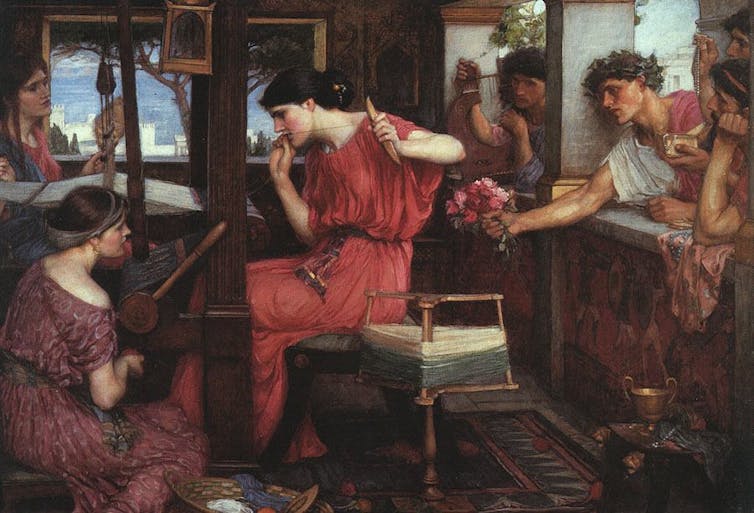
While Odysseus adapts, Penelope endures with strategic resilience. For 20 years, she fends off suitors with deft delay tactics. She avoids them by weaving and unweaving a funeral shroud for her husband’s father, Laertes. It’s a defiant, slow motion resistance campaign, waged with thread and silence.

Painting of Penelope weaving and ignoring suitors
Penelope and the Suitors by John William Waterhouse (1912).
Aberdeen Art Gallery

If Odysseus navigates external monsters, Penelope masters the domestic battlefield. Her fidelity in her husband’s absence is deliberate, political and astute. In a patriarchal world, her power lies in pause. Her story is one of emotional labour and strategic survival.

Narrative loops and non-linear journeys

The Odyssey is an ancient masterpiece of non-linear storytelling. It begins in the middle of the action and uses nested narratives, flashbacks and shifting voices. Odysseus tells much of his own story, reframing events from his point of view and reshaping himself in hindsight. Memory becomes montage. Truth bends to necessity. Fact and fiction bleed into one another.

Homer doesn’t just tell a story – he constructs a labyrinth. The Odyssey anticipates the fractured forms of modernist literature and cinema, where identity is unstable and time itself is malleable.

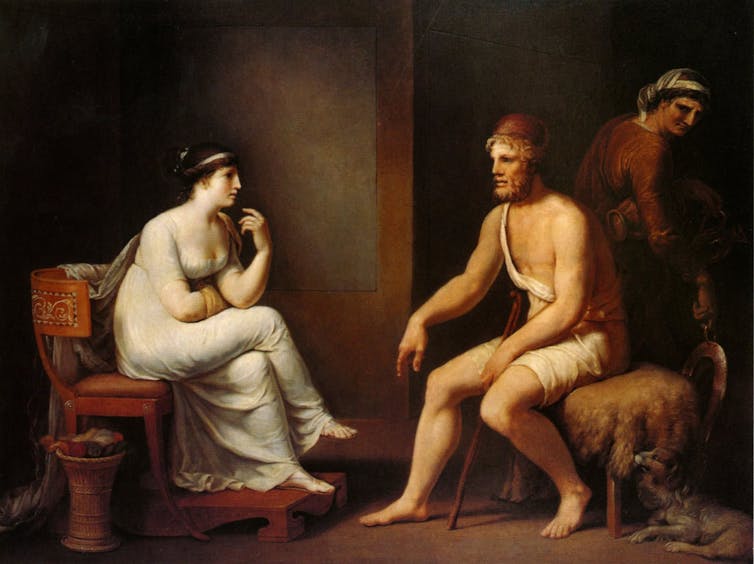
Penelope sitting with Odysseus
Odysseus and Penelope by Johann Heinrich Wilhelm Tischbein (1802).
Wiki Commons

When Odysseus finally returns to Ithaca, disguised as a beggar and quietly assessing his ship’s wreckage, it’s no romantic climax. It’s a calculated risk. Penelope doesn’t swoon; she tests. Only when he passes her intimate knowledge test – he reacts with outrage when she suggests moving their bed, which he built around a living olive tree – does she relent. Their reunion is not a Hollywood embrace but a wary negotiation.

It signals restoration, yes. But also mistrust, trauma and mutual testing. Homecoming, like survival, is complicated.

Odysseus is not a flawless hero. He is a survivor who negotiates with monsters, debates with gods and crawls home disguised as a beggar. A man shaped as much by cunning as by consequence.

Would Odysseus pass a modern ethics exam? Certainly not. Would he charm the professor, flip the question and still walk out with an A? Absolutely. Some stories endure not because they are true, but because they were told by survivors.


This article features references to books that have been included for editorial reasons, and may contain links to bookshop.org. If you click on one of the links and go on to buy something from bookshop.org The Conversation UK may earn a commission.


Get your news from actual experts, straight to your inbox. Sign up to our daily newsletter to receive all The Conversation UK’s latest coverage of news and research, from politics and business to the arts and sciences.

The Conversation

The authors do not work for, consult, own shares in or receive funding from any company or organisation that would benefit from this article, and have disclosed no relevant affiliations beyond their academic appointment.

ref. Who is Odysseus, hero of Christopher Nolan’s new epic? – https://theconversation.com/who-is-odysseus-hero-of-christopher-nolans-new-epic-261781

Vasectomy, pain and regret: what online forum Reddit reveals about men’s experiences

Source: The Conversation – UK – By Kevin Pimbblet, Professor and Director of the Centre of Excellence for Data Science, AI and Modelling, University of Hull

Fabian Montano Hernandez/Shutterstock

Vasectomy has long been regarded as a permanent, safe and effective form of contraception. Its benefits are often summarised as minimally invasive and largely risk-free.

But that may not be the full story.

In recent years, vasectomy rates in the UK have declined significantly. It’s a puzzling trend, given that the procedure’s efficacy hasn’t changed. What has arguably shifted is how men talk about it. Not in doctors’ offices, but online.

As an AI researcher working with large-scale public data, I led a 2025 study using natural language processing (NLP) – a branch of artificial intelligence that analyses patterns in human language – to examine thousands of posts from r/vasectomy and r/postvasectomypain, which are subreddits (topic-specific discussion forums) on Reddit, a social media platform where users share and comment on content in themed communities.

My goal wasn’t to weigh in on urology (I’m not that kind of doctor), but to explore the emotional tone and self-reported outcomes in digital spaces where users speak candidly and in real time.

The findings are revealing and raise important questions about informed consent, online health discourse and the growing influence of social data on healthcare communication.

Fear, regret and pain?

The most common emotional response to vasectomy, whether being considered or already undergone, is fear. To assess this, we used a tool called NRClex, a crowd-trained emotion classifier. This is an AI model trained on thousands of labelled examples to detect emotional tone in text. It found that “fear” dominated more than 70% of user-generated content.

This isn’t surprising. Men on Reddit ask questions like “How bad is the pain?” “How long does it last?” and “Will I regret this?” These are not rare concerns: they’re central to the conversation.

While overall sentiment analysis shows that most users report positive outcomes, a significant minority express deep regret and ongoing pain – sometimes lasting for years after surgery.

This pain is often described as post-vasectomy pain syndrome (PVPS), a relatively little-known condition defined by new or chronic scrotal pain that continues for more than three months after the procedure.

PVPS is poorly understood and may have multiple causes, some anatomical, some neurological and some still unclear. Though some health authorities describe it as “rare,” our Reddit data suggests it could be more common, or at least more disruptive, than currently acknowledged.

We analysed more than 11,000 Reddit posts and found that the word “pain” appeared in over 3,700 of them; roughly one-third. In many cases, the pain described persisted well beyond the expected recovery period. The word “month” appeared in nearly 900 pain-related posts, while “year” appeared in over 600.

This is noteworthy. Post-surgical pain is typically expected to resolve within days or weeks. Yet our dataset suggests that 6%–8% of Reddit users discussing vasectomy report longer-term discomfort – a rate that aligns with the upper estimates in the urological studies. More recent research, including a large-scale postoperative study, argues that the incidence is likely much lower, perhaps under 1%.

Of course, we must emphasise that these are self-reported experiences. Not all mentions of “pain” equate to a formal PVPS diagnosis. It’s also important to acknowledge that people who are dissatisfied with a medical procedure are generally more likely to post about it online – a well-recognised bias in social data. Even so, the volume, consistency and emotional intensity of these posts suggest the issue warrants closer attention from clinicians and researchers alike.

Even more strikingly, around 2% of posts mention both “pain” and “regret”, implying serious, potentially life-altering consequences for a small but significant group of people.

On r/postvasectomypain – a subreddit specifically dedicated to discussing PVPS – the tone is even more sobering. Unsurprisingly, 74% of posts describe persistent, long-term pain. Additionally, 23% mention pain during sex and 27% report changes in sensitivity.

Posts on this forum also frequently reference vasectomy reversal surgery far more often than more specialised interventions such as microsurgical denervation: a complex nerve-removal procedure used in severe cases of chronic testicular pain, typically when other treatments have failed.

From AI to andrology: an ethical crossroads

Why is a professor of AI and physics analysing pain in urology forums?

Because in today’s digital world, people increasingly turn to online platforms like Reddit for health advice, peer support and decision-making – often before speaking to a clinician. As an AI researcher, I believe we have a responsibility to examine how these discussions shape public understanding, and what they can teach us about real-world healthcare challenges.

In this case, it’s possible that the drop in vasectomy uptake is linked, at least in part, to the open and emotional sharing of negative outcomes online. These posts are not scaremongering. They’re detailed, candid and often highly specific. They represent a type of real-world evidence that clinical trials and formal studies don’t always capture.

So, what should we take from all this?

Terms like “rare”, often used in consent forms and clinical conversations, can obscure the complexity and variability of patient outcomes. Pain following vasectomy, whether mild, temporary, chronic or debilitating, appears common enough to warrant more transparent and nuanced communication.

This is not an argument against vasectomy. It remains a safe, effective, and empowering option in reproductive planning. But truly informed consent should reflect both the clinical literature and the experiences of those who undergo the procedure, especially when such experiences are now publicly available in large volumes.

In a world where online forums double as health diaries, support networks and informal research registries, we must take them seriously. Medical language matters. Terms like “rare”, “uncommon” or “low risk” carry real emotional and moral weight. They shape expectations and influence decisions.

If even a small percentage of men experience long-term pain after vasectomy, that risk should be communicated clearly, in plain English – ideally with a range of percentages drawn from published studies.


Get your news from actual experts, straight to your inbox. Sign up to our daily newsletter to receive all The Conversation UK’s latest coverage of news and research, from politics and business to the arts and sciences.

The Conversation

Kevin Pimbblet currently receives funding from STFC, EPSRC, The British Academy, The Royal Astronomical Society, The British Ecological Society, and The Office for Students. None are in direct relation to this work.

ref. Vasectomy, pain and regret: what online forum Reddit reveals about men’s experiences – https://theconversation.com/vasectomy-pain-and-regret-what-online-forum-reddit-reveals-about-mens-experiences-261633

Pacific tsunami: modern early warning systems prevent the catastrophic death tolls of the past

Source: The Conversation – UK – By Ian Main, Professor of Seismology and Rock Physics, University of Edinburgh

The earthquake in Russia’s Kamchatka peninsula on July 30 2025 may have been one of the most severe on record, with a magnitude of 8.8. But innovations in science and technology gave governments vital time to warn and evacuate their people from the resulting tsunami.

Millions of people escaped to higher ground before the tsunami hit.

The 2004 Boxing Day 9.3 magnitude earthquake and tsunami in Sumatra, which caused approximately 230,000 deaths, some as far away as Somalia on the other side of the Indian Ocean, shows how important these warnings are.

Early warning systems were not in place for the Indian Ocean in time for the 2004 disaster. But there is now a system in place, with 27 countries participating in the group effort.

The 2004 tsunami was particularly tragic because tsunami waves travel at a steady speed in the open ocean, about as fast as a jet plane. This means they can take several hours to reach shore across an ocean, with plenty of time for warning.

An early warning system for the Pacific Ocean, based in Hawaii, was created in 1948 following a deadly tsunami two years before. On April 1 1946, the magnitude 8.6 Aleutian Islands earthquake in the northern Pacific Ocean generated a tsunami that devastated parts of Hawaii hours later, leading to 146 fatalities.

The death toll was exacerbated by the leading wave being downwards. This happens in around 50% of tsunamis, and exposes the seashore in a similar way to when the tide goes out, but exposing a larger area than normal. People sometimes investigate out of curiosity, bringing them closer to the danger.

The accuracy and response times of early tsunami warnings have significantly improved since 1948.

How tsunamis happen

To understand the work involved in protecting coastal communities, first you need to understand how tsunamis are generated.

Tsunamis are caused by displacement of mass on the sea floor after an earthquake, landslide or volcanic eruption. This provides an energy source to set off a wave in the deep sea, not just near the surface like in the ocean waves we see whipped up by the wind and storms. Most are small. The Japanese word tsunami translates somewhat innocuously as “harbour wave”.

Detailed global mapping of the sea floor, pioneered by US geologist Marie Tharpe between 1957 and 1978, helped establish the modern theory of plate tectonics. It also improved the physical models for how the tsunami will travel in the ocean.

Wave height increases as it approaches the shore, and the topography of the sea floor can result in a complicated pattern of wave interference and concentration of the energy in stream-like patterns. The establishment of sea-floor observatories led to better data for the pressure at the sea floor (related to wave height) and satellite networks now directly monitor wave height globally using radar signals from space.

One of the factors that has helped scientists predict the range of a tsunami includes the setting up of the worldwide standard station network of seismometers in 1963, which allowed better estimations of earthquake location and magnitude.

These were superseded by the digital broadband global network of seismometers in 1978, which allowed more detail on the source to be calculated quickly. This includes a better estimate of earthquake size, the source rupture area and orientation in three dimensions.

It also tells scientists about the slip, which controls the pattern of displacement on the sea floor. This data is used to forecast the time of landing, the amplitude of the wave on the shoreline, and its height in areas where the wave travels further inland.

The Pacific Ocean warning system now has 46 countries contributing data. It also uses physical and statistical models for estimating tsunami height. The models developed as scientists learnt more about earthquake sources, mapped features on the sea floor and tested model forecasts against outcomes.

Today’s technology

The early warning systems we have today are due to a decades-long commitment to global research collaboration and open data. Scientists have also improved their forecast methods. Recently they started using trained AI algorithms which could improve the timeliness and accuracy.

Pioneered by the US Geological Survey, rapid data sharing is now used routinely to estimate earthquake parameters and make them available to the public soon after the rupture stops. This can be within minutes for an initial estimate then updated over the next few hours as more data comes in.

However, the forecast wave height is inherently uncertain, variable from place to place, and may turn out to be more or less than expected. Similarly, large earthquakes are rare, making it hard to estimate how likely they are on average, and therefore to design appropriate mitigation measures.

The 2011 Tohoku earthquake and tsunami in Japan destroyed or overtopped the eight-metre high protective sea walls that had been put in place based on such hazard estimates. There were over 19,000 fatalities. As a consequence, their height has been increased to 12-15 metres in some areas.

Early warning systems also rely on rapid communication to the public, including mass alerts communicated by mobile phone, coordination by the relevant authorities across borders, clear advice, and advance evacuation plans and occasional alarm tests or drills. Although tsunami waves slow down to the speed of a car as they approach the shore, it is impossible to outrun one, so it is better to act quickly and calmly.

The effectiveness of warnings also means accepting a degree of inconvenience in false alarms where the tsunami height is less than that forecast, because this is inevitable with the uncertainties involved. For good reason, authorities issuing alerts will err on the side of caution.

To give an example, nuclear power plants on Japan’s eastern seaboard were shut down on July 30.

So far it looks like the Pacific early warning system – combined with effective levels of preparedness and action by service providers and decision makers – has worked well in reducing the number of casualties that might have happened without it.

There will always be a level of uncertainty we will have to live with. On balance, it is a small price to pay for avoiding a catastrophe.

The Conversation

Ian Main is professor of Seismology and Rock Physics at the University of Edinburgh. He receives funding from UK Research and Innovation Research Council, a member of the UK Office for Nuclear Regulation Expert panel on external hazards, and acts as an independent reviewer for the Energy Industry-funded SeIsmic hazard and Ground Motion Assessment research program SIGMA3.

ref. Pacific tsunami: modern early warning systems prevent the catastrophic death tolls of the past – https://theconversation.com/pacific-tsunami-modern-early-warning-systems-prevent-the-catastrophic-death-tolls-of-the-past-262283

How Rupert Murdoch helped to build brand Trump – podcast

Source: The Conversation – UK – By Gemma Ware, Host, The Conversation Weekly Podcast, The Conversation

Donald Trump’s lawyers are pushing to get Rupert Murdoch deposed, and quickly.

The US president is suing the billionaire media owner, alongside the Wall Street Journal and Dow Jones and others, for libel after it published an article alleging that Trump once wrote a “bawdy” birthday letter to the convicted sex offender, the late Jeffrey Epstein.

Trump is seeking US$10 billion in damages. In a court filing in late July, his lawyers asked the court to order a swift deposition, citing Murdoch’s age at 94.

Trump and Murdoch have a transactional friendship that goes back decades. Despite past tensions, this rupture is something new in a relationship that has continued to serve both men’s interests.

In this episode of The Conversation Weekly podcast, professor of journalism Andrew Dodd at the University of Melbourne takes us back to where their relationship began in 1970s New York, to understand how Murdoch helped to build brand Trump.

Murdoch was already a very successful media magnate in Australia and the UK before he made his move to America. In 1976, after dabbling in two newspapers in Texas, he bought the New York Post.

“ Murdoch wanted to make it big in the US and to do that he really needed to break into New York,” says Dodd. US television networks were all based in US, he explains, “so by influencing what was going on in Manhattan, he was influencing the entire country’s media.”

Meanwhile, Trump was a young property developer from Queens. “ He’s wanting to develop and build, and he’s also wanting a profile because the profile will help him along the way,” says Dodd. “But he’s also an egomaniac. He needs publicity for its own sake, and so he’s attracted to the media.” Trump became easy and frequent fodder for the new Page Six gossip column of Murdoch’s New York Post.

Dodd says that both men saw in each other “opportunities for their own advancement”. For Trump, it was about access to notoriety. For Murdoch, a newcomer and foreigner in New York, he needed to make friends quickly and start establishing relationships. “He’s becoming ingratiated with power in the city, and so they’re all using one another,” he says.

Listen to the conversation with Andrew Dodd about Trump and Murdoch and the power they now wield over each other, on The Conversation Weekly podcast.

This episode of The Conversation Weekly was written and produced by Mend Mariwany and Gemma Ware with assistance from Ashlynne McGhee. Mixing and sound design by Eloise Stevens and theme music by Neeta Sarl.

Newclips in this episode from ITV News, MSNBC and The Independent.

Listen to The Conversation Weekly via any of the apps listed above, download it directly via our RSS feed or find out how else to listen here. A transcript of this episode is available on Apple Podcasts or Spotify.

The Conversation

Andrew Dodd does not work for, consult, own shares in or receive funding from any company or organisation that would benefit from this article, and has disclosed no relevant affiliations beyond their academic appointment.

ref. How Rupert Murdoch helped to build brand Trump – podcast – https://theconversation.com/how-rupert-murdoch-helped-to-build-brand-trump-podcast-262158

Masked and armed agents are arresting people on US streets as aggressive immigration enforcement ramps up

Source: The Conversation – UK – By Dafydd Townley, Teaching Fellow in US politics and international security, University of Portsmouth

There are masked men, and some women, on the streets in American cities, sometimes travelling in unmarked cars, often carrying weapons and wearing military-style kit. They have the power to identify, arrest, detain non-citizens and deport undocumented immigrants. They also have the right to interrogate any individual who they believe is not a citizen over their right to remain in the US.

These are agents from US Immigration and Customs Enforcement Agency, known as Ice. This is a federal law enforcement agency, which falls under the control of the Department of Homeland Security (DHS), and is playing a significant and contentious role in the implementation of Donald Trump’s tough immigration policy.

On the campaign trail Trump promised “the largest domestic deportation operation in American history”. And he is giving Ice more power to deliver his plans.

Since Trump took office in January, Ice funding has been significantly increased. Trump’s “big beautiful bill”, passed by Congress in July 2025, gave Ice US$75 billion (£55 billion) of funding for the next four years, up from around US$8 billion a year.

This funding boost will allow the agency to recruit more agents as well as adding thousands more beds plus extensions to buildings to increase the capacity of detention centres. There is also new funding for advanced surveillance tools including AI-assisted facial recognition and mobile data collection. There’s another US$30 billion going to frontline operations, covering removing immigrants and transport to detention centres.

The president has committed to deporting everyone who is in the US illegally, that is estimated by the Wall Street Journal to be about 4% of the current US population. For the past five months, the numbers of people being picked up by Ice agents has been ticking up fast.

Average daily arrests were up 268% to about 1,000 a day in June 2025, compared with the same month a year earlier. This was also a 42% rise on May 2025, according to data analysis from the Guardian and the Deportation Data Project. However, this is still considerably short of the 3,000 a day ordered by secretary of homeland security Kristi Noem and White House deputy chief of staff Stephen Miller.

Ice’s tactics have already attracted significant criticism. Right-leaning broadcaster Fox News has reported on how masked agents are not showing ID or naming their agency when picking up people in raids. Other reporting has highlighted allegations that American citizens are also sometimes being swept up in the raids.

The agency, currently led by acting director Todd M. Lyons, has three main divisions: the Enforcement and Removal Operations division, which identifies and deports undocumented immigrants as well as manages detention centres. The Homeland Security Investigations, which investigates criminal activities with an international or border nexus such as human trafficking, narcotics, and weapons smuggling. The Office of the Principal Legal Advisor provides legal advice to Ice and prosecutes immigration cases in court.

Lyons claimed that mask wearing was necessary because of Ice agents being “doxed” – when a person’s personal information such as names and home addresses are revealed online without their permission. Assaults on Ice agents have risen, he claimed. DHS data suggested that there were 79 assaults on Ice agents from January to June 2025, compared to ten in the same period in 2024.

Democratic House minority leader Hakeem Jeffries compared mask wearing by Ice agents to secret police forces in authoritarian regimes. “We’re not behind the Iron Curtain. This is not the 1930s.”


Read more:
ICE has broad power to detain and arrest noncitizens – but is still bound by constitutional limits


The Ice agency was established in 2003 by the George W. Bush administration, partly as a result of the 9/11 terrorist attacks, and was part of a broader reorganisation of federal agencies under the then newly created DHS. It incorporated parts of the former Immigration and Naturalization Service (INS) and some elements of the US Customs Service.

According to the agency’s website, Ice’s core mission is “to protect America through criminal investigations and enforcing immigration laws to preserve national security and public safety”.

News coverage of Ice agents wearing masks and not identifying themselves.

What’s changed?

At the start of the administration in January, the White House gave Ice the authority to hasten the deportation of immigrants that had entered the country with government authorisation during the previous administration. This “expedited removal” authority allowed Ice to deport individuals without requiring an appearance before an immigration judge.

As arrests have grown in the past months, Lyons told CBS News that Ice would detain any undocumented immigrant, even if they did not have a criminal record.

And the Trump administration has also allowed Ice agents to make arrests at immigration courts, which had previously been off limits. This restriction was introduced by the Biden administration in 2021 to ensure witnesses, victims of crimes and defendants would still appear in court without fear of arrest for immigration violations, unless the target was a national security threat.

Protests over Ice raids have spread across California.

However, Lyons rescinded those restrictions in May, part of a broader shift towards aggressive enforcement.

Much of the time, Ice has targeted illegal immigrants. But the agency has also arrested and detained some individuals who were residents (green card holders) or tourists – and, in some cases, citizens.

In recent weeks, according to the Washington Post, Ice has been ordered to increase the number of immigrants shackled with GPS-enabled ankle monitors. This would significantly increase the number of immigrants that are under surveillance. Ankle monitors also restrict where people can travel.

Sparking protests

There have been numerous public protests about Ice raids, most notably in California. This peaked on June 6 after Ice had conducted numerous raids in Los Angeles, resulting in clashes between agents and protesters. This led to the White House sending around 2,000 National Guard troops and 700 Marines to Los Angeles, despite opposition from California governor Gavin Newsom.

Part of the friction between the Trump administation and the state is that Los Angeles and San Francisco have adopted local policies to limit cooperation with federal immigration authorities including Ice. California has sanctuary laws, such as SB 54, that prohibit local police and sheriffs from assisting Ice with civil immigration enforcement.

However, Trump shows every sign of pushing harder and faster to crack down on illegal immigrants, and Ice agents are clearly at the forefront of how he aims to do it.

The Conversation

Dafydd Townley does not work for, consult, own shares in or receive funding from any company or organisation that would benefit from this article, and has disclosed no relevant affiliations beyond their academic appointment.

ref. Masked and armed agents are arresting people on US streets as aggressive immigration enforcement ramps up – https://theconversation.com/masked-and-armed-agents-are-arresting-people-on-us-streets-as-aggressive-immigration-enforcement-ramps-up-261499

It’s not revolutionary, but Primark’s wheelchair-using mannequin is a potent symbol

Source: The Conversation – UK – By William E. Donald, Associate Professor of Sustainable Careers and Human Resource Management, University of Southampton

Brett D Cove/Primark, CC BY-ND

July is Disability Pride Month, a time to celebrate disabled people while continuing the push for equality, accessibility and visibility. Despite making up 16% of the global population, disabled people rarely appear in fashion marketing campaigns. For brands, treading the right line between solidarity and accusations of performative allyship is vital.

Primark’s latest initiative is a notable attempt to navigate this challenge. The fashion chain has introduced its first mannequin representing a wheelchair user. Designed with disability advocate Sophie Morgan, the mannequin (named Sophie) now appears in 22 flagship stores internationally.

At first glance, this looks like progress. However, in an industry where inclusivity is often more about appearance than systemic change, it prompts an important question. Is this a genuine step forward?

The mannequin is designed to reflect a manual wheelchair user. Morgan contributed to a year-long design process that included reviewing body dimensions, 3D mock-ups and a custom wheelchair frame strong enough to withstand store conditions.

campaigner sophie morgan sitting alongside primark's wheelchair-using mannequin that is named after her.
Disability campaigner Sophie Morgan was involved throughout the design process.
Brett D Cove/Primark, CC BY-ND

The launch coincides with the expansion of Primark’s adaptive clothing collection, which was launched in January 2025. The collection features magnetic closures, elasticated waistbands and discreet openings for medical access points like feeding tubes or stomas. Many garments are designed specifically for seated wearers – as a wheelchair user, I am only too aware that this is often missing from mainstream clothing ranges.

What sets Primark’s effort apart is its emphasis on affordability. Adaptive clothing has been sold mostly through specialist retailers or premium brands. Primark’s decision to offer it at a low price point could represent a meaningful shift in making accessible fashion mainstream. And the involvement of disabled advocates and the visible changes across stores suggest a more serious commitment.

In 2014, supermarket Sainsbury’s Back To School campaign featured Natty Goleniowska, a seven-year-old girl with Down’s syndrome. Then, in 2017, the fashion chain River Island ran a campaign featuring Joseph Hale, an 11-year-old boy also with Down’s syndrome. While Sainsbury’s campaign was groundbreaking and both were widely praised, they were largely confined to advertising and online platforms.

Primark, by placing its seated mannequin in shop windows and on store floors, brings representation into physical retail spaces. This challenges long-standing visual norms and offers disabled shoppers something that has long been absent – recognition in the places where they live and shop.

What Primark gets right

First, disabled people were included throughout the campaign’s development. Morgan’s role was not symbolic – her input shaped the final design.

Second, the mannequin is more than a token gesture. It is a durable, mass-produced model intended for multiple locations. This kind of visibility in bricks-and-mortar stores matters. For many disabled people, seeing themselves reflected in major retail environments can be validating and empowering.

Third, the adaptive clothing range includes thoughtful, functional features that are often missing in standard retail offerings. Design details like seated-friendly fits or catheter access offer tangible improvements for dressing with dignity.

Finally, launching the campaign during Disability Pride Month adds relevance. Amid growing scrutiny of superficial inclusion, Primark’s approach appears to be carefully considered, as it builds on a campaign that began in January 2025.

But there’s still room for improvement across the retail sector. Mannequins cannot solve physical barriers in stores. Many retail spaces still lack step-free access, automatic doors or accessible changing rooms. Until these issues are addressed, the mannequin risks becoming a symbol disconnected from the reality of disabled shoppers.

Second, while Primark’s adaptive line is innovative, it remains small. Style variety, trend relevance and extended sizing should be priorities to ensure disabled shoppers are not limited to functional basics.

Third, economic accessibility extends beyond low prices. Disabled people face disproportionate financial pressures. Future efforts could include partnerships with health schemes or grants to improve access further.

And representation should be broader still. Disability comes in many forms, intersecting with race, body size, gender identity and types of mobility aids (including for invisible disabilities). Future campaigns should reflect this diversity. And true inclusion extends to employment practices and customer service. Hiring more disabled staff and creating accessible roles in retail would shift inclusion from visual representation to operational reality.

man using a manual wheelchair looking at shirts in a clothing shop
Ultimately, diversity should include retailers’ workforce as well as their customers.
DC Studio/Shutterstock

While there are certainly green shoots of positivity here, it is too early to tell if this will be a gamechanging move by Primark. The answer depends on whether this campaign marks the start of sustained change across the retail sector. The real test lies ahead.

Long-term commitments such as improving store accessibility, expanding representation and inclusive hiring practices are essential. Without these, it might come to be seen as performative allyship that risks damaging not only Primark’s brand but also the disabled community and society at large.

Primark’s seated mannequin is not a revolution, but it is a powerful symbol. It sends a message that disabled people deserve visibility in public life – not as an afterthought, but as valued participants. To move from intention to transformation, visibility must be matched with access.

Inclusion needs to be embedded into the infrastructure of retail, not just its imagery. All retailers should take a broader view of inclusive practices to ensure clear messaging and commitments across their supply chain, advertising and stores.

The Conversation

William E. Donald does not work for, consult, own shares in or receive funding from any company or organisation that would benefit from this article, and has disclosed no relevant affiliations beyond their academic appointment.

ref. It’s not revolutionary, but Primark’s wheelchair-using mannequin is a potent symbol – https://theconversation.com/its-not-revolutionary-but-primarks-wheelchair-using-mannequin-is-a-potent-symbol-262143

Kemi Badenoch says she wants to be Britain’s Javier Milei – but is the Argentinian president a model to follow?

Source: The Conversation – UK – By Sam Halvorsen, Reader in Human Geography, Queen Mary University of London

When UK Conservative party head Kemi Badenoch recently declared that she aspires to be Britain’s Milei, she aligned herself with one of the world’s most radical and controversial leaders.

Javier Milei, Argentina’s self-styled “anarcho-capitalist” president, has gained global notoriety since his election in December 2023 for wielding a chainsaw at rallies, promising to destroy the so-called “political caste” and launching a scorched-earth economic reform programme.

But what has Milei actually achieved since entering office? And should Britain really be looking to his administration for inspiration?

Milei swept to power on a wave of anti-establishment anger. Styling himself as an outsider economist rallying against the ruling caste, he promised to slash state spending and replace Argentina’s peso with the more stable US dollar. He also pledged to eliminate entire government ministries, including health, education and culture.

His now-famous “chainsaw plan” proposed a dramatic restructuring of Argentina’s political and economic institutions, which he blamed for decades of stagnation and corruption. Backed by business elites and libertarian ideologues, Milei offered a vision of Argentina remade through radical individualism and state retrenchment.

His campaign, which contained some clear populist tendencies, was built as much on spectacle as substance. It contained daily media outbursts, personal attacks and an anti-caste rhetoric designed to turn governance into performance.

Inflation was central to Milei’s campaign. When he took office, annual inflation in Argentina stood at over 130%, one of the highest rates in the world. Milei promised to bring it under control by slashing the fiscal deficit and enforcing monetary discipline.

Monthly inflation doubled in the first months of his administration, forcing millions of Argentinians further into poverty. But it has fallen below 50% since the middle of 2025, which has been held by the government as a success.

However, the decrease in the inflation rate is the result of economic recession. While international markets have praised Milei’s fiscal orthodoxy, there is little sign of a growth rebound. Investment has stalled, consumption has plummeted and local industries are struggling amid cuts to public procurement.

Consumption has shown signs of recovery in the last few months, but only in the high-income segment. This has deepened a dual reality where middle-class and working sectors cannot make ends meet. Instead of helping the Argentinian economy recover, high-income consumption also pushes the trade balance to deteriorate.

Milei’s government has endeavoured to keep the Argentine peso strong. A strong currency has seen foreign investments paused and, despite ongoing capital controls, millions of US dollars leave the country with a surge in Argentinian tourism abroad. This trend is exactly the opposite of the most controversial of Milei’s promises: to adopt the dollar in Argentina.

Given the critical level of the central bank’s foreign reserves, the International Monetary Fund (IMF) approved the release of a US$4.7 billion (£3.5 billion) loan tranche in April 2024. It is expected to loan an extra US$2 billion before the 2025 mid-term elections in October.

Squeezing Argentinian society

Job losses have been extensive. Tens of thousands of public sector workers have been laid off, and many more have seen their salaries decimated by inflation. Entire agencies have been shut, from science and housing to the post office.

Milei’s framing of public employees as part of a parasitic caste has helped him politically. It has reinforced his anti-establishment credentials and mobilised resentment among private sector workers and the self-employed. But it has further polarised an already fragmented Argentinian society.

Unions and civil society organisations have mobilised in response, organising strikes and mass protests. These have been met in turn with crackdowns, the criminalisation of dissent and expanded police powers.

Meanwhile, Congress has been sidelined. Milei’s critics warn of creeping authoritarianism as the president governs increasingly by decree, perhaps most notably by attempting to fill two vacancies of the Supreme Court in February.

Environmental protection and foreign policy have also been reshaped by Milei’s radical agenda. The ministry of environment was among the agencies targeted for elimination. And Milei’s sweeping law of bases bill, which became law in 2024, included provisions to weaken environmental regulations and accelerate extractive industries such as lithium and oil.

Milei dismisses environmental concerns as leftist distractions from economic freedom. This is a stance echoed in his foreign policy, which has seen Argentina pivot away from regional cooperation. He has snubbed neighbours like Brazil, withdrawn from the accession process to the Brics group of nations and has aligned himself more closely with the US, Israel and the global far right.

He frequently rails against “global socialism”, and presents himself as a figurehead of a new anti-globalist movement. This posture appeals to his domestic base and international allies, but has further isolated Argentina diplomatically and eroded longstanding regional ties.

If Badenoch wants to emulate Milei, it raises serious questions about the political and economic future she envisions for Britain. Argentina is currently living through a radical experiment in state destruction. Despite circumstantially winning praise from bond markets and libertarian circles, it has brought pain, polarisation and increasing levels of repression.

For those looking beyond spectacle, Milei’s presidency offers not a blueprint for bold reform, but a cautionary tale about the dangers of governing by chainsaw.


Get your news from actual experts, straight to your inbox. Sign up to our daily newsletter to receive all The Conversation UK’s latest coverage of news and research, from politics and business to the arts and sciences.

The Conversation

The authors do not work for, consult, own shares in or receive funding from any company or organisation that would benefit from this article, and have disclosed no relevant affiliations beyond their academic appointment.

ref. Kemi Badenoch says she wants to be Britain’s Javier Milei – but is the Argentinian president a model to follow? – https://theconversation.com/kemi-badenoch-says-she-wants-to-be-britains-javier-milei-but-is-the-argentinian-president-a-model-to-follow-261915

Hormone-free male contraceptive pill passes first safety test

Source: The Conversation – UK – By Susan Walker, Associate Professor in Contraception, Reproductive and Sexual Health, Anglia Ruskin University

The male contraceptive pill just completed phase 1 trials. Pixel-Shot/ Shutterstock

A potential new male contraceptive drug has just undergone its first tests in human volunteers. The results give the first indication that the drug, which does not use artificial hormones or affect testosterone production by the testes, may be safe in humans.

While previous attempts have been made to develop a male contraceptive in the past, these largely failed to pass clinical trials due to their unacceptable side-effects. But this newest contraceptive works differently from past attempts, which means it doesn’t require surgery and is much less likely to cause hormonal side-effects – problems that have helped stop previous attempts from reaching the market.

The study showed the drug was well tolerated in a small group of healthy young men and did not appear to cause any serious side-effects at the doses used. Further research will be needed to demonstrate precisely how effective it is as a contraceptive.

The new method uses a specially-designed chemical known as YCT-529 to target a specific cell receptor in the testes called retinoic acid receptor–alpha.

Similar, but less specific compounds, had been shown to reduce sperm production in humans previously. But these compounds also had unwanted side-effects – such as feeling ill when drinking alcohol, altering salt levels in the bloodstream and not being fully reversible in all men. This made them unsuitable for contraceptive use.

But in animal studies, YCT-529 was shown to produce fully reversible, temporary infertility without any significant side-effects. A study in mice also found that those who went on to father babies after stopping the drug produce normal, healthy offspring.

Based on these results, the drug then entered into phase one trials in humans. This is the first stage of human testing, where a small group of healthy volunteers are recruited to test safety, tolerability and possible side-effects.

This small trial involved 16 male volunteers who took the drug twice at increasing doses – either 10mg to 30mg or 90mg to 180mg. Some men took placebo pills for comparison.

The participants were monitored for 15 days for any effects on normal hormone levels, inflammation (signs of cell damage), kidney and liver function, abnormal heart rhythms, sexual desire and mood.

No changes were detected in the natural hormones in the body. There were also no lasting effects on liver and kidney function and no signs of cell damage. No dangerous abnormalities of heart rhythm were detected, and the participants reported no changes in mood or sexual desire.

However, participants only took two doses of the drug and were only followed up for 15 days. The authors say in the paper that a larger phase two trial is underway which will test the drug in a greater number of men.

This will then be followed by phase three trials in hundreds of men where the effectiveness, reversibility and side-effects of longer term use of the drug will be assessed. These are the hurdles which have prevented other approaches from being made widely available.

Why past male contraceptives have failed

At present there are no commercially available contraceptive methods for men that are not only safe and effective at preventing pregnancy, but which also allow sperm production to be turned off and on again at will.

While condoms have few side-effects and are used at will, they have a relatively high failure rate (resulting in pregnancy around 12%-18% of the time with typical use).

A vasectomy, which severs the tube connecting the sperm-producing testes to the rest of the male reproductive organs, is very effective (more than 99%) and safe – but it’s not easily reversible and requires a minor operation.

There have been previous attempts (and some ongoing) at producing a reversible method of contraception for men. Some have proven to be effective at stopping sperm production or preventing sperm from exiting the male reproductive tract. However, they haven’t moved to the stage of commercial production, often because of unwanted side-effects.

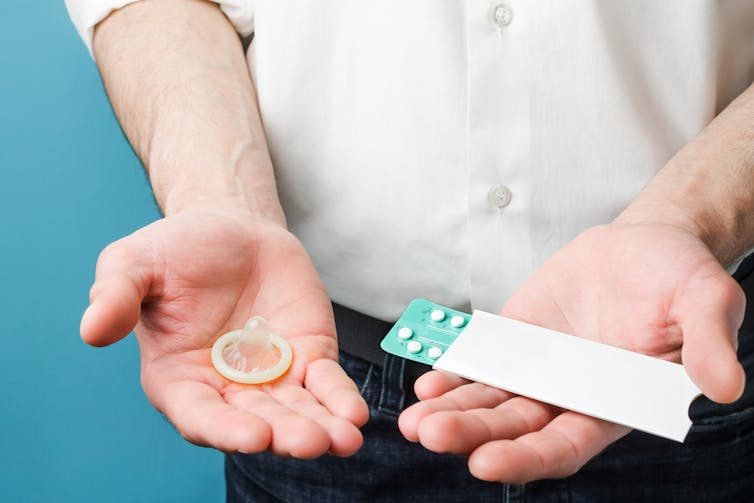
A man holds a condom in one hand and a blister pack of birth control pills in the other.
If the pill proves to be effective in phase 3 trials, it would give men another contraceptive option.
TanyaJoy/ Shutterstock

Most of these attempts used one of two main approaches to prevent pregnancy.

One method involves injecting a substance into the vas deferens (a tube leading from the testes to the urethra). This substance filters out and damages sperm during ejaculation. This substance can be flushed out through a minor procedure if the man wishes to become fertile again.

The drawback of this method is that it requires a minor surgical procedure (an injection into the scrotum) and that the man has to have a further procedure to reverse its effects.

The second route involves stopping sperm production altogether by lowering the hormones that cause sperm to be made in the testes.

The most successful of these trials used an injectable progestogen (a synthetic version of the sex hormone progesterone). This injectable signalled the brain to stop producing follicular stimulating hormone (FSH) and lutenising hormone (LH), which normally signal the testes to produce sperm and testosterone.

However, suppressing LH also turned off the testosterone in the testes that is needed for normal, healthy function in men. To counteract the loss of testosterone, this contraceptive approach required men to take an “add back” testosterone – either as a tablet or a gel applied to the skin.

But a major trial testing this method was stopped early because of the hormonal side-effects participants experienced, including mood swings, acne and changes to sex drive.

There’s a long way to go before the new drug can be considered suitable for use as a male contraceptive. But this new approach shows a lot of promise because it avoids upsetting hormonal balance and can be taken orally – rather than requiring an invasive procedure.


Get your news from actual experts, straight to your inbox. Sign up to our daily newsletter to receive all The Conversation UK’s latest coverage of news and research, from politics and business to the arts and sciences.

The Conversation

Susan Walker has previously received funding from Bayer PLC who manufacture contraceptive devices.

ref. Hormone-free male contraceptive pill passes first safety test – https://theconversation.com/hormone-free-male-contraceptive-pill-passes-first-safety-test-262083