J.D. Vance is wrong about history – here’s why this matters for Ukraine

Source: The Conversation – UK – By Chris Smith, Course Director, History, Coventry University

In a recent Meet the Press interview, the vice-president of the US, J.D. Vance, argued in relation to Russia’s illegal invasion of Ukraine: “This is how wars ultimately get settled. If you go back to world war two, if you go back to world war one, if you go back to every major conflict in human history, they all end with some kind of negotiation.”

Vance was responding to a question from the NBC news anchor, Kristen Weller, who asked: “If Russia is allowed to keep any of the territory that it illegally seized, what message does that send to China? Does it give China a green light to invade Taiwan? Does it give Russia a green light to invade other European countries, which is what your European allies are concerned about?”

Vance’s response was clearly his way of saying that the war in Ukraine would have to end in a negotiation, with the suggestion that some sort of territorial concessions on Ukraine’s part would naturally flow from that process.

But he was wrong. In fact, few major wars in recent history have ended in negotiation. Let’s take Vance’s two examples. The second world war in Europe ended with the Soviet capture of Berlin and Germany’s dictator dosing himself with cyanide and putting a bullet in his own brain. The war against Japan ended with Hirohito’s empire on the verge of famine, its infrastructure destroyed by American fire. The Soviets had invaded Manchuria, Sakhalin and the Kuril Islands, and were threatening to invade Hokkaido. To cap it all, the Americans were also threatening to invade Kyushu and then Honshu. But before that came to pass, the US deployed superweapons. Japan surrendered just days after the atomic bombings and the Soviet intervention.

As for the first world war, that ended with an armistice on November 11 1918 following the collapse of the German armed forces. The peace treaty, the Treaty of Versailles, was later signed in 1919. The Germans were not invited to those negotiations and the terms of the treaty were imposed upon them. This led to the partition of Germany, the loss of its empire, its military reduced to a rump, and a reparations bill of 20 billion gold marks (£6.6 billion).
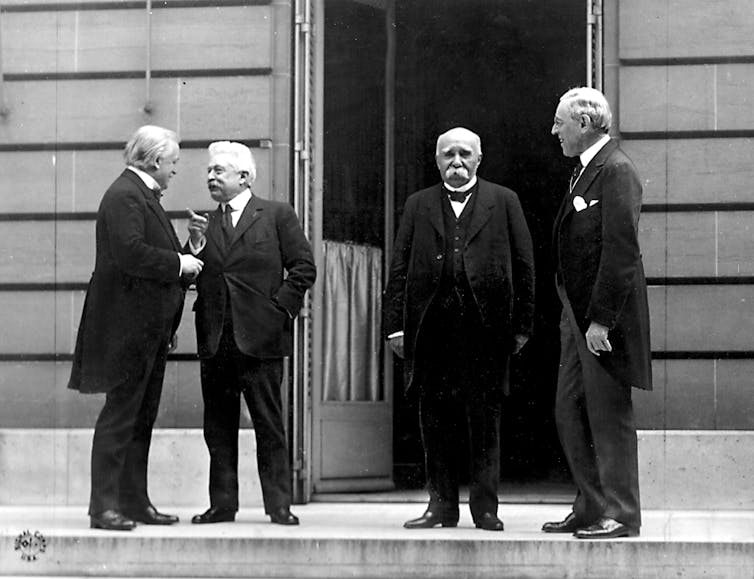
The 'Big Four' at the Versailles conference: Britain's David Lloyd George, Vittorio Orlando of Italy, Georges Clemenceau of France and US president Woodrow Wilson.
The ‘Big Four’ at the Versailles conference: Britain’s David Lloyd George, Vittorio Orlando of Italy, Georges Clemenceau of France and US president Woodrow Wilson.
Edward N. Jackson (US Army Signal Corps)

So, which major wars does Vance mean? Contrary to his pronouncements, clearly not the first or second world wars. If we look at the major wars a century prior, do we see what he is talking about?

The Napoleonic wars came to an end with coalition forces engaged in a full-scale invasion of France and entering Paris on March 30 1814. Napoleon abdicated on April 6 and was exiled to Elba. He escaped in 1815, returned to arms and was defeated at Waterloo. He was exiled again, even further away, to Saint Helena. Meanwhile after the French capitulation, a treaty was signed in Paris in November 1815, imposing a large fine, a foreign occupation and the loss of territory. So presumably Vance wasn’t referring to these conflicts.

Perhaps Vance was thinking of some of the rather smaller 19th-century wars which ended with, at least nominal, negotiated settlements.
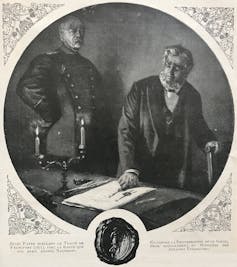
Illustration showing French foreign minister, Jules Favre signing the Treaty of Frankfurt in 1871 as German chancellor Otto von Bismarck looks on.
Watched by German chancellor Otto von Bismarck, the French foreign minister, Jules Favre, puts his seal on the Treaty of Frankfurt.
Cliche Manuel priz chez Falise/Wikimedia Commons

The Crimean war ended with another Treaty of Paris in 1856 and involved Russia agreeing to the neutrality of the Black Sea and the loss of the territories it had captured from the Ottoman empire.

The Franco-Prussian war of 1870-71 ended with the Treaty of Frankfurt in 1871, which saw France lose territory in Alsace and Lorraine. Ultimately, these wars ended with negotiated capitulation.

Negotiation or capitulation?

“Negotiation” is what Vance says regarding Russia and Ukraine. But the administration he serves has already suggested that any negotiation will involve Ukraine giving up land. President Donald Trump came away from the recent summit in Alaska talking about Ukraine giving up its territory, despite the fact that territory is not something that can simply be negotiated away over the heads of the Ukrainian people. This all sounds rather more like Ukrainian “capitulation” rather than a “negotiation”.

A friend from the Ukrainian diaspora said to me recently: Ukraine will be “forced to erase itself to make Russia happy, and that has been happening for hundreds of years”. They, as she noted, have always refused. Contrary to Vladimir Putin or Vance’s plans, the Ukrainians have their own ideas about their national destiny.

Vance is wrong for another reason. Ukraine’s defeat would represent perhaps the greatest US foreign policy disaster since the Vietnam war. In 2025 the US still claims to be the world’s only true superpower; its support and weaponry has helped keep Russia from the gates of Kyiv without firing a shot or placing a single US soldier on the ground.

Russia, by contrast – long a rival for the superpower mantle – has endured multiple recent foreign policy setbacks. Not least of these is the failure to dismantle Ukraine, which was supposed to take a matter of days. But also, the collapse of its client regime in Syria and Israel’s humiliation of Iran, another longstanding ally.

Things do not need to be as they are. Trump and Vance could assist Ukraine securing the just peace its president, Volodymyr Zelensky, is calling for. They could allay European fears about Russia by making it clear to Putin that aggression will not be rewarded. But from everything they’ve said, this is not the path they want to take. Instead, while Vance misinterprets history, Ukraine continues to bleed.

The Conversation

Chris Smith does not work for, consult, own shares in or receive funding from any company or organisation that would benefit from this article, and has disclosed no relevant affiliations beyond their academic appointment.

ref. J.D. Vance is wrong about history – here’s why this matters for Ukraine – https://theconversation.com/j-d-vance-is-wrong-about-history-heres-why-this-matters-for-ukraine-263951


Champion tennis player Monica Seles has myasthenia gravis – what is it and how does it affect sufferers?

Source: The Conversation – UK – By Adam Taylor, Professor of Anatomy, Lancaster University

The tennis legend revealed recently that three years ago she was diagnosed with the rare autoimmune condition. lev radin/ Shutterstock

Former tennis star Monica Seles has revealed she has been diagnosed with myasthenia gravis, a rare autoimmune condition that affects how the muscles work. The multiple Grand Slam champion says she was actually diagnosed three years ago after experiencing trouble with her vision and weakness in her arms and legs.

It is estimated that myasthenia gravis affects between three and 12 in every 100,000 people and occurs when the body attacks the neuromuscular junction – a specialised connection between the muscles and the body’s neurons (nerve cells). This reduces the ability to transmit neurotransmitters (chemical messengers) across the junction, affecting the way the muscles contract and function.

The most common signs of the condition are weakness of the muscles that move the eyes, drooping of one or both eyelids and blurred or double vision. Less common ocular symptoms include dry eyes, pain and tearing.

Cardiac changes are also commonly seen and arrhythmia (abnormal heart beat) is also common. The condition also weakens the facial muscles, making it more difficult to physically express emotions.

Other voluntary movements can be affected, too – particularly when moving the arms and legs. This weakness can make regular daily tasks more difficult. This symptom often worsens the more activity you do, while improving with rest.

Myasthenia gravis can affect people of any age, though in women it tends to emerge between the ages of 20 and 40. In men it tends to occur over the age of 60. It’s not considered an inherited condition, so it can occur even in people with no family history of the condition.

The condition is extremely rare in infants, though there’s a form of the myasthenia gravis that can be passed from the mother to her foetus. This causes the unborn child to acquire antibodies across the placenta, which can temporarily lead to symptoms for a few months after birth. It affects up to 30% of children whose mothers have myasthenia gravis.

Symptoms occur between three and 72 hours after birth and can include poor sucking, respiratory difficulty, facial muscle weakness or paralysis and weak muscle tone.

In the past 20 years, there has been a rise in the incidence of myasthenia gravis – particularly in over 65s. It’s unclear what factors are driving this increase. It could be due to improved diagnostics, longer life expectancy and the natural deterioration of the immune system that occurs with ageing.

A drawing depicting the neuromuscular junction.
The condition affects the neuromuscular junction, changing how the muscles function.
ALIOUI Mohammed Elamine7/ Shutterstock

While most people with myasthenia gravis have a near normal lifespan, some research suggests the condition may lead to premature death – potentially due to the effect that the condition has on the muscles needed for breathing and swallowing.

It is estimated that 20% of people with myasthenia gravis will experience a respiratory crisis. This typically happens within the first two years of diagnosis.

Managing muscle symptoms

It isn’t entirely clear what causes myasthenia gravis, but the thymus gland, located in the chest, is believed to be involved in the condition. This gland is largest in childhood, as it plays a role in forming new immune cells, but shrinks with age.

The thymus gland is believed to produce the antibodies which attack the neuromuscular junction – leading to myasthenia gravis. Adding strength to this theory are findings that patient with myasthenia gravis have better health outcomes and lower risk of premature death after having their thymus removed.

There’s currently no cure for the myasthenia gravis. Available treatments focus on reducing muscle weakness which can help to improve quality of life – particularly when symptoms worsen.

Pyridostigmine is often the first-line treatment. This medication improves communication between the nerves and the muscles by preventing the breakdown of the neurotransmitter acetylcholine that is found in the neuromuscular junction.

Corticosteroids, such as prednisolone, are also often used when pyridostigmine doesn’t work or when symptoms worsen. These steroids reduce inflammation and lower the immune system’s ability to damage the body’s tissues. Only low doses of these types of drugs are used as long-term use can have side-effects such as bone thinning (osteoporosis), increased blood sugar levels and fatigue.

Immunosuppressants can also be beneficial as they decrease the body’s attacks on its tissues and reduce symptoms.

During symptom flare-ups, treatments such as monoclonal antibodies or complement inhibitors can help, by reducing the body’s natural processes for fighting infections. In autoimmune diseases this process is overactive, leading to inflammation and tissue damage.

This is one reason why these treatments don’t come without risks. For instance, complement inhibitors can increase the risk of certain bacterial infections such as Neisseria meningitidis, which can result in meningitis.

Therapeutic plasma exchange has also been shown to reduce the number of harmful antibodies circulating in the blood. This treatment works by removing the plasma from a sample of a person’s blood using a machine, and replacing it with donated plasma or sterile fluid. This has a significant and positive impact on the severity of symptoms.

Seles isn’t the first famous person to talk about her diagnosis in the hope of educating people about the disease. Actors Sir Laurence Olivier and Suzanne Rogers, US Olympian James Carter and Christopher Milne – son of Winnie the Pooh author AA Milne – were all diagnosed with the condition. Walt Disney apparently also based Sleepy, one of the seven dwarves, on his friend who suffered from the condition.

With increasing awareness and better diagnostics, treatment options for myasthenia gravis are improving, making it easier for people who suffer with this incurable condition to lead full and active lives.

The Conversation

Adam Taylor does not work for, consult, own shares in or receive funding from any company or organisation that would benefit from this article, and has disclosed no relevant affiliations beyond their academic appointment.

ref. Champion tennis player Monica Seles has myasthenia gravis – what is it and how does it affect sufferers? – https://theconversation.com/champion-tennis-player-monica-seles-has-myasthenia-gravis-what-is-it-and-how-does-it-affect-sufferers-263242

Cigarette filters do nothing for smokers’ health and just create plastic pollution – they should be banned

Source: The Conversation – UK – By Jonathan Livingstone-Banks, Lecturer & Senior Researcher in Evidence-Based Healthcare, University of Oxford

Kristine Rad/Shutterstock.com

Cigarette filters were widely introduced in the 1950s, ostensibly to make smoking less harmful. With growing public concern about lung cancer and other smoking-related diseases, the tobacco industry responded not by making cigarettes safer, but by making them seem safer. Filters were the perfect innovation – not for health, but for public relations.

Over 70 years later, we know that filters don’t reduce harm. In fact, they may exacerbate some risks. By softening smoke and making it easier to inhale deeply, filters may actually raise the risk of lung cancer. In the early 1950s, one popular filter type even contained asbestos. Despite this, most smokers today still believe filters make cigarettes safer.

Beyond the health deception, cigarette filters create an environmental disaster. They’re made of a plastic called cellulose acetate. They don’t biodegrade but break down into microplastics, polluting our rivers and oceans.

And there are a lot of them. Cigarette butts are the single most littered item on the planet. An estimated 4.5 trillion are discarded each year, and roughly 800,000 metric tonnes of this plastic waste enters the environment annually. While legislation has restricted other single-use plastics like bottles, bags and straws, cigarette filters have largely escaped such regulatory attention.

Under pressure, some tobacco companies now market “biodegradable” filters made from new materials. But these are a false solution. Even so-called biodegradable filters offer no health benefit and continue to pollute ecosystems. They serve the industry by creating an illusion of environmental responsibility, all while maintaining the false perception that filters themselves are benign or necessary.

So why not ban cigarette filters outright?

Cigarette filters are among the most harmful single-use plastics still in global circulation. And unlike many other pollutants, they serve no essential purpose. The WHO Framework Convention on Tobacco Control already advises against measures that sustain the perception of reduced harm, and cigarette filters fall squarely into that category.

Banning cigarette filters would remove the illusion of safety from filtered cigarettes. It could reduce smoking prevalence, as unfiltered cigarettes are generally harsher and less palatable. And it would eliminate one of the most widespread sources of plastic pollution, preventing hundreds of thousands of tonnes of plastic waste each year.

If we can ban plastic straws, surely we can ban cigarette filters. In fact, it’s already been done. Santa Cruz in California voted to ban cigarette filters in 2024.

People cleaning litter on a beach. One holds a handful of plastic straws.
We managed to ban plastic straws, so why not cigarette filters?
David Pereiras/Shutterstock

Now is the perfect time to act. Plastics are on the global conscience. This month in Geneva, world leaders negotiated what could become the first legally binding UN treaty addressing plastic pollution from production to disposal. This treaty is a rare opportunity to tackle the root causes of plastic waste globally.

The current draft of the treaty includes cigarette filters, but only partially. Plastic cigarette filters are listed in Annex X, a category concerned with voluntary or mandatory restrictions. This leaves room for continued use, including so-called “eco” filters, and does not mandate a total phase-out.

If all cigarette filters (not just plastic ones) were listed in Annex Y, they would be set for a complete and mandatory ban. August negotiations continued without a final agreement, and negotiations will continue at a later date, meaning there is still time to act.

Health and environmental groups, including the World Health Organization, Action on Smoking and Health, and the Stop Tobacco Pollution Alliance, are calling for strong commitments on cigarette filters. What could be stronger than an outright ban?

Banning filters won’t end smoking overnight or eliminate plastic pollution. But it would be a meaningful and symbolic step toward aligning environmental and public health goals. It would remove a harmful and misleading product from the market, reduce pollution and make cigarettes more honest.

The Conversation

Jonathan Livingstone-Banks has received funding from the US National Institutes of Health (NIH), the National Institute for Health and Care Research (NIHR) and Cancer Research UK (CRUK).

Jamie Hartmann-Boyce receives research (including research consultancy) funding from groups involved in tobacco control, including the Truth Initiative, Cancer Research UK, and the US Food and Drug Administration.

ref. Cigarette filters do nothing for smokers’ health and just create plastic pollution – they should be banned – https://theconversation.com/cigarette-filters-do-nothing-for-smokers-health-and-just-create-plastic-pollution-they-should-be-banned-263374

Air conditioning isn’t the only answer

Source: The Conversation – UK – By Will de Freitas, Environment + Energy Editor, The Conversation

Keeping cool in Manchester, England. Iordanis / shutterstock

I recently returned from visiting family in America and was struck by how hot I felt back home in London, despite the temperatures being lower. Partly, this was down to humidity: London is sticky in summer, while Utah, where my uncle lives, is very dry.

But it’s also down to the buildings. My brick house absorbs and retains heat while every building I went to in America was either well ventilated or had air conditioning blasting away.

That contrast got me thinking: as the UK warms, can it keep its homes and workplaces comfortable without relying solely on air-con?

Jesus Lizana, Nicole Miranda and Radhika Khosla at the University of Oxford say that northern Europe is dangerously unprepared for the heat of the near future.

They looked at the coming demand for cooling using the concept of “cooling degree days”, which essentially assesses how often people will need to take extra measures, like switching the air-conditioning on, to keep themselves cool.

They found countries like Nigeria and Chad will see the biggest absolute rise in cooling degree days. “A clear indication that Africa is shouldering the burden of a problem it did not create”, they note.

But they also found that countries in northern latitudes will face the greatest relative increase in uncomfortably hot days.

“Of the top ten countries with the most significant relative change in cooling degree days as global warming exceeds 1.5°C and reaches 2°C, eight are located in northern Europe.”

It gets worse. “Buildings in the northern hemisphere”, they write, “are primarily designed to withstand cold seasons by maximising solar gains and minimising ventilation – like greenhouses.”

The solution seems obvious: let’s all get air-con.


Read more:
Northern Europe faces biggest relative increase in uncomfortable heat and is dangerously unprepared – new research


Coal-powered air-con?

But Mehri Khosravi says it isn’t that simple. An energy researcher at the University of East London, she warns that:

“Cooling requires huge amounts of energy at the exact moments when demand is already high. In 2022 and 2023, the UK had to briefly restart a coal power plant to keep the lights – and the air conditioners – on.”

Khosravi says the UK and similar countries should instead focus on reducing demand for cooling.

In winter, she says, we rightly focus on better insulation to reduce heating demand, as “it’s a lot harder to warm a house than it is to stop heat escaping in the first place.”

So how do we stop a northern European brick house from heating up in the first place?

Khosravi suggests we look to southern Europe for inspiration, where 35°C summers were common long before climate change. Her suggestions include shading and shutters to block sunlight before it enters a building, natural ventilation to let heat escape in cooler hours, and reflective or light-coloured buildings that reflect sunlight.

White wall, blue shutters, black cat
Mediterranean cooling tactics. Cat optional.
Natalia Dobryanskaya / shutterstock

It’s hard to imagine Scarborough being turned into Santorini any time soon. But while we wait to adapt our buildings for the new normal, Khosravi says we should adapt our behaviour too.

In Spain, the hottest hours are for siestas. Outdoor activities are paused, and people are more active in the mornings and evenings. Culturally, they understand that keeping curtains closed during the day and opening windows at night can prevent homes from overheating.

In the UK, heat is still culturally framed as “good weather”. Sunny weekends trigger beach trips, barbecues and more outdoor activity, even when it’s dangerously hot. This mismatch between perception and risk is a major public health challenge.


Read more:
How Britain can beat the heat without becoming addicted to air conditioning


Smarter cooling

Perhaps there are smarter ways to cool down. Academics in Australia recently published research suggesting a “fan first” approach, even when air-conditioning is installed.

“The approach is simple”, they write: “use electric fans as your first cooling strategy, and only turn on air conditioning when the indoor temperature exceeds 27°C.”

These fans use only a tiny fraction of the electricity used to run air conditioning, but “can make you feel up to 4°C cooler”. In their research, the Australian team increased an office’s air conditioning set-point from 24 to 26.5°C, with supplementary air movement from desk and ceiling fans. This “reduced energy consumption by 32%, without compromising thermal comfort”.


Read more:
Tempted to turn on the aircon? Science says use fans until it’s 27°C


Air conditioning doesn’t have to mean the typical rows of humming white boxes. Heat pumps – already central to Britain’s low-carbon heating plans – can also keep homes cool in summer.

Essentially, they’re able to act like reversible air conditioners: in winter, they draw warmth into a building, and in summer they can run in reverse to push heat out.

Crucially, they do so with far greater efficiency than traditional systems. Theresa Pistochini, an engineer at UC Davis in California, points out that heat pumps can be “anywhere from 200% to 400% efficient”, meaning they move more than twice as much energy (heat) than the energy required to operate them.

Her analysis found that “buying a heat pump today will reduce global-warming impact in almost all geographical locations.”


Read more:
Heat pumps will cool your home during the hottest of summers and reduce your global warming impact


For households, this could mean one appliance that covers both heating and cooling, slashes energy bills, and avoids the climate-damaging lock-in of conventional air conditioning. For policymakers, heat pumps may offer a way to meet surging cooling demand without blowing the carbon budget.

But heat pumps aren’t a perfect fix. Installation is costly, many older homes will still need upgrades, and there aren’t enough trained engineers. They’ll need further support if they’re to become a mainstream alternative to air-con.

Nonetheless, together with simple measures like fans and shutters, heat pumps point to a smarter approach to cooling. And it could be made even more sustainable if paired with clean energy from rooftop solar.

Homes equipped with solar panels can generate electricity during the hottest parts of the day – exactly when air conditioners or heat pumps are working hardest.

Tom Rogers and colleagues at Nottingham Trent University say solar will play a “pivotal role” in “addressing summer cooling demand and enhancing climate resilience”. They analysed satellite images to estimate that rooftop solar could provide “nearly one third” of the city’s electricity demand.


Read more:
Rising temperatures mean more air conditioning which means more electricity is needed – rooftop solar is a perfect fit


The UK is warming, and staying comfortable in hotter summers is a must. But there’s more than one way to cool down. Simple measures like fans, efficient heat pumps and rooftop solar – combined with smarter building design and passive cooling – could keep homes safe, energy use low and emissions in check.


This roundup of The Conversation’s climate coverage comes from our award-winning weekly climate action newsletter. Every Wednesday, The Conversation’s environment editor writes Imagine, a short email that goes a little deeper into just one climate issue. Join the 45,000+ readers who’ve subscribed.


The Conversation

ref. Air conditioning isn’t the only answer – https://theconversation.com/air-conditioning-isnt-the-only-answer-264063

Sun dogs, rainbows and glories are celestial wonders – and they may appear in alien skies too

Source: The Conversation – UK – By Peter Berthelemy, PhD Candidate in Atmospheric Physics , University of Bath

Earth may not be the only planet with sun dogs, as shown here in a wintry landscape. Guozongxia/Shutterstock

Every once in a while, you may look up towards the Sun and see strange bright lights on either side of it. Or perhaps you’ll be sitting in an aircraft, looking out the window at its shadow and see a circle of light, like a halo below (known as glories). Or, if you’re really adventurous, maybe you’ll even be out on a midnight walk with a full moon lighting your way, and see what appears to be a rainbow encircling the moon.

These are all beautiful examples of atmospheric optical phenomena. And a new paper has suggested they may appear in alien skies too.

These celestial wonders can tell us a lot about the state of the atmosphere at home on Earth as well as on other planets. Rainbows, for instance, the most well-known of these phenomena, can only form when light passes through spherical liquid droplets, like our normal rain on Earth. Therefore, there must be spherical liquid droplets in the atmosphere where the rainbows are observed.

Most planet atmospheres have some kind of crystalline aerosols (clouds of tiny particles) in them, from sodium chloride in Io (one of Jupiter’s moons), to carbon dioxide crystals in Mars. On Earth, these are generally ice crystals, often found in clouds as snowflakes. The orientation of these crystals, and how they change the light, dictates the type of optical phenomena you can see.

Pillars of coloured light
Light pillars over London, Ontario Canada.
Ray Majoran/Wikimedia, CC BY-SA

Sun dogs are another of these phenomena, where bright lights appear on either side of the Sun, sometimes even splitting white light into the colours of the rainbow. They form because of the light being bent by horizontally oriented hexagonal ice crystals high up in the atmosphere. If you want the best chance of seeing these, you should try to be at the same latitudes as Europe or Argentina during wintertime. Look for high altitude wispy clouds that are in front of the Sun, and you might get lucky.

Horizontal ice crystals can also create light pillars in extremely cold conditions, which look like coloured beams of light trailing to clouds over head. Vertical crystals form parhelic circles – a circle of light at the same height as the Sun. And crystals aligned with the electric fields above thunderstorms create crown flashes.

The new paper proposes that, from what we know of our own atmosphere, we can presume that similar optical phenomena happen on planets outside of our solar system (called exoplanets). It’s just a matter of spotting them and finding out why they occur.

Previous studies have shown that on many exoplanets the crystalline aerosols in their atmospheres are moved around and oriented in a multitude of different ways, much like on Earth.

Magnetic fields swirl around the planet, as they do on Earth, pushing and pulling along field lines. On Earth, this can be seen as the northern lights phenomena. Radiation pressure from a planet’s parent star pushes the crystals using the power of light, much like how the wind pushes boats. And the wind, often much faster than anywhere on Earth, speeds around the exoplanet, rushing from the hot, star-facing side of the exoplanet to the colder space-facing side as the planet spins.

A special type of exoplanet, hot Jupiters (so named because they’re huge, gassy and very hot) generally have incredibly fast winds (up to 18,000km/h) and high densities of crystalline aerosols, much like an incredibly fast-moving sandstorm.

This means that the main way that the crystals are oriented is through the superfast winds spinning around the planet. Imagine a fleet of boats all randomly turned around in a patch of ocean, then a massive gust of wind comes, turning them all so that they’re facing the same direction.

The researchers on the new paper previously used the James Webb Space Telescope (JWST) to find evidence for tiny quartz crystals in the high altitude clouds of a hot Jupiter 1,300 light years away from Earth (WASP-17 b). These crystals have an elongated shape, like boats, so are more likely to be oriented with the wind. This led them to think about what optical properties could be seen with the wind-aligned crystals.

The optical phenomena that come from the crystals being oriented the same way cannot be seen by normal cameras. But scientists can use instruments such as those on the JWST to observe these effects.

We have already gained valuable information about faraway atmospheres from looking at their optical phenomena using the JWST. For example on Venus, rainbows and glories have been used by scientists to decipher the mysteries of Venus’ extreme heats and yellow colour.

A similar technique of observing glories has been used to detect the presence of long-lasting clouds on the exoplanet WASP-76b. The new knowledge of these clouds gives us insight into the exoplanet’s atmosphere. Now we know that there can be conditions for a stable temperature, which surprised scientists as half of the planet is hot enough to melt iron.

An artist’s impression of glory on exoplanet WASP-76b.
ESA, CC BY-SA

We can also guess what optical effects might occur on planets where we know what the atmosphere is made of. For example, in the high atmospheres of Jupiter and Saturn, where a special type of ammonia crystals are concentrated, we would expect to observe four separate sun dogs. Alas, on Earth, we can only ever see two at a time due to the shape of our atmospheric ice crystals.

Who knows what other wondrous phenomena we may see on other worlds. Who’s to say whether there couldn’t be a planet surrounded by continual rainbows? There is much more to learn about so many exoplanets. Optical phenomena such as sun dogs can tell us huge amounts about their atmospheres, which could help us in the search for habitable planets in the future.

The Conversation

Peter Berthelemy does not work for, consult, own shares in or receive funding from any company or organisation that would benefit from this article, and has disclosed no relevant affiliations beyond their academic appointment.

ref. Sun dogs, rainbows and glories are celestial wonders – and they may appear in alien skies too – https://theconversation.com/sun-dogs-rainbows-and-glories-are-celestial-wonders-and-they-may-appear-in-alien-skies-too-263360

Forcing Zelensky to hand Putin Ukraine’s ‘fortress belt’ in Donetsk will lose it the war

Source: The Conversation – UK – By Rod Thornton, Senior Lecturer in International Studies, Defence and Security., King’s College London

In the recent summit talks in Alaska designed to halt the Russia-Ukraine war, Vladimir Putin demanded that Kyiv cede control of the entirety of its Donetsk oblast (region) to Russia. But this would effectively be tantamount to an acceptance of overall defeat for Ukraine.

In giving up this region, Kyiv would also be giving up its principal defensive barrier against further Russian encroachment into the whole of Ukraine – that is, it will lose its “fortress belt”. This is the name given (by the Russians themselves) to a series of fortified Ukrainian-held cities, towns and settlements in the west of the Donetsk region. This belt roughly links the city of Slovyansk in the north to Kostyantynivka, some 50 km to the south.

The current situation on the battlefield needs to be viewed with a certain context in mind – that of geography. The state that we now call Russia (which has included Ukraine for much of its existence) has been subject to many invasions throughout its long history. Foreign invaders – whether coming from the east, south or west – were generally able to make rapid initial progress in their invasions, not least because Russia had few natural barriers that could act as defensive lines.

In particular, the open steppe lands, lacking hilly or mountainous terrain, have represented an open invitation to invaders. This issue still pertains. But today, ironically, these largely indefensible steppe lands are Ukrainian territory that is under threat from Russian forces.

In light of this, Kyiv cannot rely on terrain to form defensive lines. It has to rely on creating urban barriers. Towns and cities are notoriously difficult to capture or to fight through. Buildings, especially large ones, provide ideal cover and fire points for defenders. Getting into urban areas is difficult because of the channelling effect of the road systems. Obvious routes can be well defended with mines, obstacles and covering fire. Rubble also makes movement difficult. Urban scenarios very much favour the defender.

The normal tactic for an assaulting force would be to try and outflank and surround such urban areas and to then to essentially lay siege to them to prevent their resupply and thus force their surrender. This is what happened, but on a smaller scale, with the capture of Mariupol by Russian forces early in the war.

The other alternative has been to “squeeze out” Ukrainian forces from any town they are holding. In such scenarios, towns have been enveloped on three sides by Russian troops. This has then forced the under-pressure Ukrainians to withdraw though the only remaining egress routes. Russian forces then occupy the abandoned town.

This is what happened at towns that Ukrainian forces lost earlier in the Donbas region: Avdiivka, Bakhmut and Soledar.

But both of these forms of attack on urban areas are currently being denied to Russian forces. This is because of the complex series of Ukrainian defensive lines that have been established now between the series of towns and cities in the Donetsk fortress belt. These make use of minefields, anti-tank obstacles, enfilading fire (firing along the enemy line to inflict maximum casualties) provided by tube artillery and copious drone use.

Because the Russians have largely been unable to break through these lines they have been prevented from surrounding or enveloping any of the major urban areas within the fortress belt.

Last line of defence

It is strategically vital for the Ukrainians that this belt continues to hold back the Russians. It appears that one of the main aims of the 2025 summer offensive by Moscow (according to Russian officers captured by the Ukrainians) has been to break through this belt. It was said to represent the “poslednii ryvok” (the “final push”) that would settle the war’s outcome in Russia’s favour.

ISW map showing the potential for a rapid Russian advance west of the Donetsk oblast.
Handing over the remainder of the Donetzk oblast, with its ‘fortress belt’ of fortified cities, would clear the way for a rapid Russian advance into central Ukraine.
Institute for the Study of War

But this has not happened and looks unlikely to happen anytime soon. Indeed, as the Institute for the Study of War put it recently, Russian forces “are engaged in an effort … to seize [the ‘fortress belt’] that would likely take several years to complete”.

Hence, it becomes easier to understand why Putin needed to make the demand that he did at Anchorage. What cannot be achieved on the ground in terms of breaking through the fortress belt he is trying to achieve via a peace deal brokered with US assistance.

Gaining control of the west of the Donetsk region is the key to winning the war. Putin knows this. If Donetsk and its fortress belt are given up, then the open steppe land to the west would be exposed to Russian advances. Great swaths of Ukrainian territory would rapidly fall.

As one Russian source put it this week, the fortress belt “is the last serious line of defence for the Ukrainian Armed Forces. Beyond it, Kyiv has no other prepared lines of defence to Zaporizhzhia and the Dnipropetrovsk region … [and] … the Russian army can … advance to the Dnieper River”.

If Russian forces came to be camped on this part of the Dnieper, then it’s hard to imagine that Ukraine would not then have to accede to yet further, strategically damaging, territorial demands from Moscow. With such a scenario in mind, the future course of the whole war hinges on Ukraine not giving up its fortress belt in western Donetsk.

Perhaps an irony in Putin’s demand that the whole of the Donetsk region be handed over is that it could be seen as coming from a position of what appears to be weakness and not strength. He cannot wait the years it may take to seize the cities and towns that form the fortress belt. Russia cannot remain on a war footing for too much longer, according to reliable reports on the state of its economy.

But even so, Kyiv may have to accede to Putin’s demands because it will potentially come under pressure from the Trump administration, which itself does not want to wait years to see a resolution to this conflict. If Kyiv does accede, though, then this may amount to Ukraine accepting its overall defeat. It may, indeed, lose the war.

The Conversation

The authors do not work for, consult, own shares in or receive funding from any company or organisation that would benefit from this article, and have disclosed no relevant affiliations beyond their academic appointment.

ref. Forcing Zelensky to hand Putin Ukraine’s ‘fortress belt’ in Donetsk will lose it the war – https://theconversation.com/forcing-zelensky-to-hand-putin-ukraines-fortress-belt-in-donetsk-will-lose-it-the-war-263980

Phones and other tech can enhance teens’ connection to nature

Source: The Conversation – UK – By Samantha Friedman, Lecturer in Applied Psychology, University of Edinburgh

New Africa/Shutterstock

Screens, and technology more generally, are often seen to be at odds with engagement and connection with nature. Teenagers are implored to put down their phones and go outside instead.

This is a key premise in recently announced measures by the UK government to “to re-connect young people with the world around them”. Funding for youth clubs and after-school activities is intended to remedy a situation in which young people are “stuck in their bedrooms or behind a screen”.

Certainly, investment in youth activities, especially those which support young people to build their relationships with nature, is necessary and welcome. But viewing these as merely an antidote to chronic screen use is missing the point entirely.

Screens can be an important part of how young people interact with and understand the natural world. Those screens might be the very key to getting teenagers out of their bedrooms and into the outdoors.

Placing blame

At first glance, it is tempting to place the blame on screens when considering the reasons behind why many people have spent less time outside over the last few decades.

Author and journalist Richard Louv, in his popular book Last Child in the Woods, does just this. He points to time spent watching television and using computers as contributing to a rise in what he calls nature deficit disorder – an ailment related to human separation from nature. Nature deficit disorder supposedly affects physical health and attention spans, among other negative outcomes (though many criticisms exist about this concept).

Alongside suggestions that people of all ages have spent less time outdoors over past decades, mental health difficulties in teenagers have increased in recent years. Technology is often pointed to as one potential driving force. It is important to note that the current evidence appears mixed about whether this is the case.

Given the benefits to wellbeing associated with spending time in nature, it is easy to see how a certain narrative emerges: that teens are suffering from poor mental health because they spend too much time indoors on screens, and this problem could be solved if only they would put their phones away and spend time looking at trees.

Connection to nature – the relationship that a person has with the natural world – is also known to dip in early adolescence (around age 12) and remain low until early adulthood. Encouraging young people to spend more time outside could address this issue, too.

However, when approached with the mentality of “screens versus time outdoors”, this risks being a pointless effort. Technology is central to nearly everything we do, for better or worse. It is not realistic to suggest that the answer to any of these modern difficulties – poor wellbeing, increased screentime, or decreased connection to nature – lies in restricting technology or framing time outdoors as a replacement.

Nature with tech

Instead, technology should be seen to have a role in supporting outdoor experiences. At a basic level, technology helps make the outdoors more accessible for many. Maps, location apps such as what3words and location tracking can ensure people stay safe.

Group of young people hiking and looking at phone
Tech can make access to nature and the outdoors easier.
f.t.Photographer/Shutterstock

Technology can be used to enable communication for people who communicate differently, such as through the use of iPad apps or speech-generating devices. It can help those with sensory needs feel more comfortable going outside; for instance, using a phone and headphones to listen to music can help block out unwanted sensory stimuli outdoors.

Placing higher value on tech-free outdoor experiences only serves to distance people and gatekeep experiences for those who can easily disconnect. People with caring responsibilities or health conditions, for instance, might find it impossible or dangerous to put their phones away completely when spending time outdoors. In many ways, it is a privileged position to be able to go tech-free outdoors.

Rather than taking an approach that views engagement with screens as the opposite to nature experiences, we should encourage young people to use their technology responsibly to support their experiences with nature.

For instance, phones can be used to identify bird song, plants, and animal tracks or to report wildlife sightings through citizen science projects. Even indoors, looking at photos of natural things, watching nature documentaries, or listening to nature sounds can help support relationships with nature.

Despite the drawbacks of social media, nature content can be an effective way in to experiencing the outdoors for many people. See, for instance, the extreme popularity of Outdoor Boys – a recently retired YouTube channel with 16.5 million subscribers which featured videos of an American man partaking in a range of outdoor activities with his children in Alaska and elsewhere.

With the potential to translate online interests into real-life experiences, embracing the power of nature-based social media content is one way of meeting teenagers where they already are.

People who have stronger relationships with nature are more likely to act in service of the environment. Building upon young people’s interest in the environment can provide opportunities to have frank discussions about the environmental effects of the technology we use every day. This could include, for instance, the rare earth minerals in our phones or the huge amount of energy used by generative AI.

Taking this more balanced approach will help young people see technology as a potential enabler of their experiences with nature.

The Conversation

Samantha Friedman does not work for, consult, own shares in or receive funding from any company or organisation that would benefit from this article, and has disclosed no relevant affiliations beyond their academic appointment.

ref. Phones and other tech can enhance teens’ connection to nature – https://theconversation.com/phones-and-other-tech-can-enhance-teens-connection-to-nature-263082

Being funny helps populist politicians create bonds and get voters on board

Source: The Conversation – UK – By Adam R. North, Early Career Researcher, Religions and Theology Department, University of Manchester

Humour has become one of the most potent weapons in the populist politician’s playbook. Comedic populists like Donald Trump, Boris Johnson, Nigel Farage and Argentinian president Javier Milei use ridicule, absurdity and sarcasm not just to entertain, but to deflect criticism, confuse opponents and present themselves as relatable outsiders. Their tomfoolery and comedic stunts often dominate headlines and capture attention online.

These uses of humour have been widely discussed in this context. But one key function of populist humour still receives too little attention: its power to mobilise disaffected voters.

My own research has examined how humour functions as a means of speaking truth to power. But I now believe that comedy, long mobilised as a subversive tool, is being appropriated by populists as a strategy for building political loyalty.

Beyond softening rhetoric or mocking political opponents, humour helps politicians create emotional bonds, build group identity and energise voters who feel let down by traditional politics and politicians. It isn’t just comic relief – it’s a call to action.

The appeal of comedic populists is often invisible to their critics. Dislike and distaste can blind people to the way these figures connect with large audiences – especially disaffected voters. This blind spot prevents understanding how humour fuels political support.

Take this New York Times guest essay from August 2024, titled Trump is losing the humor war. While it concedes that “Donald Trump is funny”, it argues his humour had lost its edge. That assessment was premature.

Throughout the 2024 campaign, Trump remained humorous – from working in a McDonald’s drive-through, to driving around as a bin man at a rally to mock Joe Biden, he deployed several humorous stunts to amplify his message and entertain supporters.

These stunts gained widespread coverage and went viral on platforms like TikTok – where, according to Pew Research, nearly half of US users under 30 now follow political news. Humour, in this context, becomes both strategy and spectacle.

Trump recognises this. On one Joe Rogan podcast – viewed over 60 million times – Rogan praises Trump’s comedic instincts. Trump replies: “You need at least the attitude of a comedian when you’re doing this business”. Considering Trump and other comedic populists’ success in the previous decade, it’s hard to disagree.

Who is mobilised by humour?

Populist humour resonates most strongly with disaffected voters – people who feel ignored or betrayed by traditional politics – and research shows that disenfranchised voters often vote for radically different candidates. In an era of declining trust in political institutions in many western nations, it’s unsurprising that voters should turn to political alternatives who break the conventional mould.

Some of these figures were comedians before they were politicians. Others cultivated humorous personas over time. Many have successfully capitalised on this situation. The best known is Ukraine’s Volodymyr Zelenskyy a former comedian who once played a fictional president on Ukrainian TV.

Other former comedians who have gone on to win national or regional office include Guatemala’s Jimmy Morales, Slovenia’s Marjan Šarec, and Iceland’s Jón Gnarr. Italy’s Beppe Grillo, a stand-up comic, co-founded the Five Star Movement which went on to enter government, though Grillo himself never held elected office.

Boris Johnson, Donald Trump, and Javier Milei all cultivated entertaining personalities through TV appearances and a variety of stunts. A consistent pattern emerges: these leaders tend to rise in contexts of low political trust, where their humour grabs attention and appeals to disaffected voters.

But another trend is equally clear: the sustainability of support for comedic populism often diminishes once in office. The performative and oppositional strengths that fuel electoral success often translate poorly into the demands of serious governance.

Zelenskyy appears to be an exception, although recent legislation threatens his approval ratings. Nevertheless, he remains popular due to the Russian invasion, and his shift from comic performer to a serious leader of resolve and emotional authenticity.

Populist humour in the media

Populist humour thrives on public attention. Social media rewards wit over substance; jokes, memes and soundbites travel fast. In a media environment driven by anger, disinformation and tribalism, comedy is a perfect vehicle of delivery. Humour creates sharable content, frames opponents as humourless and signals in-group identity.

A striking example came during Trump’s 2024 presidential campaign when he claimed that Haitian migrants were eating pets in a town in Ohio. The statement, though baseless and inflammatory, went viral. Critics expressed outrage, supporters laughed, and Kamala Harris scoffed at the absurdity. Yet, the allegation provided an effective means of communicating anti-migrant, racist rhetoric across news outlets and social media platforms.

It even inspired a parody song called Eating the Cats ft. Donald Trump, by the South African musician The Kiffness, which has racked up millions of views across social media.

This is the paradox of populist humour: it doesn’t need to be factual, tasteful or substantive. It just needs to resonate with its intended audience and spread across media platforms.

If we want to understand modern populism, we need to take its humour seriously. It’s not a distraction from politics; it’s a vital tool in the populist toolkit. Humour builds community, projects authenticity and drives participation and feelings of inclusion. For disaffected voters, it offers something traditional politics often doesn’t: a reason to laugh, and a reason to listen.

The Conversation

Adam R. North does not work for, consult, own shares in or receive funding from any company or organisation that would benefit from this article, and has disclosed no relevant affiliations beyond their academic appointment.

ref. Being funny helps populist politicians create bonds and get voters on board – https://theconversation.com/being-funny-helps-populist-politicians-create-bonds-and-get-voters-on-board-260343

The problem with Auschwitz-Birkenau’s new digital camp replica

Source: The Conversation – UK – By Emily-Rose Baker, Research Fellow, Department of English, University of Southampton

At this year’s Cannes Film Festival, the Auschwitz-Birkenau Memorial and Museum announced the launch of a new digital replica of the concentration camp for filmmakers. Titled Picture from Auschwitz, the virtual film location is designed to facilitate a range of productions set on the grounds, where preservation regulations currently restrict filming to documentaries.

Established in the town of Oświęcim in German-occupied Poland, Auschwitz consisted of three main camps where over 1.1 million European Jews were murdered: the Auschwitz I concentration camp, the Auschwitz II (Birkenau) killing centre and the Auschwitz III (Monowitz) labour camp.

With this new technology, the museum hopes to support the “true story” of the camp, “without compromising the memorial’s historical integrity”. It intends to do so not only by digitally preserving the Holocaust site, which receives over two million visitors annually, but by submitting the scripts for all new feature film projects involving the replica to a team of historians for review.

The panel that launched Picture From Auschwitz at Cannes.

A glimpse of the digitised location shows a virtual model of Auschwitz I which, as its name suggests, provides a clear snapshot of the camp’s barracks, grounds and infamous wrought iron gates. The two-minute trailer claims that the certified 1:1 digital representation is the “biggest and most detailed documentation of the camp”. It will eventually include the interior as well as exterior environment of Auschwitz I and II.

The project’s use of digital technology to safeguard Holocaust memories for future generations is symptomatic of a global shift towards digitising the Holocaust as the survivor generation passes on and heritage sites decay over time – a process accelerated by extreme weathering associated with the climate crisis.

As the Holocaust recedes from living memory, cultural institutions are increasingly reliant on digital tools to remember the past. While some have used virtual reality to digitally reconstruct and maintain key Holocaust sites, others have turned to AI to generate interactive survivor holograms.

These technologies are becoming popular educational tools designed for use in classrooms as well as museums and memorial sites.

Ethical implications

Digital memory projects protect and make Holocaust sites globally accessible. Yet these same technologies risk distorting the historical record.

In the UK, public debates concerning the ethics of digital Holocaust technologies including AI and VR have involved high profile politicians as well as scholars. Meanwhile, international bodies including Unesco and the World Jewish Congress have reported that generative AI in particular may fuel Holocaust distortion.

Picture from Auschwitz aims to address these issues and its creators purport to enable “ethical storytelling”. The director of the Auschwitz-Birkenau Foundation, Wojciech Soczewica, referred to the project on the Memorial’s website as a “powerful example of how culture and technology can unite to protect our shared human history from distortion and denial”. The replica will “preserve the relevance of the history of Auschwitz”, he added, ensuring it won’t “fade with time”.

While the virtual site digitally preserves and encourages historically rooted depictions of the camp, it cannot ensure ethical engagement with the Holocaust. In fact, its creation only raises further issues about the extent to which the Holocaust’s digitisation goes hand-in-hand with ethical modes of remembrance and representation.

A glimpse of the Picture from Auschwitz project

A wholly “authentic” depiction of any Holocaust site or experience is something that digital and filmic interventions can only gesture towards.

Even if such a depiction were possible, ethical portrayals of the Holocaust are not contingent on the accurate representation of sites themselves. They are equally concerned with the kinds of stories being told as well as formal and stylistic factors. As film researcher Archie Wolfman argues, filmmakers’ choices “about camera movements, angles, lighting and editing have as much ethical significance as what is in front of the camera”.

The implication that Auschwitz must be digitised for its legacy to be protected suggests that the wealth of material that already exists on the camp – including its extant remains, the personal belongings of victims and survivor testimonies – are no longer sufficient memorial tools. It also problematically suggests that Holocaust history must somehow keep up with digital culture to remain relevant.

The digitisation of Auschwitz perpetuates the privileging of some Holocaust sites and stories above others, such as the rural landscapes across central and eastern Europe where no human structures or visible traces of the past remain. Even within this, Picture from Auschwitz plans to offer only a selective representation of the camp complex. It excludes Auschwitz III, its network of sub-camps and the surrounding environment.

At the same time, the proposed script review process demonstrates the memorial’s involvement in presiding over cultural narratives of the event. The only artistic representations that are of value, the project implies, are those favouring realism, disregarding Holocaust films that diverge from this aesthetic. This includes stylised films like Jojo Rabbit (2019), The Cremator (1969) and Distant Journey (1949), the latter of which was shot on location in Terezín in the Czech Republic. It showed that films using Holocaust sites need not possess an indexical link to reality to meaningfully represent the event.

The replica ultimately reveals a tension between growing public demand for cultural Holocaust production and the difficulty in cultivating ethical representations of the event. Navigating the ethical dimensions of Holocaust narratives has always been a challenge. But this challenge is rendered ever more complex by digital innovations, which are evolving and difficult to police.

Picture from Auschwitz shows the extent to which the digital is changing how knowledge of the event is understood and disseminated – not always for the better.


Looking for something good? Cut through the noise with a carefully curated selection of the latest releases, live events and exhibitions, straight to your inbox every fortnight, on Fridays. Sign up here.


The Conversation

Emily-Rose Baker does not work for, consult, own shares in or receive funding from any company or organisation that would benefit from this article, and has disclosed no relevant affiliations beyond their academic appointment.

ref. The problem with Auschwitz-Birkenau’s new digital camp replica – https://theconversation.com/the-problem-with-auschwitz-birkenaus-new-digital-camp-replica-263469

Nearly a third of female gamers feel guilty about their hobby – new study

Source: The Conversation – UK – By Steph Rennick, Philosopher & Lecturer in Interactive Media, University of Stirling

DC Studio/Shutterstock

While playing video games has traditionally been thought of as a male-dominated pastime, 51% of women now game in some capacity compared to 53% of men. However, although the number of women playing video games continues to increase, their representation varies across different genres, platforms and games.

We surveyed 1,000 women of all ages across the UK who play mobile games (the most popular way for women to play).Our analysis, published in the journal Sex Roles, found that despite being an important part of their lives, many female gamers experience negative emotions in relation to games.

Twenty-nine per cent felt guilty for taking time to play video games, and 16% keep gaming a secret for fear of judgment.

More than 41% of the women we surveyed agreed that playing games is one of the things they most look forward to each day. However, almost 60% felt that they do not play enough games to consider themselves a “gamer” and more than 30% said they would be embarrassed to call themselves one. Women who look forward to playing were more likely to feel guilty than those who do not.

While 75% of participants classified themselves as “casual gamers”, nearly 25% of them were not only playing mobile games, but also spending more than an hour a day playing games on PC or console. Strikingly, even among women who spent more than five hours a day playing games, only 16% identified as a “hardcore gamer”.

Our results suggest that many women feel excluded from video game culture. But while we expected that feelings like guilt would reduce the amount of time women spent playing games, we didn’t find such a connection. Those who feel guilty or keep their gaming a secret don’t play less – but they feel worse. This surprised us, and led us to dig further into the data.

Woman holding her phone and wearing headphones, focusing on a game
The most common way for women to play games is via their mobile phone.
GBJSTOCK/Shutterstock

We found that younger players are particularly guilt prone. Women aged 16-24 were three times more likely to feel guilt than those older than 54. While many people feel guilty about indulging in hobbies, women often get less leisure time than men and feel pressure to spend their leisure time doing productive tasks.

But that’s not the only barrier. Women were twice as likely to feel guilty if they didn’t know which games to try or if they thought games were too violent. This finding aligns with previous research that found that one of the main barriers to gaming for women is a lack of awareness of the diversity of available games available – not least because there is a limited range marketed to women.

Finally, guilt seemed to be related to whether women felt they fit into gaming culture. Women were twice as likely to feel guilty if they also thought that gaming was mainly a male pastime, or if they said they would be embarrassed to call themselves a gamer. In contrast, women who felt that occasionally playing any game made you a gamer were 42% less likely to feel guilty.

We found that 16% of participants keep their gaming a secret for fear of judgment. Women who reported feeling anxious or depressed when scrolling social media were more than twice as likely to do so compared to women who did not.

Feeling and expressing pride in gaming as a woman is a difficult balancing act. Women who felt very proud of their achievements in games were slightly more likely to keep it a secret than those who did not feel as proud. In contrast, women who were motivated to play games to challenge themselves were half as likely to keep it a secret.

Removing barriers to play

Our findings suggest that many women feel games and gaming culture are not intended for or open to them. Women spend less time playing if they believe that gaming is a male pastime, or that they don’t play enough games to be a gamer, are embarrassed to call themselves a gamer, or think video games are too violent.

We think that guilt and keeping secrets are just symptoms. While they are clearly negatively affecting female gamers, they don’t seem to be the root of the problem.

There’s more work to do. This study focused on participants who identify as women, and there are probably other barriers to play facing people of other gender identities. Understanding these barriers and how they interrelate is important for overcoming them, to increase the quantity and quality of gaming experiences in general.

Removing barriers to play will require deeper structural changes, such as reducing leisure inequality. But people in the games industry and gaming culture can also help by broadening the perception of who plays video games, who games are for, and what types of games are available. Given that pride is associated with more time playing, it would also benefit both the games industry and players to normalise the celebration of gaming achievements for women. You can help too. If you play games, why not recommend one to a friend?


Looking for something good? Cut through the noise with a carefully curated selection of the latest releases, live events and exhibitions, straight to your inbox every fortnight, on Fridays. Sign up here.


The Conversation

Stephanie Rennick conducted this research in collaboration with Unity consulting and Undone Games.

Seán Roberts conducted this research in collaboration with Unity consulting and Undone Games.

ref. Nearly a third of female gamers feel guilty about their hobby – new study – https://theconversation.com/nearly-a-third-of-female-gamers-feel-guilty-about-their-hobby-new-study-263752