Nepal’s social media ban sparks deadly protests, but deeper grievances fuel the fire

Source: The Conversation – UK – By Leanne McCarthy-Cotter, Programme Director for Politics and International Relations, Cardiff Metropolitan University

Nepal’s prime minister, KP Sharma Oli, resigned on September 9 as his country reeled from some of its worst unrest in decades. A government ban on 26 social media apps, including Facebook, WhatsApp, YouTube and X, triggered widespread protests. The police responded violently, 19 people were killed and hundreds more injured.

Demonstrations have escalated since then in the capital, Kathmandu, and some other cities. The homes of various politicians have been vandalised, the parliament building in Kathmandu was set on fire and the death toll has risen to 22.

Nepal’s army has announced it will take control of the situation. It has imposed a countrywide curfew and is warning of punishment for anyone involved in violence or vandalism. The gen Z groups leading the protests say the movement has been hijacked by “opportunist” infiltrators.

The forces that led to Oli’s exit run far deeper than anger at the government’s social media ban. This was merely the final straw. Anger at political instability, elite corruption and economic stagnation have built up over many years.

Nepal’s democratic era began in 2008 after a decade-long Maoist insurgency culminated in the abolition of its monarchy. Several years later, in 2015, a constitution came into effect that introduced federalism and proportional representation to address ethnic tensions and prevent authoritarian rule.

But it has instead produced a highly fragmented party system. None of the 14 governments that have ruled since 2008 have completed a full term. This revolving-door politics, underpinned by patronage-driven coalitions, has fuelled public cynicism.

Nepal also consistently ranks poorly on corruption indices. It was ranked 107 out of 180 countries in Transparency International’s 2024 Corruption Perceptions Index. Two major scandals have become symbols of elite impunity in Nepal.

The first concerns the Giri Bandhu Tea Estate. The estate’s owners – allegedly in collusion with politicians – have for decades attempted to convert land protected under law into commercial real estate for profit. Nepal’s supreme court struck down the latest attempt in February 2025.

The second is known as the Lalita Niwas land grab scam. Beginning in the 1990s, it involved the illegal transfer of government-owned land to influential businessmen, politicians and government officials. Several senior Nepalese officials have been arrested and subsequently convicted over their involvement.

Most recently, the so-called “Nepo kid” campaign has seen the luxury lifestyles of politicians’ family members showcased on social media. Among the most frequently shared images was a photo claiming to show a son of a minister posing with boxes labelled Louis Vuitton and Cartier, arranged into a Christmas tree.

The images have only crystallised public anger. Wealth inequality remains stark in Nepal, where the top 10% of earners receive three times more income than the bottom 40% of earners combined. And younger Nepalis feel excluded from opportunity.

With limited career prospects at home, many young people in Nepal see emigration as the only option. Roughly 839,000 Nepalis had to leave the country in 2024 to work abroad. For young Nepalis, these realities have bred deep disillusionment. Their demands are clear: they want systemic reforms that challenge the political elite.

What happens next?

What happens next is unclear. The Nepalese army played a decisive role in Oli’s resignation. Reports indicate that the army chief, General Ashok Raj Sigdel, privately urged Oli to step down and ensured a safe exit for him and key ministers.

Troops have also been deployed to protect government buildings and maintain order. But, while the army has committed to taking control of the situation, it has at no point attempted to seize power or suspend constitutional processes.

Unlike the overtly interventionist militaries of some states in the region, such as Pakistan, Nepal’s army has traditionally avoided direct involvement in government. It has instead acted as a stabiliser during political crises and has occasionally influenced leadership transitions behind the scenes.

In this sense, its facilitation of Oli’s exit was not entirely unprecedented. But what was striking was the public visibility and speed of the army’s intervention. Its leadership effectively communicated that the prime minister’s political survival depended on their acquiescence, while carefully framing itself as a neutral arbiter rather than a ruler.

Nepal will now enter a period of caretaker government. The country’s fractured coalition politics means forming a stable administration may prove difficult. However, figures such as Kathmandu’s mayor, Balendra Shah, are gaining popularity as symbols of generational change.

Shah, 35, has garnered significant support from young Nepalese people, who view him as a break from the country’s traditional political elites. His background as a rapper and civil engineer, coupled with his anti-corruption stance, resonates with young voters seeking authenticity and reform.

His active engagement on social media, which has included expressing solidarity with protesters, has further solidified his position as a leader aligned with the aspirations of the younger generations. And his independent status, free from the influence of traditional political parties, has allowed him to present himself as an outsider capable of enacting genuine change.

Yet on its own, a turnover of leadership – while addressing a symbolic grievance – is unlikely to satisfy all of the protesters. The slow roll-out of federalism and a lack of effective decentralisation have alienated rural populations. This has fed widespread perceptions of a Kathmandu-centric elite.

Nepalese youth are demanding change. For the country’s politicians, addressing this moment will require not only new leadership, but a genuine commitment to reform and a political system credible to a generation no longer willing to accept business as usual.

Without this, Nepal risks remaining trapped in a cycle of protest and paralysis.

The Conversation

Leanne McCarthy-Cotter does not work for, consult, own shares in or receive funding from any company or organisation that would benefit from this article, and has disclosed no relevant affiliations beyond their academic appointment.

ref. Nepal’s social media ban sparks deadly protests, but deeper grievances fuel the fire – https://theconversation.com/nepals-social-media-ban-sparks-deadly-protests-but-deeper-grievances-fuel-the-fire-264923

Trading human remains: why bones should not become a commodity

Source: The Conversation – UK – By Michelle Spear, Professor of Anatomy, University of Bristol

Bokeh Stock/Shutterstock.com

In recent years, skulls, bones, and even modified human remains have appeared with increasing frequency on online marketplaces and social media platforms. What might once have been confined to specialist collectors has become a global, online trade.

The market is fuelled by diverse groups of buyers. Some are traditional collectors of curiosities, others are ritual practitioners. And a smaller number of contemporary artists and designers buy human remains to incorporate into sculptures or installations, raising concerns about the use of the body as raw material. There are also medical and dental students, some of whom still seek real skulls for their own study, unaware of the legal and ethical pitfalls.

Perhaps the most striking development is the rise of casual consumers inspired by social media. The aesthetic known as “dark academia” has helped to drive this surge. Blending gothic literature, candlelit libraries, vintage tailoring and scholarly mystique, it presents bones as fashionable props. On Instagram (#SkullDecor) and TikTok (#OdditiesTok), users pose with skeletons in the same way they might with antique books or candlelight, transforming skulls into lifestyle decor.

This trend is troubling because it normalises ownership of human remains and blurs the line between objects of study and human individuals. By aestheticising death, it risks eroding the ethical safeguards that once protected the dead from exploitation. The surge has prompted alarm among archaeologists, anthropologists and anatomists. The British Association for Biological Anthropology and Osteoarchaeology has spearheaded a campaign to curb the trade, warning that it not only exploits the dead but also risks commodifying them. Yet the legal framework is equally complex, leaving many sellers operating in a grey area.

In the UK, the law is fragmented. The Human Tissue Act 2004 regulates the use of bodies donated for anatomical education, teaching and research, but only applies to remains less than 100 years old. Anything older falls outside its scope.

This century cut-off creates a loophole: a skull described as “Victorian” can be sold, even if its provenance is doubtful. Sellers may exploit this grey area, and buyers rarely question such claims.

Sidestepping jurisdictions

Elsewhere, laws are inconsistent. In the US, Native American remains are protected under federal legislation, yet state laws vary widely and online sales often slip through the net. The global nature of the trade makes enforcement harder still: a skull listed in the UK can be shipped abroad with little difficulty, sidestepping different national jurisdictions.

The question of origin is central. The Anatomy Act of 1832 was intended to end grave robbing in Britain by providing a legal supply of bodies – those unclaimed in hospitals, prisons and workhouses – while also making body donation legal. But demand soon outstripped supply, as evidenced by the work of the resurrectionists, and by the late 19th-century Britain looked abroad for bones.

India became the world’s largest exporter, sending an estimated 60,000 skeletons overseas in 1984 alone. Many came from impoverished communities who could not afford cremation or burial, while others were stolen from cemeteries.

Grave robbing was common, and the trade remained deeply tied to colonial structures. Even after independence in 1947, India remained Britain’s main supplier until a scandal in 1985 revealed the export of 1,500 child skeletons, raising fears of kidnapping and murder. The Indian government swiftly banned the trade. China then became the leading exporter until it too banned exports in 2008.

This history shows that many of the bones circulating today in collections, and sometimes resurfacing on the open market, were acquired in ways that were profoundly exploitative.

Provenance is everything, yet often absent. While many bones circulating today are former anatomical specimens, the scale of demand has clearly encouraged more nefarious means of procurement, and grave robbing has seen a resurgence.

An empty grave.
Grave robbing is seeing a resurgence.
David Leshem/Shutterstock.com

Museums and teaching collections usually keep detailed acquisition records, so bones offered without documentation raise immediate red flags. Anatomical specimens also tend to show signs of preparation, such as drilled holes, varnish or metal fittings.

By contrast, remains taken from graves often display soil staining, root etching, or microfractures caused by long-term burial. Fragments of coffin wood, nails or textiles may still cling to them. These differences are not always conclusive, but together they suggest whether a skeleton was prepared for study or exhumed illicitly.

Beyond legality lies a more fundamental question: should human remains ever be sold at all? Human remains are not ornaments or lifestyle accessories – they are the material traces of people’s lives.

The commodification of human remains sits at the uneasy intersection of law, science and ethics. The trade thrives because of loopholes and because platforms profit from traffic even when listings violate their own policies. At its heart, this is not a legal issue so much as one of respect.

Human remains, whether ancient or recent, represent lives once lived. They carry stories of identity, community and mortality. Treating them as commodities diminishes both the individuals they once were and the societies we live in today. As calls for reform continue, the challenge is to shift attitudes away from possession and decorative display toward recognition of the dignity owed to the dead.

The Conversation

Michelle Spear does not work for, consult, own shares in or receive funding from any company or organisation that would benefit from this article, and has disclosed no relevant affiliations beyond their academic appointment.

ref. Trading human remains: why bones should not become a commodity – https://theconversation.com/trading-human-remains-why-bones-should-not-become-a-commodity-264208

Seven health conditions that show why using your phone on the toilet is a bad idea

Source: The Conversation – UK – By Adam Taylor, Professor of Anatomy, Lancaster University

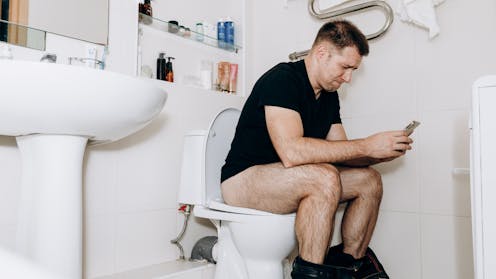
This is why you shouldn’t bring your phone with you into the toilet. Alex Goncharov/ Shutterstock

It might seem like a harmless habit to linger on the loo with your phone while “taking care of business”, but research shows that prolonged toilet time can increase the risk of several health problems. Here are the main ones.

1. Haemorrhoids

A recent study found that smartphone use while doing a number two is linked to a 46% increased risk of developing haemorrhoids. A healthy toilet trip should only last two to three minutes, yet the study found that 37% of participants who used their phones while on the can spent more than five minutes there.

Haemorrhoids are enlarged blood vessels occurring in or around the anal opening. They develop due to increased pressure in the anal cushions – a part of the spongy tissue that surrounds your anus. These cushions allow the anus to expand as faeces is expelled.

Sitting too long on the toilet places extra pressure on these cushions, leading to haemorrhoids, as does straining to force faeces out.

It’s estimated that between 50-85% of people worldwide suffer from haemorrhoids. Symptoms include painless bleeding, irritation, itching and discomfort. However, haemorrhoids aren’t always symptomatic. Some people have them without knowing.

Haemorrhoids can also lead to complications such as anaemia from prolonged bleeding, and strangulation or clotting within the haemorrhoid – both of which cause severe pain.

2. Anal fissures or tears

Sitting on the toilet too long can cause anal fissures or tears. They are small cuts in the anal lining. Anal fissures are often accompanied by significant pain – likened to passing broken glass when having a bowel movement, alongside bright red blood.

The anal lining is thin and sitting on the toilet for too long causes pooling of the blood, which stretches the lining, making it more prone to damage as faeces passes out.

3. Prolapse

Faeces may not be the only thing that passes out the body after sitting on the toilet. Extended loo time can increase your risk of having your rectum fall out of your body – a condition known as a rectal prolapse.

This uncommon condition occurred in one man who would often spend up to 30 minutes on the toilet playing smartphone games. One day, he found nearly 14cm of his rectum protruding out of his body while attempting a bowel movement.

Prolonged sitting on the toilet increases pressure in the abdomen, which subsequently increases pressure on the pelvic floor muscles. These muscles help hold our internal organs, including our rectum, inside. But prolonged pressure can weaken these muscles.

In women, this could also result in other pelvic organs – such as a uterus – prolapsing out of the body.

Rectal prolapse is often painful, and you’ll need to visit the hospital if you have one so it can be re-inserted. If it happens repeatedly or if the case is particularly extreme, it will require surgery.

4. Pressure sores and ulcers

Prolonged sitting on the loo, particularly in the elderly, may increase the risk of pressure sores occurring on the skin that comes in contact with the toilet seat.

Prolonged sitting compresses the tissues, reducing blood flow to them. This then results in toxic substances building up in the blood which damage the tissues and cause them to breakdown. Pressure sores are painful.

5. Hiatal hernia

Prolonged sitting on the toilet and straining to defecate may contribute to hiatal hernia, particularly in susceptible people (including those who are obese or over the age of 50).

This is where part of the stomach and other abdominal organs slide through the opening in your diaphragm (a dome-shaped muscle that helps us breathe), ending up in the chest cavity.

A young woman sits on the toilet looking at her phone. She is frowning.
Excess toilet time combined with straining can lead to a hernia.
Raushan_films/ Shutterstock

Hiatal hernias are common, affecting 20% of people. They typically result in indigestion, stomach pains and discomfort around the ribs and chest. They can be treated with medication to reduce the amount of acid produced by the stomach or in more severe cases require surgery.

6. Toilet seat neuropathy

Sitting too long on the toilet compresses the major nerves and blood vessels, reducing blood supply to the legs. This can cause your legs to go numb as a result – a phenomenon known as toilet seat or toilet bowl neuropathy. It usually goes away after a few minutes.

But there have been some case studies where patients who passed out on the toilet after a night of drinking – subsequently spending the night there – found themselves entirely numb and unable to move. In one extreme case, a man developed gangrene, sepsis and sadly died after falling asleep on the toilet.

7. Fainting

Prolonged toilet time combined with straining may also result in fainting.

This condition, called vasovagal syncope, occurs when prolonged straining on the toilet irritates the vagus nerves. These nerves control many of the body’s automatic functions – including heart rate and blood pressure.

In the case of defecation syncope, blood pressure can drop suddenly when we stand up from the toilet. Heart rate also drops causing dizziness, light-headedness and fainting.

The healthy way to poo

To reduce your risk of suffering any of these conditions, spend as short a time seated on the loo as possible.

You could also potentially modify your position when using the loo. Some evidence suggests squatting is better for defecation, as it reduces the stress and straining needed to poo. However, other studies have shown this position could potentially increase risk of other health problems – such as risk of stroke and damage to the achilles tendon.

Other advice includes eating more fibre and drinking water if you’re someone who regularly takes longer than five minutes to do your business as both can help you have healthier poos. They will also prevent straining while having your bowel movement.

The Conversation

Adam Taylor does not work for, consult, own shares in or receive funding from any company or organisation that would benefit from this article, and has disclosed no relevant affiliations beyond their academic appointment.

ref. Seven health conditions that show why using your phone on the toilet is a bad idea – https://theconversation.com/seven-health-conditions-that-show-why-using-your-phone-on-the-toilet-is-a-bad-idea-264808

How America helped create the Palestinian Authority – only to undermine it ever since

Source: The Conversation – UK – By Anne Irfan, Lecturer in Interdisciplinary Race, Gender and Postcolonial Studies, UCL

US president Bill Clinton with Israeli prime minister Yitzhak Rabin and Palestinian leader Yasser Arafat at the Oslo Accords signing ceremony on 13 September 1993. Vince Musi/The White House

At the end of August, the Trump administration blocked Palestinian president, Mahmoud Abbas, and 80 other Palestinian officials from attending the UN general assembly meeting in New York, which runs between September 9 and 23. The US president’s decision to revoke the Palestinian officials’ US visas comes as various European governments prepare to formally recognise the state of Palestine at the general assembly. Supporters of Palestinian statehood are proposing a central role for Abbas’ Palestinian Authority (PA) in Gaza’s future government.

Historically, the US has also supported the PA. The Oslo accords, which created the PA in the first place, were signed at the White House in 1993. US president Bill Clinton famously hosted Israeli prime minister Yitzhak Rabin and the chair of the Palestine Liberation Organisation (PLO), Yasser Arafat.

In discourse that has since become standard US policy, Clinton spoke of a so-called “two-state solution”, with security for Israel and democratic self-rule for the Palestinians. The US provided significant financial support for the PA after its establishment, with particular funding for its ample security forces.

Yet behind the scenes, the US stance on Palestinian statehood has always been murkier. A deeper look shows that the Trump administration’s recent moves blocking the PA are less of a departure from long-term US policy than they may seem. As I explain in my new book A Short History of the Gaza Strip, the US has long paired its ostensible support for the PA with policies that cripple its ability to function and undermine prospects of real Palestinian independence.

From the start, the Oslo accords were skewed in favour of Israeli interests. Under the agreement’s terms, the PA had limited autonomy over around three-quarters of the Gaza Strip and less than one-fifth of the West Bank. The Israeli military retained ultimate control and continued to seize more land for illegal settlements.

At the end of the 1990s, Clinton aligned himself closely with the new Israeli prime minister, Ehud Barak. Barak’s declared “red lines” included no Palestinian state along the 1967 borders, no Palestinian national army, no Palestinian sovereignty over any part of Jerusalem and the retention of most illegal Israeli settlements in the West Bank.

Further negotiations were structured to constrain the Palestinians, culminating in the “failure” of the 2000 Camp David summit. Familiar to anyone who has followed Israeli-Palestinian affairs, Arafat has been blamed for refusing Barak’s “unprecedented” proposal. The reality is somewhat different.

As Robert Malley and Hussein Agha wrote in their 2001 book, Camp David: a tragedy of errors, “what so many viewed as a generous Israeli offer, the Palestinians viewed as neither generous, nor Israeli, nor, indeed, as an offer”. Malley served as adviser to Clinton on Arab-Israeli affairs while Agha, a senior associate member of Oxford University’s St Antony’s College has been associated with Israeli-Palestinian affairs for more than half a century – meaning they know whereof they speak.

The US’ disingenuous approach did not end when Clinton left office. During the second intifada (Palestinian uprising) from 2000-2005, the administration of George W. Bush backed Israel’s full invasion of PA-administered areas in the West Bank and Gaza. This completely undermined any chance of a two-state solution – the very “solution” that the US ostensibly supported.

Israeli security forces shelter behind armoured vehicles when confronted by crowds of Palestinian civilians.
Second intifada, October 2000: Palestinian protesters confronting Israeli security forces near Ramallah.
Nadav Ganot (נדב גנות) / IDF Spokesperson’s Unit, CC BY-NC

In 2003, the US demanded a full restructuring of the PA’s set-up to curtail Arafat, whom Palestinians had elected president in 1996. When he died in 2004, he had spent two years under Israeli siege in Ramallah – another policy supported by the US.

Two years later, US moves to undermine the PA reached a crescendo when the 2006 Palestinian parliamentary elections returned Hamas as the largest party with 44% of the vote. While the elections were deemed free and fair by international observers, the Bush adminstration responded by plotting, arming and funding a coup to overthrow the new PA government.

In the end, the coup backfired, resulting in a lasting split from 2007 when Hamas seized control of Gaza and Abbas’ forces purged it from the PA in the West Bank. Since then, Palestinians in the two territories have been largely cut off from one another under two separate regimes. Abbas’ PA has been based in the West Bank while Hamas governs Gaza – where Israel has imposed a full blockade from 2007, supported by the US and Egypt.

No authority

In the two decades since, successive US administrations have effectively facilitated the Palestinian divide. In 2014, the Obama administration backed Israeli opposition to a short-lived Palestinian unity government. And when Abbas cancelled long-awaited Palestinian elections in 2021, the Biden administration stayed silent, with reports of tacit US support for the move behind the scenes.

While many western and Arab states are calling for the PA to take over Gaza’s future governance, critics point out that it has long been toothless and illegitimate.

Elected in 2005, Abbas is now 20 years into a four-year term. What’s more, his regime has delivered little for West Bank Palestinians in the nearly two decades since the split from Gaza.

He has been entirely ineffectual in countering the Israeli war on Gaza, launched after the Hamas-led attacks of October 7 2023 and widely recognised as genocide. As ministers call to resettle Gaza, Israel has continued to expand its illegal settlements in the West Bank and is openly planning ethnic cleansing.

It is important to remember that the PA was only ever created as an interim body, designed to serve for five years in the 1990s ahead of final negotiations. Its continued existence decades later is a serious indictment of the US-led so-called peace process. The reality of US treatment of the PA since the 1990s calls into question whether Trump’s recent moves are really a turning point in US policy – or simply the culmination of a long-term trend.

The Conversation

Anne Irfan does not work for, consult, own shares in or receive funding from any company or organisation that would benefit from this article, and has disclosed no relevant affiliations beyond their academic appointment.

ref. How America helped create the Palestinian Authority – only to undermine it ever since – https://theconversation.com/how-america-helped-create-the-palestinian-authority-only-to-undermine-it-ever-since-264759

Crashing black holes validate Stephen Hawking – new research

Source: The Conversation – UK – By Patricia Schmidt, Associate Professor of Physics, University of Birmingham

Black holes may be the fiercest objects in the universe, yet we still know very little about them. It has only been a decade since we confirmed their existence by detecting gravitational waves: ripples in the fabric of spacetime.

Since then, gravitational waves from colliding black holes have unveiled insights into their hidden physics and the theories that support them. On January 14, 2025, the loudest gravitational-wave signal ever detected, known as GW250114, was observed by the two Laser Interferometer Gravitational Wave Observatories (LIGO).

This remarkable event provided our international team of scientists with a golden opportunity to test two major predictions of Albert Einstein’s theory of general relativity with unprecedented precision: the nature of black holes and something called Hawking’s area law theorem.

The results, published in Physical Review Letters, mark a significant step forward in our understanding of gravity and black holes.

Black holes are a key prediction of general relativity, our leading theory for describing gravity. Astrophysical black holes form when a massive star reaches the end of its life and collapses under its own gravity, exceeding a certain mass called the Chandrasekhar limit (approximately 1.44 times the mass of the sun).

What remains is a region of spacetime completely disconnected from communication with the rest of the universe, bounded by a surface known as the event horizon – from which nothing can famously escape, not even light. But if black holes cannot send signals or light beyond this boundary, how can we be sure they exist and that they behave as predicted?

The power of gravitational waves

General relativity actually predicted the existence of gravitational waves in the first place. Any massive object that accelerates through spacetime will generate tiny distortions that propagate away at the speed of light. These waves encode a wealth of information about the source and the nature of gravity itself.

To produce gravitational waves strong enough to be detected, we need systems where massive objects undergo sustained and intense acceleration. One of the most powerful sources is a binary black hole, where two black holes orbit each other under the influence of gravity. As gravitational waves carry energy away from the system, the orbit will gradually shrink until the black holes eventually merge into a single, larger black hole.

Hence, by analysing gravitational waves from black hole binaries we can probe whether astrophysical black holes truly behave as predicted by general relativity.

Gravitational waves were first observed by the LIGO detectors on September 14, 2015, when they captured the collision of two black holes known as GW150914. Due to the rapid improvements in detector technology, we are now able to observe binary black hole mergers in ultra-high definition, enabling the single most stringent tests of general relativity and black hole physics to date.

Hawking’s theorem

Despite their mathematical complexity, black holes are surprisingly simple objects entirely characterised by their mass, rotation and (possibly) electromagnetic charge.

In 1972, Stephen Hawking published a seminal study showing that as two black holes merge, the surface area of the final event horizon must be larger than the sum of the surface areas of the two initial black holes. This is known as the area law.

One way to understand this is to realise that the surface area of the event horizon scales with the mass and spin of the black hole in very particular ways. If we double the mass of a black hole, its event horizon becomes four times larger. If we make the black hole spin faster, the event horizon will become more oblate (think of a rugby ball) and the surface area will decrease. For merging black holes, Hawking demonstrated that despite the loss of energy and angular momentum to gravitational waves, it will always result in a final black hole that has a larger event horizon.

GW250114 provided us with a golden opportunity to test Hawking’s predictions.
By analysing the gravitational-wave data with the best available models, our team has now validated the area law to high significance. This was possible through the detailed modelling of the “ringdown”, the final stage after the merger during which the remnant black hole emits gravitational waves in a characteristic pattern (known as quasi-normal modes).

This process is similar to striking a bell: the tones emitted depend on the material and shape of the bell, with the ringing of the bell encoding this information. By analysing the emitted sound, we can figure out the shape and material of the bell. For rotating black holes, we can do something similar using gravitational waves.

By analysing the emitted waves and all its harmonics, we can reconstruct the mass and spin of the black hole, and hence the surface area of the horizon.
With a signal this strong, we were able to carry out a comprehensive suite of tests probing different aspects of Einstein’s theory. In every case, the predictions of general relativity held firmly.

The observation of GW250114 offers the clearest validation yet of Einstein’s theory, validating some of its most profound predictions, including Hawking’s area law. This is still just the beginning, and the next decade promises to revolutionise our understanding of gravity and black holes even further.

The Conversation

Patricia Schmidt receives funding from UK Research and Innovation (UKRI) through grants ST/V005677/1 and ST/Y00423X/1, and The Royal Society through a Research Grant RGR1241327.

Geraint Pratten is supported by The Royal Society through a University Research Fellowship (URFR1221500 and RFERE221015), the UK Space Agency (grant ST/Y004922/1), and UKRI (grants ST/V005677/1 and ST/Y00423X/1).

ref. Crashing black holes validate Stephen Hawking – new research – https://theconversation.com/crashing-black-holes-validate-stephen-hawking-new-research-264995

Signs of ancient life may have been found in Martian rock – new study

Source: The Conversation – UK – By Sean McMahon, Reader in Astrobiology, University of Edinburgh

Just over a year ago, Nasa made a remarkable announcement. The Perseverance rover had found potential signs of ancient life on Mars. Now, the technical details behind that discovery have been published in a Nature paper that, despite its rather modest wording, may ultimately prove to be among the most significant in the history of science.

The bottom line is this: it might be life, but we won’t know for sure until we return the samples to Earth. Perseverance has already collected a fragment of the relevant rock — we just have to go and get it.

Indeed, Nasa has been working with the European Space Agency on a mission to go to Mars, retrieve the samples of rock collected by Perseverance and deliver them to Earth. This would include the sample from the rock that’s the subject of the Nature study. However, the mission, known as Mars Sample Return, has run into trouble because of rising costs.

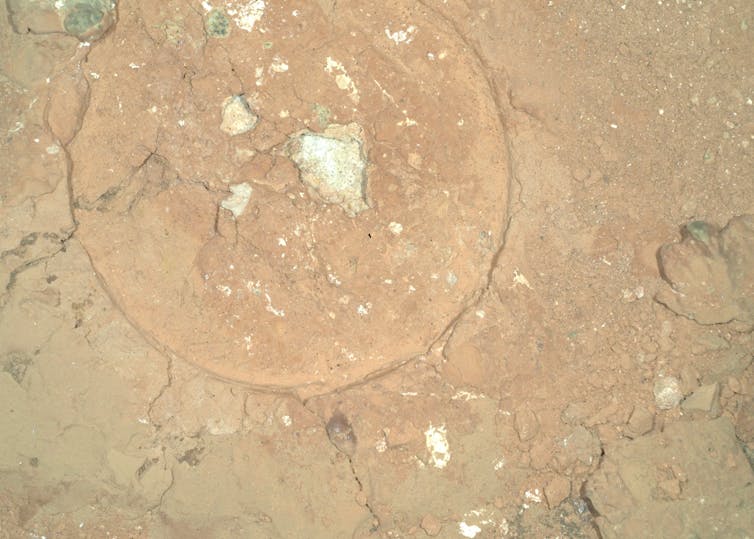
In mid-2024, the Perseverance rover encountered a block of ancient mudstone, nicknamed Cheyava Falls, distinguished by its brick-red hue. This rock was laid down by water roughly four billion years ago. While most Martian rocks appear red due to a coating of oxidised (ferric) iron dust, Cheyava Falls is red through and through – the ferric iron is in the rock itself.

More intriguingly, Cheyava Falls is peppered with dozens of tiny pale spots, typically less than a millimetre across. These spots are fringed with a dark phosphorus-rich mineral, which also appears as tiny dots called poppy seeds that are scattered between the other spots. Associated with this mineral are traces of ancient organic compounds. (Organic compounds contain carbon and are fundamental to life on Earth, but they also exist in the absence of biology.)

What does this have to do with life?

All living organisms on Earth harness energy through oxidation-reduction (redox) reactions – transferring electron particles from chemicals known as reductants to compounds named oxidants. On Earth, for example, structures called mitochondria in animal cells transfer electrons from glucose (a reductant) to oxygen (an oxidant). Some rock dwelling bacteria use other kinds of organic compound instead of glucose, and ferric iron instead of oxygen.

Serpentine Rapids
A rock dubbed Serpentine Rapids also showed features reminiscent of reduction spots.
Nasa JPL-Caltech

When ferric iron is reduced to a different form, known as ferrous iron, it becomes soluble in water and either leaches away or reacts to form new, lighter-coloured minerals. The result is that many red rocks and sediments on Earth contain small bleached spots – “reduction spots” – strikingly similar to those found in Cheyava Falls. In fact, Perseverance subsequently spotted bleached features even more reminiscent of reduction spots at a site called Serpentine Rapids, but spent too little time there to analyse them and, unfortunately, didn’t collect any samples.

The new Nature paper builds on abstracts presented at the Lunar and Planetary Science Conference, held in Houston in March 2025, but with more detail and the added weight of peer review. It confirms that the pale spots are associated with organic matter, and that they contain ferrous iron and sulphur – specifically, an iron-sulphide mineral.

The most plausible interpretation is that redox reactions occurred within the rock after it formed, transferring electrons from organic matter to ferric iron and sulphate, and producing bleached zones where ferric iron was depleted.

Perseverance
Perseverance with the Cheyava Falls rock.
Nasa JPL-Caltech

Notably, these reactions – especially sulphate reduction – don’t typically occur at the low temperatures this rock experienced over its history. Unless microbes are involved, that is. Microbial oxidation of organic matter can also produce phosphate minerals, like those found at Cheyava Falls.

Without getting samples back to laboratories on Earth, there’s only so much we can really know about what happened at Cheyava Falls four billion years ago. Even so, no entirely satisfying non-biological explanation accounts for the full suite of observations made by Perseverance.

The new paper does a good job of making this clear, considering the possibilities one by one. But in astrobiology, the lack of a non-biological explanation isn’t where life detection ends – it’s where it begins. History tells us that when we can’t think of a non-biological explanation for something, it’s usually not because there isn’t one. It’s just that we haven’t thought of it yet.

So what happens next? First, astrobiologists around the world must explore which oxidation-reduction reactions involving iron, sulphur, organic compounds, and phosphate can occur with and without biology under conditions relevant to Cheyava Falls.

Second, Nasa and other space agencies must provide bold leadership on the Mars Sample Return mission. Yes, it will be expensive – possibly tens of billions of dollars – but the payoff could be the most important scientific discovery ever made.

The Conversation

Sean McMahon has previously received funding from NASA.

ref. Signs of ancient life may have been found in Martian rock – new study – https://theconversation.com/signs-of-ancient-life-may-have-been-found-in-martian-rock-new-study-264960

Focusing on children’s first 1,001 days can build neighbourhood support for migrant families

Source: The Conversation – UK – By Tom Allport, Honorary Senior Clinical Lecturer, Bristol Medical School, University of Bristol

Royaltyfreecliick.com/Shutterstock

The UK government’s new ten-year health plan for England prioritises tackling health inequalities through local preventive measures. One promising approach is to build on the strengths of migrant families by fostering neighbourhood peer support – particularly for underserved communities.

In wealthy countries, families migrating from low-income countries are often excluded or marginalised in society and lack social support. They often have highly stressed pregnancies and many experience barriers to effective healthcare.

For migrant families, the stresses of migration, poverty, and discrimination can combine to negatively affect their children’s wellbeing and life chances, such as employment. This matters for a large number of children: one in five children born in England and Wales has a parent born in a low-income country.

Promoting early child development improves life chances and saves money. This works best when started before birth, in the “first 1001 days” of life – the period from conception until a child’s second birthday.

Pregnant woman in kitchen
The 1,001 days start before birth.
oliveromg/Shutterstock

The best programmes are available to everyone, but make extra effort to help the people who need them the most. An example is Sure Start, which was introduced in 1999 to support children aged up to the age of five and their families living in disadvantaged areas in England.


Read more:
How England’s scrapped Sure Start centres boosted the health and education of disadvantaged children


Sure Start centres foster social support for parents and help children’s early social and emotional development, as well as providing places for families to get help from a range of health, social, financial and other services. The evidence of Sure Start’s long-term benefits continues to accumulate. However, austerity measures in recent years have seen a massive reduction in Sure Start centres across the country.

Promoting social connectedness and enhancing support may be especially important for migrants and families from communal or collective child-rearing cultures. Our research has shown that better social support for pregnant women from migrant communities in Bradford is linked positively with their children’s social and emotional development.

We have also found that making social connections can be a turning point for parents’ wellbeing, which in turn helps their children’s opportunities for play and interaction. Helping communities build social support and connectedness therefore may be a powerful way to bring about change.

Social connection

Peer support (from people with similar backgrounds) is a very effective way to deliver services and improve lives, including for migrants. This is especially the case when this support can build trust.

Working with communities in Bristol over ten years, we have developed ways for communities, agencies and researchers to work together to activate family strengths through a programme called Find Your Village. Through peer support in the first 1,001 days, we aim to improve family wellbeing, child development, community connectedness, engagement with services, and longer-term life chances.

Find Your Village.

Our approach involves spending time with families, helping them solve problems and draw on their own strengths. Peer supporters also organise group activities and advocate for improvements in neighbourhood environments.

Meeting others from the same neighbourhood can help in lots of ways. For example, free, unstructured play helps children’s physical, social, and emotional wellbeing. At the same time, parents benefit from meeting each other. They can form secure relationships and grow in confidence raising their children, which brings many benefits. Parents can then in turn start to help others and give back to the community.

Many factors may challenge how accessible and helpful health services are for communities with migrant heritage. And not all social support is helpful. What helps both services and communities feel inclusive to families deserves continued attention.

There are some clear messages about how voluntary sector and government agencies can work effectively to reduce inequalities. Action to reduce inequalities works best when agencies and underserved communities work together to build and maintain trust.

Rigid, externally developed programmes are likely to lack cultural appropriateness and contextual fit and are therefore less likely to be taken up by groups who feel less connected in society. Partnership working, and flexibility to adapt to local contexts are therefore key.

Although our focus is on migrant communities, Find Your Village ideas may be relevant in other contexts of structural inequality and disadvantage. Could resourcing peer support to activate the strengths of families and communities help in the design and delivery of the new government health plans?

The Conversation

Tom Allport has previously received funding from the National Institute of Health Research.

Debbie Watson has received funding from the Economic and Social Research Council and the Arts and Humanities Research Council. She is affiliated with the Labour Party.

ref. Focusing on children’s first 1,001 days can build neighbourhood support for migrant families – https://theconversation.com/focusing-on-childrens-first-1-001-days-can-build-neighbourhood-support-for-migrant-families-264158

Recipes from the middle ages have much in common with how our grandparents used to cook

Source: The Conversation – UK – By Diane Purkiss, The William F Pollard Tutorial Fellow in English, University of Oxford

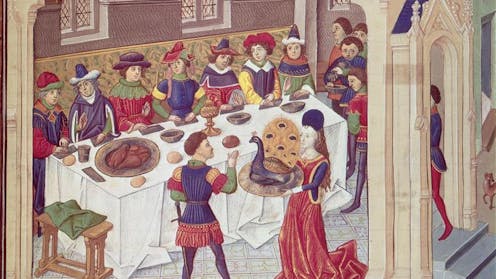
Painting of a banquet from the manuscript of The Romance of Alexander the Great, mid-15th century. Wiki Commons

“You have to keep beating it for longer,” my grandmother instructed me. “It isn’t pale yet. It’s still too yellow.” I didn’t ask how long this would take. I was nine years old, and I understood what my grandmother meant. You have to keep doing something until it works. It’s like asking: “Are we there yet?”

I watched for the miraculous transformation. The eggs, golden when first beaten, were lightening to a soft lemon colour. The texture was changing. You couldn’t see the sugar anymore; it had looked like sand, but now it was invisible, cloaked in the egg. My grandmother stopped beating, and lifted up the beater. A stream of thick liquid hung down, like the wet sand you used to reinforce a sandcastle. “Yes, that’s enough. Now add the melted butter. Slowly. Then the flour. We’ll need a bit more.”

My grandmother taught me to cook. She never weighed anything. The only measurement she used was a pink breakfast teacup, and it was more a useful scoop than a measure. Instead, she worked towards a desired result. You didn’t cook things for five minutes. You cooked things until you got the result you wanted. The first thing she taught me to make was bechamel sauce. She didn’t call it that. She called it white sauce with flavour. I could make it when I was five, and I still do it the same way.

Her cooking was preliterate, or, more exactly, a special kind of literacy, a grammar of ingredients and heat and air.

I’m a food historian and the author of English Food: A People’s History. I have never found the recipes of the middle ages as difficult to understand as most food historians. Perhaps because they look a little like my grandmother’s instructions.

Cooking in the middle ages

A medieval recipe
The recipe for sambocade from Add MS 5016.
British Library

Take and make a crust in a trap, and take cruddes and wryng out þe wheyze, and drawe hem þurgh a straynour, and put in þe straynour crustes. Do þerto sugar the þridde part and somdel whyte of ayren, and shake þerin blomes of elren, and bake it up with eurose, and messe it forth.

This is a recipe for “sambocade” from a middle ages manuscript held in the British Library. Sambocade is an elderflower cheesecake of sorts. It uses curds – the beginnings of cheese – and the recipe gives quite detailed instructions on how to make them, a method a little like making Greek yoghurt. You add sugar, egg white and elderflowers, along with rosewater. Then you serve it.

A recipe like this is not a series of instructions. It is meant to act as a reminder, a series of quick notes to recall to mind something taught orally – something taught as my grandmother taught me.

Just as Google Maps will not tell me how to walk by putting one foot in front of the other, this kind of recipe doesn’t tell me what I’m looking for or how to achieve it. It doesn’t give exact measurements. It doesn’t really give any measurements at all. But if you made this recipe half a dozen times, you would soon understand the process required. And then, it would be yours, in a way that a recipe tested or created by another cook can never quite be yours.

Medieval image of a baker putting bread into an oven
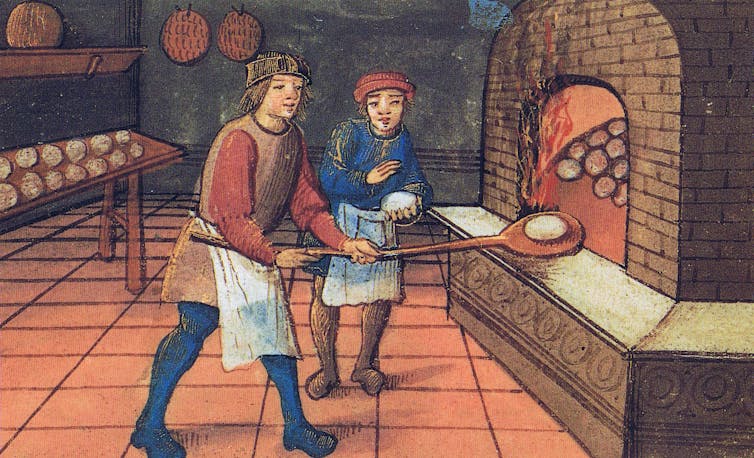
A baker with his assistant making bread rolls, from a book of hours manuscript (circa 1500).
Bodleian Library

In my kitchen I still keep my mother’s recipe book, a manuscript volume in which she tried to preserve recipes that were gifts from friends. All of it is in her handwriting.

It contains a recipe for cheesecake from the days when cheesecake was a little-known novelty; it notes that the recipe comes from an American friend. It contains exact quantities and exact baking times, although the result is a lot more strongly baked than the majority of cheesecakes now. The exact quantities preserve a memory of the effect that’s difficult to reconstruct from recipes that come from earlier times.

In the same way, I have only my memories of my grandmother’s cooking to preserve what she did; she was barely literate, and her own recipes consisted solely of lists of ingredients. These were kept in a shoe box and after she died, my mother threw it away on the grounds that it was of no possible value to anyone. All the same, every time I make a sponge cake, I say to myself, is it pale enough yet?


Looking for something good? Cut through the noise with a carefully curated selection of the latest releases, live events and exhibitions, straight to your inbox every fortnight, on Fridays. Sign up here.


The Conversation

Diane Purkiss is affiliated with Keble College, University of Oxford.

ref. Recipes from the middle ages have much in common with how our grandparents used to cook – https://theconversation.com/recipes-from-the-middle-ages-have-much-in-common-with-how-our-grandparents-used-to-cook-264139

Putting your CV together? Complete honesty might not be the best policy

Source: The Conversation – UK – By Tom Lane, Senior Lecturer in Economics, Newcastle University

PeopleImages/Shutterstock

Writing a CV requires important decisions. What should you include, what should you leave out – and how honest should you be?

One particularly tricky dilemma that might come up is whether to disclose weaknesses on your CV or remain silent about them. Common sense suggests it’s not advisable to advertise your flaws, but what about important information that employers might expect you to supply? Could the omission of such details look suspicious?

Research my colleague and I conducted looks at this specific question, focusing on the academic qualifications of new graduates entering the job market. And it provides a clear, evidence-based answer: if your grades are low, you are better off not disclosing this.

Complete honesty is not the best policy.

In the UK, where we did the research, most universities award undergraduate degrees on a scale: first-class, upper second (2:1), lower second (2:2) and third. While a first or 2:1 is often seen as evidence of strong performance, lower degrees are held in lower esteem.

A graduate jobseeker with a lower classification has a choice of what to reveal on their CV. They can be upfront about it, or they could simply state that they have a degree, without mentioning the class. (A third option, to lie about the class is probably a bad idea because employers can and do ask for proof.)

Perhaps surprisingly, traditional economic theory would probably favour fronting up. Interactions like this, where a “seller” (in our case, a jobseeker supplying their skills) holds information about their quality that they can voluntarily disclose or not to “buyers” (here, employers), have been popular subjects for analysts of game theory (the mathematical study of strategic interactions).

The idea starts with the notion that people who fail to supply available evidence about their quality look like they have something to hide. Some economists have concluded that buyers will assume non-disclosing sellers must be not merely bad, but of the lowest possible quality level.

In our context, this means employers would think that any graduate whose CV omits degree classification information has a third-class degree, and should treat them accordingly. To avoid this, it would be in the interests of any applicant who earned a 2:2 or higher to disclose it.

To see how jobseekers actually behave, we analysed the CVs of recent graduates on the job website Monster. We noticed that a substantial minority left their degree class undisclosed. Included among them, presumably, were plenty of applicants with at least a 2:2.

To work out whether these applicants were making a mistake, we also conducted a large experiment, sending more than 12,000 applications to genuine graduate job vacancies. These varied only in the jobseeker’s degree classification, and whether this was disclosed on their CV, with other details kept the same.

Success was measured by how often applications resulted in invitations for an interview or further communication. As expected, the most successful of our applications were those with a first-class degree.

However, those who said nothing about degree class were not the least successful. Instead, their success rate was in between that achieved by jobseekers disclosing 2:1s and 2:2s. Applicants who openly reported a third-class degree were the least likely to receive a response.

Put simply then, full disclosure harmed their chances.

The third degree

Our findings challenge the neat logic of traditional economic theory. If employers always assumed the worst about missing information, hiding poor grades should not help.

Yet in practice, it seems recruiters do not have time to scrutinise every detail. Faced with hundreds of applications, they may skim CVs, focusing on standout positives or negatives. If the grade is not there, it may simply go unnoticed.

Of course, interviewers might ask about grades later in the application process, but by initially concealing this information, otherwise unattractive applicants can help themselves get to the interview stage, at which point they can use other qualities to impress.

Graduates throw caps into the sky.
Don’t mention it.
Roman Samborskyi/Shutterstock

The practical message of our research is clear. If you have strong academic credentials, highlight them proudly. But if your results are weaker, you are under no obligation to advertise them. Omitting them will not guarantee success, but it may increase your chances.

The graduate job market remains highly competitive. Yet our study suggests that lower grades do not need to define a candidate’s prospects, provided they make careful choices about self-presentation.

Strategic omissions may help level the playing field for those whose academic record does not reflect their potential. So if you have recently graduated with a third, there’s no need to panic, and no need to mention it either.

The Conversation

Tom Lane does not work for, consult, own shares in or receive funding from any company or organisation that would benefit from this article, and has disclosed no relevant affiliations beyond their academic appointment.

ref. Putting your CV together? Complete honesty might not be the best policy – https://theconversation.com/putting-your-cv-together-complete-honesty-might-not-be-the-best-policy-263679

Curious Kids: why do we need to do homework?

Source: The Conversation – UK – By James Williams, Emeritus reader in science education and communication, University of Sussex

PeterPike/Shutterstock

Why do we need to do homework when we already spend all day in school? – Grace, aged nine, Belfast

If you’ve ever stared at your homework feeling stuck, you’re not alone. Many children say it makes them feel stressed, bored, or even anxious. Why do teachers keep giving you work to do at home when you’ve already spent hours learning at school?

The available research suggests that for secondary school students, well-designed homework can lead to about five extra months of progress in subjects like maths and English. In primary school, the impact is smaller – around three months – but still useful.

Homework helps you practise what you’ve learned, remember it better and build skills like time management and independence.

However, research shows that how you feel about homework depends on a few things. If you find your homework boring, it might be because the activity you’ve been given to do really is pretty boring. Not all homework is equal.


Curious Kids is a series by The Conversation that gives children the chance to have their questions about the world answered by experts. If you have a question you’d like an expert to answer, send it to curiouskids@theconversation.com and make sure you include the asker’s first name, age and town or city. We won’t be able to answer every question, but we’ll do our very best.


A worksheet that doesn’t connect to your lessons is not so helpful. A task that challenges you to think, create, or explore concepts and ideas is much better.

Teachers have to think hard about the tasks they set and how they explain them. If the task is explained clearly and if students get helpful feedback, the chance they will complete it is much higher. Teachers must also choose meaningful tasks help you see homework as part of learning – not just extra work.

Girl doing homework with pen, paper and laptop
Sometimes homework really is boring.
Studio Romantic/Shutterstock

Homework that’s creative or linked to your passions is more enjoyable. Then comes the idea of success. If the task feels impossible, it’s easy to give up. Finally, does it make sense? Homework that connects to what you learned in class feels more useful.

As a science teacher I would always try and set the homework early in the lesson rather than right at the end. Knowing what is going to be expected means that the children better understood the task and could link it to the work being done in the lesson.

How you do homework

Your attitude toward homework isn’t just about the task – it’s also about the people around you. If you have parents or guardians who encourage you, help you plan your time, or show interest in your work, this can make homework feel more positive. That said, there is research that shows that while it’s helpful for parents to ask whether you’ve done your homework, helping you do it isn’t actually useful.

Some children also face bigger challenges. Not everyone has a quiet space to work, or someone at home who can help. This is called the “homework gap” and it can make school feel unfair.

It’s up to schools whether they set homework, and some schools are rethinking homework altogether. They are looking to make it more accessible and creative. Some schools make homework optional rather than demand it for every subject. Schools are also looking at how they can make homework fair for everyone. This includes ideas such as homework clubs, where you can get help and work with friends.

Homework isn’t going away any time soon. But it doesn’t have to be a burden. When it’s well-designed, supported by teachers and parents, and connected to learning, it can help you grow – not just as a student, but as a thinker.

So next time you sit down with your homework, ask yourself: What can I learn from this? And if it feels too hard or pointless, speak up. Your voice matters.

The Conversation

James Williams does not work for, consult, own shares in or receive funding from any company or organisation that would benefit from this article, and has disclosed no relevant affiliations beyond their academic appointment.

ref. Curious Kids: why do we need to do homework? – https://theconversation.com/curious-kids-why-do-we-need-to-do-homework-262992