Charlie Kirk shooting: another grim milestone in America’s long and increasingly dangerous story of political violence

Source: The Conversation – UK – By Katie Pruszynski, PhD Candidate, Department of Politics and International Relations, University of Sheffield

Charlie Kirk, figurehead of the American far right, took a question at a 2023 event in Salt Lake City about the second amendment to the US constitution and gun-related deaths. He answered: “I think it’s worth to have a cost of, unfortunately, some gun deaths every single year, so that we can have the second amendment to protect our other God-given rights.”

Two years later, once again in Utah, Kirk was killed with a gun. His death comes against a backdrop of increased political violence in the US, driven by a new set of political, societal and technological factors, and its future trajectory will determine the health of American democracy.

Political violence is differentiated from other crimes and it is helpful to have clarity about its particular meaning. It is defined specifically as acts intended to achieve political goals or intimidate opponents through the use of physical force or threats to influence a political outcome or silence dissent. While most of these incidents come from the far right, violence is used by extremists on both sides.

Over the past decade there has been a dangerous escalation in political violence driven by rage and resentment without clearly defined goals by self-radicalised individuals rather than organised extremist groups. High profile incidents have dominated headlines. These include the insurrection of January 6 2021, the shooting at a baseball practice session of Republican members of Congress in 2018, the plot to kidnap Michigan governor, Gretchen Whitmer in 2020, the vicious attack on Paul Pelosi – the husband of the speaker of the House of Representatives – in 2022, the torching of Pennsylvania governor Josh Shapiro’s family home in April this year. And, of course, the assassination attempts on Donald Trump on the campaign trail in 2024.

But the threat has spread beyond the very visible faces of US democracy to targets such as judges, election officials, journalists and even private citizens based upon their perceived political affiliation.

It is shocking yet unsurprising, given the new factors fuelling rage in an already deeply divided society. These can be broadly summarised by three characteristics.

Hyper-partisanship at boiling point

The way politics is discussed today shows that division can’t be seen in merely partisan terms. Opponents have become enemies and those with different worldviews have become traitors. In many examples, pundits, politicians and their mouthpieces indulge in dehumanising rhetoric. Research has consistently found that dehumanisation contributes to a more ready justification of violence.

Indeed, Trump and other high-profile figures have incited violence, even when not actually issuing direct calls to action. This was most notably evident on January 6 2021, when Trump goaded supporters in Washington to march on the Capitol, telling them: “And we fight. We fight like hell. And if you don’t fight like hell, you’re not going to have a country anymore.”

Fight like hell: Donald Trump’s ‘Save America’ rally.

Digital echo chambers

These pressure cooker arguments play out on social media and online forums that help spread conspiracy theories, disinformation and violent content. Highly influential creators are able to conjure up “bespoke realities” for their followers, generating huge personal wealth from the fomenting of rage and hate. Citizens are consuming deeply flawed, incendiary political content in isolation. This fuels self-radicalisation when people become detached from reality of the world outside their bubble.

Indeed, immediately following the Kirk shooting, social media was already awash with disinformation about liberals celebrating his death and the motivations of the killer before the shooter had been found.

Erosion of trust in democracy

When faith in government, the justice system, and the electoral process erodes, citizens may come to believe that the established systems are rigged, unresponsive, or illegitimate. This makes traditional avenues for change seem futile. In this environment, violence can be rationalised as the only effective means to “correct” the broken system. The American right has long railed against a corrupt and malevolent “deep state” convincing some citizens that democratic norms no longer apply.

What next? There are three possible scenarios. The worst case is an escalation of violence in both its frequency and its organisation.

The far right has been pushing for strict limits on civil liberties, and the most extreme members may use Kirk’s assassination as an excuse for violent retaliation. Widespread civil unrest is a persistent threat, particularly approaching the 2026 midterm elections. Many fear that if Trump’s allies sense they can use escalating disorder to declare an emergency suspension of democratic processes, they will push him to do so.

More likely, but no less unsettling, is a stagnation in which political violence becomes a normalised feature of American political life without escalating to an existential crisis. This has potentially far-reaching consequences as more moderate politicians on both sides perceive the risks of being in public life to be too high and vacate their offices. This paves the way for more extreme candidates to fill the gaps. With the more moderate voices gone, it’s less likely the conversation will cool down.

But things could improve. It will require bipartisan condemnation of political violence and a reconnecting of politicians to their constituents. Both sides need to work together to drag a bigger portion of the political debate back into the real world. Meanwhile social media platforms and the legacy media alike must be held accountable for the tenor and veracity of the content they feed to the public.

And efforts must be made by political elites, the media and the public to rebuild civic trust. As the foundation stone of a healthy democracy, citizens’ trust in their government and in each other must be carefully pieced back together.

America does not need to accept violence as the norm, in fact, it must collectively and consistently reject it. The future of its democracy may depend on it.

The Conversation

Katie Pruszynski does not work for, consult, own shares in or receive funding from any company or organisation that would benefit from this article, and has disclosed no relevant affiliations beyond their academic appointment.

ref. Charlie Kirk shooting: another grim milestone in America’s long and increasingly dangerous story of political violence – https://theconversation.com/charlie-kirk-shooting-another-grim-milestone-in-americas-long-and-increasingly-dangerous-story-of-political-violence-265115

Charlie Kirk: why the battle over his legacy will divide even his most ardent admirers

Source: The Conversation – UK – By Gordon Lynch, Professor of Religion, Society and Ethics, University of Edinburgh

Wherever you stand on his political views, Charlie Kirk’s murder is a tragedy on a personal level. He was just 31 and a husband and father of young children. But as a public figure his death represents a dangerous moment, as it threatens to deepen divides between conservatives and liberals in America and beyond.

Many commentaries on Kirk’s life will focus on his significance as a political activist and the important – some would say decisive – role he played in turning out the youth vote for Trump’s presidential election victory in 2024. But it is important to recognise how significant he had become as a public leader for what a growing number of scholars have referred to as white Christian nationalism.

While there is some variation in political views and theological beliefs among white Christian nationalists, a central, shared conviction is that the US was originally established as a Christian nation. For Christian nationalists, the idea of the separation of church and state is taken to refer only to not having an official state church. The complete separation of Christianity from public institutions is anathema and secular institutions such as public schools and universities are often regarded as hostile ground.

Given their view of America’s original religious calling, many Christian nationalists therefore believe that secular, liberal society is in terminal crisis. So America will only be put right when it returns to Christian laws or principles. This view of political disagreement is inherently binary. There are those who trust in God and support God’s work to transform society. Then there are those who oppose it. These people are mired in spiritual darkness.

Kirk’s Christian nationalist views and activism were not always comfortable watching. For example, along with others on the Christian right, Kirk publicly and vehemently challenged the place and legacy of Martin Luther King Jr, a hugely honoured figure in the US. In 2024, he chose the week in which the US celebrates a national holiday in honour of the murdered civil rights leader to label King “a serial adulterer, an alleged rapist, a reparations proponent, and a race Marxist”.

His organisation, Turning Point USA, also created Professor Watchlist. This online resource encouraged conservative students to name and shame college professors who had what were judged to be problematic views or activism linked to categories including “antifa”, “socialism” and “feminism”.

But while there is an element to white Christian nationalism which risks overturning basic democratic principles (as shown by the insurrection of January 6 2021), Kirk also had a better legacy. He became widely known on social media for his roadshows on college campuses which invited students to debate with him. He would put forward his views robustly, but also listened to his opponents.

These roadshows could be challenging for more liberally inclined students unused to having to defend their views. But at their best they provided surprising opportunities to find common ground. In one filmed discussion, for example, a feminist student had an engaged and respectful discussion with Kirk about his views about essential differences between men and women. They also agreed about the harmful effects of some forms of masculinity and the normalisation of pornography in youth culture. He maintained this commitment to these open public events despite the risks involved. It ultimately cost him his life.

Charlie Kirk debates a student.

Debate over Kirk’s legacy

This ambivalence between conflict and democratic engagement in Kirk’s work and the wider Christian nationalist movement is now finding expression in responses to his murder. On Fox News, as news of his death broke, shocked and distressed reaction nonetheless highlighted an interesting divide in the commentary. There were those who wanted to see this a turning point in the battle against the side of evil, the people who opposed his Christian mission. But others saw in his legacy a commitment to engagement and debate with those whom he disagreed with.

It remains to be seen which side of this legacy wins out. It should be observed, however, that much of Kirk’s following takes its cues from the current incumbent of the White House, whose instinct is usually to lean into division. And it was not different when the US president expressed his grief and anger at Kirk’s assassination, blaming the “radical left” for rising political violence in the US.

Most of the American people are neither ardent liberals nor committed Christian nationalists. But there is an ever-deepening political divide between those on the political left and right who no longer see each other as decent, trustworthy fellow citizens. As the political scientists Steven Levitsky and Daniel Ziblatt have argued, such polarisation is often a route to the death of true democracy.

At this moment of crisis, America – and the watching world – need to hope and work hard to ensure that Kirk’s legacy of democratic engagement and debate wins out. If this does not happen, the future for America is looking bleaker today.

The Conversation

Gordon Lynch does not work for, consult, own shares in or receive funding from any company or organisation that would benefit from this article, and has disclosed no relevant affiliations beyond their academic appointment.

ref. Charlie Kirk: why the battle over his legacy will divide even his most ardent admirers – https://theconversation.com/charlie-kirk-why-the-battle-over-his-legacy-will-divide-even-his-most-ardent-admirers-265116

Charlie Kirk was emblematic of a country polarised and imploding

Source: The Conversation – UK – By Melissa Butcher, Professor Emeritus, Social and Cultural Geography, Royal Holloway University of London

In December 2021, I was in an exhibition hall in Phoenix, Arizona, with 10,000 young people who had come to hear a lineup of “America first” speakers, from Tucker Carlson to Ted Cruz. This was AmericaFest, an annual rally led by Turning Point USA, a conservative youth organisation whose founder and CEO, Charlie Kirk, was murdered on September 10.

I have spent the past four years listening most days to Kirk’s view of the world while carrying out research for my upcoming book, The Trouble With Freedom. He was charismatic, combative and at times inflammatory. But he was also strategic and clever.

He loved the US, freedom, family and football, and possessed an immense drive to “save America” from what he felt was its decline from greatness. With a national radio show and speaking tours focused on university campuses, his platform reached millions. There were times when he disseminated disinformation, but there were also times when I found myself agreeing with him.

Kirk was emblematic of a country polarised and imploding. At AmericaFest, and across a constellation of organisations and commentators working to “save freedom, save America”, the US is divided into those who are “loved” and those who are “hated”. This division is mirrored in progressive or liberal spheres.

Retribution is threatened and others are blamed. Opposing sides, each struggling for “the soul of the nation”, define the other by emotional indicators such as “angry”, “bitter”, “miserable”, “destroying”, “vicious”, “menacing”, “thugs”, “extremists”, “resentful”, “weak” or “unhinged”.

These sentiments serve a purpose. As cultural theorist Sara Ahmed argued in her 2004 book, The Cultural Politics of Emotion, it is through intensifying emotions that an “other” takes shape.

But while sharing emotions – rage as well as love – creates bonds, it also drives us away from others. This was something I experienced at AmericaFest as presenters repeatedly told the 10,000 young people present that people like me – childless, unmarried, atheist academics – hated them for being conservatives.

As people arrange themselves – where they live and who they socialise with – on the basis of how they feel, the end result can be a form of “partisan segregation”. Democrats and Republicans now appear increasingly unlikely to live with those who hold different political views.

Faced with rapid and profound changes, the idea of America and what it represents – freedom and prosperity – is slipping out of reach for some. This is creating feelings of loss and anger. In discussions I held with people from across the political spectrum, in social clubs, shooting ranges, workplaces and homes, people named points of cultural rupture.

Conversations were haunted by a feeling that community is breaking down. The promise of an affluent future is disappearing in the face of environmental collapse and successive financial crises. Deindustrialisation and the shift to a digital economy brings with it precarity. And fractious governance oversees divisions along generational, gendered, class, racial, religious, and rural and urban lines.

How people live together, and how they remember, has changed. The result is an anxiety-inducing realisation that safety can be contingent, random, luck of birth or where you happen to sit on a bus. Cultural breakdown can be watched incessantly, on repeat and archived for future reference as we doom scroll on our phones.

Responses to this rupturing and reshaping of life that was once taken for granted can range from psychological discomfort to murderous rage, as the world has just seen with Kirk’s assassination.

The US president, Donald Trump, understands this response and exacerbates it. He focuses on law and order, dystopian cities and out of control borders. He talks of a third world war not being far away, increasing anxiety and the subsequent desire for firmer ground, or a strong leader, to hang on to.

“Liberal” criticism of nationalist or populist responses neglects the pain some feel in managing change and the fears of being unsafe that go with it. This entrenches divisions further. More than just “angry Trump supporters” suffering from the loss of conservative leadership, the 2024 US election results suggest there is a broad spectrum of people who felt uncomfortable with a changing America that Democrats were held responsible for.

This is what Kirk tapped into and is encapsulated by Ines, one of the gen Z participants in my research. She said “generations that are growing up now don’t know a world where there wasn’t a school shooting every week … we were born into disaster and like our world is literally dying. So it’s like our generation doesn’t know a time when things were safe and comfortable.”

These divisions – alongside increasing inequalities, the misinformation and disinformation spread on social media and paralysed political systems – appear to be sending us collectively backwards into violent autocracy.

Even if it doesn’t feel like it right now, we can find ways to handle change and the emotions that come with it. In every conversation I’ve had across the political spectrum in the US, people talk about wanting to be part of something bigger – to care about more than just themselves, or to feel safe again through community. There’s a longing to bring back a sense of connection and care.

Even at their most angry, conversations indicated a desire to live in meaningful, caring relationships. Without a doubt, too much love and the boundaries of community become hard and less adaptable to change. But connection can also hold the potential to work against feelings of loss, ambivalence, hate and subsequent violence.

The Conversation

Melissa Butcher has received funding from UKRI and the ECR. She is affiliated with Cumberland Lodge.

ref. Charlie Kirk was emblematic of a country polarised and imploding – https://theconversation.com/charlie-kirk-was-emblematic-of-a-country-polarised-and-imploding-265094

Russian drones over Poland is a serious escalation – here’s why the west’s response won’t worry Putin

Source: The Conversation – UK – By Stefan Wolff, Professor of International Security, University of Birmingham

On the morning of September 10, Nato jets were scrambled over eastern Poland to defend the airspace of an alliance member against an incursion by Russian drones. It was the first time that the west fired shots in the Kremlin’s war against Ukraine.

This incursion marks a serious escalation by Moscow. But it also highlights yet again that the west has no clear red lines and is unprepared to respond decisively if red lines that were taken for granted in the past – like the territorial integrity of Nato members – are crossed.

This latest Russian escalation isn’t the usual war of words. It was only last week that Russia’s president, Vladimir Putin, warned that foreign troops in Ukraine would be legitimate targets for his invasion force.

He slightly qualified his comments by noting that this would be the case “especially now, while the fighting is ongoing”. But the message was nevertheless clear. Russia will oppose any international security guarantees that involve western troops in Ukraine. This has been a long-standing and frequently articulated position by Russia. Yet, Putin’s rhetoric threatening to target western troops clearly ups the ante.

But these are not the only ways in which the Kremlin has markedly turned up the pressure over the past few weeks and months. Russia has also retained some momentum in its military campaign in Ukraine and has been further empowered by several successes on the diplomatic front.

On the battlefield, Russia has continued to demonstrate significant advantages in manpower and military hardware.

Where the entire Nato alliance struggled to cope with the incursion of just 19 drones, Ukraine has been subject to an intense air campaign with hundreds of drones and often dozens of missiles every night for months.

The attacks have become more brazen – recently targeting Ukraine’s government building in Kyiv. They have also become more deadly, leading to increasing loss of civilian lives. As in past years, Russia has also targeted Ukrainian energy infrastructure, which bodes ill for another grim winter for the country.

On the ground, Russian gains have been small and Ukraine has regained strategically important territory around the key city of Pokrovsk in the Donetsk region. Nonetheless, and this is what matters for Putin’s messaging, Russia is advancing, however incrementally and costly it might be.

ISW map showing the state of the conflict in Ukraine,September, 2025.
The state of the conflict in Ukraine, September 10 2025.
Institute for the Study of War

Putin’s aggressive moves

Diplomatically, Putin received an important boost from the annual summit of the Shanghai Cooperation Organisation in Tianjin and subsequent bilateral deals agreed with China. He will have been cheered by the cordial relations on display between Russian, Chinese and North Korean leaders at the September 3 military parade to mark China’s victory over Japan in the second world war.

The Russian president can now be more assured than ever that his partners will have his back – economically in the case of China and India, and militarily in the case of North Korea.

Buoyed by such “successes” that his war machine will not suddenly grind to a halt, the Russian president felt confident enough to demand that Ukraine negotiate an end to the war with him or face the consequences of him ending the war by force.

Putin’s idea of a negotiated end to the war, however, is anything but that. What he has in mind is that Ukraine and its western allies should simply accept his longstanding demands: territorial losses, no Nato membership and no western forces to secure any peace deal.

This multi-layered Russian pressure campaign is not merely an accidental confluence of unrelated forces somehow magically lining up in Putin’s favour. It is part of a carefully crafted campaign for Russia to retain relevance in what will probably shape up as a future bipolar US and Chinese-dominated international order. If Putin has accepted Chinese dominance in Asia, he still sees opportunities for Russia to be the dominant power in Europe – and restore at least part of its Soviet-era zone of influence.

For that to be achieved, the Kremlin needs to demonstrate that Ukraine’s western partners are feckless in the face of Russian determination. So far, Putin is doing well. All of the deadlines and ultimatums set by the US president, Donald Trump, have been ignored by Russia – at zero cost.

Trump’s response to Russian drones in Polish airspace was a short post on his Truth Social network that indicated surprise more than an actual response to what could quickly develop into a serious crisis. Meanwhile, Trump has yet to offer his support for a bipartisan bill in the US senate to put more sanctions pressure on Russia.

Western response

Similarly, while European leaders have been quick and forceful in their condemnations of this latest Russian provocation, their reactions have, as usual, been at the rhetorical level.

Poland merely invoked Nato’s Article 4 procedure for formal consultations among allies in the North Atlantic Council. But the outcome of this consultation was little more than a meek statement by Mark Rutte, Nato’s secretary general, that “a full assessment of the incident is ongoing” and that the alliance “will closely monitor the situation along our eastern flank, our air defences continually at the ready”.

ISW map showing where the debris from Russia's drones was found in Poland.
Where the debris from Russia’s drones was found in Poland.
Institute for the Study of War

The statement by the EU’s foreign affairs chief, Kaja Kallas, offered solidarity with Poland and promised to “raise the cost for Moscow further by ramping up sanctions significantly on Russia and its enablers”. Given that the EU is on its 18th sanctions package and the war in Ukraine continues unabated, it’s hard to see a gamechanger here. Delivered the morning after the Russian drone incursions into Poland, the annual state of the union address by Ursula von der Leyen offered little more than confirmation of EU aspirations “to be able to take care of our own defence and security”.

None of this will have Putin worried. It should, however, worry Ukrainians and the rest of Europe.

The Conversation

Stefan Wolff is a past recipient of grant funding from the Natural Environment Research Council of the UK, the United States Institute of Peace, the Economic and Social Research Council of the UK, the British Academy, the NATO Science for Peace Programme, the EU Framework Programmes 6 and 7 and Horizon 2020, as well as the EU’s Jean Monnet Programme. He is a Trustee and Honorary Treasurer of the Political Studies Association of the UK and a Senior Research Fellow at the Foreign Policy Centre in London.

ref. Russian drones over Poland is a serious escalation – here’s why the west’s response won’t worry Putin – https://theconversation.com/russian-drones-over-poland-is-a-serious-escalation-heres-why-the-wests-response-wont-worry-putin-265001

Introducing War on Climate, a new series that explores how conflict interacts with environmental issues around the globe

Source: The Conversation – UK – By Sam Phelps, Commissioning Editor, International Affairs, The Conversation

Wars are incredibly environmentally destructive. Gorodenkoff / Shutterstock

The world is the most violent it has been in decades. A report by the Peace Research Institute Oslo recorded 61 conflicts across 36 countries last year – the highest level since 1946. Given the number of conflicts currently active worldwide, this figure could well be taken to new heights again this year.

Wars carry an obvious human cost. Almost 65,000 Palestinians have been killed in Gaza since Israel began its assault on the territory in October 2023, while the lives of up to 250,000 Russian troops are thought to have been lost in Ukraine.

We’re all familiar with these figures. This is because they’re the ones that tend to dominate news headlines. But wars are also incredibly environmentally destructive – and the damage often goes unnoticed until it’s too late to remedy.


This roundup of The Conversation’s climate coverage comes from our award-winning weekly climate action newsletter. Every Wednesday, The Conversation’s environment editor writes Imagine, a short email that goes a little deeper into just one climate issue. Join the 45,000+ readers who’ve subscribed.


There are three reasons why the climate crisis must reshape how we think about war, says Duncan Depledge of Loughborough University. His first point is that war degrades the environment. The fighting itself causes considerable damage to land, while hostilities can fragment international cooperation on climate change.

The emissions associated with military operations worldwide – such as those generated by military aircraft – also probably rival some of the highest-polluting countries.

Depledge, a senior lecturer in geopolitics and security, acknowledges that it’s not easy to calculate the footprint of military activities. China and Russia’s military emissions, for instance, have proved almost impossible to assess due to the lack of data they report.

“But the crucial point is that recognition of the climate costs of war increasingly raises moral and practical questions about the need for more strategic restraint and whether the business of war can ever be rendered less environmentally destructive.”

His second point is that the effects of climate change may well intensify the risk of violence in certain parts of the world. “Some conflicts in the Middle East and Sahel have already been labelled ‘climate wars’, implying they may not have happened if it were not for the stresses of climate change.”

And third, he suggests that military forces could soon be rendered less effective due to more extreme and unpredictable climate conditions. Depledge says that these factors are together leaving researchers “with the uncomfortable prospect of having to rethink how military force can – and ought to be – wielded” in a changing world.


Read more:
Three reasons why the climate crisis must reshape how we think about war


Has climate change always led to violence? This was the question I put to Jay Silverstein, an expert on the archaeology of warfare at Nottingham Trent University. “There is a wide consensus that climatic stress contributes to regional escalations of violence when it has an impact on food production”, he told me in response. “Yet historical evidence reveals a more complex reality.”

Silverstein explains that looming crises have often spurred human ingenuity. This has enabled some civilisations to survive and others to thrive. “Water-lifting technologies – from the Egyptian shaduf to Chinese water wheels and Persian windmills – expanded arable land and intensified production”, he notes as an example.

However, climate stress has also triggered violence that has helped wipe entire civilisations from the map. “As humanity confronts an escalating environmental crisis driven by global warming, the reflexive response to climate stress – political instability and conflict – should be challenged by a renewed commitment to adaptation, cooperation and innovation.”


Read more:
Environmental pressures need not always spark conflict – lessons from history show how crisis can be avoided


Mayan ruins.
Environmental change contributed to the collapse of the Mayan civilisation in Mesoamerica.
milosk50 / Shutterstock

War’s lasting legacy

While travelling down the coast of Vietnam a few years ago, I stopped off in the small rural province of Quảng Trị. The area was a major battleground during the Vietnam war and was pretty much bombed flat by American forces. The province remains littered with unexploded ordnance today.

Unexploded bombs continue to kill and injure people throughout Vietnam, as well as in many other places around the world. They also cause considerable damage to the environment. Sarah Njeri and Christina Greene of SOAS, University of London and the University of Arizona respectively explain that this manifests in different ways.

Unexploded bombs and landmines “can leak heavy metals and toxic waste into the soil, polluting land and water”. And even the methods for clearing unexploded ordnance can contribute to land degradation, they say, drawing on evidence of the release of hazardous metals into the soil in northeastern Iraq following demining activities.

Climate change is making matters worse. Floods and heavy rainfall can unearth or displace landmines, while extreme heat can cause abandoned or unexploded munitions to explode.

Evidence of this came just weeks ago. Wildfires on the North Yorkshire moors in the UK – where we’ve just endured our hottest summer on record – caused 18 bombs to explode that had been lodged in the soil since the second world war.

“Explosive remnants of war have a lasting impact”, say Njeri and Greene. “Climate change is only making the threat more unpredictable and challenging to address.”


Read more:
How unexploded bombs cause environmental damage – and why climate change exacerbates the problem


Another lasting effect of war is that it displaces people from their homes. These people, writes Kerrie Holloway of the ODI Global thinktank, are particularly vulnerable to the effects of climate change.

According to Holloway, a research fellow in the Humanitarian Policy Group, displaced people “are likely to have used up whatever money and other assets they had prior to their displacement, leaving them unable to make the same adaptations as those who have not been displaced.”

They also often find themselves settling on land that is only available because existing residents do not want it. Holloway points to the Iraqi city of Mosul – where Yusuf, a refugee I got to know some years ago, was forced to flee from – as an example.

“Stagnated reconstruction following the liberation of the city from the Islamic State militant group in 2017 has resulted in a scarcity of adequate housing. This has left many displaced people residing in unfinished or makeshift shelters on unpaved roads that are prone to flooding during heavy rains.”

And finally, displaced people are often overlooked in disaster management plans. This, Holloway writes, “can result in them not heeding early warnings when they are given”.


Read more:
Why people displaced by conflict are particularly vulnerable to climate risks


The Conversation

ref. Introducing War on Climate, a new series that explores how conflict interacts with environmental issues around the globe – https://theconversation.com/introducing-war-on-climate-a-new-series-that-explores-how-conflict-interacts-with-environmental-issues-around-the-globe-264815

The digital movement that is enabling Indigenous people to show for themselves how the Amazon region is changing

Source: The Conversation – UK – By Carolina Machado Oliveira, Filmmaker, Senior Lecturer in Factual, Bournemouth University

Deep in the Amazon, sound designer Eric Terena has been capturing the sounds of the rainforest while sitting silently beneath the dense, towering treetops with his recording equipment. He has noticed some huge changes.

“What the environment once spoke, what biodiversity once sang, has shifted to sounds from industrial projects that have arrived in our territories,” said Terena, co-founder of Mídia Indígena, a Brazilian media and communications network which promotes and preserves Indigenous cultures.

His words describe more than a change in sound – they show how nature is gradually being replaced by machines. Ancestral songs have been drowned out by industrial noise. Terena shares these changes using digital tools to bring local stories to global audiences, turning lived experience into climate knowledge.

In our research with Indigenous communities in the Brazilian Amazon, we examine how film and other media technologies, from smartphones to social platforms, are being used to document environmental change, defend land rights and influence climate debates. Together with Indigenous leaders and the Intercultural Faculty in Mato Grosso, Brazil, we explore how “educommunication” – which combines media education with active community participation – can build the technical skills and political capacity that young communicators need to tell their stories to different audiences, from local villagers to global leaders.

As Cop30, the UN climate summit, comes to Brazil this November, our research shows how these digital tools are enabling Indigenous voices to help reshape global understanding of the climate crisis – ensuring their perspectives are present not only in cultural storytelling, but in international environmental decision-making.

A pivotal shift

This shift didn’t happen overnight. It began with a few voices that grew into a movement. Terena co-founded Mídia Indígena in 2017 at the Free Land Camp, a yearly Indigenous rights gathering in Brasília. Alongside him, a group of young Guajajara leaders (Indigenous peoples from Maranhão, Brazil) launched the platform, training 128 young Indigenous people how to report, record and share their stories. Mídia Indígena has grown quickly – its videos now receive more than 10 million views each year.

Erisvan Guajajara shares his experience of creating and growing the Mídia Indígena network.

At the heart of this work is a powerful idea: “Nothing about us, without us.” Indigenous people can now tell their own stories without relying on outsiders to speak for them. They decide what to film, how to tell a story, and who sees it.

The impact of this shift became clear during the Yanomami humanitarian crisis in early 2023. The Yanomami, one of the largest Indigenous groups in the Amazon, live across northern Brazil and southern Venezuela in territories deeply affected by illegal gold mining. That year, reports emerged of severe malnutrition, child deaths and mercury poisoning caused by mining operations contaminating rivers and destroying forest ecosystems.

Because Mídia Indígena’s reporters were already present in the territory, they were the first to document and publish evidence of the crisis. Their coverage not only exposed the immediate health emergency but also linked it to broader issues of environmental destruction and climate change. National and international outlets eventually followed with their own reports – but only after Indigenous journalists had already broken the story.

This was more than journalism; it was lived truth, rooted in a deep knowledge of the land. Mídia Indígena’s reporting had an authenticity that no outsider could match.

And they are not alone. Young communicators from Xingu+, a network from the Xingu River basin and surrounding Indigenous territories in Brazil, created a powerful video called Fire is burning the eyes of Xingu, showing illegal fires destroying parts of the Amazon. Their video caught the attention of the US Agency for International Development and the EU, emphasising how local stories can prompt global awareness.

Films by the Ijã Mytyli Manoki and Myki Cinema Collective, founded in 2020 by two neighbouring Indigenous peoples of Mato Grosso, show how traditional knowledge and rituals are being praised in Europe, even if they’re less known in Brazil. As filmmaker Renan Kisedjê said in the short film Our Grandparents Hunted Here, “we are digital warriors”. Where once bows and arrows defended the land, today cameras and smartphones continue the fight for land, rights and justice.

The short film Our Grandparents Hunted Here (www.peoplesplanetproject.org).

Challenging outdated ideas

Collectives such as Mídia Guarani are another part of this digital resistance. Their videos challenge outdated ideas about Indigenous life and show how deeply these communities are connected to both nature and technology.

But this storytelling is not only about identity – it’s about survival. These creators shine a light on urgent threat such as Brazil’s “devastation bill”, which seeks to weaken environmental safeguards by expanding environmental self-licensing and eroding protections for traditional territories. Such measures open the door to unchecked pollution and land grabs.

By reporting on dangers like this, Indigenous communicators seek to hold governments and corporations to account. Their stories do more than inform – they generate public pressure and demand change.

This shift matters internationally too. The UK has pledged £11.6 billion in climate finance between 2021 and 2026, including £3 billion for nature restoration and £1.5 billion for forests. Yet the Independent Commission for Aid Impact, an organisation that scrutinises UK aid spending, warns that changes in accounting may have “moved the goalposts”, inflating apparent spending without ensuring impact on the ground.

Much of this funding has traditionally flowed through large international charities and foundations, such as the Rainforest Foundation UK and the International Institute for Environment and Development, which work with Indigenous communities on mapping, monitoring, advocacy and sustainable policy.

Increasingly, however, Indigenous communities are speaking directly to funding donors and shaping allocations. This shift matters because they collectively manage vast areas of land critical to conservation. While many governments invest in expensive climate technologies, these communities have long protected ecosystems through practices proven over generations.

For the first time in the history of UN climate summits, large numbers of South American Indigenous people will attend Cop30 in November – both in person and online. For a long time, they’ve been building networks to fill the gap left by mainstream media. Now, these once silenced voices are loud, clear and deeply informed.

In late August, a hundred Indigenous reporters gathered in Belém for the 1st National Meeting of Indigenous Communication. Under the motto “Indigenous communication is resistance, territory and future”, they strengthened their networks and prepared collectively for COP30.

As the world’s most experienced environmental defenders gain more power in climate talks, their stories, and the way they tell them, will help shape the decisions that affect us all.


Don’t have time to read about climate change as much as you’d like?

Get a weekly roundup in your inbox instead. Every Wednesday, The Conversation’s environment editor writes Imagine, a short email that goes a little deeper into just one climate issue. Join the 45,000+ readers who’ve subscribed so far.


The Conversation

The authors do not work for, consult, own shares in or receive funding from any company or organisation that would benefit from this article, and have disclosed no relevant affiliations beyond their academic appointment.

ref. The digital movement that is enabling Indigenous people to show for themselves how the Amazon region is changing – https://theconversation.com/the-digital-movement-that-is-enabling-indigenous-people-to-show-for-themselves-how-the-amazon-region-is-changing-261616

National anxieties and personal fear – what psychoanalysis tells us about the comfort we find in flags

Source: The Conversation – UK – By Callum Blades, Interdisciplinary PhD Researcher, Bournemouth University

The recent proliferation of English flags, from lampposts to roundabouts, can be viewed as more than a simple act of patriotism. It could be argued that it is an expression of deep-seated national anxieties.

Hanging these flags may function as a public psychological defence against a world perceived as increasingly complicated. Against this uncertainty, a flag is a simple, bold symbol. It provides a stark distinction between “us” and “them”, potentially allowing for a sense of order and belonging.

Flags may help us manage what the psychoanalyst Melanie Klein called “persecutory anxiety” – the fear that we are being pursued or attacked. When we feel overwhelmed by forces such as economic instability, social change or a health crisis, we do what we can to cope. We may, for example, resort to a primary psychological defence known as “splitting”. This is a process in which we divide the world into two camps: the “good” and the “bad”.

The flags, in this sense, can become a public object onto which we project our anxieties. Those who choose to put up the flag in public spaces may feel a part of the “good”, authentic, local group and feel the need to differentiate themselves from external “bad” forces, such as unseen globalist elites, the “woke” mob, or anyone who is offended by their flag. These forces are perceived as being linked to the person’s problems.

Psychoanalyst Donald Winnicott developed a concept called a “transitional object” to describe the crutches we use in times of anxiety. When a child is moving from a state of total dependence on their primary caregiver as a baby to a state of recognising themselves as a separate person, they often become intensely attached to a teddy or other toy.

The teddy is an object they keep with them that reminds them of their infancy as they move into a new, unknown state, and becomes an omnipotent extension of the inner psychic world. In the same way, a flag is a physical item that people can hold on to. It provides a feeling of stability and continuity – and a reminder of a more stable past – as we move into an uncertain future.

People might even find a sense of control and empowerment in the offence caused to some others with their flag. They stop perceiving themselves as passive victims of uncertain political or economic circumstances and start seeing themselves as an actor. The flag is a way of saying: “I am here, and I am on the side of good.”

An appeal to our emotions

Flags are not the only recent example of our tendency to gravitate towards symbolic objectives to channel stress. During the pandemic, for example, simple physical objects and the associated ideology could be seen as a way for people to identify with a like-minded community.

People displayed NHS rainbow flags in their windows. And baking banana bread or sourdough or banging pots and pans became objects of solidarity during lockdowns. Those who opposed masks and lockdowns pasted stickers around the urban environment inviting people to join conspiratorial groups in another form of group action.

These objects may have helped us convert the anxiety of lockdown and social change into shared symbols. National flags could be seen to function in a similar way, acting as an invitation to join a community built around a shared symbolic meaning.

It’s possible that what makes these actions so effective is that they bypass rational debate and appeal directly to our emotions. You don’t need a complex understanding of economics or immigration policy to understand a flag.

It is an immediate, emotive symbol that allows for a powerful sense of unity and shared purpose. This may be the reason why such movements can spread so quickly and seemingly without a leader. The flag itself comes to the fore as the call to action, drawing people into a mutually reinforcing social system.

Recognising these underlying psychological dynamics helps us understand the enduring appeal of these movements. They may show us that to understand the world, we could first look at how we, as individuals and as a society, manage our deepest fears. The flags on our streets may not just be a political statement, but potentially a sign of a society grappling with its anxieties.

Want more politics coverage from academic experts? Every week, we bring you informed analysis of developments in government and fact check the claims being made.

Sign up for our weekly politics newsletter, delivered every Friday.


The Conversation

Callum Blades does not work for, consult, own shares in or receive funding from any company or organisation that would benefit from this article, and has disclosed no relevant affiliations beyond their academic appointment.

ref. National anxieties and personal fear – what psychoanalysis tells us about the comfort we find in flags – https://theconversation.com/national-anxieties-and-personal-fear-what-psychoanalysis-tells-us-about-the-comfort-we-find-in-flags-264992

When ‘sustainable’ fashion backfires on the environment

Source: The Conversation – UK – By Erez Yerushalmi, Professor of Economics, Birmingham City University

triocean/Shutterstock

The circular economy – the idea of “reduce, reuse and recycle” – has long been promoted as one solution to the environmental crisis. Instead of the old “take, make, use, throw away” model, it aims to keep materials in play for as long as possible.

In fashion, this means going well beyond traditional repair habits and shopping secondhand. It entails innovations such as clothing rental platforms, fibre-to-fibre recycling, and AI tools that cut waste in supply chains and sort textiles for recycling.

This sounds like a win-win: less waste, fewer raw materials used, and a lighter footprint on the planet. But in fact, these innovations could end up making things worse.

In our recent study, we found that innovations in the circular economy – especially in the textiles and clothing industry – can trigger what’s called a “backfire rebound effect”. This is where the production and consumption of clothing rises, potentially wiping out any environmental gains. It happens when efficiency improvements lower costs and make products seem more sustainable, tempting consumers to buy more.

The rebound effect is an index measuring how innovation affects production – ranging from below zero (“super conservation”: the best outcome for the environment) to above one (“backfire”: the worst), with a range of outcomes in between.

It’s not a new concept. In 1865, British economist William Stanley Jevons observed that improvements in coal efficiency actually led to more coal being burned. Today, the same dynamics can occur in fashion.

Recycled clothing, marketed as eco-friendly, may tempt people to buy more. And if fashion brands then scale up – at home or abroad – the negative environmental impact is amplified, wiping out many of the gains from recycling.

Until now, no studies had quantified the rebound effect for the global textile industry. Clothing and textiles are widely held to be the world’s second-most polluting sector after energy, consuming around 20% of the world’s water every year, emitting 1.7 billion tonnes of CO₂ annually (about 10% of global emissions), and generating 92 million tonnes of waste each year. Less than 1% of this waste is recycled into new garments.

a large pile of used clothing for recycling
Less than 1% of waste textiles are recycled into new garments.
RymanStudio/Shutterstock

With annual global production of new textiles projected to climb to 160 million tonnes by 2030 (from 124 million tonnes in 2023), the speed of this growth means there is a clear need for more recycling and reuse. Yet our research suggests that environmental innovations could actually lead to increased levels of global textile consumption.

Specifically, we found a global average backfire effect of 1.6 – a strikingly high figure. This means that for every 1% gain in environmental textile innovation, there will be an increase in new textile production of 0.6%.

We can think of it in terms of cars that become more fuel-efficient: instead of saving petrol, people may drive more. In the same way, rather than easing pressure on the planet, innovation in textiles is fuelling more production and harm. What we really need is a rebound effect below 1 (a “partial rebound”) – or better still, below zero (super conservation).

What causes this special rebound in textiles?

When an efficient recycling innovation is introduced, production costs drop, similar to the example of the fuel-efficient cars. Consumers, drawn by lower prices and the moral appeal of “sustainable” products, increase their purchases. Businesses see opportunities to expand into new markets. Soon, the gains from the innovation are overwhelmed by rising demand, leaving the planet worse off.

This doesn’t mean circular economy strategies for fashion should be abandoned – but they need guardrails. In our simulations, a Pigouvian tax (a tax on damaging behaviour) was effective in reducing the rebound effect.

The greater the efficiency gains from circular innovations, the higher the tax required to prevent unsustainable consumption. For textiles, we found that a 10% efficiency gain from circular innovation – such as fibre-to-fibre recycling or AI sorting – requires a minimum uniform tax of 1.25% on production to prevent backfire (full rebound). A 2.5% tax could reduce the rebound to manageable levels (partial rebound).

Use of taxes to reduce rebound effect of environmental textile innovations

Other traditional policy tools could achieve similar results, including production caps on new clothes, incentives for longer lifespans for products, and measures to encourage genuinely sustainable consumption.

And because the rebound effect is not uniform across the world, such policies require both international coordination and measures that are specific to individual regions.

For example, in Bangladesh, where textiles account for more than 80% of exports and employ millions of people, blunt curbs on fast fashion could devastate livelihoods. Yet it is demand from wealthy countries for cheap clothing that fuels this dependence. Policies must therefore balance global environmental goals with local economic realities.

But the challenge goes deeper – right to the tension between a growth-driven economic system and the planet’s limits. Degrowth theory (the controversial but increasingly discussed idea that populations could voluntarily curb production and consumption) asks whether true sustainability is possible if economies remain dependent on increasing consumption.

Behavioural change is crucial – this means embracing minimalism, reusing more, and buying only what truly adds value. In the fashion world, this could mean campaigns that promote repairing clothes and cutting back on consumption, backed by policies that guide consumers towards these more sustainable habits.

Real-life examples already exist. France has a repair fund that refunds part of the cost of mending clothes. The Waste and Resources Action Programme works in the UK, Europe and Australia as a public–private partnership to cut waste across the fashion sector. And schemes like the Better Cotton Initiative, Cascale and Fashion Pact aim to shift production towards more sustainable practices.

Our study is the first to quantify the rebound effect of circular economy innovation in textiles at both global and regional scales. Its findings suggest a nuanced reality: circularity can help, yet without additional changes it risks accelerating the problems it was meant to solve.

We believe that measuring this rebound effect is key if policies are to deliver in practice. The fashion industry needs to back its sustainability promises with evidence, not just good intentions.

The Conversation

The authors do not work for, consult, own shares in or receive funding from any company or organisation that would benefit from this article, and have disclosed no relevant affiliations beyond their academic appointment.

ref. When ‘sustainable’ fashion backfires on the environment – https://theconversation.com/when-sustainable-fashion-backfires-on-the-environment-264309

Alien: Earth – how realistic are the extraterrestrials? Three experts rank them

Source: The Conversation – UK – By Thomas Haworth, Reader in Astrophysics, Queen Mary University of London

The TV series Alien:Earth has introduced a number of new creatures to the much loved, albeit terrifying, Alien franchise.

But how realistic are the new aliens? That’s a question that we – a trio of scientists who are also great fans of the franchise and show – have tried to tackle with a ranking. To be clear, we are not trying to find flaws in the show. Like many fans we are simply having fun using science to analyse the creatures.

All species in the series draw inspiration from real living organisms and processes seen on Earth, but crank it up to the extreme. We therefore won’t explore all those parallels, but instead focus on how plausible the organisms are in terms of underlying processes such as physics, chemistry, metabolism and evolution.

1. The tick

Our most plausible creature is the large blood-sucking tick. On Earth, the deer tick Ixodes do swell to the size of a walnut when feeding, which is not too different from the Alien:Earth tick. In the show, we see it attack the jugular and quickly take on a couple of pints of blood.

The perhaps surprisingly quick death of the unfortunate prey most likely results from hemorrhagic shock due to how quickly the blood is lost. It is possible that some sort of chemical agent (perhaps an anticoagulant, as has repeatedly evolved in blood predators on Earth) is also injected. We do see a defence mechanism in episode five where the ticks release an airborne toxin to prevent them being removed from their host. Chemical defences like poisons and venom are common in animals and plants on Earth to deter predators.

In later episodes, we see it break containment (with the help of another alien) but we’ll assume it is simply seeking a body of water to lay its tadpoles in, rather than exhibiting intelligence. Horrifically, we see nothing that completely prohibits a life form like this.

2. D. plumbicare (the plant pod)

This creature, which as discovered and named in the show by the crew of the USCSS Maginot, benefits from not having been seen much (at the stage of writing, we have viewed the first six episodes). As the series progresses, it could move down our list. Initially, the character Kirsh questions whether it is flora or fauna. The science officer’s analysis ultimately shows they classify it as a carnivorous plant. Its green colour could indicate it also uses chlorophyll the way photosynthetic organisms like plants do on Earth.

Not an ideal shape for photosynthesis.
Youtube, CC BY-SA

However, a near spherical body is in fact the worst structure for photosynthesis. It lacks any of the surface area enhancing adaptations you’d expect from a photosynthetic organism, such as leaves. This would be particularly important given it appears to hang underneath covering structures like cave roofs. Perhaps this is why it needs to capture prey: rather than evolving more efficient light capturing mechanisms, it instead alternates between photosynthesis and predation, depending on the resources available.

This is known as mixotrophy in science, but is a feature only of single-cell organisms on Earth. “Carnivorous” plants are not mixotrophs as they merely source compounds like nitrates, potassium and phosphorus from captured insects, rather than carbohydrates. Animals are heterotrophic, meaning they get energy by consuming other organisms.

Some organisms, such as corals, have bacterial symbiotes – “friendly” parasites – that can photosynthesise energy for them from the sun, which could be the case here.

3. Trypanohyncha ocellus

T. ocellus is the lovable little eyeball octopus parasite. It attacks its host, removing an eyeball and then takes over entirely via connections to the brain.

T Ocellus captured in the lab.
youtube, CC BY-SA

This may seem like pure science fiction, but there are parasites on Earth that replace body parts and even control their host’s behaviour. However, the latter are usually relatively simple organisms, like the Ophiocordyceps fungus where taking over the brain of another animal is a necessary part of their life cycle. The behavioural changes these parasites induce are simple, such as moving the host towards light, water or the scent of a predator.

Toxoplasma gondii, for example, is a parasite that alters the behaviour of mice, making them less avoidant of the smell of cat urine. The infected mice are therefore more likely to be eaten by cats, which then spread long-lasting parasite spores in their faeces.

T. ocellus, in contrast, is very mobile, highly intelligent and strong, showing behaviour like monitoring situations and distracting humans. This behaviour is plausible with distributed ganglia (clusters of nerve cells) in the tentacles, similar to octopuses.

The length of these tentacles, however, exceeds that of similar structures on Earth, such as chameleon tongues, and is therefore somewhat implausible (but nevertheless incredibly cool). Our main issue here is why it needs to be parasitic at all – this is ultimately a formidable life form without requiring that.

4. The fly

First seen in episode 6, the fly appears to consume metal and metal ores and it pre-digests its food by spitting an enzyme, similar to flies on earth. Our main issue with it is that it’s unclear whether this is a supplement (such as iron and other trace elements in our diet) or a main energy source.

There is a process on Earth known as chemolithotrophy (literally “rock eating”) in which energy and biomass production can be harnessed by oxidation (removal of electrons from) of geochemicals – including iron, manganese and other metals.

On Earth, this is exclusive to single celled archea such as Ferroplasma and bacteria such as Acidithiobacillus, organisms generally associated with very slow growth. Multicellularity is energetically demanding, not to mention flying, meaning metal oxidation is not a very plausible energy source for the fly.

Of course, the metal could simply be a supplement, albeit a very large one, needed to create a metallic shell. Biomineralisation of iron compounds into the teeth of marine molluscs like chitons and limpets, who need hard teeth graze on rocky surfaces, is well documented.
A similar mechanism could explain the hard metals in the Xenomorph’s exoskeleton (which it needs to be able to scratch through the metal in a ship’s hull).

5. The Xenomorph

The Xenomorph might come in at the bottom of this plausibility ranking, but it takes the top spot in our hearts/chests. The main problem with it is its impossibly fast growth rate, transitioning from a relatively small chest-burster to a fully grown adult in a very short period of time.

The Xenomorph.
The Xenomorph.
Youtube, CC BY-SA

Very crudely, if we assume it has a similar metabolic efficiency to humans, and that it weighs roughly 100 kg, then it would need to consume and convert millions of calories of food (over a tonne of pork-like meat) in what seems to be a few days at most. Of course, it could have a much higher metabolic efficiency than humans, though it would always be bound by the conservation of mass and energy. You can’t acquire more biomass than you consume. And we never see it eat, not even its initial host.

Circumventing this would require an ultradense (entirely hypothetical) energy source that it carries with it from the egg (Ovomorph). But energy has to enter the system at some point, implying the Queen would have to eat or capture huge amounts of energy somehow.

Another issue for the Xenomorph is that, if it did need to eat the huge amount of creatures it kills, it would rapidly deplete any prey resource and there would probably be no stable ecosystem that could support it. However, in the expanded universe, it seems that the Xenomorphs are artificial beings, created from a bio-weapon intended to obliterate an ecosystem, leaving a clean slate. In which case, they seem very effective.

The Conversation

Thomas Haworth receives funding from The Royal Society and UKRI.

Jen Bright receives funding from BBSRC

Chris Duffy does not work for, consult, own shares in or receive funding from any company or organisation that would benefit from this article, and has disclosed no relevant affiliations beyond their academic appointment.

ref. Alien: Earth – how realistic are the extraterrestrials? Three experts rank them – https://theconversation.com/alien-earth-how-realistic-are-the-extraterrestrials-three-experts-rank-them-263553

Why Moldova’s election is important for the whole of Europe

Source: The Conversation – UK – By Amy Eaglestone, PhD Candidate, University of Birmingham and Lecturer, Leiden University

Parliamentary elections will be held in Moldova on September 28. While this may seem like a minor event for the rest of Europe, implications for the rest of the continent’s security and stability could be profound.

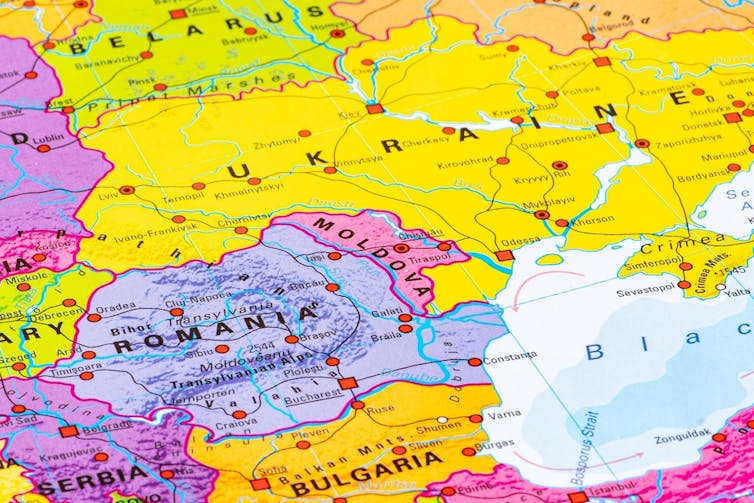
Moldova plays a vital role in supporting Ukraine. Even though it is among Europe’s poorest countries, it absorbed over 1.5 million Ukrainian refugees at one point during the war and is now home to more than 100,000.

It also helps to ship grain to and from Ukraine through its Danube ports, offering an alternative route and alleviating pressure on Ukraine’s Black Sea routes which are often cut off by Russian blockades.

Should Moldova pivot towards Moscow, Ukraine’s support structure will be weakened, undermining the EU’s eastern resilience. This would increase the risk of military attacks around the EU’s borders, with Romania looking particularly threatened, but increased attacks on Poland and the Baltic states not out of the question.

European leaders signalled awareness of just what could be at risk, with the French president, Emmanuel Macron, along with the chancellor of Germany, Friedrich Merz, and the Polish prime minister, Donald Tusk, travelling to Moldova to talk about unity and commitment to the country at the end of August.

Russia’s president, Vladimir Putin, has previously suggested he planned to occupy the whole of Ukraine, bringing his forces even closer to the rest of Europe. Footage released by Russia’s defence ministry on August 30 suggests a plan to seize Odesa and Kharkiv oblasts, areas along the Black Sea. Meanwhile, a pro-Russian Moldovan government could offer an eastern base for attacks – or even to open a new front. Another factor is that Russia already has around 1,500 troops stationed in Transnistria, a pro-Russian breakaway region of Moldova on the Ukraine border, which demanded independence in 2006, after a ballot that was not recognised by Moldova or the international community.


Read more:
Russia has provided fresh evidence of its territorial ambitions in Ukraine


This raises the stakes for the majority of nearby states, many of which are Nato members. Nato members have collective defence commitments under Nato’s article 5, which means they should come to the aid of a fellow Nato member if it were to be attacked.

Moldova’s current state

Moldova’s pro-EU president Maia Sandu currently holds 63 seats in the 101-seat parliament as part of the Party of Action and Solidarity (PAS). Since the party came to office in 2021 it has moved closer to the EU, applying for membership in 2021 after the full-scale invasion of Ukraine. Moldova was awarded candidacy status in June 2022.

A map of Moldova.

Shutterstock

In June 2024, accession negotiations were formally opened and, in July 2025, the first EU-Moldova summit was held. The population still broadly supports EU membership, but PAS is projected to vote share, although it is still leading in the polls. This dip in support from an initial 52.8% in the previous parliamentary elections in July 2021 to 25.8% in August 2025 stems from domestic dissatisfaction with [the party] and lack of progress on its policy platform.

In its election campaign PAS promised to fight corruption, make the public sector more efficient, and improve the economy, but they have not made significant progress on any of these plans.


Read more:
Why experts expect Russian interference in upcoming election on Ukraine’s borders


PAS has presented its progress on EU accession as a key achievement. But without seeing concrete benefits, the electorate has become increasingly alienated from the process.

The PAS government has been in crisis mode for much of its time in power, dealing with a variety of threats created by Russia such as an ongoing energy crisis, raising gas prices and eventually cutting off supplies and a significant loss of exports to Russia and Ukraine has also contributed to a stagnant economy.

So what’s likely to happen?

The most likely election result is that PAS will be forced into a coalition with one or more of the pro-Russian opposition parties, groups that advocate distancing Moldova from Europe. PAS has dominated the pro-EU political space, but the recently established pro-European Alternative Bloc (8.1%) is projected to gain enough votes to overcome the 5% threshold to enter parliament.

While PAS might still gain the most votes, the Patriotic Bloc of Communists, a pro-Russia group led by former president Igor Dodon, is currently expected to be the second-biggest political grouping. This brings together a number of parties including the Party of Socialists, Party of Communists, the Heart of Moldova and Future of Moldova parties. Dodon is currently facing charges of using corrupt practices to control decision making during his presidential term, and allowing state resources to be embezzled on a large scale. The US Treasury also claimed that he was involved in systemic corruption in conjunction with Russia. Court proceedings are ongoing. Dodon denies all charges, and has complained to the European Court of Human Rights that he is facing an unfair trial.

Advancing Russian influence?

Moldova has become a testing ground for Russian cyberattacks and large-scale disinformation campaigns.

It has been a target of Russian political interference. This was evident in the presidential elections and EU referendum in 2024, where attempts at manipulation and foreign influence were widely documented.


Read more:
Maia Sandu’s victory in second round of Moldovan election show’s limits to Moscow’s meddling


Similar, if not more, interference from Russia is expected in the upcoming election by the current Moldovan government and the EU.

These 2025 elections come at a decisive moment, not only for Moldova’s future but for the rest of Europe. Other countries need to pay attention to what is happening, and any interference in how the election is carried out.

The Conversation

Amy Eaglestone does not work for, consult, own shares in or receive funding from any company or organisation that would benefit from this article, and has disclosed no relevant affiliations beyond their academic appointment.

ref. Why Moldova’s election is important for the whole of Europe – https://theconversation.com/why-moldovas-election-is-important-for-the-whole-of-europe-264078