None of the cultural love stories of the 2000s started with a swipe. Friends taught us that your social circle could double as a dating pool. The Office proved that love could blossom by the water cooler, and in High School Musical the perfect match could be the new girl at school.
But in the years since, apps have changed the way we date. The old-fashioned meet-cute was replaced by swipes, and slow-burn feelings were forgotten in favour of instant digital chemistry. It came with some benefits. Gone were the days when your romantic options were limited to bad set-ups, overly flirty colleagues, or trying to catch the eye of the hottie reading on the train. And introverts could pursue connections without the anxiety of approaching someone in a noisy bar or making the first move with a friend. But there were losses too.
While the convenience of dating apps expanded our horizons, they also stripped away some of the spontaneity and authenticity of in-person connections. The rush of emotions tied to real-life interactions – the spark of chemistry when eyes meet across a room or the thrill of an unexpected conversation – has become less frequent. Swiping left and right creates a kind of detachment, where it’s easier to dismiss someone with a flick of the thumb than to take a moment to truly get to know them. What we gained in options, we lost in meaningful connections.
Now another love revolution is on the horizon as algorithms and AI start to play an ever-growing role in how we form and navigate our relationships. Whether you’re single, dating, married or somewhere in between, our love lives are increasingly mediated by technology.
This is especially true for those of us in our 20s and 30s, who grew up with the promise of finding romance in real life but came of age as the dating app revolution began in earnest. Which is where Love IRL, a new Quarter Life series from The Conversation, comes in. These research-backed articles break down the complexities of modern love, from decoding mixed signals to balancing independence with intimacy. Along the way we’ll help you navigate the ghosts, love-bombers, breadcrumbers and catfishers and strive for more meaningful connections – offline and on.
Thoughts? Relationship woes? Get in touch at quarterlife@theconversation.com
Dating today can feel like a mix of endless swipes, red flags and shifting expectations. From decoding mixed signals to balancing independence with intimacy, relationships in your 20s and 30s come with unique challenges. Love IRL is the latest series from Quarter Life that explores it all.
These research-backed articles break down the complexities of modern love to help you build meaningful connections, no matter your relationship status.
When you’re looking for a relationship, chances are you’ll start off with a wishlist for your ideal partner. Maybe someone who is attractive or wealthy, someone who likes the same movies and the outdoors. Seems like a solid starting point, right? The problem is that in the real world, these wishlists are rarely helpful. And how realistic is the idea that one person can fulfil all our needs in the first place?
In 2017, researchers conducted a large speed-dating study. They wanted to see how well the preferences people indicated for a potential partner predicted who they wanted to see again after the event.
The researchers were left with nothing: people’s wishlists did not predict who they actually liked. Instead, they suggested that the best predictor of whether you like someone is seeing how they make you feel when you interact with them. Do you feel comfortable in their presence? Do they make you laugh?
The scientific evidence suggests that you have to meet people in the flesh if you want to find your match.
Dating today can feel like a mix of endless swipes, red flags and shifting expectations. From decoding mixed signals to balancing independence with intimacy, relationships in your 20s and 30s come with unique challenges. Love IRL is the latest series from The Conversation’s Quarter Life that explores it all.
These research-backed articles break down the complexities of modern love to help you build meaningful connections, no matter your relationship status.
People used to find their romantic partner by tapping into their social networks – through friends, family, or the people they met in their daily lives. Nowadays, we often look for a romantic partner using online dating platforms, which allow us to access a larger network of potential romantic partners than ever before.
This apparent abundance may encourage a critical comparison with your wishlist and you may spend a lot of time swiping through profiles of potential partners, without initiating meeting them.
Research suggests that doing so can leave you feeling paralysed by an overload of choice and less optimistic about your chances. Research also shows that people tend to have fewer matches as the number of profiles on offer increases.
The researchers of this paradox suggest that you may be wise to put yourself on a dating diet: only looking at a limited number of profiles each day and exploring them with a curious mind. Then, when contact is established and you feel positive about the initial interaction, the real experiment begins.
When you spend a long time interacting online you may construct an idealised version of your potential partner and what you hope they’re like. That leaves you all the more likely to be disappointed when meeting them in person, as it’s easy for them to fall short of your expectations.
When you spend long time interacting online you may construct an idealised version of your potential partner. dodotone/Shutterstock
A better strategy would be to meet them in the flesh with a curious mind, before becoming overly invested in an online persona that is not a fair representation of what the other person may be like.
Taking it offline
Whether you will go on to have a satisfying relationship in the long run depends more than anything on your relationship expectations and behaviour.
Being kind and attentive to each other’s goals and needs ensures each partner’s happiness and will help weather any challenge, small or large, that couples inevitably face. But here too, technology may disrupt your mindful awareness of others – for example being on your phone in the presence of your partner – posing a risk to enjoying relationships.
Couples today also seem to have historically high expectations for their partner to help them fulfil all their goals and needs. You may want a partner to be a passionate lover, your best friend, your motivational coach and help you achieve personal growth.
In other words, people’s wishlists people carry into relationships too, as we long for a partner to fulfil all our needs.
Diversifying your friendships can put less pressure on your romantic connection. Dupe/Daniel Bughiu
Demanding all of this from one partner can place too much pressure on the relationships, rather than satisfying your needs. You may be left with a dissatisfying relationship that falls short of your expectations.
In some ways, we may all benefit from adopting lower expectations when looking for a partner and when being with them long term. This may help us appreciate them instead of taking their support and kind acts for granted.
It’s also a good idea to diversify your relationships. Having other important close (and even less close) relationships can help fulfil some needs your partner may not be best suited to meet, such as friends who like the same movies you do or who like to explore the outdoors together.
Research has shown that a greater diversity of relationships benefits happiness, as different relationships can serve different roles in fulfilling your needs, which may take some pressure off “the one” fulfilling all your needs.
Putting some brakes on your expectations for a romantic partner, when looking for a partner and when sharing your life with them, may help you to see more clearly who they are and appreciate what they contribute to your life.
Mariko Visserman does not work for, consult, own shares in or receive funding from any company or organisation that would benefit from this article, and has disclosed no relevant affiliations beyond their academic appointment.
Many dating app companies are enthusiastic about incorporating generative AI into their products. Whitney Wolfe Herd, founder of dating app Bumble, wants gen-AI to “help create more healthy and equitable relationships”. In her vision of the near future, people will have AI dating concierges who could “date” other people’s dating concierges for them, to find out which pairings were most compatible.
Dating app Grindr is developing an AI wingman, which it hopes to be up and running by 2027. Match Group, owner of popular dating apps including Tinder, Hinge and OK Cupid, have also expressed keen interest in using gen-AI in their products, believing recent advances in AI technology “have the power to be transformational, making it more seamless and engaging for users to participate in dating apps”. One of the ways they think gen-AI can do this is by enhancing “the authenticity of human connections”.
Use of gen-AI in online dating is not just some futuristic possibility, though. It’s already here.
Want to enhance your photos or present yourself in a different style? There are plenty of online tools for that. Similarly, if you want AI to help “craft the perfect, attention-grabbing bio” for you, it can do that. AI can even help you with making conversation, by analysing your chat history and suggesting ways to reply.
Extra help
It isn’t just dating app companies who are enthusiastic about AI use in dating apps either. A recent survey carried out by Cosmopolitan magazine and Bumble of 5,000 gen-Zers and millennials found that 69% of respondents were excited about “the ways AI could make dating easier and more efficient”.
An even higher proportion (86%) “believe it could help solve pervasive dating fatigue”. A surprising 86% of men and 77% of the women surveyed would share their message history with AI to help guide their dating app conversations.
Dating today can feel like a mix of endless swipes, red flags and shifting expectations. From decoding mixed signals to balancing independence with intimacy, relationships in your 20s and 30s come with unique challenges.Love IRL is the latest series from Quarter Life that explores it all.
These research-backed articles break down the complexities of modern love to help you build meaningful connections, no matter your relationship status.
It’s not hard to see why AI is so appealing for dating app users and providers. Dating apps seem to be losing their novelty: many users are reportedly abandoning them due to so-called “dating app fatigue” – feeling bored and burnt out with dating apps.
Apps and users might be hopeful that gen-AI can make dating apps fun again, or if not fun, then at least that it will make them actually lead to dates. Some AI dating companions claim to get you ten times more dates and better dates at that. Given that men tend to get fewer matches on dating apps than women, it’s also not surprising that we’re seeing more enthusiasm from men than women about the possibilities AI could bring.
Talk of gen-AI in connection to online dating gives rise to many ethical concerns. We at the Ethical Dating Online Network, an international network of over 30 multi-disciplinary academics interested in how online dating could be more ethical, think that dating app companies need to convincingly answer these worries before rushing new products to market. Here are a few standout issues.
Pitfalls of AI dating
Technology companies correctly identify some contemporary social issues, such as loneliness, anxiety at social interactions, and concerns about dating culture, as hindering people’s dating lives.
But turning to more technology to solve these issues puts us at risk of losing the skills we need to make close relationships work. The more we can reach for gen-AI to guide our interactions, the less we might be tempted to practise on our own, or to take accountability for what we communicate. After all, an AI “wingman” is of little use when meeting in person.
Also, AI tools risk entrenching much of dating culture that people find stressful. Norms around “banter”, attractiveness or flirting can make the search for intimacy seem like a competitive battleground. The way AI works – learning from existing conversations – means that it will reproduce these less desirable aspects.
Gen-AI may reproduce the negative elements of online dating culture. fizkes/Shutterstock
Instead of embracing those norms and ideals, and trying to equip everyone with the tools to seemingly meet impossibly high standards, dating app companies could do more to “de-escalate” dating culture: make it calmer, more ordinary and help people be vulnerable. For example, they could rethink how they charge for their products, encourage a culture of honesty, and look at alternatives to the “swiping” interfaces.
The possibility of misrepresentation is another concern. People have always massaged the truth when it comes to dating, and the internet has made this easier. But the more we are encouraged to use AI tools, and as they are embedded in dating apps, bad actors can more simply take advantage of the vulnerable.
An AI-generated photo, or conversation, can lead to exchanges of bank details, grooming and sexual exploitation.
Stopping short of fraud, however, is the looming intimate authenticity crisis. Online dating awash with AI generated material risks becoming a murky experience. A sincere user might struggle to identify like-minded matches on apps where use of AI is common.
This interpretive burden is annoying for anyone, but it will exacerbate the existing frustrations women, more so than men, experience on dating apps as they navigate spaces full of with timewasting, abuse, harassment and unwanted sexualisation.
Indeed, women might worry that AI will turbo-charge the ability of some men to prove a nuisance online. Bots, automation, conversation-generating tools, can help some men to lay claim to the attention of many women simultaneously.
AI tools may seem like harmless fun, or a useful timesaver. Some people may even wholeheartedly accept that AI generated content is not “authentic” and love it anyway.
Without clear guardrails in place, however, and more effort by app companies to provide informed choices based on transparency about how their apps work, any potential benefits of AI will be obscured by the negative impact it has to intimacy online.
The authors do not work for, consult, own shares in or receive funding from any company or organisation that would benefit from this article, and have disclosed no relevant affiliations beyond their academic appointment.
Zonal pricing would have categorised Britain into distinct zones, each with wholesale electricity prices that reflect how much power is generated locally, and how much demand there is for it. It would have raised prices in areas with lots of demand but low generation, like London, and lowered them where supply outstrips demand, such as in the turbine-rich Scottish Highlands.
This might have caused an immediate increase in the energy bills of already vulnerable households in some high-demand, low-generation areas, such as Tower Hamlets in London and Blackpool in north-west England.
But the idea was to encourage the construction of renewable energy to meet high demand in higher-priced zones, and prompt big electricity consumers to move to where electricity is cheaper. It was also intended to ease the need for new infrastructure to transmit electricity over long distances, like pylons. Australia, Norway and several EU nations already use this method.
The ultimate goal of zonal pricing was to make the price of electricity more accurately reflect generation and transmission costs. However, one thing has significantly inflated electricity prices in recent years, which this pricing method wouldn’t have addressed on its own: gas.
Get your news from actual experts, straight to your inbox.Sign up to our daily newsletter to receive all The Conversation UK’s latest coverage of news and research, from politics and business to the arts and sciences.
Gas is expensive, even more so since Russia’s invasion of Ukraine. Britain’s electricity system operator brings power plants onto the system to meet demand in order of the lowest to highest marginal costs.
The point at which supply meets demand forms the wholesale price of electricity. Renewable sources, like wind and solar, have zero or very low marginal costs. But most of the time the wholesale price is set by gas plants, because they can readily fill a gap in supply but have high and erratic marginal costs (largely tied to what they pay for fuel).
We need another, cheaper technology to set the wholesale price of electricity. Batteries, which can store electricity over several hours, and options capable of storing energy for longer, such as compressed air and low-carbon hydrogen, could be just the thing.
The idea is simple: batteries can be charged at times when there is a lot of surplus electricity generation (on a bright, windy day, for example) and discharge it at times of peak demand (or when the sun doesn’t shine and the wind doesn’t blow). This would entail grid operators (and ultimately, consumers) not having to pay gas plants to fire up when renewable generation cannot meet the shortfall.
Unfortunately, batteries comprised just 6% of Britain’s total electricity capacity in 2024. Investment in energy storage has lagged behind what the government forecasts is necessary to meet its 2030 clean power goals, but it is at least increasing.
Research shows that the more money that is invested in batteries, the more associated costs come down. If used instead of gas to stabilise the grid, energy storage could significantly lower the wholesale cost of the UK’s energy over time, and with the right balance of policies, household bills too. This would require subsidies to cover some of the cost of making and installing batteries, and planning mandates to build new renewables alongside new batteries.
Affordable and fair
The government could also try alternatives to zonal pricing. Wholesale electricity prices could reflect the “strike” price in renewable energy contracts. This is the price at which developers have agreed to build clean electricity generation projects, like wind farms. This would mean that gas no longer sets the wholesale price, but stable, predictable prices agreed years in advance, which would help to regulate the retail costs consumers pay.
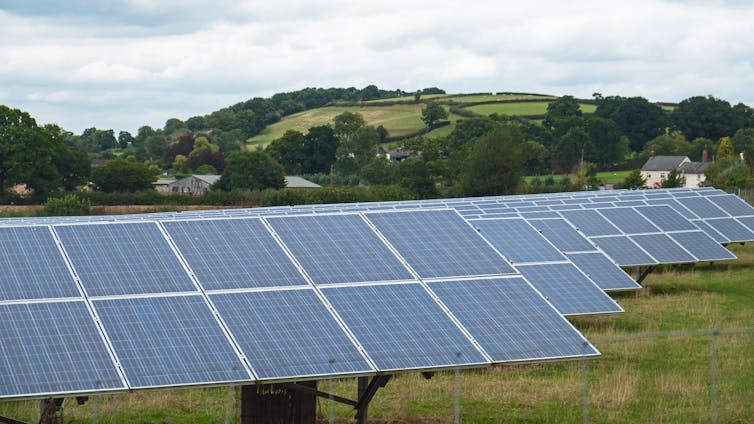
Solar arrays installed on farmland in Devon, southern England. Pjhpix/Shutterstock
These types of reforms can help set efficient energy prices, which the government usually talks about as the price needed to encourage investment in new energy technologies. But just because prices are efficient, it doesn’t mean they’re fair. Some households struggle to afford their energy bills even when markets are working efficiently. So, when prices change to encourage cleaner energy, it can hit them harder.
The government should implement new policies and expand eligibility for existing measures to take the burden off energy-poor households. These include social tariffs, which offer discounted rates to vulnerable consumers, and discounts for blocks of electricity use when renewables are generating a lot of it.
This support, combined with increasing investment in energy storage and renewables, will lower the wholesale price of electricity over time – and make energy more affordable (and fair) for everyone.
Don’t have time to read about climate change as much as you’d like?
Anupama Sen has previously received funding from the Quadrature Climate Foundation and Children’s Investment Fund Foundation.
Cassandra Etter-Wenzel and Sam Fankhauser do not work for, consult, own shares in or receive funding from any company or organisation that would benefit from this article, and have disclosed no relevant affiliations beyond their academic appointment.
Blindness, pneumonia, severe diarrhoea and even death – measles virus infections, especially in children, can have devastating consequences. Fortunately, we have a safe and effective defence. Measles vaccines are estimated to have averted more than 60 million deaths between 2000 and 2023.
But there’s more at stake than just measles itself. Emerging research suggests that the measles vaccination may offer surprising additional health benefits. Children who receive the vaccine have been shown to have a significantly lower risk of infections from diseases unrelated to measles.
Get your news from actual experts, straight to your inbox.Sign up to our daily newsletter to receive all The Conversation UK’s latest coverage of news and research, from politics and business to the arts and sciences.
One explanation for this broader benefit is the idea of “measles amnesia.” This refers to the ability of the measles virus to erase parts of the body’s immune memory.
Our immune system contains various cells that protect us from infections. Some produce antibodies that neutralise viruses, while others detect and destroy infected cells. Immune memory allows the body to “remember” past infections and mount faster responses in the future.
However, measles infection may reduce the number and diversity of these memory cells – leaving children vulnerable to a wide range of diseases they had previously developed immunity to. In other words, the virus doesn’t just make children ill in the short term, it may also undo years of immune protection.
In one study, researchers found that between 11% and 73% of antibodies targeting other diseases were lost after a measles infection in unvaccinated children. This immune depletion was not observed in children who had received the vaccine, suggesting that vaccination protects against this damaging effect.
This broad loss of immune protection may explain why measles outbreaks are often followed by spikes in other infectious diseases. Ongoing studies are exploring the impact of measles amnesia in regions such as West Africa, where measles and other infections remain widespread.
A vaccine that does more?
Another theory for the vaccine’s broader benefit is known as the “non-specific effect”. Unlike measles amnesia, which explains how the virus weakens immunity, the non-specific effect suggests that the measles vaccine actively strengthens the immune system against a wide range of pathogens.
Recent research has shown that measles vaccination may enhance the function of certain immune cells, making them more effective at fighting off other diseases. Some scientists believe this effect, rather than protection against amnesia alone, could be the primary reason why vaccinated children have better overall health outcomes.
The measles vaccine is a live attenuated vaccine, which means it uses a weakened version of the virus to stimulate a strong immune response. Live vaccines, including the BCG vaccine for tuberculosis, are known to provide broad immune training effects, which may explain this non-specific protection.
Forgotten the dangers
In the 1960s, before widespread vaccination, measles caused around 2.6 million deaths per year. It’s hard to imagine today, but that’s partly the problem.
As measles became rare, society began to forget how serious it is. We forgot how contagious it is (one infected person can spread the virus to up to 90% of nearby unvaccinated people) and we forgot how effective vaccination is (two doses provide more than 90% long-term protection).
And in some circles, this fading memory has been replaced by something more dangerous: mistrust. Misinformation, vaccine myths, and anti-vaccine rhetoric are spreading, just like the virus itself.
So, whether the additional protection offered by the vaccine is due to prevention of immune amnesia, a non-specific immune boost, or both, the takeaway is the same: Vaccinate children against measles. Because when we protect them from measles, we may also be protecting them from so much more.
Antony Black does not work for, consult, own shares in or receive funding from any company or organisation that would benefit from this article, and has disclosed no relevant affiliations beyond their academic appointment.
Is it true that male animals are dominant over females? Previous studies have often found male-biased power in primates and other mammals.
A new study, investigating physical encounters between members of the same species in 121 primates (around a quarter of all primate species) found that half of all aggressive contests were between males and females. But males won these contests in only 17% of primate populations, with females dominating in 13% – making it almost as likely for females to dominate males.
The remaining 70% of primate populations showed no clear-cut dominance of one sex over the other. This study may have shown different results to previous research because it assessed individual contests rather than categorising species based on their social structure and physical attributes.
Get your news from actual experts, straight to your inbox.Sign up to our daily newsletter to receive all The Conversation UK’s latest coverage of news and research, from politics and business to the arts and sciences.
The new study found male dominance, where males have a greater ability to influence the behaviour of the opposite sex, to be prevalent in primate species where the males are much larger than the females. This enables males to gain dominance through physical force or coercion. It was also widespread in species where males have weapons and mate with lots of females.
This is typical of African and Asian monkeys and the great apes, such as gorillas. Weighing in at around 200kg, a silverback male can be twice the size of the females within his troop. Male gorillas also have large canine teeth that can seriously injure or even kill other gorillas.
Female power was seen in primate species that had a scarcity of females, one exclusive sexual partner, similar sized males and females but did not have bodily weapons, according to the new study. These are all factors that give females more choice over who to mate with.
Female dominance was also seen in species where fighting with a male was less risky for the dependent offspring of females. For example, some primates “park” their young on their own in nests while foraging, rather than carrying them around. If a mother is holding her baby when she’s attacked, she may submit to protect her young.
Finally, matriarchal societies were common in species that live primarily in trees, which makes it easier to flee an attacker.
Female-dominated species were more likely in lorises, galagos and lemurs. So, contrary to the film Madagascar where King Julien is the king of the lemurs, females are, in fact, in charge. In the ring-tailed lemurs, females control access to food and mates, and maintain the dominance hierarchy where males are often at the bottom.
This is also true of bonobos, the closest relatives of humans. Although male bonobos are larger, females form coalitions to overcome the physical power of the males and force them into submission. This show of solidarity has also been shown in humans.
Think of how the suffragettes campaigned for women’s rights to vote in the UK. Or more recently, how women demanded new safety measures after Sarah Everard was murdered by Metropolitan Police officer Wayne Couzens in 2021.
Although female dominance has been documented less often in the wider animal kingdom, there are some examples that defy expectations. Spotted hyenas have a matriarchal society where females dominate the clans. They even have a pseudo-penis that they erect to indicate submission to more dominant individuals.
Naked mole rats have a queen that gives birth to all of the young while her offspring find food and defend the nest. The males are subordinate to the queen, but so too are the other females. In fact, the queen bullies the other members of her colony so much that the females are all rendered sterile through stress.
But what about the 70% of primate species that were found to show no dominant sex bias in the new study? These were largely the South American monkeys such as marmosets, tamarins and capuchins, that are generally small, live in trees, are social and omnivorous.
They also tended to have a prehensile tail that helps them grasp things. The ecology of these species fall in the middle of the male and female dominated species, with size difference and weapons being neither extreme nor absent, mating systems being neither polygamous nor monogamous, and the frequency of females being nether abundant nor rare.
The absence of a definitive sex-bias in dominance found in the majority of primate species may be a result of the rarity of contests between males and females, or because males and females were both equally likely to win. Nevertheless, dominance varied within species. For example the percentage of intersexual contests won by female patas monkeys ranged from 0% to 61%, depending on the population studied.
What does this mean for humans?
Human traits are not skewed towards those of male-dominated societies in other primates. We may not live in trees but males do not have natural weapons. Males are not always bigger than females, females do not tend to outnumber males and our sexual habits are varied.
Humans are actually more aligned to the 70% of species that show no clear distinction in sex biases, where species of either sex can become dominant. Let’s see which way evolution takes us.
Louise Gentle works for Nottingham Trent University.
Source: The Conversation – UK – By Neil Cocks, Associate Professor in the Department of English Literature, University of Reading
Gen V (2023-present), the recent iteration of the wildly successful superhero satire The Boys (2019), thrives on scenes of bodily outrage. One such episode concerns a young woman who is able to shrink – an ability triggered by self-induced vomiting.
Her boyfriend persuades her to use her powers during sex and we see her touching his penis, which is now taller than she is. We also understand why the boyfriend is so insistent about her transformation: relatively speaking, he has a small penis.
In Companion (2025), a film about a young man who has an abusive sexual relationship with a self-conscious robot, a small penis is also mocked. When the robot gains autonomy, and has an intelligence boost, she confronts and shames the abusive man, claiming that he is motivated in his violent and controlling behaviour by “a below average-sized penis”.
What interests me about these works, as a researcher of sexuality and film, is that they are otherwise committed to questioning reductive ideas about the body. Yes, in the universe of The Boys there is undoubted glee at all the exploding heads and superpowered, murderous buttocks, but the keynote is pathos.
Looking for something good? Cut through the noise with a carefully curated selection of the latest releases, live events and exhibitions, straight to your inbox every fortnight, on Fridays. Sign up here.
The girl who changes her shape through vomiting is arguably representing bulimic experience and there are characters whose superpowers can be understood to negotiate, for example, self-harm and dysmorphia. But when it comes to a man with a small penis, it’s a different story. His body is understood to directly influence both his actions and sense of morality.
Likewise, in Companion, which is in so many senses a meditation on the fraught relationship between mind and body, the small penis of the young man is understood to be the obvious source of his repressive actions.
In both cases, the audience is expected to laugh at the abuser because of his small penis. The small penis is framed as both a signifier and cause of abusiveness.
‘We are still so medieval about penis size’
It could be argued that in Companion and Gen V, the small penis itself is not what is being mocked. The men involved in both are young, white and heterosexual. The idea is, perhaps, that mocking those with small penises is acceptable, because in this the creators are really questioning white, heterosexual and male power structures, and that the inadequacy of that power, its mythic nature, is exposed.
One difficulty in this is that as only power held by men with small penises is mocked, the power of the well endowed, regardless of racial or sexual identity, is naturalised.
Equally, those people of colour or queer people who have small penises might implicitly be included in the mockery, with the implication that they are somehow the beneficiaries of power structures, misuse this power, and have obvious, biologically rooted motivations in so doing.
The trailer for Gen V.
Gen V qualifies the laughter – the girl , talking later to a friend, makes clear that there is nothing wrong in having a small penis, just “don’t be a dick about it”. But the only small-penised character we see is, of course, being “a dick”.
There have been a number of television shows that focus on penis size, but each explores the pathos of having a large penis: Hung (2009), The Hard Times of RJ Berger (2010), Sex Education (2019). Imagine an equivalent concerning a character with a small – or even simply not large – penis.
As journalist Caitlin Moran wrote in a 2023 Guardian article introducing her book, What About Men:
We are still so medieval about penis size that we see male genitalia as being inimical to a man’s soul. Remember when Stormy Daniels told the world that Donald Trump’s penis was ‘smaller than average – a dick like the mushroom character in Mario Kart’. And we were all like: ‘Yes, it makes sense the horrible man has a small, weird mushroom penis.’ The whole world joined in on that one.
Let us instead question the relationship between biology and destiny. And let this action be taken not to frame heterosexual white men as a disadvantaged group, but for the good of us all. Our bodies are ours to negotiate, with ourselves, and with our significant others, as well as those others that find in them indifference, or more troubling affects.
As Gen V and Companion suggest, in recent science fiction stories that otherwise reimagine the body, the small penis can only be imagined as shameful. It is taken to be an obvious motivation for abusive behaviour. Such an understanding helps no one. As the science fiction genre is especially well placed to question common-sense ideas about the human and its form, it would be a good place to begin.
Neil Cocks does not work for, consult, own shares in or receive funding from any company or organisation that would benefit from this article, and has disclosed no relevant affiliations beyond their academic appointment.
Source: The Conversation – UK – By Vincent Gauci, Professorial Fellow, School of Geography, Earth and Environmental Sciences, University of Birmingham
Satellites circling the Earth have many different functions, including navigation, communications and Earth observation. About 8%-10% of all active satellites are military or “dual use” serving intelligence or reconnaissance functions as spy satellites.
But it was a climate satellite serving as both spy and “name and shame” police officer in the sky that recently caught the world’s attention when it went quiet.
MethaneSat was developed to spot emission hot spots or plumes of invisible methane pollution from space. Built by the US non-profit, the Environmental Defense Fund with Nasa’s support, it tracked methane leaks from oil and gas sites, farms and landfills across the globe.
These are among the biggest human-caused emission sources. But methane emissions are traditionally hard to spot because they come from so many relatively small point sources or plumes.
Get your news from actual experts, straight to your inbox.Sign up to our daily newsletter to receive all The Conversation UK’s latest coverage of news and research, from politics and business to the arts and sciences.
This specialist observation satellite was developed and deployed because methane acts differently to other greenhouse gas emissions. Methane is a powerful greenhouse gas that, over 20 years, is more than 80 times more powerful a greenhouse gas than carbon dioxide.
Methane also has a short lifetime. Where carbon dioxide stays in the atmosphere for in excess of 100 years, relying on plant uptake for its removal from the atmosphere and conversion into other carbon forms, methane is broken down in the atmosphere by molecules known as hydroxyl radicals. These are nicknamed “the atmosphere’s detergent”, because they effectively remove methane from the atmosphere in less than ten years.
A gas flare at an oil refinery – one of many pinpoint sources of methane emissions. hkhtt hj/Shutterstock
This combination of short lifetime and high global warming potential (a measure of the climate strength of the gas relative to carbon dioxide) makes methane both a problem and an ideal target for reduction. In fact, growth in atmospheric methane is occurring at such a rate that it is placing us dangerously off track from meeting our Paris agreement obligations to stay within 1.5°C of climate warming by 2050 and 2°C by 2100.
Eyes in the sky
But how can we achieve these reductions and what was the role of MethaneSat in seeking to meet this objective?
There are two ways atmospheric methane concentrations can be reduced. A recent and more challenging proposition is that methane is actively removed from the atmosphere.
This is difficult because it relies on technological advances that are at their earliest stages (although growing more trees can go some way to achieving this). Another more realistic approach is to reduce emissions and then to let atmospheric chemistry do the work of removing excess methane in the atmosphere.
The global methane pledge was announced in 2021 at the UN climate summit, Cop26, in Glasgow. This aimed to reduce human-caused methane emissions by 30% on 2020 levels by 2030. More than 150 countries have now signed up to this pledge. If successful, it could reduce warming by up to 0.2°C by 2050. That’s why MethaneSat was so useful.
MethaneSat is fitted with a hyperspectral sensor – which can record sunlight reflected off Earth in hundreds of narrow colour bands across the spectrum, far beyond what our eyes can see. It’s capable of picking up concentrations of methane in air at minute quantities.
This sensor allowed the satellite to spot individual plumes of methane, so it had a crucial role in identifying those problem areas. Given that these are dispersed but also individual point sources, it was invaluable in intervening in the leaks, permitting identification of those responsible so they could be held to account and so address the problem.
No one instrument can cover what MethaneSat could do with freely available data. It had high precision, high spatial resolution and, critically, global coverage and it was particularly useful at identifying plumes in nations that don’t have the resources for the sort of regional surveys using aircraft mounted systems that can fill the gap in developed regions.
Now that MethaneSat is no longer operational, there are some other tools to identify small anthropogenic emissions sources, but they tend to be regionally focused like the aircraft measurements mentioned.
Other satellites gather similar data but that data sits behind commercial paywalls, whereas MethaneSat data was freely available. Collectively, these drawbacks mean that it’s just going to be that much harder to spot the emissions MethaneSat was so good at tracking.
Don’t have time to read about climate change as much as you’d like?
Vincent Gauci receives funding from the NERC, Spark Climate Solutions, the JABBS Foundation and has received funding from the Royal Society, Defra and the AXA Research Fund.
Recent figures from the British Beer and Pub Association show that pubs will close at the rate of one a day in the UK during 2025. This is just the latest chapter in a familiar story – more than a quarter of British pubs have closed since 2000.
The cost of running a pub has risen dramatically. The ingredients used to brew beer all cost more, as do the business rates, rents, duties, utilities and wages required to operate a welcoming venue in which to serve it. Some publicans have reported utility bills doubling in a matter of months.
Many pubs occupy prime locations and high-value buildings, which, coupled with larger floor space, mean business rates can be high relative to turnover and profit.
Meanwhile, food offerings which had provided many pubs with a profitable alternative to a drinks-only model have also been hit by rapid increases in costs. Supermarkets and delivery platforms now provide food and drink directly to consumers at prices few licenced venues can compete with. Even pubs that are economically viable are often more profitable converted into residential or retail space.
These economic challenges accompany wider cultural trends, such as the continued prevalence of home working, changes in drinking habits and competition from alternative forms of in person and online leisure.
We’ve researched pub closures in England and Wales to learn what the loss of pubs means for the communities who drink and gather in them.
When pubs closed temporarily during COVID-19 lockdowns, many people realised that what they missed about pubs was not alcohol but the social contact pubs provided. Pubs have a clear social value. They offer a space for people to meet and interact and have been shown to help tackling loneliness and social isolation.
Our research participants relayed stories of pub closure in relation to their own lives and communities:
I’ve been consoled in there, I’ve consoled friends in there. We’ve chopped up family issues, work issues. We’ve drunk for the sake of drinking in there.
Pubs help people feel connected to a local place. When they close, they can become sites of mourning, a painful reminder of change and decline. One resident of a former colliery village in Nottinghamshire said of the pub she had once worked in – now derelict, fire damaged and vandalised as it awaits redevelopment – that despite her wish that it had remained open it was now better to “knock it down” to “put us out of our misery”.
For many, pubs are a sort of bellwether for wider anxiety about social and generational change. The loss of pubs speaks to where “we” might be heading as a nation or as a community. Our recent analysis of how the British press has reported on pub closures since 2000 shows that a sense of national identity under threat is a recurring theme.
Both local and national newspapers have made repeated use of the word “our” in this context, warning readers of the grave threat to “our pubs” and “our heritage”, often invoking an idyllic image of rural life. However, much of this coverage has also praised the pub as a great leveller, as a place where people come together as a community to socialise despite their differences.
Can pubs be saved?
The Campaign for Real Ale, the leading consumer group for beer drinkers and pub goers, suggests changing planning and licensing laws to protect pubs at local and national levels, and more support and publicity for pubs to cater to changing markets.
Others have more directly lobbied for duty cuts that give pubs a fighting chance against supermarkets benefiting from economies of scale, VAT exemptions and convenience.
A hot meal served in a pub incurs a standard 20% rate of VAT, while a supermarket ready meal to be heated at home does not. The rationale for a tax cut to support pubs would rest on the social benefits they offer to communities, in contrast to supermarket-bought alcohol typically consumed at home.
A boarded-up pub in Bristol. Thomas Turnell-Read
The Localism Act 2011 gave communities the right to bid to take pubs into community ownership, designating them as assets of community value. Yet while there are some terrific examples of community-owned pubs becoming both thriving businesses and a revived focal point for communities, residents in poorer areas lack the resources to sustain viable campaigns.
In one village in our study, a pub listed as a going concern at £500,000 in fact sold as a development plot for over £660,000. A viability study suggested that an investment of £225,000, plus working capital of at least £20,000, would be needed to reopen the pub. The residents we spoke to all conceded that a purchase was far beyond the modest resources of the local community.
While the loss of so many pubs is shocking, it obscures the fact that when other licensed venues, such as bars, restaurants and licensed cafes are factored in, the downward trend is flattened – and even reversed in some areas. This suggests a long-term diversification of the sector – the pub is no longer the only option when going out for a drink.
This may also reflect a feeling that other hospitality venues better cater to different people and groups who may feel less at home in traditional pubs. Some interviewees told us that they felt craft brewery taprooms were more welcoming and family friendly. Others found cafe-bars to have a more appealing mix of coffee, food and both alcoholic and non-alcoholic drinks.
There’s a long history of pubs adapting to serve new needs and markets. Pub is the Hub, for example, has supported rural pubs to incorporate everything from village shops and libraries to pizza ovens and IT skills hubs. There have been promising experiments with fitting pubs for co-working and meeting space. And micropubs can continue to offer the benefits of a convivial social space, in a back-to-basics approach that reduces the costs of running bigger venues. Pubs can and must evolve.
Thomas Thurnell-Read receives funding from The Leverhulme Trust.
Robert Deakin does not work for, consult, own shares in or receive funding from any company or organisation that would benefit from this article, and has disclosed no relevant affiliations beyond their academic appointment.
One hundred years after a Tennessee teacher named John Scopes started a legal battle over what the state’s schools can teach children, Americans are still divided over evolution.
Scopes was charged with violating Tennessee law by teaching evolution, in a highly publicised July 1925 trial that led to national debate over evolution and education. The trial tested whether a law introduced that year really could punish teachers over evolution lessons. It could and did: Scopes was fined US$100 (£74).
But here’s the weird part: while Americans remain deeply divided about whether humans evolved from earlier species, our British predecessors largely settled this question decades before the Scopes trial.
According to thinktank Pew Research Center data from 2020, only 64% of Americans accept that “humans and other living things have evolved over time”. Meanwhile, 73% of Brits are fine with the idea that they share a common ancestor with chimpanzees. That nine-percentage-point gap might not sound like much, but it represents millions of people who think Darwin was peddling fake news.
From 1985 to 2010, Americans were in what researchers call a statistical dead heat between acceptance and rejection of evolution — which is academic speak for people couldn’t decide if we were descended from apes or Adam and Eve.
Here’s where things get psychologically fascinating. Research into misinformation and cognitive biases suggests that fundamentalism operates on a principle known as motivated reasoning. This means selectively interpreting evidence to reach predetermined conclusions. And a 2018 review of social and computer science research also found that fake news seems to spread because it confirms what people already want to believe.
Evolution denial may work the same way. Religious fundamentalism is what researchers call “the strongest predictor” for rejection of evolution. A 2019 study of 900 participants found that belief in fake news headlines was associated with delusionality, dogmatism, religious fundamentalism and reduced analytic thinking.
Get your news from actual experts, straight to your inbox.Sign up to our daily newsletter to receive all The Conversation UK’s latest coverage of news and research, from politics and business to the arts and sciences.
High personal religiosity, as seen in the US, reinforced by communities of like-minded believers, can create resistance to evolutionary science. This pattern is pronounced among Southern Baptists — the largest Protestant denomination in the US — where 61% believe the Bible is the literal word of God, compared to 31% of Americans overall. The persistence of this conflict is fuelled by organised creationist movements that reinforce religious scepticism.
Brain imaging studies
show that people with fundamentalist beliefs seem to have reduced activity in the dorsolateral prefrontal cortex — the brain region responsible for cognitive flexibility and analytical thinking. When this area is damaged or less active, people become more prone to accepting claims without sufficient evidence and show increased resistance to changing their beliefs when presented with contradictory information. Studies of brain-injured patients show damage to prefrontal networks that normally help us question information may lead to increased fundamentalist beliefs and reduced scepticism.
Fundamentalist psychology helps explain the US position in international evolution acceptance surveys. In a 2006 study, of over 33,00 people from 34 countries from 34 countries, only Turkey ranked lower than the US, with about 27% accepting evolution compared to America’s 40% at the time. Among the developed nations surveyed, the US consistently ranks near the bottom — a pattern that persists in more recent international comparisons.
Where did humans come from? Teaching children about evolution can be controversial, depending on where they live. vovan/Shutterstuck
Research shows that political polarisation on evolution has historically been much stronger in the US than in Europe or Japan, where the issue rarely becomes a campaign talking point. In the US, anti-evolution bills are still being introduced in state legislatures.
In the UK, belief in evolution became accepted among respectable clergymen around 1896, according to church historian Owen Chadwick’s analysis of Victorian christianity. But why did British religious institutions embrace science while American ones declared war?
The answer lies in different approaches to intellectual challenges. British Anglicanism has a centuries-old tradition of seeking a “via media” — a middle way between extremes — that allowed church leaders to accommodate new ideas without abandoning core beliefs. Historian Peter documented how British religious leaders actively worked to reconcile science and religion, developing theological frameworks that embraced scientific discoveries as revealing God’s methods rather than contradicting divine authority.
Anglican bishops and scholars tended to treat evolution as God’s method of creation rather than a threat to faith itself. The Church of England’s hierarchical structure meant that when educated clergy accepted evolution, the institutional framework often followed suit. A 2024 paper argued that many UK church leaders still view science and religion as complementary rather than conflicting.
A different approach
The British experience proves it’s possible to reconcile science and faith. But changing American minds requires understanding that evolution acceptance isn’t really about biology — it’s about identity, belonging, and the fundamental question of who gets to define truth. People don’t reject evolution because they’ve carefully studied the evidence. They reject it because it threatens their identity. This creates a context where education alone can’t overcome deeply held convictions.
Misinformation intervention research suggests that inoculation strategies, such as highlighting the scientific consensus on climate change, work better than debunking individual articles. But evolution education needs to be sensitive. Consensus messaging helps, but only when it doesn’t threaten people’s core identities. For example, framing evolution as a function of “how” life develops, rather than “why it exists, allows for people to maintain religious belief while accepting the scientific evidence for natural selection.
People’s views can change. A review published in 2024, analysed data which followed the same Gen X people in the US over 33 years. It found that, as they grew up, people developed more acceptance of evolution, though typically because of factors such as education and obtaining university degrees. But people who were taught at a private school seem less likely to become more accepting of evolution as they aged.
As we face new waves of scientific misinformation, the century since the Scopes trial teaches us that evidence alone won’t necessarily change people’s minds. Understanding the psychology of belief might be our best hope for evolving past our own cognitive limitations.
Edward White is affiliated with Kingston University.