Have you noticed that Nigel Farage doesn’t talk about Donald Trump anymore?

Source: The Conversation – UK – By Martin Farr, Senior Lecturer in Contemporary British History, Newcastle University

Each is the main political subject in their country, and one is the main political subject in the world. Each rode the populist wave in 2016, campaigning for the other. In 2024 the tandem surfers remounted on to an even greater breaker. Yet, though nothing has happened to suggest that bromance is dead, neither Donald Trump nor Nigel Farage publicly now speak of the other.

Trump’s presidential campaign shared personnel with Leave.eu, the unofficial Brexit campaign. Farage was on the stump with Trump, and his “bad boys of Brexit” made their pilgrimage to Trump Tower after its owner’s own triumph in the US election. Each exulted in the other’s success, and what it portended.

Trump duly proposed giving the UK ambassadorship to the United States to Farage. Instead, Farage became not merely MP for Clacton, but leader of the first insurgent party to potentially reset Britain’s electoral calculus since Labour broke through in 1922.

Then, Labour’s challenge was to replace the Liberals as the alternative party of government. It took two years. Reform UK could replace the Conservatives in four.


Get your news from actual experts, straight to your inbox. Sign up to our daily newsletter to receive all The Conversation UK’s latest coverage of news and research, from politics and business to the arts and sciences.


Trump, meanwhile, has achieved what in Britain has either been thwarted (Militant and the Labour party in the 1980s) or has at most had temporary, aberrant, success (Momentum and the Labour party in the 2010s): the takeover of a party from within. Farage has been doing so – hitherto – from without.

At one of those historic forks in a road where change is a matter of chance, after Brexit finally took place, Farage considered his own personal leave – to go and break America.

The path had been trodden by Trump-friendly high-profile provocateurs before him: Steve Hilton, from David Cameron’s Downing Street, via cable news, now standing to be governor of California; Piers Morgan, off to CNN to replace the doyen of cable news Larry King, only to crash, but then to burn on, online. Liz Truss, never knowingly understated, has found her safe space – the rightwing speaking circuit.

But Farage remained stateside. He knew his domestic platform was primed more fully to exploit the voter distrust that his nationalist crusade had done so much to provoke.

The Trump effect

Genuine peacetime transatlantic affiliations are rare, usually confined to the leaders of established parties: Ronald Reagan and Margaret Thatcher, Bill Clinton and Tony Blair. One consequence of the 2016 political shift is that the US Republicans and the British Conservatives, the latter still at least partially tethered to traditional politics, have become distanced.

During the first Trump administration, and even in the build up to the second, it was Farage who was seen as the UK’s bridge to the president. But today, at the peak of their influence, for Farage association can only be by inference, friendship with the US president is not – put mildly – of political advantage. For UK voters, Trump is the 19th most popular foreign politician, in between the King of Denmark and Benjamin Netanyahu.

There is, moreover, the “Trump effect”. Measuring this is crude – circumstances differ – but the trend is that elections may be won by openly criticising, rather than associating with, Trump. This was the case for Mark Carney in Canada, Anthony Albanese in Australia, and Nicușor Dan in Romania.

Trump’s second state visit to the UK will certainly be less awkward for Farage than it will be Starmer, the man who willed it. Farage will likely not – and has no reason to – be seen welcoming so divisive a figure.

Starmer has no choice but to, and to do so ostentatiously. It is typical of Starmer’s perfect storm of an administration that he will, in the process, do nothing to appeal to the sliver of British voters partial to Trump while further shredding his reputation with Labour voters. Farage would be well served in taking one of his tactical European sojourns for the duration. Starmer may be tempted too.

Outmanoeuvring the establishment

Reflecting the historic cultural differences of their countries, Trump’s prescription is less state, Farage’s is more. The Farage of 2025 that is. He had been robustly Thatcherite, but has lately embraced socialist interventionism, albeit through a most Thatcherite analysis: “the gap in the market was enormous”.

Reform UK now appears to stand for what Labour – in the mind of many of its voters – ought to. Eyeing the opportunity of smokestack grievances, Farage called for state control of steel production even as Trump was considering quite how high a tariff to put on it. Nationalisation and economic nationalism: associated restoratives for national malaise.

Aggressively heteronormative, Trump and Farage dabble in the natalism burgeoning in both countries – as much a cultural as an economic imperative. Each has mastered – and much more than their adversaries – social media. Each has come to recognise the demerits in publicly appeasing Putin.

And Reform’s rise in a hitherto Farage-resistant Scotland can only endear him further to a president whose Hebridean mother was thought of (in desperation) as potentially his Rosebud by British officials preparing for his first administration.

Given their rhetorical selectivity, Trump and Farage’s rolling pitches are almost unanswerable for convention-confined political opponents and reporters. These two anti-elite elitists continue to confound.

Unprecedentedly, for a former president, Trump ran against the incumbent; Farage will continue to exploit anti-incumbency, despite his party now being in office. Most elementally, the pair are bound for life by their very public near-death experiences. Theirs is, by any conceivable measure, an uncommon association.

Farage’s fleetness of foot would be apparent even without comparison with the leaden steps of the leaders of the legacy parties. His is a genius of opportunism. That’s why he knows not to remind us of his confrere across the water.

The Conversation

Martin Farr does not work for, consult, own shares in or receive funding from any company or organisation that would benefit from this article, and has disclosed no relevant affiliations beyond their academic appointment.

ref. Have you noticed that Nigel Farage doesn’t talk about Donald Trump anymore? – https://theconversation.com/have-you-noticed-that-nigel-farage-doesnt-talk-about-donald-trump-anymore-258333

US Supreme Court ponders the balance of power – and sides with President Trump

Source: The Conversation – UK – By John Stanton, Reader in Law, City St George’s, University of London

Since his second inauguration in January, Donald Trump has issued more than 160 executive orders. These orders permit the US president to make directives concerning the workings of the federal government without the need to pass laws in Congress. All US presidents have used them, including George Washington, but Trump has issued his orders at an unprecedented rate.

A number of these have courted controversy. But one stands out in particular: executive order 14160. This was signed on the day of his inauguration, January 20, and seeks to end birthright citizenship for children born in the US where the parents are in the country illegally or on temporary visas.

The purpose of this order was to redefine the scope of the 14th amendment to the constitution. This states that: “All persons born or naturalized in the United States, and subject to the jurisdiction thereof, are citizens of the United States and of the State wherein they reside.” Trump’s executive order sets limits on that principle.

Due to the order’s conflict with the constitution, various district courts have issued what are known as “universal injunctions”, blocking the order. In response to these injunctions, the government brought a case in the Supreme Court: Trump v Casa. The Trump administration argues that district judges should not have the power to issue such wide-ranging injunctions which effectively limit the president’s power.


Get your news from actual experts, straight to your inbox. Sign up to our daily newsletter to receive all The Conversation UK’s latest coverage of news and research, from politics and business to the arts and sciences.


On June 27 the Supreme Court delivered its judgment. It found in favour of the government, holding that: “Universal injunctions likely exceed the equitable authority that Congress has given to federal courts.” The court stopped short of banning them outright – but it effectively limited the extent to which courts could issue a universal block on the president’s executive orders.

The judgment did not decide on the constitutionality of the executive order itself, but focused solely on the limits of judicial power to block presidential actions more broadly. So the question of birthright citizenship remains unresolved.

People affected can bring personal lawsuits and there is also the avenue of “class action suits” in which a number of people who have grouped together with common cause and been have been ruled by a judge to constitute a “class” can seek legal relief. The New York Times has reported that plaintiffs are how preparing to refile suits to challenge executive order 14160.

But the issue raises questions about the Supreme Court. In the US, the nine Supreme Court justices are nominated by the president, and inevitably bring a corresponding political outlook to their work. Currently, there are six conservative judges – three of whom were appointed by Trump in his first term of office – and three liberal judges.

In Trump v Casa, the court divided on ideological lines. The six conservative judges supported the majority view, while the three liberal judges dissented. This was not entirely unexpected. But the ruling raises the more fundamental question about the vital constitutional role that courts play in acting as a check on government power.

Cornerstone of democracy

In democracies around the world, constitutional principles ensure that power is exercised according to law and that the various holders of legislative, executive, and judicial power do not exceed their authority. Central to these arrangements is the role of the courts. While judges must be careful not to involve themselves in the policy decisions of government, or the law-making deliberations of a legislature, it is their duty to ensure the executive does not act unlawfully or the legislature unconstitutionally.

Case reports across the world are littered with examples of judges reviewing and, on occasion, striking down government or legislative action as unlawful. In the US, the seminal case of Marbury v Madison (1803) which established, for the first time, that the Supreme Court should have the power to strike down an act of Congress as unconstitutional, has served as a beacon of this principle for over 200 years. In the UK, the Supreme Court’s finding in R(Miller) v Prime Minister that the government’s 2019 prorogation of parliament was unlawful provides a notable example of the continued importance of this role.

The balance that the courts must strike in not interfering in the policy decisions of government on the one hand, and their fundamental role in acting as a check on the lawful use of power on the other is at the heart of Trump v Casa. In the Supreme Court’s written majority opinion, Justice Amy Coney Barrett, held that the use of “universal injunctions” by the district courts was an example of judicial overreach. She wrote that federal judges were going beyond their powers in seeking to block the universal application of the executive order.

The dissenting three liberal justices issued a minority opinion saying that this finding was at odds with the rule of law. Indeed, Justice Sonia Sotomayor said the ruling in Trump v Casa “cannot coexist with the rule of law. In essence, the Courts has now shoved lower court judges out of the way in cases where executive actions is challenged, and has gifted the Executive with the prerogative of sometimes disregarding the law.”

The finding of the Supreme Court, in other words, has arguably limited the extent to which the courts in America can serve as a check on the exercise of executive power. Trump hailed the Supreme Court’s decision as a “giant win”, while attorney general Pam Bondi said it would “stop the endless barrage of nationwide injunctions against President Trump”.

Here’s the nub of the affair: while courts must be able to act as a check on the lawfulness of government action, at the same time, a government must be able to govern without too frequent or too onerous obstructions from the judiciary and this finding potentially gives the Trump administration greater room for manoeuvre.

But there is a further issue. As mentioned, US Supreme Court justices are nominated by the president. With the justices of the court being divided on political lines in Trump v Casa, questions can fairly be asked about the propriety of this arrangement – and whether it was always inevitable that one day there would be a Supreme Court in which the people might lose faith because they felt that it was more beholden to ideology than the law.

This is a potentially dangerous moment in the US. The independence of the judiciary has long been a bulwark against abuses of power – and has been regarded as such by the US people. Having judges nominated by those holding political office arguably hinders that independence – and, as the judgment in this case suggests, could throw into jeopardy the invaluable role that the courts play in keeping the exercise of government power in check.

The Conversation

John Stanton does not work for, consult, own shares in or receive funding from any company or organisation that would benefit from this article, and has disclosed no relevant affiliations beyond their academic appointment.

ref. US Supreme Court ponders the balance of power – and sides with President Trump – https://theconversation.com/us-supreme-court-ponders-the-balance-of-power-and-sides-with-president-trump-260258

Low turnout and an unfair voting system: UK elections ranked in the bottom half of countries in Europe

Source: The Conversation – UK – By Toby James, Professor of Politics and Public Policy, University of East Anglia

The UK has historically been held up as leading democracy with free and fair elections. However, our new report shows election quality in the UK is now ranked in the bottom half of countries in Europe.

The Global Electoral Integrity Report provides scores for election quality around the world. It defines electoral integrity as the extent to which elections empower citizens.

Iceland received the highest score for an election that took place in 2024, the “year of elections” during which 1.6 billion people went to the polls, according to Time Magazine. This was an unprecedented concentration of democratic activity in a single year. Iceland has a successful system of automatic voter registration and an electoral system that is judged to be fair to smaller parties.


Want more politics coverage from academic experts? Every week, we bring you informed analysis of developments in government and fact check the claims being made.

Sign up for our weekly politics newsletter, delivered every Friday.


Countries that scored highly based on their most recent election include Sweden, Denmark, Canada, Finland and Lithuania. Those at the opposite end of the scale include Syria, Belarus, Egypt, and Nicaragua. The UK is ranked 24th out of 39 countries in Europe. It is below Estonia, the Czech Republic, Italy, Austria, Luxembourg and Slovakia. It is ranked 53rd out of 170 countries overall.

The US also saw a decline. The beacons for electoral democracy are therefore now found in mainland Europe (most notably Scandinavia), Australasia, South America and the southern parts of Africa – rather than the UK and US. The centre of global democratic authority has shifted away from Westminster.

A map showing how the quality of elections around the world in 2024.
Electoral Integrity in most recent national election up to the end of 2024.
Electoral Integrity Project, CC BY-ND

The weaknesses in the UK system

There remain many areas of strength in UK elections. UK electoral officials show professionalism and independence and there is no concern about the integrity of the vote counting process. There is no evidence of widespread electoral fraud.

A major weakness is in the fairness of the electoral rules for small parties. The electoral system generated a very disproportional result in 2024. Labour took nearly two-thirds of the seats in parliament, a total of 412, with less than 10 million votes (only 34% of votes cast). Labour won a massive majority in terms of parliamentary arithmetic but the the government did not enter office with widespread support.

By contrast, Reform and the Greens received 6 million votes between them, but only nine MPs. The electoral system may have worked when Britain had a two-party system – but the two-party system no longer holds. Today’s Britain is more diverse, and political support is more distributed.

The UK also scores poorly on voter registration. It is estimated that there are around 7 million to 8 million people not correctly registered or missing from the registers entirely. This is not many less than the 9.7 million people whose votes gave the government a landslide majority. The UK does not have a system of automatic voter registration, which is present in global leaders such as Iceland, where everyone is enrolled without a hiccup.

Another problem is participation. Turnout in July 2024 was low – with only half of adults voting. Voting has been made more difficult as the Elections Act of 2022 introduced compulsory photographic identification for the first time at the general election. This was thought to have made it more difficult for many citizens to vote because the UK does not have a national identity card which all citizens hold.

Meanwhile, there are further swirling headwinds. The spread of disinformation by overseas actors in elections has become a prominent challenge around the world and there was evidence of disinformation in this campaign too. Violence during the electoral period was thought to have been removed from British elections in Victorian times. But more than half candidates experience abuse and intimidation during the electoral period.

Action needed

One year into its time in office, the government is yet to act on this issue. The word “democracy” was missing from the prime minister’s strategic defence review, despite the emphasis on protecting the UK from Russia, a country known for electoral interference and other forms of attack on democracies.

This was a sharp contrast to the former government’s 2021 review, which emphasised that a “world in which democratic societies flourish and fundamental human rights are protected is one that is more conducive to our sovereignty, security and prosperity as a nation”.

In its election manifesto, Labour promised to “address the inconsistencies in voter ID rules”, “improve voter registration” and give 16 and 17-year-olds the right to vote in all elections. There needs to be firm action on electoral system change, automatic voter registration, campaign finance reform, voter identification changes and other areas.

The Reform party is ahead in the polls and has consistently promised proportional representation. If Labour doesn’t make the reforms, another party might do so instead – and reap the benefits.

There are a complex set of challenges facing democracy and elections. New technological challenges, change in attitudes, international hostility and new emergencies are combining to batter the door of democracy down.

International organisations are increasingly stressing that political leaders need to work together and take proactive action to protect elections against autocratic forces. This means not only supporting democracy in their messages on the world stage – but also introducing reforms to create beacons of democracy in their own countries.

The Conversation

Toby James has previously received funding from the AHRC, ESRC, Joseph Rowntree Reform Trust, British Academy, Leverhulme Trust, Electoral Commission, Nuffield Foundation, the McDougall Trust and Unlock Democracy. His current research is funded by the Canadian SSHRC.

Holly Ann Garnett receives funding from the Social Sciences and Humanities Research Council of Canada and the Canadian Defence Academy Research Programme. She has previously received funding from: the British Academy, the Canadian Institute for Advanced Research, the NATO Public Diplomacy Division, the American Political Science Association Centennial Centre, and the Conference of Defence Associations.

ref. Low turnout and an unfair voting system: UK elections ranked in the bottom half of countries in Europe – https://theconversation.com/low-turnout-and-an-unfair-voting-system-uk-elections-ranked-in-the-bottom-half-of-countries-in-europe-260396

Mr. Nobody Against Putin gives an insight into the propaganda in Russian schools

Source: The Conversation – UK – By Colin Alexander, Senior Lecturer in Political Communications, Nottingham Trent University

A remarkable documentary is providing insight into the propaganda found within Russian schools. Mr. Nobody Against Putin, directed by David Borenstein, premiered at the 2025 Sundance film festival in January, where it won the world cinema documentary special jury award.

The film was recorded over two years by Pavel “Pasha” Talankin, an events coordinator and videographer at a high school in Karabash, a heavily polluted town in central southern Russia. The documentary records the intensification of Kremlin-directed ultra-nationalist and pro-war propaganda within the Russian schooling system, which has intensified since the escalation of the war against Ukraine in February 2022.

Talankin makes clear his view that this approach to “education” represents a moral wrong, and he is very much on point with the writings of the key ethicists on the subject. American theologian Reinhold Niebuhr, for example, wrote that “education is both a tool of propaganda in the hands of dominant groups, and a means of emancipation for subject classes”.

Niebuhr was writing about the education system in the US during the 1920s, when there was a widespread understanding that education was used in these two ways. Talankin’s concern is that Russia has moved to a position of imbalance, where the “dominant groups” have too much influence and are using their power to corrupt the minds of children through disingenuous narratives about national servitude, sacrifice and conformity, coupled with the unsubtle threat that those who are not patriots are “parasites”.


Looking for something good? Cut through the noise with a carefully curated selection of the latest releases, live events and exhibitions, straight to your inbox every fortnight, on Fridays. Sign up here.


In their highly respected book Propaganda & Persuasion (1986), propaganda experts Garth Jowett and Victoria O’Donnell state that “to analyse propaganda, one needs to be able to identify it”. This is a difficult task because propaganda thrives through symbols, the subliminal and in fictional works precisely because the audience is not conscious of it.

However, the creation of an environment that uses propaganda is also dependent upon who is given the oxygen of publicity and who is marginalised. These are the conditions under which ideological indoctrination occurs and power is achieved or maintained.

As such, a critical analyst of propaganda must assess the linguistic strategy, the information strategy, the eminence strategy (how to ensure that the target audience are watching, reading or listening to the desired content) and the staging strategy of the communicator. This can be remembered through the helpful L.I.E.S. mnemonic.

The trailer for Mr. Nobody versus Putin.

Talankin’s footage shows how Russian schools now promote distorted versions of European history. The well-trodden narrative that Ukraine has been taken over by neo-Nazis is referred to several times in lessons. Russian flags appear with greater frequency around the school as time goes on, and assembly time becomes an exercise in pledging allegiance to the fatherland.

Teachers are expected to read from scripts prepared for them by the ministry of education. Pupils then respond with choreographed answers – some even glancing down at notes under their desks. The children are told about how dreadful life in France and the UK is because of their reliance on Russian fossil fuels.

Interestingly, the Kremlin has asked that all of this be videoed and uploaded to a central database to ensure compliance with national regulations on what is taught in schools. Indeed, Talankin complains at one point that much of his time is now spent uploading the videos rather than actually teaching the students and helping them to be creative – as his job previously was.

Shared humanity

Talankin takes us on a tour of his city. He shows a pro-war rally that is broadly supported by the townsfolk. Or at least those in opposition dare not say anything or engage in an equivalent demonstration. He takes us to the civic library, theoretically a site of independent learning but which has been hijacked by these propaganda efforts.

Perhaps the most important moments of the documentary though are the snippets of critique and the sense of “knowing” that Talankin is keen to show. The young girl who jokingly tells her teacher to “blink twice if you’re lying”, and to which all her class then laugh. His interactions with other teachers who confide in him that they know that the propaganda is bullshit, but, worried for their status and prosperity, go along with it.

The propaganda is pretty poor though. It is clunky and obvious, and, while it might generate some short-term influence, it smacks of both arrogance and desperation on the part of the Kremlin. Indeed, it shows that there is no desire on the part of central government for Russian people to thrive intellectually.

This scenario is reminiscent of the end of the Soviet era, when communist propaganda continued to prevail, but few still believed it. Nevertheless, without a clear alternative to follow, or obvious alternative leader to guide them, most people continued to abide.

The most harrowing part of the documentary comes towards the end when Talankin provides an audio recording of the funeral of a local lad who has been killed in Ukraine. He did not dare film the funeral as this is a cultural faux pas, but the screams and wails of the mother as her son is laid to rest are piercing. The scene seems intended to bring our shared humanity to bare.

Talankin is a nice guy with intelligence and ethical fortitude. The kids are funny, charming and talented. The mother is doing what we would all do if we had lost a child to a violent death. As such, Mr. Nobody Against Putin might better be called Mr. Everybody Against Putin, as it should be of grave concern to everyone that Russia’s education system is resorting to such techniques.

The Conversation

Colin Alexander does not work for, consult, own shares in or receive funding from any company or organisation that would benefit from this article, and has disclosed no relevant affiliations beyond their academic appointment.

ref. Mr. Nobody Against Putin gives an insight into the propaganda in Russian schools – https://theconversation.com/mr-nobody-against-putin-gives-an-insight-into-the-propaganda-in-russian-schools-260162

Elon Musk says he may launch his own party: but US history tells us that’s not a recipe for success

Source: The Conversation – UK – By Matthew Mokhefi-Ashton, Lecturer in Politics and International Relations, Nottingham Trent University

To paraphrase a very old joke, how do you make a small fortune in America? Start with a large fortune and fund a third political party. American political history is littered with the wrecks of challengers who thought they could break the two-party system and failed.

This makes Elon Musk’s tease that he may launch his own new political party as an act of defiance following his falling out with Donald Trump even more intriguing.

What do we mean by a two-party system though? Since the 1860s, the Democrats and Republicans have dominated the US political landscape, holding the presidency, Congress and the vast majority of elected positions. Attempts at third parties have usually floundered at the ballot box.


Get your news from actual experts, straight to your inbox. Sign up to our daily newsletter to receive all The Conversation UK’s latest coverage of news and research, from politics and business to the arts and sciences.


Some have lasted only for a few electoral cycles, including the Progressive Party in the 1910s and the Citizens Party of the 1980s, while others like the Libertarian Party and Green Party have lasted decades and, in some cases, managed some electoral success at the local level.

But this is where an important distinction has to be made between third parties and third-party candidates. Because the US system is so personality-driven rather than party focused compared to Europe, quite often third parties have been built around a single person.

A good example is the previously mentioned Progressive Party. It was founded in 1912 by former president Theodore Roosevelt after he split from the Republicans. Without him it quickly faded away.

The Reform Party was created by billionaire Ross Perot in 1995 after he managed to get 18.9% of the vote in the 1992 presidential election. While it continued without him for some years, it was a shell of its former self. Other parties like the Socialist, Libertarian and Green parties have sprung from more organic movements and thus have been more successful at a local or state level.

When you look at recent polling though, it seems strange that the two parties continue to dominate. Public dissatisfaction with politics as usual seems at an all-time high. In a recent Pew Research poll when asked whether “I often wish there were more political parties to choose from” describes their views, 37% of respondents answered: “Very well” and 31% answered: “Somewhat well”.

In another poll, 25% of respondents said that neither of the two main parties represented their interests.

So if there is an appetite for some sort of change, why have so few challengers succeeded? The two main parties seem entrenched to the point where it resembles a cartel.

Odds stacked against third-party insurgency

The first and arguably most important reason is the electoral system. First past the post does not guarantee a two-party system (look at Britain, for instance). But political scientist Maurice Duverger argued that it does mean that the two main parties have a significant advantage. There are prizes for coming first and second, nothing for third place.

Equally, many of the big prizes in American politics such as the presidency and state governorships are indivisible and cannot be shared. So it has become received wisdom that voting for anyone other than Democrats or Republicans is a wasted vote.

In these cases, people either vote for what they perceive to be the lesser of two evils or stay at home, rather than voting for a candidate with no chance or that they may not support.

The other multi-billion dollar elephant in the room is money. The sheer cost of running for elections in recent years means that any third party is unlikely to be able to raise the funds to be truly competitive. At the last election, the Democrats and Republicans spent hundreds of millions of dollars (which isn’t even counting all of the super-PAC money spent on their behalf).

Whenever billionaires like Perot have attempted to self-fund a party, they have left themselves open to the accusation that it’s a vanity project, or lacks true mass appeal.

There is also the fact that to run successfully you must have media coverage. The media tends to focus almost exclusively on the two main parties. This creates a “chicken and egg” situation where you need success to help raise money and media coverage, but it’s difficult to be successful without first having money and media coverage.

The final reasons are that of the open primary and ideological flexibility of the main parties. Donald Trump briefly considered running as president for the Reform Party back in 2000. In 2016, the open primary system that both main parties use meant that he could impose himself on the Republican Party despite most of the party elite despising him.

Why bother starting your own party when you can run for one that already exists? It could now be argued that the Republicans have effectively become the Trump or Maga party, although whether this will survive his presidency is open to debate.

Money, money, money

Elon Musk has, for the moment, money to burn. Whether he’s willing to invest in the long term to turn this into more than a vanity project remains to be seen.

He also has charisma and a national platform to amplify his voice like few others. But, having been born outside America, he can’t run for president.

If he’s serious about electoral success, he’d have to find someone to run, and that would mean, effectively, they’d lead his party. Musk’s public persona suggests that he does not play well with others.

Founding a third party isn’t impossible, but unless there is a political earthquake it seems difficult to see how one could succeed.

The Conversation

Matthew Mokhefi-Ashton does not work for, consult, own shares in or receive funding from any company or organisation that would benefit from this article, and has disclosed no relevant affiliations beyond their academic appointment.

ref. Elon Musk says he may launch his own party: but US history tells us that’s not a recipe for success – https://theconversation.com/elon-musk-says-he-may-launch-his-own-party-but-us-history-tells-us-thats-not-a-recipe-for-success-260480

Underwater lake heatwaves are on the rise, threatening aquatic life

Source: The Conversation – UK – By Iestyn Woolway, Reader and NERC Independent Research Fellow, Bangor University

A view of Lake Superior, one of the Great Lakes. Travis J. Camp/Shutterstock

Lakes are essential to ecosystems, providing freshwater, supporting biodiversity and offering crucial habitat for fish and other aquatic species.

But a recent study by my colleagues and I shows that lakes around the world are warming, not just at the surface, but deep below as well. Subsurface heatwaves in lakes, defined as extreme periods of high water temperature below the surface, are increasing in frequency, duration and intensity.

These hidden extremes could have serious consequences for lake ecosystems. Despite that, the issue remains largely unmonitored and poorly understood.

Lake heatwaves are similar to those in the atmosphere or ocean. They are prolonged periods of excessive warmth. Most research to date has focused on surface temperatures, where climate change has already caused more frequent and intense heatwaves over recent decades.


Get your news from actual experts, straight to your inbox. Sign up to our daily newsletter to receive all The Conversation UK’s latest coverage of news and research, from politics and business to the arts and sciences.


These surface events can disrupt the chemical and physical balance of lakes, damage food webs and, in some cases, cause mass fish die-offs.

Aquatic species respond to surface heatwaves in different ways. Some benefit if the warming expands their preferred temperature range. But many others, particularly those already living near their thermal limits, face significant stress.

In lakes that stratify during summer – where warm surface water sits above a cooler bottom layer – some species seek refuge from the heat by migrating to deeper water. But what happens when that deeper refuge is no longer cool?

A closer look beneath the surface

To investigate, we analysed temperature data from tens of thousands of lakes worldwide. These included one-dimensional lake models, high-resolution simulations for the Great Lakes of North America, and local models calibrated to specific lake conditions.

By analysing how temperature varies with depth and time, we identified when and where subsurface waters crossed extreme heat thresholds.

We defined subsurface heatwaves as periods when temperatures at particular depths exceeded their typical seasonal range. We also tracked how these events have changed since 1980, and how they might evolve under different emissions scenarios by the end of this century.

Morning sun lights up a rock formation on Lake Huron.
Lake Huron, one of the Great Lakes.
Craig Sterken/Shutterstock

Subsurface heatwaves are already common and they’re becoming more so.

Since 1980, bottom heatwaves (those occurring at the deepest parts of lakes) have increased by an average of more than seven days per decade in frequency, more than two days per decade in duration and they have risen by around 0.2C per decade.

Although these deep-water events tend to be slightly less intense than surface ones, they often last longer.

We also found a rise in “vertically compounding” heatwaves. This is when extreme temperatures happen simultaneously at the surface and bottom of a lake.

These doubled-up events are now happening more than three days per decade more frequently. When they strike, aquatic species can be left with no place to escape the heat.

Even more concerning, the deep-water refuges that once offered shelter during surface heatwaves are shrinking or disappearing altogether. In some lakes, the distance fish need to travel to find cooler water has increased by nearly a metre per decade.

Our simulations suggest that these trends will intensify, especially under high-emission scenarios. By the end of this century, some bottom heatwaves could last for months, with temperature extremes not seen in the historical record.

Why this matters

Lake ecosystems rely on thermal structure. When extreme heat reaches deeper into the water column, it can trigger cascading ecological effects, from shifting fish habitats and altering species distribution, to increased nutrient cycling and algal blooms. It could even affect the release of greenhouse gases like methane from lake bed sediments.

Subsurface heatwaves pose a particular risk to bottom-dwelling species, which may be less mobile or already adapted to cold, stable conditions. The loss of thermal refuges during surface heatwaves also jeopardises species that would otherwise escape to deeper waters.

By ignoring what’s happening below the surface, we risk underestimating the true ecological effects of climate change on freshwater systems.

Our study highlights the urgent need to expand lake monitoring efforts to include subsurface temperatures. While satellites have transformed our understanding of surface warming, they can’t capture what’s happening below.

Future research should examine how different species respond to these deep-water and vertically compounding heatwaves. It should explore how changes in lake thermal structure affect different processes like nutrient cycling and methane production.

For conservation planners, that means incorporating subsurface heatwaves into risk assessments and habitat models. For climate modellers, it means better representing vertical processes in lakes within global Earth system models.

As lakes continue to warm, managing and understanding these hidden heat extremes will be critical to protecting biodiversity and the vital ecosystem services lakes provide.

The Conversation

Iestyn Woolway receives funding from UKRI NERC.

ref. Underwater lake heatwaves are on the rise, threatening aquatic life – https://theconversation.com/underwater-lake-heatwaves-are-on-the-rise-threatening-aquatic-life-258885

How Donald Trump’s economic policies, including uncertainty around tariffs, are damaging the US economy

Source: The Conversation – UK – By John Whittaker, Senior Teaching Fellow in Economics, Lancaster University

Donald Trump set a deadline of July 9 2025 for trade deals to be made before he hits some of the world’s biggest economies with his controversial tariffs. It’s impossible to predict what will happen on the day, but it is already clear that his economic policies are damaging American interests.

Just look at the state of US government debt for example. Currently it stands at US$36 trillion (£26 trillion). And with total economic output (GDP) worth US$29 trillion per year, that debt is 123% of GDP, the highest it has been since 1946.

Government debts are alarmingly high in other countries too (the UK’s is at 104% of GDP, with France at 116% and China at 113%), but the US is towards the top of the range.

The recently passed budget reconciliation bill (what Trump calls the “big beautiful bill”) is projected to add US$3 trillion to that debt over the next decade. With these sorts of numbers, there is little prospect of putting US debt on a downward track.


Get your news from actual experts, straight to your inbox. Sign up to our daily newsletter to receive all The Conversation UK’s latest coverage of news and research, from politics and business to the arts and sciences.


In 2024, the US government had to borrow an additional US$1.8 trillion to cover spending not supported by tax revenue (the budget deficit). This is equivalent to 6.2% of GDP, a number that is officially predicted to rise to 7.3% during the next 30 years.

The predictable consequence of this fiscal profligacy and the chaotic tariff programme is the high rates of interest that the US government is having to pay for its borrowing.

For instance, the interest rate on ten-year US government debt (otherwise known as its yield) has risen from 0.5% in mid-2020 to 4.3% now. And as government debt yields rise, so do interest rates on mortgages and corporate borrowing.

The power of the dollar

For decades, the United States has enjoyed a high level of trust in the strength, openness and stability of its economy.

As a result, US bonds or “treasuries”, the financial assets that the government sells to raise money for public spending, have long been considered safe investments by financial institutions around the world. And the US dollar has been the dominant currency for international payments and debts.

Sometimes referred to as “exorbitant privilege”, this status of the US dollar as the world’s reserve currency brings big advantages. It benefits US consumers by making imported goods cheaper (albeit contributing to the trade deficits (when US imports to a country are worth more than its exports) which bother the president so much).

It also means the US government can borrow a lot of money before doubts arise about its ability to repay. Investors will generally buy as many bonds as the US govt needs to issue to pay for its spending.

The dominance of the dollar in international transactions also brings political power, such as the ability to exclude Russia from major global payment systems.

But this privilege is being eroded by the US president’s tariff agenda. Economic motives aside, it is the way they are being applied – their size and the unpredictability – that is really sapping investor confidence.

It’s costly to adjust trading patterns and supply chains in response to tariffs. So when the scope of future tariffs is unknown, the rational response is to stop investing while awaiting greater certainty.

The dollar has lost 8% in value since the beginning of the year, reflecting investor doubts about the US economy, and making imports even more expensive.

Financial markets are vulnerable

But perhaps the biggest danger to US financial markets is a sudden rise in yields on government debt. No investor wants to be left holding a bond when its yield rises because – as with all fixed-interest debt – the rise in yield causes the bond’s market value to fall. This is because new bonds are issued with a higher yield, making existing bonds less attractive and less valuable.

A bond holder expecting a rise in yield therefore has an incentive to sell it before the rise occurs. But the rise in yield can become self-reinforcing if the scramble to sell becomes a stampede.

Indeed, there was a jump in US yields after the increases in trade tariffs announced on “liberation day” in early April, with the yield on ten-year treasuries rising by 0.5% in just four days.

Magnifying glass on US dollar bill with US flag and financial chart graphics.
Damaged dollar?
Dilok Klaisataporn/Shutterstock

Fortunately, this rise was halted on April 10 when the tariffs were abruptly paused, allegedly in response to the fall in bond prices and an accompanying fall in share prices. The opinion of a senior central banker, that financial markets had been close to “meltdown”, was one of several such warnings.

The dollar is unlikely to be quickly dislodged from its pedestal as the world’s reserve currency, as the alternatives are not attractive. The euro is not suitable because it is the currency of 20 EU countries, each with its own separate government debt. Nor is the Chinese yuan a likely contender, given the Chinese government involvement in managing the yuan exchange rate.

But since March, foreign central banks have been selling off US treasuries, often choosing to hold gold instead.

On Trump’s watch, the reputation of the US dollar as the ultimate safe asset has been tarnished, leaving the financial system more vulnerable – and borrowing more expensive.

The Conversation

John Whittaker does not work for, consult, own shares in or receive funding from any company or organisation that would benefit from this article, and has disclosed no relevant affiliations beyond their academic appointment.

ref. How Donald Trump’s economic policies, including uncertainty around tariffs, are damaging the US economy – https://theconversation.com/how-donald-trumps-economic-policies-including-uncertainty-around-tariffs-are-damaging-the-us-economy-259809

Agatha Christie’s mid-century ‘manosphere’ reveals a different kind of dysfunctional male

Source: The Conversation – UK – By Gill Plain, Professor of English Literature and Popular Culture, University of St Andrews

This piece contains spoilers for Towards Zero.

Agatha Christie, a middle-class English crime writer who preferred to be known as a housewife, is the world’s bestselling novelist. Since her death in 1976, her work has been translated into over 100 languages and adapted for cinema, TV and even video games.

Her writing is characterised by its cheerful readability and ruthless dissection of hypocrisy, greed and respectability. Christie is fascinated by power and its abuse, and explores this through the skilful deployment of recognisable character types. The suspects in her books are not just there for the puzzle – they also exemplify the attitudes, ideals and assumptions that shaped 20th-century British society.

If we want to know about the mid-century “manosphere”, then, there is no better place to look than in the fiction of Agatha Christie. What did masculinity mean to this writer, and would we recognise it in the gender types and ideals of today? Some answers might be found through the recent BBC adaptation of Towards Zero, which confronts viewers with a range of dysfunctional male types.


Looking for something good? Cut through the noise with a carefully curated selection of the latest releases, live events and exhibitions, straight to your inbox every fortnight, on Fridays. Sign up here.


Chief among these is Thomas Royde, a neurotic twitching figure driven to breakdown by the shame of having his word doubted. Gaslit by his pathologically perfect cousin Nevile, Thomas has been dispatched to the colonies, where he has compounded his injuries through financial failure. Broke and broken, the adaptation imagines him returning to the family home with trauma quite literally written on his body.

This is not the Thomas Royde of Christie’s original 1944 novel. That figure was stoic, silent and perfectly capable of managing his failure to live up to the spectacular masculinity of cousin Nevile. Christie’s Thomas may have regretted his romantic losses and physical limitations, but the idea of exposing his pain in public would have horrified him.

This is not a case of repression; rather it speaks to a world in which pain is respected, but simply not discussed. Thomas’s friends, we are told, “had learned to gauge his reactions correctly from the quality of his silences”. The stoical man of few words is a recurrent type within Christie’s fiction. It’s a mode of masculinity of which she approves – even while poking fun at it – and one recognised by her mid-20th century audience.

These are men who embody ideal British middle-class values: steady, reliable, resilient, modest, good humoured and infinitely sensible. They find their fictional reward in happy unions, sometimes with sensible women, sometimes with bright young things who benefit from their calm assurance.

Christie also depicted more dangerous male types – attractive adventurers who might be courageous, or reckless and deadly. These charismatic figures present a troubling mode of masculinity in her fiction, from the effortlessly charming Ralph in The Murder of Roger Ackroyd (1926), to Michael Rogers, the all too persuasive narrator of Endless Night (1967).

Superficially, these two types of men might be mapped onto Christie’s own experiences. Her autobiography suggests that she was irresistibly drawn to something strange and inscrutable in her first husband, Archie. By contrast, her second husband, the archaeologist Max Mallowan, brought friendship and shared interests.

Yet while it’s possible to see biographical resonances in these types, it is equally important to recognise them as part of a middle-class world view that set limits on acceptable masculinities. In my book, Agatha Christie: A Very Short Introduction, I explore these limits, examining a cultural climate riven with contradictions.

A different time

Mid-20th century culture insisted that men be articulate when discussing public matters – science, politics, sport – but those who extended this to the emotions were not to be trusted. They were seen to be glib, foolish or possibly dangerous.

British masculinity acts rather than talks and does a decent job of work. As a result, work itself is a vital dimension of man-making in Christie’s novels, and in the fiction of contemporaries like Nigel Balchin, Hammond Innes and Nevil Shute.

These writers witnessed the conflicting pressures on men, expected to be both soldiers and citizens, capable of combat and domestic breadwinning. They saw the damage caused by war, unemployment and the loss of father figures. But the answer wasn’t talking. Rather, the best medicine for wounded masculinity was the self-respect that comes with doing a good day’s work.

This ideology still resonates within understandings of “healthy” masculinity, but there are limits to the problems that can be solved through a companionable post-work pint. Which brings us back to the BBC’s Towards Zero. Contemporary adaptations often speak to the preoccupations of their moment, and the plot is driven by one man’s all-consuming hatred of his ex-wife.

With apologies for plot spoilers, perfect Nevile turns out to be a perfect misogynist, scheming against the woman who has – to his mind – humiliated him. But the world of his hatred is a long way from the online “manosphere” of our contemporary age.

Quite aside from the technological gulf separating the eras, Christie does not imagine misogyny as an abusive mass phenomenon, a set of echo chambers which figure men as the victims of feminism. Rather, Nevile, like all Christie’s murderers, kills for reasons that can clearly be defined, detected and articulated: he is an isolated madman, not a cultural phenomenon.

Towards Zero’s topicality – its preoccupation with celebrity, resentment of women and a manipulative gaslighting villain – does much to explain its adaptation, but it does not account for the radical revision of Thomas Royde. Is it an indication that stoicism is out of fashion? Or simply a desire to convert Christie’s cool-tempered fictions into melodramas appropriate for a social-media age?

Whatever the thinking, there is a familiar consolation for Thomas’s pain. He might not get the girl of his dreams, but he does get something better: a steady, reliable woman whose modest virtues illustrate that, in Christie’s world, “ideal masculinity” is unexpectedly non-binary. Women can be just as stoic, reserved and resilient as men.

Christie’s “manosphere”, then, has its share of haters, but they are isolated figures forced to disguise their resentments. They also, frequently, meet untimely ends – another reason why Christie remains a bestseller to this day.


This article features references to books that have been included for editorial reasons, and may contain links to bookshop.org. If you buy something, The Conversation UK may earn a commission.

The Conversation

Gill Plain does not work for, consult, own shares in or receive funding from any company or organisation that would benefit from this article, and has disclosed no relevant affiliations beyond their academic appointment.

ref. Agatha Christie’s mid-century ‘manosphere’ reveals a different kind of dysfunctional male – https://theconversation.com/agatha-christies-mid-century-manosphere-reveals-a-different-kind-of-dysfunctional-male-254726

I survived the 7/7 London bombings, but as a British Muslim I still grew up being called a terrorist

Source: The Conversation – UK – By Neema Begum, Assistant Professor in British Politics, University of Nottingham

Twenty years ago, I was walking through central London with my history teacher when a bus exploded behind us. We were in London for an awards ceremony at Westminster where I was to pick up the award for best opposition speaker in the Youth Parliament competition.

We had arrived at Euston station and all local transport had been cancelled. At this point, we heard that there’d been a bomb scare.

We bought a map at the station and set off to walk to Westminster when the number 30 bus exploded on Tavistock Square. It was the loudest sound I’d ever heard. People were running and screaming. We ran too and took shelter in a nearby park.

We later learned that four bombs had been detonated on London’s transport system. The attack, carried out by British-born Islamist extremists on July 7 2005, claimed the lives of 52 people and injured hundreds. My teacher and I were far enough away from the bus to be physically unhurt.

Four years on from the attacks on 9/11, this was a time when, in the minds of many, Muslims were already associated with terrorism. Despite going to a state school where the pupils were predominantly Muslim, we were called terrorists in the playground.


Get your news from actual experts, straight to your inbox. Sign up to our daily newsletter to receive all The Conversation UK’s latest coverage of news and research, from politics and business to the arts and sciences.


In the aftermath of 7/7, there was no space for Muslim survivors like me. No headlines about our fear, our trauma or our belonging – only suspicion. While I was lucky to walk away physically unscathed, I carried a different kind of wound: being part of a community that was treated with collective blame.

My academic research focuses on ethnic minority voting behaviour, political participation and representation in Britain. The events of 7/7 marked a critical moment in how British Muslims are still viewed as inherently suspect today.

Over the last 25 years, Muslim communities have been viewed as places where terrorism is fostered. Following 7/7, British Muslims were viewed as a security threat by politicians, the media and many non-Muslims.

One stark example was the implementation of the Prevent counter-terrorism programme after 7/7. Prevent has contributed to increased surveillance and marginalisation of Muslim communities in the UK.

Fear of Muslims and especially “home-grown terrorists” has meant that Muslims are made to feel that they must condemn terrorist acts. Despite the fact that an overwhelming majority of Muslims in the UK identify as British and are proud to be British citizens, British Muslims often feel they must prove their “Britishness” and distance themselves from stereotypes of Muslims as terrorists or terrorist sympathisers.

Post-7/7 arguments that British Muslims were at odds with “British values” and fears that Britain was sleepwalking into segregation have persisted in politics and the media. Negative portrayals of Islam and Muslims in media, including stigmatising, offensive and biased news reports have not helped.

In 2013, a device exploded outside the mosque I attended as a child, carried out by an extreme right-wing white supremacist. In 2025, hate crimes against Muslims have reached record levels.

Stereotypes of Muslims in politics

Twenty years after the London bombings, there are more Muslim voices in politics and media, and a greater awareness of Islamophobia. The idea that London could have a Muslim mayor, as it does today with Sadiq Khan, may have been unthinkable in the immediate aftermath of 7/7.

But the fear that gripped the country in 2005 never disappeared, it just changed shape. Today it shows up in political attacks and increases in anti-Muslim hate crimes in the context of the war in Gaza. It also shows up in attacks on the religious freedoms of British Muslims – like calls for a burka ban – under the guise of “British values”.

While there are more Muslims in politics at every level, they are not exempt from stereotypes. In my research on ethnic minority local councillors, I’ve found Muslim women councillors were often stereotyped as submissive and oppressed in white council spaces.

A hijab-wearing Muslim woman councillor received comments that she wasn’t “westernised enough” and that she needed to be “more modernised”. Another Muslim woman councillor had a white male journalist remark that she was “very confident” in a way she felt was derisive.

Working against ingrained stereotypes of how a Muslim woman would behave, these councillors often faced a double burden: having to constantly prove their “modernity” and competence while simultaneously navigating accusations of being either too passive or too assertive – never quite fitting the narrow expectations imposed upon them.

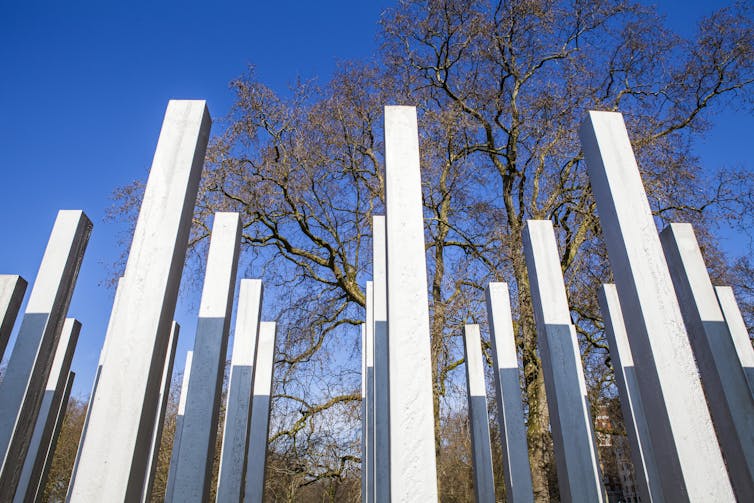
The 7/7 memorial in Hyde Park, a collection of vertical steel columns, against a blue sky
The 7/7 memorial in London’s Hyde Park.
Chris Dorney/Shutterstock

In research on ethnic minority voting behaviour in the EU referendum, I found that campaign groups for Brexit such as Muslims for Britain drew on “good Muslim” narratives to buttress their claims to Britishness. For example, they have referred to the sacrifices Muslim soldiers made for Britain in the two world wars, to position British Muslims – particularly those with south Asian heritage – as established and loyal members of the nation.

Even as a survivor of terrorism, I – like many British Muslims – am constantly made to prove my distance from it. I have particularly noticed this as a woman of Bangladeshi heritage, sharing a surname with Shamima Begum, who joined Islamic State as a teenager and had her UK citizenship stripped.

Begum is also my mother’s name, my classmates’ name, and shared by many British Bengali women. It belongs to Nadiya Hussain (née Begum), winner of The Great British Bake Off and Halima Begum, chief executive of Oxfam. Behind every headline are real, complex communities still hoping to be seen beyond the shadow of suspicion.

The Conversation

Neema Begum receives funding from the British Academy.

ref. I survived the 7/7 London bombings, but as a British Muslim I still grew up being called a terrorist – https://theconversation.com/i-survived-the-7-7-london-bombings-but-as-a-british-muslim-i-still-grew-up-being-called-a-terrorist-259316

Ageing isn’t the same everywhere – why inflammation may be a lifestyle problem

Source: The Conversation – UK – By Samuel J. White, Associate Professor & Head of Projects, York St John University

The Orang Asli age differently. Azami Adiputera/Shutterstock.com

For years, scientists have believed that inflammation inevitably increases with age, quietly fuelling diseases like heart disease, dementia and diabetes. But a new study of Indigenous populations challenges that idea and could reshape how we think about ageing itself.

For decades, scientists have identified chronic low-level inflammation – called “inflammaging” – as one of the primary drivers of age-related diseases. Think of it as your body’s immune system stuck in overdrive – constantly fighting battles that don’t exist, gradually wearing down organs and systems.

But inflammaging might not be a universal feature of ageing after all. Instead, it could be a byproduct of how we live in modern society.


Get your news from actual experts, straight to your inbox. Sign up to our daily newsletter to receive all The Conversation UK’s latest coverage of news and research, from politics and business to the arts and sciences.


The research, published in Nature Aging, compared patterns of inflammation in four very different communities around the world. Two groups were from modern, industrialised societies – older adults living in Italy and Singapore.

The other two were Indigenous communities who live more traditional lifestyles: the Tsimane people of the Bolivian Amazon and the Orang Asli in the forests of Malaysia.

The researchers analysed blood samples from more than 2,800 people, looking at a wide range of inflammatory molecules, known as cytokines. Their goal was to find out whether a pattern seen in earlier studies – where certain signs of inflammation rise with age and are linked to disease – also appears in other parts of the world.

The answer, it turns out, is both yes and no.

Among the Italian and Singaporean participants, the researchers found a fairly consistent inflammaging pattern. As people aged, levels of inflammatory markers in the blood, such as C-reactive protein and tumour necrosis factor, rose together. Higher levels were linked to a greater risk of chronic diseases including kidney disease and heart disease.

But in the Tsimane and Orang Asli populations, the inflammaging pattern was absent. The same inflammatory molecules did not rise consistently with age, and they were not strongly linked to age-related diseases.

In fact, among the Tsimane, who face high rates of infections from parasites and other pathogens, inflammation levels were often elevated. Yet this did not lead to the same rates of chronic diseases that are common in industrialised nations.

Despite high inflammatory markers, the Tsimane experience very low rates of conditions such as heart disease, diabetes and dementia.

Inflammaging may not be universal

These results raise important questions. One possibility is that inflammaging, at least as measured through these blood signals, is not a universal biological feature of ageing. Instead, it may arise in societies marked by high-calorie diets, low physical activity and reduced exposure to infections.

In other words, chronic inflammation linked to ageing and disease might not simply result from an inevitable biological process, but rather from a mismatch between our ancient physiology and the modern environment.

The study suggests that in communities with more traditional lifestyles – where people are more active, eat differently and are exposed to more infections – the immune system may work in a different way. In these groups, higher levels of inflammation might be a normal, healthy response to their environment, rather than a sign that the body is breaking down with age.

Another possibility is that inflammaging may still occur in all humans, but it might appear in different ways that are not captured by measuring inflammatory molecules in the blood. It could be happening at a cellular or tissue level, where it remains invisible to the blood tests used in this research.

A man tucks in to fast food.
Chronic low-level inflammation may be a lifestyle problem.
Nattakorn_Maneerat/Shutterstock.com

Why this matters

If these findings are confirmed, they could have significant consequences.

First, they challenge how we diagnose and treat chronic inflammation in ageing. Biomarkers used to define inflammaging in European or Asian populations might not apply in other settings, or even among all groups within industrialised nations.

Second, they suggest that lifestyle interventions aimed at lowering chronic inflammation, such as exercise, changes in diet, or drugs targeting specific inflammatory molecules, might have different effects in different populations. What works for people living in cities might be unnecessary, or even ineffective, in those living traditional lifestyles.

Finally, this research serves as an important reminder that much of our knowledge about human health and ageing comes from studies conducted in wealthy, industrialised nations. Findings from these groups cannot automatically be assumed to apply worldwide.

The researchers are clear: this study is just the beginning. They urge scientists to dig deeper, using new tools that can detect inflammation not just in the blood, but within tissues and cells where the real story of ageing may be unfolding. Just as important, they call for more inclusive research that spans the full range of human experience, not just the wealthy, urbanised corners of the world.

At the very least, this study offers an important lesson. What we thought was a universal truth about the biology of ageing might instead be a local story, shaped by our environment, lifestyle and the way we live.

The Conversation

The authors do not work for, consult, own shares in or receive funding from any company or organisation that would benefit from this article, and have disclosed no relevant affiliations beyond their academic appointment.

ref. Ageing isn’t the same everywhere – why inflammation may be a lifestyle problem – https://theconversation.com/ageing-isnt-the-same-everywhere-why-inflammation-may-be-a-lifestyle-problem-260322