Why is it so difficult for the UK to deport foreign criminals?

Source: The Conversation – UK – By Sarah Singer, Professor of Refugee Law, School of Advanced Study, University of London

macondofotografcisi/Shutterstock

A convicted sex offender has been deported from Britain to Ethiopia after being accidentally released from prison. Following a national manhunt, home secretary Shabana Mahmood confirmed that Hadush Kebatu – an asylum seeker who came to the UK without authorisation on a small boat – would be returned to his home country.

Kebatu was convicted in September of sexual offences against a woman and 14-year-old girl and sentenced to 12 months imprisonment. Mahmood announced she had “pulled every lever” to ensure his deportation. But shouldn’t it be easy for the government to deport someone who has committed a crime such as this?

Under UK law, the home secretary has a duty to pursue removal of foreign national offenders (FNOs). This includes “automatic” deportation of any foreign nationals who are sentenced to 12 months or more imprisonment. They also have discretion to deport a foreign national (whether or not they have committed an offence) if they believe it “is conducive to the public good”.

But for several reasons, the UK has struggled to do this. In 2006, it was revealed that some 1,013 foreign national prisoners had been released without the Home Office considering deportation. This was a scandal that led to the resignation of then home secretary Charles Clarke.

Currently, the UK deports approximately 5,000 FNOs per year. There are currently 10,700 FNOs held in UK prisons, around 12% of the total prison population.

FNOs are considered for deportation on completion of their sentence or, increasingly (given the pressure on space in prisons), before they have served their full sentence. This may be under early release schemes or prisoner transfer arrangements with their home country.

In practice, deportations are often complicated by procedural issues. Removal can be prevented by lack of travel documents, and the Home Office may have to seek an emergency travel document from an individual’s embassy before they can be removed – a process which can be frustrated if the offender or their embassy refuses to cooperate or are slow in doing so.

Deportation arrangements

To address these issues, the UK now has 110 prisoner transfer agreements with other countries – most recently, Albania and the Philippines. Through these arrangements, offenders can partially serve their sentence in the UK, and then be transferred to serve the remainder of their sentence in their home country.

There are two other schemes under which FNOs may be deported before serving their full sentences: early removal, and facilitated return schemes. Under these schemes, they do not serve the rest of their sentence in their home country.

Recent changes to the early removal scheme mean FNOs have to serve only 30% of their sentence (rather than 50%) before removal. The home secretary has indicated plans to reduce this to 0%, so offenders can be targeted for deportation as soon as they are sentenced.

The facilitated return scheme encourages voluntary removal. It “sweetens the deal” by providing the offender up to £1,500 to help them resettle in their home country, if they agree to withdraw any outstanding appeals or applications to stay in the UK.

There has been some criticism of the fact that Kebatu was given £500 after threatening to disrupt his deportation. Although his was a forced return, not part of voluntary removal, the Home Office argued this is still a smaller payment than would have been required to detain him and put him on a different flight.

In many cases, lack of coordination and administrative errors in the Home Office are the root cause of failed removals. Complications around booking flights, arranging escorts and other practicalities have all been found to prevent deportations.

Human rights concerns

Offenders may also appeal their deportations by arguing that removal would breach their right to private and family life, under article 8 of the European convention on human rights.

This is sometimes misreported as offering FNOs very broad protection against removal. For example, the wrongly reported case of an Albanian who resisted removal on the basis his son disliked foreign chicken nuggets, or Theresa May’s assertion that a foreign offender was able to stay in the UK because he had a pet cat. These attention-grabbing headlines often misrepresent the content of decisions and mischaracterise the role of human rights.


Read more:
How the UK could reform the European convention on human rights


In fact, the UK has a very strict interpretation of article 8, and decision-makers must balance the right against aims such as controlling immigration and public safety.

UK rules state that the public interest in removing foreign offenders will almost always outweigh any article 8 rights, except in the most exceptional cases. This may be, for example, if the person has lived in the UK for almost their whole life and would have real difficulty integrating in the country they would be removed to, or if removal would be “unduly harsh” on their (UK citizen) child or long-term partner. FNOs sentenced to four or more years in prison must show “very compelling circumstances over and above” these exceptions.

Foreign nationals may also argue that their life will be at risk, that they will suffer inhuman or degrading treatment, unlawful detention, or an unfair trial on return to their home country.

In practice, this means the UK government cannot deport someone if there is a high risk they would face irreparable harm including persecution, torture, ill-treatment or other serious human rights violations. In some cases, this has been relied on to prevent deportation where there was a risk of abduction and torture at the hands of police, or to face trial where evidence obtained by torture would be used.

However, this is only applicable where there is real risk of very serious harm and will not apply in all, or even most, cases. British courts have ruled it is possible to return people even to countries in conflict, if there is a safe place in the country they could move to.

The most recent data shows that between 2008 and 2021, 11% of FNO appeals against deportation succeeded on human rights grounds. This is 3%-4% of the approximately 60,000 FNOs removed from the UK during this period.

Despite the exceptional nature of these human rights protections, the challenges they are perceived to pose to a state’s ability to control its borders mean they attract a disproportionate amount of political attention. In May this year, nine European states took the unprecedented step of issuing a letter to the European Court of Human Rights, calling for greater state powers in removing foreign criminals.

The UK justice secretary has followed suit, stating that the UK will pursue reform of the European convention.


Want more politics coverage from academic experts? Every week, we bring you informed analysis of developments in government and fact check the claims being made.

Sign up for our weekly politics newsletter, delivered every Friday.


The Conversation

Sarah Singer does not work for, consult, own shares in or receive funding from any company or organisation that would benefit from this article, and has disclosed no relevant affiliations beyond their academic appointment.

ref. Why is it so difficult for the UK to deport foreign criminals? – https://theconversation.com/why-is-it-so-difficult-for-the-uk-to-deport-foreign-criminals-268625

J.D. Vance calls himself a ‘post-liberal’: here’s what that means for US government

Source: The Conversation – UK – By Matt Sleat, Reader in Political Theory, University of Sheffield

The US vice-president, J. D. Vance, has identified himself as being “of the post-liberal right”. Vance is generally thought of as more influential than many previous US vice-presidents and the odds are narrowing on him running for president in 2028. So it’s useful to know what this “post-liberal” section of the Republican party stands for.

In many ways, post-liberalism isn’t new. As I argue in my forthcoming book, post-liberals hold very traditional, conservative views on social issues that have been present in the Republican party going back decades.

They don’t believe in abortion rights, same-sex marriage, or gender self-identification. They also oppose access to pornography, and condemn blasphemy, while urging governments to strengthen support for families, rebuild communities, support churches, unions, and local groups, and bring society back to its Christian roots.

But post-liberalism is different from past conservatism in three big ways.

Economic policy

Since the 1980s, conservatives across the west have mostly supported neo-liberal economics. That means things like free trade, privatisation, less government spending, globalisation and letting markets run with little interference. In short: the market decides, not the state.

Post-liberals strongly disagree. They argue that neo-liberalism has helped big corporations make unprecedented profits while hurting working people, destroying local communities, and damaging the environment. They say free trade hasn’t raised living standards for everyone – especially the working class.

Instead, they want governments to break up powerful monopolies, rebuild manufacturing bases, ensure that wages can support families, protect workers (including gig workers) and support unions and trades. This is closer to former president Franklin D. Roosevelt’s New Deal in the 1930s, where an emboldened state counterbalances capital to protect communities and the working-classes, than it is Ronald Reagan’s free marketeering philosophy of the 1980s.

Freedom and the common good

Post-liberals also argue that neo-liberal economics isn’t truly conservative at all – it’s just another form of liberalism because it focuses on individual freedom and choice. Liberalism is about giving people as much freedom as possible. Post-liberals say this has gone too far. In their view, freedom is not the most important thing – it’s more important to be making the right choices.

They believe in something they call the “common good”: the idea that there is one true way to live a good life, and that politics should guide people towards it. Individuals, according to this view, can be wrong about what’s best for them. It’s the moral purpose of the state to step in and point them in the right direction.

The role of the state

Religion – especially Catholicism – plays a big role in this. Many post-liberal thinkers are Catholic (as is Vance). Some believe that the state should act under the authority of the Catholic church to pursue our spiritual ends – very likely restricting certain civil and political rights of unbelievers (or believers of the wrong religion) in doing so. Not all post-liberals agree with that extreme version. But all agree that religion needs to play a more central role in politics.

Traditional conservatives often tried to change culture first, hoping politics would follow. Post-liberals think this has failed. What is needed instead, they believe, is the opposite: political power needs to be seized and then used to make society more conservative.

Like populists, they argue that “the people” (especially the working classes) are being undermined by a liberal elite. But while populists want to hand politics to the people, post-liberals think elites are inevitable. The question is whether the right elites – those committed to the common good – wield power.

Strategies differ among post-liberals as to how this will be achieved. One model is democratic – take over a political party (as Trump did with the Republicans) and then reshape society along post-liberal lines. Another model is significantly less democratic: place loyal officials inside the administration to quietly change the system from within, even if voters do not support post-liberalism.

Which strategy post-liberals choose depends on how much they think ordinary people understand their best interests. If they believe “the people” still know what is good for them – that is, post-liberalism – then all that’s needed is a political party to run on a post-liberal platform and win support through elections.

But in reality, there isn’t much evidence that large numbers of people are already waiting to support post-liberal ideas.

That makes the second strategy – quietly reshaping government from the inside – seem more likely. In this view, if people don’t know what’s truly good for them, democracy can’t be trusted. Instead, leaders must guide – or even compel – citizens towards the “right” beliefs and choices, teaching them what their real interests are.

Where conservatives have distrusted large governments, championed markets, and celebrated individualism, post-liberals embrace “big-state conservatism”. They treat a strong and activist government as essential to counter vested economic interests. Further it’s the government’s moral purpose to guide the people towards living what they believe to be the universal view of what represents a good life.

Post-liberals want to use government power to reshape society. They want to guide people towards one view of the good life, heavily influenced by religion. But many people do not

ref. J.D. Vance calls himself a ‘post-liberal’: here’s what that means for US government – https://theconversation.com/j-d-vance-calls-himself-a-post-liberal-heres-what-that-means-for-us-government-264547

Scary stories for kids: All About Ghosts is a non-fiction book that gave me all the knowledge to spot spectres

Source: The Conversation – UK – By Catherine Bannister, Visiting Researcher at The University of Sheffield, Social research of children’s play and cultural worlds / archives of cultural tradition and childhood, University of Sheffield

Usborne

All About Ghosts by Christopher Maynard is a non-fiction book for children curious about spectral beings. First published in 1977, this book grabbed many children with the vice-like grip of a reanimated hand from a mouldering grave.

The book is one of several 1970s spooky releases that left many British children of the time with an abiding curiosity about all things unnerving. They are known as the “haunted generation”, a name coined by writer and broadcaster Bob Fischer.

One member of this haunted generation who went on to craft their own creepy contributions is actor and writer Reece Shearsmith, famous for The League of Gentlemen and Inside No.9, who introduces the 2019 edition of All About Ghosts. I too am a member, with an attraction to the mysterious that I can chart back to the original book – and which led me to become a folklorist.


Read more:
Scary stories for kids: these tales of terror made me a hit at sleepovers as a pre-teen


Despite the supernatural being an unusual topic for a factual book from an educational publisher such as Usborne, the writing addresses its younger readers with a straight face and without condescension. It presents its stories of eerie encounters succinctly and informatively, while indulging in just enough gruesome detail to have you sleeping with the light on.

The book’s whistlestop tour of the dark side opens by asking: “What is a ghost?” It provides definitions across the spectral spectrum before introducing the earliest recorded ghost sightings, beginning with the Babylonian Epic of Gilgamesh, dating from 2000BC.


This article is part of a series of expert recommendations of spooky stories – on screen and in print – for brave young souls. From the surprisingly dark depths of Watership Down to Tim Burton’s delightfully eerie kid-friendly films, there’s a whole haunted world out there just waiting for kids to explore. Dare to dive in here.


All About Ghosts leads its young readers through a landscape of graveyards and battlefields. It takes them out to a sea of doomed vessels and pirate wraiths. It wends its way through a haunted house with a bricked-up skeleton, and to the English village of Pluckley, which counts 12 ghosts among its population.

While its engaging style and clear prose indicate a younger readership, the information in the book’s brief, spooky vignettes owes a lot to research. In writing this guide to ghosts, Maynard consulted the folklorist Eric Maple, as well as organisations and archives including the Harry Price Library of Magical Literature and the Society for Psychical Research.

What resonates most are the evocative illustrations accompanying these yarns. The one-eyed phantom dog Black Shuck dripping drool is terrifying. The spectral submarine officer warning living comrades of incipient danger conveys a weird melancholy.

But the one I find most scary is Tom Colley’s ghost glowing by a gibbet – a cage in which the rotting remains of criminals were put on public display to warn against such crimes. Seeing this picture takes me back to being a child, sprawled on my bedroom carpet to read, pleasantly terrified and almost too nervous to turn the next page.

The book also invites its readers to participate in the hunt, sharing details of the equipment needed to track down apparitions and catch out frauds: “A thin layer of flour or powder … will show up any footprints or fingerprints made by fake ‘ghosts’.”

My younger self certainly took some of this advice on board. Even if I didn’t actively hunt ghosts, this book taught me to look out for the tell-tale signs of their presence: a sudden drop in temperature, strange draughts, objects moved by unseen hands. I would know a ghost was about.

Book cover

Usborne

These tips for ghost hunting in the style of other practical guides has the potential to encourage children to see themselves as daring researchers. And if the kit is a little outdated, today’s ghost hunters can always switch up a notepad and graph paper for digital tools.

The book’s examples of clever fakes and its ambiguous language – “ghosts are supposed to haunt the scene of death” – enable it to walk the line between belief and scepticism.

Children can sometimes be perceived by adults as being too ready to believe, growing into rationality later. However, folklorists of childhood Iona and Peter Opie – who have surveyed schoolchildren around the country from the mid-20th century onward on their play and games, language, beliefs and customs – describe the more nuanced phenomenon of “half belief”.

While children are drawn to the unexplained, their responses to tales of ghosts and summoning rituals, to good and bad luck, and to charms and omens, indicate they could also be taking part out of playful fun and exploration, curiosity and friendship. In subtly approaching its readers as critical thinkers as much as thrill-seekers, this book confirms its classic status for the spooky season and beyond.

All About Ghosts is suitable for children aged 10+.

This article features references to books that have been included for editorial reasons, and may contain links to bookshop.org. If you click on one of the links and go on to buy something from bookshop.org The Conversation UK may earn a commission.


Looking for something good? Cut through the noise with a carefully curated selection of the latest releases, live events and exhibitions, straight to your inbox every fortnight, on Fridays. Sign up here.


The Conversation

Catherine Bannister does not work for, consult, own shares in or receive funding from any company or organisation that would benefit from this article, and has disclosed no relevant affiliations beyond their academic appointment.

ref. Scary stories for kids: All About Ghosts is a non-fiction book that gave me all the knowledge to spot spectres – https://theconversation.com/scary-stories-for-kids-all-about-ghosts-is-a-non-fiction-book-that-gave-me-all-the-knowledge-to-spot-spectres-268244

Dam disasters of the 1920s made reservoirs safer – now the climate crisis is increasing risk again

Source: The Conversation – UK – By Jamie Woodward, Professor of Physical Geography, University of Manchester

One hundred years ago, a catastrophic flood carrying enormous boulders swept through part of Dolgarrog village, north Wales, destroying several homes, a bridge and the local chapel. Ten adults and six children lost their lives. The tragedy was widely reported and King George V sent a message of condolence.

This was not a natural flood. It was caused by the failure of two dams impounding the Eigiau and Coedty reservoirs on the Carneddau plateau, high above Dolgarrog, following a wet October. Overtopped by inflow from the Eigiau breach, the Coedty dam failed catastrophically, unleashing a flood of some 1.7 million cubic metres. There was no time to warn the village.


Read more:
When the dam broke: the 1925 disaster that reshaped a Welsh community and a country’s safety laws


The Dolgarrog disaster followed a reservoir failure at Skelmorlie, Scotland, in April 1925. Both brought attention to poor dam construction and inadequate maintenance practices, and led directly to the Reservoirs (Safety Provisions) Act of 1930.

The act sought to ensure the structural safety of large reservoirs by introducing legal requirements for regular inspection and certification by qualified engineers. It was the first attempt in the UK to regulate the design, construction, and maintenance of reservoirs through statutory safety measures.

Since Dolgarrog, the UK has had an excellent reservoir safety record. But in late July 2019, the evacuation of more than 1,500 residents from Whaley Bridge downstream of Toddbrook reservoir in Derbyshire, England, was ordered. Toddbrook had received a month’s rain in just two days.

Swollen inflows overtopped the dam’s emergency spillway, undermining its concrete slabs. A large cavity appeared on the spillway, exposing the dam’s core, raising fears of a breach.

A Chinook helicopter dropped 400 tonnes of aggregate on the Toddbrook spillway to reinforce the damaged section, while fire services used high-capacity pumps to lower the water level and reduce pressure on the dam. After several days, engineers declared the Toddbrook dam stable enough to lift the evacuation order.

The Toddbrook incident was one of the most serious near failures of a dam in recent UK history. It showed how extreme rainfall events can threaten dam safety and communities living downstream. Gavin Tomlinson, the fire incident commander, said: “We were in a situation where we had five times as much water going in than we could take out. We absolutely thought it could fail. It was a very, very tense night.”

Following this scare, in April 2021, the UK government commissioned an independent review into reservoir safety. A ministerial direction was issued to owners of all large, raised reservoirs, making the formulation of emergency flood plans a legal requirement to ensure that they are prepared for an eventuality that could result in an uncontrolled release of water.

The threat from climate change

As geomorphologists who work on river processes and landforms, we are researching the landscape-changing effects of such dam breach floods, but also how topography can amplify the hazard to communities.

As the Dolgarrog disaster showed so graphically, reservoirs that drain into steep and narrow upland valleys present a particular hazard, especially where flows increase in speed and pick up destructive boulders. All aspects of the landscape setting should be part of flood emergency planning.

While the Toddbrook reservoir was compliant with existing legislation and had been recently inspected, it suffered “unforeseen and potentially critical damage that could have led to a catastrophe.” Questions were raised by local residents about how well it had been maintained. Repairs were nearing completion in late 2025.

Most reservoirs in upland Britain were constructed in the 19th century under hydrological conditions that no longer hold. Embankment dams and older masonry dams can be especially vulnerable to erosion, seepage, slope instability or overtopping.

The most common cause of dam failures is overtopping where the spillway cannot cope with floodwaters. Reservoir safety may also be challenged by rapid or sustained water level lowering during droughts. As pore pressures change, and soils dry out and crack, embankment stability can be compromised.

Climate change is increasing both storm and drought intensity in many parts of the UK posing a threat to reservoir safety. Climate models tell us that intense rainstorms that cause flash flooding will be five times more likely by 2080. Steep upland catchments in hard impermeable rocks are especially vulnerable to flash flooding, and this is where much of the UK’s water storage infrastructure is located.

The Dolgarrog disaster was the last time anyone was killed in the UK by a dam failure. But if intense storms and prolonged droughts are the new normal for our climate, the risk to ageing upland water storage infrastructure will likely increase.


Don’t have time to read about climate change as much as you’d like?

Get a weekly roundup in your inbox instead. Every Wednesday, The Conversation’s environment editor writes Imagine, a short email that goes a little deeper into just one climate issue. Join the 45,000+ readers who’ve subscribed so far.


The Conversation

Jamie Woodward has received funding from research councils in the UK and Australia.

Jeff Warburton has received funding from UK research councils.

Stephen Tooth has received research funding from various sources, including charitable and non-charitable sources in the UK, Australia, South Africa, and USA.

ref. Dam disasters of the 1920s made reservoirs safer – now the climate crisis is increasing risk again – https://theconversation.com/dam-disasters-of-the-1920s-made-reservoirs-safer-now-the-climate-crisis-is-increasing-risk-again-267449

Witch memorials are quietly spreading across Europe

Source: The Conversation – UK – By Jan Machielsen, Senior Lecturer in Early Modern History, History, Archaeology and Religion, Cardiff University

Across Europe, campaigns for national witch memorials are gathering pace. In the Netherlands, a charity recently announced it had selected the design for a monument in Roermond, the site of the country’s worst witch-hunt.

In Scotland, campaigners Claire Mitchell and Zoe Venditozzi published a manifesto, How To Kill A Witch, to continue pressure on the Scottish government for a state-funded monument. Their Witches of Scotland campaign had won an early victory in 2022 when first minister Nicola Sturgeon issued an official apology.

Across early modern Europe (1450-1750), between 40,000 and 50,000 people were executed as witches. Though the age and gender of the accused varied from place to place, roughly 75% to 80% of all victims were women.

Within Britain and Ireland, Scotland saw some of the fiercest witch-hunting. Historians have identified more than 3,800 accusations (84% women), leading to perhaps as many as 2,500 executions.

Despite these stark figures, there are still no official national witch memorials anywhere in Europe, although the Steilneset memorial in northern Norway, created in 2011, comes close.

The lack of such national memorials does not mean the witch hunt has been forgotten. Its memory has long offered moral lessons for the present.

On the other side of the Atlantic, descendants of those caught up in the infamous 1692 Salem witch trials were among the earliest to commemorate the victims. A cenotaph erected in 1885 by descendants of Rebecca Nurse, one of the Salem accused, may well have been the first.

In Europe, there are similar local memorials. A witches’ well installed outside Edinburgh Castle in 1894 was probably the earliest such memorial in Europe, but most local attempts at memorialisation have been much more recent.

Our project – supported by Cardiff University’s On Campus student internship scheme – mapped memorials around the world and created an inventory of 134 plaques, memorials, sites and museums, which skews heavily towards the 21st century. Of the sites that can be securely dated, nearly half were unveiled during the past decade.

#MeToo, politics and wartime bears

This growth in grassroots interest has several origins. It partly stems from renewed concern at present-day violence, both against women in general but also against suspected witches in the global south. Our research threw up one memorial in the Indian state of Odisha to deter modern vigilantism.

It also coincides with the popularisation of witch-hunting as a political metaphor and the #MeToo movement. The latter not only encouraged women to call out misogyny, in the process it also highlighted how few statues of non-royal women exist.

It was the sight of a statue of Wojtek, a Polish bear and second world war mascot in Edinburgh’s Princes Street Gardens, that inspired one of the Witches of Scotland campaigners. If a bear could be commemorated, why not any of the thousands of women executed as witches?

Overlaying witch memorials with the geography of the early modern witch-hunt reveals further striking patterns. With 29 local memorials, Scotland accounts for the largest share, followed by Germany with 24 – both epicentres of the early modern witch-hunt.

By contrast, France is virtually absent from our data. There is no memorial in the former Duchy of Lorraine, another notable witch-hunting hotspot, nor any marker in Paris of the sensational and infamous “affair of the poisons” that shook Louis XIV’s court.

Whether to remember is also a political choice. Memorials in the Basque country present witch-hunting as foreign (French and Spanish) impositions, while glossing over the role played by local officials and folkloric beliefs.

Catalonia saw relatively few trials but its nationalist politicians have spearheaded motions labelling the witch-hunt “institutionalised femicide”. In this way, calls for a memorial have become something of a vehicle for progressive nationalism.

How to remember can be fraught. Accusations of kitsch, commercialism and profit haunt museums in particular. Salem’s Witch Museum was once named the world’s second biggest tourist trap.

Perhaps for this reason, many communities have settled for straightforward plaques listing those executed for alleged witchcraft. In a similar spirit, streets in Catalonia and Scotland have been renamed in their memory as well.

Going further raises thorny questions of artistic licence and historical representation. Visual depictions risk perpetuating stereotypes about warts, noses and pointy hats.

On the other hand, portraying witches as alluring ignores a substantial body of research linking witchcraft fears to young mothers’ anxieties about the postmenopausal body. For those reasons, a monument on a Belgian roundabout of a naked witch “flying to freedom” on her broomstick surrounded by traffic sparked much debate among our project team.

Acts of remembering inevitably entail acts of forgetting, and there are pitfalls here to be avoided. Stronger, more centralised states saw less witch-hunting, not more. State and church-issued pardons and apologies may thus downplay the role that communities played in witch persecutions, including other women.

Remembering is never simple. Yet, as one of history’s most infamous forms of demonisation, the early modern witch-hunt will always teach us how easy it is to blame, and how difficult it is to understand.


Looking for something good? Cut through the noise with a carefully curated selection of the latest releases, live events and exhibitions, straight to your inbox every fortnight, on Fridays. Sign up here.


The Conversation

This project was supported by Cardiff University’s On Campus internship scheme. The authors would like to thank student interns Abigail Heneghan and Gabriel Hyde for creating the memorial database and for their thoughtful comments on this article.

Paul Webster does not work for, consult, own shares in or receive funding from any company or organisation that would benefit from this article, and has disclosed no relevant affiliations beyond their academic appointment.

ref. Witch memorials are quietly spreading across Europe – https://theconversation.com/witch-memorials-are-quietly-spreading-across-europe-265506

What will Trump’s deal with Xi mean for the US economy and relations with China? Expert Q&A

Source: The Conversation – UK – By Tom Harper, Lecturer in International Relations, University of East London

It was 12 out of ten, said US president Donald Trump when reporting back on his meeting with his Chinese counterpart Xi Jinping. The two men met in the South Korean city of Busan on October 30, the first time they have come together face to face since 2019.

That, in itself, must be seen as progress after months of rising tensions. Since Trump returned to the White House in January, the world’s two biggest powers have squared off in what has threatened to become an increasingly damaging trade war.

Their meeting by no means resulted in a trade deal – that will need to be agreed in coming months, if at all. But there is definitely a sense that a truce has been agreed by Xi and Trump, which will lower the temperature considerably and bring a sense of calm to relations between the two countries.

We asked Tom Harper, an expert in Chinese foreign policy at the University of East London, for his initial reaction to the messages emerging from the talks.

Who comes away from the meeting happier – Xi or Trump?

Both leaders will be happy at the outcomes from this meeting. Donald Trump is famously transactional in his approach to foreign policy, and he comes away from the meeting able to trumpet a “win” for the US.

China will be buying American soybeans, Xi has promised to help deal with the fentanyl issue and his threat to restrict China’s exports of the all-important rare earth minerals will not come into force. For 12 months, at least.

However, it’s important to note that there was no agreement from China to relax restrictions it imposed in April on exports of some critical minerals. Xi will want to prevent the US from building stockpiles of some key rare earth elements.

Restoring some trade between the two countries will also help ease the strain on US consumers. They are currently having to shoulder higher prices for everyday items, caused by the tariffs. Given Trump pledged to bring down prices in his presidential campaign, he may be able to frame this as a political victory with American voters.

China will benefit from lower US tariffs on many of its exports and Trump will suspend plans to expand trade restrictions to companies on what is known as the “entity list”. This is something China has been pushing for as it affects many of its companies. But of course, as we know, all of this could easily change.


Read more:
Chinese controls on rare earths could create challenges for the west’s plans for green tech


What does this meeting tell us about the two countries’ priorities?

What’s very evident from the language used by the Chinese foreign ministry’s report of the meeting when compared to the US president’s comments on social media and elsewhere is the different sense of timing between the two cultures.

China’s analysis stressed that this was all at one with the country’s long-term strategy, developed “from generation to generation”. It spoke in terms of a broad sweep of development: “Our focus has always been on managing China’s own affairs well, improving ourselves, and sharing development opportunities with all countries across the world.”

Trump’s post on Truth Social focused squarely on the deals done: the soybeans, rare earths and cooperation over fentanyl. He’s clearly looking ahead to the midterm elections, which take place next November. This electoral test of what Americans think of the first 18 months of Trump’s second term is looming ever larger.

On the one hand, his administration is trying to enhance its prospects by tinkering with the voting system in the US. On the other hand, the US president clearly sees foreign policy “wins” as being important when it comes to improving his approval rating with the US public.


Read more:
Trump-Xi talks will not have changed the priorities of the Chinese government


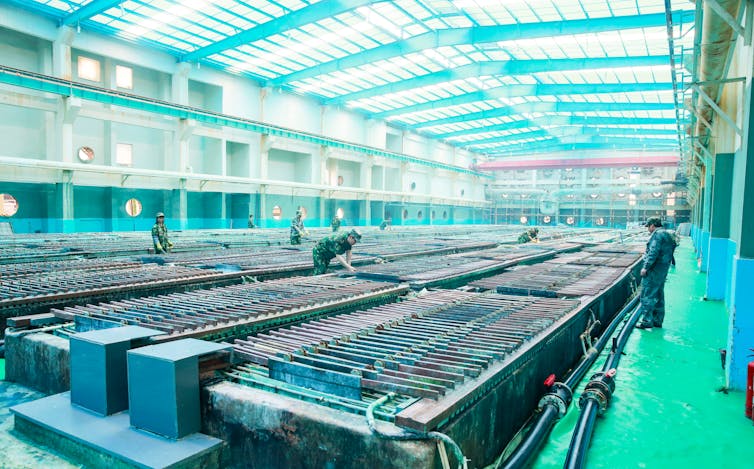
A rare earth production facility in China.
A rare earth production facility in the Jiangxi province of central China.
humphery / Shutterstock

What are the main areas of tension between the two countries now?

Tech issues will undoubtedly continue to cause tensions between Beijing and Washington. The US currently blocks Chinese access to much of the advanced tech that Beijing needs to fulfil its desire to become the world’s leader in AI.

And, despite Trump’s suggestion that he and Xi discussed China purchasing some chips from US firms, Chinese access to such advanced tech looks like it will remain heavily restricted.

Trump has said that any trade deal with China will not involve the export of Blackwell, the most advanced AI chip produced by US firm Nvidia. US lawmakers have previously raised concerns about allowing China to obtain the chip, suggesting it could bolster China’s AI industry and weaken the US’s tech edge.

Where was the regular US lecture on human rights? And was Taiwan discussed at all?

Taiwan doesn’t appear to have been on the agenda, from what both sides have said. Taiwan’s president, Lai Ching-te, took the opportunity of hosting delegates from the American Israel Public Affairs Committee lobby group this week.

He talked about nurturing “closer Taiwan-US-Israel cooperation on security, trade and beyond, promoting peace across the Taiwan Strait”. But it’s far from clear that this is at the front of Trump’s mind.

Before the trip, it was reported that Trump’s advisers had been concerned that the US president might come away from the meeting with Xi having in some way changed the language over China’s relationship with Taiwan.

There has also been talk in recent months that the US position might shift from “not supporting” Taiwanese independence to “opposing it”. However, when he was asked about this after his meeting with Xi, the US president said they hadn’t discussed it.

Human rights, on the agenda at just about every meeting between a US president and a Chinese leader for as long as anyone can remember, appears not to have featured in the two men’s discussion either.

The Conversation

Tom Harper does not work for, consult, own shares in or receive funding from any company or organisation that would benefit from this article, and has disclosed no relevant affiliations beyond their academic appointment.

ref. What will Trump’s deal with Xi mean for the US economy and relations with China? Expert Q&A – https://theconversation.com/what-will-trumps-deal-with-xi-mean-for-the-us-economy-and-relations-with-china-expert-qanda-268688

Why did the polls get the Caerphilly byelection wrong? They ignored the fact Reform is an English nationalist party

Source: The Conversation – UK – By Paul Whiteley, Professor, Department of Government, University of Essex

The results of the Caerphilly Senedd byelection held on October 23 were certainly a shock to Labour and to the Conservatives, but they also cast doubt on the reliability of polling as well. It had for some time appeared that Reform was in the running to win the seat but it ended up trailing some way behind Plaid Cymru.

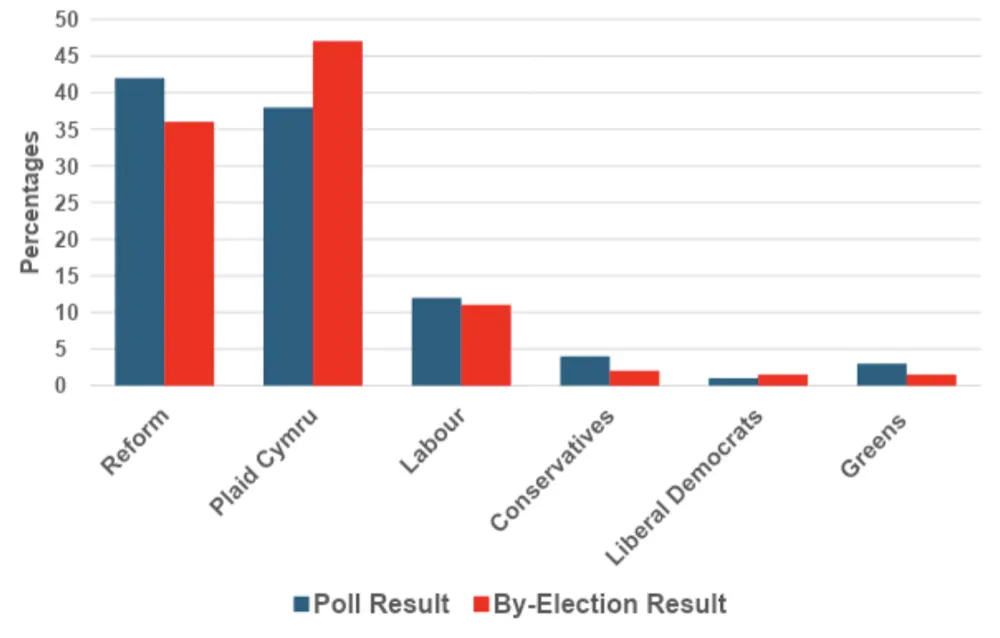
A Survation telephone poll published on October 16 suggested Plaid Cymru would come second with 38%, and the election would be won by Reform with 42%. The actual results after the October 23 vote were Plaid Cymru first on 47% and Reform second on 36%.

Labour obtained 12% in the poll and 11% in the election, which is fairly accurate. The Conservatives received 4% in the polling and got half of that with 2%. Similarly, the Greens also got half of their predicted share of 3% and the Liberal Democrats got 1.5% following a prediction of 1%.

Voting in Caerphilly – Poll vs Results:

A chart showing what a pre-election poll showed for Caerphilly and what actually happened, with the poll wide of the mark for most parties.
How a poll compared to the result.
P Whiteley, CC BY-ND

So what went wrong? The small sample telephone poll in the constituency which Survation used does not have a good track record. Surprisingly, national polls are more likely to be accurate than constituency polls.

There are a number of reasons why this is true, chiefly that it is harder to get an accurate sample of respondents at the constituency level than it is nationally. This is particularly true of telephone polls, where the great majority of people approached will not respond.

But there is another important reason why Reform did worse than expected in the byelection and it relates to national identity. The 2021 census asked questions about people’s national identities – that is, did they feel British, English, Welsh, Scottish, and so on.

Overall, 90% of the population (53.8 million people) in England and Wales identified with at least one UK national identity. This makes it possible to investigate identities at the constituency level.

Some 55% of the population in Wales described themselves as Welsh in the census, but in Caerphilly it was 69% – a far higher figure. Equally, 18% described themselves as British in Wales but in Caerphilly it was 14%. Finally, 9% of the Welsh population described themselves as English, but only 4% of the population in Caerphilly did so.

Census National Identity Data, Comparing Wales and Caerphilly:

A chart showing that people feel more Welsh in Caerphilly than the rest of Wales and less British.
Caerphilly identities.
P Whiteley, CC BY-ND

It’s also revealing to compare the constituency and the rest of Wales when it comes to voting in the general election of 2024. Plaid took just under 15% of the vote in Wales but it took 21% in Caerphilly. Reform took 17% in Wales and 20% in Caerphilly.

This is why many thought that Reform would win the byelection. So why did Plaid get 11% more of the vote share than Reform in the byelection?

The main reason is that Reform is fundamentally an English nationalist party, as the chart below reveals.

There is a very strong correlation between English identity in the census and voting Reform across the 543 constituencies in England. The more people think of themselves as English rather than British or something else, the more they were likely to vote Reform in the 2024 election.

English Identity and Reform Voting in 2024:

A chart showing a close correlation between Reform voting and English identity.
How Reform voting relates to English identity.
P Whiteley, CC BY-ND

Because English identity is low in Caerphilly, even by Welsh standards, Reform struggled to get the support it would have received in a comparable constituency containing a lot more English identifiers. It did well in the general election because this was focused on the entire UK, but when the focus is on Wales in a byelection, English identity is a problem for the party.

More generally Reform will face difficulties in the future winning seats in both Wales and Scotland, since English identifiers in these countries are few and far between.

This is going to be an issue in the Welsh Senedd elections and also the Scottish Parliamentary elections next year, since Plaid Cymru and the SNP are likely to be more successful against an unpopular Labour party in their respective countries than is Reform.

For next year’s local government and devolved parliamentary elections, there is something the pollsters can do to correct for the national identity effects.

All pollsters weight their data, that is, they attach more importance to some respondents than others in order to get an unbiased sample. They should weight for national identity using the census data and this will help to make the estimates more accurate.

Reform is in part a product of the incomplete devolution experiment introduced by Tony Blair’s government in the 1990s and 2000s. This exercise provided a powerful parliament for Scotland and a less powerful but important parliament for Wales.

The missing element was a parliament for England. It was thought at the time that this was unnecessary since the Westminster parliament would take care of English issues, but with English nationalism on the rise, it may well be time to reconsider this arrangement.


Want more politics coverage from academic experts? Every week, we bring you informed analysis of developments in government and fact check the claims being made.

Sign up for our weekly politics newsletter, delivered every Friday.


The Conversation

Paul Whiteley has received funding from the British Academy and the ESRC.

ref. Why did the polls get the Caerphilly byelection wrong? They ignored the fact Reform is an English nationalist party – https://theconversation.com/why-did-the-polls-get-the-caerphilly-byelection-wrong-they-ignored-the-fact-reform-is-an-english-nationalist-party-268630

Trump-Xi talks will not have changed the priorities of the Chinese government

Source: The Conversation – UK – By Chee Meng Tan, Assistant Professor of Business Economics, University of Nottingham

China’s president, Xi Jinping, has met with his American counterpart, Donald Trump, for their first face-to-face talks in six years. Trump emerged from the meeting in South Korea in a buoyant mood, describing it as a 12 on a scale of one to ten. He is now saying the US will lower tariffs on Chinese imports, with Beijing giving the US better access to rare earths in return.

The Chinese government’s response was, in comparison, relatively muted. In a statement, the foreign ministry declared that both sides had exchanged views on “important economic and trade issues” and said Xi was “ready to continue working” with Trump “to build a solid foundation for China and the US”.

Despite the optimism on show in South Korea, there is still much to be done before a trade deal between the two countries is signed. At the same time, Chinese officials appear to remain cautious of the Trump administration’s unpredictability and its damaging potential for their country’s economy.

Trump and Xi’s meeting came one week after China’s top leadership laid out their development priorities for the next five years, after four days of discussion in Beijing. Their message is clear: China needs to boost its self-reliance.

China has been reeling from an economic slowdown in recent years. A property market crash in 2021, which saw several major developers default on their debts, caused millions of Chinese people to lose wealth. This has dampened consumer spending and has reduced confidence in the economy.

Since China began shifting from central planning to a more market-oriented economy in 1978, it has enjoyed great success by relying on two mechanisms to stimulate growth. The first is attracting investment in the infrastructure and real estate sectors. The second, which is largely considered the primary driver of China’s extraordinary growth, is the export of manufactured goods.

However, investment in China’s infrastructure and property sectors has been lacklustre at best in recent years. At the same time, China has been embroiled in a trade war with the US – the largest importer of Chinese goods – since 2018. This period has been marked by cycles of escalating tariffs and retaliatory measures.

The external environment has become increasingly uncertain following Trump’s return to the White House in January 2025. Trump took Washington’s confrontation with Beijing to greater heights, imposing tariffs of 145% on most Chinese goods. Although many of these measures were later eased, the volatility of the two countries’ trade relationship was further evidenced when Trump threatened to reinstate 100% tariffs on Chinese exports just weeks before the Seoul meeting.

So, rather than relying heavily on exports, Chinese officials have announced that they intend to stimulate growth by boosting domestic consumption. Their plan is to create more job opportunities and improve healthcare and social benefits to help raise living standards. This should allow Chinese consumers to buy more goods and services.

However, improving domestic consumption will be no easy feat. China has weak social security nets, which encourage consumers to save more for uncertain times. Local governments in China, which provide public services, have also incurred huge amounts of debt in the past from excessive borrowing to fund projects. How China intends to improve living standards amid such debt is not certain.

A Chinese woman walking past a Gucci store.
A woman walking past a Gucci store in Chongqing, China.
Vincent_Nguyen / Shutterstock

Another key part of China’s economic plans is to become the world’s leader in AI and tech by 2035. This, like the government’s plans to boost economic growth, will also require self-reliance. The US has imposed sweeping tech restrictions in recent years to prevent advanced semiconductors and AI chips made by US firms from entering China.

These restrictions have intensified since the start of Trump’s second term. In May 2025, for example, the Trump administration ordered US chip design software makers to halt all sales to China. And even after Trump’s recent meeting with Xi, exports of advanced US technology to China still look like they will be largely restricted.

Trump said the two leaders discussed China purchasing some chips from US firms. But he clarified that the deal would not include Blackwell, Nvidia’s most advanced semiconductor, which US lawmakers have warned against allowing China to obtain. The Chinese government has not mentioned any agreement with the US regarding semiconductors.

As it stands, the US seems to be bent on ensuring that China is unable to access the tech that could aid Beijing in developing its computing and military prowess. So, to achieve tech superiority, China’s leaders have pledged more investment in education and talent. They have also promised measures to safeguard intellectual property.

Political survival

For years, China’s ruling communist party has relied on economic prosperity and nationalism to legitimise its rule. But Xi’s ability to retain control is likely to be undermined by China’s economic slowdown.

China needs a break from its external troubles, which have been induced by the US trade war and tech restrictions. And by dominating the production of rare earths, a group of metals crucial for high-tech manufacturing, China has a powerful trump card.

In early October, Beijing placed restrictions on the export of rare earths in a move that now appears to have been a calculated effort to strengthen China’s negotiating position with Washington. The strategy looks to have paid off, leading to a reduction of US tariffs on Chinese goods.

Ultimately, Xi needs victories of this sort to remain at the top of Chinese politics. If economic troubles worsen and growth continues to falter, even a leader as powerful as Xi may discover that loyalty sustained by rhetoric cannot be sustained.

The Conversation

Chee Meng Tan does not work for, consult, own shares in or receive funding from any company or organisation that would benefit from this article, and has disclosed no relevant affiliations beyond their academic appointment.

ref. Trump-Xi talks will not have changed the priorities of the Chinese government – https://theconversation.com/trump-xi-talks-will-not-have-changed-the-priorities-of-the-chinese-government-267785

What do spiders really get up to on Halloween?

Source: The Conversation – UK – By Alex Dittrich, Senior Lecturer in Zoology, Nottingham Trent University

Incy wincy hasn’t got time for witchcraft. thatmacroguy/Shutterstock

If you’re scared of spiders, Halloween certainly doesn’t help. People decorate their homes with monstrous-looking fake cobwebs and horror movies depict giant spiders hunting humans or creeping around spooky abandoned houses. Spiders’ long association with witches can also make their presence seem a little ominous.

In reality though, spiders are much more likely to be minding their own business than trying to pester humans.

The UK is home to more than 600 species of spider, with only a few of these common indoors. You might not notice them much through the year, but come autumn, more seem to start appearing in our homes.

This time of year we are focused on getting warm, sheltering from the weather outside. We may think that those animals we associate with our garden have similar ideas, and want to move in and share our cosy accommodation. However, the odds are they haven’t come in from the outside. The spiders you’re noticing have in fact probably always been there.

It’s just they are more active. Male spiders of many species are trying to find mates at this time of year. They cease to build webs and become roving individuals that are more easily spotted.

Mating for male spiders is a risky process as females often respond aggressively to male advances. So male spiders invest a lot of time and energy into finding the right mate. When spiders mate they fill specialised organs in front of their mouths, called palps, with sperm, that they then deposit into the sexual organ (epigynum) of the female.

Prior to this the male will go through a literal song and dance to make sure that the female is receptive and won’t eat him. This often involves a lot of leg tapping and sending vibratory signals sent down the female’s web. Only when she accepts these signals from the male will she mate with him.

Slowing down

Indoor female spiders are less active this time of year, often waiting in their homes, feeding and readying themselves for the mating season.

In early autumn indoor spiders are mostly nocturnal, with both males and females becoming more active at night when they are safer from potential predators, and maybe us humans.

While they rest during the day, some spider species even show signs of dreaming. A 2022 US paper found jumping spiders show bouts of eye movement and limb twitching that suggest phases of rapid eye movement (REM) sleep. REM sleep is associated with vivid dreaming.

Getting the munchies

The males may slow down the web-building but the females don’t. Spiders don’t just build webs randomly. They spend time finding the right spot based on the availability of prey as well as safety and structure.

One common species you may encounter, particularly in the UK, is the common house spider Tegenaria domestica one of Britain’s bigger spiders. It is well known for its funnel like webs which differ from classic cobwebs in the corners of rooms. These webs provide a secure home for the web dweller and surface for dispatching any potential prey that may fall on it.

Depending on the species, different webs evolved for catching different types of prey, or to provide a suitable home for the spider. There are some weird examples, such as Hyptiotes paradoxus which builds a triangular web – shaped much like a pizza slice. You are less likely to see this species in the home but you may find them on a graveyard yew tree.

Tegenaria Domestica spider walking through its funnel web.
Wirestock Creators/Shutterstock

Although not all species of spiders make complex webs, all spiders make silk that can be used for storing prey, or safety lines. For those that do make webs, depending on the species, this can take a few minutes, hours or days. It is of course a big investment taking a lot of energy to build a web. Some spiders ingest broken webs, to recycle the lost energy.

The tangled webs we find in our houses are often produced by what we refer to as synanthropic species, meaning that they have adapted well to a human-centred existence. Or rather many of them find our homes a nice facsimile to the habitat that they evolved within. Their natural habitats are similar to our homes in that they have stable temperature and humidity, with warm and dry corners and crevices.

Some synanthropic species such as the cellar spider Pholcus phalangioides are common inside. They are often seen hanging upside down waiting for their prey to fall victim to their delicate webs, in the corners of rooms, where they do a good job of eating other spiders that may enter your house. This species, however, is not native and was introduced to the UK and US from Asia in the 1800s.

Although we share our homes with many species of spider, they don’t eat crumbs or human food. But those crumbs can attract insects, which in turn attract spiders.

What can we do for spiders in the house?

There are movies on the tele at the moment that have done a good job of reinforcing people’s arachnophobia. But spiders aren’t out to get you. They just want to raise a family.

So my appeal to you is, maybe leave some of those cobwebs up (it’s great decoration for Halloween), drape a towel over the side of your bath so spiders can escape. And if you do need to remove a spider from your house, do it carefully and remember it is bad luck to kill a spider. To recite an old folk saying,“if you wish to live and thrive, let a spider run alive”.

The Conversation

Alex Dittrich does not work for, consult, own shares in or receive funding from any company or organisation that would benefit from this article, and has disclosed no relevant affiliations beyond their academic appointment.

ref. What do spiders really get up to on Halloween? – https://theconversation.com/what-do-spiders-really-get-up-to-on-halloween-265520

Why ‘green’ finance isn’t always as sustainable as it seems

Source: The Conversation – UK – By Maud Borie, Senior Lecturer in Environment, Science & Society, King’s College London

VectorMine/Shutterstock

In the wake of the 2007-08 global financial crisis, green finance has been increasingly celebrated as a way to tackle environmental challenges. Banks, investment funds and insurers have rolled out a growing range of green products, from green bonds to sustainability-linked loans. This momentum is encouraged by international environmental efforts such as the Paris climate agreement.

By aligning financial flows with sustainability goals, the world can supposedly “green finance” its way into a sustainable future.

But beneath this green spectacle lies a more complicated reality. Green finance refers to a wide-ranging mix of private and public funds, products and practices. For example, there’s no consensus regarding what makes a bond green.

There is also little clarity around what current environmental, social, governance (ESG) frameworks – which encourage businesses and authorities to disclose and monitor their environmental and social performance – are truly achieving.


Ever wondered how to spend or invest your money in ways that actually benefit people and planet? Or are you curious about the connection between insurance and the climate crisis?

Green Your Money is a new series from the business and environment teams at The Conversation exploring how to make money really matter. Practical and accessible insights from financial experts in the know.


In 2015, the former Bank of England governor and current Canadian prime minister, Mark Carney, insisted that finance can and must urgently account for climate risks. Meanwhile, Stuart Kirk, former global head of responsible investments at high street bank HSBC, argued that these risks were overstated and too far in the future to be material.

Environmental issues have become a concern for financiers, but not necessarily out of commitment to improving planetary health – rather due to reporting costs, transition risks and reputational pressure. High-profile greenwashing scandals, such as “green bonds” allegedly linked to deforestation in Sumatra, have further eroded trust. This raises questions about whether green finance is more a branding exercise than transformation.

ESG investing explained.

In the face of these ambiguities, the environmental sciences are involved in the expansion of green finance. As social scientists we have been following these developments, wondering whether they may help us pin down robust ways to develop green finance.

Some companies are now using science-based targets (emission reduction goals aligned with climate science), net zero transitions pathways or roadmaps, and high-integrity carbon credits (verified purchases of direct air capture credits to offset greenhouse gas emissions).

Most of these claim to rely on rigorous calculations. The language of science grants objectivity and legitimacy. At its most basic level, this “sciencewashing” uses the vocabulary and authority of science to claim sustainability outcomes.


Read more:
Green bonds can help finance clean energy – as long as the projects they fund are transparent


Green finance also provides many employment opportunities for environmental scientists who can work as consultants, auditors and certifiers, to assess the quality of green claims. Many startups have emerged, offering a range of high-tech services to provide environmental data to companies. That includes monitoring deforestation through remote sensing or using sounds to analyse wildlife activity.

Green finance-related industries are flourishing and more and more environmental graduates are being recruited to quantify emissions, build risk metrics, monitor changes in biodiversity and verify credits.

Sciencewashing

Drawing on five years of research and combining data emerging from participation in green finance conferences and seminars, interviews and document analysis, our study warns against different forms of sciencewashing.

london city skyline with green trees
Financial centres, like London, thrive on green finance but beyond them the benefits are unclear.
Taljat David/Shutterstock

Mounting evidence suggests a gap between the suggested possibilities and the actual outcomes of green finance. Many green finance products appear to serve financial markets and the wealthiest investors more than nature or vulnerable communities.

Even more concerning are the unintended consequences. Far from levelling the playing field, green finance can exacerbate inequality. For example, communities have been displaced to make room for renewable energy projects or offset schemes.

This creates what are known as green sacrifice zones: areas where environmental harm or social costs are tolerated in the name of advancing “green” goals.

Poorer countries often face higher borrowing costs in the name of climate risk, while wealthy economies continue to access cheaper capital. Insurance premiums are also rising in climate-vulnerable regions, pricing out those least able to afford them. So green finance can make the situation for the most vulnerable populations worse.

In its current form, green finance will most likely sustain business as usual, leaving the causes of environmental crisis untouched.

For green finance to deliver the transformative change its advocates promise, it must address the deeper political and social issues, such as the role of public authorities in regulating finance, or the relationship between green investment and global inequality.

If green finance is to serve collective wellbeing rather than the interests of a privileged few, we need rigorous and proactive public regulations and better public debates on what green finance ought to account for.


Don’t have time to read about climate change as much as you’d like?

Get a weekly roundup in your inbox instead. Every Wednesday, The Conversation’s environment editor writes Imagine, a short email that goes a little deeper into just one climate issue. Join the 45,000+ readers who’ve subscribed so far.


The Conversation

The authors do not work for, consult, own shares in or receive funding from any company or organisation that would benefit from this article, and have disclosed no relevant affiliations beyond their academic appointment.

ref. Why ‘green’ finance isn’t always as sustainable as it seems – https://theconversation.com/why-green-finance-isnt-always-as-sustainable-as-it-seems-265240