From sweetener to cancer fighter? Fermented stevia shows promise in pancreatic cancer study

Source: The Conversation – UK – By Justin Stebbing, Professor of Biomedical Sciences, Anglia Ruskin University

Dionisvera/Shutterstock

In an unexpected twist in the fight against cancer, humble kitchen bacteria and a plant best known for sweetening tea could one day help in treating one of humanity’s deadliest diseases, new research suggests.

A group of scientists in Japan has discovered that fermented stevia, a plant commonly used as a calorie-free sweetener, may hold intriguing anti-cancer properties. While these findings are early and need much more research, they hint at a potential future role for stevia in tackling pancreatic cancer.

Pancreatic cancer remains one of the most difficult cancers to treat. Symptoms typically appear only after the disease has spread, and conventional therapies like chemotherapy rarely result in a cure. The outlook is bleak: fewer than 10% of patients survive five years beyond diagnosis.

This urgent need for more effective and less toxic treatments has driven researchers to explore plant-based compounds. Many chemotherapy drugs already used today have botanical origins – including paclitaxel, derived from the bark of the Pacific yew tree, and vincristine, sourced from the Madagascar periwinkle – offering a proven pathway for discovering new cancer-fighting agents.


Read more:
Chemotherapy can be a challenging treatment – here’s how to deal with some of the side-effects


Stevia, a leafy plant native to South America, is widely known for its natural sweetness. It’s a familiar presence on supermarket shelves, but few think of it as a medicinal plant.

Stevia leaves are rich in bioactive compounds, some of which have shown hints of anticancer and antioxidant activity in previous research. The challenge has been harnessing this potential, as unfermented stevia extracts are only mildly effective in laboratory settings, often requiring high doses to affect cancer cells.

Hand plucks stevia in the rays of the bright sun
Stevia could play an important role in cancer prevention.
yul38885/Shutterstock

That’s where fermentation comes in. Known for creating yogurt, kimchi and sourdough bread, fermentation is more than a culinary technique. I’s a form of microbial alchemy that can transform plant compounds into new, bioactive molecules.

Researchers at Hiroshima University asked a simple but innovative question: what if stevia was fermented with the right bacteria? They experimented with a strain called Lactobacillus plantarum SN13T, a relative of a bacteria commonly found in fermented foods. Fermentation produced a compound called chlorogenic acid methyl ester (CAME), which showed much stronger anti-cancer effects than raw stevia extract.

In lab tests, the fermented stevia extract caused pancreatic cancer cells to die in large numbers but left healthy kidney cells largely unharmed. Further analysis revealed that CAME was responsible for this effect. It worked by blocking cancer cells at a specific phase of their life cycle, preventing them from multiplying and by triggering apoptosis, a natural process where cells self-destruct when damaged or no longer needed.

CAME seems to alter the genetic programming of cancer cells. It activates genes that promote cell death while simultaneously suppressing those that help cancer cells grow and survive. This double hit both slows cancer progression and encourages malignant cells to kill themselves.

The power of fermentation

Fermented stevia extract was also found to be a stronger antioxidant than its unfermented counterpart. Oxidative stress – an imbalance of potentially harmful moelcules known as free radicals in the body — is linked to cancer and other diseases. By neutralizing these free radicals more effectively, the fermented extract may offer extra protection for healthy cells.

This is not the first time fermentation has been shown to unlock hidden benefits. Fermented soy and ginseng have been found to offer enhanced health properties compared to their raw forms.

Red ginseng plant
Fermented ginseng, particularly red ginseng, could offer enhanced health benefits.
zhengchengbao/Shutterstock

But the stevia findings stand out because of the compound’s selectivity. Killing cancer cells while sparing healthy ones is the holy grail for cancer researchers.

It’s important to note that these results come from lab-grown cells, not from animal or human studies. Many substances that look promising in petri dishes fail in clinical trials due to the complexity of the human body. Still, the discovery is exciting and warrants further exploration.

This research highlights the potential of everyday foods and their natural microbes as untapped sources of new medicines. It also reflects growing interest in “microbialbiotransformation” – using beneficial bacteria to create powerful compounds from plants.

In the case of stevia, a simple quest for a natural sweetener has evolved into something potentially far more profound: a stepping stone toward a cancer therapy that’s natural, targeted and cost-effective.


Get your news from actual experts, straight to your inbox. Sign up to our daily newsletter to receive all The Conversation UK’s latest coverage of news and research, from politics and business to the arts and sciences.

The Conversation

Justin Stebbing does not work for, consult, own shares in or receive funding from any company or organisation that would benefit from this article, and has disclosed no relevant affiliations beyond their academic appointment.

ref. From sweetener to cancer fighter? Fermented stevia shows promise in pancreatic cancer study – https://theconversation.com/from-sweetener-to-cancer-fighter-fermented-stevia-shows-promise-in-pancreatic-cancer-study-261599

An ultra-black coating for satellites could stop them spoiling astronomy pictures

Source: The Conversation – UK – By Noelia Noël, Senior Lecturer, School of Mathematics and Physics, University of Surrey

Every night, as telescopes around the world open their domes to study the cosmos, astronomers are forced to contend with an unexpected form of pollution: bright white streaks slicing across their images.

These luminous trails are caused by satellites. Specifically, the growing number of “megaconstellations” launched into low Earth orbit (LEO). These mega-constellations consist of many, sometimes hundreds, of satellites. They are intended to work as a system, providing services such as global internet access. Commercial companies that operate mega-constellations include SpaceX, Amazon and OneWeb.

The streaks in astronomy images aren’t just cosmetic. They can corrupt sensitive astronomy data, generate false signals, and even trigger alerts for events that never happened.

There may now be a partial solution to the luminous trails vexing astronomers. An ultra-black coating could be applied to the satellites themselves, dimming the trails that they leave in images. This material, called Vantablack 310, absorbs more than 99.99% of visible light.

Modern astronomical observations rely on long exposure imaging, collecting faint light from distant galaxies, exoplanets, or supernovae over several minutes or hours. When a satellite crosses the field of view during that time, it reflects sunlight into the telescope, creating a saturated streak across the image.

The impact is already substantial. Researchers at the Vera C Rubin Observatory in Chile – a flagship survey telescope set to revolutionise our understanding of the Universe – estimate that over 30% of the telescope’s twilight images already contain at least one satellite trail. And it’s not only visible light astronomy that’s at risk.

Radio telescopes, infrared detectors, and even gravitational wave observatories are reporting increasing interference from satellites – including reflected light, unwanted radio emissions, and other forms of contamination. The ultra-black coating won’t alleviate these issues, of course. Other solutions will need to be found for these other forms of interference.


Read more:
Could the first images from the Vera Rubin telescope change how we view space for good?


A crowded sky

With more than 16,000 active satellites already in orbit and tens of thousands more planned, the skies are becoming increasingly congested. While these constellations offer enormous benefits, including global internet access, disaster response, agricultural monitoring, and climate surveillance, they also threaten the clarity of astronomical observations.

Satellites in low Earth orbit (typically 500km-600km altitude) are often visible to the naked eye shortly after sunset or before sunrise. For sensitive telescopes, they can be ten to 100 times brighter than the recommended limits set by the International Astronomical Union.

I am one of a team of researchers at the University of Surrey that is exploring Vantablack 310 as a next generation coating to reduce satellite brightness. The trials are being carried out by UK scientists in partnership with the Surrey Space Centre, and materials innovators Surrey NanoSystems.

Originally developed for high-contrast optical systems – such as instruments that need to spot faint signals next to very bright ones – the coating absorbs more than 99.99% of visible light.

Very black car surrounded by spotlights
Vantablack has been demonstrated on on a BMW concept car.
Vanderwolf Images/Shutterstock

In 2026, Vantablack 310 will be tested in orbit for the first time aboard Jovian 1, a CubeSat – a small satellite about the size of a cereal box. It was developed at the University of Surrey and launched as part of the UK’s Jupiter programme, a university-led initiative that trains students in real-world satellite design, testing and operations, while supporting cutting-edge space research.

The mission will assess how the coating performs under the harsh conditions in space, such as temperature swings, ultraviolet radiation, and micro-meteoroid impacts. If successful, it could significantly reduce how bright satellites appear to telescopes – making the streaks they leave behind much fainter and easier to remove from astronomical images.

Ultra-black coatings will not make satellites invisible. Even the darkest object in orbit will reflect some light. But the goal is not invisibility – it is compatibility. Reducing satellite brightness below key thresholds ensures that scientific observations remain viable.

What’s at stake is more than just clean astronomical data. The night sky is one of humanity’s oldest shared resources – a source of scientific insight, cultural heritage, and spiritual meaning across time and geography. From the star lore of indigenous people to ancient navigation systems, the night sky has always helped us understand our place in the universe.

Publicly funded observatories in lower income countries – where many of the world’s darkest skies still exist – are also disproportionately affected, despite those countries having little say in the decisions that affect their skies.

Framing the issue solely as a technical inconvenience for elite institutions misses the point. This is also about equity, access, and environmental justice. Who gets to access the sky, and who decides how it is altered, are global questions that demand inclusive solutions.


Get your news from actual experts, straight to your inbox. Sign up to our daily newsletter to receive all The Conversation UK’s latest coverage of news and research, from politics and business to the arts and sciences.

The Conversation

This project was funded with six months of support from the Research England Development Fund (UKRI), focusing on mitigating satellite light pollution, including the in-orbit testing of ultra-black coatings.

ref. An ultra-black coating for satellites could stop them spoiling astronomy pictures – https://theconversation.com/an-ultra-black-coating-for-satellites-could-stop-them-spoiling-astronomy-pictures-259171

Russia-Ukraine talks: both sides play for time and wait for Donald Trump’s 50 days to run out

Source: The Conversation – UK – By Stefan Wolff, Professor of International Security, University of Birmingham

Russia and Ukraine met in Istanbul on July 23 for a third round of talks since face-to-face negotiations resumed in May. Expectations were low. Two previous rounds have yielded very few concrete results, apart from agreements on prisoner exchanges the return of the bodies of soldiers killed in action.

The latest meeting was the shortest yet, lasting just 40 minutes. The negotiating teams were led by former Ukrainian defence minister Rustem Umerov and Vladimir Medinsky, a senior aide to Russian president Vladimir Putin. They agreed on another exchange of prisoners and on setting up three working groups on political, military and humanitarian issues to engage online rather than in face-to-face meetings.

But if the talks have achieved very little, they have demonstrated two things. First, that the two sides remain very far apart on what they would consider acceptable terms for a ceasefire, let alone a peace agreement. And, second, that neither side is prepared to walk away from the negotiations, worried about incurring the wrath of the US president, Donald Trump.

A fourth round of negotiations has not been ruled out, but it is unlikely to involve either Vladimir Putin or Volodymyr Zelensky, given that their negotiating positions still offer little hope of a deal ready to be signed at a leaders’ summit.


Sign up to receive our weekly World Affairs Briefing newsletter from The Conversation UK. Every Thursday we’ll bring you expert analysis of the big stories in international relations.


The latest round of talks, however, took place in a different context to the earlier two meetings. Earlier in July, Trump set a deadline of 50 days, ending on September 2, for the fighting to stop.

After this if there’s no progress towards a ceasefire, the US president will consider imposing hefty secondary sanctions on Russia’s remaining trade partners. The aim would be to starve Moscow’s war economy of crucial foreign income, principally from heavily discounted sales of oil and gas to willing buyers including India and China.

The first ten days of this 50-day ultimatum have now passed. While the talks in Istanbul might be seen as a sign that Kyiv and Moscow are taking Trump seriously, the lack of tangible results suggests otherwise. There is no indication that either Russia or Ukraine have moved from their maximalist demands.

Russia keeps insisting on the recognition of its illegal occupation in Ukraine, on future limits to Ukraine’s military strength, and on a denial of the country’s accession to Nato. Ukraine meanwhile asks for its territory to be restored and its sovereignty – including its ability to determine its alliance arrangements – to be respected.

Playing for time

Developments on and around the battlefields in Ukraine don’t offer any signs that Moscow or Kyiv are ready even for a ceasefire either. Russia continues to make incremental gains along the 1,000km of frontlines in Ukraine.

It also keeps pounding Ukrainian cities, including the capital Kyiv, with nightly drone and missile attacks. These have taken place at unprecedented scales of hundreds of drones that have repeatedly overwhelmed Ukraine’s already stretched air defence systems.

Yet, Ukraine has been buoyed by the promise of more US arms deliveries – paid for by other Nato allies – and the continuing commitments by its international partners to support the country. These include those made at the recent Nato summit in The Hague and the Ukraine Recovery Conference in Rome.

Add to that Trump’s apparent pivot away from Putin and his recently more constructive relationship with Zelensky, and it becomes clear why Kyiv – like Moscow – thinks that time is on its side.

Both may be proved wrong. Zelensky’s latest efforts to consolidate his power – a large-scale cabinet reshuffle and a decree to curb the independence of two of Ukraine’s anti-corruption agencies – have caused alarm among EU officials in Brussels. More importantly, they have also triggered rare public protests against the government in Kyiv and other major Ukrainian cities, including Dnipro, Lviv and Odesa.

The protests may not get enough traction to pose a real danger to the government. But they indicate that support for Zelensky is not unconditional.

This is something that the Ukrainian president appeared to acknowledge when he outlined his plans to submit an additional bill to parliament to protect the independence of the embattled anti-corruption agencies. What is widely seen as a power grab by the president’s inner circle also has the potential of undermining public morale at a critical time in the war.

All of this also feeds into a Russian narrative of Zelensky as an illegitimate leader of his country who Russia cannot negotiate with. But it would be a mistake to assume that Russia can simply wait until Ukrainians are simply too exhausted to continue resisting Russia’s invasion or when western support will stop keeping Ukraine in the fight.

Even if Europeans become disillusioned with Zelensky, Russia’s war against Ukraine is too much of an existential question for European security that they will abandon Kyiv just because they do not agree with its anti-corruption policies.

It’s also not clear how long Russia can sustain the intensity of its ground and air campaigns against Ukraine or how long these will provide even the kinds of incremental gains that they currently achieve. Trump’s new plan for arming Ukraine by selling arms and ammunition to European Nato allies who would then deliver them to Kyiv is likely to blunt the effectiveness of the Russian air campaign and stymie its ground offensive.

So playing for time is unlikely to get either Moscow or Kyiv any closer to achieving their war aims. But preventing the other side’s victory – whether that’s on the battlefield or at the negotiation table – may well be enough for now for both Putin and Zelensky.

At the moment, continuing their war of attrition is the second-best solution that both presidents can agree on. The outcome of the third round of talks between their negotiators indicates that they may have reached such an implicit understanding already.


Get your news from actual experts, straight to your inbox. Sign up to our daily newsletter to receive all The Conversation UK’s latest coverage of news and research, from politics and business to the arts and sciences.

The Conversation

Stefan Wolff is a past recipient of grant funding from the Natural Environment Research Council of the UK, the United States Institute of Peace, the Economic and Social Research Council of the UK, the British Academy, the NATO Science for Peace Programme, the EU Framework Programmes 6 and 7 and Horizon 2020, as well as the EU’s Jean Monnet Programme. He is a Trustee and Honorary Treasurer of the Political Studies Association of the UK and a Senior Research Fellow at the Foreign Policy Centre in London.

ref. Russia-Ukraine talks: both sides play for time and wait for Donald Trump’s 50 days to run out – https://theconversation.com/russia-ukraine-talks-both-sides-play-for-time-and-wait-for-donald-trumps-50-days-to-run-out-261793

Origins of Israel’s nuclear ambiguity lie in a secret deal forged between Richard Nixon and Golda Meir – podcast

Source: The Conversation – UK – By Gemma Ware, Host, The Conversation Weekly Podcast, The Conversation

Israel has never officially confirmed or denied having nuclear weapons and has never signed the nuclear non-proliferation treaty. Instead, even as evidence has emerged about its nuclear capabilities, Israel has maintained a policy of nuclear ambiguity.

The origins of this opacity lie in a secret deal forged in a one-on-one meeting between Israeli prime minister, Golda Meir, and the US president, Richard Nixon, at the White House in September 1969.

In this episode of The Conversation Weekly podcast, we speak to Avner Cohen, professor of non-proliferation studies at the Middlebury Institute of International Studies at Monterrey in the US, about that 1969 deal and why it has endured for more than 50 years. Cohen is the author of Israel and the Bomb, considered the definitive work on Israel’s nuclear programme, and has been interrogated by the Israeli state for his research.

Cohen tells us that the understanding between Meir and Nixon meant the US accepted Israel as a special kind of nuclear weapon state. In turn, Israel committed to restraint, not to test nuclear weapons, and not to be the first to introduce them to the region. Neither side has confirmed the existence of a deal, and there are only hints at it in the historical record. Cohen explains:

 Once you realise that there is actually a deal, it explains a great deal of the situation. Why the US [is] looking the other way, why the issue is determined to be removed from the diplomatic agenda, and why many other countries, especially in the west, prefer not to see the Israeli nuclear issue.

Listen to the conversation with Avner Cohen on The Conversation Weekly podcast.


This episode of The Conversation Weekly was written and produced by Mend Mariwany and Gemma Ware with assistance from Katie Flood and Ashlynne McGhee. Mixing and sound design by Eloise Stevens and theme music by Neeta Sarl.

Newclips in this episode from CNN, AP Archive, BBC News and ABC.

Listen to The Conversation Weekly via any of the apps listed above, download it directly via our RSS feed or find out how else to listen here. A transcript of this episode is available on Apple Podcasts or Spotify.

The Conversation

Avner Cohen does not work for, consult, own shares in or receive funding from any company or organisation that would benefit from this article, and has disclosed no relevant affiliations beyond their academic appointment.

ref. Origins of Israel’s nuclear ambiguity lie in a secret deal forged between Richard Nixon and Golda Meir – podcast – https://theconversation.com/origins-of-israels-nuclear-ambiguity-lie-in-a-secret-deal-forged-between-richard-nixon-and-golda-meir-podcast-261789

Plug-in solar panels are the latest green energy trend – here’s what you need to know

Source: The Conversation – UK – By Dylan Ryan, Lecturer in Mechanical & Energy Engineering, Edinburgh Napier University

Astrid Gast/Shutterstock

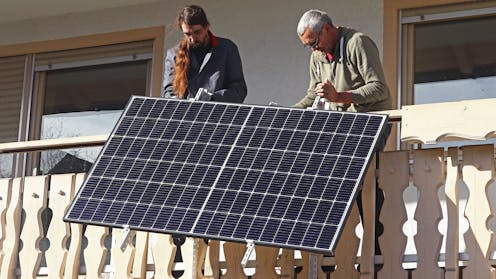
Solar power is the fastest growing source of electricity globally. Normally, anyone wanting to tap into it would have to rely on roof-mounted panels. But in many parts of Europe, people have found a simple alternative in the form of “plug-in panels” that can be arranged on balconies.

Instead of having to be wired into the house, you can feed the power generated by these panels into an inverter and a standard plug. Is this something that might catch on in the UK? Let’s investigate.

First, solar installations usually come under “permitted development” with regard to planning permission. But you still might need to apply, particularly if you live in a shared development or a listed building.

For example, some apartment blocks are insured collectively; if solar panels are going to affect the building’s insurance, it’s going to affect the whole block. There may also be rules regarding what you can put on your balcony, so consult your building manager.

The UK government is promising to ease restrictions on solar balconies, but we shall have to see how it addresses these issues.

There are also safety concerns. The power generated by the panel has to be balanced with consumption. Which, in practice, may restrict their use to a circuit that only connects to low-power devices (lights, TVs or computers are fine, but not ovens or kettles).

So you need to be aware of what the panels are connected to, particularly if you have an older home which may have been built before modern electrical safety standards. Also, to connect the panels, you would need a weatherised external plug, which not all flats have.

How much power could you get?

As luck would have it, I have a south-facing balcony, so let us run the numbers.

I came across a 800W system online that sells for £499 (with supports that would allow me to mount it). It has an area of 3.95m² and is made of a thin photovoltaic film (about 10-12% efficient).

The optimum angle for a solar panel in Edinburgh where I live is 37.6 degrees. Mounting them vertically (draped over the railing of a balcony, as is often the case) will reduce performance, with typical losses of 30-45%. My balcony is also completely shaded for half of the day due to a neighbouring building, so a panel will generate little power at those times.

A house with a large balcony covered with a vertical line of panels.
A vertically mounted solar system in France. This is not the best angle for generation.
Asurnipal/Wikimedia, CC BY

The position of the sun varies as it moves across the sky during the day, as well as seasonally, as does the solar energy received. We can input this data plus our location into an online calculator, which will account for hourly and seasonal variations.

This estimates output for a vertically mounted panel at 132 kilowatt-hours per year (kWh/yr). Assuming electricity costs of £0.24/kWh, that means a payback period of 15.7 years (thin film solar systems typically last between ten and 20 years).

If we could orientate the panel at the optimum angle of 37.6° (tilt them out from the edge of the balcony), the power generated would rise to 182 kWh/yr (a payback period of 11.4 years, although this could fall foul of planning rules).

A first-floor flat with two solar arrays tilted slightly over the balcony.
Balcony solar panels angled to achieve optimum performance.
Triplec85/Wikimedia, CC BY

Free from the shading of my neighbour on the top floor and angled optimally, output from a plug-in panel could rise to 370 kWh/yr (payback 5.6 years). But this is for south-facing balconies. An east- or west-facing balcony would produce 30% less power and a north-facing panel, half as much or less.

Is it worth it?

Another issue is that you can only use the generated electricity when you are in the house. If, for example, I’m out half the time the panels are generating power (which is likely), the payback period doubles – so they will probably never pay for themselves. A battery could help store power for use later, but that adds costs plus the hassle of wiring everything up.

Let’s look at a monocrystalline panel (these last longer than film and are more efficient) that is roof-mounted at the optimum angle (so it’s clear of any obstructions) and wired up to feed into the grid so any power you don’t use, you can sell it to the network.

An apartment building with panels mounted on the roof.
Rooftop solar panels on an apartment block in Berlin, Germany.
Georg Slickers/Wikimedia, CC BY

Assuming a 4kW monocrystalline array at an installation cost of £5,500, the online calculator estimates generation of 2,970 kWh/yr for a payback period of 7.7 years (on a system that will last 25-30 years). And that’s not even considering any possible grants that you might be eligible for.

Whether or not balcony solar is feasible is going to be very site-specific. If you have a balcony with an uninterrupted view south and you are not going to fall foul of any planning or electrical issues, it might be worth it.

If you face north, or there’s another building in the way, or your fuse box looks like a prop from Downton Abbey, less so. In many cases, a solar generator mounted at an optimum angle and exporting electricity to the grid might be a better idea, even if the initial installation costs are higher.


Don’t have time to read about climate change as much as you’d like?

Get a weekly roundup in your inbox instead. Every Wednesday, The Conversation’s environment editor writes Imagine, a short email that goes a little deeper into just one climate issue. Join the 45,000+ readers who’ve subscribed so far.


The Conversation

Dylan Ryan does not work for, consult, own shares in or receive funding from any company or organisation that would benefit from this article, and has disclosed no relevant affiliations beyond their academic appointment.

ref. Plug-in solar panels are the latest green energy trend – here’s what you need to know – https://theconversation.com/plug-in-solar-panels-are-the-latest-green-energy-trend-heres-what-you-need-to-know-260467

Sweet spot for daily steps is lower than often thought, new study finds

Source: The Conversation – UK – By Jack McNamara, Senior Lecturer in Clinical Exercise Physiology, University of East London

Focus and blur.

Your fitness tracker might be lying to you. That 10,000-step target flashing on your wrist? It didn’t come from decades of careful research. It came from a Japanese walking club and a marketing campaign in the 1960s.

A major new study has found that 7,000 steps a day dramatically cuts your risk of death and disease. And more steps bring even greater benefits.

People hitting 7,000 daily steps had a 47% lower risk of dying prematurely than those managing just 2,000 steps, plus extra protection against heart disease, cancer and dementia.

The findings come from the biggest review of step counts and health ever done. Researchers gathered data from 57 separate studies tracking more than 160,000 people for up to two decades, then combined all the results to spot patterns that individual studies might miss. This approach, called a systematic review, gives scientists much more confidence in their conclusions than any single study could.

So where did that magic 10,000 number come from? A pedometer company called Yamasa wanted to cash in on 1964 Tokyo Olympics fever. It launched a device called Manpo-kei – literally “10,000 steps meter”. The Japanese character for 10,000 resembles a walking person, while 10,000 itself is a memorable round number. It was a clever marketing choice that stuck.

At that time, there was no robust evidence for whether a target of 10,000 steps made sense. Early research suggested that jumping from a typical 3,000 to 5,000 daily steps to 10,000 would burn roughly 300 to 400 extra calories a day. So the target wasn’t completely random – just accidentally reasonable.

This latest research paper looked across a broad spectrum – not just whether people died, but heart disease, cancer, diabetes, dementia, depression and even falls. The results tell a fascinating story. Even tiny increases matter. Jump from 2,000 to 4,000 steps daily and your death risk drops by 36%. That’s a substantial improvement.

But here’s where it gets interesting. The biggest health benefits happen between zero and 7,000 steps. Beyond that, benefits keep coming, but they level off considerably. Studies have found meaningful benefits starting at just 2,517 steps per day. For some people, that could be as little as a 20-minute stroll around the block.

Age changes everything, too. If you’re over 60, you hit maximum benefits at 6,000 to 8,000 daily steps. Under 60? You need 8,000 to 10,000 steps for the same protection. Your 70-year-old neighbour gets 77% lower heart disease risk at just 4,500 steps daily.

The real secret of why fitness targets often fail? People give up on them.

Research comparing different step goals found a clear pattern. Eighty-five per cent of people stuck with 10,000 daily steps. Bump it to 12,500 steps and only 77% kept going. Push for 15,000 steps and you lose nearly a third of people.

One major study followed middle-aged adults for 11 years. Those hitting 7,000 to 9,999 steps daily had 50-70% lower death risk. But getting beyond 10,000 steps? No extra benefit. All that extra effort for nothing. Other researchers watching people over a full year saw the same thing. Step programmes worked brilliantly at first, then people slowly drifted back to old habits as targets felt unrealistic.

Commuters walking across London Bridge.
Steps easily accumulate from everyday activities.
Marius Comanescu/Shutterstock.com

Most steps happen without you realising it

Here’s something that might surprise you. Most of your daily steps don’t come from structured walks or gym sessions. Eighty per cent happen during everyday activities – tidying up, walking to the car, general movement around the house.

People naturally build steps through five main routes: work (walking between meetings), commuting (those train station treks), household chores, evening strolls and tiny incidental movements. People using public transport clock up 19 minutes of walking daily just getting around.

Research has also found something else interesting. Frequent short bursts of activity work as well as longer walks. Your body doesn’t care if you get steps from one epic hike or dozens of trips up the stairs. This matters because it means you don’t need to become a completely different person. You just need to move a bit more within your existing routine.

So, what does this mean for you? Even 2,500 daily steps brings real health benefits. Push up to 4,000 and you’re in serious protection territory. Hit 7,000 and you’ve captured most of the available benefits.

For older people, those with health conditions, or anyone starting from a sedentary baseline, 7,000 steps is brilliant. It’s achievable and delivers massive health returns. But if you’re healthy and can manage more, keep going. The benefits climb all the way up to 12,000 steps daily, cutting death risk by up to 55%.

The 10,000-step target isn’t wrong exactly. It’s just not the magic threshold everyone thinks it is.

What started as a Japanese company’s clever marketing trick has accidentally become one of our most useful health tools. Decades of research have refined that original guess into something much more sophisticated: personalised targets based on your age, health and what you can actually stick to.

The real revelation? You don’t need to hit some arbitrary target to transform your health. You just need to move more than you do now. Every single step counts.

The Conversation

Jack McNamara does not work for, consult, own shares in or receive funding from any company or organisation that would benefit from this article, and has disclosed no relevant affiliations beyond their academic appointment.

ref. Sweet spot for daily steps is lower than often thought, new study finds – https://theconversation.com/sweet-spot-for-daily-steps-is-lower-than-often-thought-new-study-finds-261605

Orlando Bloom tried to ‘clean’ his blood to get rid of microplastics – here’s what the science says

Source: The Conversation – UK – By Rosa Busquets, Associate Professor, School of Life Sciences, Pharmacy and Chemistry, Kingston University

Tinseltown/Shutterstock

When actor Orlando Bloom revealed recently that he’d undergone a procedure to have his blood “cleaned”, many people raised eyebrows. The Pirates of the Caribbean star had turned to a treatment known as apheresis – a medical process in which blood is removed from the body, centrifuged or filtered to extract certain components, then returned in an attempt to flush out microplastics and other toxins.

Apheresis is typically used to treat conditions such as autoimmune diseases or abnormally high levels of blood cells or proteins. Its use as a detox for microplastics, however, is scientifically unproven.

Still, Bloom said he suspected his body had absorbed plastic through daily exposure, and wanted it out of his system.

He’s probably right about the exposure. Scientists have found microplastics – tiny plastic fragments less than 5mm in size – in our air, water, soil, food and even inside human tissue. But when it comes to removing them from the bloodstream, that’s where the science gets murky.

As researchers studying microplastic contamination, we’ve examined this issue in the context of dialysis – a life-saving treatment for patients with kidney failure. Dialysis filters waste products like urea and creatinine from the blood, regulates electrolytes, removes excess fluid and helps maintain blood pressure.

But our study found that while dialysis is a medical marvel, it can also have an ironic downside: it could be introducing microplastics into the bloodstream. In some cases, we found that patients undergoing dialysis were being exposed to microplastics during treatment due to the breakdown of plastic components in the equipment – a troubling contradiction for a procedure designed to cleanse the blood.

Apheresis is closely related to dialysis: both involve drawing blood from the body, circulating it through plastic tubing and filters, then returning it – so both procedures carry a similar risk of introducing microplastics from the equipment into the bloodstream.

What are microplastics?

Microplastics are plastic particles that range in size from about 5mm (roughly the length of a grain of rice) down to 0.1 microns – smaller than a red blood cell.

Some microplastics are manufactured deliberately, like the plastic microbeads once common in facial scrubs. Others form when larger plastic objects degrade over time due to sunlight, friction, or physical stress.

They’re everywhere: in the food we eat, air we breathe and water we drink. Plastic packaging, synthetic clothing such as polyester, and even artificial lawns contribute to the spread. Car tyres shed plastic particles as they wear down, and food heated or stored in plastic containers may leach microplastics.

One estimate suggests the average adult may ingest around 883 microplastic particles – over half a microgramme – per day.

So far, large-scale epidemiological studies have not established an association between microplastic exposure and specific diseases. Such studies are needed, but yet to be completed.

However, early research suggests that microplastics may be associated with inflammation, cardiovascular conditions, and DNA damage – a potential pathway to cancer.

What remains unclear is how microplastics behave inside the body: whether they accumulate, how they interact with tissues, and how (or if) the body clears them.

The irony of filtration

It’s tempting to believe, as Bloom seems to, that we can simply “clean” the blood, like draining pasta or purifying drinking water. Just as a sieve filters water from pasta, dialysis machines do filter blood – but using far more complex and delicate systems.

These machines rely on plastic components, including tubes, membranes and filters, which are exposed to sustained pressure and repeated use. Unlike stainless steel, these materials can degrade over time, potentially shedding microplastics directly into the bloodstream.

Currently, there is no published scientific evidence that microplastics can be effectively filtered from human blood. So, claims that dialysis or other treatments can remove them should be viewed with scepticism, especially when the filtration systems themselves are made of plastic.

While it’s tempting to chase quick fixes or celebrity-endorsed cleanses, we are still in the early stages of understanding what microplastics are doing to our bodies – and how to get rid of them. Rather than focusing solely on ways to flush plastics from the bloodstream, the more effective long-term strategy may be reducing our exposure in the first place.

Bloom’s story taps into a growing public unease: we all know we’re carrying the burden of plastic. But addressing it requires more than wellness trends: it calls for rigorous science, tougher regulation, and a shift away from our reliance on plastic in daily life.


Get your news from actual experts, straight to your inbox. Sign up to our daily newsletter to receive all The Conversation UK’s latest coverage of news and research, from politics and business to the arts and sciences.

The Conversation

Rosa Busquets receives funding from UKRI, in a UKRI/ Horizons Staff exchanges Clean Water project (101131182). She is honorary Associate Professor at UCL and Honorary Professor at Al-Farabi Kazakh National University. She is panel member of the UNEP EEAP, where is work group lead in a field that includes microplastics. She is also funded by DASA.

Luiza C Campos is a Professor of Environmental Engineering at University College London.

ref. Orlando Bloom tried to ‘clean’ his blood to get rid of microplastics – here’s what the science says – https://theconversation.com/orlando-bloom-tried-to-clean-his-blood-to-get-rid-of-microplastics-heres-what-the-science-says-261203

Mysterious fossil may rewrite story of skin and feather evolution in reptiles

Source: The Conversation – UK – By Valentina Rossi, Postdoctoral researcher, Palaeontology, University College Cork

A delicate, innocuous little fossil reptile known as Mirasaura grauvogeli – “Grauvogel’s wonder reptile” – is forcing a rethink about the evolution of skin and its appendages such as feathers and hair.

These newly discovered fossils, from the Middle Triassic (247 million years old)
Grès à Voltzia site in northeast France, preserve evidence of some of the most astonishing soft-tissue features described to date in ancient reptiles. We are two of the authors of a new paper on these finds, published in Nature.

These fossils show that the tree dwelling Mirasaura had a large and startling crest along its back. The crest is formed by elongated appendages that are neither scales, feathers nor hair.

Until now, complex skin outgrowths such as feathers were thought to have evolved only much later – in birds, dinosaurs and pterosaurs. This probably occurred through a single origin in the common ancestor of these animals. In all other types of reptile, the only skin outgrowths present are scales.

Mirasaura has overthrown this paradigm in sensational fashion. Compared with the size of its body, the long blades of its tall dorsal crest are enormous. Closer inspection reveals this crest comprised individual, overlapping appendages, each with a narrow central ridge and a lobed outline, similar to the shaft and form of feathers.

However, the fossil structures seem to lack the fine branching architecture that characterises most feathers in modern birds. What’s more, Mirasaura is not related to birds, dinosaurs or pterosaurs, but instead belongs to a very ancient group of reptiles, the drepanosauromorphs, that are known only from the Triassic.

A complete fossils specimen of Mirasaura
The holotype of Mirasaura (State Museum of Natural History Stuttgart, Germany) showing its bird-like skull and crest along its back.
Copyright: Stephan Spiekman, CC BY-NC-ND

The soft tissues of Mirasaura are preserved as a thin brown film, rich in fossil melanosomes – cell structures that contain the pigment melanin during life. Research by our team at University College Cork and others has revealed widespread preservation of fossilised melanosomes in ancient vertebrates. These pigment granules can actually be used to reconstruct melanin-based colour patterns in extinct animals.

Our team’s research has shown that fossil melanosomes can also help reconstruct the soft tissue anatomy of fossil animals, because melanosomes from different body tissues have different shapes and sizes. Our comprehensive examination of the fossilised soft tissues in Mirasaura, coupled with rigorous statistical analysis of the preserved melanosomes, reveals that their geometry is consistent with melanosomes in feathers, but not with melanosomes found in hair and in reptilian skin. This strongly suggests the Mirasaura skin appendages share common developmental features with feathers.

Were the Mirasaura structures feathers, then? The solid, continuous blade of soft tissues either side of the central shaft shows no evidence for branching, which is a defining characteristic of most feathers in birds, dinosaurs and pterosaurs. The water is muddied, however, by the simple unbranched structure of some peculiar feathers in birds – such as the bristles of the turkey’s “beard”. Similar unbranched filaments are known in many dinosaurs and pterosaurs, and are widely considered to represent simple feathers.

Certain dinosaur fossils even have flattened, strip-like feathers that lack branching but possess a central shaft, considered by some experts to be an unusual – extinct – feather type. Whether the resemblance between these fossil structures and the Mirasaura skin outgrowths is superficial or belies closer evolutionary ties remains to be seen.

Large isolated crest of Mirasaura
Fossil specimen of a large crest of Mirasaura, hosted by the State Museum of Natural History Stuttgart.
Copyright: Stephan Spiekman, CC BY-NC-ND

Intriguingly, research on the developing chick embryo shows that feathers can lose their branched structure when certain genes are manipulated. We are currently examining in greater detail the morphology and composition of the Mirasaura structures to help us interpret their anatomy more definitively.

Irrespective of what type of skin outgrowth they represent, our analyses of the anatomy of Mirasaura consistently position it, as well as other drepanosauromorph reptiles, at the base of the reptile tree. This supports data from developmental biology indicating that the genetic basis for the growth of complex skin appendages probably originated in the Carboniferous period, over 300 million years ago.

Mirasaura therefore provides the first direct evidence that complex skin appendages did appear early during reptile evolution, and are not unique to pterosaurs, birds and other dinosaurs.

We owe these new insights to painstaking conservation efforts, which serve as a reminder of the critical importance of natural history collections in conserving our natural heritage.

The earliest discoveries of Mirasaura remains were unearthed in the 1930s by fossil collector Louis Grauvogel. After decades in the Grauvogel family, these specimens were donated to the State Museum of Natural History Stuttgart in 2019, where careful preparation revealed their true significance.

Now, the Mirasaura specimens force us to accept that even before the age of dinosaurs, reptiles were evolving striking anatomical traits normally associated with much younger fossils. This adds an intriguing dimension to future research into the origins of feathers, prompting palaeontologists to consider fossils from more diverse reptile groups – and from time periods before the appearance of dinosaurs and their direct ancestors.


Get your news from actual experts, straight to your inbox. Sign up to our daily newsletter to receive all The Conversation UK’s latest coverage of news and research, from politics and business to the arts and sciences.

The Conversation

Valentina Rossi research is funded by the European Research Council. She is affiliated with University College Cork (UCC)

Maria McNamara receives funding from the European Research Council and Research Ireland.

ref. Mysterious fossil may rewrite story of skin and feather evolution in reptiles – https://theconversation.com/mysterious-fossil-may-rewrite-story-of-skin-and-feather-evolution-in-reptiles-261695

Trump takes lead role in Cold War Steve’s reimagining of Hogarth’s 18th-century satire, The Rake’s Progess

Source: The Conversation – UK – By Rebecca Anne Barr, Associate Professor in English Literature, University of Cambridge

A reimagining of the sixth cartoon in William Hogarth’s A Rake’s Progress depicting Trump pleading for divine assistance at a gambling den. Cold War Steve

British satirist Cold War Steve has published a series of images based on the British painter William Hogarth’s The Rake’s Progress (1733-35). Hogarth’s 18th-century original charts the catastrophic decline of an affluent young man, Tom Rakewell. Cold War Steve’s 2025 reimagining substitutes the foolish rake with the US president, Donald Trump.

Hogarth’s eight densely packed images are a forerunner of the modern comic script, a kind of condensed graphic novel. The works swarm with life and hidden meanings for viewers to decode.

Tom starts out in high life, flashing his cash and enjoying himself. But he is rapidly drawn into a vortex of late-night drinking, gambling and prostitution. Desperate to save himself from extreme poverty, he sells himself in marriage to an older woman (no cougar, alas, but a rather decrepit heiress).


Looking for something good? Cut through the noise with a carefully curated selection of the latest releases, live events and exhibitions, straight to your inbox every fortnight, on Fridays. Sign up here.


But he still cannot control his behaviour. Tom is eventually imprisoned for debt, loses his mind – either to syphilis or sorrow – and dies in Bedlam, the notorious 18th-century madhouse.

Hugely popular and culturally influential, A Rake’s Progress is a modern morality tale. It’s a warning against the perils of self-indulgence, and a devastating critique of those too wealthy and foolish to care about the damage they do.

drawing of men gambling.
The Gaming House, the sixth engraving in The Rake’s Progress, depicts the protagonist back to his profligate ways after marrying an older wealthy woman.
Wikimedia

Political satire as tragicomedy

Keeping close to the original narrative, Cold War Steve uses the 18th-century paintings as backdrops, while altering the object of the satire by making Trump the main target. Renamed Trump’s Progress, this is a pointed political satire, directed at those in power.

Steve’s is a 21st-century reimagining, not a pious homage. Instead, Trump’s Progress has an irreverent punk aesthetic: a horde of Trump-supporting celebrities (such as Don King, Hulk Hogan and Liberace) are photoshopped into his digital canvases, cavorting crazily alongside Trump as he moves from his immense wealth to political pre-eminence.

Cold War Steve's reimagining of A Rake's Progress with Trump as its protagonist.
Cold War Steve’s reimagining of A Rake’s Progress with Trump as its protagonist.
Cold War Steve

Both funny and dark, this is political satire as tragicomedy. The contemporary satirist takes Hogarth as precedent, suggesting a bad end lies in store for the president.

Just as the 18th-century rake ends up in the madhouse, Cold War Steve ends his sequence with an aged Trump lying in a prison cell. Trump is tended to by Israel’s prime minister, Benjamin Netanyahu, and his daughter Ivanka, while his other erstwhile friends look less than pleased to be incarcerated along with him.

Hogarth was a key figure in 18th-century culture. His images of late-night drunkenness , sleazy politicians, and the cheek-by-jowl of luxury living and extreme poverty encapsulated the irrepressible messiness of modern life.

Hogarth reflected Britain’s aspirations to liberty and progress, but also its ongoing struggles with consumerism, luxury, corruption, and greed. These are issues that dominate our present day too, and give Hogarth’s satires an urgent and unsettling relevance.

This is not the first time Cold War Steve has used historical images from the 18th century to indict the present. In a recent article, I explored how Hogarth became a powerful visual source for the satirist during the COVID-19 crisis.

Engravings of poor people drinking beer and gin.
Hogarth’s Beer Street and Gin Lane.
Wikimedia

In May 2020, Steve published an update of Hogarth’s famous print, Gin Lane. The original shows London as a drunken dystopia, as the poor turned to cheap imported gin to ease their daily grind.

But Cold War Steve’s version dramatically altered the image’s moral message. By populating the city street with members of the Tory party and Britain’s business elite, he accused the government of gross moral negligence in treating the pandemic as an opportunity to make money.

The choice of Hogarth is not accidental. Not merely familiar to students of art history, Hogarth has a cultural legibility that makes his work an influential satirical template for artists who want to comment on the social malaise of their times.

Being in conversation with Hogarth gives contemporary works added gravitas. The veteran cartoonist Steve Bell created numerous parodies of Hogarth throughout his time at the Guardian and other publications.

People in a prison
The penultimate scene in A Rake’s Progress, The Prison Scene, shows the vices of the protagonist having caught up with him.
Wikimedia

In 2016, English artist Thomas Moore created a version in which the 18th-century gin craze has been replaced by the obesity epidemic. Hogarth’s impoverished city street is now full of fast food shops, pubs and pawnbrokers. The manic energy and cultural anxiety of Hogarth’s satires resonates with our own accelerated culture and widespread sense of moral and social decline.

In his study of the cultural afterlives of the 18th century, scholar James Ward has shown that postmodern popular culture often invokes Hogarth to question the assumption that our distance from the past is the same as progress.

By splicing together images of the past with the present, Cold War Steve’s visual satires make the serious political point that society has failed to progress since the enlightenment. In his eyes, the vices that Hogarth showed ravaging his society are still part of a culture of political shamelessness, personified by Trump.

Steve’s energetically subversive reworking of 18th-century material shows how Hogarth’s satires continue to be understood and appreciated by diverse audiences.

Former prime minister Boris Johnson portrayed Hogarth as a patriotic British product. But by successfully translating Hogarth’s satires for a transatlantic audience, Cold War Steve shows that his appeal transcends both national and political divides. Current politics might be almost beyond parody on both sides of the pond, but Steve’s bleak humour shows us that satire is thriving.


Get your news from actual experts, straight to your inbox. Sign up to our daily newsletter to receive all The Conversation UK’s latest coverage of news and research, from politics and business to the arts and sciences.

The Conversation

Rebecca Anne Barr does not work for, consult, own shares in or receive funding from any company or organisation that would benefit from this article, and has disclosed no relevant affiliations beyond their academic appointment.

ref. Trump takes lead role in Cold War Steve’s reimagining of Hogarth’s 18th-century satire, The Rake’s Progess – https://theconversation.com/trump-takes-lead-role-in-cold-war-steves-reimagining-of-hogarths-18th-century-satire-the-rakes-progess-261701

Trump’s budget cuts could shut down local news outlets and reduce reporting on emergencies

Source: The Conversation – UK – By Colleen Murrell, Chair of the Editorial Board, and Full Professor in Journalism, Dublin City University

Donald Trump’s campaign against the “fake news” media continues largely unchecked, with a decision that is expected to reduce reporting and close down some local news stations around the US.

This follows a House of Representatives decision on July 18 to agree with the Senate and slash US$1.1 billion (£813 million) funding to the Corporation for Public Broadcasting (CPB), which manages the money for National Public Radio (NPR), the Public Broadcasting Service (PBS) and their member stations. These cuts will affect the next two years of their operations.

There are fears that some local and rural stations will be forced to lay off staff and may even have to close, if they haven’t amassed significant cash reserves or receive other funding. Don Dunlap, the president of KEDT-TV/FM in Texas, said in an interview: “There are ten public TV stations in Texas, and we’re thinking probably six of them will close down within a year.”

Experts are warning that in national emergencies such as wild fires and floods, local news media are “absolutely essential services” – and that they may not be able to help keep citizens well informed in future. “Nearly three-in-four Americans say they rely on their public radio stations for alerts and news for their public safety,” NPR’s CEO Katherine Maher said .

Trump has had these media outlets in his sights for a while, claiming they are a waste of taxpayers’ money and are ideologically biased against Republicans – a claim denied by NPR and PBS.


Read more:
PBS and NPR are generally unbiased, independent of government propaganda and provide key benefits to US democracy


Public broadcasting regularly sends out alerts related to extreme weather and emergency news. This appears particularly pertinent after the recent Texas floods which killed 135 people. Kate Riley, CEO of America’s Public Television Stations, said local news outlets provide “essential lifesaving public safety services, proven educational services and community connections to their communities every day for free”.

Republican senator from Alaska Lisa Murkowski said she recently received a tsunami warning from her local radio station after an earthquake. Murkowski has tried to introduce an amendment to reduce the cuts to local stations.

The more-than-1,000 NPR stations around the US are vulnerable precisely because significant funding comes from federal sources. According to figures from news organisation Politico: “Approximately 19% of NPR member stations count on CPB funding for at least 30% of their revenue.”

Ed Ulman, president and CEO of Alaska Public Media, told Politico that over a third of public media stations in his state will shut down “within three-to-six months”. He has begun a renewed public funding campaign on social media.

Small rural US radio stations are facing tough budget cuts.

Even at well-funded TV stations such as Arizona PBS, owned by Arizona State University and run by its Walter Cronkite School of Journalism and Mass Communications, some curtailing of plans is afoot. The station provides daily programming to the region, and has trained generations of journalism students to enter careers in TV and radio. Following the announcement of these federal cuts, I spoke to Scott Woelfel, the station’s general manager, who said:

Arizona PBS will lose about US$2.3 million per year over the next two years. That represents around 13% of our total budget. While that is a significant percentage, its loss will not prevent us from operating. In fact, we prepared a reduced budget in the likely event that the rescission would occur, and have been operating under it since July 1 … It contains cuts across the board in an equal amount to the lost revenue.

Following these federal cuts, 60% of the station’s funding will derive from charitable giving, 16% from corporate support and a further 24% from state grants for education services. Woelfel doesn’t plan on making any staff cuts, but said some unstaffed positions will remain open indefinitely – and that the station will be “delaying major new initiatives until new funding is found”.

What happens next?

Overall, these cuts are likely to create additional “news deserts” – regions of the US which don’t have access to important local news and information.

After President Lyndon B. Johnson signed the Public Broadcasting Act of 1967 into law to give funds to public broadcasting, he said: “While we work every day to produce new goods and to create new wealth, we want most of all to enrich man’s spirit. That is the purpose of this act.” But such touching sentiments now seem old-school in this era of Trump’s loud media wars.

In the past week, the US president has also announced he would sue “the ass off” Rupert Murdoch, founder of News Corp, and the Wall Street Journal, which News Corp owns. This follows the WSJ’s publication of a story concerning a 2003 birthday letter framed around the outline of a naked woman that Trump allegedly sent to sex offender Jeffrey Epstein. Trump said the letter was fake. His US$10 billion lawsuit also takes in the WSJ’s owner, Dow Jones, and two of its reporters.

As Trump pushes forward with significant changes to the media landscape, he is no doubt hoping that friendly television stations such as Fox News – also a part of Murdoch’s empire – as well as his influencer following will stay loyal to his brand.

His Maga followers will undoubtedly be supportive of budget cuts and his anti-PBS and NPR statements. But when it comes to reporting from a flood or fire, influencers tend not to be on the ground supplying local residents with up-to-date information. Voters may find those important, and sometimes life-saving, services hard to replace.


Get your news from actual experts, straight to your inbox. Sign up to our daily newsletter to receive all The Conversation UK’s latest coverage of news and research, from politics and business to the arts and sciences.

The Conversation

Colleen Murrell received funding from Irish regulator Coimisiún na Meán (2021-4) for research for the annual Reuters Digital News Report Ireland.

ref. Trump’s budget cuts could shut down local news outlets and reduce reporting on emergencies – https://theconversation.com/trumps-budget-cuts-could-shut-down-local-news-outlets-and-reduce-reporting-on-emergencies-261493