‘If I must die’: poetry from Gaza creates an alternative archive of testimony

Source: The Conversation – UK – By Clodagh Philippa Guerin, PhD Candidate in Refugee World Literature, University of Limerick

In times of war and crisis, poetry can become more than just art: it can become testimony. For the people of Palestine living under siege, poetry is not a mere reflection of their suffering, but rather an act of resistance which campaigns for survival and remembrance.

Poetry has adopted these functions throughout history. Most famously in the west, the poetry of the first and second world wars still haunts cultural and sociological imaginations, from Wilfred Owen’s depictions of the trenches to Primo Levi’s poetic recollections of surviving the Holocaust.

But survivors from across history and the wider world have turned to the poetic form in an attempt to distil chaos into meaning, and to offer a language to witnessing where oppressive silence threatens to prevail.

For more than two years our phones, newspapers and televisions have displayed an onslaught of imagery documenting the violence in Palestine. The images that we have come to expect from the bitter conflict, while recording the realities of survivors on the ground, can also often portray Palestinian people as the passive victims of what has become a largely decontextualised violence.

While coverage of crisis in the media aims to elicit empathy and immediate action, it relies on portraying displaced people as hopeless victims. This re-enforces their position as outsiders while attempting to rekindle a sense of urgency in audiences who have grown desensitised to crises across the globe that are protracted and countless.

This is a common trope in the portrayal of refugees and displaced people. Many have come to expect bleak images of destruction, starving children with crying mothers, and people in camps without basic necessities.

In the era of 24-hour news cycles and never-ending scrolling, why does poetry in times of crisis still matter? I believe it is because the enduring nature of poetry slows us down.

Where headlines and TikToks flash and vanish, poetry lingers, demanding contemplation. Social media no doubt plays a role in the wider dissemination of poetry. After their deaths, Alareer’s and Abu Nada’s poems have been shared millions of times for example. However, the poem as a form itself resists the fleeting, disposable nature of digital content.

Poetry offers something that news and visual imagery cannot in times of crisis: depth over immediacy and meaning over spectacle. The poetry being penned by Palestinian people is an alternative archive of their experience of Israel’s two-year assault on Gaza, preserving their voices and identity against erasure.

The deaths of Refaat Alareer and Hiba Abu Nada in Israeli airstrikes underscores the stakes of this literary resistance. Posthumously, their work has transformed from the art of witnessing into enduring evidence and history from below.

Examples of Palestinian poetry

Alareer’s “If I Must Die” centres around the use of conditionality: language that expresses possibility or uncertainty. The titular phrase might first signal the poet’s resignation but also highlights his resistance.

The poem does not focus on the trauma porn of violence and death but rather focuses on the practicalities and imperative nature of remembrance.

If I must die,

you must live

to tell my story

If I must die

let it bring hope

let it be a tale.

The transformation of the poet’s impending mortality into narrative immortality and continuity situates individual loss within a collective horizon for Palestinian people.

By framing his death in this conditional way, and by using simplistic language to belie the complexity of his poetic message, Alareer asserts agency in what was to become his final moments.

Similarly, Abu Nada’s I Grant You Refuge uses the conceit of shelter to complicate the concepts of safety and asylum.

The poem’s central theme of offering refuge creates a powerful paradox: the destruction of homes and lives in Palestine has created mass displacement and precarity, yet I Grant You Refuge attempts to create a symbolic space for community where literal, physical safety is unachievable.

Nada’s persistent repetition of the phrase “I grant you refuge” inverts the normative dynamic of refugee and host, where the displaced person has become the one who grants refuge, creating a new social dynamic for the Palestinian people. Nada’s death in October 2023 renders the poem tragically self-reflexive. The promise of refuge collapses under bombardment yet endures through poetic testimony.

I grant you refuge in knowing

that the dust will clear,

and they who fell in love and died together

will one day laugh.

In contrast to If I Must Die and I Grant You Refuge, Abu Toha’s Under the Rubble sidesteps metaphor in favour of stark imagery, cataloguing painful scenes of mutilation and violence. For example, a mother collecting her daughter’s flesh “in a piggy bank”, a father killed while fetching bread, a child’s drawings on a wall ending at four feet high because “the painter has died in an air strike”.

Toha’s use of imagery imbues the minutiae details of everyday life with suffering. The poem’s short lines create a fractured structure and a crotchety sense of time, where mundane routine is interrupted by unpredictable violence.

These three poems are but a selection of many testimonial works emerging from Palestine. They illustrate that poetry in times of crisis is neither incidental nor ornamental. Digital platforms accelerate the circulation of images, stories and data, but the rapid, incessant flow of information can make them seem temporary and disconnected from their original meaning.

Poetry, by contrast, demands interpretive engagement and reflection. The viral dissemination of crisis poetry creates a paradox: social media at once amplifies poetry’s reach while its richness of meaning keeps it from feeling as fleeting as other online material.


Looking for something good? Cut through the noise with a carefully curated selection of the latest releases, live events and exhibitions, straight to your inbox every fortnight, on Fridays. Sign up here.


The Conversation

Clodagh Philippa Guerin does not work for, consult, own shares in or receive funding from any company or organisation that would benefit from this article, and has disclosed no relevant affiliations beyond their academic appointment.

ref. ‘If I must die’: poetry from Gaza creates an alternative archive of testimony – https://theconversation.com/if-i-must-die-poetry-from-gaza-creates-an-alternative-archive-of-testimony-271138

Three things that might trigger massive ice sheet collapse

Source: The Conversation – UK – By Inès Otosaka, Assistant Professor in Physical Geography and Environmental Science, Northumbria University, Newcastle

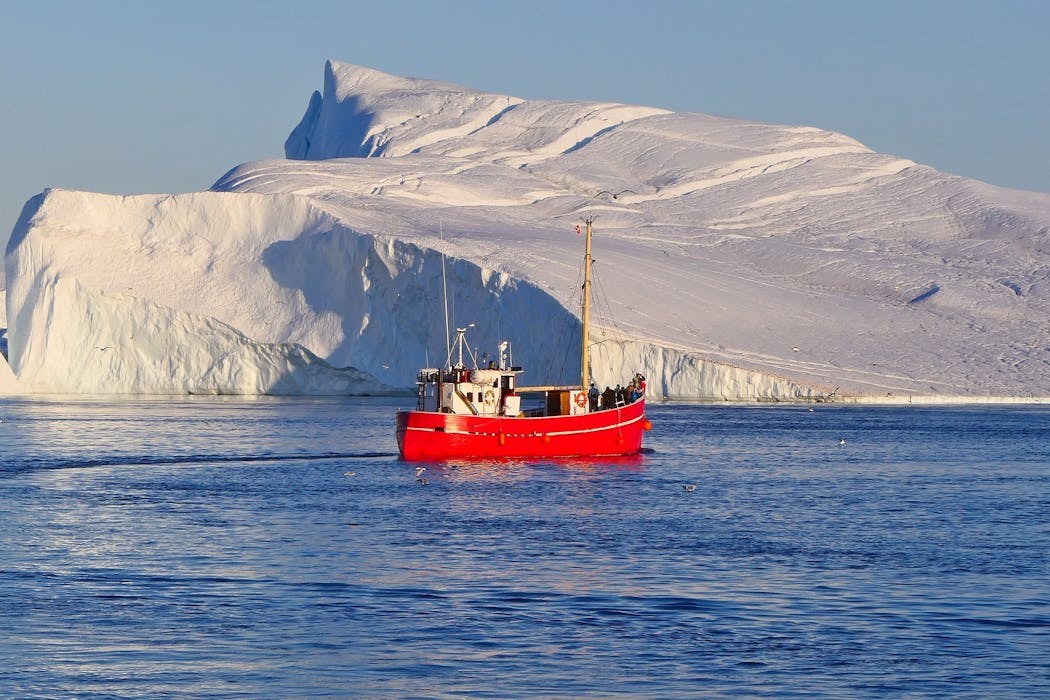
Icebergs in Disko Bay, Greenland. iralgo74/Shutterstock

The Greenland and Antarctic ice sheets are highly vulnerable to global warming and scientists are being increasingly worried about the possibility of large parts of the ice sheets collapsing, if global temperatures keep on rising.

Scientists have identified three elements that could be triggered, putting the ice sheets in Greenland and Antarctica at further risk.

These three instabilities are marine ice sheet instability (Misi), marine ice cliff instability (Mici) and surface elevation melt instability (Semi).

The first one (Misi) occurs when the seafloor beneath the ice sheet slopes downwards toward the interior of the ice sheet. The floating platforms of ice that fringe the Antarctic continent, ice shelves, are too weak to help slow down the ice from flowing into the ocean.

Because of this, the retreat of the ice sheet will happen at an accelerated pace and might become irreversible. When this happens, ice thickness increases inland, meaning that more ice is transported from the ice sheet to the ocean, causing the ice sheet to thin and further retreat.

The second factor (Mici) is linked with the collapse of ice cliffs, left after the disintegration of an ice shelf. These ice cliffs, if they become taller than a 30-storey building, are structurally unstable and would collapse through hydrofracturing.

This is a process through which surface meltwater fills crevasses, forcing fractures to rip open and causing the ice shelves to disintegrate. Their collapse would trigger a rapid retreat of the ice sheet as further, taller ice cliffs – also prone to failure – would become exposed behind.

The third one (Semi) relates to when the melting of the ice sheet causes its surface elevation to decrease, exposing it to higher air temperatures and further increasing melt.

An illustration of the three main factors that may cause ice sheet instability
Illustration of the three main factors causing ice sheet instability.
Illustration by Ricarda Winkelmann based on the Global Tipping Point Report

Which regions are most vulnerable?

West Antarctica, which is home to some of the fastest moving glaciers in the world including Pine Island and Thwaites glaciers, is particularly vulnerable to global warming.

Satellite observations have revealed that these glaciers have retreated, thinned and are flowing faster to the ocean, indicating that Misi is potentially already under way in this region. At the same time, computer models have shown that the retreat of these glaciers will continue in the future.

So far, marine ice cliff instability has been simulated in an ice sheet model but has never been observed in the real world. The conditions that might lead to the formation of such tall ice cliffs and whether their collapse would lead to such dramatic consequences are still poorly understood.

But more glaciers could be at risk if they were to lose their ice shelves, potentially exposing unstable ice cliffs.

Ice melts at Thwaites Glacier.

Surface melt instability is of particular concern in Greenland where surface melt has increased in the past decade and is becoming the main driver of ice losses.

What would happen?

If one (or several) of these instabilities are triggered, there would be an irreversible retreat of parts of the ice sheets, raising sea levels much faster than currently planned. It would still take centuries for the ice across whole regions to fully retreat.

But it could take just under 300 years, under a catastrophic Mici-driven retreat in west Antarctica. So we would already see a much higher contribution of the ice sheets to rising sea levels by 2300, with more frequent coastal flooding worldwide.

As a rule of thumb, for every centimetre of sea level rise, an additional 6 million people are at risk of coastal flooding.

According to the latest IPCC report, sea levels are predicted to rise between 0.3 and 1.6 metres by 2100, depending on future greenhouse gas emissions. However, an increase of more than 15 meters by 2300 cannot be ruled out.

Satellite observations and computer models help us understand how Greenland and Antarctica are changing and how they will continue to do so in the future. Analysis of satellite records shows that regions of both ice sheets are thinning and flowing more rapidly than before. Using computer models, self-sustaining mechanisms that could lead to increased ice sheet melting in the future have been identified.

My international team, supported by the European Space Agency, is bringing together experts in satellite remote sensing and numerical modelling to determine how close the polar ice sheets are to crossing “tipping points”, beyond which their retreat will become irreversible.

However, there is still much to understand and to research around the triggers of these instabilities, and some computer simulations suggest that
ice cliff failure might not lead to the dramatic outcome that some researchers have predicted.

Understanding more about what this means for future sea level rise will help reduce future risks so that we can avoid the dramatic human, social, and economic consequences that would come with more frequent and severe coastal flooding, storm surging and coastal population relocation.


Don’t have time to read about climate change as much as you’d like?

Get a weekly roundup in your inbox instead. Every Wednesday, The Conversation’s environment editor writes Imagine, a short email that goes a little deeper into just one climate issue. Join the 47,000+ readers who’ve subscribed so far.


The Conversation

Inès Otosaka receives funding from the European Space Agency and the UK Natural Environment Research Council.

ref. Three things that might trigger massive ice sheet collapse – https://theconversation.com/three-things-that-might-trigger-massive-ice-sheet-collapse-267275

Should the UK follow Australia’s under-16s social media ban? It could do more harm than good

Source: The Conversation – UK – By Jessica Ringrose, Professor of the Sociology of Gender and Education, Institute of Education, UCL

Drazen Zigic/Shutterstock

A ban on social media for under-16s in Australia comes into effect on December 10 2025. Young people will see their accounts deactivated, with social media companies responsible for enacting the ban.

In the UK, the government has committed to addressing young people’s use of the internet through the Online Safety Act rather than enforcing an outright ban.

However, children’s use of devices is often limited. Bans on smartphones in schools, as well as parent pledges to delay their children’s smartphone use, have gained widespread traction in the UK. They are based on assumptions including that smartphone use is addictive, distracting and leads to children doing worse in school.

On the other hand, though, research suggests the cause and effect may not be so clearcut. Studies have found that phone banning in schools does not significantly increase academic attainment or improve wellbeing.

We are academics with decades of experience exploring young people’s use of digital media. Our ongoing research suggests that an outright ban on social media platforms for under-16s is problematic. It neglects young people’s rights and voice and penalises them rather than targeting social media platforms.

Boy and mum looking at phone
Bans may deter children from talking to adults if they do see something harmful online.
VH-studio/Shutterstock

Bans could erode trust between young people and the adults in their lives. Children may be put off telling adults about something harmful they’re not supposed to have seen. This could lead to them being less able to access support.

Our ongoing study is exploring the implications of banning smartphones in schools in England. Survey data suggests that most schools in the UK do not allow phones to be used at all during the school day.

Previous research by one of us (Jessica Ringrose) explored young people’s experiences with smartphones and social media at school. This research found that girls were being sent nude images by boys at their schools and were exposed to misogynistic messages originating from the manosphere.

Nevertheless, our ongoing work shows widespread opposition to phone school bans among young people. There’s a generational divide: 75% of young people opposed school phone bans, while most parents (88%) and teachers (87%) supported them.

A problem with strict bans in school settings is that issues and harms young people may encounter online, including those that originate from their classmates, are displaced from school.

One of us (Jessica) has previously carried out research on the challenges of combating digital harms in schools that found schools lacked victim support and young people feared reporting online abuse. “No phone” policies may perpetuate this. Young people may be put off showing teachers something online that upset them when they know they’re not supposed to get out their phone.

For parents, too, phone bans may be a way of pushing away a problem they don’t feel equipped or supported to deal with. Interviews with mothers in the US who had signed pledges to delay giving young people smartphones revealed this uncertainty.

Smartphone avoidance strategies delayed the need to engage in other, more nuanced, forms of parental mediation of digital devices. Simply deferring young people’s use of smartphones may not deal with the doubts and fears that parents feel around their children’s use of technology.

Interviews with parents and carers from our ongoing study show they feel overwhelmed and unsupported when it comes to their children’s smartphone use. “When you’re a busy parent, making sure you’re on top of monitoring what they’re doing seems like quite a hard task,” one mother said. “There’s just not enough guidance,” another commented.

What teens think

Our ongoing work is focused on hearing what young people have to say about phone bans. It suggests that bans make young people feel a loss of autonomy and agency, and that they want guidance from adults on smartphone and social media use.

This need for support is something that research has consistently found that young people want. They want to be able to talk to adults and to be listened to without judgement.

We are not dismissing parents’ or teachers’ concerns, nor their hopes for safer smartphone futures. We are also not suggesting students use phones during lessons when it is not appropriate. Rather we argue that listening to young people’s and families’ views about and hopes for tech is crucial.

Research from the House of Lords shows an urgent need for critical thinking and analytical skills to access, evaluate, create and act on media, for both children and adults. Teachers have pointed to major gaps in media literacy education, especially around social media and AI.

But without addressing this at school, online harms are not reduced. Instead, responsibility for them is shifted onto parents, who already feel ill-equipped to address children’s online lives.

By focusing on media literacy in both policies and the curriculum, schools can address children’s experiences and views. This could include covering issues such as AI and social media business models, algorithms, misinformation, surveillance, privacy and consent in the use of technology.

It’s best if schools and parents are able to work together to address rapidly shifting technology concerns such as AI, instead of shifting responsibility back and forth. Parents and families need support to help children navigate responsible use of social media and issues including AI and consent.

The Conversation

Rebecca Coleman receives funding from the Economic and Social Research Council (ESRC).

Jessica Ringrose does not work for, consult, own shares in or receive funding from any company or organisation that would benefit from this article, and has disclosed no relevant affiliations beyond their academic appointment.

ref. Should the UK follow Australia’s under-16s social media ban? It could do more harm than good – https://theconversation.com/should-the-uk-follow-australias-under-16s-social-media-ban-it-could-do-more-harm-than-good-269754

Rage bait: the psychology behind social media’s angriest posts

Source: The Conversation – UK – By John McAlaney, Professor in Psychology, Bournemouth University

Jack_the_sparow/Shutterstock

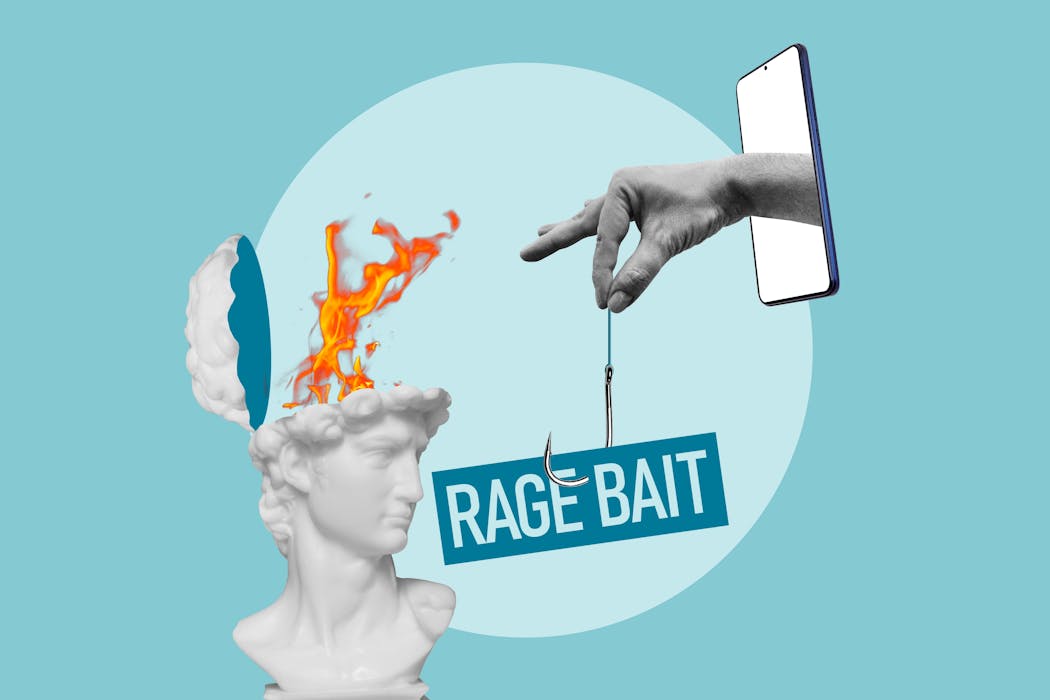
“Rage bait” has been named the word of the year by the Oxford University Press. It means social media content that is designed to create a strong and negative reaction.

Posting content intended to antagonise people may not seem like a wise strategy for a social media influencer. But people who post content on social media can make more money if their channel has a high level of engagements – regardless of how positively people are responding.

In addition, social media platforms use algorithms that tailor the content we see to what we are likely to engage with. This doesn’t necessarily mean content that will make us happy – the algorithm will learn from any engagement that we have with the content, including angry comments we might post in response.

But there are things you can do to help control your reaction to this kind of content. First though, you need to understand why rage bait is so effective.

Provocative posts can result in a higher number of clicks, shares and comments. This may be a result of a negativity bias, where negative emotions such as anger spread more quickly and more intensely through social networks.

In evolutionary terms, it is more important for us to pay attention to a situation that has caused anger to our group than a situation that has created happiness. Anger suggests that action needs to be taken to resolve an issue, whereas happiness suggests that everything is OK.

Although social media technologies are relatively new, the ways in which we understand and navigate our world are not. We are primed to look for social information, which includes anything that indicates a difference of opinion or possible threat within our social groups.

In the past, the groups we belonged to were typically local to where we lived – our friends, neighbours and colleagues. But the growth of social media means that we can now connect with people from all around the world. That means there are far more groups we can be part of and, in turn, routes through which anger can reach us.

Research has found that people can be quick to align their views with others on anything that prompts a negative emotion, which provides another evolutionary benefit by providing safety in numbers from a potential threat. In this case the person posting the rage bait content takes on the role of the pantomime villain who the audience unites against to boo at.

The other problem is we can post content or comments and immediately get a reply, non-stop 24 hours a day. Typically, we used to have some breaks from anything, or anyone, that caused us a feeling of rage. This would give us an opportunity to calm down and reflect on what had happened, but with the ubiquity of social media it can feel like we no longer have that escape.

Coping with rage bait

An awareness of the motivations behind these posts is a good place to start. There are of course people who post negative content who genuinely believe in what they are posting. But knowing that many of these posts are posted solely to drive engagement helps us reclaim our power over those interactions.

A 2020 study showed that giving people an understanding of manipulation strategies used in the media empowered them to resist these techniques.

Man in hoodie smashing through laptop screen with fist.
How not to deal with rage bait.
Ollyy/Shutterstock

Think of the person posting the content as being an actor who is playing a character, and whose actions are driven more by a desire for fame – whether that means being famous or infamous – rather than personal beliefs.

The more that we avoid engaging with any content that induces rage in us the less it will be presented to us. Unlike traditional broadcast media such as TV, we do not need to be a passive audience to social media. Instead we can influence and shape social media through both what we choose to engage with, or not engage with.

Hope instead of rage

Despite the speed and strength with which anger can spread through social media through rage bait, there is emerging research which suggests people can be nudged into reflecting on media content designed to provoke anger before they respond. This can dilute the influence of rage bait.

One benefit of social media as compared to offline interactions is that social media is, by its nature, publicly visible. This means that researchers can more easily understand what is happening on these platforms, including how rage bait is being used to drive engagements.

It can also help us better understand how to help people take control over social media content that we are exposed to, so that we can benefit from the positive aspects of these technologies without being drawn into negative content posted solely for profit.

The Conversation

John McAlaney does not work for, consult, own shares in or receive funding from any company or organisation that would benefit from this article, and has disclosed no relevant affiliations beyond their academic appointment.

ref. Rage bait: the psychology behind social media’s angriest posts – https://theconversation.com/rage-bait-the-psychology-behind-social-medias-angriest-posts-271041

Why Grand Designs-style eco-homes aren’t a good blueprint for sustainable living

Source: The Conversation – UK – By Alan Collins, Professor of Economics and Public Policy, Nottingham Trent University

A family builds an off-grid home in rural Wales. TV celebrates it as a blueprint for net-zero living. But what if this vision of sustainability simply doesn’t scale up?

Television shows such as Channel 4’s Grand Designs have long celebrated ambitious one-off homebuilding projects. These programmes often frame bespoke rural housing as a model of sustainable living.

With large audiences, they wield real influence over what viewers imagine an environmentally sustainable lifestyle looks like. But the reality behind many of these supposedly “eco” homes is far more complicated.

The BBC recently explored one such case in Wales, where a family secured planning permission under the Welsh government’s One Planet Development policy. Introduced in 2012, the policy allows zero-carbon homes to be constructed on land where conventional buildings would not be permitted. In return, residents must demonstrate they can provide their own energy and water and derive a basic income from the surrounding land.

At first glance, this all seems a laudable and well-meaning attempt to encourage net-zero living. Yet projects like these raise deeper questions about sustainability, fairness and what it means for a society as a whole to be environmentally responsible.

We can’t all live in rural eco-homes

The first issue is scalability. Rural “eco-homestead” living can appear green at the level of a single household. But how many of these homes, each taking up considerable land, could be built in the Welsh countryside – or the UK more broadly?

A few might operate as experimental demonstration sites in rural areas, but if that’s the goal then a location in or near urban areas would reach far more people.

These homes are not as self-sufficient as the image of rural idyll suggests. People living there would still own cars, commute to work, send children to school and make regular trips for food, healthcare and to socialise. Multiply these car trips over many such developments and their environmental footprint would undermine the very rationale used to approve the developments.

This is the opposite of the 15-minute city ideal. Dispersed rural living simply cannot match the efficiency of compact urban living.

Academic research in economics, geography and planning has long showed that cities generate “agglomeration economies”: the practical benefits of living around lots of other people means schools, healthcare, public transport and other services tend to be more efficient than in the countryside. This makes urban living far more sustainable for large populations and is one reason rural eco-homes are completely unsustainable as a means of meeting genuine housing needs.

Fair and inclusive

The second issue concerns fairness and access. If permission for remote single household plots is to be restricted in number, then that cap should be explicit and justified. At present, it is neither.

The result is that only the wealthy – people able to acquire attractive rural land, navigate the planning system and fund bespoke eco-builds – can pursue this lifestyle. This risks breeding resentment, especially if access to attractive countryside or forest locations becomes effectively privatised by those who can afford large, low-density housing.

This has broader political implications. As the climate crisis intensifies, public support for environmental action depends on perceptions of fairness. If “sustainable living” is seen as something the wealthy perform in idyllic rural retreats while ultimately relying on urban services and infrastructure, that narrative becomes exclusionary and demotivating. It signals that meaningful environmental responsibility isn’t possible for the majority living in towns and cities. That helps create a form of socio-environmental separation: green lifestyles for a wealthy minority, higher environmental costs for everyone else.

Programmes like Grand Designs play an important role in shaping expectations for green living and dream “forever home” residential building projects. Their enthusiasm for remote, self-built eco-homes gives viewers the impression that sustainability is achieved through architectural daring and a retreat from urban life. These stories generate a warm glow for the featured household, but they don’t represent a realistic way to collectively tackle the climate and environment crises.

The most effective solutions are more mundane, and far less televisual. For instance, better roof insulation or the replacement of old boilers could be rolled out for millions of homes and would have a far greater environmental impact. Such policies lack the drama of building a fancy off-grid smallholding, but they are scalable, accessible for all and genuinely aligned with climate goals.


Don’t have time to read about climate change as much as you’d like?

Get a weekly roundup in your inbox instead. Every Wednesday, The Conversation’s environment editor writes Imagine, a short email that goes a little deeper into just one climate issue. Join the 47,000+ readers who’ve subscribed so far.


The Conversation

Alan Collins is a very passive member of the Labour Party

ref. Why Grand Designs-style eco-homes aren’t a good blueprint for sustainable living – https://theconversation.com/why-grand-designs-style-eco-homes-arent-a-good-blueprint-for-sustainable-living-268751

How short-form videos could be harming young minds

Source: The Conversation – UK – By Katherine Easton, Lecturer, Psychology, University of Sheffield

Prostock-studio/Shutterstock.com

Online short-form video has shifted from a light distraction to a constant backdrop in many children’s lives. What used to fill a spare moment now shapes how young people relax, communicate and form opinions, with TikTok, Instagram Reels, Douyin and YouTube Shorts drawing in hundreds of millions of under-18s through endlessly personalised feeds.

These apps feel lively and intimate, offering quick routes to humour, trends and connection, yet their design encourages long sessions of rapid scrolling that can be difficult for young users to manage. They were never built with children in mind, although many children use them daily and often alone.

For some pre-teens, these platforms help develop identity, spark interests and maintain friendships. For others, the flow of content disrupts sleep, erodes boundaries or squeezes out time for reflection and meaningful interaction.

Problematic use is less about minutes spent and more about patterns where scrolling becomes compulsive or hard to stop. These patterns can begin to affect sleep, mood, attention, schoolwork and relationships.

Short-form videos (typically between 15 and 90 seconds) are engineered to capture the brain’s craving for novelty. Each swipe promises something different, whether a joke, prank or shock – and the reward system responds instantly.

Because the feed rarely pauses, the natural breaks that help attention reset vanish. Over time, this can weaken impulse control and sustained focus. A 2023 analysis of 71 studies and nearly 100,000 participants found a moderate link between heavy short-form video use and reduced inhibitory control and attention spans.

Attention hijacked

Sleep is one of the clearest areas where short-form video can take a toll.

Many children today view screens when they should be winding down. The bright light delays the release of melatonin, a hormone that helps regulate sleep, making it harder for them to drift off.

But the emotional highs and lows of rapid content make it particularly difficult for the brain to settle. A recent study found that for some teenagers, excessive short-form video use is connected to poorer sleep and higher social anxiety.

These sleep disturbances affect mood, resilience and memory, and can create a cycle that is especially hard for stressed or socially pressured children to break.

A young girl lying awake in bed.
Short-form video use may lead to insomnia.
StasyKID/Shutterstock.com

Beyond sleep, the constant stream of peer images and curated lifestyles can amplify comparison. Pre-teens may internalise unrealistic standards of popularity, appearance or success, which is linked to lower self-esteem and anxiety – although the same is true for all forms of social media.

Younger children are more susceptible

Most research focuses on teenagers, but younger children have less mature self-regulation and a more fragile sense of identity, leaving them highly susceptible to the emotional pull of quick-fire content.

Exposure to material children never intended to see adds risk and the design of short-form video apps can make this far more likely. Because clips appear instantly and autoplay one after another, children can be shown violent footage, harmful challenges or sexual content before they have time to process what they are seeing or look away.

Unlike longer videos or traditional social media posts, short-form content provides almost no context, no warning, and no opportunity to prepare emotionally. A single swipe can produce a sudden shift in tone from silly to disturbing, which is particularly jarring for developing brains.

Although this content may not always be illegal, it can still be inappropriate for a child’s stage of development. Algorithmic systems learn from a brief moment of exposure, sometimes escalating similar content into the feed. This combination of instant appearance, lack of context, emotional intensity and rapid reinforcement is what makes inappropriate content in short-form video especially problematic for younger users.

Not every child is affected in the same way, though. Those with anxiety, attention difficulties or emotional volatility seem more vulnerable to compulsive scrolling and to the mood swings that follow it.

Some research suggests a cyclical relationship, where young people with attention deficit hyperactivity disorder, or ADHD, are particularly drawn to rapid content, while heavy use may intensify the symptoms that make self-regulation difficult. Children dealing with bullying, stress, family instability or poor sleep may also use late-night scrolling to cope with difficult emotions.

This matters because childhood is a critical period for learning how to build relationships, tolerate boredom and handle uncomfortable feelings. When every quiet moment is filled with quick entertainment, children lose chances to practise daydreaming, invent games, chat with family or simply let their thoughts wander.

Unstructured time is part of how young minds learn to soothe themselves and develop internal focus. Without it, these skills can weaken.

New guidelines

There are encouraging signs of change as governments and schools begin to address digital wellbeing more explicitly. In England, new statutory guidelines encourage schools to integrate online safety and digital literacy into the curriculum.

Some schools are restricting smartphone use during the school day, and organisations such as Amnesty International are urging platforms to introduce safer defaults, better age-verification and greater transparency around algorithms.

At home, open conversation can help children understand their habits and build healthier ones. Parents can watch videos together, discuss what makes certain clips appealing and explore how particular content made the child feel.

Establishing simple family routines, such as keeping devices out of bedrooms or setting a shared cut-off time for screen use, can protect sleep and reduce late-night scrolling. Encouraging offline activities, hobbies, sports and time with friends also helps maintain a healthy balance.

Short-form videos can be creative, funny and comforting. With thoughtful support, responsive policies and safer platform design, children can enjoy them without compromising their wellbeing or development.

The Conversation

Katherine Easton has recently received funding from:
2021 – UKRI eNurture (PI) £26,762.00 Hacking the school system.
2022 – Research England, HEIF TUoS (PI) £48,983 Digiware: Knowledge Exchange in Education and Internet of Things.
to research young people’s views on the use of technology in their schools

ref. How short-form videos could be harming young minds – https://theconversation.com/how-short-form-videos-could-be-harming-young-minds-271159

Will Scotland’s planned four-day week for teachers work?

Source: The Conversation – UK – By Beng Huat See, Professor of Education Research, School of Education, University of Birmingham

Yuganov Konstantin/Shutterstock

The Scottish government recently announced plans to pilot a four-day school week. The proposal comes amid growing concerns about teacher supply and wellbeing.

Teaching remains one of the most stressful occupations in the UK, with stress, exhaustion and burnout consistently cited as major reasons for staff leaving the profession. Creating supportive cultures and cost-effective wellbeing strategies therefore remains a key challenge for school leaders.

A “true” four-day work week, as advocated for by the Four-Day Week Foundation, involves the meaningful reduction of working time as well as days. This means that working time will typically be reduced to 28-32 hours per week worked over four days. Importantly, this change is made without a reduction in pay and with expectations that overall productivity levels are maintained.

Trials across 61 UK organisations show that four-day work weeks, when implemented as genuine working-time reductions, can improve work-life balance, reduce stress and cut employee absence. Research from Australia, Canada, Ireland, New Zealand, the UK and the USA also report positive effects on wellbeing, job satisfaction and retention from adoption of the four-day work week. These studies also suggest that working-time reductions do not harm productivity.

But teaching still lags behind the wider workforce on flexible working. Many schools struggle to accommodate it. Unlike many office-based roles, schools must maintain fixed timetables, ensure pupil supervision and meet staffing ratios, which limits flexibility.

The proposal by the Scottish government differs from a “true” four-day week in that it does not reduce teachers’ overall hours but redistributes them. Teachers would work part of their planning, preparation and assessment time off-site, with only four days used for teaching.

Hand marking student work
The proposal would allow a day for assessment, planning and other tasks.
NuPenDekDee/Shutterstock

Research by one of us (Daniel Wheatley, with colleagues at the University of Birmingham) from the Four-Day Work Week Project offers useful insights from work models that do not involve reductions in hours. We have found that models of the four-day work week where hours are not reduced, and ones where working on the fifth day remains in place, are linked to high work intensity and lesser practical benefits: employees are not able to disconnect from work fully.

However, research by one of us (Beng Huat See, with colleagues at Durham University and the University of Birmingham) which has examined 18 countries, indicates that the key factor contributing to stress is not the statutory working hours, but the amount of classroom contact time. Countries where teachers have high overall hours but fewer teaching hours report fewer shortages. This suggests that the most exhausting element of teaching is the intensity of instructing and managing pupils, rather than administrative or preparatory tasks.

If reducing contact hours helps alleviate stress, then a four-day teaching week, or models that redistribute teaching time such as the proposal in Scotland, could potentially improve wellbeing and retention.

Although four-day work weeks have been adopted in some international school systems, evidence of impacts on wellbeing, retention and pupil outcomes remains limited. Most existing research has been based on people’s perceptions of the scheme rather than measurable outcomes. These could include comparing absentee rates, turnover rates of teachers and student outcomes before and after the introduction of flexible working.

The Scottish pilot therefore offers an important opportunity to generate robust evidence. In England, the Education Endowment Foundation, a research charity funded by the government, is also trialling a nine-day working fortnight and an off-site planning, preparation and assessment model, but results are not yet available.

Flexible working in practice

Whether flexible working hours are feasible in practice depends on several factors. Large academy trusts often find it easier to implement this kind of working because they can deploy staff across multiple sites, allowing less rigid timetabling than a single school can manage. Primary schools also have more capacity for flexible models because they rely less on specialist subject teaching.

Cultural change is as important as logistical change. Research from non-profit Timewise emphasises that supportive leadership is crucial. Without it, flexible arrangements remain inconsistent or inaccessible. This means that implementing a four-day week is not a simple organisational tweak.

A four-day week is not a quick fix, then, but it may be worth trying.

The Scottish government’s pilot is an ambitious step that reflects a growing recognition of the need to address teacher workload. But successful implementation will require sufficient staffing and resourcing, and a shift in leadership practice and school cultures.

Reducing the intensity of classroom contact time may be crucial to tackling stress and preventing burnout. The existing evidence base does present a cautionary tale in that adoption of work models that do not involve a meaningful reduction in working time have so far been much less successful. Nevertheless, the Scottish pilot offers a rare opportunity to test whether rethinking working patterns can improve teacher wellbeing and retention.

The Conversation

Beng Huat See receives funding from Economic and Social Research Council.

She is a Fellow of the Academy of Social Sciences, Fellow of the Royal Society of Arts and a Fellow of the Wolfson Research Institute for Health and Wellbeing

Daniel Wheatley is an Academic Fellow of the Chartered Institute of Personnel and Development, Fellow of the Regional Studies Association and member of the Association for Heterodox Economics and British Sociological Association.

ref. Will Scotland’s planned four-day week for teachers work? – https://theconversation.com/will-scotlands-planned-four-day-week-for-teachers-work-271166

Online sharing can push us apart – but when it’s authentic it can bring us together

Source: The Conversation – UK – By Claire Hart, Associate Professor of Psychology, University of Southampton

PeopleImages/Shutterstock

We spend a huge part of our social lives online. Over five billion people scroll, post and comment on social media every day, using these platforms to keep in touch, share experiences and express themselves. Yet social media is often blamed for making us lonelier, more anxious and more competitive.

Our research team at the University of Southampton wanted to test whether this overwhelmingly negative narrative tells the full story. Instead of asking only what social media does to us, we asked a different question: under what conditions does sharing online actually help our relationships?

To answer this, we conducted a systematic review of almost two decades of research on two core online behaviours: self-disclosure (sharing personal information, thoughts or feelings) and self-presentation (managing the image we project to others). Across 57 publications and 73 individual studies, a clear pattern emerged: online sharing can strengthen relationships but only when it is perceived as genuine, appropriate and socially attuned.

People have always managed how they appear to others. What social media adds is scale, speed and visibility. A single post can be seen by dozens, hundreds, or even thousands of people, from close friends to complete strangers.

Both self-disclosure and self-presentation serve important social functions. Sharing personal experiences can deepen friendships and invite support. Presenting achievements or milestones can reinforce feelings of status and belonging. Problems arise not because these processes exist, but because they become exaggerated, misjudged or mismatched to the audience.

What the evidence actually shows

Across the studies we reviewed, people who shared more about their lives online consistently felt more socially connected. Even short, everyday updates increased feelings of belonging and reduced loneliness – whether or not the posts received visible feedback.

From the audience side, people felt emotionally closer to those who disclosed more frequently and more meaningfully. These effects were not limited to close friends; even weak ties often strengthened through regular, low-stakes sharing.

Crucially, online sharing helps fulfil two fundamental social motives. One is affiliation: the need for closeness, warmth and acceptance. The second is status: the need to feel valued, admired or socially visible. Positive, sincere self-disclosure supported both. In contrast, posting that was clearly designed to impress, brag or exaggerate often undermined liking, even when it attracted superficial engagement such as likes.

One of the most robust findings from the review was the importance of perceived authenticity. Across multiple experiments, people rated targets as more trustworthy, likeable and socially attractive when their photos were candid rather than heavily posed or edited. Filtered selfies and highly polished images tended to reduce perceived genuineness, and with it, social warmth.

The same pattern appeared in written posts. Balanced, everyday content – think “Long day but finally home with a cup of tea. Nice to slow down and enjoy the small comforts” – elicited more positive responses than overt self-promotion, for example “Another huge win today — feeling unstoppable lately! Hard work really does beat talent 💪✨”. Across studies, people were consistently more liked when they appeared real rather than strategic.

This does not mean people reject positivity. Positive posts were generally associated with more likes, friendlier comments and higher interpersonal attraction. But highly curated positivity, especially when it signalled superiority, luxury or flawless success, often triggered scepticism rather than admiration.

When sharing backfires

The review also showed that more disclosure is not always better. Highly intimate or strongly negative posts were often judged as inappropriate when shared publicly, particularly among acquaintances. These posts may attract attention but not necessarily liking or trust.

Negative posts showed an important asymmetry. They tended to receive fewer likes, but more private messages and emotional support. In other words, distress expressed online does not go ignored — but the support often moves behind the scenes. What matters most is whether the disclosure appears sincere rather than performative.

Not everyone uses social media in the same way. Traits such as narcissism and attachment style shape both how people post and how others respond. Narcissistic users, for example, tended to post more frequently and more self-promotional content.

While this often increased visibility, it did not reliably increase genuine liking or closeness. By contrast, people with secure attachment styles, who were comfortable with intimacy and trust, were more likely to use social media in ways that sustain real relationships.

Context matters just as much. Close friends responded differently from acquaintances. A disclosure that strengthens closeness in an intimate relationship may feel awkward or excessive when directed at distant contacts. Platforms also differ: what feels normal on Instagram may not work on LinkedIn or X.

Most previous research, and most public debate, has focused on the harms of social media: addiction, social comparison, anxiety and loneliness. These are real concerns. But they coexist with a parallel reality: people continue to use social media because it meets genuine social needs.

Our aim was to identify what actually works in online relating. We wanted to move beyond simplistic “good” versus “bad” narratives and offer a more precise account of how digital connection succeeds or fails. The practical implications are less about posting more or less, and more about how and why we share. Posts perceived as genuine consistently outperform those seen as strategic.

In summary, positive content attracts visibility; sincere vulnerability attracts support. Extremely intimate disclosures are best reserved for closer relationships.
Heavily filtered or exaggerated self-presentation often weakens trust.

Social media is neither inherently toxic nor inherently connective. It amplifies whatever social signals we send through it. When those signals align with honesty, emotional awareness and relational context, online self-disclosure can strengthen, rather than strain, our relationships.

The Conversation

The authors do not work for, consult, own shares in or receive funding from any company or organisation that would benefit from this article, and have disclosed no relevant affiliations beyond their academic appointment.

ref. Online sharing can push us apart – but when it’s authentic it can bring us together – https://theconversation.com/online-sharing-can-push-us-apart-but-when-its-authentic-it-can-bring-us-together-271547

Even ‘weak’ cyclones are being turned into deadly rainmakers by fast-warming oceans

Source: The Conversation – UK – By Ligin Joseph, PhD Candidate, Oceanography, University of Southampton

The final week of November was devastating for several South Asian countries. Communities in Sri Lanka, Indonesia and Thailand were inundated as Cyclones Ditwah and Senyar unleashed days of relentless rain. Millions were affected, more than 1,500 people lost their lives, hundreds are still missing, and damages ran into multiple millions of US dollars. Sri Lanka’s president even described it as the most challenging natural disaster the island has ever seen.

When disasters like this happen, the blame often falls on a failure in early warnings or poor preparedness. This was the case with major floods in Kerala, south India, in 2018, which devastated my hometown.

But this time, the forecasts were largely accurate; the authorities knew the storms were coming, yet the devastation was still immense.

So, if the forecasts were good enough, why were the impacts still so severe?

Weak winds, extreme rain

One emerging explanation is that these storms were not dangerous because of their winds, but because they produced unusually intense rainfall.

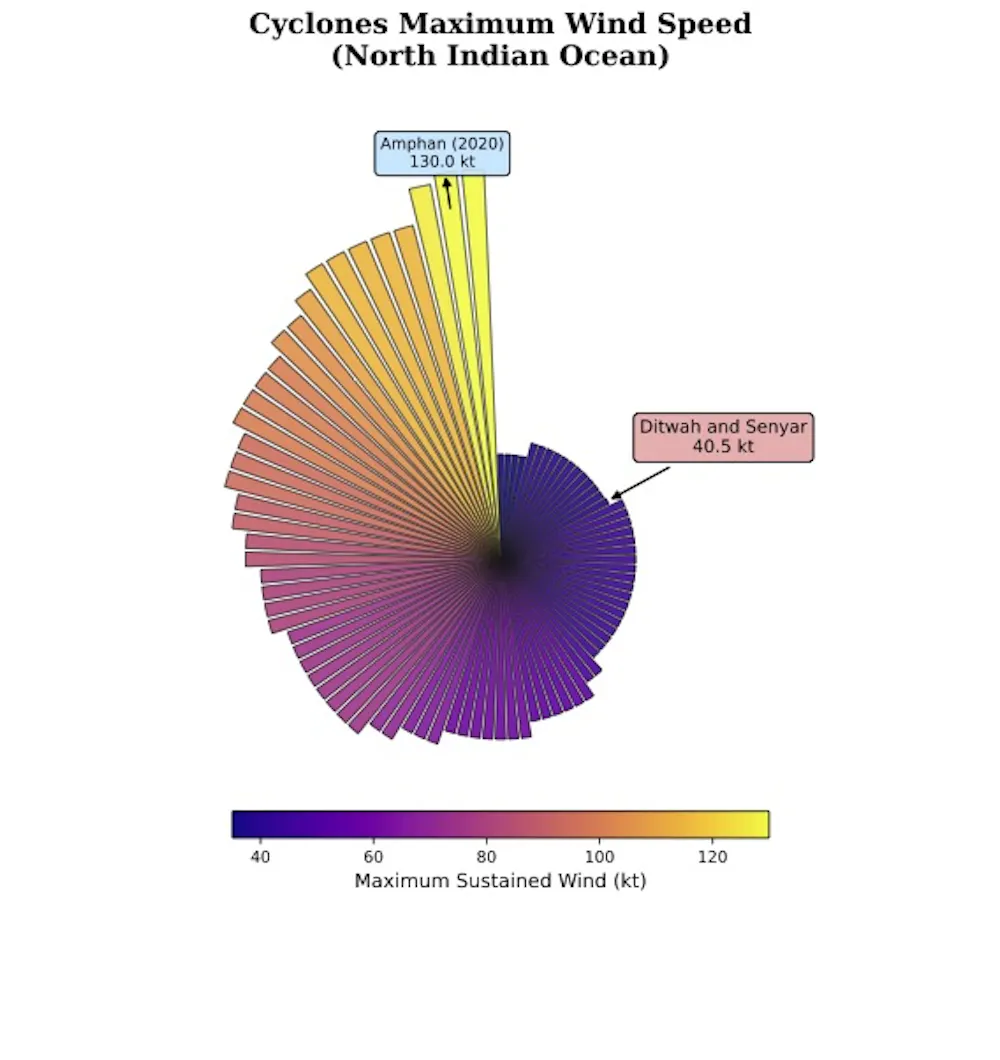
Graph of wind speeds
This graph of all cyclonic storms over the north Indian Ocean since 2001 shows Ditwah and Senyar weren’t particularly windy. (Wind speed measured in knots. 1 knot is about 1.15 mph or 1.85 kph)
Ligin Joseph (data: IBTrACS), CC BY-SA

Consider Cyclone Ditwah. Its peak winds were around 75 km/h (47 mph). That’s windy, but nothing special. In the UK, it would be classified merely as a “gale” rather than a “storm”. It was far weaker than the 220 km/h winds of the powerful 1978 cyclone that also struck Sri Lanka. Yet Ditwah still caused massive devastation.

What explains this apparent contradiction? It’s too early to say definitively, but climate change is likely a part of the story. Even when storms are not especially strong in wind terms, the amount of rain they carry is increasing.

A warmer atmosphere holds more water

A well established meteorological rule helps explain why. For every degree of global warming, the atmosphere can hold about 7% more moisture.

As the planet warms, the air above us becomes a larger reservoir, waiting to dump more water on us. When storms form, they can tap into this expanded supply, often in extremely short bursts. Even if wind speeds are modest, the rainfall alone can be catastrophic.

The oceans matter even more

Warming oceans play an even more powerful role, as cyclones draw their energy from warm ocean waters. Satellite data from late November shows just how warm the eastern Indian Ocean was, with large areas more than 1°C above normal during Ditwah and Senyar.

Coloured map of Indian Ocean and SE Asian seas
In the days before the cyclones formed (20–24 November), the oceans were even warmer than usual, creating conditions that could have fuelled and intensified the rainfall.
Ligin Joseph (Data: OISST; track positions are approximate), CC BY-SA

Such warm anomalies are no longer unusual. The oceans have absorbed more than 90% of the excess heat trapped by greenhouse gases, and long-term observations show a clear upward trend in ocean temperatures.

That doesn’t necessarily mean cyclones are becoming more frequent – their formation still depends on other ingredients, such as low wind shear (small differences in wind speed and direction with height) and the right atmospheric structure.

What warmer oceans do change, however, is the amount of energy available to any storm that does manage to form. When the ocean is warmer, cyclones have more fuel and evaporation increases, loading the atmosphere with moisture that can fall as intense rain once a storm develops. Even weak cyclones can therefore hold exceptional amounts of rain.

Coloured map of Indian Ocean and SE Asian seas
Evaporation averaged for 26–27 November. Ditwah especially travelled over warm waters supplying large amounts of moisture to the atmosphere.
Ligin Joseph (Data: ERA5), CC BY-SA

The winds near the surface help this process along. As they move across the ocean, they sweep away the moisture-filled air just above the water and replace it with drier air, allowing evaporation to continue. Put together, warmer oceans, higher evaporation, and an atmosphere that can store more moisture, these factors can significantly intensify the rainfall associated with cyclones.

Coastline hugging makes flooding worse

Local geography amplified these effects. Both Ditwah and Senyar formed unusually close to land and travelled along the coastline for an extended period. This meant they stayed over warm waters long enough to continuously draw moisture, but remained close enough to land to dump that moisture as intense rainfall almost immediately.

Cyclone Ditwah, in particular, moved slowly as it approached Sri Lanka. Slow-moving storms can be especially dangerous as they repeatedly dump rain over the same area. Even if winds are weak, this combination of warm seas, coastal proximity and slow forward speed can be devastating.

A new threat

These storms suggest that climate change – especially ocean warming – is reshaping the risks posed by cyclones. The most dangerous storms may no longer simply be the ones with the strongest winds, but also the ones with the most moisture.

Forecasting systems, including new AI-powered weather models, are getting better at predicting cyclone tracks and wind speeds. Yet rainfall-driven flooding remains far harder to forecast. As oceans continue to warm, governments and disaster agencies will need to prepare for storms that may be weak in wind but extreme in rain.

These insights are based on preliminary analysis and emerging scientific understanding. More detailed peer-reviewed studies will be needed to pinpoint exactly why Ditwah and Senyar produced such extreme rainfall. But the pattern that is emerging – weak cyclones delivering outsized floods in a warming world – must not be ignored.

The Conversation

Ligin Joseph receives funding from the UK’s Natural Environment Research Council (NERC).

ref. Even ‘weak’ cyclones are being turned into deadly rainmakers by fast-warming oceans – https://theconversation.com/even-weak-cyclones-are-being-turned-into-deadly-rainmakers-by-fast-warming-oceans-271550

RT India: how the Kremlin is spreading its ‘west v the rest’ narrative to a global audience

Source: The Conversation – UK – By Precious Chatterje-Doody, Senior Lecturer in Politics and International Studies, The Open University

On a recent visit to India, Vladimir Putin personally announced the launch of RT India, a new Kremlin-funded broadcaster. It is part of the established RT (formerly Russia Today) network. After Russia’s full-scale invasion of Ukraine, RT lost its license to broadcast in the UK, was banned in the EU and was forced to close in the US.

But the closure of RT’s western broadcast operations did not mark the end for the network. It has been using creative tactics to reach western audiences, including allegedly covertly funding Conservative influencers in the US.

As the launch of RT India shows, it has also been reorienting towards audiences further afield. Based on our prior research, we know how RT tailors its operations for different audiences, and how it adapts to changing political realities.

This means we can start to unpack where the launch of RT India falls within Russia’s broader information strategy, and what we can expect from it.

The first important point is that RT India didn’t come from nowhere. It’s part of Russia’s broader “turn to the south”. This approach has followed the steady deterioration of relations between Moscow and western capitals, especially since the full-scale invasion of Ukraine.

RT, for its part, has targeted non-western audiences for years. RT Arabic was launched in 2007, and RT en Español – highly active in Latin America – in 2009. Yet the partial loss of western markets after the invasion of Ukraine has led RT to redirect resources from its stable budget (31 billion rubles, or about £303 million in 2025) towards new target audiences.

Sub-Saharan Africa – a Russian priority since the late 2010s – is a notable example. Both RT’s French and English-language channels have substantially increased their Africa-focused content, and dozens of cooperation agreements have been signed with African media outlets. RT Brasil, RT’s Portuguese-language site, was launched in February 2023. The @RT_India_news account on X was created in September 2022, well before the launch of the RT India television channel.

RT has spent a lot of time, effort and money honing its craft. It knows how to package its content so that it doesn’t look like a Russian influence operation.

One common strategy is platforming presenters that the audience knows and trusts. For US audiences, this included Occupy’s Abby Martin and William Shatner of Star Trek fame.

In the UK, political personalities like ex-SNP leader the late Alex Salmond (who paused his show after the full-scale invasion) and politician and former Celebrity Big Brother contestant, George Galloway, who still frequently appears on RT. On RT India, it’s Bollywood star Anupam Kher and politician and author Shashi Tharoor.

Another key objective for RT is building a shared identity with the audience. For RT America and RT UK, this was by appealing to people who saw themselves as critical thinkers, prepared to challenge the untrustworthy “establishment”. For RT India, it’s a similar idea. But the untrustworthy “establishment” isn’t domestic, it’s global – and specifically, western.

West v the rest

Our ongoing research indicates that, as with the RT channels targeting audiences in places like Latin America, Africa and the Middle East, RT India revives Russia’s Soviet-era anti-colonial strategic narrative.

This rhetoric frames contemporary Russian foreign policy as a continuation of Soviet anti-imperialist engagement, and accuses the “collective west” of neocolonial intentions. It argues for strengthening ties across the so-called “world majority” of states that see themselves as disadvantaged in an international system that favours the “collective west”.

It ignores the privileges that Russia enjoys within this system (such as permanent UN Security Council membership and veto power), and advocates for a multipolar, “de-westernised” international order.

These narratives are reflected in RT India’s advertising campaigns. In late 2023 to early 2024, its first campaign featured billboards stating, “Why does the west still see India as a third-world country?” and, “They think you believe, we believe you think,” with images of 10 Downing Street and the White House in the background.

The 2025 launch campaign for the TV channel, displayed in airports, metro stations and along major roads in Delhi, Mumbai, Kolkata, Bengaluru, Chennai and Hyderabad, presented RT as “A new voice from an old friend”. Its bio on X describes it as, “Not anti-western … just not western,” reinforcing the “west v the rest” framing.

When it comes to the war in Ukraine, RT amplifies the narratives promoted by the Kremlin and ruling Russian elites. On RT India, Russia’s aggression against Ukraine is routinely framed as a defensive “special operation” aimed at protecting Russian-speaking populations from what it calls the “Kiev regime”.

Western support for Ukraine is framed as neo-colonial warmongering. By tapping into ongoing social debates about the horrors of European colonialism, this alternative and misleading representation of the conflict becomes relatable.

It’s true that India has a history of friendly relations with Russia – and the Soviet Union before that. And the evils of European colonialism should not be denied. But Putin didn’t personally launch RT India just to make these points. What is more, the imperial nature of Russia’s relations with Ukraine is something that RT India certainly won’t acknowledge.

Now, as ever, the RT network is selectively representing the world to try and build support for the Kremlin’s international goals.

The Conversation

Precious Chatterje-Doody is PI for the ‘War and Order’ research project funded by UKRI Network Plus ‘Shifting Global Polarities: Russia, China, and Eurasia in Transition’.

Maxime Audinet is co-investigator for the ‘War and Order’ research project funded by UKRI Network Plus ‘Shifting Global Polarities: Russia, China, and Eurasia in Transition’”. His research conducted within the research chair on ‘Influence and Counter-Influence Strategies in the Digital Environment’ at INALCO is supported by the French National Research Agency (ANR) and the French Ministry of Higher Education and Research

ref. RT India: how the Kremlin is spreading its ‘west v the rest’ narrative to a global audience – https://theconversation.com/rt-india-how-the-kremlin-is-spreading-its-west-v-the-rest-narrative-to-a-global-audience-271416