How climate campaigns can cut through ad fatigue

Source: The Conversation – UK – By Sayed Elhoushy, Senior Lecturer in Marketing, Queen Mary University of London

Posters at Southwark station in London ‘advertise’ fossil fuels – an example of clear and meaningful messaging. Badvertising, CC BY-NC-ND

Since November 2025, commuters at Southwark tube station in London have been passing walls lined with vintage-style posters parodying oil and gas advertising, instead of ads promoting flights or energy companies. One 1950s-style poster shows a woman holding a small yellow aeroplane as if it were a cigarette; another has the slogan: For a quicker climate crisis use … Fossil Ads.

This visibility and attention to the climate crisis is welcome. But with more campaigns competing for attention – often with conflicting messages – the effect can quickly become overwhelming. Messages designed to raise awareness or inspire action also trigger ad fatigue.

Ad fatigue is well recognised in marketing: when people encounter the same message too often, it loses impact. A growing body of research shows that repeated exposure to similar advertising messages has negative consequences within and beyond climate contexts. Climate ad fatigue refers to a decline in effectiveness when people become overexposed to climate-related messages.

Researchers like me are investigating how certain climate messages create fatigue. One study shows that people who already feel worn down by constant climate messaging can become even more fatigued after seeing one more headline. That added fatigue doesn’t only decrease their interest — it reduces compassion and reduces willingness to support climate action.

three fossil ads posters on tube station wall
Posters at Southwark station in London ‘advertise’ fossil fuels.
Badvertising, CC BY-NC-ND

Another study highlights the role of attention. Paying attention to climate change is a precondition for climate-friendly action. But attention is easily disrupted. When people are stressed, distracted or overloaded with information, climate communication becomes something to tune out rather than engage with.

Despite rising fatigue, the advertising industry is expanding rapidly. Global ad spending is expected to reach US$1.17 trillion (£0.88 trillion) in 2025 up from roughly US$792 billion in 2024. Sustainability advertising represents a growing share as brands compete to position themselves as environmentally responsible.

Oil and gas companies have increased their climate-related communication. Although many of these campaigns focus on green initiatives or future sustainability goals, critics argue that the messaging can obscure ongoing fossil-fuel operations.

Transport for London records show that hundreds of oil and gas ads have run across its network in recent years. These campaigns reach millions of commuters.

The rise of counter campaigns

Across the UK and Europe, campaign groups are pushing for limits on fossil-fuel ads in public spaces. Examples include ad-free city initiatives and petitions to prohibit such advertising altogether.

Comparisons with past tobacco advertising rules are becoming more common, with some arguing that fossil-fuel ads should face similar restrictions. The campaign at Southwark station by Badvertising, by a climate charity called Possible, reflects this wider movement.

Yet, as both sides escalate their advertising, the public risks becoming more fatigued. Research shows that people – especially children and young people – increasingly worry about the planet and often feel sad, anxious, powerless or guilty.

These emotional reactions mirror wider findings that fear-based or stress-inducing contexts often reduce responsible behaviour. Managing these emotions is important.

If climate ads are starting to grow and feel tiring, repeating the same crisis-driven messages can push people away. What keeps attention instead is relevance, creativity, and variety.

A report by thinktank ClimateXChange shows that climate messages work better when they are rooted in local realities, focused on solutions, and linked to clear, achievable actions. Storytelling plays a key role here, helping people see how climate change connects with their own lives, rather than something abstract and difficult to influence.

Creativity matters too. Research shows that creative ads, characterised by high divergence and relevance, is less likely to wear out over time. A report by a climate charity also suggests that using different frames, voices and formats – from personal stories to humour, visuals or creative perspectives – can help advertisers prevent fatigue in increasingly crowded media environments.

For the public, managing climate ad fatigue isn’t about disengaging. It is about being more selective where attention goes. People can choose to ignore climate messages that place responsibility mainly on individual behaviour, and instead engage with communications that point to systemic causes and collective solutions.

Campaigns such as the Southwark posters do this by shifting attention away from personal choice and toward the industries and regulatory systems. Public support for restrictions on fossil fuel ads, similar to those applied to tobacco, would reduce misleading messages at their source instead of placing the burden on people to filter them out.


Don’t have time to read about climate change as much as you’d like?

Get a weekly roundup in your inbox instead. Every Wednesday, The Conversation’s environment editor writes Imagine, a short email that goes a little deeper into just one climate issue. Join the 47,000+ readers who’ve subscribed so far.


The Conversation

Sayed Elhoushy does not work for, consult, own shares in or receive funding from any company or organisation that would benefit from this article, and has disclosed no relevant affiliations beyond their academic appointment.

ref. How climate campaigns can cut through ad fatigue – https://theconversation.com/how-climate-campaigns-can-cut-through-ad-fatigue-269839

Why shoppers buy fast fashion even if they disagree with it

Source: The Conversation – UK – By Yang Ding, Lecturer in Marketing, University of Reading
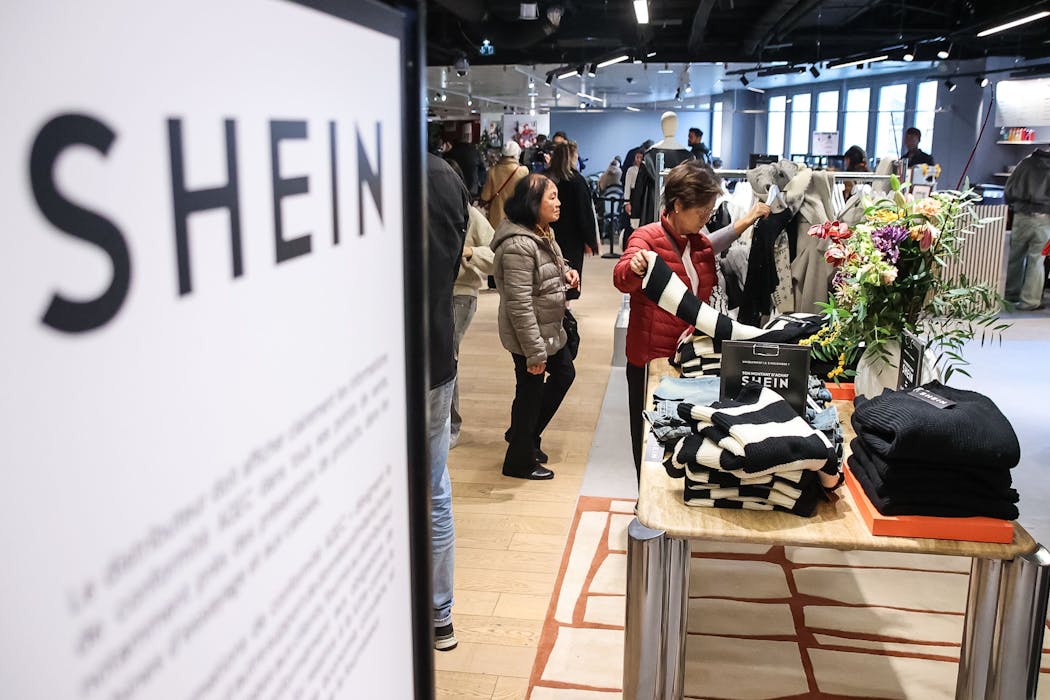
Shoppers were able to browse Shein’s range in person at its first bricks-and-mortar space in Paris. Antonin Albert/Shutterstock

Every December, many shoppers plan to buy fewer things and choose more sustainable options. Yet as the month goes on, spending rises and fast fashion becomes hard to resist. Christmas has become a moment when good intentions collide with discounts and the emotional pull of seasonal fashion.

That contradiction became unusually visible when fashion giant Shein opened its first permanent shop inside the BHV department store in Paris in November. Crowds formed as shoppers tried to get in, while protesters stood outside holding signs and shouting “shame” over concerns about its ESG (environmental, social and governance) track record.

Shein has taken rapid turnaround times and low prices to a new level, taking it beyond fast fashion to “ultra-fast fashion”.

Some other brands with retail space inside the department store announced they planned to withdraw in protest at Shein’s presence. And the opening of new Shein stores across France has been delayed.

There was more controversy. The French government demanded controls, including age verification, on parts of Shein’s online platform amid investigations into banned weapons and childlike sex dolls on its site, placing the company under more scrutiny.

When it was made aware of the products in November, a spokesman for Shein said the company was taking the issue “extremely seriously”. It disabled the part of its site where third-party sellers list their products.

At the same time, shoppers entering the Paris store found higher prices than online, which added another layer to the debate over Shein’s transparency and the wider environmental and labour concerns linked to fast fashion.

What makes Christmas such a powerful moment for fast fashion is not only seasonal marketing but also the psychological dynamics that help consumers assuage their environmental guilt. Fast fashion already accounts for a significant share of online clothing sales in France, and Shein has become one of the largest retailers by volume, despite rising public criticism.

In the UK, sales of fast fashion have reached billions of pounds, with strong annual growth, suggesting that affordability eventually outweighs ethical concerns.

Research into consumer behaviour shows that people often use moral excuses to justify questionable purchases, telling themselves that everyone else is doing the same or that the harm is distant and indirect. This softens the ethical tension long enough to make the purchase.

Beyond guilt reduction, fast fashion benefits from what marketing researchers describe as temporal discounting. This is when consumers focus on short-term enjoyment and price rather than longer-term environmental damage.

Shein’s rapid production model turns digital trends into products within days, producing instant gratification. Future harms such as waste or emissions are psychologically distant at the moment of buying. These mechanisms help explain why fast fashion continues to flourish even as climate concerns grow.

In many ways, the Christmas rush exposes a wider conflict between consumers’ ethical intentions and the realities of global retail. This paradox is not only personal. It also shapes how governments and the public respond to Shein’s growing presence.

The protests outside the Paris store echo the tension across regulatory and societal institutions, where concerns about labour conditions and environmental impact collide with the influence of a company that has become central to contemporary fashion.

Why the Paris protests matter beyond ESG

It may be tempting to see the demonstrations in Paris simply as another reaction to environmental issues. Yet concerns around Shein were already part of the public debate long before the store opened. Fast fashion has relied for decades on outsourcing to cheaper manufacturing centres with limited worker protections.

Even after the Rana Plaza disaster in 2013 when 1,134 people (mainly garment workers), were killed in Bangladesh when their factory building collapsed, many European fast fashion companies continued to face criticism about their environmental violations across global supply chains.

What distinguishes the current controversy are not the ethical problems but the challenge Shein poses to the traditional balance of power in global fashion. For much of the past century, European companies dominated the industry and shaped international tastes.

Now Shein’s algorithmically-driven and hyperresponsive model is disrupting that dominance. This speed fuels waste and environmental damage even as its low prices keep attracting millions of shoppers.

In this sense, for Shein, Paris becomes more than a retail location. Success in one of the world’s fashion capitals would mark an important moment in Shein’s global expansion and signal that it is no longer operating at the margins.

It would also test whether this new type of fashion giant can prove itself beyond its online audience, in the eyes of regulators, partner brands and in-store shoppers.

The pushback Shein faces in Paris points to a broader anxiety about who now holds influence in the fashion industry. A Chinese fast fashion giant has bypassed traditional European gatekeepers and challenged the established hierarchy of who shapes the industry’s future.

In response to a 2024 report criticising working conditions in some of the factories it uses, Shein said in a statement it was “actively working to improve our suppliers’ practices, including ensuring that hours worked are voluntary and that workers are compensated fairly for what they do”. And with regard to criticisms about its environmental impact, Shein has said its use of AI has now cut the amount of waste generated in its production processes.

The Conversation

The authors do not work for, consult, own shares in or receive funding from any company or organisation that would benefit from this article, and have disclosed no relevant affiliations beyond their academic appointment.

ref. Why shoppers buy fast fashion even if they disagree with it – https://theconversation.com/why-shoppers-buy-fast-fashion-even-if-they-disagree-with-it-271452


What the year in polls tells us about Reform’s growth – and Labour and Tory losses

Source: The Conversation – UK – By Paul Whiteley, Professor, Department of Government, University of Essex

In the year and a half since Labour won a landslide in the 2024 general election, over 400 polls have been published. Combined, these polls tell a story of a government and its traditional opposition party losing support and fringe parties gaining ground. The big question this poses is whether Reform can win the next general election.

When these polls are combined into weekly averages since the general election, they show that Labour and Reform have averaged 25% in vote intentions over this period. The Conservatives have averaged 21%, the Liberal Democrats 13% and the Greens 9%.

Vote intentions since the 2024 election:

A chart showing the fluctuations in voting intention polls since the 2024 election.
The post-2024 polling outlook.
P Whiteley, CC BY-ND

The trends show that support for Labour has declined continuously since the election. In the case of the Conservatives, they were ahead of Reform until shortly after Kemi Badenoch was elected as leader. From this point on, Nigel Farage’s Reform party moved well ahead of both Labour and the Conservatives.

It appears that Badenoch’s strategy of trying to outdo Reform in rightwing rhetoric has failed. The Liberal Democrats have remained close to their 13% support throughout. The Greens received a boost when Zack Polanski was elected leader in September 2025. The Greens are now a strong rival to Labour, hoovering up leftwing voters who supported Labour in the general election. This is particularly true if the new leftwing Your Party cannot settle its internal squabbling.

Where does the Reform vote come from?

It is interesting to know where the Reform vote comes from – and especially whether it is taking more votes from Labour or the Conservatives. One way of finding this out is to conduct a panel survey to ask the same people about their voting intentions over time, to see if it changes. Unfortunately, this cannot be done with polling data since it’s too difficult and expensive for pollsters to keep contacting the same people.

An alternative and much easier way of finding out where the vote comes from is to look at the strength of the relationship between trends in Reform voting and voting for the other parties. To do this, we need to look at the changes in support for all five parties. As an example, the correlation between changes in the Reform vote and changes in the Conservative vote over this period is -0.40.

If the correlation were -1.0 that would mean a decrease of Conservative support by 1% would produce an increase in Reform support of 1%. If the correlation was zero it would mean the Conservative vote did not influence the Reform vote at all. It appears that there is a moderately strong negative relationship between Conservative and Reform voting. Put another way, a fall of 10% in Conservative voting translates into an increase in the Reform vote of 4%. A fall of 10% in support for Labour delivers an increase of 3% for Reform.

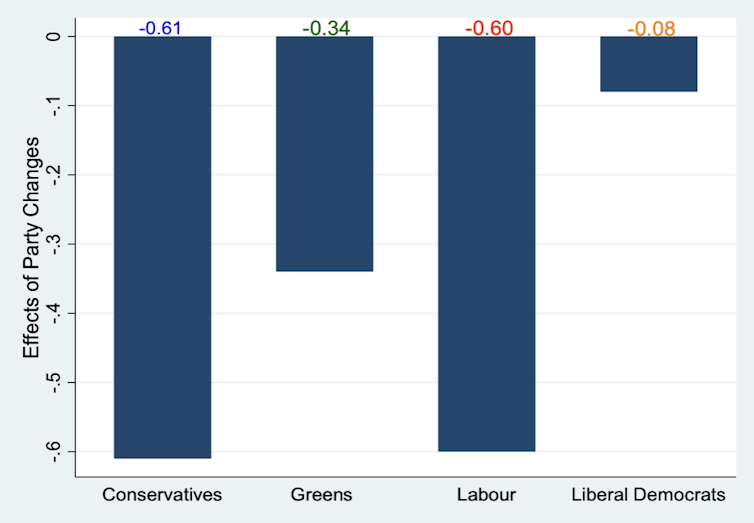
The effects of changes in vote intentions for the national parties on changes in Reform voting since the general election:

A chart showing on how voting intention has changed for four parties since the election.
It’s been downhill all the way since the election for some parties.
P Whiteley, CC BY-ND

However, there is a complication arising in the calculation when looking at each of the other parties and Reform voting separately. This approach fails to account for the relationships between these other parties.

If, for example, Reform does well against the Conservatives, this will help Labour because the Tories are a strong challenger to the Labour party. If Reform weakens support for the Tories, this could rebound to give Labour an advantage over Reform.

We need to look at the interactions between changes in support for all parties at the same time to get a clear picture.

This is done using multiple regression, which is a statistical technique that predicts changes in the Reform vote from changes in all the other party votes at the same time, thereby taking into account interactions between them.

The effects are quite strong, and they are roughly the same for Labour and the Conservatives. A fall of 10% for each of them boosts the Reform vote by 6%. The effect of Liberal Democrat voting on Reform, meanwhile, is negligible, with a coefficient of -0.08.

However, the Green vote does affect Reform, having a coefficient of -0.34. In other words, a fall of 10% in the Reform vote will boost the Green vote by about 3.4%.

The pattern observed in the polls is of Labour’s vote share continuously declining and of the Conservative vote increasing to begin with and then subsequently declining. This situation looks different when you consider their individual relationships to Reform but, in the event, when all the interactions are taken into account, they both end up losing votes to the newer party to the same extent.

This has implications for the May 2026 local elections. The leadership positions of both Keir Starmer and Badenoch are at risk if these contests turn out to be a disaster for their parties.

Unless Reform’s support starts to weaken, both parties could lose the same proportion of votes to Reform. And at the moment the party shows little sign of doing so. That said, there are four years to go at the outside to the next election – and with volatile polls like these, anything can happen.


Want more politics coverage from academic experts? Every week, we bring you informed analysis of developments in government and fact check the claims being made.

Sign up for our weekly politics newsletter, delivered every Friday.

The Conversation

Paul Whiteley has received funding from the British Academy and the ESRC.

ref. What the year in polls tells us about Reform’s growth – and Labour and Tory losses – https://theconversation.com/what-the-year-in-polls-tells-us-about-reforms-growth-and-labour-and-tory-losses-271827

Your next puffer jacket could be made from bulrushes, as carbon-storing peat farming takes off

Source: The Conversation – UK – By Zoe Lipkens, PhD Researcher, University of Leicester

martin.dlugo/Shutterstock

Have you ever wondered what keeps you warm in your winter jacket? Most jacket insulation is made from human made synthetic fibres (polyester) or natural down from ducks or geese. Some winter jackets are insulated with something a little more surprising – bulrushes.

A biomaterials company called Ponda is using the seed heads of bulrush cultivated in peatlands to create BioPuff as insulation for puffer jackets, an alternative to synthetic fibres and goose down. These jackets help to encourage wetter farming on peatlands, a practice known as paludiculture that helps keep carbon locked into the ground.

While paludiculture is a relatively new way of farming in the UK, my research investigates how this emerging farming practice is being implemented in north-west England.

It is crucial that peatlands remain wet or are rewetted to prevent the release of stored carbon. Once drained, peatlands emit a significant amount of carbon – degraded peatlands account for 4% of the UK’s total greenhouse gas emissions. Most (88%) of these emissions come from degraded lowland peatlands, which account for only 16% of the UK’s total peatland land area.

While the complete restoration of lowland peatland habitats is necessary, in many cases landowners and managers may not be willing to fully stop cultivating or grazing on parts of their agricultural peatland. Paludiculture has been proposed by UK policymakers and researchers as an innovative farming practice. In this scenario, peat soils remain wet to reduce peatlands’ carbon emissions. Simultaneously, landowners and managers can theoretically make an income from cultivating paludiculture crops.

The UK Paludiculture Live list consists of 88 native species that could be used for farming via paludiculture. This list is divided into categories including food crops (such as cranberry and celery), growing media (Sphagnum moss), fabrics (bulrush) and construction materials (such as common reed and freshwater bulrush).

Crop trials

Over the past five years there has been a growing network of researchers, landowners, land managers, conservationists, businesses and government advisors innovating and implementing paludiculture trials in north-west England. Celery, lettuce, blueberries, bulrush, and Sphagnum moss are some of first paludiculture crops that have been grown in this region.

One of the trials, delivered in partnership with the Lancashire Wildlife Trust, a tenant farmer, the landowner and Ponda, shows how paludiculture offers an opportunity for both the farming community and the sustainable fashion industry.

This trial was established with the aim to grow bulrush on five hectares (12 acres) of previously drained lowland peat soils.

After raising the water table level to between 30cm below ground level and the peat surface, the bulrush seeds were sown in June 2024 using a drone. More than a year later, the bulrush was successfully harvested in August 2025 using a specialised digger equipped with a reed-cutting bucket.

Bulrush seeds being sown by a drone at one of Lancashire Wildlife Trust’s paludiculture trial sites.

This trial was successful due to collaboration between the organisations and people in the partnership who shared paludiculture knowledge that specifically related to this region and farming practices on lowland peatlands elsewhere in the UK.

Additionally, it is crucial that paludiculture crops are supported by a concrete business case and market route so that landowners and land managers do not have to rely on variable government funding.

Uncharted waters

While paludiculture has progressed in the UK over the past five years, there are still challenges in upscaling this farming practice.

In terms of food crops, supermarkets may not accept paludiculture grown celery or lettuce if they do not match retailer requirements. The entire paludiculture market chain faces barriers from cultivation to commercialism.

These include challenges such as managing water table levels, having robust storage, handling, and processing infrastructure, market regulations and the market visibility of paludiculture products. These hurdles can make it difficult to expand trials up to larger farm and landscape scales.

Because much of the UK’s peatlands are owned by private landowners and often managed by tenant farmers, paludiculture must develop as a financially stable farming practice to ensure there is buy in from everyone involved.

However, transitioning from conventional drainage practices to wetter farming is not just a financial matter. Landowners, farmers and peatland practitioners must acquire new peatland rewetting knowledge and be willing to grow crops on wet soils. The paludiculture trial in the north-west demonstrates how these partnerships can form and help pave the way for more wetter peatland systems.

The next time you pass a wetland area, see if you can spot a bulrush. These boggy plants can help tackle climate change by storing carbon and could even be transformed into your next puffer jacket.


Don’t have time to read about climate change as much as you’d like?

Get a weekly roundup in your inbox instead. Every Wednesday, The Conversation’s environment editor writes Imagine, a short email that goes a little deeper into just one climate issue. Join the 47,000+ readers who’ve subscribed so far.


The Conversation

Zoe Lipkens receives funding from the University of Leicester’s Future 100 doctoral training pathway.

ref. Your next puffer jacket could be made from bulrushes, as carbon-storing peat farming takes off – https://theconversation.com/your-next-puffer-jacket-could-be-made-from-bulrushes-as-carbon-storing-peat-farming-takes-off-269958

Dispatches from a year of global conflict and uncertainty

Source: The Conversation – UK – By Jonathan Este, Senior International Affairs Editor, Associate Editor, The Conversation

This newsletter was first published in The Conversation UK’s World Affairs Briefing email. Sign up to receive weekly analysis of the latest developments in international relations, direct to your inbox.


Volodymyr Zelensky says there will almost certainly be no ceasefire in Ukraine before Christmas. This means the war is more than likely to stretch on into a fifth year to the dismay of everyone – barring, perhaps Vladimir Putin, for whom the war seems to be a means to a number of different ends.

Whatever the Russian president wants to gain immediately – prestige, territory, a pliant government in Kyiv, access to eastern Ukraine’s considerable resources – the war also appears to be fulfilling a number of Putin’s long-term foreign policy aims: it is driving a wedge between the US and Europe and exposing big divisions within Europe itself.

At present it looks as if we’re witnessing another of the diplomatic loops that have characterised much of the year as Donald Trump has tried to make good on his pledge to end the war. The latest deal is still being thrashed out between negotiators from the US, Ukraine and its European allies. But it’s far from clear that whatever the joint talks produce will receive buy-in from the US president, whose position – as we have seen all year – can change overnight depending on whom he talks to.

What’s more clear is that Putin will almost certainly reject the plan outright. How this will play in the White House is anyone’s guess. While the US president has shown that he is susceptible to the Russian leader’s blandishments, he has also displayed a short fuse when he thinks Putin isn’t taking him seriously enough.

Looking back on the year, it’s clear that – in the sphere of international relations – pretty much all roads lead back to Donald Trump. Most of the big international stories we’ve covered have featured the US president as a key player. So it makes sense to begin a review of the past year in international affairs with the return of Trump to the White House.

Donald Trump: a politician of consequence

After Trump was elected for a second term in November 2024, James Cooper of York St John University referred to the president as an “international disruptor”. Cooper predicted that Trump’s unconventional style might yield results via the “madman theory”, which holds that his unpredictability could prove to be an effective foreign policy approach. Quite how effective remains to be seen.


Read more:
History will remember Donald Trump as a highly consequential president


Cooper also predicted that Ukraine and America’s Nato allies might find Trump’s foreign policy outlook a major concern. And so it has proved. The US has halted military aid to Ukraine, leaving Kyiv scrambling to secure reliable support from its European allies which – as we’ve seen, are struggling to secure the funds. And America’s Nato allies in Europe learned last month, when the US released its 2025 national security strategy, that they can no longer rely on the US for security in the way that they have in the eight decades since the end of the second world war.

The strategy makes for sobering reading if you live in Europe, writes Andrew Gawthorpe, a lecturer in history and international studies at Leiden University. The 33-page public document is harshly critical of what it sees as Europe’s weakness, saying the continent risks “civilizational erasure” thanks to migration.

Gawthorpe notes that Russia has welcomed the strategy as “largely consistent” and predicts that America’s allies in Asia and Europe may have to face the prospect that Trump may prefer to align the US in a “grand bargain” with Russia and China.


Read more:
What the US national security strategy tells us about how Trump views the world


Ukraine conflict: no end in sight

Despite nearly ten months elapsing, it’s hard to forget the now-notorious White House meeting at which Trump and his vice-president, J.D. Vance, lambasted Zelensky for not being grateful for the help the US had given Ukraine. All diplomatic niceties abandoned, the Americans rounded on the Ukrainian president, accusing him of “gambling with world war three” and demanding: “You either make a deal or we are out.”

ISW map showing the state of the conflict in Ukraine, December 16.
The state of the conflict in Ukraine, December 16, 2025.
Institute for the Study of War

Stefan Wolff and Tetyana Malyarenko reported at the time that the real issue was Trump’s desire for US firms to exploit Ukraine’s considerable mineral reserves (many of Trump’s peace deals are also business deals, as we noted in a separate article last month).

Wolff, of the University of Birmingham, and Malyarenko, of the University of Odesa, have been contributing to our coverage of the conflict between Russia and Ukraine and its geopolitical implications for more than a decade. For them, the US national security strategy was confirmation of something they have suspected for a while: that Europe will be left struggling to keep Ukraine in the fight as the continent re-arms itself in the face of the very real prospect that Putin doesn’t want to stop at Ukraine.


Read more:
New US national security strategy adds to Ukraine’s woes and exacerbates Europe’s dilemmas


Our coverage of the Ukraine conflict has also been informed by Frank Ledwidge, formerly of UK military intelligence, now an expert in military strategy at the University of Portsmouth. Ledwidge is a regular visitor to Ukraine and in August contributed this vivid piece of reportage from Kharkiv, Ukraine’s “unbreakable” eastern capital.


Read more:
Kharkiv: what I saw in Ukraine’s ‘unbreakable’ eastern capital


The tragedy of Palestine

This was the year that many western countries came off the sidelines and formally declared their recognition of Palestinian statehood. These declarations, by the UK, France, Australia and Canada, were largely symbolic. As things stand the prospect of a two-state solution remains as remote as ever. The (very tenuous) ceasefire in Gaza has not progressed further than a cessation of the wholesale killing of Palestinian civilians in the enclave.

And as Leonie Fleischmann, an expert in the Israeli-Palestinian conflict at City St Georges, University of London, reports, illegal Israeli settlements have multiplied to such an extent that they threaten to cut the West Bank in two, which – as Israel’s far-right finance minister Bezalel Smotrich noted – “buries the idea of a Palestinian state”.


Read more:
Israel’s plan for massive new West Bank settlement would make a Palestinian state impossible


In Gaza meanwhile, and despite the ceasefire, the violence continues – albeit on a smaller scale, at present. Within days of the ceasefire being signed, and notwithstanding a stipulation that Hamas must disarm and disband, the militant Palestinian group was already regrouping.

Tahani Mustafa, formerly a Palestine analyst for the international crisis group and now a lecturer in international relations at King’s College London, used her considerably range of contacts on the ground in Gaza to bring us this report.


Read more:
Hamas turns to executions as it tries to establish a monopoly on force in Gaza


What 2026 may hold for the people of Gaza remains uncertain. There’s been little or no progress on establishing a framework for governance in the enclave and at present Israel’s strategy seems to be to encourage as many Gaza residents as possible to leave via the Rafah crossing into Egypt.

Whether we will see the beginnings of the realisation of the Trump blueprint for the redevelopment of much of Gaza into commercial and tourism property, sometimes called the “Trump riviera”, may become clearer next year.


Read more:
Donald Trump’s vision for Gaza’s future: what a leaked plan tells us about US regional strategy


What is clear, though, is that whatever Israeli and its allies plan to do in Gaza, it will be critical to secure the support and cooperation of the Gulf states, without which any plan for the future of the region will be a non-starter.

Scott Lucas, a Middle East expert at the Clinton Institute, University College Dublin, has been contributing to our coverage of the region for more than a decade. As the Gaza ceasefire was announced in October, he answered our questions and underlined the vital role played by other powers in the Middle East.


Read more:
Israel and Hamas agree ceasefire deal – what we know so far: expert Q&A


Civil war in Sudan

The bitter conflict in Sudan has often been eclipsed this year by the wars in Ukraine and Gaza, and it’s significant that it is not among the wars the US president claims to have solved in his eleven months in power. But the regular reports of wholesale slaughter of civilians, mass rape and other war crimes have been no less terrible for that.

The conflict is often reported as an ethnic clash: Arab militias from the country’s northern provinces fighting against African groups from Sudan’s west and south. But Justin Willis of Durham University and Willow Berridge of Newcastle University – both experts in the history of the Sudan conflict – believe it’s more complicated than that and has much to do with international meddling.


Read more:
Why has Sudan descended into mass slaughter? The answer goes far beyond simple ethnic conflict


But when you strip away the geopolitics, as ever, it is innocent civilians who are left to bear the lion’s share of the suffering, as is clear from this harrowing report based on interviews with refugees flooding south to escape the violence.


Read more:
‘I have to talk about it so that the world can know what happened to women and girls in Sudan’ – rape and terror sparks mass migration


We’re going to take a two week break over the holiday season. The next world affairs update will be on January 8 2026. Many thanks for your support over the year.


Sign up to receive our weekly World Affairs Briefing newsletter from The Conversation UK. Every Thursday we’ll bring you expert analysis of the big stories in international relations.


The Conversation

ref. Dispatches from a year of global conflict and uncertainty – https://theconversation.com/dispatches-from-a-year-of-global-conflict-and-uncertainty-272295

The truth about ‘miracle’ heaters and wood stoves

Source: The Conversation – UK – By Will de Freitas, Environment + Energy Editor, The Conversation

Hodoimg / shutterstock

This roundup of The Conversation’s climate coverage was first published in our award-winning weekly climate action newsletter, Imagine.

Each year, as temperatures drop, the same promises resurface. A tiny heater that can warm your whole home for pennies. A simple hack using candles and flowerpots. A wood-burning stove that’s cosy, clean and cheap.

Some of these fixes are outright scams. Some are just dangerous. Others work, but with hidden costs most don’t know about.

All of them run into the realities of physics, pollution or safety.

Wood-burning stoves are becoming more popular and I can see the appeal. When visiting my in-laws in rural Dorset, I sometimes work from a shepherd’s hut in their garden, which is heated with a wood stove. I like the sense of control and the boom-and-bust cycle of warmth caused by loading firewood every hour or two.

The real fire feels dependable in a way that modern systems sometimes don’t. It feels traditional. And, increasingly, it is presented as environmentally acceptable.

But beneath the romance and the cosiness there is an uncomfortable truth. Domestic burning is now recognised as a leading source of PM2.5, one of the most harmful forms of air pollution.

The UK does regulate wood stove emissions, but under a system designed for another era, says James Heydon of the University of Nottingham.

wood burning stove
Wood burning doesn’t emit 1950s-style smog – but it does pollute the air.
Kev Gregory / shutterstock

“Smoke control areas” were created as a response to lethal smogs in the 1950s, he says, but the system has barely changed since.

“Even perfect enforcement”, he writes, “would not solve the core problem. SCAs were designed to reduce visible smoke, not invisible PM2.5. Modern ‘Defra-approved’ and ‘EcoDesign’ stoves are exempt because they emit less visible smoke.”

But those exempt stoves still emit lots of PM2.5 – more than 300 times that of a gas boiler, says Heydon. “Since 2010, more than 2,500 stove models have been exempted from SCA rules, steadily widening the loophole and gradually weakening the system’s ability to control PM2.5.”

A few months back, my father-in-law replaced the shepherd’s hut stove with an electric heater. My lungs will remain pollution-free this Christmas, but I do miss the stove.

Beware heater scams

My father-in-law appears to have bought an appropriate heater that actually works. Unfortunately, many people are being sold devices that don’t live up to expectations as social media is filled with portable heater scams this winter.

Doomscrolling through a cold snap, you may see bold claims for heaters that can supposedly warm an entire home in minutes while costing pennies to run. It can often feel like true cosiness is only a click away.

These products rely on a powerful idea, that fancy new designs have unlocked a step-change in efficiency. But language, not technology, is doing the heavy lifting.

In reality, says Dylan Ryan of Edinburgh Napier University, almost all electric heaters are already close to 100% efficient. That means all the electricity is turned into heat, not “lost” as light or noise. The more electricity you put into the heater, the more it will warm your home, and vice versa.

This is why engineers like Ryan stress there is no clever design or secret hack that can make one plug-in heater significantly more efficient than another. “When a product claims to heat more while using less electricity”, he writes, “alarm bells should ring.”

Some adverts promise to warm a home in minutes. But the numbers don’t work.

Here’s Ryan again:

Heating a typical home means warming hundreds of cubic metres of air, as well as countering heat losses to the outside. That takes lots of energy. To do it quickly would require tens of kilowatts of power – far more than can be drawn safely from a standard household plug socket.

In practice, the wattage of most portable heaters is deliberately limited to avoid overheated wiring and reduce fire risk. The allowed wattage is enough to warm a small room, says Ryan, but is “nowhere near enough to rapidly heat a whole house”.

When neither tradition nor technology has the answer, people sometimes look elsewhere for answers.

This is where “heating hacks” flourish. Social media is filled with improvised fixes: bricks heated in ovens, tea lights beneath flower pots, makeshift indoor fires.

I get the appeal of feeling like an energy efficient MacGyver, keeping warm on the cheap using unexpected household goods. Unfortunately, these set ups still run into basic physics: they deliver warmth at a far higher cost per unit of energy than electricity or gas.

In a helpful piece on how to keep warm on a budget during very cold weather, Mari Martiskainen of the University of Sussex points out candles and similar heating hacks are also a major fire risk.

Smoky stoves, scam heaters and viral hacks are all responses to the same problems: energy is expensive, homes are leaky, and people are cold. But as Ryan points out, the real solutions are slower and more boring: better insulation, more efficient heating, and reforms to lower the cost of energy itself.


To contact The Conversation’s environment team, please email imagine@theconversation.com. We’d love to hear your feedback, ideas and suggestions and we read every email, thank you.


Don’t have time to read about climate change as much as you’d like?

Get a weekly roundup in your inbox instead. Every Wednesday, The Conversation’s environment editor writes Imagine, a short email that goes a little deeper into just one climate issue. Join the 45,000+ readers who’ve subscribed so far.


The Conversation

ref. The truth about ‘miracle’ heaters and wood stoves – https://theconversation.com/the-truth-about-miracle-heaters-and-wood-stoves-272303

How Venezuela has been preparing for a US invasion for more than two decades

Source: The Conversation – UK – By Gemma Ware, Host, The Conversation Weekly Podcast, The Conversation

In the latest escalation of tensions between the US and Venezuela, on December 17 US President Donald Trump ordered a “complete blockade” of sanctioned oil tankers going into and out of Venezuela. His Venezuelan counterpart, Nicolás Maduro, called the move “warmongering threats”, and accused the US of trying to steal its resources.

Since September, US military operations in the Caribbean have killed at least 95 people in 25 strikes. The Trump administration says it is targeting drug traffickers, but US lawmakers are now investigating some of the strikes amid mounting criticism of their scope and intent.

Meanwhile, Trump has placed a US$50 million bounty on the head of Maduro, and authorised the CIA to conduct covert lethal operations inside Venezuela.

In this episode of The Conversation Weekly podcast, we speak to Pablo Uchoa, a PhD candidate researching Venezuela’s military scenario planning, on how Venezuela has long been preparing for this moment.

He traces that planning back to 2002 and an unsuccessful coup attempt against former Venezuelan leader, Hugo Chávez. Uchoa explains that two important influences on Chavez’s thinking at the time were Vietnam and Iraq:

Obviously the Vietnamese army expelled the Americans just by making it so hard for the Americans to stay in – and the same thing with Iraq, in different ways. The basic idea here is that the fight is not just army against army. This is … people against an army.

Listen to the interview with Pablo Uchoa about the Venezuelan military scenario planning on The Conversation Weekly podcast.

This episode was written and produced by Mend Mariwany and Gemma Ware with production assistance from Katie Flood. Mixing by Michelle Macklem and theme music by Neeta Sarl.

Newsclips in this episode from NBC News, BBC News, Geopolitical Economy Report, Al Jazeera English, AP Archive, the Straits Times, Euronews, CBS News and Reuters.

Listen to The Conversation Weekly via any of the apps listed above, download it directly via our RSS feed or find out how else to listen here. A transcript of this episode is available via the Apple Podcasts or Spotify apps.

The Conversation

Pablo Uchoa has received UKRI funding for his research on the transformation of Venezuala’s military under Hugo Chávez.

ref. How Venezuela has been preparing for a US invasion for more than two decades – https://theconversation.com/how-venezuela-has-been-preparing-for-a-us-invasion-for-more-than-two-decades-272304

Study shows views of British empire shape voting behaviour – but in subtle ways

Source: The Conversation – UK – By Christopher Claassen, Professor of Political Behaviour, University of Glasgow

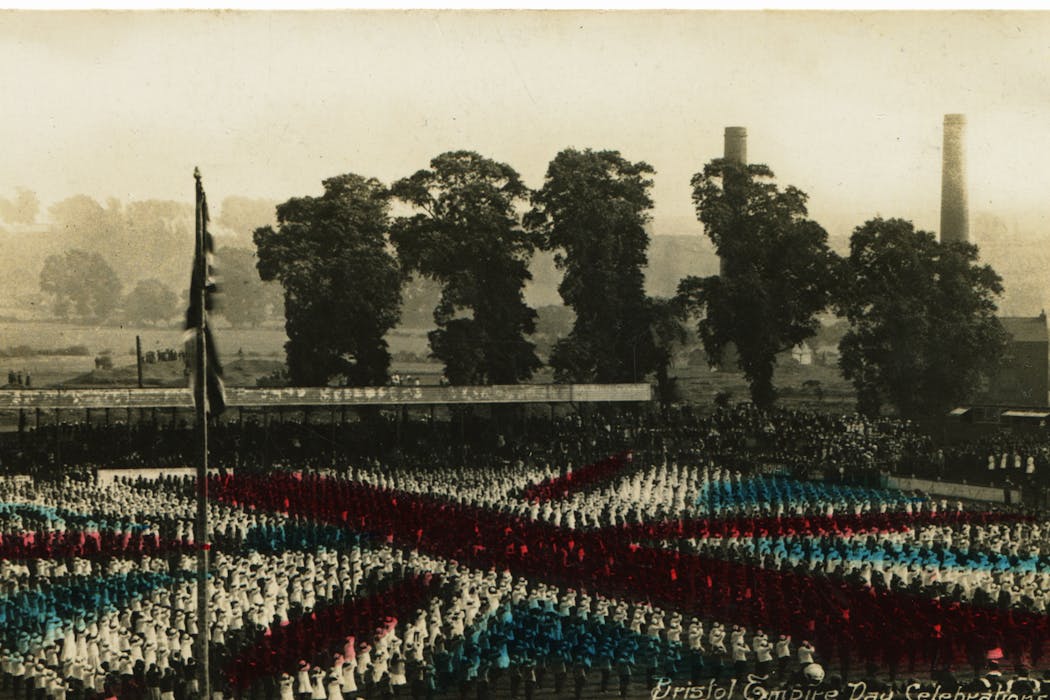
A reproduction of a postcard marking empire day celebrations in Bristol in 1912. Shutterstock/Igor Golovniov

If you wander through Glasgow Green, you’ll encounter the Doulton fountain, a gaudy terracotta tribute to empire that features “native” and colonial figures in national dress holding out the produce of their lands to the imperial centre. Like thousands of imperial monuments across Britain, the Doulton Fountain is neither widely celebrated nor widely denounced. It is part of the everyday backdrop.

That quiet coexistence says a lot about Britain’s relationship with its imperial past. Empire is everywhere – cast in stone, threaded through schoolbook stories and family lore – but rarely front-and-centre in political debate. In a new article in the British Journal of Political Science, Daniel Devine and I set out to answer two questions: what do Britons actually think about the empire, and do those views matter politically?

To answer these questions, we built a measure of imperial nostalgia using survey questions on attitudes to empire. We asked people how much they agreed with statements like “the British Empire had a great civilising effect” and “the British Empire was responsible for many atrocities”.

Across two polls in late 2023 and mid-2024, we found Britain both divided and unsure about its imperial past. Net support swings from −50 points when asked whether the empire was “responsible for many atrocities” (62% agree, 12% disagree) to +21 points on whether it had a “civilising effect” (44% agree, 23% disagree).

Between a quarter and 40% of respondents chose the “neither” or “don’t know” options, showing that there is substantial ambivalence in attitudes. Taken together, opinion about empire tilts slightly negative: more critical than celebratory, but far from a blanket rejection.

A chart showing how people responded to questions about the British empire.
Ambivalence over empire.
C Claassen, CC BY-ND

Demographically, imperial nostalgia rises with age and falls with education. It is higher among men and white British respondents, and notably lower in London and Scotland. In short, it behaves like a form of cultural conservatism. However, we find that it forms its own dimension of opinion, distinct from authoritarianism and nationalism. That distinctiveness matters, because it implies politicians may be tapping something different when they invoke empire, as when Boris Johnson recited The Road to Mandalay on a visit to Myanmar.

How imperial views relate to voting

We found that imperial nostalgia connects quite significantly with partisan politics. Supporters of Labour, the Liberal Democrats and the Greens are, on average, more critical of empire. Conservative and Reform supporters are more nostalgic about it. This is perhaps predictable but the strength of the relationship between views on empire and party preference was a surprise – it was stronger than left–right economic values, for example.

The result survives more demanding tests. Imperial nostalgia remains an important positive predictor for Conservative and Reform support, and a negative predictor of Green support, when we control for respondents’ other political attitudes and identities.

The link remains when we add a separate measure of general nostalgia (“life was better 50 years ago”), demonstrating that imperial nostalgia isn’t just another name for backward-looking mood. In fact, the two nostalgias diverge in their effects. General nostalgia negatively predicts Conservative support but positively predicts Reform support. Imperial nostalgia boosts both the Conservatives and Reform.

However, this is not to say that voters want their politicians to go on about empire. In fact, when we asked respondents to choose between hypothetical parliamentary candidates, they opted for ambivalence in their representatives. When presented with a conservative who thought empire had a “civilising effect”, a progressive who said empire was “responsible for many atrocities” and a third candidate with mixed views incorporating both, the latter was the most popular.

Detailing on the Doulton fountain showing men and women with farm animals.
The Doulton fountain in Glasgow.
Shutterstock/PJ photography

While a conservative position on empire neither helps nor hurts a candidate overall, a progressive stance actually reduces support by about five percentage points. In other words, criticism is the least popular position when it comes to politicians, even though most respondents adopted such a critical view when asked about their own opinions of empire.

The picture sharpens when we examine the results separately by respondents’ ideology and party. Conservative and culturally conservative voters punish the critical “atrocities” stance strongly, while cultural liberals offer little offsetting reward for it.

Studied silence on empire

So for political parties, openly criticising empire is not a winning strategy. It yields only minimal gains on the left while antagonising and mobilising voters on the right.

That asymmetry helps explain the studied quiet we’re currently experiencing. Steering around an issue is considered the best course of action if it divides the public and risks energising opponents more than supporters.

Our study suggests that imperial nostalgia is like a submerged current in British politics. It shapes where parties can safely sail even if they rarely talk about the tide. But we think it’s possible that the current could resurface.

Imperial nostalgia correlates strongly with support beyond the main parties: positively with Reform and negatively with the Greens. With Britain’s party system in unprecedented flux, a challenger could weaponise the issue to split opponents and mobilise a base.

And since younger Britons hold more notably critical views of empire, their entry into the electorate could make debates about the past more electorally decisive and therefore worth campaigning on. Our experiment suggests a sharp backlash from conservatives will ensue, setting the stage for a fresh culture-war divide.

Even without these two factors, it remains the case that backward-looking narratives resonate more strongly in periods of perceived national decline. So if the current stagnation persists, imperial nostalgia could surface from background mood to foreground politics.


Want more politics coverage from academic experts? Every week, we bring you informed analysis of developments in government and fact check the claims being made.

Sign up for our weekly politics newsletter, delivered every Friday.

The Conversation

Christopher Claassen has received funding from the Leverhulme Trust and NORFACE (New Opportunities for Research Funding Agency Cooperation in Europe)

ref. Study shows views of British empire shape voting behaviour – but in subtle ways – https://theconversation.com/study-shows-views-of-british-empire-shape-voting-behaviour-but-in-subtle-ways-272131

How Europe’s new carbon tax on imported goods will change global trade – and our shopping habits

Source: The Conversation – UK – By Simona Sagone, PhD Candidate, Green Finance, Lund University; University of Palermo

Image by pikisuperstar on Freepik, FAL

For people living in the EU, the price of their next car, home renovation and even local produce may soon reflect a climate policy that many have never even heard of. This new regulation, which comes fully into force on New Year’s Day, does not just target heavy industry – it affects everyday goods which now face an added carbon cost when they enter Europe.

The carbon border adjustment mechanism (CBAM) puts a carbon price on many imported goods – meaning that EU-based importers will pay for the greenhouse gases emitted during the production of certain carbon-intensive materials.

If goods come from countries with weaker climate rules, then the charge will be higher. To sell to the EU, producers will effectively need to show their goods aren’t too carbon intensive.

The goal is to prevent companies from relocating their production to places with looser regulations, ensuring fair competition between EU and non-EU companies, while incentivising global decarbonisation.

After a trial phase, full payment obligations begin on January 1 2026, when importers will need to buy CBAM certificates to cover the embedded emissions in goods such as iron and steel, aluminium, cement, fertilisers, hydrogen and (eventually) electricity.

Although it is an EU climate policy, CBAM looks set to be a gamechanger for global trade. Countries that rely on EU exports may need to make costly investments in cleaner technologies and better emissions tracking, or risk losing market share. The UK government plans to introduce its own version of CBAM in 2027 – although how this links to the EU’s is yet to be decided.

graphic of globe, two hands holding ship, money
More and more countries are introducing carbon pricing systems.
Buravleva stock/Shutterstock

A positive shift is already underway: more and more companies are now measuring and reporting their emissions accurately, responding to the growing demand for reliable carbon data. At the same time, an increasing number of countries are introducing their own carbon pricing systems to stay aligned with the EU and protect the competitiveness of their exports.

Morocco is a prominent example: its 2025 finance law gradually introduces a carbon tax from January 2026. As Moroccan firms will already pay a carbon price domestically, their exports are likely to avoid additional CBAM charges at the EU border, helping them remain competitive.


Read more:
Your essential guide to climate finance


In many countries, CBAM is also accelerating interest in renewable energy and greener industrial processes. Some see it not as a threat, but an opportunity to attract investment and position themselves as low-carbon manufacturing hubs.

However, this mechanism is still controversial. For businesses, CBAM is complex and administratively heavy. Firms need robust systems to measure embedded emissions, collect data from suppliers and produce environmental product declarations. Many will also need new renewable energy contracts to cut their carbon footprint.

Around the world, CBAM has faced strong criticism. India and China describe it as “green protectionism”, arguing that it puts unfair pressure on developing economies. At the same time, the EU has not yet created dedicated funding to help exporters in lower-income countries adapt. Without this support, the mechanism may not achieve the desired results.

What about consumers?

Although CBAM is mainly aimed at industry, its ripple effects will reach consumers in the EU. Importers are unlikely to absorb the full additional cost, meaning prices are likely to rise – particularly for goods that rely heavily on steel, aluminium or cement. This could mean Europe sees higher costs for cars, home appliances, electronics, building materials and, indirectly, food production (through fertilisers).

At the same time, CBAM may bring more transparency. Because importers must report the emissions embedded in their goods, consumers may eventually have clearer information about the climate impact of what they buy.

The mechanism will also generate EU revenues from certificate sales. These are expected to support vulnerable households in many European countries, as well as funding clean technologies and improving energy efficiency. How the funds are used will be crucial to public acceptance of Europe’s new carbon tax.

Even before full implementation, CBAM is already reshaping supply chains and influencing government policies far beyond Europe’s borders. It may trigger trade disputes, push exporters to adopt carbon pricing, and highlight the need for more climate finance to support developing countries undergoing green industrial transitions.

For many European consumers, it’s likely to mean gradual price increases – and potentially, more climate-conscious purchasing decisions. Behind the scenes, it marks a significant shift in how global trade accounts for carbon – and how climate policy reaches into people’s everyday lives.


Don’t have time to read about climate change as much as you’d like?

Get a weekly roundup in your inbox instead. Every Wednesday, The Conversation’s environment editor writes Imagine, a short email that goes a little deeper into just one climate issue. Join the 47,000+ readers who’ve subscribed so far.


The Conversation

Simona Sagone does not work for, consult, own shares in or receive funding from any company or organisation that would benefit from this article, and has disclosed no relevant affiliations beyond their academic appointment.

ref. How Europe’s new carbon tax on imported goods will change global trade – and our shopping habits – https://theconversation.com/how-europes-new-carbon-tax-on-imported-goods-will-change-global-trade-and-our-shopping-habits-270496

To feel lonely is to be human: here’s how to handle it at Christmas

Source: The Conversation – UK – By Paul Jones, Associate Dean for Education and Student Experience at Aston Business School, Aston University

Serg Grbanoff/Shutterstock

Christmas is often considered a time of connection, warmth and belonging. That’s the script, anyway. But for many people, the reality feels different; isolating, emotionally weighted and filled with comparisons that sting.

Whether you’re spending Christmas alone, navigating grief, or simply don’t feel “festive,” it can feel like you’ve slipped out of sync with the rest of the world. However, that feeling isn’t the same as being alone. Loneliness, isn’t about the number of people around you. It’s about connection, and the absence of it.

This time of year intensifies emotional experience. Rituals such as decorating a tree or watching a favourite film may bring up memories. These could be of people, or they could be of former versions of ourselves.

We measure time differently in December, a phenomenon psychologists refer to as “temporal anchoring”. The season acts as a golden thread spanning our lives, pulling us back to the past. We often use it to reflect on what we’ve lost, who we’ve become, and what didn’t happen. It can cut deeply.

It is a sharp counterpoint to the cultural messaging: people coming together, the push to be joyful and the idea that gratitude must prevail. It’s not just tinsel that is expected to sparkle. We are, too.

Some people are more vulnerable at this time of year, particularly those in flux or transitioning. A recent breakup, moving house, a medical diagnosis or redundancy can often lead to feeling emotionally unanchored. Others carry complex feelings about family, grief or past trauma, which make forced joy or cheerfulness jarring.

Personality plays a role too. People high in traits such as neuroticism or socially prescribed perfectionism can be more vulnerable to distress and loneliness when life does not live up to their expectations.

Your brain on loneliness

Studies have shown that chronic loneliness can increase stress hormones such as cortisol, impair immune function and even affect cardiovascular health. Social neuroscientist John Cacioppo described loneliness as “a biological warning system” that our need for connection isn’t being met.

Loneliness, though, is a normal human response. It is a reaction to a mismatch between our desired social experience and our reality. Self-discrepancy theory helps explain why this mismatch causes emotional pain. When there’s a gap between who we are and who we feel we should be, whether it is socially, emotionally or even seasonally, discomfort follows. Christmas, with all its trimmings, amplifies that gap.

Close up of person sitting on floor with mug of tea surrounded by Christmas-y things.
Do Christmas your own way.
Bogdan Sonjachnyj/Shutterstock

Solitude isn’t the enemy

That said, being alone at Christmas doesn’t automatically mean something’s wrong.
In fact, it might be exactly what you need.

For many, this time can be a rare opportunity for space, stillness and healing. It
might be the only time of year when you get the space to hear your own thoughts, reflect or reset. Choosing solitude purposefully can be deeply restorative.

Connecting with yourself can be just as important as connecting with others.
Research into self-determination theory also highlights autonomy, competence and relatedness as core psychological needs.

Autonomy, in particular, means honouring your own choices, not other people’s expectations. For example, choosing to spend the day quietly reading, cooking for yourself, or creating a personal ritual supports both autonomy and competence. These acts reinforce your ability to care for yourself and reduce the pressure to seek validation from others.

Philosophers such as 19th-century Danish thinker Søren Kierkegaard and ancient stoic Epictetus emphasised the importance of tuning into your own inner life rather than being governed by external forces. They remind us that authenticity doesn’t come from performing joy for others, but from noticing what we need and choosing to honour it.

The key is alignment. Do what nourishes you, not what performs well on
Instagram, and let the societal pressures wash over you rather than be driven by
them.

So what can help?

Trying to “fix” loneliness with a to-do list isn’t the answer. It’s about tuning into what you need. These approaches are rooted in psychological and philosophical insight. They are not quick fixes.

1. Let yourself feel it

Loneliness hurts. It’s okay to name it. Pushing it away rarely works. Accepting and sitting with it can be the first step toward softening its grip.

2. Create micro-rituals

Small routines bring meaning and structure. Brew a
particular tea. Rewatch a film that resonates. Light a candle for someone you miss. Rituals connect you to something larger but also connect you to yourself.

3. Reframe connection

Closeness doesn’t have to mean crowds. It might mean sending a message, joining a quiet online space or simply being present with yourself. Journaling, voice notes or reflective walks can all be forms of inward connection.

4. Celebrate your uniqueness

You are not a statistic. You don’t need to aim for the “average” mental health baseline. Your emotional life is yours alone. A little variation, a little eccentricity, these are signs of being alive.

5. Find what works for you

There’s no one right way to do Christmas. Whether it’s a solo walk, a day in pyjamas, or calling one person you trust, the point is to honour your individuality.

If you’re feeling out of step this Christmas, that doesn’t make you broken. It makes you aware. You’re noticing what’s missing; you are listening. That’s not weakness, it’s one of the greatest sources of wisdom.

In The Book of Disquiet, Portuguese poet and philosopher Fernando Pessoa wrote: “To feel today what one felt yesterday isn’t to feel – it’s to remember today what was felt yesterday, to be today’s living corpse of what yesterday was lived and lost.”

It’s a stark image, but a truthful one. At Christmas, we often try to summon old
feelings, those of joy, warmth, and belonging, as if they can be reactivated on
command. But what if we didn’t force it? Christmas doesn’t have to be remembered joy. It can be present truth.

Loneliness isn’t something to be solved or suppressed. It’s a companion on the
journey inward.

And sometimes, the most meaningful connection we can make is with ourselves.

This article features references to books that have been included for editorial reasons, and may contain links to bookshop.org. If you click on one of the links and go on to buy something from bookshop.org The Conversation UK may earn a commission.

The Conversation

Paul Jones does not work for, consult, own shares in or receive funding from any company or organisation that would benefit from this article, and has disclosed no relevant affiliations beyond their academic appointment.

ref. To feel lonely is to be human: here’s how to handle it at Christmas – https://theconversation.com/to-feel-lonely-is-to-be-human-heres-how-to-handle-it-at-christmas-271652