Positive psychology experts don’t follow their own advice. What they actually do may be the key to wellbeing

Source: The Conversation – UK – By Jolanta Burke, Associate Professor, Centre for Positive Health Sciences, RCSI University of Medicine and Health Sciences

None of the experts actively “chased” happiness or positivity – they accepted the good and the bad in their lives. OlgaBudrina/ Shutterstock

Positive psychology forms the backbone of wellbeing programmes around the world. Many people aiming to improve their mental health and live a good life are told to follow a programme of activities that focus on making an intentional effort to improve their wellbeing.

But recent research I conducted with colleagues shows that while wellbeing experts often recommend these activities to others, in real life they rarely practice them themselves. This discrepancy may tell us something important about what truly sustains wellbeing over time.

I interviewed 22 experts and practitioners in positive psychology – some with more than a decade of experience. All of them regularly recommended wellbeing activities to clients, friends and family members and told me they would tailor each activity according to an individual’s needs.

But when I asked them about their own application of positive psychology practices, it became apparent that they didn’t engage in these activities regularly. They only tended to use them during difficult periods, when they felt a need for a wellbeing boost.

Positive psychology programmes often recommend patients activities like “gratitude journaling” (writing down the things one is grateful for) daily, or undertaking three acts of kindness each week. The key emphasis with these programmes is to make an intentional, concerted effort to be more positive.

But our study showed that experts don’t use wellbeing the way many positive psychology programmes teach it. Instead of following a schedule of activities, their wellbeing came from having a flexible, wellbeing-oriented mindset, which we termed a “meliotropic wellbeing mindset”.

The term is derived from the Latin “melior” (better) and Greek “tropism” (movement towards). It’s about moving toward what makes life worth living. This way of thinking meant that experts didn’t treat wellbeing as a set of tasks they needed to complete – but rather merely as part of everyday life.

It also meant that none of the experts actively “chased” happiness or positivity. When they had a bad day, they just let it be – accepting that life sometimes comes with difficulty.

Our participants did not make the kind of drastic, intentional changes in their lives that they’d recommend patients make to improve wellbeing. They already regularly did things in their day to day that made their lives feel more meaningful – for example making time to read a book daily, volunteering for a local charity, cooking a favourite meal or even practising yoga.

While these kinds of activities may be recommended as part of a positive psychology programme, the difference here is that the experts did these activities because they were part of their identity or because it helped them feel balanced, instead of only doing them because they’d been advised to.

They were also in tune with their bodies, caring for them as attentively as they cared for their minds by prioritising sleep, nourishing food and regular movement.

And because they were highly attuned to how their physical and social environment affected them, they weren’t afraid to take proactive steps to protect their wellbeing. For instance, if their work made them unhappy, or if someone in their social circle was consistently draining, they didn’t hesitate to seek alternatives or to limit contact.

A bald, middle-aged man with a white beard reads from an orange book.
The experts focused on making small changes everyday to look after their wellbeing and make life feel more meaningful.
StockImageFactory.com/ Shutterstock

In addition, they were open to opportunities that allowed them to embrace life. One participant described waiting outside the school to pick up her child. The weather was so beautiful that she slipped off her shoes and walked barefoot across a patch of grass – a simple act that boosted her mood.


Read more:
Finding joy in the little things really can benefit your wellbeing – a scientist explains


Another one had a really bad day but when she finally got into bed that night, she was struck by a feeling of gratitude for the warmth and safety of her home, compared to all the people who have been displaced by war.

Their understanding of positive psychology helped them notice these regular opportunities to boost wellbeing.

Mindset change

Every year, new wellbeing apps appear, schools incorporate wellbeing into their curricula and organisations invest heavily in workplace wellbeing programmes. Yet the impact of these initiatives remains modest. And, some reports suggest that wellbeing programmes may even have a negative effect.

Our study’s findings may help explain why the impact of these programmes is so varied – and shows these positive activities may not be as effective for people who have applied wellbeing practices extensively in their lives.

The study also highlights an urgent need for positive psychology researchers and experts to rethink their priorities. Rather than creating ever-longer wellbeing programmes or promoting the pursuit of happiness, which evidence shows is not necessarily beneficial, we should focus on understanding the longer-term impact of wellbeing practices.

For anyone trying to improve their wellbeing, our findings are an important reminder that you don’t have to constantly “work on yourself” or pursue happiness. Experts in wellbeing rarely rely on dramatic life changes or wellbeing programmes.

Instead, they quietly cultivate a mindset that helps orient themselves toward what really matters. It’s not about chasing happiness or forcing ourselves to think positively on a bad day. It’s about gently moving toward the things that make life feel more worthwhile, in ways that fit who you are. That shift in mindset is something that all of us can adopt.

The Conversation

Jolanta Burke does not work for, consult, own shares in or receive funding from any company or organisation that would benefit from this article, and has disclosed no relevant affiliations beyond their academic appointment.

ref. Positive psychology experts don’t follow their own advice. What they actually do may be the key to wellbeing – https://theconversation.com/positive-psychology-experts-dont-follow-their-own-advice-what-they-actually-do-may-be-the-key-to-wellbeing-266737

Celebrating 150 years of Liberty’s DNA – fusing design, nature and art

Source: The Conversation – UK – By Tamsin McLaren, Senior Lecturer in Marketing, University of Bath

The world-famous Liberty department store in London celebrated its 150th anniversary this year. Describing itself as “an extraordinary laboratory of creativity, generating inventions, innovations, and original expressions of form and thought”, 2025 has seen a year-long programme of exhibitions, installations and special collections.

An exhibition entitled I am. We are. Liberty., located in the east gallery on the fourth floor of the London store, was a rare view into the Liberty archive. Showcasing 330 different print designs from the late 1800s right up until the Liberty Retold fabric collection for Spring/Summer 25.

The exhibition was curated by Ester Coen and co-curated by Silvia Spagnol, with all the designs originating from the company archives. Designed as a travelling exhibition, I am. We are. Liberty. was transported to the UK pavilion at the World Expo in Osaka, Japan,, in August, in honour of the brand’s early influences.

At the same time, a giant installation, an enormous patchwork house by The Patchwork Collective represented the brand’s living history via a community project that invited artisans, makers and designers from around the world to help create a collaborative artwork.

This physical manifestation of craft and creativity was made from more than 1,000 patchwork squares and occupied the store’s central atrium. Contributors could trace their own patch via a map which details the exact location of all 1,000 patches, paying tribute to its customers and collaborators as co-creators of the Liberty brand.

Extravagant, exotic, unusual

Founded by Arthur Liberty in 1875, the original store on Regent Street established itself as a destination at the forefront of the aesthetic movement, specialising in imported goods and fabrics. Within the same year as opening, the founder printed the first Liberty fabrics.

This late-19th century movement championed pure beauty and “art for art’s sake” (an expression coined by the 19th-century French philosopher Victor Cousin), pushing back against the moralistic materialism of Victorian England, after the Great Exhibition of 1851. With connections to influential artists and designers such as Dante Gabriel Rossetti and James Whistler, the ideals of aestheticism were commercialised by Liberty.

Liberty introduced its customers to a vast array of extravagant objects and textiles imported from the Middle East and Japan, recognising the appetite for unusual and exotic textile prints registered “Art Fabrics” as a trademark. In 1887 the iconic Liberty design Hera was created, featuring stylised peacock feathers, and by the 1890s Liberty Fabrics was a byword for the very best in avant-garde textile design.

Archiving has been part of the Liberty design practice since the 1880s. Today the archive, which is not open to the public, is home to original print designs, pattern books, paintings, drawings and artefacts. It’s an ever-growing resource. Archivist Anna Buruma has said that “Liberty has always used their archive, so prints kept being reworked – making the counting game very difficult”.

Other British heritage brands which also make good use of their archives include Clarks Shoes (The Alfred Gillett Trust), Marks and Spencer and John Lewis & Partners. These rich resources provide inspiration for designers and celebrate the role these well-loved brands have played in customers’ lives across centuries. And when they open to the public they can become important experiential and cultural destinations, such at the Shoemakers Museum, which opened in September in Somerset.

The reason for the enduring appeal of Liberty prints is their “DNA”, which the company has described as “Design, Nature and Art”. The exhibition curators invite us to consider how this continuous cycle of self-renewal works:

Liberty continually regenerates itself, remaining true to its DNA through a cyclical journey that returns to its origins and archetypes. This process allows itself to stay relevant weaving past, present and future into a single living thread in perpetual motion.

Liberty has always represented the zeitgeist, the general intellectual, moral and cultural climate of an era. Its prints worn by the Beatles, Twiggy and David Bowie. It was a fabric supplier to fashion brands Yves Saint Laurent and Cacharel. More recently, Liberty has collaborated with Hermes, Gucci, Acne Studios and Uniqlo, positioning the brand at the forefront of craft and culture.

The choice of the founder to call the store his own name was symbolic. Department stores were new businesses at the time which provided alternative means of employment for women, enabling a newfound freedom. They were the innovative emporiums mirroring societal change where women were powerful actors and agents of change as consumers, designers, workers, managers and eventually owners.

This year’s programme of events at Liberty has leveraged storytelling and sensory marketing to create immersive experiences in retail. These interactive and shareable environments help increase customer dwell times and enhance advocacy of the brand.

This rich crossover point, where retail and leisure merge, offering sensory experiences that go beyond transactions, fostering community, culture and meaning.


Looking for something good? Cut through the noise with a carefully curated selection of the latest releases, live events and exhibitions, straight to your inbox every fortnight, on Fridays. Sign up here.


The Conversation

Tamsin McLaren does not work for, consult, own shares in or receive funding from any company or organisation that would benefit from this article, and has disclosed no relevant affiliations beyond their academic appointment.

ref. Celebrating 150 years of Liberty’s DNA – fusing design, nature and art – https://theconversation.com/celebrating-150-years-of-libertys-dna-fusing-design-nature-and-art-271002

Did Charles Dickens see A Christmas Carol as an anti-slavery story?

Source: The Conversation – UK – By Lucy Whitehead, Leverhulme Early Career Research Fellow, Royal Holloway, University of London

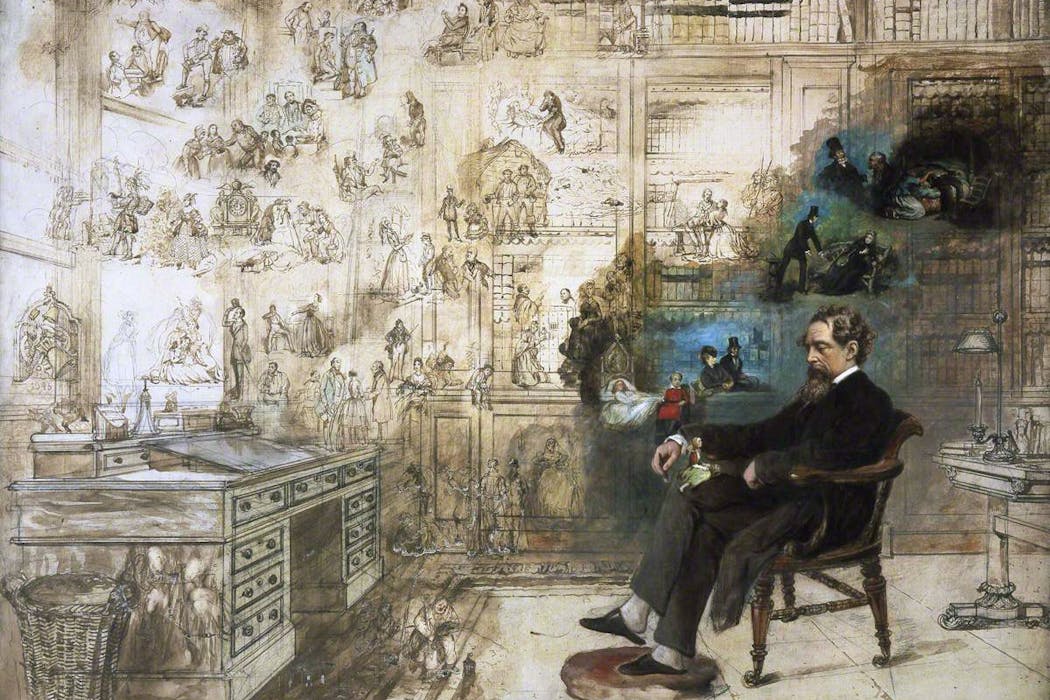
Dickens’s Dream by Robert William Buss (1875). Charles Dickens Museum

A Christmas Carol is usually read as a Victorian morality tale about capitalism and compassion. Yet an autographed script written by Charles Dickens during the American Civil War raises the possibility he may also have understood the story as speaking to the cause of ending slavery in the US.

First published in the UK on December 19 1843, the novella is famous for its advocacy of a reformed relationship between the Victorian capitalist Scrooge and the workers whose labour he profits from, epitomised by his downtrodden clerk, Bob Cratchit. The story has inspired countless adaptations in theatre, television and film.

However, a slip of blue paper held in Harvard’s Houghton Library shows how Dickens may have also seen the story through the lens of American slavery. As my current research in the library’s collections shows, on March 7 1864, Dickens wrote out and autographed A Christmas Carol’s most famous line so that it could be sold in aid of the anti-slavery side in the ongoing American civil war (1861–65).

The closing sentence – “And so, as Tiny Tim observed, God Bless Us, Every One!” – is usually associated with Victorian families united in the Christmas snow. However, Dickens’ contribution to a set of celebrity autographs being collected for sale at the 1864 New York Metropolitan Fair enlisted his novella in the cause of supporting the Union army’s goal of ending slavery in the US.

The New York fair was one of several events held across the Union states to raise funds for the US Sanitary Commission, a philanthropic organisation which promoted the health, welfare and convalescence of Union soldiers. We don’t know how much the autograph collection to which Dickens contributed ultimately sold for. But records show the collection, gathered by the wife of the US ambassador to Britain, Abigail Brooks Adams, was valued at US$1,000 – approximately US$20,000 (£14,500) in today’s money.

Dickens had been an international celebrity since the 1830s, and was well accustomed to requests for autographs. In 19th-century terms, this often meant a copied-out passage from one of his novels as well as a signature.

What survives of these autographs, written for fans in Britain and America, suggests that the passage he typically used was the death of Little Nell in The Old Curiosity Shop (1841). His unusual choice of the final line from A Christmas Carol therefore seems deliberate for this specific context.

In my ongoing research, I theorise this choice may have been designed to remind people that the message of A Christmas Carol also applied to enslaved black people in the US and show his support for them.

While there are no direct references to slavery in A Christmas Carol, there are good reasons to think it was on Dickens’s mind at the time he was writing the novella.

The two works he was publishing immediately before it – the travel book American Notes (1842) and serialised novel Martin Chuzzlewit (1843–44) – both make vivid reference to the inhumanities of slavery. They had been inspired by the five-month tour that Dickens made of the US in 1842.

There is a long cultural history of ghosts in chains like the ones that weigh down Scrooge’s partner, Jacob Marley, in A Christmas Carol. But at the time Dickens was writing it, he also had a more immediate reference point for the image of people burdened by irons.

In American Notes’s chapter on slavery, he quotes from multiple American newspaper descriptions of escaped enslaved people loaded with iron rings, chains and weights – including a 12-year-old boy with a “chain dog-collar around his neck”.

In A Christmas Carol, Marley attributes his chain, made of “cash-boxes … ledgers … and heavy purses”, to his heartless pursuit of business profit in life. Marley warns Scrooge that he too is a “captive, bound and double-ironed”, suggesting that exploitation for money will ultimately fetter the exploiter as well as the exploited.

Two recent adaptations of A Christmas Carol have suggested that Scrooge and Marley’s business is at least partly built on the trade in enslaved people. Jon Clinch’s 2019 novel Marley makes the link direct, while Steven Knight’s television series of the same year implies it.

For example, Stephen Graham’s Marley tells Guy Pearce’s Scrooge: “Look at these chains Ebenezer … Each link is a man or woman or child who died in our workshops”, mentioning locations not only in “London, Birmingham, Manchester”, but also “Batavia … Mauritius, the Bay of Honduras”. Slavery was present in the last three locations until at least the 1830s.

While Dickens opposed slavery, he was far from immune to racism. Notoriously, his support for the brutal British colonial response to an uprising of Jamaican plantation workers in 1865 contrasted with his career-long advocacy against the deprivations of the British working classes.

In Zadie Smith’s historical novel The Fraud (2023), the character of Dickens suggests that Brits should be turning their attention from the compensation given by the British government to slave owners in the British Empire to problems closer to home. Such a portrayal is supported by Dickens’s mockery of Mrs Jellyby in Bleak House (1853) for her “telescopic philanthropy”, which centres on Africans in the fictional “Borrioboola-Gha” rather than the people in her immediate vicinity.

If Dickens did intend to use the final line of A Christmas Carol to support the anti-slavery cause in the American Civil War, this would allow us to rethink how he may have seen the relationship between exploitation and inhumanity at home and abroad. It suggests that, in at least some circumstances, he was able to see these causes in connection rather than competition.


Looking for something good? Cut through the noise with a carefully curated selection of the latest releases, live events and exhibitions, straight to your inbox every fortnight, on Fridays. Sign up here.


This article features references to books that have been included for editorial reasons, and may contain links to bookshop.org. If you click on one of the links and go on to buy something from bookshop.org The Conversation UK may earn a commission.

The Conversation

Lucy Whitehead does not work for, consult, own shares in or receive funding from any company or organisation that would benefit from this article, and has disclosed no relevant affiliations beyond their academic appointment.

ref. Did Charles Dickens see A Christmas Carol as an anti-slavery story? – https://theconversation.com/did-charles-dickens-see-a-christmas-carol-as-an-anti-slavery-story-272292

English classes are being targeted by anti-immigration protesters – but they’ve been politicised for years

Source: The Conversation – UK – By Katy Highet, Lecturer in English Language & TESOL, University of the West of Scotland

New Africa/Shutterstock

Just as the protests outside asylum hotels of summer 2025 faded from headlines, some anti-immigration groups turned their attention to another target: English classes.

On November 24, a protest was organised outside a primary school in Glasgow, in opposition to an Esol (English for speakers of other languages) class being delivered for parents of children at the school. Holding placards reading “protect our kids”, protesters claimed that these classes presented a danger to children at the school.

The protest was widely publicised by Spartan Child Protection Team, a self-styled vigilante “paedophile hunter” group. Just three weeks earlier, the group circulated complaints online regarding an Esol class taking place in a community learning centre next to a primary school in Renfrew. In response, Renfrewshire Council shut down the classes.

Other anti-immigration groups across Scotland have followed suit, raising “safeguarding concerns” around Esol classes – specifically, the presence of migrant adults in proximity to schools.

Glasgow City Council took a strong stance in response to “social media speculation around family learning opportunities” and the protest at Dalmarnock primary school. They defended the importance of the classes for the school community, refused to tolerate “racism or bigotry of any kind” and labelled the campaign as “misguided and toxic”

“We will also not tolerate strangers and vigilante groups coming into our schools claiming to keep children safe when they have a clear hidden agenda to incite fear and alarm by spreading misinformation and inciting violence which is bigotry fuelled and inflamed,” a council spokesperson said in a statement to the media.

Also this month, the Reform mayor of Greater Lincolnshire, Andrea Jenkyns, received legal approval for her plans to withdraw Esol funding. She has said she wants to redirect the budget for such language courses to “Lincolnshire people”.

These examples are part of a pattern over the last 15 years of Esol education becoming politicised as part of the wider discussion on migration.

Politicising language education

Under David Cameron’s Conservative government, increasing emphasis was placed on English language acquisition as an indicator of “integration”. At the same time, however, funding for Esol was slashed, with cuts of up to 32% from 2009-11.

Additionally, Cameron’s policies were widely criticised by politicians and Muslim community groups. Critics argued that the policies stigmatised Muslim women as susceptible to radicalisation, by suggesting that the English language classes could be used to fight extremism.

Echoes of the Cameron-era policies are evident under the current government. Labour’s May 2025 white paper on restoring control over the immigration system emphasises English language skills for integration. It lays out a series of proposals to increase English language requirements for visa holders and permanent residency.

Researchers and teachers in the field of language and migration have argued that such policies take a one-sided approach to integration. The responsibility of acquiring high level English proficiency is placed wholly onto migrants, without any meaningful plans to provide the resources needed to meet the huge demand for Esol.

With decades of cuts, waiting lists for Esol have skyrocketed for public-sector funded college courses across the country. Community organisations, faith groups and migrant support charities have attempted to pick up the slack through casual, often volunteer-led English classes.

Community centres and schools are popular sites for both formal and informal Esol classes, providing easily accessible classes for migrant parents and helping them to connect with the local community.

A struggling sector

As a sector that has been severely underfunded for years, Esol is already struggling. Esol teachers have been battling against the effects of funding cuts – overwork, burnout – for over a decade.

The instructors I have interviewed in my ongoing research are concerned that attempts to further reduce Esol provision will have damaging consequences for migrants. For newcomers, Esol is a source of community, a means to access vital support and a tool to find stable, decent work.

They were also increasingly worried about the impact of the current political climate on the sector and – more importantly – on their students. With Esol taking a progressively more central place within polarised and hostile immigration debates, many felt a duty to defend Esol, and to defend migrants, refugees and asylum seekers.

For some, this meant taking inspiration from the successes of the Glasgow Campaign to Welcome Refugees from the early 2000s, when Glasgow became the first dispersal city for refugees in Scotland, in a government scheme that saw thousands of asylum seekers relocated to cities outside of London.

The campaign – led by political activists, many of whom were Esol teachers themselves – fought to unite the local community at a time of rising tensions, and to campaign for better services and resources for all.

In response to the recent attacks on Esol, some are organising to protect Esol provision and to refuse attempts by anti-immigration groups to divide communities. With initiatives such as Educators for All, Esol teachers are taking a stand to reject “racist campaigns that have targeted schools across Scotland”.

The Conversation

Katy Highet receives funding from the Carnegie Trust. She is affiliated with Stand up to Racism Sotland as a member of the steering committee.

ref. English classes are being targeted by anti-immigration protesters – but they’ve been politicised for years – https://theconversation.com/english-classes-are-being-targeted-by-anti-immigration-protesters-but-theyve-been-politicised-for-years-270872

Our Jane Austen year – a free ebook, loads of expert insights and a six-part podcast

Source: The Conversation – UK – By Naomi Joseph, Arts + Culture Editor, The Conversation

For the arts team at The Conversation, 2025 will largely be remembered as the year of Jane Austen. Since January, we have been tirelessly working towards December 16, which marked 250 years since her birth. To celebrate, we explored the world of Austen in a series of articles plus a six-part podcast – to determine the best of her work and get to know the elusive writer behind them.

The scholarship on Austen is incredibly diverse. We have published fascinating pieces from experts all over the country – some exploring specific themes in her books such as walking as an act of female resistance, and respite as an ingredient for romance. Others delved into the history of her time and how it’s represented in her work – exploring, for example, Regency balls and contemporary diversity.

We have chosen ten of our favourite articles and collated them into a free ebook, which you can download here.


This article is part of a series commemorating the 250th anniversary of Jane Austen’s birth. Despite having published only six books, she is one of the best-known authors in history. These articles explore the legacy and life of this incredible writer.


Fans of Jane Austen have very strong feelings regarding her work, and we also wanted to find out what our readers love most about her literary worlds. In that spirit, arts and culture editor Anna Walker launched the Jane Austen Fight Club: a series of articles where academics made the case for their favourite novel, heroine and leading man. Each includes the opportunity for you to have your say.

Let us know which of her books you think is best by answering the poll below.

The cherry on the top of the Austen sundae is our podcast, Jane Austen’s Paper Trail. Over six episodes – one for each of her major novels – we take you on a journey through the writer’s life and times with the help of some of the UK’s top Austen experts.

Along the way, we enjoy some buns in a scandal-filled tearoom in Bath to ask whether Austen was a gossip; we attend a glittering Regency ball to find out whether she was a romantic; and we call on her house in Hampshire to find out what she thought about being a writer. We also dive into the pages of each book to see what more we can glean with the help of our Austen specialists.

There will be a final bonus episode in January 2026, in which we will answer listeners’ questions with a panel of experts. So please tell us what you’d most like to know about Austen and her work, either by emailing podcast@theconversation.com or in the comments below.

I have to confess something. Before this year, if you had asked me if I liked Jane Austen, I would have said no. I enjoyed the humour in the few books I had read and appreciated the skill of her writing, but found the formulaic narrative arcs frustrating. They ended too neatly, in my opinion.

Having got to know her intimately this year, you’ll be glad to hear my opinion has changed. I now have a deep and sincere reverence for her books – particularly Northanger Abbey, which is such a funny and incisive takedown of snobby readers. While I am ready to move on to 2026, I must admit I feel a little sad to be leaving Miss Austen behind.


Looking for something good? Cut through the noise with a carefully curated selection of the latest releases, live events and exhibitions, straight to your inbox every fortnight, on Fridays. Sign up here.


The Conversation

ref. Our Jane Austen year – a free ebook, loads of expert insights and a six-part podcast – https://theconversation.com/our-jane-austen-year-a-free-ebook-loads-of-expert-insights-and-a-six-part-podcast-272464

Violence against women and girls: four key takeaways from a strategy that aims to change society

Source: The Conversation – UK – By Sophie King-Hill, Associate Professor at the Health Services Management Centre, University of Birmingham

As the UK government launches its violence against women and girls strategy, the situation it is seeking to remedy makes for hard reading.

One in eight women in England and Wales experienced sexual assault, domestic abuse or stalking between March 2024 and March 2025. Between June 2024 and June 2025, almost 200 rapes were recorded daily. More than 150 women are killed each year.

The picture is similar for young people too: 39% of teens aged 13 to 17 experience emotional or physical abuse in a relationship.

The strategy emphasises prevention and early intervention – stopping violence before it occurs, or before it worsens. It centres support for victims and accountability perpetrators.

The strategy is built off the back of a number of interventions that have already taken place. These include making sexually explicit deepfakes a criminal offense, laws on cyberflashing and the introduction of interventions of “honour” abuse.

The goal is to halve violence against women and girls in a decade. It’s an ambitious target that requires action in multiple different areas. Below are four key points from the strategy and consideration as to why they’ve been included.

1. A major societal shift for men and boys

Significantly, the strategy envisages a whole-society approach to this problem. That means that it recognises male violence as a public health crisis rooted in patriarchal norms and hegemonic masculinity.

Addressing this requires early socialisation of boys, safe spaces for them to explore difficult issues and identity development and emotional literacy, which will shift the focus from blame to prevention and cultural change.

Attached to the strategy is an explanatory note that discusses men and boys as victims of violence and explores how this violence not only causes harm but also influences future behaviours and experiences.

One thing that isn’t explicitly mentioned is the importance of safeguarding language when abuses and violence is experienced by boys. Ensuring terminology is inclusive, legally accurate and reflects all children and young people, not just girls, is important in this context.

An important part of the strategy is the idea that reducing violence against women and girls requires a fundamental shift in how society engages men and boys. It argues that focusing solely on survivors and those who cause harm is insufficient because the roots of this issue lie in deeply embedded gender norms that sustain patterns of inequality.

To dismantle these norms, men and boys must be seen not as potential risk factors but as key stakeholders in change. The note calls for education that equips boys and men to challenge inequitable attitudes and behaviours, fostering empathy, respect and healthy relationships.

2. Starting early to prevent problem behaviour

As part of a goal to disrupt harmful behaviour before it begins, schools will get help to deliver education on misogyny and consent education. There are also plans to work with parents and carers which include a 2026 public campaign to help them reinforce respectful relationships at home.

An online parent hub will offer guidance on media literacy and online safety and a new digital service under the best start in life strategy to provide trusted advice and connect families to local support. There will also be campaigns and awareness raising activities to generate a national public conversation around violence against women and girls.

Running parallel to this is a focus on supporting young men and boys in understanding these issues and giving them support when concerns are raised. This aspect of the strategy links strongly with the new guidance given to schools on relationships, sex and health that is due to become statutory in 2026.

3. A ‘relentless pursuit of perpetrators’

A key term in the strategy is the “relentless pursuit of perpetrators”. To ensure that justice for victims is swift and robust, domestic abuse specialists will be embedded into emergency services response teams and specialist rape and sexual offence teams will be introduced.

These changes reflect recommendations made by the independent inquiry into child sexual abuse for stronger accountability and specialist expertise in responding to sexual abuse.

4. Support for survivors

For victims and survivors, there will be a push to address what is seen as an inconsistent approach. The intention is to meet their needs, not only via specialist services but also within the criminal justice system.

This means creating a more trauma-informed approach in courts and policing, improving communication and procedural fairness and embedding specialist training for justice professionals. Victims should experience consistent, respectful treatment wherever they seek help, whether through dedicated support services or during legal processes, so that justice feels accessible, safe and supportive.

The strategy recognises that helping people move on with their lives after experiencing violence requires a joined-up approach, not just to the criminal justice element but to housing and healthcare. This again reflects recommendations made by the independent inquiry into child sexual abuse, which stressed that support needs to be ongoing (beyond the immediate situation) and tailored to individual needs, as requirements often change over time.

This strategy marks a significant step forward. Its whole-society, public health approach and focus on prevention, survivor support, cultural change and accountability are essential elements that are needed to reduce violence in all its forms.

Its success will depend on sustained investment, cross-sector collaboration and a commitment to embedding these principles and actions into everyday life. By addressing root causes, supporting survivors and engaging men and boys as partners in change, we can move closer to a future built on respect, equity and safety for all.

The Conversation

Sophie King-Hill received funding from the ESRC.

ref. Violence against women and girls: four key takeaways from a strategy that aims to change society – https://theconversation.com/violence-against-women-and-girls-four-key-takeaways-from-a-strategy-that-aims-to-change-society-272096

Medieval Londoners’ cheaply imported mass-produced Christmas gifts look surprisingly familiar

Source: The Conversation – UK – By Justin Colson, Senior Lecturer in Urban and Digital History, School of Advanced Study, University of London

We often imagine medieval life as dull, dirty and short, with little in the way of material comfort or decoration. However, medieval Londoners were importing toys, treats and trinkets by the boatload centuries before the modern festive rush.

Searching in the records of imports contained within London’s extensive late medieval customs accounts, we found that medieval Londoners, much like their modern-day counterparts, were hooked on mass-produced, cheaply imported items.

Everyday goods from tennis balls to children’s dolls and board games were imported by the thousands, with prices that show they were not elite luxuries. This reveals that medieval people had plenty of “stuff” and suggest an attitude to consumerism that’s not so very different from our own.

Our new project has digitised records of more than 200,000 consignments of imports and exports which passed through the Port of London between 1380 and 1560.

Historians have looked at these sources for generations, particularly to analyse exports of English wool and cloth. Until now though, little attention has been paid to the imported goods themselves. These records give a real insight to the variety and rich material culture of everyday life. We have counted thousands of different commodities, from printed alphabets to zinziber (ginger).

By analysing the goods on which Londoners paid customs duty each November and December we have uncovered a detailed picture of the objects imported in time for Christmas celebrations.

Some of the richest Londoners, such as the Cely family whose letters from the 1470s survive, travelled to Bergen-op-Zoom, near Antwerp, in modern Belgium, to buy from the “Cold Mart”. One of Europe’s biggest trade fairs, this market, which began on November 6 each year, could be seen as a forerunner of a modern Christmas Market.

For most people, however, homewares, trinkets and gifts were imported by an army of merchants, many of them Dutch and Flemish. These traders then sold them on in London’s haberdashers’ shops – many of them on London Bridge – and via travelling chapmen (pedlars) who sold door-to-door in the countryside.

Seasonal highlights included children’s rattles and dolls, tennis balls, gaming boards, dice, devotional items such as rosary beads and Agnus Dei jewellery. Large quantities of fruit and spices appear throughout the records alongside jewellery and fine leather gloves, which were particularly common gifts.

In November 1480, one single consignment included dozens of paintings, whistles, harp strings, hundreds of candlesticks, a “box of japes” (tricks or toys)’, and “14 dozen Jesuses”.

We’ve found amazing amounts of evidence for Londoners’ reading, and writing habits, with printed books imported by the basket, chest, or even by the barrel from the 1480s onward. The aptly named Wynkyn de Worde, England’s second recorded printer, paid custom duties on “one hoggeshede bookes” (yes, the same as a hogshead beer barrel) worth 50 shillings in 1507.

Frustratingly, though we hardly ever get the title or description of individual books. Paper, both for writing, and as wrapping paper, was an equally regular import. While spectacles, often with matching cases, were routinely imported by the hundred.

Less common, but fascinating consignments illustrate London’s emerging global connections. These include coconut shells, often set with silver to turn them into cups, and “popingays” (pet parrots), one of which was assessed for customs duties in 1421 along with a sack of seeds supplied as its food.

It’s striking that so many of these objects were clearly ubiquitous but have otherwise left so little trace. That’s precisely because they were meant to be cheap and disposable. Customs accounts provide rare evidence of the everyday possessions, and shopping habits, of ordinary medieval people, revealing how many goods were lost to time.

While London Museum holds some of the finest surviving examples of medieval household objects, the customs accounts show how many more once existed.

By looking at these records as sources for cultural history, we can begin to trace the movement of tastes and consumer preferences across borders. Our approach reveals that customs accounts don’t only document trade, but illuminate life.


Looking for something good? Cut through the noise with a carefully curated selection of the latest releases, live events and exhibitions, straight to your inbox every fortnight, on Fridays. Sign up here.


The Conversation

Justin Colson receives funding for this project from the Arts and Humanities Research Council (AHRC) and German Research Foundation (DFG).

Werner Scheltjens receives funding for this project from the Arts and Humanities Research Council (AHRC) and German Research Foundation (DFG).

ref. Medieval Londoners’ cheaply imported mass-produced Christmas gifts look surprisingly familiar – https://theconversation.com/medieval-londoners-cheaply-imported-mass-produced-christmas-gifts-look-surprisingly-familiar-272218

EU agrees €90 billion loan to Ukraine, but squabbles over frozen Russian assets expose the bloc’s deep divisions

Source: The Conversation – UK – By Richard Whitman, Member of the Conflict Analysis Research Centre, University of Kent; Royal United Services Institute

By agreeing to provide a loan of €90 billion (£79 billion) for the years 2026-2027, EU leaders have set the direction for the future of support for Ukraine.

At stake at the meeting of the European Council on December 18 was not just Kyiv’s ability to continue to defend itself against Russia’s ongoing aggression, but also the credibility of the EU as a player in the future of European security.

The key decision for the EU’s leaders was whether, and how, they would provide financial support for Ukraine over the next two years. Europeans have provided a vital drip-feed of ongoing financial assistance to Kyiv throughout almost four years of war.

But they have also struggled to fill, in its entirety, the hole created by the withdrawal of US support since the return of Donald Trump to the White House in January 2025.

The estimated €136 billion of budget support needed by Ukraine in 2026 and 2027 is a relatively fixed figure regardless of whether any peace initiative comes to fruition. A large part of it – €52 billion in 2026 and €33 billion in 2027 – is for military support.

The EU-agreed loan of €90 billion, “based on EU borrowing on the capital markets backed by the EU budget headroom”, thus covers at least the essential military needs of Ukraine. It The loan? will either contribute to the ongoing war effort or help create a sufficiently large and credible defence force to deter any future aggression by Russia.

Brussels is now the most important financial partner for Ukraine by any measure.

To fund the support the EU wants to provide to Ukraine, the commission developed two proposals. The most widely supported – and ultimately rejected – proposal was to use the Russian assets held by the Belgium-based Euroclear exchange as collateral to for a loan to fund Ukraine’s defence and reconstruction over the next few years.

In view of Belgian opposition because of insufficient protections against likely Russian retaliation, the European Commission had also proposed joint EU borrowing to fund support for Kyiv. Despite resistance from a group of EU member states, it was the only agreeable solution at the end.

The agreement on a loan to Ukraine funded from EU borrowing achieves the primary goal of securing at least a modicum of budgetary stability for Kyiv. But it came at the price of EU unity.

An “opt-out clause” had to be provided for Hungary, Slovakia and Czechia. All three countries are governed by deeply Euro-sceptical and Russia-leaning parties.

The deep irony is that by opposing EU support for Ukraine, they expose Ukrainians to a fate similar to that they suffered when the Soviet Union suppressed pro-democracy uprisings in Hungary in 1956 and then Czechoslovakia in 1968.

The EU until now managed to maintain a relatively united front on sanctions against Russia, on political, economic and military support for Ukraine, and on strengthening its own defence posture and defence-industrial base.

Over the past year, these efforts have accelerated in response to Trump’s return to the White House. This has shifted the US position to one which is in equal measure more America first and more pro-Russia than under any previous US administration.

And the pressure on Kyiv and Brussels has increased significantly over the past few weeks.

First there was the 28-point peace plan, which may have been a US-led proposal, but read as if it was Kremlin-approved. Then the new US national security strategy, which gave significantly more space to criticisms of Europe than to condemnation of Russia for the war in Ukraine.

No longer casting Russia as a threat to international security shows how detached the US has become from reality and the transatlantic alliance.

Russia’s president, Vladimir Putin, keeps insisting that he will achieve his war aims of fully annexing another four Ukrainian regions – in addition to Crimea – by force or diplomacy. Giving his usually optimistic outlook on Russia’s military and economic strength, Putin reiterated these points at his annual press conference on December 19.

EU divisions widen

In light of how squeezed Brussels and Kyiv now are between Washington and Moscow, the agreement on EU financing for Ukraine, despite its flaws and the acrimony it has caused within the EU, is a significant milestone in terms of the EU gaining more control over its future security. But it is not a magic wand resolving Europe’s broader problems of finding its place and defining its role in a new international order.

The agreement reached at the summit between the EU’s leaders on how to financially support Ukraine was overshadowed by their failure to overcome disagreement on signing a trade agreement with the South American trade group, Mercosur.

A decision on this trade deal with Argentina, Bolivia, Brazil, Paraguay, Uruguay and (currently suspended) Venezuela had been 25 years in the making. The deal was due to be signed on December 20, but this has now been postponed until January.

This is meant to provide time for additional negotiations to assuage opponents of the deal in its current form, especially France, Italy and Poland, who fear that cheaper imports from Mercosur countries will hurt European farmers. Those farmers staged a fiery protest at the European parliament ahead of the European Council meeting.

The delay does not derail the trade deal, which aims to create one of the world’s largest free trade areas. But it severely dents the EU’s claim to leadership of an international multilateral trading system based on rules that prioritise mutual benefit, as an alternative to the Trump administration’s unpredictable and punitive America-first trade practices.

Both disagreements continue to hamper the EU’s capacity for a decisive international role more generally. Where Trump’s US offers unpredictability, Brussels for now only offers extended procrastination on key decisions.

This places limits on the confidence that the EU’s would-be partners in a new international order can have in its ability to lead the shrinking number of liberal democracies. Without skilled and determined leadership, they will struggle to survive – let alone thrive – in a world carved up between Washington, Moscow and Beijing.

The Conversation

Richard Whitman has received funding from the Economic and Research Council of the UK as a Senior Fellow of the UK in a Changing Europe initiative. He is a past recipient of grant funding from the British Academy of the UK, EU Erasmus+ and Jean Monnet Programme. He is a Senior Associate Fellow at the Royal United Services Institute (RUSI), and an Academic Fellow of the European Policy Centre in Brussels. He is a past Associate Fellow and Head of the Europe Programme of the Royal Institute of International Affairs (Chatham House).

Stefan Wolff is a past recipient of grant funding from the Natural Environment Research Council of the UK, the United States Institute of Peace, the Economic and Social Research Council of the UK, the British Academy, the NATO Science for Peace Programme, the EU Framework Programmes 6 and 7 and Horizon 2020, as well as the EU’s Jean Monnet Programme. He is a Trustee and Honorary Treasurer of the Political Studies Association of the UK and a Senior Research Fellow at the Foreign Policy Centre in London.

ref. EU agrees €90 billion loan to Ukraine, but squabbles over frozen Russian assets expose the bloc’s deep divisions – https://theconversation.com/eu-agrees-90-billion-loan-to-ukraine-but-squabbles-over-frozen-russian-assets-expose-the-blocs-deep-divisions-272095

Young people’s social worlds are ‘thinning’ – here’s how that’s affecting wellbeing

Source: The Conversation – UK – By Eamon McCrory, Professor of Developmental Neuroscience and Psychopathology, UCL

AstroStar/Shutterstock

Between 2014 and 2024, the proportion of people aged 16–24 in England experiencing mental health issues rose from 19% to 26%.

This means over 1.6 million young people – enough to fill Wembley Stadium 18 times over – are affected by mental ill-health today.

Social media is often at the centre of conversations about what’s driving this trend. But while our increasingly digital lives are part of the story, the bigger picture is more complex. Young people are arguably spending more time online partly because the real world has less and less to offer them.

At the heart of their declining wellbeing is the hollowing out of the real-world infrastructure that supports healthy social development, with social lives becoming increasingly fragile and “thinned”.

This “social thinning”, a term we developed in research exploring trauma, includes fewer opportunities to play, take risks and build supportive relationships. This thinning, we believe, has worrying implications for development and mental health.

One of us (Eamon McCrory) is a neuroscientist who has spent years studying risk and resilience and brain systems that develop across adolescence. During this period, the brain refines the systems that help us understand others, form a clear sense of self and regulate our emotions.

Teenagers are wired to explore friendships, navigate complex social groups and practice handling conflict and rejection. These experiences help young people develop agency and independence.

But developing these abilities depends on spending time in a wide range of real social environments with different kinds of relationships, from casual interactions to close friendships.

When chances to practise these skills shrink, it can lead to loneliness and consequences for development. It can become harder to trust others, feel connected to peers or manage strong emotions.

For example, one study used the pandemic as an opportunity to test the effect of a significant reduction in social connections between teenagers. The researchers found that trust was low in adolescents during lockdown, and this in turn was associated with high levels of stress.

In other words, the evidence points to deprivation of social connection as having developmental consequences, and over time, an increased risk of mental health difficulties.

Thinning social worlds

The real-world experiences that support these crucial neurological processes have been steadily declining. Between 2011 and 2023, over 1,200 council-run youth centres in England and Wales closed, and £1.2 billion has been stripped from youth service budgets since 2010 in England. Meanwhile, parks and open spaces have suffered from underinvestment.

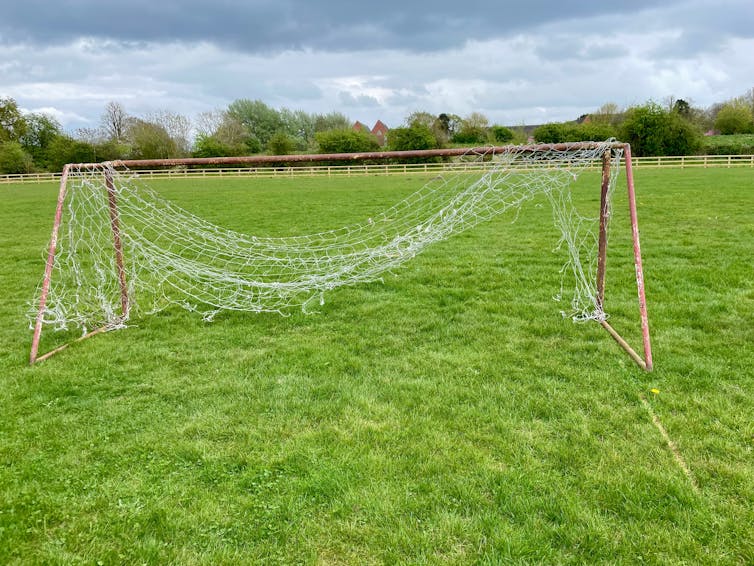
Dilapidated goal in park
Investment in youth services has shrunk.
Knights Lane/Shutterstock

Cultural shifts have also had an impact. It has been suggested that fears about safety and a desire to minimise risks for their children have produced a “risk-averse” parenting culture. In schools, rising academic pressures and an emphasis on achievement have come at the expense of play and exploration.

Research suggests that children today have significantly less freedom to roam, play outdoors, or gather with peers than previous generations.

The environments in which young people can explore, fail safely and develop social mastery have been radically narrowed. It is into an already thinning social ecosystem that digital platforms enter.

Digital help and harm

Despite many arguments to the contrary, digital spaces are not inherently harmful. They can offer connection, self-expression and community.

This can be particularly true for those marginalised offline, with research suggesting social media can actually support the mental health and wellbeing of young LGBTQ people. Our online and offline lives are deeply intertwined, with online connections often allowing us to deepen existing relationships.

The problem is less that young people are online, and more that online life has rushed in to fill the gaps left by a shrinking offline world.

Moreover, digital platforms are built for profit, not development. Young people are shaping their identities, sense of belonging and social status within systems designed to drive constant engagement – a phenomenon which is only accelerating with the advent of AI.

Social media platforms encourage comparison, performance and rapid responses. More broadly, the digital world can pull attention away from the real world and place young people under persistent pressure. It can also affect how – across a formative period of development – they make sense of themselves and the world around them.

Solid foundations in a digital world

There is growing recognition that preventing mental ill health means investing in the social foundations of childhood. McCrory is the chief executive of the mental health charity Anna Freud, which is making a significant shift towards prevention: prioritising building strengths,reducing risks and supporting wellbeing before problems become entrenched. And, of course, positive relationships are the cornerstone of healthy development.

To reverse rising rates of mental ill health, we need to reimagine and invest in the social scaffolding that supports healthy development, ensuring children and young people grow up in socially rich environments. This requires serious investment in youth services, outdoor spaces and community infrastructure.

Schools need more time for play, creativity and extracurricular activities, not just academic performance. Families need support to create shared experiences, from outdoor play to community participation.

Digital platforms are now part of everyday life, but they must complement rather than replace experiences in the physical world. By enriching, not thinning, young people’s social worlds and giving them places and relationships that build trust, foster agency and support connection, we can strengthen the foundations for lifelong wellbeing.

The Conversation

Eamon McCrory is affiliated with UCL (Professor of Developmental Neuroscience and Psychopathology) and Anna Freud (CEO)

Ritika Chokhani is currently the recipient of a PhD studentship funded by the Wellcome Trust, focusing on similar research areas.

ref. Young people’s social worlds are ‘thinning’ – here’s how that’s affecting wellbeing – https://theconversation.com/young-peoples-social-worlds-are-thinning-heres-how-thats-affecting-wellbeing-272111

Pimple patches have hidden our blemishes for hundreds of years – historian explains

Source: The Conversation – UK – By Sara Read, Lecturer in English, Loughborough University

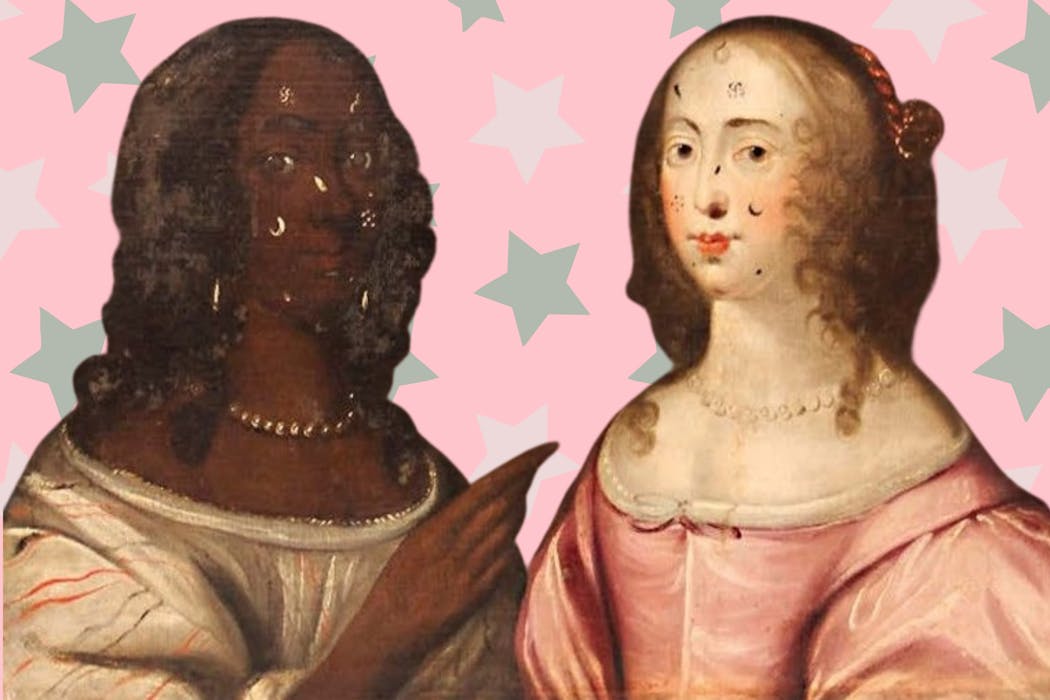
Two Women Wearing Cosmetic Patches, painter unknown (circa 1650). Compton Verney Art Gallery/Canva

You may have noticed people out and about with little stickers on their faces. Perhaps you’ve seen moons, stars, clouds or even smiley faces adorning people’s cheeks and chins. Maybe you wear them yourself. While some people do wear them as accessories, these colourful stickers are medicated “pimple patches”, designed to treat spots or acne.

Some of the patches simply contain a gel formula, which keeps the emerging blemish moist to aid healing. Some wearers opt for near-transparent film patches to get the benefit in a more inconspicuous way.

Far from a new fad, beauty patches have a long history. The trend first took off in 17th-century Europe, with patches made from paper, silk or velvet, or even fine leather, cut into lozenge shapes, stars or crescent moons.

They could be made in many colours, but black was generally preferred as it made a stark contrast to the idealised pale face of western upper-class men and women, who saw this complexion as a status symbol, showing they did not go outdoors to work. The play Blurt, Master-Constable from 1602 explains another appeal of the patches – when well applied, they could “draw men’s eyes to shoot glances at you”.

Mentions of patches occur regularly in print from the late 16th and early 17th century. Just like today, beauty patches had a dual function. In his 1601 play Jack Drum’s Entertainment, John Marston explains that: “Black patches are worn, some for pride, some to stay the rheum, and some to hide the scab.”

So, some were worn by people wanting to make themselves seem more attractive, and some – sometimes medicated – were used to dry up sores. Some patches were used to conceal blemishes like the scars left by diseases such as smallpox or even syphilis.


No one’s 20s and 30s look the same. You might be saving for a mortgage or just struggling to pay rent. You could be swiping dating apps, or trying to understand childcare. No matter your current challenges, our Quarter Life series has articles to share in the group chat, or just to remind you that you’re not alone.

Read more from Quarter Life:


This latter use was the reason moralists took issue with patches. One anonymous book from 1665 claimed a chaplain of King Charles I had given a sermon comparing beauty patches to the biblical mark of Cain. It is reported that he went so far as to suggest that wearing these accessories invited plague epidemics: “black-patches and beauty-spots … were Forerunners of other Spots, and Marks of the Plague”.

Other moralists focused on how, just like makeup, their job was to conceal and present a false front, which could trick admirers. This was a criticism that took on more weight into the 18th century, when people linked the use of patches to sexual promiscuity.

A Harlot’s Progress by William Hogarth (1731) is a series of images depicting the fall of a country girl, Moll Hackabout. Newly arrived in London, she is tricked by the real life brothelkeeper Elizabeth Needham. Needham’s face is covered with black patches.

Civil servant Samuel Pepys makes over a dozen mentions of these patches in his diary between 1660 and 1669. He first encountered “two very pretty ladies, very fashionable and with black patches, who very merrily sang all the way” on a business trip to the Hague in spring 1660.

The next day on a stroll through town, he noted how: “Everybody of fashion speaks French or Latin, or both. The women many of them very pretty and in good habits, fashionable and black spots.”

He noted that patches were often moistened with spit to hold them on. In May 1668, he recalled seeing Lady Castlemayne – mistress to Charles II – demanding a patch from the face of her maid, wetting it in her mouth and applying it to the side of her own face. We know from Pepys that James, Duke of York also favoured a patch or two.

By August that same year, Pepys noted in a diary entry that his wife Elisabeth was sporting black patches to a christening. Yet he seemed to have forgotten this when he noted in November that: “My wife seemed very pretty to-day, it being the first time I had given her leave to wear a black patch.” He sported a patch himself in September 1664 when he woke with a scabby mouth.

The fashion for wearing patches rose higher in the Restoration era (1660-1700), when returning royalist exiles from the Commonwealth brought home French fashions that they considered the height of sophistication.

English writer Mary Evelyn explained that mouches was the fashionable French name for “Flies, or, Black Patches”, since patches were called “flies” in French and sometimes in English too. Evelyn’s poem The Ladies Dressing-Room Unlock’d, published posthumously in 1690, was a biting satire on the Francophile fashions of Restoration London that Evelyn thought only the vulgar would indulge in.

While it is hard to see how people wearing spot patches nowadays might be subject to the same sorts of moralising backlash seen in the past, there are corners of the internet that mock people for going out in public with visible spot patches.

Whether they work or not, pimple patches are a harmless accessory. From the late 17th century, books begin to refer to patch boxes, ornate little containers specifically designed to hold patches.

Fashionable types came to like to be seen carrying a little silver box especially designed to hold their velvet or silk patches. Perhaps this will be the next development in the modern pimple patch craze.


Looking for something good? Cut through the noise with a carefully curated selection of the latest releases, live events and exhibitions, straight to your inbox every fortnight, on Fridays. Sign up here.


The Conversation

Sara Read does not work for, consult, own shares in or receive funding from any company or organisation that would benefit from this article, and has disclosed no relevant affiliations beyond their academic appointment.

ref. Pimple patches have hidden our blemishes for hundreds of years – historian explains – https://theconversation.com/pimple-patches-have-hidden-our-blemishes-for-hundreds-of-years-historian-explains-271013