Psychologists and nutritionists both agree that short-term, restrictive diets aren’t great for long-term weight loss success.metamorworks/ Shutterstock
Those hoping to lose weight this year might be tempted to try to a diet challenge in the hopes of kick-starting their weight loss. But while we might think these kinds of short-term, restrictive diets will help give our waistlines a nudge, psychology and physiology shows us why this strategy can be so hard to stick to – and why it probably won’t result in long-term weight loss.
Research estimates that as few as 20% of people who lose weight through dieting manage to keep the weight off long-term.
For decades, psychologists have been trying to understand why it is that diets so often fail.
One potential reason for this is that diets often involve strict food rules – such as avoiding the foods you enjoy.
The problem with this strategy is that the foods people tend to crave most – such as chocolate, ice cream and crisps – activate the brain’s reward system. This creates positive feelings.
When we cut these foods out of our diet, we lose the pleasure they bring. This can then trigger food cravings – a complex psychological process where we experience an intense desire to eat a particular food, even when we’re not hungry.
Food cravings are often dependent on mood and may be particularly bad when we feel stressed. They can also be especially intense in the afternoon and evening when we feel more tired and have less willpower to resist these cravings.
Food cravings can drive overeating, especially when trying to diet. One review even showed that when people deliberately excluded certain foods from their diet, they experienced an increase in cravings for the foods they were avoiding.
Although the review’s authors conclude that this response can be unlearned, it explains why even short-term restrictive diets tend not to work. Crash diets can trigger stronger food cravings, which can make it harder to stick to your goals – and may even lead to weight gain instead.
Nutritionists also agree that short-term restrictive diets aren’t great for long-term weight loss success.
Our appetite (how hungry we feel) and satiety (how long we feel full) are controlled by complex physiological signalling pathways that play a significant role in weight loss.
When we follow very low-calorie diets, our bodies react by increasing appetite, reducing satiety and even reducing energy expenditure (how many calories we burn).
The body also compensates for drastic calorie reductions by sending stronger hunger signals to the brain. This can drive overeating.
These physiological responses mean diets that are too restrictive can make weight loss harder – and may even lead to weight regain.
From an evolutionary perspective, these responses helped our ancestors to survive food scarcity – but today, it explains why severe calorie restriction so often leads to weight regain. In fact, research shows that people tend to regain about 50%–70% of the weight they lose after dieting.
Another possible explanation for this phenomenon is that you’re not just losing fat when the scale drops – you lose muscle too. This matters because muscle is a key contributor to resting energy expenditure, which is part of your metabolism. Research has also shown that a loss of muscle mass is associated with weight regain.
Since rapid weight loss diets create a large energy deficit and may contain lower amounts of protein, this increases the risk of losing muscle mass. It also increases your chances of regaining weight you may have lost while on the diet.
The best strategies for weight loss
If you’re aiming to make a substantial weight loss attempt, an “all-or-nothing” crash diet may not be your best option. A slower, more balanced approach is far more likely to protect your muscles and support longer-lasting results.
Think nutrient quality, not calories
When it comes to eating well, the key is not to “diet”. As we’ve shown, restricting calories often backfires as our bodies and brains compensate by increasing food cravings and hunger signals. So instead of focusing on what to cut out, think about what you can add to meals to make them healthier.
The types of food we eat influences our appetite and satiety signals – not just the number of calories we consume. For example, protein provides feeling of fullness, and high-fibre carbohydrates keep us more satisfied than highly processed refined ones.
So, aim for nutrient-rich foods. Adding plenty of fibre to your meals, such as whole grains, legumes, lentils, beans, fruits and vegetables, is a great start.
Research suggests that eating more fibre as part of a balanced diet can also help you maintain a healthy body weight throughout your life.
So, rather than making short-term changes in January, aim for small swaps you can stick with throughout the year.
Think like a health coach
Health psychologists have developed frameworks of behaviour change techniques that are known to help people change their physical activity and eating behaviour longer term. These evidence-based techniques are usually used by health coaches to support patients with lifestyle changes – but you can be your own coach by applying some of them yourself.
Examples include setting goals, making an action plan, identifying barriers, or teaming up with a friend or partner.
In practice, this could mean setting a goal to lose a realistic amount of weight per week incrementally (around one to two pounds per week), identifying the things that might get in the way of your goals, exercising with a friend and tracking your progress.
Quick-fix, low-calorie diet challenges might promise fast results, but they rarely deliver lasting change. Following evidence-based advice from the fields of psychology and nutrition can help you avoid the restrictive diet trap this January and achieve more sustainable, longer term lifestyle changes.
Sarah Hillier has previously received research funding from Slimming World (2019).
Chloe Casey does not work for, consult, own shares in or receive funding from any company or organisation that would benefit from this article, and has disclosed no relevant affiliations beyond their academic appointment.
Our beliefs aren’t fixed. They’re shaped, stretched and sometimes overturned by the ideas we encounter as we move through life. For many of us, books are the moments where that shift happens – a sentence that lingers, an argument that unsettles, a story that re-frames how we see the world. We asked 12 academic experts to share the book that challenged their assumptions and changed their thinking in a lasting way.
1. A Very Short Introduction to the Philosophy of Science (2002)
Induction lets us predict from patterns – if 11 eggs in a dozen are rotten, we expect the 12th to be rotten too. But as Hume notes, this reasoning is logically flawed: we justify induction by saying it has worked before, which is circular because it uses induction to defend itself.
This line of thought reshaped my views. There is no ultimate logical proof that induction works; I simply believe it does. In other words, I have faith in the scientific method.
Realising this stopped me fretting about how others reconcile science and religion. Faith and evidence coexist in my own thinking. I’m no more inclined to believe in a god, but I no longer have a problem understanding how faith and science can inhabit the same mind.
Mark Lorch is a biochemist, writer, and Professor of science communication
2. Nature is a Human Right, edited by Ellen Miles (2022)
Like so many others, I found myself gravitating back towards the natural world during the COVID pandemic, both in my academic work and my personal life. And I’d come to understand how disconnection and detachment from nature was harming the health and happiness of millions of people worldwide. But I hadn’t given much serious thought to equitable access to nature until I’d read Nature Is a Human Right.
The collection of essays and writings in this edited volume irrevocably convinced me that contact with, and access to, the natural world should not just be a privilege for some, but enshrined as a basic right for everyone.
The collection of ideas and arguments in this book – sometimes uncomfortable, sometimes upsetting – has persuaded me that we have to take action, not just to protect the natural world, but to ensure that contact with nature is a birthright for everyone.
Viren Swami is a professor of psychology
3. The Sketchnote Handbook by Mike Rhode (2012)
When I completed my PhD in 2012, I felt a strong pressure to adhere to a narrow view of computer science, where creativity and storytelling were often seen as superfluous. Then I attended a sketchnotes workshop, a practice I had never encountered before. Sketchnotes is a visual note-taking method that combines words and sketches to support creativity and memory recall.
The facilitator recommended Rohde’s book, and during my postdoctoral research, it quietly transformed my perspective. Joining the sketchnotes community, I met people from diverse backgrounds – teachers, chief technical officers and physicists – creating compelling visual stories. The book and community showed me that sketching should not be overlooked in computer science. Something I had always kept as a personal practice could become central to my research and teaching.
I challenged the stereotype of sketching as a “soft skill” and embraced it as a disciplined, creative and impactful way to understand people and their interactions with technology. Now, sketching is not just a tool, but a mindset that shapes everything I do.
Makayla Lewis is an senior lecturer of computer science (user experience)
4. Children of Time by Adrian Tchaikovsky (2015)
In Tchaikovsky’s novel, Earth has become uninhabitable and humanity spreads out into the stars in search of a new home. After much trial and error, we find a viable world – but it’s already home to a species of intelligent spiders.
I’m arachnophobic, so this novel might seem like an odd choice. However, Children of Time is told partly from the spiders’ perspective, and though they don’t think exactly like us, we can empathise with them as we follow the sometimes-painful growth of their civilisation, and their inevitable encounter with scary alien invaders – us.
I’m not claiming this novel to be a miracle cure, but it prompted me to reflect on my anxiety. I’m not going to get a pet tarantula anytime soon, but I’m more mindful of spiders than I was before. They really are quite fascinating little creatures when you get to know them.
Jack Fennell is a lecturer in English
5. On the Plurality of Worlds by David Lewis (1986)
Is the past real? How about the future? Common sense says no: the present encapsulates all existence. I used to agree. Then, in my early 20s, I read On the Plurality of Worlds. David Lewis’s metaphysical masterpiece changed my mind about many things, but most profoundly about time.
Lewis convinced me that time is analogous to space. Spatially distant objects (a café in Paris, a crater on Mars) are real, even if they aren’t “here”. Lewis argues time is identical. The past and future are merely temporal locations.
This leads to a stunning conclusion: Julius Caesar and the dinosaurs have just as much existence as you and I, even if they aren’t “now”. They haven’t vanished into nothingness. They are simply located elsewhere in the temporal dimension. The same applies to future things and events. Once I accepted this, I stopped seeing reality as a fleeting moment and began to see it as a vast, existing landscape of time. It was a complete conceptual shift that has remained with me ever since.
Benjamin L. Curtis is a senior lecturer in philosophy
6. Humankind: A Hopeful History and Utopia for Realists by Rutger Bregman (2019)
From criminal punishment to tax incentives, modern society assumes humans need guidance to avoid their worst instincts. Humankind by Rutger Bregman offers a very different perspective on our species and how peace can be achieved.
Have you ever felt embarrassed by blushing? You shouldn’t – blushing is a “superpower”. Our capacity to show shame helps form complex social bonds. History shows the most stable societies temper leaders’ ambitions and promote humility. Humans generally prioritise fairness over harm, and when violence occurs, it’s often due to hierarchy, not innate instinct. Bregman cites studies showing that leadership can reduce empathy, increase selfishness and encourage cheating.
The book challenged my view of government. I’d believed strong laws create order, but often it’s attempts to control others that empower strong leaders and cause instability. True social order comes from daily human relationships. A better world requires rethinking how we distribute power.
Michael Strange is an associate professor of international relations
7. Shikasta by Doris Lessing (1979)
When I was 18, Doris Lessing’s Shikasta first crossed my path. Even if I now, 46 years later, no longer remember the details of the plot, I still recall the unsettling feeling the novel gave me. It was as if I had glimpsed a dark future.
Materialism, egoism, war and unemployment thrived while deeper values as striving for collaboration or peace (ha!) vanished in to the air. When I read the book, I started to look upon the state of the world in new light. I wondered if the injustices on our planet could be avoided. And what we could expect in a nearby future.
I was both a bit scared and at the same time had the feeling that I had understood or seen something others didn’t talk about. For a long time, I waited to see Lessing’s vision unfold. Perhaps, in some ways, it now has.
Eva Wennås Brante is an associate professor in educational science
8. Sapiens by Yuval Noah Harari (2011)
Sapiens brilliantly weaves its author’s expertise in anthropology, behavioural science, geopolitics and socioeconomics into an enthralling, astute and thoroughly entertaining book that challenged, demolished and rebuilt my worldview. The unexpected ways creating, sharing and learning from stories have influenced who we trust, what we believe and how we govern ourselves, as individuals and as organised groups, are masterfully explained in the book.
In particular, the exploration of the impact of storytelling on our communities and the way we define, experience and shape culture fascinated me.
Harari draws from a wealth of real world examples that offer a fresh perspective on key historical events and core aspects of our societies that we routinely take for granted. I gained a new understanding of life and how to live it.
Alina Patelli is a senior lecturer in applied artificial intelligence
9. 50 Simple Things You Can Do to Save the Earth (1990)
In the 90s, my father gave me 50 Simple Things You Can Do to Save the Earth by the Earth Works Group. It started with short summaries on global environmental concerns at the time (the hole in the ozone layer, pollution, biodiversity loss). But then, importantly, it proceeded to give readers ideas about practical changes in their lives they could do to address those global concerns.
As a child, this book taught me that these were global issues but that my actions mattered, that we all had the power to help our natural world. It changed my mind about who can solve global problems and helped set me on a path to get involved in environmental conservation, which eventually became a career in marine climate change research. Today, this experience tells me that it is never too early to start thinking about what we as individuals can do for nature.
Ana M. Queirós is a professor in climate change and marine biology
10. Man’s Search for Meaning by Viktor Frankl (1946)
During my postdoctoral research, I was drawn towards Holocaust testimonies including Survival in Auschwitz by Primo Levi (1947) and Night by Elie Wiesel (1956). These are powerful, remarkable memoirs, but the book that redirected my thoughts was Viktor Frankl’s Man’s Search for Meaning.
Holocaust testimonies explore the experience of struggle, the shock of witnessing the unthinkable, the terrifying logistics of a genocide. But Man’s Search for Meaning also offers the reader an insight into Frankl’s enlightened psychological perspective as this book was written while he was still inside the camp, rather than as a reflection afterwards.
Frankl was an established psychiatrist when sent to Auschwitz, but his reflections on the meaning of abject psychological and physical suffering pushed him into philosophical territory. In the darkest place on Earth, he found an existential truth: A person can “choose one’s attitude in any set of given circumstances, to choose one’s own way”. He refers to this choice as “the last inner freedom … a spiritual freedom” in the face of despair and death.
Laura Stephenson is a senior lecturer in film
11. The Concept of the Mind by Gilbert Ryle (1949)
Pre-eminent among the books that have forever changed my thinking is Gilbert Ryle’s The Concept of Mind. In medical school I learnt all about the human sciences but was baffled by psychology, a parallel universe where the laws of physics didn’t seem to apply. Ryle explained that there’s no “ghost in the machine” but that we can describe our one world using a physical or a psychological vocabulary.
When I worked as a psychiatrist, The Concept of Mind showed me that different models of mental illness based on neurophysiology or psychoanalysis or behaviourism or social rehabilitation could all, in principle, be correct.
So I was free to help change patients minds by altering their neurochemistry or by psychological means, confident that their brains would also heal.
Ryle implies that inferences about mental facts should be as carefully drawn as those about physical phenomena. But it has seemed to me, as a mental capacity law researcher, that the process of inferring capacity is tortuous and irretrievably subjective. The Concept of Mind has given me the confidence to challenge the law and to provide radical alternatives. I am greatly in Gilbert Ryle’s debt.
Jonathan Fisk is a PhD candidate in law
12. The Mushroom at the End of The World by Anna Tsing (2015)
We are not used to reading stories without human heroes – and yet, as researchers, these are exactly the narratives we often reproduce. During my PhD, I spent four months in Botswana and South Africa chasing tails (and tales) of African wild dogs. For me, this is where Anna Tsing’s work came alive.
Though much of the research in my field tells us that non-human beings are active participants in shaping encounters and environments, this co-production is rarely extended to our work. The Mushroom at the End of the World asks us to “bring back curiosity”, noticing beyond seeing, opening up a multi-sensory world of presence and possibility.
In the field, this meant adapting my methods in situ, incorporating sound and smell to attend to wild dogs’ ways of moving through and understanding space. This counter-mapping transgresses imagined human boundaries and paths, opening up ways to research and respond to more-than human worlds.
Anna Bedenk-Smith is a lecturer in human geography
Has a book ever changed your mind? Let us know in the comments below
Looking for something good? Cut through the noise with a carefully curated selection of the latest releases, live events and exhibitions, straight to your inbox every fortnight, on Fridays. Sign up here.
This article features references to books that have been included for editorial reasons, and may contain links to bookshop.org. If you click on one of the links and go on to buy something from bookshop.org The Conversation UK may earn a commission.
The authors do not work for, consult, own shares in or receive funding from any company or organisation that would benefit from this article, and have disclosed no relevant affiliations beyond their academic appointment.
Source: The Conversation – UK – By Bamo Nouri, Honorary Research Fellow, Department of International Politics, City St George’s, University of London
Tehran has said it is ‘ready for war’ after Trump’s threats of US military action.Lucas Parker / Mr Changezi / Shutterstock / Canva
Donald Trump is weighing military action in Iran over the state’s crackdown on protesters. Reports suggest that more than 600 people have been killed since the protests began in late December, with the US president saying the US military is now “looking at some very strong options”.
Trump has not yet elaborated on what these options are and has said that Iranian officials, keen to avoid a war with the US, had called him “to negotiate”. But he added that the US “may have to act before a meeting” if the deadly crackdown continues.
There is a wide spectrum of measures available to Washington should it decide to intervene in Iran. These range from diplomatic condemnation and an expanded sanctions regime, to cyber operations and military strikes. However, history weighs heavily against every move the US government may be considering.
Targeted sanctions and diplomatic pressure, which includes the 25% tariff rate recently introduced by Trump on any country that does business with Iran, remain the least escalatory tools. They allow the US to coordinate with its allies and signal moral support for protesters in Iran without triggering direct confrontation. Yet decades of experience show the limits of this approach.
Iran’s leadership has mastered how to absorb economic pressure, shift costs on to society and frame longstanding western sanctions as collective punishment imposed by hostile outsiders. The government in Tehran has adapted over time by developing alternative markets and expanding informal and non-dollar trade.
It has also boosted its economic resilience through regional networks, particularly in Iraq where political, financial and security ties help sustain revenue flows and cushion the impact of sanctions on the state.
There are other, more covert tools at Washington’s disposal, including cyber disruption and efforts to assist independent media or help protesters bypass internet shutdowns. These measures can help protesters stay visible internationally and complicate the state’s capacity to ramp up repression.
However, even here expectations should be modest. These tools may create friction within the Iranian elite by raising the costs of, and imposing technical difficulties on, surveillance and repression. But they do not change the core calculus of a regime that prioritises survival above all else.
At the most extreme end of the spectrum are military strikes. The rationale behind strikes would be to undermine the regime’s repression efforts. But in reality, they risk doing the opposite. Iran’s ruling system, and particularly the powerful Islamic Revolutionary Guard Corps branch of the armed forces, has historically relied on external threats to consolidate power domestically.
A preemptive US strike would almost certainly hand Iran’s security apparatus the very narrative it seeks: an existential battle for national survival. This framing is already explicit in the discourse of the Iranian elite.
Mohammad Bagher Ghalibaf, the hardline speaker of the Iranian parliament, warned in a recent speech that any attack on Iran would make Israel and all US military bases and assets in the region “legitimate targets”. Iranian state media then showed large crowds of regime supporters rallying in Tehran and other cities, chanting “Death to America” and “Death to Israel.”
Military escalation is especially dangerous given the character of the current protest movement. Women have been at the forefront, challenging the ideological foundations of the state, while regions populated largely by ethnic Kurds have endured disproportionate levels of violence at the hands of the authorities.
These protests are civic, decentralised and rooted in social grievances. US military strikes would allow the Iranian state to overwrite that reality, recasting a diverse domestic movement as a foreign-backed security threat. In doing so, it would legitimise a far harsher crackdown than anything seen so far.
Shadow of 1953
Many ordinary Iranians are also cautious of direct US interference. This stems from a CIA-backed coup in 1953 that ousted Iran’s elected prime minister, Mohammad Mosaddeq, and restored the monarchy under Shah Mohammad Reza Pahlavi. The coup was followed by nearly two decades of repression, political policing and authoritarian rule closely aligned with western interests.
This experience is not distant history; it is a foundational trauma that continues to shape Iranian political consciousness. As a result, recent suggestions by Trump that the collapse of Iran’s theocratic system would naturally make way for a democratic transition cannot be disentangled from the memory of an external intervention that produced dictatorship rather than self-rule.
It also explains why many people inside Iran are sceptical of figures such as Reza Pahlavi, the son of country’s last shah who has often been promoted in the west as a possible future leader of Iran. Pahlavi remains symbolically tied to a system associated with oppression and foreign backing. This leaves him without the broad domestic legitimacy required for any credible democratic transition, regardless of his messaging.
The scepticism of Iranians is reinforced by recent regional experiences. In Iraq, foreign intervention hollowed out the state, leaving a weak system that has been co-opted by external powers and militias.
And in Syria, the collapse of central authority paved the way for a former al-Qaeda leader, Ahmed al-Sharaa, to take power. He has been rebranded by western powers, including Trump, into a credible political figure despite his jihadist past.
These cases reinforce a belief across the Middle East that western intervention tends not to empower democratic forces. It instead appears to elevate the most organised and militarised parties to power, producing long-term instability rather than renewal.
Without a credible, homegrown transition, Iran risks fragmenting and sliding into chaos. For Washington, the most difficult reality may be that the wisest path is not bold intervention, but restraint combined with sustained support for Iranian society.
Genuine change in Iran cannot be engineered from the outside, especially at the point of a missile.
Bamo Nouri does not work for, consult, own shares in or receive funding from any company or organisation that would benefit from this article, and has disclosed no relevant affiliations beyond their academic appointment.
Source: The Conversation – UK – By Shelley Galpin, Lecturer in Culture, Media and Creative Industries, King’s College London
Thomas Hardy’s final novel, Jude the Obscure (1895), was ahead of its time in more ways that one. Upon its publication, it provoked controversy with its explicit criticism of organised religion and traditional marriage, leading to book burnings and public criticism.
Hardy attributed the public criticism to his retirement from novel writing. He had already courted controversy in the literary establishment a few years earlier by describing the unmarried mother who (spoiler alert) goes on to commit murder at the centre of Tess of the D’Urbervilles (1891) as “a pure woman”. But Jude the Obscure was his most searing attack yet on the hypocrisies of late Victorian society.
The novel’s apparent endorsement of free love, and damning portrait of conventional marriage, alienated many readers including – perhaps unsurprisingly – Hardy’s wife, with whom the novel caused an irreparable breach.
This article is part of Rethinking the Classics. The stories in this series offer insightful new ways to think about and interpret classic books and artworks. This is the canon – with a twist.
There’s no getting away from it, the story is something of a downer. It’s the tale of a young man – the “obscure” Jude – whose life starts off hard and gets harder as he faces a string of obstacles in the pursuit of his dreams. And he is a dreamer.
The novel opens with a young Jude being introduced to the idea of a university education, as his beloved schoolteacher leaves him for the dreaming spires of Oxford (called Christminster in the novel). Gazing at the “mirage” of the cityscape on the horizon and captivated by the idea of this “beautiful city”, Jude is immediately cautioned by his guardian that it “is a place much too good for you”.
As the somewhat bleak title suggests, this is a story about alienation and social exclusion. Unperturbed by the ominous warnings, the working class Jude seeks to prepare himself for a university education by self-educating, using borrowed textbooks to teach himself Ancient Greek and Latin and studying diligently for many years.
As a young man, working as a stonemason in Christminster, Jude is determined to prove that universities are not, as he is told, “only for them with plenty o’ money”. He writes to the university, seeking advice on how to further his ambition of studying with them. The answer, when it comes, is crushing. Jude is advised that “as a working-man … [he] will have a better chance of success in life by remaining in [his] own sphere and sticking to [his] trade”.
In one of the most visceral images in the book, Jude responds by scrawling on the outside walls of the university: “I have understanding as well as you. I am not inferior to you.”
Sadly, this act of protest is still resonant today. As Jude understands, education is a path to social mobility. His impassioned defence of his own worth, as a scholar and as a human being, highlights the barriers faced by economically disadvantaged young people.
Inequality persists
In today’s society, it is unlikely that any hopeful student would receive such overt “stay in your lane” advice. Contemporary higher education aspires to a culture of widening participation, in which students from traditionally underrepresented groups are encouraged through outreach initiatives, contextual offers (in which applicants from disadvantaged backgrounds are given slightly lower grade requirements) and scholarships to apply to university.
Well-publicised schemes such as the Stormzy Scholarships, which seek to make University of Cambridge degrees more affordable for black students, have the explicit aim of redressing historical inequalities to make the university admissions process a more equitable system.
However, inequalities persist. Students from the poorest backgrounds are still drastically underrepresented at the UK’s most elite universities. Admissions statistics show that at Oxford, the object of Jude’s ambitions, applicants from fee-paying schools are more likely to be accepted than those from state schools.
Trailer for the 1996 adaptation of Jude the Obscure.
Factor in, too, the increasingly eye-watering costs of living for students and, despite years of effort, the danger is that a university education remains the preserve of “them with plenty o’ money”.
As Hardy shows in the novel, the consequences can be devastating. While on a population level it results in stagnating social mobility, on a personal level the frustrations associated with the failure to fulfil your potential are profound, and the practical implications of being forced to remain in a position of economic dependence are severe.
Jude’s persistent reliance on the goodwill of others, and his struggles to provide for his growing family, all stem from his exclusion from the opportunity to raise his social position.
As his desperate scrawls on the walls of the university argue, access to higher education should be for those with merit, not money. Some 130 years on from the publication of Hardy’s novel, it seems work still needs to be done, lest we risk future generations falling into obscurity.
Beyond the Canon
As part of the Rethinking the Classics series, we’re asking our experts to recommend a book or artwork that tackles similar themes to the canonical work in question, but isn’t (yet) considered a classic itself. Here is Shelley Galpin’s suggestion:
Like Jude the Obscure, Willy Russell’s Educating Rita (1980) is about education and the class system. In one scene, Rita, a working class Open University student from the north of England, has her books burned by her husband after he discovers she’s secretly been using contraception.
Watching Rita look on helplessly as her books and notes gradually succumb to the flames, as dramatised in the 1983 film, I vividly remember being moved to tears. I understood that Rita’s husband wasn’t just hindering her learning, he was telling her he didn’t want her to become an educated person, as he feared what education would give her.
Trailer for the 1983 adaptation of Educating Rita.
At the heart of the play is a message that is too often lost in the current obsession with quantifiable measures of success and employability. That is, for some people, education is not merely a means to a qualification or a higher paying job. Education can be the end in itself.
Describing the book burning, Rita reflects on her husband’s failure to understand her studies, stating that her education is a chance to “breathe” and find herself. The value of this for anyone, although not easily measurable, can be profound.
While Jude’s barriers prove insurmountable, Rita’s is a more hopeful story. It stands as an impassioned argument for the significance and power of lifelong learning, and like Hardy’s novel before it, for the importance of accessible education.
Looking for something good? Cut through the noise with a carefully curated selection of the latest releases, live events and exhibitions, straight to your inbox every fortnight, on Fridays. Sign up here.
This article features references to books that have been included for editorial reasons, and may contain links to bookshop.org. If you click on one of the links and go on to buy something from bookshop.org The Conversation UK may earn a commission.
Shelley Galpin does not work for, consult, own shares in or receive funding from any company or organisation that would benefit from this article, and has disclosed no relevant affiliations beyond their academic appointment.
Source: The Conversation – UK – By Rabia Charef, Senior Research Associate in Circular Economy & Digitalisation, Lancaster University
RenNeo / shutterstock
Solar power has a dark side: panels are still built to be thrown away, and we risk creating a mountain of waste that locks away valuable minerals.
The world already faces up to 250 million tonnes of solar waste by 2050, as panels installed during the solar boom of the 2000s and 2010s reach the end of their service life.
These panels were not designed to be repaired, refurbished, or disassembled. Indeed, current recycling processes mainly extract glass and aluminium, while the materials that carry the highest economic and strategic value such as silver, copper and high-grade silicon are generally lost in the process.
The industry now faces a narrow window to rethink. Without a shift in design, the energy transition could end up shifting environmental pressures rather than reducing them. Building low-carbon technology is essential, but low-carbon does not inherently mean sustainable.
A booming industry designed for the dump
The average lifespan of solar modules is about 25 to 30 years. This means a massive wave of installations from the early 2000s is now reaching the end of its life cycle. Countries with mature solar markets like Germany, Australia, Japan and the US are already seeing a sharp increase in the number of panels being taken out of service.
The challenge lies not only in the scale of the waste but also in the very design of the panels. To survive decades of weather, solar panels are built by stacking layers of glass, cells and plastic, then bonding them together so tightly with strong adhesives that they become a single, inseparable unit.
You can think of a solar panel like an industrial-strength sandwich. VectorMine / shutterstock
But this durability has a downside. Because the layers are so tightly bonded, they are exceptionally difficult to peel apart, effectively preventing us from fixing the panels when they break or recovering materials when they are thrown away (those materials could generate US$15 billion (£11 billion) in economic value by 2050).
The limits of recycling
In any case, recycling should be a last resort because it destroys much of the embedded value. That’s because current processes are crude, mostly shredding panels to recover cheap aluminium and glass while losing high value metals.
For instance, while silver represents only 0.14% of a solar panel’s mass, it accounts for over 40% of its material value and about 10% of its total cost. Yet it is rarely recovered when recycling. During standard recycling, solar panels are crushed. The silver is pulverised into microscopic particles that become mixed with glass, silicon and plastic residues, making it too difficult and expensive to separate.
That’s why strategies that aim to extend the life of solar panels – such as repair and reuse – are vastly superior to recycling. They preserve the value of these products, and avoid the massive energy cost of industrial shredding. They keep valuable materials in circulation and reduce the need to extract new raw materials. They can even generate new revenue for owners. But this circular vision is only viable if solar panels are designed to be taken apart and repaired.
Designing panels for a circular future
Moving towards such an approach means redesigning panels so they can be repaired, upgraded and ultimately disassembled without damaging or destroying the components inside. The idea of designing for disassembly, common in other sectors, is increasingly essential for solar too.
Instead of permanent adhesives and fully laminated layers, panels can be built using modular designs and reversible connections. Components such as frames, junction boxes and connectors should be removable, while mechanical fixings or smart adhesives that release only at high temperatures can allow glass and cells to be separated more easily.
Standardising components and improving documentation would further support repairers, refurbishers and recyclers throughout a panel’s life cycle. In short, the next generation of solar panels must be designed to last longer, be repairable, and use fewer critical materials — not simply to maximise short-term energy output.
Digital tools can help
If you want to repair or recycle a panel years from now, you’ll need to know what materials it contains, what adhesives were used and how it was assembled. Digital tools can help here by storing information, essentially acting like a car’s logbook or a patient’s medical record.
One promising example is the EU’s new Digital Product Passport. These passports will include guidance on repair options, disassembly, hazardous substances, lifecycle history and end-of-life handling. They will be introduced progressively for priority product groups from 2027, with further expansion to many other products, expected towards around 2030.
The Digital Product Passport acts as a static “ingredients list” for a solar panel. It shows what a panel is made of and how it should be handled. Digital twins, by contrast, function more like a real-time monitoring system.
Continuously updated with performance data, they can signal when a panel is under-performing, has become too dusty, or needs repairing. Used together, these tools can help technicians identify which parts can be be repaired or reused and ensure solar panels are safely dismantled at the end of their life.
However, even the best digital twin isn’t much use if the panel itself is glued shut and designed for the dump. Without panels that are built to be repaired or taken apart, digitalisation will offer only marginal benefits.
Digital tools also have their own environmental footprint, from sensors to data storage, which makes it even more important that they support genuinely repairable designs rather than compensate for poor ones. We must rethink how we design solar panels right now, before today’s solar boom locks in tomorrow’s waste problem.
Rabia Charef is a Senior Research Associate at Lancaster University and works as an independent consultant on circular economy and digitalisation. She has previously worked on research related to the end-of-life of solar photovoltaic panels. This article is based on a review of the academic literature and does not draw on unpublished project data. The views expressed are the author’s own.
Protesters defied a savage regime crackdown to take to the streets to demand change.X
Iranians have shown a willingness to pay a devastating price for political change, as protest has consistently been met by the Islamic Republic with violence and mass killing. The death toll since Iranians took to the streets on December 28 has reportedly passed 500, with more than 10,000 arrested. Incoming reports put the casualty count much higher.
A clear majority of Iranians do not want the theocracy that came to power with the 1979 revolution. They want a secular democracy. But what does public opinion tell us about what that should entail and how this change should be achieved?
Measuring public opinion in one of the world’s most repressive countries is not an easy matter. Conventional surveys conducted through (landline) phones or by face-to-face interviews tend to reflect an implausibly homogeneous Islamic and pro-regime society. By contrast, Gamaan — the Group for Analysing and Measuring Attitudes in Iran — conducts surveys anonymously through the internet.
Our research is based on representative samples of anything from tens of thousands to over 100,000 respondents. In 2020 a Gamaan survey revealed a diverse, secularising and dissident society, in which around 70% rejected the compulsory hijab. These numbers materialised in the streets in 2022, during the “woman life freedom” protests (find out more about sample characteristics, weighting information, and external benchmark tests at gamaan.org and this Wapor methodology webinar).
To improve randomisation, we collaborate with Psiphon VPN, which is widely used across Iran. By 2025, an estimated 90% of Iranian internet users relied on VPNs to access blocked platforms, including basic messaging apps such as Whatsapp.
This level of coverage enabled what we call VPN sampling, yielding large, socially diverse samples under conditions of safety and anonymity. Combined with scale, anonymity offers reliable insight into what Iranians really want. The latest survey on the 12-day war with Israel, taken in September 2025, secured more than 30,000 responses from inside the country.
Why protests, again? What is different?
Our surveys consistently show that the majority shares a consensus on what it does not want. Across provinces, rural and urban areas, age groups and gender, roughly 70–80% say they would not vote for the Islamic Republic.
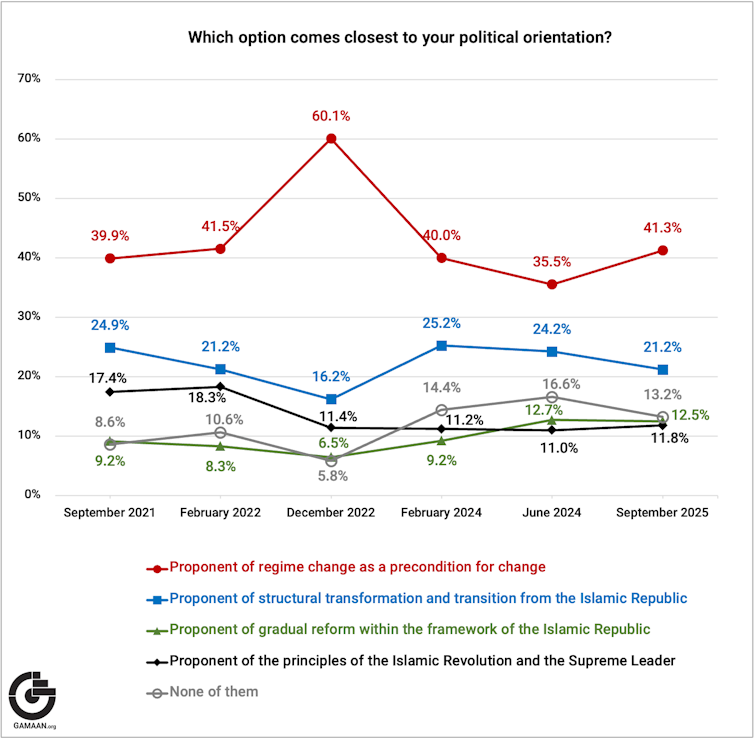
In all survey waves, support for regime change as a precondition for meaningful progress has been the most popular position. This support previously spiked during the “woman life freedom” protests. We believe we are currently witnessing another spike, given the increase observed after the 12-day war.
Results from GAMAAN’s surveys conducted between 2021 and 2025. CC BY-ND
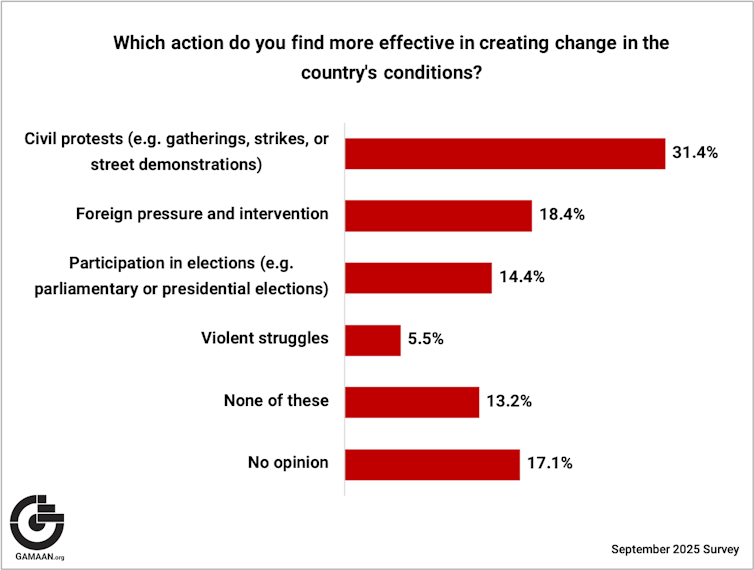
Iranians believe that protests, foreign pressure and intervention are more likely to bring about political change than elections and reforms. They were thus emboldened when, for the first time, a US president threatened intervention should protesters be killed. This came days after the abduction by the US military of the Venezuelan president, Nicolás Maduro, a key ally of the Islamic Republic.
Results from GAMAAN’s 2025 survey on the 12-Day War. CC BY-ND
The popularity of Reza Pahlavi, the former crown prince in exile who represents inherited monarchical nationalism, can be understood in light of this Iran-first mentality. Pahlavi’s social base remained stable in Gamaan’s surveys between 2022 and 2025. Roughly one-third are strong supporters and another third strongly oppose him. The remaining segment somewhat agrees or disagrees, or expresses no opinion.
The current surge in pro-Pahlavi slogans suggests that his popularity is attracting segments of the latter moderate or undecided population. But our surveys found that his popularity is unevenly distributed. It is lower in provinces with higher ethnic minority populations, such as the Kurds, Azeri Turks and Baluch.
Results from GAMAAN’s 2025 survey on the 12-day war. CC BY-ND
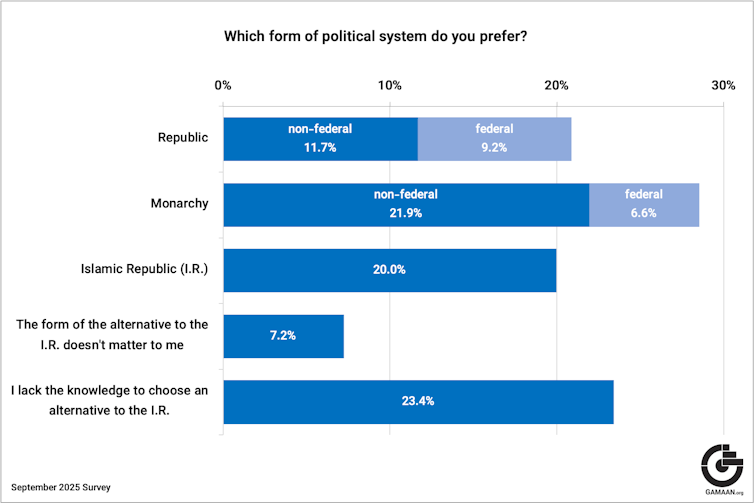
Although there is no consensus on the form or structure of an alternative political system, it is noteworthy that in 2025 there was, for the first time, a marked increase in support for monarchy. Given the significant size of those who do not voice a strong opinion on the alternative, any group that can successfully topple the Islamic Republic will have an advantage in convincing the majority to adopt its proposed model.
Results from GAMAAN’s 2025 survey on the 12-day war. CC BY-ND
Iranians overwhelmingly support a “democratic political system” – with 89% in favour. Support for political liberalism, however, is weaker. In 2024, 43% agreed with having “a strong leader who does not have to bother with parliament and elections”. This view is significantly higher among those without higher education – among monarchists, it is 49%.
These facts should not be lamented or mocked but understood, if the threat of a lack of liberalism is to be mitigated. While nationalism may generate the force of a revolutionary storm capable of toppling the regime, long-term stability, after the fall of the Islamic Republic, will also require an acceptance of Iran’s cultural and ideological diversity as permanent features of a truly free nation.
Ammar Maleki is the founder and director of non-profit GAMAAN. He was selected as World Association for Public Opinion Research’s national representative for Iran for the 2025–2027 term.
Pooyan Tamimi Arab receives funding from the Dutch Research Council for the project Iran’s Secular Shift (2025-2030; VI.Vidi.231F.020). He is a board member of the non-profit research institute GAMAAN.
Even in winter, when long dark nights can amplify feelings of loneliness, spending time with nature may elicit awe and wonder that brings important wellness benefits. While the winter chill can make stepping outside feel like a struggle, it’s worth it.
Connecting with nature makes us happier, less likely to suffer anxiety, and more likely to care for the natural world around us. So here are some tips for engaging with nature this winter, and enjoying some spectacular sights not far from home.
Awakening butterflies
Slanting winter sunlight can be surprisingly warm on your upturned face, so try to schedule your outdoors time to coincide with winter sun. The best time to get out is mid-morning, when the light is brightest.
On unusually warm days in Britain and other temperate areas, you might see red admiral butterflies temporarily awakening from their overwintering dormancy – even in early January. On cold days, they are often nestled in tree cavities and caves, or tucked away in garden sheds.
Lakes alive with wildlife
Rivers, ponds and streams tend to have less human visitors in the cold of wintertime, meaning less disruption to wildlife. Early morning is a good time to catch swans on icy lakes, gliding silently out of the mist. Many other water birds, such as mallard ducks and great-crested grebes, as well as fish including perch, roach and grayling, are also active throughout the year.
Riverbanks are quieter this time of year, which makes it easier to spot wildlife. Dave Knibbs/Shutterstock
The joy of clear, frosty mornings
There’s almost nothing more clarifying for the mind than the satisfying crunch of ice crystals under foot, and landscapes transformed into astonishing whiteness. The geometrical patterns of ice crystals on frozen puddles, ponds and even car windscreens are a spectacle to behold.
Try gently using the tip of your finger to topple miniature towers of hoar frost that decorate the surfaces of plants. It’s another quiet joy.
Bountiful berries
Bright red hawthorn berries are particularly bountiful this year, providing food for voles, dormice and birds. And look out for the glistening white berries of mistletoe, a plant whose roots penetrate the high-up branches of broad-leaved trees.
Beautiful birds
In an open field, stand still, look up, and you might see murmurations of starlings wheeling in the sky. Meanwhile, the tiny hardy birds – goldfinches, goldcrests, bluetits and chaffinches – that stay at home all winter provide a rejuvenating soundscape in the hedgerows.
In humans, visual perception dominates – but with practice, we can make better use of all our senses for a richer experience. Note the acrid smell telling where a fox has marked its territory, and the sharp scent of woodsmoke from cottages – their homely lights winking on as dusk settles.
Or listen carefully to the chirrup of a watchful robin, or the busy chatter of sparrows in hedgerows. Notice the satisfying clatter that a woodpigeon’s wings make as it takes flight, and the raucous cawing of crows socialising high up in the trees.
To best experience nature, we need to learn how to cultivate an intense attention to our surroundings. One approach is to focus on just a small part of a winter scene, savouring the textures and colours. Then, gradually, expand the lens of your perception to a wider area. Take some deep breaths absorbing the sounds and smells.
Take time to reconnect (in the right clothes)
We humans are part of nature, after all, which is why it feels so restorative to drop our busyness for a while and reconnect.
Taking sufficient time outdoors each day to engage with nature – it need not be long, just a few moments in a day – also helps us carry back that joy to our friends and family.
One final tip: wear the right clothes. With a warm coat and good boots, you can revel in flooded fields and muddy paths, and laugh while getting damp from raindrops in woodlands – before returning to enjoy the cosy indoors even more.
Tom Oliver has received research funding from BBSRC, NERC, Natural England and VKRF for biodiversity and climate change research and for investigating ‘nature-centric’ governance approaches. He was affiliated with Defra as a senior scientific fellow on their Systems Research Programme, with the Government Office for Science working on long-term risks to the UK, and spent four years with the European Environment Agency on their scientific committee. He currently sits on the Food Standards Agency science council and Office for Environmental Protection expert college. He is author of two relevant books: “The Self Delusion: The Surprising Science of Our Connection To Each Other and the Natural World”, published by Weidenfeld and Nicholson, and the forthcoming book “The Nature Delusion: Why We Can’t Fix The World Without Fixing Ourselves”, published by Bristol University Press.
Driving is the one activity carried out by three-quarters of adults in England which has a risk of killing or being killed. But society seems to accept the risks associated with car travel.
As transport secretary Heidi Alexander notes, we would never accept four people a day dying in train or plane crashes – yet that is the daily toll on roads in Britain.
This is why the government has announced a series of reforms – including lowering the drink-driving limit in England and requiring regular eye tests for over-70s – aimed at reducing deaths and serious injuries by 65% over the next decade. This is a welcome, if ambitious, target.
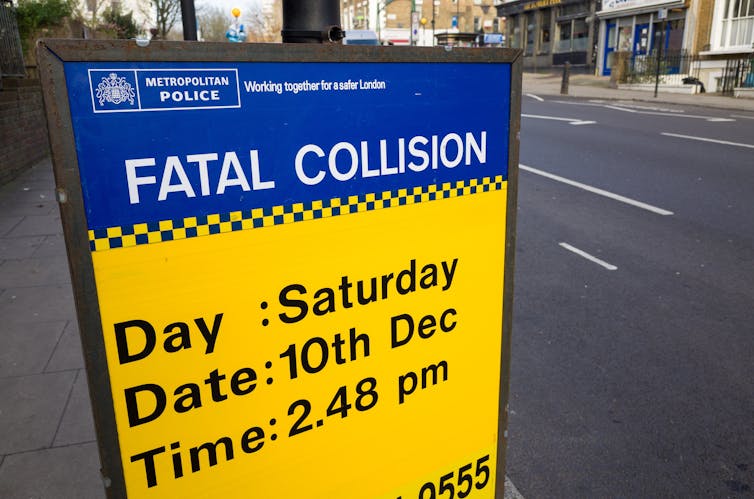
Any surviving driver involved in a fatal collision faces investigation and potential prosecution if found to be at fault. But the government’s proposed strategy rejects the idea that drivers alone bear responsibility for road safety. A number of proposals relate to designing roads and vehicles to reduce the chance and impact of collisions.
It also highlights that certain groups – particularly young male drivers are disproportionately involved in crashes, and proposes measures to address these risks.
As someone who researches motoring law, and how it is applied in practice, I argue this is a welcome shift to prevention, rather than punishment. Recent government policy has leaned heavily on punitive responses that attempt to close the stable door after the horse has bolted.
Over the past three decades, penalties for causing death on the roads have increased significantly. But while longer sentences are deserved in some cases, this approach has done little to punish the underlying offences – dangerous, careless or drink driving – that leads to fatalities.
There are now five specific criminal offences of causing death by driving under the Road Traffic Act 1988. The most serious – causing death by dangerous driving and causing death by careless driving while under the influence of drink or drugs – carry a maximum sentence of life imprisonment, equivalent to manslaughter.
Despite these tougher penalties, bereaved families report dissatisfaction with sentencing, concerned that drivers do not receive the penalty they deserve.
Punishing dangerous driving
Last year, I conducted a study analysing press reports of over 200 sentencing decisions in fatal crashes, mainly from 2024. The final report found that new sentencing guidelines, introduced in 2023, are largely being followed.
The worst cases now receive sentences exceeding the previous maximum of 14 years, aligning with manslaughter sentences. Eight cases resulted in sentences of 15 years or more, with the highest at 19 years.
Sentencing is complex, influenced by numerous factors, including the significant reduction applied when defendants plead guilty. A discount of up to one-third applies to all criminal offences. But given that 70.5% of offenders plead guilty in death-by-driving cases, this has a significant impact.
The maximum penalty under the law is life imprisonment. But the sentencing guidelines do not consider a life sentence appropriate even in the worst cases – those involving extreme speed, alcohol or drugs and multiple aggravating factors. The current guidelines allow judges to take a nuanced approach, with variability in sentencing generally reflecting the unique circumstances of each case.
While drivers who kill on the roads are now generally receiving longer sentences, victims are still being let down in several ways. Many see delays in investigation, the right charge not always being selected for prosecution, some cases being dealt with in a magistrates’ court rather than the Crown Court, and the suspect being able to continue driving up until conviction and again soon after they are released from prison.
Furthermore, harsh sentences are unlikely to deter other deaths. Psychological biases mean drivers rarely believe they will be involved in a fatal crash. Increasing the maximum penalty for such offences appears to be an easy political win without actually addressing the underlying behaviour.
Can the law improve road safety?
If the law is to succeed in deterring deaths on the road, it needs to address drivers’ behaviour before they kill.
Some of the proposals in the road safety strategy correspond with recommendations made in my report, such as the suspension of licences for serious offenders awaiting trial, and measures to support novice drivers. These, however, fall short of the recommendations previously made by the RAC Foundation, a transport policy research charity.
Measures such as lowering the drink-drive limit for all drivers, introducing safeguards for new drivers and suspending licences for those suspected of drink or drug driving are positive steps towards using the law more effectively to reduce road violence.
However, passing new laws aimed at changing driver behaviour will not, on its own, save lives. The enforcement of such legislation depends on effective policing of the roads. As recommended by my report, investment in roads policing and collision investigation is essential.
Fundamentally, we as a society need to take all driving offences seriously, given the ultimate harm they can cause. We need to take a step back and understand that what is sometimes framed as a “war on motorists” is trying to prevent the carnage on our roads.
Sally Kyd received funding from the Parliamentary Advisory Council on Transport Safety (PACTS). She is a member of the Policy Research Committee of PACTS.
At its peak in the 1990s and 2000s, Manchester United was the reference point in professional club football around the globe. It set the commercial agenda, dominated the game domestically and projected power far beyond the pitch. That era now feels distant – not because ambition has faded, but because competence in execution has.
Manchester United’s latest chapter, the sacking of manager Ruben Amorim, has been framed as a necessary football decision. The team’s results were inconsistent and its performances uneven.
Yet focusing on Amorim alone risks missing the wider truth. Manchester United is stuck in a cycle of poor business decisions off the field. The arrival of petrochemical billionaire Sir Jim Ratcliffe’s Ineos to assist majority owners the Glazer family in 2023 has not broken it.
Ineos was brought in as a corrective force, promising modern governance, football expertise and significant investment in infrastructure. At the time, it stated that it wanted to see Manchester United back at the “very top” of English, European and world football.
Fast forward a couple of years and that aim already looks in jeopardy. Instead, the club continues to display the same damaging tendencies that have defined the era after Sir Alex Ferguson’s legendary management period between 1986 and 2013.
These tendencies include reacting to the performances on the pitch rather than prioritising the long-term vision and allowing managerial changes to disrupt wider restructuring projects. Staff redundancies, plans for a new stadium and the latest managerial sacking have all drawn criticisms from fans, analysts and journalists, who often take aim at the way Ineos has structured the hierarchy at the club.
Manchester United’s operating model has become predictable. First, the club appoints a “project” manager – someone with a clearly defined philosophy and a reputation for innovation. Expectations are set high, often publicly, with talk of culture change and long-term vision.
Next comes the structural failure. Recruitment and wage strategy are not aligned to the manager’s philosophy, creating a disconnect between the board, technical director and the manager. Players are inherited who do not fit the system, while new signings are compromises driven by availability, commercial logic or short-term pressure rather than long-term squad building. Power is split between executives, technical directors and owners, leaving the head coach as the scapegoat.
Under-performance then follows. This is not always catastrophic, but it is enough to trigger anxiety at board level and among supporters. The squad looks mismatched, results fluctuate and narratives of decline re-emerge.
Finally, the reset button is pressed. The manager is dismissed, the “culture” is blamed, and the cycle begins again. Reports since Amorim’s sacking have detailed tensions over control, recruitment and tactical direction.
Amorim publicly hinted at frustrations behind the scenes, while leadership including CEO Omar Berrada, director of football Jason Wilcox, and director of recruitment, Christopher Vivell, appeared unconvinced that his approach suited the club’s needs. What is striking is not that the relationship broke down, but how familiar the breakdown felt.
The question should not be whether Amorim was perfect – few managers are. It is whether Manchester United ever created the ecosystem required for him to succeed. The evidence suggests they did not.
Amorim was hired for his clearly defined system and his personality as a modern, progressive coach. But he walked into a squad built for very different managers and ideas. Clear lines of responsibility never fully emerged, and football decisions – or a shared footballing philosophy – struggled to filter down through the club’s corporate structure.
Amorim himself openly questioned how he had been appointed as a “manager”, only to discover that in practice he was operating more as a head coach. The club still seems unsure as to whether it wants a powerful manager, a dominant sporting director or a committee-led model running its football operation.
This ambiguity leaves every coach vulnerable. When results dip, there is no shared accountability – only a convenient exit route.
Financial consequences beyond the pitch
Sacking managers is also a costly business. Amorim left the club with 18 months remaining on his contract, a decision estimated to cost around £12 million in compensation.
Since 2014, the cumulative cost of sacking managers and senior staff at Manchester United has been estimated at close to £100 million. The club also paid £8.3 million in October 2024 to appoint Amorim early. Even for a financial powerhouse, such inefficiency risks becoming a burden.
Externally, instability weakens Manchester United’s negotiating position. Elite players increasingly view the club as a risk rather than a destination, while rivals with coherent structures exploit the indecision.
This is where the financial reality may bite, particularly if the club continues to miss out on the Uefa Champions League, the biggest club football tournament in Europe. The revamped competition can deliver close to £100 million per season for clubs that progress deep into the tournament.
Manchester United has so far maintained revenues — ranking fourth globally – but rivals such as Real Madrid, Barcelona, Bayern Munich, Arsenal and Liverpool have moved ahead on and off the pitch. Missing the Champions League once or twice is manageable; missing repeatedly is not.
Ineos may still believe the club is mid-reform, but reform without coherence is merely motion. Until Manchester United decides who truly owns the football vision and protect that vision through recruitment, patience and structural alignment, no managerial appointment will succeed for long.
Sacking Amorim may feel decisive. History suggests it will change little. Manchester United’s biggest problem is not who stands on the touchline, but how the club makes decisions when the cameras are off.
Manchester United FC and Ineos were approached for comment.
The authors do not work for, consult, own shares in or receive funding from any company or organisation that would benefit from this article, and have disclosed no relevant affiliations beyond their academic appointment.
Inside the body, a 24-hour rhythm, known as the circadian rhythm, quietly coordinates when we sleep, wake, eat and recover. This internal timing system helps keep organs and hormones working in sync. When it becomes disrupted, the effects may extend well beyond poor sleep, with growing evidence suggesting consequences for long-term brain health.
A large 2025 study of more than 2,000 people with an average age of 79 found that those with a strong circadian rhythm had an almost halved risk of developing dementia. Circadian rhythms regulate daily processes including sleep timing, hormone release, heart rate and body temperature.
Over three years of follow-up, dementia developed in 7% of participants with irregular body clocks, measured using heart rate monitors, compared with 10% of those whose rhythms remained more regular.
Disrupted circadian rhythms are often associated with poor sleep. For decades, poor sleep has been suspected to contribute to both dementia and heart disease, which share several underlying risk factors. In the 2025 study, worse heart health and high blood pressure, both commonly linked to sleep disruption, were accounted for in the analysis. Sleep apnoea, however, was not.
Sleep apnoea is a common condition in which breathing repeatedly stops and starts during sleep, reducing oxygen supply to the brain and raising blood pressure. Its relationship with dementia remains debated, largely because sleep apnoea is more common in people who already have established dementia risk factors such as obesity, diabetes, smoking and alcohol misuse. This overlap makes it difficult to determine whether sleep apnoea itself increases dementia risk or whether it reflects broader metabolic and cardiovascular vulnerability.
This review suggested that addressing physical inactivity linked to fatigue from disrupted sleep may be a promising approach. Increasing activity could reduce obesity, improve sleep quality and support brain cell health, potentially lowering dementia risk through several pathways at once.
Other explanations may also help clarify the link between disrupted circadian rhythms and dementia. One involves the immune system, which is influenced by circadian rhythms as well as sleep and plays a role in both heart disease and neurodegeneration. Another is the theory that sleep supports the removal of toxic proteins from the brain, including amyloid plaques that characterise Alzheimer’s disease, through a waste clearance system that appears to be more active during sleep.
While this clearance hypothesis is widely discussed, evidence remains mixed. Some animal studies, including those in mice, have shown reduced rather than increased toxin clearance during sleep. Animal findings must be interpreted cautiously, as sleep patterns in mice differ substantially from those in humans, particularly in later life.
The Lancet commission update on dementia prevention concluded that sleeping for longer or shorter durations is unlikely to be a true independent risk factor for dementia. One reason for this conclusion is that evidence from real-world sleep disruption does not clearly point to sleep duration as the main driver of risk. Although shift work is associated with increased dementia risks, studies do not consistently show higher risk in night shift workers compared with day shift workers. If sleep disruption alone were responsible, night shifts would be expected to carry a greater risk.
This suggests that circadian disruption may matter independently of sleep duration. However, shift work is also associated with unhealthy lifestyle patterns, including poorer diet, smoking, alcohol use and variable physical activity. Chronic stress, lack of routine, hormonal disruption, raised blood pressure, reduced opportunities for leisure and social isolation also cluster around shift work. Each of these factors is independently linked to dementia, heart disease and poor sleep, complicating attempts to isolate the effects of circadian disruption alone.
The Lancet authors also argued that if amyloid clearance does occur in humans, it likely happens during the first two hours of sleep, when deep sleep is most prominent. Deep sleep tends to be preserved even when total sleep duration falls below seven hours. They therefore suggested that fragmented sleep and disrupted biological rhythms may be early consequences of dementia-related brain changes, rather than causes. The toxic plaques may accumulate in brain regions that regulate sleep and wakefulness long before memory problems become apparent.
So should sleep be deprioritised in dementia prevention? The Lancet advice was not to restrict sleep. Evidence linking long sleep, defined as more than eight hours, to dementia risk was not supported when broader data were considered.
A recent trial tested a personalised programme combining several approaches, such as light exposure, sleep scheduling, daytime activity and caregiver support, to improve sleep in people with dementia. After eight months, sleep improved in the intervention group, although sleep also improved with usual care. The overall effect was small to moderate, and there was no improvement in dementia-related behaviours or overall health. These approaches may benefit carers by supporting routines, but their impact for people with dementia appears limited.
Both acute and chronic sleep deprivation, particularly loss of deep sleep and REM sleep, can impair memory. Whether long-term disruption of restorative sleep increases dementia risk later in life, and whether treating sleep problems can prevent dementia, remains uncertain.
Because improving sleep is often seen as a potential prevention strategy, medications used to treat insomnia also deserve scrutiny. Sedative drugs such as benzodiazepines have been linked to increased dementia risk, as well as daytime drowsiness, falls and accidents. Melatonin, while used by many, has not shown consistent benefits for improving sleep in adults.
That said, there are evidence-based ways to improve sleep and support healthy circadian rhythms. Regular moderate exercise, around 30 minutes a day, particularly outdoors and before midday, is one of the most effective. As a bonus, physical activity is also one of the strongest protective factors against heart disease and dementia. So wrap up warm and get walking.
Eef Hogervorst has received funding from governmental research grants to investigate lifestyles and dementia risk. She is affiliated with Loughborough University and acted as expert for NICE and ESHRE Guidelines on whether women going through menopause should be treated with hormones to prevent dementia


























.jpg)