Your brain is currently expending about a fifth of your body’s energy, and almost none of that is being used for what you’re doing right now. Reading these words, feeling the weight of your body in a chair – all of this together barely changes the rate at which your brain consumes energy, perhaps by as little as 1%.
The other 99% is used on the activity the brain generates on its own: neurons (nerve cells) firing and signalling to each other regardless of whether you’re thinking hard, watching television, dreaming, or simply closing your eyes.
Even in the brain areas dedicated to vision, the visuals coming in through your eyes shape the activity of your neurons less than this internal ongoing action.
In a paper just published in Psychological Review, we argue that our imagination sculpts the images we see in our mind’s eye by carving into this background brain activity. In fact, imagination may have more to do with the brain activity it silences than with the activity it creates.
Imagining as seeing in reverse
Consider how “seeing” is understood to work. Light enters the eyes and sparks neural signals. These travel through a sequence of brain regions dedicated to vision, each building on the work of the last.
The earliest regions pick out simple features such as edges and lines. The next combine those into shapes. The ones after that recognise objects, and those at the top of the sequence assemble whole faces and scenes.
Neuroscientists call this “feedforward activity” – the gradual transformation of raw light into something you can name, whether it’s a dog, a friend, or both.
In brain science, the standard view is that visual imagination is this original seeing process run in reverse, from within your mind rather than from light entering your eyes.
So, when you hold the face of a friend in mind, you start with an abstract idea of them – a memory or a name, pulled from the filing cabinet of regions that sit beyond the visual system itself.
That idea travels back down through the visual sequence into the early visual areas, which serve as your brain’s workshop where a face would normally be reconstructed from its parts – the curve of a jawline, the specific shade of an eye. These downward signals are called “feedback activity”.
A signal through the static
However, prior research shows this feedback activity doesn’t drive visual neurons to fire in the same way as when you actually see something.
Even behind closed eyes, early visual brain areas keep producing shifting patterns of neural activity resembling those the brain uses to process real vision.
Imagination doesn’t need to build a face from scratch. The raw material is already there. In the internal rumblings of your visual areas, fragments of every face you know are drifting through at low volume. Your friend’s face, even now, is passing through in pieces, scattered and unrecognised. What imagining does is hold still the currents that would otherwise carry those pieces away.
All that’s needed is a small, targeted suppression of neurons that are pulled by brain activity in a different direction, and your friend’s face settles out of the noise, like a signal carving its way through static.
Steering the brain
In mice, artificially switching on as few as 14 neurons in a sensory brain region is enough for the animal to notice it and lick a sugar-water spout in response. This shows how small an intervention in the brain can be while still steering behaviour.
While we don’t know how many neurons are needed to steer internal activity into a conscious experience of imagination in humans, growing evidence shows the importance of dampening neural activity.
Other lines of evidence strengthen our theory, too. About one in 100 people have aphantasia, which means they can’t form mental images at all. One in 30 form these images so vividly they approach the intensity of images we actually see, known as hyperphantasia.
Research has found that people with weaker mental imagery have more excitable early visual areas, where neurons fire more readily on their own. This is consistent with a visual system whose spontaneous patterns are harder to hold in shape.
Taking all this together, the spontaneous activity reshaping hypothesis – our new theory that imagination carves images out of the steady stream of ongoing brain activity – explains why imagination usually feels weaker than sight. It also explains why we rarely lose track of which is which.
Visual perception arrives with a strength and regularity the brain’s own internal patterns don’t match. Imagination works with those patterns rather than against them, reshaping what is already there into something we can almost see.
The authors do not work for, consult, own shares in or receive funding from any company or organisation that would benefit from this article, and have disclosed no relevant affiliations beyond their academic appointment.
US President Donald Trump is a longtime climate denier and oil industry ally, who sums up his own energy policy as “drill, baby, drill”. Yet he is doing more than almost anyone to speed up the global shift from fossil fuels to clean energy and electric vehicles (EVs).
After the US and Israel struck Iran in late February, Tehran closed the Strait of Hormuz and triggered the largest disruption of oil supply in history.
Ironically for Trump and his oil industry donors, this crisis may be an irreversible tipping point for clean energy. For years, fossil fuel advocates spruiked oil, gas and coal as “reliable” energy. That narrative has been reversed. Fossil fuels have become expensive and unreliable, while renewables are cheap, reliable and secure.
For the first time ever, more than 50 nations will gather next week in Colombia to hash out how to wind down and end their dependence on coal, oil and gas. The history-making conference was planned before the Iran war. But this year’s energy crisis has greatly raised the stakes.
The oil crisis is real
Iran’s closure of the narrow Strait of Hormuz stopped oil tankers reaching their destinations. But that wasn’t all. More than 60 gas and oil sites have been damaged in the conflict so far. Even if a durable ceasefire is reached, these impacts will reverberate for months and years to come.
Around 80% of the trapped crude oil was destined for the Asia-Pacific. Faced with dwindling supply, the region’s governments are implementing emergency measures such as sending workers home, banning government travel, rationing fuel and cutting school hours.
The problem is especially bad in the Pacific. Many island nations use diesel for power generation. In response, leaders declared a regional emergency.
Fuel import bills were already a major burden for Pacific nations, leading to efforts to switch to local renewables. Fuel bills could rise by A$933 million in Fiji (nearly three times the healthcare budget).
When energy supplies are disrupted, leaders have three options: find alternate supplies, reduce use or switch to alternatives. In the very short term, countries aim to shore up supply, just as Australian Prime Minister Anthony Albanese did last week in Malaysia.
Countries have also moved to reduce use. This can have lasting effects. During the Middle East oil shocks of the 1970s, oil prices tripled and then doubled again. Authorities responded by improving energy productivity to do more with less. The world’s final oil demand per capita peaked in 1979 and has never recovered.
But the real difference from half a century ago is that fossil fuel alternatives are ready for prime time. Since the 1970s, the price of solar panels has fallen 99.9%, while the cost of wind has fallen 91% since 1984. Battery prices have fallen 99% since 1991.
This year’s oil shock shows signs of creating an unplanned social tipping point – a threshold for self-propelling change beyond which systems shift from one state to another. Climate scientists warn of climate tipping points which amplify feedback and accelerate warming. But social scientists also point to positive tipping points – collective action that rapidly accelerates climate action.
Australia’s 1.3 million hybrid and battery electric vehicles avoid almost 15 million litres of petrol and diesel use every week.
The rush to electric transport is global. Most new Chinese cars are powered by batteries, not oil. Battery electric vehicles outsold petrol cars for the first time in Europe in January.
A conference to quit fossil fuels
The routine burning of coal, oil and gas is the primary driver of the climate crisis. The world’s highest court last year made clear nations have obligations to stop burning fossil fuels.
But fossil fuels have barely been mentioned in 30 years of global climate negotiations, due in part to blocking efforts by big fossil fuel exporters and lobbyists.
Frustrated by slow progress, a coalition of nations has bypassed global climate talks to discuss how to actually phase out fossil fuels.
The first of these summits will take place next week. More than 50 nations will gather in Santa Marta, Colombia, to discuss a potential standalone treaty to manage fossil-fuel phaseout while protecting workers and financial systems.
Colombian Environment Minister Irene Vélez Torres says it comes at the “best possible moment”, as the oil crisis focuses global attention on fossil fuel dependency.
If next week’s summit produces real momentum to wean off fossil fuels amid the energy crisis, we might look back at it as a social tipping point where early adopters move in earnest – and make it easier for the rest of the world to follow.
Wesley Morgan is a fellow with the Climate Council of Australia
Ben Newell receives funding from the Australian Research Council.
In the opening moments of Vladimir, Netflix’s new erotic drama series, the protagonist M (Rachel Weisz) is sprawled on a couch in her negligee, writing in her notepad. She leans towards the camera, then stares into the lens to address you, the viewer, on your couch.
In film and television, this is called “breaking the fourth wall”. It is a ploy of metafiction: a kind of self-aware mode of storytelling.
The fourth wall is the invisible plane through which the camera observes the action. To break the fourth wall is to play with – or sever – audiences’ suspension of disbelief, and abandon the norms of screen narration.
The history of breaking the fourth wall is almost as long as the history of cinema itself. Edwin S. Porter’s film The Great Train Robbery ends with an outlaw firing his gun directly towards the camera. Back in 1903, audiences ducked for cover.
Nearly a century later, director Martin Scorsese paid homage to Porter in Goodfellas (1990) in a scene where Mobster Tommy DeVito (Jo Pesci) fires his gun directly at the screen. Here, the fourth wall break is used in an existential moment for Henry Hill (Ray Liotta) – rather than for pure shock.
In fact, the shock value of the technique has depleted over time, as audiences have become more media literate.
Making the invisible visible
The fourth wall breaks from early cinema fast disappeared with the industrialisation of the medium. The rise of the American studio system privileged some film techniques over others.
The “Classical Hollywood” style – think Casablanca (1942) – was built on a premise of invisibility, from the carefully directed eye-lines of actors, to “continuity” editing that stitched together different camera angles.
In Breathless (À bout de souffle, 1959) Jean-Luc Godard opted for jump-cuts and “direct address”. This is when a character speaks to, or looks directly at, the viewer.
Today, direct address is used widely across genres, from Barbie (2023), to Marvel’s Deadpool films (2016, 2018, 2024), and Jane Austen adaptations such as Persuasion (2022).
On television, we’ve seen women creators and characters explore the power of direct address in a re-calibration of the “male gaze”.
One example is Phoebe Waller-Bridges’ confessions to the camera in Fleabag (2016–19). Cinematographer Tony Miller notes how creative camera choices work in conjunction with direct address to make viewers “complicit in her [character’s] journey”.
The direct gaze
A fourth wall break is not always dialogue-driven. In Persona (1966) film auteur Ingmar Bergman directed his actors to stare deep into the abyss of the camera lens, delivering existential malaise.
This direct gaze has been remediated for streaming programs, including in the
intense close-up shots of Carmy (Jeremy Allen-White) in the final season of The Bear (2025), and knowing glances from the troubled Rue (Zendaya) in Euphoria (2019–26).
Fourth wall breaks can also be graphic. In Pulp Fiction, Mia Wallace (Uma Thurman) traces a square of light on the screen with her finger instead of calling Vincent Vega (John Travolta) a “square”.
And in Michael Haneke’s films Funny Games (1997, 2007) a home invader literally “rewinds” the story when a victim kills his accomplice. These kind of wall breaks call attention to the invisible membrane of the screen.
As filmmaker Mark Cousins attests in The Story of Film: An Odyssey, the medium has advanced over time through innovation and the recycling of techniques such as fourth wall breaks.
Is breaking the fourth wall back in vogue?
With the dominance of literary adaptations for the screen (and IP-driven screen stories in general) we’re likely to see more cases of direct address, as screenwriters seek to creatively refashion texts for the screen. Vladimir, for instance, is an adaptation of Julia May Jonas’ 2022 novel of the same name.
While breaking the fourth wall may have lost its shock value, it remains a bold storytelling device which, if done well, can set apart one screen production from another.
Actor Matt Damon recently pointed out how streamers such as Netflix are discussing the potential to reiterate “the plot three or four times in the dialogue” of a film, to account for people who scroll on their phone while listening to “background TV”.
Having a character speak directly to a distracted audience may be one way to return their gaze to the bigger screen.
Hyper-reality in unscripted TV
Breaking the fourth wall sits within a wider envelope of “metafictional” storytelling.
As screen culture becomes increasingly aware of its own machinery, unscripted genres such as reality TV are not merely breaking the fourth wall, but abandoning the conceit of separation entirely. The boundaries between cast, camera, story producers and audience have become increasingly porous.
Alex Baskin, executive producer of the long-running series Vanderpump Rules (2013–25), describes this as “hyperreality”. In the wake of Scandoval, the cheating scandal of Tom Sandoval, the reality TV cast started to intervene in the producers’ narrative arcs by speaking on camera about audience feedback, and providing meta commentary on their own “edits”.
When Ariana Madix (Sandoval’s ex) refused to film with him, it disrupted plans for a neat season finale based on his apology. Madix left the set, effectively ending the entire show. Fellow cast member Tom Schwartz called it a “plot twist”. Unsurprisingly, Scorsese is a fan of the show.
Meta and hyperreal storytelling will continue to be on the rise as screen creators seek to imbue a point-of-difference in a congested market – serving an ever-distracted audience.
Alex Munt does not work for, consult, own shares in or receive funding from any company or organisation that would benefit from this article, and has disclosed no relevant affiliations beyond their academic appointment.
Today, Apple announced the tech company’s longtime chief executive Tim Cook will step down and transition to the role of executive chairman of Apple’s board of directors.
This change will take effect from September 1 2026. John Ternus, currently Apple’s senior vice president of hardware engineering, will take over as chief executive.
However, Cook will remain in place until then to ensure a “smooth takeover”. As chairman, he’ll then take on a more strategic role of engaging with policy makers and corporate governance.
Rather than signalling a dramatic shift, this transition is likely going to be more subtle, without a major strategic reset.
A rich legacy for Cook
Cook was only the second chief executive in Apple’s history, after cofounder Steve Jobs resigned in 2011 and died six weeks later.
Cook is widely recognised for his strengths in operations, scale and business model innovation. Under his leadership, Apple became one of the most successful global supply chain organisations reaching more than 200 markets worldwide. The company’s value grew from about US$350 billion in 2011 to US$4 trillion today.
Importantly, Cook drove a decisive shift towards service monetisation – charging users fees for Apple’s digital services and subscriptions, rather than just making money from selling devices such as iPhones, iPads and laptops. Cook’s strategy capitalised on Apple’s already massive base of 2.5 billion active devices.
Service monetisation led to high-margin revenues from Apple’s offerings such as iCloud, Apple Music and the Apple store. Consequently, Apple made more than US$100 billion in 2025 from this business, providing a stable and predictable income beyond cyclical hardware sales.
Who is John Ternus?
In contrast to Cook, Ternus has a deeply technical, product-oriented background shaped by more than two decades in hardware engineering.
At Apple, he has overseen the development of key product lines that include many iterations of the iPhone, iPad, AirPods and the Apple Watch, among others. He’s been closely associated with advances in materials, durability and performance.
The difference in background between Cook and Ternus suggests a subtle but important shift in emphasis for the technology giant.
While Cook focused on transforming Apple into a highly monetised ecosystem anchored in services and global scale, Ternus is likely to reassert the importance of product-led innovation. In his current role, he’s been focusing on engineering excellence and integrating fresh technologies into Apple devices.
With Ternus at the helm, it’s likely the company will try to balance an optimised ecosystem of revenue (that is, service monetisation) with reinvigorating the hardware products that sustain it. That would make a lot of sense.
Apple faces numerous pressures
A stronger product focus under Ternus may also become the company’s response to multiple structural pressures facing Apple.
Apple’s device-centric approach will ensure products are meaningfully distinct from competitors through partnerships. For example, the company will be using Google’s Gemini AI as the basis for an enhanced Siri assistant. At the same time, consumers are upgrading their devices more slowly, so Apple will need more compelling product innovation to drive demand.
Time will tell, but so far everything suggests Ternus succeeding Cook as Apple chief executive will represent a logical and necessary calibration of strategy, rather than a radical shakeup.
Rajat Roy does not work for, consult, own shares in or receive funding from any company or organisation that would benefit from this article, and has disclosed no relevant affiliations beyond their academic appointment.
In the opening moments of Vladimir, Netflix’s new erotic drama series, the protagonist M (Rachel Weisz) is sprawled on a couch in her negligee, writing in her notepad. She leans towards the camera, then stares into the lens to address you, the viewer, on your couch.
In film and television, this is called “breaking the fourth wall”. It is a ploy of metafiction: a kind of self-aware mode of storytelling.
The fourth wall is the invisible plane through which the camera observes the action. To break the fourth wall is to play with – or sever – audiences’ suspension of disbelief, and abandon the norms of screen narration.
The history of breaking the fourth wall is almost as long as the history of cinema itself. Edwin S. Porter’s film The Great Train Robbery ends with an outlaw firing his gun directly towards the camera. Back in 1903, audiences ducked for cover.
Nearly a century later, director Martin Scorsese paid homage to Porter in Goodfellas (1990) in a scene where Mobster Tommy DeVito (Jo Pesci) fires his gun directly at the screen. Here, the fourth wall break is used in an existential moment for Henry Hill (Ray Liotta) – rather than for pure shock.
In fact, the shock value of the technique has depleted over time, as audiences have become more media literate.
Making the invisible visible
The fourth wall breaks from early cinema fast disappeared with the industrialisation of the medium. The rise of the American studio system privileged some film techniques over others.
The “Classical Hollywood” style – think Casablanca (1942) – was built on a premise of invisibility, from the carefully directed eye-lines of actors, to “continuity” editing that stitched together different camera angles.
In Breathless (À bout de souffle, 1959) Jean-Luc Godard opted for jump-cuts and “direct address”. This is when a character speaks to, or looks directly at, the viewer.
Today, direct address is used widely across genres, from Barbie (2023), to Marvel’s Deadpool films (2016, 2018, 2024), and Jane Austen adaptations such as Persuasion (2022).
On television, we’ve seen women creators and characters explore the power of direct address in a re-calibration of the “male gaze”.
One example is Phoebe Waller-Bridges’ confessions to the camera in Fleabag (2016–19). Cinematographer Tony Miller notes how creative camera choices work in conjunction with direct address to make viewers “complicit in her [character’s] journey”.
The direct gaze
A fourth wall break is not always dialogue-driven. In Persona (1966) film auteur Ingmar Bergman directed his actors to stare deep into the abyss of the camera lens, delivering existential malaise.
This direct gaze has been remediated for streaming programs, including in the
intense close-up shots of Carmy (Jeremy Allen-White) in the final season of The Bear (2025), and knowing glances from the troubled Rue (Zendaya) in Euphoria (2019–26).
Fourth wall breaks can also be graphic. In Pulp Fiction, Mia Wallace (Uma Thurman) traces a square of light on the screen with her finger instead of calling Vincent Vega (John Travolta) a “square”.
And in Michael Haneke’s films Funny Games (1997, 2007) a home invader literally “rewinds” the story when a victim kills his accomplice. These kind of wall breaks call attention to the invisible membrane of the screen.
As filmmaker Mark Cousins attests in The Story of Film: An Odyssey, the medium has advanced over time through innovation and the recycling of techniques such as fourth wall breaks.
Is breaking the fourth wall back in vogue?
With the dominance of literary adaptations for the screen (and IP-driven screen stories in general) we’re likely to see more cases of direct address, as screenwriters seek to creatively refashion texts for the screen. Vladimir, for instance, is an adaptation of Julia May Jonas’ 2022 novel of the same name.
While breaking the fourth wall may have lost its shock value, it remains a bold storytelling device which, if done well, can set apart one screen production from another.
Actor Matt Damon recently pointed out how streamers such as Netflix are discussing the potential to reiterate “the plot three or four times in the dialogue” of a film, to account for people who scroll on their phone while listening to “background TV”.
Having a character speak directly to a distracted audience may be one way to return their gaze to the bigger screen.
Hyper-reality in unscripted TV
Breaking the fourth wall sits within a wider envelope of “metafictional” storytelling.
As screen culture becomes increasingly aware of its own machinery, unscripted genres such as reality TV are not merely breaking the fourth wall, but abandoning the conceit of separation entirely. The boundaries between cast, camera, story producers and audience have become increasingly porous.
Alex Baskin, executive producer of the long-running series Vanderpump Rules (2013–25), describes this as “hyperreality”. In the wake of Scandoval, the cheating scandal of Tom Sandoval, the reality TV cast started to intervene in the producers’ narrative arcs by speaking on camera about audience feedback, and providing meta commentary on their own “edits”.
When Ariana Madix (Sandoval’s ex) refused to film with him, it disrupted plans for a neat season finale based on his apology. Madix left the set, effectively ending the entire show. Fellow cast member Tom Schwartz called it a “plot twist”. Unsurprisingly, Scorsese is a fan of the show.
Meta and hyperreal storytelling will continue to be on the rise as screen creators seek to imbue a point-of-difference in a congested market – serving an ever-distracted audience.
Alex Munt does not work for, consult, own shares in or receive funding from any company or organisation that would benefit from this article, and has disclosed no relevant affiliations beyond their academic appointment.
With a shaky ceasefire in place between the US, Israel and Iran – and little progress on talks to resolve the complex issues at the heart of the war – where is this conflict going?
The most likely scenario is a frozen conflict.
A frozen conflict is not static, but is an unresolved war that continues at a low-level below the threshold of full-scale combat.
Even if negotiations resume this week in Pakistan and an eventual agreement is reached, there are still three reasons we believe this is headed towards a frozen conflict, not a comprehensive peace agreement.
1) Trump equates ceasefires with an end to war
US President Donald Trump’s approach to foreign policy has shown he does not treat ceasefires as pauses for negotiations to agree on substantive political issues. Rather, he declares a ceasefire as a US success, then moves on to the next global issue.
Trump claims to have ended ten wars, including the current conflict with Iran and Israel’s war in Lebanon. A closer look reveals that in most of these conflicts, a shaky ceasefire has held while substantive issues remain unresolved.
This has left frozen conflicts in place with ongoing tensions. In India and Pakistan, which engaged in a brief armed conflict last year, for example, there is a continued risk of renewed hostilities. And a lasting peace between Thailand and Cambodia after last year’s border spats remains elusive.
Yet, Trump has walked away from these conflicts and claimed an end to war as soon as a cessation of major hostilities was in place.
2) Asymmetric wars are difficult to resolve
The current war is asymmetric because of the huge difference in military strength between the US and Israel on one side, and Iran on the other.
Iran has intentionally used asymmetric tactics to counter the US’ overwhelming military power, including targeting infrastructure in Persian Gulf countries not involved in the war and closing the Strait of Hormuz to commercial shipping traffic to disrupt the global economy.
Research shows asymmetric wars are inherently protracted and often open-ended. As a result, they are more likely to end in a frozen conflict than an enduring political settlement.
The reason for this is simple. The weaker actor cannot win a conventional military battle against the stronger actor. So, it tries to exhaust the more powerful nation with political, economic and psychological pressure, forcing a withdrawal and cessation of hostilities.
This is what we are seeing now between the US and Iran. Trump is feeling these rising pressures and is pursuing a ceasefire, while trying to claim a US victory.
Iran, meanwhile, has agreed to a ceasefire in a bid for survival as the weaker actor, rather than a commitment to an enduring end to the conflict.
This is reminiscent of the Taliban in Afghanistan, who survived 20 years in a frozen conflict with the US before taking back control of the country when the US withdrew.
3) There’s been no focus on the more complex issues
Neither the US nor Iran appears committed to any long-term resolution of the underlying tensions at the root of the conflict. Key among these is the question of Iran’s nuclear program.
For Washington, the first round of peace talks in Pakistan on April 11–12 were aborted because Iran refused to compromise on its nuclear program. And Iran has long argued it has an inalienable right to enrich uranium for civilian purposes.
The negotiations that led to the multilateral 2015 deal on Iran’s nuclear program – the Joint Comprehensive Plan of Action – took 20 months to conclude. Trump withdrew from the agreement three years later, calling it a “horrible one-sided deal”.
Given this history, a quick and clear resolution to this complex dispute is unlikely.
Some analysts believe the US and Iran could announce a partial agreement that would leave many of the technical aspects to be ironed out later.
But Trump is now facing an opponent that is unlikely to become more accommodating with respect to its long-term “nuclear rights”. In fact, Iran has already shown its resolve by asserting a new geostrategic normal, closing the Strait of Hormuz and disrupting the global economy.
What a frozen conflict means for the region
The Iran-US war may conclude with a series of ceasefires, but will likely remain a frozen conflict due to these underlying tensions. This means more threats from both sides over Iran’s nuclear program and periodic flare-ups of violence between Israel and Iran, the US and Iran, or both.
This is much like the frozen situation in Gaza. Last October, Israel and Hamas agreed to a ceasefire under Trump’s 20-point peace plan. The first phase of the plan was then largely implemented, leading to a hostage-prisoner exchange, a decrease in Israel’s heavy bombardments of Gaza and a resumption of aid into the strip.
However, there has since been no progress on the more complex questions of the post-war governance of Gaza, redevelopment of the strip and – crucially – the disarmament of Hamas fighters. As a result, Israel has refused to completely withdraw its troops and violence has continued.
From a historical perspective, the frozen conflict in the Koreas is also instructive. The war ended with an armistice in 1953 and no peace treaty, effectively leaving North and South Korea at war to this day. This led to the North developing an underground nuclear weapons program that continues to pose a threat to the world.
Similarly, the decades-long frozen India-Pakistan conflict has led to an arms race (including the development of nuclear weapons on both sides), instability in South Asia and periodic flare-ups of violence.
A frozen conflict between the US, Israel and Iran will no doubt create similar long-term instability in the Middle East, including a possible arms race in the Middle East and more flare-ups of violence, particularly around control of the Strait of Hormuz.
The authors do not work for, consult, own shares in or receive funding from any company or organisation that would benefit from this article, and have disclosed no relevant affiliations beyond their academic appointment.
Over the past several days, there have been conflicting reports about the Strait of Hormuz. It’s difficult to know what’s happening from one moment to the next.
Iran said the waterway was open to commercial shipping again, then turned around and said it was closed.
Iran then fired at two Indian-flagged ships going through the strait, forcing them to turn around.
The next day, the US fired on an Iranian cargo vessel, which Tehran called a violation of the two countries’ temporary ceasefire and threatened retaliation.
What’s actually happening in the strait? Are both sides acting lawfully? We asked naval expert Jennifer Parker to explain.
What happened over the weekend?
There have been several key developments over the last 48 hours.
The first was the statement from US President Donald Trump and the Iranian foreign minister on social media that the Strait of Hormuz remained open. It was an interesting announcement because it was consistent with what the foreign minister had said at the beginning of the ceasefire a week and a half ago.
On Saturday, we saw a large number of tankers and cargo vessels move towards the top of the strait to follow what Iran has designated as a new passageway. Some ships that are clearly desperate to get out of the strait were obviously more confident they were safe to transit through at that point.
The Joint Maritime Information Centre in Bahrain said 18 ships were able to transit through, at least ten through the new Iranian-designated transit route, which is north of the normal transit route.
However, Iranian Revolutionary Guard Corps Navy then reportedly attacked a number of
civilian merchant vessels. One was an Indian tanker that was on an approved list with the IRGC to travel through the strait.
This suggests the Iranian military may have been disagreeing with the statement of the Iranian foreign minister, saying the strait remains closed.
Is the US blockade legal?
Then, on Sunday, the US fired on an Iranian-flagged cargo ship in the Arabian Sea.
The US is blockading Iranian ports through what’s called a distant blockade. This means US Navy ships are not sitting right off Iran’s ports to stop vessels. Rather, they are positioned further back in the Gulf of Oman and the northern Arabian Sea, with a blockade line effectively drawn between the Iranian-Pakistan border to around the Omani-UAE border.
The US Central Command has reported turning away a number of ships – at least 23 as of April 18.
When a ship approaches the blockade line en route to or from an Iranian port, the US Navy will radio the vessel and say it is not free to go through. Most ships will then turn around.
This is allowed in a lawful blockade under the law of naval warfare. Once a conflict has started, a blockade is a lawful if it complies with certain provisions:
the blockade must be declared
it must be impartial, meaning it needs to apply to all ships
humanitarian goods must be permitted to go through
it must be effective, meaning you can’t declare a blockade, start doing it, and then not actually enforce it
it can’t close off neutral ports.
Many news reports have said the US is blockading the Strait of Hormuz. But it is actually blockading Iranian ports, not the strait. A blockade of the strait would be illegal because this would affect neutral ports in the Persian Gulf. Ships in an international strait enjoy unimpeded transit passage, which cannot be hampered or suspended by the coastal state.
Is the US permitted to fire on a cargo vessel?
The US says it warned the Touska, the Iranian-flagged vessel, to stop over a six-hour period.
If a vessel doesn’t comply with warnings like this, warning shots can then be fired, depending on your country’s rules of engagement. The country maintaining the blockade may also use “disabling fire” against the ship.
This is what the US claims happened – the US Navy destroyer fired on the Touska’s engine room to make it stop. My assessment is this is consistent with the law of naval warfare because the US Navy is enforcing an effective blockade. It also appears to have adhered to the principles of proportionality and necessity under international law.
The US also seized the ship, which is consistent with the law. In terms of the crew, the US has not announced what it intends to do with them. If the crew is non-Iranian, they would likely be released and repatriated. If the crew is Iranian, or if some of the crew are linked to the IRGC, they could be detained.
By contrast, based on current reporting, the ships fired on by Iran appear to have been neutral merchant vessels transiting an international strait. On the information publicly available, there is no indication they had become lawful military objectives.
This is not a lawful use of force because these vessels are not a lawful military objective.
Neutral merchant vessels are generally considered civilian objects under the law unless, by their nature, location, purpose or use, they make an effective contribution to military action. Therefore, it’s not lawful to attack them.
There are some exceptions to that, including a merchant vessel seeking to breach a lawful blockade.
Where do things go from here?
The US is not saying it’s in control of the strait, it’s saying it’s in control of the vessels going in and out of Iran, which is different.
Iran has claimed it’s in control of the strait since the war began. It has been attacking and threatening civilian, predominantly neutral vessels since then.
What I think we are seeing is a tussle for leverage to supercharge the negotiations between the US and Iran, should they continue this week in Pakistan.
Ten years earlier, Kim Gordon’s career began during New York’s post-punk era. Her book, Girl In A Band (2015), recently re-released as a tenth anniversary edition, chronicles her time with Sonic Youth, and charts her role within an alternative scene that shaped and influenced independent music culture across the United States.
By the early 1990s, she was something of a godmother figure for Auf der Maur’s generation of women.
Review: Even the Good Girls Will Cry: My 90s Rock Memoir – Melissa Auf Der Maur (Atlantic); Girl in a Band – Kim Gordon (Faber)
Introverted individuals with distinct perspectives on the peculiar challenges of the rock industry, Gordon and Auf der Maur appear to have benefited from a stability missing in many of their peers.
As bass players, they avoided the spotlight until embarking on their solo projects. And with backgrounds in the visual arts, they each had access to independent creative identities away from the stage, which no doubt minimised the pitfalls of rock stardom.
As a music journalist throughout the 1990s, I interviewed many of the people in their stories, including Courtney Love, Billy Corgan, Dave Grohl, Thurston Moore and Kurt Cobain. I witnessed their complex politics and fierce power plays, some still ongoing.
For example, a very high profile singer tried to persuade other women not to speak to me for my first book because my magazine profile of her was badly altered by a male editor. Another musician blamed me for publishing personal details in an interview after I’d given her full copy approval.
It was, as Auf der Maur says, a time of “messy humanity”, low-level trust, and delicate egos.
It was also, as she points out, the last analogue decade: a time before the music scene was transformed by the internet, when rock culture appeared to be finally embracing powerful women and female agency. But in my experience, and as each of these books reveals, it was never that straightforward.
Musical callings and romantic dreams
An artistic free spirit raised in Montreal by unorthodox, creative parents, Melissa Auf der Maur first saw Hole and Smashing Pumpkins within a fortnight of each other in July 1991. Both bands played at the legendary punk club, Les Foufounes Électriques, where she worked part-time while studying photography.
More impressed by Hole’s calm, centred bassist, Jill Emery, than the band’s infamous, volatile frontwoman, Auf der Maur was truly starstruck by Corgan. She introduced herself to him after he was bottled on stage by her roommate. Watching him play, she experienced a “new musical calling”. Four months later, she travelled to a Pumpkins show in Vermont and spent the night “soul fucking” him in his motel room.
“I am you and you are me,” she remembers Corgan saying to her, in what sounds like a rock-starry show of narcissism towards an impressionable fan. But for Auf der Maur, who occasionally veers into grandiose claims, the encounter was a “romantic dream come true” and “a turning point […] musically, personally and cosmically”.
More tellingly perhaps, though she describes Corgan as eventually exerting “more influence on my life than anyone other than my parents”, Auf der Maur didn’t question his patriarchal power dynamic for many years – despite being in one of rock’s most notorious female-fronted bands.
But Corgan’s hold extended to his former girlfriend, Courtney Love, long after she left him for Kurt Cobain. When Hole’s second bassist, Kristen Pfaff, died from an overdose, it was Corgan who decided Auf der Maur should be the replacement.
The Hole drama
Life in Hole was nothing if not dramatic – and Auf der Maur’s account harbours no illusions about the difficulty of working with a grieving, traumatised widow.
But her empathy and compassion keep her story from collapsing into the critical terrain so often provoked by the outspoken, uncontained Love who attracted considerable vitriol, particularly after becoming involved with Kurt Cobain.
Auf der Maur is also more forgiving than drummer Patty Schemel, who paints a harsher picture of the ambitious, tempestuous singer in her brilliant memoir, Hit So Hard. But she was very aware of her marginalised position as Love’s “good girl” in the autocratic Hole. She had no artistic freedom in the band and eventually grew frustrated with her unfulfilling situation.
After five years in Love’s orbit, Auf der Maur wanted out. By 1998, the singer’s Hollywood film career had catapulted her into a different stratosphere of celebrity culture, further widening the existing chasm between her and her band members.
And the glamour and excitement of big festival billings and hit records were not enough to prevent the bass player from feeling ultimately “disillusioned and disconnected”.
Her decision to quit was compounded when she fell in love with ex-Nirvana drummer Dave Grohl, now with the Foo Fighters. His long-running rift with Love had previously made him “off-limits”.
But before she was released from her restrictive contract with Hole, Corgan was back in touch, asking her to replace D’arcy Wretzky in Smashing Pumpkins for a year of intensive touring. Wretzky’s sudden departure is glossed over in the book as a “touchy subject”, though she played with the Pumpkins for 11 years, and was reputedly a friend of Auf der Maur.
I remember Wretzky as a quietly intelligent individual with a striking stage presence, but Corgan’s domineering personality and punishing work ethic apparently proved too much for her.
And Auf der Maur makes no secret of Corgan’s ruthlessness. At her first rehearsal, he issued her with three rules: “One, you can’t make a mistake. Two, you can’t get sick. And three, there are no days off.”
Away from Grohl, who was also on the road with his band, she was bound to a gruelling schedule at the hands of a man she now saw as a moody overachiever. In response, she began to change her perspective.
Corgan’s partner at the time was the gifted photographer Yelena Yemchuk, who, Auf der Maur notes, had become “a bit of a kept woman”. Knowing Grohl wanted marriage and children, she witnessed Yemchuk with “her beautiful talent trapped in the bell jar of Billy’s world” with growing alarm.
As the two women became close, together they realised they needed to “step out of the shadows of these bigger, more successful men” and forge their own paths.
With the culmination of the Pumpkins world tour in 2001, Auf der Maur was 29 and finally ready for a new direction. She left her relationship with Grohl and turned down Corgan’s invitation to collaborate on a new project. She finishes her book with a glimpse into her next chapter: motherhood, and a grounded life of artistic ventures in upstate New York.
It’s more of a beginning than an end.
Feminism and challenges with men
The first time I interviewed Kim Gordon was over the phone in 1990. At the time, she was the bass player with Sonic Youth, the seminal no wave band she co-founded with her husband, singer/guitarist Thurston Moore, in 1981. Hinting at what I suspected was sometimes a lonely situation, she told me that while the band’s relationship was essentially a beautiful one, her male colleagues could be “so non-communicative”.
Three years later, I had a second, longer conversation with Gordon in her New York apartment for my aforementioned book, during which she elaborated on her original theme. Being in a band with men could be challenging, she said, because “there are some really boring aspects to it” and “no matter how much of a new man someone thinks they are, they’re just not!”
Gordon’s experience is summed up by both the content and title of her acclaimed memoir. With a new foreword by her friend, celebrated American writer, Rachel Kushner, and an additional closing chapter where Gordon reflects on the intervening decade, the latest version of the book is testament to its ongoing relevance for feminism, popular culture and music history.
Infused with the visceral, embodied sensuality of her artistic perspective, Gordon’s memoir details her upbringing in Los Angeles with her schizophrenic brother, Keller, whose moods clouded her early life, and whose death in 2023, aged 74, she recounts in the new edition.
It charts her pivotal move to New York as a 27-year-old in 1980, her involvement with the city’s post punk arts and music scene, her relationship with Moore and their resulting career with Sonic Youth.
Crucially, it details her influence in the Riot Grrrl movement, and her side projects, Free Kitten, with best friend Julie Cafritz, and fashion label, X-Girl, with Daisy von Furth, all of which afforded her the female companionship she lacked in Sonic Youth.
‘Painfully protracted’ marriage breakdown
It also tells the more universal story of a painfully protracted marriage breakdown and a couple’s failed attempts to save their relationship, following Gordon’s discovery of Moore’s affair. The book refrains from specifying dates, but by the time she found out through texts and emails, her husband had been unfaithful for several years.
The woman in question, who is not named in the book, was Eva Prinz, who became Moore’s second wife in 2020. At the time of the affair, Prinz was married to her second husband. She had previously been involved with one of Sonic Youth’s collaborators.
An editor for an independent publisher, she had initially approached Gordon about a potential book project in the early 2000s, but Gordon had passed it onto Moore, with fateful consequences.
Sickened by Moore’s long-concealed infidelity with someone well known to their inner circle, Gordon was left to navigate the devastating impact on her family, her career and her sense of self. Given the pivotal nature of this episode, it seems fitting that she starts her story here, at the end of a significant personal and professional era, with Sonic Youth’s final performance in 2011.
According to Gordon, this last appearance in Sao Paulo, Brazil “was all about the boys”. Struggling to hide her misery, anxiety and anger on stage, while her ex regressed into an adolescent display of “rock star showboating”, she was tempted to verbalise her fury on stage. But she didn’t want to follow the unboundaried example of Courtney Love, who was then ranting and raving her way around South America on tour with Hole.
“I would never want to be seen as the car crash she is,” writes Gordon. “I didn’t want our last concert to be distasteful when Sonic Youth meant so much to so many people; I didn’t want to use the stage for any kind of personal statement, and what good would it have done anyway?”
Distance as power
Gordon is highly adept at balancing between strong emotion and careful restraint. Throughout her book, she considers herself honestly, but thoughtfully. She conveys a quiet self-possession and enigmatic presence, writing as she speaks: with intelligence and a guarded openness. It’s how I remember her: warm enough to gift me a pair of John Fluevog sandals straight from her own closet, yet somehow always slightly removed. As Kushner says in her introduction to the memoir, “distance is the power of her performance”.
Now 72, Kim Gordon has been a touring musician for almost 40 years. Having made multiple forays into the worlds of fashion, art and film, since Sonic Youth she has launched two experimental bands with male collaborators, Body/Head and Glitterbust, been nominated for two Grammy awards, and released three highly acclaimed solo albums as a formidable frontwoman with an all-girl band.
These days, Gordon performs as if her life depends on it. With her second chapter well underway, she’s on fire – and cooler than ever. Let’s hope a second memoir is in the works.
Liz Evans does not work for, consult, own shares in or receive funding from any company or organisation that would benefit from this article, and has disclosed no relevant affiliations beyond their academic appointment.
Transparent acrylic samples coated in the new material.RMIT
Think of how many surfaces you touch every day, from your kitchen bench to the hand rail on the bus or train, your work desk and your phone screen.
A range of nasty viruses and other germs can easily spread via these surfaces. The typical route of infection involves touching a contaminated surface – and then touching your eyes, nose or mouth.
Of course, it’s possible to clean surfaces with chemical products. But these can wear off, harm the environment or contribute to antimicrobial resistance, where germs no longer respond to medicines because of repeated exposure.
In our new study, published in Advanced Science, colleagues and I created a thin plastic surface with tiny nanoscale features, billionths of a metre in size, that mimic the nanotextured surface of insect wings and can physically rupture viruses – specifically human parainfluenza virus type 3 (hPIV-3).
This new material offers a cheap, scalable way to make surfaces such as phones and hospital equipment far less likely to spread disease.
The downsides of disinfectants
Current methods for combating the spread of viruses via surfaces usually involves cleaning to remove dirt and disinfection to remove hidden contaminants.
Disinfectant must remain wet for some time to kill germs. This can be challenging in some real-world settings.
Surfaces can also be recontaminated quickly when other people touch them. And disinfection often involves the use of harsh chemicals which can damage equipment and the environment.
Scientists have previously developed antiviral surface modifications. These strategies often involve incorporating materials such as graphene or tannic acid and other natural agents into personal protective equipment such as masks, gloves, goggles, hard hats, and respirators.
These coatings are efficient. But they can pose a risk to human health. They can also be environmental hazards due to chemical leaching and have declining effectiveness over time as the potency of the active ingredients weakens.
A decade-long journey
Our journey toward a virus-bursting surface started more than a decade ago.
We initially aimed to engineer a surface so smooth that germs would simply slide off. Surprisingly, we discovered the opposite. Bacteria adhere quite readily to nanoscopically smooth surfaces.
Nature offers examples of bacteria-free surfaces. Take the water-repelling wings of cicadas and dragonflies. While these wings are self-cleaning, they act less by repelling bacteria and more as natural bactericides. That is, they kill bacteria. Natural bactericides are nature-derived “agents” that can kill germs, rather than inhibit their growth.
Experiments my colleagues and I did with gold-coated wings confirmed this bacteria-killing effect is not driven by surface chemistry, but rather by topography.
The physical nanostructures on the surface essentially force bacterial cell membranes to stretch and rupture.
Our earlier work showed that nanospike-covered silicon effectively destroys viruses on contact. But its rigid nature restricts its use on complex objects.
Microscope image of a virus cell being ruptured by the nanotextured surface. RMIT
A lightweight, flexible and virus-bursting material
In this new study, we addressed this problem by creating a virus-bursting material that was lightweight, cost-effective and flexible.
This material is a thin acrylic film covered in thousands and thousands of ultra fine pillars. The nanotextured materials are smooth to touch. However, these nanopillars grab and stretch a virus’s outer shell until it ruptures. This kills viruses through mechanical force.
Lab tests with hPIV 3, which causes bronchiolitis and pneumonia, found up to 94% of virus particles were ripped apart or fatally damaged within an hour of contact with this material.
We discovered the distance between nanopillars matters far more than their height, with tightly packed pillars about 60 nanometres apart working best.
The mould we used to create this material can be easily scaled to provide wide-ranging industrial opportunities, from food packaging to public transport systems to hospital equipment and office desks.
Nanostructured surfaces are built for durability. But they are susceptible to the same physical, chemical, and environmental stressors as any other material, and will degrade over time.
Much remains to be discovered in the search for germ-free surfaces. But these nanotextured surfaces have enormous potential in the fight against viruses and provide an alternative to traditional, chemical-based methods.
Elena Ivanova does not work for, consult, own shares in or receive funding from any company or organisation that would benefit from this article, and has disclosed no relevant affiliations beyond their academic appointment.
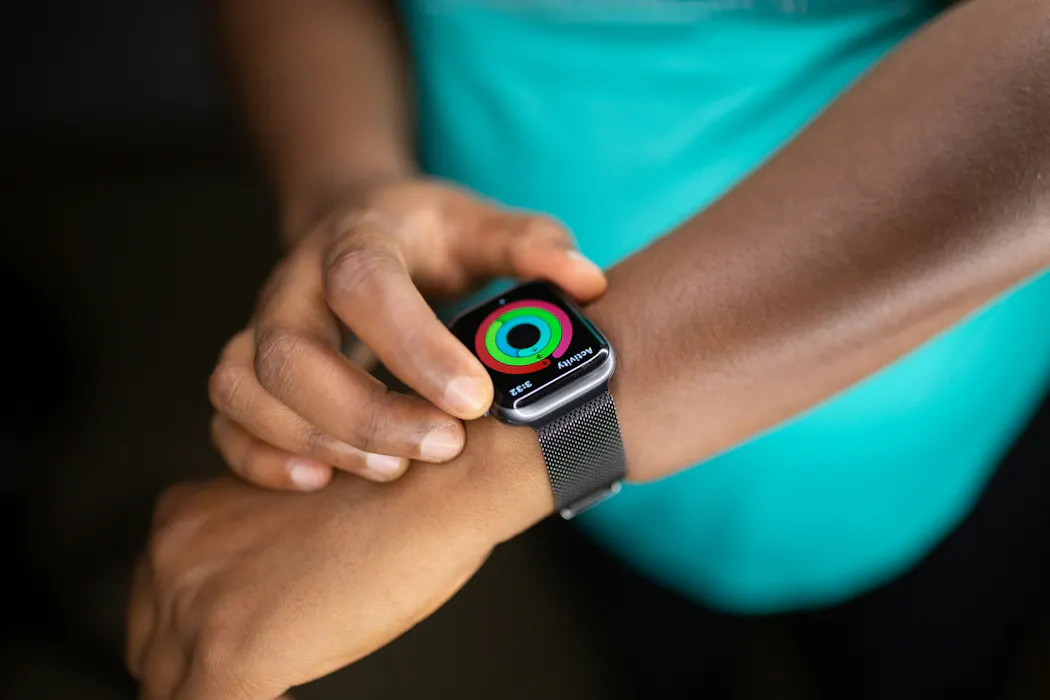
You check your smartwatch after a run. Your fitness score has dropped. You’ve burnt hardly any calories. Your recovery score is really low. It’s telling you to take the next 72 hours off exercise.
The worst bit? The whole run felt amazing.
So why’s your watch telling you the opposite?
Ultimately, it’s because smartwatches and other fitness trackers aren’t always accurate.
Smartwatches can shape how you exercise
Using wearable fitness technology, such as smartwatches, has been one of the top fitness trends for close to a decade. Millions of people around the world use them daily.
These devices shape how people think about health and exercise. For example, they provide data about how many calories you’ve burnt, how fit you are, how recovered you are after exercise, and whether you’re ready to exercise again.
But your smartwatch doesn’t measure most of these metrics directly. Instead, many common metrics are estimates. In other words, they’re not as accurate as you might think.
1. Calories burned
Calorie tracking is one of the most popular features on smartwatches. However, the accuracy leaves a lot to be desired.
This matters because people often use these numbers to guide how much they eat.
For example, if your watch overestimates calories burned, you might think you need to eat more food than you really need, which could result in weight gain. Conversely, if your watch underestimates calories burned, it could lead you to under-eat, negatively impacting your exercise performance.
2. Step counts
Step counts are a great way to measure general physical activity, but wearables don’t capture them perfectly.
Smartwatches can under-count steps by about 10% under normal exercise conditions. Activities such as pushing a pram, carrying weights, or walking with limited arm swing likely make step counts less accurate, as smartwatches rely on arm movement to register steps.
For most people, this isn’t a major problem, and step counts are still useful for tracking general activity levels. But view them as a guide, rather than a precise measure.
3. Heart rate
Smartwatches estimate your heart rate using sensors that measure changes in blood flow through the veins in your wrist.
This method is accurate at rest or low intensities, but gets less accurate as you increase exercise intensity.
Arm movement, sweat, skin tone and how tightly you wear the watch can also impact the heart rate measure it spits out. This means the accuracy can vary between people.
This can be problematic for people who use heart rate zones to guide their training, as small errors can lead to training at the wrong intensity.
Almost every smartwatch on the market gives you a “sleep score” and breaks your night into stages of light, deep and REM sleep.
The gold standard for measuring sleep is polysomnography. This is a lab-based test that records brain activity. But smartwatches estimate sleep using movement and heart rate.
Most smartwatches track heart rate variability and use this, with your sleep score, to create a “readiness” or “recovery” score.
Heart rate variability reflects how your body responds to stress. In the lab it is measured using an electrocardiogram. But smartwatches estimate it using wrist-based sensors, which are much more prone to measurement errors.
This means most recovery metrics are based on two inaccurate measures (heart rate variability and sleep quality). This results in a metric that may not meaningfully reflect your recovery.
As a result, if your watch says you’re not recovered, you might skip training – even if you feel good (and are actually good to go).
6. VO₂max
Most devices estimate your VO₂max – which indicates your maximal fitness. It’s the maximum amount of oxygen your body can use during exercise.
The best way to measure VO₂max involves wearing a mask to analyse the amount of oxygen you breathe in and out, to determine how much oxygen you’re using to create energy.
But your watch cannot measure oxygen use. It estimates it based on your heart rate and movement.
This means the number on your watch may not reflect your true fitness.
What should you do?
While the data from your smartwatch is prone to errors, that doesn’t mean it is completely worthless. These devices still offer a way to help you track general trends over time, but you should not pay attention to daily fluctuations or specific numbers.
It’s also important you pay attention to how you feel, how you perform and how you recover. This is likely to give you even more insight than what your smartwatch says.
Hunter Bennett does not work for, consult, own shares in or receive funding from any company or organisation that would benefit from this article, and has disclosed no relevant affiliations beyond their academic appointment.