Trump’s Brazil tariffs point more to his enduring bond with far-right Bolsonaro than economic concerns

Source: The Conversation – Global Perspectives – By Rafael R. Ioris, Professor of Modern Latin America History, University of Denver
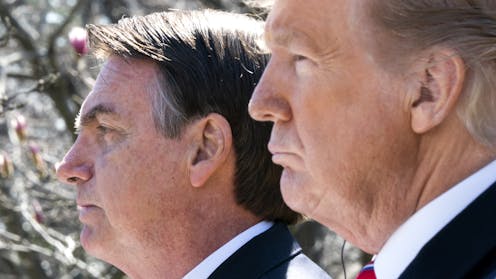
U.S. President Donald Trump and then-Brazilian President Jair Bolsonaro attend a joint news conference at the White House on March 19, 2019. Jim Lo Scalzo-Pool/Getty Images

After much back-and-forth over several months, President Donald Trump announced on July 9, 2025, that he planned to levy a 50% tariff on Brazilian exports to the United States. While Brazilian authorities, along with leaders of most other countries, have been expecting new tariffs given their centrality to Trump’s economic agenda, the announcement seemingly caught Brazilian officials off guard, as trade negotiations between the two nations were still ongoing.

Brazil President Lula da Silva was quick in reacting, stating his country could respond in kind, if tariffs indeed come into effect on Aug. 1.

There has been much speculation about the reasons behind Trump’s decision and timing, with some onlookers noting the proximity to the recent meeting of the BRICS nations, a grouping of emerging economies, including Brazil, which had already drawn Trump’s ire. Others argued that this was a protective measure to defend key U.S. industries, such as steel, which have been facing continued difficulties against cheaper products from Brazil.

The clearest answer, however, came from Trump himself.

In a letter to Lula, the U.S. president indicated that his main grievance with Brazil is in fact the trial that former Brazilian President Jair Bolsonaro faces in front of that country’s highest court. The former far-right firebrand is charged for refusing to recognize the result of the last presidential election in October 2022 and for allegedly having led an attempted coup against the democratic institutions and rule of law in January 2023. If convicted, Bolsonaro and some of his closest associates could face long prison sentences.

A history of meddling

The only economic rationale mentioned in Trump’s letter, that of a deficit that his country is said to face with Brazil, is belied by the numbers. The U.S. has sustained consistent surpluses in trade with the South American nation for close to two decades now.

And Steve Bannon, Trump’s former adviser, active cheerleader and primary conduit between the Trump camp and Bolsonaro, was even more blunt than the U.S. president. In an interview with one of Brazil’s main news site, he stated: “Stop the trial and we will reverse the tariffs.”
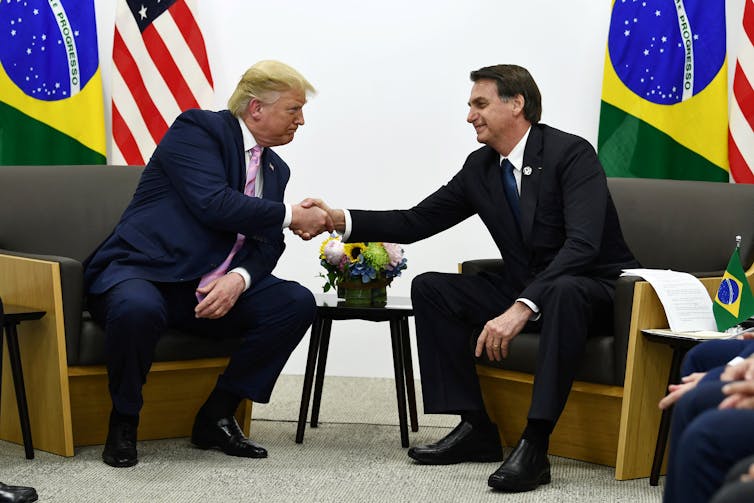
Two men in suits shake hands.
Bolsonaro meets with Trump during the G20 Summit in Osaka, Japan, on June 28, 2019.
Brendan Smialowski/AFP via Getty Images

As the history of U.S.-Latin American relations ably demonstrates, this is far from the first time Washington has meddled in the region in order to satisfy its own political proclivities. Indeed, particularly during the Cold War, a slew of U.S. decision-makers actively intervened to support friendly right-wing regimes or to otherwise remove from power administrations considered unacceptably independent.

This was nonetheless the first time in recent history that the official U.S. position is that a foreign nation should face harsh economic punishment unless its current government illegally circumvent the judicary’s constitutional role to stop a major investigation against someone accused of high crimes.

Trump-Bolsonaro: Mutual admiration

Of course, Trump’s overt support for Bolsonaro is not surprising, nor new. Their relationship of mutual admiration and ideological affinity hearkens back to the latter’s first presidential campaign in 2018, when he was labeled, to great reciprocal delight, the “Trump of the Tropics.”

During the subsequent two years when their terms coincided (2019-2000), both men pledged to have a mutual special relationship, though to little consequence – no consequential bilateral projects were put in place.

Both leaders also share the experience of having failed to obtain a second consecutive term and having supported the derailment of the peaceful transfer of power.

Now that Trump is back in power, Bolsonaro hopes that the U.S. president will come to his rescue.

Seeking to obtain explicit support, Bolsonaro’s third son, Eduardo, a member of Brazil’s lower house of congress and his family’s most eloquent international voice, took a leave from his legislative duties and moved to the U.S. early this year. He did so to lobby on behalf of his father based on the fallacious argument that Lula is a left-wing dictator, that Bolsonaro faces a politically motivated trial, and that the U.S. government should act against Lula’s administration.

Given Trump’s tariff notice and the explicit reasons he gave for it, it seems safe to assume that Eduardo’s actions paid dividends.

Which direction will Brazil head?

Like the U.S., Brazil is deeply fractured along left and right political lines. So it was no surprise that the local reactions to Trump’s announcement manifested along ideological camps.

Despite their leader’s legal travails, Bolsonaro’s supporters remain very influential in politics, the media and among important economic areas, such as the agribusiness sector. Whether Trump’s decision will serve to help people rally around and in support of Lula and against a case of foreign interference is unclear. Lula’s initial pronouncement that Brazil would respond in kind was seen favorably among his supporters, though the opposition and many in the media pinned the blame on Lula for not being able to forge compromise with the Trump administration.

Key industrialists in the powerful state of Sao Paulo, where Bolsonaro’s powerful ally Tarcisio de Freitas serves as governor, will be the first ones affected by the new tariffs. But the pain will likely spread into other activities, including in the countryside.

And given that the bulk of the country’s agricultural exports go to China rather than to the U.S., the important question is whether these powerful exporters will act pragmatically and work with Lula to enlarge trade with the Asian giant and other countries, or whether they will continue to act ideologically and continue to support Bolsonaro’s enduring partnership with Trump against their own economic interests.

Dialogue has been a hallmark of Brazil’s diplomacy, and even in the middle of these latest heated diplomatic exchanges, Lula reiterated his willingness to negotiate. It is unclear, though, whether the Trump adminstration’s actions in Latin America will be conducted on the basis of rationality and actual numbers, or if they will indeed bring back some old ideologically driven behaviors of picking sides in the internal political disputes of foreign nations. Should one consider at face value Trump’s latest letter, there is reason for concern.

The Conversation

Rafael R. Ioris does not work for, consult, own shares in or receive funding from any company or organization that would benefit from this article, and has disclosed no relevant affiliations beyond their academic appointment.

ref. Trump’s Brazil tariffs point more to his enduring bond with far-right Bolsonaro than economic concerns – https://theconversation.com/trumps-brazil-tariffs-point-more-to-his-enduring-bond-with-far-right-bolsonaro-than-economic-concerns-260993

Was the Air India crash caused by pilot error or technical fault? None of the theories holds up – yet

Source: The Conversation – Global Perspectives – By Guido Carim Junior, Senior Lecturer in Aviation, Griffith University

Over the weekend, the Indian Aircraft Accident Investigation Bureau released a preliminary report on last month’s crash of Air India flight 171, which killed 260 people, 19 of them on the ground.

The aim of a preliminary report is to present factual information gathered so far and to inform further lines of inquiry. However, the 15-page document has also led to unfounded speculation and theories that are currently not supported by the evidence.

Here’s what the report actually says, why we don’t yet know what caused the crash, and why it’s important not to speculate.

What the preliminary report does say

What we know for certain is that the aircraft lost power in both engines just after takeoff.

According to the report, this is supported by video footage showing the deployment of the ram air turbine (RAT), and the examination of the air inlet door of the auxiliary power unit (APU).

The RAT is deployed when both engines fail, all hydraulic systems are lost, or there is a total electrical power loss. The APU air inlet door opens when the system attempts to start automatically due to dual engine failure.

The preliminary investigation suggests both engines shut down because the fuel flow stopped. Attention has now shifted to the fuel control switches, located on the throttle lever panel between the pilots.

This is what the fuel switches look like, with the throttle lever above them.
Aircraft Accident Investigation Bureau

Data from the enhanced airborne flight recorder suggests these switches may have been moved from “run” to “cutoff” three seconds after liftoff. Ten seconds later, the switches were moved back to “run”.

The report also suggests the pilots were aware the engines had shut down and attempted to restart them. Despite their effort, the engines couldn’t restart in time.

We don’t know what the pilots did

Flight data recorders don’t capture pilot actions. They record system responses and sensor data, which can sometimes lead to the belief they’re an accurate representation of the pilot’s actions in the cockpit.

While this is true most of the time, this is not always the case.

In my own work investigating safety incidents, I’ve seen cases in which automated systems misinterpreted inputs. In one case, a system recorded a pilot pressing the same button six times in two seconds, something humanly impossible. On further investigation, it turned out to be a faulty system, not a real action.

We cannot yet rule out the possibility that system damage or sensor error led to false data being recorded. We also don’t know whether the pilots unintentionally flicked the switches to “cutoff”. And we may never know.

As we also don’t have a camera in the cockpit, any interpretation of pilots’ actions will be made indirectly, usually through the data sensed by the aircraft and the conversation, sound and noise captured by the environmental microphone available in the cockpit.

We don’t have the full conversation between the pilots

Perhaps the most confusing clue in the report was an excerpt of a conversation between the pilots. It says:

In the cockpit voice recording, one of the pilots is heard asking the other why did he cutoff. The other pilot responded that he did not do so.

This short exchange is entirely without context. First, we don’t know who says what. Second, we don’t know when the question was asked – after takeoff, or after the engine started to lose power? Third, we don’t know the exact words used, because the excerpt in the report is paraphrased.

Finally, we don’t know whether the exchange referred to the engine status or the switch position. Again, we may never know.

What’s crucial here is that the current available evidence doesn’t support any theory about intentional fuel cutoff by either of the pilots. To say otherwise is unfounded speculation.

We don’t know if there was a mechanical failure

The preliminary report indicates that, for now, there are no actions required by Boeing, General Electric or any company that operates the Boeing 787-8 and/or GEnx-1B engine.

This has led some to speculate that a mechanical failure has been ruled out. Again, it is far too early to conclude that.

What the preliminary report shows is that the investigation team has not found any evidence to suggest the aircraft suffered a catastrophic failure that requires immediate attention or suspension of operations around the world.

This could be because there was no catastrophic failure. It could also be because the physical evidence has been so badly damaged that investigators will need more time and other sources of evidence to learn what happened.

Why we must resist premature conclusions

In the aftermath of an accident, there is much at stake for many people: the manufacturer of the aircraft, the airline, the airport, civil aviation authority and others. The families of the victims understandably demand answers.

It’s also tempting to latch onto a convenient explanation. But the preliminary report is not the full story. It’s based on very limited data, analysed under immense pressure, and without access to every subsystem or mechanical trace.

The final report is still to come. Until then, the responsible position for regulators, experts and the public is to withhold judgement.

This tragedy reminds us that aviation safety depends on patient and thorough investigation – not media soundbites or unqualified expert commentary. We owe it to the victims and their families to get the facts right, not just fast.

The Conversation

Guido Carim Junior has received funding from Boeing R&D Australia to conduct research projects in the past five years.

ref. Was the Air India crash caused by pilot error or technical fault? None of the theories holds up – yet – https://theconversation.com/was-the-air-india-crash-caused-by-pilot-error-or-technical-fault-none-of-the-theories-holds-up-yet-261102

How do you stop an AI model turning Nazi? What the Grok drama reveals about AI training

Source: The Conversation – Global Perspectives – By Aaron J. Snoswell, Senior Research Fellow in AI Accountability, Queensland University of Technology

Anne Fehres and Luke Conroy & AI4Media, CC BY

Grok, the artificial intelligence (AI) chatbot embedded in X (formerly Twitter) and built by Elon Musk’s company xAI, is back in the headlines after calling itself “MechaHitler” and producing pro-Nazi remarks.

The developers have apologised for the “inappropriate posts” and “taken action to ban hate speech” from Grok’s posts on X. Debates about AI bias have been revived too.

But the latest Grok controversy is revealing not for the extremist outputs, but for how it exposes a fundamental dishonesty in AI development. Musk claims to be building a “truth-seeking” AI free from bias, yet the technical implementation reveals systemic ideological programming.

This amounts to an accidental case study in how AI systems embed their creators’ values, with Musk’s unfiltered public presence making visible what other companies typically obscure.

What is Grok?

Grok is an AI chatbot with “a twist of humor and a dash of rebellion” developed by xAI, which also owns the X social media platform.

The first version of Grok launched in 2023. Independent evaluations suggest the latest model, Grok 4, outpaces competitors on “intelligence” tests. The chatbot is available standalone and on X.

xAI states “AI’s knowledge should be all-encompassing and as far-reaching as possible”. Musk has previously positioned Grok as a truth-telling alternative to chatbots accused of being “woke” by right-wing commentators.

But beyond the latest Nazism scandal, Grok has made headlines for generating threats of sexual violence, bringing up “white genocide” in South Africa, and making insulting statements about politicians. The latter led to its ban in Turkey.

So how do developers imbue an AI with such values and shape chatbot behaviour? Today’s chatbots are built using large language models (LLMs), which offer several levers developers can lean on.

What makes an AI ‘behave’ this way?

Pre-training

First, developers curate the data used during pre-training – the first step in building a chatbot. This involves not just filtering unwanted content, but also emphasising desired material.

GPT-3 was shown Wikipedia up to six times more than other datasets as OpenAI considered it higher quality. Grok is trained on various sources, including posts from X, which might explain why Grok has been reported to check Elon Musk’s opinion on controversial topics.

Musk has shared that xAI curates Grok’s training data, for example to improve legal knowledge and to remove LLM-generated content for quality control. He also appealed to the X community for difficult “galaxy brain” problems and facts that are “politically incorrect, but nonetheless factually true”.

We don’t know if these data were used, or what quality-control measures were applied.

Fine-tuning

The second step, fine-tuning, adjusts LLM behaviour using feedback. Developers create detailed manuals outlining their preferred ethical stances, which either human reviewers or AI systems then use as a rubric to evaluate and improve the chatbot’s responses, effectively coding these values into the machine.

A Business Insider investigation revealed xAI’s instructions to human
“AI tutors” instructed them to look for “woke ideology” and “cancel culture”. While the onboarding documents said Grok shouldn’t “impose an opinion that confirms or denies a user’s bias”, they also stated it should avoid responses that claim both sides of a debate have merit when they do not.

System prompts

The system prompt – instructions provided before every conversation – guides behaviour once the model is deployed.

To its credit, xAI publishes Grok’s system prompts. Its instructions to “assume subjective viewpoints sourced from the media are biased” and “not shy away from making claims which are politically incorrect, as long as they are well substantiated” were likely key factors in the latest controversy.

These prompts are being updated daily at the time of writing, and their evolution is a fascinating case study in itself.

Guardrails

Finally, developers can also add guardrails – filters that block certain requests or responses. OpenAI claims it doesn’t permit ChatGPT “to generate hateful, harassing, violent or adult content”. Meanwhile, the Chinese model DeepSeek censors discussion of Tianamen Square.

Ad-hoc testing when writing this article suggests Grok is much less restrained in this regard than competitor products.

The transparency paradox

Grok’s Nazi controversy highlights a deeper ethical issue: would we prefer AI companies to be explicitly ideological and honest about it, or maintain the fiction of neutrality while secretly embedding their values?

Every major AI system reflects its creator’s worldview – from Microsoft Copilot’s risk-averse corporate perspective to Anthropic Claude’s safety-focused ethos. The difference is transparency.

Musk’s public statements make it easy to trace Grok’s behaviours back to Musk’s stated beliefs about “woke ideology” and media bias. Meanwhile, when other platforms misfire spectacularly, we’re left guessing whether this reflects leadership views, corporate risk aversion, regulatory pressure, or accident.

This feels familiar. Grok resembles Microsoft’s 2016 hate-speech-spouting Tay chatbot, also trained on Twitter data and set loose on Twitter before being shut down.

But there’s a crucial difference. Tay’s racism emerged from user manipulation and poor safeguards – an unintended consequence. Grok’s behaviour appears to stem at least partially from its design.

The real lesson from Grok is about honesty in AI development. As these systems become more powerful and widespread (Grok support in Tesla vehicles was just announced), the question isn’t whether AI will reflect human values. It’s whether companies will be transparent about whose values they’re encoding and why.

Musk’s approach is simultaneously more honest (we can see his influence) and more deceptive (claiming objectivity while programming subjectivity) than his competitors.

In an industry built on the myth of neutral algorithms, Grok reveals what’s been true all along: there’s no such thing as unbiased AI – only AI whose biases we can see with varying degrees of clarity.

The Conversation

Aaron J. Snoswell previously received research funding from OpenAI in 2024–2025 to develop new evaluation frameworks for measuring moral competence in AI agents.

ref. How do you stop an AI model turning Nazi? What the Grok drama reveals about AI training – https://theconversation.com/how-do-you-stop-an-ai-model-turning-nazi-what-the-grok-drama-reveals-about-ai-training-261001

Can’t work out without music? Neither could the ancient Greeks and Romans

Source: The Conversation – Global Perspectives – By Konstantine Panegyres, Lecturer in Classics and Ancient History, The University of Western Australia

Wikimedia Commons, CC BY-SA

These days when you see people exercising, they’re usually also listening to music, whether they’re at the gym, or out jogging on the street.

It makes sense, as studies have shown listening to music can help you get the most out of a workout.

Somehow the ancient Greeks and Romans knew this too, long before modern science was there to back it.

A more than 2,000-year-old habit

In his oration To the People of Alexandria, the Greek writer Dio Chrysostom (40-110 CE) complained about a phenomenon he saw all the time.

Dio wrote people loved to listen to music in their daily activities. According to him, music could be found in the courtroom, in the lecture theatre, in the doctor’s room, and even in the gym.

“Everything is done to music […] people will presently go so far as to use song to accompany their exercise in the gymnasium,” Dio wrote.

But exercising to music wasn’t a new thing in his day. This practice has been recorded across the ancient Greek and Roman worlds from the earliest times, and as far back as the poems of Homer (circa 800 BCE).

Why exercise to music?

There are many depictions of professional athletes training, or competing, to the accompaniment of music in ancient Greek vase paintings.

In one vase painting from the 5th century BCE, a group of athletes trains while a musician plays the aulos, a type of ancient pipe instrument.

Young men exercising to the sound of an aulos player (an ancient wind instrument).
Wikimedia

The ancient writer Plutarch of Chaeronea (46-119 CE) tells us music was also played while people wrestled or did athletics.

Athenian writer Flavius Philostratus (circa 170-245 CE) offers clues as to why. In a book about gymnastics, Philostratus wrote music served to stimulate athletes, and that their performance might be improved through listening to music.

Today’s researchers have proven this to be true. One 2020 study involving 3,599 participants showed listening to music during exercise had many benefits, such as reducing the perception of fatigue and exertion, and improving physical performance and breathing.

Singing and trumpets

Since ancient people didn’t have electronic devices, they found other ways to exercise to music. Some had music played by a musician during their exercise routine. Others sang while they exercised.

Singing while playing ball games was particularly popular. In Homer’s Odyssey (circa 8th century BCE), Nausicaa, the daughter of the King of Phaeacia, plays a ball game with her girl friends, and they all sing songs as they play.

Similarly, the historian Carystius of Pergamum (2nd century BCE) wrote the women of his time “sang as they played ball”.

Another popular activity was dancing to music. Dancing was widely regarded as a gymnastic exercise people could do for better health.

One famous advocate of the benefits of dancing as exercise was the great Athenian philosopher Socrates (circa 470-399 BCE). According to the historian Diogenes Laertius (3rd century CE), “it was Socrates’ regular habit to dance, thinking that such exercise helped to keep the body in good condition”.

Exercising to music was depicted in several ancient Greek vase painting.
Wikimedia, CC BY-NC-SA

Apart from individuals using music in their personal exercise, soldiers also did training exercises, and marched to battle, to the sound of trumpets.

Don’t skip leg day

There was a belief in ancient Greek and Roman that music and exercise played an important role in shaping and developing the body and soul.

The ideal was harmony and moderation. The body and soul needed to be balanced and proportionate in all their parts, without any excess. As such, doing one kind of exercise too often, or exercising one body part excessively, was frowned upon.

The physician Galen of Pergamum (129-216 CE) criticised types of exercise that focused too much on one part of the body. He preferred ball games as they exercised the whole body evenly.

Immoderation in music – that is, listening to too much, or listening to music that was too emotional – was also sometimes frowned upon.

For example, the Athenian philosopher Plato (circa 428-348 BCE) famously argued most music should be censored as it can stir the passions too strongly. Plato thought only simple and unemotional music, listened to in moderation, should be allowed.

If the ancients could see today’s people running along the pavement with music thumping in their ears, they would surely be amazed. And they’d probably approve – as long as it wasn’t being done in excess.

The Conversation

Konstantine Panegyres does not work for, consult, own shares in or receive funding from any company or organisation that would benefit from this article, and has disclosed no relevant affiliations beyond their academic appointment.

ref. Can’t work out without music? Neither could the ancient Greeks and Romans – https://theconversation.com/cant-work-out-without-music-neither-could-the-ancient-greeks-and-romans-258069

Cycling can be 4 times more efficient than walking. A biomechanics expert explains why

Source: The Conversation – Global Perspectives – By Anthony Blazevich, Professor of Biomechanics, Edith Cowan University

You’re standing at your front door, facing a five kilometre commute to work. But you don’t have your car, and there’s no bus route. You can walk for an hour – or jump on your bicycle and arrive in 15 minutes, barely breaking a sweat. You choose the latter.

Many people would make the same choice. It’s estimated that there are more than a billion bikes in the world. Cycling represents one of the most energy-efficient forms of transport ever invented, allowing humans to travel faster and farther while using less energy than walking or running.

But why exactly does pedalling feel so much easier than pounding the pavement? The answer lies in the elegant biomechanics of how our bodies interact with this two-wheeled machine.

A wonderfully simple machine

At its heart, a bicycle is wonderfully simple: two wheels (hence “bi-cycle”), pedals that transfer power through a chain to the rear wheel, and gears that let us fine-tune our effort. But this simplicity masks an engineering that perfectly complements human physiology.

When we walk or run, we essentially fall forward in a controlled manner, catching ourselves with each step. Our legs must swing through large arcs, lifting our heavy limbs against gravity with every stride. This swinging motion alone consumes a lot of energy. Imagine: how tiring would it be to even swing your arms continuously for an hour?

On a bicycle, your legs move through a much smaller, circular motion. Instead of swinging your entire leg weight with each step, you’re simply rotating your thighs and calves through a compact pedalling cycle. The energy savings are immediately noticeable.

But the real efficiency gains come from how bicycles transfer human power to forward motion. When you walk or run, each footstep involves a mini-collision with the ground. You can hear it as the slap of your shoe against the road, and you can feel it as vibrations running through your body. This is energy being lost, literally dissipated as sound and heat after being sent through your muscles and joints.

Walking and running also involve another source of inefficiency: with each step, you actually brake yourself slightly before propelling forward. As your foot lands ahead of your body, it creates a backwards force that momentarily slows you down. Your muscles then have to work extra hard to overcome this self-imposed braking and accelerate you forward again.

Kissing the road

Bicycles use one of the world’s great inventions to solve these problems – wheels.

Instead of a collision, you get rolling contact – each part of the tyre gently “kisses” the road surface before lifting off. No energy is lost to impact. And because the wheel rotates smoothly so the force acts perfectly vertically on the ground, there’s no stop-start braking action. The force from your pedalling translates directly into forward motion.

But bicycles also help our muscles to work at their best. Human muscles have a fundamental limitation: the faster they contract, the weaker they become and the more energy they consume.

This is the famous force-velocity relationship of muscles. And it’s why sprinting feels so much harder than jogging or walking – your muscles are working near their speed limit, becoming less efficient with every stride.

Bicycle gears solve this problem for us. As you go faster, you can shift to a higher gear so your muscles don’t have to work faster while the bike accelerates. Your muscles can stay in their sweet spot for both force production and energy cost. It’s like having a personal assistant that continuously adjusts your workload to keep you in the peak performance zone.

A graphic with a cyclist and a pedestrian.
Cycling can be at least four times more energy-efficient than walking and eight times more efficient than running.
The Conversation, CC BY

Walking sometimes wins out

But bicycles aren’t always superior.

On very steep hills of more than about 15% gradient (so you rise 1.5 metres every 10 metres of distance), your legs struggle to generate enough force through the circular pedalling motion to lift you and the bike up the hill. We can produce more force by pushing our legs straight out, so walking (or climbing) becomes more effective.

Even if roads were built, we wouldn’t pedal up Mount Everest.

This isn’t the case for downhills. While cycling downhill becomes progressively easier (eventually requiring no energy at all), walking down steep slopes actually becomes harder.

Once the gradient exceeds about 10% (it drops by one metre for every ten metres of distance), each downhill step creates jarring impacts that waste energy and stress your joints. Walking and running downhill isn’t always as easy as we’d expect.

Not just a transportation device

The numbers speak for themselves. Cycling can be at least four times more energy-efficient than walking and eight times more efficient than running. This efficiency comes from minimising three major energy drains: limb movement, ground impact and muscle speed limitations.

So next time you effortlessly cruise past pedestrians on your morning bike commute, take a moment to appreciate the biomechanical work of art beneath you. Your bicycle isn’t just a transport device, but a perfectly evolved machine that works in partnership with your physiology, turning your raw muscle power into efficient motion.

The Conversation

Anthony Blazevich does not work for, consult, own shares in or receive funding from any company or organisation that would benefit from this article, and has disclosed no relevant affiliations beyond their academic appointment.

ref. Cycling can be 4 times more efficient than walking. A biomechanics expert explains why – https://theconversation.com/cycling-can-be-4-times-more-efficient-than-walking-a-biomechanics-expert-explains-why-257120

Even a day off alcohol makes a difference – our timeline maps the health benefits when you stop drinking

Source: The Conversation – Global Perspectives – By Nicole Lee, Adjunct Professor at the National Drug Research Institute (Melbourne based), Curtin University

d3sign/Getty

Alcohol has many negative effects on our health, some of which may surprise you. These include short-term impacts such as waking up with a pounding head or anxiety, to long-term effects including cancer.

If you are thinking about taking some time off alcohol, you’ll find many quick wins and long-term gains for your health.

How long will you have to wait to feel the benefits?

We’ve made a timeline – based on scientific research – that shows what you might feel in the first days, weeks, months and years after taking a break from alcohol.

Some benefits start immediately, so every day without alcohol is a win for your health.

After one day

Alcohol takes around 24 hours to completely leave your body, so you may start noticing improvements after just one day.

Alcohol makes you need to urinate more often, causing dehydration. But your body can absorb a glass of water almost immediately, so once alcohol is out of your system alcohol dehydration is reduced, improving digestion, brain function and energy levels.

Alcohol also reduces the liver’s ability to regulate blood sugar. Once alcohol leaves the system, blood sugar begins to normalise.

If you are a daily drinker you may feel a bit worse to start with while your body adjusts to not having alcohol in its system all the time. You may initially notice disrupted sleep, mood changes, sweating or tremors. Most symptoms usually resolve in about a week without alcohol.

After one week

Even though alcohol can make you feel sleepy at first, it disrupts your sleep cycle. By the end of an alcohol-free week, you may notice you are more energetic in the mornings as a result of getting better quality sleep.

As the body’s filter, the liver does much of the heavy lifting in processing alcohol and can be easily damaged even with moderate drinking.

The liver is important for cleaning blood, processing nutrients and producing bile that helps with digestion.

But it can also regenerate quickly. If you have only mild damage in the liver, seven days may be enough to reduce liver fat and heal mild scarring and tissue damage.

Even small amounts of alcohol can impair brain functioning. So quitting can help improve brain health within a few days in light to moderate drinkers and within a month even for very heavy dependent drinkers.

Bodies of man and woman sitting on a couch with tv remote and glasses of wine.
Alcohol damages your liver, but it’s very good at regenerating and healing itself.
skynesher/Getty

After one month

Alcohol can make managing mood harder and worsen symptoms of anxiety and depression. After a few weeks, most people start to feel better. Even very heavy drinkers report better mood after one to two months.

As your sleep and mood improve you may also notice more energy and greater wellbeing.

After a month of abstinence regular drinkers also report feeling more confident about making changes to how they drink.

You may lose weight and body fat. Alcohol contains a lot of kilojules and can trigger hunger reward systems, making us overeat or choose less healthy foods when drinking.

Even your skin will thank you. Alcohol can make you look older through dehydration and inflammation, which can be reversed when you quit.

Alcohol irritates the gut and disrupts normal stomach functioning, causing bloating, indigestion, heartburn and diarrhoea. These symptoms usually start to resolve within four weeks.

One month of abstinence, insulin resistance – which can lead to high blood sugar – significantly reduces by 25%. Blood pressure also reduces (by 6%) and cancer-related growth factors declines, lowering your risk of cancer.

After six months

The liver starts to repair within weeks. For moderate drinkers, damage to your liver could be fully reversed by six months.

At this point, even heavy drinkers may notice they’re better at fighting infections and feel healthier overall.

Man looks out the window drinking a beer.
Just a month without alcohol can you make more confident about sticking to changes.
Yue_/Getty

After one year or more

Alcohol contributes to or causes a large number of chronic diseases, including heart disease, stroke, type 2 diabetes, and seven different types of cancer, as well as mental health issues. All of these risks can be reduced by quitting or cutting back on alcohol.

Alcohol increases blood pressure. High blood pressure (hypertension) is the top risk factor for death in the world. A small 2mmHg increase in blood pressure above the normal range (120mmHG) increases death from stroke by 10% and from coronary artery disease by 7%.

Cutting back on alcohol to less than two drinks a day can reduce blood pressure significantly, reducing risk of stroke and heart disease. Reducing blood pressure also reduces risk of kidney disease, eye problems and even erectile dysfunction.

With sustained abstinence, your risk of getting any type of cancer drops. One study looked at cancer risk for more than 4 million adults over three to seven years and found the risk of alcohol-related cancer dropped by 4%, even for light drinkers who quit. Reducing from heavy to moderate drinking reduced alcohol-related cancer risk by 9%.

Making a change

Any reduction in drinking will have some noticeable and immediate benefits to your brain and general health. The less you drink and the longer you go between drinks, the healthier you will be.

Whether you aim to cut back or quit entirely, there are some simple things you can do to help you stick with it:

If you are still wondering about whether to make changes or not you can check your drinking risk here.

If you have tried to cut back and found it difficult you may need professional help. Call the National Alcohol and other Drug Hotline on 1800 250 015 and they will put you in touch with services in your area that can help. You can also talk to your GP.

We would like to thank Dr Hannah MacRae for assistance in identifying the research used in this article.

The Conversation

Nicole Lee works as a paid evaluation and training consultant in alcohol and other drugs. She has previously been awarded grants by state and federal governments, NHMRC and other public funding bodies for alcohol and other drug research. She is CEO of Hello Sunday Morning.

Dr Katinka van de Ven is the Research Manager of Hello Sunday Morning. She also works as a paid evaluation and training consultant in alcohol and other drugs. Katinka has previously been awarded grants by state governments and public funding bodies for alcohol and other drug research.

ref. Even a day off alcohol makes a difference – our timeline maps the health benefits when you stop drinking – https://theconversation.com/even-a-day-off-alcohol-makes-a-difference-our-timeline-maps-the-health-benefits-when-you-stop-drinking-249272

Rugby headgear can’t prevent concussion – but new materials could soften the blows over a career

Source: The Conversation – Global Perspectives – By Nick Draper, Professor of Sport and Exercise Science, University of Canterbury

The widely held view among rugby players, coaches and officials is that headgear can’t prevent concussion. If so, why wear it? It’s hot, it can block vision and hearing, and it can be uncomfortable.

Headgear was originally designed to protect players from cuts and abrasions. But players still hope it will offer them a degree of protection against the collisions they experience in the game. Some players adopt it after previous concussions.

We’re now seeing increasing numbers of professional players opting in. The Irish men’s team, for example, field up to five players each match sporting headgear. In Japan, it’s mandatory for juniors. And more parents in New Zealand are making their children wear it, too.

The exact specifications for rugby match kit – boots, shorts, shoulder pads and
headgear – are regulated through World Rugby’s Law 4 and Regulation 12. In 2019, the governing body launched a trial enabling players to wear headgear with new technical specifications in training and matches.

The specifications have meant manufacturers can take advantage of novel “isotropic” materials that can potentially reduce the impact forces experienced by players.

Conventional headgear is composed of soft foams that flatten when a player’s head collides with the ground or another player. As such, they can only minimally absorb those collision forces.

Isotropic materials behave differently. They can absorb impacts from multiple directions and may offer a level of protection against the effects on a player’s head of a tackle or other collision event.

Given these changes, and in light of recent research, we may need to change the narrative around rugby headgear: while it may not prevent concussion, it might reduce the total contact “burden” experienced by players in a game and over a whole season. And this could have benefits for long-term brain health.

Impacts across seasons and careers

Contact in rugby – through tackles, at the breakdown, and in scrums and lineouts – leads to players experiencing a number of collisions or “head acceleration events”. This contact is most commonly head to ground, head to body or head to head.

By having players use “smart” mouthguards with embedded micro-accelerometers and gyroscopes to capture head movements, researchers can now measure each collision and each player’s contact load in a game – and potentially over a career.

A player’s total contact load is found by adding together the magnitude of the impacts they experience in a game. These are measured as “peak linear accelerations” or “peak rotational accelerations”.

While past research and media attention has focused on concussion, it has become clear the total contact burden in training and matches – the total “sub-concussive knocks” through head acceleration events – may be as important, if not more so.

One of our own research projects involved following 40 under-16 players wearing smart mouthguards for all training and matches across one season. Peak Linear accelerations are measured as a g-force (g). Activities such as such as running, jumping and shaking the head would measure under 8g, for example, whereas heading a soccer ball might measure 31g.

The results of our study showed the players differed greatly in their cumulative exposure over a whole season, from 300g to nearly 14,000g. These differences would be amplified further over an entire rugby career.

Some of the variation is likely due to a player’s team position, with loose forwards having a greater burden than others. But it also seems some players just enjoy the contact aspects of the game more than others.

Rugby is an impact sport: the Ireland and England women’s teams clash in 2025.
Getty Images

Potential benefits of new headgear materials

Researcher Helen Murray at the University of Auckland has highlighted the need for more research into the burden of collisions, rather than just concussions, over a rugby career. In particular, we need to know more about its effect on future brain health.

We hope to contribute to this by following our existing cohort of players through their careers. In the meantime, our research has examined the potential of existing rugby headgear and new isotropic materials to mitigate peak accelerations in rugby collisions.

Using the field data collected from male and female players over the past four seasons, we have designed laboratory testing protocols to compare the conventional and newer materials.

The results suggest the new forms of headgear do have the potential to reduce the impact burden for players.

We found 55–90% of head acceleration events do involve direct contact with the head. As such, collision-mitigation headgear could be beneficial. And our laboratory testing produced an estimated 30% reduction in peak linear accelerations with the headgear compared to without.

The nature of concussion is complex and related to the size of an impact as well as its direction and angle. For instance, we observed the concussions experienced by the junior players occurred between 12g and 62g – well below the male threshold of 70g requiring professional players to be removed from the field for a head injury assessment.

Currently, it seems unlikely headgear can prevent concussion. But it does appear new headgear materials could significantly reduce the total impact burden for players during their careers. And this may help safeguard their future brain health.

The Conversation

Nick Draper receives funding from the Health Research Council, Cure Kids, the Neurological Foundation, Canterbury Medical Research Foundation, Pacific Radiology Group, the Maurice and Phyllis Paykel Trust, and the UC Foundation.

ref. Rugby headgear can’t prevent concussion – but new materials could soften the blows over a career – https://theconversation.com/rugby-headgear-cant-prevent-concussion-but-new-materials-could-soften-the-blows-over-a-career-258912

What is the Strait of Hormuz and why is it so important for global shipping?

Source: The Conversation – Global Perspectives – By Belinda Clarence, Law Lecturer, RMIT University

During the recent conflict between Iran and Israel, Iran threatened to block the Strait of Hormuz, one of the world’s major shipping routes.

Would that be possible, and what effects would it have?

The Strait of Hormuz is a choke point at the entrance to the Persian Gulf. It is used to transport about 20% of global daily oil consumption.

Iran effectively controls this crucial shipping route because it is a coastal state bordering this narrow stretch of water. The strait is too narrow to avoid navigating waters claimed by Iran. This raises thorny legal questions about whether it is really possible for Iran to block the strait, and what recourse other states have if it does.

This geographical reality is far from new, and the legal frameworks governing international maritime activity have developed over centuries. At its heart is the lex mercatoria — the “law of merchants” — a body of transnational commercial law that emerged organically from the practices of traders operating across borders.

Within this broader framework sits the lex maritima, or customary maritime law, which has long adapted to the hazards of shipping across vast oceans.

The lex maritima originated from the shared practices of seafarers and merchants. Its purpose? To manage the unpredictable nature of maritime trade that demands coherent and stable rules.

One of the most enduring principles of this legal tradition is the idea of mare liberum, or “the free sea”, set out by Dutch jurist Hugo Grotius in 1609. He argued the high seas should remain open to all for peaceful navigation and trade. This conveniently legitimised the ambitions of European colonial powers, granting them unfettered access to global maritime routes at a time when control over sea-based trade promised immense economic and strategic advantage.

The shifting boundaries of maritime law

One of the most fundamental questions in maritime law is: where do a nation’s territorial waters end, and the high seas begin?

After the second world war, a series of conferences culminated in the United Nations Convention on the Law of the Sea (UNCLOS), where the customary 3 nautical miles (5.56km) of territorial waters states could claim as their own was extended. This narrow limit was rooted more in historical naval range – the so-called “cannon shot rule” – than in modern geopolitical or environmental realities.

In 1959, Iran took the unusual step of unilaterally extending its territorial sea to 12 nautical miles, despite not being a party to UNCLOS. Two decades later, following the 1979 Iranian Revolution and the US Embassy hostage crisis, Washington grew increasingly anxious about the security of oil flows from the Persian Gulf. These concerns intensified during the Iran-Iraq War, especially as Iran began using small islands in the Strait of Hormuz to deploy military forces and threaten commercial shipping.

UNCLOS and the new rules of the sea

One of the key compromises of UNCLOS was an extension of territorial waters for states that ratified the treaty. In exchange, UNCLOS replaced the older concept of “innocent passage” – which allowed only surface navigation through territorial seas – with the broader notion of “transit passage”. Under this regime, vessels and aircraft from other states are granted the right to travel not only on the surface, but also under the sea and through the air above straits used for international navigation.

While 169 states have ratified UNCLOS, both Iran and the United States remain notable holdouts. This means Iran does not enjoy the broader 12-nautical-mile limit recognised under UNCLOS, and the US cannot claim the agreement’s protections for transit passage through strategic choke points.

While the geopolitical and legal tensions surrounding the Strait of Hormuz may seem far removed from the world of private commerce, the global economy continues to function thanks to a powerful legal tool: the contract. Contracts offer a predictable framework that allows trade across borders without parties needing to trust one another personally.

The Strait of Hormuz is bordered by active, assertive states such as Iran, which means the potential for interstate conflict is relatively high. This doesn’t mean commercial contracts are irrelevant to the recent dispute in the Strait of Hormuz — far from it. But their influence is more indirect.

What can be learned?

Without significant political change in Tehran, it’s unlikely either Iran or the US will shift its position on adopting UNCLOS. Yet despite Iran’s repeated threats to close the strait, it has never followed through — and the US Navy continues to maintain a steady presence in the region. For now, a fragile but persistent equilibrium holds.

The Conversation

Belinda Clarence does not work for, consult, own shares in or receive funding from any company or organisation that would benefit from this article, and has disclosed no relevant affiliations beyond their academic appointment.

ref. What is the Strait of Hormuz and why is it so important for global shipping? – https://theconversation.com/what-is-the-strait-of-hormuz-and-why-is-it-so-important-for-global-shipping-260920

Trump is aiming to silence public media in the US – and if he succeeds, his supporters here will take note

Source: The Conversation – Global Perspectives – By Bruce Wolpe, Non-resident Senior Fellow, United States Study Centre, University of Sydney

The ABC dodged a bullet in the Australian election. The Albanese government supports the ABC. In the United States, however, the 2024 presidential election severely wounded public media in America.

Fresh from his decisive victory in Congress – passage of the One Big Beautiful bill that locks in the legislation to prosecute Trump’s domestic policy agenda – Trump is demanding Congress cancel funding for public media, the Public Broadcasting Service (PBS) and National Public Radio (NPR). Hardliners in the US House of Representatives have already voted to end all federal funding for public media. The Senate will vote on this issue in mid-July.

We have tale of two vital and powerful media institutions in Australia and the US. What happens over there can affect what happens here.

Towards the end of Australia’s election campaign, Peter Dutton, then leader of the Liberal Party, opened up on the ABC. He looped in The Guardian for good measure. And he implied other media deserved his words:

Forget about what you have been told by the ABC, The Guardian and the other hate media.

Dutton’s words embellished previous policies under Coalition governments, with budget cuts to the ABC of over $500 million, and several inquiries into the degree of ABC’s neutrality and objectivity in its coverage of news and current affairs.


Read more:
Peter Dutton calling the ABC and the Guardian ‘hate media’ rings alarm bells for democracy


Kim Williams, chair of the ABC, said the network would “perform well” under any scrutiny from a Dutton government. Dutton himself, shortly before the election, demanded the ABC show “excellence” in order to prove to taxpayers that its almost $1.2 billion annual budget was justified.

The Coalition’s defeat aided the ABC’s victory in its longstanding quest for financial stability and future growth. The ABC can continue to build on the commitments established by the Albanese Labor government in 2023 – even though there are choppy waters for the ABC as its new leadership makes programming and staffing decisions for the years ahead.

With a new Coalition shadow cabinet in place, we will see as future budgets play out whether they have changed their tune on their approach to the ABC.

We will see how both the government and the Coalition react to Kim Williams’ powerful case he recently presented for “more investment for much-needed renewal” in the ABC.

Public media in Trump’s America

In America today, public media are facing Trump’s wrath.

Trump’s hatred of mainstream media is legendary. For the past decade, Trump has called the major media outlets the “enemy of the people” – the same label that Soviet dictator Joseph Stalin used against those who dared to oppose him.

In his second term, Trump is engaged in aggressive muscling of the enemies he sees in the media. The Associated Press is barred from the pool of journalists covering the president. Trump has silenced the Voice of America. The US ABC and CBS television networks have both settled lawsuits filed by Trump to seek damages for their broadcast coverage of him and the 2024 presidential campaign. The price to help avoid regulatory punishment by the government of those two networks: $US16 million (A$24.5 million) each.

For a country that established freedom of the press under its Constitution, Trump’s attacks on news media are an ongoing assault on America’s democracy.

Trump’s attacks on PBS and NPR show the existential threat they face.

In 1967, Congress established and funded the Corporation for Public Broadcasting to bring to life public television and radio across America. Money from CPB supports the stations. The stations contract with PBS and NPR to help produce the programming they air, from the PBS NewsHour, Frontline and Sesame Street on PBS to Morning Edition and All Things Considered on NPR – and much more.

Trump holds the same sentiment that Dutton expressed against the ABC – that the public broadcasters are biased toward the “extreme woke Marxist left”. Trump wrote on Truth Social that:

Jim Jordan of Ohio, one of the most influential Republican leaders in the House of Representatives, was in-your-face direct on the case against public media:

This bill’s real simple. Don’t spend money on stupid things, and don’t subsidize biased media.

In late April, Trump ordered the firing of three of CPB’s five directors. On May 1, Trump issued an executive order that will savage public media’s existence:

At the very least, Americans have the right to expect that if their tax dollars fund public broadcasting at all, they fund only fair, accurate, unbiased, and nonpartisan news coverage […] The CPB fails to abide by these principles to the extent it subsidizes NPR and PBS.“

Public media has filed red-hot lawsuits against Trump and his officials for crushing the First Amendment free-speech rights of public televion and radio stations, and for cancelling funds appropriated by Congress. The court rulings in these cases will be crucial to the outcome.

The last near-fatal threat to public broadcasting was in 1981, when President Ronald Reagan sought Congress’ approval to decimate its funding. Under Reagan conservatism, media belong in the private sector. The conservative’s political bias against public broadcasting framed the push to cancel government funding.

But Congress rose up successfully against the Reagan cuts – led not only by Democrats but with Senate Republicans from rural states who understood how important public broadcasting was to their communities. Their budgets were trimmed, but PBS and NPR were not decapitated.

Lessons for the ABC

The same is true here: ABC stations in country areas are similarly held in high regard.

The cuts to public media passed the US House by one vote on June 12.

The Senate will vote in the coming days. We will see if some Senate Republicans who voted against Trump’s One Big Beautiful bill last week will stand up again and vote to buck Trump on this issue and protect public media in their states.

If Trump succeeds in silencing public media in America, the Trump echo chamber in Australia will take note. Some hard conservatives in Canberra and the Murdoch media will likely leverage Congress’ approval of Trump’s order that PBS and NPR be punished for their left-wing bias and that public media should become the province of the private sector. Defunding public media in the US will sustain the sentiment that one day, under a future government here, the scythe will be wielded at the ABC.

If the US Senate supports Trump, the fight for the ABC in Australia – not just over money, but over its role, responsibilities and standing in Australia – may not be over.

The Conversation

Bruce Wolpe is a (non-resident) Senior Fellow at the United States Studies Centre at the University of Sydney. The views expressed herein are his own. Wolpe served on the staff of Prime Minister Julia Gillard. He worked on the Democratic staff in Congress on public broadcasting issues and was an executive with NPR. He is the author of two books on Trump and Australia.

ref. Trump is aiming to silence public media in the US – and if he succeeds, his supporters here will take note – https://theconversation.com/trump-is-aiming-to-silence-public-media-in-the-us-and-if-he-succeeds-his-supporters-here-will-take-note-260584

Does Donald Trump deserve the Nobel Peace Prize? We asked 5 experts

Source: The Conversation – Global Perspectives – By Emma Shortis, Adjunct Senior Fellow, School of Global, Urban and Social Studies, RMIT University

Israeli Prime Minister Benjamin Netanyahu has formally nominated United States President Donald Trump for the Nobel Peace Prize. He says the president is “forging peace as we speak, in one country, in one region after the other”.

Trump, who has craved the award for years, sees himself as a global peacemaker in a raft of conflicts from Israel and Iran, to Rwanda and the Democratic Republic of Congo.

With the conflict in Gaza still raging, we ask five experts – could Trump be rewarded with the world’s most prestigious peace prize?

The Conversation

Emma Shortis is Director of International and Security Affairs at The Australia Institute, an independent think tank.

Jasmine-Kim Westendorf has received funding from the Australian Research Council.

Shahram Akbarzadeh receives funding from Australia Research Council.

Ali Mamouri and Ian Parmeter do not work for, consult, own shares in or receive funding from any company or organisation that would benefit from this article, and have disclosed no relevant affiliations beyond their academic appointment.

ref. Does Donald Trump deserve the Nobel Peace Prize? We asked 5 experts – https://theconversation.com/does-donald-trump-deserve-the-nobel-peace-prize-we-asked-5-experts-260801