Source: The Conversation – Global Perspectives – By Celeste Rodriguez Louro, Associate Professor, Chair of Linguistics and Director of Language Lab, The University of Western Australia
Vadishzainer / Getty / The Conversation
Last year I attended a panel on generative AI in education. In a memorable moment, one presenter asked: “What’s the big deal? Generative AI is like a calculator. It’s just a tool.”
The analogy is an increasingly common one. OpenAI chief executive Sam Altman himself has referred to ChatGPT as “a calculator for words” and compared comments on the new technology to reactions to the arrival of the calculator.
People said, ‘We’ve got to ban these because people will just cheat on their homework. If people don’t need to calculate a sine function by hand again […] then mathematical education is over.’
However, generative AI systems are not calculators. Treating them like calculators obscures what they are, what they do, and whom they serve. This easy analogy simplifies a controversial technology and ignores five crucial differences from technologies of the past.
1. Calculators do not hallucinate or persuade
Calculators compute functions from clearly defined inputs. You punch in 888 ÷ 8 and get one correct answer: 111.
This output is bounded and unchangeable. Calculators do not infer, guess, hallucinate or persuade.
They do not add add fake or unwanted elements to the answer. They do not fabricate legal cases or tell people to “please die”.
2. Calculators do not pose fundamental ethical dilemmas
Calculators don’t raise fundamental ethical dilemmas.
Making ChatGPT involved workers in Kenya sifting through irreversibly traumatising content for a dollar or two an hour, for example. Calculators didn’t need that.
After the financial crisis in Venezuela, an AI data-labelling company saw an opportunity to snap up cheap labour with exploitative employment models. Calculators didn’t need that, either.
Calculators didn’t need new infrastructure to be built. The calculator industry didn’t see a huge mining push such as the one currently driving rapacious copper and lithium extraction as in the lands of the Atacameños in Chile.
3. Calculators do not undermine autonomy
Calculators did not have the potential to become an “autocomplete for life”. They never offered to make every decision for you, from what to eat and where to travel to when to kiss your date.
Calculators did not challenge our ability to think critically. Generative AI, however, has been shown to erode independent reasoning and increase “cognitive offloading”. Over time, reliance on these systems risks placing the power to make everyday decisions in the hands of opaque corporate systems.
4. Calculators do not have social and linguistic bias
Calculators do not reproduce the hierarchies of human language and culture. Generative AI, however, is trained on data that reflects centuries of unequal power relations, and its outputs mirror those inequities.
Language models inherit and reinforce the prestige of dominant linguistic forms, while sidelining or erasing less privileged ones.
While projects exist that attempt to tackle the exclusion of minoritised voices from technological development, generative AI’s bias for mainstream English is worryingly pronounced.
5. Calculators are not ‘everything machines’
Unlike calculators, language models don’t operate within a narrow domain such as mathematics. Instead they have the potential to entangle themselves in everything: perception, cognition, affect and interaction.
Language models can be “agents”, “companions”, “influencers”, “therapists”, and “boyfriends”. This is a key difference between generative AI and calculators.
While calculators help with arithmetic, generative AI may engage in both transactional and interactional functions. In one sitting, a chatbot can help you edit your novel, write up code for a new app, and provide a detailed psychological profile of someone you think you like.
Staying critical
The calculator analogy makes language models and so-called “copilots”, “tutors”, and “agents” sound harmless. It gives permission for uncritical adoption and suggests technology can fix all the challenges we face as a society.
It also perfectly suits the platforms that make and distribute generative AI systems. A neutral tool needs no accountability, no audits, no shared governance.
But as we have seen, generative AI is not like a calculator. It does not simply crunch numbers or produce bounded outputs.
Understanding what generative AI is really like requires rigorous critical thinking. The kind that equips us to confront the consequences of “moving fast and breaking things”. The kind that can help us decide whether the breakage is worth the cost.
Celeste Rodriguez Louro receives funding from the Australian Research Council and Google.
Videos promoting #testosteronemaxxing are racking up millions of views. Like “looksmaxxing” or “fibremaxxing” this trend takes something related to body image (improving your looks) or health (eating a lot of fibre) and pushes it to extreme levels.
Testosterone or “T” maxxing encourages young men – mostly teenage boys – to increase their testosterone levels, either naturally (for example, through diet) or by taking synthetic hormones.
Podcasters popular among young men, such as Joe Rogan and Andrew Huberman, enthusiastically promote it as a way to fight ageing, enhance performance or build strength.
However, taking testosterone when there’s no medical need has serious health risks. And the trend plays into the insecurities of young men and developing boys who want to be considered masculine and strong. This can leave them vulnerable to exploitation – and seriously affect their health.
We all produce the sex hormone testosterone, but levels are naturally much higher in males. It’s produced mainly in the testes, and in much smaller amounts in the ovaries and adrenal glands.
Testosterone’s effects on the body are wide ranging, including helping you grow and repair muscle and bone, produce red blood cells and stabilise mood and libido.
During male puberty, testosterone production increases 30-fold and drives changes such as a deeper voice, developing facial hair and increasing muscle mass and sperm production.
It’s normal for testosterone levels to change across your lifetime, and even to fluctuate daily (usually at their highest in the morning).
Lifestyle factors such as diet, sleep and stress can also affect how much testosterone you produce.
A doctor can check hormone levels with a blood test. For males, healthy testosterone levels usually range between about 450 and 600 ng/dL (nanograms per decilitre of blood serum). Low testosterone is generally below 300 ng/dL.
Diagnosing low testosterone
In Australia, taking testosterone is only legal with a doctor’s prescription and ongoing supervision. The only way to diagnose low testosterone is via a blood test.
Testosterone may be prescribed to men diagnosed with hypogonadism, meaning the testes don’t produce enough testosterone.
This condition can lead to:
reduced muscle mass
increased body fat
lower bone density (increasing the risk of fracture)
Hypogonadism affects around one in 200 men, although estimates vary. It is more common among older men and those with diabetes or obesity.
Yet on social media, “low T” is being framed as an epidemic among young men. Influencers warn them to look for signs, such as not developing muscle mass or strength as quickly as hoped – or simply not looking “masculine”.
There is evidence some people are undergoing testosterone replacement therapy, even when they don’t have clinically low levels of testosterone.
What are the risks of testosterone replacement?
Taking testosterone as a medication can suppress the body’s own production, by shutting down the hypothalamic-pituitary-gonadal axis, which controls testosterone and sperm production.
While testosterone production can recover after you stop taking testosterone, this can be slow and is not guaranteed, particularly after long-term or unsupervised use. This means some men may feel a significant difference when they stop taking testosterone.
Testosterone therapy can also lead to side effects for some people, including acne and skin conditions, balding, reduced fertility and a high red blood cell count. It can also interact with some medications.
So there are added risks from using testosterone without a prescription and appropriate supervision.
People taking these drugs without medical supervision face potential infection, organ damage, or even death, since contaminated or counterfeit products have been linked to toxic metal poisoning, heart attacks, strokes and fatal organ failure.
But for healthy young men without hypogonadism, the best ways to regulate hormones and development are healthy lifestyle choices. This includes sleeping and eating well and staying active.
To fight misinformation and empower men to make informed choices, we need to meet them where they are. This means recognising their drive for self-improvement without judgement while helping them understand the real risks of non-medical hormone use.
We also need to acknowledge that young men chasing T maxxing often mask deeper issues, such as body image anxiety, social pressure or mental health issues.
Samuel Cornell receives funding from an Australian Government Research Training Program Scholarship.
Timothy Piatkowski receives funding from Queensland Mental Health Commission. He is affiliated with Queensland Injectors Voice for Advocacy and Action and The Loop Australia.
Luke Cox does not work for, consult, own shares in or receive funding from any company or organisation that would benefit from this article, and has disclosed no relevant affiliations beyond their academic appointment.
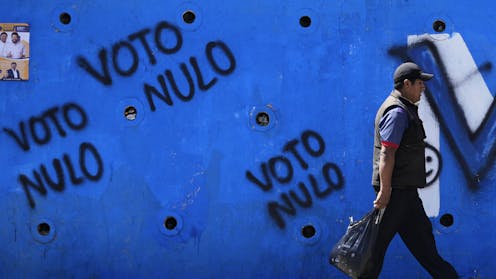
A pedestrian walks past graffiti promoting a null vote in the 2025 Bolivian presidential elections.AP Photo/Juan Karita
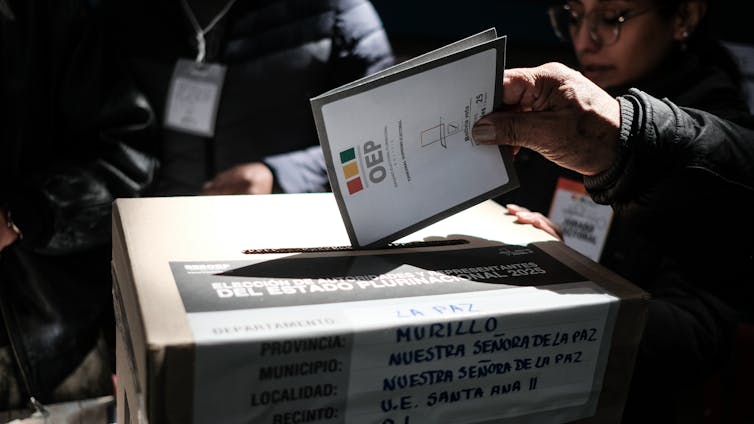
For the first time since the country’s return to democracy in 1982, Bolivia’s presidential election will go to a runoff after no candidate secured the required absolute majority in the first-round vote on Aug. 17, 2025.
The choice Bolivians now face means that the country is set to elect a non-left-wing candidate for the first time in a generation. In October, they will choose between the center-right Sen. Rodrigo Paz Pereira, who led the first round with approximately 32% of the valid vote, and former right-wing interim President Jorge “Tuto” Quiroga, who had close to 27%.
As many predicted, the left lost spectacularly, with the best-performing leftist candidate, Andrónico Rodríguez, winning only around 8% of the valid vote.
In fact, the left performed so poorly that its vote count was surpassed by invalid ballots. More than 19% of all ballots were spoiled and an additional 2.5% left blank. Indeed, the invalid vote roughly quadrupled compared to presidential elections between 2006 and 2020, when only about 5% of ballots were invalid.
Invalid votes are those that have been left unmarked – “blank” votes – or mismarked – “null” or “spoiled” votes – so that a voter’s intent is unclear. They are usually counted but excluded from official electoral math. But as I document in my 2024 book, “None of the Above,” blank and spoiled votes are also one of the most widely used tools of protest in Latin American democracies. Every year, millions of voters use the tactic to express their frustration with the candidates on the ballot, while at the same time demonstrating their commitment to democracy and elections.
In the case of Bolivia, I believe the rise in invalid votes is both a symptom of widespread dissatisfaction with the political and economic status quo and a signal of persistent, but not overwhelming, support for the divisive former president, Evo Morales.
Bolivia’s presidential election took place as the country experiences dual economic and political crises. Like many of its neighbors, Bolivia experienced a commodity-driven economic boom at the beginning of the 21st century, fueled in this case by the export of lithium and natural gas. However, boom turned to bust in the 2010s as global commodity prices plunged. With its currency pegged to the U.S. dollar and a heavy reliance on gas exports, Bolivia’s economy suffered.
The country’s economic situation remains fraught. The national debt has ballooned to 95% of the size of its GDP in 2024. Meanwhile there are widespread fuel shortages; a decline in international currency reserves, meaning a likely further devaluation of the national currency; and a rising annual inflation rate that in July reached 24%.
Presidential candidates across the political spectrum promised economic austerity measures, like ending popular fuel subsidies.
This rightward shift also reflects growing divides among Bolivia’s political left, centered around Morales, a former labor leader and the first Indigenous president in a country where about half of the population is of native, non-European descent.
Morales’ 2006 victory was hailed at the time as a victory for Bolivian democracy. His government dramatically reduced the poverty rate, and expanded Bolivia’s middle class. However, critics contended that Morales also degraded democracy by, for example, stacking the courts and ignoring term limits. Morales’ time in office ended with allegations of fraud during the 2019 election, which he steadfastly denied. He fled the country soon after, returning in 2020 when his then-political ally and one-time protege Luis Arce assumed the presidency.
After seeing his popularity plummet during his term, Arce opted not to run this time around. Meanwhile, the coutry’s constitutional court, citing term limits, barred Morales from running for a fourth term as president. However, he continues to be a force in Bolivian politics. Recently, infighting between Morales, Arce and left-wing presidential candidates contributed to the inability to pass legislation meant to fix the current economic crisis.
These intraparty fights split the Bolivian left, leaving Morales supporters without a viable candidate.
Shut out, Morales campaigns for a null vote
In late July, the former president began actively campaigning for the invalid vote.
Campaigns promoting the blank or spoiled vote in presidential elections are not uncommon, with similar movements occurring in more than 30% of Latin American presidential elections during the 2010s. Indeed, nearly every country in the region has experienced at least one invalid vote campaign during a presidential election since 1980.
And as I found in the course of my research, most null vote campaigns self-consciously promote democratic values. Campaigners protest the persistent underperformance of democratic politics, ongoing corruption by high-ranking politicians or blatant efforts to rig elections.
Bolivia’s 2025 invalid vote campaign in some ways echoes those previous efforts. In Morales’ telling, Bolivia’s term limits curtailed his fundamental right to run for office and his supporters’ right to select their preferred candidate. Widespread ballot spoiling would be a way to send a strong message to those currently in power to allow Morales to run.
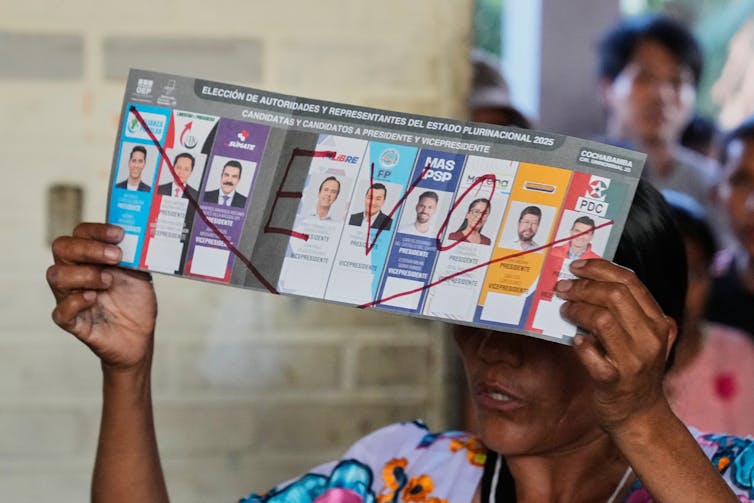
An electoral official shows a null vote that has ‘Evo’ — referring to former President Evo Morales, who is barred from running — written on it, as they count votes after polls closed for general elections. AP Photo/Jorge Saenz
But Morales’ campaign also faced challenges that often undo invalid vote campaigns. Such campaigns are generally unpopular with the public, and are even less popular when they are led by politicians who would benefit personally from an increase in the invalid vote. Morales was just such a candidate. Increased invalid vote rates would show his ability to sway the public and increase his political influence, something he appeared to acknowledge when declaring at a recent rally that he would have “won the elections” if the null vote reached 25%.
In this way, Morales is different from most null vote campaigners. He has been the central figure in Bolivian politics for nearly 20 years. He has a track record of both strong economic performance and of undermining Bolivian democracy and the rule of law. It is a testament to his popularity and influence that nearly 1 in 5 Bolivians spoiled their ballots.
The health of Bolivian democracy
Still, it would be a mistake to conclude that the increase in spoiled ballots signals overwhelming support for Morales, as he contends. Pre-election polling showed that Bolivians intended to cast invalid votes at a higher rate well before Morales began his campaign. Rather, Morales’s campaign likely harnessed existing anti-candidate sentiment, while leaching support from left-wing alternatives.
Additionally, while the spoiled vote rate was quite high, Morales did not achieve his goals: The null vote did not “beat” the runoff candidates, nor did it reach 25% of the vote. While Morales has staked a strong claim that the Bolivian public “voted but did not choose,” this argument is belied by the results: Most Bolivians did select a candidate, and a majority of them voted for a candidate from the political right. By that metric, Morales does not retain majoritarian support in Bolivia.
But neither should the relatively high number of invalid ballots be ignored. Over 1 million Bolivians used their ballots to send a message to politicians. Those leaders now have an opportunity to respond by working to restore trust with these voters.
Whoever wins the runoff in October 2025, Bolivian society will likely continue to be plagued by the social, political and economic divisions that have been present for years.
Indeed, the high rate of spoiled votes suggests that citizens are dissatisfied with their democratic choices. And those charged with protecting Bolivia’s democracy might well be advised to heed this signal.
Mollie J. Cohen does not work for, consult, own shares in or receive funding from any company or organization that would benefit from this article, and has disclosed no relevant affiliations beyond their academic appointment.
Source: The Conversation – Global Perspectives – By Matthew Sussex, Associate Professor (Adj), Griffith Asia Institute; and Fellow, Strategic and Defence Studies Centre, Australian National University
The bizarre summit between Donald Trump and Vladimir Putin in Alaska should sway all but the most credulous doubters that the White House is more interested in friendly relations with Russia’s dictator than achieving a lasting peace in Ukraine.
An abridged program saw the two leaders swiftly conclude the meeting earlier than had been expected. They then heaped praise on one another at a press conference that didn’t feature any questions from the press.
Worryingly, Trump is still as unconcerned about handing Putin symbolic victories as he is unwilling to put any real pressure on the Russian leader.
Symbolic ‘wins’ for Putin
The venue itself was telling. Russia has long carped that Alaska, which it sold to the US in the 1860s, is rightfully still its territory. Prior to the meeting, Kremlin mouthpieces made much of Putin’s team taking a “domestic flight” to Anchorage, recalling billboards that went up in Russia in 2022 proclaiming “Alaska is ours!” That wasn’t helped by yet another Trump gaffe prior to the meeting when he said he would “go back to the United States” if he didn’t like what he heard.
When Putin’s plane landed, US military personnel kneeled to fix a red carpet for the Russian president to walk across – as a respected leader, rather than an indicted war criminal. Putin was then invited to ride along with Trump in his limousine.
Beyond the optics, Trump handed Putin a number of other wins that will shore up his support at home and reinforce to the world that US-Russia relations have been normalised.
A summit is typically offered as a favour – an indication of an earnest desire to improve relations. By inviting him to Alaska, Trump gave Putin a stage to meet the American president as an equal. There was no criticism of Russia’s appalling human rights abuses, its increasingly violent attempts to fragment the transatlantic alliance, or its desire to reshape its fortunes by conquest.
Instead, Trump sought again to portray Putin and himself as victims. He complained that both had been forced to “put up with the ‘Russia, Russia, Russia’ hoax” that Moscow had interfered in the 2016 US presidential election.
He then gifted Putin yet another win, putting the onus for accepting Russian terms to end the war in Ukraine back onto the Ukrainian government and Europe, by observing “it’s ultimately up to them”.
Putin got exactly what he could have hoped for. Aside from the photo ops, he framed any solution to the conflict around the “root causes” – code for NATO being to blame rather than Putin’s unprovoked war of imperial aggression.
He also dodged any prospect of vaguely threatened US sanctions, with Trump returning to his familiar refrain of needing “two weeks” to think about them again.
And then, having pocketed both a symbolic and diplomatic bonanza, Putin promptly skipped lunch and flew home, presumably also accompanied by the bald-headed American eagle ornament that Trump had presented to him.
What does this mean moving forward?
After Trump’s subsequent call with European leaders to brief them on the summit, details about a peace proposal began to leak out.
Putin is reportedly prepared to fix the front lines as they stand in the Kherson and Zaporizhzhia regions of Ukraine, provided Kyiv agrees to cede all of Luhansk and Donetsk, including territory Russia doesn’t currently hold. There would be no immediate ceasefire (which is Europe’s and Ukraine’s preference), but a move towards a permanent peace, which aligns with the Kremlin’s interests.
Make no mistake: this is a thinly disguised trap. It amounts to little more than Putin and Trump slinging a dead cat at Ukraine and Europe, then blaming them as laggards and warmongers when they object.
For one thing, Ukraine still controls a sizeable portion of Donetsk. Giving up Donetsk and Luhansk would not only cede coal and mineral reserves to Moscow, but also require abandoning vital defensive positions that Russian forces have been unable to crack for years.
It would also position Russia to launch potential future incursions, opening the way to Dnipro to the west and Kharkiv to the north.
Trump’s apparent backing for Russia’s demands that Ukraine cede territory for peace – which NATO’s European members reject – means Putin is succeeding in further fracturing the transatlantic partnership.
There was also little mention of who would secure the peace, or how Ukraine can be reassured Putin will not simply use the breathing space to rearm and try again.
Given the Kremlin has opposed NATO membership for Ukraine, would it really agree to European forces securing the new line of control? Or American ones? Would Ukraine be permitted to rearm, and to what extent?
And, even in the event of a firmer US line in a future post-Trump era, Putin will still have achieved a land grab that would be impossible to undo. That, in turn, reinforces the message that conquest pays off.
One apparently brighter note for Ukraine is the hint the US is prepared to offer it a “non-NATO” security guarantee.
But that should also be viewed with caution. The Trump administration has already expressed public ambivalence about US commitments to defend Europe via NATO’s Article 5, which has called its credibility as an ally into question. Would the US really fight for Ukraine if there were a future Russian invasion?
To their credit, European leaders have responded firmly to Trump’s dealings with Putin.
They have welcomed the attempt to resolve the conflict, but told Ukrainian President Volodymyr Zelensky they will continue to back him if the deal is unacceptable. Zelensky, who is due to meet Trump in Washington on Monday, has already rejected the notion of ceding the Donbas region (Donetsk and Luhansk) to Russia.
But Europe will have to face the reality that not only must it do more, but it must also provide sustained leadership on security issues, rather than just reacting to repeated crises.
Trump’s deeper motivations
Ultimately, the Alaska summit shows that peace in Ukraine is only part of the broader picture for the Trump administration, which is dedicated to achieving warmer ties with Moscow, if not outright alignment with it.
In that sense, it matters little to Trump how peace is attained in Ukraine, or how long it lasts. What’s important is he receives credit for it, if not the Nobel Peace Prize he craves.
And while Trump’s vision of splitting Russia away from China is a fantasy, it is nonetheless one he has decided to entertain. That, in turn, compels America’s European partners to respond accordingly.
Already there is plenty of evidence that having failed to win a trade war with China, the Trump administration is now choosing to feast on America’s allies instead. We see this in its fixation with tariffs, its bizarre desire to punish India and Japan, and the trashing of America’s soft power.
Even more sobering, Trump’s diplomatic forays continue to see him treated as sport by authoritarian leaders.
That, in turn, provides a broader lesson for America’s friends and partners: their future security may well rest on America’s good offices, but it is foolish to assume that automatically places their fortunes above the whims of the powerful.
Matthew Sussex has received funding from the Australian Research Council, the Atlantic Council, the Fulbright Foundation, the Carnegie Foundation, the Lowy Institute and various Australian government departments and agencies.
That outcome is far from guaranteed. But even if AI’s technical promise is realised – and with it, once intractable problems are solved – how will that abundance be used?
We can already see this tension on a smaller scale in Australia’s food economy. According to the Australian government, we collectively waste around 7.6 million tonnes of food a year. That’s about 312 kilograms per person.
At the same time, as many as one in eight Australians are food-insecure, mostly because they do not have enough money to pay for the food they need.
What does that say about our ability to fairly distribute the promised abundance from the AI revolution?
AI could break our economic model
As economist Lionel Robbins articulated when he was establishing the foundations of modern market economics, economics is the study of a relationship between ends (what we want) and scarce means (what we have) which have alternative uses.
Markets are understood to work by rationing scarce resources towards endless wants. Scarcity affects prices – what people are willing to pay for goods and services. And the need to pay for life’s necessities requires (most of) us to work to earn money and produce more goods and services.
This article is part of The Conversation’s series on jobs in the age of AI. Leading experts examine what AI means for workers at different career stages, how AI is reshaping our economy – and what you can do to prepare.
The promise of AI bringing abundance and solving complex medical, engineering and social problems sits uncomfortably against this market logic.
It is also directly connected to concerns that technology will make millions of workers redundant. And without paid work, how do people earn money or markets function?
Meeting our wants and needs
It is not only technology, though, that causes unemployment. A relatively unique feature of market economies is their ability to produce mass want, through unemployment or low wages, amid apparent plenty.
As economist John Maynard Keynes revealed, recessions and depressions can be the result of the market system itself, leaving many in poverty even as raw materials, factories and workers lay idle.
In Australia, our most recent experience of economic downturn wasn’t caused by a market failure. It stemmed from the public health crisis of the pandemic. Yet it still revealed a potential solution to the economic challenge of technology-fuelled abundance.
Changes to government benefits – to increase payments, remove activity tests and ease means-testing – radically reduced poverty and food insecurity, even as the productive capacity of the economy declined.
This is a research focus of the Australian Basic Income Lab, a collaboration between Macquarie University, the University of Sydney and the Australian National University.
If everyone had a guaranteed income high enough to cover necessities, then market economies might be able to manage the transition, and the promises of technology might be broadly shared.
If Australia already has an abundance of food, why are some people going hungry? Jools Magools/Pexels
Welfare, or rightful share?
When we talk about universal basic income, we have to be clear about what we mean. Some versions of the idea would still leave huge wealth inequalities.
My Australian Basic Income Lab colleague, Elise Klein, along with Stanford Professor James Ferguson, have called instead for a universal basic income designed not as welfare, but as a “rightful share”.
They argue the wealth created through technological advances and social cooperation is the collective work of humanity and should be enjoyed equally by all, as a basic human right. Just as we think of a country’s natural resources as the collective property of its people.
These debates over universal basic income are much older than the current questions raised by AI. A similar upsurge of interest in the concept occurred in early 20th-century Britain, when industrialisation and automation boosted growth without abolishing poverty, instead threatening jobs.
Even earlier, Luddites sought to smash new machines used to drive down wages. Market competition might produce incentives to innovate, but it also spreads the risks and rewards of technological change very unevenly.
Universal basic services
Rather than resisting AI, another solution is to change the social and economic system that distributes its gains. UK author Aaron Bastani offers a radical vision of “fully automated luxury communism”.
He welcomes technological advances, believing this should allow more leisure alongside rising living standards. It is a radical version of the more modest ambitions outlined by the Labor government’s new favourite book – Abundance.
Bastani’s preferred solution is not a universal basic income. Rather, he favours universal basic services.
Under a universal basic services model, services like public transport would be made available for free. Ersin Baştürk/Pexels
Instead of giving people money to buy what they need, why not provide necessities directly – as free health, care, transport, education, energy and so on?
Of course, this would mean changing how AI and other technologies are applied – effectively socialising their use to ensure they meet collective needs.
No guarantee of utopia
Proposals for universal basic income or services highlight that, even on optimistic readings, by itself AI is unlikely to bring about utopia.
Instead, as Peter Frase outlines, the combination of technological advance and ecological collapse can create very different futures, not only in how much we collectively can produce, but in how we politically determine who gets what and on what terms.
The enormous power of tech companies run by billionaires may suggest something closer to what former Greek finance minister Yanis Varoufakis calls “technofeudalism”, where control of technology and online platforms replaces markets and democracy with a new authoritarianism.
Waiting for a technological “nirvana” misses the real possibilities of today. We already have enough food for everyone. We already know how to end poverty. We don’t need AI to tell us.
Ben Spies-Butcher is co-director of the Australian Basic Income Lab, a research collaboration between Macquarie University, University of Sydney and Australian National University.
The power of the war photograph is that it won’t let you look away. And nowhere is this proving truer than in Gaza.
One recent example portrayed a skeletal boy, Muhammad Zakariya Ayyoub al-Matouq, held in his mother’s arms. Palestinian photographer Ahmed al-Arini captured the boy and his mother in the iconic pose of the Madonna and child.
Photographs coming out of Gaza since October 2023 have communicated the severity of the destruction: collapsed buildings, bodies in shrouds, dead and maimed children, and bombed-out hospitals and shelters. There have also been viral AI-generated images, such as All Eyes on Rafah.
Between April and July, more than 20,000 people in Gaza were hospitalised for malnutrition, including 3,000 children in life-threatening condition.
The photo of Muhammad is a visual condensation of collective suffering that is impossible to ignore or deny. This is what makes it so powerful.
Drawing from religious imagery
War photography is often impactful because it communicates the brutalities of war with visual mastery.
Photographic elements such as composition, timing, tone, colour and light combine to create a visual story that is full of intent.
This is what American photographer and curator John Szarkowski called “the photographer’s eye”, and what French photographer Henri Cartier Bresson coined as “the decisive moment”. It is to know where to point the camera, when to release the shutter and how to select the “right” image to release into the world.
An iconic war photograph often reproduces a pose or gesture that is familiar to the popular imagination – particularly through iconic religious imagery. Think of the horrifying photos that came out of Abu Ghraib prison during the Iraq War, where one tortured prisoner was photographed in the pose of Christ on the cross.
Prisoner Abdou Hussain Saad Faleh is standing on the box with wires attached to his left and right hand. Wikimedia
Such photographs can change the course of war. They often shape how wars are remembered, even when there is controversy around their truthfulness and authorship, as we have seen with the contested image of Kim Phúc.
It purports to show a soldier shot dead mid-fall during the Spanish Civil War. But historians suggest the man might have been posing, not dying.
Whether it is real or staged remains unresolved. Still, it circulates as though it is true – reminding us that the myths of war are just as important as the facts when it comes to how war is remembered.
Photos are limited by their inability to convey sound, smell, or any broader context. A staged photo might, at times, be even more effective than an unstaged one in conveying the lived experience of a war – even if the ethics of the staging are dubious.
The weaponisation of war imagery
Photos and video from Gaza continue to circulate on social media, despite Israel barring foreign journalists from entering Gaza.
Israeli authorities have killed Palestinian journalists in record numbers. Yet this visual censorship has not stopped citizen journalists and organisations such as Activestills
from sharing the atrocities in Gaza.
In Gaza, control over imagery has become part of the conflict. Al Jazeera was banned from operating inside Israel. Social media platform Meta has been found silencing posts from Palestinian accounts, with graphic images increasingly being labelled with warnings such as “sensitive content”.
What does it mean to be advised to look away from something someone else is living?
As we know from the second world war, images are powerful evidence. The photographs of starved concentration camp survivors during the Holocaust were used to prosecute Nazis at the Nuremberg Trials.
But the meaning of war photographs also depends on timing, context, who controls what is shown, and where the photos are distributed.
While these photos can communicate the horrors of a conflict, they are also entangled in acts of violence. In Abu Ghraib, American soldiers used photography to turn their war crimes into visual souvenirs. Similarly, Al Jazeera is collecting such “trophies” shared by Israeli soldiers as evidence of their war crimes.
Eliciting grief
American gender studies scholar Judith Butler argues Western media weaponise images to construct a hierarchy of grief that determines whose life is publicly mourned.
Publishing a war photograph is not just an act of documentation – it’s an act of interpretation. It shapes what others think is happening. In their book Picturing Atrocity (2012), Nancy Miller and colleagues ask us how we can witness suffering without turning it into spectacle.
The book raises important ethical questions. Who owns an image of someone suffering? What if the person photographed has died? What if the image perpetuates violence that hurts those closest to it?
A war photograph does not stop a missile. It does not feed a starving child. But it can interrupt denial and silence.
It can insist that something happened – and reinforce, as many of the placards on the Harbour Bridge said, “you cannot say you didn’t know”.
The authors do not work for, consult, own shares in or receive funding from any company or organisation that would benefit from this article, and have disclosed no relevant affiliations beyond their academic appointment.
Hours before meeting Russia’s leader Vladimir Putin in Alaska, Donald Trump said he wanted to see a ceasefire in Ukraine and was “not going to be happy” if it wasn’t agreed today. The US president appears to have left Alaska with no such agreement in place.
“We didn’t get there”, Trump told reporters, before later vaguely asserting that he and Putin had “made great progress”. Trump is likely to return to the idea of engaging Putin in the coming weeks and months, with the Russian leader jokingly suggesting their next meeting could be held in Moscow.
A land-for-ceasefire arrangement, an idea Trump has repeatedly raised as an almost inevitable part of a peace settlement between Russia and Ukraine, could still reemerge as a possible outcome. In fact, in an interview with Fox News after the summit where Trump was asked how the war in Ukraine might end and if there will be a land swap, Trump said: “those are points that we largely agreed on”.
Securing territorial concessions from Ukraine has long been one of Moscow’s preconditions for any negotiations on a peace deal. Putin is likely betting that insisting on these concessions, while keeping Ukraine under sustained military pressure, plays to his advantage.
Public fatigue over the war is growing in Ukraine, and Putin will be hoping that a weary population may eventually see such a deal as acceptable and even attractive. Russia launched a barrage of fresh attacks against Ukrainian cities overnight, involving more than 300 drones and 30 missiles.
Ukrainian president Volodymyr Zelensky, who was excluded from the Alaska summit, has maintained that Kyiv will not agree to territorial concessions. Such a move would be illegal under Ukraine’s constitution, which requires a nationwide referendum to approve changes to the country’s territorial borders.
The assumption behind a land-for-ceasefire deal is that it would enhance Ukrainian and European security. Trump sees it as the first step in bringing Putin to the negotiation table for a broader peace deal, as well as unlocking opportunities for reconstruction. In reality, such a deal would do little to diminish the longer-term Russian threat.
Moscow’s efforts to shore up and modernise its defence capabilities and neo-imperial ambitions would remain intact. Its hybrid attacks on Europe would also continue, and Ukraine’s capacity to secure meaningful reconstruction would be weakened.
Whether or not Russia ever opts for a direct military strike on a European Nato member state, it has no need to do so to weaken the continent. Its hybrid operations, which extend well beyond the battlefield, are more than sufficient to erode European resilience over time.
Russia’s disinformation campaigns and sabotage of infrastructure, including railways in Poland and Germany and undersea cables in the Gulf of Finland and Baltic Sea, are well documented. Its strategic objectives have focused on deterring action on Ukraine and sowing disagreement between its allies, as well as attempting to undermine democratic values in the west.
Europe is under pressure on multiple fronts: meeting new defence spending targets of 5% of GDP while economic growth is slowing, reducing the dependence of its supply chains on China and managing demographic challenges.
These vulnerabilities make it susceptible to disinformation and have deepened divisions along political and socioeconomic fault lines – all of which Moscow has repeatedly exploited. A land-for-ceasefire deal would not address these threats.
For Ukraine, the danger of such a deal is clear. Russia might pause large-scale physical warfare in Ukraine under a deal, but it would almost certainly continue destabilising the country from within.
Having never been punished for violating past agreements to respect Ukraine’s territorial integrity, such as when it annexed Crimea in 2014, Moscow would have little incentive to honour new ones. The government in Kyiv, and Ukrainian society more broadly, would see any accompanying security guarantees as fragile at best and temporary at worst.
The result would probably be a deepening of Ukraine’s vulnerabilities. Some Ukrainians might support doubling down on militarisation and investment in defence technologies. Others, losing faith in national security and reconstruction, could disengage or leave the country. Either way, in the absence of national unity, reconstruction would become far more difficult.
Making reconstruction harder
Ukraine’s reconstruction will be costly, to the tune of US$524 billion (£387 billion) according to the World Bank. It will also require managing a web of interconnected security, financial, social and political risks.
These include displacement and economic challenges brought on by the war, as well as the need to secure capital flows across different regions. It will also need to continue addressing governance and corruption challenges.
A permanent territorial concession would make addressing these risks even more difficult. Such a deal is likely to split public opinion in Ukraine, with those heavily involved in the war effort asking: “What exactly have we been fighting for?”
Recriminations would almost certainly follow during the next presidential and parliamentary elections, deepening divisions and undermining Ukraine’s ability to pursue the systemic approach needed for reconstruction.
Ongoing security concerns in border regions, particularly near Russia, would be likely to prompt further population flight. And how many of the over 5 million Ukrainians currently living abroad would return to help reconstruct the country under these conditions is far from certain.
Financing reconstruction would also be more challenging. Public funds from donors and international institutions have helped sustain emergency energy and transport infrastructure repairs in the short term and will continue to play a role. But private investment will be critical moving forward.
Investors will be looking not only at Ukraine’s geopolitical risk profile, but also its political stability and social cohesion. Few investors would be willing to commit capital in a country that cannot guarantee a stable security and political environment. Taken together, these factors would make large-scale reconstruction in Ukraine nearly impossible.
Beyond fundamental issues of accountability and just peace, a land-for-ceasefire deal would be simply a bad bargain. It will almost certainly sow deeper, more intractable problems for Ukraine, Europe and the west.
It would undermine security, stall reconstruction and hand Moscow both time and a strategic advantage to come back stronger against a Ukraine that may be ill-prepared to respond. Trump would do well to avoid committing Ukraine to such an arrangement in further talks with Putin over the coming months.
Olena Borodyna does not work for, consult, own shares in or receive funding from any company or organisation that would benefit from this article, and has disclosed no relevant affiliations beyond their academic appointment.
The New York-based media freedom organisation, the Committee to Protect Journalists, is scrupulous with its words. So, when the organisation described the killing of six Palestinian journalists in an Israeli air strike as “murder”, the word was a carefully considered choice.
The CPJ defines “murder” as the “deliberate killing of journalists for their work”.
Why were the journalists targeted?
Israeli authorities said they were targeting one man – a 28-year-old Al Jazeera reporter named Anas al-Sharif – who they said was the leader of a Hamas “cell”. They also accused him of “advancing rocket attacks against Israeli civilians and (Israeli) troops.”
Israel made no claims about the other five; three of them were al-Sharif’s Al Jazeera colleagues and the other two were freelance journalists.
Prior to the strike, we obtained current intelligence indicating that Sharif was an active Hamas military wing operative at the time of his elimination.
The evidence the Israeli authorities claimed to have was circumstantial at best: “personnel rosters, lists of terrorist training courses, phone directories and salary documents.”
Israeli military spokesperson Avichay Adraee also posted undated photos on X that appeared to show al-Sharif in an embrace with Yahya Sinwar, the Hamas mastermind of the October 2023 attack on Israel.
Israel says it has further classified evidence that includes more damning detail.
Without seeing it all, it is impossible to verify the claims but the photograph itself is hardly proof.
Front-line journalists (myself included) will have selfies with those they have interviewed, including some very unpleasant characters.
Many will have phone numbers of extremists – they will appear in call logs and records of meetings.
None of it is evidence of anything other than a well-connected reporter doing their job.
Of course, Israel may well be right. Despite the vigorous denials from Al Jazeera, it is still possible al-Sharif was working for Hamas. And if he was, the Israeli authorities should have no problem allowing independent investigators complete access to verify the claims and settle the matter.
The horrors of covering war
But the strike also fits a disturbing pattern. With 190 media workers now killed since the October 7 attacks, this is the deadliest conflict for journalists since the CPJ began keeping records.
While some of the victims were inevitably caught in the violence along with so many other civilians, many of them died in rocket strikes aimed squarely at their homes, their clearly marked vehicles, or while they were wearing body armour labelled “PRESS”.
In all, the CPJ has identified 24 journalists who appeared to have been targeted – murdered, in the group’s words – specifically because of their work.
The number may well be far higher but those figures alone raise disturbing questions about Israel’s tolerance for critical media reporting. They also demand answers from independent investigators.
We receive horrific reports from Gaza daily, but Israel repeatedly dismisses them as Hamas propaganda.
“A terrorist is a terrorist, even if Al Jazeera gives him a press badge”, the Israeli foreign ministry posted on social media.
If Israel believes the journalism from Palestinian reporters is nothing more than Hamas propaganda, the solution is straightforward: let foreign correspondents in.
Despite the risks, journalists want access
It is worth recalling the reason we cherish media freedom is not because we want to privilege a particular class of individual. It is because we recognise the vital importance accurate, independent reporting plays in informing public debate.
Without it, we are blind and deaf.
International news organisations have repeatedly called for access to Gaza. Now, a group of more than 1,000 international journalists have signed a petition demanding to be let in (I am one of the signatories).
Israel has so far refused. The government says it cannot guarantee their security in such an active battlefield. But that cannot be justification alone.
All those who have signed the petition know well the risks of reporting from hostile environments. Many have crossed active war front lines themselves. Most have friends who have died in other conflicts. Some have been wounded, arrested or kidnapped themselves.
None are naive to the dangers and all are committed to the principles behind media freedom.
Calling for foreign journalists to be let into Gaza is not to deny the extraordinary sacrifice of Anas al-Sharif or any of the other Palestinians who have been killed while doing their jobs.
Rather, it is to assert the importance of the fundamental right of all – the right to information. That applies as much in Gaza as it does in Ukraine, or Russia, or Sudan, or any other crisis where the public needs accurate, reliable information to support good policy.
Peter Greste is a professor of journalism at Macquarie University, and the Executive Director for the Alliance for Journalists’ Freedom. He also worked as a BBC correspondent in Gaza in 2007, and as an Africa correspondent for Al Jazeera from 2011 to 2015.
This year marks 80 years since Japan’s catastrophic defeat in the Asia-Pacific War. In 1945, the country lay in ruins. Millions had died in battle or in the devastating Allied bombings of Tokyo, Hiroshima, Nagasaki, and other cities. Across Asia and the Pacific, Japan’s bid to create a Greater East Asia Co-Prosperity Sphere left millions violated, impoverished, or dead.
Backed into a corner, in August 1945 Emperor Hirohito defied his generals and accepted unconditional surrender under the Potsdam Declaration.
In his unprecedented radio broadcast on August 15, he urged the Japanese to bear the unbearable and endure the unendurable. With defeat, Japan’s empire dissolved, its “divine” emperor became mortal, and a nation that had pursued autonomy through conquest now faced a humbling occupation led by its former archenemy, Amerika.
Standing in the burnt-out fields of 1945, survivors could scarcely have imagined the Japan of today. The country has changed dramatically. In my research, I identify ten key factors that define this “postwar” era — a term that in Japan still refers to the entire period since surrender. The “post” of the postwar speaks to the drive to transcend the past, while the “war” to the enduring shadow of that past in memory, politics, and diplomacy.
1: Post-empire Japan. While Japan’s empire vanished in 1945, former colonies and violated regions could not and would not forget the past. Postwar leaders and their American backers promoted an image of a peaceful and ethnically homogeneous island nation, but wartime memories have repeatedly strained relations with South Korea, China, and others. In this sense, Japan has been as much “post-empire” as it has been “postwar” since 1945.
2: Ambiguous demilitarisation. After defeat, Japan’s wartime military –responsible for a trail of misery and havoc across Asia and the Pacific – was dismantled. The American-authored constitution renounced war and the maintenance of a military.
But with the Cold War, Washington backtracked, pushing Japan to create its Self-Defense Forces in the mid-1950s. Today Japan has a sophisticated military and it exports military equipment, but constitutional constraints constantly force leaders to make incremental reinterpretations over the legal status of the Self-Defense Forces and the scope of its activities. Some have claimed this constraint inhibits postwar Japan from being a normal country.
3: Bastion of democracy in the far east. Although democracy had prewar roots, it was consistently subject to oppression. The postwar constitution finally institutionalised freedoms of speech, assembly, and political participation, while codifying rights for women and others. The Japanese embraced these rights, flocking to polling booths, and organising political parties, unions, and countless civic movements. Long-term conservative rule repeatedly undercut democracy, but it became part of everyday life and survives to the present.
4: America’s embrace. The United States-led occupation ended in 1952, but Japan’s economy, security, and culture remain bound to America. Feelings towards the former archenemy are complex.
The American dream in brands such as Levis, Coca Cola, McDonalds, and Disney, have symbolised a bright and affluent future. But the continued US military presence and memories of the atomic bombings are constant reminders of Japan’s subservience. Nonetheless, the Japanese have never seriously considered breaking from their powerful trans-Pacific patron.
5: One party to rule them all? Politically, postwar Japan is an unusual democracy, with the Liberal Democratic Party (LDP) ruling almost continuously since forming in 1955. The LDP offered political stability, but this was accompanied by recurrent scandal and corruption.
Opposition parties essentially gave up on winning government, remaining fractured and powerless. In fact, the larger story of postwar Japanese politics is one of increasing public disillusionment. Many Japanese see politicians as increasingly out of touch and, as was apparent in its most recent elections, search for radical alternatives.
6: Economic rollercoaster. Following defeat, the Japanese built an economy that stunned the world. By the 1970s, Japan was the second largest capitalist economy, powered by exports of cars, electronics, and steel. Rising incomes fuelled mass consumption and international travel, and observers spoke of “Japan as Number One.”
But the economic meltdown in the 1990s triggered an era of stagnation. The economy struggled to keep up with new competitors and technologies. The myth of shared prosperity gave way to widening generational and gender disparity. Ironically, there is a risk Japanese today may end up less well off than their parents.
7: Homogenisation and its discontents. Economic growth drew millions into a culture of mass consumption and standardised life, giving rise to a popular vision of Japan as a totally middle-class society. But this rose-colored vision was as much myth as reality. Homogenisation tended to mask differences while encouraging discrimination based on gender, age, ethnicity, and location. Since the 1990s, the myth of a middle-class nation has collapsed, with no compelling replacement on the horizon.
8: The demographic tsunami. The silent, yet perhaps most profound, factor of postwar Japan is demographic change. The era witnessed three great shifts here.
First, rural-to-urban migration in the late 1950s transformed Japan from an agrarian nation into one of the world’s most urbanised. Second, the fertility rate fell steadily, apart from brief baby booms in the late 1940s and early 1970s. Third, longevity rose to among the world’s highest.
Today, an ageing, shrinking population strains public finances and welfare, while youth face economic insecurity. Indeed, Japan may be the “canary in the coal mine” for other ageing societies.
9: Japan’s return to the world. Unable to project military power, after 1945 Japan used its economic, cultural, and diplomatic influence internationally. Even at the height of the Cold War, it maintained trade with China. Economic strength also helped Japan to restore ties in Asia and secure a respected place in global institutions.
But Japan’s return to the postwar world has been complicated. Leaders must juggle nationalist rumblings, American demands, and the responsibilities of global citizenship. As economic fortunes change and regional geopolitics transform, Japan must rethink its international posture.
10: Environmental laboratory. Economic growth brought prosperity, but also caused severe environmental damage. In the 1960s and 1970s, Japan experienced shocking cases of industrial pollution from methylmercury and other neurotoxins.
Earthquakes and tsunamis killed tens of thousands and, at Fukushima, bequeathed a nuclear catastrophe of generational proportions. Every year, climate change intensifies typhoons, floods, and heatwaves, but energy-vulnerable Japan still struggles to chart a low-emissions pathway to the future.
A universal story
For a country that has long been touted as exceptional, I am struck by the global resonances in this history, like grappling with the past, managing economic highs and lows, navigating demographic change, and confronting environmental crisis.
Japan’s postwar era certainly offers a portrait of one nation’s revival, but it may also represent a microcosm for tackling our own challenges.
Simon Avenell does not work for, consult, own shares in or receive funding from any company or organisation that would benefit from this article, and has disclosed no relevant affiliations beyond their academic appointment.
Everyone knows her photo. For some it shows the cheeky smile of a young girl, “Miss Quack Quack”. For others, the image represents an enigmatic veil of mystery, similar to Leonardo Da Vinci’s Mona Lisa.
Millions have read her diary, watched various renditions in theatres and on the screen, or visited exhibitions devoted to her story. Thousands queue in front of the house in Amsterdam, where she spent 760 days in the secret annex, hiding from the Gestapo and their Dutch collaborators.
People quote the most famous sentence from her diary, immortalised in the Hollywood film, saying that “in spite of everything I still believe that people are really good at heart”.
The sentence was written in July 1944 by 15-year-old Jewish girl Anne Frank, three weeks before the capture of her family by the Nazis. It represents the innocence, perhaps naivety of an adolescent, who after the war became one of the most iconic symbols of the Nazi Holocaust.
The quote carries a universal message that good will eventually prevail. This has turned Anne’s legacy into an easily adoptable trope, serving activists and political agendas. But who, actually, was Anne Frank? And how did she differ from the “Anne Franks” that have emerged since the end of the war?
The Many Lives of Anne Frank – Ruth Franklin (Yale University Press)
Acclaimed author Ruth Franklin explores these probing questions in her newest book. She is to be commended for her sensitive treatment of a difficult subject and an attempt to get as close as possible to Anne’s personality and nature.
Franklin follows two paths. First, she reconstructs Anne’s life based on the diary and recollections of people who knew her. In the second part, she reveals the afterlife of the diary and “Anne Frank”, in different contexts and on different platforms.
She concludes that the “Anne” most people know, or imagine, differs quite significantly from the girl who lived in the secret annex and penned the diary.
The story
Annelies Marie Frank was born in 1929 in Frankfurt am Main to an affluent assimilated German-Jewish family. After the rise of Hitler and the introduction of the first racial laws, her parents Otto and Edith decided to take Anne and her older sister Margot to the Netherlands. They continued to live in Amsterdam despite the growing threat, even after the German invasion in 1940. Attempts to emigrate to the United States failed.
The mounting persecution kept restricting their lives. In early 1942, the Nazis began to plan deportations of the Jews to the east. In July, when Margot received a call to the transport to occupied Poland, the family decided to go into hiding.
They spent over two years in the secret annex, eventually accepting four more fugitives: the van Pels family, including their teenage son Peter, and dentist Fritz Pfeffer. They were supported by a group of people, including, most famously, Miep and Jan Gies.
The group, experiencing the constant tensions of living in the claustrophobic space, ran out of luck in early August 1944. They were betrayed, and the Nazis sent them to the transit camp of Westerbork, from where they continued on the very last train to Auschwitz. After a month, Margot and Anne were separated from their mother and sent to Bergen-Belsen in central Germany.
Their physical and mental state soon deteriorated. A survivor of Belsen later remembered the “two thin, shaven-headed figures” who “looked like freezing little birds”.
Shortly before the end of the war, typhus erupted in the overcrowded camp and Anne and Margot became its victims. Otto, liberated from Auschwitz, was the only survivor from the eight who hid in the secret annex.
Jan and Miep Gies in 1980. Dutch National Archives, via Wikimedia Commons, CC BY
The diary
Anne got the red-checkered diary on her 13th birthday, shortly before moving to the secret annex. She wrote only occasionally, but soon the diary turned into her constant companion. It was a place where she could express her feelings.
Written in the form of letters to an imaginary friend Kitty (identified by Franklin as a character in Cissy van Marxveldt’s popular books for children), the diary offers a vivid reconstruction of life in hiding, describing in detail the daily routine. It also allowed Anne to vent frustration from constant conflicts with her mother, Mrs. van Pels and Pfeffer.
Another prominent feature, dominating later representations, was her evolving relationship with Peter, which eventually turned romantic.
In March 1944, Anne heard a radio broadcast by the exiled Dutch education minister Gerrit Bolkestein, who asked listeners to keep documentary evidence about their life under the Nazis. Anne began to rewrite her diary, now with the intention of making it public. Franklin suggests that this turned the book into a memoir in the form of diary entries.
Anne had not finished when the raid stopped her efforts. Not all parts of the diary survived. At least one of the original volumes, covering over a year, is missing; it does, however, exist in the version Anne wrote after March 1944.
Several versions
Otto returned to Amsterdam in June 1945. After they received a confirmation that Anne did not survive, Miep Gies handed over Anne’s papers, which she had found in the annex. Otto decided to publish the diary but, in what Franklin calls “the most confusing and contested” aspect of Anne’s story, “betrayed” her legacy.
Otto combined both versions of the diary. He returned to the manuscript sections that Anne removed, including details of her romance with Peter. He softened the criticism of Anne’s mother and of Mr. and Mrs. van Pels.
Franklin believes Otto did so out of respect for victims. The last surviving pages from Anne’s diary, offering critical comments about her parents’ marriage, were made public only after Otto’s death decades later.
It took almost 40 years before a critical edition, comparing all the versions of the diary, was published by Dutch researchers. This necessarily raises the question of how far the Anne Frank people know from Otto’s version is different from Anne who lived in hiding and perished in Belsen.
Afterlife and projection
Despite initial scepticism, the diary immediately became a hit, especially in the United States. Soon there were efforts to turn it into a theatre play and film. Otto agreed, because he needed money to preserve the house with the annex.
The Broadway play premiered in 1955 and the Hollywood feature film in 1959. In the following decades, Anne’s story inspired scores of authors, but also activists who referred to the public icon in support of their agenda.
The immense publicity did not come without controversies. It has led, according to Franklin, to Anne becoming “whoever and whatever we need her to be”. Such efforts keep surfacing. Franklin is right to criticise those who deliberately aim to provoke, for example, by using Anne’s image in anti-Zionist campaigns.
The original theatre and film representations, according to some, intentionally universalised Anne’s story, suppressing her Jewish identity. This, according to Franklin, made the story more palatable to the American audience and reflected the American Jewish ideal at that time of full assimilation into American society.
Yet although Anne’s diary can speak to a multitude of audiences, it is a deeply Jewish story. Anne’s relation with her Jewish identity and Zionism was ambiguous, though she was aware of her background and wrote that they “will always remain Jews”. Margot, her sister, wanted to go to Mandatory Palestine as a maternity nurse; Otto in his later life was supportive of the Zionist project.
Another affair, more recently, focused on the parts of the diary where Anne expressed her desire to touch her female friend’s breast and kiss her. She also wrote about her attraction to female nudity in art.
There were accusations that Otto censored these parts of the diary, in an effort to deny the coming out of his daughter. This is unfair criticism. As Franklin shows, Otto included the entries, slightly modified, in the first US edition, even though Anne had removed them from the rewritten version of her diary.
Ironically, conservative circles in the United States have called for a ban of a graphic novel based on the book, calling it “Anne Frank pornography”. Franklin cautions us against such projections and reading too much into these comments. We simply don’t know enough about Anne and about how her sexuality would develop. In the diary, she repeatedly expressed attraction to several boys, including Peter van Pels.
The raid
These efforts only show how the popularised image of Anne keeps attracting attention. We still want to know more about her and solve all mysteries. In 2022, a Canadian author Rosemary Sullivan, in cooperation with a former FBI special agent, published a book that claimed to solve the mystery of Anne’s betrayal.
Until today, the culprit has not been identified. According to Sullivan, the Annex eight were betrayed by a member of the Dutch Jewish Council. This compulsory community body has often been accused of collaboration.
The publication triggered a quick response from Dutch Holocaust historians who, in a long rebuttal, rejected Sullivan’s claim, calling it a baseless fabrication. Dutch and German publishers withdrew the book.
Is it the girl who penned the first version of her diary to cope with the persecution and isolation in the annex? Is it the young woman, author of the second version, who matured too quickly because of a lack of contact with her peers? Is it the Anne that Otto, grieving after the loss of his whole family, reconstructed from the pages saved by Miep Gies?
Or is she one of the versions of her story produced at Broadway, Hollywood, by countless writers, and now even political activists?
We all suffer from cognitive dissonance. The only photos we have of Anne are those of a young girl from the time before the family went into hiding. But the Anne who wrote the diary was older, almost womanlike, physically and mentally. Miep Gies recalled that “she had arrived a girl, but she would leave a woman”.
Reading the diary, even though we know the end, we hope she will survive. We don’t want to know what happened after their capture. We don’t want to see her bald and emaciated in Auschwitz or Belsen.
At the same time, we know the story will end there. Franklin bitterly remarks that “readers already perceive Anne as if she were a figure in a book rather than a real person. To just about everyone, her life is of secondary importance to what we make of it.”
Perhaps we should just conclude, together with Franklin that Anne was a talented girl and “an accomplished and sophisticated writer – a deliberate, literary witness to Nazi persecution”. She had many virtues and vices.
She can inspire us, we need to learn about her, but we should respect her. We should not project onto her our current agenda, concerns or political views. We should “restore her as a human being”, and that’s exactly what Franklin does.
Jan Lanicek receives funding from the Australian Research Council and is co-president of the Australian Association for Jewish Studies.